EDUCATION FOR ALL

Daily writing prompt
What Olympic sports do you enjoy watching the most?

The Department of School Education and Literacy is implementing an integrated centrally sponsored scheme for School education- Samagra Shiksha. The scheme treats school education holistically, without segmentation from pre-primary to class XII in alignment with the recommendations of the National Education Policy (NEP) 2020 and aims to ensure that all children have access to quality education with an equitable and inclusive classroom environment which should take care of their diverse background, multilingual needs, different academic abilities and make them active participants in the learning process.

Under Samagra Shiksha, financial assistance is provided to States and UTs for implementation of various provisions of Samagra Shiksha Scheme including  free uniform to eligible children at elementary level, free textbooks at elementary level, reimbursement under RTE Act, various qualitative components development of primers/textbooks for tribal language, teaching learning materials, transport/escort facility up to secondary level, special training for age appropriate admission of out of school children and residential as well as non-residential training for older children, seasonal hostels / residential camps, special training centers, age-appropriate residential and non-residential training, support to Out of School Children (16 to 19 years) for completion of education through NIOS/SIOS, Holistic Progress Card, bilingual teaching material and books.

Further, financial assistance is also provided to the States and UTs for  opening/strengthening of new schools upto senior secondary level, construction of school buildings & additional classrooms, development/strengthening of school infrastructure in northern border areas under Vibrant Village Programme, setting up, up-gradation and running of Kasturba Gandhi Balika Vidyalayas, setting up of Netaji Subhash Chandra Bose Avasiya Vidyalayas, construction of hostels for PVTGs under PM-JANMAN, construction of hostels under Dharti Aaba Janjatiya Gram Utkarsh Abhiyan for unsaturated ST population, strengthening of teacher education and strengthening of DIETs/BRCs/CRCs, provision of ICT and digital interventions.

Under the student-oriented component for the children with special needs, financial assistance is provided for identification and assessment of children with special needs, aids and appliances, braille kits and books, appropriate teaching learning material and stipend to girl students with disability etc. It also has provisions for creation of differently-abled friendly infrastructure such as ramps, ramps with handrails and differently-abled friendly toilets for barrier free access in schools. Further, to improve the identification of CwSN, the Government has introduced the Prashast App for early screening and identification of CwSN in regular schools. Teacher capacity building programs are being undertaken under NISHTHA in hybrid mode to train general teachers to address the learning needs of CwSN.

The New India Literacy Programme (NILP) popularly known as ULLAS – targets non-literates aged 15 years and above who have missed formal schooling and provide educational opportunities to them to make them literate. It is being implemented from FY 2022-23 to 2026-27. A dedicated ULLAS App has been created for registering learners and volunteer teachers. Till now, over 2.20 crore learners and more than 40 lakh volunteer teachers have registered on the app. The App also contains TLM in the form of ULLAS primers in all languages.

The Scheme supports creation and strengthening of infrastructure like, School buildings, Additional Classrooms, Toilets, Drinking Water, Ramp and Handrails, electrifications, Boundary wall, Science labs, Library Rooms, Computer Rooms, and Major Repairs works as per state requirements.

To bridge the gap between rural and urban areas in educational access, digital initiatives like ICT Labs, Smart Classrooms, PM e-Vidya including DIKSHA and SWAYAM PRABHA DTH-TV Channels are also being supported under the scheme.

The annual plans are prepared by the States and UTs as per their requirements/ priority including creation/ strengthening of infrastructure, support to teachers’ salary etc. and same is reflected in their respective Annual Work Plan and Budget (AWP&B) Proposals. These plans are then appraised and approved by the Project Approval Board (PAB) in the Department of School Education & Literacy in consultation with the States and UTs as per the programmatic and financial norms of the scheme and physical and financial progress of the State for the interventions approved earlier.

PRESIDENT OF INDIA INAUGURATES VISITOR’S CONFERENCE 2024-25

Daily writing prompt
Where would you go on a shopping spree?

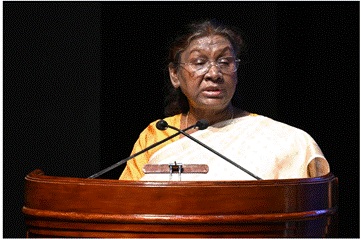
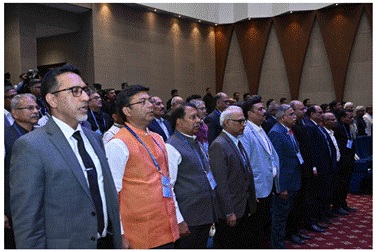
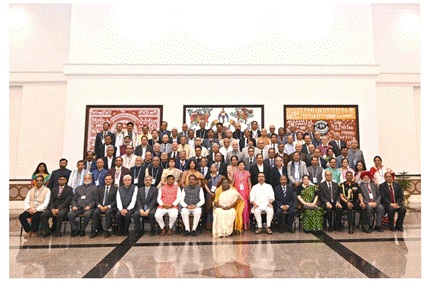
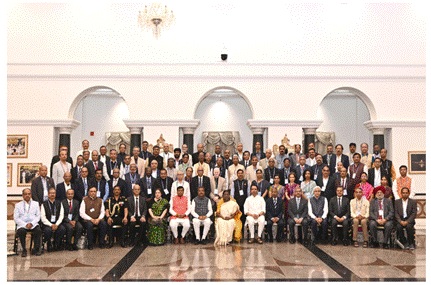
The President of India, Smt Droupadi Murmu inaugurated the two-day Visitor’s Conference 2024-25 at Rashtrapati Bhavan today (March 3, 2025). The President of India is the Visitor of 184 Central Institutes of Higher Education.

In her inaugural address, the President said that the level of development of any country is reflected in the quality of its education system. She told the heads of the institutions of higher learning that they have a crucial role in achieving the goal of establishing India as an important centre of the knowledge economy. She highlighted the need to pay a lot of attention to research along with education. She said that the Government of India has established the National Research Fund with a very good objective. She expressed confidence that institutions of higher learning would make good use of this important initiative and encourage research.

The President said that the ambition of our higher education community should be that researchers from our institutions get recognition at the world level, patents of our institutions can bring change in the world, and students from developed countries choose India as a preferred destination for higher education.

The President said that students from India enrich the world’s leading educational institutions and developed economies with their talent. She emphasised the need of making efforts to utilize their talent in our country. She stated that our national goal of establishing India as a Global Knowledge Super Power would be achieved only when the world community is eager to adopt the work being done in our laboratories.

The President said that many higher education institutions of our country have global brand value. The students of these institutions get big responsibilities in the best institutions and companies of the world. However, all our institutions should move ahead very fast. The leadership of heads of institutions of higher learning would be recognised by developing and utilising the immense talent of our large youth population.

The President said that along with excellence, social inclusion and sensitivity should also be an essential aspect of our education system. No economic, social, or psychological limitation of any kind should be a hindrance in getting higher education. She said that heads and teachers of institutions of higher learning should take care of young students, remove any insecurity from their minds and provide them moral and spiritual strength. She urged them to make every possible effort to provide counselling and inspiration to students and spread positive energy in the campuses.

The President said that our country has a rich tradition of scientific achievements. The branches and sub-branches of Indian knowledge and science have flourished in every region of the country. It would be very useful to rediscover the invaluable but extinct streams of knowledge and science by doing intense research. She stated that it is the responsibility of the higher education ecosystem to find ways to use such organically grown knowledge systems in today’s context.

The President said that educational institutions shape the future of the nation. Young students learn from the conduct of our policy makers, teachers, heads of institutions, and senior students. She expressed confidence that with their global thinking, the heads of higher learning institutions would prepare a generation of builders of a developed India.

During the inaugural session, the President presented the eighth Visitor’s Awards in the categories of Innovation, Research, and Technology Development.

The Visitor’s Award for Innovation was given to Prof Saripella Srikrishna, Banaras Hindu University, for developing Novel Indigenous Innovation in Quantum Technology to boost the National Green Hydrogen Mission.

The Visitor’s Award for Research in the field of Physical Sciences was conferred upon Prof Ashwini Kumar Nangia, University of Hyderabad, for his seminal research in the discovery and development of high bioavailability drugs and pharmaceuticals with enhanced efficacy at affordable cost.

The Visitor’s Award for Research in Biological Sciences was jointly presented to Prof Rina Chakrabarti, University of Delhi and Prof Raj Kumar, Central University of Punjab. Prof Chakrabarti has been conferred the Award for her research contributions to Sustainable Freshwater Aquaculture while Prof Raj Kumar has been presented the Award for his research contributions to exploring various cancer hallmarks and the development of synthetic anticancer lead molecules.

The Visitor’s Award for Technology Development was presented to Dr Venkateswarlu Chintala, Gati Shakti Vishwavidyalaya, for his research contributions to the petrol and diesel production at commercial scale from landfill municipal mixed plastic waste.

Tomorrow, the Conference will deliberate on issues such as – Flexibility in academic courses, Credit Sharing and Credit Transfer with multiple entry and exit options; Internationalisation efforts and collaboration; Translation Research and Innovation related to converting research or innovation into useful products and services; Effective student selection processes and respecting student choices in context of NEP; and Effective assessments and evaluation. The outcome of these deliberations will be presented before the President in the closing session of the Conference.

Shri Dharmendra Pradhan, while presenting the opening remarks, expressed his gratitude to the President, Smt. Droupadi Murmu, for guiding the academic fraternity with constant guidance, steady support, and visionary leadership. He also congratulated all the distinguished recipients of the 8th Visitor’s Awards.

Shri Pradhan mentioned that Smt. Droupadi Murmu’s leadership has always shown the way forward in breaking new ground in education, achieving national educational priorities, navigating the ever-evolving learning landscape, as well as taking significant strides toward making India the epicentre of knowledge, research, and innovation.

He urged the participants of the Conference to share their concerns, discuss best practices, and envision the future of higher education. He also highlighted that NEP 2020 stands at the heart of today’s discussions, a transformative blueprint reshaping the country’s education system.

The Minister urged everyone to create an ecosystem that empowers the youth, strengthens the workforce, and accelerates India’s journey toward Viksit Bharat 2047.

Expressing his gratitude to Prime Minister Shri Narendra Modi for his clarion call of Viksit Bharat by 2047, the Minister said the nation ought to be self-reliant, innovative, and knowledge-driven. Education must go beyond degrees; it must create thinkers, innovators, solution-givers, and job creators, for which the implementation of NEP 2020 in letter and spirit is essential, he noted. He emphasized the importance of rising above institutional silos to ensure that NEP 2020 translates into real and long-lasting impact.

He stressed the importance of working collaboratively and sharing best practices to optimize academic strength, strengthen policies, and execute them well with a real impact on the ground.

Showing his optimism, he said that academic institutions will emerge as the lighthouse of Viksit Bharat, anchoring the developmental journey in the Amrit Kaal and beyond. He also expressed confidence that the Visitor’s Conference will provide a clear roadmap for holistically transforming the education system, empowering the youth, strengthening the workforce, and establishing India’s higher education ecosystem as a global benchmark.

Please click here to see the President’s Speech: https://static.pib.gov.in/WriteReadData/specificdocs/documents/2025/mar/doc202533511401.pdf

*****

Discipline in the Indian Education System

By Shashikant N Sharma

In education, discipline refers to the rules and practices that help students learn and grow in a safe environment. It helps students stay organized and focused, and can help them develop good study habits. 

Daily writing prompt
Describe the most ambitious DIY project you’ve ever taken on.

Discipline is a crucial component of the Indian education system, shaping the moral, ethical, and academic foundation of students. It is not just about maintaining order but also about instilling values such as responsibility, respect, and self-regulation. The Indian education system, rooted in ancient traditions and evolving through modern reforms, has always emphasized discipline in various forms.

1. Historical Perspective on Discipline in Indian Education

a. Ancient Gurukul System

  • The Gurukul system was the earliest form of education in India, where students (shishyas) lived with their teachers (gurus) in an ashram.
  • Discipline was strictly maintained through rules that emphasized obedience, humility, and rigorous academic and physical training.
  • Punishments were minimal as self-discipline was encouraged through spiritual learning and practical wisdom.

b. Colonial Influence on Discipline

  • The British education system introduced structured discipline in schools through strict rules, uniforms, and punishments.
  • Corporal punishment was common, and the system focused more on rote learning and obedience rather than creativity and critical thinking.

c. Post-Independence Reforms

  • After independence, India adopted a more balanced approach, incorporating discipline with democratic values.
  • Policies promoted student-friendly environments while maintaining classroom order and respect for authority.

2. Forms of Discipline in Indian Schools and Colleges

a. Self-Discipline

  • Encouraged from an early age, students are taught to take responsibility for their actions.
  • Morning assemblies, yoga, meditation, and moral education help in self-discipline.

b. Institutional Discipline

  • Schools and colleges follow strict codes of conduct regarding attendance, uniforms, behavior, and academic performance.
  • Rules are set to ensure order, such as punctuality, respect for teachers, and adherence to dress codes.

c. Teacher-Imposed Discipline

  • Teachers play a major role in enforcing discipline through classroom management and behavioral guidance.
  • Positive reinforcement, mentorship, and counseling are increasingly replacing traditional punitive methods.

d. Parental and Societal Influence

  • Indian parents place significant emphasis on discipline, ensuring that children follow rules at school and home.
  • Society also plays a role in shaping student behavior through cultural expectations and moral upbringing.

3. Role of Discipline in the Indian Education System

a. Academic Excellence

  • A disciplined environment ensures that students focus on studies, complete assignments on time, and respect deadlines.
  • Punctuality and time management are key aspects of academic discipline.

b. Character Development

  • Discipline instills values like honesty, responsibility, and perseverance.
  • It prepares students to face real-world challenges with resilience and determination.

c. Social Harmony

  • Schools promote discipline to foster mutual respect, teamwork, and cooperation among students from diverse backgrounds.
  • It helps in reducing conflicts and promoting a peaceful learning atmosphere.

d. Preparation for Professional Life

  • The disciplined environment of educational institutions prepares students for the workforce, where punctuality, work ethics, and responsibility are essential.

4. Challenges in Maintaining Discipline

a. Changing Societal Norms

  • The influence of social media and digital platforms has impacted traditional discipline methods.
  • Students are more independent but also more prone to distractions and indiscipline.

b. Issues of Corporal Punishment

  • Though banned, corporal punishment still exists in some schools, leading to psychological stress among students.
  • The focus is now shifting toward counseling and positive discipline strategies.

c. Parental Overindulgence

  • Some parents are overprotective, interfering in school disciplinary actions and making it difficult for institutions to enforce rules.

d. Teacher Shortages and Workload

  • Overburdened teachers struggle to maintain discipline effectively while handling large class sizes.

5. Modern Approaches to Discipline in Education

a. Positive Discipline Strategies

  • Encouraging students through rewards and appreciation rather than punishments.
  • Engaging students in decision-making to develop accountability.

b. Digital Monitoring and AI-Based Discipline

  • Schools use digital attendance, CCTV cameras, and AI-driven behavior monitoring to track and enforce discipline.

c. Student Counseling and Emotional Support

  • Schools and colleges now focus on mental health and counseling to address behavioral issues rather than harsh disciplinary measures.

d. Legal Framework for Student Discipline

  • The Right to Education (RTE) Act, 2009, and guidelines from CBSE, ICSE, and UGC ensure that discipline policies align with child rights and ethical standards.

6. Conclusion

Discipline in the Indian education system has evolved from rigid control to a more balanced, student-friendly approach. While maintaining order and respect remains essential, modern education policies emphasize holistic development, self-regulation, and psychological well-being. Moving forward, India must continue to balance traditional discipline with progressive, positive reinforcement strategies to create responsible, well-rounded individuals.

References

Amare, G. (1967). Aims and Purposes of Church Educaiton in Ethiopia. The Ethiopian Journal of Education1(1), 1-11.

Adaobi, E. M., & Abigail, O. M. (2021). Effect of problem-based learning on achievement of secondary school computer studies sudents in nnewi educaiton zone. International Journal of Innovative Research and Advanced Studies (IJIRAS)8(6), 93-97.

Harman, G. (2000). Institutional Mergers in Australian Higher education since 1960. Higher Education Quarterly54(4), 343-366.

Cavanagh, D. M. (1985). Teacher Curriculum: A Failed Paradigm of Practise and Proceedure. Australian Journal of Teacher Education10(2), 5.

Ping, H., & Liu, Y. (2010, March). Notice of Retraction: Demonstrative Analysis of Undergraduate Hospitality Management Education in Research-oriented Universities of China and of America. In 2010 Second International Workshop on Education Technology and Computer Science (Vol. 1, pp. 735-738). IEEE.

Yorke, M. (2000). Developing a Quality Culture in Higher Educaiton. Tertiary Education and Management6(1), 19-36.

Leap in Rural School Enrollment

Daily writing prompt
Who are your favorite people to be around?

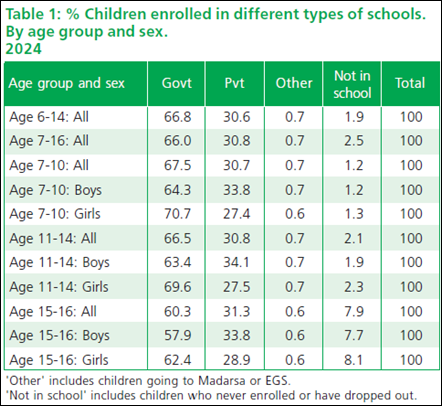
The Annual Status of Education Report (ASER) 2024 is a nationwide rural household survey that reached 649,491 children in 17,997 villages across 605 rural districts in India. Further, ASER surveyors visited 15,728 government schools with primary sections. 8,504 were primary schools and 7,224 were schools which also had upper primary or higher grades.

Photo by Fox on Pexels.com

Key Findings for Pre-primary (age group 3-5 years)

  1. Enrollment in pre-primary institutions
  • Among children aged 3-5 years, enrollment in some type of pre-primary institution (Anganwadi centre, government pre-primary class, or private LKG/UKG) has improved steadily between 2018 and 2024.
  • Among 3-year-olds, enrollment in pre-primary institutions increased from 68.1% in 2018 to 77.4% in 2024GujaratMaharashtraOdisha, and Telangana have achieved near-universal enrollment for this age group.
  • Among 4-year-olds, the all-India figure for enrollment in pre-primary institutions increased from 76% in 2018 to 83.3% in 2024. In 2024, enrollment rates in pre-primary for this age exceed 95% in states like Gujarat, Maharashtra, Karnataka, Tamil Nadu, and Odisha.
  • Among 5-year-olds, this figure also showed big increases, rising from 58.5% in 2018 to 71.4% in 2024. The states with enrollment exceeding 90% in pre-primary institutions for this age include Karnataka, Gujarat, Maharashtra, Kerala, and Nagaland.
  1. Type of pre-primary institution
  • Anganwadi centres continue to be the biggest provider of services in pre-primary age group in India.
  • Approximately one-third of all 5-year-olds attend a private school or pre-school in 2024. This figure was 37.3% in 2018, fell to 30.8% in 2022, and returned to 37.5% in 2024.
  1. Age of entry to Standard (Std) I
  • The proportion of children who are “underage” (age 5 or below) is decreasing over time. In 2018, this figure was 25.6%, in 2022 it stood at 22.7%, and in 2024, nationally the percentage of underage children in Std I was at its lowest ever at 16.7%. On average, this proportion has either declined or remained stable across all states in India.

Key Findings for Elementary (age group 6-14 years)

  1. Enrollment
  • Overall school enrollment rates among the 6-14 age group have exceeded 95% for close to 20 years. This proportion has stayed almost the same, from 98.4% in 2022 to 98.1% in 2024. Across all states, enrollment in this age group is above 95% in 2024.
  • In 2018, 65.5% of children in the 6-14 age group in India were enrolled in government schools. By 2024, the all-India figure increased to 66.8%.
  1. Reading
  • Std III: The percentage of Std III children able to read Std II level text was 20.9% in 2018. This figure increased to 23.4% in 2024. The improvement in government schools is higher than the corresponding recovery for private schools. Following a decline in Std III reading levels in government schools in most states in 2022, all states have shown a recovery in 2024. States with more than a 10-percentage point increase in this proportion between 2022 and 2024 in government schools include Himachal Pradesh, Uttarakhand, Kerala, Uttar Pradesh, Haryana, Odisha, and Maharashtra.
  • Std V: Reading levels improved substantially among Std V children, especially for those who are enrolled in government schools. The proportion of Std V children in government schools who can read a Std II level text fell from 44.2% in 2018 to 38.5% in 2022 and then recovered to 44.8% in 2024. In 2024, Mizoram (64.9%) and Himachal Pradesh (64.8%) had the highest proportions of Std V children in government schools able to read Std II level text. States with over a 10-percentage point increase in this proportion in government schools include Uttarakhand, Uttar Pradesh, Gujarat, and Tamil Nadu.
  • Std VIII: Reading levels increased among children enrolled in Std VIII in government schools, which fell from 69% in 2018 to 66.2% in 2022 but then rose to 67.5% in 2024. Government schools in states such as Gujarat, Uttar Pradesh, and Sikkim show notable improvements.
  1. Arithmetic
  • Std III: The all-India figure for children in Std III who are able to do a numerical subtraction problem was 28.2%. This figure has increased to 33.7% in 2024. Among government school students, this figure went from 20.9% in 2018 to 27.6% in 2024. For private school students, this number showed a smaller improvement since 2022. Government schools across most states have shown gains since 2022, with over 15-percentage point increases recorded in states like Tamil Nadu and Himachal Pradesh.
  • Std V: At the all-India level, the proportion of children in Std V who can do a numerical division problem has also improved. This figure was 27.9% in 2018 and then rose to 30.7% in 2024. This change is also driven mainly by government schools. States with the showing most improvement (more than 10-percentage points) in government schools include Punjab and Uttarakhand.
  • Std VIII: The performance of Std VIII students in basic arithmetic remains similar to earlier levels, going from 44.1% in 2018 to 45.8% in 2024.

Key Findings for Older children (age group 15-16 years)

  1. Enrollment
  • The proportion of 15-16-year-old children who are not enrolled in school dropped sharply from 13.1% in 2018 to 7.9% in 2024 at the all-India level.
  1. Digital literacy
  • Access to smartphones is close to universal among the 14-16 age group. Almost 90% of both girls and boys report having a smartphone at home. More than 80% report knowing how to use a smartphone.
  • Of the children who could use a smartphone, 27% of 14-year-olds and 37.8% of 16-year-olds reported having their own phone.
  • 82.2% of all children in the 14-16 age group reported knowing how to use a smartphone. Of these, 57% reported using it for an educational activity in the preceding week while 76% said that they had used it for social media during the same period. While the use of a smartphone for educational activities was similar among girls and boys, girls were less likely than boys to report using social media (78.8% of boys as compared to 73.4% of girls). Kerala stands out in this respect, with over 80% children who reported that they used the smartphone for educational activity and over 90% using it for social media.
  • Among children who used social media, knowledge of basic ways to protect themselves online was relatively high62% knew how to block or report a profile, 55.2% knew how to make a profile private, and 57.7% knew how to change a password.

Key Findings of School Observations

  1. Foundational Literacy and Numeracy (FLN) activities
  • Over 80% of schools had received a directive from the government to implement Foundational Literacy and Numeracy (FLN) activities with Std I-II/III, both in the previous as well as in the current academic year. A similar proportion had at least one teacher who had received in-person training on FLN.
  • More than 75% schools had received Teaching Learning Material (TLM) and/or funds to make or purchase TLM for FLN activities.
  • More than 75% schools reported implementing a school readiness program for students prior to entering Std I, in both the previous and the current academic year.
  • More than 95% schools reported having distributed textbooks to all grades in the school, a substantial increase over 2022 levels.
  1. Student and teacher attendance
  • Student and teacher attendance in government primary schools show small but consistent improvements since 2018. Average student attendance increased from 72.4% in 2018 to 75.9% in 2024.
  • Average teacher attendance increased from 85.1% in 2018 to 87.5% in 2024. This trend is largely driven by changes in teacher and student attendance in Uttar Pradesh.
  1. Small schools and multigrade classrooms
  • The proportion of government primary schools with less than 60 students enrolled shows a sharp increase, rising from 44% in 2022 to 52.1% in 2024More than 80% primary schools in these states are small schools: Jammu and Kashmir, Himachal Pradesh, Uttarakhand, Nagaland, and Karnataka. Himachal Pradesh has the highest proportion of small Upper primary schools at 75%.
  • Two-thirds of Std I and Std II classrooms in primary schools were multigrade, with students from more than one grade sitting together.
  1. School facilities
  • Nationally, all Right to Education-related indicators included in ASER have shown small improvements between 2018 and 2024 levels. For example, the fraction of schools with useable girls’ toilets increased from 66.4% in 2018 to 72% in 2024.
  • The proportion of schools with drinking water available increased from 74.8% to 77.7%, and the proportion of schools with books other than textbooks being used by students increased from 36.9% to 51.3% over the same period.
  • Sports-related indicators remain at close to the levels observed in 2018. For example, in 2024, 66.2% schools have a playground, similar to 66.5% in 2018.

References

Leap in Rural School Enrollment

*********

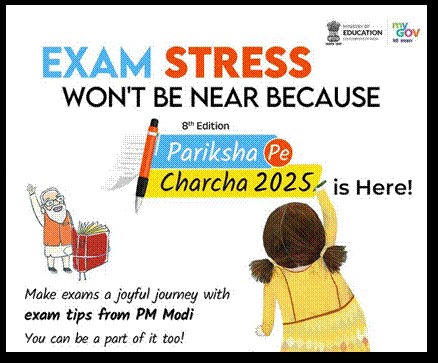
Pariksha Pe Charcha 2025

Daily writing prompt
Tell us about your favorite pair of shoes, and where they’ve taken you.

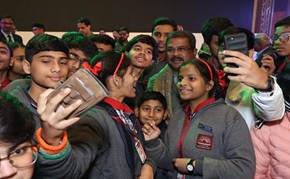
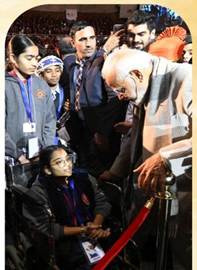
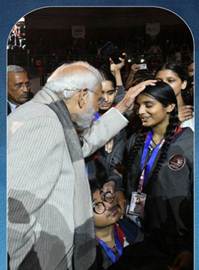
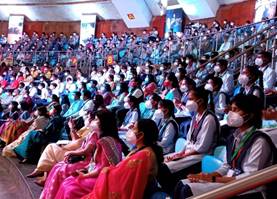
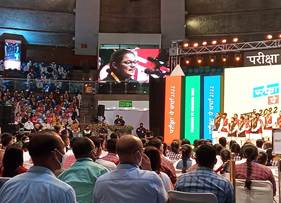
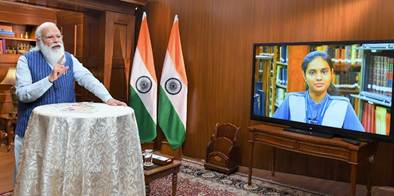
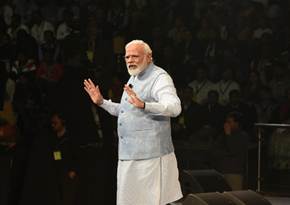
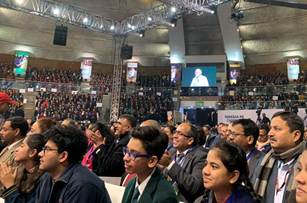
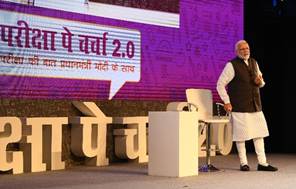
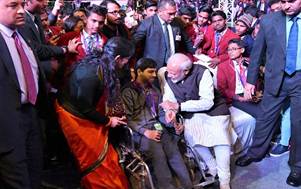
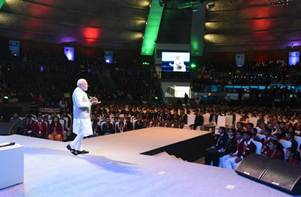
On 10th February 2025, Prime Minister Shri Narendra Modi interacted with students at Sunder Nursery, New Delhi, during the first episode of the 8th edition of Pariksha Pe Charcha (PPC). In this informal yet insightful session, the Prime Minister engaged with students from across the country, discussing a variety of topics. The 36 students present learned from the Prime Minister valuable lessons on Nutrition and Wellness; Mastering Pressure; Challenging Oneself; The Art of Leadership; Beyond Books – 360º Growth; Finding Positives and more. This interactive session provided students with valuable insights and practical strategies to navigate academic challenges with confidence and a growth mind set.

Today, renowned actor and mental health champion Deepika Padukone participated in the second episode of the 8th edition of Pariksha Pe Charcha. Around 60 students attended the interactive session.

Deepika shared how addressing mental health challenges can be empowering and spoke about the valuable lessons she learned from her own struggles. Sharing her stress management strategies, she emphasized the importance of getting enough sleep, spending time outdoors in natural sunlight and fresh air, and maintaining a healthy daily routine to effectively reduce stress. She further emphasized that self-confidence and a positive mind set are key to success. Encouraging students to see failures as learning opportunities, she inspired them to keep moving forward with determination.

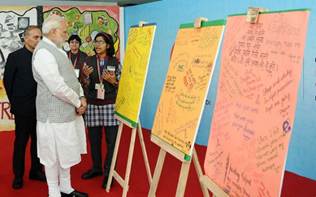
Reiterating Prime Minister Shri Narendra Modi’s message—”Express, Never Suppress”—Deepika stressed the importance of seeking help when needed. She engaged with students in an interactive activity, where they wrote down their strengths and pinned them on a board on the stage, reinforcing the significance of self-awareness and recognizing one’s strengths. She conducted a live grounding session through an activity called 54321, demonstrating a technique to improve concentration during exams.

Students physically present at the program posed their queries, and Deepika responded by drawing from her personal experiences, offering valuable insights and practical advice. Additionally, a student from an international CBSE school also had the opportunity to ask a question, further enriching the discussion with a wider perspective.

The 8th edition of PPC had set a new benchmark. With over 5 crore participation, this year’s program exemplifies its status as a Jan Andolan, inspiring collective celebration of learning. For the episode with the Prime Minister, 36 students from all State and UT were selected from State/UT Board Government schools, Kendriya Vidyalaya, Sainik School, Eklavya Model Residential School, CBSE and Navodaya Vidyalaya. Pariksha Pe Charcha 2025 will feature additional six insightful episodes, bringing together renowned personalities from diverse fields to guide students on essential aspects of life and learning. Each episode will address key themes:

Link to watch the 1st episode: https://www.youtube.com/watch?v=G5UhdwmEEls

Link to watch the 2nd episode: https://www.youtube.com/watch?v=DrW4c_ttmew

*****

Pariksha Pe Charcha -Empowering Students, Transforming Lives

Examinations are often a source of stress for students and their families, but the “Pariksha Pe Charcha” (PPC) initiative by Prime Minister Narendra Modi has been transforming this narrative. Scheduled for 11 AM on February 10, 2025, this year’s PPC will once again serve as an interactive platform where the Prime Minister directly engages with students, teachers, and parents. Each edition of PPC highlights innovative approaches to tackle exam-related anxiety, fostering a celebratory attitude toward learning and life.

The Record-Breaking PPC 2025

The 8th edition of PPC, scheduled on 10 February 2025, has already set a new benchmark. With over 5 crore participation, this year’s program exemplifies its status as a Jan Andolan, inspiring collective celebration of learning This year, 36 students from all State and UT, have been selected from State / UT Board Government schools, Kendriya Vidyalaya, Sainik School, Eklavya Model Residential School, CBSE and Navodaya Vidyalaya. Pariksha Pe Charcha 2025 will feature seven insightful episodes, bringing together renowned personalities from diverse fields to guide students on essential aspects of life and learning. Each episode will address key themes:

  • Sports & Discipline – M.C. Mary Kom, Avani Lekhara, and Suhas Yathiraj will discuss goal setting, resilience, and stress management through discipline.
  • Mental Health – Deepika Padukone will emphasize the importance of emotional well-being and self-expression.
  • Nutrition – Experts Shonali Sabherwal, Rujuta Diwekar, and Revant Himatsingka (Food Farmer) will highlight healthy eating habits, sleep, and overall well-being.
  • Technology & Finance – Gaurav Chaudhary (Technical Guruji) and Radhika Gupta will explore technology as a learning tool and financial literacy.
  • Creativity & Positivity – Vikrant Massey and Bhumi Pednekar will inspire students to cultivate positivity and manage negative thoughts.
  • Mindfulness & Mental Peace – Sadhguru will introduce practical mindfulness techniques for mental clarity and focus.
  • Stories of Success – Toppers from UPSC, IIT-JEE, CLAT, CBSE, NDA, ICSE, and past PPC participants will share how PPC shaped their preparation and mindset.

A Journey Through the Years

 2024: Nationwide participation.

The seventh edition of PPC, held on January 29, 2024, was expansive with 2.26 crore registrations on the MyGov portal, it reflects the program’s immense popularity and relevance. For the first time, 100 students from Eklavya Model Residential Schools (EMRS) participated, symbolizing the inclusivity of the initiative. The event was held in a town-hall format at Bharat Mandapam, ITPO, Pragati Maidan, New Delhi, with approximately 3,000 participants, including students, teachers, parents, and winners of the Kala Utsav.

Pariksha Par Charcha 2024

2023: Widening Participation 

The 6th Edition of PPC was conducted on 27 January 2023 at Talkatora Stadium, New Delhi. Hon’ble Prime Minister of India interacted with students, teachers and parents during this programme and gave his valuable suggestions/ inputs to all stakeholders. The programme was telecast live by many TV Channels and YouTube channels. 718110 students, 42337 employees and 88544 Parents viewed the live programme of PPC-2023. The interaction of the Hon’ble Prime Minister of India with students, teachers and parents was inspiring, motivating thought-provoking for all.

Pariksha Par Charcha 2023

2022: The Revival of Physical Interactions

5th Edition of PPC was conducted on 1st April 2022 at Talkatora Stadium, New Delhi. Hon’ble Prime Minister of India has interacted with students, teachers and parents in this programme and has given them his valuable suggestions/ inputs. 9,69,836 students, 47,200 employee and 1,86,517 parents viewed the live programme of Pariksha Pe Charcha-2022. The programme was telecast live by the many TV Channels and YouTube channel etc

Pariksha Par Charcha 2022

2021: The Virtual Connection

In response to the COVID-19 pandemic, the fourth edition of PPC was held online on 7 April 2021. Despite the challenges posed by the pandemic, the interaction continued to inspire students and their families. The focus shifted to resilience and adaptability, teaching life skills to help students navigate uncertain times.

Pariksha Par Charcha 2021

2020: Expanding Participation

The unique Town Hall format of the event in which the Hon’ble Prime Minister directly interacted with school students at the Talkatora Stadium, New Delhi was held on 20th January, 2020.  The event broadened its scope with an online competition for students that received  2.63 lakh entries. Students from all over India and also Indian students residing abroad from 25 countries participated. The event highlighted the need to embrace challenges as stepping stones for success.

Pariksha Par Charcha 2020

2019: Growing Reach 

On January 29, 2019, the second edition of PPC took place at the same venue, witnessing an even greater level of participation. The interaction, which lasted for over ninety minutes, saw students, teachers and parents relax, laugh, and repeatedly applaud the Prime Minister’s observations, which included a touch of humour and wit.

Pariksha Par Charcha 2019

2018: The Inaugural Interaction

The first-ever Pariksha Pe Charcha was held on February 16, 2018, at Talkatora Stadium, New Delhi. There were more than 2500 students from schools and colleges who were present in Talkatora Stadium of 16th February, 2018 for the interaction and more than 8.5 Crore students from across the country viewed or heard the programme on DD/TV Channels/ Radio Channels. The Prime Minister emphasized holistic development, resilience, and the importance of maintaining balance during exams. The event’s success set the tone for future editions.

Pariksha Par Charcha 2018

The Impact of Pariksha Pe Charcha

Over the years, PPC has evolved into an opportunity aimed at transforming exam-related stress into positive energy. By addressing real questions and offering actionable solutions, Prime Minister Modi has bridged the gap between policy and practice, empowering students to thrive under pressure. The program’s inclusivity, digital reach, and innovative approaches ensure its continued success as a cornerstone of student engagement in India. With each passing year, PPC reinforces the message that exams are not the end but a beginning!

References

Annual report 2023-24 to 2018-19. https://www.education.gov.in/documents_reports?field_documents_reports_tid=All&field_documents_reports_category_tid=All&title=&page=1

Click here to download PDF

*****

Daily writing prompt
What were your parents doing at your age?

Pariksha Pe Charcha 2025

Daily writing prompt
Write about your first computer.

Pariksha Pe Charcha (PPC), an initiative by Prime Minister Shri Narendra Modi to transform exam-related stress into a festival of learning, witnessed unprecedented growth in its 8th edition.  Pariksha Pe Charcha (PPC), an initiative by Prime Minister Shri Narendra Modi to transform exam-related stress into a festival of learning, witnessed unprecedented growth in its 8th edition. Since its beginning in 2018, PPC has evolved into a nationwide movement, garnering a staggering 3.56 crore registrations for its 8th edition in 2025. This also marks a significant increase from the 7th edition, which saw 2.26 crore registrations, reflecting a remarkable surge of 1.3 crore registrations.

Pariksha Pe Charcha has not only become a popular program but has also transformed into a “Jan Andolan” (people’s movement), resonating deeply with students, teachers, and parents across the country. The initiative’s focus on addressing exam stress and encouraging students to view examinations as a festival – “Utsav” – has struck a chord with people from all walks of life. The overwhelming participation in PPC reflects a growing awareness and acceptance of the importance of mental well-being and holistic education. The program’s interactive format, which involves open dialogue between students, teachers, and the Prime Minister, has further contributed to its success.

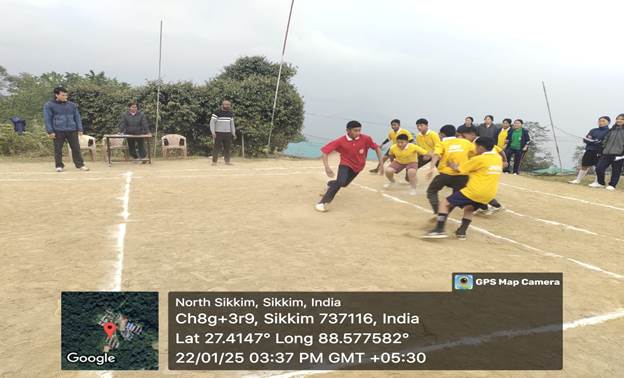
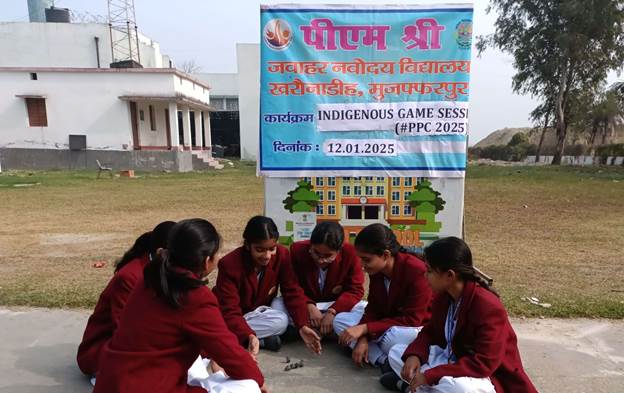
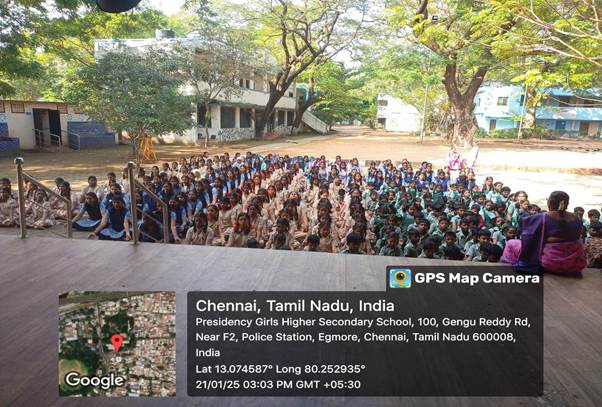
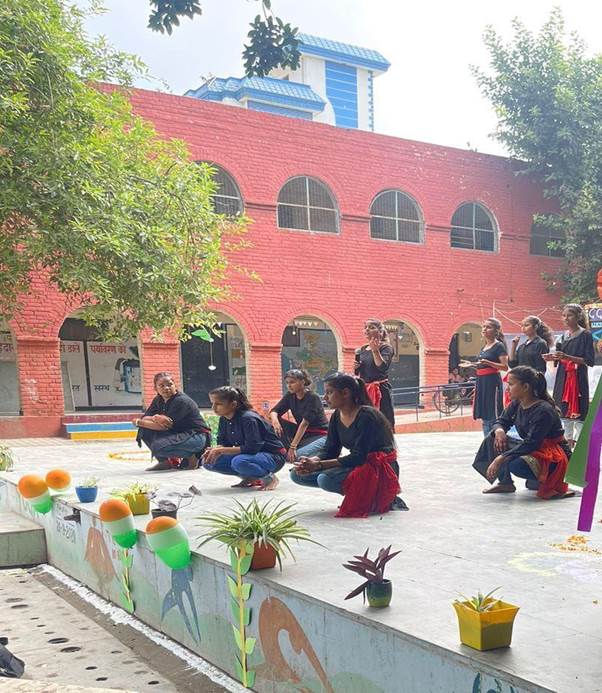
To further strengthen PPC as a “Jan Andolan,” a series of engaging activities were conducted from 12th January 2025 (National Youth Day) to 23rd January 2025 (Netaji Subhash Chandra Bose Jayanti) at the school level. These activities, conducted across States/UTs, aimed to engage students, parents, and teachers in celebrating PPC as a festival. A total of 1.42 crore students, 12.81 lakh teachers, and 2.94 lakh schools participated. These activities were designed to reduce stress, improve focus, and enhance performance during exams and beyond. Students were encouraged to participate in a diverse range of activities, including indigenous games like Kho-Kho and Kabaddi, short-distance marathons, creative meme competitions, engaging Nukkad Natak performances, and eye-catching poster-making. They were also encouraged to share their experiences through student testimonials, participate in student-led discussions, and engage in yoga and meditation sessions to cultivate relaxation and mindfulness. Schools organized plays developed by students, conducted workshops, and invited special guests to share their insights.

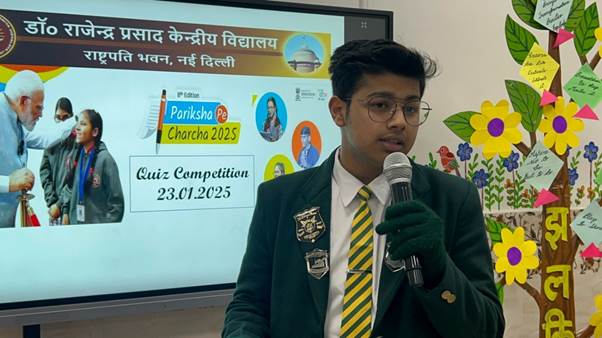
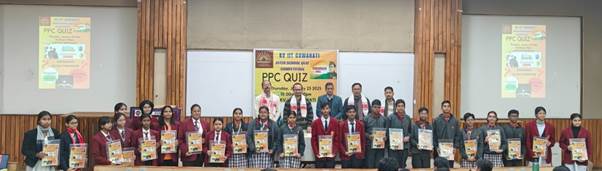
Culminating these activities, screening of glorious inspirational stories of valour and sacrifice, the “Bharat Hai Hum” series was conducted on 23rd January 2025. Thereafter, a quiz competition based on the series “Bharat Hai Hum” was conducted across 567 Kendriya Vidyalayas nationwide. A total of 55,961 students participated, including 17,408 from Kendriya Vidyalayas, 4,567 from Jawahar Navodaya Vidyalayas, 5,542 from PM SHRI Schools, 18,394 from CBSE-affiliated schools, and 10,050 from State Board schools. Prizes were awarded to the winners, and all participants received a copy of the book “Exam Warriors,” authored by the Prime Minister of India. This initiative not only tested the students’ knowledge but also reinforced the valuable lessons imparted through the “Bharat Hain Hum” series.

Pariksha Pe Charcha 2025 has once again proven to be a resounding success, solidifying its position as a pivotal initiative in fostering a positive and supportive learning environment for students across India.

*****

Grand Finale of National School Band Competition 6.0 starts at Major Dhyan Chand National Stadium

Daily writing prompt
Describe your most ideal day from beginning to end.

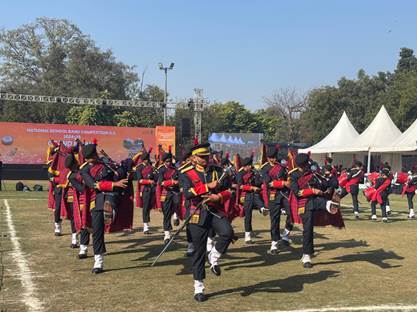
The Grand Finale of the National School Band Competition 6.0 was inaugurated today at the Major Dhyan Chand National Stadium, New Delhi. Secretary, Department of School Education and Literacy (DoSEL), Ministry of Education, Shri Sanjay Kumar; Defence Secretary, Shri Rajesh Kumar Singh; Additional Secretaries, DoSEL, Shri Anil Kumar Singhal and Shri Anandrao V. Patil; Chairperson, CBSE, Shri Rahul Singh; Commissioner, Kendriya Vidyalaya Sangathan, Smt. Nidhi Pandey; Joint Secretary, DoSEL, Dr. Amarpreet Duggal; Joint Secretary, Ministry of Defence, Shri Amitabh Prasad, and other officials of Ministry of Education and Ministry of Defence were present at the event.

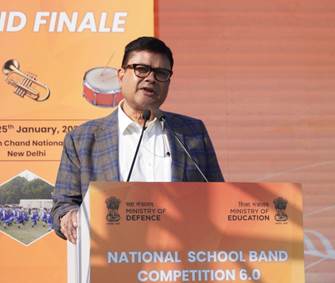
Shri Sanjay Kumar, in his address, highlighted the significant importance of a band, particularly in fostering a sense of discipline and teamwork among participants, which nurtures a collective spirit to excel. He further emphasized the relevance of this collective spirit in educational pursuits. He noted that more schools would join the Band System, with support from the Army Regional Centres, opening new opportunities for children. Shri Sanjay Kumar also expressed his heartfelt gratitude to the Ministry of Defence for their invaluable support and assistance.

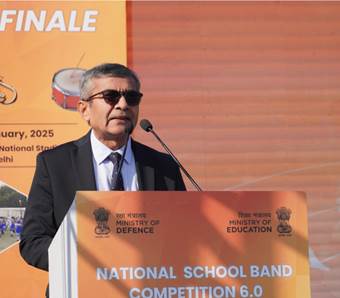
Shri Rajesh Kumar Singh, while addressing the gathering, highlighted the rich tradition of military music in the Armed Forces, which boosts morale, adds dignity to ceremonies, and provides talented individuals with an opportunity to showcase their prowess. He also mentioned how, since 2023, the Government has been involving and encouraging talented school children to actively participate in the Republic Day celebrations. The objective of organizing the National School Band Competition, he added, is to inspire a sense of unity, esprit de corps, and a profound feeling of belonging among school children towards their schools and the nation.

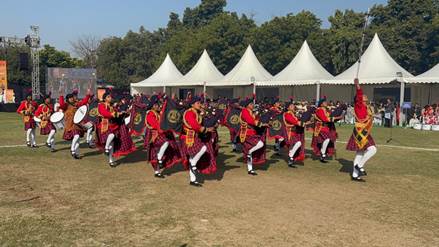
Ministry of Education, in collaboration with the Ministry of Defence, is organising the grand finale of National School Band Competition 6.0 on 24-25 January 2025 at Major Dhyan Chand National Stadium, New Delhi. This year 16 band teams from 13 States with 463 children have been shortlisted for the finale (list annexed) through State- and Zonal-level competitions. At the State-Level Competitions, 568 teams comprising 13,999 children participated; while at the Zonal Level, 84 teams comprising 2,337 children took part.

For the first time:

1.   Band Teams from three government schools have got the opportunity to participate in the Republic Day Parade.

2.   PM SHRI KGBV Patamda, Purbi Singhbum, Jharkhand school students will be giving their performance at the rostrum in front of the Presidential stage.

3.   Two band teams (Kendriya Vidyalaya and Government Sr. Sec. School West Point, Sikkim) will be performing at Vijay Chowk in the Republic Day Parade.

4.   In tandem with the “whole of Government approach”, initiative has been taken for training of PM SHRI school band teams by the band instructors/teams of Army Regimental Centres. Training has begun in 11 States/UTs and will commence shortly in the rest of the States/UTs. This is a step towards imparting holistic education to students of PM SHRI schools and developing them into well-rounded personalities.

The National Education Policy 2020 is the first education policy of the 21st century and aims at large-scale transformational reforms in the education sector. In that direction, this program will not only instil a sense of patriotism and national pride but will also enhance the musical skills of the students and inculcate discipline among them. This initiative aims to rejuvenate the spirit of patriotism and unity amongst school students throughout the country and help in the furtherance of holistic education.

List of Participating Teams at the Grand Finale

Sl. No.State/UTNo. of SchoolsName and Address of the SchoolCategory
BandBoys/Girls
 Andhra Pradesh1Monte CBSE School Kurnool, Pandipadu Village, Kallur Mandal-Kurnool, Andhra PradeshPipeGirls
 Chhattisgarh1St. Xavier’s English Medium School, Pathalgaon, ChhattisgarhBrassBoys
 Himachal Pradesh1Pinegrove School, Kuthar Road, Subathu, Distt. Solan, Himachal PradeshBrassBoys
 Jharkhand1PM Shri KGBV Patamda, Purbi Singhbhum, JharkhandPipeGirls
 Karnataka1PM SHRI Kendriya Vidyalaya No.2 Belagavi Cantt, KarnatakaPipeBoys
 Kerala1St Joseph’s Anglo Indian Girl’s Higher Secondary School, Kozhikode, KeralaBrassGirls
 Madhya Pradesh1St. Joseph’s Convent Sr. Sec. School, Edgah hills, Bhopal, Madhya PradeshBrassGirls
 Maharashtra2Bhonsala Military School Girls, Nasik, MaharashtraPipeGirls
RBP Military School Sports Academy Sangli, MaharashtraPipeBoys
 Rajasthan1Prince Lotus Valley Sikar, RajasthanBrassBoys
 Sikkim2Government Sr. Sec. School West Point, Gangtok, East Sikkim, SikkimBrassGirls
North Sikkim Academy, Nangan (private CBSE affiliated), North Sikkim, SikkimPipeBoys
 Tripura1St. Xaviers Higher Secondary School, Pathaliyaghat, Sepahijala, TripuraBrassBoys
 Uttarakhand1Gayatri Vidyapeeth, Shantikunj, Haridwar, UttarakhandBrassGirls
 Uttar Pradesh2Shri Thakurdwara Balika Vidyalaya, Hapur Mod Tiraha, G.T Road, Ghaziabad, Uttar PradeshPipeGirls
City Montessori School, Kanpur Road Campus, Sec – D LDA Colony Kanpur Road, Lucknow, Uttar PradeshPipeBoys
Total13States / UTs16   

*****

UGC (Minimum Qualifications for Appointment & Promotion of Teachers and Academic Staff in Universities and Colleges and Measures for Maintenance of Standards in Higher Education) Regulations, 2025

Daily writing prompt
Write about a few of your favorite family traditions.

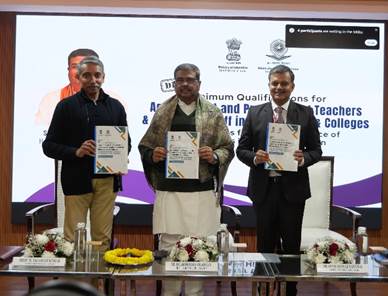
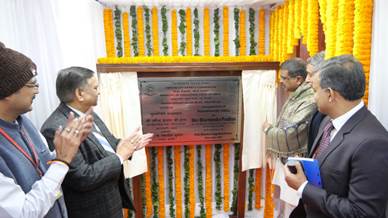
Union Minister for Education, Shri Dharmendra Pradhan, released the draft UGC (Minimum Qualifications for Appointment & Promotion of Teachers and Academic Staff in Universities and Colleges and Measures for the Maintenance of Standards in Higher Education) Regulations, 2025, today in New Delhi. He also inaugurated ‘Pushpagiri’, the new auditorium of UGC. Shri Sunil Kumar Barnwal, Additional Secretary, Ministry of Education; Prof. M. Jagadesh Kumar, Chairman, UGC; heads of the institutions, academicians, officials of the Ministry and other dignitaries were also present at the event.

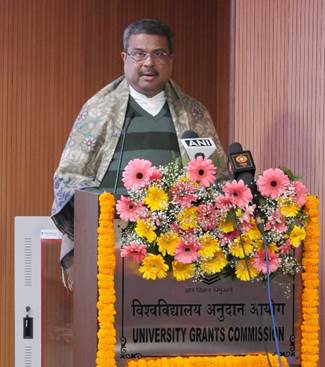
Shri Dharmendra Pradhan, while addressing the audiences said that these draft reforms and guidelines will infuse innovation, inclusivity, flexibility and dynamism in every aspect of higher education, empower teachers and academic staff, strengthen academic standards and pave the way for achieving educational excellence. He congratulated the team of UGC for their efforts in formulating the Draft Regulations and Guidelines in sync with the ethos of NEP 2020.

The Minister mentioned that the Draft Regulations, 2025, have been placed in the public domain for feedback, suggestions, and consultations. He expressed confidence that the UGC will soon publish the Draft Regulations, 2025, in their final form, driving transformations in the education system and propelling the country towards Viksit Bharat 2047 through quality education and research.

Shri Pradhan also complimented the UGC for honouring the unparalleled intellectual heritage of Odisha by naming their newly constructed auditorium ‘Pushpagiri.’ He noted that it is a matter of great pride and personal delight for him. He highlighted how Pushpagiri in Jajpur, Odisha, was a cradle of knowledge and a symbol of enlightenment. He commended the UGC for this laudable step in reappropriating Bharat’s intellectual heritage and values in the 21st century. Additionally, he expressed hope that this state-of-the-art auditorium would emerge as a hub for vibrant intellectual discourses, shaping bright futures.

Shri Sunil Kumar Barnwal, in his address, said that these regulations will significantly enhance the quality of teaching and learning in the higher education institutions. He also mentioned how the Ministry is committed to supporting their effective implementation across the country.

About the Regulations

The Draft UGC (Minimum Qualifications for Appointment & Promotion of Teachers and Academic Staff in Universities and Colleges and Measures for the Maintenance of Standards in Higher Education) Regulations, 2025 will give flexibility to universities in appointing & promoting teachers and academic staff in their institutions.

The draft regulations and guidelines are available for public consultation, inviting comments, suggestions and feedback from stakeholders at:

Draft Regulations: https://www.ugc.gov.in/pdfnews/3045759_Draft-Regulation-Minimum-Qualifications-for-Appointment-and-Promotion-of-Teachers-and-Academic-Staff-in-Universities-and-Colleges-and-Measures-for-the-Maintenance-of-Standards-in-HE-Regulations-2025.pdf

Key Highlights of the Regulations

•     Flexibility: Candidates can pursue teaching careers in subjects they qualify for with NET/SET, even if different from their previous degrees. Ph.D. specialisation will be prioritised.

•     Promoting Indian Languages: The draft Regulations encourage the use of Indian languages in academic publications and degree programmes.

•     Holistic Evaluation: It aims to eliminate score-based short-listing, focusing on a broader range of qualifications, including “Notable Contributions.”

•     Diverse Talent Pool: Creates dedicated recruitment pathways for experts in arts, sports, and traditional disciplines.

•     Inclusivity: Provides opportunities for accomplished sportspersons, including those with disabilities, to enter the teaching profession.

•     Enhanced Governance: Revises the selection process for Vice-Chancellors with expanded eligibility criteria with transparency.

•     Simplified Promotion Process: Streamlines the criteria for promotions, emphasising teaching, research output, and academic contributions.

•     Focus on Professional Development: Encourages continuous learning and skill enhancement for teachers through faculty development programs.

•     Enhanced Transparency and Accountability: Promotes transparent processes for recruitment, promotion, and addressing grievances.

*****

APAAR ID Card, The One Nation One Student ID 2025

Daily writing prompt
What do you enjoy doing most in your leisure time?

APAAR ID Card, the One Nation One Student ID: The Ministry of Education in conjunction with the Government of India has introduced the APAAR ID program, which stands for “One Nation One Student ID Card.” This initiative is set to greatly benefit students by digitally consolidating their complete academic records, including degrees, scholarships, rewards, and other credits into a unified APAAR ID. If you have enrolled in a school or college, you will need to complete the One Nation One ID Registration at abc.gov.in and then access your APAAR ID in PDF format from the official website. This program is open to all students, allowing them to participate and complete their ABC Bank Registration on the official website.

In this article, we provide comprehensive information about the advantages of the ABC Card and include  from abc.gov.in. It is important to obtain your One Nation One ID Card using this provided link, as it grants you access to a variety of benefits offered by the card. By pursuing different courses and developing skills, you can accumulate various rewards and credits through the ABC Card program.

The One Nation One Student ID, APAAR ID Card, is a significant step towards a more organized and accessible academic experience for students in India. By registering and downloading your APAAR ID Card, you can unlock various benefits and conveniently store your academic records. With thousands of institutes and millions of students already benefiting from this program, it’s a promising development in the education sector.

APAAR ID Card 2025: One Nation One Student ID Overview

SchemeAPAAR ID Card : One Nation One Student ID
Full form of APAAR IDAutomated Permanent Academic Account Registry
AuthorityMinistry of Education and Government of India
Portal NameABC Bank
BeneficiariesStudents in India
Purpose of the SchemeStudent Mobility, Academic Flexibility, Unified Student ID and Easy Transfers
Total Registered Students2 Crore + Students
How to RegisterUsing Mobile Number
Details RequiredAadhar Card Number, Mobile Number, University Name

Apaar Id Full Form

APAAR ID stands for Automated Permanent Academic Account Registry. This system aims to create a unique and permanent identification number for every student in India, storing their academic records securely and digitally. While online applications aren’t yet available, it’s important to be aware of the initiative and its future developments.

Use of APAAR ID for students, parents and schools

  1. APAAR ID will be unique nature and will work as One Nation, One Student ID giving identify to students across all use purpose and will be easy for transfer of students from one school to other school, state etc.
  2. It will empower students with their own ID.
  3. This unique ID will be lifelong and help in accessing the educational resources too.
  4. APAAR ID will be useful for tracking educational progress and achievement of students;
  5. APAAR ID will be useful for monitoring the dropout students and mainstreaming them.
  6. APAAR ID will be gateway for accessing Digilocker ecosystem which will store digitally all achievements of students like exam results, holistic report card, health card, learning outcomes besides other achievements of students be it OLYMPIAD, Sports, Skill training or any field.
  7. Students can use the credit score for their higher education or employment purpose in future.
  8. APAAR ID will also be used for multiple use cases e.g., Entrance tests conducted by NTA, admissions, Scholarship disbursement, transfer of government benefit, issue of awards, recognition etc for students, teachers and other users.

APAAR ID Card Key Features

  1. Preserving student achievements
  2. Streamlines credit recognition
  3. Enhance educational flexibility
  4. Credit transfer across institutions

APAAR ID Card Registration Form

  • Government Initiatives: Explore how the Government of India and the Ministry of Education continue to introduce initiatives that benefit citizens.
  • Registration Process: Understand the significance of completing the APAAR ID registration and how to download the APAAR ID card for use.

APAAR ID Card Apply Online

There are two main ways to apply for an APAAR ID Card online:

1. Through the Academic Bank of Credits (ABC) website:

Here’s the step-by-step process:

  • Visit the ABC website: https://www.abc.gov.in/
  • Choose “My Account” and then “Student.”
  • If you don’t have a DigiLocker account:
    • Click “Sign up” and enter your mobile number, address, and Aadhaar card details.
    • Agree to share your Aadhaar details with ABC for KYC verification.
  • If you have a DigiLocker account:
    • Log in using your credentials.
    • DigiLocker will ask for your consent to share your Aadhaar card details with ABC. Select “I agree.”
  • Enter your academic details: school/university name, class, course name, etc.
  • Submit the form.
  • Your APAAR ID card will be generated.

2. Through DigiLocker:

  • Open your DigiLocker account.
  • Search for “Education” in the categories.
  • Select “Academic Bank of Credits” service.
  • Choose “Create APAAR/ABC ID.”
  • Select your University and click “Generate APAAR/ABC ID.”
  • Your ID will be displayed. You can download it.

How to Download the ABC Card PDF

We have some exciting news to share with you! The Academic Bank of Credits, which was talked about in the National Education Policy (NEP), has been launched.

With this special portal, all students can sign up and enjoy the benefits of the ABC Card.

Here’s how to get your ABC Card PDF:

  1. Follow the steps outlined in the ABC Card PDF Download Process.
  2. After you’ve downloaded the APAAR Card PDF @ abc.gov.in, take a moment to check the details on it. Make sure your Name, APAAR ID, QR Code, and other information are correct.
  3. Right now, thousands of schools and two crore (20 million) students have already signed up online for the ABC Card or APAAR ID Card. It’s a big deal!

APAAR ID Card: One Nation One ID Card Registration

We want to let you know that the ABC Bank registration through Digilocker is currently open, and we encourage all students to complete it to enjoy the benefits.

Here’s how to do it:

  1. Use Digilocker to open an ABC Bank Account. You can then access your APAAR Card using your Mobile Number.
  2. Provide your University Name, Academic Qualifications, and other required details.
  3. Submit the form, and your APAAR Card will be generated.
  4. Your ABC Card will be available online for you to download. You can use it for various services.
  5. As an ABC Card Holder or APAAR Card user, you can also enjoy discounts and special offers available to students.

Instructions for Online APAAR ID Registration @ abc.gov.in

To complete your APAAR ID registration online at abc.gov.in, follow the steps below:

  1. Visit the website mentioned above and wait for the homepage to load.
  2. Click on the “Login” option and then select the “Signup” button.
  3. Provide your Mobile Number and Aadhar Card Number to complete the registration process.
  4. Next, choose your School or University and specify your Class or Course.
  5. Submit the registration form, and your APAAR ID Card will be generated.
  6. Download the card online and utilize it to access and manage your academic credits.

ABC ID Card Overview

The ABC ID Card, also known as APAAR ID, is a digital document issued by the Academic Bank of Credits (ABC) in India. It acts as a unique identifier for students, storing and managing their academic information in a central location. Here’s a quick overview:
Purpose:

  • Serves as a digital record for students’ academic achievements, including:
    • Degrees
    • Diplomas
    • Certificates
    • Training details
    • Co-curricular accomplishments
  • Functions as a link to DigiLocker, a secure online document storage platform.
  • Streamlines the verification process for admissions or job applications by providing easy access to academic credentials.

Benefits:

  • Enhances student mobility: Enables seamless transfer of credits between or within higher education institutions.
  • Promotes flexibility: Allows students to pursue courses from various institutions and build their qualifications at their own pace.
  • Simplifies record management: Eliminates the need for physical documents and ensures secure storage of academic records.

Key Points:

  • Each student receives a unique 12-digit ID.
  • Information is stored in digital format on the ABC platform.
  • Students can access and manage their records through the user-friendly interface.

APAAR ID Card: One Nation One Student ID FAQ

Automated Permanent Academic Account Registry (APAAR) ID has sparked significant interest and raised numerous questions. This FAQ aims to address common queries regarding the APAAR ID, also known as “One Nation, One Student ID,” and provide a clear understanding of its purpose and implementation.

Q1: What is the APAAR ID, and why is it significant?
A. The APAAR ID, or Automated Permanent Academic Account Registry ID, is a unique identification number assigned to students across India. It is part of the “One Nation, One Student ID” initiative under the National Education Policy (NEP) 2020. The APAAR ID is significant because it provides a lifelong identifier for students to track their educational journey and achievements, from pre-primary to higher education.

Q2: How does the APAAR ID work?
A. The APAAR ID is a unique alphanumeric code linked to an individual student. It will be used to centralize and maintain a record of the student’s academic achievements, certificates, and other educational data throughout their academic career.

Q3: Is the APAAR ID linked to Aadhaar?
A. Yes, the APAAR ID will be linked to the student’s Aadhaar ID, which is a unique identification number issued by the Indian government. However, it’s important to note that the APAAR ID does not replace the Aadhaar ID but complements it for educational tracking purposes.

Q4: Who will be assigned an APAAR ID, and what is the process for obtaining one?
A. All students in both private and government schools will be assigned an APAAR ID. The process for obtaining an APAAR ID involves consent from parents. Schools will seek consent from parents before creating an APAAR ID for their child. Parents can choose to withdraw their consent at any time.

Q5: What information will be included in the APAAR ID?
A. The APAAR ID will include a variety of academic data, including information about the student’s educational journey, achievements, certificates, and other relevant details. It may also include additional information such as the student’s blood group, height, and weight.

Q6: When will the APAAR ID be implemented, and is it mandatory for all students?
A. The implementation of the APAAR ID is an ongoing process. State education departments have directed educational institutions to conduct meetings between teachers and parents to discuss the importance and relevance of the APAAR ID. While it is being actively encouraged, participation is not always mandatory, and parents have the choice to provide consent for their child’s APAAR ID.

Q7: How can parents and students ensure the security of their data linked to the APAAR ID?
A. The government has assured that student data linked to the APAAR ID will remain confidential and will only be shared with government agencies when deemed necessary. Parents and students should be vigilant about how their data is handled and ensure it is used solely for educational purposes as intended.

Q8: Can students or parents access and update information linked to the APAAR ID?
A. Students and parents may have the option to access and update certain information linked to the APAAR ID, but this will depend on the specific policies and systems in place at the educational institutions and government agencies handling the APAAR ID.

Q9: How will the APAAR ID benefit students and the education system?
A. The APAAR ID is expected to benefit students by providing a unified record of their academic journey, making it easier to access and share educational credentials and achievements. For the education system, it streamlines the management of student data and can assist in assessing educational progress and needs more efficiently.

Q10: Are there any concerns or criticisms regarding the APAAR ID?
A. While the APAAR ID initiative has garnered support, it has also raised concerns about data privacy, consent, and the potential for misuse of student data. Some individuals and organizations have raised questions about the implementation and the need for clear policies to protect student information.

What is Personal Education Number (PEN)

Daily writing prompt
What do you enjoy doing most in your leisure time?

Personal Education Number

Pen-Title

A child starts its learning journey from a play school followed by primary, secondary, any other higher/professional or vocational education with multiple touch points involving many entities (schools, college, universities, education boards, sports academy, financial institutions etc.). In the current scenario, all these entities maintain their records in isolation, creating multiple and duplicate information for each student having its own way to become accessible to the individual. This leads to nothing but chaos, confusion, no way to track dropouts and increased efforts at every stage and for every stakeholder but most importantly for the student.

Public Digital Platform for Education could be envisaged as unifying isolated systems into a combined Platform with a unique number where all the entities through consent-based mechanism supported by new age technologies would interact with the data available across entities. Thus, helping the student with a consolidated view of their education journey foremost but also making it easier for other stakeholders involved within the education system and even outside it.

Image of Public Digital Platform for Education
What is Personal Education Number (PEN) ? :

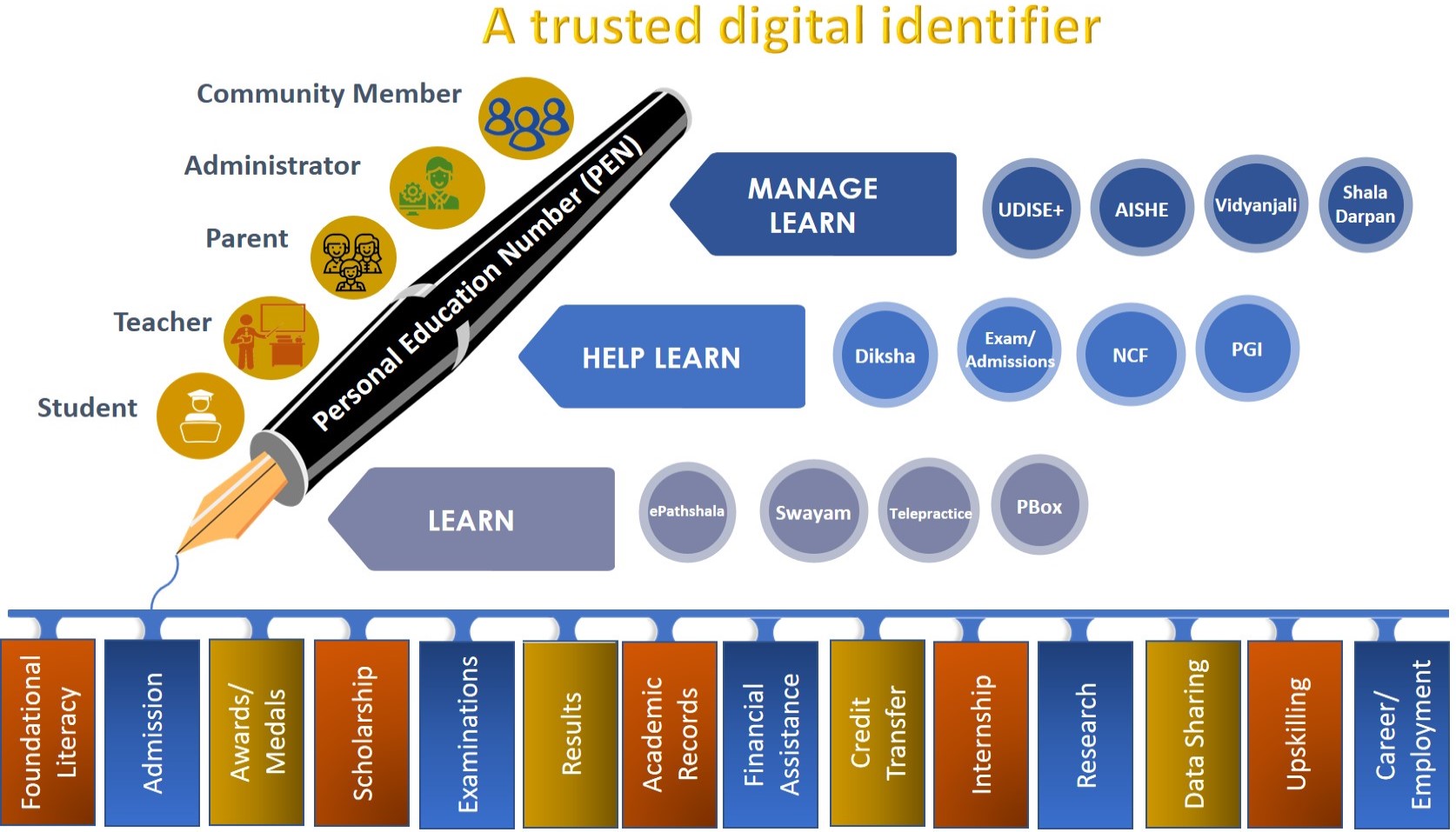
Personal Education Number or “PEN” is an initiative to create a unique identification number across all the Education platforms. PEN would be issued to 5 key personas (Learners, Parents, Teachers, Administrators and Community Members) interacting through 3 generalized scenarios: Learn, Help Learn and Manage Learn as defined in National Digital Enterprise Architecture (NDEAR).

  • PEN would contain minimum set of essential parameters (like name, date of birth, gender, email, phone etc.) validating the association of personas to the education sector to uniquely identify an academician or an entity.
  • PEN would facilitate unifying of existing digital assets and applications part of the federated system.
  • It would act as a permanent reference number in the entire persona lifecycle at different learning stages including pre-primary, primary, secondary, senior secondary, graduate, post-graduate, upskilling etc.
  • PEN can also facilitate building of national core registries such as student, teacher, counsellor, entities etc. as identified in NDEAR.
  • Most importantly, it would benefit the personas by providing a unified view of digital assets from diverse federated systems. Stakeholders would be able to share the digital academic assets like UPI model which uses mobile number linked to various kinds of financial accounts for making transaction. On the similar lines PEN linked with multiple registration numbers can be used for availing different services including employment, education, scholarship, credit transfer, loans, examinations, admissions, Passport/Visa etc.
Why Not Aadhaar and other Identifiers ? :

Aadhaar can be enlisted as an attribute for PEN rather than a unique identifier as it might not always be available for everyone part of the education system like NRIs, foreign nationals, organizations etc. Also, due to the legal frameworks associated with Aadhaar, it can’t be made a mandatory parameter for educational services. Similar is the case with other identifiers like Health ID, Passport, PAN etc.

Way Forward

Although generating identification numbers for such a huge population can be a daunting task, it can be implemented if done in a phased manner. In the initial phase, the focus can be on existing class 10th passed students and teachers for whom the database is readily available and slowly it can be cascaded down further for rest of the population. The new entrants can be easily considered by providing tools and creating policies & procedures.

UGC (Minimum Qualifications for Appointment & Promotion of Teachers and Academic Staff in Universities and Colleges and Measures for Maintenance of Standards in Higher Education) Regulations, 2025

Daily writing prompt
What’s your dream job?

Union Minister for Education, Shri Dharmendra Pradhan, released the draft UGC (Minimum Qualifications for Appointment & Promotion of Teachers and Academic Staff in Universities and Colleges and Measures for the Maintenance of Standards in Higher Education) Regulations, 2025, today in New Delhi. He also inaugurated ‘Pushpagiri’, the new auditorium of UGC. Shri Sunil Kumar Barnwal, Additional Secretary, Ministry of Education; Prof. M. Jagadesh Kumar, Chairman, UGC; heads of the institutions, academicians, officials of the Ministry and other dignitaries were also present at the event.

Shri Dharmendra Pradhan, while addressing the audiences said that these draft reforms and guidelines will infuse innovation, inclusivity, flexibility and dynamism in every aspect of higher education, empower teachers and academic staff, strengthen academic standards and pave the way for achieving educational excellence. He congratulated the team of UGC for their efforts in formulating the Draft Regulations and Guidelines in sync with the ethos of NEP 2020.

The Minister mentioned that the Draft Regulations, 2025, have been placed in the public domain for feedback, suggestions, and consultations. He expressed confidence that the UGC will soon publish the Draft Regulations, 2025, in their final form, driving transformations in the education system and propelling the country towards Viksit Bharat 2047 through quality education and research.

Shri Pradhan also complimented the UGC for honouring the unparalleled intellectual heritage of Odisha by naming their newly constructed auditorium ‘Pushpagiri.’ He noted that it is a matter of great pride and personal delight for him. He highlighted how Pushpagiri in Jajpur, Odisha, was a cradle of knowledge and a symbol of enlightenment. He commended the UGC for this laudable step in reappropriating Bharat’s intellectual heritage and values in the 21st century. Additionally, he expressed hope that this state-of-the-art auditorium would emerge as a hub for vibrant intellectual discourses, shaping bright futures.

Shri Sunil Kumar Barnwal, in his address, said that these regulations will significantly enhance the quality of teaching and learning in the higher education institutions. He also mentioned how the Ministry is committed to supporting their effective implementation across the country.

About the Regulations

The Draft UGC (Minimum Qualifications for Appointment & Promotion of Teachers and Academic Staff in Universities and Colleges and Measures for the Maintenance of Standards in Higher Education) Regulations, 2025 will give flexibility to universities in appointing & promoting teachers and academic staff in their institutions.

The draft regulations and guidelines are available for public consultation, inviting comments, suggestions and feedback from stakeholders at:

Draft Regulations: https://www.ugc.gov.in/pdfnews/3045759_Draft-Regulation-Minimum-Qualifications-for-Appointment-and-Promotion-of-Teachers-and-Academic-Staff-in-Universities-and-Colleges-and-Measures-for-the-Maintenance-of-Standards-in-HE-Regulations-2025.pdf

Key Highlights of the Regulations

•     Flexibility: Candidates can pursue teaching careers in subjects they qualify for with NET/SET, even if different from their previous degrees. Ph.D. specialisation will be prioritised.

•     Promoting Indian Languages: The draft Regulations encourage the use of Indian languages in academic publications and degree programmes.

•     Holistic Evaluation: It aims to eliminate score-based short-listing, focusing on a broader range of qualifications, including “Notable Contributions.”

•     Diverse Talent Pool: Creates dedicated recruitment pathways for experts in arts, sports, and traditional disciplines.

•     Inclusivity: Provides opportunities for accomplished sportspersons, including those with disabilities, to enter the teaching profession.

•     Enhanced Governance: Revises the selection process for Vice-Chancellors with expanded eligibility criteria with transparency.

•     Simplified Promotion Process: Streamlines the criteria for promotions, emphasising teaching, research output, and academic contributions.

•     Focus on Professional Development: Encourages continuous learning and skill enhancement for teachers through faculty development programs.

•     Enhanced Transparency and Accountability: Promotes transparent processes for recruitment, promotion, and addressing grievances.

*****

Implement every aspect of NEP 2020, amends “No Detention Policy”

Daily writing prompt
What are your favorite sports to watch and play?

The National Education Policy (NEP) 2020, envisions a comprehensive revision and revamping of the education system, including its governance and regulation. The Department of School Education & Literacy remains committed to supporting students in achieving better learning outcomes, thereby ensuring an inclusive and effective education system.

In line with this commitment, the Central Government, through notification (G.S.R. 777(E)) dated 21st December 2024, published in the Gazette of India, has amended the rules under the Right of Children to Free and Compulsory Education (RTE) Act, 2009, as revised by the RTE (Amendment) Act, 2019. The amended rules, titled the Right of Children to Free and Compulsory Education (Amendment) Rules, 2024, introduce significant changes to promote student learning while ensuring equity and inclusion.

The amendment is the introduction of a revised “Detention Policy” applicable to students in Grades 5 and 8 of school established, owned or controlled by the Central Government, or the administrator of the Union Territory, having no legislature.

Under this, if a student fails to meet the promotion criteria after annual examination, he or she will be provided additional instruction and an opportunity to appear for a re-examination within two months of the declaration of results. In the event the student does not meet the promotion criteria even after the re-examination, he/ she will be continued in the same grade. During this period, the class teacher will actively engage with the student and the parents, providing specialized guidance and addressing identified learning gaps through targeted interventions.

Though the RTE Act was amended in 2019 it was decided to await finalisation of National Education Policy (NEP), 2020 and National Curriculum Framework for School Education (NCFSE), which was put up in public domain on 23.08.2023. After due consultation with stake holders, the rules have been notified.

As reported by States and Union Territories, 18 States/UTs have issued notification for implementation of provisions of  RTE(Amendment) Act, 2019, these include Assam, Bihar, Gujarat, Himachal Pradesh, Jammu & Kashmir, Jharkhand, Madhya Pradesh, Meghalaya, Nagaland, Punjab, Rajasthan, Sikkim, Tamil Nadu, Tripura, Uttarakhand, West Bengal, NCT of Delhi and Dadar & Nagar Haveli & Daman & Diu. State of Haryana and UT of Puducherry are yet to take a decision in the matter.

The States/UTs of Andhra Pradesh Arunachal Pradesh, Chhattisgarh, Goa, Karnataka, Kerala, Maharashtra, Manipur, Mizoram, Odisha, Telangana, Uttar Pradesh, Andaman & Nicobar Island, Chandigarh, Ladakh and Lakshadweep continue to follow the no detention policy from Class I to VIII.

The amendment reinforces that no child shall be expelled from school until the completion of elementary education ensuring every child’s right to education.

*****

Job Opportunities After CTET Exam

Daily writing prompt
Share what you know about the year you were born.

The Central Teacher Eligibility Test (CTET) is a national-level examination conducted by the Central Board of Secondary Education (CBSE) to assess candidates’ eligibility for teaching positions in schools. Qualifying CTET opens the door to various teaching opportunities in both government and private schools across India. This article provides a comprehensive overview of the career prospects available after clearing the CTET exam.


Why CTET is Important?

  1. Mandatory Qualification: CTET is a prerequisite for applying to teaching positions in central government schools like Kendriya Vidyalayas (KVs) and Navodaya Vidyalayas (NVs).
  2. Enhanced Credibility: CTET certification adds weight to a candidate’s profile, even in private and unaided schools.
  3. Nationwide Acceptance: The CTET score is recognized by schools across India, providing broader career opportunities.

Teaching Opportunities After CTET

1. Central Government Schools

  • Examples: Kendriya Vidyalayas (KVs), Navodaya Vidyalayas (NVs), Tibetan Schools, and other schools under the administrative control of the central government.
  • Roles:
    • Primary Teacher (PRT) for Classes I-V.
    • Trained Graduate Teacher (TGT) for Classes VI-VIII (requires additional qualifications).
  • Benefits:
    • Competitive salary.
    • Job security and pension benefits.
    • Opportunities for professional development.

2. State Government Schools

  • Many state governments consider CTET scores for recruitment in state-run and aided schools.
  • Candidates may need to meet specific state eligibility criteria, such as proficiency in the local language.

3. Private and Unaided Schools

  • Role: Teachers in reputed private schools often prioritize candidates with CTET certification.
  • Advantages:
    • Higher chances of selection due to CTET qualification.
    • Negotiable salary packages in high-ranking schools.

4. Education Departments

  • Role: Educational officers or trainers for teacher training programs.
  • Scope: Opportunities to work in curriculum development, teacher training, and educational policy implementation.

5. Special Category Schools

  • Examples: Schools run by the Ministry of Defence, such as Army Public Schools and Air Force Schools.
  • Role: Primary and secondary teachers for children of defense personnel.

6. E-Learning and EdTech Platforms

  • Role: Content developers, online tutors, or subject matter experts in educational technology companies.
  • Scope: Creating teaching material, video lessons, or conducting live classes.

7. International Schools

  • Some international schools in India and abroad recognize CTET and prioritize candidates with this qualification for teaching positions.

Non-Teaching Opportunities After CTET

  1. Educational Content Development
    • Designing teaching aids, lesson plans, and curriculum resources for publishers and educational organizations.
  2. Teacher Training
    • Assisting in the professional development of teachers by conducting workshops and training sessions.
  3. Education Consultant
    • Advising schools or educational bodies on curriculum design, teaching methodologies, and assessment practices.

Salary Prospects After CTET

  1. Government Schools:
    • Primary Teacher (PRT): ₹35,000 to ₹50,000 per month.
    • Trained Graduate Teacher (TGT): ₹40,000 to ₹60,000 per month.
    • Post Graduate Teacher (PGT): ₹50,000 to ₹70,000 per month.
  2. Private Schools:
    • Salaries vary based on the school’s reputation and location, ranging from ₹20,000 to ₹60,000 per month.
  3. EdTech Platforms:
    • Online tutors or content developers may earn ₹25,000 to ₹75,000 per month, depending on experience.

Career Advancement Opportunities

  1. Promotions:
    • With experience, teachers can advance to positions like Head of Department (HOD), Vice Principal, or Principal.
  2. Further Qualifications:
    • Pursue courses like Bachelor of Education (B.Ed.), Master of Education (M.Ed.), or specialized certifications to enhance career prospects.
  3. Research and Higher Studies:
    • Opportunities to work in educational research or pursue higher studies in pedagogy and child development.

Preparation for Further Exams

CTET qualification also makes candidates eligible to apply for other competitive exams, such as:

  1. State TET Exams: To qualify for state-level teaching positions.
  2. KVS/NVS Recruitment Exams: For higher-level positions in central government schools.
  3. NET (National Eligibility Test): For college and university-level teaching positions.

Conclusion

Qualifying CTET is a significant milestone for aspiring teachers. It not only opens the doors to rewarding teaching positions in government and private schools but also provides opportunities in diverse educational roles. With the growing emphasis on quality education, the demand for CTET-qualified teachers is set to rise. Those passionate about teaching can look forward to a fulfilling and impactful career.

Top Schools in Asia: An Overview of Academic Excellence

Asia, a continent known for its rich history, diverse cultures, and rapid economic growth, is also home to some of the world’s top-performing educational institutions. With an increasing emphasis on global competitiveness, the quality of education in many Asian countries has risen to new heights in recent decades. Schools in Asia are recognized for their academic rigor, innovative teaching methods, and focus on developing global citizens. This essay will explore some of the top schools in Asia, highlighting the factors that contribute to their success and influence.

1. The International School of Beijing, China

The International School of Beijing (ISB) is one of the premier international schools in China. Located in the capital city, ISB offers an education primarily based on the International Baccalaureate (IB) curriculum, with an emphasis on inquiry-based learning. It serves students from pre-kindergarten through grade 12, drawing families from over 50 countries. One of ISB’s key strengths is its commitment to fostering cultural diversity and international-mindedness. The school offers a wide range of extracurricular activities, including sports, music, drama, and Model United Nations (MUN), which help develop leadership and communication skills.

ISB’s strong academic results are also a testament to its high standards. The school’s high school students consistently perform well in the IB Diploma Programme, and its university placement record is excellent, with graduates attending prestigious universities across the globe.

2. Singapore American School (SAS), Singapore

The Singapore American School (SAS) is widely regarded as one of the best schools in Asia. Founded in 1956, SAS offers a rigorous American-style education from pre-kindergarten to grade 12. The school is renowned for its high academic standards, exceptional facilities, and outstanding faculty. SAS is particularly known for its focus on developing well-rounded individuals, with a strong emphasis on both academics and extracurricular activities.

The school offers Advanced Placement (AP) courses, and its students routinely perform well in these exams, with many going on to attend top universities in the United States, such as Ivy League schools. SAS is also known for its focus on STEM (science, technology, engineering, and mathematics) education, with state-of-the-art laboratories and robotics programs. Its commitment to character development and service learning makes it a leader in educating global citizens. You can view website to get an in-detailed idea of international schools in Singapore.  

3. The International School of Hong Kong (ISHK), Hong Kong

The International School of Hong Kong (ISHK) is one of the top international schools in the region. It offers the International Baccalaureate (IB) curriculum, catering to students from early childhood through to high school. ISHK is particularly known for its personalized approach to education, focusing on individualized learning paths that meet the needs of each student. The school emphasizes inquiry-based learning, which allows students to actively engage with the material and develop critical thinking skills.

ISHK’s strong emphasis on cultural diversity is also a standout feature. Hong Kong is a melting pot of cultures, and ISHK fosters a global perspective, encouraging students to understand and appreciate different cultures and backgrounds. Its high school students consistently achieve impressive results in the IB Diploma Programme, which enables them to gain entry to top universities around the world.

4. Nanjing International School (NIS), China

Nanjing International School (NIS) is another top international school in Asia, located in Nanjing, China. NIS offers a challenging and well-rounded education, focusing on both academic excellence and holistic development. The school follows the IB curriculum and places a strong emphasis on inquiry-based learning, which nurtures independent thinkers and problem solvers.

NIS has a reputation for offering a well-integrated approach to education, with a robust arts and sports program. The school also encourages service learning and social responsibility, helping students develop a sense of global citizenship. NIS graduates regularly gain acceptance into prestigious universities worldwide, making it one of the top choices for expatriate families in China.

5. Seoul Foreign School, South Korea

Seoul Foreign School (SFS) is one of the top international schools in South Korea, offering a curriculum that blends American and international standards. Established in 1912, SFS has a long history of providing an excellent education to expatriates in Seoul. The school serves students from preschool through to grade 12 and offers a diverse range of extracurricular activities in addition to its rigorous academic programs.

SFS offers both the Advanced Placement (AP) and IB Diploma Programmes, allowing students to choose the educational pathway that best suits their needs. The school has consistently high academic standards, and its graduates have gone on to attend prestigious universities, particularly in the United States. SFS’s commitment to developing well-rounded individuals is reflected in its strong focus on sports, arts, leadership, and community service.

6. The British International School, Phuket, Thailand

The British International School (BISP) in Phuket is a prominent institution in Thailand, known for its high academic standards and focus on developing global citizens. Following the British curriculum, BISP offers a strong academic program from early childhood through to the A-levels. The school is particularly well-regarded for its emphasis on extracurricular activities, including sports, music, drama, and outdoor education.

BISP’s commitment to holistic education is demonstrated by its focus on both academic achievement and personal development. The school boasts a strong university placement record, with graduates attending top institutions in the United Kingdom, United States, and other parts of the world. Its picturesque location in Phuket provides a conducive learning environment, and its international community ensures a diverse, inclusive atmosphere.

7. Jeddah International School, Saudi Arabia

Jeddah International School (JIS) is one of the top international schools in the Middle East and has earned a strong reputation for its academic excellence. Offering both the IB and American curriculums, JIS provides a rigorous academic environment for its students, alongside a diverse array of extracurricular activities. The school places a strong emphasis on moral values, social responsibility, and leadership.

JIS has a highly dedicated teaching staff and offers a range of extracurricular activities, such as sports, arts, and community service, that encourage students to grow in a well-rounded manner. Its university placement program is highly successful, with many students gaining entry to prestigious universities in the US, UK, and other countries.

8. Tata Institute of Social Sciences (TISS), India

While India is home to a multitude of prestigious schools, Tata Institute of Social Sciences (TISS) stands out due to its unique focus on social sciences and social work education. Based in Mumbai, TISS offers undergraduate, postgraduate, and doctoral programs in various fields, including social work, education, health systems, and public policy. TISS is known for its rigorous academic curriculum, combined with a strong emphasis on social responsibility and community engagement.

Although TISS is more of a university-level institution, its influence and reputation for academic excellence make it a leader in higher education in Asia. The university has consistently ranked among the top in India and offers a transformative educational experience.

Conclusion

The top schools in Asia exemplify excellence in education, each with its unique approach to developing students into successful, well-rounded global citizens. Whether following international curriculums like the IB or offering specific country-based systems, these schools are shaping the future of education in Asia and beyond. With their emphasis on academic rigor, cultural diversity, and holistic development, these institutions set the stage for the next generation of leaders, thinkers, and innovators. As Asia continues to play a central role in global development, the quality of education in its schools will undoubtedly remain a critical factor in shaping the future of the continent and the world. Visit the website to get more insights on international schools in Asia.