Demise of Indian Football and Cricket Icon Chuni Goswami

On 30 April 2020 within few hours, two famous Indian personalities who entertained us – one through football and cricket and another one through film passed away.  Since I have already paid my tribute through my publication to Rishi Kapoor so in this article few lines about great footballer, who was one of the architects to take Indian football at the zenith, is presented. He was also a well-known cricketer and popularly known as ‘Chuni’ Goswami. Although his birth name was Subimal Goswami (15 January 1938 – 30 April 2020), but commonly Indians know him as ‘Chuni’ Goswami. As a footballer he played in the forward position as we know goalkeeper, defence and forward are normally three positions played in football and all are having equal importance in the game.  Chuni captained both the Mohun Bagan Football club and the Indian National Team. He was an Olympian, representing India national team at the 1960 Summer Olympics. He also led Indian team to attain gold medal in 1962 Asian Games and in 1964 Indian team was the runners-up at AFC Asian Cup. It is worthy to mention that great football icons P.K. Banerjee, Chuni Goswami and Tulsidas Balaram were part of famous Indian forward line which scored nine out of 11 goals in the Asian Games that fetched gold medal to us. Anyway, it is sad to mention that P.K. Banerjee passed away one month before Goswami’s death.

Cricket Icon Chuni Goswami

A Brief History of Cricket Icon Chuni Goswami

Chuni Goswami as footballer joined the Mohun Bagan Junior Team in 1946 at the age of 8 years. He was a part of the junior squad up to 1954 and then graduated to the Mohun Bagan senior team.

According to frontline.thehindu.com, Chuni made his debut in the national side “at the age of 19, when he was selected for India’s tour to the Far East. In 1958, he played in the Tokyo Asian Games, and in 1959, in the Merdeka Tournament”. He was last seen for the national team in 1984 at the age of only 27 years.  He was brilliant cricketer also. In 1971-72, Goswami led Bengal team to the Ranji Trophy (in Ranji cricket, Bengal is mentioned not West Bengal) and reached in the final but lost against Bombay.

Chuni Goswami was awarded with many laurels, inter alia of which are – 1962 Best Striker of Asia Award, 1963 Arjuna award, 1983 Padma Shri and in 2005 Mohun Bagan Ratna. He enthralled spectators through his football skill. Indian football expert and commentator Novy Kapadia wrote in his book “Barefoot to Boots: The Many Lives of Indian Football”, “Goswami belonged to a golden period for the Mariners (a fond nickname for the club given by the fans) in the 1960s, where he was part of a squad that also included the likes of Jarnail Singh and T.A Rahman in defence, centre-forward Ashok Chatterjee and goalkeeper Peter Thangaraj”. But what made Goswami different? As a player he was renowned for his entertaining football. “His superb speed with the ball, excellent trapping and shrewd passing had made him a household name, but it was his dazzling dribbling and body swerves that ultimately set him apart from the other greats of his era,” as mentioned by Kapadia (www.livemint.com).

Chuni Goswami was popular among all sections of people because of his amicable nature. Plethora of condolences was poured after his death. The Chief Minister of West Bengal Mamata Banerjee expressed her condolences; State Sports Minister Arup Biswas visited the hospital and paid his last respect to the departed soul.  The many leading personalities sent condolence messages and few are –    the Indian football icons Sunil Chhetri and Bhaichung, Bhutia, boxer Vijender Singh,   Indian news anchor Rajdeep Sardesai, cine personality Boney Kapoor, cine artiste Rituparna Sengupta and many others. BCCI in their condolence message, mentioned “Subimal ‘Chuni’ Goswami, an all-rounder in the truest sense. He captained the Indian national football team & led to them to gold in the 1962 Asian Games. He later played first-class cricket for Bengal & guided them to the final of Ranji Trophy in 1971-72”

Chuni Goswami is survived by his wife Basanti and son Sudipto. And millions of sports lover will remember him for his splendid performance in football and cricket.

I am as a sportsperson is deeply saddened for his death and pray almighty May His Soul of Rest in Peace

Dr. Shankar Chatterjee

Former Professor& Head (CPME)

NIRD &PR (Govt. of India),

Hyderabad-500 030

Telangana, India

Email <shankarjagu@gmail.com>


The following websites were consulted for writing the article.

eLearning guidelines project day

All the project leaders involved in the eLearning guidelines project gathered today at the Wellington airport conference centre. The steering committee meeting held yesterday was used to plan today’s event.

The main aim for today was to introduce project leaders to each other and to discuss items around managing the projects. There were some group activities around finding common ground, sharing ideas and resources, and risk factors. The risk analysis brainstorm session highlighted a lot of concerns. or example, staff turnover, keeping to milestones, budgets, project management skills. It was a very useful exercise. The show and tell after lunch was an excellent way to keep everyone awake and informed about who was doing what. The short snappy explanations about the projects were just the right length (two minutes) to inform. Also the session where we had to migrate into groups of similarity was also very useful.

I joined the design group and it became apparent that everyone was keen to keep the discussion going around best practice in design, and also to share resources developed for the projects. For example, several people are gathering material for a literature review. The Otago Polytechnic project is called: The power of design on flexible learning and digital network literacy

The eLearning guidelines that the project will use are listed below:
  • TD11 Should staff use a team approach to develop and teach the course?
  • TD12 Is the design of learning informed by research on effective eLearning?
  • TO9 Are staff encouraged to participate in networks and learning communities involved in reviewing, developing or sharing good practice in the use of e-learning?

For the demo session today , I added some information about the project to the Otago Polytechnic project space on WikiEducator. This was essentially the project application. The plan is to have a meeting as soon as possible with Leigh and Terry to discuss the way forward for the project and who will be involved.

It was very good to meet most people involved in the projects, and people seemed keen to keep the contact going on group email and to support each other. Motivation and pastoral care from John, the project manager will be very important in keeping us all on track. And I hope people will take the time to log what they are doing regularly and share their progress in an open manner and support each other.

eLearning guidelines project day

All the project leaders involved in the eLearning guidelines project gathered today at the Wellington airport conference centre. The steering committee meeting held yesterday was used to plan today’s event.

The main aim for today was to introduce project leaders to each other and to discuss items around managing the projects. There were some group activities around finding common ground, sharing ideas and resources, and risk factors. The risk analysis brainstorm session highlighted a lot of concerns. or example, staff turnover, keeping to milestones, budgets, project management skills. It was a very useful exercise. The show and tell after lunch was an excellent way to keep everyone awake and informed about who was doing what. The short snappy explanations about the projects were just the right length (two minutes) to inform. Also the session where we had to migrate into groups of similarity was also very useful.

I joined the design group and it became apparent that everyone was keen to keep the discussion going around best practice in design, and also to share resources developed for the projects. For example, several people are gathering material for a literature review. The Otago Polytechnic project is called: The power of design on flexible learning and digital network literacy

The eLearning guidelines that the project will use are listed below:
  • TD11 Should staff use a team approach to develop and teach the course?
  • TD12 Is the design of learning informed by research on effective eLearning?
  • TO9 Are staff encouraged to participate in networks and learning communities involved in reviewing, developing or sharing good practice in the use of e-learning?

For the demo session today , I added some information about the project to the Otago Polytechnic project space on WikiEducator. This was essentially the project application. The plan is to have a meeting as soon as possible with Leigh and Terry to discuss the way forward for the project and who will be involved.

It was very good to meet most people involved in the projects, and people seemed keen to keep the contact going on group email and to support each other. Motivation and pastoral care from John, the project manager will be very important in keeping us all on track. And I hope people will take the time to log what they are doing regularly and share their progress in an open manner and support each other.

Higher Education Leadership Development programme

UK-India Education and Research Initiative (UKIERI) is a bilateral partnership between UK and India which aims to promote institutional excellence through academic/research linkages and leadership development programme.

University Grants Commission (UGC) and British Council under the auspices of UKIERI is going to deliver a Higher Education Leadership Development programme focusing on training of mid and senior level educational administrators in Universities in India.

In addition to leadership training being provided to top level leaders like Vice-chancellors and academic faculty, higher education sector also needs leadership development for mid and senior levels functionaries so as to bring about a professional transformation of our Universities.

British Council has identified Advanced HE, a UK based not-for-profit institution, specializing in governance and leadership development of higher education for delivering the programme. The programme will be jointly funded under UKIERI.

ugc - University Grants Commission
ugc – University Grants Commission

OBJECTIVES

  • Ø  Train the academic administrators so as to enable them to bring about systemic changes with renewed approaches, capacity, tools and skills in the higher education institutions
  • Ø  Identify and train potential future leadership development programme trainers in order to provide a framework for dissemination and cascading of leadership training to other HEIsØCreate and Strengthen sustainable relationship between UK and Indian Higher Education Institutions and utilize UK’s expertise in the field of Higher Education Administration and leadership

WHO CAN APPLY

  • Central Universities funded by University Grants Commission
  • State Public Universities included under section 2(f) & 12B of the UGC ActTARGET GROUP• Administrative functionaries at the level of Registrar and Joint/Deputy/Assistant Registrar of the eligible Universities

    HOW TO APPLY

    • Eligible Universities shall apply in the prescribed format (Annexure I)
    • Universities shall nominate 3-5 functionaries in order of preference at the level ofRegistrar and Joint/Deputy/Assistant Registrar of the eligible Universities
    • To ensure gender diversity on the programme, at least one of the top three nomineesshould be a female.
    • The application may be duly forwarded and signed by the Vice Chancellor/authorisedsignatory of the university.
    • The filled in application in the form of .pdf file should be sent to heldpa.ugc@gmail.com
    • The last date for receipt of application is 16th March 2020.GUIDELINES FOR FILLING IN THE APPLICATION
  • Section A: Provide basic information like Name, Address, Contact Person, Contact details of your institutions
  • Section B: Provide details of 3-5 programme nominees at the level of Registrar and Joint/Deputy/Assistant Registrar. Please provide information about their designation, department, role, strength etc.
  • Section C: Statement of support from Vice Chancellor duly signed and stamped and the preference of the nominees must be mentioned. Out of the first three nominees, one nominee should preferably be a female.
  • Section D: A brief proposal identifying a real time change project which are strategically improtant to your university. Some of the project theme are mentioned, but are not in any way limited to the same. In case a change project is Not Yet Known please insert “NYK”
  • Section E: Please indicate who according to you, among your nominees can be the potential leadership developer. If this is not yet known, please insert “NYK”

page2image2546770672

PROCEDURE FOR SELECTION

  • The application shall be assessed on the basis of criteria such as Participating Institution’s commitment to the programme; Experience, achievements and potential of the participants; Clarity of programme goals; Potential impact of the programme; and Sustainability and transferability beyond the programme.
  • The names of the selected universities and participants along with the schedule of training shall be announced by the end of March 2020.PROGRAMME DELIVERY
    • Participants will attend two 5-day blocks of development workshops to be held between April and December 2020 in various locations in India. The dates and venues of workshops shall be communicated later on.
    • 30 potential future leadership development programme trainers will be selected amongst the participants.
    • The expenditure related to the travel, boarding and lodging of the Indian participants shall be borne by UGC.

eLearning guidelines project day

All the project leaders involved in the eLearning guidelines project gathered today at the Wellington airport conference centre. The steering committee meeting held yesterday was used to plan today\’s event.

The main aim for today was to introduce project leaders to each other and to discuss items around managing the projects. There were some group activities around finding common ground, sharing ideas and resources, and risk factors. The risk analysis brainstorm session highlighted a lot of concerns. or example, staff turnover, keeping to milestones, budgets, project management skills. It was a very useful exercise. The show and tell after lunch was an excellent way to keep everyone awake and informed about who was doing what. The short snappy explanations about the projects were just the right length (two minutes) to inform. Also the session where we had to migrate into groups of similarity was also very useful.

I joined the design group and it became apparent that everyone was keen to keep the discussion going around best practice in design, and also to share resources developed for the projects. For example, several people are gathering material for a literature review. The Otago Polytechnic project is called: The power of design on flexible learning and digital network literacy

The eLearning guidelines that the project will use are listed below:
  • TD11 Should staff use a team approach to develop and teach the course?
  • TD12 Is the design of learning informed by research on effective eLearning?
  • TO9 Are staff encouraged to participate in networks and learning communities involved in reviewing, developing or sharing good practice in the use of e-learning?

For the demo session today , I added some information about the project to the Otago Polytechnic project space on WikiEducator. This was essentially the project application. The plan is to have a meeting as soon as possible with Leigh and Terry to discuss the way forward for the project and who will be involved.

It was very good to meet most people involved in the projects, and people seemed keen to keep the contact going on group email and to support each other. Motivation and pastoral care from John, the project manager will be very important in keeping us all on track. And I hope people will take the time to log what they are doing regularly and share their progress in an open manner and support each other.

eLearning guidelines project day

All the project leaders involved in the eLearning guidelines project gathered today at the Wellington airport conference centre. The steering committee meeting held yesterday was used to plan today\’s event.

The main aim for today was to introduce project leaders to each other and to discuss items around managing the projects. There were some group activities around finding common ground, sharing ideas and resources, and risk factors. The risk analysis brainstorm session highlighted a lot of concerns. or example, staff turnover, keeping to milestones, budgets, project management skills. It was a very useful exercise. The show and tell after lunch was an excellent way to keep everyone awake and informed about who was doing what. The short snappy explanations about the projects were just the right length (two minutes) to inform. Also the session where we had to migrate into groups of similarity was also very useful.

I joined the design group and it became apparent that everyone was keen to keep the discussion going around best practice in design, and also to share resources developed for the projects. For example, several people are gathering material for a literature review. The Otago Polytechnic project is called: The power of design on flexible learning and digital network literacy

The eLearning guidelines that the project will use are listed below:
  • TD11 Should staff use a team approach to develop and teach the course?
  • TD12 Is the design of learning informed by research on effective eLearning?
  • TO9 Are staff encouraged to participate in networks and learning communities involved in reviewing, developing or sharing good practice in the use of e-learning?

For the demo session today , I added some information about the project to the Otago Polytechnic project space on WikiEducator. This was essentially the project application. The plan is to have a meeting as soon as possible with Leigh and Terry to discuss the way forward for the project and who will be involved.

It was very good to meet most people involved in the projects, and people seemed keen to keep the contact going on group email and to support each other. Motivation and pastoral care from John, the project manager will be very important in keeping us all on track. And I hope people will take the time to log what they are doing regularly and share their progress in an open manner and support each other.

A time for transformational Change


The ‘New Normal’ – Post COVID 19

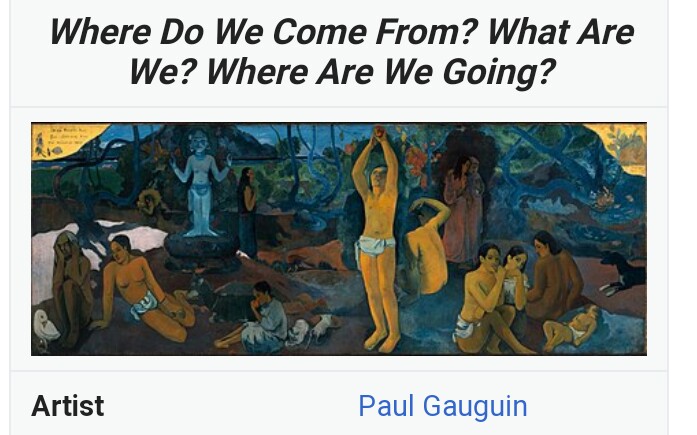
Where have come from? where are we now?
and where are we going?
This is the title of a painting by Paul Gauguin when he was feeling depressed and suicidal. Which when he completed it he felt better illustrating the power of creativity in moments of despair?
In the midst of the pandemic Covid 19 it seems relevant.
We cannot go back to the ‘old normal’!

The question is where are we going in the futures because it seems we cannot go back to ‘normal’ because the normal it no answer to challenges that lie ahead, most of all Global Warming, which requires a real change in values, behaviors and creative action.

We can learn from the past, where we have come from, because there are obviously lessons to be learnt. Mark Twain was said to have said that ‘history doesn’t repeat itself but it sure rhymes’.
The Black Death
If we go back to the Black Plague, which killed a third of Europe’s population, this plague created a change of attitude towards authority and led to new ideas, and with the invention of printing now called the Reformation.

Covid 19 provides such an opportunity for new ideas.

I am aware that Twain also said that ‘prediction if difficult now even if we have no real idea of what will unfold; if direction is important –means will be found

The world goes to big epochs of change each one requiring different behaviors, values and most important of actions

 First we were hunters and gatherers, then humans developed a more settled Agricultural Age, followed by an Industrial Age marked by mass production – now, it seems, we are moving into an Information Age (based on the disruptive power of modern information technology) or even a Creative Age – a Second Renaissance.
Cycles of change in recent history
Franklin Delano Roosevelt

The above are rather big changes but recent times political thinking seems to go in smaller cycles lasting three or four decades.

The ‘Roaring Twenties’ – ‘free market’ capitalism
In the 1920s, often called the ‘roaring twenties’, free market politics was the thing until in 1929 when it came to a sudden end – the Great Depression A depression leading to unheard of unemployment and extreme poverty. Maybe this is the’ rhyming’ Twain talked about.
The rise of the New Deal
The world struggled along until new thinking evolved (not really new but up until then largely ignored) resulting in the election in America of Democrat Franklin Delano Roosevelt. Roosevelt developed an unheard of programme of government assistance called the New Deal. Sounds familiar?
The Welfare State of Michael Joseph Savage

In New Zealand the Great Depression equally caused great dislocation and as a result voters elected the First Labour Government led by Michael Joseph Savage. Savage introduced extensive life saving welfare provisions.  In the UK Clement Atlee was elected to replace war leader Winston Churchill and introduced similar reforms.

The importance of the State to protect all citizens
The importance of the state, or central government, worldwide was made more pertinent by World War Two by returning troops who, along with their families, felt the need to develop a better fairer world.
Years of rebuilding and prosperity
The years following the War lead to decades of prosperity, led by the state, that all provided social security for all.

Up until the 1970s all went well but with the expensive oils shocks, and with an economy felt by many to be dictated by union power, and added to this, the increasing costs of the welfare state, new ideas were in the air (ideas not seen since the twenties).
The rise of Neo Liberal politics
Reagan and Thatcher

There were those who believed ‘big’ government was limiting enterprise and creativity. This was best expressed by Republican President Ronald Reagan whose stated ‘the government is no longer the solution, it is the problem’. Social welfare politics worldwide were demonized as being a ‘nanny state’ and worse still ‘socialism’ – one step, for many, away from communism.

The rise of the self-interested individual
In the UK Conservative Margaret Thatcher was elected saying, ‘there is no such thing as community only self-interned individuals and their families’. Ironically, in New Zealand, it was a Labour Government, under Prime Minister David Lange and Finance Minister Roger Douglas, who introduced privatization politics known as ‘Rogernomics’
And so began the introduction in Western countries of ‘market knows best ‘politics and that brings us up to present day
  •        State assets were sold off, often at low prices, to private enterprise to be made more         efficient and profitable.
  •    The power of unions limited and the idea of personal contracted workers introduced.
  •    The cult of privatization was introduced and loosening up on regulations
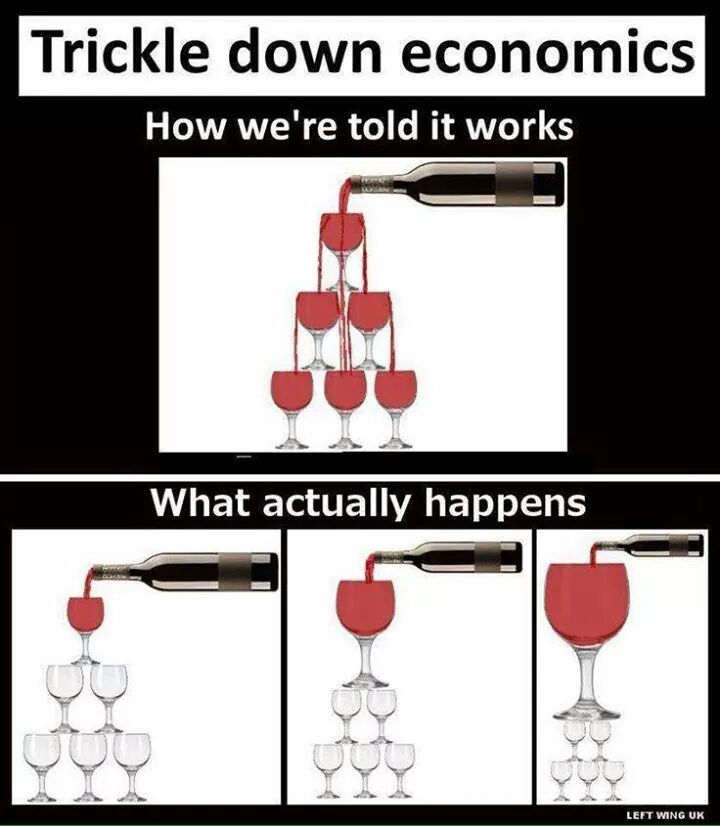
  •     And the ‘big sell’, wealth created by privatization would ‘trickle down ‘and benefit all.
  •      All of this was based on a disdain for the public sector and a reduced role for the state

The promise of ‘trickle down ‘economics

The key phrase of ‘trickle down’ used by the supports of ‘market force’s,’ has resulted today’s troubling list of social problems along with housing problems and growth in personal debt
Beyond Covid 19 – Climate Change
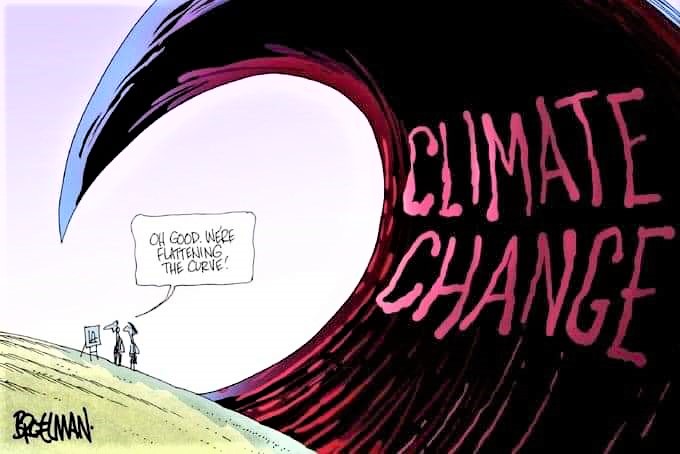
The focus on economic growth at all costs has contributed to the biggest issue facing us today – beyond the challenge of Virod 19 – –  that of global warming and sustainability of the environment and human civilization as we know it.

Apposing politician views

The National Party is still wedded to Market Force ‘free market’ politics (sometimes called neo –liberal politics) if somewhat watered down over the years.

 As yet the Labour Coalition Government has not made a dramatic shift from neo liberal politics, no doubt because to voting public still support the previous conservative government. Up until now there has been no real anger about the inequality – it has become ‘normal’.
This brings up to ‘where we are now’ – and the challenge of the current pandemic or more to the point, ‘where to from here’.
Returning to the old ‘normal’ no longer seems an alternative except for hard line neo conservatives. Private enterprise word wide has had to be supported by central governments – this is a return to social welfare on a large scale. Some might call this state assistance socialism!


Beyond Covid 19
The Covid 19 Crisis provides an opportunity to face up to the challenge of climate change and to develop push new ideas to encourage new ideas of responsible regenerative systems of production and consumption. Ideas that bring together the ‘well-being’ of people and our planet as we face a bigger challenge of climate warming.
Where to from here? What sort of country do we want to become?
To ensure transformation requires anger to be expressed at the inequality and environmental despoliation that has been created by the past three decades of growth at all costs – the basis of the market forces and privatization policies implemented, with the false promise of wealth ‘trickling down’ since the 1980s
There is now an alternative.


Those who implemented market policies convinced all that ‘there was no alternative (TINA) and demonized the ‘nanny state’, believing in less government, and to achieve privatization they demonized the union movement.
A reason for anger and need for change.
Up until this day all governments have implemented ‘market force’s policies including Helen Clark, Bill Clinton and Tony Blair. In New Zealand Helen Clark’s Labour Governments did their best ameliorate the worst aspects by introducing policies like ‘working for families’ to assist those most affected. Never the less inequality and despoliation of the environment has been the result; the rich have got richer and the poor poorer.

For thirty-five years the corporate world has ruled supreme. Particularly in the USA, but now ironically they are being rescued by the state that they have seen as ineffective.  Neo liberalism was all about individuals deciding for themselves, based on self-interest, and by competing with each other. Such an approach did not tap the power of community energy, communal collaboration and cooperation and this is where we now need to turn.

The need for change in a few dramatic weeks

Who would’ve thought in a few short weeks, as a result of Covoid 19, the world would change so dramatically providing challenges well beyond self-interested private enterprises – all a sudden only the state can assist in such dire situations. Greater social welfare and assistance is now essential.

So time to demonize and discredit the ‘trickle down’ market forces politics to change the consciousness of people to be able to envisage a better world. In times of crisis impossible ideas become possible. We cannot go back to the ‘normal’ destructive road of market forces politics.
The Challenge for the Coalition Government.
The challenge for the Labour Coalition Government, as we move out of the Covid 19 crisis and under the leadership of Jacinda Ardern, is develop a new vision or direction for our future based on the ideas of ‘well-being’ of all citizens and the sustainability of the environment.
Labour is well placed to articulate such a people centred community and environmentally sustainable vision. A government led by Jacinda Ardern could see New Zealand being a world leader, something we could all be proud of.
Need to rebalance state and private enterprise
What is required is to rebalance the influences of state direction and private enterprise; to focus and reward private enterprises who focus on developing a sustainable New Zealand.’ Let the market decide’ is now a failed dogma.
There are a number of ideas to consider, none original:

·         To introduce a ‘Green New Deal; for state agencies to implement and for private enterprises to be rewarded for positive actions. To encourage investment in productive areas of the economy and not just for individual reward This relates to the ideas introduced by Franklyn Delano Roosevelt following the Great Depression as well as the policies of the First Labour Government in New Zealand.
·       

  t      To  build on the ‘well-being’ philosophy underpinning the Coalition Government and to move away from a narrow misleading emphasis on GDP. A focus on GDP emphasizes the idea of infinite growth serving, first and foremost, the richest 10% and says little about non material well-being such as mental health and capturing the fullness of human flourishing.

·         To upgrade infrastructure needs – the ‘shovel ready ‘projects. Consider the possibility of the government buying into firms currently struggling and to develop a Ministry of Works to coordinate projects.
·       To continue developing a range of state innovative low cost housing and accommodation including communal concepts.
·         To build on the regional development being led by Minister Shane Jones.
·          It might be time to consider rebalancing the central and local Government.  There is a need to provide greater finance and flexibility for local government making local government more attractive for voters to be involved.  This could also more power sharing with local organizations and identifying steps to be taken to build community and strengthen the local community.
·         As part of the Green New Deal to encourage and assist land owners to develop regenerative agricultural approaches.
·         To come to terms with the possibility that unemployment (and under employment) will become endemic with the continued application of automation and to introduce a Universal Basic

Income. Not only would this simplify the plethora of welfare benefits but it would remove any stigma that people currently feel as well as providing a much needed sense of security.  There are numerous article outlining benefits and problematic issues to be taken into consideration. I believe a UBI would encourage innovative creative activities for many creative individuals. An extra payment could be given to people working as teacher aides or similar worthwhile occupation such as working in rest homes or working with adults with special needs

·         Even with a UBI progressive tax required rising to a higher percentage of income earned over a generous certain amount.
·         A reconsideration of a Capital Gains Tax (needing cross party agreement) as a lack of a Capital Gains Tax is a major factor in driving up house prices Wealth Tax is another option although I’m not sure what this involves. Plus, raising taxes on fossil fuel fertilizer to encourage regenerative agriculture.

·         Encouraging renewable clean energy projects   and to reduce extractive industries to move New Zealand to a post carbon economy. Further subsidizing house insulation and including solar panels.
·         A greater focus on protecting New Zealand’s natural environment – investment in preserving the environment would provide much needed jobs. A New Green Deal workforce. There is a need to encourage ‘degrowth’ – a deliberate downscaling of segments of the economy harmful to the ecosystem such as the fossil industry while at the same time valuing people such as those working in the care industry.
·         Providing greater Research and Development finance to encourage an environment of innovation and to share and upscale successful projects.
·      

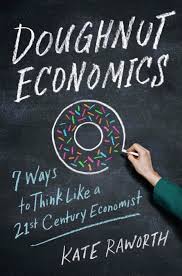
   Consider the circular regenerative economy outlined by economist Kate Raworth in her book The Doughnut Economy. The book sets out the minimum we need to lead a good life and sustain the environment. It highlights boundaries across which human kind should not go in contrast to current greed based economics.

With Covid 19 and the Climate Change challenge provides motivation for transformational change.
The free market promised to liberate the individual from the supposedly restrictions of the ‘nanny state’ but instead it has weakened safety nets, increased insecurity for far too many and put the entire planet at risk
Covid 19 and the Climate Warming crisis has given us an opportunity and the resolve to move away from self-interested capitalism to a kinder, fairer and more creative world – one we have a chance to hand on to future generations.
 It is possible to imagine a new world and a different type of society with new values and behaviours. – where human values of fairness, mutual aid and compassion are paramount.  It Hs happened before after the Great Depression and we can do it.
 It must have looked equally challenging in the days after WW2 when social democratic governments, including our own led by Michael Joseph Savage and Peter Fraser developed socially secure states leading to an era of unparalleled prosperity.