Photographs and genealogy

Years ago, when I first saw this picture in the family collection, it puzzled me. I knew that the little girl to the left was my grandmother, and I suspected the other two children on the floor were her brother and sister. I assumed that the man to the left was her father and that the woman in back was her grandmother? But who is the other boy in the room? My family and I dubbed him Heathcliff, remembering that he joined the Earnshaw family by adoption when he was a young boy (Wuthering Heights).

This spring I’ve had the opportunity to go through family photographs and also to research my family tree. I deduced that this picture was taken Christmas 1905. The extra boy is a cousin to my grandmother. These same people were still in the same household at the 1910 census. The grandmother, by the way, is the mother of my grandmother’s mother, mother-in-law to the man in the picture.

Here’s another picture of the same family taken a few months earlier. The younger woman is my great-grandmother; she died in June of 1905. The man with the cigar is probably Heathcliff’s father, and the two additional girls are Heathcliff’s sisters.

Why are those sisters missing from the Christmas picture? According to the 1910 census, they were boarding at the Chicago Industrial School for Girls. Later records show that both grew up, had jobs as clerks, and got married.

Here’s Heathcliff and his sisters—possibly taken at their school. On the desk is a cube with the date: Wednesday December 27. Historians, archivists, and genealogists love clues like that hiding in photographs. (December 27, 1905, was a Wednesday.)

And what became of Heathcliff? He also got married. He and his wife had a son who lived only three months and a daughter who eventually grew up and married. In 1917, when Heathcliff registered for the Great War, he was a clerk supporting wife and mother (possibly mother-in-law). In 1920, he was living with his wife, in-laws, and infant son. In 1930, though, he was divorced and living alone in Chicago. October 1930 saw him incarcerated at Leavenworth, Kansas—I have no idea why. By 1942, when he registered because of the second World War, he was back in Chicago, working for Keller & Sons. He died in 1959, at the age of 63.

“Heathcliff’s” real first name was the same as his father and his grandfather. By coincidence, my wife and I chose the same name for our son. After skipping several generations, it’s nice to have the name return to the family, even though the previous holder of that name was a crook. J.

5 Tips to Improve Your Mental Health and Wellness This Year

Taking the time to nourish your mind and soul can help you put your best self forward at work, school and in your interactions with others.

Being healthy is about more than just eating right and exercising. Your mental health also has an effect on your overall well-being, productivity and your motivation. Taking the time to nourish your mind and soul can help you put your best self forward at work, school and in your interactions with others.

College can be a stressful period for many students, especially for those of us who are balancing work, family and other demands on our time. Recently, researchers at Harvard Medical School surveyed college students across from more than 100 schools across the country. They found that college students today experience higher levels of stress, anxiety and depression, sometimes to the detriment of their mental and physical health.

I recently graduated from Herzing University’s online medical billing and coding program. As a mother of two, I know how difficult it is to find time for school along with everything else. I learned that if you want to strike a healthy balance, you need to know your limits and make time for yourself.

Here are my tips for improving your mental health and overall wellness in the new year:

1. Make time for the things that bring you joy

There’s lots of advice out there on how to achieve happiness, but there’s no one answer for everyone. I’m happiest when I am doing something I love with the people I love. It can be something as simple as spending time with my kids or reading a book. Think about the things in your life that make you feel good, and make those things a priority!

2. Disconnect

In the age of social media, it’s hard not to compare yourself to others and their accomplishments. I cannot tell you how many times I’ve been scrolling through Facebook and suddenly I realize that I no longer feel good about myself. It’s important to remember that everyone’s journey is different, and everybody achieves their goals at their own pace. Focus on yourself and your journey, and periodically take a social media break if you need to.

3. Establish healthy coping mechanisms for stress

While stress is an inevitable part of life, there are ways that you can manage it so that it doesn’t negatively affect your health. Practicing good time management is one way that you can minimize stress and stay on top of all of your to-dos. Some days are going to be crazy, and that’s okay. Just don’t make a habit of letting stress derail your routine. Make sure you are taking care of yourself by eating right and getting plenty of sleep.

4. Schedule a “me” day

Finding a moment to yourself might seem impossible, but taking time to de-stress is essential if you want to avoid burnout and feel your best.

I’ve found that spending time alone helps me process my thoughts and clear my head. I recommend setting aside some time for yourself every week and doing something that helps you reset, whether that’s hanging out with your pets, a walk or even a drive out of town. Learn to enjoy the peace and use the time to get to know yourself and your thoughts. I cannot express how much spending time alone has helped me feel more centered and focused.

5. Lean on your support system

We all have days when we feel stressed out and overwhelmed. Don’t be afraid to ask for help when you need it. If you don’t have a support system at home, remember that your professors and advisors are there for you and can help you navigate whatever you’re going through, whether that means scaling back your course load for one semester, or just getting some extra help on an assignment.

No matter what you hope to accomplish in the year ahead, it’s important to prioritize your mental health and well-being. These tips will help you stay healthy, focused and energized so you can feel your best.

initial planning FLLinNZ third round

Our planning session for the Flexible Learning leaders in New Zealand planning meeting all the 1st and 2nd round FLLinNZers gathered at Wiapuna Hotel at Mt Wellington, Auckland. We started with a warmup and a discussion of what we are expecting from the third round of funding and any issues. The facilitator presented on the situation in Australia.
Main points were:
  • competency-based apprenticeships
  • qualifications recognised across Aus
  • maximum flexibility in system – impacts on quality
  • grow private training orgs with effective competition
  • school-based apprenticeships
  • RPL – want to improve uptake
  • industry wants to control knowledge base – web 2 does not fit
  • training providers not keeping pace with rapid technological change – important
  • costs, flexibility and access
  • need training to meet needs of lifelong learners – skills shortages, shiftworkers, contractors, mature learners, just-in-time and to suit learners
  • need to build capability – respond to physical and online environment
    changing role of education and training
key activity: who can we connect with to make the most influence?
often fail to equip people with skills to be able to problem solve and think forthemselves.
Pedagogical shifts
  • more of the following:
  • distributed networks
  • social networking
  • blended and flexible models
  • facilitation driving pedagogy not instruction
  • innovation
  • market changes e.g. full employment
  • Less occurrence of the teacher teaching many.
Examples: Motor Traders Association – mp3 audio files used in training to capture their interest
Caryl Oliver – mlearning – there is a recording of an interview with Caryl.
Manager of 2020: multigenerations, longer later, more teams, flexible working, performance emphasised, innovation

Overview of pressures on the NZ tertiary education sector can be seen on the concept map (to be loaded).

Facilitator talked about Australian Flexible Framework and how we could have links with Australian projects. Learnscope and Knowledge tree online journal. eLearning networks project is running a September Online Event: Tapping into Resources for E-learning 6 – 8 September 2006

What You Need to Know About Becoming an Assisted Living Nurse

If you’re interested in working in a long-term healthcare environment, you might be considering a career as an assisted living nurse.

Assisted living is one of the long-term care options for elderly individuals and those with disabilities. For many seniors, assisted living communities can help with the transition to a new phase of life, one in which they need more assistance with daily activities and management of their personal health.

In an assisted living community, nurses and other healthcare professionals provide 24-hour supervision and a variety of personal care and health services for residents. As demand for long-term healthcare services increases, many assisting living providers are dealing with workforce shortages, particularly for registered nursing roles.

If you’re interested in working in a long-term care environment, you might be considering a career in assisted living. Here’s what you need to know about this growing nursing specialty:

Who can work in assisted living?

There are many types of nurses who can work in an assisted living setting, including registered nurses (RNs)licensed practical nurses (LPNs), certified nursing assistants (CNAs) and even nurse practitioners (NPs).

Some assisted living communities might serve residents with specific medical conditions, such as Alzheimer’s or dementia. As a result, nurses who work in a long-term care setting might choose to specialize in a particular area of care, such as geriatric nursing or pain management.

What are the responsibilities of an assisted living nurse?

Assisted living communities do not provide the same level of skilled nursing care as a nursing home or hospital. In an assisted living setting, nurses typically help residents with daily activities, such as:

  • Personal care. A nurse or CNA can help disabled or physically impaired residents with daily needs such as bathing or dressing.
  • Medication management. Nurses can help residents monitor and manage their pain levels. They may also assist with the administration of medicine, or supervise residents to ensure they take their medications as prescribed.
  • Memory care. Nurses may provide individualized care for residents with Alzheimer’s, dementia, or related illnesses. This could include pain management and psychiatric care, as well as general assistance during meals and social activities.
  • Exercise and general wellness. A nurse might help residents create a wellness program to maintain or improve their health or mobility. They may also assist residents with physical therapy or rehabilitation exercises, as prescribed by a physical therapist.
  • Corresponding with family members. Nurses may also regularly correspond with a resident’s family members. They help the family understand their loved one’s evolving needs and level of care and keep them informed in the event of any emergencies.

What skills are required to work in assisted living?

Soft skills, such as critical thinking and communication, are essential to your success in a long-term care environment.

“Our nurses need to be exceptional communicators and emotionally intelligent, as they often have to have difficult conversations with residents and their families,” says Pam Klein, co-founder of Fresh Coast Partners, an assisted living provider with communities in Kenosha, Wisconsin. “We also look for problem-solvers. We have to be able to pivot to a new approach when current strategies are not working.”

Patience and compassion are also important. Some patients could be dealing with chronic pain or conditions such as dementia or Alzheimer’s, and may be prone to irritability, anxiety and depression as a result. Nurses can help minimize these negative experiences for their patients by remaining calm in difficult situations and understanding the daily challenges their patients are facing.

Are there advancement opportunities in assisted living?

Yes. As more new nurses join the workforce, experienced nurses will have the opportunity to move into specialized roles and leadership positions.

“There will certainly be a growing need for leaders in the healthcare industry, especially within the assisted living field,” Klein said. “Nurses can play important roles as leaders and can benefit from further education to help them hone those skills.”

Graduate degree programs can help nurses expand their careers into advanced practice nursing, nurse education and nurse management. Herzing University offers three MSN degree pathways, as well as two post-master’s certificate options for nurses looking to take their careers to the next level.


How can I prepare for a career in assisted living?

Generally, registered nurses with a Bachelor of Science in Nursing (BSN) will have better job prospects than those without one, according to the Bureau of Labor Statistics. A hands-on BSN program that exposes you to a range of clinical settings can help you determine if assisted living is the right nursing environment for you.

Herzing University alum Kim Bonn honed her clinical skills in geriatric and community health nursing through clinical rotations at the Milwaukee VA Center and Horizon Hospice in Menominee Falls, Wisconsin. Through these experiences, she developed a passion for working with seniors and learned valuable skills that would prepare her for a career in long-term care.

“My courses and clinical experience helped me develop the critical thinking skills that allowed me to be successful,” Bonn said. “I’ve been able to take on new responsibilities and become more autonomous in my current role, and that’s because I am trusted by our residents.”

What Does a Family Nurse Practitioner (FNP) Do?

An FNP’s scope of practice may vary depending on the state and place of employment, but day-to-day duties can include performing exams, prescribing medication

If you’re looking to advance in the healthcare field and play a greater role in patient care, consider becoming a Family Nurse Practitioner (FNP).

Similar to nurse practitioners (NPs), FNPs are Advanced Practice Registered Nurses (APRNs) that provide patient care across the lifespan. Their scope of practice ranges from diagnosis to treatment, disease management and health prevention. FNPs can work across different specialties, in various healthcare environments and care for patients of all ages.

As the baby boomer population ages and demand for healthcare services grows, FNPs play an increasingly vital role in providing primary and specialty care for their communities. In some areas, FNPs provide services for which patients would have historically waited weeks to see a physician, especially in rural areas where there is a shortage of primary care providers.

Interested in learning more? Keep reading to find out what a family nurse practitioner does and what you need to do to become one.

What are the official responsibilities of a Family Nurse Practitioner (FNP)?

An FNP’s scope of practice may vary depending on the state and place of employment, but day-to-day responsibilities generally include:

  • Performing physical exams. FNPs can perform routine checkups to assess a patient’s health and they can also be involved in diagnosing and treating various health problems.
  • Developing care plans. If a patient requires treatment, FNPs can develop and implement a care plan. They can also provide general health counseling to help patients and their families lead healthier lives or learn how to manage their illnesses and injuries.
  • Prescribing medications. In most states, FNPs are able to prescribe medication. They may also monitor a patient’s response to different medications so that they can determine the best option for treatment.
  • Consulting with other healthcare professionals. FNPs may consult other healthcare professionals as they develop or contribute to a patient’s existing treatment plan. However, they often work independently and they can serve as a patient’s primary care provider.
  • Ordering and performing diagnostic tests. FNPs can order diagnostic tests to help evaluate a patient’s condition. They may conduct additional tests throughout treatment to evaluate whether the current care plan is working or if adjustments are needed.

What are the benefits of becoming an FNP?

On the fence about whether or not a career as an FNP is right for you? There are numerous benefits to this career path:

  • It’s fast growing. There’s never been a better time to become an FNP. The career is in high demand due to the growing need for healthcare services, with the Bureau of Labor Statistics (BLS) estimating a 28% increase in employment from 2018 to 2028.
  • It’s a sought-after career. U.S. News & World Report ranked FNPs as #5 in the Best Health Care Jobs for 2019 and #7 on the list of 100 best jobs in America.
  • There’s high earning potential. Registered nurses (RNs) earn an average annual salary of $71,730, while the median annual wage of FNPs is $113,930, according to the BLS. The top 10% of FNPs earn more than $182,750.
  • There are a variety of paths available. While the title “family nurse practitioner” makes it seem as though you’ll be working in family practice, you can choose from a variety of specialties that fit your interests and skills, including pediatrics, urgent care, internal medicine and more.
  • You can build your leadership skills. As an FNP, you’re the primary care provider for your patients, which means you’re delegating responsibilities and managing nurses and other members of the healthcare team.

How do I become an FNP?

If you’re interested in becoming an FNP, your path will depend on whether you’re already in the healthcare field.

  1. Earn your degree. If you’re already an RN and have your Bachelor of Science in Nursing (BSN), you can earn your Master of Science in Nursing (MSN) degree in Family Nurse Practitioner in 20 months. With Herzing University, you can complete your degree online, allowing you to learn at your own pace and on your own time. This means you can continue working full time or raising a family without putting your career goals on hold.
    • For RNs with an associate degree, you’ll have to earn your BSN, which can be done with Herzing University’s RN to BSN program. If you’re not in the healthcare field at all, you can start by earning your ASN or BSN to become an RN and then work toward your MSN in Family Nurse Practitioner.
  2. Build your skills. In addition to a degree, it helps if you’re skilled in communication and critical-thinking, as FNPs must clearly communicate with patients and healthcare professionals, and must make decisions regarding plans of action for patients. Learn more about the qualities of the best nurse practitioners.
  3. Get licensed. Once you earn your degree, you’ll want to become licensed in the state you plan on working. Licensure requirements differ and are dictated by each state’s board of nursing.

Learn more about Herzing University’s online MSN FNP program to find out how you can get started on the path to becoming a family nurse practitioner.

initial planning FLLinNZ third round

Our planning session for the Flexible Learning leaders in New Zealand planning meeting all the 1st and 2nd round FLLinNZers gathered at Wiapuna Hotel at Mt Wellington, Auckland. We started with a warmup and a discussion of what we are expecting from the third round of funding and any issues. The facilitator presented on the situation in Australia.
Main points were:
  • competency-based apprenticeships
  • qualifications recognised across Aus
  • maximum flexibility in system – impacts on quality
  • grow private training orgs with effective competition
  • school-based apprenticeships
  • RPL – want to improve uptake
  • industry wants to control knowledge base – web 2 does not fit
  • training providers not keeping pace with rapid technological change – important
  • costs, flexibility and access
  • need training to meet needs of lifelong learners – skills shortages, shiftworkers, contractors, mature learners, just-in-time and to suit learners
  • need to build capability – respond to physical and online environment
    changing role of education and training
key activity: who can we connect with to make the most influence?
often fail to equip people with skills to be able to problem solve and think forthemselves.
Pedagogical shifts
  • more of the following:
  • distributed networks
  • social networking
  • blended and flexible models
  • facilitation driving pedagogy not instruction
  • innovation
  • market changes e.g. full employment
  • Less occurrence of the teacher teaching many.
Examples: Motor Traders Association – mp3 audio files used in training to capture their interest
Caryl Oliver – mlearning – there is a recording of an interview with Caryl.
Manager of 2020: multigenerations, longer later, more teams, flexible working, performance emphasised, innovation

Overview of pressures on the NZ tertiary education sector can be seen on the concept map (to be loaded).

Facilitator talked about Australian Flexible Framework and how we could have links with Australian projects. Learnscope and Knowledge tree online journal. eLearning networks project is running a September Online Event: Tapping into Resources for E-learning 6 – 8 September 2006

5 Reasons You Should Earn Your MBA

93 percent of MBA alumni reported that they would still pursue a graduate degree again, given what they know now and the value they’ve seen.

In today’s competitive business environment, your bachelor’s degree might not be enough to set you apart from the competition for high-level management roles. Although a bachelor’s degree used to be the educational standard, employers are increasingly looking for candidates that have gone above and beyond to continue their education, earning a master’s level degree or higher.
Employers know that MBA graduates bring a fresh perspective to existing organizational practices. From problem-solving skills to strong leadership abilities, MBA graduates are able to take control, improve bottom lines and reconfigure dated processes.
Research shows that earning your MBA is ultimately worth the investment. According to a recent Alumni Perspectives Survey from the Graduate Management Admission Council (GMAC), 93 percent of MBA alumni reported that they would still pursue a graduate degree again, given what they know now and the value they’ve seen as a result of furthering their education.
Here are five powerful reasons to consider earning your MBA:

1. Networking

Your MBA program is filled with students who, like you, are ambitious, driven and committed to continuing their education and furthering their careers. As an MBA student, you have the opportunity to meet and network with people from a wide range of industries and professional backgrounds. Not only does this help expand your perspective of the business world, you can also make connections that prove valuable for your career. Who knows? You might even find the co-founder for the new business operation that you launch right out of school.

2. Earning potential

By earning a graduate degree, you could increase your lifetime earning potential. GMAC found that, on average, MBA alumni earn a higher cumulative base salary than those who did not achieve a graduate business education. While it’s important that you consider the cost of enrolling in graduate school, keep in mind that receiving your MBA could offer important long-term financial and career benefits.

3. Leadership skills

MBA programs are designed to help you develop the transformative leadership, management and problem-solving skills that employers are looking for today. Employers cite soft skills, such as communication and critical thinking, as essential traits of a good manager. Developing these skills before you graduate will be tremendously beneficial to your post-graduate employment options and career success.

4. Real-world training

From immersive courses to career-focused training and skill development, an MBA program helps you gain the experience and the knowledge you need to find solutions to complex business problems. It’s this kind of exposure that will set you apart from the competition.

5. Specialized knowledge

Some universities offer industry-specific or specialized MBA programs in areas such as human resourcesaccounting and finance, project management and more, allowing you to gain additional relevant experience and position yourself for niche roles within your specialty of interest.
Earning your MBA will help you achieve personal, educational and professional goals. Not to mention, you’ll make lifelong friends and critical business connections that help you hit the ground running.

Why Bedside Care is So Important

A nurse should provide information that answers all parties’ questions. We do this by making ourselves available and encouraging questions.

Imagine one of your family members is in the hospital or sick. This family member is likely concerned, scared and uncertain about his/her health. Your family also has questions, but no definitive answers. Tension seems to rise over speculation. Everyone’s imagination is running wild over the diagnosis, especially after you search the internet for answers.
Does this scenario sound familiar? Maybe you’ve been in this situation yourself or witnessed it unfold before your own eyes while working as a nurse. Let’s ask ourselves, “What could I have done as a nurse to alleviate this situation?”
The answer is simple: provide competent bedside care.
To avoid this problem, a nurse should provide information that answers all parties’ questions. We do this by making ourselves available and encouraging questions.

What does competent bedside care involve?

As nurses, we provide bedside care by doing assessments, administering medications, taking vitals, bathing clients, changing linens and providing information. However, bedside care is not only caring for physical needs, as listed above, but providing emotional support to aid in the recovery process.
Taking care of physical needs is obviously important (let’s face it, those tasks are how we keep people alive), but I want to expand on emotional support because that is what is often lacking during our daily care.

How do I provide competent bedside care?

Think about our earlier scenario of the scared patient and concerned family and the unneeded anxiety that is caused by lack of knowledge about a medical diagnosis.
The first thing many patients do when they have questions is perform an internet search. After reviewing the internet, a nosebleed could seem like a severe health issue. Misinformation, stress and anxiety could be avoided by one simple step, and that is for a nurse to be available to answer questions.
When meeting with patients, don’t announce how busy you are today before you ask if there is anything you can do for them. After hearing that you’re busy, some patients may forgo the questions they may want to ask you so they don’t take up too much of your time. Instead, make time to sit down and talk with your patient. Make your patients feel like no one is more important than they are while you are in their presence.
Exercise your active listening skills and then address anything they may have concerns over in detail. By providing information, you are empowering your patient to make informed decisions and this helps them participate in their own care. This process will improve a patient’s confidence, reduce stress and help foster a trusting relationship. When you listen and make yourself available to your patients, they will know that they are receiving competent care.
Bedside care is more than just passing medications and taking vitals. It’s the process where the nurse provides emotional support and advocates for the patient. Taking time to listen, giving 100 percent of yourself, providing timely care and responding to a patient’s basic needs will not only help build rapport but it will most importantly improve the healing process.

Student Story: IT Degree Leads to Career Reboot

Herzing alumni\’s IT degree put him in the running for some of the most in-demand jobs today and helped him launch a successful career.

As a systems engineer for one of the world’s leading health IT companies, Ronald Crayton supports and manages information solutions and software for healthcare clients around the world.
It’s pretty amazing, Crayton admits, given that he knew relatively little about computers several years ago.
Here’s how he got to where he is today:

Looking for a change

Six years ago, Crayton had just moved to Atlanta from New York and was working as a telemarketer. He didn’t know what he wanted to do in the long run, but he wanted a change.
\”I was sick and tired of my job,” he remembered. “I was working long hours for low pay. I just felt it was time to do something.\”
Crayton knew IT was a growing field, and that earning a college degree would help him unlock new career opportunities. He was right – his IT degree put him in the running for some of the most in-demand jobs today, and helped him launch a successful career at a multinational corporation.
“The more I looked into it, the more I felt that IT would be a good fit for me,” Crayton said. “I liked the idea of solving problems.”
Crayton began exploring IT programs at several universities in the Atlanta area, and soon decided to enroll at Herzing University.
“I knew Herzing was the school for me as soon as I walked through the doors,” Crayton said. “From the admission advisors to the faculty, everyone was very friendly and welcoming. It just felt right.”
An IT career is ideal for those who, like Crayton, are drawn to working with computers and technology and enjoy troubleshooting and resolving technical problems.
“I also really liked the fact that as a student I would have the chance to work with physical hardware and software that I was learning about,” Crayton said. “Working with routers and switches and getting to test all of the different parts of a system was a huge part of my learning experience and really helped solidify the concepts I learned in class.”

A fresh start

Crayton graduated from Herzing in just three years with his bachelor’s in information technology and a concentration in security technology. He also earned his CompTIA A+ certification, which, among other industry-recognized IT certifications, is becoming a valuable differentiator for new IT professionals entering the workforce.
Shortly thereafter, he began a career as a systems administrator for a medical center in Atlanta, serving as the organization’s main point of contact for IT support needs. It wasn’t long before he was contacted on LinkedIn for another job opportunity – this time for a position at a leading health information solutions provider.
The company liked Crayton so much, they even paid for him to relocate to Kansas.

New opportunities

IT graduates like Crayton have the opportunity to pursue careers in a variety of industry sectors and work in many different environments, from small businesses to government agencies.
Employment for IT and computer-related professions are projected to grow by as much as 13 percent between 2016 and 2026, according to the Bureau of Labor Statistics, and experts predict much of the future growth in IT will be driven by a greater emphasis on cloud computing, big data and cybersecurity.
In fact, a 2017 report from the Center for Cyber Safety and Education estimated there will be a shortage of 1.8 million skilled cybersecurity workers by 2022.
Cybersecurity is a major point of concern for industries that handle sensitive data, such as financial services organizations and healthcare providers. A breach in the security of patient data, for example, could have long-lasting effects on an organization’s reputation.
That’s why professionals like Crayton are so important. On a typical day, Crayton oversees 2,000-4,000 servers, troubleshoots system issues and ensures smooth operations for healthcare providers worldwide.
“Herzing really helped change my life,” Crayton said. “Completing my bachelor’s degree helped me become well-rounded IT professional. I feel that now I have the skills and the knowledge to really make a difference.”

6 Tips to Help You Find Your Nursing Specialty

Choosing your specialty involves a lot of trial and error and some time and patience.

Eight years ago, if you had asked me which nursing specialty I was interested in, I would have been clueless. Today, I have a clear idea of which specialty I like best. Choosing your specialty involves a lot of trial and error and some time and patience.
Here’s how you can find out which specialty is right for you:

1. Work as a Certified Nursing Assistant (CNA) at a hospital or nursing home.

I did a few clinical rotations at an assisted living facility eight years ago and realized it was not a specialty I was interested in. Do not get me wrong, geriatric facilities are wonderful and there is so much to see and do. I would say the best part about that particular specialty is that you will bond with the residents. For me, it felt like my home away from home.

2. Position yourself for new experiences.

If you think you might like to work in a hospital setting, and want to expose yourself to other nursing specialties, I highly recommend applying as a CNA (also known as nurse tech) in the hospital “float pool.” This will automatically open so many doors for you because you will not be assigned to the same unit every week.
The point of the float pool is that whenever any floor needs an extra staff member, the shift is yours if you want it. You might find yourself working in ICU one night, the ER the next night, and so on. Working the float pool is one way that you can dip your toes into all specialties and see what you like.

3. Work on different units.

You can accomplish this through job shadowing or by switching to a new unit a couple years into your first job. Either way, you will eventually find something you enjoy.

4. Know your academic weakness, strengths.

Some students are great with cardiac topics and are happy when they end up working in a cardiac unit. Some students enjoy studying pediatrics or similar topics. While in school, figure out the nursing topics you enjoy the most. Your grades will reflect your confidence in those topics as well.

5. Do research online.

In addition to gaining experience with different specialties and practices, read up on other positions that might appeal to you. Through my own research, I found a quiz that shows you the types of specialties that might suit your interests. Give it a try and see what you think.

6. Don’t put too much stock in what other people say.

I would highly recommend that you take other peoples’ experiences with a grain of salt because everyone experiences things in a different way. What someone might dislike, you might absolutely love. Be mindful of that when peers say negative or positive things about any specialty.
Take my experience, for example. For years, my peers told me that the ER was crazy and chaotic. I got floated to the E.R. several times and each time it was an amazing experience. I knew then that I found my specialty.
Make sure you try out as many or all specialties if you can. Only then will you be able to decide which specialty works for you.

Find the specialty that\’s perfect for you.

Take our nursing specialty quiz to determine what type of career as a nurse you might be interested in. Whether you’ve never been a nurse, are a new nursing grad looking for a specialty or an experienced RN exploring options, Herzing University can help you discover your ideal nursing career.

5 Tips from Our Graduates

From navigating a career change to surviving online classes, here are their tried-and-true tips for success.

By earning your degree, you’re making an important investment in your future. We asked five of our recent graduates for their advice on how new and returning students can make the most of that investment and achieve their personal and professional goals.
From navigating a career change to surviving online classes, here are their tried-and-true tips for success.

1. Trust the process

Your classes won’t always be easy, and it can be tricky to find time for school when you’re balancing a full-time job and/or raising a family – but that doesn’t mean you can’t be successful.
“My advice for other students is to just stay focused,” says Trisha Warner, who earned her surgical technology degree while raising her three children.
“You will be more confident in everything you do. Every class is there for a reason, even if at the time it seems silly. You will make lifelong friends that will help you along the way. No one can take your degree from you.”

2. Get help when you need it

If you do find yourself struggling in class, know that you don’t have to go it alone. Whether you’re attending on campus or online, make sure that you are taking advantage of all the tools and resources at your disposal.
“Ask for help if you need it. This can be very challenging, but it might be what gets you from one week to the next!” says online MBA graduate Stephanie Dennis.
“Use the resources the school has available, whether it’s finding a tutor or making extra time to meet with your instructor,” she adds.

3. Start preparing for your job search BEFORE you graduate

From perfecting your resume to honing your interview skills, you ought to get a jump start on your future job hunt while you’re still in school.
For technology student Mary Kimani, working with Career Services helped her find new opportunities in the IT field.
“For me, the most challenging part was transitioning into the IT field after being in nursing school for two years,” she said. “I started working on my resume with the help of career services. This helped me start applying for several IT jobs and I received multiple interviews and job offers before graduation.”

4. Make your education work for YOU

Nursing grad Sharese Windley was accustomed to being a great student, but after failing her pharmacology course, she realized that she was going to have to take a different approach to her learning if she wanted to be successful.
“After taking four months off, I re-enrolled and switched to night classes at Herzing,” she said. “Taking classes in the evenings allowed me to study during the day, when my three children were at school. I retook pharmacology and made an A.”
“Failing that class changed my life. It made me reevaluate everything, and I found another route that worked a lot better for me in the long run. You just have to find your own way because the same process or path doesn’t work for everyone.”

5. Don’t get discouraged

When you feel overwhelmed or stressed, remember why you are earning your degree. Know that it’s possible for you to overcome whatever challenges you might be facing to achieve the career and the education you want.
“There may be moments when you want to give up and quit, but it’s the challenging times when we learn the most about ourselves and our abilities,” says business management graduate Virginia C. Cesar Jass.
“If you are struggling, get help. Keep a positive attitude, set attainable goals for yourself and manage your time wisely. Keep your eye on the prize and do everything you can to stay focused and get that degree. You will be so proud of yourself. It is all worth it.

How to Care For Your Mental Health as a Busy College Student

Mental health is so important to me as a college student, and it should be for you as well.

Your health and your well-being should always your first priority. That’s why mental health is so important to me as a college student, and it should be for you as well.
College classes can become overwhelming and take a toll on your mental health. Learning how to manage my mental health has been extremely important to me because I was recently diagnosed with Major Depressive Disorder. This illness didn’t come out of nowhere; it stems from childhood, and I’ve dealt with it ever since I was 8 or 9 years old. I am 23 years old now.
I have come a long way since I started classes more than a year ago. Long story short, I’ve hit my breaking point at times and needed to get professional help. I’m here today to share with you that you are not alone – there are millions of others who suffer from similar feelings.
Here are some tips that helped me and might assist fellow students to get through a rough patch:

1. Take time out for yourself

It’s easy to burn out and overwork yourself, which will worsen your mental health. I learned this the hard way. Instead, try to make time for the things you enjoy doing, such as watching television, playing with your child/children, getting on social media, talking to a friend, cooking, cleaning, sleeping … whatever helps you unwind and relax. Putting unnecessary stress on yourself does no good. Everyone wants to achieve high marks in classes, but is it worth it if your mental health is compromised?

2. Talk to a trusted individual

When things escalate and get to the point when it’s overwhelming, talk to someone you trust about how you’re feeling. Sometimes it seemed as if no one would understand how I was feeling, and, as a result, I bottled up my emotions. This is very unhealthy and dangerous for your mental health. Sometimes when you’re in a situation like mine you feel like you are alone, but you’re not. When you talk to a counselor, trusted friend or family member and release those negative feelings, you’ll feel tremendously better, and you’ll receive some words of wisdom from that person.

3. Develop a strong support system 

We have a great support network at Herzing, but we each need a strong emotional support system as well. Family is often your strongest support system. I know that I can definitely rely on my family, but if that’s not the case for you, close friends might be best. There are people around you that want to see you succeed and win in life! You are not alone in your educational journey.
Paying attention to my mental health has drastically improved my schooling. I would spend all day focusing and getting ahead of the game on my assignments, but I realized that I could only take so much at a time. Taking care of myself and my mental health helped me retain more information and feel better. We all are a work in progress, on an educational journey to start or improve our careers, and we should be taking the same approach to our mental health as well.

Grammar Lesson: Comma Splices

As an English teacher, comma splices are the most common writing error that I see. Here\’s how you can recognize and avoid them in your writing.

Have you ever received feedback that your writing contains a comma splice? You might be wondering what a comma splice is and why it matters if you have one. As an English teacher, comma splices are the most common writing error that I see. They’re easy to make, and we tend to see them in casual writing, which makes them harder to recognize and avoid in academic writing.

What is a comma splice?

The first step to recognizing a comma splice is knowing the difference between dependent and independent clauses. An independent clause is a sentence that expresses a complete thought and contains a subject (who or what the sentence is about) and a verb (what the subject is doing).
For example:
Picard was the best captain.
You can have a phrase with a subject and verb that does not express a complete thought. Often, this occurs when the sentence starts with a conjunction:
Because Picard was the best captain.
A conjunction is a word, such as “and,” “but,” or “because,” that is used to join two thoughts together. “Because Picard was the best captain” is missing a second thought and is therefore incomplete.

A comma splice occurs when two independent clauses are connected by a comma:

Picard was the best captain, Sisko is my favorite.
“Picard was the best captain” and “Sisko is my favorite” are both independent clauses; therefore, this is a comma splice.
There are three ways to fix a comma splice.

1. Replace the comma with a period

Picard was the best captain. Sisko is my favorite.
This is the easiest fix, and it gives you two complete sentences. However, depending on the audience and context for your writing, these two sentences might need a transitional word or phrase to show how they work together. Replacing the comma in a comma splice with a period works best when your two clauses are two independent and individual thoughts and when it’s clear to your audience how the two clauses are related.

2. Replace the comma with a semicolon

Picard was the best captain; Sisko is my favorite.
This is grammatically correct, but your reader might get confused if it’s unclear how your two clauses are related. A semicolon should only be used when two independent clauses are so very closely related that they simply cannot be in separate sentences.

3. Turn one of the independent clauses into a dependent clause

Adding a conjunction after the comma makes the second clause dependent:
Picard was the best captain, but Sisko is my favorite.
Adding an introductory element makes the first clause dependent:
Even though Picard was the best captain, Sisko is my favorite.
Bonus tip: “However” sometimes acts like a conjunction, but it’s not one. It’s a conjunctive adverb, which is similar to a conjunction, but different. The biggest difference is that a clause starting with a conjunction is almost certainly a dependent clause (But Sisko is my favorite…), while a clause starting with a conjunctive adverb is almost certainly an independent clause (However, Sisko is my favorite).
This means that “Picard was the best captain, however Sisko is my favorite” is STILL a comma splice.
A comma splice in your writing makes your ideas feel rushed. Comma splices are sometimes used intentionally in artistic writing, like a novel, when a character’s thoughts are racing. However, in academic writing, they should be avoided so that each idea is given the weight it deserves and so that the reader understands how different ideas relate to each other.

7 Easy Ways to Perfect Your Resume

These seemingly small details in your resume can make a big difference in helping you get noticed for the roles you want.

Whether you’re a recent grad new to the job search or an experienced professional looking for new opportunities, these seemingly small details in your resume can make a big difference in helping you get noticed for the roles you want.
Check out our quick tips for taking your resume from good to great:

1. Skip the formatting headache

Pre-formatted templates make it easier for you to get to the important steps – detailing the skills and accomplishments that make you right for the job – rather than wasting time on borders, spacing and fonts. If you’re creating your first resume, you might find it helpful to use a free template to get started.
Microsoft Word offers a variety of templates to help individuals at different career stages, from recent graduates to seasoned professionals, create the right resume for their job search. Free design tool Canva also has a library of resume templates that are ideal for those in creative industries like graphic design and marketing.

2. Show what you know

 It’s important to highlight your most recent degree and professional certifications. If you’ve earned an advanced degree, such as an MBA or an MSN, for example, list that at the top of your education section. Similarly, industry-recognized certifications might make you more qualified for the position you are applying for, so don’t bury them at the bottom of the page.

3. List your most relevant experience first

Your employer doesn’t need to know about every job you’ve ever had – only the ones that make you a good candidate for the role you are interested in. If you’re switching careers, highlight transferrable skills you gained from your old job that are applicable to this new role. If you’re a recent graduate or current student, highlight the skills and qualifications you have as a result of your internship experience, coursework and extracurricular activities. Check out this blog post for more resume writing tips.

4. Send your resume as a PDF

This is a simple but often-overlooked step that can make a big difference in your job search. When you send your resume as a PDF, you ensure that whoever opens the file sees it exactly as you intended. Some word processing applications may not be compatible, and older versions of Word can have trouble opening emailed documents. You want to make it as easy as possible for recruiters and hiring manager to open, read and pass along your resume.

5. Name your resume

More often than not, resumes are submitted and reviewed electronically. Therefore, it’s important to name the document so that it is easily searchable in the recipient’s inbox.
Pro tip: the name of your resume should not be “resume.” Include your first name, last name and the word “resume” in the title of your document to make sure that it doesn’t get lost in the shuffle.

6. Add links

Since you can assume that your resume will be opened on a computer or mobile device, consider embedding hyperlinks to your LinkedIn page, blog or online portfolio if you have one. You can also hyperlink your email, so that it’s even easier for a prospective employer to reach out to you after reviewing your resume.

7. Update your LinkedIn

If you’ve gone to the trouble to overhaul or refine your resume, make sure that those changes are reflected on your LinkedIn profile as well. This is especially important if you’ve included the link to your LinkedIn page in your resume document. You can even upload your resume PDF to LinkedIn to make it easier for recruiters and potential employers to read about your accomplishments.

Creating social phrasebooks with Phraseum

I spend a lot of time looking at different web-based tools and apps and thinking about if and how they can be used for learning. Sometimes it takes some thought and at other times it’s really obvious. With Phraseum it was instantly obvious that this was a really great tool for learning.


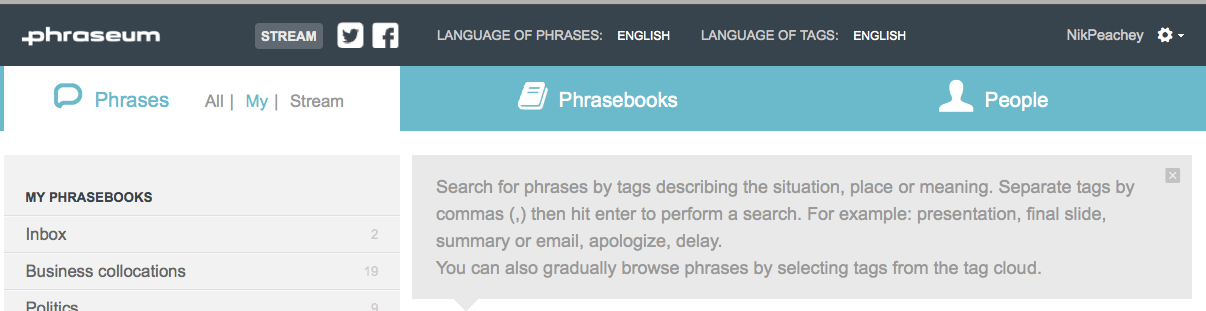
Phraseum allows you to collect words, phrases and sentences from anywhere on the web while you you browse and organise them into social phrasebooks.


Phraseum is a browser-based tool which can be activated from your browser toolbar. Simply create an account and then drag the ‘Clipping button’ bookmarklet to your favourites bar on your browser.


Once that’s done you can just collect any words or phrases that you find online by highlighting them and then clicking on the bookmarklet. This opens up a window where you can add tags to the phrase and add your own private notes and annotations. The tags could be a definition, translation, part of speech or something about the context in which it could be used. You can then save the phrase into one of your phrasebooks. The phrases and phrasebooks can be private or they can be made public and so shared with others.


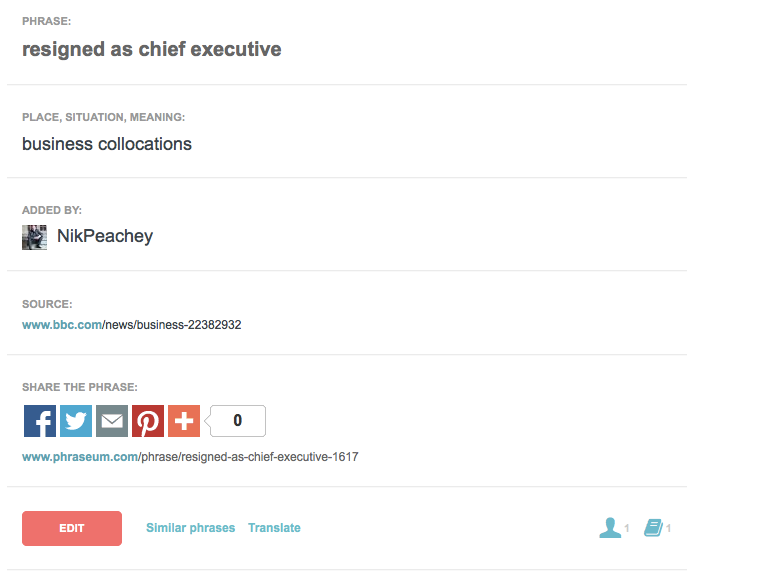
If you want to include specific words or phrases from a word document or PDF, you can also just type in the words or phrases you want to include in your phrasebooks, but if you save them from the web then Phraseum also stores a link back to the original source, so you can go back and see how the word or phrase is used in context. You can also get a link from the phrase to a translation from Google Translate.


Phraseum is social, so you can share phrases and phrasebooks with anyone else on the site and follow other people if you like the kinds of things they are saving and sharing. You can also click on any of the tags on your phrase to find other related words or phrases which have been saved by other users and add those to your own collection.

If you use social media with your students you can post the phrases you save through various social media channels so this is a great way to feed information and activities into something like a Facebook group or page or a Twitter feed that you use with students.

All of the entries you make to Phraseum can be edited and changed, so students can always add additional tags, change them and add the same entry to multiple phrasebooks.

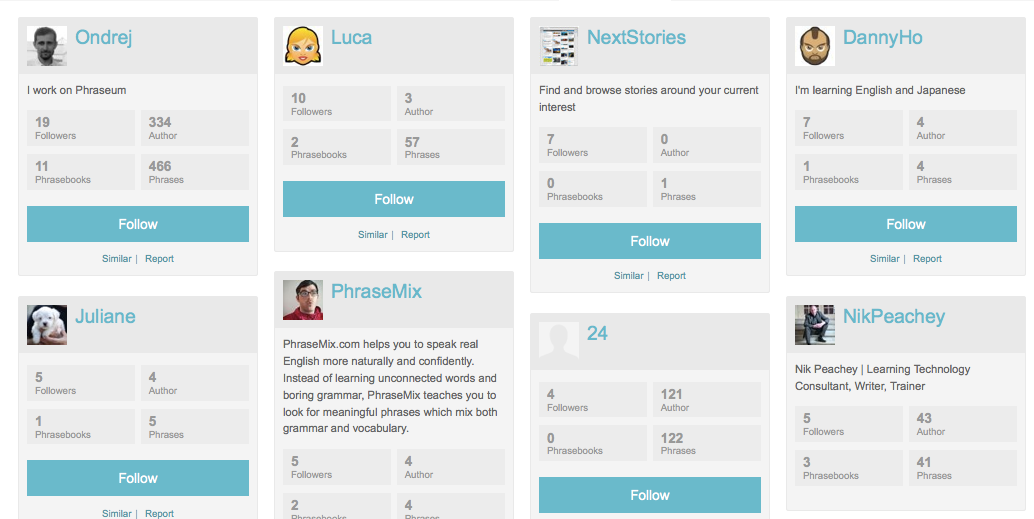
Phraseum also enables you to follow people in a similar way to Twitter or Pinterest. If you follow people you can see their public phrasebooks and keep up-to-date with what they are saving.


This is really useful if you are using it with students, as by following them you can easily monitor their work and use the comments feature if you need to help, support or encourage your students.

Here are a few examples of phrasebooks I\’ve created:


How to use Phraseum with students

  • You could get started just by creating a few of your own useful phrasebooks and sharing them with your students.
  • If you like to pre-teach vocabulary, a good way to do this would be to create a vocabulary phrasebook from a particular online article you would like your students to read. They can look at the phrasebook before they read and check they understand the vocabulary, or use it as a reference while or after they read.
  • You could also collect a phrasebook with a collections of more random words and phrases and see if the students can predict the genre or kind of text the phrases came from.
  • You can collect phrases into a phrasebook and ask students to suggest appropriate tags to add.
  • If you train your students to use Phraseum then they can start using it to create phrasebooks while they read. They can sort new words into specific groups. They could be grouped according to the source or topic or they could group words according to word classification such as parts of speech or types of collocation.
  • You can get students to share phrasebooks and crosscheck so that they share vocabulary and check that they have similar definitions or translations of the words.
  • You can send students on treasure hunts for specific things, for example searching for business related collocations. If they use this as the tag they will then be able to share their results together (any tag you click on shows you all other words and phrases which share that same tag).
  • Get students to use the phrasebooks to revise and review their vocabulary.


What I like about Phraseum

  • I love that it works in the browser tool bar. This makes it really easy and quick to access at any time you are online.
  • I really like the social aspect too. Being able to share and compare phrasebooks with other people is really useful.
  • It’s great that it makes it easy for students to go back to the source of the word or phrase.
  • Saving phrases really encourages students to think about words within lexical chunks rather than as independent entities.
  • Phraseum can be used in multiple languages.
  • It’s free.
I think this is a great tool to support more of a lexical approach to online learning. It can also support students digital literacy and study skills. I hope you and your students find Phraseum useful. Be sure to share in the comments any ideas you have for using it with your students.
Related links: