More about my family

When I composed yesterday’s post, I got so excited sharing the history of my family that I forgot part of what I wanted to say. Here it is:

This month I have been posting historic family pictures on FaceBook each day. Sometimes it’s a single picture, sometimes it’s two or three pictures. I’ve been getting good reactions from family—including cousins I almost never see anymore—as well as from other friends.

Why am I doing this? Well, as a historian and an archivist, I want to promote the business. Especially those weeks that I had to work from home, trying to do the same things I would be doing at work, I knew that I had to do the full job of an archivist—not merely to preserve and to organize, but also to share. Archivists don’t digitize the entire collection and put it online—we digitize a small amount of material that is interesting or informative. Real researchers don’t stop at surfing the internet; when they find something of interest, they identify where it is located and come to that place to look at the rest of the collection.

Beyond that, I have gotten major fatigue scrolling through FaceBook and other social media. It feels like a game of dodgeball back in junior high school, trying to avoid all the mentions of disease and politics and the intersection of the two. So I thought I’d change the subject—give myself and other people something different to talk about and think about. And that has worked.

It has worked so well that my sister and some of my cousins commented over the weekend that I ought to take all this family information I’ve been gathering and write a book. I’ve handled books written by genealogists. They tend to be dry as dust—recording vital information, but often omitting the interesting and unusual family stories about these various individuals.

So I’m considering a book on the Salvageable family. The first question is: how much of the family do I want to cover? Am I writing for my children and their descendants—do I want to include my wife’s side of the family? Do I want to focus on me and my ancestors? Or do I want to stick to my mother’s side of the family, which contains most of the interesting stories that have come to light thus far. (And includes those cousins who are suggesting that I write a book.)

Even though that matter is not settled, I have made two other decisions. If I write this book, I will start each family line with the immigrant who came to the United States. Where I know names and dates for ancestors who remained in Europe, I might include them in an appendix or sidebar, but I want this to be an account of the Salvageables in America. Also, rather than focusing on one line at a time, with chapters relating to different streams that entered the river, I want to make the book chronological. I would like to write a chapter for each decade, describing where the various ancestors were during that decade and what they were doing.

Moreover, I want to include some historic context in each chapter. Think how much fun the 1860s will be—men fighting each other in the Civil War (and I have ancestors who fought for the Union and ancestors who fought for the Confederacy). Wouldn’t it be cool to find two great-great grandfathers involved in the same battle, shooting each other? (And, if either of them had been a better soldier, I would never have been born.)

I can only guess how long it will take to complete the family research and begin writing. This project likely will be years in the making. And it will not be lucrative—we’re not talking Roots here. I don’t care to dabble in historical fiction, creating conversations that may have happened. I want to include verifiable facts, along with family stories and mysteries.

And this is much more fun than slogging through the current international crisis and thinking only about it night and day. J.
Why Nurses Should Get Their MSN

I graduated with my bachelor’s degree in nursing in 2017 and it wasn’t long before I started thinking about advancing my education with an MSN.

I graduated with my bachelor’s degree in nursing in 2017 and it wasn’t long before I started thinking about advancing my education with an MSN. I have a passion for teaching and I wanted to do more for my patients and help them learn how to lead healthier lives.

Deciding to go back to school wasn’t an easy decision. I was somewhat nervous about enrolling in an online MMSN program, especially because I was going to be working full-time while in school. My friends all said that earning their MSN was the best thing they ever did, but I wasn’t sure if I could make it work. Was I smart enough? Would I have the time? What if I failed?

I put those doubts aside and I’m glad I did. In nine short months, I will graduate with my Master of Science in Nursing from Herzing University’s Family Nurse Practitioner program. It has been challenging at times, but I have no doubt that it will be worth the time and the effort.

As a nurse practitioner, I will be able to be more involved in providing excellent care for my patients and I will owe it all to taking that first step to continue my education.

Here’s why you should consider earning your MSN:

1. Increasing demand for experienced, specialized nurses

As healthcare organizations deal with a growing patient population and a shortage of skilled healthcare professionals, nurses with advanced knowledge and skills are in high demand. With an MSN, you can expand your scope of practice, help train new nurses and play an increasingly central role in ensuring quality patient care.

Why Nurses Should Get Their MSN

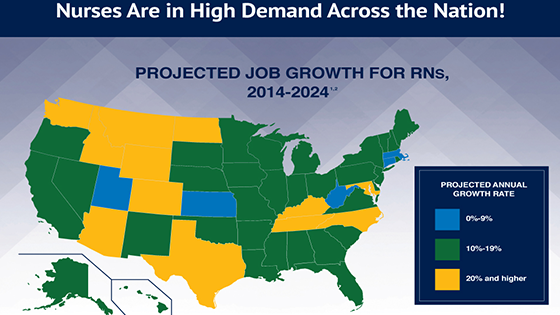
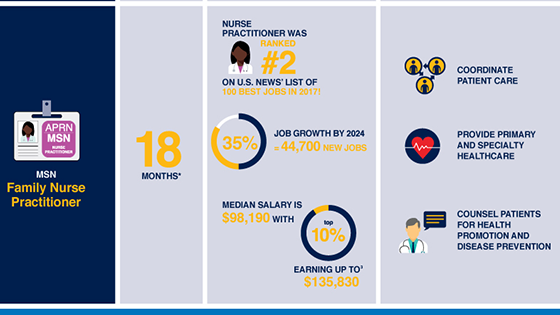
The Bureau of Labor Statistics predicts that employment for nurse practitioners will increase by 36 percent from 2016-2026, due in part to a shortage of primary care physicians and ever-growing demand for healthcare services. FNPs can make a very good salary; learn more about how much a family nurse practitioner can make in your state.

I wanted to be more involved in patient care, so becoming a nurse practitioner seemed like the perfect next step for me. Nurse practitioners are certified to provide many of the same services as a general physician and can help increase access to health care in underserved areas.

Why Nurses Should Get Their MSN

2. Advancement opportunities

I also knew that I would soon be left behind if I didn’t continue my education. New nurses are joining the workforce at a rapid rate, creating opportunities for experienced nurses to move into specialized roles and leadership positions. With an MSN, you can pursue specialties in a variety of different areas, including nurse education and nurse leadership. Advancing your education not only makes you more marketable for leadership roles, but it also increases your value to an organization and makes you an indispensable part of the nursing team.

Why Nurses Should Get Their MSN

3. More responsibility

As you advance to these leadership roles, you also gain more responsibility and have more opportunities to make a difference in patient outcomes. I knew that pursuing my MSN would allow me to be involved in the nursing process at a higher level, prescribing medications and working alongside physicians.

Why Nurses Should Get Their MSN

Today, I’m looking forward to graduation and I’m proud of the success I’ve had thus far. The support and resources provided by the faculty and staff at Herzing University have helped make this process possible. I have not felt alone once, which is especially important to me as an online student.

No matter what your inspiration is, earning your master’s degree in nursing is worthwhile. It will help you grow exponentially, not only in your career but in your relationships with others, as you will become their inspiration for continuing their education.

When I look in my nine-year-old daughter’s eyes, I know that she deserves this. I want to show her how hard work pays off, and that if you set a goal, it is attainable. I can only hope that this will inspire her someday, not to follow in my footsteps (although that would be lovely), but to set her own goals and see that they are within arm’s reach.

You owe it to yourself to dust off the books and advance your nursing degree. Your community will thank you and your future self will thank you. There is no better time than now to pursue the next step in your nursing career.

FLLinNZ meeting

Our planning session for the Flexible Learning leaders in New Zealand planning meeting all the 1st and 2nd round FLLinNZers gathered at Wiapuna Hotel at Mt Wellington, Auckland. We started with a warmup and a discussion of what we are expecting from the third round of funding and any issues.

The facilitator presented on the situation in Australia. Main points were:

  • competency-based apprenticeships
  • qualifications recognised across Aus
  • maximum flexibility in system – impacts on quality
  • grow private training orgs with effective competition
  • school-based apprenticeships
  • RPL – want to improve uptake
  • industry wants to control knowledge base – web 2 does not fit
  • training providers not keeping pace with rapid technological change – important
  • costs, flexibility and access
  • need training to meet needs of lifelong learners – skills shortages, shiftworkers, contractors, mature learners, just-in-time and to suit learners
  • need to build capability – respond to physical and online environment
  • changing role of education and training
key activity: who can we connect with to make the most influence?
often fail to equip people with skills to be able to problem solve and think forthemselves.
Pedagogical shifts
  • more of the following:
  • distributed networks
  • social networking
  • blended and flexible models
  • facilitation driving pedagogy not instruction
  • innovation
  • market changes e.g. full employment
Less occurrence of the teacher teaching many.
Examples: Motor Traders Association – mp3 audio files used in training to capture their interest
Caryl Oliver – mlearning – there is a recording of an interview with Caryl.
Manager of 2020: multigenerations, longer later, more teams, flexible working, performance emphasised, innovation
Overview of pressures on the NZ tertiary education sector can be seen on the concept map (to be loaded).
Facilitator talked about Australian Flexible Framework and how we could have links with Australian projects. Learnscope and Knowledge tree online journal. eLearning networks project is running a September Online Event: Tapping into Resources for E-learning 6 – 8 September 2006

Why I Became a Nurse After the Navy: Q&A with Shaeye Frierson

We sat down with Shaeye to learn more about her experience in the nursing program, as well as her transition to a career as a nurse educator.

Military veterans have a lot of relevant experience to share after their service to the country is over, and many of them are choosing a career in nursing to help meet growing demand.

Shaeye Frierson, a nursing instructor at Herzing University, joined the military at age 22, in hopes of building a better life for her 2-year-old son. During her 11 years as a hospital corpsman in the Navy, and through several deployments, she realized she had a true passion for helping others.

In 2010, Shaeye applied her Post-9/11 GI Bill funds toward nursing school at Herzing, while her mother helped her raise her two young children. She’s now working on her master’s degree while teaching nursing classes at Herzing, and serving as an unofficial mentor for military vets on campus.

We sat down with Shaeye to learn more about her experience in the nursing program, as well as her transition to a career as a nurse educator.

What inspired you to become a nurse?

I always knew I wanted to go into the medical field, but I wasn’t sure what I wanted to do. When I joined the military, I was offered a medic position and I really enjoyed it. I moved up in rank, and became even more passionate about my work. Our fellow soldiers depended on us for their lives. I thought there could be no more rewarding career than that. I knew then that I wanted to pursue a career in nursing.

What did you enjoy about the accelerated nursing program?

What was challenging? In the military, your education is so fast, and you get used to learning that way. The accelerated program was perfect for me, and I excelled because of my medical training and my experience with learning at that pace.

Balancing the demands of work and school can be challenging at times, and a lot of students struggle with that at first, especially in an accelerated program. I created a schedule for myself, setting aside time for homework, work, sleep, etc., because that’s how you’re programmed to do things in the military. It worked for me, and I share that tip with a lot of my students. It seems to work for them as well.

What are some of the differences between civilian healthcare and military healthcare?

A hospital corpsmen in the Navy can do pretty much everything a civilian nurse can do, and more. Our medical training in the military is often more advanced and accelerated than a traditional nursing program because we have to know how to handle a lot of different situations.

For example, in 2004, I was deployed on a ship for eight months. We only had one doctor on the ship. If a person was sick, they would come to us – the corpsmen—and we would treat them or provide recommendations for the doctor to sign off on. We had more autonomy than a civilian nurse because that’s the only way you can ensure everyone receives the care they need.

Why did you choose to become a nurse educator?

I graduated from Herzing with my BSN in 2013. I had become a mentor and resource for other military veterans on campus, and when the dean asked me if I wanted to be an instructor I accepted. Students with a military background need someone to help them navigate the transition to an accelerated nursing program, and I can be that person because I’ve done it myself. I’m currently enrolled in the MSN Nurse Educator program and expecting to graduate in January 2020.

What is most rewarding about being an educator?

The most rewarding part about my job is giving back to the university that helped me become the nurse I am today. I love helping out the military veteran students – even those that aren’t in the nursing program. I usually find out who they are during orientation, and make an effort to meet with them and ask about their concerns, if they need help with their benefits, etc. I want to help them be successful.

What advice would you offer to other veterans who want to pursue a healthcare career?

I would say Herzing is the perfect school for a military veteran, especially if you want to become a nurse. The accelerated BSN program is a smooth transition because the pace of learning is similar to what you’re used to. We also have incredibly supportive instructors to help you every step of the way.

How to Study Like a Straight-A Student

Establishing a study plan that works for you is most important, as everyone finds success in different ways. Here are some study tips!

Achieving straight A’s can be difficult, especially if you are just beginning your college journey. It takes time and practice to develop effective study habits, but once you master them, you will be well on your way to achieving the grades you want.

Developing good study habits has other benefits as well. If you suffer from test anxiety, better study habits can help boost your confidence and your comprehension of course material, which will make timed quizzes or final exams less stressful.

Establishing a study plan that works for you is most important, as everyone finds success in different ways. Once you find what works, it can truly be a game-changer.

Here are some tips for studying like a straight-A student:

1) Don’t procrastinate

Starting your assignments in a timely fashion is a simple and effective way to achieve higher grades. Procrastination is a bad habit that will make it difficult for you to do your best work. Once you are assigned something, try getting a start on it in the first few days, even if the due date is not for a few weeks. Working on assignments little by little can help break up a major task into more manageable pieces.

2) Ask for feedback whenever possible

Professors won’t know you need help unless you tell them. If you feel stuck on an assignment and need guidance, be proactive and approach the professor right away. The feedback they provide can help you determine whether you are on the right track or if you could use some re-direction. If you receive a poor grade on a paper, you can also talk to your professor after the fact to learn what you could have done differently. You can take this feedback to a tutor, or make a note of the things you want to correct the next time you have to complete a similar assignment.

3) Eliminate all possible distractions while studying

In order to be productive in your studies and achieve the best possible grade, you truly need to be 100% focused on the task at hand. Students that want to achieve high grades remove all distractions so that they are completely focused on their work. Leaving your phone or the TV remote in another room until you finish your schoolwork can make a world of difference in your productivity. That funny cat video will still be there when you are finished!

4) Study for understanding rather than memorization

It can be tempting to breeze through your study materials quickly, but this is not an effective study technique. Memorization may work well for a pop quiz, but it won’t do you much good on a final exam. Most professors care less about the specifics you’ve memorized and more about how you can apply your knowledge to real-world situations. Studying for understanding is a much better method to use because it will help you be better prepared for those more detailed assessments. Creating a study guide is one of the best ways to prepare for an exam and achieve a deeper understanding of the material.

5) Avoid cramming

Cramming the night before an exam is about as effective as not studying at all. If you try and cram a month’s worth of material into your brain in just one night, chances are you will only retain a small part of it. Spacing out your studying is much more effective and will help you to understand the concepts more thoroughly. In a study conducted at the University of California, spacing out your learning was proved to be more effective than cramming for 90% of participants. Studying in advance will also help you feel more prepared for an exam, which will help dull any last-minute exam stress.

6) Ask questions to test your understanding

Participating in class is another great way to test your comprehension of material and make sure that you are well-prepared for an upcoming assessment. Professors are always willing to answer questions and you can learn a lot from the answers they give you. This is also why it is important to attend every class session. There might be important topics discussed during class that are not in the textbook, and you never know when they might show up on an exam.

7) Work with other motivated students

Studying with other students who are as driven as you are can be quite a helpful resource. If others around you are engaging in productive activities, it is more likely that you will feel motivated to do the same. Study groups are also a great place to share ideas with your fellow classmates, learn new study techniques, and get help preparing for major tests or projects, especially if you are all taking similar courses.

Not only will these tips help you boost your grades, they can also help you develop other skills that will be important for your future, such as time management and communication. Even though grades won’t necessarily be a concern post-college, the need for a strong work ethic won’t disappear. By developing effective study habits now, you can position yourself for success both in and out of the classroom.

FLLinNZ meeting

Our planning session for the Flexible Learning leaders in New Zealand planning meeting all the 1st and 2nd round FLLinNZers gathered at Wiapuna Hotel at Mt Wellington, Auckland. We started with a warmup and a discussion of what we are expecting from the third round of funding and any issues.

The facilitator presented on the situation in Australia. Main points were:

  • competency-based apprenticeships
  • qualifications recognised across Aus
  • maximum flexibility in system – impacts on quality
  • grow private training orgs with effective competition
  • school-based apprenticeships
  • RPL – want to improve uptake
  • industry wants to control knowledge base – web 2 does not fit
  • training providers not keeping pace with rapid technological change – important
  • costs, flexibility and access
  • need training to meet needs of lifelong learners – skills shortages, shiftworkers, contractors, mature learners, just-in-time and to suit learners
  • need to build capability – respond to physical and online environment
  • changing role of education and training
key activity: who can we connect with to make the most influence?
often fail to equip people with skills to be able to problem solve and think forthemselves.
Pedagogical shifts
  • more of the following:
  • distributed networks
  • social networking
  • blended and flexible models
  • facilitation driving pedagogy not instruction
  • innovation
  • market changes e.g. full employment
Less occurrence of the teacher teaching many.
Examples: Motor Traders Association – mp3 audio files used in training to capture their interest
Caryl Oliver – mlearning – there is a recording of an interview with Caryl.
Manager of 2020: multigenerations, longer later, more teams, flexible working, performance emphasised, innovation
Overview of pressures on the NZ tertiary education sector can be seen on the concept map (to be loaded).
Facilitator talked about Australian Flexible Framework and how we could have links with Australian projects. Learnscope and Knowledge tree online journal. eLearning networks project is running a September Online Event: Tapping into Resources for E-learning 6 – 8 September 2006

Learning about Clinicals: Ask an ASN grad

We asked former Herzing nursing student Shenese Stewart about her clinical experience and what other nursing students can do in order to be successful

Your first clinical externship can be daunting, but it’s also exciting. You’re ready to get to work in the field, but it’s normal to feel a little nervous about working with real patients
We asked former Herzing nursing student Shenese Stewart about her clinical experience and what other nursing students can do in order to be successful.

What did your clinical mean to you?

Clinical was important to me because it gave me the opportunity to put my classroom knowledge into \”real life\” practice. I was able to work with patients and had the opportunity to ask questions.

In your opinion, why is a clinical experience so important to your nursing career?

Clinical experience is important to your nursing career because you are able to explore different areas in the clinical setting. Many times, you find what you like and don\’t like in clinical and that helps you decide what types of positions you will apply for when you graduate. It also helps connect the dots between theory and practice. Reading about something and actually doing it can help solidify it in your mind.

Do you have any secret tips on how to survive clinical?

Clinical can be intimidating, but don\’t leave with unanswered questions. Learn your medications and labs. Know how to keep your patient safe and never assume anything. Always ask questions, especially if it’s something you need to know to stay safe.

How important was your cohort during your clinical?

I feel that your cohort in clinical, not class, can make or break you. Your clinical cohort is experiencing a lot of the same feelings that you are, and they can encourage you, motivate you and explain things to you sometimes in a way that your instructors cannot. Try not to be the lone wolf in clinical.

How important is your clinical instructor?

Your clinical instructor is an invaluable resource who guides you and helps pull it all together. Don\’t be scared to tell your clinical instructor what you don\’t know. You may lose points, but you\’ll know next time, and your instructor will know that they can trust you to be honest, which is critical in nursing.

Tell us about a time that you struggled during your clinical and how you overcame that struggle.

It took a lot of practice for me to learn about all the different medications, side effects and drug classes. I was in a LPN clinical and was giving medications to a patient with my instructor. The patient asked me what Lisinopril was for and I told her it was for cholesterol (it’s actually for blood pressure). Not only did I lose 10 points for the day, the patient laughed and said, \”Stupid student, I knew I\’d get you.\” The lesson for me was to never treat any student in a disrespectful way – regardless of what profession they are preparing for – and to learn everything there is to know about Lisinopril!

Tell us a great memory about your clinical.

My best memories from clinical were when I felt that accomplishment of completion, when the light bulb went off in my head and I saw the big picture. You just connect bits and pieces until one day it all just makes sense.

Managing behaviour in the digital age

If you ask most teachers, especially newly trained ones, what one of the biggest challenges of teaching is, they would probably say managing student behaviour. Especially as class sizes grow and more students are bringing along potentially distracting digital devices, making sure you are keeping students on task is becoming ever more important. If this is something that concerns you, then read on.

ClassCharts could be the solution to your problem. ClassCharts is a digital management tool which can help you, your students and their parents to track and improve student behaviour across the whole school.


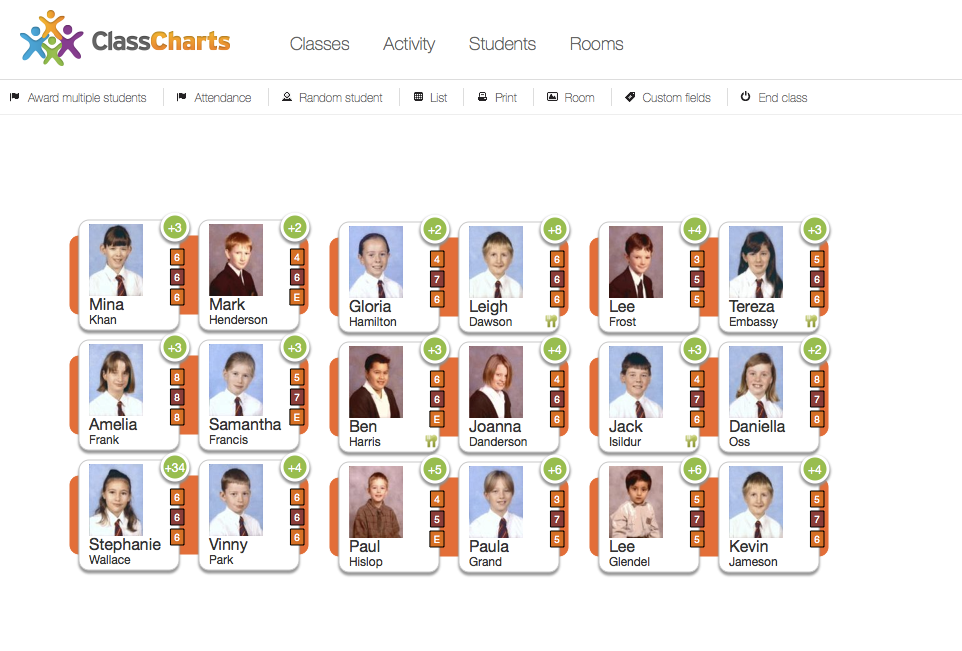
Using ClassCharts you can set up seating charts for every room in your school and create a profile for each student. Teachers can then use ClassCharts to monitor and reward positive behaviour as well as track negative behaviour. As the teacher builds up data across classes they can start to understand how different seating arrangements and student pairing and grouping can impact on behaviour, then generate seating charts for students that group them in ways that help them to work more efficiently and harmoniously.


So how does it work?

Well one of the first things to do is to add seating plans of your rooms. This is easy to do and you can drag the virtual desks around into whatever configuration you have in your classroom.


Then you also need to upload your students. What I really like about ClassCharts is that you can also upload a photograph of each one, and this can be really useful if you have large classes and lots of students names to remember, especially when it comes to writing reports.


You can then either manually assign seats or generate a random seating chart. During the class you can use ClassCharts acknowledge a range of positive and negative behaviours. These behaviours are all customisable so you can create your own or use the default ones.


ClassCharts uses html 5 so should run in any modern browser whether it’s a laptop, iPad or Android tablet, so the teacher can use an tablet during the class to instantly update behaviours.

Either before or during the class the teacher can also shuffle the class seating depending on a number of criteria from things like attainment targets to gender or previous behaviour.


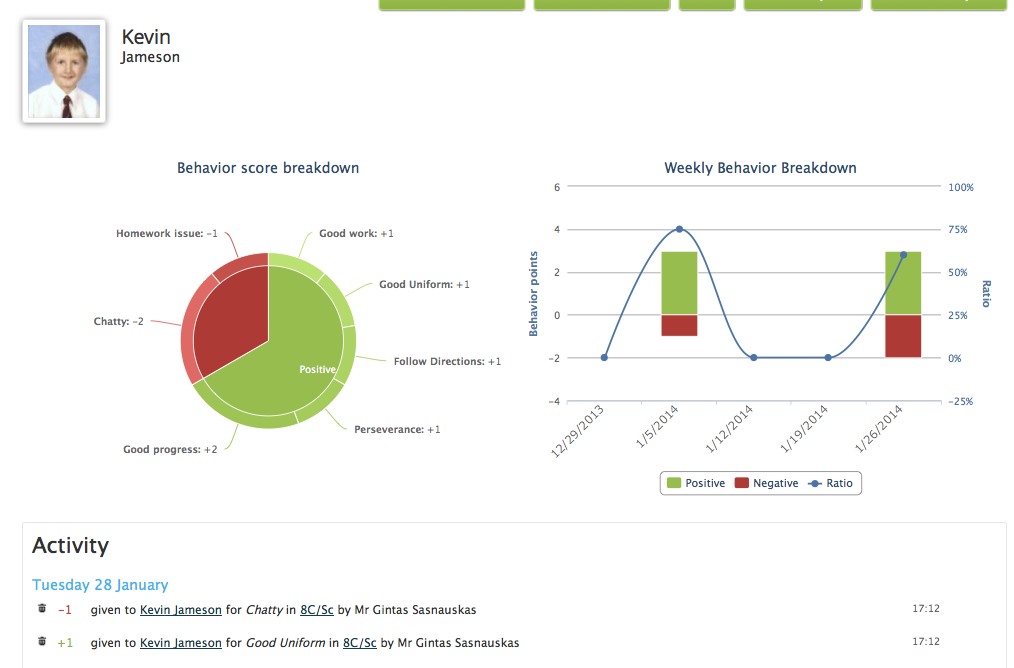
One of the real time-savers of ClassCharts though is when it comes to report writing time. Each students’ behaviour has been tracked through their various classes and teachers can get a detailed report, including dates when different behaviours were recorded.


Both students and parents can also access live reports and monitor progress throughout the term, so students and parents know how they are doing and parents don’t have to wait until the end of term to find out what’s been going on with their child.

This helps to share responsibility and makes it much easier to get parents involved in dealing with any negative behaviour at the earliest possible date.

Although ClassCharts is free and has been designed so that a single teacher can set it up to track their own classes independently, the real power of the platform is its ability to work across the school and track student behaviour in every class. To make this easier ClassCharts also interconnects with a range of other educational management software systems, from simple tools like Edmodo to more complex ones like SIMS and PowerSchool.


What I like about ClassCharts

  • I’m really impressed by the fact that such a powerful and well designed tool is free.
  • It’s great that a system like this and the data it collects can be applied and shared across a whole school.
  • I really like that you can see the student and access a range of information about them from targets, to behaviour and even a little about their background.
  • Great to get parents involved and students monitoring their own progress.


What I’m not so sure about

  • This is quite a complex tool and creates a lot of data, so I think it’s going to take a bit of getting used to for teachers and perhaps a bit of training too.
  • It does produce a lot of data and you can easily get a bit too tied up in this and forget about the person.
Well I hope you find ClassCharts useful and give it a try.
Related links: