Economic Revolution through Blue Revolution

The Pradhan Mantri Matsya Sampada Yojana (PMMSY) aims to enhance fish production to 220 lakh metric tons by 2024-25 from 137.58 lakh metric tons in 2018-19 at an average annual growth rate of about 9%. The Union Minister for Fisheries, Animal Husbandry and Dairying, Shri Giriraj Singh, today said the ambitious scheme will result in doubling export earnings to Rs.1,00,000 crore and generate about 55 lakhs direct and indirect employment opportunities in fisheries sector over a period of next five years. Dedicating the PMMSY to fishers, fish farmers, fish workers, fish vendors and other stakeholders associated with the fisheries sector, Shri Giriraj Singh said that insurance coverage for fishing vessels is being introduced for the first time. 

Addressing a press conference on the “PMMSY – A scheme to bring about Blue Revolution through sustainable and responsible development of fisheries sector in India”, approved by the Union Cabinet chaired by the Prime Minister Shri Narendra Modi on 20th May, 2020, Shri Giriraj Singh said that the scheme envisages an estimated investment of Rs. 20,050 crores comprising Central share of Rs. 9,407 crore, State share of Rs 4,880 crore and Beneficiaries contribution of Rs. 5,763 crore. He added that the PMMSY will be implemented over a period of 5 years from FY 2020-21 to FY 2024-25 in all States/Union Territories. 

Shri Giriraj Singh said that under the PMMSY thrust will be given towards enhancement of fish production and productivity, quality, sustainability, technology infusion, post-harvest infrastructure, modernisation and strengthening of value chain, standards and traceability in fisheries sector from ‘catch to consumer’, establishing a robust fisheries management framework, fishers’ welfare, enhancement of fisheries export competitiveness.  He further mentioned that PMMSY will create a conducive environment for private sector participation, development of entrepreneurship, business models, promotion of ease of doing business, innovations and innovative project activities including start-ups, incubators etc. in fisheries sector.  The Minister further mentioned that PMMSY being a fisher centric umbrella scheme, fishers, fish farmers, fish workers and fish vendors are the key stakeholders in the developmental activities envisaged and enhancement of their socio-economic status is one the core objectives of this scheme. 

The Fisheries Minister said that about 42% of the total estimated investment of the PMMSY is earmarked for creation and upgradation of fisheries infrastructure facilities. Focus areas include Fishing Harbours and Landing Centers, Post-harvest and Cold Chain Infrastructure, Fish Markets and Marketing Infrastructure, Integrated Modern Coastal Fishing Villages and Development of Deep-sea Fishing. Besides creating critical fisheries infrastructure by attracting private investments in fisheries sector, the scheme plans to reduce post-harvest losses from the present high of 25% to about 10% by modernizing and strengthening value chain. Under the Swath Sagar plan, activities envisaged with a view to modernize the fisheries sector include promotion of Bio-toilets, Insurance coverage for fishing vessels, Fisheries Management Plans, E-Trading/Marketing, Fishers and resources survey and creation of National IT-based databases. 

Underlining the need to enhance domestic fish consumption with corresponding health benefits, the Minister said that the Government will register “Sagar Mitra” and encourage formation of Fish Farmers Producer Organizations (FFPOs) to help achieve the PMMSY goals. Youth will be engaged in fisheries extension by creation of 3477Sagar Mitras in coastal fisher villages. Large number of Fisheries Extension Services Centers will be set up in private space to create job opportunities to young professionals. 

The scheme will also focus on several new activities and areas such as Traceability, Certification and Accreditation, Aquaculture in saline/alkaline areas, Genetic improvement programmes and Nucleus Breeding Centres, Fisheries and Aquaculture start-ups, promotional activities for fish consumption, branding, GI in fish, Integrated Aqua parks, Integrated coastal fishing villages development, State-of-art wholesale fish markets, Aquatic Referral Laboratories, Aquaculture Extension Services, Biofloc, support for new/upgradation of fishing boats, disease diagnostic and quality testing labs, Organic Aquaculture Promotion and Certification and Potential Fishing Zone (PFZ) devices. 

            Shri Giriraj Singh said that the PMMSY provides thrust for infusing new and emerging technologies like Re-circulatory Aquaculture Systems, Biofloc, Aquaponics, Cage Cultivation etc. to enhance production and productivity, productive utilization of wastelands and water for Aquaculture. He added that some activities like Mariculture, Seaweed cultivation and Ornamental Fisheries having potential to generate huge employment especially for rural women will be promoted.

Stressing on attaining self-sufficiency in availability of quality seed at affordable price, Shri Giriraj Singh said that the scheme will result in increasing aquaculture average productivity to 5 tons per hectare from the current national average of 3 tons per hectare. This will be achieved through promotion of high value species, establishing a national network of Brood Banks for all commercially important species, Genetic improvement and establishing Nucleus Breeding Centers for self-reliance in Shrimp Brood stock, accreditation of Brood banks, Hatcheries, Farms and also addressing diseases, antibiotics and residues issues, aquatic health management. These steps are likely to ensure quality, higher productivity, improve export competitiveness and fetch higher prices to fishers and farmers. 

            Constituting about 7.73% of the global fish production and export earnings of Rs.46,589 Crores (2018-19), India today has attained the status of the second largest aquaculture and 4th largest fish exporting nation in the world. Shri Giriraj Singh that the country has high potentiality to attain the 1st highest fishing producing and exporting nation in the world in the coming years, and his Ministry is committed to take the fisheries sector to newer heights. The Minister said that the Fisheries sector has shown an impressive growth in terms of fish production and export earnings during the past five years. The sector recorded an Average Annual Growth Rate of 10.88% during 2014-15 to 2018-19, 7.53% average annual growth in fish production and 9.71% average annual growth in export earnings, with 18% share in agricultural exports. He further added that the Gross Value Added (GVA) of Fisheries sector in the national economy during 2018-19 stood at Rs 2,12,915 crores which constituted 1.24% of the total National GVA and 7.28% share of Agricultural GVA. 

            Foreseeing the huge scope for development of fisheries, the Prime Minister Shri Narendra Modi, in December, 2014, had called for “a revolution” in the Fisheries sector and named it as “Blue Revolution”. The Union Government has taken several initiatives to harness the potential of the Fisheries sector in a sustainable and responsible manner towards ushering the Blue Revolution in Fisheries as envisioned by the Prime Minister. Some of the major reforms and steps taken by the Union Government include (i) Creation of a separate Ministry of Fisheries, Animal Husbandry and Dairying in the Union Government, (ii) Setting up a new and dedicated Department of Fisheries with independent administrative structure, (iii) Implementation of the Centrally Sponsored Scheme on Blue Revolution: Integrated Development and Management of Fisheries during the period 2015-16 to 2019-20 with a central outlay of Rs. 3,000 crore, (iv) Creation of Fisheries and Aquaculture Infrastructure Development Fund (FIDF) during 2018-19 with a fund size of Rs. 7,522.48 crore, and (v) Launching of PMMSY with an investment of Rs. 20,050 crore, the scheme with highest ever investment for fisheries sector. 

            The Ministers of State for Fisheries, Animal Husbandry and Dairying, Shri Sanjiv Kumar Baliyan and Shri Pratap Chandra Sarangi, and Secretary, Department of Fisheries, Dr. Rajeev Ranjan, were present during the press conference. On the occasion, the dignitaries released a booklet on the PMMSY.


Click here to view booklet on PMMSY

How to Set Goals and Stick to Them in the New Year

The start of a new year or a new semester can often restore your sense of motivation, and many people take advantage of that time to set goals.

The start of a new year or a new semester can often restore your sense of motivation, and many people take advantage of that time to set goals for the year ahead. There is an art to effective goal-setting, however. While there’s no harm in challenging yourself, you’re more likely to stick to your goals when you know you can be successful.

Here are five tips for setting and sticking to your goals:

1. Be SMART

The key to sticking with your goals is to make them challenging, but achievable. The SMART goal framework helps you establish goals that are specific, measurable, attainable, relevant and time-bound. Each of these criteria helps you think through your goals so that it’s easier for you to be successful.

For example, “getting good grades” is too vague to be a SMART goal because you don’t have a specific outcome to work toward, or a time frame in which you must achieve it. A better goal would be: “I want to get As in all of my courses this semester.” This goal is specific, measurable, attainable, relevant and time-bound.

2. Make a game plan

Once you’ve decided on your goals, create a game plan for how you intend to achieve them. For example, if you want to get all As next semester, you will need to make sure you’re on top of all your assignments and prepared for each exam. That might involve setting aside time to study each day, planning out all of your due dates ahead of time, or setting a standing appointment with a tutor for extra help.

“When you set a goal, you need to hold yourself accountable and commit to specific actions in order to get what you want,” says Tina Shanahan, an assistant professor of English at Herzing University. “Start out with a straightforward objective and then break it down into smaller steps.”

3. Set short-term benchmarks

It’s not always easy to stay motivated, especially when accomplishing your goals seems to be a long way off. If you’re working toward a long-term goal, like getting a promotion or graduating college, you might find it helpful to create short-term goals along the way. These goals can be a part of your larger game plan and they should also follow the SMART goal format.

For example, if your main goal is to graduate and get a job in two years, a short-term goal could be securing a relevant internship in your last semester, or meeting with a career coach to practice certain interview skills. These steps move you toward your ultimate goal and give you something to focus on in the moment.

4. Track your progress

Another great way to stay motivated is to keep track of your progress and celebrate your successes along the way. Keep a journal of the steps you’re taking to move closer to your goal and what worked or didn’t work along the way.

Let’s say you do well on an exam in one of your more difficult courses. Take a moment to reflect on the steps you took that helped you be successful. If you didn’t do so well, use that time to reflect on what you can do differently next time.

5. Adjust your goals as needed

Don’t get discouraged if you find it difficult to get the results you want. Life happens and sometimes you have to modify your goals along the way. Herzing University student Shenese Stewart learned that it’s OK to follow a different path than your peers and classmates.

“In order to be successful, you have to make realistic adjustments for your life,” she says. “Don’t compare yourself to what other people are doing. Everyone’s situation is different. Keep your eye on the prize.”

Relaxation to Tour Operators, Travel Agents and Tourist Transport Operators

The Ministry of Tourism classifies hotels under the star rating system to conform to the expected standards for different classes of tourists. Under this system, hotels are given a rating, from One Star to Three Star, Four and Five Star with or without alcohol, Five Star Deluxe, Heritage (Basic), Heritage (Classic), Heritage (Grand), Legacy Vintage (Basic), Legacy Vintage (Classic), Legacy Vintage (Grand) and Apartment Hotels, Home stays, Guest house etc. The classification/ certification is valid for period of five years.

Considering the current situation when the hospitality industry is going through a very difficult time in the wake of Covid 19 Pandemic and lockdown that has severely impacted the accommodation sector, it has been decided that validity of approval or certifications of hotels and other accommodation units whose project approvals/reapprovals and classification/reclassification have expired/are likely to expire during the period (24.03.2020 to 29.6.2020) are deemed to be extended till 30.06.2020.

Similarly, the Ministry has a scheme of approving Travel Agents, Tour Operators, Adventure Tour Operators, Domestic Tour Operators and Tourist Transport Operators etc. the idea being to encourage quality, standard and service in these categories so as to promote Tourism in India.

Due to postponement of inspection work and application scrutiny during the lockdown period from March 2020 onward in the wake of COVID-19 pandemic, the Ministry of Tourism has decided to allow six months’ relaxation or extension to all categories of Tour Operators (Inbound, Domestic, Adventure) Travel Agents and Tourist Transport Operators for their approval with the Ministry of Tourism subject to the following conditions: –

(i) The previous approval expired or the current approval expires during the period of 20th March, 2020 (i.e. the date of issuance of order by the Ministry for discontinuation of inspection work by India Tourism offices) till continuation of lockdown, and

(ii) They applied for renewal before expiry of their current/previous approval.

COVID-19 led to develop innovative tractor-mounted sanitization sprayer

For months, Rajendra Jadhav had been following the news of how Corona Virus was creating upheavals by devastating the health infrastructure and paralysing normal life. The sexagenarian villager from Satana in Nashik district had the vision to realise that this virus has the potential to create havoc if it happens to enter his village.

The information about how COVID-19 infection spreads and continuous awareness messages about the need for sanitization that were pouring in from radio, TV and WhatsApp messages. It made him realize the need for a mass sanitization drive in his village and tehsil.

The self-taught engineer who has been putting his technical knowledge to use in making agricultural tools and machineries to suit the needs of the local farming community, decided to develop a mass sanitizing machine. Accordingly, Jadhav started his research in his village workshop to develop a machine that can be used for mass cleaning of roads and public spaces. 

Within 25 days, he came up with an innovative sprayer mounted on a tractor which is capable of sanitizing or washing large areas like roads, societies, doors, compounds, walls, etc.

The sprayer consists of two radial fans of aluminium, moving opposite to each other. In terms of mechanism, each fan sucks air from two opposite directions, which is released through nozzles at high pressure with minute droplets sizes. As the panel rotates 180 degrees, it can cover from the ground up to 15 feet tall walls. Any 15 HP tractor can be used to operate this sprayer. 

Jadhav’s machine has a capacity to store 600 litres of disinfectant mixed water in the tanker. As a result, compounds, doors can easily be sanitized with this sprayer. 

An added advantage of using this sprayer for disinfecting works is that it hardly requires any human intervention and thus prevents human contact.  A single person can drive the tractor and operate the sprayer.

‘Yashwant’ santization sprayer has been identified as a potential S&T based innovative solution in Challenge COVID-19 Competition (C3) organised by the National Innovation Foundation 

The cost incurred for developing this machine is around 1.75 lakh rupees, stated Jadhav. This sprayer is being used by Satana Nagar Nigam to cleanse and disinfect about 30 sq. km area in Satana. 

Upon seeing the utility of this tractor mounted sprayer machine, a friend from Dhule district requested Jadhav to make one for sanitizing his village.  The second machine manufactured by Jadhav has been deployed for sanitization in Dhule district.

‘Yashwant’ Sanitization sprayer has been deputed to disinfect areas under Satana Municipality  

Rajendra Jadhav has named his innovative sprayer ‘Yashwant’. This is the brand name he uses for all the agricultural tools he makes.                             
While Rajendra Jadhav has applied for a patent for his unique sprayer, he has also sent across his innovative design to National Innovation Foundation (NIF). The Yashwant sprayer has been identified as a potential S&T based innovative solution in India’s fight against COVID-19.

Rajendra Jadhav with the tractor mounted sanitization sprayer he has developed to disinfect large areas in the wake of COVID-19. The sexagenarian is engaged in further improving the sprayer machine.

About National Innovation Foundation

NIF is India’s national initiative to strengthen the grassroots technological innovations and outstanding traditional knowledge. It was set up in the year 2000 in Ahmedabad to provide institutional support for scouting, sustaining and scaling up the grassroots innovations across the country.

Breakthrough event of Chamba Tunnel under Chardham Pariyojana

Union Minister for Road Transport & Highways and MSMEs Shri Nitin Gadkari today inaugurated the breakthrough event of Chamba Tunnel under Chardham Pariyojana through video conference mode. Border Roads Organisation (BRO) achieved this major milestone by digging up a 440 m long Tunnel below the busy Chamba town on Rishikesh-Dharasu road Highway (NH 94). The breakthrough was completed amidst threat of COVID-19 and nationwide lockdown. The construction of tunnel was a challenging task in terms of weak soil strata, continuous water seepage, heavy built up area on top thereby chances of sinking of houses, land acquisition issues, restrictions during COVID lockdown etc.

Union Minister for Road Transport & Highways and MSMEs Shri Nitin Gadkari today inaugurated the breakthrough event of Chamba Tunnel under Chardham Pariyojana through video conference mode.

Speaking on the occasion, the Minister said, this Rishikesh-Dharasu-Gangotri road in Uttarakhand has a very significant role from socio economic and religious point of view. He said, opening of this tunnel will ease out congestion though the Chamba town and reduce the distance by one kilometer and journey through the town will take only ten minutes as compared to thirty minutes earlier. Shri Gadkari lauded BRO for working in some of the very difficult terrain and ensuring implementation of critical projects. He said that he has been informed about completion of the project by October 2020, ie, three months ahead of the schedule.

Director General of Border Roads Organisation, Lt Gen Harpal Singh said, BRO started the work on North Portal of this tunnel in Jan 2019 but work on South Portal could be started only after Oct 2019 due to stiff resistance from locals on account of safety concerns and compensation issues. To compensate for the loss in time, day and night working shifts along with use of modern technology facilitated the breakthrough. BRO is a key stake holder in prestigious Chardham project and breakthrough of this tunnel has been achieved by Team Shivalik. Latest Austrian technology has been used in its construction. The tunnel will be through for traffic by October this year, almost three months before its scheduled date of completion.

Director General, Border Roads Organisation, Lt Gen Harpal Singh, PVSM, AVSM, VSM flagging off the first lot of vehicles through the tunnel. Shri Gadkari is seen in the inset.

Under prestigious Chardham Project costing around Rs 12,000 Crore with approximate length of 889 Km, BRO is constructing 250 Km of National Highways leading to holy shrine Gangotri and Badrinath. Majority of the works are progressing ahead of schedule and BRO is slated to complete four projects by October this year.

BRO has been entrusted 251 Km of stretches  costing Rs 3000 Cr approx consisting of 17 Projects on road Rishikesh – Dharasu (NH-94) from Km 28 onwards of 99 Km length, Dharasu- Gangotri Highway (NH-108) of 110 Km length and Joshimath to Mana ( NH-58) of 42 Km length. Out of these, 10 Projects consisting of 151 Km road length have been sanctioned which are worth Rs 1702 Cr and works are under progress as under:-

(i)       Rishikesh – Dharasu( NH-94) , 99 Km length (Five  projects).

(ii)     Dharasu- Gangotri Highway (NH-108), 22 Km length (Two  projects). Five projects of BESZ are yet to be sanctioned.

(iii)   Joshimath to Mana (NH-58) 32 Km (Three Projects). Two projects are yet to be sanctioned

BRO is slated to complete four Projects aggregating a length of 53 Km out of 10 ongoing projects ahead of their scheduled, date of completion as under:- 

  1. Dharasu- Gangotri Highway (NH-108) KM 110-123 by June 2020.
  2. Rishikesh- DharasuHighway (NH-94) Km28-59 by July 2020.
  3. Rishikesh- Dharasu Highway (NH-94) Km 59-65 including Chamba Tunnel by October 2020.
  4. Chinialisaur bye pass on Rishikesh- Dharasu Highway (NH-94) by October 2020.

A Tunnel of 440 mtr length to decongest busy Chamba town is being constructed out of these 10 projects. This is a Horse shoe type tunnel with 10 mtr carriage way width and 5.5 mtr vertical clearance. The sanctioned cost of this tunnel is 107.07 Crore. The awarded cost is Rs 86 Crore, including 43 Crore for Tunnel and 43 Crore for 4.2 Km approach roads to tunnel.

information literacy modules

bahtings
I would like to point people to an eLearning Collaborative Development funded (ECDF) project where we are developing reusable Information literacy modules – a New Zealand Ministry of Education funded project. The University of Otago is leading the project and the Dunedin College of Education and Otago Polytechnic are also involved in the project – Dunedin, New Zealand.

See http://oil.otago.ac.nz/ and click on the link to essay writing to see the first module which is currently being piloted.

We have set the modules up as authentic tasks and have funding until 2007 to construct 10 modules. The project has been a very interesting collaborative venture and the team is learning a lot from the experience.
We are conducting usability testing on the raw prototypes and conducting a research evaluation project with piloted modules. All the completed modules will be made freely available across the tertiary sector in New Zealand.

Some of the issues which are arising include aspects such as SCORM compliance and packaging and reusability. All modules will be transferable between different LMS and will also be able to be viewed using a scorm player. We have successfully managed to upload the module in to Moodle. However I was unable to upload it into Blackboard.

We are hoping lots of people will visit the site, and give us feedback on the module.

7 Important Teamwork Skills You Need in School and Your Career

Teamwork is one of the most sought-after skills in the workplace. Here are seven teamwork skills that are essential for your academic and professional success

Teamwork is one of the most sought-after skills in the workplace, according to a survey by the National Association of Colleges and Employers. Advancements in technology have allowed companies to be more connected and collaborative than ever before, with a diverse workforce dispersed around the world.

As a result, it’s even more important for employees to demonstrate strong teamwork skills, in both face-to-face and virtual team interactions.

College is the perfect time to start practicing your teamwork skills. Group work is an integral part of your academic coursework, and your internship, externship and clinical experiences are also a great opportunity to develop your relationship building, project management and leadership abilities.

Here are seven teamwork skills that are essential for your academic and professional success:

1. Communication

Communication is the foundation of effective teamwork. Whether you’re working on a presentation with your classmates or spearheading a new project at work, it’s important to talk openly and honestly with your group members about expectations, deadlines, and responsibilities. Establishing open lines of communication promotes trust and makes for a positive team environment. While disagreements might occur, being upfront and respectful in your communication with other team members will help you resolve issues quickly.

2. Time management

Time management, accountability and responsibility are all equally important for your career as they are in your academic life. Project managers, for example, must have strong organizational skills in order to set manageable goals for their team and keep others on track to meet their deadlines. Nurses must also demonstrate strong time management skills, prioritizing and delegating tasks so that they can spend more time on the patients who need extra care.

Learning how to balance multiple deadlines and assignments while you are in school will make it easier for you to adjust to a fast-paced and collaborative work environment in the future.

3. Problem-solving

Effective problem solvers are able to think outside the box when challenges or issues arise. Rather than focusing on negative outcomes, they stay calm and help their team work towards a solution. This approach helps uncover roadblocks or inefficiencies that are inhibiting the team’s success, so you can work to improve those processes in the future.

4. Listening

When working in a group, it’s important to keep an open mind. Recognize that your team members may see things from another perspective, and hear them out. Listening to other points of view can help you see multiple sides of an issue, including ones that you have never considered before. This allows you to be a better colleague and leader, to anticipate needs and challenges before they arise and to respond effectively when they do.

5. Critical thinking

Critical thinking allows you to make better, more informed decisions. It can be tempting to follow along with whatever the group decides, or what one team member believes is the best course of action, but sometimes a different approach or a new idea can help achieve better results. By thinking critically about the situation – examining all sides of an issue, reflecting on past experiences, and listening to what other group members have to say – you could arrive at a breakthrough that moves your team forward in new and exciting ways.

6. Collaboration

Working in a team can be challenging at times, but more often it is a great opportunity to uncover creative ideas, share different perspectives and experiences, as well as enhance your own skills. If you treat each group project as a learning experience, you can help foster a more productive team environment. Your desire to learn and your willingness to explore new approaches will make you a better contributor, manager, or leader.

7. Leadership

A leader who works well with others – both within his or her own department and across departments – can help spread knowledge and resources, develop new leaders and contribute to an organization’s success. Leaders can demonstrate strong teamwork skills by promoting collaboration, acting as a mentor or coach for their employees and by empowering others to learn, grow and advance.

At Herzing, we help you sharpen or develop the skills you need for career advancement through group work, hands-on learning experiences, presentations and capstone projects. Additionally, our P.R.I.C.E. of Success philosophy is focused on the core values of professionalism, respect, integrity, caring and engagement, which are the foundation for a successful, meaningful career.

Learn more about our degree programs and start your path to career advancement today!

8 Skills Dental Assistants Need to Master

Dental assistants work closely with dental hygienists and dentists to treat patients. They take X-rays, perform office management tasks and educate patients.

Dental assistants work closely with dental hygienists and dentists to treat patients. In addition to helping dentists during examinations and procedures, dental assistants also take X-rays, perform office management tasks and educate patients on proper oral care and hygiene.

The role of a dental assistant might sound similar to that of dental hygienist, but there are important differences. Dental assistants help prepare patients for exams, while hygienists are primarily responsible for cleaning patients’ teeth and evaluating their oral health.

There are plenty of advantages to becoming a dental assistant, including flexible schedules, variety in your day-to-day routine and strong employment prospects. The Bureau of Labor Statistics projects 11% employment growth for dental assistants through 2028, which equates to more than 38,000 new jobs.

Here are some of the skills you need to be successful as a dental assistant:

1.) Administrative skills

Dental assistants spend part of their time completing office tasks, such as answering phones, scheduling appointments and maintaining patient records. Strong time management skills and attention to detail are necessary, as is a basic understanding of medical records systems and technology.

2.) Communication skills

Dental assistants are often one of the first people to interact with patients during an appointment. They might be in charge of asking about a patient’s medical history, explaining a procedure and teaching patients about proper oral care. Having good communication skills can help dental assistants build a rapport with their patients, gauge patients’ pain levels, and learn important information about their medical history that might affect the procedure or treatment plan. Communication and teamwork are also necessary for working alongside dentists, dental hygienists and other members of the dental team.

3.) Critical thinking

Being able to think critically is an important skill as a dental assistant. As a helping hand to dentists, you need to be able to anticipate their needs and have all the necessary tools and instruments ready to go at a moment’s notice. Don’t be afraid to be proactive if you know there is something else you can do that will help the dentist during a procedure. Being flexible and adaptable are important skills to develop.

4.) Ability to follow instructions

Dental assistants need to be attentive and quickly follow through on instructions. It can be easy to get distracted when there are multiple things that need your attention, but making sure you stay focused and alert when the dentist needs you is crucial.

5.) Good judgment

Dental assistants also need to have strong decision-making skills. While you don’t have complete control over the direction of a procedure, your input is still valid and if you feel something needs to change for the benefit of a patient, be sure to speak up! Having basic knowledge of dental medicine will allow you to make more informed decisions and react quickly and appropriately in any given situation.

6.) Strong customer service skills

Interacting with patients is a huge part of a dental assistant’s primary responsibilities. Greeting patients with a smile and providing assistance wherever needed makes a great impression and keeps them coming back to your office. Being friendly and welcoming can also provide comfort to patients who are first-timers or nervous about being at the dentist.

7.) Strong organizational skills

Keeping track of patient appointments and patient information takes a great deal of organization. This information is confidential, so dental assistants must take great care to keep an organized workspace and ensure all patient records are filed appropriately.

8.) Basic knowledge of dental medicine

Some states require dental assistants to graduate from a dental assisting program. Typically, an associate degree in dental assisting can be completed in one year. Herzing University offers both a diploma and associate degree in dental assisting at its Minneapolis campus. In addition to becoming qualified for entry-level dental assisting roles, graduates of the associate degree program are prepared for bachelor’s-level programs in healthcare management or dental hygiene.

Additionally, through Herzing’s unique dental pathway, students have the option to earn their dental assisting qualification in as little as 24 months, and then continue earning a Bachelor of Science in Dental Hygiene while they gain work experience.

If you’re interested in helping others and promoting oral health, a career as a dental assistant could be the right path for you. Learn more about Herzing’s dental degree programs and find out how you can get started.

Create online learning with 123ContactForm

123ContactForm may not sound like the kind of tool that would be of interest to educators, but as I discovered when they asked me to review their online form creation tool, they offer quite a range of features that can solve many of the problems we have as 21st century teachers.


We can use it to:

  • Create surveys to do research and action research
  • We can create interactive materials based around multimedia objects
  • We can eve use it to sell our materials or services online and take payments


The tool itself is browser based and so doesn’t require any downloading or installation and that in itself can save a lot of hassle if you work in an institution that has very restrictive practices regarding the installation of software.

To get started you just need to go to the site and register at: http://www.123contactform.com/education-forms.htm

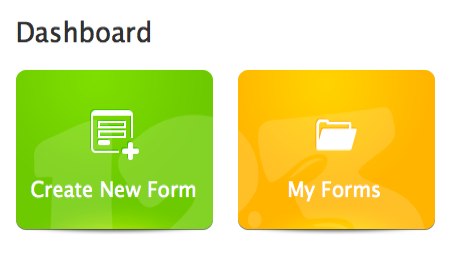
Once you have registered you get access to the dashboard and this is where you can start creating your forms. You just need to click on ‘Create New Form’.


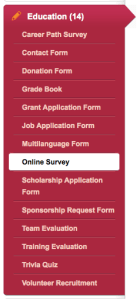
You will then get a choice of different types of form to create. It’s a good idea to click on ‘Other Forms’ this takes you to the online educator forms.   If you have a look at some of the templates and educator forms that have already been created it will give you some idea of what the platform can do. There is an Education section with some ready made templates in.


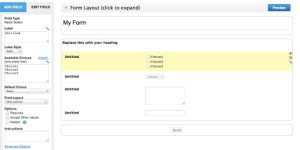
When you are ready to create your own educator forms, you could start by clicking on ‘Blank Form’. Call your form ‘My first activity’ and then save it and look at the different types of interactions you can create.

You will see the basic interactions you can add to the page. Clicking on them will add the interaction type to the page.


Then when you click on the interaction type you can edit its features.


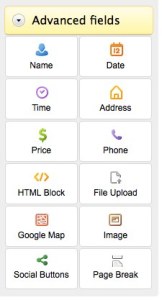
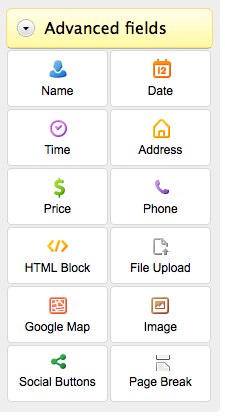
Some of the advanced interaction types are particularly interesting, especially the html feature which enables you to embed interactive media objects such as videos or digital books into your forms and then build interactive activities around them.


You can also add social buttons to enable users to share your activities through social media channels. 123ContactForm does also have a Facebook app so once your activities are complete you can post them directly into Facebook pages or groups for users to do from there.

This video shows you how to use all the main features of the forms.


Once you have created your activities they are saved in the ‘My Forms’ section of the site and you can go there to edit them. Here you can get the code to publish your educator forms into your bog website or CMS, or get a link to email out to students.

You can also check to see who has submitted answers to the questions and see the record of what answers have been given in the ‘Reports’ section. This is one of the best features of the site as it turns it into a form of LMS (learning management system) where you can collect and analyse students responses and generate graphs of the results.

The site also allow users to add and customise the theme of the forms, so if you want them to blend into your site or blog, then customising the look and feel of the forms is quite easy and you can even add your own logo.

This video shows you how to customise your form.


So how can we use this with EFL / ESL students?

  • We can create action research forms and get detailed and anonymous feedback on our teaching
  • We can create multimedia materials for learning or assessment and track our students responses. This is particularly useful if we a creating homework assignments and we need to assess these and know that our students have done them.
  • We can create learning objects to embed into online courses that track and assess students’ performance.
  • We can make fun engaging quizzes based around images.

As ELT professionals

  • We can use the forms to create surveys for research.
  • We can start selling materials, self published books, or private online classes and collect payment in a safe and secure way.

What I like about 123ContactForm

  • It’s a very versatile platform and really does enable a lot more than the name suggests. In fact it’s a pretty sound way to create online learning materials with a built in LMS.
  • It’s a great tool for freelancers who want to start making money online by selling their own products and services in a user friendly way.
  • It runs in the browser and is pretty simple to use.
  • It’s easy to produce something that looks very professional.
  • I’ve said it already, but the tracking capabilities are great.
  • The company runs on a freemium model, so although it is a free service, there is also a business model there to support the site so it’s less likely to suddenly disappear or fold.

What I’m not so sure about

  • As I said the company runs on a freemium model, so many of the best features are the ones they charge for.
  • On the free subscription you can create 5 forms and collect up to 100 students’ responses each month which is probably enough for the individual teacher to use it with a class, but it would be nice to have a few more of the premium features available to the Free subscriber, such as the html embed to enable the use of video and multimedia in the activities.
  • You have to be on the Platinum account to be able to enable payments and that costs $29.95 per month, which for a company or school is not much, but for a teacher / freelancer who wants to test the waters with selling their own products or services, it might seem like quite a big risk when they are just getting started, but you can cancel your subscription if things don’t go well and 123ContactForm does offer a 30day money back guarantee. It’s also worth mentioning that if you are a teacher or teacher trainer and you get in contact with the company, they are offering a 35% educational discount, so that can help to reduce the risk and the cost.


On the whole I think this is a really good product, particularly for a small school that wants to venture into online teaching or blended learning, then a platinum account at $29.95 per month is quite a small risk. For a teacher thinking of going freelance it might be a good option if you are confident that you can make enough through online sales to justify the monthly outlay. As a teacher working in class, then it’s a nice way to get started with creating some online learning with a degree of interactivity, but it would be much more attractive if the html embed functionality came as part of the free subscription.

123ContactForm has plenty of potential for the online educator or anyone wanting to create blended learning, so it’s well worth checking out, and when I get my book finished I may well be using it myself. I hope you find it useful too.

Related links:

Financial lending Institutions to support Small-scale units

Union Minister for MSME and Road Transport and Highways, Shri Nitin Gadkari today said that the government is exploring new financial lending institutions to support small-scale units in terms of financial support.  Shri Gadkari said that government is working towards strengthening the NBFCs which will help small businesses to avail easy credit in the coming time.

He was speaking at a meeting via video conferencing with the Members of Calcutta Chamber of Commerce on impact of COVID-19 on MSMEs and the measures taken to address the challenges at hand.

Addressing the members, Shri Gadkari re-iterated that these are trying times as we are waging a war against COVID-19 pandemic as well as the economic instability caused by it. He requested all the stakeholders to work in tandem and urged the industry to maintain a positive attitude during this time to tide over this crisis.

The Minister also stressed  on usage of PPE (masks, sanitizer etc.) and advised to maintain social distancing norms in personal life and at work places.

Apprising the representatives of recent announcement on Special Economic Package: Aatmanirbhar Bharat Abhiyan, he explained various support measures which has been announced for MSMEs such as collateral free automatic loan, distress fund etc. He said that all these measures will provide the required support to MSMEs to face the current economic challenges.

The Minister also informed them  that there has been restructuring of 6 lakh MSMEs till March 2020 and the Ministry is aiming to cover additional 25 lakh until December 2020. He added that the current contribution of MSMEs in export is 48%, which may be increased to 60%. He further shared that currently 11 crore jobs have been created through MSMEs and this to be increased to 5 crores.

The Union Minister mentioned that special focus towards export enhancement is the need of the hour. He further added that there is need to reduce our cost on production, logistics etc. to become economically viable. The Minister shared that the Ministry of MSME is working on two booklets to cover details about last three year’s export and import.

Some of the questions asked and the suggestions given included: issue of delayed payment needs additional thrust to ensure timely payment to MSMEs, interest subvention of 4% should be looked at to provide support to MSMEs and safeguard them from becoming an NPA, how banks can be incentivized for proper implementation of proposed measure etc.

Shri Gadkari responded to the questions from representatives and assured all possible help from the government.

National Gallery of Modern Art commemorates 115th Birth Anniversary of Ramkinkar Baij

Ministry of Culture’s National Gallery of Modern Art will organise virtual tour titled “Ramkinkar Baij | Journey through silent transformation and expressions” to commemorate the 115th Birth Anniversary of Ramkinkar Baij on 26th May 2020. The NGMA takes pride in 639 works of art created by the iconic artist. This virtual tour presents the works of art from the prominent artworks of Ramkinkar Baij from reserve collection of NGMA, grouped in a series of five different themes of (i) Portrait, (ii) Life Study, (iii) Abstract & Structural Composition, (iv) Nature Study & Landscape and (v) Sculptures.


Director General of NGMA Shri Adwaita Charan Gadanayak said that this virtual tour is being launched to pay tribute to the one of the greatest sculptor, painter – an iconic artist of modern India, especially for the young artists to know the kind of restless experiment that the artist had one with forms – figurative and abstractive both.


Shri Gadanayak added that I take pride of the tireless effort of our entire IT Cell to conceive and conceptualize the idea of launching this Virtual Tour and design and develop the same amidst lock down period to facilitate our esteemed visitors with such prestigious collection of NGMA.


This virtual tour also includes ‘Jeevansmriti’ to through light into the memory lane in addition to showcasing 520 works of art by the iconic artist in five distinct categories and three sketch books. At the end of the tour visitors can ‘Join the Conversation’ on the first cultural media platform under the banner of NGMA at https://so-ham.in/ramkinkar-baij-journey-through-silent-transformation-and-expressions/ and also attempt a quiz based on the content of the virtual tour.


Ramkinkar Baij, one of the most seminal artists of modern India, was an iconic sculptor, painter and graphic artist. Ramkinkar Baij (1906-1980) was born in Bankura, West Bengal, into a family of little economic and social standing and grew by his sheer determination into one of the most distinguished early modernists of Indian art. In 1925, he made his way to Kala Bhavana, the art school at Santiniketan and was under the guidance of Nandalal Bose. Encouraged by the liberating, intellectual environment of Santiniketan, his artistic skills and intellectual horizons blossomed, thus acquiring greater depth and complexity. Soon after completing his studies at Kala Bhavana he became a faculty member, and along with Nandalal Bose and Benodebehari Mukherjee played a pivotal role in making Santiniketan one of the most important centres for modern art in pre-Independent India. Ramkinkar’smonumental sculptures are established landmarks in public art. One of the earliest modernists in Indian art, he assimilated the idioms of the European modern visual language and yet was rooted in his own Indian ethos. He experimented restlessly with forms, moving freely from figurative to abstract and back to figurative, his themes were steeped in a deep sense of humanism and an instinctive understanding of the symbiotic relationship between man and nature. Both in his paintings and sculptures, he pushed the limits of experimentation and ventured into the use of new materials. For instance, his use of unconventional material, for the time, such as cement concrete for his monumental public sculptures set a new precedent for art practices. The use of cement, laterite and mortar to model the figures, and the use of a personal style in which modern western and Indian pre-classical sculptural values were brought together was equally radical.

Although, his work was passed over for quite a while, gradually it began to get both national and international attention. He was invited to participate in the Salon des Réalités Nouvelles in 1950 and in the Salon de Mai in 1951. In the national honours began to come his way one after the other. In 1970, the Government of India honoured him with the Padma Bhushan for his irrefutable contribution to Indian art. In 1976 he was made a Fellow of the Lalit Kala Akademi. In 1976, he was conferred the honorary Doctoral Degree of ‘Desikottama’ by Visva Bharati, and in 1979 an honorary D.Litt by Rabindra Bharati University.

Ramkinkar made his last journey, after a period of illness, in Kolkata on the 2nd August, 1980.

information literacy modules

bahtings
I would like to point people to an eLearning Collaborative Development funded (ECDF) project where we are developing reusable Information literacy modules – a New Zealand Ministry of Education funded project. The University of Otago is leading the project and the Dunedin College of Education and Otago Polytechnic are also involved in the project – Dunedin, New Zealand.

See http://oil.otago.ac.nz/ and click on the link to essay writing to see the first module which is currently being piloted.

We have set the modules up as authentic tasks and have funding until 2007 to construct 10 modules. The project has been a very interesting collaborative venture and the team is learning a lot from the experience.
We are conducting usability testing on the raw prototypes and conducting a research evaluation project with piloted modules. All the completed modules will be made freely available across the tertiary sector in New Zealand.

Some of the issues which are arising include aspects such as SCORM compliance and packaging and reusability. All modules will be transferable between different LMS and will also be able to be viewed using a scorm player. We have successfully managed to upload the module in to Moodle. However I was unable to upload it into Blackboard.

We are hoping lots of people will visit the site, and give us feedback on the module.

How to Give a Presentation like a Pro

Developing strong presentation skills early will benefit you considerably when you’re asked to give a presentation later in your career.

No matter what career path you’re pursuing, having strong communication skills is a must – and that includes being able to give a solid presentation. Developing strong presentation skills early will benefit you considerably when you’re asked to give a presentation later in your career, whether it’s at a sales meeting, a conference or to internal team members.
The classroom is a great place to learn and apply different speaking techniques. Even skilled public speakers have opportunities to improve because giving a strong presentation is about more than just confidence.
Here’s how you can knock it out of the park next time you’re asked to give a presentation:

Know your audience

A lot of the work that goes into a successful presentation happens before you even get up in front of the room. It’s important to first understand who your audience is and what your primary goals are for the presentation. Is it to inform your audience? Inspire? Create action?
If you’re speaking to a classroom of your peers, for example, your primary goal is likely to educate. If that’s the case, you might want to include some activities or opportunities for interaction so that people have a chance to engage with and reflect on the material you’re presenting.

Focus on key messages

Next, determine what you want your audience to take away from your presentation. If they only remember one thing you said, what would you want that to be? Then, focus on weaving those key messages throughout your presentation and driving them home at the end of your talk.

Show – don’t tell

While statistics and data points can be helpful for supporting your main ideas, they’re not as engaging for your audience. Bring your presentation to life by including different types of multimedia, or breaking up large chunks of information with anecdotes or interactive sessions.
Keep in mind that your presentation doesn’t necessarily have to be a PowerPoint. While slideshows can be a great way to display key information, many people end up putting too much information on their slides – and that makes for a boring presentation.
Consider other ways to incorporate visuals, such as by showing a video at the beginning, or using handouts as a reference sheet for key points. Prezi is another tool that can help you create a more innovative and engaging slideshow experience.

Tell a story

Good speakers know how to elicit an emotional buy-in from their listeners. There are many ways to do this, but the most effective way is to tell a story.
All stories have a beginning, a middle and an end. For example, when Steve Jobs introduced the iPhone to an audience of investors and international media, he didn’t just jump into talking about the new product. Jobs painted a picture for his audience by retelling the history of communication technology, leading all the way up his revolutionary new product – the iPhone.
The iPhone was the new frontier, the key to making our lives faster and easier. It wasn’t just something we all would want – it was something we all would need. The presentation is still recognized as one of his best. If you haven’t seen it, check it out here.

Practice

Of course, practice makes perfect. Running through your presentation a few times will help you feel more comfortable on the big day. Think about memorizing your key points so that you don’t have to rely on notes during your presentation and practice moving around the space so that you can engage different parts of the audience. Check out this blog post for more tips on being a confident public speaker.

Create online learning with 123ContactForm

123ContactForm may not sound like the kind of tool that would be of interest to educators, but as I discovered when they asked me to review their online form creation tool, they offer quite a range of features that can solve many of the problems we have as 21st century teachers.


We can use it to:

  • Create surveys to do research and action research
  • We can create interactive materials based around multimedia objects
  • We can eve use it to sell our materials or services online and take payments


The tool itself is browser based and so doesn\’t require any downloading or installation and that in itself can save a lot of hassle if you work in an institution that has very restrictive practices regarding the installation of software.

To get started you just need to go to the site and register at: http://www.123contactform.com/education-forms.htm

Once you have registered you get access to the dashboard and this is where you can start creating your forms. You just need to click on \’Create New Form\’.


You will then get a choice of different types of form to create. It\’s a good idea to click on \’Other Forms\’ this takes you to the online educator forms.   If you have a look at some of the templates and educator forms that have already been created it will give you some idea of what the platform can do. There is an Education section with some ready made templates in.


When you are ready to create your own educator forms, you could start by clicking on \’Blank Form\’. Call your form \’My first activity\’ and then save it and look at the different types of interactions you can create.

You will see the basic interactions you can add to the page. Clicking on them will add the interaction type to the page.


Then when you click on the interaction type you can edit its features.


Some of the advanced interaction types are particularly interesting, especially the html feature which enables you to embed interactive media objects such as videos or digital books into your forms and then build interactive activities around them.


You can also add social buttons to enable users to share your activities through social media channels. 123ContactForm does also have a Facebook app so once your activities are complete you can post them directly into Facebook pages or groups for users to do from there.

This video shows you how to use all the main features of the forms.


Once you have created your activities they are saved in the \’My Forms\’ section of the site and you can go there to edit them. Here you can get the code to publish your educator forms into your bog website or CMS, or get a link to email out to students.

You can also check to see who has submitted answers to the questions and see the record of what answers have been given in the \’Reports\’ section. This is one of the best features of the site as it turns it into a form of LMS (learning management system) where you can collect and analyse students responses and generate graphs of the results.

The site also allow users to add and customise the theme of the forms, so if you want them to blend into your site or blog, then customising the look and feel of the forms is quite easy and you can even add your own logo.

This video shows you how to customise your form.


So how can we use this with EFL / ESL students?

  • We can create action research forms and get detailed and anonymous feedback on our teaching
  • We can create multimedia materials for learning or assessment and track our students responses. This is particularly useful if we a creating homework assignments and we need to assess these and know that our students have done them.
  • We can create learning objects to embed into online courses that track and assess students\’ performance.
  • We can make fun engaging quizzes based around images.

As ELT professionals

  • We can use the forms to create surveys for research.
  • We can start selling materials, self published books, or private online classes and collect payment in a safe and secure way.

What I like about 123ContactForm

  • It\’s a very versatile platform and really does enable a lot more than the name suggests. In fact it\’s a pretty sound way to create online learning materials with a built in LMS.
  • It\’s a great tool for freelancers who want to start making money online by selling their own products and services in a user friendly way.
  • It runs in the browser and is pretty simple to use.
  • It\’s easy to produce something that looks very professional.
  • I\’ve said it already, but the tracking capabilities are great.
  • The company runs on a freemium model, so although it is a free service, there is also a business model there to support the site so it\’s less likely to suddenly disappear or fold.

What I\’m not so sure about

  • As I said the company runs on a freemium model, so many of the best features are the ones they charge for.
  • On the free subscription you can create 5 forms and collect up to 100 students\’ responses each month which is probably enough for the individual teacher to use it with a class, but it would be nice to have a few more of the premium features available to the Free subscriber, such as the html embed to enable the use of video and multimedia in the activities.
  • You have to be on the Platinum account to be able to enable payments and that costs $29.95 per month, which for a company or school is not much, but for a teacher / freelancer who wants to test the waters with selling their own products or services, it might seem like quite a big risk when they are just getting started, but you can cancel your subscription if things don\’t go well and 123ContactForm does offer a 30day money back guarantee. It\’s also worth mentioning that if you are a teacher or teacher trainer and you get in contact with the company, they are offering a 35% educational discount, so that can help to reduce the risk and the cost.


On the whole I think this is a really good product, particularly for a small school that wants to venture into online teaching or blended learning, then a platinum account at $29.95 per month is quite a small risk. For a teacher thinking of going freelance it might be a good option if you are confident that you can make enough through online sales to justify the monthly outlay. As a teacher working in class, then it\’s a nice way to get started with creating some online learning with a degree of interactivity, but it would be much more attractive if the html embed functionality came as part of the free subscription.

123ContactForm has plenty of potential for the online educator or anyone wanting to create blended learning, so it\’s well worth checking out, and when I get my book finished I may well be using it myself. I hope you find it useful too.

Related links: