7 Workplaces Your FNP Degree Can Take You

If you’re looking to advance your nursing career, consider becoming an FNP. FNPs have specialized educational and clinical training in family practice.

If you’re looking to advance your nursing career, consider becoming a Family Nurse Practitioner (FNP), which offers a more specialized path within the healthcare field. FNPs, also known as family nurse practitioners, have specialized educational and clinical training in family practice. They provide care to patients of all ages, giving diagnoses, offering health advice and discussing topics such as disease prevention. A few examples of regular FNP duties could include:

  • Providing immunizations
  • Prescribing medications and therapies
  • Providing comprehensive physical exams
  • Ordering diagnostic tests
  • Performing procedures

Due to the aging baby boomer population, the job outlook for FNPs is expected to increase 26%by 2028, creating an estimated 53,300 new jobs, according to the Bureau of Labor Statistics (BLS). According to the BLS, the median annual wage of a nurse practitioner was $107,030in May 2018, with the highest 10% earning over $182,750.

How to Become an FNP

It’s common to work as a registered nurse (RN) for a couple of years before becoming an FNP to gain experience. After working as an RN, you can earn a master of science in nursing from an accredited college or university. These programs typically include both classroom work and clinical experience and are specifically built for students who aspire to become an FNP. Herzing University offers several MSN pathways, one of which allows you to complete your Master of Science in Nursing – Family Nurse Practitioner, in as little as 20 months.

FNP Workplaces

FNPs have a variety of workplace options, depending on the age range of patients they treat and whether they wish to work in public or private settings. Potential workplaces could include:

1. Private Practice

Only available in certain states, private practice is ideal if you want to work with a limited number of patients and build familiarity with them and their treatment plans. Depending on the state, FNPs can act as the primary caregiver and prescribe medications.

 2. Hospice Facility

Hospice care is for terminally ill patients. Along with general patient care, you will be responsible for keeping your patient’s families up-to-date on the next steps.

3. School Clinic

FNPs that work in a primary school or university are responsible for providing care to any students that feel ill or require other medical assistance. Primary schools typically offer only basic medical care and first aid, while college health centers will offer more specialized treatments including pharmaceutical facilities, pregnancy tests and even counseling services.   

4. Home Health Center

In this setting, FNPs work directly in the home of a patient, which is an alternative to care in a rehab center. Nurses focus on assisting the patient in everyday tasks as well as other specialized treatments.

5. Community Health Center

Often found in lower-income neighborhoods, FNPs will treat patients who might face barriers to care, such as high costs, insurance problems or language barriers.

6. Office of a Physician

In this fast-paced work setting, FNPs assist a physician with patient care. In select states, FNPs can see patients without physician oversight.

7. Outpatient Care Facility

Nurse practitioners help surgeons to prepare patients for tests or surgical procedures as well as providing them with the proper rehabilitation instructions.

Ready to start your career as an FNP? Learn more about Herzing University’s FNP program options.
Quiz: Which MBA Concentration is Right for Me?

Deciding if you should get an MBA? Take our quiz and find out what kind of MBA specialization is perfect for you.

Are you considering pursuing a Master of Business Administration (MBA)? There are many options to choose from and different career possibilities depending on the degree path you choose. Take our quiz to find out what MBA concentration may fit your personality best.


What is an MBA and what does that mean for me?

A Master of Business Administration (MBA) is an internationally recognized degree for business and business management. An MBA can provide you with leadership skills as well as critical thinking, better communication, self-discipline, improved time management and more. An MBA degree is not only valuable for a career in business and marketing but can also be useful for those pursuing careers in the public sector, private industry, the government and non-profit organizations.

Do I need an MBA?

While a bachelor’s degree is standard across the industry, an MBA can provide additional opportunities for career growth and set you apart from other candidates. An MBA degree also shows that you’re a dedicated self-starter who is passionate about your field of work.

Is it worth it to complete my MBA?

Getting your MBA can be well worth the investment. An MBA sees a great return on investment (ROI), both financially and personally.

According to an Alumni Perspectives Survey, 93% of MBA graduates would pursue their degree again. Many Herzing MBA graduates are also glad they completed their degree because of the numerous career opportunities that have come from it.

An MBA is more in demand than ever before. The value of an MBA degree is being felt across the industry by employers who appreciate educated, self-starting leaders with advanced critical thinking skills.

According to the Bureau of Labor Statistics (BLS), MBA graduates tend to make about $2,0001 more per year on average than someone with just a bachelor’s degree. This is especially true if you’ve been working in an industry for a while. Your experience alongside an MBA makes you a valuable candidate and could help increase your average salary up to $400,000 over the course of your career.

What can you do with an MBA?

An MBA demonstrates that you have the necessary skills and qualifications to be a competent leader in your field.

According to U.S. News & World Report the top five careers for MBAs include:

  • Product manager
  • Consultant
  • Medical and health services manager
  • Financial manager
  • Product marketing manager or brand marketing manager

What is an MBA concentration?

specialized MBA versus a general MBA is for those looking for a specific industry to work in. All MBA programs have core courses in economics, accounting and marketing. If you choose to pursue a masters, you can focus your degree on your professional interests and experience. Herzing offers MBA programs in the following career paths:

If you’re having trouble finding a career field that interests you, that’s OK. Browse Herzing’s MBA Degree Programs to learn more.

How can I complete my MBA?

MBA program length can vary depending on your previous experience and degree pathway. At Herzing you can graduate in as little as 12 months. More students are choosing to take online courses to complete their MBA due to multiple responsibilities and a busy schedule, which is why we offer online MBA programs to earn your degree at a pace that works for you.

Our business program is accredited by the International Accreditation Council for Business Education (IACBE) so that Herzing graduates meet international standards.

Your MBA degree options

Want to talk through your quiz results? You can contact a Herzing University faculty member or advisor about your results and your education options. You can also do some more reading to see if an MBA is right for you.

How to Find Networking Events Near You, Plus Tips on How to Make Connections!

No matter your level of experience or industry, there are always networking events available to you – you just have to know where to look!

Networking events are valuable opportunities to create and strengthen business connections, advance your career, build confidence, get career advice and more. However, not everyone takes advantage of these opportunities because they either don’t know where to look for them or have preconceived notions that they won’t fit in, think they’re too old or young, overqualified or inexperienced, etc. However, no matter your level of experience or industry, there are always networking events available to you – you just have to know where to look!

Where to Find Networking Opportunities

Here are a few resources to find upcoming networking opportunities in your area:

  • Networking Websites: Websites like Eventbrite and Meetup will show you a wide variety of events taking place in your community. You can search by interest, date and/or location to start networking with others who have similar interests and professional goals. Joining groups on Facebook will also lead you to some worthwhile networking events.
  • Local Chamber of Commerce: Visit your local chamber of commerce or take a look at the events calendar on the chamber’s website. Their calendar will include several networking events in the community hosted by the chamber or area businesses.
  • Individual Meetings: If you find networking events to be too intimidating, you can start small by meeting individually with existing connections or get introduced to a professional by someone you know. Meet for a cup of coffee to learn about their career path and current role while also sharing your professional ambitions.

How to Create and Nurture Connections

Once you have identified the networking opportunities you’d like to attend, it’s important to focus on how you can make the most out of your experience. Here are a few tips for leveraging your networking events into worthwhile career opportunities:

  • Buddy System: If you’re uncomfortable attending an event by yourself, bring a friend or coworker with you who is also interested in networking. You can encourage each other to wander off to meet some new people, but still check in with each other throughout the event, if needed.
  • Ask to Be Introduced: If you don’t know anyone at the event, ask event organizers to introduce you to a few of their connections to break the ice and get conversations going.
  • Don’t Overthink It: If you wait to find the perfect networking event at the perfect location on the perfect topic, you will be searching forever. Even if aspects of the event seem outside of your wheelhouse, attend anyway! You won’t be the only person there feeling that way and you may end up making more lasting connections because of it.
  • Keep the Connection: Collecting business cards will work in a pinch, but most professionals you’ll interact with can be found on LinkedIn. Before you part ways with the connection you just made, ask to connect with them on LinkedIn. The LinkedIn app has a feature that allows you to connect with people near you so you don’t have to go searching for their profile. Once you have your Bluetooth activated, open the app and go to “My Network” then “Connect” then “Find Nearby.” Pull up this feature on the app and connect with them instantly!

By regularly using these tips to find networking events near you and make the most of the networking experience, you will gain a reliable and lasting professional network in no time

Sustainability workshop

Model based on The Natural Step idea. Curriculum DNA model – disciplines, needs, actions.
what is the concept of sustainable education – sustainable education – thesis by ?
looks at core values, transformative education. There is a specific language.

Discussion about how material will be presented e.g. via Internet or Intranet, and what should be open or private.
Four issues around education – knowledge, student-centred learning and action capability, ?

OP wants sustainability embedded in curriculum rather than starting with specialist options at most basic level of operation as sustainable graduates.

Staff development ideas
workshops: 1. what\’s best? Decision-making for a sustainable future. From June 28 EDC and Steve.
2. Curriculum development for a sustainable future.
Should these be done in order or in parallell. Do we use inquiry, authentic-based, experiential?

Do we work within discipline or across discipline? There is a place for both.

Creating online learning with Riddle

On the surface Riddle is a great free tool for creating a variety of quizzes and polls that can have rich media embedded into them, but when you look below the surface it\’s actually a pretty sophisticated tool for quickly authoring engaging elearning.


Creating a Riddle is easy
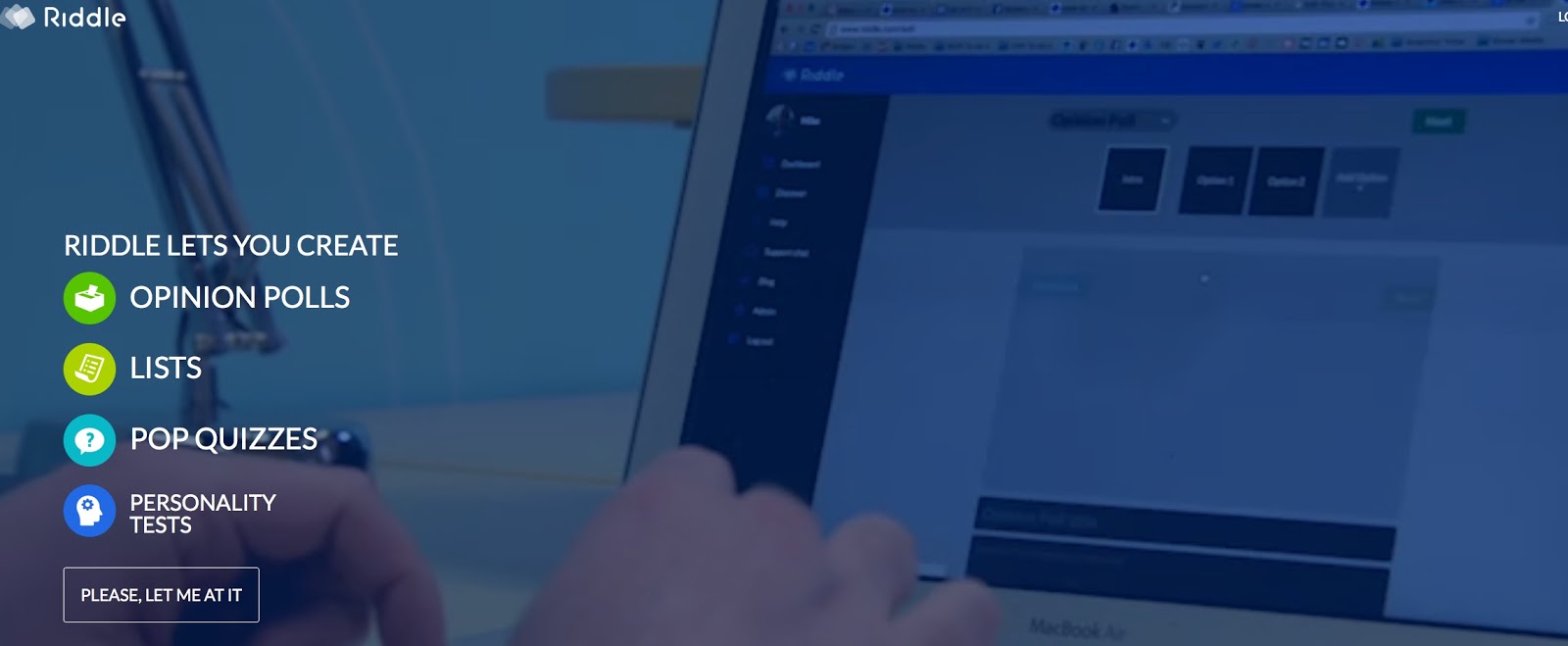
Go to: http://www.riddle.com and sign up. Then you will see the different quiz types. The main types of interactions you can create are:


  • Opinion polls – These are simple single question polls which can contain a number of fixed response for the recipient to choose from.
  • Lists – Lists aren’t questions as such, they are more like a nice way of presenting information in a series of chunks. Each chunk of information can also have media or text embedded into it. This would make a great way of presenting infographic type information in a more mobile friendly way.
  • Pop quiz – A pop quiz can contain a number of multiple choice questions. Pop quizzes can be scored across percentage of correct answers. Students can also get feedback on each answer within the quiz and you can attach specific messages to scores to tell students what they need to do in response to their score.
  • Personality tests – With this kind of test you can create a number of questions for participants to answer and link the answers to specific personality types. So for example if the participant answer a to all questions they are shown their a personality type. You can actually create the different personality types yourself.
  • Surveys – Surveys are the most flexible poll type. You can have a choice of different question types from text fields for written input to single choice or multiple select questions.

You can either click on ‘New’ to start from a blank template or click on ‘Template\’ and you’ll see an example of that type of quiz which should give you an idea of how to create one yourself.
Most quiz types start with some kind of introduction screen where you outline the theme and purpose of the quiz. With Riddle it’s easy to add media to this part of the quiz just by clicking on the media type and searching for it or uploading your own file.

Then add the questions and potential answers. You can also add a score the answer in the pop quiz type questions and some explanatory feedback.
Once you have added the questions you can customise the look of the quiz by changing colours or fonts.

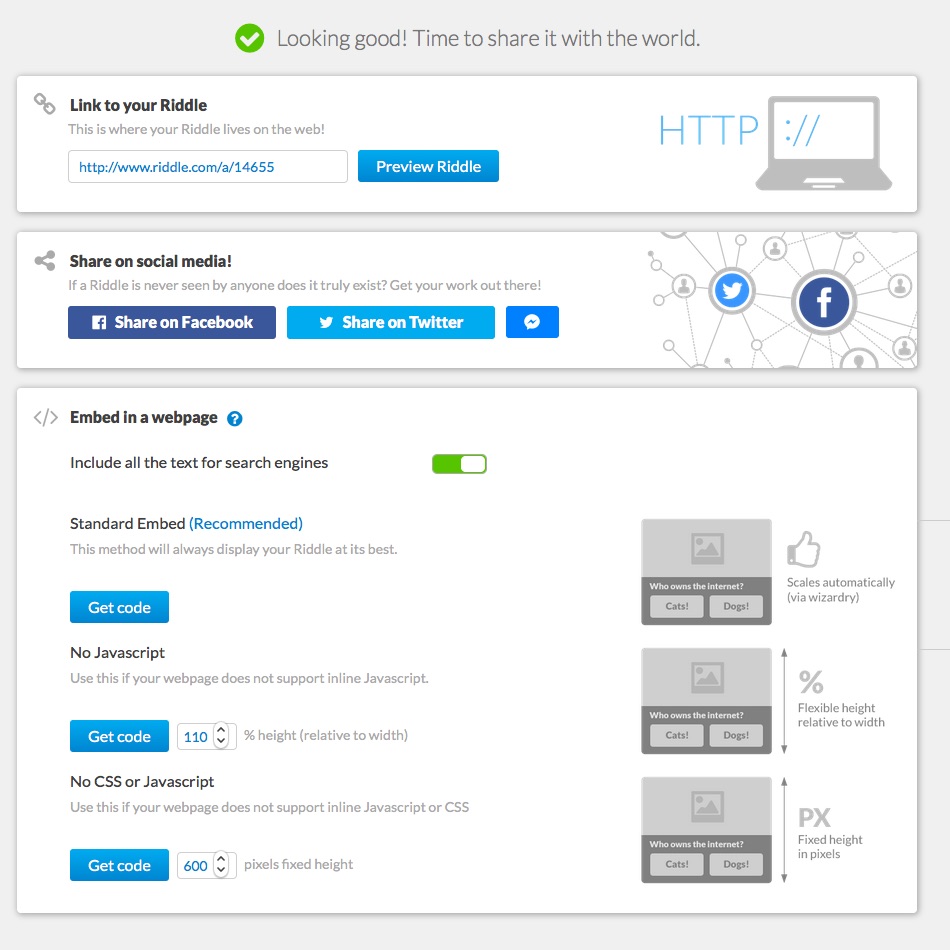
Then once the quiz is complete you can share either a URL or embed code or post it directly to your social network accounts.


The responses to all the questions are collected within the platform and you can view and download these by clicking on ‘Statistics’ (to download a csv file you need a pro account) so this provides a form of LMS though it doesn’t enable you to identify specific students (again you would need a pro version to do that).


How to use Riddle with learners

  • Riddle is pretty simple and quick to learn so you can get students to create their own research questionnaires. These could be for classroom research or they could share them through social media networks. You could use infographics to base the research on and get students to do parallel research and create their own infographic.
  • You could get students using the List option as tasks to report on films or reading assignments. They could create a ten point list to include the ten most important features of the book or film.
  • You can create opinion polls to lead into classroom discussion. This would give students the opportunity to think about the issues before they come into class. You could then follow this up with a second poll to see how many people had changed their mind about the issue.
  • You could use the list option to have mock elections. Students could use the list to create a ten point election manifesto. The students could then look through them and decide who they would like to vote for.
  • You can use lists to present different aspects of verb tenses with a section each on meaning, form, pronunciation, time lines and usage. You could also include links to videos or songs where the verb tense is being used.
  • You can use personality tests to identify learning styles and make students more aware of them. You just need to define the different learning styles and then add answers to the multiple choice questions that identify each style.
  • You can create a pre test to get students thinking around topic you want to teach and to find out what they already know about it.
  • You can use Riddle as part of flipped learning approach with video embedded into quizzes or polls. Then you can collect students’ answers and go into class with a clear understanding of what they have understood from the material.
  • You can embed articles, short stories or video clips in the pop quiz or surveys and then build them into  complete online course.

What I like about Riddle

  • The free option still gives lots of scope for creativity.
  • There is a great range of quiz types.
  • The simplicity of creating the quizzes makes this easy for students to learn quickly
  • I love the choice of media and how easy it is to embed media into the quizzes.
  • I like the way the personality type quiz answers can be set up with sliders to refine the way the answers apply to the different personality types.
  • The list type quizzes are a great way to segment the presentation of new materials

I hope you enjoy using Riddle and create some useful interactive learning materials.

Related links:

VAJRA (Visiting Advanced Joint Research) Faculty scheme

Hon’ble Prime Minister during the 14thPravasiBharatiya Divas Convention at Bengaluru on 8th January 2017 has announced the launching of VAJRA (Visiting Advanced Joint Research) Faculty scheme by the Department of Science and Technology which enables NRIs and overseas scientific community to participate and contribute to research and development in India. The Science and Engineering Research Board (SERB), a Statutory body of the Department will implement the Scheme.

VAJRA faculty will undertake research in S&T priority areas of nation wherein the capability and capacity are needed to be developed. The VAJRA faculty will engage in collaborative research in public funded institutions.

The residency period of the VAJRA Faculty in India would be for a minimum of 1 month and a maximum of 3 months a year.

The VAJRA Faculty is provided a lump-sum amount of US$ 15000 in the first month of residency in a year and US$ 10000 p.m. in the other two months to cover their travel and honorarium. While no separate support is provided for e.g. accommodation, medical / personal insurance etc. the host institute may consider providing additional support.

The Indian collaborator and the overseas faculty will jointly frame a research plan and the application duly endorsed by the Head of the Institution will be submitted online by the Indian collaborator.

A Selection Committee of eminent scientists will evaluate the applications. The Committee will meet twice a year in January and July and make recommendations. SERB will announce the results in the month of April and September.

Public funded academic institutions and national laboratories are eligible to host the VAJRA Faculty. These institutions should appoint them as Adjunct / Visiting Faculty and involve them in co-guiding and mentoring of students and developing collaborative programs. The Faculty can also be allowed to participate in other academic activities as agreed to by the host institution and the Faculty.

For details log on to www.vajra-india.in

Impacting Research Innovation and Technology (IMPRINT )

Introduction:

IMPacting Research INnovation and Technology (IMPRINT), the first-of-its-kind Pan-IIT and IISc joint initiative, is a Ministry of Human Resource Development (MHRD) initiative to address  major engineering challenges that the country must address and champion to enable, empower and embolden the nation for inclusive growth and self-reliance. Department of Science and Technology is partnering with  MHRD in implementing this program.

Selected Technology Domain:

In order to pursue the mandates of IMPRINT, ten technology domains as grand engineering challenges have been thought of. The ten domains that represent the most important areas for the country along with their coordinating institutes are given below:

  1. Healthcare Technology: IIT Kharagpur
  2. Computer Technology: IIT Kharagpur
  3. Advance Materials: IIT Kanpur
  4. Water Resources: IIT Kanpur
  5. Sustainable Habitat: IIT Roorkee
  6. Security and Defense: IIT Madras
  7. Manufacturing Technology: IIT Madras
  8. Nano-technology Hardware: IIT Bombay
  9. Environment and Climate: IISc, Bangalore
  10. Energy Security: IIT Bombay

The overall  National Coordinator is IIT, Kanpur. Each domain in IMPRINT is divided into themes, sub-themes, target and topics for educational orientation, research and innovation. For details, please visit http://imprint-india.org

Cognitive Science Research Initiative (CSRI)

Cognitive Science is the study of human mind and brain, focusing on how mind represents and manipulates knowledge and how mental representations and processes are realized in the brain. The field is highly transdisciplinary in nature, combining ideas, principles and methods of psychology, computer science, linguistics, philosophy, neuroscience etc. In Indian scenario which is full of diversity, it is important to foster scientific research in interdisciplinary field of Cognitive Science for better understanding of Indian mind sets, languages and cognitive disorders etc. With this aim, the Department of Science & Technology (DST) had initiated a highly focused programme “Cognitive Science Research Initiative (CSRI)” in 2008 during 11th Five year plan. The Cognitive Science Research Initiative facilitates a platform to scientific community to work for better solution of challenges related with cognitive disorders and social issues through various psychological tools & batteries, early diagnosis & better therapies, intervention technologies and rehabilitation programmes.

Objectives:

Cognitive Science Research Initiative is aimed to revolutionize research in various fields, such as:

  • Nature and origins of mental disorders, of physiological, social and neuro-chemical origins.
  • Design of better learning tools and educational paradigms.
  • Design of better software technologies and artificial intelligence devices.
  • Streamlining of social policy formulation and analysis.

Thrust Areas: Cognitive science has wide horizons which covers different aspects of cognition. DST has identified specific thrust areas in Cognitive Science which include Foundations of Cognition; Language and Cognition; Computational Intelligence; Cognitive Psychology and Cognitive Neuroscience etc.

Activities Supported under CSRI:

  1. Individual R&D Projects: Grant is available for R&D projects in any thrust areas identified. Support will be provided for Equipments, Manpower and other research grant.
  2. Multi-centric Mega Projects: Multi-centric projects are encouraged to provide better solution of issues related with social relevance, better understanding of neurodegenerative diseases and their therapeutics.
  3. Post Doctoral Fellowship:Two years ‘Post Doctoral Fellowship’ Programme is aimed to develop human resource in Cognitive Sciences. The Scheme provides Opportunities to Young Scientists (below 40 years) for pursuing innovative research in frontier areas of Cognitive Science.
  4. Support for Schools, Training, Workshops, Conferences etc: The CSRI programme extends partial support for organizing conference/seminar/symposia/training programmes/workshops/schools on a selective basis. The support is provided to Academic or Research Institutions, Universities and other Professional bodies to encourage young researchers and keep scientific community abreast of the latest developments in various areas of Cognitive Science.

Programme Schedule: Department invites Individual Project Proposals and application for Post Doctoral Fellowship once in a year through advertisement in all leading Newspapers and DST website. Mega projects for intensified research in particular area are supported under top-down approach in discussion with DST and stakeholders. Proposals for conducting Schools /Conferences are open throughout the year and considered on request.

Advertisement for submission of research proposal under Cognitive Science Research Initiative – Last Date – 31 July 2018 [PDF]392.12 KB


Sanctioned Projects  – 2015-16[PDF]101.34 KB

Sanctioned Projects  – 2016-17[PDF]117.5 KB

What SERB offers to Scientists?

What is SERB?

The Science and Engineering Research Board (SERB) is a statutory body established through an Act of Parliament. Supporting basic research in emerging areas of Science & Engineering are the primary and distinctive mandate of the Board. The Board structure, with both financial and administrative powers vested in the Board, would enable quicker decisions on research issues, greatly improving thereby our responsiveness to the genuine needs of the research scientists and the S&T system.

What SERB offers to Scientists?

SERB supports research in frontier areas of Science and Engineering. A regular faculty / researcher in an academic / research institution can seek research support to carry out his/her research. Board also gives special attention to young scientists below the age of 35 years (relaxable by 5 years in the case of SC/ST/OBC, woman and physically handicapped category) to undertake independent research in newly emerging and frontier areas of science and engineering. High priority areas are supported in through the “Intensification of Research in High Priority Area “(IRHPA) Program. The Board offers JC Bose National Fellowship to scientists and engineers for their outstanding performance and contributions and RAMANUJAN Fellowship for brilliant scientists and engineers from all over the world to take up scientific research positions in India, especially those scientists who want to return to India from abroad. Board also provides financial assistance for presenting research paper in international scientific event (conference/ seminar/ symposium/ workshop etc.) held abroad. SERB extends partial financial support, on selective basis, for organising scientific events (National as well as International) in the country.

National Science & Technology Management Information System

NSTMIS, DST is responsible for collection, collation, analysis and dissemination of information on resources devoted to S&T activities in the country.

The Scientific and Technological (S&T) activities play a vital role in the economic, social and physical development of a country. Scientific and technological research needs huge investments and calls for a judicious utilization of scarce resources like finance, trained manpower, raw materials etc. Data collection and analysis pertaining to resources, devoted to S&T, therefore, assumes significant importance. The growth of S&T, its performance and impact on society and economy are indicators to assess the effectiveness of planning and policy formulation.

The National Science and Technology Management Information System (NSTMIS), a division of Department of Science and Technology (DST) has been entrusted with the task of building the information base on a continuous basis on resources devoted to scientific and technological activities for policy planning in the country.

Activities

NSTMIS undertakes broadly two types of research activities:

  • In-house Research
  • Sponsored Research

In-house Research

  • National Survey on resources devoted to S&T activities in the country.
  • National Level database on Extramural (sponsored) R&D projects.

As an outcome of above in-house research, NSTMIS brings out the following publications

  • Research and Development Statistics
  • Research and Development in Industry
  • S&T Data Book
  • Directory of R&D Institutions
  • Directory of Extramural R&D Projects

Sponsored Research

While some of the valuable basic data on input resources into S&T activities were processed in -house, it was felt necessary to involve other interested individuals/organisations to take up studies in the sponsored project mode in order to convert this activity into a very comprehensive and cohesive plan programme to make available Science and Technology indicators. Keeping this in view, the divisional activities were further strengthened during Seventh Five Year Plan (1985-90) by enlarging the scope and including the following :

  • Creation, Updation and Dissemination of databases on R&D resources, projects, institutions, experts, equipments, other infrastructure facilities.
  • Development of S&T indicators.
  • Studying aspects related to R&D management and policy issues.
  • Estimation of short term and long term requirement of different categories of scientific manpower particularly in new emerging areas of S&T.
  • Studying the mismatch between employment and output of S&T personnel.
  • Supporting R&D projects on various S&T dimensions.

So far, more than 125 projects on the various facets of S&T have been sponsored to various organisations/ establishments and the results of 85 completed projects have already been published in the form of reports and disseminated to various researchers/users.

Call for Proposals (2017-18) – Centre for Human and Organisational Resource Development (CHORD Division)

New Initiatives

Innovation plays a vital role in nation’s prosperity. Recognizing the importance, the Indian Government has mounted a new initiative the Science, Technology, Innovation and Creation of Knowledge framework (STICK). The National Innovation Survey framework, evolved upon in-depth discussion with the national and international experts shall be used in the implementation of the STICK Programme.

For more information on STICK Programme National Innovation Survey

Linkages

NSTMIS division maintains a close liaison with UNESCO, NSF, OECD, etc. for matters relating to S&T statistics and indicators. NSTMIS officers are taken as resource persons by UNESCO for the various workshops conducted by them on standardisation of concepts and terminologies used in S&T statistics. NSTMIS expertise has also been shared with other developing nations like China and Trinidad and Tobago. Apart from this, NSTMIS continually interacts with various national organisations like Planning Commission, Institute of Applied Manpower Research, University Grants Commission, Confederation of Indian Industries and other scientific organisations for exchange of information and expertise related to Science Statistics and Indicators.

Project List Year Wise –


2004-05[PDF]10.96 KB 2005-06[PDF]9.75 KB 2006-07[PDF]15.43 KB 2007-08[PDF]20.99 KB 2008-09[PDF]21.5 KB
2009-10[PDF]9.01 KB 2010-11[PDF]9.65 KB 2011-12[PDF]10.13 KB 2012-13[PDF]7.93 KB 2013-14[PDF]14.79 KB
2014-15[PDF]137.39 KB 2015-16[PDF]15.09 KB 2016-17[PDF]233.86 KB 2017-18[PDF]247.83 KB 2018-19[PDF]240.6 KB

Swarnajayanti Fellowships Scheme

Govt. of India had instituted a scheme “The Swarnajayanti Fellowships” to commemorate India’s fiftieth year of Independence. Under this scheme a selected number of young scientists, with proven track record, are provided special assistance and support to enable them to pursue basic research in frontier areas of science and technology. The fellowships are scientist specific and not institution specific, very selective and have close academic monitoring..

Nature of Support:

The award consists of a Fellowship of Rs 25000/- per month in addition to the salary drawn from the parent Institute along with a Research Grant of Rs 5 lakh per annum by Department of Science and Technology for a period of 5 years, while the project submitted by the selected Fellows will be considered for funding by the Science & Engineering Research Board (SERB) as per SERB norms, for recurring and non-recurring heads. Scientists selected for the award will be allowed to pursue unfettered research with a freedom and flexibility in terms of expenditure as approved in the research plan. The project should contain innovative research idea and it should have a potential of making impact on R&D in the discipline.

Duration:

The duration of the fellowship will be for a period not exceeding five years.

The advertisement for  “Swarnajayanti Fellowships Scheme” for each year will appear on the DST website with all details.

Swarnajayanti Fellowships Awards

Project List Year Wise
1997-05 2005-06[PDF]28.02 KB 2006-07[PDF]26.44 KB 2007-08[PDF]16.86 KB 2008-09[PDF]22.37 KB 2009-10[PDF]14.59 KB 2010-11[PDF]46.39 KB 2011-12[PDF]82.02 KB 2012-13[PDF]102.55 KB 2013-2014[PDF]160.97 KB 2014-2015[PDF]29.24 KB 2015-2016[PDF]49.78 KB 2016-2017[PDF]65.09 KB 2017-2018[PDF]294.97 KB 2018-2019[PDF]255.81 KB

Advertisement

Advertisement for the “SwarnaJayanti Fellowships Scheme 2019-20”[PDF]0 bytes

Science Olympiad Programme

A National Science Olympiad Program covering Mathematics and Sciences including Astronomy is operational in the country.  These programs aim at promoting excellence in Science and Mathematics among pre-university students. While HomiBhaba Centre for Science Education (HBCSE), Mumbai is the nodal organization for selection, training of students through Indian Association of Physics Teachers (IAPT) for participation of students at various International Olympiads meet. The program is financially supported by Government of India, in particular Department of Science and Technology, Board of Nuclear Sciences (Department of Atomic Energy), Department of Space, Ministry of Human Resource Development and Ministry of Earth Sciences.

Except Mathematics Olympiad, HBCSE administered and coordinates various other Olympiads such as Astronomy (Junior & Senior), Biology, Chemistry, Earth Science, Physics and Junior Science through National Steering Committee (NSC) and the Department of Science and Technology (DST) is the member of NSC for implementation.

For more details please visit www.olympiads.hbcse.tifr.res.in

Kishore Vaigyanik Protsahan Yojana (KVPY)

Kishore VaigyanikProtsahanYojana (KVPY) is an on-going National Programme to provide Mentorship and Scholarship support to pursue study in Basic Sciences. While KVPY program is initiated and funded by the Department of Science and Technology, Government of India, it is administered and implemented by the Indian Institute of Science (IISc) Bangalore to attract exceptionally motivated students to study science and pursue careers in research.

The objectives of the program are to identify students with talent and aptitude for research, help them realize their potential in their studies, encourage them to take up research careers in science and ensure the growth of the best scientific minds for research and development in the country.

The KVPY Program enrolls students starting from Class XI standards (science subjects) and operates in 3 streams i.e. stream SA, Stream SX and Stream SB. Initiating with mentorship in initial 1-2 years through exposure in VIJOSHI Science Camp, it provides scholarship to KVPY students who joins in Science Courses (out 18 subjects) at the undergraduate (BSc, BS-MS or Integrated MS) level and continued upto post-graduate level.

The KVPY Programme announces every year sometime in May/June to conduct its selection process which is carried out in two stages: i) Aptitude Test (in November or so) and ii) Personal Interview. Each year nearly 2000 students are selected in 3 streams and approximately 1000 students received KVPY Scholarship every year.

For more information please visit website: www.kvpy.iisc.ernet.in

Science and Technology of Yoga and Meditation (SATYAM)

Department of Science and Technology (DST), in 2015, conceptualized a new research program- ‘Science and Technology of Yoga and Meditation’ (SATYAM)- under its Cognitive Science Research Initiative (CSRI). As Yoga and Meditation are interdisciplinary endeavors that interface with Neuroscience, Medicine, Psychology, Philosophy, and so on, therefore an interdisciplinary approach is needed to converge different & diverse disciplines as well as approaches & methods in the study of yoga and meditation. Thus comprehensive research on yoga and meditation is expected to address various challenges confronting physical and mental health. This new programme is aimed to foster scientific research on the effects of yoga and meditation on physical & mental health and on cognitive functioning in healthy people as well as in patients with disorders.

Themes: Basic themes being covered under SATYAM include, among others, (1) investigations on the effect of Yoga and Meditation on physical and mental health and well being, and (2) investigations on the effect of Yoga and Meditation on the body, brain, and mind in terms of basic processes and mechanisms.

Who can apply: Scientists/academicians with research background in ‘Yoga and Meditation’ and having regular position are invited to participate in this initiative. Practitioners actively involved in yoga and meditation practices are also encouraged to apply in collaboration with academic and research institutions of repute. Interested researchers are required to submit research proposals in their area of expertise along with Endorsement Certificate from the Head of the Institution and detailed bio-data of PI and Co-PIs.

Project duration: The project is tenable for a maximum period of three (3) years.


Last date for proposal submission under Science and Technology of Yoga and Meditation (SATYAM) and COVID-19 related SATYAM ‘Special Call’ has been extended till 31 May 2020)

Special Call under SATYAM to fight against COVID 19[PDF]0 bytes

Concept Note Format[PDF]517.48 KB

Advertisement for Science and Technology of Yoga and Meditation (SATYAM)- 2019-20[PDF]0 bytes

Format for Submission of Research Proposal Under Science and Technology of Yoga and Meditation (SATYAM)[PDF]580.33 KB 

Sanctioned Projects  – 2015-16[PDF]97.59 KB

Sanctioned Projects  – 2016-17[PDF]86.04 KB

Innovation in Science Pursuit for Inspired Research Programme

Innovation of Science Pursuit for Inspire Research (INSPIRE) is one such innovative scheme proposed by the Department of Science & Technology for attraction of talent to science. The basic objective of INSPIRE would be to communicate to the youth population of the country the excitements of creative pursuit of science and attract talent to the study of science at an early stage and build the required critical human resource pool for strengthening and expanding the Science & Technology system and R&D base.

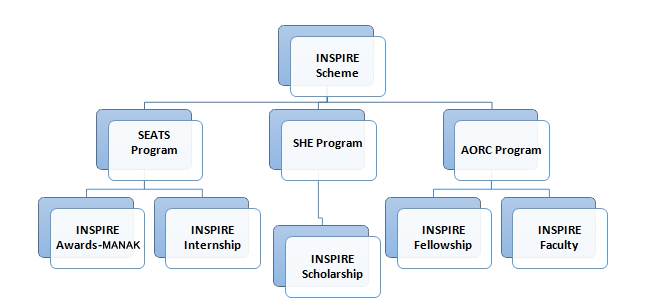
INSPIRE Scheme has included three programs and five components. They are i) Scheme for Early Attraction of Talents for Science (SEATS), b) Scholarship for Higher Education (SHE) and c) Assured Opportunity for Research Careers (AORC).The schematic diagram of the programme is shown below

Government of India approved this Scheme in November 2008 at a total cost of Rs 1979.25 crores in the 11th Plan Period and Hon’ble Prime Minister launched the Program on 13th December 2008. The Scheme with all the components is continuing in 12th Plan (2012-2017) at a total allocation of Rs.2200 crores. The Scheme has achieved the desired targets of enrolment of students in all 5 components by FY 2013-14.

For details on i) INSPIRE-Awards-MANAK ,click here:

For ii) INSPIRE Programme (4 other Components) ,click here:

1. Results of Level-2 Evaluation in 9th Advertisement (Provisional to Final) of INSPIRE Fellowship have been declared. Out of total 370 Declared Results, Selected for Final Offer: 256, Rejected-114.This results is compiled of applications received with documents uploaded up to 8th December 2017.

2. Partial Results of Results of Level-2 Evaluation in 10th Advertisement of INSPIRE Fellowship have been declared. Out of total 397 applications accepted for Level-2 Evaluation, now released results for 254 applications (158 accepted for Final Offers and 96 rejected), the remaining applications results will be announced shortly.

Results – 9th & 10th advertisement of INSPIRE- Candidate Click Here to View Result

Announcement for INSPIRE Faculty Fellowship Scheme for 2019[PDF]0 bytes