Here’s What a Medical Assistant’s Resume Should Look Like

To make yourself stand out from the pool of other applicants, you need to showcase why are you are the best fit for the position. Here are some tips!

In a high-demand field like medical assisting, competition for jobs can be intense. To make yourself stand out from the pool of other applicants, you need to showcase why are you are the best fit for the position.

Here are some tips for crafting a standout medical assisting resume.

1. Summarize your clinical and administrative skills

Medical assisting students or graduates should focus on displaying their proficiency with key clinical skills, such as administering medications and taking vitals. Be sure to also describe the impact of your work, such as helping an organization serve more patients, or working alongside a team of doctors and nurses to improve the patient experience.

If you are applying for a front desk medical assisting position, you also need to demonstrate that you have relevant administrative skills. For example, highlight your experience with using electronic medical records systems, or your knowledge of medical billing. Your proficiency with medical terminology is also an important skill for both front office and back office positions.

“Including relevant skills in your job descriptions will help your resume become more searchable by the Applicant Tracking System, a tool that many employers use to scan resumes for qualified candidates,” says Jennifer Osburn, a Career Development Coach at Herzing University.

2. Feature your work experience

If you’ve completed a medical assisting externship as part of your degree program, make sure this is featured prominently on your resume. Employers look for experienced candidates, even for entry-level roles. They want to be able to tell immediately whether you have the skills needed to succeed on the job, and externships are a good marker of your preparation and experience.

On the other hand, if you are a student looking for an externship, you might not have a lot of direct professional experience to highlight. In this case, you should showcase your relevant experiences, which can include academic accomplishments, extracurricular activities and volunteer work that make you a good fit for the position.

3. Highlight transferable skills

If your work experience does not directly align with the position you want, focus on highlighting the skills you have that would help you succeed in an MA role. These are called transferable skills.

Examples of skills that you may have performed at other, non-healthcare related positions that are transferable to an MA position include customer service, data entry, or clerical work. Employers also value soft skills, such as communication and teamwork.

4. List your education

It is important to include your education on your resume. Make sure to state the level of degree you’ve earned, such as a diploma or an associate degree in medical assisting. Also include your expected graduation date and any accolades you have received.

5. Showcase your certifications

Healthcare certifications like the Red Cross BLS for Healthcare Providers or first aid certification can help you differentiate yourself from the pool of other applicants. Be sure to include the dates for when you obtained these certifications, as well as when they are expected to expire. Medical assisting graduates should list their Registered Medical Assisting (RMA) certification or Certified Clinical Medical Assistant (CCMA) certification, as they are required by some states.

6. Update your resume for each position

Always be sure to update your resume to match the skills and requirements for the position. According to a Career Builder survey, 61% of employers are more likely to pay attention to a resume that is tailored to the position in question. Creating a customized resume demonstrates your interest in the positon and lets employers know how serious you are as a candidate.

Bonus: Resume Dos and Don’ts

There are certain dos and don’ts that apply to every resume, no matter the career or position.

Do:

  • Organize your resume: Organize your skills and information in a way that is easy to digest and understand. A medical assisting resume will typically have a section for relevant skills at the top, followed by professional experience, education, volunteer work or extracurricular activities.
  • List a professional email: Make sure that you list a professional email at the top of your resume so it is easy for employers to contact you. If you are a student, you can use your college or university email address. Also, make sure that you have a professional voicemail message recorded for the phone number that you list.
  • Save as a PDF: Do save your resume as a PDF. This may seem like a very trivial tip, but it can make a big difference in your job search. Sending your resume as a PDF ensures that whoever opens the file sees it exactly as you intended. Some word processing applications may not be compatible, and older versions of Word can have trouble opening emailed documents. You want to make it as easy as possible for recruiters and hiring managers to open, read and pass along your resume.

Don’t:

  • Overlook typos: Typos and grammar mistakes show poor attention to detail and a lack of effort. Before you submit your resume to an employer, proofread it yourself or ask an advisor to review it with you.
  • Sell yourself short: Your resume is your ticket to landing an interview. Make sure that it clearly shows your qualifications and why you are a good fit for the position. Consider all of the tips and tricks above to ensure your resume is the best it can be.

Where can you go to get resume help?

Herzing’s Career Development Team can help you organize your resume, share tips for improving your job descriptions, and review the final draft with you to make sure there are no typos or grammar mistakes. Visit Herzing’s online Career Center or set an appointment with your advisor to get started.

FCI has become a lifeline for food distribution

Union Minister for Consumer Affairs, Food & Public Distribution, Shri Ram Vilas Paswan today chaired the review meeting with the Food Corporation of India’s Zonal Executive Directors and Regional General Managers on the distribution and procurement of food grains, through video conference.

In his address, Shri Paswan lauded the role of FCI during the lockdown and said food grain movement has been at an all-time high. He said FCI workforce have emerged as Food Warriors at the time of global pandemic crisis and they turned this challenge into an opportunity. FCI has undertaken record loading, unloading and transportation of food grains during the lockdown period. On the other hand, procurement also continued without disruptions and the wheat procurement by government agencies this year surpassed the last year’s figures.

The Minister also took stock of the distribution of food grains in the states and UTs during the review meeting.

Atma Nirbhar Bharat Package

While reviewing the allocation of food grains under Atma Nirbhar Bharat Package for Migrants/Stranded Migrants, Shri Paswan said that the Government of India has made allocation of 8.00 LMT food grains (2.44 LMT wheat and 5.56 LMT Rice) to 37 State/UTs for the months of May and June 2020.  According to FCI, against this allocation, up to 27.05.2020, 2.06 LMT food grains have been lifted by the States/UTs. Andaman & Nicobar, Andhra Pradesh and Lakshadweep have lifted the entire allocation foe two months. The Minister directed the FCI to coordinate with the State/UT Governments and expedite the lifting of food grains.

Pradhan Mantri Garib Kalyan Anna Yojana

Under this scheme, Government has made allocation of 120.04 LMT food grain (15.65 LMT wheat and 104.4 LMT Rice) to 37 State/UTs for the months of April, May and June 2020. While reviewing this scheme Shri Paswan asked the concerned officials to coordinate with State/UTs Government to expedite the lifting, so that the food grains reach the beneficiary in time. FCI informed, against the PMGKAY allocation, up to 27.05.2020,  95.80 LMT food grain (15.6 LMT wheat and 83.38 LMT Rice) have been lifted by the States/UTs.

Sale of food grain to Charitable / NGO under OMSS(D) without e-auction

As per the instructions of Government of India, up to 25.05.2020, FCI informed that it has approved sale of 1179 MT wheat to 186 organisations and 8496 MT rice to 890 organizations against which 886 MT wheat & 7778 MT rice have been lifted by these organizations.

Amphan Cyclone in West Bengal and Odisha

As per FCI, West Bengal Government has requested 11,800 MT rice stock under OMSS (D) sale without e-auction @Rs.2250/- per qtl, but no requirement of food grains has been intimated by the Odisha Government till date. Shri Paswan said that the FCI should coordinate with the State Governments of West Bengal and Odisha and appraise the latest status of food grains in the Cyclone hit states.

Procurement (Rice/Wheat)

In the review meeting the minister reviewed the sale of wheat in RMS 2020-21 and procurement rice in KMS 2019-20. As the procurement of wheat is already ahead of its last year’s procurement quantity, the minister asked FCI to update the further wheat (RMS 2020-21) and rice (KMS 20-21) procurement. According to FCI as on 27.5.2020, total 351 LMT wheat (RMS20-21) has been procured.  60.40 LMT rice (RMS) has been procured. Total 700.29 LMT paddy  (including 470.23 LMT rice) has been procured in 2019-20.

Movement of food grains

Since the lockdown, food grains have been lifted and transported across the country including North Eastern States though roads, railways, waterways and by air in difficult and hilly areas. About 100 LT food grains have been transported through 3550 rail rakes. 12 LT food grains have been transported through roads and 12,000 Tonnes of food grains was transported through 12 ships. Total 9.61 LMT food grains have been transported to North Eastern states.

Stocks in Central Pool

FCI informed about the current stock position of food grains as on 27.05.2020. Officials said 479.40 LMT wheat & 272.29 LMT rice, total 751.69 LMT food grain are available in the Central Pool. Expressing satisfaction at the stock position to meet the country’s present and future need of food grains, Shri Paswan pledged the government’s all-out support to FCI officers and workers who have been toiling hard during this period of crisis.

Mix Images and Animation on Your Mobile

A couple of years back I wrote about a really nice web based tool called Xtranormal and since then I’ve heard from so many teachers saying how useful their students have found it, so I was delighted yesterday to find that the same makes had now produced a free mobile / tablet app called Tellagami. The app runs on a mobile device and allows users to add animated speaking characters to a selection of backgrounds or to the users’ own images. You can then either use text to speech to write a script for the character, or you can record your own voice and the app will lip-synch you text to the character. This is very quick and easy to do. Here’s how.

Open the app an click on create.


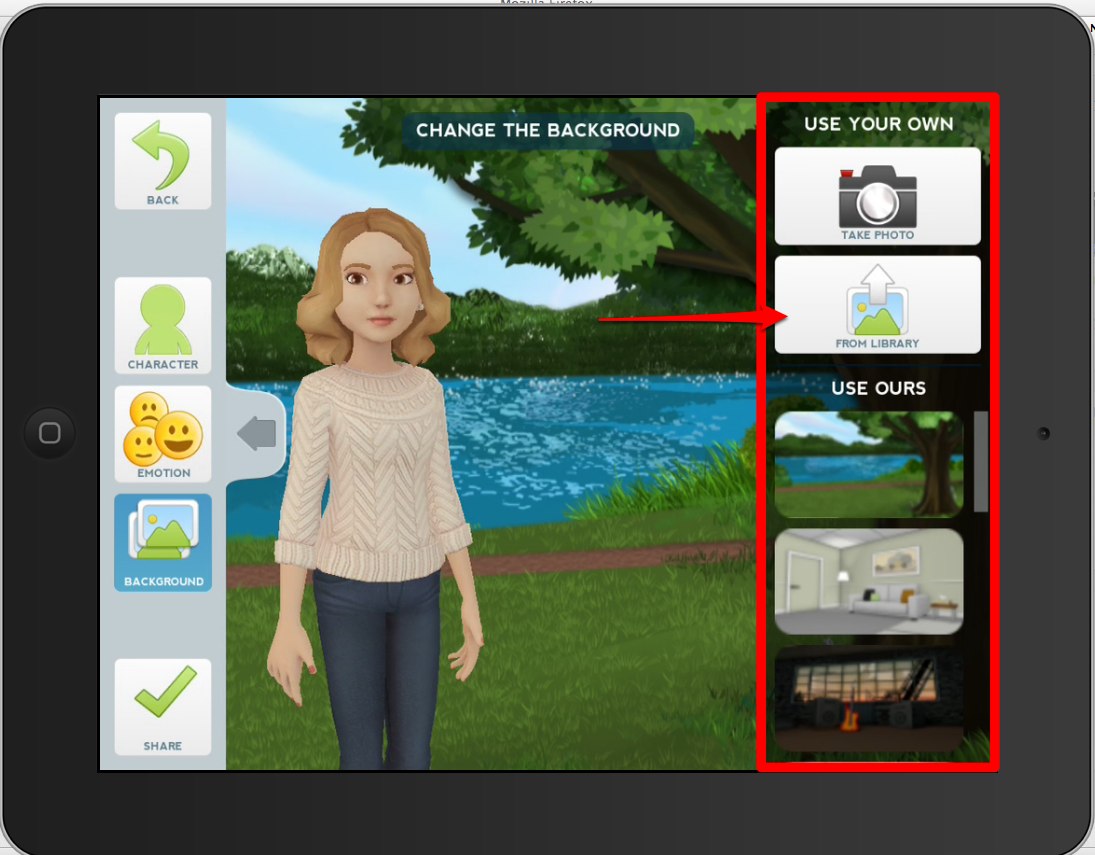
Then choose your background, either from the ones provided, from your own image library or you can take a photograph of wherever you are at the time.

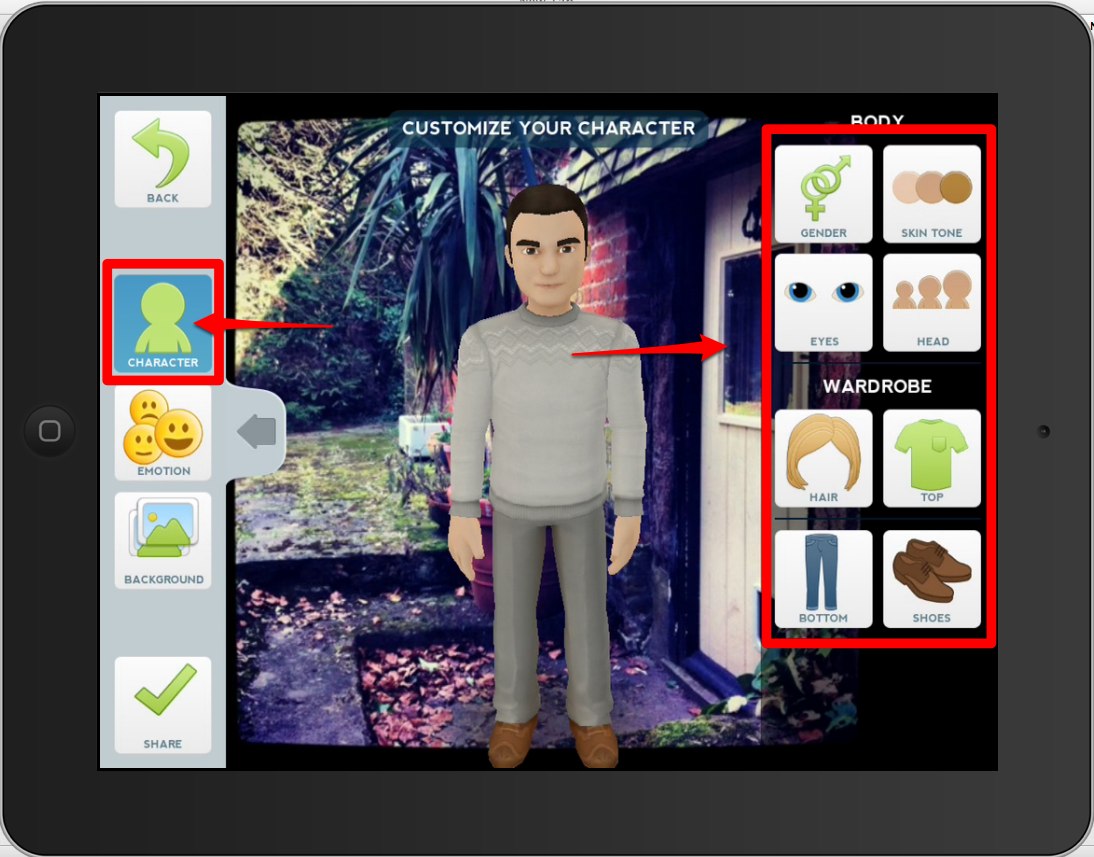
Then you can choose the character you want to use and customise their appearance.

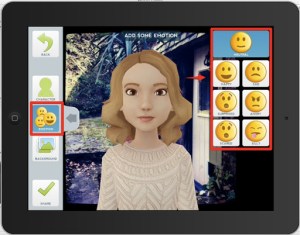
Next you can select an emotion for your character.


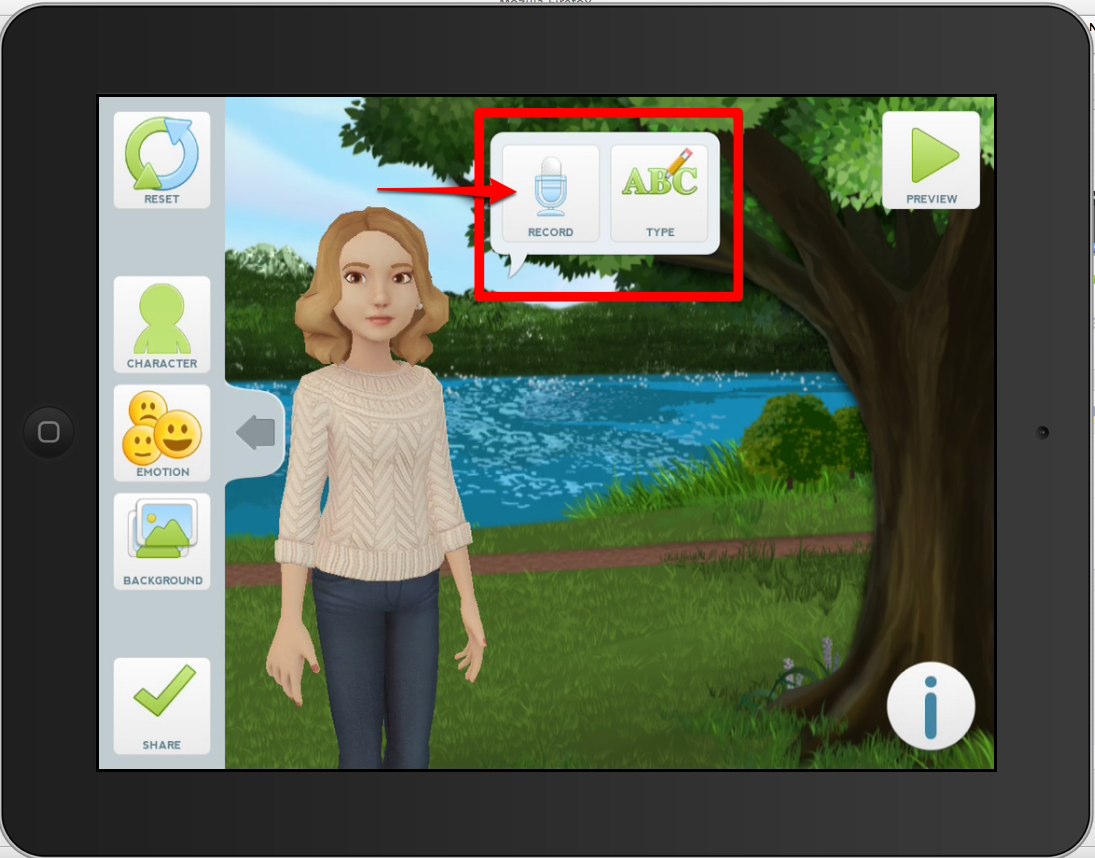
Lastly, you can either type in your message or record it directly onto your device. You can record up to 30 seconds of spoken audio.


Once you animation is complete you can either send it by email, share it through various social networks or just save it onto your device to show it in class.


 You can complete the whole process in just a couple of minutes.

I think this is a great app to get students speaking either in the classroom, at home or while they are out and about in the world.

Some learning activities for students

  • Ask the students to create 4 – 5 animated images explaining their route to school.
  • Get students to create animated images of 4 – 5 of their favourite places around their town.
  • Get students to take pictures of objects and create an animated video dictionary.
  • Get students to talk about images of people in their family.
  • Create some animated images of different steps in a process (making coffee, tea etc) and then get the students to watch and put them in the correct order.
  • Get students to create an animated image journal by adding one new image each day.
  • Get students to take pictures of their favourite book covers or film posters and then record a review.
  • Get students to create animated video cards on special occasions.

 I’m sure there are lots more activities you can think of.

What I like about Tellagami

  • It’s free and very easy to use.
  • It encourages students to speak.
  • It can be used effectively outside the classroom.
  • Students can use it to pull some aspects of their own life and experience into the classroom.
  • It produces very professional looking results.

Possible problems

  • At present it’s only available for iPhone / iPad so that limits who can use it.

 So if your students have iPads / iPhones and you ant to give them motivating speaking assignments for homework, Tellagami is a great tool to use for the job.

I hope you find it useful.

Related links

Best

Exporters to be more competitive and provide quality products to the world

Shri Piyush Goyal, Union Minister for Commerce & Industry and Railways, today, through Video Conference, participated in the Digital Summit on Exports organized by the Confederation of Indian Industry (CII). EXIM Bank of India was the Institutional Partner for the Summit.

Addressing the Summit, Shri Goyalsaid that the future of growth lay with industry and the private sector, with the government having a lesser role to play. The minister identified three important ways to increase India’s exports:  reviving manufacturing, diversifying the exports basket, and finding newer and more accepting markets. He emphasised that the diversification of exports, in addition to consolidating current areas of strength, is necessary for our economy to grow. He stated that India has a huge opportunity to promote indigenous production in auto component sector, furniture, air conditioners, and others. He said that MeitY is promoting electronics production, in pharma we are encouraging API manufacturing, and in the agri export sector the opportunity is huge. He said that in the IT related service, the world recognizes the Indian expertise and prowess, and hence we have asked the NASSCOM to target for $500 billion export in the sector in next five years.

AatmaNirbhar Bharat, he said, is not just about greater self-reliance, but also engaging with the world from a position of strength. He said that India should be seen as a dependable partner and reliable friend in the world market, particularly when the global supply chains are undergoing rejig. Talking about the Prime Minister’s vision to make India self-reliant, Shri Goyal said that we should talk from the position of strength, be competitive, and provide quality products to the world. There should be killer instinct in us to succeed. No crisis can stop our march, if there is willingness to take on the challenges head-on.

 Shri Goyal congratulated CII on completing 125 years and the launch of the Taskforce on Enhancing Exports through integration into the Global Value Chains (GVCs). He committed to working closely with the Taskforce and take action where necessary for the benefit of industry, and the country.He assured the exporting community that the Government, whether the union or states, are there to provide full support and are willing to work in partnership. He said that the country has skilled workforce, and world class institutions like Universities and research labs, and let us work for the well-being of 130 crore people of India.

Mr. Chandrajit Banerjee, Director General, CII, said that we must carry out all reforms necessary to overhaul our exports and this is the right time to roll them out. Trade logistics, compliance with quality standards, seamless functioning of GVCs, and a robust strategy to leverage FTAs would be key, he said.

CIPET renamed as Central Institute of Petrochemicals Engineering &Technology

Central Institute of Plastics Engineering & Technology (CIPET) has been renamed as Central Institute of Petrochemicals Engineering & Technology (CIPET), a premier national institution under the Ministry of Chemicals and Fertilizers, Govt. of India.

The changed name has been registered under the Tamil Nadu Societies Registration Act 1975 ( Tamil Nadu Act 27 of 1975)

Union Minister for Chemicals and Fertilizers DV Sadananda Gowda has said  that now CIPET will be in a position to fully devote itself  for the growth of entire petrochemical sector with a focus on Academics, Skilling, Technology Support and Research. 

The primary objective of CIPET has been contributing towards the growth of the plastics industry through a combined program of education and research. The Institute has evolved through the years, creating closer ties with industries with the intent to create innovative plastic based solutions which are resource efficient and marketable.

New and Renewable Energy

The Prime Minister reviewed the work of the Ministry of Power and Ministry of New and Renewable Energy, last evening. Policy initiatives including revised Tariff Policy and the Electricity (Amendment) Bill 2020 to redress the problems afflicting the power sector were discussed.

Prime Minister emphasized the need to enhance consumer satisfaction while increasing operational efficiency, and improving financial sustainability of the power sector. He pointed out that the problems in the power sector, especially of the electricity distribution segment, vary across regions and states. Instead of looking for a one-size-fits-all solution, the Ministry should put in place state-specific solutions to incentivize each state to improve its performance.

He advised the Ministry of Power to ensure that the DISCOMs publish their performance parameters periodically so that the people know how their DISCOMs fare in comparison to the peers. He also emphasized that equiement usages in power sector to be make in India.

Regarding New and Renewable Energy, Prime Minister emphasized the need for wholistic approach for entire supply chain of the Agriculture Sector ranging from solar water pumps to decentralized solar cold storages. He also emphasized for innovative model for rooftop solar and desired that each State should have atleast one city (either a capital city or any renowned tourist destination) to have fully solar city through rooftop solar power generation. Emphasize was also made on ecosystem development for manufacturing of ingots, wafers, cells and modules in India, which would also help generate employment in addition to various other advantages.

Prime Minister also desired to expedite the plan for carbon neutral Ladakh and emphasized for drinking water supply in coastal areas by harnessing the solar and wind energy.

work meanderings


Its taken a while to get going on my blog. I wonder do I deserve a virtual choc fish for starting and hopefully writing something meaningful.
Source: www.bbc.co.uk

A lot has been happening at work. For a start we are lucky enough to have visits from a couple of people involved in flexible learning – Cathy Gunn (University of Auckland) and John Clayton (WINTEC – Hamilton, NZ)….more about this later.

FLUG meets Blackboard head on
I have been busy with the formation of the new and improved FLUG – a group of enthusiasts involved in flexible learning and support. With our organisational strategy of flexible teaching and learning, it was timely to change the name of the Blackboard User Group to FLUG (Flexible Learning Users Group).

We also needed to extend the group – so a bigger cross section of people involved in flexible options here could muck in and get their hands dirty.

Source: www.geoimagery.com

This way the small core of enthusiasts and people involved with the Learning Management System will have more of \”a voice\” in some of the changes which are happening here in our organisation. So the Bb User Group has re-birthed as FLUG.

So…what does this mean? FLUG will hopefully provide information to the newly formed Flexible …committee about operational matters and stuff from the coal face. We also hope to assist in developing some sort of flexible learning and teaching strategy which is meaningful for our learners and staff in the organisation.

So who do we think we are…why should we have a say?
Because FLUG hopefully will represent the \”real users\” because it is made up mainly of people who get it. But do we?

We all know that flexible learning is a very important strategy for quality education.What gets me though is that every organisation seems to be busying themselves with the development of strategies for eLearning or flexible learning and teaching…..but what are these strategies based on?? What everyone else has been doing..or on the unique culture within an organisation? The former I believe because it is easier.

It is also easier to follow like sheep and stay with an LMS like Bb – the same as the others. It is also easier to stay with an imposition model  a model where the learners are told what they\’re getting rather than being asked how they want to approach teaching and learning.

The best model for a flexible learning and teaching strategy which I have seen is the one QUT (Queensland University of Technology) developed called the QUT Teaching Capabilities Framework. See overview at: http://www.library.qut.edu.au/framework/

QUT surveyed staff and students who were using the LMS (Blackboard), to find out what was important to them as both teachers and learners. The project team took their findings and using a process of wide consultation, they developed a framework. This framework now underpins how teaching and learning is offered at the university, and has informed the professional development of staff.

Unfortunately, we have not gone down this track, but have taken the route followed by many. Additionally, we have also developed a teaching qualification without developing a teaching and learning strategy first. Now staff will be indoctrinated into \”a way\” of teaching which may not be right for our learners…or for our environment.

We have broken the first golden rule! We didn\’t find out what our learners actually wanted first!
As a result, our flexible learning and teaching strategy may also not be based on actualities but on assumptions. I believe we do have time to find out what our teachers and learners actually want, what their experience is to date and what they would like to see happening.

Wont this save time in the end! We are in a good position to really do something different and lead flexible learning in a new direction.


I would really like to see us get out from behind the herd, stop the baaing and mooing and get to the green grass first…for a change.

Watch this space to find out how the flexible strategy and the teaching qual evolve.

Earning a Nursing Degree Online: Ask a RN-BSN student

Being a RN has opened more doors than I can count. The opportunity to care for patients has provided me the chance to make a difference.

In celebration of National Nurse’s Week, Shenese Stewart, an RN-BSN student at Herzing University, shares her first-hand knowledge about what it takes to succeed in an online RN to BSN nursing program.
Earning a Nursing Degree Online: Ask a RN-BSN student

Why did you decide to study nursing?

I worked as a Certified Nursing Assistant and Certified Medical Assistant before returning to school to become a registered nurse. Eventually, my desire to do more for my patients outgrew my scope of practice. I worked as a Licensed Practical Nurse for four years before deciding to return for my RN license.
Being a RN has opened more doors than I can count. The opportunity to care for patients in a multitude of settings provides people like me the chance to make a difference in several places in the nursing field.

What does a typical day as an online RN-BSN student look like for you?

I work three 12-hour shifts per week that often turn into 13 or 14 hours depending on what happens that day. During each day that I work, I will check Blackboard for announcements and my e-mail to make sure I do not miss any important messages, but I do not do any school work. The other four days of the week, I work out in the morning, eat breakfast and have a scheduled study time that is usually 8-12 hours long. I\’ll study for 45 minutes and take a 15-minute break.

How do you balance home/family, work and online schooling?

Online schooling is very demanding, so you have to practice good time management. Because there is not a certain time to be in class, it is easy to put off logging on until later. Work, however, is a priority and cannot be put off until later.
My family and friends are the people I call when I need to cry, laugh, vent and express joy. They are my support system and my cheering squad. It took practice for me to look at my school schedule, work schedule and family obligations and set blocked times for them, but it got better over time.
I make appointments to hang out, go to dinner and go to movies instead of doing it randomly. This has helped my family and friends understand that they are important and a priority, but school is important and a priority too.

What is most challenging about being a nursing student online, and how have you overcome those challenges?

The most challenging part for me has been reducing my hobbies to devote more time to school and staying the course when I get distracted. Nursing takes a considerable amount of time to learn. It is not just memorizing – it is understanding and putting it into practice.
I enjoy piano lessons, self-defense classes and other extra-curricular activities that I needed to put on hold in order for me to accomplish my goal. I\’ve learned my brain starts to get tired after about 45 minutes of concentration, so I take a 15-minute break and do something else to prevent becoming distracted. I may fold clothes, watch television or eat a snack.

What tips do you have for future RN-BSN students?

  • Ask questions: Always understand the reason behind anything you do. Never memorize anything just for the test. There are no dumb questions. Know what you don\’t know, and know where to find the answers. There is always something to learn.
  • Don’t compete with anyone but yourself. Nursing school and the profession isn\’t about competition. It is about collaborating and helping each other make a positive difference in the lives of others.
  • Know what type of learner you are and the best way to study. Everyone is different, so there is no right or wrong way. Just do what works for you. For example, I learn best by reading and writing in a quiet environment alone in the morning. I need to read the material twice and make note cards. I study the note cards at a later time while listening to classical music. I also use the VARK learning style questionnaire.
  • Never give up. If you are not successful in a class, remember that you may be delayed, but you are not denied. Remember your reason for pushing so hard, and know it is worth it in the end.
When you finish, help someone else. Remember how you felt and pay it forward.

Mix Images and Animation on Your Mobile

A couple of years back I wrote about a really nice web based tool called Xtranormal and since then I\’ve heard from so many teachers saying how useful their students have found it, so I was delighted yesterday to find that the same makes had now produced a free mobile / tablet app called Tellagami. The app runs on a mobile device and allows users to add animated speaking characters to a selection of backgrounds or to the users\’ own images. You can then either use text to speech to write a script for the character, or you can record your own voice and the app will lip-synch you text to the character. This is very quick and easy to do. Here\’s how.

Open the app an click on create.


Then choose your background, either from the ones provided, from your own image library or you can take a photograph of wherever you are at the time.

Then you can choose the character you want to use and customise their appearance.

Next you can select an emotion for your character.


Lastly, you can either type in your message or record it directly onto your device. You can record up to 30 seconds of spoken audio.


Once you animation is complete you can either send it by email, share it through various social networks or just save it onto your device to show it in class.


 You can complete the whole process in just a couple of minutes.

I think this is a great app to get students speaking either in the classroom, at home or while they are out and about in the world.

Some learning activities for students

  • Ask the students to create 4 – 5 animated images explaining their route to school.
  • Get students to create animated images of 4 – 5 of their favourite places around their town.
  • Get students to take pictures of objects and create an animated video dictionary.
  • Get students to talk about images of people in their family.
  • Create some animated images of different steps in a process (making coffee, tea etc) and then get the students to watch and put them in the correct order.
  • Get students to create an animated image journal by adding one new image each day.
  • Get students to take pictures of their favourite book covers or film posters and then record a review.
  • Get students to create animated video cards on special occasions.

 I\’m sure there are lots more activities you can think of.

What I like about Tellagami

  • It\’s free and very easy to use.
  • It encourages students to speak.
  • It can be used effectively outside the classroom.
  • Students can use it to pull some aspects of their own life and experience into the classroom.
  • It produces very professional looking results.

Possible problems

  • At present it\’s only available for iPhone / iPad so that limits who can use it.

 So if your students have iPads / iPhones and you ant to give them motivating speaking assignments for homework, Tellagami is a great tool to use for the job.

I hope you find it useful.

Related links

Best

COVID-19 in North Eastern Region

Senior Member of “National Commission for Women” (NCW), Mrs Soso Shaiza today met Union Minister of State (Independent Charge) Development of North Eastern Region (DoNER), MoS PMO, Personnel, Public Grievances, Pensions, Atomic Energy and Space, Dr Jitendra Singh and discussed COVID related issues, particularly in the context of the North Eastern Region.   

Mrs Shaiza conveyed her appreciation for Prime Minister Shri Narendra Modi for all the precautionary measures taken in time to contain the spread of COVID pandemic.  She also expressed confidence that India will be able to overcome this challenge. 

Briefing about the activities during the current pandemic, Mrs Shaiza informed Dr Jitendra Singh about the services rendered in the wake of the nationwide lockdown, particularly in helping the people from North Eastern Region living in different parts of the country. She also presented to the Minister a broad road map about how to vocationally engage young boys and girls returning back to Northeast who are particularly skilled in certain specialised jobs.

Dr Jitendra Singh appreciated the role, particularly by women Self Help Groups, during the last few weeks of the pandemic. He said, women in the North East had taken a lead in preparing several items during the lockdown period.  He made a special mention of the face covers being prepared by the Self Help Groups in a wide variety and fancy designs, which are fast gaining popularity all over the country. 

Dr Jitendra Singh also informed the Member of National Commission for Women about the various steps taken by Ministry of Development of North Eastern Region (DoNER) in the wake of COVID pandemic.   He said, the Ministry of DoNER had offered to financially assist and expeditiously process proposals from North Eastern States related to the health sector, especially for management of COVID and other infectious diseases.  Appreciating the role of various State governments of the North Eastern Region, Dr Jitendra Singh assured Mrs Soso Shazia that every care is being taken for comfortable return and sustenance of people coming back from different parts of the country. 

A Great Freedom Fighter and Patriot but Forgotten India: Rash Behari Bose

For the independence of India many persons sacrificed their lives and many suffered physically or humiliated by the British who came thousands kilometres away to exploit our human, agricultural, natural and mineral resources. Even many British insulted Indians in many ways by using filthy language. One example may be cited here, Prof E F Otten made a racist remark against the Indian students in Presidency College of Calcutta for which Netaji Subhas Chandra Bose and other students vehemently objected.            .

      In this article, I am presenting a case of a great patriot, a great human being but presently forgotten by many in India, is Rash Behari Bose. He was born in present state of West Bengal to Binod Behari Bose and Bhubaneshwari Devi on 25 May 1886. Since childhood, he had interest in sports. Bose became famous after the Delhi-Lahore conspiracy case, which was a series of assassination attempts on Lord Hardinge and Commissioner Lawrence Gordon (www.sirfnews.com/rash-behari-bose-the-forgotten-hero).

  During World War I, Bose was involved with the Gadar (Ghadar) Revolution that attempted a revolt against the British in India in February 1915. He was that time one of the leading figures in the Party. The philosophy of the Gadar/Ghadar leaders was to get rid of the slavery caused by the British. But it was not successful and many Gadar (Ghadar) functionaries were arrested and punished. Anyway, Rash Behari managed to escape and reached Japan in 1915.   The British wanted to extradite him from Japan, but subsequent hostilities between the two countries helped him to stay in Japan. It is pertinent to mention that the wealthy Soma family of Japan managed to save him by hiding him in the basement of their Nakamuraya bakery, where he worked with the chefs to make Indian curry and later on he married Soma’s daughter Ms. Toshiko Soma, happy married life and they had two children also.  Bose also taught his wife Toshiko how to wear Indian sari. Bose got Japanese citizenship in 1923 but unfortunately because of bad health his wife passed away in 1924. After her death, he never remarried (theprint.in/theprint-essential/rash-behari-bose-the-indian-freedom-fighter-japan-remembers-as-its-beloved-chef/62722).

   Rash Behari Bose’s enormous contribution as great patriot may be seen from the following few lines, “With the bombing of Pearl Harbor on 7 December 1941, Japan was officially at war with the allied forces. Rash Behari Bose seized this opportunity to convince Prime Minister Tojo of Japan to support Indian cause. Japanese spared Indians in the British and American territories they conquered. This proved vital as Indian PoWs were treated respectfully and later on handed over to Rash Behari Bose who organised them as the Indian National Army in the year 1942.   The Japanese set up a War Council with Rash Behari Bose’s IIL (Indian Independence League) and the INA (Indian National Army) to launch a campaign in India” (www.sirfnews.com/rash-behari-bose-the-forgotten-hero).

 On 4 July 1943, Rash Behari Bose handed over all operations to Netaji Subash Chandra Bose, another great patriot of India. It is noteworthy to mention that Aiyappan-Pillai Madhavan Nair (1905–1990), A.M. Nair was closely involved in Indian independence movement. Nair helped in establishing the Indian Independence League (IIL) in Japan which was set up under Rash Behari Bose and later he (Nair) and Rash Behari Bose advised Japan Government to bring Subhas Chandra Bose to Japan. Finally when Subhas Chandra came Nair greatly helped him in various ways.

     Rash Behari Bose although passed away on 21 January 1945 and many Indians might have forgotten in India but in Japan, he was given the highest honour: the Second Order of the Rising Sun.

Pronam to such a great soul of the country.

.  Dr. Shankar Chatterjee

 Former Professor& Head (CPME)

NIRD &PR (Govt. of India),

Hyderabad-500 030

Telangana, India

Email <shankarjagu@gmail.com>

Social Media Marketing Internship

About EDuindex news

Eduindex News is a next-generation global news publishing company that helps scholars get the free access to educational contents and news at one place. Our digital products, services, and engineering are built on years of innovation, with a world-renowned management philosophy, a strong culture of invention and risk-taking, and a relentless focus on customer relationships. 

Joining the Eduindex News team give you an opportunity to work on different fields of content writing, editorial works, digital marketing, publishing, audio visual communication and public relation building aspects of the media publication work.

About the work from home job/internship

Selected intern’s day-to-day responsibilities include:

1. Create organic reach on different social networks such as Facebook, WhatsApp, and Instagram through stories and curated posts for our program
2. Share our program’s curated posts on social networks 
3. Invite students and spread awareness about our program’s mass counseling session (webinars) in their respective city/town
4. Establish student-level connect/representation in every college/coaching groups in each targeted districts
5. Create our program as a center of discussion in topics like ‘career after 12th class’ and ‘IT as a career’
6. Bring more participation in various Eduindex News activities like school orientation/mass counseling sessions through webinars
7. Generate student database from colleges/coaching
8. Connect & share contact details of school principals and coaching directors of their respective work location

Who can apply: from anywhere in world.
-Who has a presence in overall social media platforms
-Can start the internship between 22nd May to 25th May 20
-Are ready to make calls to students for program counseling 

# of jobs/internships available: 5
Skill(s) required

Social Media Marketing

Who can apply

Only those candidates can apply who:

  1. are available for the work from home job/internship
  2. can start the work from home job/internship between 19th May’20 and 23rd Jun’20
  3. are available for duration of 1 month
  4. have relevant skills and interests

How to Apply

Send application to career@eduindex.org

Perks

Certificate.

News Analysis and Current Affairs

Eduindex News is a next-generation global news publishing company that helps scholars get the free access to educational contents and news at one place. Our digital products, services, and engineering are built on years of innovation, with a world-renowned management philosophy, a strong culture of invention and risk-taking, and a relentless focus on customer relationships. 
Photo by Daria Shevtsova on Pexels.com

How to Prepare for the Next Semester

As a student who is in just a matter of days becoming an alum, I’d like to share with you how I prepared for each upcoming semester.

Sometimes we get so focused on what we are doing right now that we forget to plan ahead; this is especially true during the semester break. It’s easy to want to forget about your classes and just relax with family and friends, but it’s also the best time for you to start preparing for the semester ahead.

In just a few days, I will graduate from Herzing’s medical assisting program and I could not be more excited. Life can be pretty busy when you’re a full-time student and a mother, and planning ahead is critical if you want to be successful.

So, as a student who is in just a matter of days becoming an alum, I’d like to share with you how I prepared for each upcoming semester.

1. Stick to your routine

Whenever I had a break between semesters, I would stick to my routine from the school year. I would even review my notes from previous courses and reread chapters of my textbooks. I would also start reading ahead for next semester if my books were available ahead of time. I did this so I could keep information fresh in my mind and it actually proved very helpful for me. By sticking to my routine during breaks, I was able to stay focused when a new semester began and I didn’t have to worry about trying to force myself back on a schedule.

2. Read the course syllabus

As soon I could view my courses online in Blackboard, I printed out and reviewed the course syllabus. The syllabus tells you everything you need to know about the course, including deadlines, points possible for each assignment and details about what is expected each week. If you want to be extra prepared, you can start writing down deadlines for each course in your planner. This will help when you get busier, and it’s easier for you to plan ahead for major assignments.

3. Stock up on supplies

Before each new semester started, I always took time during my break to restock school supplies. For example, for my clinical medical assisting course, I made sure to have plenty of pens and paper to take notes, as well as index cards, because I knew I’d need to make flashcards for studying. I also double-checked that I had plenty of paper and ink in my printer, knowing that I’d need to print off diagrams for class. These may seem like last-minute details, but I can assure you that they really do make a difference and save you time in the long run!

As I transition from being a student to an alum, I look back and ask myself if I was always as prepared as I could have been. In hindsight, I truly believe I was! Using your breaks to prepare for the next semester will help you stay focused, reduce stress and allow you to do your best work.

If you ever do feel overwhelmed or burned out, just remember your goals and why you began this journey. It is worth it!

NHAI gears up to keep National Highways in good condition

In order to keep the national highways in patchless and traffic worthy condition, National Highway Authority of India (NHAI) has directed its Regional Officers (ROs) and Project Directors (PDs) to undertake maintenance of the National Highways on top priority-basis considering ensuing monsoon season. The aim is to facilitate timely action and keep the highway stretches traffic-worthy ahead of the monsoon season i.e. latest by 30th June, 2020.

NHAI has issued new policy guidelines to help its ROs/PDs plan and prioritize better; and then expedite the process of highway maintenance in the desired manner. The target is to ensure thorough planning of the requisite activities and the implementation of the same in a time bound manner.

Regional Officers of NHAI have been delegated sufficient financial powers to take quick decisions regarding maintenance activities.  Project Directors have been advised to make assessment of the condition of highways supported by technology driven tools through car mounted camera/ drone/ Network Survey Vehicle (NSV) etc. for identification of various highway distress (like depression, rutting, cracking etc.) and plan rectification measures.

All field officers have been directed to adhere to the timelines, regularly monitor the progress of maintenance work and keep reporting the same to the Authority at regular intervals.

NHAI HQ will be monitoring the progress closely through its Project Management Software – Data Lake where pictures of before and after repair works would be uploaded, apart from other repair related information.