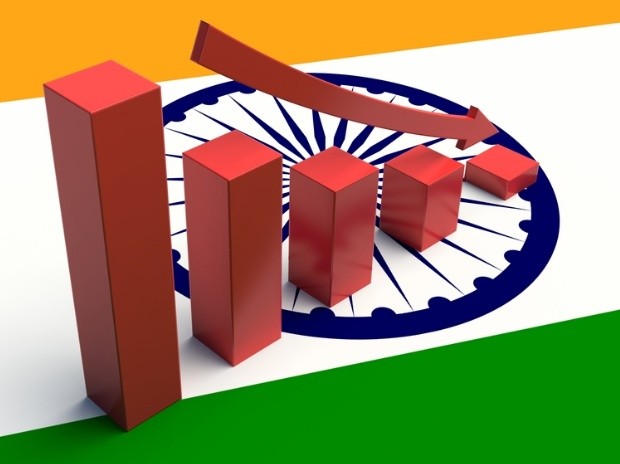
The economic impact of the Covid-19 pandemic in India has been largely disruptive. India’s growth in the fourth quarter of the fiscal year 2020 went down to 3.1% according to the Ministry of Statistics. The Chief Economic Adviser to the Government of India said that this drop is mainly due to the coronavirus pandemic effect on the Indian economy. Notably India had also been witnessing a pre-pandemic slowdown, and according to the World Bank, the current pandemic has “magnified pre-existing risks to India’s economic outlook”.
Economists slashed GDP rates for the predictable future due to the obvious impact of the lockdown. However, it was also estimated that the country might bounce back quickly because its industry composition, with unorganized markets being largely dominant. Losses from organized sectors amounted to an estimated nine trillion rupees in late March, projected to increase with the prolonging of the lockdown. As expected, the most affected industries included services and manufacturing, specifically travel & tourism, financial services, mining and construction, with declining rates of up to 23 percent between April and June 2020.
Recently an industry survey that is jointly conducted by industry body Ficci and tax consultancy Dhruva advisors and took responses from about 380 companies across the sectors. It is said that businesses are grappling with “tremendous uncertainty” about their future.
According to the survey, COVID-19 is having a ‘deep impact’ on Indian businesses, over the coming month’s jobs are at high risk because firms are looking for some reduction in manpower. Further, it is added that already COVID-19 crisis has caused an unprecedented collapse in economic activities over the last few weeks.
The present situation is having a “high to very high” level impact on their business according to almost 72 per cent respondents. Further, 70 per cent of the surveyed firms are expecting a negative growth sales in the fiscal year 2020-21.
Ficci said in a statement, “The survey clearly highlights that unless a substantive economic package is announced by the government immediately, we could see a permanent impairment of a large section of the industry, which may lose the opportunity to come back to life again.”
The survey found:
–In respect to the approved expansion plans, around 61 per cent of the respondents expect to postpone such expansions for a period of up to 6 or 12 months, while 33 per cent expect it to for more than 12 months.
–Surveyed firms of around 60 per cent have postponed their fund-raising plans for the next 6-12 months. Also, nearly 25 per cent of the firms have decided the same.
–Surveyed firms around 43 per cent have reported that they do not predict an impact on exports. Further, 34 per cent said that exports would take a hit by more than 10 per cent.
According to Du & Bradstreet, COVID-19 no doubt disrupted human lives and global supply chain but the pandemic is a severe demand shock which has offset the green shoots of recovery of the Indian economy that was visible towards the end of 2019 and early 2020.
Almost four months has passed, 1.3 Billion Indians have gradually adjusted to the new normal and its completely alright because there isn’t any option left for us. Health workers, security services are working tirelessly to ensure our safety. Centre and State government machinery along with supply chains for essential goods & services are doing best to ensure that food & financial security is available for those who need it the most. Let us all do a favour to our Incredible Nation by helping to constrain the virus, make wise use of unlock period to avoid another lock-down period.
Bio-terrorism is the intentional arrival of infections, microscopic organisms, poisons or other hurtful operators to cause ailment or passing in individuals, creatures, or plants. These operators are normally found in nature, yet could be transformed or modified to build their capacity to cause sickness, make them impervious to current medications, or to expand their capacity to be spread into the earth. Natural specialists can be spread through the air, water, or in food. Organic specialists are appealing to fear mongers since they are very hard to distinguish and don’t make ailment for a few hours a few days. Some bio-terrorism specialists, similar to the smallpox infection, can be spread from individual to individual and a few, similar to Bacillus anthracite
Bioterrorism might be supported in light of the fact that organic operators are generally simple and cheap to acquire, can be effectively scattered, and can cause broad dread and frenzy past the real physical harm. Military pioneers, be that as it may, have discovered that, as a military resource, bioterrorism has some significant confinements; it is hard to utilize a bioweapon such that solitary influences the foe and not agreeable powers. A natural weapon is valuable to fear mongers chiefly as a technique for making mass frenzy and disturbance to a state or a nation. In any case, technologists, for example, Bill Joy have cautioned of the potential force which hereditary designing may put in the possession of future bio-psychological militants.
The utilization of specialists that don’t make hurt people, yet upset the economy, have additionally been talked about. One such pathogen is the foot-and-mouth malady (FMD) infection, which is fit for causing across the board financial harm and open worry (as saw in the 2001 and 2007 FMD episodes in the UK), while having basically no ability to taint people.
Use of bio-terrorism in history was when World War I started, endeavors to use anthrax were aimed at creature populaces. This for the most part end up being insufficient. Soon after the beginning of World War I, Germany propelled an organic damage crusade in the United States, Russia, Romania, and France. Around then, Anton Dilger lived in Germany, yet in 1915 he was sent to the United States conveying societies of glanders, a destructive malady of horse and mules. Dilger set up a research facility in his home in Chevy Chase, Maryland. He utilized stevedores working the harbors in Baltimore to contaminate ponies with glanders while they were holding back to be dispatched to Britain. Dilger was under doubt similar to a German specialist, yet was never captured. Dilger in the long run fled to Madrid, Spain, where he kicked the bucket during the Influenza Pandemic of 1918. In 1916, the Russians captured a German operator with comparable goals. Germany and its partners tainted French rangers ponies and huge numbers of Russia’s donkeys and ponies on the Eastern Front. These activities prevented cannons and troop developments, just as gracefully escorts.
Tom Inglesy, the CEO and executive of the Center for Health Security at the Johns Hopkins Bloomberg School of Public Health and a universally perceived master on general well being readiness, pandemic and rising irresistible infection said in 2017 that the absence of an internationally standardized approval process that could be utilized to manage nations in directing general well being tests for reviving an illness that has just been killed builds the hazard that the ailment could be utilized in bio-terrorism.
India provided outdoor exercise equipment for the island-nation Maldives on 13 July through a financial grant of USD 8 million. The equipment was officially handed over to the country by the High Commissioner to Maldives, Sanjay Sudhir, in an event at Male. According to him, installing of equipment will require the involvement of the island councils and will reinforce the concept of decentralized regime cherished by the Maldivian government.
India was among the first to recognize Maldives to recognize as an independent nation in 1965 and diplomatic relations with that country. India and the Maldives have since established strong political, military, fiscal, and cultural relationships. India continues to contribute in maintenance of security of the island nation. This move strengthens the bilateral relations between relations between the countries. Maldives has been an important strategic ally to India with respect to oil transportation lanes, Indian diaspora and checking Chinese influence in the Indian Ocean.
The archipelago of Maldives comprising 1,200 coral islands lies next to main shipping lanes providing an uninterrupted energy supply to India. Maldives’ strategic position in the Indian Ocean is of geopolitical importance to India to restrict the growing Chinese influence. India and Maldives share cultural, linguistic, and religious relations with each other. More than 25,000 Indian people residing in Maldives (second largest expatriate community). Indian visitors account for nearly 6 percent of the annual tourists.
Events that proved to be influential in shaping the bilateral relations
Operation Cactus
In November 1988, 80 armed terrorists of LTTE infiltrated the region. A Maldivian businessman had thought the plot to be a coup attempt waged a Maldivian businessman and politician who opposed the erstwhile President Maumoon Gayoom’s regime. Gayoom later requested India for immediate military assistance. Rajiv Gandhi, the then Indian Prime Minister, ordered 1,600 soldiers to support the government in Maldives. Indian forces arrived, in a military operation codenamed “Operation Cactus”, within just 12 hours of the request for aid being made. India armed forces thwarted the coup and took complete control over the country within hours.
2014 Drinking-water crisis
The collapse of the only water-treatment plant in Male resulted a drinking-water crisis in the island on 4 December 2014. Maldives has sought immediate assistance from India. India came to the rescue by sending its heavy lift air-carriers such as C-17 Globemaster, Il-76 containing huge quantities of bottled water.
The relations got severely when President Abdulla Yameen came into power. His pro-China stance deeply severed the relations for the next five years. India canceled PM Narendra Modi ‘s visit to Male in March 2015, following the rampant political unrests in the country. The Maldives under Yameen declined India ‘s invitation to its biennial naval exercise, Milan.
Relations between India and Maldives have improved after Yameen’s tenure came to an end. India was one of many countries to congratulate Ibrahim Mohamed Solih after the preliminary results of the presidential elections in Maldives. Modi made his first overseas visit to the Maldives, after being sworn in as Prime Minister for the second time. The two leaders reaffirmed their firm commitment to reinforcing and revitalizing historically strong and friendly relationships.
Recently, in April, amidst the lockdown due to the Covid-19 pandemic, Indian Air Force airlifted 6.2 tons of critical and hospital medicines and consumables onboard Indian to Male C-130 aircraft. ‘Operation Sanjeevani’ was launched by IAF and medicines were lifted from various airports across the country with the help of the Indian Army, and then flew to the Maldives.
The HRD Ministry has just tweeted the decision of the eligibility criterion of jee mains exams has been relaxed Considering the partial cancellation of class 12 exams by several Boards, the Joint Admission Board (JAB) has decided to relax this eligibility criterion for JEE qualified candidates. with the new decision, all jee advanced students to get admission in IITs.if he is passed the board exams
The Supreme Court in june said it will investigate the practicality of physical appearances of lawyers in the court while sticking to physical distancing standards in the midst of the COVID-19 pandemic. The court has been hearing pressing cases through videoconference all through the time of the lockdown. The Benches hearing these cases sit in the courts while legal advisors, who are provided with video joins, make their entries from their homes or workplaces. The court had named this component as the ‘virtual court’ system. However, the Supreme Court Advocates-on Record Association (SCAORA) has been making portrayals to the top court that a greater part of the legal counselors find that they can’t adequately introduce their contentions during virtual court hearings. SCAORA had as of late kept in touch with the court to start physical court hearings from July to serve the legal advisors.
The Bar Council of India (BCI) had recently asked the Chief Justice of India Sharad A. Bobde to continue physical court hearings from June 1. BCI chairperson and senior advocate Manan Kumar Mishra had written in a portrayal to the CJI that solitary a “handful of privileged class of advocates are beneficiaries of the virtual court system”. In its short roundabout, the court showed that it was available to the chance of physical court hearings, gave supporters and gatherings who come face to face to introduce their cases give a joint agree with respect to their “eagerness for genuinely showing up and contending in court”. The court said it would think about how conceivable it is dependent upon the accessibility of Benches, requests of the skilled position and physical removing standards.
Since March, 2020 an enormous number of people and associations have moved toward the Supreme Court concerning the effect of Covid-19. A large number of the Petitions, for example, the supplication to pronounce monetary crisis, are trivial. Some others have petitions requiring significant levels of clinical or other mastery, which the Supreme Court doesn’t have, can’t be gone into. Then again, various issues have been brought up in the Supreme Court which it could have and ought to have engaged however neglected to do as such. The essential methodology of the Supreme Court has been to either say that the Government is accomplishing awesome work and in this way the Court ought not meddle or to say that these are matters concerning strategy which can’t be meddled with. Basically the Supreme Court has been profoundly respectful towards whatever the Central Government says, particularly through the Solicitor General; and when pushed, the court will at the most solicitation the Central Government to consider the issue brought up in a Petition. No course of events is given nor any direction with regards to what are the elements to be taken into account while thinking about the issue. No inquiries are posed and no worries communicated; the Petition passes on a characteristic demise. Let us presently take a gander at a portion of the significant issues managed by the Supreme Court concerning Covid-19.
undoubtedly, this was uncommon in which the Government must be permitted a specific opportunity to go about as it saw fit. In any case, to totally abandon its duties towards the poor was something shocking. Possibly, be that as it may, Covid-19 is the darkest stage throughout the entire existence of the Supreme Court when it renounced its obligation at one go towards a huge number of penniless and underestimated individuals and this record will take some beating in the decades to come.
Performance Appraisal is the systematic evaluation of the performance of employees and to understand the abilities of a person for further growth and development. Performance appraisal is generally done in systematic ways which are as follows:
The supervisors measure the pay of employees and compare it with targets and plans.
The supervisor analyses the factors behind work performances of employees.
The employers are in position to guide the employees for a better performance.
Performance Appraisals are done with a few key objectives in mind: 1. To maintain records for compensation packages, wage structure, salaries, pay raises, or restructuring. 2. To identify the strengths and weaknesses of employees. 3. To assess and maintain the potential each person has for further growth and development. 4. To provide feedback to employees regarding their performance. 5. To serve as a basis for improving working habits of employees. 6. To review and retain promotional and other training programmes.
performance appraisal are an investment for both the company and the employees. After evaluate the performance appraisal of employees, company understand about their work performance towards company and they know other quality of the employee like learn other skills, behaviour with employees and others and their responsibilities are fulfil by his / her. And if employees work not well in organisation they ask him about the problem and motivate them for better performance. It is every year in organisation on that basis they decide which employees are promoted or demoted.
There are many advantages of performance appraisal in an organisation as follows:
Promotion: after performance appraisal help the supervisors to recommend promotion programmes for efficient employees but it is demoted or dismissed from the work to inefficient employees.
compensation: Performance appraisals help to evaluate compensation packages for employees. Packages, which include bonuses, higher salary rates, extra benefits and allowances, are dependent on how an employee is performing.
Employees Development : It help supervisors to develop training policies and programmes based on the strengths and weakness of employees so that new role can be designed gor efficient employees.
Communication: For any organisation , effective communication between employee and employer are very important . Through performance appraisal, employers can understand and accept skill of workers, A company can maintain a position labour – management relationship, and employee can also understand, learn to trust and have confidence on supervisors.
Motivation: Performance appraisal serves as a motivational tool. After evaluate which employee achieved their goal or target , a person’s efficiency can be determined. This motivates a person to work toward perhaps a better job, and helps him or her to improve performance in the future.
There are some methods from which performance appraisal are evaluated in the organisation:
# Ranking method
# Forced choice method
Process of performance appraisal:
1: Establishing performance standards
2: Communication standards and expectations
3:Measuring the actual performance
4: comparing with standard
5: Discussing result (providing feedback)
6: Decision making or taking corrective action
360 degree appraisal:
There are three general reasons as to why as organisation would go in for a 360° degree appraisal :
1- To get a better view of performance and prospective of future leaders.
2- To have a board insight of developmental needs of manpower
3- To collect more feedback so as to ensure justice to the job performed by employee.
In 360° appraisal system, the feedback is collected from the managers, peers,subordinates, customers, team member etc. A survey is conducted to get close understanding of- on the job performance of employee.
Everyone is no one to everyone. You is both singular and plural in English grammar but it’s different in life. It’s always singular and you are only you and no one cares. Caring is done only if you pay. Money makes people and breaks people. If you have money, you can buy anything. Believe no one else you become only one.
Have faith in others but don’t trust others. Being you everytime and thinking only about you is atmost necessary in this cruel world. Have faith and beleive in yourself. No one is going to help unless you help them. Why do anyone help anyone without getting something. Giving is difficult and taking is easy. Beleive the process but not people. Trust no one and have faith in you. Life in this selfish world is so selfless. Living for others make your mates treat you as some other random guy. Never hope for something . Expecting is foolish because you are a fool to expect. Never give and never hope for the return.
Someone is something to you when he expects something to you and you become something when he gets his something. Don’t give atleast a thing and if anyone gives you something to you even before you give them believe him. Trusting blindly is so easy. Don’t give them opportunity because that makes them to have a choice between leading a luxurious life and happy life. Everyone will experience a moment in their life whether to choose a luxurious life by breaking the choice or to have a happy life by keeping the promise.
Believing your children isn’t trust worthy because there are few of them whom we can take as examples. Sometimes trusting yourself is too dangerous but there will be no choice to make because you are the choice maker. Make yourself strong because atlast you will be left alone right beside you to condolence yourself. It’s ok if you betray yourself because it’s better than getting betrayed by some others. Have a great hioe and become a master of making you. Don’t ever try to oversmart yourself because you know who you are.
How are you coping nowadays? Is everything going according to what you have planned? Or are you making the efforts to change your ways?
COVID-19 has surely changed our way of living life, doing business and definitely changed our perception of life. Our body was programmed to wake up in the morning, doing personal work, dressing up and heading for work, returning to our loved ones and spending time with our families. But now we wake up and we feel like we are running in circles. Waking up and trying to do everything at one go, with overloaded information and then there is a huge feeling of procrastination and it seems like everything is taking a toll on our mind. Nowadays we are always feeling like doing “more” and “better”, and that too in a very short span of time. Now there is no harm is trying to do more and in a better way, but there should be a pause on this. Our mind is taking its own time to adapt to this drastic change and we should be patient enough to give time to our mind.
Mindfulness. Such a long word and yet so simple. It is a state of our mind where we are aware of the present and we are aware of our own behavior at each moment. Study reveals that it is very crucial to practice and imbibe mindfulness so that we do not feel stressed and depressed. Now is the time, more than ever when such a practice can improve us and make us feel alive more than ever.
A few tips by which you can bring mindfulness in your life:
Wake up early. It is a good habit to wake up by 6 AM in the morning and take a whiff of fresh air. It clears you brain and makes you feel energized.
Meditate. Make sure to meditate for about 10-15 minutes in the morning. It will make you ready for the day.
Read newspaper. Study shows that what we study in the morning, we tend to remember it for a long time. Newspaper or a few pages of your book will open your mind to face the day.
Sip green tea. Obesity is the new form of smoking. To reduce the caffeine intake and to ensure our health is in good condition, switch from black to green tea.
Eat slowly and mindfully. Take small bites and stay away from T.V, laptop or any kind of social media while eating. Let your body and mind to enjoy the food.
Talk to nature. Staying within the closed doors will make us sicker. Take some time out and enjoy the greenery outside.
Check you digital time. Always try to keep a tab on the time you are spending on social media or on the screen. For this one can use Pomodoro Technique.
Follow your passion. Now is a great time of you want to follow up on something which you previously did not get time to do. It will also be good to keep stress at bay.
These are the few techniques which one can definitely follow to practice mindfulness. It is advisable to acknowledge that things are tough but we should also be mindful to not let stress build its house in our mind.
The feminist movement (also known as the women’s movement, or simply feminism) refers to a series of political campaigns for reforms on issues such as reproductive rights, domestic violence, maternity leave, equal pay, women’s suffrage, sexual harassment, and sexual violence, all of which fall under the label of feminism and the feminist movement. The movement’s priorities vary among nations and communities, and range from opposition to female genital mutilation in one country, to opposition to the glass ceiling in another. Feminism in parts of the Western world has gone through three waves. First-wave feminism was oriented around the station of middle- or upper-class white women and involved suffrage and political equality. Second-wave feminism attempted to further combat social and cultural inequalities. Although the first wave of feminism involved mainly middle class white women, the second wave brought in women of color and women from other developing nations that were seeking solidarity. Third-wave feminism is continuing to address the financial, social and cultural inequalities and includes renewed campaigning for greater influence of women in politics and media. In reaction to political activism, feminists have also had to maintain focus on women’s reproductive rights, such as the right to abortion. Fourth-wave feminism examines the interlocking systems of power that contribute to the stratification of traditionally marginalized groups. Feminism in China started in the 20th century with the Chinese Revolution in 1911. In China, Feminism has a strong association with socialism and class issues. Some commentators believe that this close association is damaging to Chinese feminism and argue that the interests of party are placed before those of women.
HISTORY :
Feminism in the United States, Canada and a number of countries in western Europe has been divided into three waves by feminist scholars: first, second and third-wave feminism.Recent (early 2010s) research suggests there may be a fourth wave characterized, in part, by new media platforms The women’s movement became more popular in May 1968 when women began to read again, more widely, the book The Second Sex, written in 1949 by a defender of women’s rights, Simone de Beauvoir (and translated into English for the first time in 1953; later translation 2009). De Beauvoir’s writing explained why it was difficult for talented women to become successful. The obstacles de Beauvoir enumerates include women’s inability to make as much money as men do in the same profession, women’s domestic responsibilities, society’s lack of support towards talented women, and women’s fear that success will lead to an annoyed husband or prevent them from even finding a husband at all. De Beauvoir also argues that women lack ambition because of how they are raised, noting that girls are told to follow the duties of their mothers, whereas boys are told to exceed the accomplishments of their fathers. Along with other influences, Simone de Beauvoir’s work helped the feminist movement to erupt, causing the formation of Le Mouvement de Libération des Femmes (The Women’s Liberation Movement). Contributors to The Women’s Liberation Movement include Simone de Beauvoir, Christiane Rochefort, Christine Delphy and Anne Tristan. Through this movement, women gained equal rights such as a right to an education, a right to work, and a right to vote. One of the most important issues that The Women’s Liberation movement faced was the banning of abortion and contraception, which the group saw as a violation of women’s rights. Thus, they made a declaration known as Le Manifeste de 343 which held signatures from 343 women admitting to having had an illegal abortion. The declaration was published in two French newspapers, Le Nouvel Observateur and Le Monde, on 5 April 1971. The group gained support upon the publication. Women received the right to abort with the passing of the Veil Law in 1975.
Feminism: Belief in and desire for equality between the sexes. As Merriam-Webster noted last month: “the belief that men and women should have equal rights and opportunities.” It encompasses social, political and economic equality. Of course, a lot of people tweak the definition to make it their own.
According to Maggie Humm and Rebecca Walker, the history of feminism can be divided into three waves. The first feminist wave was in the nineteenth and early twentieth centuries, the second was in the 1960s and 1970s, and the third extends from the 1990s to the present.
‘Intellect’ refers to the creations of the mind. Intellectual Property is a type of intangible property and includes inventions, literary and artistic works, symbols, names and paintings.
Intellectual Property Rights (IPRs) are the Rights granted to the creators of Intellectual Property (IP) by the Government. The nature of IPR is territorial. In any country an IP has to seek protection separately under the relevant laws.
Mechanisms which are Special in nature have been kept in place for various territories in order to provide protection to different types of IPRs. It confers an exclusive right to the inventor/ creator or assignee to fully utilize the invention/ creation for a given period of time.
It’s been established that the intellectual labor associated with the innovation should be given due importance so that public good emanates from it.
This is a strong tool, to protect investments, time, money, effort invested by the inventor/creator of an IP, since it grants the inventor/creator an exclusive right for a certain period of time for use of his invention/creation.
Hence it aids in the economic development of a country by promoting healthy competition and encouraging industrial development which shall also aid in the growth of the economy.
WHAT IS AN INTELLECTUAL PROPERTY?
Intellectual Property(IP) refers to creations of the mind; inventions; literary and artistic works; and symbols, names and images used in commerce.
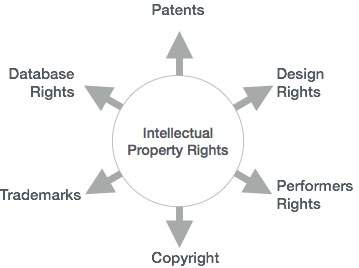
IP is divided into two categories: 1) Industrial Property:- includes patents for inventions,trademarks, industrial designs and geographical indications. 2) Copyright:- covers literary works (such as novels,poems and plays), films, music, artistic works (e.g., drawings, paintings, photographs and sculptures) and architectural design.
In Intellectual property(IP), there are Rights which relates to the rights of performing artists in their performances, producers of phonograms in their recordings, and broadcasters in their radio and television programs are included.
WHAT ARE INTELLECTUAL PROPERTY RIGHTS?
So what do you mean by intellectual property rights? IP rights like any other property right allow creators, or owners, of patents, trademarks or copyrighted works to benefit from their own work or investment in a creation.
These rights are outlined in Article 27 of the UDHR which provides for the right to benefit from the protection of moral and material interests resulting from authorship of scientific, literary or artistic productions.
The importance of intellectual property was first recognized in the Paris Convention for the Protection of Industrial Property (1883) and the Berne Convention for the Protection of Literary and Artistic Works (1886). Both treaties are administered by the World Intellectual Property Organization (WIPO).
There are various pros which are more compelling than the cons.
1) The progress and well-being of humanity rest on its capacity to create and invent new works in the areas of technology and culture.
2) The legal protection of new creations and this encourages the commitment of additional resources for further innovation.
And Lastly the third pros is that the 3) Promotion and protection of intellectual property spurs economic growth, creates new jobs and industries, and enhances the quality and enjoyment of life.
An efficient and equitable intellectual property system can help all countries to realize intellectual property’s potential as a catalyst for economic development and social and cultural well-being. The intellectual property system helps strike a balance between the interests of innovators and the public interest, providing an environment in which creativity and invention can flourish.
INTELLECTUAL PROPERTY HOLDERS IN A QUANDARY DUE TO COVID-19 PANDEMIC
While experts are in a combat mode and the race is on to discover the cure for COVID-19, the claim of intellectual property rights for exclusive use of the cure poses a dilemma as it is not considered the most rational thing to do at the moment.
Carlos Correa addressed to organizations like WHO, WTO and WIPO via an open letter to seek support for WTO countries that invoke the ‘security exception’ contained in Article 73 of the Agreement on Trade Related Intellectual Property Rights (TRIPS) Agreement, to take ‘actions it considers necessary for the protection of its essential ‘security interests’ in the wake of COVID-19 threat.
It has been suggested that invocation of exception under Article 73 will be warranted to procure medical products and devices or to use the technologies to manufacture them as necessary to take cue of the present public health emergency.
By suspending the enforcement of any Intellectual Property right as given under Article 73(b) of TRIPS Agreement, an obstacle for the procurement or local manufacturing of the medical equipments shall be necessary in order to protect the population of the world will be outlasted.
The question which is raised due to the above is regarding IP rights which are aimed to aid the public by promoting technological advancement in return of providing the inventor an exclusive right over the invention, though for a limited time. Though the IP rights are at a standstill due to the outbreak the IP Registry offices all over have limited their functioning.
TYPES OF INTELLECTUAL PROPERTY
Trade Mark: –
A trademark is used in order to identify a business entity and it also differentiates the goods made or services offered by a company or an individual. Names, Words, Logos, Colors, Packaging, Sounds (audible), Signs (visual) or any combination thereof are considered and can be filed as trademarks.
A trademark must be Unique and Distinctive in nature and must also avoid adjectives for eg efficient and Names of person or places (E.g. India). Even Obscene words, Religious or Government words or symbols (E.g. OM) and Common Shapes (Square) should be avoided.
The Trade mark means a mark used in relation to goods for the purpose of indicating a connection in the course of trade between the goods and some person having the right as proprietor to use that mark.
The function of a trade mark is to give an indication to the purchaser or a possible purchaser as to the manufacture or quality of the goods, to give an indication to the trade source from which the goods come or the trade hands through which they pass on their way to the market.
The Trade Marks Act, 1999 is an act which provides for the registration and better protection of trademarks for goods and services and for the prevention of the use of fraudulent marks. A trade mark is valid for a period of 10 years.
Case Name: The Coca-Cola Company v. Bisleri International Pvt. Ltd Case Citation: Manu/DE/2698/2009
Copyright: –
Copyright is an exclusive legal right granted to the creators of an intellectual work. The owner of a Copyright has rights to reproduce, translate, adapt, perform, distribute and must be publicly allowed to display the work, etc.
Registration is not mandatory since copyright comes into existence as soon as the intellectual work is created but it is recommended to register a copyright for better enforceability, since registered copyrights have more evidentiary value in court.
(a) Types of Works covered under Copyright:-
(1) Literary including Software – Books, Essay, Compilations, Computer Programs.
(2) Artistic – Drawing, Painting, Logo, Map, Chart, Plan, Photographs, Work of Architecture.
(3) Dramatic – Screenplay, Drama.
(4) Musical – Musical Notations.
(5) Sound Recording – Compact Disc.
(6) Cinematograph Films – Visual Recording which includes sound recording.
(b) Duration of Copyright:-
(1) Literary, Dramatic, Musical or Artistic Works – Lifetime of the author + 60 years from the death of the author.
(2) Anonymous & Pseudonymous Works – 60 years from the year the work was first published.
(3) Works of Public Undertakings & Government Works – 60 years from the year the work was first published.
(4) Works of International Organizations – 60 years from the year the work was first published.
(5) Sound Recording – 60 years from the year in which the recording was published.
(6) Cinematograph Films – 60 years from the year in which the film was published.
Case Name:- Indian Performing Rights Society Ltd. v. Eastern India Motion Picture Association Case Citation: – 1977 SCR (3) 206
Designs: – The Design Act, 2000 states that it protects the aesthetic and ornamental features of an object. As per the Act a 2D or 3D pattern of a handicraft, a product, or even an industrial commodity.
The Unique Selling Point (USP), protects the looks and feels of the product and it prevents the duplication of the product. An industrial design helps in drawing a customer’s attention and helps in increasing the commercial value of an article.
Case Name:-Cello Household Products v. M/S Modware India and anr Case Citation:- Notice of Motion (L) No. 209/2017 in Suit (L) No. 48/2017
Patents On the 4th December, 2018, The Ministry of Commerce and Industry released the draft (rules amendment) for Patents Act 1970. These rules are mainly amended with respect to international applications, patent opposition and a few form related extensions. The Central Government proposes to make these amendments in exercise of the powers conferred by section 159 of the Patents Act, 1970.In order to align with TRIPS, inventions which are not patentable have been included even, wider rights of patentee is incorporated. Uniform period of protection is 20years. Case Name: Bajaj Auto Limited v.TVS Motor Company Limited. Case Citation: JT 2009 (12) SC 103
5. Integrated Circuits
Semiconductor Integrated Circuits Layout Design (SICLD) Act 2000 states the meaning of Semi conductor Integrated Circuit as, a product having transistors and other circuitry elements designed to perform an electronic circuitry function. There are 2 types of designs as per the act:-
(i) Layout Design – A layout of transistors and other circuitry elements including lead wires which connects semiconductor integrated circuits.
(ii) Layout-Design Registry (SICLDR) is the office where the applications on Layout-Designs of integrated circuits are filed for registration. The jurisdiction of this Registry is whole of India. The Registry, as per the guidelines laid down in the Semiconductor Integrated Circuits Layout Design (SICLD) Act 2000 and the Semiconductor Integrated Circuits Layout-Design (SICLD) Rules 2001, examines the layout-designs of the Integrated Circuits and issues the Registration Certificate to the original layout-designs of the Semiconductor Integrated Circuits.
Case Name: Sunil Alag v. Union of India and Others Case Citation: W.P. (C) 8152/2013
6. Biological Diversity
The Biological Diversity Act 2002 was enacted to realize the objectives enshrined in the United Nations Convention on Biological Diversity (CBD) 1992 which was passed by the Lok Sabha on 2nd December 2002 and by the Rajya Sabha on 11th December 2002.
It recognizes the sovereign rights of states to use their own Biological Resources due to the scarcity and also to conserve it. The Act provides for a mechanism for equal sharing of benefits arising out of the use of traditional biological resources and knowledge. It is a federal legislation enacted by the Parliament of India for preservation of biological diversity in India.
Case Name: Environment Support Group vs National Biodiversity Authority Case Citation: W.P. No.41532 / 2012
7. Plant Varieties and Farmers
Protection of Plant Varieties and Farmer’s Rights Act of 2001(PPV & FR Act, 2001) confers right to breeders, researchers and farmers over their plant varieties. Reaching legislation with regards to establishing rights for farmers to save, use, exchange and sell farm saved seed.
The Act establishes nine rights for farmers of which the most important in this regard are the right to “seed” and the right to “compensation” for crop failure (Art. 39). Not only does the 2001 Act protect the rights of framers to save, use, exchange and sell farm- saved seed, it also seeks to ensure that these seeds are of good quality, or at least that farmers are adequately informed about the quality of seed they buy.
In addition, safeguards are provided against innocent infringement by farmers. Farmers who unknowingly violate the rights of a breeder are not to be punished if they can prove that they were not aware of the existence of such a breeder’s right (Art 42).
Case Name:- Monsanto Technology LLC & Ors Vs. Nuziveedu Seeds Ltd & OrsHigh Court of Delhi Case Citation: CS (Comm) 132/2016
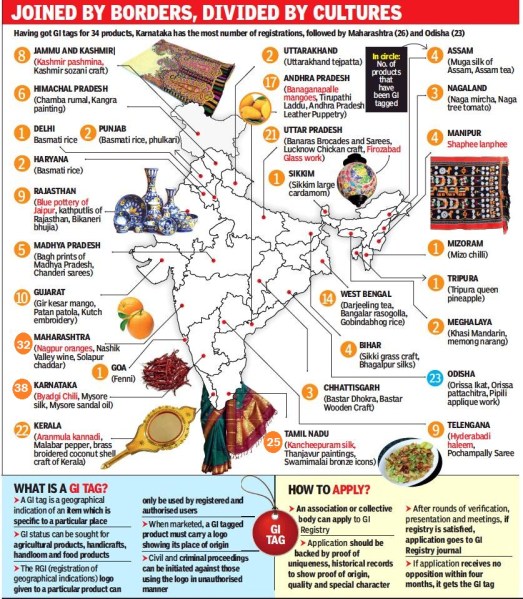
The Geographical Indication of Goods:- The Geographical Indications of Goods (Registration and Protection) Act, 1999 states Geographical Indication as it is primarily an agricultural or food product, natural or a manufactured product (handicrafts, Handloom textiles or industrial goods) originating from a definite geographical territory. A product is considered to be manufactured in a territory if any one of the activities of either the production or of processing or preparation of the goods takes place there. It promotes the producers prosperity of goods which have been produced in the geographical territory.
It helps the producer community to differentiate its products from other competing products that are present in the market and generate goodwill around its products. Hence, it acts as a signaling device by helping consumers to identify genuine quality products.
Case Name:- Tea Board Vs ITC Limited on 20 April, 2011 Case Citation:- GA No. 3137 of 2010 CS No. 250 of 2010
It has been suggested that invocation of exception under Article 73 will be warranted to procure medical products and devices or to use the technologies to manufacture them as necessary to take cue of the present public health emergency.
CONCUSION
The above overview clearly depicts that India has adopted and adhered to the latest IPR Regime and it has forayed into the global trade competition with a double edged sword.
– distortion of language, truth, meaning and reality
– sham killings
– begin repeatedly taken to the point of death or threatened with death
– being forced to witness abusive acts on others
– being forced to make impossible “choices”
– boundaries smashed i.e. by the use of forced nakedness, shame, embarrassment
– hoaxes, ‘set ups’, testing and tricks
– being forced to hurt others
Ritual abuse survivors often describe much the same things.”
Laurie Matthew
Bullying comes easily to us, we have each bullied and been bullied. When the bullying gets out of hand, we go to the authorities. What happens when the authorities start bullying us? What if our “democratic” government becomes our bully? What if they get annoyed and torment us when we stand up for ourselves?
Unfortunately, throughout history, democracy, or dictatorship, people who have had enough and who stood up against their government in power, were tortured. The government confuses free speech for hate speech and plasters the sedition law in bold letters. Perversely, neither the charge is accurate nor is the life sentence fair.
What is the Sedition Law in India?
Article 124A:
“Sedition.—Whoever by words, either spoken or written, or by signs, or by visible representation, or otherwise, brings or attempts to bring into hatred or contempt, or excites or attempts to excite disaffection towards, the Government established by law in India, shall be punished with [imprisonment for life], to which fine may be added, or with imprisonment which may extend to three years, to which fine may be added, or with fine.
Explanation 1. — The expression “disaffection” includes disloyalty and all feelings of enmity.
Explanation 2. — Comments expressing disapprobation of the measures of the Government with a view to obtain their alteration by lawful means, without exciting or attempting to excite hatred, contempt or disaffection, do not constitute an offence under this section.
Explanation 3. — Comments expressing disapprobation of the administrative or other action of the Government without exciting or attempting to excite hatred, contempt or disaffection, do not constitute an offence under this section.”
The above Article 124A is part of the Indian Penal Code and restrains citizens of India from spreading hatred or from urging others to show “disaffection” towards the Government of India.
In the explanations following the article, “disaffection” has been referred to as feelings of disloyalty or enmity. Comments that object the measures of the governments made lawfully are not considered an offence, neither is revealing disapproval of any action taken by the government peacefully.
Indian Citizen’s Rights:
India is a proudly democratic and secular country. It’s been taught to us that India is one of the few countries that celebrate various cultures, religions, languages democratically.
Article 19 of the Constitution:
“Protection of certain rights regarding freedom of speech, etc.,
(1) All citizens shall have the right:
(a) to freedom of speech and expression;
(b) to assemble peaceably and without arms;
(c) to form associations or unions [or co-operative societies];
(d) to move freely throughout the territory of India;
(e) to reside and settle in any part of the territory of India;
(f) Omitted
(g) to practise any profession, or to carry on any occupation, trade or business.”
Article 19 of the Constitution of India gives its citizens freedom of speech, expression and to assemble peacefully.
Assembling Peacefully, aka, Protesting, and showcasing disapproval (without spreading hatred) for any law the Government of India has passed is a citizen’s basic human right.
Using arms, hurting, killing, sexually assaulting, aka Rioting, however, isn’t lawful and is a punishable offense.
2020 North-East Delhi Riots:
Since the anti-CAA and anti-NRC protests started last December in India, thousands of peaceful protestors have been arrested and even more detained. Internet and Phone services were shut down, halting all forms of communication. Many were tortured to death. Journalists have been intimidated and threatened, news channels been suspended. Students have been expelled.
Peaceful protests are every citizen’s right. Rioting is not.
Yet on 23rd February 2020, angry Hindus led a 6-day riot killing 53 and wounding thousands. Most of those deceased and harmed were Muslims, the main targets of the rioters. The week-long riots were bloody, racist, and unnecessary. Students were trapped in universities without electricity, food, or water, fearing the armed haters separated by just a door. Mosques were attacked and set on fire. Saffron flags (a symbol of Hindutva) were hoisted every place the rioters destructed. Hospitals were filled with injured protestors and rioters. Shots were fired, batons were hit, buildings destroyed, lives destroyed, peace destroyed. All this destruction for religious hatred?
This is not just a violent act, but it was driven by religious hatred. Weeks after the riot ended, bodies were still being discovered beaten and tortured. Universities were raided, students were sexually, physically, emotionally assaulted and yet more innocent people are captive.
Fearing for their lives and their loved ones, many minorities left Delhi, soon after. Most of whom remained, have been linked to violent behavior and have been arrested.
Political Prisoners of India – Safoora Zargar, Meeran Haider, Shifa-Ur-Rehman, Asif Iqbal Tanha and more:
“At no time have governments been moralists. They never imprisoned people and executed them for having done something. They imprisoned and executed them to keep them from doing something.”
Aleksandr Solzhenitsyn
All the innocent people arrested with affiliation to the peaceful protests since December 2019 and the Delhi Riots are Political Prisoners of India.
The Encyclopedia of Human Rights quotes, “Many victims of human rights abuses are civilian casualties in the war against him rights abuse; political prisoners are usually the war’s frontline soldiers.”
Although most student protestors and others are charged under the Unlawful Activities (Prevention) Act (UAPA), it is clear that they are political prisoners. If Safoora Zargar was an actual criminal, she wouldn’t have been released following the protests and petitions signed to get her out. A criminal would never be set free as a result of protests.
This is not the secular, democratic India we were proudly taught about. This is not the India I want to be a part of. This is not the leadership, India and its citizens deserve. India should be the most populous democracy it claims to be. India is not a Hindu country, with only one language, Hindi. India is a country with multiple religions and cultures with over 470 languages. India is not an Anti-Muslim Country despite the way it is being portrayed. The only religion India is against is the religion of Terrorism. And Muslims are NOT terrorists!
I am speaking up. I am using my voice. I am not disrespecting my country, India. I am criticizing the way the government, honestly and respectfully! I am using my right to be vocal about what I think is problematic in my country!
Malnutrition is one of the world’s highly overlooked issues. Many still believe that malnutrition is restricted to the African continent, which is the biggest myth this article will bust. If the first image that pops into your mind when you think of malnutrition is a scrawny African kid, this is the article to educate you about our world.
Malnutrition, as the name suggests, is the deficiency of the required nutrients in one’s body. A properly balanced diet should constitute sufficient energy/calorie requirements and also meet our diverse nutritional requirements. Our biology tells us more about our ailments than our body weight and structure.
Another myth associated with malnutrition is that only those without timely meals are malnourished. Malnourishment exists in three main forms: under-nourished, over-nourished, and targeted nourishment.
Under-Nourished: A person who is not consuming a timely balanced diet
Over-Nourished: A person consuming more nutrients than needed, they are over-nourished, or obese
Targeted Under-Nourishment: A person consuming timely food, but lacking a balanced food intake
Malnourishment is less about how much you eat and more about what you eat. To further bust the myth, Africa might be the continent with the highest malnourished population, but the country with the highest malnourished population is, Yemen.
The Double-Burden of Malnourishment is a crisis that almost all countries are facing, trying to end under-nourishment while tackling an increasingly obese population.
Food Security is the availability of food and one’s access to it. Food insecurity is when there’s an infrequent availability and one’s eating habits are disrupted as a result of lack of money and other resources.
9.2% of the world was severely affected by food insecurity, and 1-in-4 are moderately affected by food insecurity in 2018.
As a result of this, many people fail to avail of the basic requirement, food.
Over 1 billion people were undernourished in 1990, 795 million as of 2014. The number soon reaching 821 million by 2017.
Contrary to popular belief, India is one of the highest-ranking countries in the world worst affected by malnutrition amongst children. About 30% of Indian children are underweight, almost twice than in Sub-Saharan Africa.
Over 5% of the Indian population is morbidly obese. Processed, sugar-free, and other un-healthy options have substituted our diets. Organic options have become a thing of luxury. The National capital surpasses every other state and union territory with 45.5% men and 49.8% women obese population (Transgender data not given). While Madhya Pradesh and Rajasthan exceed in the undernourished population.
Fad Diets promising quick weight shedding are part of the problem. While you may shed the “few extra pounds,” they leave you with a malnourished body. Omitting fats from our diets does us more harm than good. Take, for instance, potatoes and sugars, high in starch and carbohydrates, are still vital for our body.
Each year, enough food is produced to feed more than 12 billion people. The world population is 7 billion!
A country as a whole very rarely struggles with food insecurity. It is a group or even a marginalized community that struggles with finding proper access. Haddad in their article, “Lifting the Curse: Overcoming Persistent Undernutrition in India” wrote, “A poor capacity to deliver the right services at the right time to the right populations, an inability to respond to citizens’ needs and weak accountability are all features of weak nutrition governance.” While government officials claim that it is a challenge for every country to provide people with access to healthy food.
While it is debatable as to how much the government does or can do, many factors come into play. To name a few, the socio-economic status, region, religion, and relationships.
One strong link to malnutrition in India is domestic violence. Domestic violence brings with it emotional and physical abuse. The dual-abuse affects one’s oxidative stress, hemoglobin blood levels, and produce anemic malnutrition.
Another link is that of religion, scientific studies prove that in India, Hindus and Muslims tend to be more malnourished than those from Christian, Sikh or Jain backgrounds.
Each type of malnutrition brings with it many diseases and high mortality rates. Visible signs of malnutrition and dehydration are most common include, including moon face, dry eyes, periorbital edema, glossitis, enamel mottling, dull-sparse-brittle hair, alopecia, thin and soft nail plates, muscles wasting, calcium-vitamin D-vitamin C deficiencies, and more.
With the ongoing pandemic and the related lockdown, many families have lost their source of income. People are struggling to choose between food and rent. The malnutrition rates have been higher in the last few months than last year. UNICEF’s plan to achieve Zero Hunger by 2030 seems unlikely.
A bare reading of the definition of lynching states,
“To punish (a person) without legal process or authority, especially by hanging, for a perceived offense or as an act of bigotry”
One clear understanding from the above-mentioned definition is that there is no place for Mob lynching in a civilized land and especially in the world’s largest democracy.
The drafters of the Indian Constitution knew that laws in the country could be twisted to challenge the Fundamental Rights which were assured to the citizens and that’s exactly why The Right to Constitutional Remedies, that is, a process to seek justice through courts, was included in it.
Also going to through the epics, it holds no substantial, memorable or any quoted reference to this stated vicious practice.
Thus, in today’s world, Lynching stands as an exception.
The biggest irony and misfortune of our country is that everything and anything is politicized for insignificant political interests and vote bank. The same is true with most inhuman and abominable activity of mob lynching.
Early political context has been witnessed in the Kherlanji massacre in 2006. It was when four people were lynched over a land dispute at Kherlanji in Maharashtra. A mob of at least 50 villagers captured Bhaiyyalal Bhotmange’s house, and lynched four members of his family. Bhotmange’s wife and their daughter were marched naked in the village and sexually abused before being brutally murdered. The attack was after these women filed a police complaint against 15 villages who thrashed a relative. And despite such chaos, there were efforts to normalise the lynching later saying it was a casteist outrage against Dalits by the politically dominant Kumbi caste.
The next lynching that shocked the nation happened in Dimapur in 2015. A mob of least 7,000 to 8,000 infuriated people broke into Dimapur Central Jail, dragged Syed Farid Khan accused in a rape case out, marched him naked, stoned him, thrashed him, dragged him for over seven kilometres. There were attempts of tying a rope to his waist from a motorcycle. Ultimately, killing him and displaying his body on a clock tower. The brutal punishment was for the rape on a superficial level but what the mob thought was that they were lynching a Bangladeshi migrant. Khan, originally from Assam, had been living in for over Dimapur eight years. What is conflicting in this case is that the medical reports about the rape initially said the woman, who filed the complaint, was raped and then denying the same. Khan’s family claimed he was framed and said that the woman invited Khan to a hotel, forced him to drink and demanded Rs 2,00,000 from him. Ironically, this horrific mob violence executed was quoted by many as an example of serving justice.
Not much time later, Dadri lynching was witnessed. A 52-year-old Muslim man, Mohammad Akhlaq and his son, were attacked by a village mob with sticks and bricks, accusing them of stealing and slaughtering a cow calf and storing and consuming beef. The son was severely injured in the attack. Akhlaq was beaten till he died. This incident in Uttar Pradesh’s Bisara village near Dadri, was the first case of a Muslim lynched by a Hindu mob in the name of cow and beef. A primary inquiry by the Uttar Pradesh Veterinary Department said the meat recovered from Akhlaq’s refrigerator was not beef but of “goat progeny”. After a year in Mathura’s forensic department, the report said that the meat was of a cow or its progeny. And not much to surprise, the report was said to be politically motivated to normalise the lynching saying the mob was “emotionally charged” since cow slaughter is an extremely emotional issue for Hindus.
India is a multi-religious, multi-cultural, multi-ethnic, multi-dimensional and diverse country where people belonging to various faiths and religious denominations live together in peace and tranquillity. In such a diverse country, mob lynching in the name of protecting cow has the potential of leading to communal disharmony which may lead to national disintegration when national integration is badly required for peace, economic development and societal upliftment of the country.
Even since, Government imposed a ban on the sale and purchase of cattle for slaughter at animal markets across India, under Prevention of Cruelty to Animals statutes in 2017, it flashed a new wave of cow vigilante throughout the country. Though the SC suspended the ban on the sale of cattle in its judgment in 2017, giving relief to the multi dollar beef and leather industries and several states where beef is one among the primary foods, there was a rise in attacks on Muslims accusing them as beef eaters. Several innocent Muslims were murdered in such mob attack.
Law and order is a state subject and therefore all State Governments should deal with this inhuman activity strictly to maintain the rule of law and its supremacy. No one should be allowed to tinker with the law and the law violators and unruly mobs that resort to mob lynching should be put behind bars and severe punishment should be given to them so that this issue will be curbed and the country is saved from disturbance and violence. The primitive mindset and mob lynching are alien to our culture and should as such be discouraged and the secular democracy saved for the welfare of its citizens without any distinction of caste, creed, color or sex. Otherwise we will stoop to the 18th century which will take us back to the days of ignorance and illiteracy.
The government, though, has taken initiatives as it has asked States to appoint a nodal officer in each district to prevent the incidents of mob lynching. It has also asked to set up a special task force to procure intelligence reports about the people who are likely to commit such crimes or who are involved in spreading hate speeches, provocative statements and fake news.
Two high-level committees have also been constituted by the Centre to suggest ways to deal with incidents of mob lynching. One of the committees is being headed by Union Home Minister and the other by Union Home Secretary. The move came a week after the SC asked the Centre to enact a law to deal with incidents of lynching and take action on mob violence. The government respecting the directions of the Apex Court on the issue of mob lynching has issued an advisory to the State governments urging them to take effective measures to prevent such incidents, and also take severe actions as per the law.
Mob lynching should be dealt with an iron hand as it has the ramification of disturbing communal amity and peace in the diverse society and as such should not be tolerated and no one should be allowed to take law into his or her hands. It cannot be associated with any particular religion as it is a criminal activity and the criminal mindset does not come into people of any specific community. Thus to associate it with majority community is unjustified. But the majority community has the moral responsibility to protect and safeguard the minorities and supplement the efforts of the Government in this regard otherwise we cannot claim to build a new India where everyone irrespective of religion and faith will be safe and sound. We can rebuild new India only when there will be peace and the sectarian and communal violence will be things of yesteryears.
Thus, mob lynching should be condemned, discouraged and curbed if we have to build a strong and new India as a big economic power.
Sushant Suicide Case: Subramanian Swamy writes to Modi requesting for CBI Enquiry, Says big names of industry with links to a don from Dubai are trying to cover up • Swamy wrote: My Lawyer Ishkaran Bhandhari investigated on the reasons of sushant’s suicide. • Swamy is confident on his belief that following PM’s advice the Maharashtra CM will allow for the CBI Enquiry. The Demands for CBI Enquiry in case of Sushant’s Suicide are increasing day by day. After commiting suicide on 14th June, many fans of Sushant, Bolywood celebrities and politicians from Bihar have demanded for a CBI Enquiry in this case. Former Union Minister and BJP Member of Parliament wrote a letter to PM Narendra Modi requesting to intervene in the matter. In his letter, Swami wrote: Many big names from the industry are in contact with a Don from Dubai to put pressure on the matter. In the letter- I believe you all might know about the sad demise of Sushant. My laywer Ishkaran Bhandhari investigated the reasons for sushant’s alleged suicide. However, the police is still investigsting the matter. I have come to know from my sources that many big names from the industry in contact with a don from Dubai are pressuring the police to cover up as suicide. I request you to advice the CM of Maharashtra to agree for a CBI Enquiry to gain public confidence. I am sure that the CM would agree for the enquiry upon your advice. Swamy Requested for enquiry five days ago Swamy asked lawyer Ishkaran Bhandhari to see through the matter that if CBI Enquiry is required. Swamy spoke in this matter through several tweets. He said, in the starting it came up as a suicide and as the CBI investigation proceeds it will be mentioned as a murder in the chargesheet.
Aim of Untied Nations charter is to maintain international peace and security and to that end to take effective collective measures for the prevention and removal of threats to the peace and for the suppression of acts of aggression or other breaches of the peace and to bring about by peaceful means.
Purpose of the United Nations are:-
1. To maintain international peace and security, and to that end: to take effective collective measures for the prevention and removal of threats to the peace, and for the suppression of acts of aggression or other breaches of the peace, and to bring about by peaceful means, and in conformity with the principles of justice and international law, adjustment or settlement of international disputes or situations which might lead to a breach of the peace;
2. To develop friendly relations among nations based on respect for the principle of equal rights and self-determination of peoples, and to take other appropriate measures to strengthen universal peace;
3. To achieve international cooperation in solving international problems of an economic, social, cultural, or humanitarian character, and in promoting and encouraging respect for human rights and for fundamental freedoms for all without distinction as to race, sex, language, or religion,
4. To be a center for harmonizing the actions of nations in the attainment of these common ends.
5. To develop friendly relations among nation based on respect for the principle of equal rights and self determination of people’s.
Article 2
The Organization and its Members, in pursuit of the Purposes stated in Article 1, shall act in accordance with the following Principles.
1. The Organization is based on the principle of the sovereign equality of all its Members.
2. All Members, in order to ensure to all of them the rights and benefits resulting from membership, shall fulfil in good faith the obligations assumed by them in accordance with the present Charter.
3. All Members shall settle their international disputes by peaceful means in such a manner that international peace and security, and justice, are not endangered.
4. All Members shall refrain in their international relations from the threat or use of force against the territorial integrity or political independence of any state, or in any other manner inconsistent with the Purposes of the United Nations.
5. All Members shall give the United Nations every assistance in any action it takes in accordance with the present Charter, and shall refrain from giving assistance to any state against which the United Nations is taking preventive or enforcement action.
6. The Organization shall ensure that states which are not Members of the United Nations act in accordance with these Principles so far as may be necessary for the maintenance of international peace and security.
7. Nothing contained in the present Charter shall authorize the United Nations to intervene in matters which are essentially within the domestic jurisdiction of any state or shall require the Members to submit such matters to settlement under the present Charter; but this principle shall not prejudice the application of enforcement measures under Chapter VII.
The charter of the United Nations establishes a fundamental distinction between legal and illegal resort to force. By this it has in a way revived in international law the old distinction between just and unjust war.
The preamble of the charter of the United Nations starts with the determination of the people’s of the United Nations to save succeeding generations from the scourge of war and their willingness to practice tolerance and live together in peace with one another as good neighbors and not use armed force except in the common interest.
The prohibition of the threat or use of force in international relations against the territorial integrity or political independence of any state.
The use of force is necessary if it’s not possible to maintain peace by talks like things going on in Syria Iraq. But it’s not possible world or human being alwasys devide in two sides one is favour and one in against as positive negative or heads and tails this is impossible to fix everything and take stance at one side.








 Eduindex
You must be logged in to post a comment.