World Shorebirds day in the Caribbean

Not only do birdwatchers the world over love looking at birds, they also love to count them: lists and data factor into the pastime in a big way. In the Caribbean, these “citizen scientists” play an important role in documenting the presence and the movements of island birds — there are special dates on which they spring into action, and one of these is World Shorebirds Day, which was recognised this year on September 6.

In honour of the occasion, regional birds were counted, photographed, and recorded in the eBird Caribbean database between September 3 and 9.

Many shorebird species in the Caribbean are migratory, often stopping off in different islands on their way to somewhere else. The chunky Red Knot, for example, is an incredible long-distance flyer. In its ongoing series of online colouring book pages, the nongovernmental conservation organisation (NGO) BirdsCaribbean noted:

Red Knots breed in the far north, the Arctic. They can spend the winter as far south as the southernmost tip of South America. This means they make some amazing migratory journeys of tens of thousands of miles overall! Red Knots gather in large groups in some places during autumn and winter; this makes them vulnerable to threats like sea-level rise and hunting.

BirdsCaribbean also shared a useful Shorebird ID guide, as many of these charming little birds can be deceptively similar:

BirdsCaribbean’s guide to identifying common Caribbean shorebirds.

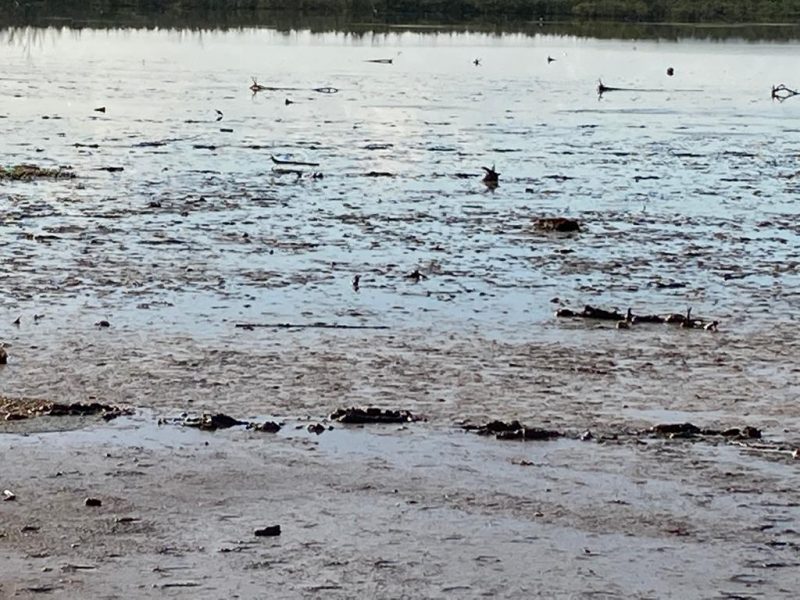
Members of BirdLife Jamaica — much fewer in numbers this year, due to COVID-19 restrictions — trekked in ones and twos to their favorite viewing sites. One member, on arriving in Old Harbour Bay after heavy rains the day before, found the location overwhelmed with mud :

Watching seabirds often involves large quantities of mud. Photo courtesy of Ian Gage, with permission.

Many shorebirds have an amazing range. The Short-billed Dowitcher, for example, flies from Alaska to Canada, winters south in Brazil and spends time in the Caribbean, too:

Short-billed Dowitchers in Great Bay, St. Elizabeth, Jamaica. Photo courtesy Ann Haynes Sutton, Conservation Ecologist, with permission.

The Grey or Black-bellied Plover is a global nomad. It breeds in the Arctic tundra and winters south, spreading virtually worldwide. This one decided to make a stop in Jamaica:

The Grey or Black-bellied Plover feeding along the water’s edge near Black River, St. Elizabeth, Jamaica. Photo courtesy Emma Lewis, with permission.

There were more sociable events on the calendar. The NGO SusGren (Sustainable Grenadines) shared photos of an educational trip to the newly-restored Ashton Lagoon on Union Island:

In celebration of World Shorebirds Day 2020, SusGren in collaboration with Environmental Attackers conducted educational outreach for some students of the Stephanie Brown Primary school. The high-spirited students, who were out of their beds as early as 5:30 a.m for the session, were engaged in activities such as bird labeling, bingo, and bird identification.

In Trinidad, a huge and diverse array of wetland species was on display. The Whimbrel, an elegant shorebird, is another Caribbean migrant that is still fairly widespread globally:

Whimbrel, Trinidad. Photo courtesy of Jerome Foster, with permission.

The Black Skimmer, however, is quite an unusual sight in the Caribbean. This bird literally skims the surface of calm coastal waters and lagoons:

Black Skimmer, Trinidad. Photo courtesy Jerome Foster, with permission.

The beautifully named Laughing Gull is fairly common across the Caribbean, where it breeds. It spends winters in northern Brazil:

Laughing Gulls in Trinidad. Photo courtesy Jerome Foster, with permission.

Some shorebirds, of course, do stick around. The Brown Pelican, for example, is a regular sight, cruising along the shorelines and further out to sea. Its local name in Jamaica is “Old Joe”; it is a common, year-round resident of the larger islands, gliding low over the waves or doing spectacular dives for fish:

Brown Pelican, known as “Old Joe,” in-flight at Palisadoes, Kingston Harbour, Jamaica. Photo courtesy Ian Gage, with permission.

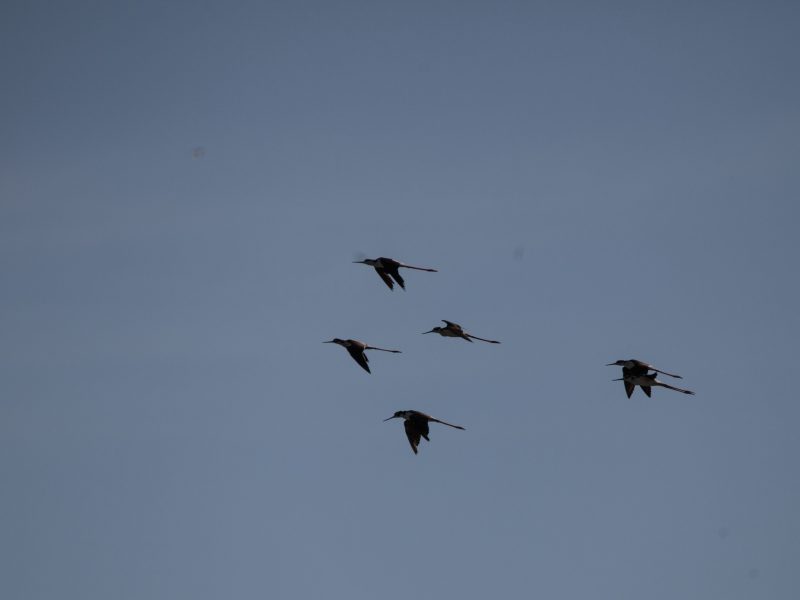
Another charming Jamaican resident, whose numbers may be augmented by migrants from North America in winter, is the Black-necked Stilt. This noisy bird, on its spindly red legs, nests on the ground near water’s edge:

Black-necked Stilts in flight in Old Harbour Bay, Jamaica. Photo courtesy Ian Gage, with permission.

For Jamaican birders, the highlight of World Shorebirds Day was perhaps the appearance of an adorable family of West Indian Whistling Ducks, captured on video by Damion Whyte, biologist, birder and a passionate social media educator on all things environmental. The location — a sewage pond in Portmore, St. Catherine, — was perhaps not so beautiful, but a good birding spot nonetheless.

Species such as this beautiful bird are declining in numbers throughout their range in the Caribbean. Large tourism developments, including hotels, marinas and other projects, continue to be built along the islands’ coastlines, resulting in the destruction of vital mangroves and wetlands in which these birds rest along their migratory flyways. Currently, three tourism projects under way in Grenada threaten wetlands that shelter several endangered species, including turtles.

On some islands, especially in the French Caribbean, hunting and plastic pollution are major threats.

World Shorebirds Day in the Caribbean is not only a celebration of the birds themselves, but of the beautiful places they call home, even if only temporarily for many of them.

Protests in Thailand for Democracy

Despite the COVID-19 pandemic restrictions and the imposition of an emergency decree which prohibit mass gatherings, young Thai activists continue to organize massive protests across the country. This student-led pro-democracy movement marks the first time in modern Thai history when the Thai monarchy has been talked about publicly in a critical way since doing so is a jailable offense.

The first wave of protests was sparked in February 2020 by the forced dissolution of an opposition party which outraged and inspired young people to organize pro-democracy actions. Despite the COVID-19 March lockdown, the ‘youthquake’ continued and saw young Thais use cyberspace to speak out on political issues, build resistance networks, and launch online protests.

The second wave of protests was signaled by the student-led protest on July 18 at Bangkok’s landmark Democracy Monument. More than 2,000 protesters gathered and raised three demands, namely dissolving the parliament, rewriting the military-based constitution and ending the intimidation and arbitrary arrests of critics of the government.

Another significant demand is the call for reforms of the the monarchy, a topic which is not only taboo but also a criminal offense since Thailand has a strict Lèse Majesté (anti-Royal insult) law.

Students and youth activists echo these demands in various forms of creative online and offline protests. For example, Thai protesters have adopted as a symbol of their defiance and demand for democracy the three-finger salute inspired by the popular US movie series the “Hunger Games”.

On August 16, more than 20,000 people assembled again at the Democracy Monument in central Bangkok. It was the biggest protest in Thailand since the military grabbed power in 2014.

Authorities have since summoned dozens of student leaders, artists, and human rights activists and threatened them with harassment suits, yet the youth-led protest movement has gained nationwide support. Pro-democracy advocates from various sectors have also participated in several rallies organized by students.

Besides, young activists from Hong Kong and Taiwan have also issued solidarity statements that reflect the growing influence of the #MilkTeaAlliance, a netizen-driven democracy campaign challenging Chinese trolls.

The future parents.

What we know so far, Gen Zers are a diverse and open-minded generation who’ve grown up enjoying the benefits of social media at their fingertips. Yet, equally, they’re also a group associated with high levels of anxiety and an overwhelming pressure to project success, both online and off.

Now that older Gen Zers have started to enter the workforce and, generally speaking, more of them will begin having children a few milestones down the road, it’s interesting to think how this group will approach and redefine parenthood.

This has already built a generation of outspoken individuals, taking a stand on issues like LGBTQ rights, racial bias and inequality, and plenty of other issues. As parents, Gen Zers are likely to value empathy and teach their children tolerance and acceptance of others.

Gen Zers are also stereotyped for spending hours curating their lives on social media. While this may have negative associations with mental health, it could also have positive use cases for parenting.

In a study done by Collage Group, over 70 percent of Gen Z females without children felt FOMO regularly, but only 36 percent with children felt the same. It seems the presence of kids may actually reduce some of the negative impacts of social mediIn a study done by Collage Group, over 70 percent of Gen Z females without children felt FOMO regularly, but only 36 percent with children felt the same. It seems the presence of kids may actually reduce some of the negative impacts of social media.

In recent years, the teen suicide rate has increased drastically – over 70 percent among 10-17 year-olds. However, 37 percent of Gen Zers also reported seeking help from mental health professionals, which is significantly higher than millennials, Gen Xers and baby boomers.

As parents, Gen Zers are likely to emphasize the importance of mental health. They’re expected to help their children deal with life stressors in a different way than their parents did for them.

Because of their own positive experiences with treatment and therapy, Gen Z parents will also be more likely to identify symptoms of mental illness and seek it for their children.

Gen Z’s awareness and approach to mental health can have a positive influence on their parenting by allowing them to be emotionally healthy and drivers of open communication. It can also help shape a future generation that will understand, accept, and seek to treat their own mental health issues.

The ongoing conversations about mental illness also offer a better understanding of the impact it can have on daily life. Gen Zers want the energy and ability to travel, have new adventures, and make great friends. Having a mental health issue can stifle that dream and they would rather deal with the issue and hopefully move forward from it than to let it stop them from what they desire.

Gen Z’s willingness to identify and address their mental wellness—even long before they have children—may only enhance their parenting. Young adults who seek treatment before having kids will have a greater chance at being emotionally healthy parents, says Compton.

Whether a parent is excited about a promotion or steaming from a fight with an in-law, even the youngest children are able to pick up on emotional ups and downs in the household. If a parent is able to speak openly—appropriately for the child’s developmental level—the child will learn to do the same. Children will no longer need to ‘fill in the blank’ about why Mommy or Daddy is so sad or mad. Or are present and then suddenly disappear.

Similarly, parents will have developed emotional regulation and be able to teach that to their children. Discussion of emotions will be normalized within the family. Children and teens will understand that all feelings are accepted and that it is perfectly normal to reach out for support. They will also be able to create and nurture deep authentic relationships with their children through honest conversations.

How did we evolve?

Historical sources are pretty difficult to find. Why? Because, we never know where exactly they are, are they even real. It solely depends upon. Our imagination. Cause we can’t grab a time machine and time travel to see exactly what happened (but that would’ve damn great!). Evolution is crucial in every animal and has taken place eat one point of time. But then..who were we evolved from..?

  • The starting point

Now, atleast at some point of time,you must have thought, ‘From where the heck did this universe start?’.  The thing is, We Don’t Know. We do have theories regarding the point though, which give an applicable reason as to the beginning of life. So the theory was of the Big Bang. We all know what exactly this ‘big bang’ is.It is believed that, there existed something very small,smaller than any other thing. Even from a microbe.And at one point,it exploded. That phenomenon was called the big bang, through which large balls of fire were generated. After many billions of years,the fire balls started to align themselves, unto a newly forming star,the Sun due to its pull. And eventually,some more billion years later,the fireballs started to cool down. Now,was the time when the first organism appeared on earth. But why only earth. Because, Earth is situated in something called the ‘Goldilocks zone’. The earth was just at a perfect distance from the sun for life to exist. If the earth was any nearer of any farther, you and me, including everything would probably not have existed at all.(sad? I know). The first organism to exist on earth was the Archaea.  This microbe was the first to live on the still hot earth. How? Archaea, maybe   had adapted themselves to the hot temperatures of the earth. Which means, we all have actually evolved from Archaea!

They are even found today, in the thermal beds, and wherever the temperatures are fit for them.

From the Archaea evolved the bacteria, which are prokaryotes(primitive organisms) then came the eukaryotes(  true cells) and all the kingdoms. And today we live with all the complex tissues and cells, working everyday in our bodies. How did water come though? It is believed that during the big bang, not only did it release fireballs,but also many gases. Then, probably the atoms of hydrogen(H) and Oxygen (O)  made bonds to create the existence of water. These are all one of the speculations and assumptions made by us to understand the beginning of life in a better way. Who knows the truth? No one does. At least not from earth anyways.

Photo By Pixabey

Even now the earth is still cooling down. A live example would be volcanoes. Meaning,only the outer portion of earth has cooled down after the time period of 4.5 billion years. So,when the water made an appearance on the surface of earth, seas and oceans were probably formed. But the lands were still not. Then where did life continue to exist?In the oceans of course. Something called the Endo-genetic movements ( movements which occur on the inside of the earth) made the continent buildings possible.

While the continents still continued to cool down, after the volcanic eruption that is, the life in the aquatic region continued to make  progress.

Did you know that the continents which are formed today are not how it was a million years ago?

 Many types of continental structures were formed in our history. For example: Rodinia,Pannotia, Pangaea, Gondwana etc. Out of these, Pangaea lasted for the longest period.( due to the internal and external movements of earth,the continental formation kept on changing). How did Dinosaurs go extinct? Dinosaurs came to extinction due the humongous amounts of volcanic eruptions and the other Endo-genetic movements( yes,those cartoons had shown you the truth!)

Photo by Clive Kim from Pexels

Now what happened was that the living organisms which were living in the aquatic region came to the land. Slowly,they started adapting themselves to the terrestrial lands. They say that evolution of man,that is the ancestors of our species are from apes. Slowly but steadily,they evolved to form stages. The first stage was said to be Homo Habilis,the second was Homo Erectus, the third was Neanderthals, and then finally,the Homo Sapiens. Infact, all of these species used to live together. Meaning,suppose it was not like everyone was Neanderthals, some of them were still not evolved from Homo Erectus. They all lived and learnt the sources of nature. 

As time passed, they evolved, their organs developed and were also divided. But….wait! Does that mean that we evolved from oceans? Well, we don’t exactly know about the truth but it is said that the statement does hold some weight on it and might be true. And if it was true, we had gills for lungs! Infact, some people say that we did evolve from the oceans. How? Because,the person who held most maximum time in water is 20 minutes. The same amount the dolphins can hold their breath in water. We don’t have any specific organ to conserve our sweat but the other animals do. We have fingerprints  and footprints instead of paws. Sure,these statements may be irrational to many people,but it lets one to imagine. To brainstorm about where exactly did we,as in our existence start from?

Fact- It is believed that hiccups are the left out defect of our aquatic habitat….….is it true,though? Nobody knows so!

Agricultural Marketing; a boost for Agro-Products and their contribution towards G.D.P.

Article by – Shishir Tripathi
Intern at Hariyali Foundation
In collaboration with
Educational News

For an Agrarian Economy like India, the agricultural sector should contribute more than any other sector in the Gross Domestic Product (G.D.P) but even after being an occupation of almost 55 -60% of people, agriculture is contributing just 15 – 20% in the G.D.P. Being an occupation of such a large group of people and still minimal share in the G.D.P. of the economy means that there are certain limitations which are needed to be overcome.


The biggest limitation is that the agricultural products right from the simple wheat to a produced wheat bread, there is absence of proper agricultural marketing.

Now, when one uses this terms agricultural marketing, he or she is simply referring to an organized process of planning, organizing, directing and handling of agricultural produce in such a way as to satisfy the farmers, intermediaries and consumers. It involves numerous inter connected activities like planning production, growing and harvesting, grading, packing and packaging, transport, storage, agro and food processing, provision of market information, distribution, advertising and sale.

Agricultural marketing is based upon the idea of reducing the distance between the farmers (producers) and the consumers. It is a broader concept not just limited to villages and small towns but across the International borders too. Planned agriculture which comes under agricultural marketing is important so that whatever crop is produced it meets the demand of the consumers in the form of finished products. It aims in such a way that there is neither a situation of excess supply or excess production (that is just left uncared without good storage facilities) nor a situation of excess demand.

It also includes growing and harvesting of crops paying extra attention towards the techniques followed in the production process and efficient use of land and human resource along with technological resources too.

Grading is also done amongst different types of harvested crops and other agricultural products so that different types of products are available to different types of consumers with different requirements and available financial resources.

After Grading, the product is needed to be packaged in such way that it must be appealing to the consumers including use of different images and colors, and involving the details of the ingredients and the nutritional value of the product. Packaging the products in such a way that they must last longer and can be stored as well at the stockrooms and at consumers’ place as well.

Storage facilities are needed to developed by the government and other concerned authorities so that whichever good is produced in ample amounts, it can be stored for future without any degradation in the quality of the product due to insects, rats and other factors like moisture, rain, heat, etc.

Various researchers are trying to study markets and find the idealistic market structure for people living in villages and small town. The emphasis to markets is given in such a way that they meet the requirements of all the people living in that particular area.

Also, the transportation facilities are needed to be facilitated properly and should be made available to the producers in the remote areas of the country. The transportation costs must be affordable so that every producer willing to transport his produce or product should not stop himself or herself in being a part of this long chain and enjoying the benefits after the final sale of the produce or other agricultural products.


Now the most important of all is branding and advertising. Even if any other foreign firm or domestic firm is willing to sell the product under its label then also proper advertising should be there for the given product through Television ads and promotions through social media on various Apps. Advertising should be done in such a way that the product should look so appealing to the consumer and an urgent feel of purchasing the concerned product should be felt by the consumer after watching the advertisement. The buyers must feel that how important the product is to them in their daily lives after watching the product’s advertisement.

And the market for the product is again very important whether the product is sold online through e-commerce sites or is sold by various outlets in the cities and towns. A well managed system is needed so that the good that is sold to consumer is of the best quality and a justified price and the producers along with the intermediaries involved in this long chain are satisfied and get their share after the sale of a good.

Agro products not only include crop produce and other products manufactured from those crops but also the products produced by the people at local level such as milk from cattle, honey from bee-keeping, etc.

Such mechanisms will increase the share of primary sector in the G.D.P. The state and the central governments should make provisions and provide incentives to the producers and the intermediaries for developing such a fruitful mechanism that will be giving good returns to the country as well in the form of overall growth of people in remote areas and prosperity of the nation too.

Value everybody’s mental health: Who knows if you’re next!…

There is construction going on in front of our house. So in between all the workers, there was a worker named Jack. He was working with the flooring contractor. He was just labour and used to do things like transferring goods and cleaning up.
He had some mental issue. He used to take more time to understand things. Sometimes he even used to the exact opposite of what he supposed to. The construction owner was getting pissed by his behaviour. He was having so much trouble because of Jack. One or two times, Jack even caused loss to him. Jack mistakenly drilled a hole in a new wall. Another time, Jack threw construction debris in front of someone’s car. So such incidents were happening continuously. The owner complained about him to the contractor many times. But the contractor told him that Jack’s family pleaded him to keep him on work, so I’m just adjusting him.
But the owner was not happy with Jack’s work at all. The contractor was getting complaints about Jack every single day. One day, Jack came, worked for a day and went back home early in the evening. When neighbours begin to shout, the owner got to know that the road is totally blocked by construction debris. He was so angry and frustrated. But somehow he managed to clean the road with the help of other labours. When the contractor came at the site, the owner called him and shouted at him for Jack. The contractor made an apology and told the owner that he already fired Jack and he’ll be no longer with them.
So? Who was at loss now? I could see the one who was at loss was only Jack. The contractor knew that Jack has some mental health issue. Even the owner got to know this by Jack’s actions. But none of them stood out for Jack and adjusted him. That’s how our cruel society works actually. When we see or when we are around a mental health patient, we consider them as a healthy and normal human being. But they struggle badly. Lacking concentration at the work, confusion during the work is their disease only. So they struggle while doing that. So it’s our duty as a human to accept their struggle and help them during it. But we do exactly the opposite. We keep on discouraging them, bashing them as if they are normal and finally end up pushing them in the valley of mental diseases. Actually, we should encourage them. They carry the courage which we can never imagine. Fighting with your own brain to survive the battle of life takes lots of guts. Only these people have this courage. So it’s our duty to accept them as they are, help them in need and the most important thing is to ignore their mistakes. Because now we see them as a third person or maybe a stranger. But who knows if your life events take a dramatic change and you or your loved ones are in the position of Jack. At that day, you will realize your mistake as you’ll also receive the same treatment as you did to someone in past. So let’s take a pledge to consider mental health of each human being. Each life has a value and it’s our social responsibility to make them survive along with us!…

Karl Marx

Karl Marx was a German philosopher, economist and political thinker, usually portrayed as the father of 20th century Communism. After a brief carrier as a teacher and journalist, Marx spent the rest of his life as an active revolutionary and writer, living mainly in London and supported mainly by his friend and life-long collaborator Friedrich Engels. From Marx’s perspective, human beings distinguished themselves from other animals based on their consciousness, autonomy, and ability to be productive members of a society, which give them a sense of purpose in life. Broadly, this is what Marx referred to as human nature, which he characterized as the essence of a person, or one’s ability to control their own destiny to a certain extent.

One of the most original contributions of the Marx is his Theory of Alienation. This is contained in his early work Economic and Political Manuscripts, which were written in 1843 but were discovered nearly fifty years after his death. These Manuscripts shows that ‘early Marx’, was mainly interested in the problem of alienation.

The concept of Alienation has increasingly occupied a forefront in sociological and philosophical interest. This is mainly due to the growing awareness and concern over the negative and unexpected consequences of rapid scientific and industrial progress in contemporary life. Marx’s theory of Alienation involves the relationship between workers in capitalist society and their productive activity or the act of labour itself. Workers do not confirm themselves in their work, they experience their work as misery, their physical and intellectual capacities are stunted, their work is not freely chosen and their work belongs to another. Yes, Marx’s conception of alienation illuminates some premises of the idea of emancipation. From his point of view, this social position discouraged the labourer from taking control of their own future or pursuing ways to climb the social ladder, which put increasing distance between individuals and their human nature.

For Marx, alienation is rooted in the historical situation and its consequences. In the Capitalist society, the creation of objects or production does not help man to realize himself, i.e. to realize his potential. This inability of man to realize his potential while being engaged in the creation of objects causes alienation. Hence, alienation will be overcome when the production of objects will lead to unfolding of the human potentialities. Alienation as exists in the capitalist society has many dimensions. However, three dimensions are fundamental.

Marx developed his theory of alienation to reveal the human activity that lies behind the seemingly impersonal forces dominating society. He aimed to show how, although aspects of the society we live in appear natural and independent of us, they are the results of past human actions. Marx believed that human action could shape a future world free from the contradictions of capitalism. For him, alienation was not rooted in the mind or in religion, as it was for his predecessors Hegel and Feuerbach. Instead Marx understood alienation as something rooted in the material world. Alienation meant loss of control, specifically the loss of control over labour.

Learning to live life is essential

Accept your mistakes and start learning from them, learn lessons from time and make your future better

• Lessons from our mistakes bring experience and learning to handle

• If you have experienced some kind of negative experience, remember to learn from it forever

We all have a few common teachers. The experiences of those who concentrate in their classroom become inspiration for others. Sometimes there is a lesson to be learnt in time, then after gaining some experience, a new lesson is taught. Sometimes the behavior of loved ones is learned, and sometimes the behavior of strangers becomes our lesson. Also consider these things and situations as teachers who teach, explain and carve you a lot. Every lesson, experience and feeling of this class that is going on in life is filled.

Learn from mistakes

It is said that one’s own mistakes are the biggest teacher in life. Like this, making mistakes is also a part of the journey of learning.Lessons from our mistakes bring experience and learning to handle. Usually we are unable to accept our mistakes. But no learning can be achieved without this acceptance. Whereas the identity of a successful and alert person is that he or she should learn from his or her mistakes from time to time and never repeat them further, so that such mistakes become experiences and make you alert and understanding forever. 

Studying in nature class

Nature gives a test every day. Embraces every season. Teaches you how to deal with every situation. After autumn, the feeling of blooming again in the spring explains the feeling of acceptance of sorrow and happiness. Nature teaches and explains that time does not always remain the same. But after times of trouble, a better time also comes, when again the hope and enthusiasm spring up.There is aneed so much that we keep our lives irrigated with cheerfulness and positiveness. 

Learn from the experience of others

According to Charles Kalton, “It is better to demand experience than to buy it from others.”  Anyway, to learn by mistake every time, the whole life is short. That is, to avoid making mistakes ourselves, we should also learn from the experience of others. Not only this, if you have experienced some kind of negative experience, then remember to learn from it forever. ‘Bad experience is a kind of school where only fools keep going back.’ 

Awareness lessons

It is said that one who is educated is aware only. But the truth is also that being aware can teach us something. Being alert and awake in life-related situations gives a lesson every day, every moment. Life is like a classroom to say. Always learn to be vigilant in this so that you can learn many lessons from your problems and surroundings, lessons from them can be used in life. 

Learn lessons from time

Time is the greatest teacher in life. The ups and downs that come with the time make us aware of many aspects related to life. A bad time, when confronted with bitter truths, can never be forgotten.From relationships to work to work, to understand every aspect of life, lessons learned from time to time lead to the direction of life. Time is like a bitter-sweet medicine which does not appear but becomes a great teacher and teaches us  in life a lot.

Today is Hindi Day, the day of the honor of the fourth most spoken language in the world

Priya Yadav,

Hindi Day is celebrated on 14 September every year. On 14 September 1949, Hindi was declared as the official language in the Constituent Assembly by vote. After this decision, from 1953 on September 14, India was celebrated as Hindi Day every year on the request of Rashtrabhasha Prachar Samiti, Wardha, to broadcast Hindi in every region. Hindi is one of the 22 languages ​​of India. Most Indians speak and understand Hindi. Hindi is spoken and understood in the northern states of Rajasthan, Uttar Pradesh, Haryana, Delhi, Bihar, Jharkhand, Chhattisgarh, Madhya Pradesh.

Many programs are organized on Hindi Day for the promotion and promotion of Hindi. Many cultural programs are also organized on this day in schools and colleges. On 14 September 1953, Hindi Day was celebrated for the first time in the country. Hindi is not only our mother tongue or national language, but it is a symbol of national identity and pride. Without language, no one can express their words, their feelings. Different types of culture can be known only through language. Hindi language is very important in that. In Hindi, you can easily explain your point.

There is also a fact that 14 September 1949 was the 50th birthday of Rajendra Sinha, a pioneer of Hindi, who struggled for a long time to make Hindi the national language. After the attainment of independence, Vayuhar Rajendra Singh worked tirelessly with writers like Kaka Kalelkar, Maithili Sharan Gupta, Hazariprasad Dwivedi, Seth Govindadas to establish Hindi as the national language.

In the year 1918, Gandhiji had asked to make the Hindi language a national language in Hindi Sahitya Sammelan. Gandhiji also called it the language of the people. In the year 1949, on 14 September 1949, after much deliberation on the question of the national language of independent India, this decision was taken which is mentioned in Article 343 (1) of Chapter 17 of the Indian Constitution. According to this, the national language of the Sangh will be Hindi and the script Devanagari.

REGIONAL LANGUAGES ON THE VERGE OF EXTINCTION

In the very long history of Human civilization, many languages have survived, many have thrived, many have died a slow death. Few think that Hindi is pushing other languages to oblivion. But how true is that?

Once upon a time, languages like Sanskrit, Latin and even Persian were thriving. Today, they are confined to a much smaller dominion.Is Hindi causing the death of other languages? First of all, are we really speaking Hindi in our daily lives?

We don’t speak Hindi any more. We speak Hindustani. It’s a language which is a mixture of Hindi, Urdu and Persian. Whenever you speak pure Hindi, you receive a look of amusement even from the so called Hindi speakers.

Now, is Hindustani destroying other languages? Hindustani has thrived mainly due to two aspects – Simplicity and Acceptance. It has slowly given up complicated words from both Urdu and Sanskrit and has adopted easier words. This is also the main reason why English is most popular in the world.

Any simple language will spread on its own. This is the law of nature and nothing can supersede it. It can be slowed down, but never stopped. You cannot get back Latin and kick away English. English was once a language of poor and commoner and was associated with poverty and still it spread because it kept on adopting words from different languages. This acceptance is also the primary reason why English is a phonetically incorrect language.

Due to a multiple reasons, English has been unable to penetrate the rural India, specially in North India. Hence it would be foolish to expect that English can take place of Hindustani in India within a span of a few more decades.

Hindustani is spreading and will keep on spreading as it keeps on accepting words from different languages. Any language which is not open to accepting vocabulary of other languages will die away with time.

Language is essentially the medium of communication and Humans tend to bend towards ease and simplicity.

No matter how much Indian government pushes India towards pure Hindi, it would fail. With time, even the pure Hindi might die.

BLACK TRUTHS OF MAKE-UP INDUSTRY

The beauty industry rakes in over a billion dollar per year. With expendable budgets and promises, these beauty companies spend millions of dollars in advertising as a means to create loyal, life-long customers. With the promise of making you, your best self and give you a forever youthful glow, you start to wonder what the catch is. Every industry has it’s darkside and the beauty industry is no outlier. Humans are visual and social creatures. It makes sense thus that, historically, we have been collectively preoccupied with beauty. Someone’s appearance is the first thing we notice about them upon meeting them. The nature of beauty itself has been the focus of Aesthetics, a major field of study in Western Philosophy, and has occupied the brilliant minds of numerous philosophers, from Plato to the aforementioned Kant.

People have been using makeup and cosmetics since ancient times: the Egyptians’ use of dark eyeliner is present in everyone’s mind through their paintings and deities, while most know that Victorian women often fainted not because of their demureness, but because of the wide-spread use of lead-based creams to “improve complexion” together with constricting girdles.So what is an example of a potentially harmful beauty product you could come into contact with? Well, 1-in-5 products on the market contain traces of formaldehyde, which is known as a human carcinogen. Some signs to be aware of that could contain formaldehyde are that you notice watery eyes, burning of the nose and throat, coughing or skin irritation. This is your sign to stop using these products, immediately. Your body’s telling you it is not feeling great with these products around.


How about the environment? Aerosol sprays where you at?! The wrong answer would be anywhere besides the trash. Just take a moment to think about the last time you went to the store and how many aerosol cans you saw stacked on the shelves. This is not a good thing. Aerosol cans contain hydrocarbons that can contribute to global warming. And don’t think this harm starts and stops with aerosol cans. Fingernail polish, mouthwash, perfumes and roll on deodorants also have the potential to release hydrocarbons into the environment.


Growth in the beauty industry, however, has boomed in recent years, in a trend that many link to a broader generational trend of attention to physical wellbeing (which we covered in our recent article about the growing plant-based market and Beyond Meat). Millennials are often quoted as being the main drivers behind the meteoric growth of the beauty segment. There have been many articles written on this trend, citing everything from the aging of the millennial demographic to a focus on “self-care” as a coping method against a difficult political and economic climate.

Creativity at its best

As much as difficult it is to analyze creativity, it’s even harder to assess it. Creativity is as difficult to assess as it is fun to analyze. It favours a prepared mind.
According to Albert Einstein -Creativity is … Thinking outside the confines of the situation, being open to unexpected events /chances, allowing the subconscious mind to take over leading to and springing up with surprise solutions at unexpected times.

Research to uncover facts about creative people that are all supported by scientific studies are as follows:

Sleep On It
Research backs this one up. A study published in Nature found that people who were given a creative task to solve and then allowed to sleep on it were more successful than those who remained awake to solve it. Sleep allows your unconscious mind to restructure information, resulting in new and insightful responses. Just make sure to keep a notepad by the bed for when inspiration strikes.


A Person’s Creativity Mostly Peaks During “off” Hours.
Another research shows that your inclination towards being a night or day person affects your creativity in interesting ways. One of the lesser-known facts about creativity is that night owl creatives are smarter and outgoing and early birds are more proactive, persistent, and meticulous. When challenged to create at their non-preferred times, they passed the questions with amazing marks.


DAYDREAMING IS SURPRISINGLY GOOD FOR YOUR BRAIN
According to the science on daydreaming, these moments provide a sort of mental incubation period that can enhance creative thinking, long-term planning, and self awareness. Psychologists have been studying the concept of “positive-constructive daydreaming” for decades and uncovering the various ways in which, as the authors put it, “the mind’s wandering is vital to imagination and creative thought.”

Write During Your “Off Time”
People have what scientists call a circadian preference, which essentially means they are either morning people or evening people. You probably assume it is best to write during your most optimal time (morning people writing in the morning, evening people in the evening), but that’s not true. Although analytical thinking—the kind you use to solve math problems—is better during people’s optimal times, a 2011 study found that creativity was actually better during people’s non-optimal times. Because our conscious mind is groggy during our non-optimal time, it relaxes the reigns on our unconscious mind and gives it more freedom to wander

 Memory Plays a Significant Role in Creative Thought.
Our subconscious immediately takes us to the past, which is very familiar when asked to think of a new idea. Future circumstances are fabricated by details we have retrieved from past scenarios. Hence, having a strong sporadic memory can help in creative thinking.

Creative people are more likely to suffer from bipolar disorder.
From Picasso’s blue period to Van Gogh’s infamous mood swings, the study of why creative individuals tend to get the blues is a widely discussed topic. Although the link between depression and creativity is still disputed, this recent study found that creative people are more likely to be diagnosed with bipolar disorder.

creativity must also be recognised and encouraged in the workplace. Because, after all, it’s creative thinking that leads to problem solving and innovation in a range of areas.

Should commercial surrogacy be banned in India?

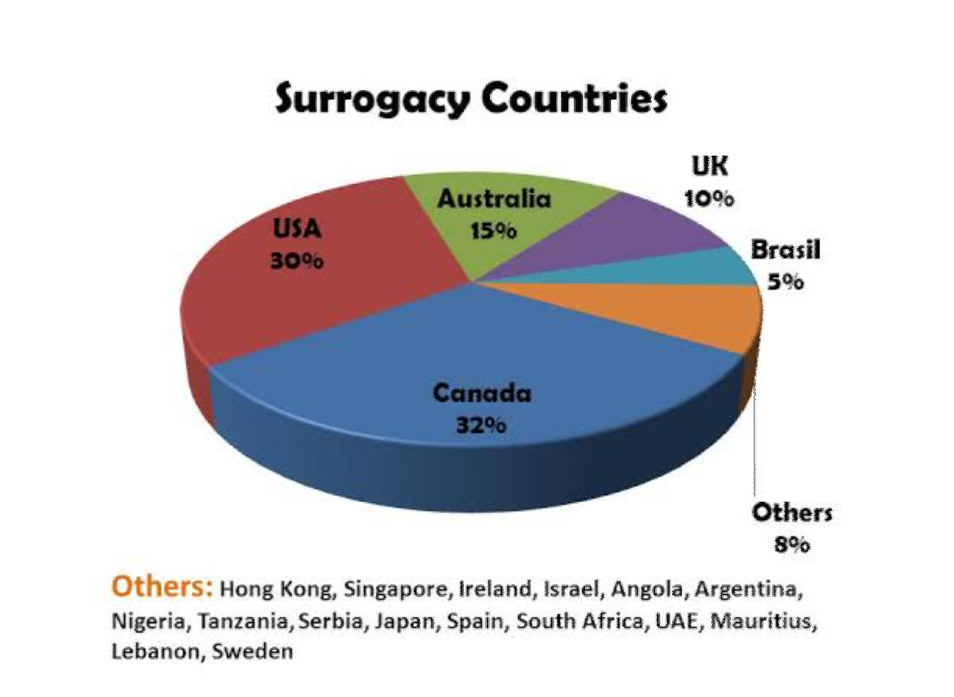
Commercial surrogacy is the process by which an individual or couple pays a fee to a woman in exchange for her carrying and delivering a baby. At birth the child, homo-sexual couples, and single people who wish to be parents are the most common types of people who seek surrogate mothers.

Commercial surrogacy has been legal in India from 2002 onwards but due to unethical practices, a bill has been approved by the Union Cabinet in August 2016. This one lapsed when Parliament adjourned without taking the measure for a vote.

The new proposal came in 2019 that is to ban commercial surrogacy. The Indian minister of health has called the 2019 bill a “need of the hour” citing a rough estimate that between 2000 to 3000 unregulated clinics currently operate in the country. Under the new law anyone who performs or promotes this would be punished with up to 10 year of imprisonment and a fine up to one million rupees. The surrogacy bill’s provision restricting surrogacy to married heterosexual couples within strict age ranges also discriminates against members of L G B T community, older couples and unmarried people who might seek to have a child. The bill goes against the principles of equality provided under Article 14 of the Indian constitution.

Regulation, not ban, is needed. The commercial surrogacy in India needs a regulation and stricter rules that could ensure good care and pay to the woman alone and not agents or others. Good clinical facilities for the surrogate mother and a healthy environment where she could stay safely before and after delivery could lessen exploitation. There is no provision in the law about the custody of the child if the couple later refuse to accept it if the child is mentally challenged or born with a defect. People who hire surrogates have a need to do so due to medical reasons. It is not their choice. Regulation on this practice is very much needed and must be done to close loopholes due to which exploitation of surrogate mothers is taking place.

Indian society is yet to progress so much as to accept surrogate motherhood. The woman who rents her womb even if for the cause of humanity towards an unfortunate couple will never be accepted in society when she goes back to her normal life. People will look down on her and she may probably not be able to find a husband, if she was unmarried at the time of surrogacy. We need to be broad-minded and accept these women and respect their choice of renting their wombs.

Giving women a safe and free environment for surrogacy can help in curbing the evils attached and the industry could do well along with giving good money to such poor women so that they can make their lives better as well as give prosperity to their families.

Thank you for reading. Have a nice day!

Text of PM’s address at the inauguration of three key projects related to the Petroleum sector in Bihar

कार्यक्रम के शुरूआत में मुझे एक दुखद खबर आपके साथ साझा करनी है। बिहार के दिग्‍गज नेता श्रीमान रघुवंश प्रसाद सिंह, वे अब हमारे बीच नहीं रहे हैं। मैं उनको नमन करता हूं। रघुवंश बाबू के जाने से बिहार और देश की राजनीति में शून्‍य पैदा हुआ। जमीन से जुड़ा व्‍यक्तित्‍व, गरीबी को समझने वाला व्‍यक्तित्‍व, पूरा जीवन बिहार के संघर्ष में बिताया। जिस विचारधारा में वो पले- बढ़े, जीवनभर उसको जीने का उन्‍होंने प्रयास किया।

मैं जब भारतीय जनता पार्टी के संगठन के कार्यकर्ता के रूप में कार्य करता था, उस काल में मेरा उनका निकट परिचय रहा। अनेक टीवी डिबेट में काफी वाद-विवाद, संघर्ष करते रहते थे हम लोग। बाद में वो केन्‍द्रीय मंत्रिमंडल में थे यूपी में, मैं गुजरात के मुख्‍यमंत्री के नाते भी उनके साथ लगातार संपर्क में रहता था विकास के कामों को ले करके। अब पिछले तीन-चार दिन से वे चर्चा में भी थे। उनके स्वास्थ्य के लिए मैं भी चिन्‍ता करता था। लगातार जानकारियां लेता रहता था। और मुझे लगता था कि बहुत ही जल्‍द ठीक हो करके वो वापिस बिहार की सेवा में लग जाएंगे, लेकिन उनके भीतर एक मंथन भी चल रहा था।

जिन आदर्शों को ले करके चले थे, जिनके साथ चले थे, उनके साथ चलना अब उनके लिए संभव नहीं रहा था और मन पूरी तरह जद्दोजहद में था। और तीन- चार दिन पहले उन्‍होंने अपनी भावना को चिट्ठी लिखकर प्रकट भी किया था। लेकिन साथ-साथ भीतर अपने क्षेत्र के विकास के लिए भी उतनी चिन्‍ता थी तो उन्‍होंने बिहार के मुख्‍यमंत्री जी को अपनी एक विकास के कामों की सूची भेज दी। बिहार के लोगों की चिन्‍ता, बिहार के विकास की चिन्‍ता उस चिट्ठी में प्रकट होती है।

मैं नितीश जी से जरूर आग्रह करूंगा कि रघुवंश प्रसाद जी ने अपनी आखिरी चिट्ठी में जो भावनाएं प्रकट की हैं, उसको परिपूर्ण करने के लिए आप और हम मिल करके पूरा प्रयास करें क्यूंकि पूरी तरह विकास की ही बातें उन्‍होंने लिखी थीं, उसको जरूर करें। मैं फिर एक बार आज कार्यक्रम के प्रारंभ में ही श्रीमान रघुवंश सिंह प्रसाद जी को आदरपूर्वक श्रद्धांजलि देता हूं, उनको नमन करता हूं।

बिहार के गवर्नर श्री फागू चौहान जी, बिहार के मुख्यमंत्री श्री नीतीश कुमार जी, केंद्रीय मंत्रिमंडल में मेरे सहयोगी श्री धर्मेंद्र प्रधान जी, रविशंकर प्रसाद जी, गिरिराज सिंह जी, आर के सिंह जी, अश्विनी कुमार चौबे जी, नित्यानंद राय जी, बिहार के डिप्टी सीएम सुशील कुमार मोदी जी, अन्य सांसद और विधायक गण और तकनीक के माध्यम से जुड़े मेरे प्यारे भाइयों और बहनों !

अपने सबके प्रणाम करै छीयै, आज के इ आयोजन शहीद अरू शूरवीर के धरती बांका में होय रहल छै। जे – जे योजना के लोकार्पण आज होलो छै , ओकरो लाभ बिहार के संगे- संगे पूर्वी भारत के बड़ हिस्सा के भी मिलतै । आज 900 करोड़ रुपया से बेसी के जे लोकार्पण अरू शिलान्यास कइलो गेल छै, ओकरा में LPG पाईपलाइन छै, दू टा बड़ा बॉटलिंग प्लांट भी छै। इ सब सुविधा लेली, विकास के ई सब प्रोजेक्टस ख़ातिर बिहार वासी लोगन के बहूत बहूत बधाई छै!

साथियों,

कुछ वर्ष पहले जब बिहार के लिए विशेष पैकेज की घोषणा की गई थी, तो उसमें बहुत फोकस राज्य के इंफ्रास्ट्रक्चर पर था। मुझे खुशी है कि इसी से जुड़े एक महत्वपूर्ण गैस पाइपलाइन प्रोजेक्ट के दुर्गापुर-बांका सेक्शन का लोकार्पण का मुझे सौभाग्य मिला है। डेढ़ साल पहले इस प्रोजेक्ट का शिलान्यास करने का भी अवसर मुझे ही मिला था। इस सेक्शन की लंबाई करीब-करीब 2 सौ किलोमीटर है। मुझे बताया गया है कि इस रूट पर पाइपलाइन बिछाकर काम पूरा करना बहुत ही चुनौतीपूर्ण था। जिस रास्ते में 10 के करीब बड़ी नदियां हों, कई किलोमीटर के घने जंगल और चट्टानी रास्ते हों, वहां काम करना इतना आसान भी नहीं होता। नई इंजीनियरिंग तकनीक, राज्य सरकार के सक्रिय सहयोग, हमारे इंजीनियरों, श्रमिक साथियों के कठिन श्रम के कारण ये प्रोजेक्ट समय पर पूरा हो पाया है। इसके लिए मैं इस प्रोजेक्ट से जुड़े सभी साथियों को बहुत-बहुत बधाई देता हूं।

साथियों,

बिहार के लिए जो प्रधानमंत्री पैकेज दिया गया था, उसमें पेट्रोलियम और गैस से जुड़े 10 बड़े प्रोजेक्ट थे। इन प्रोजेक्ट्स पर करीब-करीब 21 हजार करोड़ रुपए खर्च किए जाने थे। आज ये सातवां प्रोजेक्ट है जिसमें काम पूरा हो चुका है, जिसे बिहार के लोगों को समर्पित किया जा चुका है।

इससे पहले पटना LPG प्लांट के विस्तार और Storage Capacity बढ़ाने का काम हो, पूर्णिया के LGP प्लांट का विस्तार हो, मुजफ्फरपुर में नया LGP प्लांट हो, ये सारे प्रोजेक्ट पहले ही पूरे किए जा चुके हैं।

जगदीशपुर-हल्दिया पाइपलाइन प्रोजेक्ट का जो हिस्सा बिहार से गुजरता है, उस पर भी काम पिछले साल मार्च में ही समाप्त कर लिया गया है। मोतीहारी अमलेखगंज पाइपलाइन पर भी पाइपलनाइन से जुड़ा काम पूरा कर लिया गया है।

अब देश और बिहार, उस दौर से बाहर निकल रहा है जिसमें एक पीढ़ी काम शुरू होते देखती थी और दूसरी पीढ़ी उसे पूरा होते हुए। नए भारत, नए बिहार की इसी पहचान, इसी कार्यसंस्कृति को हमें और मजबूत करना है। और निश्चित तौर पर इसमें नीतीश जी की भी बहुत बड़ी भूमिका है।

मुझे विश्वास है कि ऐसे ही निरंतर काम करके हम बिहार और पूर्वी भारत को विकास पथ पर ले जा सकते हैं।

साथियों,

हमारे शास्त्रों में कहा गया है कि – सामर्थ्य मूलं स्वातंत्र्यम्, श्रम मूलं वैभवम् ।

यानि सामर्थ्य स्वतंत्रता का स्रोत है और श्रम शक्ति किसी भी राष्ट्र की प्रगति का आधार होती है। बिहार सहित पूर्वी भारत में ना तो सामर्थ्य की कमी है और ना ही प्रकृति ने यहां संसाधनों की कमी रखी है। बावजूद इसके बिहार और पूर्वी भारत विकास के मामले में दशकों तक पीछे ही रहा। इसकी बहुत सारी वजहें राजनीतिक थी, आर्थिक थीं, प्राथमिकताओं की थीं।

इन स्थितियों की वजह से पूर्वी भारत या बिहार के इंफ्रास्ट्रक्चर प्रोजेक्ट्स हमेशा अंतहीन देरी का शिकार रहे। एक समय था जब रोड कनेक्टिविटी, रेल कनेक्टिविटी, एयर कनेक्टिविटी, इंटरनेट कनेक्टिविटी, ये सब प्राथमिकताओं में थे ही नहीं।… इतना ही नहीं, अगर रोड बनाने की बात करते तो ये पूछा जाता था, ये तो गाड़ीवालों के लिए बन रहा है, पैदल वालों के लिए क्या है यानी सोच में ही गड़बड़ थी।

ऐसे में गैस बेस्ड इंडस्ट्री और पेट्रो-कनेक्टिविटी की तो बिहार में पुराने ज़माने में कल्पना भी नहीं की जा सकती थी। Landlocked स्टेट होने की वजह से बिहार में पेट्रोलियम और गैस से जुड़े वो साधन-संसाधन उपलब्ध नहीं हो पाते थे जैसे समंदर से सटे राज्यों में होते हैं। इसलिए बिहार में गैस आधारित उद्योगों का विकास एक बड़ी चुनौती थी।

साथियों,

गैस बेस्ड इंडस्ट्री और पेट्रो-कनेक्टिविटी, ये सुनने में बड़े टेक्नीकल से टर्म लगते हैं लेकिन इनका सीधा असर लोगों के जीवन पर पड़ता है, जीवन स्तर पर पड़ता है। गैस बेस्ड इंडस्ट्री और पेट्रो-कनेक्टिविटी रोजगार के भी लाखों नए अवसर बनाती है।

आज जब देश के अनेकों शहरों में CNG पहुंच रही है, PNG पहुंच रही है, तो बिहार के लोगों को, पूर्वी भारत के लोगों को भी ये सुविधाएं उतनी ही आसानी से मिलनी चाहिए। इसी संकल्प के साथ हम आगे बढ़े।

प्रधानमंत्री ऊर्जा गंगा योजना के तहत पूर्वी भारत को पूर्वी समुद्री तट के पारादीप और पश्चिमी समुद्री तट के कांडला से, जोड़ने का भागीरथ प्रयास शुरु हुआ। करीब 3 हज़ार किलोमीटर लंबी इस पाइपलाइन से 7 राज्यों को जोड़ा जा रहा है जिसमें बिहार का भी प्रमुख स्थान है। पारादीप-हल्दिया से आने वाली लाइन अभी बांका तक पूरी हो चुकी है। इसको आगे पटना, मुज़फ्फरपुर तक विस्तार दिया जा रहा है। कांडला से आने वाली पाइपलाइन जो गोरखपुर तक पहुंच चुकी है, उसको भी इससे जोड़ा जा रहा है। जब ये पूरा प्रोजेक्ट तैयार हो जाएगा तो ये विश्व की सबसे लंबी पाइपलाइन परियोजनाओं में से एक हो जाएगी।

साथियों,

इसी गैस पाइपलाइन की वजह से अब बिहार में ही सिलेंडर भरने के बड़े-बड़े प्लांट्स लग पा रहे हैं। बांका और चंपारण में ऐसे ही 2 नए bottling plants का आज लोकार्पण किया गया है। इन दोनों प्लांट्स में हर साल सवा करोड़ से ज्यादा सिलेंडर भरने की क्षमता है। इन प्लांट्स से आपके बिहार के बांका, भागलपुर, जमुई, अररिया, किशनगंज, कटिहार, पूर्वी चंपारण, पश्चिम चंपारण, मुज़फ़्फ़रपुर, सिवान, गोपालगंज और सीतामढ़ी जिलों को सुविधा मिलेगी।

वहीं झारखंड के गोड्डा, देवघर, दुमका, साहिबगंज, पाकुड़ जिलों और उत्तर प्रदेश के कुछ क्षेत्रों की LPG से जुड़ी ज़रूरतों को ये प्लांट पूरा करेंगे। इस गैस पाइपलाइन को बिछाने से लेकर इससे जो नए उद्योगों को ऊर्जा मिल रही है, उससे बिहार में हज़ारों नए रोज़गार बन रहे हैं और आगे भी अनेक रोज़गारों के लिए संभावना बन रही है।

साथियों,

बरौनी का जो खाद कारखाना बंद हो गया था, वो भी इस गैस पाइपलाइन के बनने से अब बहुत जल्द काम करना शुरु कर देगा। गैस कनेक्टिविटी से जहां एक तरफ फर्टिलाइज़र, पावर और स्टील इंडस्ट्री की ऊर्जा बढ़ेगी, वहीं दूसरी तरफ CNG आधारित स्वच्छ यातायात और पाइप से सस्ती गैस और आसानी से लोगों के किचन तक पहुंचेगी।

इसी कड़ी में आज बिहार और झारखंड के अनेक जिलों में पाइप से सस्ती गैस देने की शुरुआत हुई है। ये देश के हर परिवार को साफ-सुथरे ईंधन, धुआं रहित किचन से जोड़ने के आंदोलन को और गति देगा।

साथियों,

उज्जवला योजना की वजह से आज देश के 8 करोड़ गरीब परिवारों के पास भी गैस कनेक्शन मौजूद है। इस योजना से गरीब के जीवन में क्या परिवर्तन आया है, ये कोरोना के दौरान हम सभी ने फिर महसूस किया है। आप कल्पना कीजिए, जब घर में रहना ज़रूरी था, तब अगर इन 8 करोड़ परिवारों के साथियों को, हमारी बहनों को, लकड़ी या दूसरा ईंधन जुटाने के लिए बाहर निकलना पड़ता तो क्या स्थिति होती?

साथियों,

कोरोना के इस दौर में उज्जवला योजना की लाभार्थी बहनों को करोड़ों सिलेंडर मुफ्त में दिए गए हैं। इसका लाभ बिहार की भी लाखों बहनों को हुआ है, लाखों गरीब परिवारों को हुआ है। मैं पेट्रोलियम और गैस से जुड़े विभाग और कंपनियों के साथ-साथ डिलिवरी से जुड़े उन लाखों साथियों को, उनको कोरोना वॉरियर्स की प्रशंसा करता हूं। ये वो साथी हैं, जिन्होंने इस संकट के दौरान भी लोगों के घरों में गैस की कमी नहीं होने दी और आज भी संक्रमण के खतरों के बावजूद सिलेंडर की सप्लाई को बनाए हुए हैं।

साथियों,

एक समय था जब पूरे देश में और बिहार में एलपीजी गैस कनेक्शन होना बड़े संपन्न लोगों की निशानी होता था। एक एक गैस कनेक्शन के लिए लोगों को सिफारिशें लगवानी पड़ती थीं।… MP साहब के घर के बहार कतार लग जाती थी। जिसके घर गैस होती थी, वो माना जाता था कि बहुत बड़े घर-परिवार से है। जो समाज में हाशिए पर थे, पीड़ित थे, वंचित थे, पिछड़े थे, अतिपिछड़े थे, उन्हें कोई पूछता नहीं था। उनके दुख, उनकी तकलीफों को देखकर भी नजरअंदाज कर दिया जाता था।

लेकिन बिहार में अब ये अवधारणा बदल चुकी है। उज्जवला योजना के माध्यम से ही बिहार के करीब-करीब सवा करोड़ गरीब परिवारों को गैस का मुफ्त कनेक्शन दिया गया है। घर में गैस कनेक्शन ने बिहार के करोड़ों गरीबों का जीवन बदल दिया है।अब वो अपनी शक्ति खाना बनाने के लिए लकड़ी के इंतजाम में नहीं, बल्कि खुद को आगे बढ़ाने में लगा रहे हैं।

साथियों,

जब मैं कहता हूँ कि बिहार देश की प्रतिभा का पावरहाउस है, ऊर्जाकेंद्र है तो ये कोई अतिशयोक्ति नहीं होगी। बिहार के युवाओं की, यहाँ की प्रतिभा का प्रभाव सब जगह है। भारत सरकार में भी बिहार के ऐसे कितने ही बेटे-बेटियां हैं जो देश की सेवा कर रहे हैं, दूसरों के जीवन में सकारात्मक बदलाव ला रहे हैं।

आप किसी भी IIT में चले जाइए, वहाँ भी बिहार की चमक दिखेगी। किसी और संस्थान में चले जाइए, आँखों में बड़े-बड़े सपने लिए, देश के लिए कुछ कर गुजरने का जज्बा लिए बिहार के बेटे और बेटियां सब जगह कुछ न कुछ हटकर कर रहे हैं।

बिहार की कला, यहाँ का संगीत, यहाँ का स्वादिष्ट खाना, इसकी तारीफ तो पूरे देश में होती ही है। आप किसी दूसरे राज्य में भी चले जाइए, बिहार की ताकत, बिहार के श्रम की छाप आपको हर राज्य के विकास में दिखेगी। बिहार का सहयोग सबके साथ है।

यही तो बिहार है, यही तो बिहार की अद्भुत क्षमता है। इसलिए, ये हमारा भी कर्तव्य है, और मैं तो कहूँगा कि कहीं न कहीं हमारे ऊपर बिहार का कर्ज है, कि हम बिहार की सेवा करें। हम बिहार में ऐसा सुशासन रखें, जो बिहार का अधिकार है।

साथियों,

पिछले 15 सालों में बिहार ने ये दिखाया भी है कि अगर सही सरकार हो, सही फैसले लिए जाएं, स्पष्ट नीति हो, तो विकास होता है और हर एक तक पहुंचता भी है। हम बिहार के हर एक सेक्टर के विकास को आगे बढ़ा रहे हैं, हर एक सेक्टर की समस्याओं के समाधान का प्रयास कर रहे हैं, ताकि बिहार विकास की नई उड़ान भरे। उतनी ऊंची उड़ान भरे जितना ऊंचा बिहार का सामर्थ्य है।

साथियों,

बिहार में कुछ लोग कभी ये कहते थे कि बिहार के नौजवानों को पढ़-लिखकर क्या करेंगे, उन्हें तो खेत में ही काम करना है। ऐसी सोच ने बिहार के प्रतिभाशाली युवाओं के साथ बहुत अन्नाय किया। इसी सोच की वजह से बिहार में बड़े शिक्षण संस्थानों को खोलने के लिए ज्यादा काम ही नहीं किया गया। नतीजा ये हुआ कि बिहार के नौजवान बाहर जाकर पढ़ाई करने के लिए, नौकरी करने के लिए मजबूर हो गए।

साथियों,

खेत में काम करना, खेती किसानी बहुत परिश्रम और गौरव का काम है, लेकिन युवाओं को दूसरे मौके न देना, न ऐसी व्यवस्थाएं बनाना, ये भी तो सही नहीं था। आज बिहार में शिक्षा के बड़े-बड़े केंद्र खुल रहे हैं। अब एग्रीकल्चर कॉलेज, मेडिकल कॉलेज, इंजीनियरिंग कॉलेजों की संख्या बढ़ रही है। अब राज्य में IIT, IIM, IIIT, बिहार के नौजवानों के सपनों को ऊंची उड़ान देने में मदद कर रहे हैं।

नीतीश जी के शासन के दौरान ही बिहार में दो केंद्रीय विश्वविद्यालय, एक IIT, एक IIM, एक निफ्ट, एक नेशनल लॉ इंस्टीट्यूट जैसे अनेकों बड़े संस्थान खुले हैं। नीतीश जी के प्रयासों के चलते आज बिहार में पॉलीटेक्निक संस्थानों की संख्या भी पहले के मुकाबले तीन गुना से ज्यादा हो गई है।

स्टार्ट अप इंडिया, मुद्रा योजना, ऐसी योजनाओं ने बिहार के नौजवानों को स्वरोजगार के लिए जरूरी राशि मुहैया कराई है। सरकार का प्रयास ये भी है कि जिला स्तर पर कौशल केंद्रों के माध्यम से बिहार के नौजवानों को स्किल बढ़ाने की ट्रेनिंग दी जा सके।

साथियों,

बिहार में बिजली की क्या स्थिति थी, ये भी जगजाहिर है। गांवों में दो-तीन घंटे बिजली आ गई तो भी बहुत माना जाता था। शहर में रहने वाले लोगों को भी 8-10 घंटे से ज्यादा बिजली नहीं मिलती थी। आज बिहार के गांवों में, शहरों में बिजली की उपलब्धता पहले के मुकाबले कहीं ज्यादा हुई है।

साथियों,

पावर, पेट्रोलियम और गैस से जुड़े सेक्टर में जो आधुनिक इंफ्रास्ट्रक्चर का निर्माण हो रहा है, जो रिफॉर्म्स लाए जा रहे हैं, वो लोगों का जीवन आसान बनाने के साथ-साथ उद्योगों और अर्थव्यवस्था को भी गति दे रहे हैं। कोरोना के इस कालखंड में अब एक बार फिर पेट्रोलियम से जुड़े इंफ्रास्ट्रक्चर के कार्यों ने गति पकड़ ली है।

रिफाइनरी प्रोजेक्ट्स हों, Exploration या Production से जुड़े प्रोजेक्ट हों, pipelines हों, City Gas Distribution projects हों, ऐसे अनेकों प्रोजेक्ट्स या तो फिर से चालू हो चुके हैं या फिर नए शुरु किए गए हैं। इनकी संख्या कम नहीं है। ये 8 हजार से ज्यादा प्रोजेक्ट्स हैं, जिन पर आने वाले दिनों में 6 लाख करोड़ रुपए खर्च किए जाएंगे। आप अंदाजा लगा सकते हैं कि देश में, बिहार में गैस आधारित अर्थव्यवस्था के लिए कितने बड़े पैमाने पर काम चल रहा है।

इतना ही नहीं, इन प्रोजेक्ट्स में जितने लोग पहले काम कर रहे थे, वो वापस तो लौटे ही हैं, इनकी वजह से रोजगार के नए अवसरों की भी संभावनाएं बनी हैं। साथियों, इतनी बड़ी वैश्विक महामारी देश के प्रत्येक व्यक्ति के लिए परेशानियां लेकर आई है। लेकिन इन परेशानियों के बाद भी देश रुका नहीं है, बिहार रुका नहीं है, थमा नहीं है।

100 लाख करोड़ रुपए से ज्यादा के नेशनल इंफ्रास्ट्रक्चर पाइपलाइन प्रोजेक्ट से भी आर्थिक गतिविधियों को बढ़ाने में मदद मिलने वाली है। बिहार को, पूर्वी भारत को विकास का, आत्मविश्वास का अहम केंद्र बनाने के लिए हम सभी को तेजी से काम करते रहना है। इसी विश्वास के साथ सैकड़ों करोड़ की सुविधाओं के लिए फिर से पूरे बिहार को बहुत-बहुत बधाई। खासकर के, माताओं और बहनों का जीवन आसान होने वाला है इसलिए उनको अनेक अनेक बधाई देता हूँ ।

याद रखिएगा, कोरोना संक्रमण अभी भी हमारे बीच में मौजूद है। और इसलिए मैं बार बार कहता हूँ – जब तक दवाई नहीं, तब तक ढिलाई नहीं ! फिर से सुन लीजिये जब तक दवाई नहीं, तब तक ढिलाई नहीं।

इसलिए, दो गज़ की दूरी, साबुन से हाथ की नियमित सफाई, यहां वहां थूकने से मनाही और चेहरे पर मास्क, इन जरूरी बातों का हमें खुद भी पालन करना है और दूसरों को भी याद दिलाते रहना है।

आप सतर्क रहेंगे तो बिहार स्वस्थ रहेगा, देश स्वस्थ रहेगा। मैं फिर एक बार आप सबको इन अनेक भेंट-सौगातों के साथ बिहार की विकास यात्रा में नई ऊर्जा के इस अवसर पर आपको बहुत-बहुत शुभकामनाएं  । 

बहुत-बहुत धन्यवाद !

PM dedicates to the nation three key projects related to the Petroleum sector in Bihar

The Prime Minister Shri Narendra Modi dedicated to the nation three key projects related to the Petroleum sector in Bihar today via video conferencing. The projects include the Durgapur-Banka section of the Paradip-Haldia-Durgapur Pipeline Augmentation Project and two LPG Bottling Plants. They have been commissioned by IndianOil and HPCL, PSUs under the aegis of the Ministry of Petroleum and Natural Gas.

Speaking on the occasion, the Prime Minister said the special package announced for Bihar a few years ago, focused much on the state’s infrastructure. He said the special package given for Bihar had 10 big projects related to petroleum and gas worth Rs 21 thousand crore. Among these today it is the seventh project which is being dedicated to the people of Bihar. He also listed the other six projects which had been completed in Bihar earlier. He expressed happiness that he is inaugurating the Durgapur-Banka section (about 200 km) of an important gas pipeline project for which he laid the foundation stone about one and a half years ago. He lauded the hard work of the engineers and laborers and active support of the state government for completing this project on time, in spite of the challenging terrain. He lauded the Chief Minister of Bihar for playing a big role in making Bihar come out of the work culture in which one generation used to start the work and the other generation completed it. He said this new work culture needs to be strengthened and it can take Bihar and East India on the development path.

The Prime Minister quoted from the scriptures “सामर्थ्य मूलं स्वातंत्र्यम्, श्रम मूलं वैभवम् ।” meaning strength is the source of freedom and power of labour is the basis of development of any nation. He said there is neither a shortage of power of labour in eastern India, including Bihar, nor this place lacked natural resources and despite this, Bihar and East India remained behind in terms of development for decades and suffered endless delays due to political, economic reasons and other priorities. He said since road connectivity, rail connectivity, air connectivity, internet connectivity were not a priority earlier, gas based industry and petro-connectivity could not be imagined in Bihar. He said development of gas based industries was a major challenge in Bihar due to it being a landlocked state and thus lacking resources related to petroleum and gas which are otherwise available in the states adjacent to the sea.

The Prime Minister said Gas-based industry and petro-connectivity have a direct impact on people’s lives, on their standard of living and also create millions of new employment opportunities. He said today, when CNG & PNG are reaching many cities in Bihar and Eastern India, people here should get these facilities easily. He said the Bhagiratha effort to connect eastern India with Paradip on the eastern seaboard and Kandla on the western seaboard began under the Pradhan Mantri Urja Ganga Yojana and seven states will be connected through this pipeline, which is about 3000 km long, of which Bihar also has an prominent role. The line from Paradip – Haldia will now be further extended to Patna, Muzaffarpur and the pipeline coming from Kandla which has reached Gorakhpur will also be connected to it. He said when the entire project is ready, it will become one of the longest pipeline projects in the world.

The Prime Minister said due to these gas pipelines, big bottling plants are being installed in Bihar. Of which two new Bottling Plants have been launched today in Banka and Champaran. Both these plants have a capacity to fill more than 125 million cylinders every year. These plants will meet the LPG requirements of Godda, Deoghar, Dumka, Sahibganj, Pakur districts and some areas of Uttar Pradesh in Jharkhand. He said Bihar is creating thousands of new jobs from the laying of this gas pipeline to the new industries based on the energy from the pipeline.

The Prime Minister said the fertilizer factory of Barauni, which was closed in the past, will also start working soon after the construction of this gas pipeline. He said today eight crore poor families of the country have gas connections because of the Ujjwala scheme. This has changed the lives of the poor during the period of corona as it was necessary for them to stay at home and they need not go out to collect wood or other fuel.

The Prime Minister said in this period of Corona, millions of cylinders have been provided free of cost to the beneficiaries of the Ujjwala scheme which has benefited millions of poor families. He lauded the efforts of the petroleum and gas departments and companies, as well as the millions of delivery partners, as they did not let people run out of gas, even during the time of Corona, despite the dangers of infection. He said there was a time when LPG gas connections in Bihar were a sign of affluent people. People had to make recommendations for each gas connection. But now this has changed in Bihar due to the Ujjwala scheme, about 1.25 crore poor families of Bihar have been given free gas connection. The gas connection at home has changed the lives of crores of poor in Bihar.

The Prime Minister praised the youth of Bihar and said Bihar is the powerhouse of the country’s talent. He said the strength of Bihar and the imprint of Bihar’s labor will be seen in the development of every state. He said in the last 15 years, Bihar has also shown with a right government, right decisions and a clear policy, development happens and reaches every one. There was a thinking, education was not necessary as the youth of Bihar have to work in the fields. Due to this thinking, not much work was done to open large educational institutions in Bihar. The result was that the youth of Bihar were forced to go out to study, to work. Working in the field, farming is very hard work and pride, but do not give other opportunities to the youth, nor make such arrangements, it was not right.

The Prime Minister said today big centers of education are opening in Bihar. Now the number of agricultural colleges, medical colleges, engineering colleges is increasing. Now IIT, IIM and IIIT in the state are helping to make the dreams of the youth of Bihar soar. He lauded the efforts of the Chief Minister of Bihar in tripling the number of polytechnic institutions and opening of two large universities, one IIT, one IIM, one NIFT and one National Law Institute in Bihar.

The Prime Minister said Start up India, Mudra Yojana and many such schemes have provided the necessary amount of self-employment to the youth of Bihar. He said today the availability of electricity in cities and villages of Bihar is more than ever. The modern infrastructure is being built in the power, petroleum and gas sectors, the reforms are being brought in, are making the lives of people easier as well as giving impetus to industries and the economy. He said in this period of Corona, once again the petroleum-related infrastructure works like refinery projects, projects related to Exploration or Production, pipelines, City Gas Distribution projects, many such projects have gained momentum. He said there are more than 8 thousand projects, on which 6 lakh crore rupees will be spent in the coming days.

The Prime Minister said migrant labourers have returned back and new employment opportunities have also been created. Even during such a huge global epidemic the country has not stopped especially Bihar has not stopped. He added the National Infrastructure Pipeline Project worth more than Rs 100 lakh crore is also going to help in increasing economic activity. He urged everyone to to keep working fast to make Bihar, Eastern India an important center of development.