What Should All Women Do In Their 20s?

You know how there are all these motivational quotes on Pinterest, and Instagram about your twenties being some of the most crucial years of your life? The years you have the most room to fail, make mistakes, try new things and grow? Well, maybe there is something to this whole theory. I mean, nobody’s twenties can be held against them, it doesn’t matter how many faux pas you end up making, as long as you learn from them.

1. Saving for your future:

This is one is quite evident, the pay gap isn’t close to being remedied anytime soon, and we can’t wait on that whole process to come to fruition to start thinking of our financial security. This isn’t to say that your twenties should be spent penny-pinching, but, learning when and where to spend money is definitely worth it. So, think about how to start investing in mutual funds, stocks and consider getting health insurance. 

2. Start taking care of your mental health:

Whether you decide to do this by going to a therapist. Or, by maintaining bullet journals to track your mental health, meditating, taking healthy breaks and doing self-care rituals – your twenties are a great time to start recognising the importance of your mental health and taking care of it. 

3. Stop being afraid of authority figures:

As women (especially desi women) we’re often taught to respect and follow the lead of authority figures almost blindly. And naturally, this can lead to fears around speaking up in front of older people, school teachers or bosses. But this fear is rooted in a societal norm that is used to keep children from becoming a danger to themselves and the people around them. It isn’t a very sustainable practice beyond that point. 

Besides, women are policed way too much, and their autonomy isn’t taken very seriously. So to take control of ones narrative by speaking up in front of authority figures is an act of bravery that frankly deserves to be followed through more often. 

4. Start working on your confidence levels:

Your twenties are a great time to allow yourself to look silly, and shed any self-limiting beliefs you’ve been carrying around. Especially about how the world views you. For all you know, you are your biggest critic, and your mistakes aren’t as gigantic as you make them out to be in your mind. So, read as many self-help books, listen to as many life coaches and do one thing every day that scares the heck out of you, until you realise confidence is less about your image and reputation, and more about how you see yourself. 

5. Find a good gynaecologist for yourself:

This is a no brainer. A non-negotiable clause. Taking responsibility for yourself also includes taking care of your body, loving it and protecting it like you would a loved ones. Women are constantly going through it when it comes to their hormonal and reproductive health, so it’s really important to find a gynaecologist you feel super comfortable around, trust wholeheartedly, and can stick to for the long haul. 

6. Start investing in a capsule wardrobe:

As frivolous or as vain as this sounds, it’s actually a great way to manage your finances for the long run. Clothes are an investment, and if you have ten basic, high-quality pieces in your closet that you can style eighty different ways, with a few experimental items – you’ll save the money you’d be spending on clothes that might get tattered in six months. This is also a great way to curb the habit of going on compulsive (and pocket-burning) shopping sprees. 

7. Prioritise travelling more often:

Experiences teach you a lot and stay with you your whole life. Rather than cluttering your house, they’ll take up meaningful space in your mind as good memories. So, spending money on a travel experience is never a waste of money, or time. Especially if you make sure to learn about the different cultures you get to see. 

8. Invest in educating yourself:

Whether it’s going back to school to get a master’s degree or taking up online courses, or reading up on a certain subject – learning something new will add substance to your personality, and help you build a healthy relationship with yourself. It’ll teach you self-trust and independence on whole new level. 

9. Stop being afraid to make mistakes:

Allowing yourself the room to make mistakes builds resilience and leads to wisdom that can be used to better your future. Your twenties are the best (but not the only) decade to stop judging yourself and to push yourself past your comfort zone. It’s okay if you just got out of college and want to pursue a career that’s unrelated to your degree, or if you don’t even know what you want to do in life, confusion doesn’t always spell disaster. Without a bit of confusion, there would be no incentive to find clarity and discernment

10. Stop laughing at jokes you don’t find funny:

Often, women are conditioned to sit in discomfort and let any kind of disrespect slide, but you don’t have to continue living with the same set of beliefs. You can start living on your own terms and have healthy boundaries with people. And, boundaries are a lot about not accepting mistreatment, disrespect, or derogatory remarks especially if they’re disguised as jokes. 

This doesn’t mean you need to shut a joke down by being rude or disrespectful in return, but it is important to learn how to remove yourself from toxic situations and dynamics that cost you your mental health. You don’t have to play along with someone who is actively trying to make you feel uncomfortable. 

11. Start prioritizing your physical health:

Your physical health has a lot fo do with your brain chemistry. It’s all over the internet, all those studies about which chemicals release while we exercise and the hormones it helps balance out. So, clearly working out has its benefits. But, this does not mean you’ve to kill yourself in the gym or chase an unrealistic body standard. All you’ve to do is move your body and get some blood pumpin’. 

12. Find a solid support system:

Life is hard. And adulting is even harder. most people start adulting fully in their twenties. Just as spending some alone time and building a healthy relationship with yourself is important, making time for your family, and friends is also important. As you get older, life only gets busier, and more complicated, and we all need support through that. We all need a home team or a soul tribe, even if that’s just our two best friends from 7th grade. 

Panchali is a victim to fate-The Palace of Illusions

The Palace of Illusions by Chitra Banarjee Devakaruni (2008) reimagines the world famous Indian epic, the Mahabharta. The story has been narrated from Draupadi’s point of view. It is half history, half myth and wholly magical.

Since the eternity, Draupadi has been blamed for being the cause of the great war while the actions of men are neglected. Drauopadi has been a passive figure in the past but Chitra Banerjee gives her a voice, the authority to navigate. The plot of Palace of Illusions majorly focuses her relationship with Krishna and her secret longing for Karna.

Draupadi and her brother Drishtadyum were born out of fire sacrifice. Draupadi was not expected, however was accepted. Both the siblings had been their for each other from the beginning. Her love for Dhri (Drishtdyum) stopped Draupadi from marrying Karna because Dhri’s life was at stake. This decision, however, she would regret or lifetime.

By becoming the wife of five brothers- the Pandavas, it was clear, Panchali had no absolute control over her fate. Infact she herself said

“Aren’t we all pawns in the hands of time, the greatest player of them all.”

Karna’s vengeance did not stop the Vastraharan- the most shameful act in history and Panchali became its victim.The anger brewing in her made her seek revenge through her husband. This feeling of vengeance in Draupadi is given more weightage. But people fail to see the faults of her husband who in addiction of the game and to keep his so called words betted his wife’s pride.

When the war started , it was Sage Vyaasa who assure Draupadi that the war was the result of seed sown long ago and not her fault. Several hundreds lost lives, Panchali lost her brother, father and beloved Karna only to get the blame of being the cause of war.

Only at the end when she dies, she comes to know her origin.

Try to remember that you are the instrument and I the doer.

Krishna to Panchali

Therefore it is clear at the end that Panchali was just a pawn and this fate was chosen for her by the almighty. This novel justifies the allegations put on her since time eternal.

Free Britney Spears.

Entertainer Britney Spears attends the iHeartRadio Music Festival at the MGM Grand Garden Arena on September 21, 2013 in Las Vegas, Nevada.

Britney Spears’s private life has been on display ever since she burst on the scene back within the late ’90s with “…Baby another Time.” It seems that each few months, new questions arise about the conservatorship the pop icon has been under since 2008 (initially together with her father, Jamie Spears, in charge), with some fans even starting a #FreeBritney campaign.

a conservatorship is “a court case where a judge appoints a responsible person or organization (called the ‘conservator’) to worry for an additional adult (called the ‘conservatee’) who cannot look after himself or herself or manage his or her own finances.”
Spears may be a celebrity like no other — an A-list performer who pulls in many dollars a year but doesn’t have full control over her life or business affairs. Since her public unraveling in 2008, she has been subject to a court-approved conservatorship — known in other states as a legal guardianship — that provides her father authority over her finances and lots of personal decisions. Fans who believe the arrangement is meant to take advantage of instead of help her have adopted a hashtag and rallying cry: #FreeBritney.

There is a particular segment of the web that’s become convinced Britney is sending secret messages to fans posing for help. It really gained steam back in 2019 but seems to pop copy again every few months, especially when Brit is active on social media. The gist is that fans think Britney wants out of the conservatorship, and they’ve started a movement, #FreeBritney, to support her.

Team Software Process (TSP) – In Short

What is TSP ?

 TSP (Team Software Process) is a guideline for software product development teams.
 TSP focuses on helping development teams to improve their quality and productivity to better meet
goals of cost and progress.
 TSP is designed for groups ranging from 2 persons to 20 persons. TSP can be applied to large
multiple-group processes for up to 150 persons.
 There are 8 steps for implementing PSP and TSP. Each step is focused on solving particular process
problems.

1. Objectives of TSP

1.To build a self-directed teams that plan and track their work, establish goals and own their process
and plans. These can be pure software teams or integrated teams
2.Shows managers how to coach and motivate the team members so that they can give peak (high)
performance.
3.It accelerate (increases) the software process development

2. Goal of TSP

The goal of the TSP is to build a ―Self-Directed‖ project teams that organizes itself to produce high
quality software.

3. Activities of TSP

1) Project Launch: It reviews project objective and describes the TSP structure and content. It
assigns need and roles to the team members and describes the customers need statement.
2) High Level Design: it creates the high level design, specify the design, inspect the design and
develop the integration plan.
3) Implementation: This uses the PSP to implement the modules and the functions.
4) Integration and Testing: Testing builds and integrates the system.
5) Postmortem: Writes the cycle report and produces peer and team review.

4. TSP Advantages

  1. Defines roles and responsibilities for each team member.
  2. Track quantitative project data.
  3. Identifies a team process that is appropriate for the project and a strategy for implementing the process.
  4. Defines local standards that are applicable to the team‘s software engineering work;
  5. Continually assesses risk and reacts to it;
  6. Tracks, manages, and reports project status.

TSP & PSP Comparison

PSP TSP
1. PSP(Personal Software Process)provide a standard personal process structure for software developers1. TSP (Team Software Process) is a guideline for software product Development teams.
2. PSP consists of a set of methods, tables, scripts etc. that serve as a guideline for software developers to plan, measure and manage their  Work, including how to define their processes and measure quality and productivity.2. TSP focuses on helping development teams to improve their quality and productivity to better   meet goals of cost and progress.    
3. PSP skills are used in a TSP team Environment.3. TSP teams consist of PSP-trained developers who volunteer for areas of project responsibility, so the project is managed by the team Itself.
4. The PSP is a personal process that can be adapted to suit the needs of the individual developer.4. TSP uses team based planning sessions 
5. The Personal Software Process (PSP) is an SEI technology that brings discipline to the practices of individual software engineers for improving product quality and increasing cost. 5. The Team Software Process (TSP) is complementary SEI technology that enables teams   to develop software-intensive products more effectively.   

Subjects to be incorporated in the school curriculum

Education is more than a black board and ahead of the school text books. Woefully education has just been dumped and limited to the curriculum followed in schools which comprises of science, mathematics, social science and languages. These five subjects cannot solely provide the skills required for the career of every individual in the long run. Although the above subjects frame a basic foundation for the students, education is beyond this small circle. It should facilitate quality learning all through the life which should be enduring. Education should be concentrated on a wide range of fields and provide platforms to exhibit the potentials of students across various sectors. Co curricular and extra curricular subjects are also very salient to be emboldened by the school managements to formulate a better path for the students. Let us take a look on some of the topics that could be enhanced and introduced in the school curriculum.

Physical training is a course taught in schools that focuses on developing physical fitness and it also promotes the student’s interests towards the various sports activities. In most of the schools this subject would be scheduled just one/ two periods per week and the students would be earnestly waiting for this period to arrive because this also acts an area of relaxation form the other tedious subjects. The sad reality is, the allotted two periods would also be taken away/borrowed sometimes by the other subject teachers. We take much pride if a person from our country/ state represents himself/herself in the Olympics. But the struggle faced by each individual to achieve such an eminent position is very challenging and they have to undertake trainings externally and some cannot afford to do so. Some even fail to take the opportunity due to the lack of training and guidance. Physical training should be given equal importance as the other subjects and if this is regularized in schools we can perceive many astounding talents.

Value education is the subject that inculcates moral values in students which aids them to shimmer in the society. Education without the social values is fruitless and ineffectual. The basic etiquettes taught will transform the students into better humans. It includes interpersonal developments, social mannerisms which develops students into a sensible person with strong character and values. The purpose of value-based education is to make the student work with the right attitude and standards to face the outside world. Value education helps students to become more responsive and practical. In some schools this subject is just concentrated at the time of exam. The objective is not only to recognize the values but also to reflect them in their behavior and attitudes.

Arts – Arts education encompasses a range of activities that help students with the development of motor skills, language skills, communication, inventiveness, problem solving skills etc. It stimulates the imagination and fuels it. It is a process of learning to create ourselves and supports the bigger view of life. These activities and experience help students to make sense of the world. This can boost the inner confidence in them to involve in productive works of their interest.

Computer knowledge Computer science is a subject in some schools only in the higher secondary education. The contemporary world being digitalized in all forms it is requisite to educate the computer knowledge form the early stages of life. This would be very helpful for the students to get along with the technologies and also in dealing with future projects and presentations.

Mindfulness (yoga) The stress of being a teenager should not be underestimated. Mental health is equally important as physical fitness. Mindfulness can develop skills for concentration and impulse control. Yoga, simple meditation and breathing skills will help in an efficient way for the younger minds to work more effectively. These classes could be taken for at least a period of 15 min to 30 min before the regular classes. It reduces and eliminates stress. It augments self esteem and empowerment. Mindfulness improves the student’s cognitive performance and better emotional and social intelligence.

The above topics and many other related subjects could be intensified and augmented in the school curriculum for a mindful and efficacious learning!!

Subjects to be incorporated in the school curriculum

Education is more than a black board and ahead of the school text books. Woefully education has just been dumped and limited to the curriculum followed in schools which comprises science, math enrichment singapore, social science, and languages. These five subjects cannot solely provide the skills required for the career of every individual in the long run. Although the above subjects frame a basic foundation for the students, education is beyond this small circle. It should facilitate quality learning all through the life which should be enduring. Education should be concentrated on a wide range of fields and provide platforms to exhibit the potentials of students across various sectors. Co curricular and extra curricular subjects are also very salient to be emboldened by the school managements to formulate a better path for the students. Let us take a look on some of the topics that could be enhanced and introduced in the school curriculum.

Physical training is a course taught in schools that focuses on developing physical fitness and it also promotes the student’s interests towards the various sports activities. In most of the schools this subject would be scheduled just one/ two periods per week and the students would be earnestly waiting for this period to arrive because this also acts an area of relaxation form the other tedious subjects. The sad reality is, the allotted two periods would also be taken away/borrowed sometimes by the other subject teachers. We take much pride if a person from our country/ state represents himself/herself in the Olympics. But the struggle faced by each individual to achieve such an eminent position is very challenging and they have to undertake trainings externally and some cannot afford to do so. Some even fail to take the opportunity due to the lack of training and guidance. Physical training should be given equal importance as the other subjects and if this is regularized in schools we can perceive many astounding talents.

Value education is the subject that inculcates moral values in students which aids them to shimmer in the society. Education without the social values is fruitless and ineffectual. The basic etiquettes taught will transform the students into better humans. It includes interpersonal developments, social mannerisms which develops students into a sensible person with strong character and values. The purpose of value-based education is to make the student work with the right attitude and standards to face the outside world. Value education helps students to become more responsive and practical. In some schools this subject is just concentrated at the time of exam. The objective is not only to recognize the values but also to reflect them in their behavior and attitudes.

Arts – Arts education encompasses a range of activities that help students with the development of motor skills, language skills, communication, inventiveness, problem solving skills etc. It stimulates the imagination and fuels it. It is a process of learning to create ourselves and supports the bigger view of life. These activities and experience help students to make sense of the world. This can boost the inner confidence in them to involve in productive works of their interest.

Computer knowledge Computer science is a subject in some schools only in the higher secondary education. The contemporary world being digitalized in all forms it is requisite to educate the computer knowledge form the early stages of life. This would be very helpful for the students to get along with the technologies and also in dealing with future projects and presentations.

Mindfulness (yoga) The stress of being a teenager should not be underestimated. Mental health is equally important as physical fitness. Mindfulness can develop skills for concentration and impulse control. Yoga, simple meditation and breathing skills will help in an efficient way for the younger minds to work more effectively. These classes could be taken for at least a period of 15 min to 30 min before the regular classes. It reduces and eliminates stress. It augments self esteem and empowerment. Mindfulness improves the student’s cognitive performance and better emotional and social intelligence.

The above topics and many other related subjects could be intensified and augmented in the school curriculum for a mindful and efficacious learning!!

Shashi Tharoor and his Ideology on the British Rule in India

Shashi Tharoor is a writer and that too an extraordinary one. He is a legend and his pen has the power to change the world through his words. He writes others maybe imagine but can not put into appropriate words. He has many published works which are just perfect. One such work of his is the book named An Era of Darkness : The British Empire in India. This book was also published in United Kingdom under the name Inglorious Empire : What the British did to India. It was of course a best seller. This book basically depicts what is in Shashi Tharoor’s mind about the British rule in India. His ideology about the British Empire is written in this amazing work. Through this book he wants us to know about “the origins of the difficulties that confronted India.” , as stated by himself. In simple words, he wants us to understand about the evils of the British Rule in India and how it affected us. He strongly desires an apology from the British, same as whole of the country does. In his opinion, an apology would be most desirable, rather than compensation by cash or other valuables. This book also exposes the corruptions during that period along with questions their claim on superiority.

Photo by Pixabay on Pexels.com

He deeply explains the way how it all came to the establishment of British Empire and also about why it all happened. He puts light on the manipulations of the British on the people of our country. He has clearly stated in his book that “this book is an argument and not a story.” He argues that the ruling record of the Indian governments is far better than the British. He accepts the fact that the British has in fact paid the reparations in form of aids over the years, but he is adamant that they were not due to guilt. According to Tharoor, India suffered many problems and conflicts due to racism, wars, disputes for kingdoms and other several problems, under the British Rule. He also states in his book that “this just basic knowledge about the history of our country but is still unknown even to the educated Indians.” He stresses on his point of the reparations, by saying that day by day it is getting late to amend things but it’s certainly not that late. The damage is done but can still be somewhat repaired to some extent.

Tharoor has remarked that every single thing the British did and the rules they imposed on the citizens were for their own benefit and not ours. He is right of course in all his arguments. The correct word for the Rule of British in India has to be ‘rotten’. The British Rule and their Empire was rotten in terms of all the policies they put up to follow, all the standards as compared to ours. He has done an impeccable job on the book and made us realize what we had forgotten with time.

IIT-MADRAS, AVISHKAR HYPERLOOP TEAM QUALIFIES FOR EUROPEAN HYPERLOOP WEEK

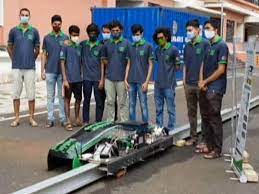
A group of students with team named “AVISHKAR” from IIT Madras have been working tremendously towards the technology behind the future of transportation, HYPERLOOP. The team comprises of forty students from various department of IIT, madras. They have been working on this new prototype hyperloop project since last November.

BUT, WHAT IS HYPERLOOP?

Basically, hyperloop is a high speed mass transportation system. A hyperloop is a super speed ground-level transportation system in which people could travel in a hovering pod inside a vacuum tube at speeds as high as 760 mph (1220 km/h).

While talking about the product, Neel said, “Hyperloop is a proposed mode of transportation in which many pods will be traveling inside a vacuum tube, capable of attaining high speeds due to no air friction and reduced air drag.” It IS the fifth and most efficient mode of transportation that the world is moving towards, he added. Further he said, “Because Hyperloop is sustainable, it works on electrical energy, we can install Solar panels on top of the tube, which could store energy and the same energy could be used to propel the hyperloop. This is way more sustainable .”

HOW DOES A HYPERLOOP WORK?

It has three major components: a tube, pod, and terminal. The tube is a large low pressure system that is sealed and tube can be constructed either above or below the ground. A pod is a coach that runs inside this controlled system and this pod employs magnetic or aerodynamic levitation along with electromagnetic or aerodynamic propulsion to glide along a fixed guideway. The terminals are used for arrivals and departures. Hyperloop is based on simple science called Magnetic levitation. But one thing that needs to be noted is, that it requires complex machinery and sensors to make a Pod travel at nearly 1000 km/h inside a vacuum tube. However the team has cracked that and named their pod “GARV”, which translates to “PRIDE”. It consists of Carbon Fiber shell, packed with advanced machinery and sensors.

STATEMENT:

Pranit, who is Head of Braking Module, said that Garv is their second Pod which is more efficient and lighter than the one they designed for SpaceX. “This time we are introducing several technologies like linear induction motor to achieve ‘contactless propulsion’ and ‘contactless braking. The motor produces a magnetic field which makes the Pod move forward and the contactless Braking has magnets which come closer to the rail, creating a Braking force and decelerating the Pod,” Pranit added.

Parth, a member of the Controls team, said, “Our team started in November. Everything we did online such as brainstorming sessions and discussions about the simulations. Once we were confident, we came back to the institute and started working on the Pod.” He said, “We are participating in European Hyperloop Week which will be conducted on 19th – 25th July and Valencia, Spain. Because of the pandemic, we are forced to compete virtually, but that is not a setback for us.”

EUROPEAN HYPERLOOP WEEK SELECTION:

With all their hard work, they have now crossed the hurdle and are qualified for the European Hyperloop Week that is to be held in Valencia, Spain from July 19 to 25. The team will participate virtually due to pandemic restrictions. With upgraded prototype, the team estimates the travel time between Chennai and Bangalore to be a mere 30 minutes ride instead of a six hours journey. They are also working on the study of energy, costs, demands and other aspects of hyperloop so as to access the economic feasibility of hyperloop in India.

“Indira Gandhi” Biography

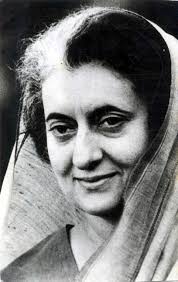
Indira Gandhi was an Indian states women and to date the only female Prime Minister in India. She was born on November 19, 1917 in Allahabad India. Her father’s name of Jawaharlal Nehru and mother’s name Kamala Nehru. Her father was independent India’s first Prime Minister and mother was a freedom fighter.

She attained her preliminary education at
home then attended school to complete her matriculation. Indira was enrolled at the Viswa Bharti University in Calcutta that had to leave the same due to the failing health of her mother in Europe. Post the death of
her mother, Indira attended the University of Oxford in Britain where she studied history political science, and economics. However, due to her constant ill-health, she returned to India without a degree she married to rose Gandhi on March 26 1942 they got two sons named Rajiv Gandhi
and Sanjay Gandhi. After the death of her father in 1964 Indira Gandhi was
appointed as a member of the Rajya Sabha. She also becomes one of the member of Lal Bahadur Shastri cabinet serving as the minister of Information and Broadcasting after the death of Lal Bahadur Shastri Indira
Gandhi become the prime minister of India in January 1966. During her the
term as prime minister Gandhi brought about a radical change in the
country’s economic-political International and national policies. She included the nationalization of 14 major commercial bank coal Steel copper refining cotton Textiles and insurance industries she nationalized the Oil Companies after the 1971 war against Pakistan. When India faced oil crisis in 1971 Gandhi supported the east Pakistan in the Pakistan civil war
which led to the formation of Bangladesh administration gave statehood
to some area. Indira Gandhi had a good relationship with the Soviet Union
and Bangladesh post the Assassination of Bangladesh Prime Minister Sheikh Mujibur Rahman the ties between India and Bangladesh soured Gandhi also brought social reforms by introducing classes in the Indian constitution related to wages equal pay for equal work to both men and women after the 1971 election the opposition parties acaused her of using the unlawful method and electoral fraud to win the elections Allahabad High Court found Gandhi guilty on June 1975 the court declared the
election null and void and unseated Indira Gandhi from the Lok Sabhaadditional she was banned from contesting for the net that year later due to internal crisis and strike president Fakhruddin Ali Ahmed declare a
state of emergency on the advice oan f Gandhi the emergency lasted for 21
months from June 1975 until March 1977 it best out on Gandhi the power to Rule by decree.

Gandhi extended the state of emergency twice before the election of March 1977 the result of the election the Congress party
was defeated convincingly they I won just 153 sheats both Indira Gandhi
and her son Sanjay Gandhi lost their sheat Indira Gandhi and Sanjay Gandhi arrested on charges of planning to kill the opposition leader during an emergency the following year she won elections to the Lok Sabha the
lower level of parliament in 1980 she returned to power as prime minister
that same year Gandhi son Sanjay died in a plane crash in New Delhi the Prime Minister then began preparing her other son Rajiv for leadership on October 31st, 1984 Gandhi what short and carried by two of her body cord both Sheiks in Retribution for the attack at the Golden Temple she died at the age of 66 every new experience bring it on maturity and a great future and clarity of vision.

IIT-MADRAS, AVISHKAR HYPERLOOP TEAM QUALIFIES FOR EUROPEAN HYPERLOOP WEEK

A group of students with team named “AVISHKAR” from IIT Madras have been working tremendously towards the technology behind the future of transportation, HYPERLOOP. The team comprises of forty students from various department of IIT, madras. They have been working on this new prototype hyperloop project since last November.

BUT, WHAT IS HYPERLOOP?

Basically, hyperloop is a high speed mass transportation system. A hyperloop is a super speed ground-level transportation system in which people could travel in a hovering pod inside a vacuum tube at speeds as high as 760 mph (1220 km/h).

While talking about the product, Neel said, “Hyperloop is a proposed mode of transportation in which many pods will be traveling inside a vacuum tube, capable of attaining high speeds due to no air friction and reduced air drag.” It IS the fifth and most efficient mode of transportation that the world is moving towards, he added. Further he said, “Because Hyperloop is sustainable, it works on electrical energy, we can install Solar panels on top of the tube, which could store energy and the same energy could be used to propel the hyperloop. This is way more sustainable .”

HOW DOES A HYPERLOOP WORK?

It has three major components: a tube, pod, and terminal. The tube is a large low pressure system that is sealed and tube can be constructed either above or below the ground. A pod is a coach that runs inside this controlled system and this pod employs magnetic or aerodynamic levitation along with electromagnetic or aerodynamic propulsion to glide along a fixed guideway. The terminals are used for arrivals and departures. Hyperloop is based on simple science called Magnetic levitation. But one thing that needs to be noted is, that it requires complex machinery and sensors to make a Pod travel at nearly 1000 km/h inside a vacuum tube. However the team has cracked that and named their pod “GARV”, which translates to “PRIDE”. It consists of Carbon Fiber shell, packed with advanced machinery and sensors.

STATEMENT:

Pranit, who is Head of Braking Module, said that Garv is their second Pod which is more efficient and lighter than the one they designed for SpaceX. “This time we are introducing several technologies like linear induction motor to achieve ‘contactless propulsion’ and ‘contactless braking. The motor produces a magnetic field which makes the Pod move forward and the contactless Braking has magnets which come closer to the rail, creating a Braking force and decelerating the Pod,” Pranit added.

Parth, a member of the Controls team, said, “Our team started in November. Everything we did online such as brainstorming sessions and discussions about the simulations. Once we were confident, we came back to the institute and started working on the Pod.” He said, “We are participating in European Hyperloop Week which will be conducted on 19th – 25th July and Valencia, Spain. Because of the pandemic, we are forced to compete virtually, but that is not a setback for us.”

EUROPEAN HYPERLOOP WEEK SELECTION:

With all their hard work, they have now crossed the hurdle and are qualified for the European Hyperloop Week that is to be held in Valencia, Spain from July 19 to 25. The team will participate virtually due to pandemic restrictions. With upgraded prototype, the team estimates the travel time between Chennai and Bangalore to be a mere 30 minutes ride instead of a six hours journey. They are also working on the study of energy, costs, demands and other aspects of hyperloop so as to access the economic feasibility of hyperloop in India.

The Tiananmen Square Protests

What was it?

Tiananmen square is a city square in Beijing, China. In 1989, there were student-led protests and demonstrations calling for democracy, free speech and free press in China that culminated in this square. The pro-democracy student protestors had marched through Beijing to Tiananmen Square following the death of Hu Yao bang, a former communist party leader who had worked to introduce democratic reform in China. In mourning Hu, the students called for a more open, democratic government and also demanded the resignations of Chinese Communist Party leaders who were deemed repressive and inadequate. For nearly three weeks, the protesters kept up daily vigils, marched and chanted. The event drew around one million participants and was being captured and reported on by news channels all over the world. It had become a global event, but one which would have a terrifying ending.

The Tiananmen Square Massacre

The government had considered negotiating with the demonstrators and offering concessions. However, many in power were opposed to this and decided that to avoid anarchy, the protests needed to be suppressed forcibly. To this end, martial law was declared in Beijing, and army troops were stationed around the city. Initially, attempts by the troops to reach Tiananmen Square were thwarted by the citizens of Beijing who flooded the streets and blocked their way. Eventually however, the Chinese government decided to crack down on the protestors in Tiananmen square with all their might. They sent soldiers and security police that stormed through Tiananmen Square, firing indiscriminately into the crowds of protesters. Tanks and heavily armed troops advanced toward Tiananmen Square, opening fire on or crushing those who tried to block their way.

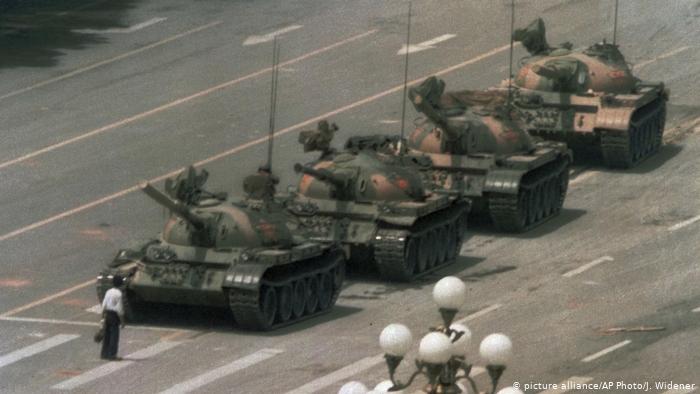
Hence, carnage ensued as tens of thousands of the young students tried to escape the terrorizing Chinese forces. Other protesters fought back, stoning the attacking troops and overturning and setting fire to military vehicles. Once the soldiers reached the square, a number of the few thousand remaining demonstrators chose to leave rather than face a continuation of the confrontation. By morning the area had been cleared of protesters, though sporadic shootings occurred throughout the day. By June 5, the military had secured complete control, though during the day there was a notable, widely reported incident involving a lone protester momentarily facing down a column of tanks as it advanced on him near the square. This incident is now a famous picture that serves as a representation of what happened at Tiananmen (featured image of the article).

The Aftermath

In the aftermath of the massacre and crackdown, the United States instituted economic and diplomatic sanctions on China for a time, and many other foreign governments criticized China’s handling of the protesters. Leaders and governments worldwide condemned the Chinese government’s military actions. Still, the Chinese government arrested thousands of individuals who were suspected to have been involved in the protests, and many of them received prison.

From the outset of the incident, the Chinese government’s official stance was to rationalize their actions, calling the protesters ‘counterrevolutionaries’ and minimizing the extent of the military actions. The government’s count of those killed was 241 (including soldiers), with some 7,000 wounded. However, most other estimates have put the death toll much higher. In the years since the incident, the government has attempted to suppress all references to it, and public commemoration of the incident is officially banned. However, the residents of Hong Kong have held an annual vigil on the anniversary of the crackdown, even after Hong Kong reverted to Chinese administration. It remains a sensitive topic to date in China, and there is little to no discussion or debate about in Chinese public forums. Regardless, everyone in China and in the world knows and remembers the tragic events that occurred in Tiananmen square and the protestors that died while wishing for a better China.

Self – Sacrificing

“For anything worth having one must pay the price; and the price is always work, patience, love, self-sacrifice – no paper currency, no promises to pay, but the gold of real service” —- JOHN BURROUGHS

countless stories can be told of sacrifices made and the innocents deaths that brings to fore the real humanity of the corona virus warriors who keeps risking their life’s to saves peoples from the depth of death an provide solace to those who have lost their dear ones even thought they were surrounded by the medicine. can this spirits of altruism, fortitude and self – sacrifice pave away for a new eco 0 friendly lifestyle?

Religious text are filled with narratives of tremendous sacrifice and resilience. The power of faith in a divine beings binds desperate elements of society to rise to great heights. The obedience of ram to give up his kingdom and go exile; the deeply insightful decision of the buddha to sacrifice his kinship to venture into the forest in search of answer to our existential reality; the crucifixion of Jesus Christ for the absolution of the sinning multitudes; the martyrdom of Imam Hussain to upholds the standards of truth when confronted by a heartless tyrannical ruler; the martyrdom of Guru Tegh Bahadur for protecting religious freedom are just a few examples. As soon as the cloud or the smoke cleared away will the people still be happy with the alien virus they struggled with.

To build a new world is no easy task. Since the beginning of the outbreak, healthcare professionals have truly been selfless warriors, giving everything to uphold their job responsibilities, even at the cost of cutting themselves off from their families and loved ones. Although most doctors have experienced the gratification of healing patients and saving their lives, many battles have also been lost along the way with several doctors going to the extent of even sacrificing their own lives in the line of duty. Doctors, nurses and many others in the healthcare sector have donned the role of a brave medical army fighting against coronavirus, standing strong with thermometers, stethoscopes and ventilators as their weapons. I salute their courage, valour and selflessness in serving society. No words are enough to express gratitude towards all the Corona Warriors, who risked their own lives to save the lives of others. It’s unfortunate and a great personal loss for me that so many of them lost their lives during this time.

About Global Warming!

Although the terms global warming and climate change are often used interchangeably, they apply to different phenomena. Climate change refers to changes in Earth’s temperature, humidity, air pressure, wind, clouds, and precipitation patterns over time. Global warming is a contributing factor to climate change and refers specifically to the effect of greenhouse gases on Earth’s average surface temperature. When discussing rising temperatures caused by greenhouse gases, global warming is an acceptable term. However, climate change is the more accurate term when describing other long-term changes to the planet’s weather patterns.

The term global warming first appeared in geochemist Wallace Broecker’s 1975 Sciencemagazine article, “Climatic Change: Are We on the Brink of a Pronounced Global Warming?” Scientists began studying the effect of greenhouse gases on Earth’s climate more than a century prior, however, as early as 1820. It was during this time that French scientist Joseph Fourier first discovered that Earth’s atmosphere functions to retain the sun’s heat. In the early 1900s, Serbian astrophysicist Milutin Milankovitch also identified the long-term climate effects of natural fluctuations in Earth’s orbit as well as the tilt and precession of its axis. Since then, scientists and policymakers have worked to better understand the workings of the atmosphere, as well as how to respond to challenges created by climate change.

 
Causes of Climate Change

Earth’s atmosphere contains various gases that act as a blanket to trap heat from the sun and prevent it from escaping back into space. This process is known as the greenhouse effect, and the gases are referred to as greenhouse gases. The main greenhouse gases that occur in nature are carbon dioxide, methane, and nitrous oxide. Without the greenhouse effect, the planet would be too cold to support life. Over time, the amount of greenhouse gases trapped in Earth’s atmosphere has increased significantly, causing worldwide temperatures to rise.

Natural processes on Earth constantly create and destroy greenhouse gases. The decay of plant and animal matter, for example, produces carbon dioxide, which plants then absorb during photosynthesis. This natural cycle keeps the level of carbon dioxide in the atmosphere fairly stable. Shifts in the planet’s crust and changes in ocean patterns impact weather, as do fluctuations in the sun’s output of radiation. Volcanic activity also affects the climate because eruptions discharge greenhouse gases and other pollutants into the atmosphere. Climate change scientists at the National Aeronautics and Space Administration (NASA) and other federal and international agencies recognize that these natural factors continue to play a role in climate change but contend that the impact of these factors alone does not explain the substantial rise in Earth’s temperature. Natural causes of climate change are referred to as naturogenic, while human-made causes of climate change are referred to as anthropogenic.

Earth’s vegetation releases and absorbs more than two hundred billion metric tons of carbon dioxide annually. Human activities, such as the burning of fossil fuels, add an extra seven billion metric tons per year. Over time, these additions have had a dramatic effect on the atmosphere. In the past 150 years, the concentration of carbon dioxide in the atmosphere has risen by more than 30 percent. Deforestation has also played a role in this increase by eliminating forests that would otherwise absorb tons of carbon dioxide.

Increased levels of other greenhouse gases such as nitrous oxide and methane have also resulted from human activities. Several agricultural and industrial activities, such as the use of certain fertilizers in agriculture, produce nitrous oxide. Methane emissions come from the production of fossil fuels, from landfills, and from livestock. These gases may cause even more harm than carbon dioxide, even though less of them exist, because they have a much greater effect per pound on Earth’s temperature. Methane, for example, is a greenhouse gas that is twenty-one times as potent as carbon dioxide. Beginning in October 2015, a methane gas leak from a California storage facility vented about five billion cubic feet of gas into the atmosphere. The leak took more than three months to seal and was finally capped on February 18, 2016. The incident constituted the largest accidental discharge of greenhouse gases in US history, releasing the equivalent of the yearly exhaust emissions from 572,000 automobiles.

Humans have created and released greenhouse gases that do not occur in nature. These include hydrofluorocarbons (HFCs), perfluorocarbons (PFCs), and sulfur hexafluoride (SF6). These gases, released during such industrial processes as aluminum production and electrical transmission, have thousands of times greater effect on the planet’s temperature than carbon dioxide.

Happiness

Happiness is a state of mind which we possess when something good happens to us and we feel that goodness at our heart. This is an abstract feeling which is not materialistic and cannot be bought by money or some other possession. Happiness brings with itself a lot of positivity and also provides us with the motivation to go ahead and achieve other milestones. Happiness also maintains the zeal and enthusiasm for doing things and experiencing new paths. Happy state of mind also increases the age of people and lets them live a longer life.

Happiness is a key to healthy life; it sets a soul free and encourages it to explore the world and also gives us power. Happiness is a part of being successful in life it is that fruit which we all want to grow and thus we do so much of hard work throughout our entire life so that we can live a happy peaceful life after all. Happiness cannot be ever faked it comes straight out from our heart and it is priceless. At the end of a hard-earned day all we care for is some peace and happiness in our families and ourselves so that we can start another fresh day ahead.

4 levels of Happiness :

” Happiness is the meaning and the purpose of life, the whole aim and end of human existence” . Of course, there are a number of different types of happiness and each person has different things in life that make them happy and unhappy. It is important for people to be self- aware and to truly understand what makes them happy and content as individuals. Take a look at the different types of happiness below and think about the things in your life that maku you happy.

There are main types of happiness, these being related to; pleasure, passion and purpose.

Pleasure :

Pleasure is important to us human beings but its related benefits are relatively short term. A delicious meal, a nice meeting with friends or listening to our favourite music all produce endorphins and offerus happy moments that can be the highlights of our day. However, these singular moments don’t equate to long- term satisfaction.

Passion :

Being passionate about something whether a hobby cause or group activity and actively being involved with it can be a great source of happiness. These activites deliver contentment in the medium term and provide a sense of achievement and variety in life

Purpose :

Feeling like you are part of something bigger than yourself and that your actions will really matter can lead to a deep sense of fulfillment and long- term happiness. We all like to think that our lives have menaing and if you can find your ” calling” or be part of great team, group or organisation that are making a difference then chances are you will be truly happy.

Ultimate Good :

The fourth level of happiness is known as ultimate good. This is a fundamental desire we have as human beings for perfect truth, goodness beauty and love . Many people find this form of happiness through their religious beliefs. Even those who don’t believe in a higher power can find happiness in their pursuit of truth, beauty, love and goodness in themselves and in helping others. This level is happiness is often considered the most enduring and profound.

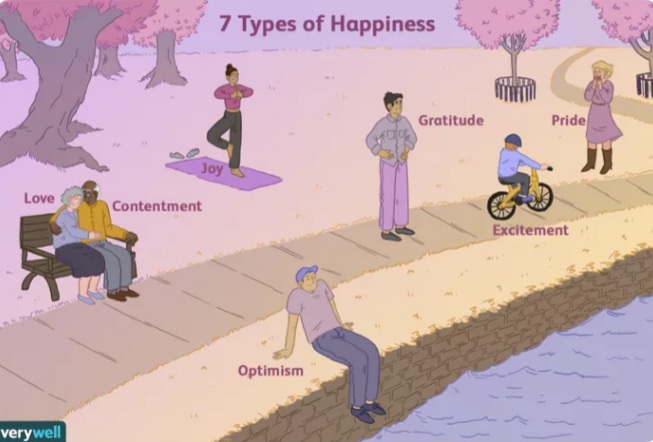
Different types of Happiness :

1. Joy :

Joy is when you win a hard- fought competition, you finally accomplish a project you’ve wanted to or times when you doible over in uncontrolled laughter when someone relates a hilarious story. Joy makes you feel great about yourself, makes you feel confident, assertive, capable, loved and fulfilled.

The feeling of joy is fleeting joy is presemt at the moment. It is possible to feel joy despite grief or uncertainty. Happiness can be found in many things. It transforms tough times into blessimgs and turns heartache into gratitude.

2. Love :

Second, on the list pf different types of happiness is love. Which means other things to different people still, a wholesome ,reciprocared love with another person seems to be the fundamental predictor of happiness. Here, we are not just talking about romantic love, it means to love with friends and family, as well as partners. When you’re in love, you’ re blissfully happy all the time.

3. Contentment :

The secret of Happiness is contentment which means a state of happiness or satisfaction . It isn’t a matter of being satisfied with what you have. Contentment not only holds the power tobmake you happy, but it will transforms your life in many ways.

4. Optimism :

Optimism is a type of happiness that reflects the belief that events or experience outcomes will generally be positive. The key to attaining happiness is to have an optimistic approach to life, as optimism reflects hope and faith, helping people believe that this world is the right place

5. Gratitude :

Gratitude creates positive emotions, like different types of happiness, joy, love, and contentment, it can undo the hold of negative emotions. It goes hand in hand with mindfulness in its focous on the present and greatfulness for what we have now, rather than wanting more and more.

6. Excitment :

Excitment can be anything from about a new job or moving to a different place and motivates youbto work harder and channel that positive energy into more constructive activity. Excitements is fleeting. It dissipates rather quickly and can turn into ennui. It sometimes acts as a motivating factor , and execitment often leads people to likely make a decision. Even a bad one as excitment leads to impulsivity.

7. Pride :

Last on the list of different types of happiness is pride. Yes, pride and happiness go hand in hand. You can take pride in your work and your family, your haome and yourself, and in anything you put effort, attention, and love into. It is a positive feeling in reactive to a jouous event.

There are 7 essential keys to happiness and success that will help to materialize both those things in your life:

* Gratitude.

* Be present

* Manage time Effectively

* Set smarter Goals

* Embody an Empowering morning Routine

* Tackle the MITs

* Focus on Health and wellbeing.

To get the most bang for the happiness buck, I’ve realized that I should complete four stages of reveling in a moment of happiness :

* Anticipate with pleasure.

* Savor the moment as I experience it,

* express my happiness to myself or others,

* reflect on a happy memory.

Four happy hormones :

* Dopamine

* serotonin

* Endorphins

* oxytocin

Strategies of Happiness :

* Do more activities that truely engage you

* savor life’s joy

* Learn to forgive

* Practice acts of kindness

* Nature relationships

* cultivate optimisim

* Avoid overthinking and social comparison

* Develop strategies for coping

STAY HAPPY 🤩AND KEEP SMILING ALWAYS😁 .BE HAPPY 🥳

Fertilizers pose threat to ecosystem

The chemical substances supplied to the crops to increase their productivity and crop yield are called fertilizers. They contain the essential nutrients required by the plants to grow- nitrogen, potassium, and phosphorus. Fertilizers are chemical substances supplied to the crops to increase their productivity. These are used by the farmers daily to increase the crop yield. The fertilizers contain the essential nutrients required by the plants, including . They enhance the water retention capacity of the soil and also increase its fertility.

Pros

  • increase plants’ tolerance towards pests. This has
  • reduced reliance on insecticides and herbicides, thereby, producing healthier crops.
  • Consequently, diseases have reduced, providing aesthetic value to the crops.
  • improve the water holding capacity of the plants and increase root depth.
  • The potassium content present in the fertilizers strengthens the straws and stalks of the plants.
  • The phosphorus present in the fertilizers helps in the faster development of roots and formation of seeds in the plants.
  • Nitrogen in the fertilizers enhances the growth of the plants

Cons

  • They are expensive.
  • The ingredients in the fertilizers are toxic to the skin and respiratory system.
  • Excessive use of fertilizers damages the plants and reduces soil fertility.
  • Leaching occurs and the fertilizers reach the rivers causing eutrophication.
  • Long term use reduces the microbial activity and disturbs the pH of the soil.

Eutrophication

Eutrophication is the gradual increase in the concentration of phosphorus, nitrogen, and other plant nutrients in an aquatic ecosystem.  These substances enter the ecosystem primarily by runoff( runoff includes not only the waters that travel over the land surface and through channels to reach a stream but also interflow, the water that infiltrates the soil surface and travels by means of gravity) from land that carries debris and products of the reproduction and death of terrestrial organisms. Rainfall washes off the fertilizers from field into water. The amount of organic material that can be broken down into nutrients increases thereby enriching the ecosystem. This creates suitable living conditions for algae and microbes to grow and proliferate. Algae often develop on the surface, preventing the light penetration and oxygen absorption necessary for underwater life. Eutrophic waters are often murky and may support fewer large animals, such as fish and birds, than non-eutrophic waters.

The phenomenon of lack of oxygen in body which leads to unconsciousness and death is called Asphyxiation. This poses as the main reason of mass killing of fish. According to reports, causes of natural fish kills are:

■ Lack of oxygen in the water (anoxia). The majority of natural kills are caused by this problem.
■ Naturally toxic water. Acidic water containing toxic levels of aluminium leached from acid-sulphate soils
has been identified on the floodplains of Magela Creek and Nourlangie Creek.
■ Disease, especially red spot disease, often kills fish but this only rarely results in a large number of deaths at
one time.


During the day, aquatic plants and algae produce oxygen as a by-product of photosynthesis, raising the
levels of oxygen in the water. At night, the oxygen is used up by respiration of all the aquatic biota, reaching a minimum level at dawn. The decay of dead plant material at the end of the Wet season can aggravate this effect. With high temperatures and declining water levels at the end of the Wet and the Dry season, there may be little or no oxygen left in the predawn period. This causes oxygen stress to the fish and can result in deaths

Since the chemical fertilizers adversely affect soil fertility, biofertilizers were brought into use. These are substances that contain living or latent cells, and even micro-organisms. They provide the soil with the necessary nutrients and microbes for the growth of the plants. They help the soil to retain its fertility. They are environment-friendly and also destroy pathogenic components responsible for causing disease in plants. Acetobacter and Rhizobium are widely used biofertilizers.