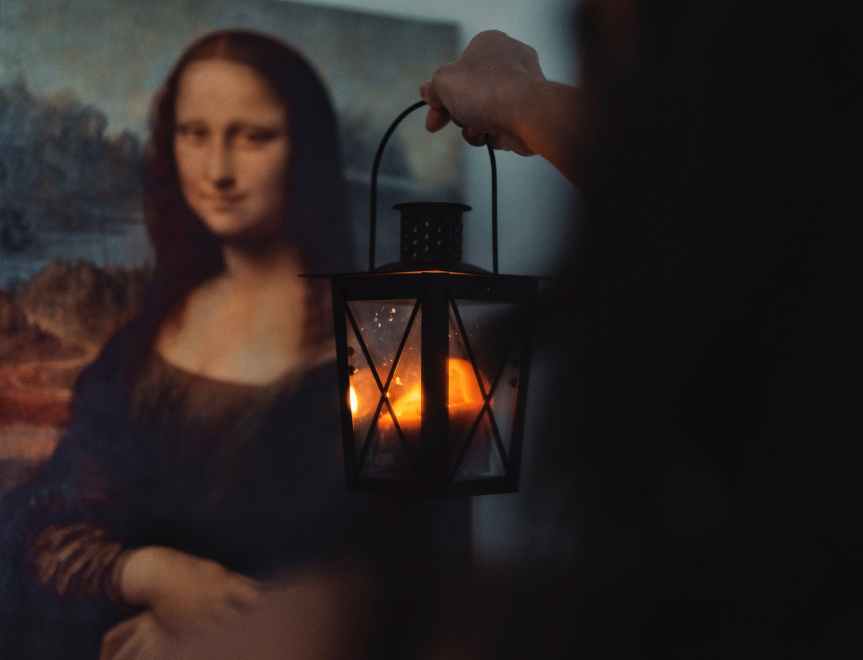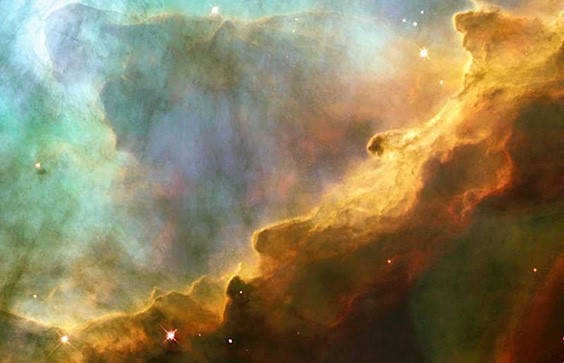
Expansion of Space

When scientists talk about the expanding universe, they mean that it has been growing ever since its beginning with the Big Bang.

The galaxies outside of our own are moving away from us, and the ones that are farthest away are moving the fastest. This means that no matter what galaxy you happen to be in, all the other galaxies are moving away from you.

However, the galaxies are not moving through space, they are moving in space, because space is also moving. In other words, the universe has no center; everything is moving away from everything else. If you imagine a grid of space with a galaxy every million light years or so, after enough time passes this grid will stretch out so that the galaxies are spread to every two million light years, and so on, possibly into infinity.

The universe encompasses everything in existence, from the smallest atom to the largest galaxy; since forming some 13.7 billion years ago in the Big Bang, it has been expanding and may be infinite in its scope. The part of the universe of which we have knowledge is called the observable universe, the region around Earth from which light has had time to reach us.
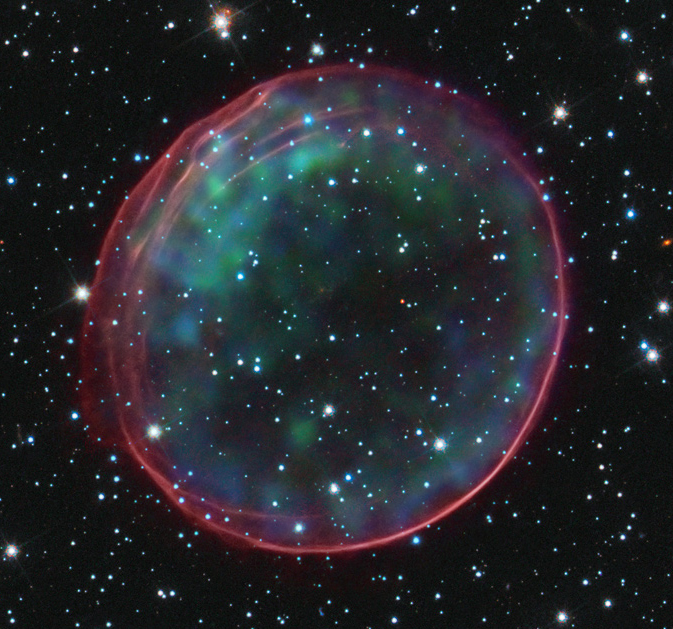
One famous analogy to explain the expanding universe is imagining the universe like a loaf of raisin bread dough. As the bread rises and expands, the raisins move farther away from each other, but they are still stuck in the dough. In the case of the universe, there may be raisins out there that we can’t see any more because they have moved away so fast that their light has never reached Earth. Fortunately, gravity is in control of things at the local level and keeps our raisins together.

Who Figured This Out?

The American astronomer Edwin Hubble made the observations in 1925, proving that there is a direct relationship between the speeds of distant galaxies and their distances from Earth.   The observation that galaxies are moving away from the Earth at speeds proportional to their distance has traditionally been known as Hubble’s Law, although it should be noted that, in 2018, the International Astronomical Union (IAU) voted to recommend amending the name to the Hubble–Lemaître law,  in recognition of the contributions of both Hubble and the  Belgian astronomer Georges Lemaître to the development of modern cosmology.
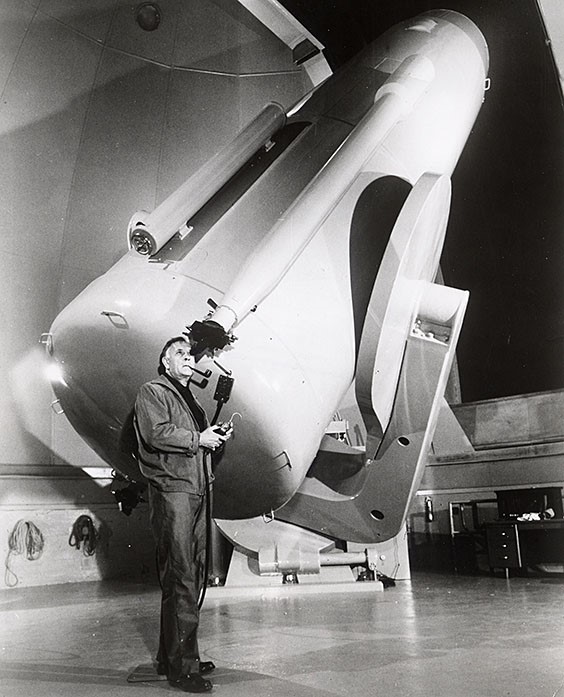
The Hubble Space Telescope was named after Edwin Hubble, and the single number that describes the rate of the cosmic expansion, relating the apparent recession velocities of external galaxies to their distance, is called the Hubble Constant.

Is the Universe Infinite?

It might be easier to explain about the beginning of the universe and the Big Bang Theory, than to talk about how it will end. It is possible that the universe will last forever, or it may be crushed out of existence in a reverse of the Big Bang scenario, but that would be so far in the future that it might as well be infinite. Until recently, cosmologists (the scientists who study the universe) assumed that the rate of the universe’s expansion was slowing because of the effects of gravity. However, current research indicates that the universe may expand to eternity. But research continues and new studies of supernovae in remote galaxies and a force called dark energy may modify the possible fates of the universe.

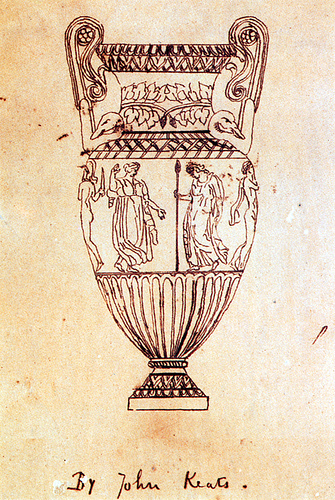
Keats’ ‘Ode on a Grecian Urn’

John Keats was an exemplary second-generation romantic poet who lived in the early 19th century. The romantic period refers to several literary movements that were characterised by their highly subjective form of writing, which was essentially a breakaway from the traditions of more rigid writing followed by the Neoclassical poets. Keats belonged to a group of poets who were later dubbed as the ‘second-generation romantics’ and it included other poets like Shelly, Wordsworth and Byron. The romantic age in England is generally marked by the publishing of ‘Lyrical Ballads’ by Coleridge and Wordsworth in 1789.

Thou still unravish'd bride of quietness,
       Thou foster-child of silence and slow time...

One of the main characteristics that set the romantics apart from the others is their intensely personal subject matter. It ranged from their own internal conflicts, to their philosophical thoughts, to praising the glory of nature and its effects on humans. Their poetic style was free and untamed (not that it did not have any metrical compositions, they were comparatively flexible in relation to the neoclassic poets.) like the vast untamedness of nature. They found their sources of poetry from particularly unique and seemingly unlikely experiences. For them, poetry conveyed its own truth and the sincerity was the true criterion for judging a poetry.

Heard melodies are sweet, but those unheard
       Are sweeter; therefore, ye soft pipes, play on;
Not to the sensual ear, but, more endear'd,
       Pipe to the spirit ditties of no tone:...

Several of Keats’ poetry questions the mortality and impermanence of human life with relations to art and its everlasting life on earth. In ‘Ode on a Grecian Urn’, the speaker comes across an old Grecian artefact and admires all the paintings on it. The urn contains several pictures of characters including a fair youth who sings beneath an evergreen tree, two lovers who are almost kissing, a melodist playing a pipe, a town of people on a procession with a sacrificial cow and so on. He takes a moment to think about each of their stories and wonders how it is to remain immortal.

For ever panting, and for ever young;
All breathing human passion far above,
         That leaves a heart high-sorrowful and cloy'd,
                A burning forehead, and a parching tongue...

He starts off the poem by describing the beautiful shape of the urn. He addresses it by several names and revels in the beauty and satisfaction that it gives him. He then addresses the sweetness of the music that might be coming out of the painted instruments. He assures himself by saying that the unheard melodies are sweeter because it speaks directly to our inner soul. He then moves onto the loves and assures them that though they may never kiss, they will forever remain young and fair. He complements the beautiful boughs of the trees and tells them that they will never wilt and will forever remain beautiful. In the later stanza, the poem takes a little turn as the speaker as he examines how they will live forever while humans living in the real world are all eventually bound to die one day. He then examines a procession of people who are carrying a sacrificial heifer and wonder which town or village is empty of this folk.

  "Beauty is truth, truth beauty,—that is all
                Ye know on earth, and all ye need to know."

In the final stanza of the poem, the speaker once again admires the beauty of the urn and decides that even after his lifetime, the urn will forever remain and tell its story for generations to come. The speaker finally neds the poem with one of the most beautiful verses in the poem going “Beauty is truth, truth beauty” which he confirms is the only eternal truth that one needs to know on earth.        

Reference Links:


Chhatrapati Shivaji

Chhatrapati Shivaji was a great king and brave warrior. He was born on 19th february 1630 at Shivneri Fort in Pune, Maharashtra.His father Shahaji Bhonsle and mother Jijabai. He got best qualities of his character from his mother and Guru Ramdas. Dadaji kond deva was the teacher of Shivaji. Shivaji was the founder of the Marathi Empire in western India.

chhatrapati shivaji

Shivaji always believed in equality and justice.He had also strictly warned his solders not to harm or disrespect to women.The battle technique of shivaji was called Guerrilla Warfare. The technique are still used in modren days.He introduced the concept of Ashtha Pradhan Mandal where each minister has particular responsibilities. He was the biggest enemy of Mugal Emperor Aurangzeb. At the age of 15, he gathered trusted soldiers which were called “Mavlas” and pledged to establish the swarajya,self governance.They were highly inspired to shivaji and ready to sacrifice their lives for the swarajya and shivaji.

After the death of Shahaji,Shivaji Maharaj started his conquest again. Adil shah(ruled the Sultanate of Bijapur) ordered his commander Afzal Khan to plan a murder and eradicate shivaji. Afzal acted as a friend to gain his confidence and kill him. Shivaji was one step ahead,he killed Afzal Khan.This battle technique was the major weapon of Shivaji Maharaj and it was called “Guerrilla warfare”.Later real battle started with the Mughal Emperor.There are so many acts of bravery of Shivaji Maharaj such as his clever escape from the Aurangzeb arrest in Agra and so many other.

Shivaji Maharaj was crowned as the king of Marathas on June 6,1674.He introduced the collection pf two taxes called the Chauth and Sardeshmukhi. He encourged women’s liberty and respected them atmost. He had also strictly warned his soldiers not to cause harm or disrespect to women. In late March, Shivaji fell ill with fever and dysentery.He died on 3rd April,1680 in Raigad.


Importance of Education

Education is very important for every individual human being and for every country. It is the “ray of light in the darkness”.Education teaches the ability to read and write.Reading and Writing is the foremost step in education. Education helps to improve knowledge, skills and develops the personality.Education is important to both men and women to understand every aspect of life.Educated people know when to speak and when to remain silent.

“Purpose of education is to turn mirrors into windows”

Educate yourself and get as many qualifications and experience as possible.one of the benefits of educational system teaches us how to obtain and develop critical and logical thinking and make independent decisions. Educated people are treated as equal on the basis of their knowledge and competence.Thus we are able to shape a better society, education plays a very important role in all aspects of every humans.

The Legendary Kentaro Miura

Legendary manga creator Kentaro Miura of the critically acclaimed Berserk series has passed away at the age of 54. He died on May 6 due to acute aortic dissection. Miura is best known for both his stunning artistic prowess and compelling storytelling abilities that he employed in his seminal series Berserk. Since it began in 1989, his masterpiece has spawned a 1997 anime adaption of the manga’s earlier chapters, three movies covering the same events as the original adaptation in 2012-13, and a 2016 series that delved into the manga’s later arcs for two seasons. Miura’s work, which also influenced a proliferation of gaming adaptations, was still ongoing with 40 volumes of 364 chapters and more than 35 million copies sold worldwide.

Berserk told the story of Guts, a former mercenary who later embraced the ominous identity of the Black Swordsman. For the majority of the series, Guts seeks revenge against his former friend Griffith who sacrificed his companions so he could achieve his dream of building his own kingdom. On his bloody conquest, Guts is plagued by demons, as the world falls into an existential state of chaos as a direct result of Griffith’s selfish actions.

Although a manga artist, Miura pioneered a new artistic style that was unheard of at the time and that, even now, few have attempted or even considered to replicate. This bold step in breaking away from the norm of how characters and settings are drawn in this particular medium allowed Miura to venture into an incredibly dark and intricate world that set it apart from other manga. Regardless of this stark departure, Berserk always felt like a manga, allowing Miura to grasp and fully benefit from all of the best characteristics and qualities that the medium has to offer, without sullying his own artistic genius and direction.

When he began Berserk, Miura embraced an extreme form of violence that transcended what existed in manga at the time. It may have been a risky move, but it was a tactic that ended up strengthening his story and deepening his characters in a way that any normal depiction of violence could never achieve. It was clear that Miura understood how much of an impact such unsettling depictions could have on readers.

Yet, despite the existential despair that Kentaro Miura created, humanity still shone through in Berserk, as Guts strove to protect his friends and Casca, the woman he loved, from the interminable wave of nihilistic violence that surrounded them. In fact, near the end of his manga series, Miura began hinting at the seemingly impossible, undermining what drove so many to embrace his work in the first place. Guts, despite being propelled by hate and anger for so long, appeared to have been letting go of his hatred of Griffith. Even in the violent world that he himself created, Miura was willing to break his own rules, all for the sake of love and hope. Kentaro Miura was a visionary. He was a legend. He will be missed. RIP.

CLOUDS

According to their height, clouds are classified into the following types
☆ High clouds (6-20km Height)
☆ Middle clouds (2.5km-6km Height)
☆ Low clouds (ground surface to 25km height)

These major types of clouds are further divided into different types on the basis of shape and structure.

High clouds

Cirrus

Detached clouds in the forms of white delicate fibrous silky filaments formed at the high sky (8000 meters to 12000 meters) are called Cirrus clouds. These clouds have Ice crystals and are dry and do not give rainfall.

Cirro-cumulus

Whitepatched, sheet or layer like clouds composed of ice crystals.

Cirro-stratus

Smooth milky transparent whitish clouds composed of tiny ice crystals.

Middle clouds

Alto-stratus

Thin sheets of grey or blue coloured clouds in uniform appearance. Consisting of frozen water droplets.

Alto-cumulus

Clouds fitted closely together in parallel bands, called as ‘Sheep clouds’ or wool pack clouds.

Nimbo stratus

These are clouds of dark colour very close to the ground surface associated with rain, snow or sleet.

Low clouds

Strato-cumulus

Grey or whitish layer of non-fibrous low clouds found in rounded patches at an height of 2500 to 3000 meters, associated with fair or clear weather.

Stratus

Dence, low lying fog-like clouds associated with rain or snow.

Cumulus

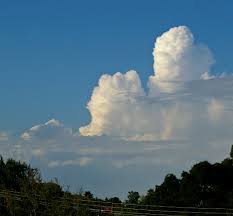
Dome-shaped with a flat base often resembling a cauliflower, associated with fair weather.

Cumulo-nimbus

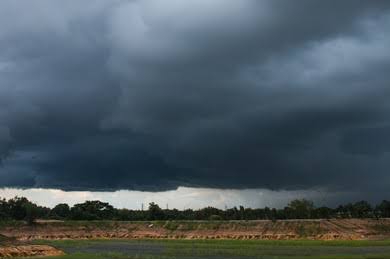
Fluffy thick towering thunderstorm cloud capable of producing heavy rain, snow, hailstorm or tornadoes.

Precipitation

Falling down of condensed water vapour in different forms is called Precipitation. When the dew point is reached in the cloud water droplets become saturated and start to fall. Hence, they fall on the earth as Precipitation.

The climatic conditions/factors influencing the forms of precipitation mainly are :
☆ Temperature
☆ Altitude
☆ Cloud type
☆ Atmospheric conditions
☆ Precipitation process
The main forms of precipitation include drizzle, rain, sleet, snow, hail etc.

Drizzle

Falling of numerous uniform minute droplets of water with diameter of less than 0.5 mm is called drizzle from low clouds. Sometimes drizzles are combined with fog and hence reduce visibility.

Rain

Rain is the most widespread and important form of precipitation in places having temperature above the freezing point. It occurs only when there is abundant moisture in the air. The diameter of a rain drop is more than 5mm.

Sleet

Sleet refers to a precipitation, in the form of pellets made up of transparent and translucent ice. This precipitation is a mixture of snow and rain.

Snow

Snow is formed when condensation occurs below freezing point. It is the precipitation of opaque and semi opaque ice crystals. When these ice crystals collide and stick together, it becomes snowflakes.

Hails

Hails are chunks of ice (greater than 2cm in diameter) falling from the sky, during a rainstorm or thunderstorm. Hailstones are a form of solid precipitation where small pieces of ice fall downwards. These are destructive and dreaded forms of solid precipitation because they destroy agricultural crops and human lives.

Principles of India’s Foreign Policy

The foreign policy of India regulates  India’s relations with other states of the world in promoting its national  interests.

Principles of foreign policy:

Promotion of world peace- India’s foreign policy aims at the promotion of international peace and security. Article 51 of the constitution directs the Indian state to promote international peace and security, maintain just and honourable relations between nations, foster respect for international law and treaty obligations and encourage settlement of international disputes by arbitration.

Anti colonialism- The foreign policy of India opposes colonialism and imperialism. India views that colonialism and imperialism leads to exploitation of the weaker sections by the Imperialist powers  and affect the promotion of international peace. India advocated the liquidation of colonialism in all forms and supported the Liberation Movement in Afro Asian countries like Indonesia Malaya Tunisia and so on.

Anti racialism- Opposition to racialism in all its forms is an important aspect of Indian foreign policy. India strongly criticized the policy of racial discrimination being followed by the white minority racist regime of South Africa.

Non alignment- This policy was initiated in the the cold war era when India refused to join any of the two blocks that is USA and USSR and chose to adopt a policy of non alignment. Under this India has no military alliances with countries of either blocs or indeed with any nation. India has an independent approach to foreign policy and she attempts to maintain friendly relations with all countries.

Panchsheel- This policy implies the five principles of conduct in international relations, it was embodied in the Preamble of The Indo China Treaty on Tibet signed in 1954 by Jawaharlal Nehru and Chou En-Lai the Chinese premier. The principles are mutual respect for each other’s territorial integrity and sovereignty, non aggression, equality and mutual benefit, peaceful coexistence and non interference in each others internal affairs.

Support to the UN- India became a member of the UN in 1945 itself since then it has been supporting the activities and programs of the UN. It has expressed full faith in the objectives and principles of the UN. India has actively participated in UN peacekeeping missions in Korea, Congo, Cambodia, Angola and so on.

Disarmament- The foreign policy of India is opposed to arms race and advocates this armament both conventional and nuclear. This is aimed at promoting world peace and security by reducing or ending tensions between power blocs and to accelerate economic development of the country by preventing the unproductive expenditure on the manufacture of arms.

An escape from reality – Books

I can never agree with people who say watching a movie or series is better than reading a book. While watching a movie, we are just looking at a projection of the film. We are not using our imagination.

I have read the divergent series by Veronica Roth. It also has a movie trilogy. Well, the movie is a disappointment to what the book portrays. The book has so much more details which the movie fails to show.

Books allow us to create our own imagination. They talk about the prominent features of their characters like the almond-shaped caramel eyes and the brown hair with a tint of waves and a well-defined jaw of the person. They leave it on us to decide how the person looks. They describe the cottage with a warm and cozy fireplace but do not provide us with how the cottage looks.

Books allow us to create a world of our choice. Every person reading the book would imagine their world differently. I started reading books as an escape from reality. When I was going through a hard time in my life, books became my best friends. No matter how bad my day was, I was always looking forward to start reading. It made me forget about my life because books allow us to live the life of the characters of fiction. Their life would become mine till I completed the book. At the end of every book, I would feel happy and sad at the same time. I felt sad because I never wanted the book to end. Happy because I get to live the life of another character when I start my next book.

Now you see books are an escape from reality, but they are a good escape. Reading books comes with a lot of benefits:

Improving vocabulary: when I started reading, I would make sure to find the meaning of every word that I was unaware of. For me, reading is incomplete without knowing what every word means.

Improves creativity: A person reading a book isn’t just reading literature words. An entire world of imagination is going on in their minds.

The best form of entertainment: it is better than looking at your screens for hours.

Creates a sense of understanding: when we read a book where the character has anxiety. It will make us understand how people around us with anxiety would feel like.

Inspires us: I have read books where the main characters do not give up, no matter how many problems come their way. This has honestly inspired me a lot in my life.

Makes us a better writer: reading makes our brain absorb the vocabulary and grammar required for better writing skills.

You must have also noticed that talking to people who read has always been interesting. People who read have a lot to share with the world. I remember talking to a few people who read a lot and our conversation never dies down. Reading also reduces stress and boosts our mood instantly. I want to end with my favorite quote by Mason Cooley

“Reading gives us someplace to go when we have to stay where we are”

DURING RENAISSANCE.

The Renaissance began in Italy hand spreading the rest of Europe by the 16th century which influence was fit in art architecture philosophy literature music science technology politics religion and other aspects of the intellectual inquiry. The Renaissance scholars employed the humanist method of study and searched for realism and human emotion in art well after the first artist return to class system has been exchanged filed in the scripture of Nicole Pisano Florentine painter by Masacloio strove to portray the human form realistically developing techniques to render prospective and light more naturally. Some scholars such as Rodney stark play down The Renaissance in favour of the earlier innovations of the Italian City States in the middle ages.Lorenzo de Medici bajda catalyst for any enormous amount of arts patronage the leading artist of Florence including Leonardo da Vinci,Sandro Botticelli and Michelangelo Buonarrati.

Looking on the famous renaissance artist Leonard da Vinci is probably the best known Renaissance artists famous for his mass works is innovative techniques including laying of paints precise attention to light shadow and human form and the and a detailed eye for expression and gesture the classic Renaissance man was not only an artist but also and innovator scientist architect engineer and more. Why is fame initially e registered on his achievements as a painter also became known for his notebooks on a variety of subjects including anatomy astronomy botany cartography painting and paleontology. He was known for painting drawing much more and of credited as the founder of high Renaissance. Is Magnum Opur the Mona Lisa is is best known work and often regarded as the world’s famous painting Salva. Image substantial discoveries in anatomy civil engineering hydrodynamics geology optics and tribology and the famous artwork of Da Vinci was Monalisa Last supper self-portrait head of women lady with ermine vitruvian man the virgin Salvator mundi Ginevra de benci the virgin and child with saint Anne.

Michelangelo was an accomplished artist poet architect and engineer is artist versatility watch as such as I order is output in this field there prodigious. Despite holding a low opinion of painting a also created two of the most influential frescoes in the history of the Western art as a young boys Michelangelo what sent for Florence to study grammar however issue no interest but referring to copy paintings from churches and later became artist most of Michelangelo works were Pieta,David Doni tonado (holy family) the large bathers. Raphael is known as third of the great master artist of Renaissance Italy is works trailer extremely influential even during his lifetimes. Raphael express the humanistic philosophy that we had learnt in the Urbino court as a boy. The Raphael artworks where resurrection of Christ the holy trinity the creation of Eve from Adam madana with lamp angel angel holding a scroll God the father and the virgin Mary Madonna Solly portrait of a man.

And finally Donatello who nailed from the period known as the early Renaissance . He mainly as a sculptor and the realism. Us able to create mark stark break common in middle age. Donatello was gaining reputation using innovative technique and extraordinary skills is workwear David Saint George the feast of Herod Magdalena penitent Judith and holeferner.

Mental Health- still a taboo?

Just because no one else can heal or do your inner work for you, doesn’t mean you can, should or need to do it alone.

Lisa Olivero

Have you ever felt the stark desire to inevitably scream in a room full of people, hoping they just care enough to notice the signs you have been leaving regarding your deteriorating mental state and how desperately you need help? But instead, you just accept your solitude in an empty chair and try to repress your bottled-up emotions deep within the realms of your consciousness.

A lot of us might have gone through the same situation at a certain point in our lives. The primary reason behind this subconscious aversion to the expression of thoughts is the mere fact that humans have been conditioned to do so throughout their lives. Men are typically the most vulnerable victims of this detrimental mindset. From an early age, they are frequently instructed to not cry like a girl. According to a survey, a significant percentage of men in the nation are currently depressed, and they themselves admitted that they lack a support system.

Mental health is still a deeply rooted stigma that people aren’t ready to accept. In order to understand the concept one needs to broaden the perspective of understanding humans and follow certain ways like-

  1. Instead of asking,”How are you?” ask,” How are you, really?”
  2. Look for obvious signs in a person- whether they feeling low from abnormal no. of days.
  3. Asking your closed ones to describe their day in detail and be a good listener.
  4. Do not mistreat someone who is already going through some sort of trauma.
  5. Treat people with kindness, you never know what someone is going through.

Additionally, in India, therapists continue to be overlooked as a useful resource for treating a person’s mental health. A person is called a “lunatic” if they see a therapist. In light of the increased public awareness during the pandemic’s lockdown time, these issues are being explored on social media, and many people now see psychology as a crucial component of the educational system. People have now started considering mental health as being equally essential as physical health as because of an alarming spike in suicide incidents during this period.
Still, awareness needs to be assured at ground level and there is still a long way to go to see the day when all of us are not reluctant to lend a helping hand to our fellow humans.

A fundamental aspect of any society should be understanding, accepting, and embracing each and every emotion one feels which makes them human.

When my thoughts met the two faced words.

Never in my life had I thought you’ll fade away. Never in my dreams had I thought you’ll forget everything. Never in million years had I thought I will lose you.
Nothing lasts forever; neither things nor people. Life is all about accepting these facts. That’s all I have heard from people and I hate to agree but they are right.

But are changes easy to adapt?
BUT: always grabs people’s attention. There is always a but that makes people more attentive and conscious.
What if things come back on track?
WHAT IF: always makes people observant. There’s always a what if that brings hope or despair in a sentence. And it is hope that every tomorrow hurts a lilttle less than yesterday and it is despair that weakens us every now and then.

Words are just a medium to express our emotions. There are thousands of words expressing enormous amount of emotions in a sentence, but these two words added a lot of aspiration, distress, consciousness, attentiveness in my thoughts:
But what if my plan works?
PLANS: are made to be cancelled; unsuccessfull. Maybe that’s why I had planned some meetings, some trips, me dancing at your wedding and you singing channa mereya at mine. Lol.

But what if you’re happy this way?
HAPPINESS: a state of mind. Never knew whether I made you happy or not. Maybe that’s why I was always scared and awkward before doing something for you. Lol.

But what if we are destined together?
DESTINY: a predetermined state. One never knows their fate still we hope. Maybe that’s why I was holding onto you for so long.

But what if I lose you?
YOU: my all. My best friend, my love, my soulmate, my strength, my weakness. My all. You have been my comfortzone all these years; have made me laugh in my toughest times; have been my support throughout.

Never in my life had I thought I would be writing this to you. Never in my life had I thought life will lead to this. Never in my life had I thought you will fade away.

CAN WE BUY EVERYTHING WITH MONEY?

In todays world we all are in a race to earn more money to get everything but we never think about the things that we can’t buy with money because we all think that those things are very easy to get. In trying several methods to earn money we all miss the small and precious pleasures that life offers to us. We people sometimes behave too greedy in earning money and at some stage of our life we feel that money can itself give us all things we want. Yes, of course money can give us a good stature in the society but we can’t buy our health, satisfaction, happiness and many more things with money.

The most important thing in every body’s life is having a lovable and supportable family with us. Many of us think that we can buy those relationships with money or some of us may also think that every relation is made for the sake of money only. Guys we can buy the relations with money but we should always remember that we can’t buy the true love and effection of our dear ones with money. There is also a saying that the people who enters in our life because of our money will leave us easily when we loose all our assets.

It is important for all of us having an efficient money to enjoy the luxurious life style and it is also important for us to look after our parents who crossed all the barriers to see their children in heights but most of us neglect them when we reach our desired position and we forget about the responsibilities on us but I’m sure guys we can never get back our parents love and care once after losing them in our life though we are ready to pay a large amount of money for them. Guys , Money has it’s own signature in every moment of our life that may be positive or negative.

It is necessary for everyone to understand about the adverse effects of the money in order to know about the reality of our society. Guys always be conscious before losing anything that is available in nature that may be your parents or your health or your time and most importantly your life because you can not bring them back with your money if you lose them once.

To be clear, I’m not against of earning money or improving assets but I’m trying to convey that spend your money wisely and know the reality of the society to lead your life in a perfect way. Money can arrange all the necessary things in your life to survive but it is not only the thing which helps you to live your life happily. The only aim of this article is, one should give equal priority to their values and responsibilities in this running world apart from earning money and should understand that money is something that we need but not every thing in life and never forget that time is more precious than money.

Microscopy and types of microscope

The cells are very minute and complex organisations.The small dimensions and transparent nature of cell and its organelles pose problems to cell biologists trying to understand its organisation and functioning.Various instruments and techniques have been developed to study cell structure, molecular organization and function.

The diameters of majority of cells range from 5-500 micrometers,but most are between 10-150 micrometer.

While viewing objects,human eyes have limited distinguishing or resolving power.The ability to reveal minute details is expressed in terms of limit of resolution.

Types of microscope

Compound light microscope

This microscope uses visible light for illuminating the object.It contains glass lenses that magnify the image of the object and focus the light on the retina of the observer’s eye.It has two lenses one at each end of a hollow tube.The lens closer to the object being viewed is called objective lens.The lens closer to the eye is called ocular lens or eyepiece.The object is illuminated by light beneath it.A third lens called condenser lens is located between the object and the light source and it serve to focus the light on the object.

Dark field microscope

This type of microscope is useful for viewing suspensions of bacteria.It has a special condenser that allows only rays of light scattered by structures within specimen.The result is an image that appears bright against background,with a high degree of contrast.The process is similar to seeing dust particles floating in a Sunbeam.

Phase contrast microscope

The phase contrast microscope has special fitments to the objective lens and such condenser,the effect of which is to exaggerate the structural differences between the cell components As a consequence,the structures within living,unstained cells become visible in high contrast and with good resolution.Phase contrast microscopy avoids the need to kill cells or to add dye to a specimen before it is observed microscopically.

Oil immersion microscopy

In oil immersion microscopy the light gathering properties of the objective lens are enhanced by placing oil in the space between the slide and objective lens.Normally the technique is used to view permanently mounted specimens.The oil immersion lens gives higher magnification than the normal high power objective lens.

Electron microscopy

The electron microscopy uses the much shorter wavelengths of electrons to achieve resolutions as low as 3 angstrom.Electromagnetic coils are used to control and focus a beam of electrons accelerated from a heated metal wire by high voltages,in the range of 20,000 to 100000 volts.The degree of which electrons are scattered is determined by the thickness and atomic density of the object.Hence the specimens used in electron microscopy must be extremely thin.Living cells which are wet cannot be viewed in electron microscope.

Scanning electron microscopy

This microscope has less resolution power than the TEM.However it is a very effective tool to study the surface topography of a specimen.The whole specimen is scanned by a beam of electrons.An image is created by the electrons reflected from the surface of the specimen.Scanning electron micrographs show depth of focus and a three dimensional image of the object.


Data Privacy

Data privacy, also known as information privacy, is a subset of data protection that deals with the proper handling of sensitive data, such as personal data but also other confidential data like financial data and intellectual property data, in order to comply with regulatory requirements while maintaining the data’s confidentiality and immutability. When it comes to protecting data from external and internal dangers, as well as defining what digitally stored data may be shared and with whom, security becomes crucial. In practise, data privacy refers to components of the data sharing process, including how and where that data is maintained, as well as the particular rules that apply to those procedures.

Data Sovereignty

Digital data that is subject to the laws of the country in which it is stored is referred to as data sovereignty.

Many nations have enacted new legislation requiring data to be retained inside the country in which the client resides, in response to the growing use of cloud data services and a perceived lack of security. Governments are currently concerned about data sovereignty because they want to prevent data from being stored outside of the original country’s borders. It might be difficult to ensure that data is exclusively stored in the host nation, and it frequently relies on the details supplied in the Service Level Agreement with the Cloud Service Provider.

Data Privacy Importance

  1. Business Asset Management: Data is, without a doubt, a company’s most valuable asset. We live in a data economy, where businesses place a high value on gathering, sharing, and analysing data on their customers and users, particularly from social media. Transparency in how companies obtain consent to preserve personal data, adhere to their privacy rules, and handle the data they gather is critical to establishing confidence with consumers who regard privacy as a basic human right.
  1. Regulatory Compliance: Data management for regulatory compliance is arguably much more critical. Noncompliance with regulatory obligations on how a company collects, stores, and processes personal data might result in hefty penalties. If the company is hacked or ransomware is used, the implications in terms of lost income and consumer confidence may be considerably greater.

Elements of Data Privacy

Data privacy, often known as information privacy, is made up of three components:

  • Individuals have the right to privacy and control over their personal data.
  • Procedures for managing, processing, collecting, and exchanging personal data in an appropriate manner
  • Data protection rules are followed.

Technologies and Practices for Data Protection that Can Assist You in Protecting User Data

There are numerous storage and management choices to select from when it comes to securing your data. You may use solutions to control access, monitor activities, and respond to threats. Some of the most widely utilised practises and technologies are as follows:

  • Data loss prevention (DLP) is a set of techniques and technologies for preventing data from being stolen, lost, or destroyed by accident. Several techniques to defend against and recover from data loss are frequently included in data loss prevention systems.
  • Storage with built-in data protection—modern storage technology has disc clustering and redundancy as standard features. Cloudian’s Hyperstore, for example, offers up to 14 nines of durability, low cost storage of huge amounts of data, and quick access for low RTO/RPO.
  • Firewalls are tools for monitoring and filtering network traffic. Firewalls can be used to guarantee that only authorised users can access or transmit data.
  • Authentication and authorization—controls that aid in the verification of credentials and the proper application of user privileges. These restrictions are generally used in conjunction with role-based access controls as part of an identity and access management (IAM) system (RBAC).
  • Encryption modifies data content using a method that can only be undone with the correct encryption key. Even if your data is taken, encryption protects it against unwanted access by rendering it unreadable.
  • Endpoint protection safeguards your network’s entry points, such as ports, routers, and connected devices. Endpoint security software generally allows you to monitor and filter traffic at the network perimeter as needed.
  • Data erasure reduces responsibility by removing information that is no longer required. This can be done after the data has been processed and evaluated, or it can be done on a regular basis when the data is no longer useful. Many compliance laws, such as GDPR, demand the deletion of unneeded data.

The Essay on Departure of a Guest

Nothing can last forever. The Green will turn Yellow yet, the life goes on.

Have you ever wondered at the marvel of human species? Does human superiority make them all-powerful?

Humans are the only creature in the world that can decide on their destiny. They are the only creatures that has the potential to make or break the world.They are the masters yet ,they are not. Their fragility is marked by their transience.The universe has its own laws for the cosmic balance ,which limits the unlimited powers of man.

About the essay

This essay is penned by Hilaire Belloc in 1908 and published in The Oxford Book of Essays. The essay follows a conversational style and the dialogues are uttered by two people, the unnamed Host and the Youth. There is one other important character the Master, who is powerful yet never appears in the essay. The Master almost exerts a sense of omnipotent power over the other two characters and it can be understood as the personification of Time or may be the Divine. All the chief characters in this essay are unnamed and are kept gender-neutral, this allows the readers to accommodate themselves easily within the pages of this essay. In this essay, Belloc metaphorically represents human body as a house, whose owner is the Host, the soul personified and the temporary resident, the Youth personified. This essay touches on the themes of transience of youth and worldly possessions, immortality of soul, virtues and vices and human choices and their after effects.