DEEP LEARNING SERIES- PART 8

The previous article was about the padding, stride, and parameters of CNN. This article is about the pooling and the procedure to build an image classifier.

Pooling

This is another aspect of CNN. There are different types of pooling like min pooling, max pooling, avg pooling, etc. the process is the same as before i.e. the kernel vector slides over the input vector and does computations on the dot product. If a 3*3 kernel is considered then it is applied over a 3*3 region inside the vector, it finds the dot product in the case of convolution. The same in pooling finds a particular value and substitutes that value in the output vector. The kernel value decides the type of pooling. The following table shows the operation done by the pooling.

Type of poolingThe value seen in the output layer
Max poolingMaximum of all considered cells
Min poolingMinimum of all considered cells
Avg poolingAverage of all considered cells

The considered cells are bounded within the kernel dimensions.
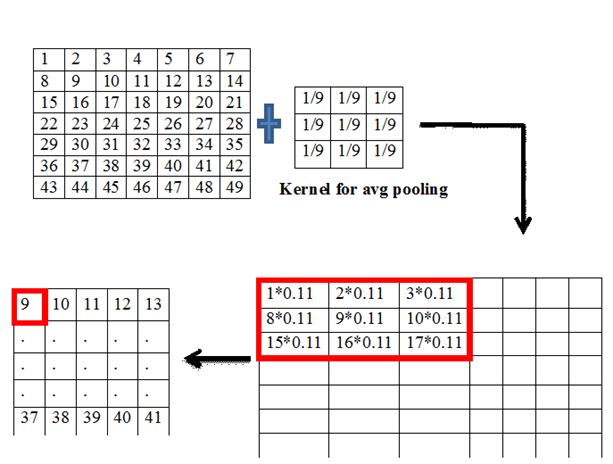
The pictorial representation of average pooling is shown above. The number of parameters in pooling is zero.

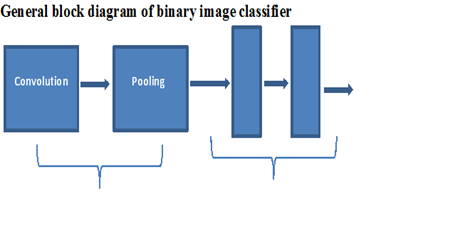
Convolution and pooling are the basis for feature extraction. The vector obtained from this step is fed into an FFN which then does the required task on the image.

Features of CNN

  1. Sparse connectivity
  2. Weight sharing.


    Feature extraction-CNN              classifier-FNN

In general, CNN is first then FFN is later. But the order or number or types of convolution and pooling can vary based on the complexity and choice of the user.

Already there are a lot of models like VGGNet, AlexNet, GoogleNet, and ResNet. These models are made standard and their architecture has been already defined by researchers. We have to reshape our images in accordance with the dimensions of the model.

General procedure to build an image classifier using CNN

  1. Obtain the data in the form of image datasets.
  2. Set the output classes for the model to perform the classification on.
  3. Transform or in specific reshape the dimension of the images compatible to the model. The image size maybe 20*20 but the model accepts only 200*200 images; then we must reshape them to that size.
  4. Split the given data into training data and evaluation data. This is done by creating new datasets for both training and validation. More images are required for training.
  5. Define the model used for this task.
  6. Roughly sketch the architecture of the network.
  7. Determine the number of convolutions, pooling etc. and their order
  8. Determine the dimensions for the first layer, padding, stride, number of filters and dimensions of filter.
  9. Apply the formula and find the output dimensions for the next layer.
  10. Repeat 5d till the last layer in CNN.
  11. Determine the number of layers and number of neurons per layer and parameters in FNN.
  12. Sketch the architecture with the parameters and dimension.
  13. Incorporate these details into the machine.
  14. Or import a predefined model.  In that case the classes in the last layer in the FNN must be replaced with ‘1’ for binary classification or with the number of classes. This is known as transfer learning.
  15. Train the model using the training dataset and calculate the loss function for periodic steps in the training.
  16. Check if the machine has performed correctly by comparing the true output with model prediction and hence compute the training accuracy.
  17. Test the machine with the evaluation data and verify the performance on that data and compute the validation accuracy.
  18.   If both the accuracies are satisfactory then the machine is complete.

HAPPY LEARNING!!

TECHNOLOGY – A BOON OR BANE


Technology uses techniques to manufacture
or make some products and services. In this modern world, Technology is very
important and ever increasing. Technology changed each of our lives in many way
till these last decade. It has a very high impact on Big industries to normal
Human beings. So, we can extremely say that Technology played a crucial role in
changing each of our lives. Technology has been Revolutionary. It gave us so
many good things. But, a coin should have two sides. It has a good and a bad side
too. Technology changed our lives, but we can’t to say it changed us completely
in a positive way. Technology, of course is a boon as well as a bane!

One of the serious issue of Technology
growth is High usage of Mobile phones, especially , smart phones . Since early
times, smart phones have been revolutionary. Smart phones have had so many
advantages, it helped us in so many ways, but smart phone misuse is a major
drawback. But, it isn’t the fault of its developers as they never develop it in
order to make social issues. It is us, who make it worst. So, Smart phones make
our life easier, thereby, making us lazy. Technology has become an essential
part of our lives. It has transformed luxuries into necessities. I agree with
this statement. In earlier times, affording a computer or even a television was
considered as a luxury but, now-a-days, it has become a necessity. The
generation today wants everything personal T.V., laptop, computer, etc. According
to me, technology has improved the standard of living. Owning new and latest
gadgets is a status symbol now. Earlier, there used to be the postal service.
like, if we wanted to inform anything to somebody, we wrote letters or sent
telegrams. Now, they are outdated; and are replaced by e-mails, SMS, WhatsApp,
etc. undoubtedly, it is very much faster as compared to the older systems.
Development in technology has helped the people of all ages, student, teacher,
doctor, housewife, businessman and many more.

Negative Aspect of Technology

Although technology is a good thing,
everything has two sides. Technology also has two sides one is good and the
other is bad. Here are some negative aspects of technology that we are going to
discuss.

With the help of technology, students
understand what they are taught and can apply it in real life easily. Thanks to
technology, school has become a place where students love to go.

Even outside the classroom, students can
share notes online, research, annotate, collaborate on work, have study groups,
share courses and create virtually creative content online with the help of
apps like google drive. Even social media platforms like facebook and twitter
are places where students can connect with each other to share ideas, articles
and other resources with each other.
Internet is the biggest
advantage of technology. We can find anything or order anything while sitting
at home. It is a great boon to us. So, I’ll conclude by saying that, though
technology has provided us with many things but we should be wise enough to use
them.

DEEP LEARNING SERIES- PART 7

The previous article was about the process of convolution and its implementation. This article is about the padding, stride and the parameters involved in a CNN.

We have seen that there is a reduction of dimension in the output vector. A technique known as padding is done to preserve the original dimensions in the output vector. The only change in this process is that we add a boundary of ‘0s’ over the input vector and then do the convolution process.

Procedure to implement padding

  1. To get n*n output use a (n+2*n+2) input
  2. To get 7*7 output use 9*9 input
  3. In that 9*9 input fill the first row, first column, last row and last column with zero.
  4. Now do the convolution operation on it using a filter.
  5. Observe that the output has the same dimensions as of the input.

Zero is used since it is insignificant so as to keep the output dimension without affecting the results

Here all the elements in the input vector have been transferred to the output. Hence using padding we can preserve the originality of the input. Padding is denoted using P. If P=1 then one layer of zeroes is added and so on.

It is not necessary that the filter or kernel must be applied to all the cells. The pattern of applying the kernel onto the input vector is determined using the stride. It determines the shift or gaps in the cells where the filter has to be applied.-

S=1 means no gap is created. The filter is applied to all the cells.

S=2 means gap of 1. The filter is applied to alternative cells. This halves the dimensions on the output vector.

This diagram shows the movement of filter on a vector with stride of 1 and 2. With a stride of 2; alternative columns are accessed and hence the number of computations per row decreases by 2. Hence the output dimensions reduce while use stride.

The padding and stride are some features used in CNN.

Parameters in a convolution layer

The following are the terms needed for calculating the parameter for a convolution layer.

Input layer

Width Wi – width of input image

Height Hi – height of input image

Depth Di – 3 since they follow RGB

We saw that 7*7 inputs without padding and stride along with 3*3 kernels gave a 5*5 output. It can be verified using this calculation.

The role of padding can also be verified using this calculation.

The f is known as filter size. It can be a 1*1, 3*3 and so on. It is a 1-D value so the first value is taken. There is another term K which refers to the number of kernels used. This value is fixed by user.

These values are similar to those of w and b. The machine learns the ideal value for these parameters for high efficiency. The significance of partial connection or CNN can be easily understood through the parameters.

Consider the same example of (30*30*3) vector. The parameter for CNN by using 10 kernels will be 2.7 million. This is a large number. But if the same is done using FNN then the parameters will be at least 100 million. This is almost 50 times that of before. This is significantly larger than CNN. The reason for this large number is due to the full connectivity. 


Parameter= 30*30*3*3*10= 2.7M

HAPPY READING!!

QUALITIES OF GOOD LEADER

Best characteristics of an effective leader | IronStrike

1.Good Communications skills

Communication can make or break your efforts to connect with your team, manage and coordinate initiatives, and build trust within your organization. Great pioneers speak with a worker first focal point. They communicate based on the needs and preferences of their team members and seek to listen to and understand the employee experience.

2.Have a dream for what’s to come/have a vision

Vision gives center, inspiration, and course to travel through change and snags. Great pioneers have a reasonable vision and can express the way ahead to their group. Leaders ought to have the option to interface the work on the ground to the master plan and give the explanation for all that they do.

3. Understanding what others want

For dealing with a group one should understand what sorts of jobs are reasonable for every single individual from the group. The pioneer ought to have the capacity to use every individuals potential to the most extreme. Each colleague ought to have singular objectives fell down from a solitary Goal and vision of the group. Colleagues accordingly feel that their commitments are significant in accomplishing the goal/Goal.

4.Consider themselves responsible

Great pioneers consider themselves responsible and are continually attempting to improve and advance. They are perpetually discontent with business as usual. Responsibility and consistent improvement require a guarantee to looking for and following up on criticism, gaining from errors, and course remedying.

5.Show appreciation

A grateful pioneer is an powerful pioneer. Appreciation brings positive collaborations and association, expands commitment, and fabricates flexibility. Grateful leaders comprehend that achievement is a collaboration and they make a point to perceive the work and commitments of their group.

RESOURCES:

  1. https://www.ccl.org/articles/leading-effectively-articles/characteristics-good-leader/

2. https://www.quantumworkplace.com/future-of-work/5-qualities-of-a-good-leader

The time when Britain-China clashed over India's Opium -> Opium War 1840

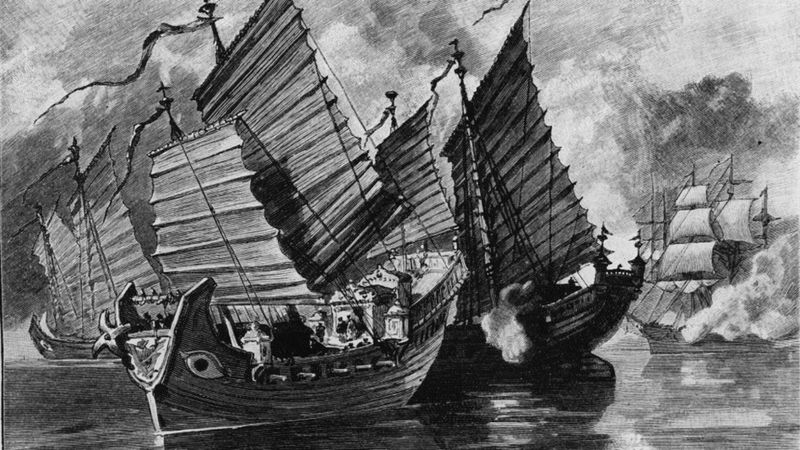
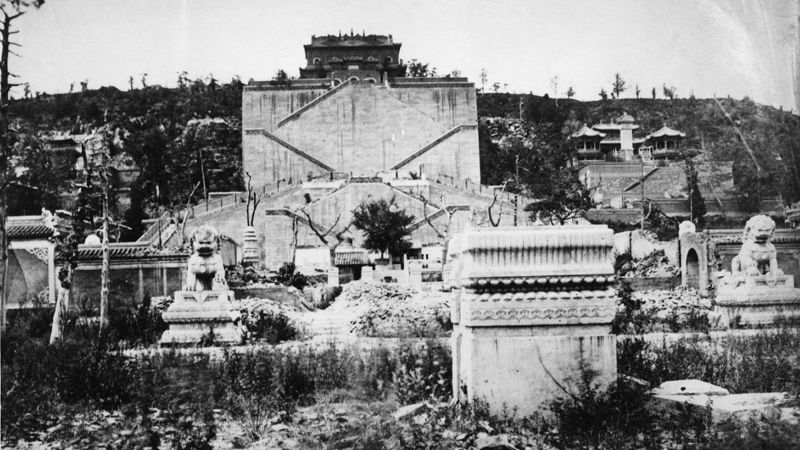
It was in June 1840 when a fleet of British warships went to China’s Pearl River Delta and started war. The security system of China’s coastal areas was weak. China could not last long in front of this British attack and it knelt down.

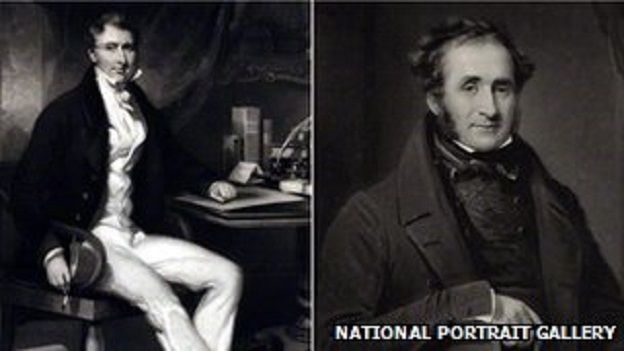
This was the first Opium War in which thousands of people were killed and that too in the name of free trade. The opium trade in China was a profitable business but it was also illegal. Two Scottish men were involved in this business and both played a major role at the start of the war.

William Jardine was a doctor by profession and also a businessman.

From Tea to Opium :

After the first meeting in a Chinese brothel, another businessman named James Matheson became William’s partner. In 1832, the two together formed Jardine, Matheson and Company, headquartered in Canton, southern China. The canton is now known as the Ganzhou of China.

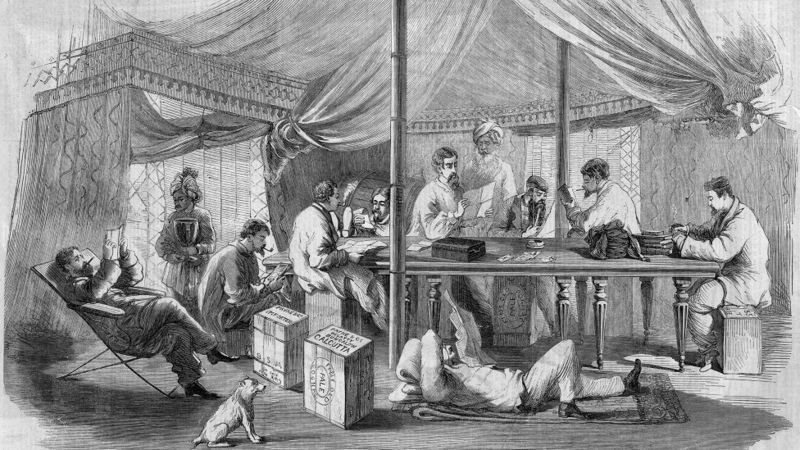
Foreigners were allowed to do business only in this area of ​​China. They used to trade opium instead of tea. There was a great craze for tea in Britain. By the end of the 18th century, Britain was importing 6 million pounds of tea from the canton every year.

Business in Silver :

But soon Britain started facing problems in this business because China’s condition was that it would take only silver as the price of tea. Britain offered things like carved utensils, scientific instruments and woolen cloth as the price of the tea. But China refused to take it.

Qian Long, the then emperor of China, wrote in a letter to King George III, “We have all those things and are of better quality. I do not value such useless things and we have no use for things made in your country.”

Smuggling of Opium :


In the span of fifty years, Britain paid China the equivalent of 270 million pounds of silver, and in return could only sell them 9 million pounds of goods. This tea coming from China for Britain gradually started becoming expensive and they did not see any other way to make money there.

At least legally it was so. But British businessmen in India saw it as an opportunity. Opium was grown on a large scale in the Bengal region. Although opium was banned in China, opium has been used in Chinese medicine for thousands of years.

Ban in China :

But by the time of the fifteenth century, Chinese people started using it for intoxication by mixing it with tobacco. Soon a large section of Chinese society became addicted to opium and fell into its grip. Its social side effects also started coming to the fore. The victims of opium addiction started selling their valuables for it.

In 1729, Emperor Yongzheng of China completely banned the sale and sale of opium and its use as a drug. But after a hundred years had passed, the craze for opium of the Chinese had not diminished in the slightest and the British started exploiting their addiction.

Eastern Part of India : 

By the year 1836, 30,000 boxes of opium started reaching China every year from India. Jardine, Matheson & Company held a quarter of this business. By breaking the government order banning opium in China, Britain had found a way to increase its income from China.

According to Professor Jan Carroll of the University of Hong Kong, “The British realized that opium is grown in the eastern region of India and that smuggling it into China can make a lot of profit.” And this was made easy for Britain by the coastal position of Canton city of China.

China’s action : 

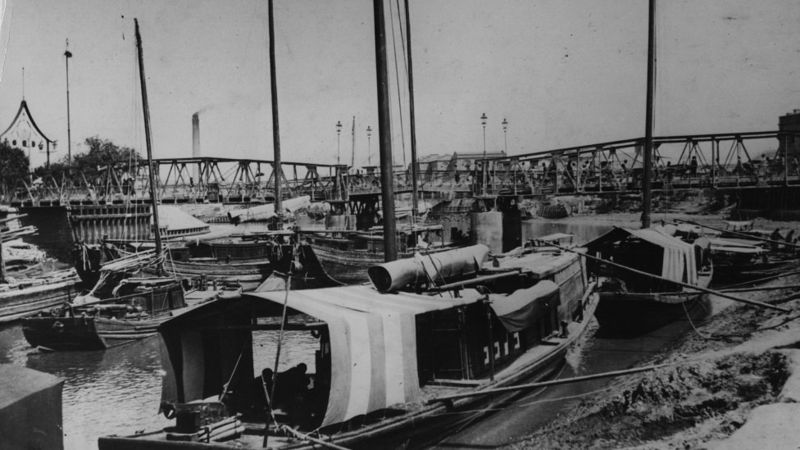
Professor Jan Carroll said, “They easily carried opium in small boats to the shores of the canton. There was always someone there to help them on the shore. From an economic point of view, it was making a lot of profit.”

But breaking the law of Britain in this way did not remain hidden for long. In 1839, Emperor Daoguang of China declared war on drugs. An order was given to launch a raiding campaign against Western businessmen.

British Government :


Warehouses located in the 13 Factories area of ​​Canton were raided and sealed by Chinese troops. The Chinese forced the foreign businessmen to surrender. In this action of China, goods worth 2 million pounds were confiscated. It also had 20,000 boxes of opium and 40,000 opium pipes.

Following this seizure, Pershan left for London from William Jardine Canton, where he pleaded with the British Foreign Minister, Lord Palmerston, to retaliate against China. Opium played a major role in the British’s revenue from India, so it did not take long for the British government to decide to send a navy to China.

China’s Defeat :

In June 1840, Britain sent 16 warships and 27 ships to China’s Pearl River Delta. There were 4000 people on these ships. The fleet also had the iron warship Nemesis, on which rocket launchers that could be fired up to two miles were stationed.

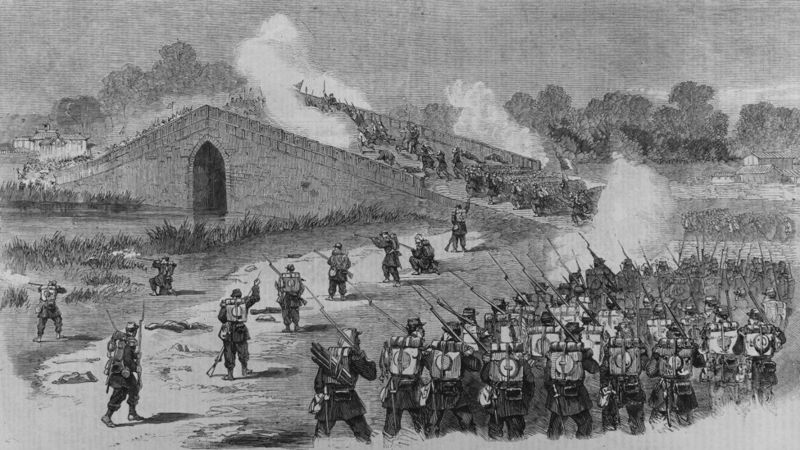
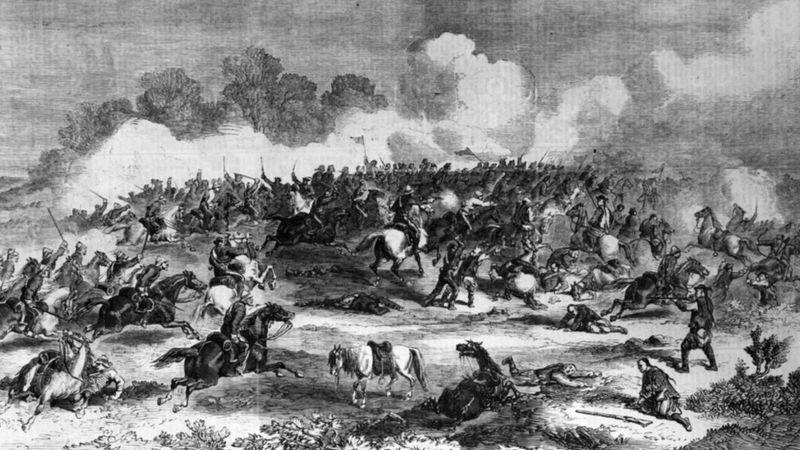
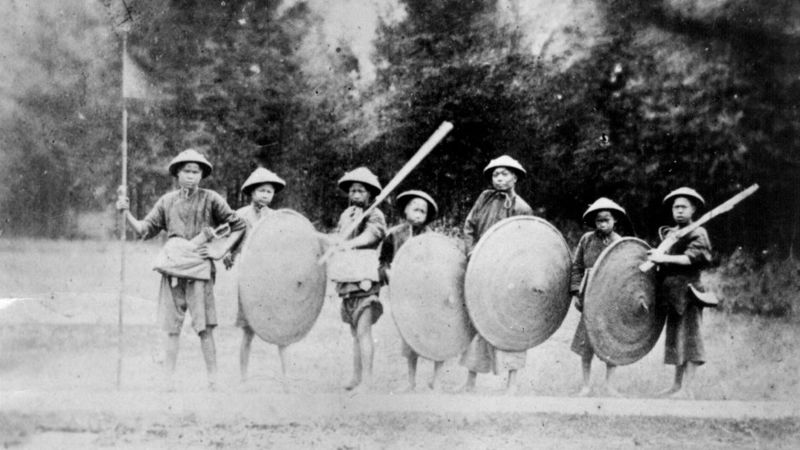
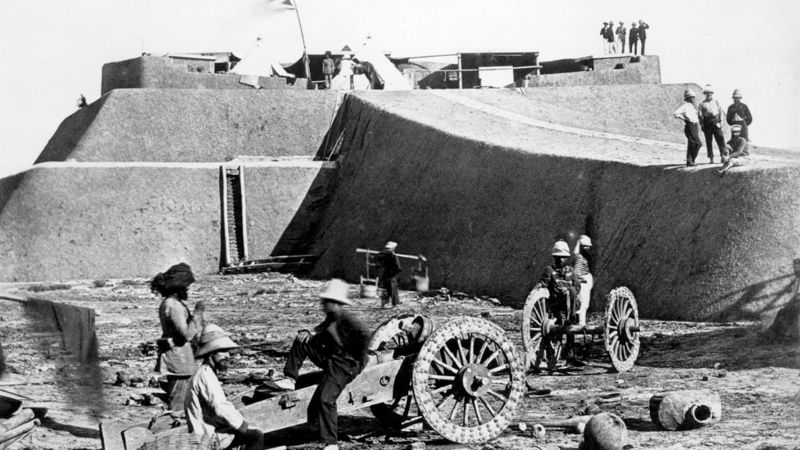
Although the Chinese were ready for this attack, they did not have the ability to counter the British power. His cannon could last only four to five hours in front of Britain. For the next two years, the British Navy started moving through the Chinese coast towards Shanghai.

Treaty of inequality :

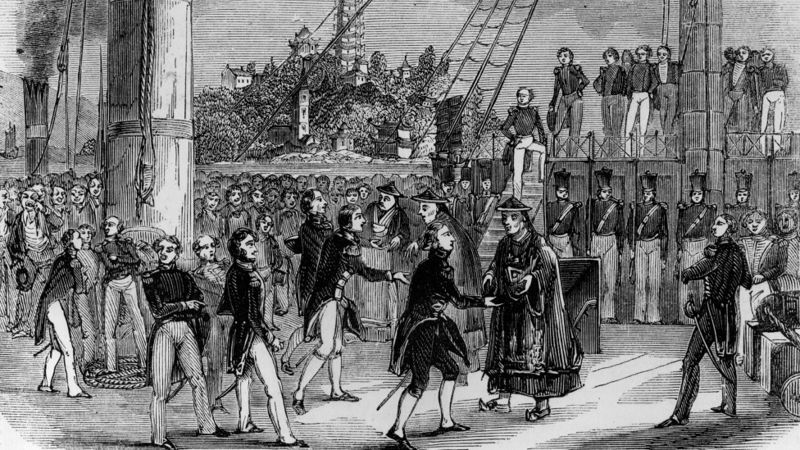
Most of the Chinese soldiers were victims of opium addiction and were defeated everywhere. There were 20 to 25 thousand Chinese casualties in this war while Britain lost 69 soldiers. After this war, China was completely shaken. In August 1842, on HMS Cornwallis near Nanking, the British signed an agreement with the Chinese, which the world knows as the ‘Equal Treaty’ or ‘Treaty of Equality’.

China had to open five ports to foreign trade and paid 201 million silver dollars to Britain as damages caused by the opium trade and the war. Britain got possession of Hong Kong from this treaty, which was to be used to increase the opium trade in China.

Is Chocolate Good For Our Health?

We all love eating chocolate but our parents always scolded for eating them. But is it really good for our health or it just brings obesity.

Although eating too much chocolate is not good but in adequate amount it serves various benefits. Researchers have found that an ingredient in chocolate – cocoa beans contains antioxidants (a substance that inhibits oxidation, especially one used to counteract the deterioration of stored food products.) which reduces the damage to our cells which otherwise may lead to cancer development. Some report that eating chocolate may lower the risk of certain cancers, while others show no benefit.

 Flavanols ( naturally occurring compounds found in cocoa) have been shown to lower blood pressure and make heart, veins, and arteries work better. Chocolates contains maximum amount of cocoa are considered best in terms for our heart.  Chocolate is also said to fight against bad cholesterol and so consuming a bit of chocolate once in a while will keep the bad stuff away for a long time.

 Dark chocolate is loaded with soluble fiber and many essential minerals like zinc, iron, magnesium and copper. Since it contains sugar it is thus a great source of energy. It is also found that dark chocolate contains certain chemicals that signals brain to release a happy hormone- dopamine which is a stress relieving hormone.

Apart from these benefits – “Excess of everything is bad”. Since it contains high amounts of sugar therefore it should be taken in less amount and is not recommended to obese people. Moreover eating high level of chocolates is also not good for our teeth and we should always brush our teeth after having them. Furthermore only those chocolates should be taken which contains high amount of cocoa atleast 70% of cocoa and less amount of cocain. It might give your heart some benefit, and it generally has less sugar and saturated fat than milk chocolate or other kinds of chocolate. 

Plight of Victim in Criminal Justice System

                                                        (Photo: The Daily Guardian)

You want to report,
but that could get your family in danger… And if you snitch on a real gang
leader…. they can get you bad… [The] police don’t have your back unless
you’re like someone on the news or whatever, and they will kind of give you
witness protection. But that doesn’t happen in the real world. 

FEMALE,
SACRAMENTO

 The expression
‘victims of crime’ has been defined in section 2 of the code of criminal
procedure, 1973. Initially, the criminal justice system in India was focused on
punishment as part of the crime without much attention on the suffering of
victims of crime. The rights of prisoners were protected even after their
conviction whereas little concern was shown for the rights of victims of crime.
Though there is a wealth of data on victims of reported crime nationally, as
well as various services and programs intending to meet their needs, there
remains a dearth of clear information on how to interrupt cycles of violence
and the persistence vulnerability that keeps such an overwhelming percentage at
high risk of experiencing more crime.

 However, with the
emergence of public interest litigation, the higher courts’ attention was drawn
to this lacunae in the existing criminal justice system by social activists,
and the courts started granting compensatory relief to victims of crime, but
comprehensive legislation on this aspect of criminal justice was still awaited.
In recent times, among the many reforms canvassed for improving the criminal justice
system is the one that advocates a victim orientation to criminal justice
administration. Though there are some provisions under the Indian constitution
and some sections in the code of criminal procedure, 1973 to protect the rights
of the victims and for providing compensation, the criminal courts at the lower
level in India have ignored those provisions for a long time and not utilized
them during their sentencing processes.

 Victim plays an
important role in the criminal justice system but his or her welfare is not
given due regard by the state instrumentality. Thus, the role of high courts or
the supreme court in our country in affirming and establishing their rights
holds much importance. “
Tears shed for the accused are traditional
and trendy but has the law none for the victim of crime, the unknown martyrs
“?
This remark by the Hon’ble Justice VK Krishna Iyer aptly describes the plight
of victims in the criminal justice system in our country. The victim is almost
a forgotten entity in the criminal system rather the irony is that the victim
sets the wheel of justice moving by giving information to the state
instrumentalities without which the entire system would collapse.

 Victims
should come first
“…

 It is of
course an indisputable fact that victims of crime have long been a forgotten
group, a group that suffered for centuries not only from society’s neglect but
also from the exploration of their rightful dias by the state. It is also true
that they had their conflicts stolen by professionals and by the criminal
justice system. However, the exceptional speed with which they were
rediscovered and their cause adopted by the politicians, let alone the
political climate that prevailed at the time of their rediscovery, is bound to
raise questions about the real interests and motives behind what has been
portrayed as a genuinely humanitarian and disinterest cause.

 A comprehensive
legal code for victim compensation is a dire necessity. The time has come for
the legislature to stop shirking its duty. Hence, a comprehensive legal code
should be enacted providing for fair treatment, assistance, and adequate
compensation to victims of crime. Only on embarking on this step can justice in
its more altruistic forms be obtained. It should be made mandatory for the
state to pay compensation to the victims of the crime of not only the private
criminal wrongs but also for the criminal acts perpetrated by its agencies.
This mandatory duty of the state gains importance from two points of view
namely as a welfare state committed to the constitutional goal of social
justice and secondly, for its failure to protect the life, liberty, and
security of its citizens.

 Therefore, I would
like to conclude with this quote-

 “Too
much money…. often resulted in further crimes which were fatal to innocent
victims who need not have been victims if justice had been put first and mercy
second
.” 

Agatha Christie


How Psychology has affected my life?

 by Shashikant Nishant Sharma 

(Photo: EduAdvisor)

It takes the
innocence out of everything. You don’t see love (or any other feeling) as love
but dig deep to uncover a subconscious need. Of course, that usually turns out
to be true, in which case it worsens the lack of spontaneity. A psychologist
will define it or forever be in pursuit of the meaning behind it. Some people’s
brains are like that. They’re good at it. But nobody likes to be under a
scanner all the time. It’s unnerving.

 Psychology softens
one’s understanding of oneself.  But the same distance or unattached
empathy has to be maintained to achieve that. At first, psychology and its
study is a way to answer personal conflicts. Studying psychology has affected
and taught me to recognize and check my biases. I used to think that I was fair
and unbiased in how I viewed other people and myself. I have learned about
various psychological errors and biases which made me realize how wrong I was.

 Psychology is all
about observing how we behave and why behave that way in every situation of our
life. It changes your way of approaching a problem or situation drastically and
you can find a solution easily to any problem. It changed my way of thinking
and increased my maturity level to better standards. Now I’m able to receive
people as they are without judging them and able to find out the root causes of
my emotional problems and carefully editing my emotions.

 It’s an old saying:
For the world, a psychologist is crazy; for a psychologist, the
whole world is crazy
.” This is so true. We consider a psychologist as
a mental. We fail to understand the benefits which we can derive from a
psychologist or simply by studying psychology. In today’s world of rush, it’s
hard to keep yourself calm and your mind in peace. Psychology helps you to deal
with that. So, it is very much needed in today’s world. 

 They say that
knowledge is power, and indeed it’s true that studying certain subjects gives
you an edge over others, and in life in general. Psychology proved to be one of
those. It helps in inculcating various skills that are relevant in today’s
world. Along with my problem, psychology has helped me in developing five major
skills which are: communication skills, critical thinking skills, insight into
people’s behavior skills, research skills, and understanding skills.

 In a nutshell, a
mind is a powerful tool, and psychological insight can hone it into something
invincible. It has the power to change your perspective and outlook. It has the
power to change you into a better person. Studying psychology has proved to be
a blessing for my life and it has affected my life positively.


LIFE WITHOUT MODERN GADGETS

By: Astha Raghav
Technology today has revolutionalized our times in all possible ways. From dawn to dusk there is no time where we work without a gadget in our hand. Be it the global plague of mobile phones or our fingures struck on computers, i-pads,tabs, modern gadgets are such an integral part of our everyday life today that we can’t really imagine a world without them.
Today we are completely dependent on modern gadgets. Our mobile phone is like a personal secretary with accounts of all that we do everyday. The times when we remembered the phone numbers of important contacts have long gone, now that is the job of mobile to save it in its memory. Everywhere around, we can spot young people with headphones in their ear, connected to their i-pads and unaware of their surroundings. Modern gadgets seem to have helped to connect us virtually but in reality they have forced us to  an isolated life. The human connects, especially the amount of time we used to spend with family and friends in past has today reduced to watsApp messages and Facebook updates. Perhaps if we go back to such a time when we have our life without modern gadgets, we will be able to come close to our family and friends. The connect between two persons is a human bond. Messages and emails transfer our words but they can’t send the emotions which lie behind those words.

 Thus in today’s time, a life without modern gadgets will be one of human emotions and feelings and not of robotic expressions and methods. We will be able to build relationships and not increase the friends list. It will be a human life with sensitivity and love. Science has made life easy, convenient, comfortable, better and more beautiful. Its achievements, discoveries and inventions are wonderful. Friends and relatives living in different parts of the world seem a lot closer all thanks to modern gadgets, such as web cam, etc. Therefore, it is suffice to say that life without modern gadgets would slow down and become less efficient. Science has made life easy, convenient, comfortable, better and more beautiful. 

THANK YOU!

LAUGHTER IS THE BEST MEDICINE

 By: Astha Raghav

It should not take a doctor to tell you that laughing is good for health, a better way to cope with life than brooding over negative thoughts. Can there be a better way to greet the day than with a smile or a deep- bellied laugh? Laughingout loud helps more than endless rounds of medication. Not only is laughter therapy free and easy to practice, it can benefit in many ways. The benefits of laughter. It’s true: laughter is strong medicine. It draws people together in ways that trigger healthy physical and emotional changes in the body. Laughter strengthens your immune system, boosts mood, diminishes pain, and protects you from the damaging effects of stress.

Laughter is a good muscle-relaxant and reduces stress hormones, it increases the count of natural killer cells and raises antibody levels. 15 minutes of laughter is equivalent to 10 minutes of strenuous aerobic exercise. It is the enemy of anti-depressant pills and tranquillizers.

  Laughter improves lung capacity and oxygen levels in blood and cures chest infections. It is the best medicine. Do not waste time; join a laughter club and harvest rich benefits from the healing effects of laughter therapy. Laughter is the best medicine!: Humor is good for the health! idiom. This idiom suggests that laughter or good humor is beneficial to the health. The old cliche, “laughter is the best medicine,” may actually have some truth to it. According to legendary funny man Carl Reiner, “there isn’t anything more important than being able to laugh. When you can laugh, life is worth living.

THANK YOU!

What Are Paralympics?

The Paralympics started in a small scale in 1948 and now it is one of the most anticipated events of all times. It is a periodic series of international events comprising of multiple events involving athletes with a range of disabilities, including impaired muscle power (e.g. paraplegia and quadriplegia, muscular dystrophy, post-polio syndrome, spina bifida), impaired passive range of movement, limb deficiency (e.g. amputation or dysmelia), leg length difference, short stature, hypertonia, ataxia, athetosis, vision impairment and intellectual impairment.

It comprises of summer Paralympics and Winter Paralympics. It is held immediately after the Olympics. The Paralympics has grown from 400 athletes with a disability from 23 countries in 1960 to thousands of competitors from over 100 countries at the 2012 Summer Paralympics. Paralympians strive for equal treatment with non-disabled Olympic athletes, but there is a large funding gap between Olympic and Paralympic athletes. The games are governed by the International Paralympic Committee (IPC).

Since the athletes participating in the games can have varied disabilities therefore to make the games equal for all, the permissible disabilities has been divided into 10 parts.  The categories are impaired muscle power, impaired passive range of movement, limb deficiency, leg length difference, short stature, hypertonia, ataxia, athetosis, vision impairment and intellectual impairment. These categories are further broken down into classifications, which vary from sport to sport.

The first Winter Paralympic Games were held in 1976 in Sweden. This was the first Paralympics in which multiple categories of athletes with disabilities could compete. The Winter Games were celebrated every four years on the same year as their summer counterpart, just as the Olympics were. The International Paralympic Committee is the global governing body of the Paralympic Movement. It comprises 176 National Paralympic Committees (NPC) and four disability-specific international sports federations. The IPC’s international headquarters are in Bonn, Germany.

The Paralympic Games emphasize the participants’ athletic achievements and not their disability. Recent games have emphasized that these games are about ability and not disability. The movement has grown dramatically since its early days – for example, the number of athletes participating in the Summer Paralympic games has increased from 400 athletes in Rome in 1960 to 4,342 athletes from 159 countries in Rio de Janeiro in 2016. Both the Paralympic Summer and Winter Games are recognized on the world stage.