On lazy days when we aren’t in the mood to cook and don’t want to go out either, Zomato is one the first things that comes to our mind, to rescue us in situations like these. Zomato is an Indian food delivery aggregator app, other than delivery food from various partnered restaurants under one roof, it also provides concrete information regarding the restaurant, that includes the menu, reviews, pricing and more.
The founders Deepinder Goyal and Pankaj Chaddah launched Foodiebay, a food directory website in 2008, and later rebranded it as Zomato in 2010. And since then the growth of Zomato has been phenomenal despite of having few ups and downs. The company is one of India’s first food-tech unicorn.
Origin of Zomato
The founders of Zomato, Deepinder Goyal and Pankaj Chaddah who are both IIT Delhi graduates worked as analysts at Bain and Company, Delhi. One day at their office they realised that there were a lot people who were waiting for a long time just to get a flash of the menu card at a nearby café. And at that moment, they came up with a solution to put an end to such inconveniences. And thus, Foodiebay was launched.
Foodiebay gained tremendous user base and growth rate, and within nine months of its launch, it became the largest restaurant directory in Delhi NCR. It initially started out in Delhi and eventually extended their services to Mumbai and Kolkata, and now all across India. After having two successful years, the founders decided to go international. After being backed by investors and little modification, Foodiebay was rebranded to be called Zomato in 2010.
In 2012, Zomato started its international with its UAE launch and eventually launching its services in Europe and South Asia. In 2015, it launched Zomato Gold, which is a membership program in which consumers can avail exclusive deal at Gold-tagged restaurants.
Struggles of Zomato
Zomato had a good start to the business till 2014, as it had a fully functional international service, however things took a turn since 2015, and it went through a ‘make or break’ point. In 2015, Zomato laid off 300 employees to curb losses. In the same year, Zomato acquired Urbanspoon in the USA, and rebranded it as their own company, but things did not go as expected and the venture failed miserably.
In 2016, Zomato had to cut out its services in several countries like the US, UK, Chile, Canada, Brazil, Sri Lanka. Ireland, Italy and more. And when they resumed, Zomato had to resort to remote services. In 2017, Zomato faced its biggest blow as it encountered a cyberattack with a hacker that had breached into 17 million users record from the company database. However, the issue was soon resolved, as the hacker just wanted to prove that there were loopholes in the security system.
In 2019, the #logout campaigned surfaced when the partnered restaurants called out Zomato for consuming their profit margins through, Zomato Gold and Infinity dining service. The restaurants also highlighted unreasonably high commissions and arbitrarily applied additional charges. Post this campaigned Zomato altered Zomato Gold rules and discontinued Infinity dining features. In the following years, Zomato has been involved in a number of other controversies, which have been resolved soon.
Re-establishing Itself
Despite having such controversies, Zomato claims to have registered a rise of 177% of restaurant partners and got on board an additional 73,000 restaurants. Zomato has over 1.4 million listed restaurants and 12,000 restaurant partners aligned with its app, as of August 2021.
Zomato has raised more than $2.1 Billion in funding, and continues to do so. In the 12 years of its journey, Zomato acquired around 14 companies, and one of their biggest acquisition was Uber Eats- India for $206 Million in January 2021.
Despite having tough competitors like Swiggy, Foodpanda, it still managed to generate a revenue of $1 billion in the financial year 2021. And offered Rs 9,375 crore as initial IPO, which opened for subscription during July 14-15 July 2021, and received a strong reception from investors. The public issue was subscribed 38 times, which is the highest in the last 13 years among IPOs valued at more than Rs 5,000 crore.
Zomato also has a strong social media presences, which helps in connecting with urban youth. It produces content that are trendy and relevant to the target demographic.
Zomato changed the Indian food delivery system and it continues to mould it further. Zomato’s tagline ‘Never have a bad meal’, truly lives up to it. Zomato shows that despite of having ups and downs, they stood strong and sailed through it, and continue to improve themselves by adding new and relevant features.
An IP address abbreviation of Internet Protocol address, it is an address that is provided by the Internet Service Provider to the user, it is just like a postal address code that is pin code to find the location or place where to send the message. An IP address is a unique group of number what are separated by the period (.), it varies from 0 to 255, and every device has a separate and unique IP address that is assigned by the specific Internet Service Provider (ISP) to identify which particular device is communicating with them and accessing the internet from there.
If you want to access internet from you device which may be your Android, I phone, Computer the service provider assigned them a particular, unique address that is help them to communicate send, receive information from the right person without any misunderstanding, mistake the message is pass to the authentic person to whom it has to send. This problem is solved by the IP address, in olden days; we have postal address to send the message/letter to the person, the message that has to be sent with the help of the address which may be his house number, city, town, postal code. The sender will write the address on the top of the letter envelope so that it will be delivery to the right person. If the person connected his device to internet provide by the hotel, the hotel‘s Internet Service Provider will assign an IP address to the device.
Types of IP addresses
There are different types of IP based on different categories, types.
Consumer IP addresses
A Consumer IP addresses is the individual IP addresses of a customer who connects his/her device to a public or private network. A consumer connects his device through internet from his Internet Service Provider, or from the Wi-Fi. In these days the Consumer has many electronic gadgets which he connects to his router that transfer the data from the Internet Service Provider.
Private IP addresses
A Private IP addresses are a secure one that is connected Private Network and every devices that is connected to this Private Network is assigned a unique IP address that is assigned by the Internet Service Provider. All Mobile devices, Computer, and Internet of Things that are connected to this private network are assigned a unique string number to the devices.
Public IP addresses
A Public IP addresses is the main address that is related to your network, as stated above that the IP address are assigned by the Internet Service Provider, the Public IP address is also assigned by the Internet Service Provider, The Internet Service Provider has a large amount of IP addresses that are stored and assigned to the customer. The public IP address is the address that devices that are outside the network use to identify the network.
The Public IP addresses are further classified into two types they are:
Dynamic
Static
Dynamic IP addresses
The Dynamic IP address are the IP address that changes very frequently, so the Internet Service Providers purchase a very huge amount of IP addresses , they assign it mechanically to the customer . This frequently changing the IP address helps the customer not to make the security actions. The frequently changing IP address won’t let the hacks to track or pool your data.
Static IP addresses
The Static IP addresses is the contradictory to the Dynamic IP address, it remain fixed. The IP address remains fixed when it is assigned by the Internet Service Provider. The mostly many person and business man don’t choose static because it is risk of getting easily track, but most business which are trying host her own website server choose Static IP address so it will easier for the customer to find them.
The IP address can be protect by 2 ways that are using proxy and the other one is use of Virtual Private Network. A proxy server acts as a intermediary between the internet server and your internet service providers, when you visit any website it will show the proxy IP address not yours.
Where to find IP address is Device?
The IP address set up in every device that is connected to the Internet, but the steps or direction is different in different devices. Some of device direction is given below:
In this Digital age, the market has became more global than ever it has been, the use of internet has been at peak, than it has never before, the small business that were in the street has started to open a wide market through the use of Internet, the local shop has reached to other parts of the world through the use of internet, websites, social media etc., many big multinational company has been facilitating the tools and facilities for the small business owner to come on the much bigger platform than ever before through the internet. Global integration through this medium that remove the barrier of trade, investment, communication, factor flows, bringing the economics together for the development.
There is a global change in the world, in this pandemic, changes in economies, business, technology, communication, politics and many more. This changes make the require the business to adapt to this changes as quick as possible or else they will get outdated, obsolete and might even wind up the business. There are many uncertainties in the business, so the entrepreneur must adapt to this changes, think about the future of the business. There are many other factors that are forcing the business to make changes, like limited resources, limited market, huge competition, highly skilled labor to change from traditional way to alternative way for getting the business more successful and to get in global market. Advantages of going international: It can able to take advantage of market opportunities in abroad countries through internet, trade. It also defends and grips the position of the business from the competitive position in varying technology, and also from domestic rivalry or government policies. It also enhances their return from the higher revenue and also lowers their cost of production. It also reduces it imports and try to increase their exports It breaks the barriers of places, geographical locations through internet. It also amplifies their relations with the International Diplomats. It also takes benefits from the international technology, labor and many opportunities. To get more access to the global markets and get the resources at low price without compromising its quality. The Domestic business is a business that buys or sells the goods and services within the national boundaries. It gets its resource within the country boundaries doesn’t have any option to search for the better option and even for the markets, it has limited its boundaries in terms of place, markets, resources unlike International business where goods and services are traded across the boundaries of the country, it can be either the countries or between the multinational companies from the different countries. The Domestic business has some limitation that it operates only within the boundaries, limited to narrow markets, no new customer, no customer visibility and reach, scare resources with high price, not good quality, but whereas International business all this limitations are eradicated with the help of technologies which remove the barrier of place, market, time, and new customer with high quality product with reasonable price, and the owner get the raw material with good quality and with reasonable price. In domestic business, the business get a constant threat of competition, rival companies as they don’t have new markets and large reach for their products, it becomes difficult for the domestic business to survive in the market. Many domestic businesses are going in the way of globalization, market integration with the use of technologies and becoming the international business and removing all the hindrance of the small business problems, competition.
Most common problem being faced by almost everyone, especially during this pandemic, STRESS.Sounds familiar, right?
What exaclty is stress?
Stress is a state of mental or emotional strain or tension resulting from adverse or demanding circumstances. It can come from any event or thought that makes you feel frustrated, angry or nervous. In short bursts, stress can be positive, such as when it helps you avoid danger or meet a deadline. But when stress lasts for a long time it may harm your health.
There are two main types of stress:-
■ACUTE STRESS: the short-term stress which goes away quickly. It occurs when you do something new or exciting. You may feel this when you slam on the breaks , have a fight with a close one, etc. Everyone has this kind of stress at one time or another■ CHRONIC STRESS: the stress which lasts for a longer period of time. It goes on for weeks or months. Reason of chronic stress can be money problem, unhappy relationship, trouble at work, etc.
Your body and stress
Your body reacts to stress by releasing hormones. These hormones make your brain more alert, cause your muscles to tense and increase your pulse. In short term these reactions are good because they can help you handle the situation causing stress. This is your body’s way of protecting itself. But overtime, this puts you at risk for various health issues .
Pandemic and stress
According to various research and surveys, highest level of stress is seen during this noval pandemic. The nation is facing collective trauma at this point of time. Prolonged stress can affect both physical and mental health. This pandemic has given a lot of reasons for stress, such as •People spend whole day sitting in front of screens, going through a lot of work load. •Following improper routine of sleep. •And there are people who are idle and are just overthinking which leads to stress.
Management of stress
If you’re living with high stress levels you’re putting your entire health at risk. It narrows your ability to think clearly, function effectively, and enjoy life.Effective stress management helps you break the hold stress has on your life, so you can be healthier, happier and more productive.You might think that there is nothing you can do about stress, but there are several ways which would help you overcome this issue. The following steps can help you do that:
Step 1: Identify the source of stress in your life
To identify your true sources of stress, look closely at your habits, attitude, and excuses:
▪Do you explain away stress as temporary (“I just have a million things going on right now”) even though you can’t remember the last time you took a breather?
▪Do you define stress as an integral part of your work or home life (“Things are always crazy around here”) or as a part of your personality (“I have a lot of nervous energy, that’s all”)?
▪Do you blame your stress on other people or outside events, or view it as entirely normal and unexceptional?
Until you accept responsibility for the role you play in creating or maintaining it, your stress level will remain outside your control.
Step 2: Practice the 4A’s of stress management
▪AVOIDE UNNECESSARY STRESSNot every stress is bad, so don’t avoide every stressful situation that hits since that may have a negative effect. You can do this by:- •SAY ‘NO’- avoide and say ‘NO’ to the objects and and situations, which are out of your limits and those which distract you from your task.•Manage your task- analyze your ‘to do’ list in terms of ”must do” and ”should do” task. ▪ ALTER THE SITUATIONTry alter the situation in case it is not possible avoid it. For example, exam, that to be of a subject you’ve no interest, how stressful they are, in this case you can share your emotions and thoughts with your friends instead of just bottling them up. Holding on such emotions could lead to negative feelings and mental health issues.Hence, express your feelings whether it be by talking to a friend or writing it down in a diary. ▪ADAPT TO THE STRESSORAt times, there’s nothing you can do to change the stressor. Instead change the way you perceive the stress. For instance, when you’re stressing about your studies, visualise that you’re climbing a ladder and that your goal getting through that is at the top. As you complete understanding each concept, take a break and realise you’ve just got one step higher towards that goal. ▪ ACCEPT THE UNCHANGEABLEFinally, some situations and stressors are unchangeable and nothing you do can change that. For us students, this means no matter how much we want our assignment or exams to go away- it won’t. Accepting that and moulding our schedule accordingly is the only option to keep the stress under control. This way you can save yourself from various mental health issues. Share
Do you know World Chocolate Day? It happenson July7th of each year. To celebrate, read the history of chocolate and the interesting journey from cocoa beans to chocolate bars.
A brief history of chocolate was first used as a beveragein Central America more than 3,500 years ago. It is very popular among the Mayans and Aztecs, who mixed cocoa beans with vanilla or chili. In fact, cocoa beans are so important to them that they are used as money. Cocoa was first grown in Ecuador, which has long been the world’sleading producer of cocoa beans. It is still one of the ten soybean producers, but today more than 70% of cocoa beans come from West Africa.
Cocoa Beans Cocoa Beans come from the cacao tree. These trees grow in tropical forests all over the world, from South America to Indonesia. The beans grow in colorful red, yellow, and purple pods. Inside the pod are beans. Each tree producesabout 50 pods per year and each pod can contain 20 to 60 beans. It takes about 100 beans to make 100 grams of chocolate. Pick the pods by hand to protect the trees. Prepare the beans After removing the pods from the tree, split them and remove the beans. Beansmust go through many different processes before they are ready to become chocolate. First, the beans and pulp are placed in special boxes, where they are slowlyfermented for up to five days. Here, the beans turn brown and begin to develop their special flavor. They were then exposed to the sun to dry for about 14 days. After that, roast them for about 15 minutes to prepare them for the final stage, at which point the beans are removedfrom the shell. At the end of this process, we obtained cocoa beans,thepurest chocolate and the basic ingredient of all chocolate products. From cocoa beans to chocolate syrup The first step is to grind the cocoa beanswitha machine or between two large stones. This produces cocoa liquor, a semi-solid paste. It is then cooked and mixed continuously for hours or even days until just right. This is also the stage where other ingredients are added: sugar, milk, various flavors. Interestingly, chocolate melts at 34ºC. This is just below body temperature, which explains why it is so sticky and messy, and why it melts as soon as itis put in the mouth. From liquid to solid At this point, the cocoa bean is ready for the last legof the journey. In orderto turn the cocoa liquor into solid chocolate, it must be heated, cooled and heated again until a solid mass is formed.In this way, in the end, the journey from bean to bar is over.Nowthat you know how to make chocolate, you might want to celebrate this day by eating one of your favorite chocolate snacks!
The Primary Colors, Yellow, Red and Blue, are at the top of any color structure. That’s because you can think of the three Primaries as the original parents of all the future generations of colors. Basically all the colors are formed from the primary colours
In traditional color theory (used in paint and pigments), primary colors are the 3 pigment colors that cannot be mixed or formed by any combination of other colors. It is formed by the combination of primary and secondary color ,her we find various of shades of colors
Red is considered to be a color of intense emotions, ranging from anger, sacrifice, danger, and heat, through to passion, and sexuality. Used in branding, it can deliver an impactful punch with the ability to increase desire. Not surprising when it’s the color of fire and blood, as well as being associated with love. It is a bold, energetic, and lively color that can symbolize strength, confidence, and power.
2.Pink
Pink is regarded widely in the western world as the color of femininity. Because of this, it is used to bring awareness to breast cancer . However, like all colors, pink is quite diverse and the level of intensity can impact its meaning. Pale pink is often aimed at little girls, dusty pink is more sentimental, while hot pink indicates youthfulness.
3.Orange
Blending the warmth of red and the optimism of yellow, orange communicates activity and energy. Orange has different tones and shades, each with different meanings and effects. For example, light pastel peach tones are seen as sweet, conversational, and affable, whereas more intense, vibrant oranges are seen as representative of vitality, energy, and encouragement.
As the population of the world increases consequently demand of food is also increased day by day. To fulfill the need of food, we have to adopt new technologies in our farming system to get more yield in short period of time without having any kind of loss due to climatic condition. Hydroponic system is that kind of modern approach of smart farming.
Soil less cultivation of crops is called as hydroponics system. In this system liquid nutrient mixture is used instead of soil. Nowadays it is a growing technology of modern Agriculture.
Types of Hydroponics System:
A. Standing aerated nutrient solution /Deep water culture system (DWC)
B. Nutrient film technique (NFT)
Benefits of Hydroponics System:
As there is no soil, so there is no chances of any soil borne disease infection.
Water requirement is very low compared to traditional method.
Higher productivity than traditional method.
As crops are grown in controlled climate, so there is no attack of any pest or disease.
Through hydroponics system year round cultivation of off season crops is possible.
There is no wastage of nutrient in case of hydroponics.
The National Small Industries Corporation Limited (NSIC) a Public Sector Undertaking under the Ministry of Micro, Small and Medium Enterprise (MSME) facilitates MSMEs to meet their raw material requirement by making arrangements with bulk manufacturers for procuring the materials and supplying the same to MSMEs. NSIC also provides financial assistance to MSMEs under their Raw Material Assistance (RMA) Scheme against bank guarantee for payment to the suppliers. The issue of regular increase in prices of raw materials specifically post-pandemic was regularly taken up by NSIC with the bulk producers. Further, the Government of India has taken several measures to deal with the issue of rise in raw materials including MSME sector, which include:
To ensure enhanced production and availability of iron ore and steel, steps like reforms in mining and mineral policy early operationalization of forfeited working mines of Odisha by the State/Central PSUs and ramping up production and capacity utilization by steel producers have been taken by the Government.
In Union Budget 2021-22, Customs Duty has been reduced uniformly to 7.5% on Semis, Flat and Long products of non-alloy, alloy and stainless steels. Further, Basic Custom Duty (BCD) on steel scrap has been exempted for a period up to 31st March, 2022. In addition to the above, ADD and CVD on certain steel products have also been revoked / temporarily revoked.
To give relief to secondary and MSME sector steel industry engaged in Housing/construction sector, TMT bars below 8 mm have been exempted from the purview of the Quality Control Order, as these are primarily used for non-critical applications.
Ministry of Steel has also issued clarifications to CPWD, MoRTH etc. that steel produced through various routes of production using iron ore, steel scrap and DRI should be treated at par if the steel produced conforms to the relevant BIS standards.
India is the world’s second-largest consumer of liquor. The WHO study also illustrates that India’s consumption was 2.4 liters per person in 2005, which surged up to 5.7 liters per person in 2016. The Research and Markets on changing behavioral patterns of Indian Alcohol consumption, says that the estimated consumption of alcohol would reach up to 16.8 billion liters by 2022. The report also says that the alcohol industry in Indian markets is growing at a CAGR of 8.8 percent. The figures infer that there is always a thriving market that creates an opportunity for the alcohol industry in India to strengthen its sales and revenue.
Despite pervasive alcohol harmful effects, India does not have a national alcohol policy system. Instead, alcohol policy solutions rely on state governments. Even though alcohol benefits the economy of India more than the revenue it generates. The state governments think of alcohol as a revenue-generating product. This thinking led to alcohol policy-making such as excise alcohol taxation being centered around revenue instead of public health.
Alcohol stores were closed nationwide from March 25, 2020, accepting social distancing protocols due to the deadly pandemic of COVID-19. While the reopening in May 2020 caused people to throng outside stores in massive numbers, and the government had to quickly re-analyze. Meanwhile, the New Delhi authorities introduced a “Special Corona Fee” of 70% on top of retail liquor costs. On the other hand, Mumbai shut down its liquor stores entirely within two days of its reopening. So, the administration exercised online home delivery of alcohol. On May 8, 2020, the Supreme Court of India examined that the states should find alternatives to liquor delivery. Here is where players like Zomato and Swiggy came into the process.
Methods for online delivery
As alcohol is regulated by the state government so different states are using different methods for online delivery of alcohol. These include,
Online purchase and issuing e-tokens for pickup,
Online purchase and home delivery through the alcohol portal, or
Online purchase and home delivery through a third-party delivery platform.
Difficulty faced during delivery
However, the delivery of liquor and its products is not as simple as the food delivery market. It is a highly regulated market. Different states have established different legal ages for alcohol consumption. Also, the suppliers have to obey multiple regulations and rules assessed by the government to stay within legal holds to deliver liquor.
Measures to ensure safe delivery
To secure the safe delivery of alcohol in obedience to laws, Swiggy introduced compulsory age confirmation and user authentication features on their application. Customers have to verify their age by uploading a picture of a valid government ID. A selfie is then also required for authentication that is verified by the platform using an AI-powered system. All the orders carry a special OTP, which is expected at the time of delivery and needs to be procured by the customer. There is also control over the quantity of liquor ordered.
Zomato, as well, has acquainted consumption and identity confirmation procedures, several safety procedures and inspections, to ensure credible and safe ordering and delivery of alcohol. There are age checks at the time of ordering as well as the delivery. There are product category maxima to stimulate responsible consumption. The application only has licensed alcohol retailers who have opted for the service.
Demerit of online delivery
Although this move by the delivery companies like Zomato and Swiggy has opened a new way for alcohol orders through smartphones, which promotes social distancing and consumer safety. But there is a high possibility that the delivery man can be attacked by goons for the bottles and, we know, what a person can do if he does not get goods to which he is addicted. Moreover, the young generation knows how to use the internet very well. So there is a possibility of a bad influence on the young generation of the country.
The movies of Alfred Hitchcock, seem to have a permanent place in both American and Global Cinematic history. He is a common topic to turn when discussing auteur directors, film history, suspense and psychoanalysis. His visual style is very distinct, the close-ups, subjective camerawork, unusual camera angles and the list goes on. Today, in this article, we intend to analysis the visual choices of Hitchcock’s most well known works including Vertigo, Rear Window and Psycho.
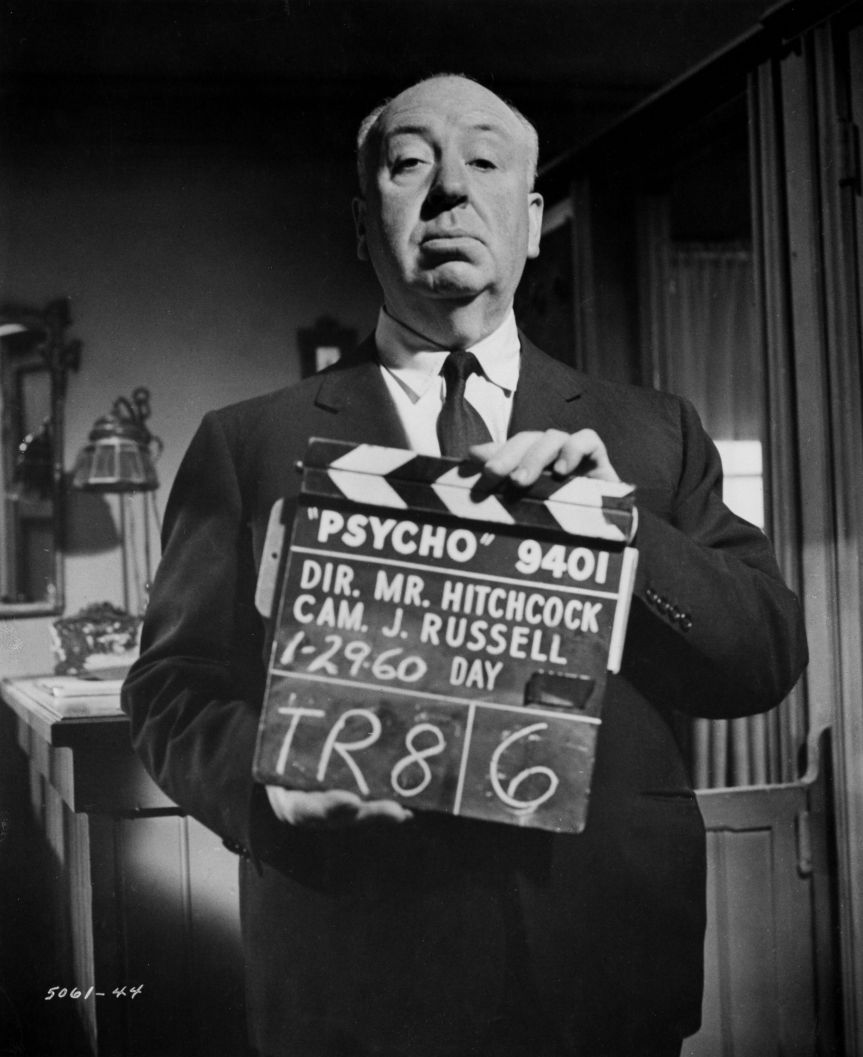
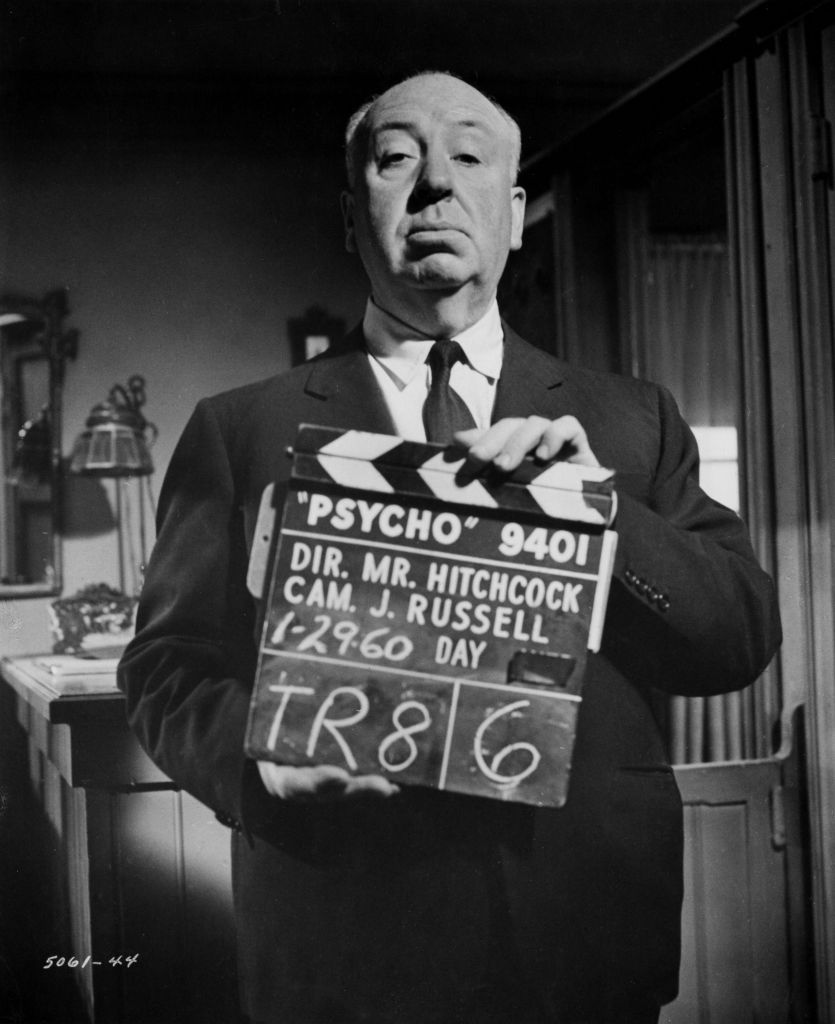
Sir Hitchcock before the shooting for Psycho (1960)
About Alfred Hitchcock
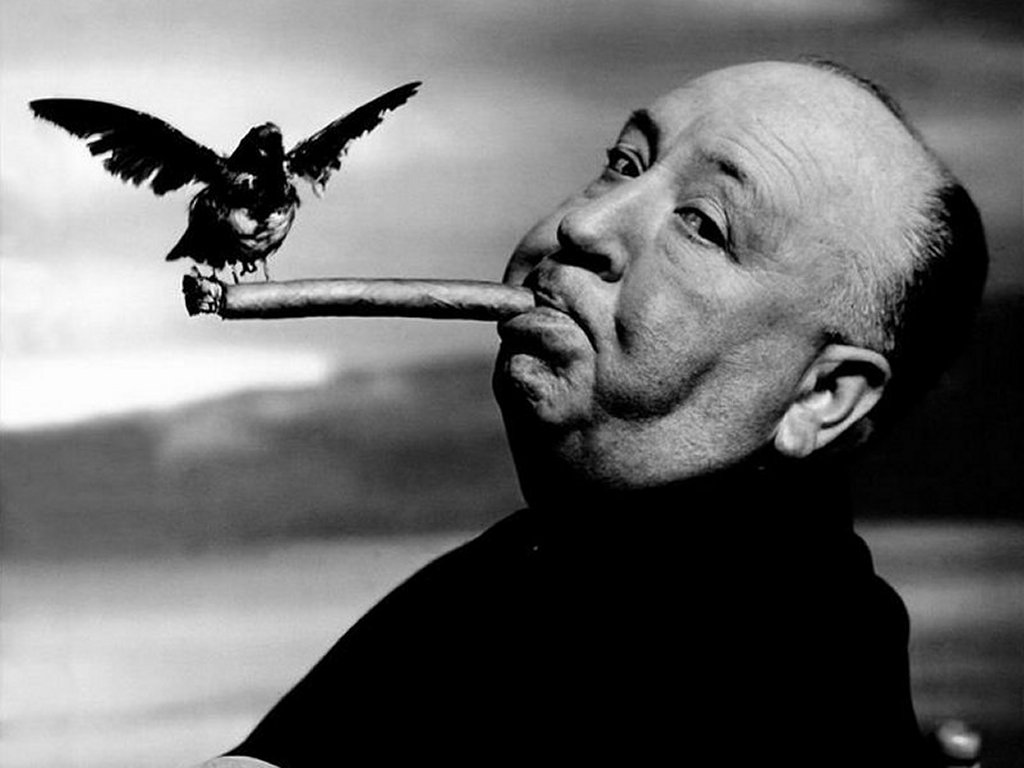
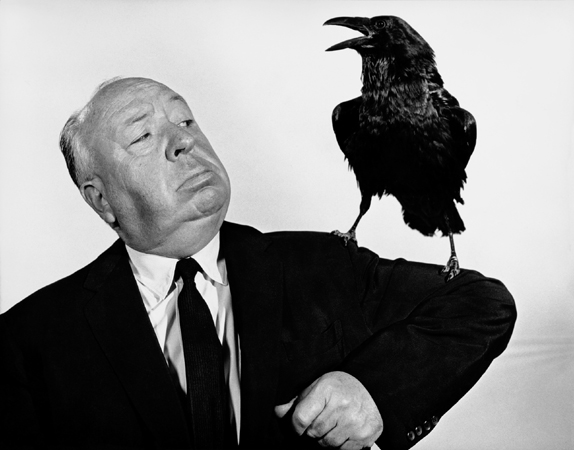
Sir Alfred Joseph Hitchcock (13 August 1899 – 29 April 1980) was an English filmmaker who was one of the most influential figures in the history of cinema. In a career spanning six decades, he directed over 50 feature films, many of which are still widely watched and studied today. Known as the “Master of Suspense“, he became as well known as any of his actors thanks to his many interviews, his cameo roles in most of his films, and his hosting and producing the television anthology Alfred Hitchcock Presents (1955–65). His films garnered 46 Academy Awards nominations, including six wins, although he never won the award for Best Director despite five nominations.
Sir Hitchcock
Techniques and Methodology of Hitchcock’s Works
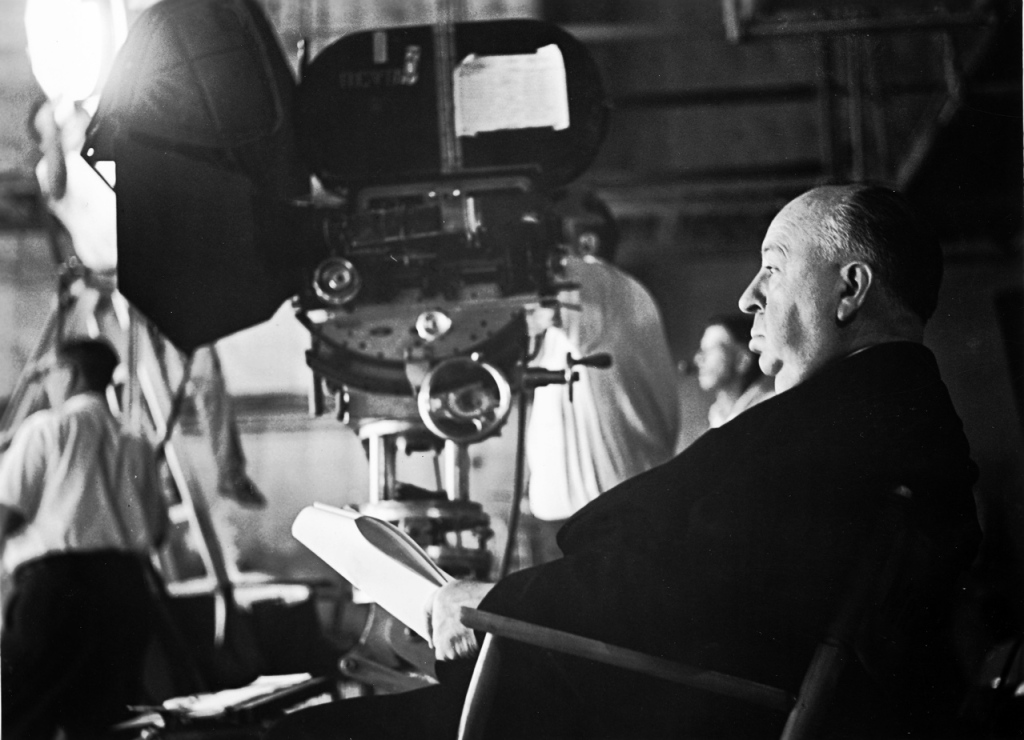
Alfred Hitchcock’s attention to detail in his films is one of the many things that makes him one of the most recognized film auteurs of all time. He was very particular what about he wanted seen on screen and how he wanted to get those shots. From camera movements to the things found in the mise-en-scène, Hitchcock was very precise about every little thing that is seen in his on screen worlds. He would strategically place objects throughout the mise-en-scène and have characters wear certain clothing. By doing this, Hitchcock is able to let the audience know things about the characters and the plot without it having to be said on camera. Hitchcock once said that “If it’s a good movie, the sound could go off and the audience would still have a perfectly clear idea of what was going on” . To Hitchcock, the conversations in his films were not important. Visuals were of the utmost importance. He loved point of view shots, which showed a shot of the actor and then cut to a shot of what the actor was looking at in order to convey what the actor is looking at; pretty much, the Kuleshov effect.
Sir Alfred Hitchcock on the set of one of his movies
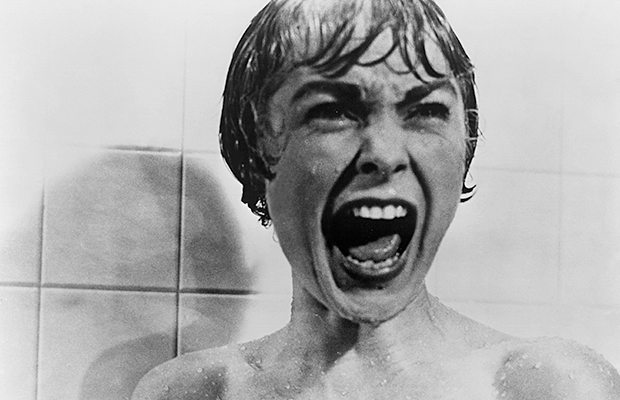
The soundtrack was extremely important to Alfred Hitchcock, as he managed to sync the music with the actions of the scenes. His most famous scene would be the shower scene in Psycho, where the orchestra is perfectly correlated with the murder. In his famous film, Hitchcock also incorporated the use of shot/reverse shot, a standard shot pattern that directors use to film conversations between two characters. In general, the actors avoid speaking directly to the viewer, because doing so acknowledges the audience’s presence and destroys the illusion of a naturally unfolding story. From panning shots, to tracking shots Alfred Hitchcock used his techniques in filming and editing in order to create great products that continue to intrigue audiences to this day.
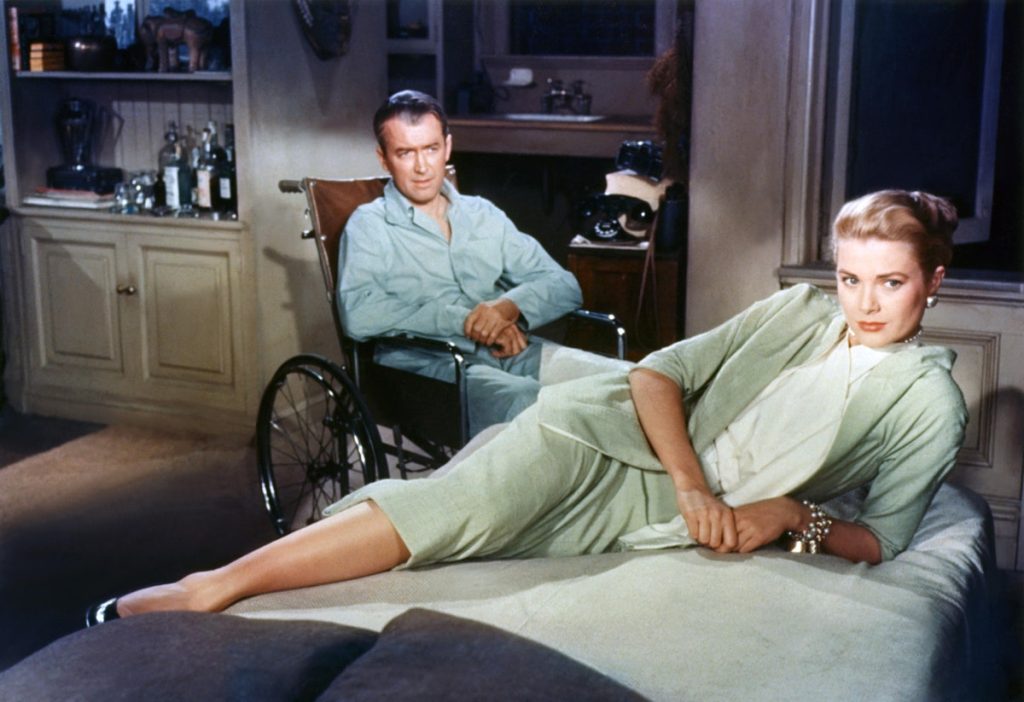
James Stewart as Jeff and Grace Kelly as Lisa Carol in Hitchcock’s Rear Window (1954) movie
Analysis of The Film “Rear Window” (1954)
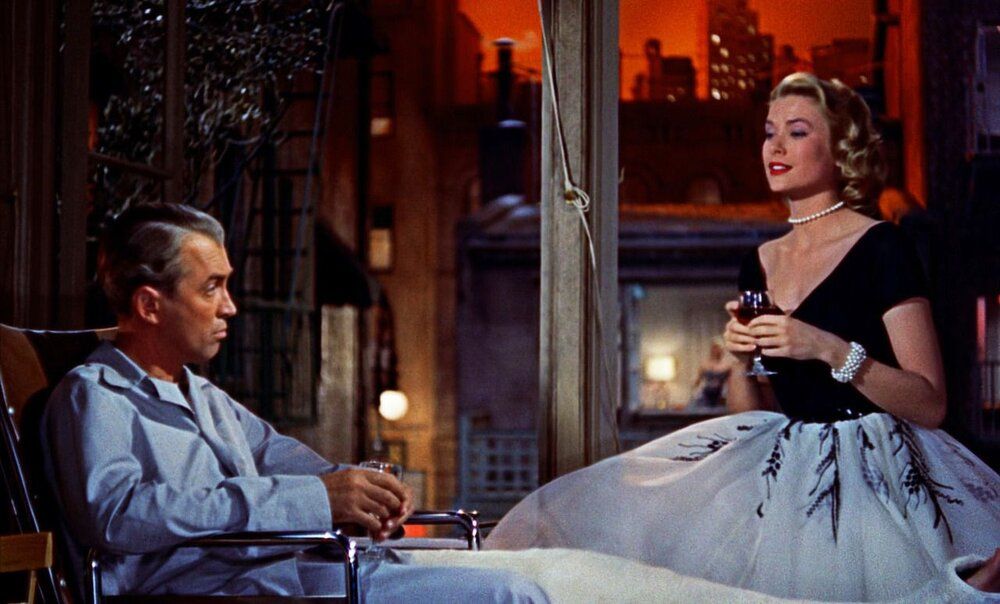
The cinematography ofRear Window mainly focuses on the use of lighting and shadows. With the darkness and mystery of the film, Alfred Hitchcock was able to use his lighting to his best advantage. The light always is picking up on important symbols or messages in the scene. Such as the scene when the salesman finally comes into Jeff‘s room, the light only picks up on Jeff’s most valuable senses; his hands and eyes. Along with the lighting, the interesting angles are very common. Not only did it create suspense, it creates confusion and the viewer wants to see more. Mise en Scene was very important in this film, as all of the scenes happened in the same group of apartments. In the city of New York, everything is very tight because of the huge population. The use of the differently decorated rooms also created personality and character for the roles who didn’t even speak.
Scene from Hitchcock’s Rear Window (1954) movie
Although sound and music weren’t always in the film, it was there when it needed to be. The traffic and sounds of the city were placed delicately to remind the viewer of the area. The mix of piano from the songwriter in one apartment, from the screeching violins during nail-biting moments, created emotions for the viewer. Editing was evident everywhere, especially during a fight scene, or used very consciously during high suspense. The fades were apparent from day to day, which helped the viewer better understand the passage of time.
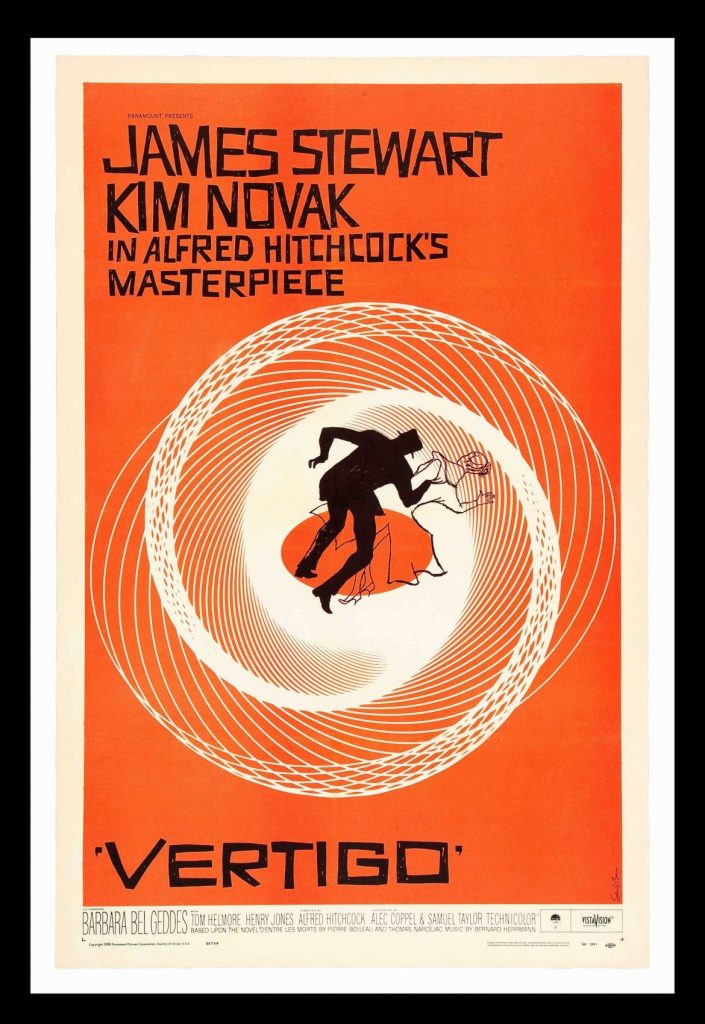
Poster of Hitchcock’s Vertigo (1958) movie
Analysis of The Film “Vertigo” (1958)
Vertigo is a 1958 suspense thriller directed by Alfred Hitchcock, written by Alec Coppel and Samuel Taylor and based upon the 1954 novel ‘D’entre Les Morts’ by Pierre Boileau and Thomas Narcejac. Starring James Stewart, Kim Novak and co-starring Barbara Bel Geddes.
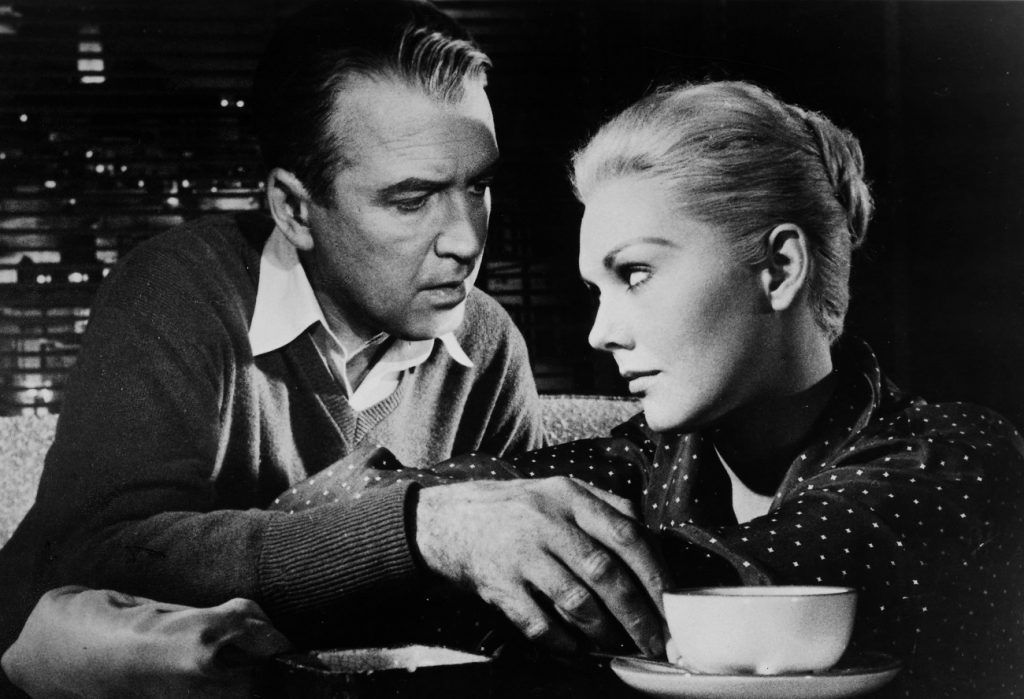
James Stewart as John Ferguson and Kim Novak as Madeleine in Hitchcock’s Vertigo (1958) movie
Vertigo is a film which functions on multiple levels simultaneously. On literal level it’s a mystery suspense story of a man hoodwinked into acting as an accomplice in a murder, his discovery of a hoax, and the unravelling of the threads of the murder plot. On a Psychological level, the film traces the twisted , circuitous routes of a psyche burdened down with guilt, desperately searching for an object on which to concentrate its repressed energy. Finally, on an allegorical or figurative level, it is a retelling of a immemorial tale of a man who has lost his love to the death and in hope of redeeming her descends into the underworld, the most famous of these stories being that of Orpheus and Eurydice in Greek Mythology. Vertigo’s complexity however does not end with this multilevel approach to its tale, the film also succeeds in blurring the already fine line between objectivity and subjectivity . It takes the viewers so far into the mind of its main characters ( Scottie, played by Hitchcock veteran James Stewart), that audiences’ own objectivity, at least initially, is lost and replaced by complete identification with Scottie’s fantasies and obsessions.
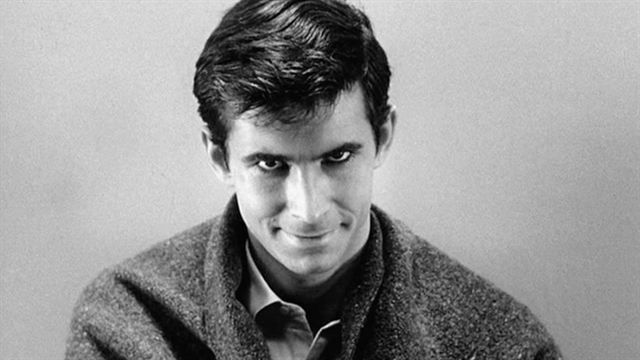
Anthony Perkins as Norman Bates in Hitchcock’s Psycho (1960) movie
Analysis of The Film “Psycho” (1960)
Hitchcock’s Psycho has been commended for forming the archetypical basis of all horror films that followed its 1960 release. The mass appeal that Psycho has maintained for over three decades can undoubtedly be attributed to its universality.
Scene from Hitchcock’s Psycho (1960) movie
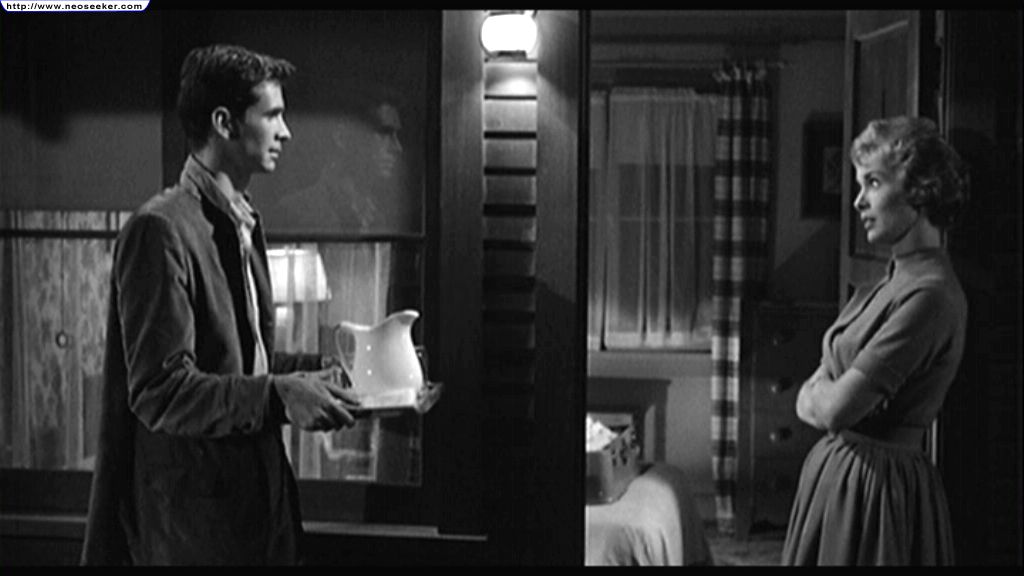
In Psycho, Hitchcock allows the audience to become a subjective character within the plot to enhance the film’s psychological effects for an audience that is forced to recognize its own neurosis and psychological inadequacies as it is compelled to identify, for varying lengths of time, with the contrastingpersonalities of the film’s main characters. Hitchcock conveys an intensifying theme in Psycho, that bases itself on the unending subconscious battle between good and evil that exists in everyone through the audience’s subjective participation and implicit character parallels. The initial confrontation between Marion and Norman Bates is used by Hitchcock to subtly and slowly sway the audience’s sympathy from Marion to Norman. Hitchcock compels the audience to identify with the quiet and shy character whose devotion to his invalid mother has cost him his own identity. Upon the introduction of Norman, Hitchcock introduces the first of several character parallels within Psycho. The clash between Marion and Norman, although not apparent to the audience until the end of the film, is one of neurosis versus psychosis.
Anthony Perkins as Norman Bates and Janet Leigh as Marion Crane in Hitchcock’s Psycho (1960) movie
The fear that Psycho creates for the audience does not arise from the brutality of the murders but from the subconscious identification with the film’s characters who all reflect one side of a collective character. Hitchcock enforces the idea that all the basic emotions and sentiments derived from the film can be felt by anyone as the unending battle between good and evil exists in all aspects of life.The effective use of character parallels and the creation of the audience’s subjective role in the plot allows Hitchcock to entice terror and convey a lingering sense of anxiety within the audience through a progressively intensifying theme. Hitchcock’s brilliance as a director has consolidated Psycho’s place among the most reputable and profound horror films ever made.
Scene from Hitchcock’s Psycho (1960) movie
Conclusion
Alfred Hitchcock who has been entitled to the master of apprehension, suspense and fear, entices the audience to discern his unknown inner in a simulation over cinema curtain. Human, sets back his instincts for years; withholds sex and anger and wrap it in his inner depths where even is impenetrable for himself. But there is always probability of arising it in the society as a coarse event. Eruption of anger from sub-consciousness of Hitchcock’s characters brings along murder, crime and often imagination, tragic psychic disturbances. Anyone might be involved with the condition of these characters in real world. Most of Hitchcock’s movies create suspense in very first minutes of the show. The propensity to know arouses in him. He limits and draws attention of the audience to the film.Dark spaces, long and fearsome roads, deserted places and empty of habitat, are signs and symbols which sometimes refers to unaware and its inner events. Making use of sharp-pointed lines and thorn-shaped edges in locations and shades, which are taken from Gothic style, makes the movies horror and terror. Hitchcock through increasing vigilance, guides the audience toward making a powerful “ego” against incidents which mostly indicates determinism.
Assam the land of valleys Incredible India termed Assam as the land of “Blue Hills and Red River” also we can identify the state as the gateway to the North East India .It is where the nature seems to be very powerful surrounded with beauty of greenery . My birth place is Assam , from childhood I have attachment with the nature , the land of tea leaves and we know mostly people start their day drinking a cup of tea. Assam having different cultures we can find here Assamese , Bengali, Bodo, Karbi anglong and so many other tribes too.
We can find here varieties of languages and all of them live together in the state , Bihu is the famous festival in Assam where all the people dance and sing together celebrate the festival . Here Bengali
The word ‘business environment’ indicates the aggregate total of all people, organisations and other forces that are outside the power of industry but that may affect its production.
Business environment is an aggregate of all conditions, events and influences that surround and affect it. It is broad and ever changing as its separate elements interact. A single firm’s environment is narrow in scope than the total environment of business. It is complicated and continuously changing.” —Professor Keith
No business can exist in a vacuum. The rapidly changing business environment might shorten the life of a given strategy. The external changes might influence the activities and quality of decisions of both the firm and its competitors. George Salk says, “If you’re not faster than your competitor, you’re in a tenuous position, and if you’re only half as fast, you’re terminal.”
Hence, as Kenich Ohmae says that “environmental analysis is the critical starting point of strategic thinking.” Charles Darwin has said, “It is not the strongest of the species that survive nor the most intelligent, but the one most responsive to change.”
We live in a dynamic environment that changes all the time. Businesses must understand the changes in the environment and how these changes affect their performance. The process of thinking strategically requires that managers understand how the structure and competitive dynamics of their industry affect the performance and profitability of their companies. Armed with an appreciation of the forces in their industry that give rise to opportunities and threats, managers should be able to make better strategic decisions.
Successful managers must recognize opportunities and threats in their firm’s external environment. Regardless of the industry, the external environment is critical to a firm’s survival and success. A host of external factors influence a firm’s choice of direction and action.
The caste system in India finds its origin around 1500 BC on the arrival of Aryans. Primarily, it was based on the occupation one chooses to practice. For example, a religious leader performing sacred rituals was called Brahmin, while the one who was a part of a kingdom’s army ( a warrior ) was called Kshatriya etc. Every occupation and individuals associated with it were addressed with particular names like a cobbler was called Chamar, a blacksmith as Lohaar, etc. And all of these occupations were a part of 4 Varnas viz. Brahmin, Kshatriya, Vaishya, Shudra. Teachers, farmers were a part of Vaishya while Shudras consisted of artisans, blacksmiths, laborers, maids, etc.
Like most societies of the world, in India also the son inherited his father’s profession. And so there developed families, who professed the same family profession for generation in which, the son continued his father’s profession. Later on, as these families became larger, they were seen as communities or Jatis. Different families who professed the same profession developed social relations between them and organized as a common community, meaning Jati. But later this Varma system became rigid. There was merely any occupational fluidity left. A Brahmin’s son also became a Brahmin, a cobbler’s son had to become a cobbler and nothing else. If he aspires to become a Kshatriya (warrior), the society and societal norms did not permit him to do so. Perhaps, the Varna system which was primarily based on occupation had now become a basic identity attained by an individual right from his birth, hence evolving as the ‘CASTE SYSTEM’. Subsequently, the rigidity of this system proliferated on the advent of the norms like intra-caste marriage, where a Brahmin could marry only to a Brahmin, a Chamar (cobbler) only to a Chamar, a Kshatriya only to Kshatriya. Besides, it also stated hierarchy in the society where Brahmins were considered the elite and were at the top. Followed by the Kshatriyas, then Vaishyas, and then Shudras. There was another community that was excluded from the society, the UNTOUCHABLES (aka Dalits).
Everyone was expected to follow societal norms. The problem began when some did not wish to comply. As popularly said ‘Love knows no bounds’, couples who wished to get married and live together had to face backlash from society if they belonged to different castes. Such couples had to face a social boycott. Their families, as well, had to face a social boycott, many times, resulting in eviction from the village. As a result, the need to protect honor was palpable. Hence, honor killings were frequent in society. The caste-based hierarchy was strictly followed. Defiance was eligible for punishment. Dalits were not included in religious practices. They were denied entry to temples. Water reservoirs meant for the upper caste were not allowed access to Dalits. They were barred from educational institutions. Chhatrapati Shahu Maharaj made efforts to eradicate caste discrimination, educate people against caste prejudice. He also offered a scholarship to Dr. Babasaheb Ambedkar for his further studies in foreign universities. Dr. Ambedkar was intelligent and a studious one but was overwhelmed and fed up by the discrimination he faced resulting in his initiation of a battle against the Caste system and Brahmanical patriarchy. In March 1930, Dr. Babasaheb Ambedkar launched a satyagraha seeking that Dalits be allowed to enter and pray in the Kalaram temple at the pilgrimage center of Nashik in Maharashtra. Evidently, was opposed by the upper castes. He also initiated the Mahad satyagraha to thereby allow Dalits to drink water from a public tank only meant for the upper castes.
Reservations.
Chhatrapati Shahu Maharaj, in 1921, had first introduced reservations for SC, ST, and OBC people. Also, Dr. Babasaheb Ambedkar strived for reservations in government jobs and educational institutions in order to alleviate the socio-economic and educational backwardness of the lower castes. After 70 years of Independence, do we still need reservations? Few questions need to be answered first. Reservations were granted due to social inequality and discrimination. But has this social discrimination ceased to exist? Has the educational backwardness of lower castes alleviated? Are the untouchables (Dalits) and Shudras permitted entry to temples and educational institutions everywhere in India?
According to a research by IIT Delhi, there is a systematic bias against the socially and economically backward castes in the provisions of public schools. Eg: In the state of Uttar Pradesh, the villages where upper caste population in maximum, there is 1 government school for every 3 villages, while the villages where Schedule caste (SC) population is maximum, there is 1 school for every 10 villages. Also, in Schedule tribe (ST)-majority villages there is 1 school for every 12 villages. The situation is not any better in Madhya Pradesh or Maharashtra. A study has shown that upper caste villages are twice as likely to get secondary level school than Dalit ones. In SC-majority villages, the probability drops from 75% at primary level to 9% at secondary.
Talking about our society, even today, in many rural areas, Dalits get beaten up for entering temples. One such incident in Rajasthan’s Pali district, where a minor Dalit boy was tied and beaten allegedly by a group of upper-caste men after he tried to enter a temple. Two months before this, many incidents of atrocities were seen, particularly the wedding processions being attacked because Dalit grooms were riding on horses. In Jalgaon district of Maharashtra, Dalit boys were allegedly beaten as they were found swimming in a well, apparently meant for the upper castes. Villagers (many from the upper castes) allegedly caught them, stripped them, and paraded them naked around the village. After the video went viral, the then Union Minister Ramdas Athavle had condemned the incident, and subsequently, police arrested few men under the Prevention of Atrocities Act. Water is a natural resource and everyone has a right to it. But caste restrictions and discrimination haven’t left it untouched. When natural resources are denied to lower castes, how can we expect that resources like education and jobs aren’t denied to them? Our society, unfortunately, has continued to practice the age-old norms of casteism and discrimination associated with it. Hence, if society cannot ensure equal opportunities to the lower castes, then the government has to! This is why reservations were introduced and still continue to exist.
Ramachandra Guha is an Indian Historian and a columnist. His notable works include India After Gandhi and Gandhi: The Years That Changed the World. He has been awarded with several accolades for his achievements in the field of history. He has experiences of teaching at Yale University, the Indian Institute of Science and the University of California at Berkeley. He was also the Indo – American Community chair professor in 1997 and 1998.
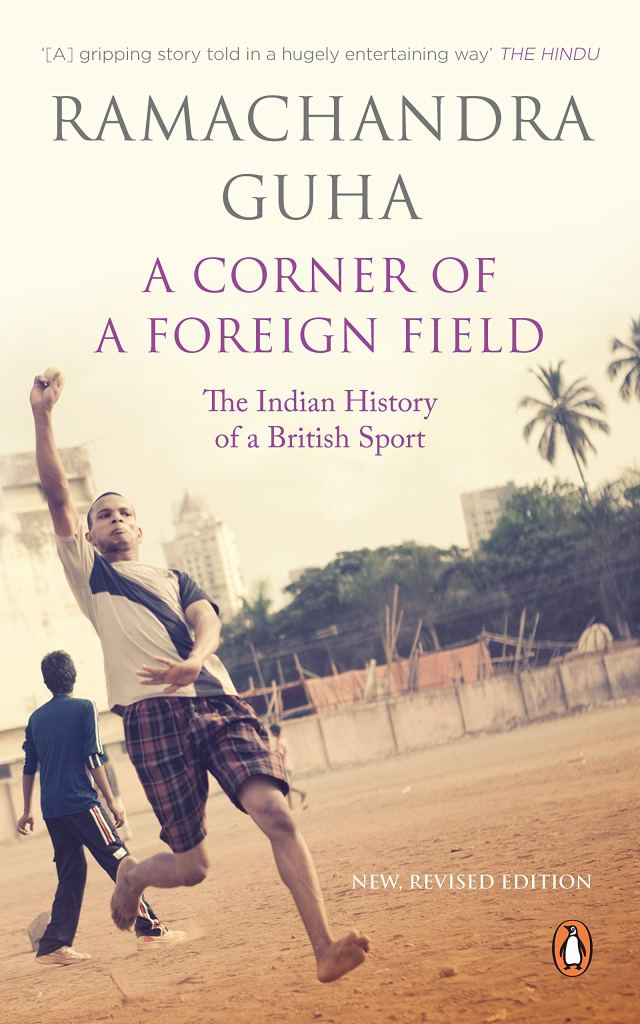
A Corner of a Foreign Field is a fascinating fusion of Indian history and Indian cricket.The book is divided into four chapters titled Race, Caste, Religion and Nation respectively. The first three chapter greatly benefit from thorough research and the skill of a great historian. The last chapter contains more of the authors feeling and opinion. Nevertheless, the book does not suffer from the personal feeling of the author. Throughout the book, the reader can experience the author’s love for the game.
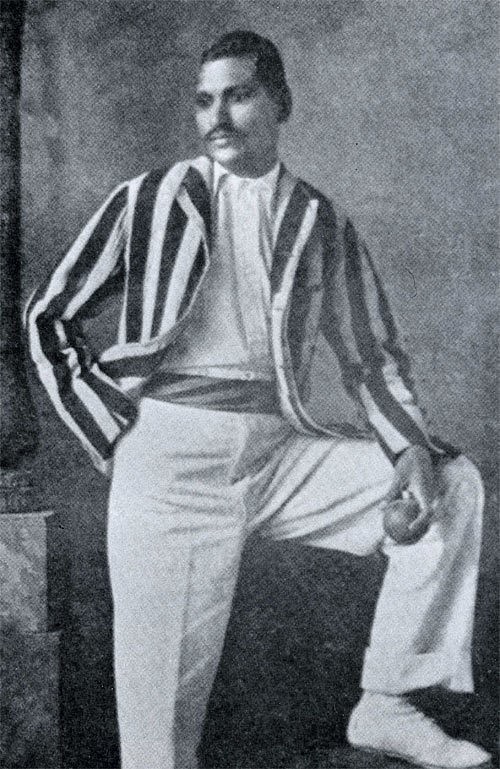
Palwankar Baloo
A Corner of a Foreign Field: The Indian History of a British Sport is a book about, one feels, the life of cricket in India so far. It is not just a history of the sport, but also a as much objective document of the sport as is possible. Cricket in India, as it is often said, is more than a sport. It evokes strong feelings from the audience and it won’t be an exaggeration to say that the team carries the burden of expectations of a billion people. Every on and off the field happening related to cricket is closely watched and excites opinions from all. This book views the unique sport through the lenses of race, religion, caste and nation. It speaks about the beginnings of cricket in India, how people reacted to this sport, its growth, impact and reception, BCCI, politics and much more. The book also gives insights into lives of people connected to the sport in one way or the other. The tales of cricketers like C. K Nayudu, Vijay Merchant, Palwankar Baloo and his brothers, Vijay Hazare makes it an interesting experience. It is astonishing how the game reflects the society at that point of time and the impacts each have had on one another throughout their history. It portrays the socio-cultural, political, economical aspects of the society by placing cricket at its centre. The book reflects the feelings of both an enthusiastic admirer of the sport and a historian keen on the socio-political happenings. The tales about cricketers are also good character sketches of the person. Not surprising, the story of Palwankar Baloo and his family is at the heart of this book as this originally began as a book about the life of Baloo. The book draws information heavily from newspapers of the day and the author uses this information beautifully to breathe life into the stories. The responses of various presses to the sport make for an interesting read. The knowledge of the author is seamless woven into the narrative. The writing of this book makes it an engaging experience even for a person not acquainted with the sport. Even for a fan of cricket, the book has much to offer and provide a great experience. It provides a whole lot new information and perspective even to a devoted follower of the sport.
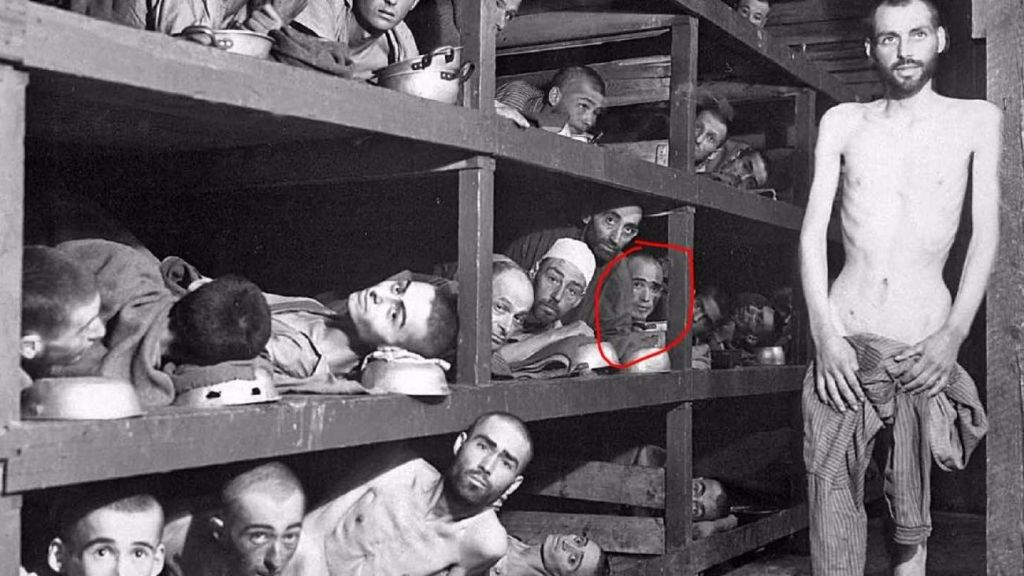
Elie Wiesel’s Night is a personal account of the Holocaust. It narrates the experiences of a schoolboy in the camps of Auschwitz and Buchenwald. It is a poignant account of the cruelties imposed on man by man.
Elie Wiesel was a schoolboy who was born in Sighet and spent his life with his family. In 1944, he was taken to Auschwitz and then to Buchenwald. Immediately separated from his mother and sister, he is left with his father to work in the camp. The rest of the book recalls his experiences in the camp until he was released a year later. The book voices out the grief and despair of the inmates of the camp. The author successfully manages to express himself and provide a disturbing account of the Holocaust.
Eliezer Wiesel was a Holocaust Survivor who later became a writer, professor and an activist. He was born on September 30 in the year of 1928. He authored several book that bear witness to the experiences of concentration camps. He was honoured with the Nobel Prize for Peace in the year 1986. He dedicated his whole life for Jewish causes and human rights causes. He died in the year 2016.
“Then came the march past the victims. The two men were no longer alive. Their tongues were hanging out, swollen and bluish. But the third rope was still moving: the child, too light, was still breathing… And so he remained for more than half an hour, lingering between life and death, writhing before our eyes. And we were forced to look at him at close range. He was still alive when I passed him. His tongue was still red, his eyes not yet extinguished.
Behind me, I heard the same man asking: “For God’s sake, where is God?” And from within me, I heard a voice answer: “Where He is? This is where–hanging here from this gallows…”
That night, the soup tasted of corpses.”
Forced out of silence by experiences such as these, the author manages to create an enduring account of what an inmate went through in the camp. Though the book is short and the writing sparse, it makes the reader relive the suffering experienced by the people in the camp. It makes the reader empathize with the author and feel his disgust at humanity after reading the book.
Never shall I forget that smoke. Never shall I forget the small faces of the children whose bodies I saw transformed into smoke under a silent sky. Never shall I forget those flames that consumed my faith forever. Never shall I forget the nocturnal silence that deprived me for all eternity of the desire to live. Never shall I forget those moments that murdered my God and my soul and turned dreams to ashes. Never shall I forget those things, even were I condemned to live as long as God Himself. Never.
The pain that is contained in the words alone is sufficient to make one ponder about the absurdity and meaninglessness of inflicting pain upon fellow humans in the name of race, caste, or gender.
“If only I could get rid of this dead weight … Immediately I felt ashamed of myself, ashamed forever.”
“Here there are no fathers, no brothers, no friends”, a Kapo tells him. “Everyone lives and dies for himself alone.”
The book captures, with precision, the emotions of the human mind in the face of extreme suffering. Events such as doctors pulling out gold crown tooth, people who enjoyed watching people fight for a loaf of bread, a father abandoned by his son make one question about Faith and God just like the author.
“One day when I was able to get up, I decided to look at myself in the mirror on the opposite wall. I had not seen myself since the ghetto. From the depths of the mirror, a corpse was contemplating me. The look in his eyes as he gazed at me has never left me.”
After reading the last lines of this book, the reader’s mind is sure to be purged of trivialities and filled with a deep sense of empathy.







 Eduindex
You must be logged in to post a comment.