Preamble : The introductory part of the Constitution

The term Preamble refers to the introduction or preface to the Constitution. It explains the constitution’s philosophy and objectives and the core values and principle of the nation. Preamble to Indian Constitution is based on the Objective Resolution drafted by Jawaharlal Nehru and adopted by the framers of the Constitution.

The preamble basically gives idea of the following things :

• Source of the authority of the constitution – It derives it authority from the people of India.
• Nature of Indian State – It declares India to be sovereign,socialistic, secular, democratic and republican state.
• Statement of its objectives – It specifies justice, liberty, equality to all citizens and fraternity to maintain unity and integrity of the nation as the objectives.
• Date of its adoption – It was adopted on November 26, 1949.

Key terms in Preamble :

1. We, the people of India – It indicates that the power to run the government of India lies in the hands of the people of India. Their views are represented by the members of legislature elected by them.
2. Sovereign – The term refers to India is not governed or controlled by any external power. It has its own independent authority.
3. Socialist –  It refers to mixed economy where both Public and Private sector co-exist side by side. Indian style of socialism is a democratic socialism where both public and private enterprises is encouraged.
4. Secular –  The term implies that there is not a single religion for every indian. They have freedom to follow any religion. All the religions in India get equal respect, protection and support from the state.
5. Democratic – The term implies that the Constitution of India has an established form of Constitution which gets its authority from the will of the people expressed in an election.
6. Republic – It explains that the head of the country, President, is (indirectly) elected by the people.

Objectives of Indian Constitution :

The Constitution is the supreme law and it helps to maintain integrity in the society and to promote unity among the citizens to build a great nation.The main objective of the Indian Constitution is to promote harmony throughout the nation.
The factors which help in achieving this objective are:
• Justice: It is necessary to maintain order in society that is promised through various provisions of Fundamental Rights and Directive Principles of State Policy provided by the Constitution of India. It comprises three elements, which is social, economic, and political.
1. Social Justice – Social justice means that the Constitution wants to create a society without discrimination on any grounds like caste, creed, gender, religion, etc.
2. Economic Justice – Economic Justice means no discrimination can be caused by people on the basis of their wealth, income, and economic status. Every person must be paid equally for an equal position and all people must get opportunities to earn for their living.
3. Political Justice – Political Justice means all the people have an equal, free and fair right without any discrimination to participate in political opportunities.
• Equality: This term refers to no section of society has any special privileges and all the people have given equal opportunities for everything without any discriminations. Everyone is equal before the law.
• Liberty: This term means freedom for the people to choose their way of life, have political views and behavior in society. Liberty does not mean freedom to do anything, a person can do anything but in the limit set by the law.
• Fraternity: It means a feeling of brotherhood and an emotional attachment with the country and all the people. Fraternity helps to promote dignity and unity in the nation.

The Preamble of the Constitution is considered as part of the Constitution. The Preamble is not the supreme power or source of any restriction or prohibition but it plays an important role in the interpretation of statutes and provisions of the Constitution. So, it can be concluded that preamble is part of the introductory part of the Constitution but is not directly enforceable in a court of justice in India.
Amendment of the Preamble :
The preamble is only amended once through the 42nd Amendment Act, 1976. The term ‘Socialist’, ‘Secular’, and ‘Integrity’ were added to the preamble through 42nd Amendment Act, 1976.As a part of the Constitution, Preamble can be amended under Article 368 of the Constitution, but the basic structure of the preamble can not be amended.

Sources : The Hindu, Insights on India and Dristi IAS

Preamble is the soul of our constitution, which lays down the pattern of our political society. It contains a solemn resolve, which nothing but a revolution can alter’- Former Chief Justice of India, M Hidayatullah

The Jallianwala Bagh massacre

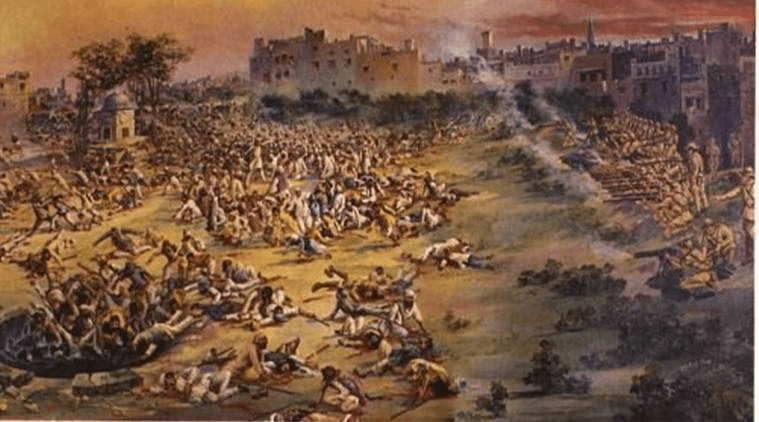
Jallianwala Bagh tragedy- a large peaceful crowd gathered at the Jallianwala Bagh, Amritsar on april 13, 1919 to protest against the arrest of leaders like Dr. Saifuddin kitchlu and Dr. Satya pal. jallianwala bagh had only one exit, it’s other three sides was enclosed with buildings.

General Dyer- the military commander of Amritsar, surrounded the Bagh(which means garden) with his soldiers. after closing the exit with his troops, he ordered them to shoot at the crowd. the troops kept on firing till their ammunition was exhausted.

Jallianwala Bagh Massacre took the lives of as many as 379 people, as Colonel Reginald Dyer ordered to open fire on them. Around 1200 people were injured during the firing.

People from the Sikh community gathered on the occasion of the Baisakhi festival near the Golden Temple.

As many as 90 British Indian Army soldiers, commanded by Colonel Reginald Dyer, opened fire on over 20,000 unarmed men, women, and children without any warning or order to disperse.

During the inquiry, Dyer said that it was a necessary measure as Punjab, along with Bengal, was the hub of anti-British rebels and anti-empire movements and that the firing was “not to disperse the meeting but to punish the Indians for disobedience.”

Such a heinous incident triggered a nationwide uproar. Rabindranath Tagore rejected his knighthood, Gandhi called for nationwide protests and generations awakened to the tune of independence. Even the British nationals were furious about the massacre. Colonel Dyer was dropped from the House of Commons.

After the massacre, the British government made a half hearted attempt at constitutional reform. But, it also made it clear that it had no intention of parting with political power or sharing it with indians. Also, the british government refused to annul the Rowlett Act and make amends for the atrocities in Punjab.

Jallianwala Bagh massacre happened 103 years ago, however, the day is registered in the heart of every Indian.

The first Indian university!!

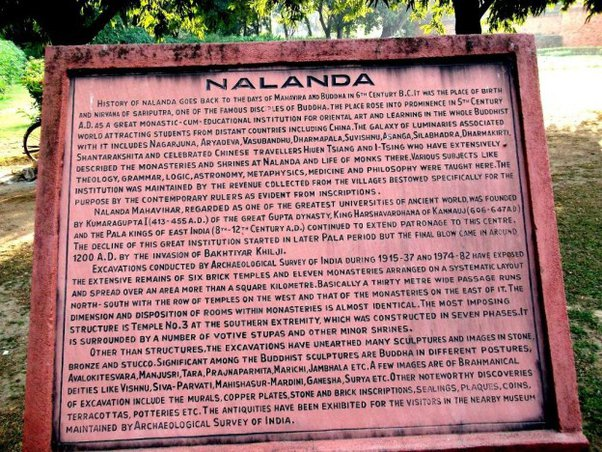
One of the most prehistoric Universities in the country that was established in the Gupta Dynasty era is the renowned and ancient Nalanda University. Located in the primeval Magadha region (modern Rajgirh), which is about 90 kilometers from Patna towards the Southeast, it is the world’s oldest residential university i.e. the students and scholars who came from all around the world, received On-campus facilities.

The university used to run in its prime state between 427 and 1197 CE. The patrons of this university consisted of many Indians and Japanese people, irrespective of them being Buddhists or not. Over 750 years, thousands of travelers, pilgrims, scholars, and students from Korea, China, Tibet have visited Nalanda University and cited their experience here in their very own literary documentation. Although sacked and destroyed to the ground by Bakhtiyar Khilji, the university was later restored.

At a time when Europe was mired in the Dark Ages, one lamp of learning shone brightly in the East, illuminating generations upon generations of minds. Nalanda University, an ancient seat of Buddhist learning and one of India’s lost glories, was founded in the fifth century and earned a reputation for intellectual excellence long before Oxford or Cambridge universities were built.

In the 12th century, that light went out. Muslim invaders rampaged through Bihar, in the northeast of India, sacking Nalanda. Legend has it that the multi-storey library and its great towers, bejewelled and gilded to reflect the rays of the sun, was so vast it took weeks to burn. Persian historian Minhaj-i-Siraj narrated how “smoke from the burning manuscripts hung for days like a dark pall over the low hills”.

They destroyed what many say was the world’s first university. Its name and reputation were known across Asia, even as far away as Greece. For 800 years, it was a centre of knowledge not only for Buddhist studies but for philosophy, medicine, astronomy and mathematics. Nalanda ceased to exist just when other universities were opening in Bologna, Italy, Paris, France, and Oxford, England.

This learning center was built by Buddhist monks during the reign of King Kumaragupta in 426 AD. The study of Buddhism, the practice of religion was the main. But besides, Hindu philosophy, Vedas, theology, logic, medical science, grammar, linguistics, science and many other subjects were taught. The cost of the university was in favor of the king. Merit and the only merit was the key to enter this university. Even in the case of members of the royal family, there was no room for bias. Students did not have to pay any salary for studying. On the contrary, they used to get nutritious food like milk, ghee, rice and butter from 200 grams.

Nalanda Burning

Nalanda also housed a library which held innumerable manuscripts and texts not only of Budhdhism but also of various literature and sciences like astronomy and medicine. It was said that the collection of texts were so huge in number, that the library burnt for three months when Bhaktiyar Khilji destroyed it.

One of the pride of this university was its library. The name was ‘Dharmaganj’. Here were three gigantic multi-storey buildings. The names of the buildings were ‘Ratnasagar’ (meaning ocean of gems), ‘Ratnodadhi’ (meaning sea of ​​gems) and ‘Ratnaranjak’ (meaning jeweled). It is unknown at this time what he will do after leaving the post. It is said that the authentic manuscripts of some parts of the Upanishads were here. There were also scriptures like Prajnaparamita Sutra and Guhya Samaj. How much! And those invaluable resources were finally swallowed up by the mad fire

NEWSPAPER MIRROR TO SOCIETY.

Newspaper can be defined as a print medium for conveying current news of various information .

History of newspaper in India:
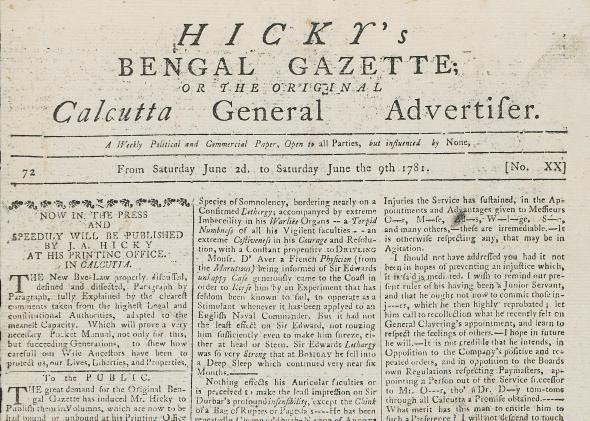
The first newspaper in India the Bengal Gazette was published in January 29, 1780 by James Augustus Hicky ,which was also known as”Calcutta Advertiser”. It was commonly known as “Bengal Gazette “. The first edition of the newspaper has two pages and was later expanded to page 4. Its size was 35 cm x 24 cm. East India Company did not considered Freedom of the Press good for society. They tried to curb the publication of newspapers. He was a very brave editor. He continued to criticize British authorities and publishing reports attacking East India Company officials for their way of working. British Authorities have arrested Hicky many times. Finally they finished his work of newspaper in 1782 and stopped publishing. Hicky was asked to leave Country. He was sent back to England. A copy of the Bengal Gazette is still preserved in the National Library of Calcutta and the British Museum in London.


Following in Hickey’s footsteps in 1780, a second newspaper was launched “The Indian Gazette” and “Calcutta Gazette” which begins publishing in 1784 and the “Bengali Journal” was started in 1785 which is also the third and fourth newspaper from Calcutta. The previous four newspaper were all published in English. Slowly Newspapers also begun to issue from other parts of the country in different languages and. The Tuesday “Madras Courier” (1785) and “Madras Gazette” (1795) starting from Madras. From Mumbai, “Bombay Herald” was started in 1789. The strict press regulations and censorship imposed by the UK hindered publication of more newspapers in India.In 1818, Lord Hastings abolished these strict censorship measures which leads to the appearance of many new newspapers in various Indian languages. Raja Ram Mohan Roy, who is known to have fought for the freedom of the press, edited a Persian weekly newspaper called “Mirat-ul-Akhbar”. But the editors of this newspaper were foreigners, not Indians. The first Indian language newspaper published by an Indian was “The Bengali Gazette” which was started in Calcutta by Gangadhar
Bhattacharjee in 1816. Pandit Jugal Kishore started Udant Martand the first Hindi newspaper published in India beginning on May 30, 1826, in Calcutta the weekly was published every Tuesday .


Importance of newspaper in India Freedom Struggle:
The newspaper and the press played a very important crutial role in the struggle for independence. The newspapers made the Indian public aware to the cruelty of the British Empire on the people . The press was the main tool for carrying out political tasks, propagating, political education, forming and spreading national ideology, mobilizing and consolidating national public opinion. The press is a powerful weapon in nationalist struggles, and Indian nationalists have led the struggle through the help of press. In fact, many of the great leaders of the freedom movement became journalists themselves and used the press as an instrument to spread their ideas to the masses and people in different parts of the country.


The Vernacular Press Act of 1878, against Indian-language newspapers, was passed in a meeting of the Royal Legislative Council. The law orders the seizure of a newspaper’s publications, papers, and other materials if the government believes the newspaper is publishing instigating material that could be harmful for the government. The Indian press enjoyed considerable freedom until 1908. However, due to the great growth of the nationalist movement, the Press Act was passed in 1908 and the Indian Press Act of 1910. Till 1930 the Indian press enjoyed relative freedom to give free opinion. However, the Press Act of 1932 and the Foreign Relations Act of 1932 refused India’s press freedom. The press was used as an effective weapon in the hands of social reform groups to expose social evils such as class restriction, child marriage, the prohibition of widows remarrying, social inequalities, laws and regulations.At that time it was very useful to uplift the society.


Newspaper at present:
Newspapers today occupy an important place in the world. The presence of newspapers is inevitable in today time. They are the reflections of the world. The press is considered the fourth pillar of democracy. The press is the most powerful of the powerful. They are defenders of truth and human rights. They act as spokespersons for the public. They are the link between the people and their government. It was still preferred by people over other media platforms because of its reliability, at a time when media was seen as a fake system that didn’t work properly.


“A good newspaper, I suppose , is a nation talking to itself ”

By Arthur Miller

What is society?

Photo by Krizjohn Rosales on Pexels.com

Man is a social animal. Psychologists like McDougall say that man is social because of the basic human instinct called gregarious instinct. Gregariousness refers to the tendency of man to live in groups. He lives in social groups, in communities and in societies. Various cases show that ‘man can become man only among men”. Man is biologically and psychologically equipped to live in groups and solitary life is unbearable to him. We very often use words such as groups, community, society, etc., in our day-to-day life. These are not merely words, they are concepts. They carry some precise meaning.

The term society is derived from the Latin word ‘socius’, which means companionship or friendship. Companionship means sociability. As George Simmel pointed out, it is this element of sociability which defines the true essence of society. It indicates that man always lives in the company of other people. Man needs society for his living, working and enjoying life. Society has become an essential condition for human life to arise and to continue. Human life and society always go together.

Some definitions of Society:

1. Morris Ginsberg said, “A society is a collection of individuals united by certain relations or mode of behavior which mark them off from others who do not enter into these relations or who differ from their behavior.”

2. MacIver defined society as “a web of social relationship”.

3. G.D.M. Cole said “Society is the complex of organized associations and institutions with a community”.

Characteristics of Society:

1. Society consists of people: Without people there can be no social relationships, no social life and hence no society.

2. Mutual interaction and mutual awareness: Mutual interaction refers to the reciprocal contact between two or more persons. An individual is a member of the society so long as he engages in relationship with other members of society. Social interaction is possible because of mutual awareness. Social relationships exist only when the members are aware of each other. Society exists only where social beings ‘behave’ towards one another in ways determined by their recognition of one another.

3. Society depends on likeliness: Likeliness refers to the similarities. Just as ‘birds of the same feather flock together’, men belonging to the species called homo-sapiens have many things in common. Society in brief, exists among like beings and likeminded.

4. Society rests on differences too: If men are exactly alike, their social relationships would be very much limited. There would be little give-and-take, little reciprocity. Life becomes boring, monotonous and uninteresting if differences are not there. However, differences alone cannot create society. It is subordinate to likeliness.

5. Co-operation and division of labor: Likeliness and differences create division of labor. It involves the assignment to each unit or group a specific share of common task. Division of labor needs specialization. Society is based on co-operation. It refers to the mutual working together for the attainment of a common goal.

6. Society is dynamic: Change is ever present in society. Changeability is an inherent quality of human society.

7. Social control: Society has its own ways of regulating the behavior of its members. These ways can be formal such as, law, legislation, police, court, etc., and informal such as customs, traditions, manners, etc.

8. Culture: Culture refers to, as Linton says, the social heritage of man. Culture is not society, but an element of society that binds together its component individuals.

Man depends on society for protection and comfort, for nurture and education from old age to death. Society makes our life livable. Society is, therefore, as MacIver puts it, more than our environment. It is within us as well as around us. It liberates and controls our talents and capacities. It stimulates the growth of our personality. Emotional development, intellectual maturity, satisfaction of physical needs and material comfort are unthinkable without society.

Apple Releases New Safari Technology Preview With MacOS Ventura Features

AppleInsider is supported by its audience and may earn commission as an Amazon Associate and affiliate partner on qualifying purchases. These affiliate partnerships do not influence our editorial content.

Apple has released a new version of Safari Technology Preview with features included in the company’s upcoming macOS Ventura update.

Safari Technology Preview is an experimental browser designed to test features that could be released in new versions of Safari. The company on Tuesday released Safari Technology Preview 147, with several macOS Ventura features.

The new browser version includes Live Text, support for Apple Passkeys, and improved Safari Web Extensions, among other features. However, some features are missing, such as Tab Groups syncing, Website Settings, and Web Extensions.

With the release, users who are currently on macOS Monterey will be able to test out some of those new features without downloading the beta version of macOS Ventura.

Apple’s full release notes for the Safari Technology Preview version are available below.

Live Text. Select and interact with text in videos or translate text in images on the web in macOS Ventura betas on Apple Silicon-based Macs.

Web technologies. Experience and test the HTML, CSS, JavaScript, and other web technologies that are available in Safari 16 Beta and included in previous Safari Technology Preview releases.

Web Push. Send notifications to people who opt-in on your website or web app with Safari Technology Preview on macOS Ventura betas.

Passkeys. Preview the new type of phishing-resistant credential that makes signing in to websites safer and easier. Available through Safari’s WebAuthn platform authenticator. To learn more about passkeys, see Meet passkeys.

Improved Safari Web Extensions. Test out API improvements including the ability to open a Safari Web Extension popover programmatically.

Web Inspector Extensions. Build custom tooling or convert existing developer tools extensions to use in Web Inspector.

Flexbox Inspector. Use the new visualization overlay in Web Inspector to help you more quickly and easily understand the layout of elements with Flexbox. It marks both the free space and gaps between flex items to reveal how they affect the result.

Call for Papers IJR 2022

 International Journal of Research (IJR) is an international peer reviewed journal. The journal is dedicated to publishing investigations on new and untested ideas, and disseminating research findings that make original and significant contributions to different areas of education, culture and society. The aim of the journal is to promote the work of young talented researchers in the humanities, cultural studies, social sciences, law, economics and education and the dialogue of sciences. 

Send papers for publication in this journal to editor@pen2print.org 

Visit the journal site at https://ijrjournal.com/index.php/ijr

The topics related to this journal include but are not limited to:

And Translation Theory and Practice
Cognition and Culture
Communication and Culture
Cross-cultural Learning
Cultural Studies
Educational Assessment and Evaluation
Ethnicity and Culture
Intercultural Communication
International and Comparative Education
Language and Culture
Languages and Literature
Popular Culture
School Health Counseling and School Psychology
Special Education
STEM (Science, Technology, Engineering, and Mathematics) Studies
Teacher Education

Call for Papers IJR July 2022

 International Journal of Research (IJR) is an international, peer-reviewed, online journal published by Edupedia Publications Pvt Ltd. It provides an academic platform for professionals and researchers to contribute innovative work in the field. IJR carries original and full-length articles that reflect the latest research and developments in both theoretical and practical aspects of English Language Education. The Journal links the everyday concerns of practitioners with insights gained from relevant academic disciplines such as applied linguistics, education, psychology, and sociology. 

IJRi is an international, open access, peer-reviewed, rapid publication journal. It provides a forum for creative and scholarly experts communicate and discuss new ideas in higher education. This journal focuses on higher education studies that examines educational developments throughout the world in universities, polytechnics, colleges, and vocational and education institutions. All contributions to the journal are rigorously refereed and are selected on the basis of quality and originality of the work.

Send papers for publication in this journal to editor@pen2print.org 

Visit the journal site at https://ijrjournal.com/index.php/ijr

The topics related to this journal include but are not limited to:

Syllabus
Materials Design
Flipped Class
Mixed Learning
Deep Active Learning
Teaching Strategies
Skill Teaching
Academic and Scholarly Writing 
Virtual Education and MOOCs
Materials and E-learning
Minority Language Education Policy
Teaching English as a Second Language
English Teachers’ Training and Education
Studies in English Culture and Literature
English Teaching in Educational Institutions
Mobility and Autonomy in Higher Education