The National Education Policy (NEP), 2020 emphasizes the critical importance of universal and high-quality Early Childhood Education along with the power of multilingualism and the importance of including children’s languages in primary education. To fulfil the vision of NEP 2020, the Department of School Education & Literacy (DoSE&L), Ministry of Education has launched “Baalpan ki Kavita initiative: Restoring Bhartiya rhymes/poems for young children” for preparing a compendium of nursery rhymes/poems in all Bhartiya Bhasha and also in English, focusing on content relevant to the Indian context. The purpose of this initiative is that the young children can have better learning at the Foundational stage by becoming familiar with the world around them through easily understandable and joyful poems and rhymes, in their mother tongue.
To further this initiative, the DoSE&L in collaboration with MyGov is inviting contribution to the “Baalpan ki Kavita initiative: Restoring Bhartiya rhymes/poems for young children”. The participants of the contest can send existing poems/rhymes popular in folklore (mentioning the name of the author) or newly composed joyful poems/rhymes under three categories:
Pre-primary (ages 3-6)
Grade 1 (ages 6-7)
Grade 2 (ages 7-8)
Entries are invited in all Indian language (Bhartiya Bhasha), also in English, and can include regional rhymes/poems that hold cultural significance in Indian context. The competition is starting from 26.03.2025 till 22.04.2025, on the MyGov website (https://www.mygov.in/). There is no entry fee for participation. Other details of the competition can be seen on MyGov website.
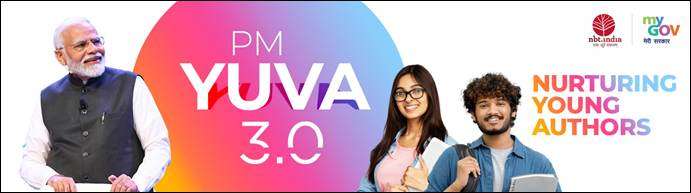
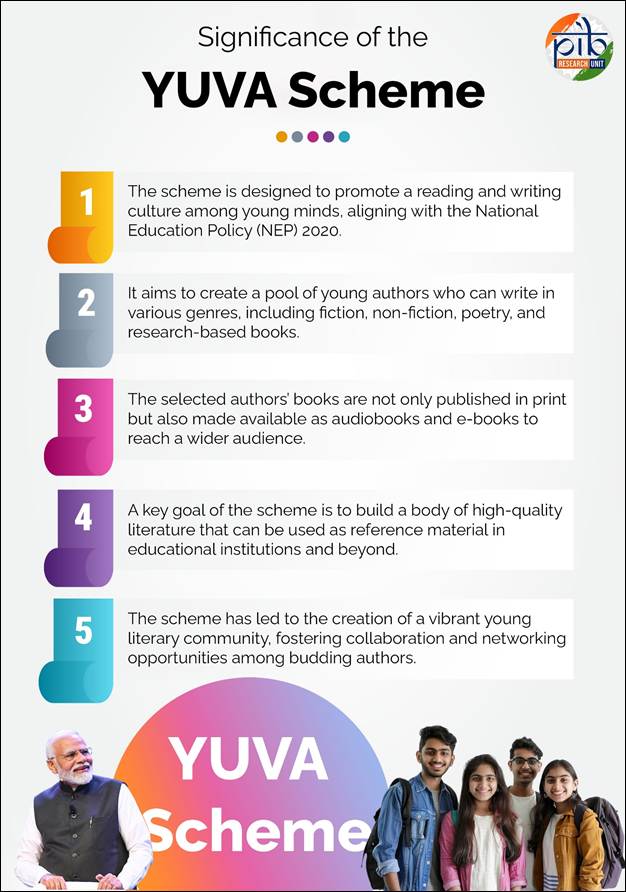
The Ministry of Education (MoE) and the National Book Trust (NBT) of India launched the thirdedition of the Prime Minister’s Young Authors Mentorship Scheme, known as YUVA 3.0, on March 11, 2025. The initiative aims to nurture young writers under 30 years of age, providing them with mentorship and exposure to hone their creative writing skills. YUVA 3.0 builds upon the success of its predecessors, YUVA 1.0 and YUVA 2.0, continuing the government’s commitment to fostering literary talent and promoting reading, writing, and book culture in India. The scheme aligns with the vision of Ek Bharat, Shreshtha Bharat, encouraging the documentation and dissemination of India’s rich cultural heritage and knowledge.
YUVA 3.0: Features and Objectives
Theme and Focus
The Themes of PM-YUVA 3.0 are: Contribution of Indian Diaspora in Nation Building; Indian Knowledge System; and Makers of Modern India (1950-2025). The scheme will help to develop a stream of writers who can write on various facets of India encompassing the past, present and future. Besides, the scheme will also provide a window to the aspiring youth to articulate themselves and present a comprehensive outlook of contribution of Indians across fields in ancient and present times.
Selection Process
The scheme invites applications from aspiring writers through MyGov India’s online portal.
A competitive process shortlists 50 young authors based on a well-defined evaluation criterion.
The National Book Trust (NBT) will constitute the selection committee.
Applicants are required to submit a book proposal of 10,000 words, which is then reviewed by a panel.
The shortlisted candidates undergo a multi-stage selection process before the final selection.
Mentorship and Support
Selected authors receive a mentorship program spanning six months.
The authors undergo workshops, interactions with mentors, and exposure to India’s literary ecosystem.
They receive financial assistance of ₹50,000 per month for six months.
Their works are published and promoted by the NBT in multiple languages.
Under the mentorship, a National Camp will be held for the PM-YUVA 3.0 Authors during the New Delhi World Book Fair 2026.
Selected authors get the opportunity to present their work at literary festivals and international forums.
Background of the YUVA Scheme
National Education Policy 2020 has emphasized on the empowerment of the young minds and creating a learning eco-system that can make the young readers/learners ready for leadership roles in the future world. India is considered to be a ‘young country’ because 66% of its total population are young and can be tapped for capacity and nation building. In this context, a national scheme for mentoring generations of young authors has proven to be a significant stepping stone for laying the foundation of the future leaders of the creative world. This scheme has been conceptualised on the premise that the 21st century India needs to groom a generation of young authors to create ambassadors of Indian literature and world view. In view of the fact that our country is ranked third in the arena of book publishing and we have a treasure trove of indigenous literature, India must project it at the global stage. The first mentorship scheme was launched on 31st May 2021, then subsequently in October 2022 and now in March 2025.
YUVA 2.0: Expansion and Achievements
Launched in October 2022, YUVA 2.0 built upon the foundation of YUVA 1.0 with a renewed focus on ‘Democracy’ as the core theme. The scheme aimed to foster young writers’ engagement with India’s democratic values, traditions, and governance structures.
Theme and Vision
The Theme of PM-YUVA 2.0 was Democracy (Institutions, Events, People, and Constitutional Values). The scheme helped in developing a stream of writers who can write on various facets of Democracy in India encompassing the past, present and future. Besides, the scheme also provided a window to the aspiring youth to articulate themselves and present a comprehensive outlook of Indian democratic values at domestic as well as international platforms.
Selection and Implementation
The competition received an overwhelming response, with a diverse pool of participants from across the country.
75 authors were selected through a competitive process. They were also required to submit a book proposal of 10,000 words.
The mentorship program included interaction with constitutional experts, historians, and renowned authors.
Special training sessions were held to enhance research skills, language proficiency, and storytelling techniques.
Outcomes and Impact
The Union Minister for Education launched 41 new books under the PM YUVA 2.0 scheme at the New Delhi World Book Fair 2025 in February.
Several books were published in multiple Indian languages, making them accessible to a broad readership.
Young authors gained national and international recognition, participating in events like the World Book Fair and literary forums.
Many participants had their books included in academic and government libraries for research and reference.
Some authors had the opportunity to meet and interact with policymakers and scholars, further enriching their perspectives.
YUVA 1.0: Inception and Legacy
The inaugural edition, YUVA 1.0, was launched in May 2021 as part of the Azadi Ka Amrit Mahotsav celebrations to commemorate 75 years of India’s independence. The scheme aimed to empower young authors and provide them a platform to express their perspectives on India’s history and contemporary narratives.
Theme and Inspiration
The theme was National Movement of India with focus on Unsung Heroes; Little known facts about the Freedom Struggle; Role of various places in National Movement; Entries bringing out new perspectives related to political, cultural, economic, or science related aspects of national movement etc. as part of Azadi ka Amrit Mahotsav. This scheme helped to develop a stream of writers who can write on a spectrum of subjects to promote Indian heritage, culture and knowledge system.
Selection and Implementation
The contestants were asked to submit a manuscript of 5000 words.
75 young authors were selected, representing diverse linguistic and regional backgrounds.
The selection was made by a committee constituted by National Book Trust (NBT).
Mentorship included training in writing, editing, and publishing processes.
Special sessions were conducted by eminent historians, journalists, and literary figures.
A consolidated scholarship of Rs.50,000 per month for a period of six monthsper author will be paid under the Mentorship Scheme.
Outcomes and Impact
The results were announced on 25.12.2021.
The books produced under YUVA 1.0 were translated into multiple Indian languages, enhancing their reach.
The initiative contributed to India’s literary heritage, encouraging young voices to document historical narratives.
Several young authors gained recognition, contributing to mainstream literature and academic discussions.
The scheme established a strong foundation for young writers, many of whom went on to publish additional books independently.
10% royalty is being paid by NBT on publication and sale of the books.
Conclusion
The YUVA scheme, in its three editions, has played a crucial role in nurturing young literary talent in India. As the program continues to evolve, it reinforces India’s commitment to promoting creative expression, multilingual literary heritage, and a culture of reading and writing among the youth. The impact of the scheme is evident in the success stories of young authors whose voices have been amplified at both national and international levels. With continued support and innovation, the YUVA scheme will remain a cornerstone of India’s literary and cultural renaissance.
The Ministry of Education, Department of Higher Education, launched PM-YUVA 3.0 -Prime Minister’s Scheme for Mentoring Young Authors, an Author Mentorship programme to train young and budding authors (below 30 years of age) in order to promote reading, writing and book culture in the country, and project India and Indian writings globally on 11th March, 2025. In view of the significant impact of the first two editions of PM-YUVA Scheme with large scale participation from young and budding authors in 22 different Indian languages and English, PM-YUVA 3.0 is now being launched.
The launch of PM-YUVA 3.0 (Young, Upcoming and Versatile Authors) is in tune with the Prime Minister’s vision to encourage the youth to understand and appreciate India’s rich culture, heritage and contribution of visionaries in the development and growth of the country.PM-YUVA 3.0 intends to bring to the fore the perspectives of the young generation of writers on the themes:1) Contribution of Indian Diaspora in Nation Building; 2) Indian Knowledge System; and 3) Makers of Modern India (1950-2025) in an innovative and creative manner. This scheme will thus help to develop a stream of writers who can write on a spectrum of subjects to promote Indian heritage, culture and knowledge system.
NEP 2020 has emphasised on the empowerment of the young minds and creating a learning ecosystem that can make the young readers/learners ready for leadership roles in the future world. India tops the chart in youth population being 66% of the total, waiting to be tapped for capacity building and thereby nation building. With the purpose of mentoring a new generation of young creative writers, there is an imminent requirement to take initiatives at highest level, and in this context, PM-YUVA 3.0 will go a long way in laying the foundation of the future leaders of the creative world.
The National Book Trust, India, under the Ministry of Education as the Implementing Agency, will ensure phase-wise execution of the Scheme under well-defined stages of mentorship. The books prepared under this scheme will be published by National Book Trust, India, and translated into other Indian languages, fostering cultural and literary exchange while promoting ‘Ek Bharat Shreshtha Bharat’. The selected young authors will engage with esteemed writers, participate in literary festivals, and contribute to a diverse body of work that reflects India’s rich heritage and contemporary progress.
The scheme aims to cultivate a new generation of writers who can articulate the contributions of the Indian diaspora in nation-building, highlighting their peaceful integration and influence across political, economic, and socio-cultural spheres. It will also emphasise on the role of Indian Knowledge System in preserving historical wisdom, generating new opportunities, and synthesising indigenous knowledge for national development. Through this initiative, young authors will explore the impact of visionaries in various fields like education, science, economy, social empowerment, etc. thereby presenting a comprehensive narrative of India’s growth and resilience.
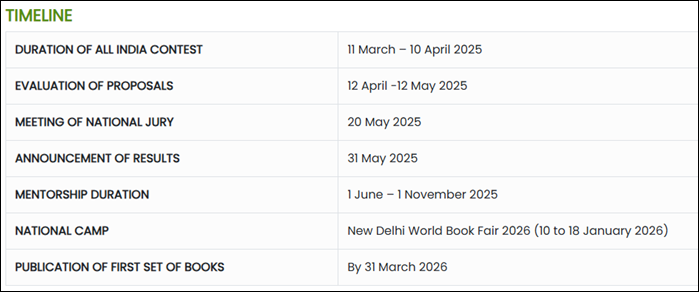
The Schedule of PM-YUVA 3.0 (Young, Upcoming and Versatile Authors) is as follows:
Announcement of the Scheme 11 March 2025.
A total of 50 authors will be selected through an All India Contest to be conducted through https://www.mygov.in/ from 11 March 2025 – 10 April 2025.
The number of authors to be selected as per the theme:
1) Contribution of Indian Diaspora in Nation Building – 10 authors
2) Indian Knowledge System – 20 authors
3) Makers of Modern India (1950-2025) – 20 authors
The received proposals would be evaluated in April 2025.
The list of selected authors will be announced in May- June 2025.
The young authors will be trained by eminent authors/mentors from 30 June – 30 December 2025.
Under the mentorship, a National Camp will be held for the PM-YUVA 3.0 Authors during the New Delhi World Book Fair 2026.
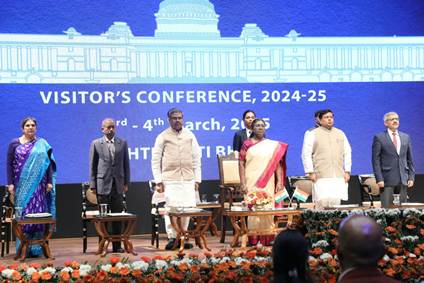
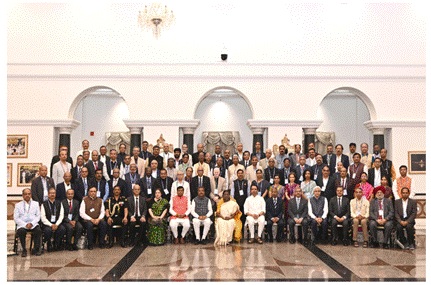
The two-day Visitor’s Conference at Rashtrapati Bhavan concluded today.
The Conference deliberated on the themes – Flexibility in academic courses, Credit Sharing and Credit Transfer with multiple entry and exit options; Internationalisation efforts and collaboration; Translation Research and Innovation related to converting research or innovation into useful products and services; Effective student selection processes and respecting student choices in context of NEP; and Effective assessments and evaluation. The outcome of deliberations was presented before the President of India, Smt Droupadi Murmu.
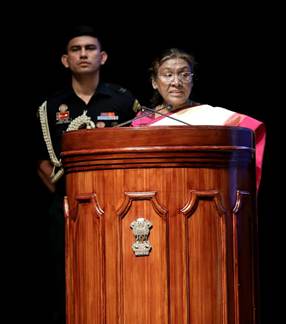
In her concluding remarks, the President said that our national goal is to make India a developed country before the end of the first half of this century. To achieve this goal, all stakeholders of the educational institutions and students would have to move forward with a global mindset. Young students would make a more effective identity for themselves in the 21st century world with the strengthening of internationalisation efforts and collaborations. Availability of excellent education in our higher education institutions would decrease the tendency to study abroad. Our young talent would be better utilized in nation building.
The President said that India is moving towards becoming the third largest economy in the world. Being self-reliant is the hallmark of a truly developed, large and strong economy. Self-reliance based on research and innovation would strengthen our enterprises and economy. Such research and innovation should get every possible support. She highlighted that in developed economies, the academia-industry interface appears strong. Due to continuous exchange between the industry and higher education institutions, research work remains linked to the needs of the economy and society. She urged the heads of institutions of higher learning to make institutional efforts to have continuous discussions with senior people of industrial institutions in mutual interest. She said that this would benefit the teachers and students doing research work. She also told them that connecting the laboratories of educational institutions with local, regional, national and global needs should be their priority.
The President said that it is imperative and challenging to have an education system that is system-based and flexible according to the special talents and needs of the students. In this context, there is a need to remain constantly alert and active. Appropriate changes should continue to take place based on experience. Empowering students should be the objective of such changes.
The President said that a nation becomes strong and developed only on the strength of characterful, sensible and capable youth. In educational institutions, the character, prudence and capability of our young students are developed. She expressed confidence that the heads of institutions of higher learning would achieve the proud ideals of higher education and would present a bright future to the young children of Mother India.
Union Minister for Education Shri Dharmendra Pradhan, while addressing the gathering, expressed his gratitude to President Smt. Droupadi Murmu for her guidance and words of inspiration during the inauguration and the concluding session. He also expressed gratitude to academic leaders for their active participation and meaningful discussions at the Visitor’s Conference. He noted that their diverse perspectives and forward-thinking ideas had enriched the confluence and contributed to shaping a roadmap for the country’s bright future.
Highlighting the collective responsibility of shaping India’s education system, he emphasized that the swift and large-scale implementation of NEP 2020 should be a national mission.
Acknowledging the challenges ahead, he affirmed that with collective efforts, a shared vision, and strong commitment, the education system could be redefined, paving the way for a knowledge-driven, self-reliant Bharat on its journey to becoming a developed country by 2047.
He further underscored the significance of students as the most important stakeholders and the backbone of the education system.
Reiterating the vision of Prime Minister Shri Narendra Modi, he stressed the importance of prioritizing students’ interests by investing in their education, equipping them with the right skills, empowering them to dream big, and supporting them in achieving their aspirations—not merely as an academic obligation but as a duty toward the nation.
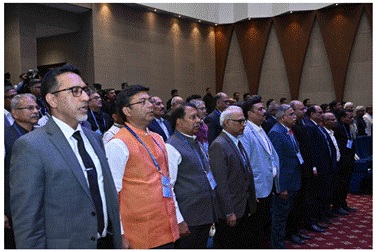
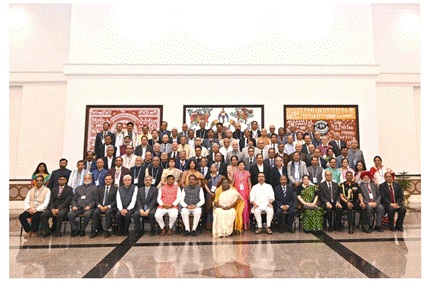
Union Minister of State for Education & Development of the North Eastern Region, Dr. Sukanta Majumdar presented the Vote of Thanks. Secretary, Department of Higher Education, Dr. Vineet Joshi presented the summary of the session. Shri Amit Khare, Advisor to the Prime Minister and Smt. Deepti Umashankar, Secretary to the President were also graced the occasion. Officials of the President’s house, Ministry of Education and Heads of Higher Education Institutes were also present at the event.
In addition to summing up the key takeaways of the five sessions, Dr. Joshi, in his speech, stated that the conference had served as a platform that brought together visionary leaders, educationists, and policymakers to deliberate on the future of higher education in India. He highlighted that the National Education Policy (NEP) 2020, which is a transformational reform rooted in ancient Indian principles, upholds the pursuit of knowledge (Gyan), wisdom (Pragyaa), and truth (Satya) as the highest human goals. He emphasized the five key pillars of NEP 2020, which are Learner-Centric Education, Digital Learning, Academic Research and Internationalization, Industry-Institute Collaboration, and Indian Knowledge Systems. The policy is aimed at creating a holistic, inclusive, high-quality, and accessible education ecosystem, he also added.
Session Summary:
Session 1:
The theme of the 1st Session was Flexibility in academic courses, Credit Sharing and Credit Transfer with multiple entry and exit options. The session summary was presented by Prof. Anand Bhalerao, Vice-Chancellor of the Central University of Rajasthan. He informed the key snippets of the deliberation, which were, The Need for Academic Flexibility; Credit Sharing and Transfer: A Pathway to Student Mobility; Global Best Practices as a Model for India; Multiple Entry and Exit Options Will Democratize Higher Education; and Challenges in implementation and the way forward. The Session also focused on areas of focus such as institutional readiness, Inter-university coordination, technology and infrastructure, Quality Control, and Regulatory Framework. He also informed the recommendations of the Panel which were strengthening policy and regulatory framework, building digital infrastructure for credit transfer, enhancing university collaboration and partnership, capacity building for faculty and administrators, ensuring student awareness and engagements and fostering industry collaboration and skill development.
Session 2:
The theme of the 2nd session was Internationalization efforts and collaborations and Prof. M. Jagadesh Kumar, Chairman, UGC, presented the summary. He highlighted the great potential that India has for the Internationalization of Education. Three kinds of Internationalization were discussed during the deliberation, which were encouraging Indian institutions to set up campuses outside India, the potential India has to attract international students and providing high-quality international education to Indian students in India. He especially highlighted how discussions were carried out on keeping Global South in focus. He also emphasized how Institutes can implement NEP2020, introducing the Indian Knowledge System to international students to present a unique opportunity.
Session 3:
The theme of the 3rd session was Translation Research and Innovatio. Prof. Govindan Rangarajan, Director, Indian Institute of Science (IISc) Bangalore, presented the session summary for this session. He highlighted a few challenges the HEIs face in translational research and innovation from Lab to Land. He showed the link between Science (Know-Why), Engineering (Know-How) and ‘Technology’ (Show-How). Emphasizing the importance of fundamental research, he listed the factors important for changing the faculty mindset (Publications to Products); not diluting fundamental research; link between Product patents and research papers; inspiring to solve local problems (society, industry); Translational research fellowships etc. The factors needed for building the necessary ecosystem; How to attract and partner with industry (Trust & Track record); were also discussed during the deliberation, he informed.
Session 4:
The theme of the 4th session was Effective student selection processes and respecting student choices in the context of NEP for which the session summary was presented by Prof. Manindra Agrawal, Director, IIT Kanpur.
Session 5
The theme of the 5th session was Effective Assessment & Evaluation for which the session summary was presented by Dr. K Radhakrishnan, Former Chairman, ISRO and Chairman, BoG IIT Kanpur. He elaborated on the context of the discussion, which was Technology, which is advancing exponentially and pervading (Including Pedagogy); Imperative for the multidisciplinary mind; Holistic Development of Students; Outcome-based education; and transforming the key Enablers, which are faculty, programme, and institutions. He elaborated on the facets of holistic development of studies, which include intellectual, aesthetic, social, physical, extracurricular Arts, Sports, emotional, ethical, and value-based education. He also elaborated on the discussion that took place on five dimensions of outcome-based education, which were Knowledge Acquisition (Recall); Application of Knowledge (Problem-Solving); Analytical Ability (Decipher Patterns, Trends, Critical Thinking); Synthesis (New Ideas from Multi-farious inputs); and Learning how to learn.
Click here to see the President’s speech in Hindi:
In her inaugural address, the President said that the level of development of any country is reflected in the quality of its education system. She told the heads of the institutions of higher learning that they have a crucial role in achieving the goal of establishing India as an important centre of the knowledge economy. She highlighted the need to pay a lot of attention to research along with education. She said that the Government of India has established the National Research Fund with a very good objective. She expressed confidence that institutions of higher learning would make good use of this important initiative and encourage research.
The President said that the ambition of our higher education community should be that researchers from our institutions get recognition at the world level, patents of our institutions can bring change in the world, and students from developed countries choose India as a preferred destination for higher education.
The President said that students from India enrich the world’s leading educational institutions and developed economies with their talent. She emphasised the need of making efforts to utilize their talent in our country. She stated that our national goal of establishing India as a Global Knowledge Super Power would be achieved only when the world community is eager to adopt the work being done in our laboratories.
The President said that many higher education institutions of our country have global brand value. The students of these institutions get big responsibilities in the best institutions and companies of the world. However, all our institutions should move ahead very fast. The leadership of heads of institutions of higher learning would be recognised by developing and utilising the immense talent of our large youth population.
The President said that along with excellence, social inclusion and sensitivity should also be an essential aspect of our education system. No economic, social, or psychological limitation of any kind should be a hindrance in getting higher education. She said that heads and teachers of institutions of higher learning should take care of young students, remove any insecurity from their minds and provide them moral and spiritual strength. She urged them to make every possible effort to provide counselling and inspiration to students and spread positive energy in the campuses.
The President said that our country has a rich tradition of scientific achievements. The branches and sub-branches of Indian knowledge and science have flourished in every region of the country. It would be very useful to rediscover the invaluable but extinct streams of knowledge and science by doing intense research. She stated that it is the responsibility of the higher education ecosystem to find ways to use such organically grown knowledge systems in today’s context.
The President said that educational institutions shape the future of the nation. Young students learn from the conduct of our policy makers, teachers, heads of institutions, and senior students. She expressed confidence that with their global thinking, the heads of higher learning institutions would prepare a generation of builders of a developed India.
During the inaugural session, the President presented the eighth Visitor’s Awards in the categories of Innovation, Research, and Technology Development.
The Visitor’s Award for Innovation was given to Prof Saripella Srikrishna, Banaras Hindu University, for developing Novel Indigenous Innovation in Quantum Technology to boost the National Green Hydrogen Mission.
The Visitor’s Award for Research in the field of Physical Sciences was conferred upon Prof Ashwini Kumar Nangia, University of Hyderabad, for his seminal research in the discovery and development of high bioavailability drugs and pharmaceuticals with enhanced efficacy at affordable cost.
The Visitor’s Award for Research in Biological Sciences was jointly presented to Prof Rina Chakrabarti, University of Delhi and Prof Raj Kumar, Central University of Punjab. Prof Chakrabarti has been conferred the Award for her research contributions to Sustainable Freshwater Aquaculture while Prof Raj Kumar has been presented the Award for his research contributions to exploring various cancer hallmarks and the development of synthetic anticancer lead molecules.
The Visitor’s Award for Technology Development was presented to Dr Venkateswarlu Chintala, Gati Shakti Vishwavidyalaya, for his research contributions to the petrol and diesel production at commercial scale from landfill municipal mixed plastic waste.
Tomorrow, the Conference will deliberate on issues such as – Flexibility in academic courses, Credit Sharing and Credit Transfer with multiple entry and exit options; Internationalisation efforts and collaboration; Translation Research and Innovation related to converting research or innovation into useful products and services; Effective student selection processes and respecting student choices in context of NEP; and Effective assessments and evaluation. The outcome of these deliberations will be presented before the President in the closing session of the Conference.
Shri Dharmendra Pradhan, while presenting the opening remarks, expressed his gratitude to the President, Smt. Droupadi Murmu, for guiding the academic fraternity with constant guidance, steady support, and visionary leadership. He also congratulated all the distinguished recipients of the 8th Visitor’s Awards.
Shri Pradhan mentioned that Smt. Droupadi Murmu’s leadership has always shown the way forward in breaking new ground in education, achieving national educational priorities, navigating the ever-evolving learning landscape, as well as taking significant strides toward making India the epicentre of knowledge, research, and innovation.
He urged the participants of the Conference to share their concerns, discuss best practices, and envision the future of higher education. He also highlighted that NEP 2020 stands at the heart of today’s discussions, a transformative blueprint reshaping the country’s education system.
The Minister urged everyone to create an ecosystem that empowers the youth, strengthens the workforce, and accelerates India’s journey toward Viksit Bharat 2047.
Expressing his gratitude to Prime Minister Shri Narendra Modi for his clarion call of Viksit Bharat by 2047, the Minister said the nation ought to be self-reliant, innovative, and knowledge-driven. Education must go beyond degrees; it must create thinkers, innovators, solution-givers, and job creators, for which the implementation of NEP 2020 in letter and spirit is essential, he noted. He emphasized the importance of rising above institutional silos to ensure that NEP 2020 translates into real and long-lasting impact.
He stressed the importance of working collaboratively and sharing best practices to optimize academic strength, strengthen policies, and execute them well with a real impact on the ground.
Showing his optimism, he said that academic institutions will emerge as the lighthouse of Viksit Bharat, anchoring the developmental journey in the Amrit Kaal and beyond. He also expressed confidence that the Visitor’s Conference will provide a clear roadmap for holistically transforming the education system, empowering the youth, strengthening the workforce, and establishing India’s higher education ecosystem as a global benchmark.
On the occasion of World Autism Awareness Day (April 2, 2025), the Ministry of Education, Government of India reaffirms its commitment to inclusive education by strengthening support systems for children with autism spectrum disorder in schools.
Through Block Resource Centres (BRCs), the government is ensuring that children with autism spectrum disorder (ASD) receive essential therapy services, specialized interventions, and learning support to help them reach their full potential.
Supported under the centrally sponsored scheme- Samagra Shiksha, the BRCs serve as dedicated resource centers, offering essential therapy-based interventions to support the physical, cognitive, and communicative needs of CwSN.
These include:
Occupational Therapy: Helps children develop fine motor skills, hand-eye coordination, and independence in daily activities.
Physiotherapy:Supports children with mobility challenges, improving posture, muscle strength, and physical coordination.
Speech and Communication Therapy: Supports children with delayed speech, difficulty in communication, or social interaction challenges, especially beneficial for children with autism.
Psychological & Behavioural Support: Provides emotional and behavioural counselling to enhance confidence, social interaction, and well-being.
BRCs are staffed with trained resource persons, special educators, and therapistswho work closely with parents, teachers, and caregivers to create personalized intervention plans for children.
These centres also organize regular screening camps, parent counselling sessions, orientation/teacher training programs, assistive devices, appropriate Teaching-Learning Material (TLM), and aids & appliances etc. to ensure a holistic approach to inclusive education.
As envisioned in the National Education Policy (NEP) 2020, the government is continuously strengthening these inclusive learning environments by integrating therapy services with classroom learning and ensuring accessible infrastructure, assistive devices, and digital learning solutions for CwSN across the country.
State and district education authorities are encouraged to maximize the utilization of Resource Centres and also collaborate with local health and social welfare departments to further expand support for children with diverse needs.
On this World Autism Awareness Day, the Ministry appeals to schools, educators, and parents to optimally utilise the services of BRCs for CwSN and also work together to promote awareness, acceptance, and meaningful inclusion of children with autism spectrum disorder.









 Eduindex
You must be logged in to post a comment.