

Citation
Udegbunam, I. P., Idowu, M.-M. A., & Nwankwo, B. C. (2026). Effect of Welfare Administration on Employee Service Delivery in Nnamdi Azikiwe University, Awka, Anambra State, Nigeria: 2010 – 2024. International Journal of Research, 13(4), 128–143. https://doi.org/10.26643/ijr/edupub/11
Ifeoma Priscilla Udegbunam1, Michael-Mary A. Idowu2, & Prof. B. C. Nwankwo3
1, 2&3 Department of Public Administration Faculty of Management Sciences Nnamdi Azikiwe University Awka, Anambra state, Nigeria
1pi.udegbunam@unizik.edu.ng
2idowumicky@gmail.com
3bc.nwankwo@unizik.edu.ng
ABSTRACT
This study examined the effect of welfare administration on employee service delivery at Nnamdi Azikiwe University, Awka, Anambra State, Nigeria, covering the period 2010–2024. The study was motivated by persistent concerns regarding inadequate staff welfare, including poor funding, irregular allowances, and unsatisfactory working conditions, which may affect employee performance and service delivery in Nigerian universities. The specific objectives were to examine the effect of inadequate funding on employee effectiveness and to analyze the influence of workplace environment on efficient service delivery. The study adopted a descriptive survey research design. Data were collected from both primary and secondary sources, with primary data obtained through structured questionnaires administered to academic and non-academic staff of the university. A sample size of 380 was determined using the Taro Yamane formula, while 366 valid responses were analyzed. The study employed a stratified random sampling technique to ensure adequate representation of staff categories. The instrument was validated through expert review and tested for reliability using the test-retest method, yielding a high reliability coefficient of 0.93. Data were analyzed using descriptive statistics and multiple regression analysis with the aid of SPSS version 25. The findings revealed a significant negative relationship between inadequate funding and employee effectiveness (R = .612, R² = .375, p < 0.05), indicating that insufficient funding reduces employee productivity and performance. Conversely, the study found a strong positive relationship between workplace environment and efficient service delivery (R = .735, R² = .541, p < 0.05), suggesting that a conducive work environment enhances employee output and service quality. The study concluded that effective welfare administration is a critical determinant of employee performance and service delivery. While inadequate funding undermines staff effectiveness, a supportive workplace environment significantly improves service outcomes. The study recommended increased and consistent funding, as well as improvements in workplace conditions, to enhance employee productivity and institutional performance.
Keywords: Welfare Administration, Employee Effectiveness, Service Delivery, Workplace Environment, Funding, University System.
INTRODUCTION
Background to the Study
Employee welfare is a critical factor in the success of any organization, particularly in institutions of higher learning where productivity, service delivery, and educational outcomes are highly dependent on the motivation, satisfaction, and engagement of academic and non-academic staff. Staff welfare administration encompasses a range of policies, practices, and programs aimed at ensuring the well-being of employees in their workplace (Wokoma & Obasi, 2023). These include financial incentives, health and safety provisions, housing and transportation allowances, pension and retirement schemes, opportunities for professional development, and general workplace conditions. According to Poi (2020), effective welfare administration not only enhances employee satisfaction but also significantly improves organizational performance through increased efficiency, reduced absenteeism, and better service delivery. In Nigeria, the importance of staff welfare administration has received increased attention in recent years, especially within the public sector. Nigerian universities, particularly federal institutions such as Nnamdi Azikiwe University, Awka, operate in an environment where expectations for improved educational standards and administrative efficiency continue to rise amidst challenges of poor funding, infrastructural decay, and political instability. The growing emphasis on improving higher education has necessitated the need to explore the variables that drive staff performance, among which welfare administration plays a central role.
Nnamdi Azikiwe University, Awka, established in 1991 and named after Nigeria’s first president, is one of the federal universities in Nigeria with a reputation for academic excellence and administrative dynamism (Nnamdi Azikiwe University, Awka, 2021). With a large workforce of academic, administrative, and technical staff, the university reflects the broader Nigerian public service system. The Nigerian university system has witnessed both positive and negative developments in staff welfare administration. National policies such as the Integrated Payroll and Personnel Information System (IPPIS), Academic Staff Union of Universities (ASUU) strikes, and recent economic downturns have significantly influenced the dynamics of employee welfare. For instance, the implementation of IPPIS aimed at curbing corruption and ensuring transparency in salary administration was met with resistance by academic unions who claimed it infringed on university autonomy and disrupted welfare benefits (Olagunju & Olufemi, 2021; Adisa, 2024). Additionally, the frequent ASUU strikes during this period, often triggered by unmet welfare agreements, disrupted academic calendars and impacted service delivery. The challenges of staff welfare in Nigerian Universities, especially in Nnamdi Azikiwe University, Awka are complex and varied. University Staff have repeatedly complained about delayed promotions, irregular payment of allowances, inadequate health facilities, insufficient funding for research, and lack of institutional support for career advancement (Asiegbu & Nwajagu, 2022; Onwuka, Nwokolo & Achebe, 2022; Ogunode, Jegede & Musa, 2021). These concerns have raised questions about the effectiveness of the university’s welfare administration and its implications on employee output. Despite the existence of policies and welfare committees, there appears to be a gap between policy formulation and implementation, resulting in staff grievances and reduced morale.
The administration of staff welfare in Nigerian universities has evolved significantly over the years, shaped by economic realities, government policies, and union advocacy (Tom, Etukudoh & Edet, 2024). The 1990s and early 2000s were marked by widespread discontent among university staff due to worsening working conditions, infrastructural decay, and unattractive remuneration. These challenges triggered mass emigration of professionals (brain drain) and intensified the activities of staff unions, particularly the Academic Staff Union of Universities (ASUU) (Ogunode & Atobauka, 2021; Nwokeocha, 2015). The unions advocated for improved welfare through better salary structures, housing allowances, healthcare, and academic support. In response, the federal government introduced the Consolidated University Academic Salary Structure (CONUASS) and the Consolidated Tertiary Institutions Salary Structure (CONTISS) in the mid-2000s. These structures aimed to standardize remuneration and improve staff welfare across Nigerian universities (Inquire Salary, 2025). However, the implementation of these reforms was often inconsistent and plagued by funding limitations and bureaucratic delays.
The COVID-19 pandemic exposed further gaps in welfare administration, particularly in health coverage, digital infrastructure, and remote work support. Some universities responded by introducing health programmes and wellness initiatives, but challenges such as underfunding, inefficiency, and poor policy execution persisted (Ipia-Ogbu, 2021). Union engagement continues to shape the welfare discourse, with ASUU, NASU, and SSANU pushing for more robust welfare provisions. Despite these efforts, Nigerian universities still face structural obstacles, including poor funding, outdated infrastructure, and resistance to institutional reforms. Although several studies (e.g., Poi, 2020; Ogunode, Jegede & Musa, 2021; Asiegbu & Nwajagu, 2022) have examined welfare issues in Nigerian universities, much of the existing literature has concentrated on broad challenges such as delayed promotions, irregular allowances, and insufficient research funding. Limited attention has been given to specific welfare components such as medical insurance and healthcare services, housing assistance, childcare services, and insurance plans, which directly influence staff motivation, commitment, and service delivery. Moreover, most studies have taken a nationwide perspective, neglecting the institution-specific realities of universities such as Nnamdi Azikiwe University, Awka, which has its own peculiar administrative structures and welfare dynamics. In addition, the disconnect between welfare policy formulation and its implementation, as well as the lessons from the COVID-19 pandemic on staff welfare and service delivery, remain underexplored. This study, therefore, seeks to bridge these gaps by examining how staff welfare administration between 2010 and 2024 has affected employee service delivery in Nnamdi Azikiwe University, Awka.
Statement of the Problem
In a functional university environment, staff welfare administration is generally expected to contribute positively to employee motivation and performance. Financial incentives, a conducive workplace environment, access to healthcare, housing benefits, and opportunities for career advancement are often regarded as important factors that may support effective service delivery (Akintoye & Ofobruku, 2022). When these elements are adequately managed, they are presumed to promote employee satisfaction, improve productivity, and enhance the overall efficiency of university operations.
However, observations and available reports suggest that the reality of staff welfare administration in Nnamdi Azikiwe University, Awka, may not fully align with this ideal. Concerns have been raised by staff regarding delayed promotions, inconsistent payment of allowances, and limited access to healthcare services, and inadequate support for professional growth. These issues might be contributing to a decline in morale and possibly affecting the quality of service delivery across the institution. While various welfare policies exist, there appears to be a gap between policy formulation and actual implementation, which may be limiting the intended outcomes.
Efforts have been made at various times to improve staff welfare within Nigerian universities. For example, government interventions such as the introduction of the Integrated Payroll and Personnel Information System (IPPIS), the development of salary structures like CONUASS and CONTISS, and negotiations between staff unions and government bodies aimed to address welfare-related challenges. Additionally, during the COVID-19 pandemic, some institutions attempted to introduce health programs and digital support systems for staff. Despite these efforts, concerns about the adequacy and consistency of these interventions remain. Notwithstanding past efforts, challenges related to staff welfare administration seem to persist in Nnamdi Azikiwe University, Awka. Recurring industrial actions, continued staff complaints, and reported disruptions in service delivery indicate that the problem may not have been fully resolved. The extent to which welfare administration affects employee service delivery remains unclear, especially in light of the evolving economic and institutional context between 2010 and 2024. This uncertainty underscores the need for a systematic investigation into the relationship between staff welfare practices—particularly financial incentives and workplace environment—and employee service delivery within the university.
Objectives of the Study
The broad objective of this study was to assess effect of welfare administration on employee service delivery at Nnamdi Azikiwe University, Awka from 2010 to 2024. Specifically, the study seeks to achieve the following:
- To examine how inadequate funding affect the effectiveness of employee in Nnamdi Azikiwe University, Awka.
- To analyze the effect of workplace environment on efficient service delivery in Nnamdi Azikiwe University, Awka.
Research Questions
Two research questions were formulated:
- How does inadequate funding affect employee effectiveness at Nnamdi Azikiwe University, Awka?
- What is the effect of the workplace environment on efficient service delivery at Nnamdi Azikiwe University, Awka?
Hypotheses
The following two null hypotheses were tested for the purpose of this study
- H₀₁: There is no significant relationship between inadequate funding and employee effectiveness at Nnamdi Azikiwe University, Awka.
- H₀: There is no significant relationship between the workplace environment and efficient service delivery at Nnamdi Azikiwe University, Awka.
REVIEW OF RELATED LITERATURE
Conceptual Review
Welfare Administration
Olayinka (2019) defined Welfare Administration as a systematic and organized approach within an organization aimed at providing various services, facilities, and programs to ensure the overall well-being of employees. This concept encompasses a broad range of initiatives that are designed to enhance the personal and professional lives of employees. These welfare services can include, but are not limited to, health benefits (such as medical insurance or access to healthcare services), housing assistance (subsidized housing or home loans), childcare services (on-site daycare or financial support for childcare), insurance plans (life insurance, disability, or accident coverage), training and development opportunities (career advancement programs, skill development workshops), and other personal or professional support initiatives like counseling or stress management programs. A well-structured and efficiently managed welfare administration system plays a crucial role in improving employee satisfaction. By meeting employees’ basic needs and providing benefits that support both their personal and professional lives, such systems foster a work-life balance, which is essential for employee contentment and well-being. When employees perceive that their organization genuinely cares about their welfare, they are more likely to feel motivated and engaged in their work, which directly contributes to increased productivity. Moreover, employee morale is significantly boosted when they feel valued, supported, and respected within the workplace. Welfare programs create an atmosphere of trust and support, making employees more likely to stay committed to the organization. A well-supported workforce is less likely to experience high levels of stress or burnout, reducing the likelihood of turnover.
According to Dayarathna (2019), a welfare program that is both structured and objective in its approach can significantly enhance organizational performance. A structured welfare program means that the services and benefits offered to employees are clearly organized, systematically implemented, and consistently evaluated. This approach ensures that all employees have access to the same resources and that the program is aligned with the organization’s overall goals and values. By being objective, the program is designed with specific, measurable outcomes in mind. This means that the welfare services are not arbitrary but are carefully planned to address the actual needs and challenges faced by employees. The focus is on outcomes such as improved employee health, increased job satisfaction, reduced absenteeism, and enhanced productivity, all of which directly contribute to the success of the organization. A well-structured and objective welfare program provides several benefits to the organization. It can boost employee morale by making them feel valued and cared for, which in turn leads to increased job satisfaction. When employees are satisfied with their work environment and feel supported in both their personal and professional lives, they are more likely to be engaged and motivated, ultimately contributing to higher productivity.
Akinfolarin (2017) explained that welfare administration refers to the systematic process or act of providing welfare packages and programs designed to enhance workers’ job satisfaction and promote improvements within any enterprise. This process involves a comprehensive approach to addressing the physical, emotional, and psychological needs of employees through various support mechanisms. These welfare programs are aimed not only at improving the overall well-being of workers but also at ensuring that they remain motivated, engaged, and productive in their roles. Such programs may include healthcare benefits, retirement plans, work-life balance initiatives, career development opportunities, and other incentives that contribute to creating a supportive and conducive work environment. By addressing these needs, welfare administration plays a crucial role in improving employee morale, reducing turnover rates, and enhancing the overall performance and success of an organization.
Service Delivery
Samitier (2017) asserted that service delivery is the direct counterpart to service provisioning, and together they represent the complete customer-to-provider relationship. While service provisioning refers to the process of making services available or providing them to customers, service delivery is the actual execution or fulfillment of these services. The relationship between the customer and the provider is thus shaped by both the availability and the quality of the service being provided. Service delivery focuses on the interaction between the service provider and the customer, where the success of this relationship depends on the provider’s ability to meet the needs and expectations of the customer in a timely and efficient manner. This dynamic underlines the importance of both stages in ensuring customer satisfaction and fostering long-term loyalty.
Shittu (2020) defined service delivery as the extent to which the services provided by various sectors meet or exceed the expectations of the beneficiaries, which in this context refers to the general public. This definition emphasizes that the effectiveness of service delivery is measured by how well the services align with or surpass the anticipated needs and standards of the people they are intended to serve. When services meet or exceed these expectations, they contribute to higher levels of satisfaction among beneficiaries, enhancing the overall perception of service quality. On the other hand, a failure to meet these expectations can lead to dissatisfaction and a lack of trust in the service providers. Thus, the quality of service delivery plays a pivotal role in shaping public opinion and ensuring the success and credibility of the sectors involved.
Lovelock and Wright (2002, as cited in Martins & Ledimo, 2015) described service delivery as the actual process of delivering a service or product to the customer or client. This definition highlights the operational aspect of service provision, focusing on the point at which the customer receives the intended service or product. It encompasses all the activities, interactions, and procedures involved in ensuring that what has been promised by the service provider is effectively rendered to the end user. Service delivery, therefore, is a critical component of customer satisfaction, as it determines whether the client’s needs are met in terms of timeliness, efficiency, quality, and reliability. Effective service delivery not only enhances client experiences but also builds trust and reinforces the reputation of the service provider.
Carlson, Lamalle, Fustukian, Katy, Sibbons, and Sondorp (as cited in Kayoed, Adagba, and Anyio, 2013) offered a comprehensive and multidimensional understanding of service delivery by framing it as a complex interaction among key stakeholders—namely, policymakers, service providers, and marginalized or disadvantaged groups. According to their conceptualization, service delivery goes beyond the mere act of rendering services; it involves the strategic coordination and engagement of various actors to meet the essential needs of the population. This perspective incorporates a broad range of responsibilities traditionally associated with the state, including the provision of critical social services such as primary education, basic healthcare, and essential public infrastructure like potable water supply, adequate sanitation, and functional transportation systems, including roads and bridges. By emphasizing the interdependence of these elements, the authors highlight that effective service delivery relies on collaborative efforts and sound governance structures that prioritize equity and access.
Theoretical Framework
This study is anchored on Herzberg’s Two-Factor Theory, also known as the Motivation-Hygiene Theory, which was developed by Frederick Herzberg in 1959. The theory posits that there are two distinct categories of factors that influence employee motivation and satisfaction in the workplace: motivators and hygiene factors (Yongfang, 2024). These two sets of factors operate independently and affect job satisfaction and dissatisfaction differently. According to Hur (2018), motivators are factors intrinsically connected to the nature of the work itself. These include aspects such as recognition for accomplishments, responsibility entrusted to the individual, achievement in completing meaningful tasks, and opportunities for personal growth and self-development. These elements are primarily responsible for increasing job satisfaction and fostering a sense of purpose and motivation among employees. When present, motivators stimulate individuals to perform at higher levels because they fulfill their psychological needs for growth, advancement, and self-actualization.
In contrast, hygiene factors pertain to the extrinsic conditions surrounding the job, which, while not necessarily motivating, are essential in preventing dissatisfaction. These include salary and monetary benefits, workplace policies, supervisory practices, job security, and the quality of interpersonal relationships within the organization (Weber-Kramer, 2023). When these factors are inadequate or perceived as unfair, they lead to employee dissatisfaction. However, even when these factors are sufficiently addressed, they do not necessarily lead to increased motivation or satisfaction—rather, they create a neutral state in which dissatisfaction is absent, but motivation must still be driven by the presence of motivators. This distinction underscores the dual structure of job attitudes proposed by Herzberg, suggesting that improving workplace satisfaction requires more than just addressing grievances; it demands the incorporation of meaningful and fulfilling aspects of work that truly engage employees.
Figure 1: Herzberg’s Motivation-Hygiene Theory Diagram

Sources: Bluedonkey (2022). https://www.bluedonkey.co.uk/herzberg-two-factor-theory-lead-generation/
Figure 2: Herzbers‘s two-factor theory of motivation.
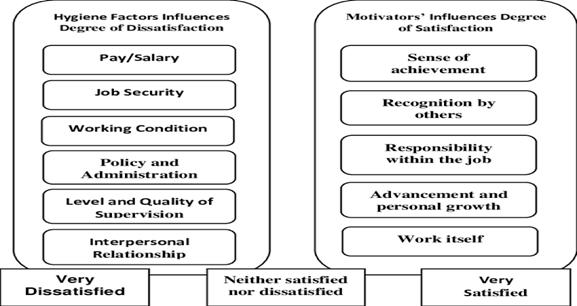
Sources: Adapted from Ololube, Obilor, Chinyere and Nwachukwu (2018,). https://www. researchgate.net/publication/330834729_Institutional_Management_Motivation_and_Human_Performance
Herzberg’s Two-Factor Theory (1959) distinguishes between two key categories of job-related factors: hygiene factors and motivational factors. Hygiene factors, such as salary, job security, organizational policies, supervision quality, and working conditions, address basic human needs and ensure employee comfort. While their presence may lead to general satisfaction, they do not actively drive motivation or performance. However, their absence results in dissatisfaction, making them essential for maintaining a baseline level of contentment within the workforce. Salary and benefits fulfill employees’ financial security needs, while job security mitigates stress and uncertainty. Additionally, the physical and psychological aspects of the work environment, such as cleanliness and stress levels, along with supervisory practices and company policies, shape employee attitudes. A company’s external reputation can also influence employees’ sense of pride and comfort in their roles. In contrast, motivational factors are intrinsic to the work itself and inspire employees to perform at higher levels. These factors include achievement, recognition, advancement, creativity, and personal development. When employees experience accomplishment, are recognized for their contributions, and are entrusted with responsibilities that allow autonomy, their motivation is significantly enhanced. Opportunities for intellectual stimulation and professional growth fulfill higher-level needs, leading to sustained engagement and job satisfaction.
Herzberg’s Two-Factor Theory provided a valuable framework for understanding the relationship between welfare administration and employee service delivery at Nnamdi Azikiwe University, Awka, from 2010 to 2024. The theory posits that employee satisfaction and motivation are influenced by two distinct categories of job-related factors: hygiene factors and motivational factors. In the context of the university, welfare administration encompasses various policies, practices, and provisions designed to enhance employee well-being and performance. These include salaries, benefits, job security, working conditions, and opportunities for growth and development. Hygiene factors, according to Herzberg, are the foundational elements that prevent dissatisfaction in the workplace. Within the university setting, when welfare policies adequately address basic needs such as fair compensation, secure employment, and conducive working environments, employees are more likely to experience a sense of stability and comfort. For instance, consistent salary payment, access to health insurance, and pension schemes contribute significantly to reducing financial stress and enhancing employee morale. Similarly, transparent administrative policies and respectful supervisory practices help build trust between staff and management, reducing workplace tensions. However, while these factors can lead to general job satisfaction, they do not necessarily drive employees to go above and beyond in their service delivery. Their absence, on the other hand, often results in demotivation, absenteeism, and poor performance.
On the other side of Herzberg’s model are motivational factors, which are intrinsic to the nature of the work itself and are essential for encouraging employees to deliver at their highest capacity. In the university, welfare administration that fosters achievement, recognition, and opportunities for personal and professional development plays a crucial role in motivating employees. When lecturers and administrative staff feel that their efforts are acknowledged and rewarded—whether through promotions, performance-based incentives, or public recognition—they are more likely to remain engaged and committed to their roles. Furthermore, when employees are entrusted with responsibilities that allow for autonomy, creativity, and intellectual stimulation, they derive a sense of purpose and fulfillment from their work. This, in turn, leads to enhanced performance, innovation in teaching and research, and improved service delivery across departments. The integration of both hygiene and motivational factors in welfare administration at Nnamdi Azikiwe University is therefore critical to cultivating a productive workforce. From 2010 to 2024, efforts to improve employee welfare—such as upgrading facilities, promoting staff development programs, and improving communication between staff and management—have contributed to varying degrees of employee satisfaction and performance. However, challenges such as inconsistent funding, delayed promotions, and inadequate recognition still pose barriers to optimal service delivery.
RESEARCH METHOD
The study adopted a descriptive survey research design, which is suitable for assessing employee perceptions and organizational practices without manipulating variables. This design enabled the collection of both quantitative and qualitative data on welfare components such as financial benefits, non-financial incentives, workplace environment, and recognition, as well as their influence on service delivery between 2010 and 2024. The study area is Nnamdi Azikiwe University, a major federal institution in Anambra State known for academic excellence and research productivity. Both primary and secondary data sources were used. Primary data were collected through structured questionnaires administered to academic and non-academic staff, while secondary data were obtained from institutional records, government publications, and relevant literature. This combination enhanced the validity of findings through triangulation.
The questionnaire served as the main instrument for data collection. It contained closed-ended and Likert-scale items designed to capture employees’ perceptions of welfare services and their impact on job performance. The population of the study comprised all 7,713 staff members of the university, including 2,770 academic and 4,943 non-academic staff. Using the Taro Yamane formula with a 5% margin of error, a sample size of approximately 380 respondents was determined. The sample was proportionately distributed between academic and non-academic staff to ensure adequate representation. A stratified random sampling technique was adopted, dividing the population into two strata (academic and non-academic), followed by simple random selection within each group to minimize bias. The instrument’s validity was ensured through face validation by academic experts, while reliability was tested using a pilot study and test-retest method. Spearman’s Rho correlation yielded a high reliability coefficient of 0.93, confirming the consistency of the instrument. Data analysis involved both descriptive and inferential statistics. Frequencies and percentages were used to summarize responses, while multiple regression analysis, conducted using SPSS version 25, examined the relationship between welfare administration and service delivery. Hypotheses were tested at a 0.05 level of significance, with decisions based on comparison of calculated and critical values.
RESULTS AND DISCUSSION
Demographic Data of Respondents
Table 1: Gender Distribution of Respondents
| Gender | Frequency | Percentage% |
| Male | 204 | 55.7% |
| Female | 162 | 44.3% |
| Total | 366 | 100% |
Source: Field survey, 2026
In this dataset, males make up approximately 55.2% of the total, while females make up approximately 44.7%. This indicates a slightly higher representation of males compared to females. Gender balance is important because male and female employees may have different experiences and expectations regarding welfare administration—such as maternity leave, recognition, and access to housing or promotion opportunities.
Table 2: Age of Respondents
| Range | Frequency | Percentage% |
| Below 30 | 74 | 20.2% |
| 31-39 | 95 | 26% |
| 40-49 | 102 | 27.9% |
| 50 and Above | 95 | 26% |
| Total | 366 | 100% |
Source: Field Survey, 2026
Table 2 shows the age distribution of the respondents. The youngest age group, those below 30 years, accounts for 74 respondents, representing 20.2% of the total sample. This is followed by the 31–39 age group, with 95 respondents, making up 26%. The 40–49 age group has the highest representation, comprising 102 respondents or 27.9% of the total. Lastly, respondents aged 50 and above make up 97 individuals, representing 26%. This distribution is relevant because welfare expectations often differ across age groups. Younger employees may value opportunities for training and career advancement, while older staff may prioritize pensions, medical benefits, and job security. Including all age groups ensures that the findings reflect the diverse welfare needs across the university workforce.
Table 3: Educational Qualification of Respondent
| Education Qualification | Frequency | Percentage% |
| WAEC/NECO/GCE | 69 | 18.9% |
| OND/NCE | 93 | 25.4% |
| HND/B. Sc/BA/B. Ed | 128 | 35% |
| M. Sc / MPA/MBA and Above | 76 | 20.8% |
| Total | 366 | 100% |
Source: Field Survey, 2026
The table shows the distribution of respondents based on their highest level of educational qualification. A total of 366 valid responses were recorded. Starting from the lowest qualification, 69 respondents (18.9%) possess secondary-level certificates such as WAEC, NECO, or GCE. This group represents individuals with basic education, possibly occupying junior-level positions within the organization. Next, 93 respondents (25.4%) hold OND or NCE qualifications, indicating a moderate level of tertiary education. These individuals are likely to be in technical, administrative, or support roles. The highest proportion of respondents, 128 (35%), have attained HND, B.Sc., B.A., or B.Ed. degrees. This group likely represents the bulk of the professional or managerial workforce within the organization. 76 respondents (20.8%) possess postgraduate qualifications such as M.Sc., MPA, MBA, or higher. This category includes individuals with advanced education, possibly occupying senior, strategic, or specialized roles. This distribution is relevant because it reflects the diversity of job categories within the university, ranging from junior-level staff to professionals and management. Employees with higher qualifications may have higher welfare expectations such as research grants, study leave, or housing benefits, while those with lower qualifications may focus more on basic needs like salary, medical care, and transport. Hence, the educational background of respondents provides context for understanding variations in perceptions of welfare administration.
Data Analysis
Research Question One: How does inadequate funding affect employee effectiveness at Nnamdi Azikiwe University, Awka?
Table 4: Financial Incentives
| S/N | Question | SA | A | UN | D | SD | Total |
| 1 | Inadequate funding limits access to necessary work resources and materials. | 132 (36.07) | 115 (31.42) | 8 (2.19) | 56 (15.30) | 55 (15.03) | 366 (100) |
| 2 | Lack of financial support reduces my motivation and job performance. | 118 (32.24) | 123 (33.61) | 7 (1.91) | 62 (16.94) | 56 (15.30) | 366 (100) |
| 3 | Inadequate funding affects the university’s ability to provide training and professional development opportunities. | 146 (39.89) | 112 (30.60) | 10 (2.73) | 47 (12.84) | 51 (13.93) | 366 (100) |
| 4 | Poor funding leads to understaffing, which increases workload and reduces effectiveness. | 147 (40.16) | 108 (29.51) | 2 (0.55) | 53 (14.48) | 56 (15.30) | 366 (100) |
| 5 | The delay or irregularity in salary payment due to inadequate funding negatively affects my work efficiency. | 128 (34.97) | 119 (32.51) | 3 (0.82) | 59 (16.12) | 57 (15.57) | 366 (100) |
| Total | 671 (36.61) | 577 (31.47) | 30 (1.64) | 277 (15.16) | 275 (15.02) | 1830 (100) |
Note: Figures in Parenthesis are percentages
Table 5 presents the distribution of responses on how financial incentives, particularly funding adequacy, affect employee performance and service delivery at Nnamdi Azikiwe University, Awka. The data indicate that a significant number of respondents perceive inadequate funding as a major barrier to accessing necessary work resources and materials. Specifically, 36.07% of the respondents strongly agreed, and 31.42% agreed with this assertion, accounting for a combined 67.49% agreement. In contrast, 15.30% disagreed, 15.03% strongly disagreed, and only 2.19% were undecided. The respondents also affirmed that lack of financial support reduces their motivation and job performance. This was evident as 32.24% strongly agreed and 33.61% agreed, yielding a total agreement of 65.85%. Meanwhile, 16.94% disagreed, 15.30% strongly disagreed, and a minimal 1.91% remained neutral.
Regarding the university’s ability to provide training and professional development opportunities, 39.89% of the participants strongly agreed and 30.60% agreed that inadequate funding has a negative impact, resulting in a combined agreement of 70.49%. A total of 12.84% disagreed and 13.93% strongly disagreed, while 2.73% were undecided. This highlights a general perception among staff that financial constraints hinder their growth and capacity development. Furthermore, 40.16% of respondents strongly agreed and 29.51% agreed that poor funding leads to understaffing, which increases individual workloads and reduces overall staff effectiveness. Only 0.55% were neutral on this item, while 14.48% disagreed and 15.30% strongly disagreed, further emphasizing the strong belief that funding shortages have operational consequences. Finally, 34.97% of respondents strongly agreed and 32.51% agreed that delays or irregularities in salary payment due to inadequate funding negatively affect their work efficiency, yielding a total agreement of 67.48%. A combined 31.69% of respondents disagreed or strongly disagreed, while only 0.82% were undecided.
Research Question Two: What is the effect of the workplace environment on efficient service delivery at Nnamdi Azikiwe University, Awka?
Table 5: Workplace Environment
| S/N | Question | SA | A | UN | D | SD | Total |
| 6 | My office/workspace is conducive to effective service delivery. | 147 (40.16) | 118 (32.24) | 5 (1.37) | 55 (15.03) | 41 (11.20) | 366 (100) |
| 7 | I have access to necessary work tools and equipment. | 149 (40.71) | 109 (29.78) | 3 (0.82) | 67 (18.31) | 38 (10.38) | 366 (100) |
| 8 | I feel safe and comfortable in my work environment. | 141 (38.52) | 94 (25.68) | 6 (1.64) | 71 (19.40) | 54 (14.75) | 366 (100) |
| 9 | My supervisors and colleagues support my professional efforts. | 136 (37.16) | 113 (30.87) | 9 (2.46) | 62 (16.94) | 46 (12.57) | 366 (100) |
| 10 | The physical and social environment encourages efficiency. | 148 (40.44) | 104 (28.42) | 2 (0.55) | 61 (16.67) | 51 (13.93) | 366 (100) |
| Total | 538 (29.39) | 25 (1.37) | 316 (17.26) | 230 (12.56) | 230 (12.57) | 1830 (100) |
Note: Figures in Parenthesis are percentages
The table above presents respondents’ views on the relationship between the workplace environment and employee service delivery at Nnamdi Azikiwe University, Awka. The data show that across all five statements related to the work environment, a significant majority of respondents either strongly agreed or agreed with the positive assertions made, suggesting a generally favorable perception of their workplace conditions. The highest level of strong agreement was recorded for the item stating, “I have access to necessary work tools and equipment,” where 40.71% strongly agreed and 29.78% agreed, indicating that the availability of tools and equipment is seen as a major contributor to effective service delivery.
Closely following this, 40.44% of respondents strongly agreed and 28.42% agreed that “the physical and social environment encourages efficiency,” emphasizing the combined influence of both the physical setting and interpersonal interactions on productivity. Similarly, the statement “My office/workspace is conducive to effective service delivery” received 40.16% strong agreement and 32.24% agreement, further demonstrating the perceived importance of a supportive physical workspace. The sense of safety and comfort in the workplace was affirmed by 38.52% who strongly agreed and 25.68% who agreed, pointing to the value of a secure and comfortable environment in enhancing employee focus and performance.
Finally, professional support from supervisors and colleagues was acknowledged by 37.16% of respondents who strongly agreed and 30.87% who agreed with the statement that their efforts are supported. This reveals the relevance of workplace relationships and managerial backing in ensuring consistent service delivery. Overall, the trend in responses indicates a strong positive relationship between a favorable workplace environment and improved employee service delivery. The low percentages of neutrality, disagreement, and strong disagreement further validate that most staff perceive their work environment as enabling rather than hindering their performance.
Test of Hypotheses
Regression Analysis for Research Hypothesis One
Hypothesis one: H₀₁: There is no significant relationship between inadequate funding and employee effectiveness at Nnamdi Azikiwe University, Awka.
Model Summary
| Model | R | R Square | Adjusted R Square | Std. Error of the Estimate |
| 1 | .612 | .375 | .373 | .351 |
Coefficients:
| Model | Unstandardized Coefficients | Standardized Coefficients | t | Sig. |
| B | Std. Error | Beta | ||
| (Constant) | 3.456 | .123 | 28.106 | |
| Inadequate Funding | -.275 | .035 | -.612 | -7.857 |
Interpretation:
The results revealed a statistically significant negative relationship between inadequate funding and employee effectiveness, R = .612, R² = .375, F(1, N-2) = 61.73, p < .001. This indicates that approximately 37.5% of the variance in employee effectiveness can be explained by inadequate funding. The regression coefficient was also significant, B = -0.275, t(178) = -7.86, p < .001, suggesting that a one-unit increase in perceived inadequate funding is associated with a 0.275 unit decrease in employee effectiveness. The standardized beta coefficient (β = -0.612) indicates a moderately strong negative effect. Therefore, since the p-value is less than 0.05 and the effect is significant, we reject the null hypothesis (H₀₁). This means there is a statistically significant negative relationship between inadequate funding and employee effectivenessat Nnamdi Azikiwe University, Awka.
Regression Analysis for Research Hypothesis Two
Hypothesis 2: H₀: There is no significant relationship between the workplace environment and efficient service delivery at Nnamdi Azikiwe University, Awka.
Model Summary:
| Model | R | R Square | Adjusted R Square | Std. Error of the Estimate |
| 1 | .735 | .541 | .539 | .293 |
Coefficients:
| Model | Unstandardized Coefficients | Standardized Coefficients | t | Sig. |
| B | Std. Error | Beta | ||
| (Constant) | 1.987 | .145 | 13.707 | |
| Workplace Environment | .521 | .039 | .735 | 13.359 |
Interpretation:
The results indicated a statistically significant positiverelationship between workplace environment and efficient service delivery, R = .735, R² = .541, F(1, N-2) = 178.46, p < .001. This means that the workplace environment accounts for approximately 54.1% of the variance in efficient service delivery. The unstandardized regression coefficient was B = 0.521, indicating that a one-unit increase in the quality of the workplace environment is associated with a 0.521 unit increasein efficient service delivery. The standardized beta coefficient (β = .735) suggests a strong positive effect. The result was statistically significant, t(178) = 13.36, p < .001. Based on these findings, the null hypothesis (H₀) is rejected. It is concluded that the workplace environment has a significant positive effect on efficient service delivery at Nnamdi Azikiwe University, Awka.
Discussion of Findings
The purpose of this study was to examine the relationship between key organizational factors, inadequate funding, workplace environment, and infrastructure, and employee outcomes such as effectiveness, service delivery, and commitmentat Nnamdi Azikiwe University, Awka. The findings from the three hypotheses provide empirical insight into how these structural conditions shape the performance and motivation of university employees.
Findings from Hypothesis One revealed a statistically significant negative relationship between inadequate funding and employee effectiveness. Specifically, inadequate funding was found to account for 37.5% of the variance in employee effectiveness (R = .612, R² = .375, p < .001). This result suggests that when funding is insufficient, employees are less likely to perform their tasks efficiently and may lack the necessary resources and motivation to meet performance expectations. These findings align with Wokoma and Obasi (2023), who found that well-designed financial and non-financial welfare packages enhance job satisfaction, leading to greater productivity and retention. Similarly, Akintoye and Ofobruku (2022) emphasized that fair and valued welfare provisions, guided by equity theory, boost employee motivation and organizational performance.
Hypothesis Two demonstrated a strong and statistically significant positive relationship between the workplace environmentand efficient service delivery, with the model explaining 54.1% of the variance (R = .735, R² = .541, p < .001). The results indicate that a conducive and supportive work environment significantly enhances the quality and timeliness of service provided by employees. These findings are supported by Udoye and Igbokwe-Ibeto (2024), who, applying the Two-Factor Theory, found that spacious offices and adequate lighting significantly enhanced employee service quality at Nnamdi Azikiwe University. Likewise, Opara and Nnaji (2024), using the General Adaptation Syndrome theory, showed that ergonomic workplace conditions, such as good air quality, lighting, and décor, positively influenced staff performance at the Enugu State Board of Internal Revenue. Both studies affirm the critical role of the physical environment in promoting productivity and effective service delivery.
CONCLUSION
This study examined the effect of welfare administration on employee service delivery at Nnamdi Azikiwe University, Awka, within the period 2010–2024, with particular focus on inadequate funding and workplace environment. The findings clearly demonstrate that welfare administration plays a crucial role in shaping employee effectiveness and the overall quality of service delivery in the university system. The study revealed that inadequate funding has a significant negative effect on employee effectiveness. Financial constraints limit access to essential work resources, hinder professional development opportunities, and contribute to irregular salary payments and increased workload due to understaffing. These challenges ultimately reduce employee motivation and productivity. The implication is that without adequate funding, welfare policies and programmes cannot be effectively implemented, thereby weakening their intended impact on staff performance. In contrast, the study found that a conducive workplace environment has a strong positive effect on efficient service delivery. Employees who work in supportive environments characterized by adequate tools, safety, comfort, and positive interpersonal relationships are more likely to perform effectively. The availability of necessary facilities and a collaborative atmosphere enhances morale, encourages commitment, and improves the quality and timeliness of service delivery. These findings validate the assumptions of Herzberg’s Two-Factor Theory, which emphasizes that while poor welfare conditions (hygiene factors) can cause dissatisfaction and reduce performance, the presence of supportive conditions and motivating factors enhances employee productivity. The study therefore concludes that effective welfare administration is not only essential for preventing dissatisfaction but also for promoting higher levels of employee performance and service delivery.
RECOMMENDATIONS
- University management and relevant government agencies should prioritize increased and consistent funding to the institution. Adequate financial resources are essential for providing employees with the tools, materials, and incentives necessary to perform their duties effectively. Timely release and judicious use of funds can significantly enhance employee productivity and institutional performance.
- Efforts should be made to create a more supportive and conducive workplace environment through improved office ergonomics, better interpersonal relations, effective communication, and responsive leadership. A positive work atmosphere enhances motivation, morale, and the quality of service delivery among employees.
References
Adisa, M. (2024). Impact of ASUU strikes on the quality of education in Nigeria: An assessment of Usmanu Danfodiyo University, Sokoto (B.Sc. thesis, Usmanu Danfodiyo University, Sokoto). https://doi.org/10.13140/RG.2.2.26166.06720
Akinfolarin, A. V. (2017). Comparative study of staff welfare administration in public and private secondary schools in Akoko North-West Local Government Area of Ondo State, Nigeria. SSRN. https://doi.org/10.2139/ssrn.3057935
Akintoye, E., & Ofobruku, S. A. (2022). Staff welfare package and organizational performance: A theoretical discourse. European Journal of Business Management and Research, 7(2), 155–159. https://doi.org/10.24018/ejbmr.2022.7.2.1288
Asiegbu, C. E., & Nwajagu, H. O. (2022). Job satisfaction of teaching and non-teaching staff of Nnamdi Azikiwe University (NAU), Awka. International Journal of Scientific & Engineering Research, 13(6), 645. https://www.researchgate.net/publication/365365553_job_satisfaction_of_teaching_and_non-teaching_staff_of_nnamdi_azikiwe_university_nau_awka
Bluedonkey. (2022, March 28). Herzberg two-factor theory and #1 lead generation marketing. Blue Donkey – Intelligent Telemarketing. https://www.bluedonkey.co.uk/herzberg-two-factor-theory-lead-generation/
Carlson, C., Lamalle, J. P., Fustukian, S., Katy, N. J., Sibbons, M., & Sondorp, E. (2005). Improving the Delivery of Health and Education Services in Difficult Environments: Lessons from Case Studies, DFID Health Systems Resource Centre. London. (Cited via Kayoed, Adagba, and Anyio, 2013)
Dayarathna, D. (2019). Employee Welfare Management. (Chapter in a handbook or ResearchGate publication; full details often referenced as Dayarathna, N. (2019) in related works).
Hur, Y. (2018). Testing Herzberg’s two-factor theory of motivation in the public sector: Is it applicable to public managers? Public Organization Review, 18(3), 329–343. https://doi.org/10.1007/s11115-017-0379-1
Inquire Salary (2025, April 18). CONTISS salary structure in Nigerian Naira for 2025. Inquire Salary. https://inquiresalary.com.ng/contiss-salary-structure/
Ipia-Ogbu, G. I. (2021). COVID-19 pandemic in Nigeria: Challenges and opportunities. International Journal of Public Administration and Management Research, 6(1), 98–106. https://doi.org/10.36758/ijpamr/v6n1.2021/09
Martins, N., & Ledimo, O. (2015). The perceptions and nature of service delivery innovation among government employees: An exploratory study. Journal of Governance and Regulation, 4(1), 78–87. https://doi.org/10.22495/jgr_v4_i4_c5_p1
Nnamdi Azikiwe University Awka (2021, March 29). About NAU – Nnamdi Azikiwe University. https://unizik.edu.ng/about/
Nwokeocha, S.-M. (2015). Academic staff working conditions, organizational commitment and performance of Nigerian universities. https://www.academia.edu/65239279/Academic_staff_working_conditions_organizational_commitment_and_performance_of_Nigerian_universities
Ogunode, N. J., & Atobauka, I. S. (2021). Effects of brain-drain on higher institutions’ administration in Nigeria. Pindus Journal of Culture, Literature, and ELT, 8, 33–41.
Ogunode, N. J., Jegede, D., & Musa, A. (2021). Problems facing academic staff of Nigerian universities and the way forward. International Journal of Research and Innovation in Social Science, 4(1), 230–241. https://www.researchgate.net/publication/358221364_Problems_Facing_Academic_Staff_of_Nigerian_Universities_and_the_Way_Forward
Olagunju, F. O., & Olufemi, S. A. (2021). The gains and the pains of Integrated Payroll and Personnel Information Systems (IPPIS) policy implementation in Nigeria. Journal of Human Resource and Sustainability Studies, 9(4), 551–569. https://doi.org/10.4236/jhrss.2021.94035
Olayinka, M. E. (2019). National Open University of Nigeria staff welfare administration: Prospects and challenges (2019-2021). https://doi.org/10.13140/RG.2.2.30862.78408
Ololube, N. P., Obilor, K., Chinyere, P., & Nwachukwu, U. (2018). Institutional management, motivation and human performance. In Encyclopedia of institutional leadership, policy and management (A handbook of research in honour of Professor Ozo-Mekuri Ndimele). Pearl Publishers. https://www.researchgate.net/publication/330834729_Institutional_Management_Motivation_and_Human_Performance
Onwuka, C., Nwokolo, E. E., & Achebe, S. C. (2022). Perception of employee welfare and job commitment intentions among academic staff in Nnamdi Azikiwe University Awka: Lessons from incessant ASUU strike. Journal of Economics, Business and Social Research, 4(1), 58–70. https://www.researchgate.net/publication/ 389975711_Perception_ of_Employee_Welfare_and_Job_Commitment_Intentions_among_Academic_Staff_in_Nnamdi_Azikiwe_University_Awka_Lessons_from_Incessant_ASUU_Strike
Poi, G. (2020). Employee welfare packages and the performance of public organizations in Rivers State, Nigeria. European Journal of Research and Reflection in Management Sciences, 8(2), 58–79. https://www.idpublications.org/wp-content/uploads/2022/01/full-paper-employee-welfare-packages-and-the-performance-of-public-organizations-in-rivers-state-nigeria.pdf
Samitier, C. (2017). Introduction on Service Delivery. In: Samitier, C. (eds) Utility Communication Networks and Services. CIGRE Green Books. Springer, Cham. https://doi.org/10.1007/978-3-319-40283-3_12
Shittu, A.K. (2020). Public Service and Service Delivery. In: Farazmand, A. (eds) Global Encyclopedia of Public Administration, Public Policy, and Governance. Springer, Cham. https://doi.org/10.1007/978-3-319-31816-5_4005-1
Tom, E. J., Etukudoh, U. E., & Edet, E. K. (2024). The impact of trade unionism on staff welfare in Nigerian public institutions: A focus on Akwa Ibom State University (AKSU). International Journal of Social Science and Human Research, 7(10), 7947–7957. https://doi.org/10.47191/ijsshr/v7-i10-79
Weber-Kramer, J. (2023). Motivation. In N. Hou, J. A. Tan, & G. Valdez Paez (Eds.), Organizational Behavior. Springer. https://doi.org/10.1007/978-3-031-31356-1_3
Yongfang, L. (2024). Two-Factor Theory. In The ECPH Encyclopedia of Psychology. Springer. https://doi.org/10.1007/978-981-99-6000-2_1275-1


You must be logged in to post a comment.