

Buyers of industrial parts often rely on samples. A supplier sends a few pieces, the buyer measures them, and if they match the drawing, the order goes ahead. For bearings, that check is useful but incomplete. A sample can look perfect and still hide the one thing that decides how long it lasts.
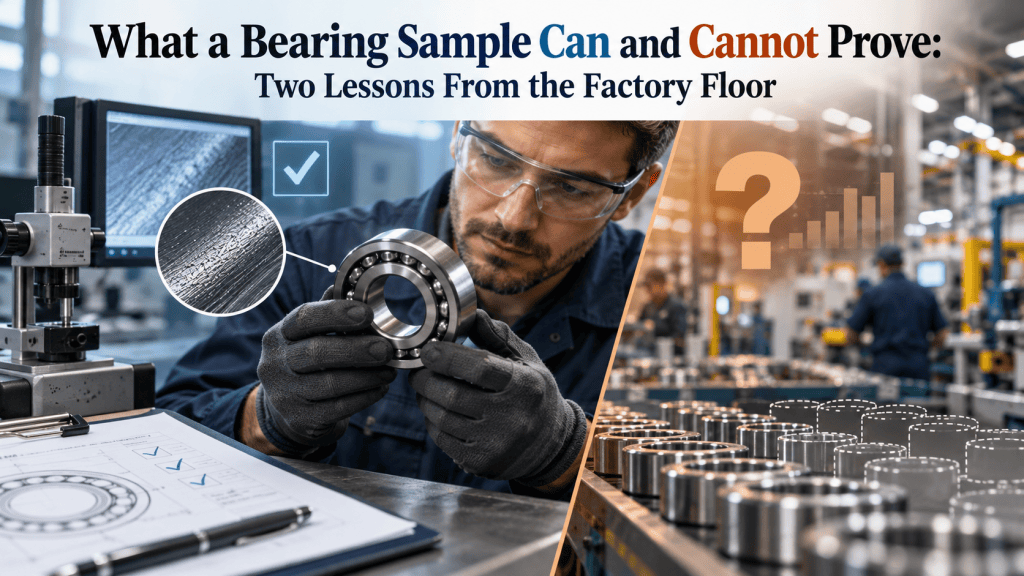
I have worked in bearing sales for more than twenty years. Two orders from our factory taught me what a sample can and cannot tell a buyer.
The sample that measured right and weighed wrong
In 2016 a well-known Asian bearing brand was choosing an OEM factory for the 51228, a thrust ball bearing with a brass cage. Their buyer asked three or four factories for quotes and samples. Ours was one of them.
Two of the other factories quoted well below us. Because the gap was so large, the brand inspected those samples with extra care. Outside appearance and dimensions matched ours almost exactly. They told us the order would go to a cheaper factory, since nothing in the samples looked different.
I gave them one suggestion: weigh the samples.
The washers weighed the same as ours. The brass cages did not. They looked identical but were clearly lighter. I suggested they break one open. Inside, the cage was hollow.
The brand placed the order with us.
The lesson: dimensions and appearance only prove the outside. Weight is a cheap first test of what is inside. If one sample is clearly lighter than another of the same type, break one open before you sign.
The order where less was the right answer
The second lesson runs the other way. In 2008 a customer in the United States bought 51108 thrust ball bearings from us. We worried the quality might fall short, so production took extra care on every step.
The customer was pleased with the quality. Then he asked a question we did not expect: could we make them cheaper, even if the quality was lower?
The bearings went into a robotic arm. The load was very light, and the bearing only turned a few times a day when the arm moved to pick up goods. For that duty, our factory changed the process. We used 45 steel, a medium-carbon steel, instead of chrome bearing steel. We cut rough grinding from six passes to three. The price came down by about 30%. The customer was satisfied with the next shipment, and there were no returns.
The lesson: a sample shows the quality a factory can make. It does not show the quality your machine needs. Only a clear description of the duty does that.
What buyers can take from both cases
| Check | What it proves | What it misses |
| Dimensions | Outside size fits | Internal parts, material |
| Appearance | Finish and marking | Hollow or thin parts |
| Weight | Total material present | Steel grade, heat treatment |
| Duty description | What quality is really needed | Nothing, if it is honest |
A good sample check uses all four. Measure the sample, weigh it against others, and, when the price gap is large, cut one open. Then tell the factory what the bearing actually does. Load, speed and running hours often matter more to the final price than the sample itself.
At FULI Bearings, we ask buyers for the duty before we quote. A bearing that is too good for the job wastes money, and one that only looks right wastes much more.
What’s something you’ve done that your past self would be proud of?
View all responses


