

Critical digital services need power protection that can respond when the utility supply becomes unstable or unavailable. A lithium UPS project combines power conversion and battery-storage considerations, so capacity, runtime, safety controls, and maintenance planning all need to be assessed together. The most useful design discussions begin with the conditions the system will face in daily operation. An installation becomes easier to manage when its technical limits, maintenance duties, and upgrade path are understood by everyone involved. The central design task is to connect the selected equipment with a clear site requirement.
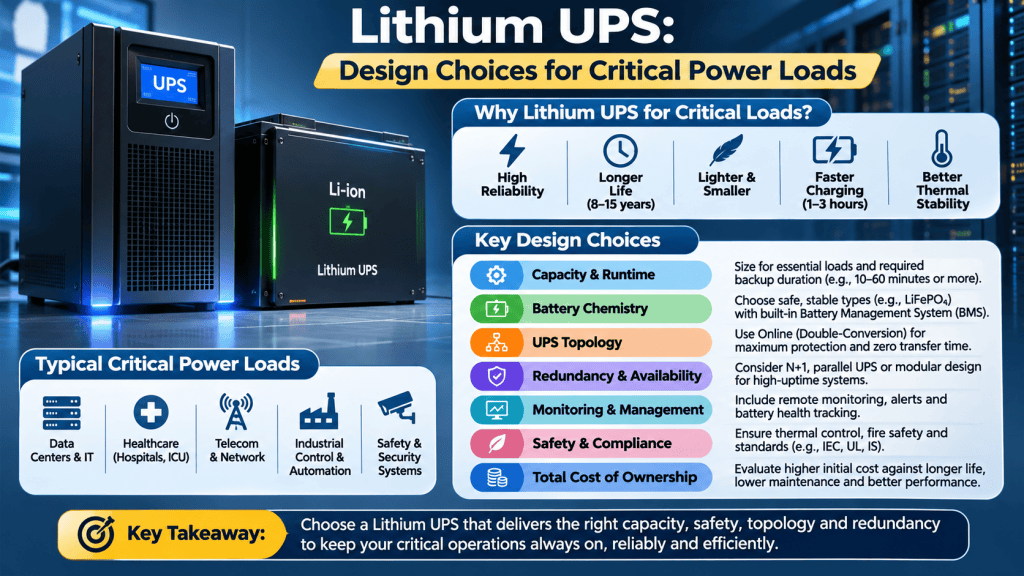
Equipment and site considerations for ؼ applications.
Define the load that must remain protected
A UPS is selected to support a specific group of critical loads, not simply to match the total building power. Server racks, storage systems, network devices, and control equipment may have different power profiles and tolerance for interruption. The load list should identify current demand, expected growth, power factor, and any unusual startup or transient conditions.
Review redundancy at the system level
A redundant UPS configuration can improve availability, but the result depends on distribution paths, bypass design, switchgear, battery strings, and common upstream sources. Engineers should map failure modes and determine whether a single fault can affect multiple protected loads. Maintenance scenarios are especially useful for identifying hidden shared dependencies. For a closer look at the solution scope, review lithium UPS and consider how its documented functions fit the site layout, electrical interfaces, and operating plan.
Use efficiency data across the expected load range
UPS efficiency varies with load level and operating mode. A unit may perform differently at light load than near its rated capacity, so comparisons should use the site’s expected load profile. High-efficiency modes can reduce losses, but their transfer behavior and protective characteristics must be evaluated against the critical load and the operator’s risk tolerance.
Define the operating boundary
A useful specification states what the equipment is expected to do, under which conditions, and where the supplier’s responsibility ends. Capacity, environmental limits, interfaces, protection behavior, and service assumptions should be written in measurable terms. This makes proposals easier to compare and gives commissioning teams a practical basis for acceptance. Performance should always be assessed against the actual installation conditions and the complete system boundary.
Test the complete backup sequence
Commissioning should verify loss of input power, battery operation, bypass transitions, restoration of utility supply, alarm delivery, and generator interaction where applicable. Tests must be performed under an approved safety procedure and with the protected load represented appropriately. Recording the actual response gives operators a baseline for future maintenance. A project specification for lithium UPS should identify the applicable configuration, installation limits, commissioning checks, and service responsibilities.
Specify service and replacement arrangements
The long-term value of a UPS depends partly on the availability of trained service personnel, spare power modules, batteries, and firmware support. Procurement documents should clarify response times, preventive maintenance, warranty boundaries, and the process for replacing a battery or module. These details are important when the site operates continuously.
If you had a free round-trip ticket to anywhere, where would you go?
View all responses


You must be logged in to post a comment.