

Prime Minister Narendra Modi will share his thoughts with the people in the country and abroad in the ‘Mann Ki Baat’ programme on All India Radio at 11 AM today. It will be the 66th episode of the monthly radio programme. It will be broadcast on the entire network of AIR and Doordarshan and also on AIR News website www.newsonair.com and newsonair Mobile App.
It will also be streamed live on the YouTube channels of AIR, DD News, PMO and Information and Broadcasting Ministry. AIR will broadcast the programme in regional languages immediately after the Hindi broadcast. The regional language versions will be repeated at eight in the evening.
Author: Eduindex News
Visit us for more news at https://eduindex.org
Google Scholar
Google Scholar provides a simple way to broadly search for scholarly literature. From one place, you can search across many disciplines and sources: articles, theses, books, abstracts and court opinions, from academic publishers, professional societies, online repositories, universities and other web sites. Google Scholar helps you find relevant work across the world of scholarly research.
You can visit Google Scholar at https://scholar.google.com/

Features of Google Scholar
- Search all scholarly literature from one convenient place
- Explore related works, citations, authors, and publications
- Locate the complete document through your library or on the web
- Keep up with recent developments in any area of research
- Check who’s citing your publications, create a public author profile
How are documents ranked?
Google Scholar aims to rank documents the way researchers do, weighing the full text of each document, where it was published, who it was written by, as well as how often and how recently it has been cited in other scholarly literature.
Google Scholar Citations
Google Scholar Citations provide a simple way for authors to keep track of citations to their articles. You can check who is citing your publications, graph citations over time, and compute several citation metrics. You can also make your profile public, so that it may appear in Google Scholar results when people search for your name, e.g., richard feynman.
Best of all, it’s quick to set up and simple to maintain – even if you have written hundreds of articles, and even if your name is shared by several different scholars. You can add groups of related articles, not just one article at a time; and your citation metrics are computed and updated automatically as Google Scholar finds new citations to your work on the web. You can choose to have your list of articles updated automatically or review the updates yourself, or to manually update your articles at any time.
Research Gate

ResearchGate is the professional network for scientists and researchers. Over 17 million members from all over the world use it to share, discover, and discuss research. We’re guided by our mission to connect the world of science and make research open to all.

It started when two researchers discovered first-hand that collaborating with a friend or colleague on the other side of the world was no easy task.Founded in 2008 by physicians Dr. Ijad Madisch and Dr. Sören Hofmayer, and computer scientist Horst Fickenscher, ResearchGate has more than 17 million members today. We strive to help them make progress happen faster.Here’s how it worksShare your publications, access millions more, and publish your data.

Visit Research Gate at https://www.researchgate.net/

ResearchGate and publishers will cooperate in educating users about their rights in relation to copyright-protected content by providing users with more and better information about how and when they may share their journal articles on the network

Publishers will get better visibility into the usage of new content on the platform that was originally published in their journals

Accelerating science is what drives us – we’ve built a platform that gives the world’s scientists the tools and services they need to connect, collaborate, and advance their research.

We believe that learning never stops, and we help each other get better. You’ll get the autonomy, mentorship, and training you need to excel at what you do.

We make ResearchGate a great place for skilled and passionate people to thrive. Join us to find and keep the talent we need to achieve our mission.
https://www.researchgate.net/
Academia
Academia.edu is a platform for academics to share research papers. The company’s mission is to accelerate the world’s research.

Academics use Academia.edu to share their research, monitor deep analytics around the impact of their research, and track the research of academics they follow. Over 129 million academics have signed up to Academia.edu, adding 25 million papers. Academia.edu attracts over 63 million unique visitors a month.
Guided by a mission to accelerate the world’s research, Academia.edu aims to make every academic paper ever published available for free online and accessible by anyone in the world. Academia.edu was founded in 2008 in San Francisco by Richard Price who recognized the need for open access of scholarly work while he was a doctoral candidate in philosophy at Oxford University.
Visit academia.edu at https://www.academia.edu/
Follow Academia.edu on Facebook, LinkedIn, and Twitter
Academia’s new mobile app represents a significant breakthrough in ensuring that scholarly research reaches beyond the Ivory Tower and into the real world where its true impact can be harnessed, all through the convenience and accessibility of a simple smartphone.
Mobile app users will be able to read millions of academic papers on over two million research interests, all for free. An Android version of the mobile app will be released in the coming months.
Academia.edu announced its acquisition of peer review platform Plasmyd, with the intention of proving that the two academic startups do indeed intend to generate an industry-wide shakeup.
Plasmyd is itself a peer-review platform, that has handled thousands of scientific papers and provided a space for scientists to discuss and critique each other’s work. Plasmyd sees itself as binding its scientific search engine platform with Academia.edu’s user base (which just hit 5 million yesterday). The two companies view this as a way to begin promoting new online academic platforms. “[Academia.edu has] built the largest online community of scientists while we’ve been working on building the next generation tools of peer review,” said Plasmyd’s co-founder Adnan Akil.
Research sharing platform Academia.edu is adding an analytics dashboard in order to allow measurement of the reach of academic papers shared on the site.
The new dashboard enables researchers to see who is accessing their research and how it is being referenced, both by academics and by non-academics. This information becomes invaluable when academics need to defend the merit of new research by noting, for example, that an individual’s research is being cited in Congressional hearings, public interest press releases, journal articles and news briefs.
The dashboard is now fully available for members after previously being available in a beta form.
Metrics available for members to browse include:
- Total profile and research views for each member’s material;
- Information on which search engines have driven traffic to a profile page;
- Details on specific keywords that drive traffic; and
- Breakdowns on which countries’ citizens are viewing specific research.
One of the things that might help such profile sites as Academia.edu grow is the presence of other researchers with whom you can network and whose work you can follow, as they maintain their profiles. Communities based around particular disciplines or research groups might well form around different sites like this one. I have chosen to “follow” a couple of my colleagues on Academia.edu and it works a bit like Facebook or LinkedIn or lots of other “Web 2.0” or social networking sites in the sense that my home page tells me about the activity of the people I have chosen to follow.
Apart from networking opportunities which are reliant upon community use, researchers could use this site as a place to promote their publications and their research expertise/interests. I uploaded my papers when I set up the profile and it was interesting to see recently that someone had viewed my profile after searching for keywords that are key to the topic of one of my papers. My own papers are of niche interest to librarians, so I won’t have a lot of activity to keep track of(!), but for researchers who are keen to monitor and to be able to demonstrate impact of their research, they could do worse than to see how often people are finding out about their work and which keywords are bringing people to their profile.
I do recommend that researchers put listings of their publications on lots of sites, but rather than uploading the full text of papers to external sites like this one, I think it best to put reference details up here and link back to the WRAP repository for the full text. I recommend this because it will boost the search engine ranking of a page if there are lots of links to it from an external domain, so you can use profile sites like this one to help the ranking of your paper at the web location you prefer most. Also, it makes sense if you want to collate statistics about those who read the full text of your work if you are always referring people to one source.
Planetizen
Eduindex News tries to bring in focus organisations working for the betterment of the society and institutions providing quality contents and services to scholars.
Planning
Planning is the professional practice and an academic study focused on the future of built environments and connected natural environments—from the smallest towns to the largest cities and everything in between.
Planning: A professional practice and an academic study focused on the future of built environments and connected natural environments—from the smallest towns to the largest cities and everything in between.
Planetizen: The independent resource for people passionate about planning and related fields.
Planetizen
Planetizen is a fiercely independent platform that creates, curates, and amplifies stories and resources to inform planning and people passionate about planning.
Scholars can visit the site of the Planetizen at https://www.planetizen.com/
Planetizen published its first story, by Anthony Downs, on August 1, 2000. The first Planetizen server ran on a used desktop computer connected to a telephone line in Chris’s house, and the site published 3-4 stories a day.
Within months, thousands were reading, and Planetizen expanded to cover news throughout California. By 2003, Planetizen contributors were submitting news from across the country, capturing the growing interest in the Internet and the need for an online community interested in planning.
Today, Planetizen reaches 90% of the U.S. urban planning community through news, editorial, job postings, online courses, books, and product sales. But one thing hasn’t changed: We are always looking for new ways to advance the field and work for healthier, more prosperous communities.
the mission of Planetizen Press is to provide innovative resources for students and professionals in the field.

Planetizen is the go-to news and information site for the urban planning, design, and development community. With a steady stream of fresh, relevant stories every day, our readers check in regularly to get the latest news on transportation, architecture, infrastructure, housing, economic development, and urban design. Our readers follow our influential bloggers and read original features from leaders in the field.
Publications
The Planetizen Press catalog currently includes a variety of titles available at the Planetizen Store.
Submissions
Planetizen Press accepts manuscripts for consideration from authors and opinion leaders. We favor manuscripts that are near completion on the subjects Planetizen covers on a regular basis:
- Urban and regional planning and land use
- Transportation and transit
- Environmental issues
- Energy and infrastructure
- Historic preservation
- Landscape architecture
- Urban planning technology
- Planning-related humor
We are open to ideas ranging from extended academic papers to popular non-fiction, like The Tipping Point. Our goal is to encourage debate and spread knowledge of the concepts and goals of urban planning. However, we are primarily interested in near-finished manuscripts. We are not seeking to develop books with authors from scratch.
Hope readers will be enrich themselves by visiting such resourceful forum. If you thing your organisation is working for the benefits of the scholars and community at large then let us know so that we can highlight their resource to our thousands of readers worldwide. For writing guest post and for informing about new and useful resources, write a mail to news@eduindex.org
We will try to give space in our News Portal free of charge. Keep reading and keep enriching yourself and keep helping others in getting good resources like Planetizen.


Planning Tank
Eduindex News tries to bring in focus organisations working for the betterment of the society and institutions providing quality contents and services to scholars.

We found that Planning Tank has a mission to create Happy, Healthy & Sustainable Human Settlements by means of education & awareness. They are active and providing quality educational resources for students, academicians & professionals covering their diverse needs. Scholars who are looking for articles to read on different topics of Urban Planning and the following sub aspects:
- Resources for Urban, Rural & Regional Planners
- Data Sources, analysis & presentation
- Geographic Information System (GIS)
- Academic Writing information
- Environment & sustainable development
Scholars can visit the site of the Planning Tank at https://planningtank.com/.
They keep on updating the latest information to the website and improving the existing information. The information provided is meant to cater to the needs of students, professionals, the general public, planning enthusiast alike. Apart from Urban Planning we frequently cover information related to:
- Real Estate
- Latest happening affecting human settlements
- Job opportunity
- Urban & Land Economics
- Memes
- Organizations & agencies dealing with Planning
Hope readers will be enrich themselves by visiting such resourceful forum. If you thing your organisation is working for the benefits of the scholars and community at large then let us know so that we can highlight their resource to our thousands of readers worldwide. For writing guest post and for informing about new and useful resources, write a mail to news@eduindex.org
We will try to give space in our News Portal free of charge. Keep reading and keep enriching yourself and keep helping others in getting good resources like Planning Tank.
Privatisation in India

The transfer of ownership, property or business from the government to the private sector is termed as privatization. The government ceases to be the owner of the entity or business.
In the privatisation process, somewhere it can be seen that a public traded company is taken over by a few people.
Here via a contract or franchise or lease or grant etc. the government keeps the ownership and the responsibility of an enterprise.
But the private company will handle the daily activities and deliver the product or service. The state will remain an active participant in this process.
Government can also hold the share but it would be a minority stackholder.
The aim of the privatisation is improve profitability and efficiency of public enterprises.
in private company employee is paid incentives on behalf of his/her service and work. Whereas the services provided in governmental control are good to an extent.
Through privatisation, government is free from most of the working resposibilities and it increases focus on administration and development of the country but some where government can keep an eye on the company.
But privatisation leads to rise in cost of the services in comparison to governmental services.
PM says timely initiatives of govt & people driven fight has kept India at better position in fight against COVID-19
Prime Minister Narendra Modi has said that powered by the Corona warriors, India is firmly fighting COVID-19. Addressing an event through video conferencing to mark the special occasion of the 90th birthday of Most Revered Doctor Joseph Mar Thoma Metropolitan, Mr Modi said, earlier this year, some people had predicted that the impact of the virus in India would be very severe.
He said, due to lockdown, many initiatives taken by the Government and a people driven fight, India is much better placed than many other nations. Mr Modi said, India’s recovery rate is rising. He said, a people driven fight has given good results so far but we cannot let our guard down.
The Prime Minister said, people have to be even more careful now. He said, wearing masks, social distancing, do gaz ki doori, avoiding crowded places, are still important.
Mr Modi said, the world is fighting a strong battle against a global pandemic and COVID-19 is not only a physical sickness that is a threat to lives of people. He said, it also takes our attention to unhealthy life-styles.
Mr Modi said, in the last few weeks, Government of India has addressed both short-term and long-term issues relating to the economy. He said, from the sea to space, from the farms to the factories, people-friendly and growth friendly decisions have been taken.
The Prime Minister said, Government wants to ensure better technology, infrastructure and making value chains stronger. He said, Government has taken decisions not from comfortable Government offices in Delhi but after feedback from people of the ground.
Mr Modi said, it is this spirit that ensured every Indian has access to a bank account. He said, over 8 crore families have access to smoke free kitchens and over 1.5 crore houses have been made to give shelter to the homeless. He added that India is home to the largest healthcare scheme in the world, Ayushman Bharat.
The Prime Minister said, for the poor, Government is bringing one nation-one ration card scheme to help them where they are. He said, for the middle class, Government has brought a number of initiatives, to boost Ease of Living.
Mr Modi said, for farmers, Government has increased the Minimum Support Price and made sure they get the right price. He said, people should think of this that how can their actions contribute to national development. Mr Modi said, today India is saying, it will produce locally and also buy local products. He said, it will light the lamp of prosperity in the homes of many.
Prime Minister Narendra Modi conveyed his greetings to Most Revered Doctor Joseph Mar Thoma Metropolitan and wished him a long life and best health. He said, Dr. Joseph Mar Thoma has devoted his life for the betterment of the society and nation and he has been particularly passionate about removal of poverty and women empowerment.
Mr Modi said, the Mar Thoma Church is closely linked with the noble ideals of Saint Thomas, the Apostle of Lord Christ. He said, India has always been open to spiritual influences from many sources.
Mr Modi said, it is with this spirit of humility that the Mar Thoma Church has worked to bring a positive difference in the lives of our fellow Indians. He said, they have done so in areas such as healthcare and education.
DELEGATION OF AUTHORITY
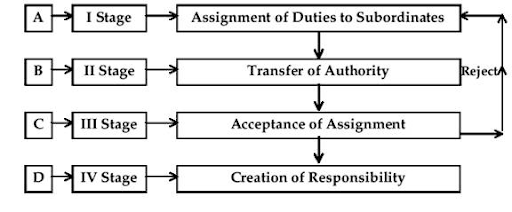
Just as no person alone in an enterprise can do all the tasks necessary for the accomplishment of goals, so also it is impossible, for one person to exercise all the authority for making decisions. There is a limit to the number of person managers can effectively supervise and for whom they can make decisions and once this limit is crossed, the authority must be delegated to the subordinates, who will make decisions within the area of their assigned duties. Then the question is how authority is delegated when decision-making power is vested in a subordinate by his superior and superiors cannot delegate all their authority without, in effect, transferring their position to their subordinates. The entire process of delegation involves four steps. They are:
- The determination of results expected from persons in a position;
- The assignment of tasks to persons;
- The delegation of authority for accomplishing these tasks; and
- The holding of people responsible for the accomplishment of these tasks.
Thus, delegation is the process that a manager follows in diving the work assigned to him so that he performs that part, which because of his position, can perform effectively. According to F.G.Moore “ Delegation means assigning work to others and giving them authority to do it”.
FEATURES OF DELEGATION OF AUTHORITY
The salient features of the delegation of authority that can be derived are:
- Delegation essentially means passing on authority.
- Only a part of the authority is delegated by a superior.
- Authority is delegated to a subordinate.
- A superior can delegate authority only when the superior possesses that.
- The limits within which a subordinate is expected to exercise delegated authority, have to be fixed.
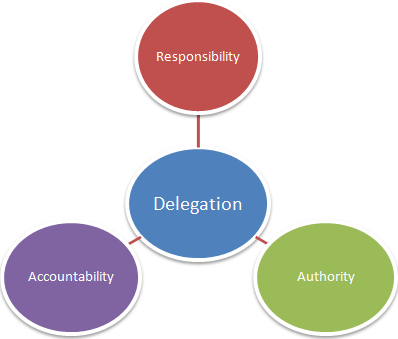
- Delegation of authority does not imply the abdication of responsibility on the part of the superior.
- Delegation of authority is for the discharge of some responsibility or duty assigned.
- It creates accountability or obligation on the part of the person who has been delegated authority, for proper use of authority and accomplishment of the task assigned.
A manager cannot delegate all his authority and for the purpose of the delegation, all authority of a manager can be divided into three broad categories:
- The authority which must be delegated as authority to take routine decisions for the accomplishment of tasks;
- The authority which can be delegated as the administration of policies; and
- The authority cannot be delegated at all as the authority to make policy decisions.
A successful manager is one who can delegate his authority successfully and he must delegate the authority to do work of routine and subsidiary nature. For instance, the marketing manager of a business enterprise is responsible for many operations like conducting marketing research, development of means of sales promotion, management of advertising, employment and training of sales forces, etc. The marketing manager cannot look after all these operations and he can entrust the responsibility of the performance of some of these operations to his subordinates.
India-China relations

China–India relations, also called Sino-Indo relations , refers to the bilateral relationship between China and India. India and China are two most populous countries in the world. These two major economies are growing very fast.
Both the countries started with signing panchsheel, in which five principles are mentioned to maintain peace and co-operation.
However, the relation between India and China has remained cold since the war of 1962 and the mistrust between these two countries have been prevailing since then. China, economy has developed itself at a greater pace and has established as the new economic superpower on the world stage. However, it has failed miserably on human rights, democracy and social freedom.
India, on the other hand, has managed to balance economic development with liberal human rights. Although it has not kept pace with China as far as economic prosperity is concerned, however, it has preserved its cultural diversity, secularism, democratic socialism and so on.
India and China have shown cooperation in BRICS, WTO, SCO, BCIM etc. These two countries have been engaged in vibrating trade and business. China is willing to invest heavily in Indian economy. India also wants to establish the lost cultural ties between the two countries. However, the deep-rooted mistrust, diplomacy and competition to emerge as superpowers have caused the persistence in the strained relationship between India and China. In spite of Modi’s aggressive foreign policy agenda, as evident from a plethora of important leaders and visits from both countries, the relation between these countries have remained cold.
present scenario is, China support to Pakistan on various issues, China makes obstruction in India’s bid for NSG membership and permanent seat of the Security Council, huge trade imbalances, dumping of Chinese goods in India, India support to Vietnam and so on.
But both the countries ties up when the situation arises to war. India is a peaceful country whereas China always tries to make trouble to India to hold it’s supermacy in chenese public.
How to be Your Own Best Friend When You’re Grieving
“This is a moment of suffering. Suffering is part of life. May I be kind to myself in this moment. May I give myself the compassion I need.” ~Kristen Neff
Understand your limitations, while gently pushing beyond them.
Being self-compassionate includes being self-aware and empathetic.
Include the people in your life who will help you regain your strength. And stay away from those who drain your energy.
Being self-compassionate includes minimizing the amount of time you spend with people who drain your energy. This is a great rule for us to follow at all times, but now it is even more important. You are running on empty both physically and emotionally, and you need take care of yourself first. Remember put your own oxygen mask on first!
Trust your intuition.
A friend who I had fallen out of touch with learned that I was navigating the death of my mother and my husband. The good news for me is that she had forgotten my address. I say that because she began bombarding me with messages about how she needed to come be with me. I needed someone to come take care of me, and I could not be by myself.
In the past, I had watched her method of taking care of others, and while she meant well and had a heart of gold, she was loud, and she was overbearing. Her way to take care of someone was to take over every aspect of their life. As an introvert, all I wanted was quiet. I could not imagine having someone in the house with me, telling me what was best for me.
Tell your inner critic to be quiet.
You would think that during a time such as this, your inner critic would just be quiet. But that’s not what inner critics do, is it? Your inner critic might be telling you things like:
“You should stop crying so much.”
“Why aren’t you crying more? What’s wrong with you?”
“You should be able to concentrate on your work.”
“You should be more productive.”
“You should, you should, you should…”
There is no such thing as should, there is only what is. Pay close attention to what you are feeling.
Don’t use self-compassion as an excuse for self-destruction.
Being self-compassionate is not a free pass to being self-destructive. It does not mean that it is okay to eat a pint of ice cream every day or to drink a pint of vodka every day. Keep an eye out for self-destructive behaviors.
You still have responsibilities, and you will handle those responsibilities. This is the time to really sort through the difference between what are nice things to do and what are required things for you to do. Paying your rent or your mortgage, let’s call that required. Going to an event because someone said it would be good for you, let’s call that optional.
Being self-compassionate does not mean you never do anything difficult. The day comes when you need to go back to work, or interact with the public, or attend social functions. Be aware of your limitations.
Keep an eye on yourself.
You are going to have days where all you want to do is stay under the covers. This is normal. Allow yourself a day to mope. However, do not allow yourself to spend seven days a week under the covers.
Most days you want to get out of bed at a normal time and get dressed. Groom yourself, whether you are leaving the house or not. Eat healthy meals. Resume your exercise routine. Keep in touch with the right people, the people who do not drain your energy.
If you are having severe difficulties getting up and getting dressed and handling day-to-day living, then get help. Seek out grief support groups and counseling. Ask trusted friends for help. Nobody said you had to go through this alone.
Allow grief to be a part of your life.
I found that I was able to return to instructing and also to attending classes within a week. On my way to teaching, I would cry in the car all the way to class. When I was in front of the class, I was able to concentrate on my students and, for that short period of time, I was able to forget about my sadness.
Once I left the classroom and got back in my car, I would cry all the way home. I learned to keep a good supply of tissues and eye makeup with me at all times. And I learned not to judge myself for needing to cry.
About two months after, I was scheduled to travel to teach a corporate class across the country. I went, because I thought it might be good for me to leave the house and because I believed that I could be sad anywhere.
I was right; in some ways it was good for me, and it was true, I could be sad anywhere. Living my life was not about denying the grief, it was about supporting myself in a way that I could get back to the business of living, and, for me, the business of living included making room for grieving.
Don’t impose an end date on your grief.
Even while I was teaching others how to plan and schedule and meet deadlines, I began to realize that there is no specific timeline for grief. There is no magic date on which your sadness expires. As you move forward your days will be different. Your grief will change from a sharp stabbing pain, to a dull ache. Do not let anyone tell you when you should ‘get over it.’ Everyone’s path is different.
Please be your own best friend.
You are the one who knows yourself the best. Be kind. Do not use your own self-talk to say things that you would not say to others. Your best friend is grieving, and he or she above all others deserves your compassion.
Theory vs Practices : Super Conjunctive Comparison !!!!!!
I want to justify titles with several popular quotes-

“In theory, there is no difference between theory and practice. But in practice, there is.” – Jan L.A. van de Snepscheut
“The people heard it, and approved the doctrine, and immediately practiced the contrary.” – Benjamin Franklin, The Way to Wealth.
Tweet
“Theory is when you know everything but nothing works. Practice is when everything works but no one knows why. In our lab, theory and practice are combined: nothing works as and no one knows why!” – Anon.
Tweet
“Beware of bugs in the above code; I have only proved it correct, not tried it.” – Donald E. Knuth, The Art of Computer Programming
“At school, we learn the theory to do the practice, but they didn’t teach you that in real life you learn from the practice to know the theory.” – Goitsemang Mvula
Tweet
“An economist is someone who says, when an idea works in practice, ‘let’s see if it works in theory.’” – Walter W. Heller
“Well, it may be all right in practice, but it will never work in theory.” – Warren Buffett on how the academia considers his investment techniques.
“I have a name for people who went to the extreme efficient market theory—which is “bonkers.” It was an intellectually consistent theory that enabled them to do pretty mathematics. So I understand its seductiveness to people with large mathematical gifts. It just had a difficulty in that the fundamental assumption did not tie properly to reality.” – Charlie Bonker
“Before I got married I had six theories about raising children; now, I have six children and no theories.” – John Wilmot.
Tweet
“Very simple was my explanation, and plausible enough—as most wrong theories are!” — H.G. Wells, The Time Machine
“In Theory everything is possible; however, I live in Practice and the road to Theory has been washed out.” – Anon.
“In my relativity theory I set up a clock at every point in space, but in reality, I find it difficult to provide even one clock in my room.” – Albert Einstein
“If the facts don’t fit the theory, change the facts.” – Albert Einstein
“A theory with mathematical beauty is more likely to be correct than an ugly one that fits some experimental data,” – Paul Dirac.
Tweet
“It’s a recession when your neighbor loses his job; it’s a depression when you lose yours.” – Harry S Truman.
Tweet
“If Edison had a needle to find in a haystack, he would proceed at once with the diligence of the bee to examine straw after straw until he found the object of his search… I was a sorry witness of such doings, knowing that a little theory and calculation would have saved him ninety per cent of his labor.” – Nikola Tesla, New York Times, 19 October 1931
“How empty is theory in the presence of fact!” – Mark Twain, A Connecticut Yankee in King Arthur’s Court
“It doesn’t matter how beautiful your theory is, it doesn’t matter how smart you are. If it doesn’t agree with experiment, it’s wrong.” – Richard P. Feynman.
Tweet
Always remember, theory and practice are just theoretically related…
Reference – https://divyanshspacetech.wordpress.com
High-level GoM meeting on Covid19 chaired by Health Minister to be held in New Delhi today
The meeting of the high-level Group of Ministers, GoM on COVID-19 chaired by Health Minister Dr. Harsh Vardhan, will be held in New Delhi today.
The GoM will be briefed about the latest status, response and management of COVID-19 in the country. The GOM is expected to be briefed on the progress made in the spheres of the tasks assigned to the 11 Empowered Groups.
It will also be apprised about the growing medical infrastructure in the country.
The Group of Ministers (GoM) will have in depth deliberation on containment strategy and management aspects of COVID-19.
External Affairs Minister, Civil Aviation Minister, Minister of State for Home, Minister of State for Shipping and Chemical and Fertilizers, Minister of State for Health are part of the GoM. Chief of Defence Staff is also part of it.
Dispassionate scrutiny and reform of all multilateral entities needed: EAM Dr S Jaishankar
Asserting that the world stands at a transformative moment, External Affairs Minister Dr S Jaishankar has said that a dispassionate scrutiny and reform of all multilateral entities were needed to make them purpose-built for the current times and representative of this century.
Addressing a virtual ministerial meeting of Alliance for Multilateralism yesterday, Dr Jaishankar said, it is an empirical fact that every process and institution must evolve to meet the needs of its time. He said, no institution, howsoever important, can remain frozen at the moment of its foundation.
The Minister said, this is why India continue to call for reformed multilateralism – one that is relevant for the age in which we live, not when this architecture was erected. He said, our Alliance must stand for a dynamic multilateralism, for a purposeful reform of existing structures, which must continue to serve the international community even more in this complex and uncertain time.
Dr Jaishankar said, the world is facing a two-pronged attack of a pandemic and misinformation going viral. He said, in other words, this is an era of both a health crisis and an infodemic.
The Minister said, the pandemic has devastated the globalised economic system, apart from taking a toll of over 4 lakh lives and it has fundamentally affected the way people live, work, travel and indeed, relate to each other. He said, suspicion of human interaction is fuelled, more often than not, by fake news, wrong information and targetted disinformation.
Dr Jaishankar asserted that the way forward to address both the challenges is similar and said that there is a need to strengthen the belief in scientific approaches. He said, we must set aside politics and focus on facts-whether it is the effort to dispassionately analyse the causes and drivers of the current coronavirus pandemic, or to assess what changes our multilateral health mechanisms need to implement to improve preparations for a future pandemic.
Dr Jaishankar said, the Resolution adopted at the World Health Assembly last month is an opportunity to use facts and science to assess our response to this pandemic and take those lessons to prepare better for the future. The Minister said, as Chair of the WHO Executive Board, India is ready to work towards these goals.
He said, there is a need to restore the faith in meaningful and equal partnerships. Dr Jaishankar said, trust, partnership and cooperation draw people, societies and countries together especially during crises, particularly when fake news and disease engender isolationism and unilateralism. He said, in this context, India is pleased to be part of cross-regional group presenting a Statement on the ongoing ‘Infodemic’ in the context of COVID-19 at the UN.
The “Alliance for Multilateralism” launched by the French and German foreign ministers is an informal network of countries united in their conviction that a rules-based multilateral order is the only reliable guarantee for international stability and peace.
Southwest monsoon covers entire country, 12 days ahead of its normal date
India Meteorological Department (IMD) has said that Southwest Monsoon has covered the entire country. The normal date for Monsoon to cover entire country is 8th July. IMD said, the Monsoon this year covered the entire country 12 days prior to normal date.
In the recent past, such early coverage of Monsoon over the entire country occurred in 2013 when it covered the entire country on 16th June 2013. The early advance over the central and northwest India was facilitated by formation of a low pressure area over Bay of Bengal which moved west-northwestwards and another cyclonic circulation over central India.
IMD said, Monsoon has further advanced into remaining parts of Rajasthan, Haryana and Punjab. During past 24 hours, there has been fairly widespread rainfall activity over West Rajasthan and adjoining Punjab and Haryana.


You must be logged in to post a comment.