Publishing 3.0 – A new model for independent educational publishing

My New Years resolution this year was to start work on a series of ebooks for iPads, e-readers and other digital devices. This has been my ambition since I published my first book Web 2.0 Tools for Teachers back in 2009, but I’ve never felt that the time, the technology or the market was at the right place.


Significant changes over the last couple of years though have led me to believe that now is the time to look at a new model of ELT publishing, at least for the realm of teacher development books.

The changes I mention above include

  • A proliferation of increasingly low cost e-reading devices and tablets.
  • The development of powerful free software and applications such as iBooks Author for the development of media rich ebooks.
  • The combination of these applications with secure and reliable marketing platforms, such as Lulu and iBookStore.
  • The development of crowd-funding platforms such as KickStarter and Indigogo.


I believe that the combination of these developments is now enabling individual teachers to write develop and launch their own products to the market on a commercially competitive basis with established publishers.

So why is this a good thing?
Well anyone who has ever approached a publisher with an idea for a book will know how difficult it can be to get it accepted. The established publishers are, by necessity, cautious about taking on new, innovative or risky projects. Producing and distributing paper-based books is a hugely expensive endeavor and in the case of teacher development books, the returns are likely to be small for both the publisher and the writer.

The changes I mention above, however, have the potential to liberate writers from the established publishing process and give them the freedom to develop their own projects and products independently.

  • The proliferation of low cost mobile devices such as e-readers, tablets and iPads provides a really useful and accessible medium on which to publish teacher development materials. Instead of having your books at home on the bookshelf you can now carry them around with you on your device so they are on hand at the moment of need.
  • These devices and the applications used to develop content for them are capable of providing a media rich experience with colour interactive images, audio, video and a range of interactive learning apps, none of which is possible in a traditional paper-based book.
  • The combination of these applications with established secure marketing platforms means that writers with the commitment to see their projects through to completion can easily market them internationally and actually get a reasonable financial return on the work they put in.
  • Crowd-funding platforms like KickStarter and Indigogo enable writers to raise the funds they need to develop good quality professional products that the market wants.


I’ve put the crowd-funding platform at the end of my list, but really it should be at the beginning, because crowd-funding doesn’t just supply the money to launch the product, it also acts as a market research tool to see if there really is a market for the product. If the people for whom the product is intended aren’t willing to invest in it to get it created, then it’s likely that there isn’t really a viable market for this product.

So this brings me back to where I started with my New Years resolution. I have launched my own crowd-funding project to try to create the first in a series of ebooks in a series that I intend to call The Digital Classroom. The first of these will focus on the use of online video as a tool for learning.

You can find out more about this project by following this link Digital Classrooms – Online Video or watching the video below.


If you think this is a product you would be interested in having them please do support it buy either buying and advance copy of the book or by sharing the link with others you think may be interested.

You can also get an idea of the kind of content the book will cover and even contribute your ideas for what the book should contain, using the crowd-sourcing questionnaire below. Just add your ideas and vote for the things you would most like included in the book. That way you can ensure that I produce the book that you need to help support and develop your teaching.


powered by tricider

You can also follow the project on Facebook by going to The Digital Classroom and clicking on \’Like\’.

I hope you find the project interesting and that this post gets you started thinking about how you can produce your own book too.

More about my family

When I composed yesterday’s post, I got so excited sharing the history of my family that I forgot part of what I wanted to say. Here it is:

This month I have been posting historic family pictures on FaceBook each day. Sometimes it’s a single picture, sometimes it’s two or three pictures. I’ve been getting good reactions from family—including cousins I almost never see anymore—as well as from other friends.

Why am I doing this? Well, as a historian and an archivist, I want to promote the business. Especially those weeks that I had to work from home, trying to do the same things I would be doing at work, I knew that I had to do the full job of an archivist—not merely to preserve and to organize, but also to share. Archivists don’t digitize the entire collection and put it online—we digitize a small amount of material that is interesting or informative. Real researchers don’t stop at surfing the internet; when they find something of interest, they identify where it is located and come to that place to look at the rest of the collection.

Beyond that, I have gotten major fatigue scrolling through FaceBook and other social media. It feels like a game of dodgeball back in junior high school, trying to avoid all the mentions of disease and politics and the intersection of the two. So I thought I’d change the subject—give myself and other people something different to talk about and think about. And that has worked.

It has worked so well that my sister and some of my cousins commented over the weekend that I ought to take all this family information I’ve been gathering and write a book. I’ve handled books written by genealogists. They tend to be dry as dust—recording vital information, but often omitting the interesting and unusual family stories about these various individuals.

So I’m considering a book on the Salvageable family. The first question is: how much of the family do I want to cover? Am I writing for my children and their descendants—do I want to include my wife’s side of the family? Do I want to focus on me and my ancestors? Or do I want to stick to my mother’s side of the family, which contains most of the interesting stories that have come to light thus far. (And includes those cousins who are suggesting that I write a book.)

Even though that matter is not settled, I have made two other decisions. If I write this book, I will start each family line with the immigrant who came to the United States. Where I know names and dates for ancestors who remained in Europe, I might include them in an appendix or sidebar, but I want this to be an account of the Salvageables in America. Also, rather than focusing on one line at a time, with chapters relating to different streams that entered the river, I want to make the book chronological. I would like to write a chapter for each decade, describing where the various ancestors were during that decade and what they were doing.

Moreover, I want to include some historic context in each chapter. Think how much fun the 1860s will be—men fighting each other in the Civil War (and I have ancestors who fought for the Union and ancestors who fought for the Confederacy). Wouldn’t it be cool to find two great-great grandfathers involved in the same battle, shooting each other? (And, if either of them had been a better soldier, I would never have been born.)

I can only guess how long it will take to complete the family research and begin writing. This project likely will be years in the making. And it will not be lucrative—we’re not talking Roots here. I don’t care to dabble in historical fiction, creating conversations that may have happened. I want to include verifiable facts, along with family stories and mysteries.

And this is much more fun than slogging through the current international crisis and thinking only about it night and day. J.

Why Nurses Should Get Their MSN

I graduated with my bachelor’s degree in nursing in 2017 and it wasn’t long before I started thinking about advancing my education with an MSN.

I graduated with my bachelor’s degree in nursing in 2017 and it wasn’t long before I started thinking about advancing my education with an MSN. I have a passion for teaching and I wanted to do more for my patients and help them learn how to lead healthier lives.

Deciding to go back to school wasn’t an easy decision. I was somewhat nervous about enrolling in an online MMSN program, especially because I was going to be working full-time while in school. My friends all said that earning their MSN was the best thing they ever did, but I wasn’t sure if I could make it work. Was I smart enough? Would I have the time? What if I failed?

I put those doubts aside and I’m glad I did. In nine short months, I will graduate with my Master of Science in Nursing from Herzing University’s Family Nurse Practitioner program. It has been challenging at times, but I have no doubt that it will be worth the time and the effort.

As a nurse practitioner, I will be able to be more involved in providing excellent care for my patients and I will owe it all to taking that first step to continue my education.

Here’s why you should consider earning your MSN:

1. Increasing demand for experienced, specialized nurses

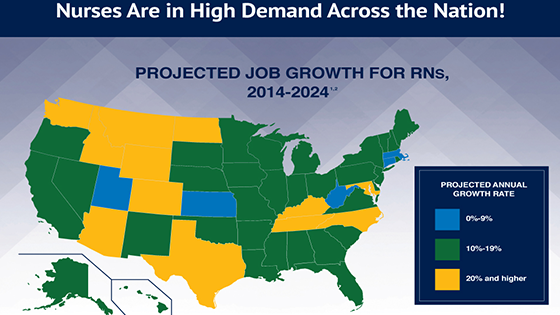
As healthcare organizations deal with a growing patient population and a shortage of skilled healthcare professionals, nurses with advanced knowledge and skills are in high demand. With an MSN, you can expand your scope of practice, help train new nurses and play an increasingly central role in ensuring quality patient care.

Why Nurses Should Get Their MSN

The Bureau of Labor Statistics predicts that employment for nurse practitioners will increase by 36 percent from 2016-2026, due in part to a shortage of primary care physicians and ever-growing demand for healthcare services. FNPs can make a very good salary; learn more about how much a family nurse practitioner can make in your state.

I wanted to be more involved in patient care, so becoming a nurse practitioner seemed like the perfect next step for me. Nurse practitioners are certified to provide many of the same services as a general physician and can help increase access to health care in underserved areas.

Why Nurses Should Get Their MSN

2. Advancement opportunities

I also knew that I would soon be left behind if I didn’t continue my education. New nurses are joining the workforce at a rapid rate, creating opportunities for experienced nurses to move into specialized roles and leadership positions. With an MSN, you can pursue specialties in a variety of different areas, including nurse education and nurse leadership. Advancing your education not only makes you more marketable for leadership roles, but it also increases your value to an organization and makes you an indispensable part of the nursing team.

Why Nurses Should Get Their MSN

3. More responsibility

As you advance to these leadership roles, you also gain more responsibility and have more opportunities to make a difference in patient outcomes. I knew that pursuing my MSN would allow me to be involved in the nursing process at a higher level, prescribing medications and working alongside physicians.

Why Nurses Should Get Their MSN

Today, I’m looking forward to graduation and I’m proud of the success I’ve had thus far. The support and resources provided by the faculty and staff at Herzing University have helped make this process possible. I have not felt alone once, which is especially important to me as an online student.

No matter what your inspiration is, earning your master’s degree in nursing is worthwhile. It will help you grow exponentially, not only in your career but in your relationships with others, as you will become their inspiration for continuing their education.

When I look in my nine-year-old daughter’s eyes, I know that she deserves this. I want to show her how hard work pays off, and that if you set a goal, it is attainable. I can only hope that this will inspire her someday, not to follow in my footsteps (although that would be lovely), but to set her own goals and see that they are within arm’s reach.

You owe it to yourself to dust off the books and advance your nursing degree. Your community will thank you and your future self will thank you. There is no better time than now to pursue the next step in your nursing career.

FLLinNZ meeting

Our planning session for the Flexible Learning leaders in New Zealand planning meeting all the 1st and 2nd round FLLinNZers gathered at Wiapuna Hotel at Mt Wellington, Auckland. We started with a warmup and a discussion of what we are expecting from the third round of funding and any issues.

The facilitator presented on the situation in Australia. Main points were:

  • competency-based apprenticeships
  • qualifications recognised across Aus
  • maximum flexibility in system – impacts on quality
  • grow private training orgs with effective competition
  • school-based apprenticeships
  • RPL – want to improve uptake
  • industry wants to control knowledge base – web 2 does not fit
  • training providers not keeping pace with rapid technological change – important
  • costs, flexibility and access
  • need training to meet needs of lifelong learners – skills shortages, shiftworkers, contractors, mature learners, just-in-time and to suit learners
  • need to build capability – respond to physical and online environment
  • changing role of education and training
key activity: who can we connect with to make the most influence?
often fail to equip people with skills to be able to problem solve and think forthemselves.
Pedagogical shifts
  • more of the following:
  • distributed networks
  • social networking
  • blended and flexible models
  • facilitation driving pedagogy not instruction
  • innovation
  • market changes e.g. full employment
Less occurrence of the teacher teaching many.
Examples: Motor Traders Association – mp3 audio files used in training to capture their interest
Caryl Oliver – mlearning – there is a recording of an interview with Caryl.
Manager of 2020: multigenerations, longer later, more teams, flexible working, performance emphasised, innovation
Overview of pressures on the NZ tertiary education sector can be seen on the concept map (to be loaded).
Facilitator talked about Australian Flexible Framework and how we could have links with Australian projects. Learnscope and Knowledge tree online journal. eLearning networks project is running a September Online Event: Tapping into Resources for E-learning 6 – 8 September 2006

Why I Became a Nurse After the Navy: Q&A with Shaeye Frierson

We sat down with Shaeye to learn more about her experience in the nursing program, as well as her transition to a career as a nurse educator.

Military veterans have a lot of relevant experience to share after their service to the country is over, and many of them are choosing a career in nursing to help meet growing demand.

Shaeye Frierson, a nursing instructor at Herzing University, joined the military at age 22, in hopes of building a better life for her 2-year-old son. During her 11 years as a hospital corpsman in the Navy, and through several deployments, she realized she had a true passion for helping others.

In 2010, Shaeye applied her Post-9/11 GI Bill funds toward nursing school at Herzing, while her mother helped her raise her two young children. She’s now working on her master’s degree while teaching nursing classes at Herzing, and serving as an unofficial mentor for military vets on campus.

We sat down with Shaeye to learn more about her experience in the nursing program, as well as her transition to a career as a nurse educator.

What inspired you to become a nurse?

I always knew I wanted to go into the medical field, but I wasn’t sure what I wanted to do. When I joined the military, I was offered a medic position and I really enjoyed it. I moved up in rank, and became even more passionate about my work. Our fellow soldiers depended on us for their lives. I thought there could be no more rewarding career than that. I knew then that I wanted to pursue a career in nursing.

What did you enjoy about the accelerated nursing program?

What was challenging? In the military, your education is so fast, and you get used to learning that way. The accelerated program was perfect for me, and I excelled because of my medical training and my experience with learning at that pace.

Balancing the demands of work and school can be challenging at times, and a lot of students struggle with that at first, especially in an accelerated program. I created a schedule for myself, setting aside time for homework, work, sleep, etc., because that’s how you’re programmed to do things in the military. It worked for me, and I share that tip with a lot of my students. It seems to work for them as well.

What are some of the differences between civilian healthcare and military healthcare?

A hospital corpsmen in the Navy can do pretty much everything a civilian nurse can do, and more. Our medical training in the military is often more advanced and accelerated than a traditional nursing program because we have to know how to handle a lot of different situations.

For example, in 2004, I was deployed on a ship for eight months. We only had one doctor on the ship. If a person was sick, they would come to us – the corpsmen—and we would treat them or provide recommendations for the doctor to sign off on. We had more autonomy than a civilian nurse because that’s the only way you can ensure everyone receives the care they need.

Why did you choose to become a nurse educator?

I graduated from Herzing with my BSN in 2013. I had become a mentor and resource for other military veterans on campus, and when the dean asked me if I wanted to be an instructor I accepted. Students with a military background need someone to help them navigate the transition to an accelerated nursing program, and I can be that person because I’ve done it myself. I’m currently enrolled in the MSN Nurse Educator program and expecting to graduate in January 2020.

What is most rewarding about being an educator?

The most rewarding part about my job is giving back to the university that helped me become the nurse I am today. I love helping out the military veteran students – even those that aren’t in the nursing program. I usually find out who they are during orientation, and make an effort to meet with them and ask about their concerns, if they need help with their benefits, etc. I want to help them be successful.

What advice would you offer to other veterans who want to pursue a healthcare career?

I would say Herzing is the perfect school for a military veteran, especially if you want to become a nurse. The accelerated BSN program is a smooth transition because the pace of learning is similar to what you’re used to. We also have incredibly supportive instructors to help you every step of the way.

How to Study Like a Straight-A Student

Establishing a study plan that works for you is most important, as everyone finds success in different ways. Here are some study tips!

Achieving straight A’s can be difficult, especially if you are just beginning your college journey. It takes time and practice to develop effective study habits, but once you master them, you will be well on your way to achieving the grades you want.

Developing good study habits has other benefits as well. If you suffer from test anxiety, better study habits can help boost your confidence and your comprehension of course material, which will make timed quizzes or final exams less stressful.

Establishing a study plan that works for you is most important, as everyone finds success in different ways. Once you find what works, it can truly be a game-changer.

Here are some tips for studying like a straight-A student:

1) Don’t procrastinate

Starting your assignments in a timely fashion is a simple and effective way to achieve higher grades. Procrastination is a bad habit that will make it difficult for you to do your best work. Once you are assigned something, try getting a start on it in the first few days, even if the due date is not for a few weeks. Working on assignments little by little can help break up a major task into more manageable pieces.

2) Ask for feedback whenever possible

Professors won’t know you need help unless you tell them. If you feel stuck on an assignment and need guidance, be proactive and approach the professor right away. The feedback they provide can help you determine whether you are on the right track or if you could use some re-direction. If you receive a poor grade on a paper, you can also talk to your professor after the fact to learn what you could have done differently. You can take this feedback to a tutor, or make a note of the things you want to correct the next time you have to complete a similar assignment.

3) Eliminate all possible distractions while studying

In order to be productive in your studies and achieve the best possible grade, you truly need to be 100% focused on the task at hand. Students that want to achieve high grades remove all distractions so that they are completely focused on their work. Leaving your phone or the TV remote in another room until you finish your schoolwork can make a world of difference in your productivity. That funny cat video will still be there when you are finished!

4) Study for understanding rather than memorization

It can be tempting to breeze through your study materials quickly, but this is not an effective study technique. Memorization may work well for a pop quiz, but it won’t do you much good on a final exam. Most professors care less about the specifics you’ve memorized and more about how you can apply your knowledge to real-world situations. Studying for understanding is a much better method to use because it will help you be better prepared for those more detailed assessments. Creating a study guide is one of the best ways to prepare for an exam and achieve a deeper understanding of the material.

5) Avoid cramming

Cramming the night before an exam is about as effective as not studying at all. If you try and cram a month’s worth of material into your brain in just one night, chances are you will only retain a small part of it. Spacing out your studying is much more effective and will help you to understand the concepts more thoroughly. In a study conducted at the University of California, spacing out your learning was proved to be more effective than cramming for 90% of participants. Studying in advance will also help you feel more prepared for an exam, which will help dull any last-minute exam stress.

6) Ask questions to test your understanding

Participating in class is another great way to test your comprehension of material and make sure that you are well-prepared for an upcoming assessment. Professors are always willing to answer questions and you can learn a lot from the answers they give you. This is also why it is important to attend every class session. There might be important topics discussed during class that are not in the textbook, and you never know when they might show up on an exam.

7) Work with other motivated students

Studying with other students who are as driven as you are can be quite a helpful resource. If others around you are engaging in productive activities, it is more likely that you will feel motivated to do the same. Study groups are also a great place to share ideas with your fellow classmates, learn new study techniques, and get help preparing for major tests or projects, especially if you are all taking similar courses.

Not only will these tips help you boost your grades, they can also help you develop other skills that will be important for your future, such as time management and communication. Even though grades won’t necessarily be a concern post-college, the need for a strong work ethic won’t disappear. By developing effective study habits now, you can position yourself for success both in and out of the classroom.

FLLinNZ meeting

Our planning session for the Flexible Learning leaders in New Zealand planning meeting all the 1st and 2nd round FLLinNZers gathered at Wiapuna Hotel at Mt Wellington, Auckland. We started with a warmup and a discussion of what we are expecting from the third round of funding and any issues.

The facilitator presented on the situation in Australia. Main points were:

  • competency-based apprenticeships
  • qualifications recognised across Aus
  • maximum flexibility in system – impacts on quality
  • grow private training orgs with effective competition
  • school-based apprenticeships
  • RPL – want to improve uptake
  • industry wants to control knowledge base – web 2 does not fit
  • training providers not keeping pace with rapid technological change – important
  • costs, flexibility and access
  • need training to meet needs of lifelong learners – skills shortages, shiftworkers, contractors, mature learners, just-in-time and to suit learners
  • need to build capability – respond to physical and online environment
  • changing role of education and training
key activity: who can we connect with to make the most influence?
often fail to equip people with skills to be able to problem solve and think forthemselves.
Pedagogical shifts
  • more of the following:
  • distributed networks
  • social networking
  • blended and flexible models
  • facilitation driving pedagogy not instruction
  • innovation
  • market changes e.g. full employment
Less occurrence of the teacher teaching many.
Examples: Motor Traders Association – mp3 audio files used in training to capture their interest
Caryl Oliver – mlearning – there is a recording of an interview with Caryl.
Manager of 2020: multigenerations, longer later, more teams, flexible working, performance emphasised, innovation
Overview of pressures on the NZ tertiary education sector can be seen on the concept map (to be loaded).
Facilitator talked about Australian Flexible Framework and how we could have links with Australian projects. Learnscope and Knowledge tree online journal. eLearning networks project is running a September Online Event: Tapping into Resources for E-learning 6 – 8 September 2006

Managing behaviour in the digital age

If you ask most teachers, especially newly trained ones, what one of the biggest challenges of teaching is, they would probably say managing student behaviour. Especially as class sizes grow and more students are bringing along potentially distracting digital devices, making sure you are keeping students on task is becoming ever more important. If this is something that concerns you, then read on.

ClassCharts could be the solution to your problem. ClassCharts is a digital management tool which can help you, your students and their parents to track and improve student behaviour across the whole school.


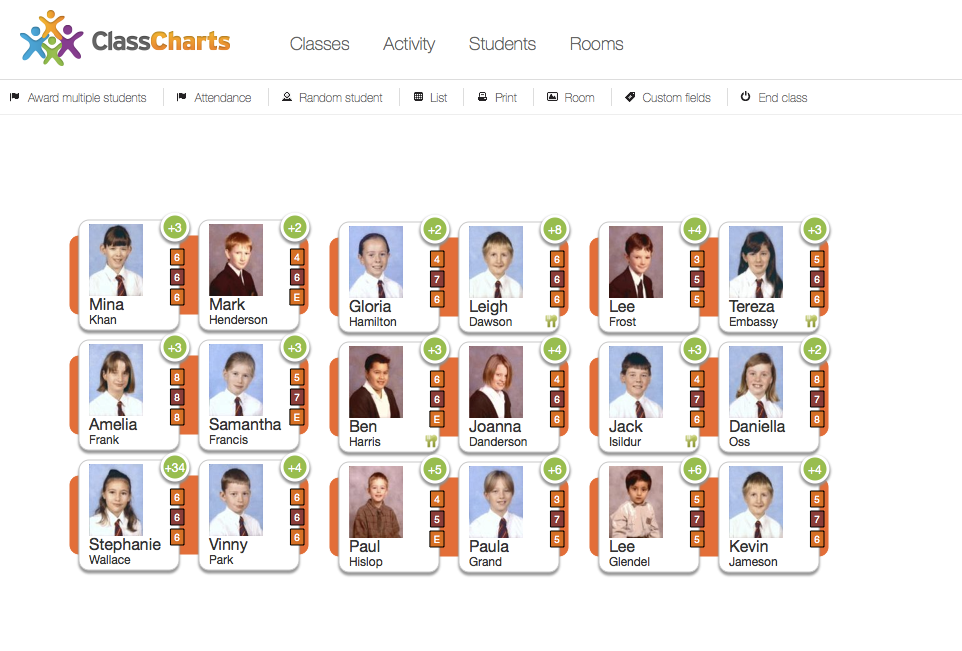
Using ClassCharts you can set up seating charts for every room in your school and create a profile for each student. Teachers can then use ClassCharts to monitor and reward positive behaviour as well as track negative behaviour. As the teacher builds up data across classes they can start to understand how different seating arrangements and student pairing and grouping can impact on behaviour, then generate seating charts for students that group them in ways that help them to work more efficiently and harmoniously.


So how does it work?

Well one of the first things to do is to add seating plans of your rooms. This is easy to do and you can drag the virtual desks around into whatever configuration you have in your classroom.


Then you also need to upload your students. What I really like about ClassCharts is that you can also upload a photograph of each one, and this can be really useful if you have large classes and lots of students names to remember, especially when it comes to writing reports.


You can then either manually assign seats or generate a random seating chart. During the class you can use ClassCharts acknowledge a range of positive and negative behaviours. These behaviours are all customisable so you can create your own or use the default ones.


ClassCharts uses html 5 so should run in any modern browser whether it’s a laptop, iPad or Android tablet, so the teacher can use an tablet during the class to instantly update behaviours.

Either before or during the class the teacher can also shuffle the class seating depending on a number of criteria from things like attainment targets to gender or previous behaviour.


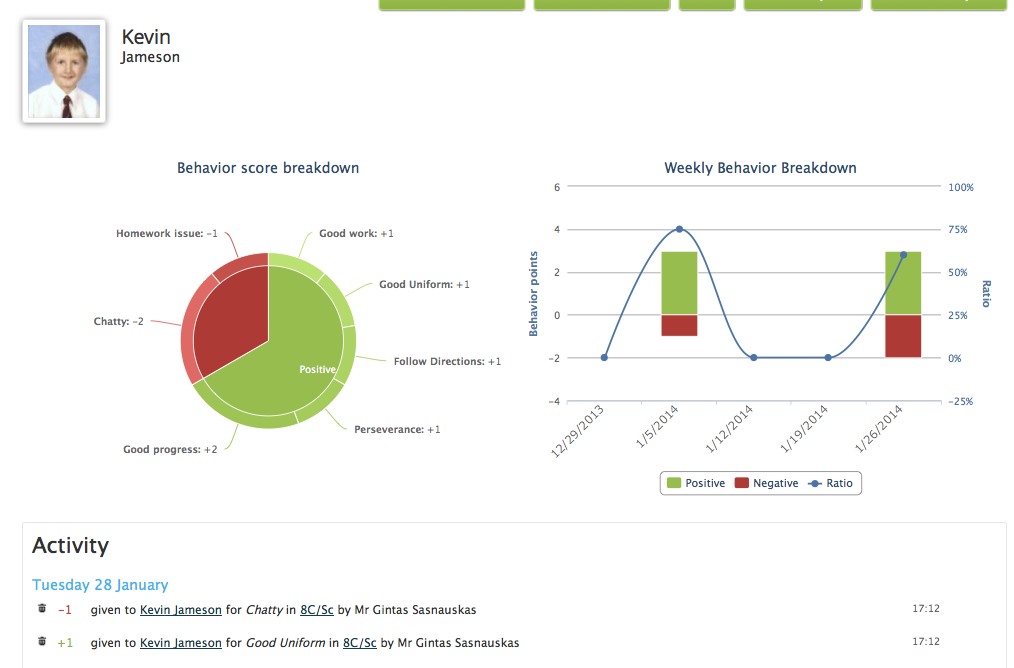
One of the real time-savers of ClassCharts though is when it comes to report writing time. Each students’ behaviour has been tracked through their various classes and teachers can get a detailed report, including dates when different behaviours were recorded.


Both students and parents can also access live reports and monitor progress throughout the term, so students and parents know how they are doing and parents don’t have to wait until the end of term to find out what’s been going on with their child.

This helps to share responsibility and makes it much easier to get parents involved in dealing with any negative behaviour at the earliest possible date.

Although ClassCharts is free and has been designed so that a single teacher can set it up to track their own classes independently, the real power of the platform is its ability to work across the school and track student behaviour in every class. To make this easier ClassCharts also interconnects with a range of other educational management software systems, from simple tools like Edmodo to more complex ones like SIMS and PowerSchool.


What I like about ClassCharts

  • I’m really impressed by the fact that such a powerful and well designed tool is free.
  • It’s great that a system like this and the data it collects can be applied and shared across a whole school.
  • I really like that you can see the student and access a range of information about them from targets, to behaviour and even a little about their background.
  • Great to get parents involved and students monitoring their own progress.


What I’m not so sure about

  • This is quite a complex tool and creates a lot of data, so I think it’s going to take a bit of getting used to for teachers and perhaps a bit of training too.
  • It does produce a lot of data and you can easily get a bit too tied up in this and forget about the person.
Well I hope you find ClassCharts useful and give it a try.
Related links:

Photographs and genealogy

Years ago, when I first saw this picture in the family collection, it puzzled me. I knew that the little girl to the left was my grandmother, and I suspected the other two children on the floor were her brother and sister. I assumed that the man to the left was her father and that the woman in back was her grandmother? But who is the other boy in the room? My family and I dubbed him Heathcliff, remembering that he joined the Earnshaw family by adoption when he was a young boy (Wuthering Heights).

This spring I’ve had the opportunity to go through family photographs and also to research my family tree. I deduced that this picture was taken Christmas 1905. The extra boy is a cousin to my grandmother. These same people were still in the same household at the 1910 census. The grandmother, by the way, is the mother of my grandmother’s mother, mother-in-law to the man in the picture.

Here’s another picture of the same family taken a few months earlier. The younger woman is my great-grandmother; she died in June of 1905. The man with the cigar is probably Heathcliff’s father, and the two additional girls are Heathcliff’s sisters.

Why are those sisters missing from the Christmas picture? According to the 1910 census, they were boarding at the Chicago Industrial School for Girls. Later records show that both grew up, had jobs as clerks, and got married.

Here’s Heathcliff and his sisters—possibly taken at their school. On the desk is a cube with the date: Wednesday December 27. Historians, archivists, and genealogists love clues like that hiding in photographs. (December 27, 1905, was a Wednesday.)

And what became of Heathcliff? He also got married. He and his wife had a son who lived only three months and a daughter who eventually grew up and married. In 1917, when Heathcliff registered for the Great War, he was a clerk supporting wife and mother (possibly mother-in-law). In 1920, he was living with his wife, in-laws, and infant son. In 1930, though, he was divorced and living alone in Chicago. October 1930 saw him incarcerated at Leavenworth, Kansas—I have no idea why. By 1942, when he registered because of the second World War, he was back in Chicago, working for Keller & Sons. He died in 1959, at the age of 63.

“Heathcliff’s” real first name was the same as his father and his grandfather. By coincidence, my wife and I chose the same name for our son. After skipping several generations, it’s nice to have the name return to the family, even though the previous holder of that name was a crook. J.

5 Tips to Improve Your Mental Health and Wellness This Year

Taking the time to nourish your mind and soul can help you put your best self forward at work, school and in your interactions with others.

Being healthy is about more than just eating right and exercising. Your mental health also has an effect on your overall well-being, productivity and your motivation. Taking the time to nourish your mind and soul can help you put your best self forward at work, school and in your interactions with others.

College can be a stressful period for many students, especially for those of us who are balancing work, family and other demands on our time. Recently, researchers at Harvard Medical School surveyed college students across from more than 100 schools across the country. They found that college students today experience higher levels of stress, anxiety and depression, sometimes to the detriment of their mental and physical health.

I recently graduated from Herzing University’s online medical billing and coding program. As a mother of two, I know how difficult it is to find time for school along with everything else. I learned that if you want to strike a healthy balance, you need to know your limits and make time for yourself.

Here are my tips for improving your mental health and overall wellness in the new year:

1. Make time for the things that bring you joy

There’s lots of advice out there on how to achieve happiness, but there’s no one answer for everyone. I’m happiest when I am doing something I love with the people I love. It can be something as simple as spending time with my kids or reading a book. Think about the things in your life that make you feel good, and make those things a priority!

2. Disconnect

In the age of social media, it’s hard not to compare yourself to others and their accomplishments. I cannot tell you how many times I’ve been scrolling through Facebook and suddenly I realize that I no longer feel good about myself. It’s important to remember that everyone’s journey is different, and everybody achieves their goals at their own pace. Focus on yourself and your journey, and periodically take a social media break if you need to.

3. Establish healthy coping mechanisms for stress

While stress is an inevitable part of life, there are ways that you can manage it so that it doesn’t negatively affect your health. Practicing good time management is one way that you can minimize stress and stay on top of all of your to-dos. Some days are going to be crazy, and that’s okay. Just don’t make a habit of letting stress derail your routine. Make sure you are taking care of yourself by eating right and getting plenty of sleep.

4. Schedule a “me” day

Finding a moment to yourself might seem impossible, but taking time to de-stress is essential if you want to avoid burnout and feel your best.

I’ve found that spending time alone helps me process my thoughts and clear my head. I recommend setting aside some time for yourself every week and doing something that helps you reset, whether that’s hanging out with your pets, a walk or even a drive out of town. Learn to enjoy the peace and use the time to get to know yourself and your thoughts. I cannot express how much spending time alone has helped me feel more centered and focused.

5. Lean on your support system

We all have days when we feel stressed out and overwhelmed. Don’t be afraid to ask for help when you need it. If you don’t have a support system at home, remember that your professors and advisors are there for you and can help you navigate whatever you’re going through, whether that means scaling back your course load for one semester, or just getting some extra help on an assignment.

No matter what you hope to accomplish in the year ahead, it’s important to prioritize your mental health and well-being. These tips will help you stay healthy, focused and energized so you can feel your best.

initial planning FLLinNZ third round

Our planning session for the Flexible Learning leaders in New Zealand planning meeting all the 1st and 2nd round FLLinNZers gathered at Wiapuna Hotel at Mt Wellington, Auckland. We started with a warmup and a discussion of what we are expecting from the third round of funding and any issues. The facilitator presented on the situation in Australia.
Main points were:
  • competency-based apprenticeships
  • qualifications recognised across Aus
  • maximum flexibility in system – impacts on quality
  • grow private training orgs with effective competition
  • school-based apprenticeships
  • RPL – want to improve uptake
  • industry wants to control knowledge base – web 2 does not fit
  • training providers not keeping pace with rapid technological change – important
  • costs, flexibility and access
  • need training to meet needs of lifelong learners – skills shortages, shiftworkers, contractors, mature learners, just-in-time and to suit learners
  • need to build capability – respond to physical and online environment
    changing role of education and training
key activity: who can we connect with to make the most influence?
often fail to equip people with skills to be able to problem solve and think forthemselves.
Pedagogical shifts
  • more of the following:
  • distributed networks
  • social networking
  • blended and flexible models
  • facilitation driving pedagogy not instruction
  • innovation
  • market changes e.g. full employment
  • Less occurrence of the teacher teaching many.
Examples: Motor Traders Association – mp3 audio files used in training to capture their interest
Caryl Oliver – mlearning – there is a recording of an interview with Caryl.
Manager of 2020: multigenerations, longer later, more teams, flexible working, performance emphasised, innovation

Overview of pressures on the NZ tertiary education sector can be seen on the concept map (to be loaded).

Facilitator talked about Australian Flexible Framework and how we could have links with Australian projects. Learnscope and Knowledge tree online journal. eLearning networks project is running a September Online Event: Tapping into Resources for E-learning 6 – 8 September 2006

What You Need to Know About Becoming an Assisted Living Nurse

If you’re interested in working in a long-term healthcare environment, you might be considering a career as an assisted living nurse.

Assisted living is one of the long-term care options for elderly individuals and those with disabilities. For many seniors, assisted living communities can help with the transition to a new phase of life, one in which they need more assistance with daily activities and management of their personal health.

In an assisted living community, nurses and other healthcare professionals provide 24-hour supervision and a variety of personal care and health services for residents. As demand for long-term healthcare services increases, many assisting living providers are dealing with workforce shortages, particularly for registered nursing roles.

If you’re interested in working in a long-term care environment, you might be considering a career in assisted living. Here’s what you need to know about this growing nursing specialty:

Who can work in assisted living?

There are many types of nurses who can work in an assisted living setting, including registered nurses (RNs)licensed practical nurses (LPNs), certified nursing assistants (CNAs) and even nurse practitioners (NPs).

Some assisted living communities might serve residents with specific medical conditions, such as Alzheimer’s or dementia. As a result, nurses who work in a long-term care setting might choose to specialize in a particular area of care, such as geriatric nursing or pain management.

What are the responsibilities of an assisted living nurse?

Assisted living communities do not provide the same level of skilled nursing care as a nursing home or hospital. In an assisted living setting, nurses typically help residents with daily activities, such as:

  • Personal care. A nurse or CNA can help disabled or physically impaired residents with daily needs such as bathing or dressing.
  • Medication management. Nurses can help residents monitor and manage their pain levels. They may also assist with the administration of medicine, or supervise residents to ensure they take their medications as prescribed.
  • Memory care. Nurses may provide individualized care for residents with Alzheimer’s, dementia, or related illnesses. This could include pain management and psychiatric care, as well as general assistance during meals and social activities.
  • Exercise and general wellness. A nurse might help residents create a wellness program to maintain or improve their health or mobility. They may also assist residents with physical therapy or rehabilitation exercises, as prescribed by a physical therapist.
  • Corresponding with family members. Nurses may also regularly correspond with a resident’s family members. They help the family understand their loved one’s evolving needs and level of care and keep them informed in the event of any emergencies.

What skills are required to work in assisted living?

Soft skills, such as critical thinking and communication, are essential to your success in a long-term care environment.

“Our nurses need to be exceptional communicators and emotionally intelligent, as they often have to have difficult conversations with residents and their families,” says Pam Klein, co-founder of Fresh Coast Partners, an assisted living provider with communities in Kenosha, Wisconsin. “We also look for problem-solvers. We have to be able to pivot to a new approach when current strategies are not working.”

Patience and compassion are also important. Some patients could be dealing with chronic pain or conditions such as dementia or Alzheimer’s, and may be prone to irritability, anxiety and depression as a result. Nurses can help minimize these negative experiences for their patients by remaining calm in difficult situations and understanding the daily challenges their patients are facing.

Are there advancement opportunities in assisted living?

Yes. As more new nurses join the workforce, experienced nurses will have the opportunity to move into specialized roles and leadership positions.

“There will certainly be a growing need for leaders in the healthcare industry, especially within the assisted living field,” Klein said. “Nurses can play important roles as leaders and can benefit from further education to help them hone those skills.”

Graduate degree programs can help nurses expand their careers into advanced practice nursing, nurse education and nurse management. Herzing University offers three MSN degree pathways, as well as two post-master’s certificate options for nurses looking to take their careers to the next level.


How can I prepare for a career in assisted living?

Generally, registered nurses with a Bachelor of Science in Nursing (BSN) will have better job prospects than those without one, according to the Bureau of Labor Statistics. A hands-on BSN program that exposes you to a range of clinical settings can help you determine if assisted living is the right nursing environment for you.

Herzing University alum Kim Bonn honed her clinical skills in geriatric and community health nursing through clinical rotations at the Milwaukee VA Center and Horizon Hospice in Menominee Falls, Wisconsin. Through these experiences, she developed a passion for working with seniors and learned valuable skills that would prepare her for a career in long-term care.

“My courses and clinical experience helped me develop the critical thinking skills that allowed me to be successful,” Bonn said. “I’ve been able to take on new responsibilities and become more autonomous in my current role, and that’s because I am trusted by our residents.”

What Does a Family Nurse Practitioner (FNP) Do?

An FNP’s scope of practice may vary depending on the state and place of employment, but day-to-day duties can include performing exams, prescribing medication

If you’re looking to advance in the healthcare field and play a greater role in patient care, consider becoming a Family Nurse Practitioner (FNP).

Similar to nurse practitioners (NPs), FNPs are Advanced Practice Registered Nurses (APRNs) that provide patient care across the lifespan. Their scope of practice ranges from diagnosis to treatment, disease management and health prevention. FNPs can work across different specialties, in various healthcare environments and care for patients of all ages.

As the baby boomer population ages and demand for healthcare services grows, FNPs play an increasingly vital role in providing primary and specialty care for their communities. In some areas, FNPs provide services for which patients would have historically waited weeks to see a physician, especially in rural areas where there is a shortage of primary care providers.

Interested in learning more? Keep reading to find out what a family nurse practitioner does and what you need to do to become one.

What are the official responsibilities of a Family Nurse Practitioner (FNP)?

An FNP’s scope of practice may vary depending on the state and place of employment, but day-to-day responsibilities generally include:

  • Performing physical exams. FNPs can perform routine checkups to assess a patient’s health and they can also be involved in diagnosing and treating various health problems.
  • Developing care plans. If a patient requires treatment, FNPs can develop and implement a care plan. They can also provide general health counseling to help patients and their families lead healthier lives or learn how to manage their illnesses and injuries.
  • Prescribing medications. In most states, FNPs are able to prescribe medication. They may also monitor a patient’s response to different medications so that they can determine the best option for treatment.
  • Consulting with other healthcare professionals. FNPs may consult other healthcare professionals as they develop or contribute to a patient’s existing treatment plan. However, they often work independently and they can serve as a patient’s primary care provider.
  • Ordering and performing diagnostic tests. FNPs can order diagnostic tests to help evaluate a patient’s condition. They may conduct additional tests throughout treatment to evaluate whether the current care plan is working or if adjustments are needed.

What are the benefits of becoming an FNP?

On the fence about whether or not a career as an FNP is right for you? There are numerous benefits to this career path:

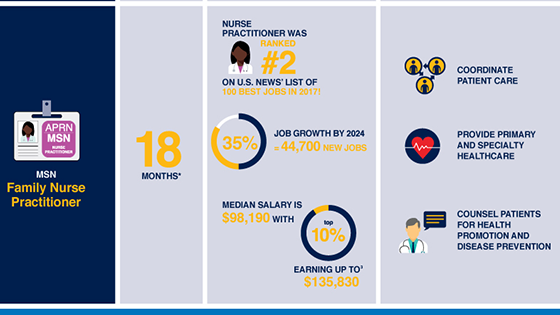
  • It’s fast growing. There’s never been a better time to become an FNP. The career is in high demand due to the growing need for healthcare services, with the Bureau of Labor Statistics (BLS) estimating a 28% increase in employment from 2018 to 2028.
  • It’s a sought-after career. U.S. News & World Report ranked FNPs as #5 in the Best Health Care Jobs for 2019 and #7 on the list of 100 best jobs in America.
  • There’s high earning potential. Registered nurses (RNs) earn an average annual salary of $71,730, while the median annual wage of FNPs is $113,930, according to the BLS. The top 10% of FNPs earn more than $182,750.
  • There are a variety of paths available. While the title “family nurse practitioner” makes it seem as though you’ll be working in family practice, you can choose from a variety of specialties that fit your interests and skills, including pediatrics, urgent care, internal medicine and more.
  • You can build your leadership skills. As an FNP, you’re the primary care provider for your patients, which means you’re delegating responsibilities and managing nurses and other members of the healthcare team.

How do I become an FNP?

If you’re interested in becoming an FNP, your path will depend on whether you’re already in the healthcare field.

  1. Earn your degree. If you’re already an RN and have your Bachelor of Science in Nursing (BSN), you can earn your Master of Science in Nursing (MSN) degree in Family Nurse Practitioner in 20 months. With Herzing University, you can complete your degree online, allowing you to learn at your own pace and on your own time. This means you can continue working full time or raising a family without putting your career goals on hold.
    • For RNs with an associate degree, you’ll have to earn your BSN, which can be done with Herzing University’s RN to BSN program. If you’re not in the healthcare field at all, you can start by earning your ASN or BSN to become an RN and then work toward your MSN in Family Nurse Practitioner.
  2. Build your skills. In addition to a degree, it helps if you’re skilled in communication and critical-thinking, as FNPs must clearly communicate with patients and healthcare professionals, and must make decisions regarding plans of action for patients. Learn more about the qualities of the best nurse practitioners.
  3. Get licensed. Once you earn your degree, you’ll want to become licensed in the state you plan on working. Licensure requirements differ and are dictated by each state’s board of nursing.

Learn more about Herzing University’s online MSN FNP program to find out how you can get started on the path to becoming a family nurse practitioner.

initial planning FLLinNZ third round

Our planning session for the Flexible Learning leaders in New Zealand planning meeting all the 1st and 2nd round FLLinNZers gathered at Wiapuna Hotel at Mt Wellington, Auckland. We started with a warmup and a discussion of what we are expecting from the third round of funding and any issues. The facilitator presented on the situation in Australia.
Main points were:
  • competency-based apprenticeships
  • qualifications recognised across Aus
  • maximum flexibility in system – impacts on quality
  • grow private training orgs with effective competition
  • school-based apprenticeships
  • RPL – want to improve uptake
  • industry wants to control knowledge base – web 2 does not fit
  • training providers not keeping pace with rapid technological change – important
  • costs, flexibility and access
  • need training to meet needs of lifelong learners – skills shortages, shiftworkers, contractors, mature learners, just-in-time and to suit learners
  • need to build capability – respond to physical and online environment
    changing role of education and training
key activity: who can we connect with to make the most influence?
often fail to equip people with skills to be able to problem solve and think forthemselves.
Pedagogical shifts
  • more of the following:
  • distributed networks
  • social networking
  • blended and flexible models
  • facilitation driving pedagogy not instruction
  • innovation
  • market changes e.g. full employment
  • Less occurrence of the teacher teaching many.
Examples: Motor Traders Association – mp3 audio files used in training to capture their interest
Caryl Oliver – mlearning – there is a recording of an interview with Caryl.
Manager of 2020: multigenerations, longer later, more teams, flexible working, performance emphasised, innovation

Overview of pressures on the NZ tertiary education sector can be seen on the concept map (to be loaded).

Facilitator talked about Australian Flexible Framework and how we could have links with Australian projects. Learnscope and Knowledge tree online journal. eLearning networks project is running a September Online Event: Tapping into Resources for E-learning 6 – 8 September 2006

Creating social phrasebooks with Phraseum

I spend a lot of time looking at different web-based tools and apps and thinking about if and how they can be used for learning. Sometimes it takes some thought and at other times it’s really obvious. With Phraseum it was instantly obvious that this was a really great tool for learning.


Phraseum allows you to collect words, phrases and sentences from anywhere on the web while you you browse and organise them into social phrasebooks.


Phraseum is a browser-based tool which can be activated from your browser toolbar. Simply create an account and then drag the ‘Clipping button’ bookmarklet to your favourites bar on your browser.


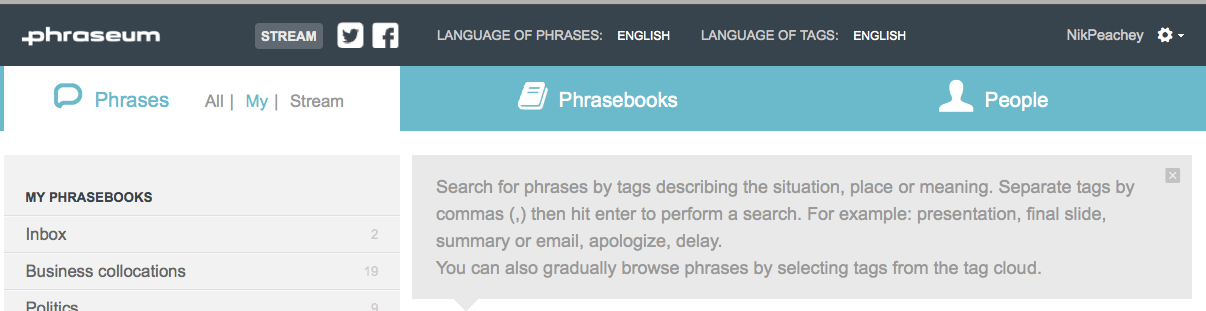
Once that’s done you can just collect any words or phrases that you find online by highlighting them and then clicking on the bookmarklet. This opens up a window where you can add tags to the phrase and add your own private notes and annotations. The tags could be a definition, translation, part of speech or something about the context in which it could be used. You can then save the phrase into one of your phrasebooks. The phrases and phrasebooks can be private or they can be made public and so shared with others.


If you want to include specific words or phrases from a word document or PDF, you can also just type in the words or phrases you want to include in your phrasebooks, but if you save them from the web then Phraseum also stores a link back to the original source, so you can go back and see how the word or phrase is used in context. You can also get a link from the phrase to a translation from Google Translate.


Phraseum is social, so you can share phrases and phrasebooks with anyone else on the site and follow other people if you like the kinds of things they are saving and sharing. You can also click on any of the tags on your phrase to find other related words or phrases which have been saved by other users and add those to your own collection.

If you use social media with your students you can post the phrases you save through various social media channels so this is a great way to feed information and activities into something like a Facebook group or page or a Twitter feed that you use with students.

All of the entries you make to Phraseum can be edited and changed, so students can always add additional tags, change them and add the same entry to multiple phrasebooks.

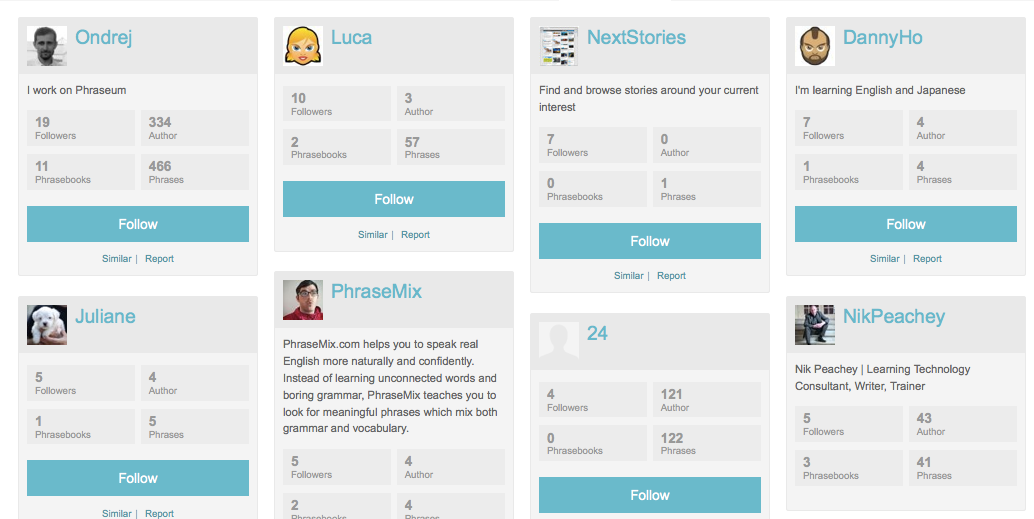
Phraseum also enables you to follow people in a similar way to Twitter or Pinterest. If you follow people you can see their public phrasebooks and keep up-to-date with what they are saving.


This is really useful if you are using it with students, as by following them you can easily monitor their work and use the comments feature if you need to help, support or encourage your students.

Here are a few examples of phrasebooks I\’ve created:


How to use Phraseum with students

  • You could get started just by creating a few of your own useful phrasebooks and sharing them with your students.
  • If you like to pre-teach vocabulary, a good way to do this would be to create a vocabulary phrasebook from a particular online article you would like your students to read. They can look at the phrasebook before they read and check they understand the vocabulary, or use it as a reference while or after they read.
  • You could also collect a phrasebook with a collections of more random words and phrases and see if the students can predict the genre or kind of text the phrases came from.
  • You can collect phrases into a phrasebook and ask students to suggest appropriate tags to add.
  • If you train your students to use Phraseum then they can start using it to create phrasebooks while they read. They can sort new words into specific groups. They could be grouped according to the source or topic or they could group words according to word classification such as parts of speech or types of collocation.
  • You can get students to share phrasebooks and crosscheck so that they share vocabulary and check that they have similar definitions or translations of the words.
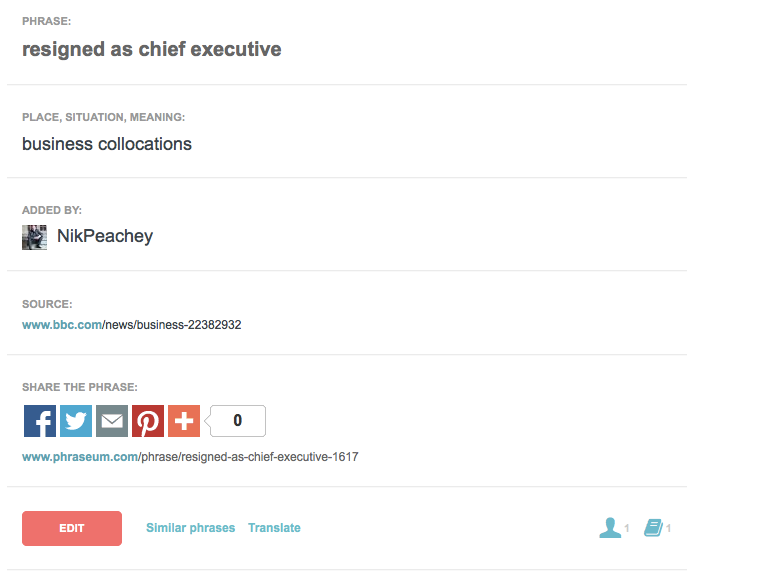
  • You can send students on treasure hunts for specific things, for example searching for business related collocations. If they use this as the tag they will then be able to share their results together (any tag you click on shows you all other words and phrases which share that same tag).
  • Get students to use the phrasebooks to revise and review their vocabulary.


What I like about Phraseum

  • I love that it works in the browser tool bar. This makes it really easy and quick to access at any time you are online.
  • I really like the social aspect too. Being able to share and compare phrasebooks with other people is really useful.
  • It’s great that it makes it easy for students to go back to the source of the word or phrase.
  • Saving phrases really encourages students to think about words within lexical chunks rather than as independent entities.
  • Phraseum can be used in multiple languages.
  • It’s free.
I think this is a great tool to support more of a lexical approach to online learning. It can also support students digital literacy and study skills. I hope you and your students find Phraseum useful. Be sure to share in the comments any ideas you have for using it with your students.
Related links: