The Secret Formula of a Winning Resume is Revealed

Secret Formula of a Winning Resume
Ever wondered how some of your friends get the coolest jobs and they’re not even that good? Or you keep wondering why you were never called for an interview, even though you’ve applied to several job positions for the last few consecutive days?
The answer is simple: your physical or digital resume is not good enough. The physical is the traditional one, where you get to handwrite/print a piece of paper which contains everything an employer needs to know.
The digital resume is basically your online presence. The fastest way employers can get to you is by leveraging social media channels. So if your online presence looks unprofessional, there are quite good chances that your traditional (sent) resume won’t matter.
Now even though the title of the article talks about the “secret” formula, I’m here to break the ice and tell you that there’s no secrecy when it comes to landing awesome jobs. You see, most people (including you) might perceive work, jobs, and even success as something that might or might not come.
You wait for an article like this to give you the “secret” pill to success, a concept which suggests the instant possibility of a better future, without any work.

How to Actually Build Your Way Up to The Top

You need to start perceiving yourself as a business. Now think…what do most successful businesses do best? They spread their name around, sell their products and services, and most importantly, they create a brand image which will always suggest their own unique name.
In your case, a professional who’s looking to build a career, you need to consider the following aspects:
  1. What talents do you have that others don’t?
  2. What makes you remarkable and basically a good choice for the employer?
  3. What have you practically done to improve your expertise and professionalism?
  4. How can you benefit the companies that you will work for in the future?
Figure out the answers to these questions as soon as you can! If the answers are somehow disappointing, if you notice that you’re ‘not good enough’, that’s a big warning sign that you need to improve yourself.

Improving Your Online & Offline Resume

As I’ve already suggested, creating an effective resume that instantly convinces employers to give you a shot for an interview is not going to happen overnight. You need to commit to improving your image over time. The best mindset is this:
You need to be extremely patient but focus on speed as much as you can. If it didn’t make sense to you, let me explain: most of the major successes happen as a result of lots of work and patience. Your resume is the same: you need to build skills, prove results, and create authority.
Here are some quick insights that should improve the next resumes that you’ll send. The job marketplace tendencies always change, so these tips are extremely relevant for 2017.
They’ll help you judge what could work best for your own situation. Keep in mind that each domain of activity has its own twist, so you need to judge if these strategies are possible in your own niche.
  1. Show Your Social Media Presence

Smart employers are always looking at your social media channel in case they’re interested in what they’ve previously seen on your traditional resume. Now, in order make their life easier, add your LinkedIn, Facebook, and/or Twitter professional account.
In case you’re using social media only for fun and communication, you can’t add this up. I’d suggest building professional pages and posting interesting links which are related to your niche. If your social media presence gives the impression of professionalism, you’re improving your chances of being called big time!
  1. Emphasize Human-Only Skills

Nowadays, technology is replacing a lot of skills that until now only humans could have. The digital tools and apps that are showing up on the market each and every day are revolutionizing the way things work, and they’re definitely changing the job marketplace’s dynamics.
Employers will mainly look for people who are technical at something. Being a pro on one skill is better than being a newbie at 10. Now – if you possess qualities that computers cannot replicate and skills that can only be leveraged by humans, emphasize them as much as you can.
  1. Display Emotional Intelligence Skills

Emotional intelligence has become an extremely discussed topic nowadays. The “IQ” score slowly starts to fade away after numerous studies have revealed that a person’s “IQ” can change as they’re improving their mental abilities. But the “EQ” concept is different.
It refers to extremely different skills and concepts such as self-awareness, empathy, or emotions management. People who show high degrees of emotional intelligence are always welcomed with open hands by their employers. Figure out and list those emotional intelligence traits and see the results blooming in no time!
  1. Use a Professional Service

There are different services that have already managed to help thousands of professionals like you. I’ll list just three of them, the ones which I’ve actually tested myself:
  • CareersBooster.com – the place which helps you take care of every possible aspect that’s related to your personal image and to the resume writing and editing process.
  • VisualCV – visual content is on the rise, and this service gives you choices to plant visually stimulating content throughout your CV.
  • Vizualize.me – similar to the above, this service creates visual CVs that could make a huge impact.
Choose the service you like most and work on the design of a resume until you’re satisfied with the end product. Work with professional tools to assist you in resume creation process is actually s smart choice.

Conclusion

Do you want to build the best resume ever? You need to work hard, gain experience, gain skills, gain knowledge, and only then…only then you should consider how to make everything look better.
Until you don’t take action towards your personal development process, you can’t expect for great things to happen. Once you have something to show, landing good jobs will be a piece of cake!

Shri Arjun Munda inaugurates the function to celebrate “16th foundation of day of NCST”

Shri Arjun Munda, Union Minister for Tribal Affairs inaugurated the function to celebrate “16th Foundation of Day of National Commission for Scheduled Tribes (NCST)” organised by National Commission for Scheduled Tribes (NCST) here today. He delivered keynote address on the occasion. Smt. Renuka Singh Saruta, Minister of State for Tribal Affairs was the Guest of Honour. Shri Nand Kumar Sai, Chairman, NCST and members of the Commission and many dignitaries were present.

Shri Arjun Munda presented awards for exemplary service towards Scheduled Tribes in the country to (i) CPSU – Western Coalfields Ltd. Nagpur (Shri Rajiv Ranjan Mehra, CMD received the award) and (ii) Individual (Shri Ajay Kumar Jaiswal, Secretary, ASHA, Ranchi received the award).

Delivering keynote address, Shri Arjun Munda said that the National Commission for Scheduled Tribes (NCST) was set up with effect from 19th February, 2004 by amending Article 338 and by inserting a new article 338A  in the Constitution through the Constitution (89th Amendment Act, 2003 which inter-alia enjoins upon the Commission to oversee the implementation of various safeguards provided to Scheduled  Tribes under the Constitution or under any other law for time being in force or under any other order to the Govt. and to evaluate the working of such safeguards.

Shri Munda said that the Commission has been constituted with a great purpose to take care of STs in our country. He opined that there should be a Data Bank of Tribal lands all over the country, NCST should have an Independent Research Team for proper research work. Also, the Commission should have a proper Data Management System. He assured the full support and cooperation of Ministry of Tribal Affairs in strengthening NCST.

Shri Nand Kumar Sai, in his address dwelt upon the many activities and programmes of NCST for the welfare of STs in our country.

Smt. Renuka Singh Saruta said that that former Prime Minister Shri Atal Bihari Vajpayee created a separate Ministry of Tribal Affairs in year 1999 and later on separate National Commission for Scheduled Tribes was created on 19th February, 2004. She said that many States have State Commission for STs but many States do not have such Commission for STs. All States should have Commission for STs. She said that the tribal people have contributed a lot in our freedom struggle and nation building.

The Commission comprise a Chairperson, a Vice Chairperson and three full time members (including one lady member). The term of office Chairperson, Vice Chairperson and Members of NCST is three years from the date of assumption of charge. The Chairperson has been given the rank of Union Cabinet Ministries, the Vice Chairperson have the rank of a Minister of State and other Members have the rank of a Secretary to the Government of  India.

Constitution of India under Clause (5) of Article 338A has assigned the following duties and functions to the Commission:

  1. To investigate and monitor all matters relating to the safeguards provided for the Schedule Tribes under the Constitution or under any other law for the time being in force or under any order of the Government and to evaluate the working of such safeguards.
  2. To inquire into specific complaints with respect to the deprivation of rights and safeguards of the Scheduled Tribes.
  3. To participate and advice in the planning process of socio-economic development of the Scheduled Tribes and to evaluate the progress of their development under the Union and any State.
  4. To present to the President, annually and at such other times as the Commission may deem fit, report upon the working of those safeguards.
  5. To make in such reports, recommendations as to the measures that should be taken by the Union or any State for effective implementation of those safeguards and other measures for the protection, welfare and socio-economic development of the Scheduled Tribes.
  6. To discharge such other function in relation to the protection, welfare and development and advancement of the Scheduled Tribes as the President may subject to the provisions of any law made by Parliament by rule specify.

*****

How to Improve Project Management and Create a Better Process

Paul Dandurand is a big believer in process. The Burlington-based, start-up entrepreneur is CEO and founder of PieMatrix and creator of Pie, a visual project management software platform. He says a lack of process at many organizations leads to reduced productivity, failed projects, and disengaged employees.
We talked to Paul about project management, the pitfalls of lists, and keeping employees motivated through process improvement.

Process seems to be a lost art in today’s multi-tasking, fragmented workforce. When it comes to project management, why do you think process is something not done more effectively?

I see two reasons why many are missing a process mindset. One is a traditional focus on budget and time. When asked, the majority will say a quality end-result is critical, but upper management is more financially driven than quality driven, at least for the short term. Second, people who plan projects are more or less schedulers. They don’t think about how the process is done. It’s easier to think about who’s doing the what than the how. In these two cases, organizations end up running projects from task lists created from scratch or from a copy of something done in the past. In either way, it’s just a list of stuff with assignments, dates, and progress.

Why is process so important?

Eighty percent of what you’re doing at work is process based. We do repeatable work all the time, which naturally lends better for process. For example, let’s say an education department has a project to create courses for the new semester. Guess what? The approach is most likely the same each year. It’s a project, but the methodology is always repetitive. That’s the process part. A process is a set of repetitive ways to get something done really well, over and over. A good process leads to a good project done on time, on budget, and with happy results.

What happens to process when there is turnover at a company or organization?

Often when people leave, their knowledge goes out the door with them. It can be detrimental if the knowledge is not previously captured and available at your fingertips to execute in real time. Also, whether or not the process knowledge stays behind, we should still be open to improvement when a new person comes into the organization with new insight. The key to process is that it should be flexible and sustainable.

What do you think are some of the biggest pitfalls in project management?

The Standish Group CHAOS survey is a good place to look at the biggest pitfalls. It’s one of the most recognized and extensive project management surveys of large organizations. Their top reasons for failures are lack of executive support, weak behaviors on how people work together, poor user involvement when gathering information, business improvement effectiveness is lacking, and just not enough skilled and experienced people since the good ones get promoted or retire.
I love the CHAOS reports since they really show the seriousness of failures. I have a three-part blog series talking about why 70 percent of your projects fail and what to do about it.

What are some habits professionals need to have in order to be successful at project management?

When I think of a project manager, I think of someone who is a good team leader, a problem solver, and always thinking about getting quality results. It’s also someone who is engaging the team to be creative with how to improve the process for next time, and very diligent with following up by looking at what people are doing and asking questions.

What are some warning signs that an organization needs help with project management?

Too many crises, especially repeated ones. Disengaged people, missing targets, and lousy end results.

How can leaders and managers use process to help engage and motivate employees?

There needs to be a culture change to focus on process and process improvement. I would also suggest a focus on gathering ideas from employees and talking about lessons learned, and then figuring out how to incorporate those ideas and lessons. It’s also helpful to encourage employees by giving them recognition when they contribute ideas, help others, and ask for help.

How does process benefit employees and productivity?

A process helps you understand interdependencies, how work is grouped, and how to make it more efficient. A good process provides a way to draw on and improve from lessons learned. A process tends to engage the teams much more than a task list. It helps us think creatively about what we learned and how to make it better the next time around. I think the world would become a better place is everyone spent extra time thinking about how to incrementally improve something every day

Gadkari Witnesses High Efficiency Logistic Vehicles in Gothenburg, Sweden

Union Minister for Road Transport & Highways and MSMEs Shri Nitin Gadkari visited the Swedish Logistics Automotive manufacturer ‘Volvo’ in Gothenburg, Sweden today. The Minister saw high-efficiency logistics vehicles (road-trains), LNG trucks, electric trucks, etc. Volvo is one of the world’s largest manufacturers of heavy-duty trucks, construction equipment, buses and heavy-duty diesel engines as well as a leading supplier of marine and industrial engines. The Minister was accompanied by Ambassador of Sweden in India Mr Klas Molin.

The Minister in in Sweden these days, to represent India at the “3rd High Level Global Conference on Road Safety for Achieving Global Goals 2030” being held in Stockholm during 19th and 20th of February, 2020. The objective of the two-day conference is to bring road safety on the global agenda and renew the world community’s commitment to safer roads. Leaders from participating countries will draw up a road-map for reaching the United Nation’s goal set under the UN Decade of Action of reducing road crashes by 2030.

During his stay in Stockholm, Shri Gadkari will have bilateral dialogue with his Swedish Minister for Infrastructure Tomas Eneroth, Minister for Foreign Trade Anna Hallberg, Minister for Business, Industry & Innovation Ibrahim Baylan and also with the British Minister for Road Safety Baroness Vere. Shri Gadkari will also hold talks with the World Bank Vice President (South Asia) Hart Schafer. Also on Gadkari’s itinerary will be a Sweden-India Transportation Safety and Innovation Partnership meeting to be attended a number of CEOs. Swedish and Indian businesses are likely to exchange several MOUs on this occasions.

***

MS/

Indian Navy Reviews Refit of Ships and Submarines and Infrastructure Buildup

Indian Navy’s Annual Refit Conference (ARC) and Annual Infrastructure Conference (AIC) commenced at Headquarters Eastern Naval Command, Visakhapatnam on 18 Feb 20. The two-day conference chaired by Vice Admiral GS Pabby PVSM, AVSM, VSM, Chief of Materiel (COM), Integrated Headquarters, Ministry of Defence(Navy) is being attended by all the stakeholders representing the Naval Headquarters, three Naval Commands, the Tri-Services Andaman & Nicobar Command at Port Blair, Dockyards, Repair Yards and Material Organisations of the Navy.  The delegates will deliberate upon refit plans for all ships and submarines of the Indian Navy and formulate plans for infrastructure augmentation to meet the growing requirements of the Indian Navy.

Delivering the inaugural address, Vice Admiral Atul Kumar Jain, PVSM, AVSM, VSM, Flag Officer Commanding-in-Chief, ENC welcomed the delegates and appreciated the dedicated efforts being put in by one and all in ensuring combat availability of Naval platforms. Role of the Naval Repair Yards towards the sustained operation of platforms at sea was lauded.

The Chief of Materiel (COM), during his address, complimented the forum for ensuring quality refits of ships and submarines, with a focus on the safety of personnel and material. During the course of the conference, technical and logistics aspects concerning refits were deliberated at length with a special emphasis on enhanced efficiency/ capability of sea-going units. He also urged all concerned to focus on greater indigenisation in keeping with the spirit of the ‘Make in India’ initiative.

The Annual Infrastructure Conference will be held on 19 Feb 20 to review progress towards modernisation and augmentation of repair and refitting infrastructure in order to maintain the lethal edge of combat assets of the Indian Navy.

***

Indian Navy Reviews Refit of Ships and Submarines and Infrastructure Buildup

Indian Navy’s Annual Refit Conference (ARC) and Annual Infrastructure Conference (AIC) commenced at Headquarters Eastern Naval Command, Visakhapatnam on 18 Feb 20. The two-day conference chaired by Vice Admiral GS Pabby PVSM, AVSM, VSM, Chief of Materiel (COM), Integrated Headquarters, Ministry of Defence(Navy) is being attended by all the stakeholders representing the Naval Headquarters, three Naval Commands, the Tri-Services Andaman & Nicobar Command at Port Blair, Dockyards, Repair Yards and Material Organisations of the Navy.  The delegates will deliberate upon refit plans for all ships and submarines of the Indian Navy and formulate plans for infrastructure augmentation to meet the growing requirements of the Indian Navy.

Delivering the inaugural address, Vice Admiral Atul Kumar Jain, PVSM, AVSM, VSM, Flag Officer Commanding-in-Chief, ENC welcomed the delegates and appreciated the dedicated efforts being put in by one and all in ensuring combat availability of Naval platforms. Role of the Naval Repair Yards towards the sustained operation of platforms at sea was lauded.

The Chief of Materiel (COM), during his address, complimented the forum for ensuring quality refits of ships and submarines, with a focus on the safety of personnel and material. During the course of the conference, technical and logistics aspects concerning refits were deliberated at length with a special emphasis on enhanced efficiency/ capability of sea-going units. He also urged all concerned to focus on greater indigenisation in keeping with the spirit of the ‘Make in India’ initiative.

The Annual Infrastructure Conference will be held on 19 Feb 20 to review progress towards modernisation and augmentation of repair and refitting infrastructure in order to maintain the lethal edge of combat assets of the Indian Navy.

***

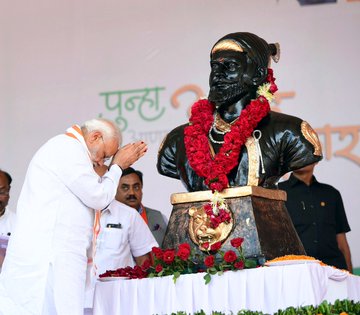
PM pays tributes to Chhatrapati Shivaji Maharaj on his Jayanti

The Prime Minister, Shri Narendra Modi has paid tributes to Chhatrapati Shivaji Maharaj, on his Jayanti today.

Prime Minister said, “Bowing to one of the greatest sons of Mother India, the embodiment of courage, compassion and good governance, the exceptional Chhatrapati Shivaji Maharaj on his Jayanti. His life continues to motivate millions.

Chhatrapati Shivaji Maharaj made a mark as a valorous warrior and an outstanding administrator. From building a strong navy to ushering several pro-people policies, he was outstanding in all spheres. He will always be remembered for his opposition to injustice and intimidation”.


Narendra Modi

@narendramodi

महान छत्रपती शिवाजी महाराज यांच्या जयंती दिनी त्यांना नमन!

Bowing to one of the greatest sons of Mother India, the embodiment of courage, compassion and good governance, the exceptional Chhatrapati Shivaji Maharaj on his Jayanti. His life continues to motivate millions.

View image on Twitter
10.4K people are talking about this

Narendra Modi

@narendramodi

महान छत्रपती शिवाजी महाराज यांच्या जयंती दिनी त्यांना नमन!

Bowing to one of the greatest sons of Mother India, the embodiment of courage, compassion and good governance, the exceptional Chhatrapati Shivaji Maharaj on his Jayanti. His life continues to motivate millions.

View image on Twitter

Narendra Modi

@narendramodi

Chhatrapati Shivaji Maharaj made a mark as a valorous warrior and an outstanding administrator. From building a strong navy to ushering several pro-people policies, he was outstanding in all spheres. He will always be remembered for his opposition to injustice and intimidation.

2,913 people are talking about this


*****

VRRK/KP

KALA KUMBH – Handicrafts Exhibitions for promotion of GI Crafts

With an objective to promote Geographical Indication (GI) crafts and heritage of India the Ministry of Textiles is organising Kala Kumbh – Handicrafts Thematic Exhibition in various parts of the country through the Office of Development Commissioner (Handicrafts). The exhibitions are planned in various major cities like Bengaluru, Mumbai, Kolkata and Chennai. The exhibitions sponsored by Export Promotion Council for Handicrafts (EPCH) started on 14th February, 2020 and will continue till 23rd February 2020 at Bengaluru and Mumbai and will also be organized in Kolkata and Chennai in March 2020.

The GI tag is used on handicrafts which correspond to a specific geographical location or origin (e.g., a town, region, or country). As on August 2019, 178 GI handicraft products were registered from all over India. The artisans are the backbone of Indian handicraft sector and possess inherent skill, technical and traditional craftsmanship.

During the 10 day exhibitions, the visitors will be able to see a wide variety of handicrafts with their friends and family and by buying these handicrafts they can directly contribute in the improvement of the livelihood of these artisans and also create awareness of the rich heritage of the country.

In Bengaluru exhibition, GI crafts like Mysore rosewood inlay, Channapatna lacquerware, Dharwad kasuti embroidery, Kolhapur chappal, Bidriware, Molakalmur handblock printing, Ananthapur leather puppet, Thrissur screwpine, Vishakapatna lacquerware, Sandur lambani embroidery, Jodhpur terracota, Jaipur handprinted textile, bronze casting, Medinipur mat weaving, Birbhum artistic leather and Khurdah palm leaf engraving are being displayed.

In Mumbai exhibition GI crafts like Chittoor kalamkari painting, Thrissur screwpine crafts, Pokharan terracotta crafts, Kutch embroidery & crochet crafts, Pingla patachitra, Birbhum kantha embroidery, Jajpur photachitra painting, Madhubani Mithila painting, Kolhapur chappal, Palghar Worli painting, Kondagaon wrought iron craft, Agate stone crafts and Krishna handblock printing are being displayed.

***

Photo by julie aagaard on Pexels.com

Clarification about the Discussions and Decisions taken in the meeting of National Statistical Commission

A section of the media reported about the discussions and decisions taken in the meeting of the National Statistical Commission (NSC) on 15 Jan 2020.  It is clarified that in the meetings of NSC, the concerned Divisions make a presentation on the agenda items and after elaborate discussions, decisions are taken.  These decisions are unanimous after due deliberation and are in line with the Code of Professional Ethics notified by the Government.  It is further clarified that the NSC is a recommending body that helps the national statistical system in evolving better strategies to improve the functioning of the system.  It is unfortunate that the report has sought to portray a difference of opinion in the decision making of the Commission whereas the decisions were unanimous. Such coverage by the media is inappropriate, to stay the least, and the Commission unequivocally condemns it.  The Commission is conscious about the initiatives being taken for improving the data quality in the statistical products and processes and works closely with the statistical agencies in the central and state government to ensure its implementation.

***

VRRK/AK

District Skill Committees to work closely with the Center to drive demand-driven skill development initiatives

  • Role of States to increase substantially in skill development activities
  • Discussion on developing an action plan for better implementation of skilling initiatives and for creating employment opportunities for India’s youth
  • Short Term Training courses to be introduced in ITIs in with due consultation from the State Skill Development Missions (SSDMs)
  • Promoting Self Employment and Entrepreneurship for overall economic growth and innovation

Ministry of Skill Development and Entrepreneurship (MSDE) organized a day long consultative workshop here today, with representatives from States and Union Territories, to review skill development across geographies and segments and to seek their valuable suggestions on streamlining the upcoming initiatives. The key thrust of the workshop was to increase the participation of the District Committees for better coordination of the skill efforts in each district and to achieve the broader objectives of the Hon’ble Prime Minister’s vision of making India the skill capital of the world.

During the workshop, Vision 2025 was also discussed which lays out the key focus areas and ready-to-implement roadmap for promoting Skill Development and Entrepreneurship in country.

The aim for organizing today’s workshop was to unlock the true potential of the youth by making skills aspirational and building sustainable livelihood pathways for them. The State and Union Territory representatives shared their regional perspective on the various aspects of the Skill India Mission including Apprenticeship, Long Term Skilling; Sankalp and Strive initiatives; Entrepreneurship; Short Term Skilling and the next stage of the Pradhan Mantri Kaushal Vikas Yojana (PMKVY), PMKVY 3.0 and the related challenges and opportunities.

The center proposed that the District Skill Committees (DSCs) should be further empowered with substantial fund allocation to ensure stringent monitoring and evaluation of skill training under the next phase of PMKVY.

Towards this, MSDE has recently introduced the Mahatma Gandhi National Fellowship (MGNF), an initiative designed and implemented by IIM Bangalore in collaboration with State Skill Development Missions (SSDMs), where fellows will be posted in district for 2 years working closely with the district administration to create specific State Skill Development Plans. Relevant local and state level programs will also receive additional funding under the SANKALP scheme of MSDE, beyond the already allocated state incentive grants.

The workshop also deliberated on integration of skill development in the plans of Gram Panchayats ensuring last mile connectivity.

Urging the states to increase scale and standards of skill development, Dr. Mahendra Nath Pandey, Minister for Skill Development and Entrepreneurship said, “Our endeavor is to move away from the low skill equilibrium and contribute towards economic growth and wealth creation through skill development and entrepreneurship. This will eventually lead to increased employment prospects for the youth of the nation. The success of Skill India is dependent on the increased participation of the States and the District committees to drive demand-driven skill development in market relevant courses and prepare our youth to be industry ready.”

“There should consistent research and analysis on skill gaps at a local level, so that our strategies match the demand of the market and the aspiration of the youth. We should enable industry surveys to enable outcome-based skilling,” said Shri R K Singh, Minister of State (IC) Power and New & Renewable Energy, MoS in the Ministry of Skill Development and Entrepreneurship.

MSDE assured its support to States in keeping pace with the industry best practices by enabling upgradation of Industrial Training Institutes (ITIs) and encouraging more participation from industry giants. Initially, MSDE will focus on the top 500 ITIs, on the basis of the grading of these institutes, and will also determine surplus existing capacity for Short Term Training in ITIs. MSDE has also identified 100 industrial clusters for improved and broadening Apprenticeship training. Out of these, agreements have already been signed with eleven clusters.

To promote entrepreneurship in the country, the Ministry proposed entrepreneurship development unit in each State which will be anchored with State Skilling Mission. It also proposed developing mentorship and handholding of existing and new entrepreneurs, through district entrepreneurship incubation lab in existing skilling institutions.

***********

Gadkari Visits Safety Equipments Manufacturer and Winesses The E-Highway Test-Bed Demonstration Site in Sweden

Union Minister for Road Transport & Highways and MSMEs Shri Nitin Gadkari visited the Swedish Automotive Safety Supplier ‘Autoliv’ in Stockholm today. The Minister presented a copy of the Report on ‘Road Safety in India’ to company representative, and took note of the recent products and innovations of the company. Autoliv is the world’s largest automotive safety equipment supplier, with sales to all major car manufacturers in the world.

Road safety is a major concern in India. The country has committed to safety, efficiency and sustainability in the transport sector. The problem of safety is also linked to social equity in India. With a large population of pedestrians, cyclists and motorised two-wheelers competing for space on roads, the road safety needs for these vulnerable sections has to be kept in mind while designing and developing transport strategies.


The Minister later visited E-highway Test-bed Demonstration site in Sweden. Government of India has already announced E-highways. During the visit, he was informed about the recent technological developments in the sector achieved by Sweden.

The Minister in in Sweden these days, to represent India at the “3rd High Level Global Conference on Road Safety for Achieving Global Goals 2030” being held in Stockholm during 19th and 20th of February, 2020. The objective of the two-day conference is to bring road safety on the global agenda and renew the world community’s commitment to safer roads. Leaders from participating countries will draw up a road-map for reaching the United Nation’s goal set under the UN Decade of Action of reducing road crashes by 2030.

During his stay in Stockholm, Shri Gadkari will have bilateral dialogue with his Swedish Minister for Infrastructure Tomas Eneroth, Minister for Foreign Trade Anna Hallberg, Minister for Business, Industry & Innovation Ibrahim Baylan and also with the British Minister for Road Safety Baroness Vere. Shri Gadkari will also hold talks with the World Bank Vice President (South Asia) Hart Schafer. Also on Gadkari’s itinerary will be a Sweden-India Transportation Safety and Innovation Partnership meeting to be attended a number of CEOs. Swedish and Indian businesses are likely to exchange several MOUs on this occasions.

***

Central Government employees selected for appointment

s and Pensioners’ Welfare to address the longstanding demand of Central Government employees whose recruitment was finalized before 01/01/2004 but who had, for various reasons, joined the services on or after 01/01/2004. However, he noted that the last date to exercise this option would be 31/05/2020, and those who fail to exercise the option by this stipulated date would continue to be covered by the National Pension System.

The Central Government by this order has rectified a long standing grievance of a huge number of employees whose recruitment (including written examination, interview and declaration of result) had been finalized on or before 01.01.2004 (which was the cut-off date for employees to be covered under the old Pension scheme) but whose joining was delayed on account of administrative reasons and such delay was beyond the control of such Government servants.

This order of the Government of India is expected to give relief to several Central Government employees, some of whom were knocking the doors of the Courts in order to get covered under the CCS (Pension) Rules, 1972 and will also substantially bring down the litigation on this subject matter.

A few illustrations where the selection was finalized before 01.01.2004 but actual joining took place on or after 01.01.2004 are as under:

  1. The result for recruitment was declared before 01.01.2004 but the offer of appointment and actual joining of the Government servant was delayed on account of police verification, medical examination etc.;
  2. Some of the candidates selected through a common selection process were issued offers of appointments and were also appointed before 01.01.2004 whereas the offers of appointments to other selected candidates were issued on or after 1.1.2004 due to administrative reasons/constraints including pending Court/CAT cases.
  3. Candidates selected before 01.01.2004 through a common competitive examination were allocated to different Departments/organization. While recruitment process was completed by some Department(s)/organizations on or before 31.12.2003 in respect of one or more candidates, the offers of appointment to the candidates allocated to the other Departments /Organization were issued on or after 01.01.2004.
  4. Offers of appointment to selected candidates were made before 01.01.2004 with a direction to join on or after 01.01.2004.
  5. Offers of appointment were issued to selected candidates before 01.01.2004, and many/most candidates joined service before 01.01.2004. However, some candidate(s) were allowed extension of joining time and they joined service on or after 01.01.2004. However, their seniority was either unaffected or was depressed in the same batch or to a subsequent batch, the result for which subsequent batch was declared before 01.01.2004.
  6. The result for recruitment was declared before 01.01.2004 but one or more candidates were declared disqualified on the grounds of medical fitness or verification of character and antecedents, caste or income certificates. Subsequently, on review, they were found fit for appointment and were issued offers of appointment on or after 01.01.2004.

In all the above illustrative cases, since the result for recruitment was declared before 01.01.2004, denial of the benefit of pension under CCS (Pension) Rules, 1972 to the affected Government servants is not considered justified.s

It has been decided that in all cases where the results for recruitment were declared before 01.01.2004 against vacancies occurring on or before 31.12.2003, the candidates declared successful for recruitment shall be eligible for coverage under the CCS (Pension) Rules, 1972.

Accordingly, such Government servants who were declared successful for recruitment in the results declared on or before 31.12.2003 against vacancies occurring before 01.01.2004 and are covered under the National Pension System on joining service on or after 01.01.2004, may be given a one-time option to be covered under the CCS (Pension) Rules, 1972. This option may be exercised by the concerned Government servants latest by 31.05.2020.

Those Government servants who are eligible to exercise option in accordance with para-4 above, but who do not exercise this option by the stipulated date, shall continue to be covered by the National Pension System and the option once exercised shall be final.

The matter regarding coverage under the CCS (Pension) Rules, 1972 based on the option exercised by the Government servant shall be placed before the appointing authority for consideration in accordance with these instructions. In case the Government servant fulfils the conditions for coverage under the CCS (Pension) Rules, 1972, in accordance with these instructions, necessary order in this regard shall be issued latest by 30th September, 2020. The NPS account of such Government servants shall, consequently, be closed w.e.f. 01st November, 2020.

The Government servants who exercise option to switch over to the pension scheme under CCS (Pension) Rules, 1972, shall be required to subscribe to the General Provident Fund (GPF).

*****

VG/VM/HS


Dr. S Jaishankar to inaugurate Indian Pavilion at 70th Berlin International Film Festival

The festival will be held from 20th February to 1st March 2020 in Berlin, Germany. The film festival will also see an India Pavilion which will provide a platform to popularize Indian cinema in the overseas market and facilitate new business opportunities.

This year in Berlin, three Indian feature films as well as one short documentary film have been selected, namely Pushpendra Singh’s Laila Aur Satt Geet, Prateek Vats’ Eeb Allay Ooo!, Akhsay Indikar’s “Sthalpuran” and Ekta Mittal’s short documentary “Gumnaam Din”.


Dr. S Jaishankar, Minister of External Affairs will inaugurate the Indian Pavilion at Berlinale.

India seeks to promote its films across linguistic, cultural and regional diversity and establish multiple international collaborations in the space of distribution, production, filming in India, and script development technology through its participation at Berlinale 2020.

The Indian delegation, through various interactions, seeks to promote the ease of shooting films in India through Film Facilitation Office (FFO) that facilitates Single Window Clearance for filmmakers and provides the platform for ‘Cinematic Tourism’ in India. The delegation will exhibit India as a post-production hub and promote collaborations for films with international production houses.

The Audio-Visual Services sector has been recognized as one of the Champion Services Sectors by the Government of India with an aim to promote India as a leading destination source for Media and Entertainment.

Government delegation to Berlinale will facilitate international participation for the 51st edition of International Film Festival of India (IFFI) 2020, Goa. IFFI aims at providing a common platform to the cinemas across the world to project the excellence of the art of film making.

The delegation has meetings scheduled with officials from countries including Israel, South Africa, New Zealand, Spain, Brazil, Portugal, France, Italy, Switzerland, Germany, Canada, United States of America and Rwanda. The delegation will meet with officials from Locarno Film Festival, Sundance Film Festival, Venice International Film Festival, Cannes Film Festival, Raindance Film Festival, Edinburgh International Film Festival, Annecy International Animation Festival, among others.

India enjoys comparative advantage in several aspects of the filmmaking process. It has a strong domestic film industry across the country and is home to world class technicians and equipment and diverse location choices to shoot any type of film.

With over 1,800 feature films produced in the country, more than 900 television channels, 500 million internet users, 500 million smart phone users, India’s vibrant media and entertainment (M&E) industry provides attractive growth opportunities for global corporations.

*********

Annual Review Meeting of Swachh Iconic Places (SIP) at Baidyanath Dham Deoghar, Jharkhand

The 3rd Annual Review meeting on Swachh Iconic Places (SIP) was held today at Baidyanath Dham Deoghar, Jharkhand. The SIP is the brainchild of the Prime Minister Shri Narendra Modi and is coordinated by the Department of Drinking Water and Sanitation (DDWS), Ministry of Jal Shakti under the Swachh Bharat Mission. Thirty Swachh Iconic Places have been selected across the country in three phases, and are implementing their action plans for improving the sanitation facilities and overall cleanliness, focusing on enhancing visitor’s experience and convenience.

The National Review Meeting was inaugurated by the Minister, Drinking Water and Sanitation, Government of Jharkhand, Shri Mithilesh Thakur, and attended by Shri Parameswaran Iyer, Secretary, DDWS, Government of India, and senior officials from the state and central government, nodal persons from iconic sites/states, partnering PSUs and other local bodies.

Speaking on the occasion, Shri Mithilesh Thakur said that SIP projects have played a very critical role in improving the cleanliness standards at the selected thirty iconic sites, and especially at Baidyanath Dham Temple, Deoghar. He spoke about some of the key activities undertaken to improve swachhata in the temple premises like using the waste generated from the offerings at the temple to generate compost, and rejuvenation of water bodies like Shiv Ganga Sarovar. The Minister also launched and dedicated ‘Five Water ATM’s for Baidyanath Dham Temple, supported by the PSU partner Power Grid Corporation of India Limited.

Shri Parameswaran Iyer, Secretary, DDWS elaborated the importance of SIP, and gave the example of how the SIP activities at Deoghar have been recognized and awarded twice in the past for their good work. He also gave examples of the good work being done at some of the other sites from across the country.

Shri Samir Kumar, Joint Secretary, DDWS made a presentation highlighting the key role of partner Ministries, district administration and CSR partners in implementation of the SIP. He also stressed the importance of convergence for funds, proposals, cross learning, and experience sharing. Earlier, Secretary, DDWS, Govt of Jharkhand, Smt. Aradhana Patnaik welcomed participants from all the iconic sites and appreciated their efforts in improving conditions at these sites.

Nodal officers from 25 of the 30 iconic sites and their PSU partners presented their progress and key activities being carried out at these sites including Solid and Liquid Waste Management (SLWM), beautification and landscaping of premises and approach areas, construction of sanitation and safe drinking water facilities, rooftop solar panels, battery operated sweeping machines, rejuvenation of water bodies, ban on plastic use, Sewage Treatment Plants (STPs), multi-level parking, illuminated boards, awareness campaigns and IEC interventions among others.

Phase I Iconic sites:  1. Ajmer Sharif Dargah; 2. CST Mumbai; 3. Golden Temple, Amritsar; 4. Kamakhya Temple, Assam; 5. Maikarnika Ghat, Varanasi;  6. Meenakshi Temple, Madurai; 7. Shri Mata Vaishno Devi, Katra, J&K; 8. Shree Jagannath Temple, Puri; 9. The Taj Mahal, Agra; 10. Tirupati Temple, Tirumala

Phase II Iconic sites: 1. Gangotri; 2. Yamunotri; 3. Mahakaleshwar Temple, Ujjain; 4. Char Minar, Hyderabad; 5. Church and Convent of St. Francis of Assissi, Goa; 6. Adi Shankaracharya’s abode Kaladi in Ernakulam; 7. Gomateshwar in Shravanbelgola; 8. Baijnath Dham, Devghar; 9. Gaya Tirth in Bihar; 10. Somnath Temple in Gujarat.

Phase III Iconic sites: 1. Sree Dharma Sastha Temple; 2. Mana Village, Uttarakhand; 3. Vidur Kuti Temple, Uttar Pradesh; 4. Shri Sarveshwar Mahadev Temple; 5. Shri Nag Vasuki Temple; 6. Kanvashram, Uttar Pradesh; 7. Ema Keithel, Manipur; 8. Hazarduari Palace, West Bengal; 9. Pangong Tso; 10. Sri Raghvendra Swamy Mutt Mantralayam


*****