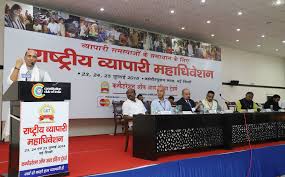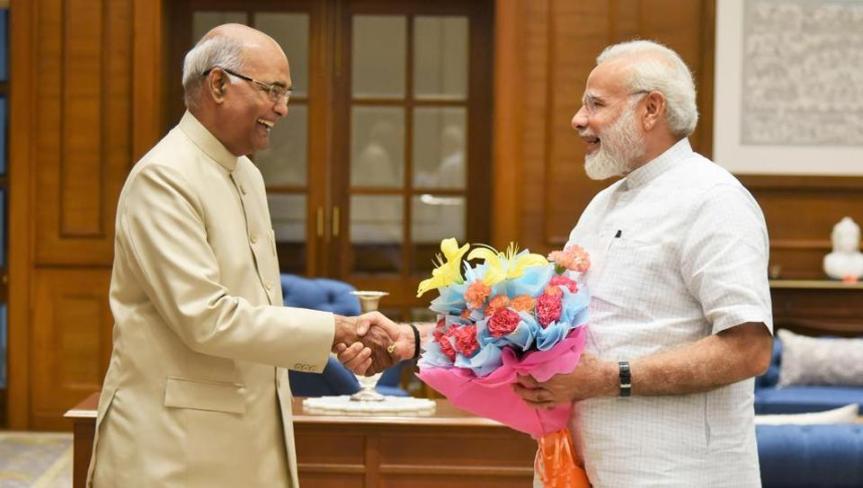
Address by the Hon’ble President of India Shri Ram Nath Kovind on the Occasion of the Inauguration of the Constitution Day

  1. I feel honoured to be here today to inaugurate the Constitution Day celebrations. Today I feel doubly blessed as before coming to the Supreme Court, I addressed a joint session of parliament on the occasion of the 70th anniversary of adopting the Constitution. I have the rare privilege of being associated with both the institutions, Parliament and the Supreme Court, which are temples of our Republic.
  1. On this occasion I also feel humbled when I recall our Founding Fathers. Guided solely by the light of liberty and justice, they sat down to write this document of our destiny amid historic events and challenges. They created institutions and designed the right balance among them to ensure that their core objectives are not compromised. The co-existence of our fully independent judiciary with a vibrant parliamentary democracy is a testimony to their sagacity and foresight.
  1. These sages put in words the noble vision of our Republic in the Constitution after marathon deliberations over three years. The nation will always remain grateful to all the members and office-bearers of the Constituent Assembly, particularly its President, Dr Rajendra Prasad, and the Chairman of the Drafting Committee, Dr Babasaheb Bhimrao Ambedkar, who is rightly known as the architect of the Constitution. Their zeal and devotion to meet the task of such magnitude was matched by contributions from the titans like Jawaharlal Nehru and Sardar Vallabhbhai Patel. They headed various committees and sub-committees, along with ‘Acharya’ Kripalani, H. C. Mookerjee, Gopinath Bordoloi and Amritlal Thakkar.
  1. I would like to also pay homage especially to the 15 women members of the Constituent Assembly. They included Sarojini Naidu, Rajkumari Amrit Kaur, Hansaben Jivraj Mehta, Sucheta Kripalani and G. Durgabai, who spoke of equal rights for one and all, when women in many parts of the world were denied basic rights.
  1. In his speech before the Constitution was adopted, Dr Rajendra Prasad rightly noted that the successful working of democratic institutions requires willingness to respect the views of others, and capacity for compromise and accommodation. He said, [quote] “Many things which cannot be written in a Constitution are done by conventions. Let me hope that we shall show those capacities and develop those conventions.” [Unquote] Seventy years later, we have reasons to believe that the nation has lived up to his hopes to a fair degree.
  1. As Rajen Babu, Babasaheb and many others pointed out that day, a Constitution is after all a mere document, recording in words the inspired ideas. It can come alive and enter our world only when it is translated into life of the nation and its ideals put into practice. It is the scripture of our nation that has to be read in a sensitive and delicate manner. The Constitution gave this onerous task to the judiciary. Keeping the role of the Supreme Court as final interpreter of the constitution and the laws enacted under it, the judiciary assumes the role of its guardian. The authors of our Constitution took extra care in providing it the necessary powers and freedoms to function without any undue influence. Over these eventful seven decades, the judiciary has remained alive to the high responsibility placed on it. I am aware of the fact that it has initiated several innovative measures to reach out to people.
  1. But for a large section of people, justice is still beyond reach. While we celebrate the 150th birth anniversary of Mahatma Gandhi, let me refer to his views on the issue. Neither was the Father of the Nation a member of the Constituent Assembly, nor do we know his views on our founding document. What we know for sure is that he had played a crucial role in the making of the Constituent Assembly and blessed this historic endeavour. In a sense, the Constitution is the product of the values inspired by the Freedom Struggle. It, thus, very much reflects the democratic virtues Gandhiji lived by. Still, the closest we have as his views on a possible Constitution is a book called ‘Gandhian Constitution for Free India’. Shriman Narayan Agarwal wrote it in 1946, based on his understanding of Gandhian principles. The book had the benefit of being read and approved by Gandhiji himself, even though the words are not his.
  1. The book is critical of the British judicial system in India. In panchayats of the old times, it says, [Quote] “Justice was cheap and fair. Modern courts, on the contrary, are very expensive; even very ordinary cases are disposed of only after months, if not years.” [Unquote] What I wish to point out here is that Gandhiji would have been unhappy at the high cost of justice.
  1. Indeed, the Constitution itself calls for making justice accessible to all. Consider the Preamble, which is the ‘seed text’ of the whole document. Why did ‘We, the People of India’, solemnly resolve to constitute India into a republic”? Obviously this pledge seeks, “To secure to all its citizens: JUSTICE—Social, Economical and Political”. Like any religious scripture, this grand statement or “Mahavakya” of the constitution aims to secure liberty, equality and fraternity along with justice.

Ladies and gentlemen,

  1. On today’s occasion, let us deliberate how we can make justice accessible to all. One way out of the high cost is the provision of free legal aid. Pro-bono service is a subject close to my heart. As many of you know, during my days as a Supreme Court advocate, I provided pro-bono aid to weaker sections of society in general, and women and the poor in particular. I remain grateful to veteran lawyer Ashoke Sen who showed me the way. In the multiple roles he played in the field over a long career, his sole objective was the pursuit of justice, for one and all. I hope more and more law professionals will take inspiration from the example of Shri Sen and distribute freely the fruits of their knowledge among the needy. I would like to stress here that the task of making justice more accessible to all has to be a collective effort of all the stakeholders in the bench and the bar.
  1. The question of access is not limited to the cost factor alone. Language too has been a barrier for many, for a long time. On this count, however, I am happy that the Supreme Court has followed up my suggestion and started making its judgments available in nine regional languages. In the days to come, the list can include more languages, so that common people can read the verdicts of the highest court.
  1. Another hurdle in the way of justice is the delay and the resulting backlog. Clearing this bottleneck requires detailed deliberations and systemic efforts. I also understand it is an ongoing process. Information and communication technology can bring about amazing results in this domain, and I am happy to learn that beginnings have been made to take help of technological innovations. In this context, I am glad to learn that three apps for mobile phones are being launched today. This litigant-friendly move will bring the portals of the apex court closer to the people.

Ladies and gentlemen,

  1. In listing the obstacles before the delivery of justice, I have in mind the words of Dr Ambedkar. In his concluding speech before the Constituent Assembly, he exhorted us not to be tardy in the recognition of the evils that lie across our path and not to be weak in our initiative to remove them. He said, [QUOTE] “That is the only way to serve the country. I know of no better.” [UNQUOTE]
  1. To answer Babasaheb’s call, we should also strive to spread the awareness about the making of the Constitution, its provisions and its fundamental principle of equality. We need to especially narrate to the young generation the grand vision of our founding fathers. After all, we stand as a mere link between two generations in the continuing saga of this nation. Interpretation of the Constitution is a work in progress, and it will be up to the youth of the nation to carry forward the task of realizing its ideals.

Ladies and Gentlemen,

  1. Let me share something with you on a personal note. As I mentioned before, I come here after having addressed the Parliament. Standing before you, I recall that in 1993-94, I had made a journey from here to there; from being an advocate here to being a member of the Upper House. Such journeys have enriched my perspectives on the functioning of the republic. The framers of our Constitution rightly underlined the doctrine of separation of powers among the organs of the state. This, however, was not to be a hurdle in serving the people. Indeed, it was meant to serve the people better. Observing the life of the nation from more than one station in my journey, I now better appreciate the vision of our Founding Fathers.
  1. I thank you for inviting me to share my views. I congratulate the nation on the occasion of the Constitution Day, and extend my best wishes to all of you for the celebrations.


Thank you,

Jai Hind!


*****

What is (more) \’Educationally Responsible\’?

What is more educationally responsible from among the alternatives below. Anytime you feel it\’s all very clear, don\’t ignore the possibility that there may a trap somewhere…

  • Encouraging someone to ask questions or give answers to questions no one is asking?
  • Helping learners discover worlds of fascinating and worthwhile knowledge around them versus providing them information from books?
  • Setting challenging tasks versus \’telling\’ children, giving explanatory lectures ?
  • Encouraging reflection or ensuring memorization of the right answers?
  • Preventing errors or letting children discover for themselves when they\’ve made a mistake?
  • Giving feedback versus giving marks (and remarks)?
  • Ensuring all children get the same opportunity versus ensuring different children get different opportunities?
  • Doing everything oneself (if you\’re a teacher) versus passing on some of your tasks to children (e.g. marking attendance, ensuring participation of peers)
  • Maintaining all provided materials in good shape or using them at the risk of their getting spoilt, torn, etc.?
  • Asking community to help with their knowledge heritage versus asking community to contribute to improvement in mid day meal?
  • Using a textbook as a resource versus using a textbook as a definitive material (i.e. assuming it is the curriculum)
  • Reading this blog or reading a useful book on education?!

So what is more educationally responsible? Let me have more such pairs / alternatives to choose from, and also your views on the above!

What is (more) \’Educationally Responsible\’?

What is more educationally responsible from among the alternatives below. Anytime you feel it\’s all very clear, don\’t ignore the possibility that there may a trap somewhere…

  • Encouraging someone to ask questions or give answers to questions no one is asking?
  • Helping learners discover worlds of fascinating and worthwhile knowledge around them versus providing them information from books?
  • Setting challenging tasks versus \’telling\’ children, giving explanatory lectures ?
  • Encouraging reflection or ensuring memorization of the right answers?
  • Preventing errors or letting children discover for themselves when they\’ve made a mistake?
  • Giving feedback versus giving marks (and remarks)?
  • Ensuring all children get the same opportunity versus ensuring different children get different opportunities?
  • Doing everything oneself (if you\’re a teacher) versus passing on some of your tasks to children (e.g. marking attendance, ensuring participation of peers)
  • Maintaining all provided materials in good shape or using them at the risk of their getting spoilt, torn, etc.?
  • Asking community to help with their knowledge heritage versus asking community to contribute to improvement in mid day meal?
  • Using a textbook as a resource versus using a textbook as a definitive material (i.e. assuming it is the curriculum)
  • Reading this blog or reading a useful book on education?!

So what is more educationally responsible? Let me have more such pairs / alternatives to choose from, and also your views on the above!

What is (more) \’Educationally Responsible\’?

What is more educationally responsible from among the alternatives below. Anytime you feel it\’s all very clear, don\’t ignore the possibility that there may a trap somewhere…

  • Encouraging someone to ask questions or give answers to questions no one is asking?
  • Helping learners discover worlds of fascinating and worthwhile knowledge around them versus providing them information from books?
  • Setting challenging tasks versus \’telling\’ children, giving explanatory lectures ?
  • Encouraging reflection or ensuring memorization of the right answers?
  • Preventing errors or letting children discover for themselves when they\’ve made a mistake?
  • Giving feedback versus giving marks (and remarks)?
  • Ensuring all children get the same opportunity versus ensuring different children get different opportunities?
  • Doing everything oneself (if you\’re a teacher) versus passing on some of your tasks to children (e.g. marking attendance, ensuring participation of peers)
  • Maintaining all provided materials in good shape or using them at the risk of their getting spoilt, torn, etc.?
  • Asking community to help with their knowledge heritage versus asking community to contribute to improvement in mid day meal?
  • Using a textbook as a resource versus using a textbook as a definitive material (i.e. assuming it is the curriculum)
  • Reading this blog or reading a useful book on education?!

So what is more educationally responsible? Let me have more such pairs / alternatives to choose from, and also your views on the above!

I agree with Elizabeth Warren !

Readers of my last few posts on TPP would have noticed my complete disagreement with one Elizabeth Warren – junior Senator from the Bay State of Massachusetts. In this blogger\’s humble opinion she is a card carrying member of the loony left. And yet, here is proof that even from the loony left, an occasional wise word may arise (granted this is as rare as a bright sunny day in the great state of Oregon, but ….. !)
Her utterance was actually from last year – \”The message to every Wall Street banker is loud and clear. If you break the law you are not going to jail\”, said the good lady. Well, let us pass lightly over the fact that there are no banks on Wall Street and that the New York Stock Exchange is not the same as banks. She has a point, which has been doubly proven in the events of lastweek.
It was a familiar story. Six banks agreed to pay $5.6 bn in penalties for manipulating currency markets. Five of the six admitted to the crimes. And yet, there is not a single banker going to jail. In fact , in all the settlements (LIBOR rigging, abetting client tax evasion, etc etc), the penalties are in billions of dollars. And nobody has gone to jail.
The details of the current forex manipulation case are not the purpose of this post. The  banks formed a cartel and used coded communication in online chat rooms to rig the daily fixes of the exchange rate between the Euro and the US dollar. We won\’t get into the details. Suffice to say that this is a fraud, and that if prosecution were to be brought against the perpetrators, they would go to jail. Yet this never happens. Why ?
Firstly it is hellishly difficult to prosecute banks. They have access to the best lawyers, tons of money, and their actions are of such a highly specialist nature that proving the fraud in a court of law is extremely difficult, time consuming and expensive.  Secondly the authorities drool at the prospect of these huge settlements and greed wins them over the principle of criminal deterrence.  Thirdly, even though banks agree to these huge settlements, it is far from clear that a criminal act was actually involved – banks are so terrified about losing a case and having their banking license revoked (an automatic consequence) that at the first possibility, they agree on a settlement however outrageous the amount is and however strong or weak the case against them is.
Look at who wins and loses. The shareholders of the bank lose (after all these settlements are being paid out of their profits). Their customers lose – by rigging forex rates they essentially screwed their customers. The winners are firstly the bank management and the actual employees who committed the fraud. Nothing happens the bank management. As for the employees caught in the act, they get fired allright, but simply join another bank or fund house across the street. Worse, they get to keep their bonuses.
This is an outrageous state of affairs. This will keep happening again and again. Fines, even of such gargantuan amounts, mean nothing to them. The bank committing the fraud must be taken to court. The employees who actally did the deed must be locked up in jail. The bank must lose its license and suffer the consequence. Only such a deterrence will prevent such monstrosities from happening again and again.
In this stand I am in the camp of the said Elizabeth Warren, the Tea Party (they are outraged at this too) and The Economist ! Strange bedfellows, eh ?

CEOs sacked for conduct don\’t deserve severance pay

This blogger has been fascinated with lululemon for some time. The Vancouver based company has been peddling fashion wear for yoga and been successful at it. Firstly this blogger is amazed that you have fashion wear for yoga. Secondly, can a company really be named lululemon ? And spelt without a capital L ? There was also the business of yoga pants that, er, revealed too much, a few years ago. With that sort of pedigree, it is a \”must follow\” company !
(Wunder Under Hi-Rise 7/8 Tight Full-On Luxtreme 25\” for $98.00 USD – Note the price !)

They are in the news again. They fired their CEO yesterday. The gobbledygook announcement they put out said \”lululemon expects all employees to exemplify the highest levels of integrity and respect for one another, and Mr. Potdevin fell short of these standards of conduct.\” In plain English, the Board fired him. He did something wrong, relating to employees, and they fired him. Plain and simple. Nothing earth shattering about that – CEOs are fired for a variety of reasons and this happens all the time. But clearly he was fired, not for poor performance, but for something he should not have done with employee(s), but did. We should not speculate further.

So far nothing spectacular. But what got my goat was also the statement in the announcement that \”Potdevin will receive a cash payment of $5 million, including $3.35 million upfront and an additional $1.65m over the next 18 months, according to a separation agreement filed with the Securities and Exchange Commission.\” This is outrageous. He\’s guilty of misconduct and you pay him $5 million ? I\’m gobsmacked. Yes, there must have been a separation payment in his employment contract. That\’s standard in almost all CEO contracts. Why CEOs – any employee\’s contract. You have to be paid a severance pay (however measly it may be) if you are fired.

But this guy is being fired for wrong conduct. Would any low level employee guilty of the same conduct as Mr Potdevin ever be paid a severance pay ? No chance ? Then why should he be paid simply because he was the CEO. If there was an iron clad clause in his contract that said he would be paid no matter what the reasons for firing are, then the guys who drafted such a contract must be fired and made to pay a fine equal to this severance pay.

This sort of action is why companies are hated by the general public. Any corporate action must not only be fair, but be seen to be fair. The Board of lululemon deserves to be fried , roasted and hauled over coals. It is a listed company. What are the shareholders doing ?

CEOs are exactly the same as any other employee of a company. I have no problem with them being paid handsomely for the work they do. But they should not be paid for conduct that necessitates a firing.

CEOs sacked for conduct don\’t deserve severance pay

This blogger has been fascinated with lululemon for some time. The Vancouver based company has been peddling fashion wear for yoga and been successful at it. Firstly this blogger is amazed that you have fashion wear for yoga. Secondly, can a company really be named lululemon ? And spelt without a capital L ? There was also the business of yoga pants that, er, revealed too much, a few years ago. With that sort of pedigree, it is a \”must follow\” company !
(Wunder Under Hi-Rise 7/8 Tight Full-On Luxtreme 25\” for $98.00 USD – Note the price !)

They are in the news again. They fired their CEO yesterday. The gobbledygook announcement they put out said \”lululemon expects all employees to exemplify the highest levels of integrity and respect for one another, and Mr. Potdevin fell short of these standards of conduct.\” In plain English, the Board fired him. He did something wrong, relating to employees, and they fired him. Plain and simple. Nothing earth shattering about that – CEOs are fired for a variety of reasons and this happens all the time. But clearly he was fired, not for poor performance, but for something he should not have done with employee(s), but did. We should not speculate further.

So far nothing spectacular. But what got my goat was also the statement in the announcement that \”Potdevin will receive a cash payment of $5 million, including $3.35 million upfront and an additional $1.65m over the next 18 months, according to a separation agreement filed with the Securities and Exchange Commission.\” This is outrageous. He\’s guilty of misconduct and you pay him $5 million ? I\’m gobsmacked. Yes, there must have been a separation payment in his employment contract. That\’s standard in almost all CEO contracts. Why CEOs – any employee\’s contract. You have to be paid a severance pay (however measly it may be) if you are fired.

But this guy is being fired for wrong conduct. Would any low level employee guilty of the same conduct as Mr Potdevin ever be paid a severance pay ? No chance ? Then why should he be paid simply because he was the CEO. If there was an iron clad clause in his contract that said he would be paid no matter what the reasons for firing are, then the guys who drafted such a contract must be fired and made to pay a fine equal to this severance pay.

This sort of action is why companies are hated by the general public. Any corporate action must not only be fair, but be seen to be fair. The Board of lululemon deserves to be fried , roasted and hauled over coals. It is a listed company. What are the shareholders doing ?

CEOs are exactly the same as any other employee of a company. I have no problem with them being paid handsomely for the work they do. But they should not be paid for conduct that necessitates a firing.

CEOs sacked for conduct don\’t deserve severance pay

This blogger has been fascinated with lululemon for some time. The Vancouver based company has been peddling fashion wear for yoga and been successful at it. Firstly this blogger is amazed that you have fashion wear for yoga. Secondly, can a company really be named lululemon ? And spelt without a capital L ? There was also the business of yoga pants that, er, revealed too much, a few years ago. With that sort of pedigree, it is a \”must follow\” company !
(Wunder Under Hi-Rise 7/8 Tight Full-On Luxtreme 25\” for $98.00 USD – Note the price !)

They are in the news again. They fired their CEO yesterday. The gobbledygook announcement they put out said \”lululemon expects all employees to exemplify the highest levels of integrity and respect for one another, and Mr. Potdevin fell short of these standards of conduct.\” In plain English, the Board fired him. He did something wrong, relating to employees, and they fired him. Plain and simple. Nothing earth shattering about that – CEOs are fired for a variety of reasons and this happens all the time. But clearly he was fired, not for poor performance, but for something he should not have done with employee(s), but did. We should not speculate further.

So far nothing spectacular. But what got my goat was also the statement in the announcement that \”Potdevin will receive a cash payment of $5 million, including $3.35 million upfront and an additional $1.65m over the next 18 months, according to a separation agreement filed with the Securities and Exchange Commission.\” This is outrageous. He\’s guilty of misconduct and you pay him $5 million ? I\’m gobsmacked. Yes, there must have been a separation payment in his employment contract. That\’s standard in almost all CEO contracts. Why CEOs – any employee\’s contract. You have to be paid a severance pay (however measly it may be) if you are fired.

But this guy is being fired for wrong conduct. Would any low level employee guilty of the same conduct as Mr Potdevin ever be paid a severance pay ? No chance ? Then why should he be paid simply because he was the CEO. If there was an iron clad clause in his contract that said he would be paid no matter what the reasons for firing are, then the guys who drafted such a contract must be fired and made to pay a fine equal to this severance pay.

This sort of action is why companies are hated by the general public. Any corporate action must not only be fair, but be seen to be fair. The Board of lululemon deserves to be fried , roasted and hauled over coals. It is a listed company. What are the shareholders doing ?

CEOs are exactly the same as any other employee of a company. I have no problem with them being paid handsomely for the work they do. But they should not be paid for conduct that necessitates a firing.

The Three Simplest, Least Expensive Ways To Improve Learning In Children

What\’s the simplest, least expensive way to improve learning in children? Here are three such. They cost you no money, and are entirely in your control. They do involve technique, but not technology. However, they don’t involve working extra hard (just changing what you do, slightly). 

1. Smile more!
This has to be the least expensive and most effective. Smile. Look at children and smile a happy smile. You’re lucky to be with them. And smile the one that glows in your eyes – all children have an inbuilt ability to know when you’re only pretending.
And what should you do after smiling? Well, nothing special, just keep on doing whatever you were doing – teaching or taking children out or organizing the morning assembly or the mid-day meal or asking them to come back into the class. Smile.
And let me know after three months about the improved learning in your classroom. As they say, you need neither money nor orders to do this.
2. Talk with children. And listen more
We have so much to tell children – instructions, information, questions, answers. But all this is not equal to talking with children. Real conversation requires taking an interest in the lives of your students, interacting with them about things that matter to them, and above all – listening to them. If you are the kind of teacher that children can relate with and say what is in their minds, you’re well on your way to improving learning in the classroom.
3. Ask yourself what you would like if you were the child in front of you
We were all born as babies and spent a fair amount of time as children. Unfortunately, we grew up and became adults. We forgot that delight which gripped us when something new or challenging or interesting was put before us. We lost track of that person in us who would not give up something engaging, no matter what. And of course we fail to recall how much we enjoyed learning something, especially when we did it on our own, whether it was cycling or reading a book to figure something out or in the sports field.
Now that you’re a teacher, it will really help if for a moment you put yourself in your students’ place. What would you really enjoy being engaged in most? What way of presenting or unfolding the learning objective under consideration be most involving? How could you get children themselves to do and think more?
This is neither as difficult or crazy as it sounds. In fact, it’s much simpler than taking the usual role of doing all the work yourself – explaining, showing a picture, using the blackboard, thinking of examples to give – while children are simply sitting around watching you! In fact, this is also what you are supposed to do – i.e. use activity, exploration, projects and other similar means.
How difficult is that? Not so difficult that it can’t be done. There are many, many sources for you to draw upon, as there are many in-service training and materials available for you. And just in case there aren’t, do let me know.
In the meantime, I hope you’ll make vigorous use of these three simplest, least expensive methods – and really boost learning among your children.

GETTING THE ‘RIGHT’ BOOKS INTO CHILDREN’S HANDS

What kind of books do children need? And what do we do to enable such books to be selected and included in the school libraries being introduced under RTE across the country?
I. What kind of books do children need?
The five questions that must be answered in ‘yes’ in order to qualify them as being ‘right’ for children.
1. Is it child oriented?
·         Does it see from the child’s point of view?
·         Does it take as its core what will be interesting / fun / engaging for children?
·         Does it see children as having some intelligence and experience of their own, or as empty pots to be ‘filled’ or as passive beings to be ‘moulded’?
·         Is it preachy or does it help children come to their own understanding, their own conclusions?
2. Is it age appropriate?
·         In terms of subject matter, use of fantasy/imagination, treatment of the subject, references made to the child’s life and way of seeing, understanding what is difficult for a child at this age (and making it easy), use of language / vocabulary / structure of narrative or presentation, modes of communication used (e.g. text to picture ratio), designing, fonts, etc.?
3. Is it true to the genre and its requirements?
·         If it is a story does it have a real conflict driving the plot?
·         Does a poem have the kind of word play and imagery that children can relate with as well as take forward?
·         Does non-fiction use entry points that draw children in, and relate with children’s day-to-day experiences while helping them understand something that lies beyond their environment?
4. Can it be re-visited?
·         Does it have the emotional appeal that draws children to go through it again and again?
·         Can they find new things in it, whether in the visuals or in the text?
·         Can they do things with it differently, over different times?
·         Are there ‘openings’ in it that children can fill in differently at different times?
5. Does it take the child beyond what she can usually pick up in textbooks or regular TV shows?
·         A book is a take-off point where the action continues in the child’s mind. It can be inexpensive, easy to carry around and use….
·         And it should enable exploration, sharing, further imagination…
6. Finally, is the overall package localizable?
Children who are deprived of such books are deprived. Period.
In fact, the absence of such materials reflects the true poverty of India…Do our children, everyday, spend hours engaging with such material?
And what do we do so that this happens?
II. Getting the right books into children’s hands
All children will come across textbooks… we need to influence these, but that is another story…
Under the RTE, libraries are being established in each of the 13.5 lakh+ government schools. You already know how books get selected, and why the ‘wrong’ books are so prevalent ‘out there’.
What do we do?
Some suggestions:
1. Establish standards and disseminate them
·         Agree on a reasonably clear set of criteria of what kind of books are desirable in our context. (The context bit is critical!)
·         Convert this into the kind of language that a lay person can understand (accompanied by a set of objectively chosen exemplars to illustrate these if needed).
·         Ensure that you actually develop and publish such material at an affordable price.
·         Organize widespread dissemination of this set of criteria (or standards). In the media there are talk shows, columns, TV programmes on topics such as fashion (what your child should wear), the latest gadgets, preparing your children for admissions or examinations – but not on what your child should be reading. We are at fault, and we deserve what we face…
·         Use the weekend supplements of newspapers to showcase good material, actually give exemplars.
·         Have regular reviews brought out (like the film reviews that give ratings on a 5 star systems!) – while spelling out why something is rated well.
2. Develop and disseminate procurement guidelines
·         Develop what you think should be model guidelines for procurement of good children’s books. Make the process of developing these guidelines itself a participatory and transparent one, involve government representatives.
·         Once you have such guidelines available, ask the ministries / departments to consider using them, make them available in the internet, and in the hands of decision-makers who are required to use such guidelines.
·         Identify good practices (related to large-scale book procurement) and disseminate them. Institute a system of objectively recognizing good governance with regard to procurement and use of books and libraries. Have a credible system of doing this (if our process is in doubt, once again, we would deserve what we get!).
3. Reach out to parents
·         Take the parent and SMCs into confidence. Have a communication strategy wherein they learn about the importance of god books and also realize that it is their children’s right to get them under the RTE. A large-scale parental education programme is called for.
·         This is one area where a large number of NGOs could also contribute.
4. Provide exposure where required
·         Organize a buyers’ book fair specifically for state officials from across the country or at least make better use of the existing book fairs. Maybe you can convince NBT/MHRD to support the organization of a business / buyers’ fair’ of this kind.
May the best books be bought and reach children’s hands!

Indra Nooyi is not an idiot !

No No. PepsiCo is not foolish enough to launch Doritos for women. For Gods sake, PepsiCo is one of the greatest consumer marketing companies on earth. Sure, even the finest companies can lay a goose egg once in a while. But  not such an obvious bloomer like Doritos for women.
The brouhaha started with an interview Indra Nooyi, the Chairperson of Pepsico gave to Freakonomics. As reported in the New York Times –
 Ms. Nooyi told the interviewer that women did not eat Doritos the same way men did.“They don’t like to crunch too loudly in public,” she said. “And they don’t lick their fingers generously, and they don’t like to pour the little broken pieces and the flavor into their mouth.”She was asked whether PepsiCo — which owns Frito-Lay, the manufacturer of Doritos — was planning “a male and female version of chips.”
Ms. Nooyi responded: “It’s not a male and female as much as, ‘Are there snacks for women that can be designed and packaged differently?’ And yes, we are looking at it, and we’re getting ready to launch a bunch of them soon. For women, low-crunch, the full taste profile, not have so much of the flavor stick on the fingers, and how can you put it in a purse? Because women love to carry a snack in their purse.”
The Sun (of the  notorious British tabloid fame) took this and reported that Doritos for women was being launched. Social media picked it up and hyped it with juicy headlines.

Feminists responded by lashing out and saying this simply reinforced gender stereotypes. Men  lashed out saying this was PC going too far. Sending a tweet is easy – you don’t have to think and you can spew whatever banality you wish to without any consequence;  just ask a certain old man occupying a seat of power. And then before you could say Doritos, a full blown controversy had erupted. The company had to issue a statement that No, they were not launching Doritos for women !
Indra Nooyi must be scratching her head in bewilderment. All she was outlining in her podcast was how Frito Lay really tried to understand consumers, tried to get insights and tailor products accordingly. Very likely they may have launched a variant that was less crunchy, if that’s what women preferred. But they wouldn’t do something as dumb as launching a “Doritos for women”.
Just goes to show how careful anybody has to be when making a public appearance. It seems altogether appealing not to appear in public at all – after all no human is infallible enough not to utter an inanity. It also shows how lots of people have nothing else to do but to respond to every nonsense and tweet some rubbish. A certain distinguished reader of mine is a prodigious tweeter. He may want to pause 🙂

    President of India Inaugurates Constitution Day Celebrations; Says Interpretation of the Constitution is a Work in Progress, and it will be up to the Youth of the Nation to Carry Forward the Task of Realizing its Ideals

    The President of India, Shri Ram Nath Kovind, inaugurated the Constitution Day celebrations, organised by the Supreme Court, to mark the 70th anniversary of the adoption of our Constitution, today (November 26, 2019) in New Delhi.

    Speaking on the occasion, the President said that the Constitution is the scripture of our nation that has to be read in a sensitive and delicate manner. The Constitution gave this onerous task to the judiciary. Keeping the role of the Supreme Court as final interpreter of the Constitution and the laws enacted under it, the judiciary assumes the role of its guardian. The authors of our Constitution took extra care in providing it the necessary powers and freedoms to function without any undue influence. Over these eventful seven decades, the judiciary has remained alive to the high responsibility placed on it.

    The President noted that the Supreme Court has initiated several innovative measures to reach out to people. But for a large section of people, justice is still beyond reach.

    Pointing the issue of making justice accessible to all, the President said that one way out of the high cost is the provision of free legal aid. Remembering, veteran lawyer Ashoke Sen, he said that in the multiple roles Shri Sen played in the field over a long career, his sole objective was the pursuit of justice, for one and all. He expressed hope that more and more law professionals will take inspiration from the example of Shri Sen and distribute freely the fruits of their knowledge among the needy. He said that the task of making justice more accessible to all has to be a collective effort of all the stakeholders in the bench and the bar.

    The President said that the question of access is not limited to the cost factor alone. Language too has been a barrier for many, for a long time. He was happy to note that the Supreme Court has started making its judgments available in nine regional languages. He said that another hurdle in the way of justice is the delay and the resulting backlog. Clearing this bottleneck requires detailed deliberations and systemic efforts. Information and communication technology can bring about amazing results in this domain. He was happy to note that beginnings have been made to take help of technological innovations.

    The President said that we should strive to spread the awareness about the making of the Constitution, its provisions and its fundamental principle of equality. We need to especially narrate to the young generation the grand vision of our founding fathers. After all, we stand as a mere link between two generations in the continuing saga of this nation. Interpretation of the Constitution is a work in progress, and it will be up to the youth of the nation to carry forward the task of realizing its ideals.


    *****

    The Tsunami We Don\’t Always See

    Our hearts go out to the sufferings of people in Japan. The pictures of the tsunami rushing in and engulfing everything in sight, wreaking havoc – will stay with us. Our sympathies and support should – and will – be available to help our fellow human beings in whatever way we can.
    Our horror – and the desire to do something – would obviously be even more if we saw something similar happening all around us. And in a way something similar is happening all around us, only it is not as dramatic as a physical tsunami, making it a little difficult to be noticed by most people. It is what I would call the tsunami of poor quality of education that is hitting a million schools and tens of millions of children, its impact likely to be visible over the years rather than right now, instantly, in front of our eyes.
    The Tsunami Around Us
    No this is not alarmist, but an effort to put across a real picture and the urgency with which it needs to be recognized and acted upon. Every day, in hundreds of thousands of locations across the country, children make their way to the school. Around a quarter of them may find their teacher not there. This number alone is staggering, ranging as it would between one and two million teachers. MILLION! And if each teacher has 30 children in his class, you can estimate the number but not really conceive how enormous it is. And it is huge not just in terms of numbers, but for each child who loses a day of learning, and does so for many days every month, it is incalculable.
    Had the facilities or the teachers not been available we could have cried over our fate in terms of being an underdeveloped country. But having the infrastructure (over 98% children have a school within a kilometre, and most buildings are not bad) and teachers actually in place (though the number of vacancies is still very large) – it is horrifying to watch or at least it should be, for there doesn\’t seem to be a sense of horror, or as much of it as would shake the country into action.
    However the story doesn\’t end there. It is when \’teaching\’ takes place that the impact on children is often at its greatest. Decades ago, the Yashpal Committee\’s report on The Burden of the School Bag had detailed the \’burden of incomprehension\’ a majority of children bear. And it is difficult to see if things have changed dramatically, despite changed curricula, textbooks, the use of TLM, evolving assessment patterns, new training programmes… The number of children attending school – and their diversity – too has grown in leaps and bounds, while the approach to handling their needs has remained fairly static. Hence, survey after survey shows that – despite a degree of improvement – we continue to be far from the levels of learning desired (and possible).
    But it is when it comes to the process that the greatest deadening effect takes place. Rote memorization, \’explanation\’ ina language not necessarily understood by children, a disregard for the needs of children who are too poor to be able to attend regularly, (an often active) discrimination in the classroom, are the lot of a majority of our children. If you doubt this, all you have to do is visit any 10 government schools in different locations, especially those away from \’headquarters\’.
    This is not to say that all government schools are bad and that the \’bad\’ is restricted to government schools. It is to point out that even if only a third of schools are like the ones described above (and the number is surely more than that), it adds up to literally hundreds of thousands of schools and tens of millions of children – a slow tsunami of poor quality education that is surely wreaking havoc on the potential of our children, our country.
    Dealing With It
    So after all this panic, what do we do?
    As in any disaster, stay calm! First recognize that there is a problem and accept that something must be done about it.
    Second, realize that you are the right person to do something about it. Anyone is, everyone is. Every small action counts. Even if you smile at a child, say an encouraging word to a teacher, raise this issue with friends, relatives and colleagues, you are doing something.
    Third, if you are willing to be more proactive or are already active, please do look at the urgency of the situation. Children cannot wait for us to learn or get our act together slowly. We need to quickly:
    • Establish the minimum conditions that must obtain. These are well laid out in the RTE (Right to Education) and its rules. Raise this issue wherever you can, and directly with the school or education authorities.
    • Encourage and support the community and the school management committees (SMCs) drawn from among the community to become more active. You can help in setting them up, in record keeping, in setting the agenda, in follow up, in helping ensure that teachers take them seriously and that they in turn don\’t take an adversarial position vis-à-vis teachers. You can use your position to ensure that the educational agenda is not hijacked by the money-making or power-gaining agenda.

    If you are a Head Teacher, supervisor, CRC-BRC / district level teacher educator or officer:
    • Model the kind of behaviour you want from teachers
    • Share practical steps they can take in their classes, especially in terms of activity-based teaching (see the many entries in this blog for support)
    • Encourage teachers to be innovative, support them. If they ask questions, don\’t be dismissive (pass on the questions here if you can answer them!)

    If you are a planner / policy-maker / decision- maker, please start by not dismissing what you have just read here. It is real, and it is happening – and it\’s on a gargantuan scale. On any given day, the number of children who are in school and not learning is more than the population of many countries – and it is a shame. What kind of performance standards can you set in place? What kind of outcomes can you insist on? How can you prepare the institutions and the system to deliver this, monitor them effectively and enable an ongoing improvement? Once again, the many entries in this blog would be helpful – and you could always share issues you would like others to provide suggestions / inputs on.
    As surely as Japan will recover from the huge earthquake and the devastating tsunami, we can deal with this too. But first we have to see it as an emergency and address it. With all our might.

    The Tsunami We Don\’t Always See

    Our hearts go out to the sufferings of people in Japan. The pictures of the tsunami rushing in and engulfing everything in sight, wreaking havoc – will stay with us. Our sympathies and support should – and will – be available to help our fellow human beings in whatever way we can.
    Our horror – and the desire to do something – would obviously be even more if we saw something similar happening all around us. And in a way something similar is happening all around us, only it is not as dramatic as a physical tsunami, making it a little difficult to be noticed by most people. It is what I would call the tsunami of poor quality of education that is hitting a million schools and tens of millions of children, its impact likely to be visible over the years rather than right now, instantly, in front of our eyes.
    The Tsunami Around Us
    No this is not alarmist, but an effort to put across a real picture and the urgency with which it needs to be recognized and acted upon. Every day, in hundreds of thousands of locations across the country, children make their way to the school. Around a quarter of them may find their teacher not there. This number alone is staggering, ranging as it would between one and two million teachers. MILLION! And if each teacher has 30 children in his class, you can estimate the number but not really conceive how enormous it is. And it is huge not just in terms of numbers, but for each child who loses a day of learning, and does so for many days every month, it is incalculable.
    Had the facilities or the teachers not been available we could have cried over our fate in terms of being an underdeveloped country. But having the infrastructure (over 98% children have a school within a kilometre, and most buildings are not bad) and teachers actually in place (though the number of vacancies is still very large) – it is horrifying to watch or at least it should be, for there doesn\’t seem to be a sense of horror, or as much of it as would shake the country into action.
    However the story doesn\’t end there. It is when \’teaching\’ takes place that the impact on children is often at its greatest. Decades ago, the Yashpal Committee\’s report on The Burden of the School Bag had detailed the \’burden of incomprehension\’ a majority of children bear. And it is difficult to see if things have changed dramatically, despite changed curricula, textbooks, the use of TLM, evolving assessment patterns, new training programmes… The number of children attending school – and their diversity – too has grown in leaps and bounds, while the approach to handling their needs has remained fairly static. Hence, survey after survey shows that – despite a degree of improvement – we continue to be far from the levels of learning desired (and possible).
    But it is when it comes to the process that the greatest deadening effect takes place. Rote memorization, \’explanation\’ ina language not necessarily understood by children, a disregard for the needs of children who are too poor to be able to attend regularly, (an often active) discrimination in the classroom, are the lot of a majority of our children. If you doubt this, all you have to do is visit any 10 government schools in different locations, especially those away from \’headquarters\’.
    This is not to say that all government schools are bad and that the \’bad\’ is restricted to government schools. It is to point out that even if only a third of schools are like the ones described above (and the number is surely more than that), it adds up to literally hundreds of thousands of schools and tens of millions of children – a slow tsunami of poor quality education that is surely wreaking havoc on the potential of our children, our country.
    Dealing With It
    So after all this panic, what do we do?
    As in any disaster, stay calm! First recognize that there is a problem and accept that something must be done about it.
    Second, realize that you are the right person to do something about it. Anyone is, everyone is. Every small action counts. Even if you smile at a child, say an encouraging word to a teacher, raise this issue with friends, relatives and colleagues, you are doing something.
    Third, if you are willing to be more proactive or are already active, please do look at the urgency of the situation. Children cannot wait for us to learn or get our act together slowly. We need to quickly:
    • Establish the minimum conditions that must obtain. These are well laid out in the RTE (Right to Education) and its rules. Raise this issue wherever you can, and directly with the school or education authorities.
    • Encourage and support the community and the school management committees (SMCs) drawn from among the community to become more active. You can help in setting them up, in record keeping, in setting the agenda, in follow up, in helping ensure that teachers take them seriously and that they in turn don\’t take an adversarial position vis-à-vis teachers. You can use your position to ensure that the educational agenda is not hijacked by the money-making or power-gaining agenda.

    If you are a Head Teacher, supervisor, CRC-BRC / district level teacher educator or officer:
    • Model the kind of behaviour you want from teachers
    • Share practical steps they can take in their classes, especially in terms of activity-based teaching (see the many entries in this blog for support)
    • Encourage teachers to be innovative, support them. If they ask questions, don\’t be dismissive (pass on the questions here if you can answer them!)

    If you are a planner / policy-maker / decision- maker, please start by not dismissing what you have just read here. It is real, and it is happening – and it\’s on a gargantuan scale. On any given day, the number of children who are in school and not learning is more than the population of many countries – and it is a shame. What kind of performance standards can you set in place? What kind of outcomes can you insist on? How can you prepare the institutions and the system to deliver this, monitor them effectively and enable an ongoing improvement? Once again, the many entries in this blog would be helpful – and you could always share issues you would like others to provide suggestions / inputs on.
    As surely as Japan will recover from the huge earthquake and the devastating tsunami, we can deal with this too. But first we have to see it as an emergency and address it. With all our might.

    The Tsunami We Don\’t Always See

    Our hearts go out to the sufferings of people in Japan. The pictures of the tsunami rushing in and engulfing everything in sight, wreaking havoc – will stay with us. Our sympathies and support should – and will – be available to help our fellow human beings in whatever way we can.
    Our horror – and the desire to do something – would obviously be even more if we saw something similar happening all around us. And in a way something similar is happening all around us, only it is not as dramatic as a physical tsunami, making it a little difficult to be noticed by most people. It is what I would call the tsunami of poor quality of education that is hitting a million schools and tens of millions of children, its impact likely to be visible over the years rather than right now, instantly, in front of our eyes.
    The Tsunami Around Us
    No this is not alarmist, but an effort to put across a real picture and the urgency with which it needs to be recognized and acted upon. Every day, in hundreds of thousands of locations across the country, children make their way to the school. Around a quarter of them may find their teacher not there. This number alone is staggering, ranging as it would between one and two million teachers. MILLION! And if each teacher has 30 children in his class, you can estimate the number but not really conceive how enormous it is. And it is huge not just in terms of numbers, but for each child who loses a day of learning, and does so for many days every month, it is incalculable.
    Had the facilities or the teachers not been available we could have cried over our fate in terms of being an underdeveloped country. But having the infrastructure (over 98% children have a school within a kilometre, and most buildings are not bad) and teachers actually in place (though the number of vacancies is still very large) – it is horrifying to watch or at least it should be, for there doesn\’t seem to be a sense of horror, or as much of it as would shake the country into action.
    However the story doesn\’t end there. It is when \’teaching\’ takes place that the impact on children is often at its greatest. Decades ago, the Yashpal Committee\’s report on The Burden of the School Bag had detailed the \’burden of incomprehension\’ a majority of children bear. And it is difficult to see if things have changed dramatically, despite changed curricula, textbooks, the use of TLM, evolving assessment patterns, new training programmes… The number of children attending school – and their diversity – too has grown in leaps and bounds, while the approach to handling their needs has remained fairly static. Hence, survey after survey shows that – despite a degree of improvement – we continue to be far from the levels of learning desired (and possible).
    But it is when it comes to the process that the greatest deadening effect takes place. Rote memorization, \’explanation\’ ina language not necessarily understood by children, a disregard for the needs of children who are too poor to be able to attend regularly, (an often active) discrimination in the classroom, are the lot of a majority of our children. If you doubt this, all you have to do is visit any 10 government schools in different locations, especially those away from \’headquarters\’.
    This is not to say that all government schools are bad and that the \’bad\’ is restricted to government schools. It is to point out that even if only a third of schools are like the ones described above (and the number is surely more than that), it adds up to literally hundreds of thousands of schools and tens of millions of children – a slow tsunami of poor quality education that is surely wreaking havoc on the potential of our children, our country.
    Dealing With It
    So after all this panic, what do we do?
    As in any disaster, stay calm! First recognize that there is a problem and accept that something must be done about it.
    Second, realize that you are the right person to do something about it. Anyone is, everyone is. Every small action counts. Even if you smile at a child, say an encouraging word to a teacher, raise this issue with friends, relatives and colleagues, you are doing something.
    Third, if you are willing to be more proactive or are already active, please do look at the urgency of the situation. Children cannot wait for us to learn or get our act together slowly. We need to quickly:
    • Establish the minimum conditions that must obtain. These are well laid out in the RTE (Right to Education) and its rules. Raise this issue wherever you can, and directly with the school or education authorities.
    • Encourage and support the community and the school management committees (SMCs) drawn from among the community to become more active. You can help in setting them up, in record keeping, in setting the agenda, in follow up, in helping ensure that teachers take them seriously and that they in turn don\’t take an adversarial position vis-à-vis teachers. You can use your position to ensure that the educational agenda is not hijacked by the money-making or power-gaining agenda.

    If you are a Head Teacher, supervisor, CRC-BRC / district level teacher educator or officer:
    • Model the kind of behaviour you want from teachers
    • Share practical steps they can take in their classes, especially in terms of activity-based teaching (see the many entries in this blog for support)
    • Encourage teachers to be innovative, support them. If they ask questions, don\’t be dismissive (pass on the questions here if you can answer them!)

    If you are a planner / policy-maker / decision- maker, please start by not dismissing what you have just read here. It is real, and it is happening – and it\’s on a gargantuan scale. On any given day, the number of children who are in school and not learning is more than the population of many countries – and it is a shame. What kind of performance standards can you set in place? What kind of outcomes can you insist on? How can you prepare the institutions and the system to deliver this, monitor them effectively and enable an ongoing improvement? Once again, the many entries in this blog would be helpful – and you could always share issues you would like others to provide suggestions / inputs on.
    As surely as Japan will recover from the huge earthquake and the devastating tsunami, we can deal with this too. But first we have to see it as an emergency and address it. With all our might.