

The Seven Myths That Make Education Difficult To Improve

Have you ever had the experience of failing to open a lock till you discovered that you were using the wrong key? That\’s a little like discovering after years or decades of work that perhaps some of the things we\’ve been taking for granted all along don\’t necessarily hold true. There are probably many such notions, but here are what seem to be the seven most crucial ones. Each one of these is elaborated upon in a separate post, and followed by a note on what we can do – all over the next eight days.
The Seven Myths:
1. Children are homogenous

·      All must learn the same thing, in the same way, with the same material.
·      All must learn the same amount

If someone falls behind, something must be wrong with them – they don’t conform to the norm!
2. All children must attend school every day
3. There is one form of knowledge and it belongs to the ‘educated classes’.
4. Students learn mainly by listening to the teacher.
5. Teachers can improve by following instructions given to them by their seniors.
6. Stakeholders are concerned about education (as educationists understand it)
7. The education system exists to improve education.

Myth # 1 – Children are homogenous

·      All must learn the same thing, in the same way, with the same material.
·      All must learn the same amount

It’s quite amazing, isn’t it? What daily observation and commonsense (backed by vast, vast amounts of in-depth research) tells us is that children are very different from each other. That it is indeed difficult to expect all of them to learn the same amount in a year, that all ‘averages’ are mere guess work, certainly in terms of subject-related expectations after the early years. In fact, even the idea of putting children into classes or grades may not have sufficient basis – it is more management friendly than learning friendly. The question is not ‘How can the teacher teach if all children have to learn differently?’ but ‘How can naturally diverse children learn if the teacher teaches the same thing and in the same way to all?’
As a result of all this, if some children fall behind, it is assumed something must be wrong with them – they don’t conform to the norm! The ones falling behind are actually often those from under-resourced backgrounds – because the ‘norm’ and design of education is such that you are likely to do better if you are from an economically better background. Which is why it is actually news if a child from a poor family does well in a board exam!
And of course if you happen not to be able to learn the way in which you are being taught (you might be from a privileged family) even then something is wrong with you (though less wrong than if you were poor). You may not like school, but you can be sure the school does not like you too.
This myth is so common, so prevalent that it’s hard to imagine there might be other ways… what do you think?
From Shirking To Working

One of the defining features of the government offices we visit is the number of people who seem to be comfortably sitting around doing nothing. Literally – nothing. You might find a chair occupier arrive, put away his lunch-box, arrange his things, have a drink of water and then sit down on his chair, make himself comfortable and then – simply sit there, look unseeingly in front. The more social / active among this population might move around talking with ‘friends’. The scholarly ones might unfurl a newspaper and go through it, all the while putting away files and documents absent-mindedly.
However, it would be really unfair to blame those in government service, for the desire to sit around and do nothing, especially if one is paid for it, may be found in almost as many places as you can imagine. The common view that ‘the moment a person becomes permanent he stops working’ does have plenty of reason to be so common! Those paid to do any work, if they do any work, often appear to be doing it under duress or at least clearly wishing they did not have to be doing it. So great is the aversion to actually working that it is common to hear people praise jobs where ‘pay is good but work is not hard.’
So why exactly is not working seen as better than working? Why would one deprive oneself of the satisfaction of becoming good at something, of being successful (and useful), of achieving results or a reputation? I think the reason is that these are precisely the things that most people in such positions can’t hope for. That is why for them, doing nothing is perhaps a better option.
Maybe a whole sociological / psychological / some-other-cal inquiry is needed to find out the underlying causes of this massive phenomenon. My amateurish take is that these people are in jobs that do not require them to think, take initiative or be responsible in any serious way. Their role is merely to follow instructions or – more commonly – pass on those instructions. Their chance of ever getting credit – is zero. Because there are no standards as to what it means to be ‘good’ in their work, they can never be appreciated or recognized or gain a real reputation.
So how do they respond? We know the answer…
The question for us: Is there any way in which shirkers can become workers? It might be simplistic but if we want to convert shirkers into workers we have to create conditions for success, where doing nothing is definitely worse than not working because it so clearly deprives you of so much that is so much more valuable! We need to think on the following:
  •        Clarify where professional decisions must be taken by each ‘level’ of person
  •        Identify standards of doing any task/job ‘well’ – so that it becomes possible for people to take pride in doing something well
  •        Instead of relationships based on instructions, how about developing partnerships
This naturally seems idealistic, but one great thing is that this is one of those efforts that can begin at the top. Which means that instead of mobilizing masses, we need to convince a relatively smaller number of people. Once they do implement any of this, the results would speak for themselves.

Sack all Fund Managers !

Here is uncontestable proof that all Fund Managers are a waste of time. They are (mostly) lavishly paid for nothing. If that sounds a radical statement, read on.
Its a well known saying in financial circles that you cannot beat the market in the long run. The sage of Omaha, Warren Buffett has been saying this for a long time. In 2007, he publicly laid a bet that the S&P 500 index would outperform hedge funds over a 10 year period. He wagered $500,000 on it to anybody who would take up the challenge, observing cheekily , ” “After all, these managers urged others to bet billions on their abilities. Why should they fear putting a little of their own money on the line?”
Surprisingly only one person took up the bet (shame on you hedge fund industry). Protege Partners handpicked a  portfolio of hedge funds. And the wager was on – the S&P 500 against this handpicked pool of hedge funds.
Ten years ended on 31 Dec 2017. And guess who won ? The hedge fund pool gained 22% over 10 years. The S&P 500 rose 85%. No contest ! Buffet won a handsome amount and promptly donated it to the charity,  Girls Inc of Omaha.
There’s a big lesson to everybody who is saving and investing. In the long run you cannot beat the market index. Repeat after me, In the long run you cannot beat the index. Repeat again, In the long run you cannot beat the index. Write it out 1000 times.
And yet, we listen to advice from friends. To tips. We hire investment managers. Fund Managers design all sort of esoteric funds and write research reports on how their funds are outperforming the market. A million online portals exist that cater to advice on investment. All of them charge a fee. All of them get handsomely paid.  
Instead follow the advice of Warren Buffet (for free; no fees charged). Simply invest in an index fund – the S&P 500 if you are in the US, the Footsie if you are in the UK, the Nifty if you are in India. A fund that will charge minimum fees to simply hold the basket of securities exactly mimicking the index. And then forget about it. Come back after 10 or 20 or 30 years. You would have made more money than anybody else. It’s as simple as that.
There’s only one slight problem. Warren Buffet has beaten the S&P Index handsomely in the 50 odd years he has been at the helm of Berkshire Hathaway !

Has Anyone Asked Teachers This Yet?

Over the last two decades, as the number of teachers has grown, so too has a certain attitude towards them. This comes up in different ways in the various interactions we have – during school visits, meetings at cluster or block level, workshops and training programmes for different groups of personnel, and informal interaction at all levels. Somehow, the discussion ends up at the teacher\’s door. And the following statement springs forth: \’Teacher is at the heart of the matter sir; only when teacher improves can anything improve.\’
This is then followed by a long list of what teachers are not good at, including examples such as (this is a mild list!):
  • Teachers don\’t practice Quality Teaching
  • Are not able to \’go according to the level of children\’
  • Don\’t make use of psychology (I assume this means something called \’child psychology\’)
  • Application is missing – teachers are not linking concepts to practical life.
  • They show a lack of Social Awareness
  • Don\’t go for innovative activities
  • Don\’t do voluntary service
  • Don’t give examples while teaching
  • Don\’t pin accountability for the task given (i.e. don\’t take responsibility themselves)
  • Fail to develop or revive the interest to teach
  • Are not flexible to change their mentality
  • Don\’t give individual attention to children
  • Are not patient
  • Don’t make use of case study
  • Don\’t take a friendly approach
  • Are poor listeners
  • Have no tolerance
  • Are partial
  • Reluctant
  • Lazy
  • Lack in adaptation, and don\’t update their knowledge
  • Are in a hurry to get the product rather than being bothered about the process
  • Expect more with little effort!

Believe it or not, this is an actual list produced by participants in a workshop (which also included teachers!) and is also typical of most parts of the country.
But when asked to name any strengths that teachers have, what you usually get are blank stares or a scrawny, reluctant list of maybe four points, such as:
  • Covers syllabus in time
  • Preparing children for getting marks.
  • Good in lecturing (encouraging rote learning)
  • Conducting special coaching for those falling behind

As you can see, no shortage of left-handed compliments here!
Typically, when asked if they\’ve actually asked teachers what they\’re good at, or what they feel they\’re not good at, the people who make the above statements tend to draw a blank! However, when teachers themselves are asked what they\’re not good at, their statements include points such as these:
  • In trying to address the average student, I\’m unable to take care of those who are falling behind
  • I find it difficult to make the subject interesting for some students
  • If parents can\’t help children with their homework, I find it difficult to help the child in class

Clearly, there\’s a perception mismatch between teachers and those tasked with appointing, deploying, orienting, developing, mentoring and monitoring teachers. It might be a little too much to ask, but the following seem clearly required;
  • There\’s a need to listen to teachers before coming to the kind of conclusions we have come to
  • In order to go beyond impressions, systematic observation and research are required
  • How about finding out the strengths teachers have and how to build on them
  • Finally, what is the system doing to make some of its own dire predictions about teachers become true?

7 Ways to Retain Optimism (Even If You Work In Improving Elementary Education!)

Got you, didn\’t it! Sooner or later, you hit a wall. There\’s a feeling that nothing works. That the system is so overwhelming that hardly anything can be done. Eventually, if you\’re someone trying to improve elementary education – whether as a teacher or resource person or administrator – you find yourself unwillingly accepting that the poor quality of education will continue to prevail in hundreds of thousands of classrooms.
Ok, so that\’s stated a little too strongly. But there is grain of truth there! Which is why, in the interest of millions of children, we need to look at how to retain the enthusiasm and optimism we started out with. So here are some ways to preserve your cheer, mental health and youthful looks despite the years you\’ve put in.
1. Think \’how\’, not \’should\’
Much too often we find ourselves talking about what \’should\’ be happening. Slowly the discussion slides into a list of things we are dissatisfied with – teachers not working, infrastructure remaining poor, lack of leadership, absence of commitment…. You can hear the pitch rising, can\’t you? Keep the pitch raised and you\’re bound to have a stressed heart!
To retain your desire to make things better (and keep your heart healthy), it would be so much better to talk of the how. What ordinary things can a teacher do? E.g. smile at children, read the textbook before the class, solve a puzzle herself to find out how much fun it is, read aloud a book to children once in a while – nothing that requires an \’order\’ or funding or special mandate or skill or training. Similarly, what can a head teacher do, burdened as she is with administrative tasks made difficult by lack of support? Share and delegate (e.g. make it fun for other teachers to participate and work as a group), discuss some of the records maintained in the school (e.g. connect children\’s attendance rates and test performance), and so on.
As you can see, you would have something doable to share. Chances are, some of the ideas might actually get picked up – in which case don\’t forget to really appreciate the person implementing them.
2. Focus on outcomes, not inputs
This is much more if you\’re a planner, administrator, supervisor, programme leader. Very often we\’re so focused on the inputs flowing from our side that we ignore what these are for. Thus it seems important to see whether material is supplied or not, the number of days of in-service training covered, physical targets fulfilled – and then one day it suddenly turns out that all this has not had much impact. We\’re left feeling that all our effort didn\’t amount to much, and a sinking feeling starts to grow. Of course we don\’t tell anyone else about it but we\’re aware it\’s there, isn\’t it?
How to overcome this situation? After all, inputs have to be provided. Sure they have – but for a purpose. It might be more useful to take a look at what all this is meant to bring about. For instance, the issue is not whether material is supplied or not but whether it is used as intended by children. This suddenly makes us see that we need to focus on training, incorporate this into the monitoring and academic support, share examples with teachers, encourage children and parents to lose inhibitions and start using material in school and at home… All of which, if done even on a small scale and only partially successful, has the wonderful effect of making you feel giddy with success. Pessimism – gone!
3. Be incremental
This point is so commonsensical and obvious that it gets ignored. Don\’t try to do everything or too much in one go (especially if you are at the district / sub-district level). For instance, for any teacher to make a real change in the classroom processes, some 40 different practices are likely to change. Try doing a full \’training\’ and expect all these changes – there\’s only chaos. Teachers do try but fail – no one\’s sure what to start with, the sequence in which to implement these changes, the steps to be taken. All it takes is one or two failures for teachers and schools to feel that nothing much can be done, that it\’s all too difficult, and doesn\’t work and is therefore not worth the effort. Soon, you begin to feel the same and are a pale shadow of the enthusiastic person who set out on a journey of change.
To get back on track on this journey, scale things down a little. Expect only a few changes at a time. E.g.
  • Give teachers a list of 6-8 possible changes (ranging from calling each child by the name, to making use of activities given in the textbooks to encouraging children to ask questions).
  • Ask them to select only 3-4 from this list (making a choice generates ownership and commitment); discuss the steps they need to take in order to bring about these changes.
  • Encourage them to make a 2-3 month implementation plan around these steps and help them monitor themselves and each other to see if the changes are actually happening.
  • Extend this cycle at the end of each 2-3 month period. Over a year or two, a dramatic change would occur – only it would have been less noticed as it happened, more successful, and breeding optimism rather than pessimism.

For those in the know, this is precisely what ADEPTS is all about and has made a positive change happen in over 22,000 (that\’s right, 22 thousand) schools in Gujarat.
4. Enter with questions, leave with (people\’s) ideas
Trainers, facilitators and academics trying to communicate with teachers end up being frustrated very soon – \’they don\’t pay any attention to whatever we say\’ is a common complaint. To which the reply is – why should they? The days are over when someone followed your ideas / views / instructions simply because you came from a so-called \’superior\’ level such as a university or senior position in the hierarchy. No, people will do things differently only if they are convinced and feel like doing it from inside. Our role is to touch people\’s hearts and minds rather than trying to shape them or fill them with our views.
How can one do this? It\’s so simple that I\’m almost ashamed to mention it! Don\’t enter a training session or a meeting with a list of things to tell. Instead, concentrate on a few key questions to ask. Questions that will generate response, reflection, and provoke people into coming out with their own views and ideas. For instance, ask questions such as:
  • If material is so easy to generate, why should we supply anything? What do you think?
  • Suggest ways in which you can use a library along with the textbook?
  • Shouldn\’t we trust children and get them to mark their own attendance instead of the teacher spending time on it?
  • When children don\’t understand decimals, exactly where do you think the problem lies?

Don\’t believe me, try it out and see what happens. At any rate, the tired old complaint will not be heard any more.


5. Don\’t see people as they are but as they\’re going to be…
Anyone who\’s responsible for helping people be different usually ends up using phrases such as \’dog\’s tail that can never be straightened\’. But that\’s because they see people as they actually are rather than what they can be like. Try this out the next time you\’re in such a situation – 
  • Look at your students / participants / team members and visualise them as being different. 
  • What qualities can you visualise them as having? 
  • What ways do you seem them adopting to make good use of the capabilities they already have? 
  • And what do you see yourself learning from them?

Gives you a different perspective, doesn\’t it? Every time I\’ve worked with a group that has been called \’difficult\’, this is what has helped me make good friends with the participants and support them in changing themselves. Not exactly rocket science, and works very well too. End result? You can imagine…
6. The system is people too
When you work on an impersonal, solid thing called a \’system\’, it\’s hard to see it changing. Indeed, it has an inertia of its own because it has usually arrived at some degree of stability over the years – and here you are, trying to destabilise it for reasons of your own! Why on earth would it meekly go along?
But if you look upon a system as a number of people bound in a set of relationships, you have several entry points where there didn\’t seem to be any in the beginning. There are bound to be persons in the system trying to make good things happen (if nothing else, just the law of averages determines that there have to be at least a few of these). Can you locate such persons? Is there a way of interacting with them, perhaps even bringing together a few of them? Can you change a few persons at a time? Is there an activity that would support or recognize their efforts, and given them the feeling that they\’re not alone? And when success (even small success) happens and is recognized, the circle of those willing to engage and dialogue, grows. With it grows the possibility of real change happening, thus reducing the chances of your growing old before your time out of sheer frustration and pessimism.
7. This is where I need your help
Please be so kind as to let me know the 7th (and 8th, and 9th) way…

GETTING THE ‘RIGHT’ BOOKS INTO CHILDREN’S HANDS

GETTING THE ‘RIGHT’ BOOKS INTO CHILDREN’S HANDS
What kind of books do children need? And what do we do to enable such books to be selected and included in the school libraries being introduced under RTE across the country?
I. What kind of books do children need?
The five questions that must be answered in ‘yes’ in order to qualify them as being ‘right’ for children.
1. Is it child oriented?
·         Does it see from the child’s point of view?
·         Does it take as its core what will be interesting / fun / engaging for children?
·         Does it see children as having some intelligence and experience of their own, or as empty pots to be ‘filled’ or as passive beings to be ‘moulded’?
·         Is it preachy or does it help children come to their own understanding, their own conclusions?
2. Is it age appropriate?
·         In terms of subject matter, use of fantasy/imagination, treatment of the subject, references made to the child’s life and way of seeing, understanding what is difficult for a child at this age (and making it easy), use of language / vocabulary / structure of narrative or presentation, modes of communication used (e.g. text to picture ratio), designing, fonts, etc.?
3. Is it true to the genre and its requirements?
·         If it is a story does it have a real conflict driving the plot?
·         Does a poem have the kind of word play and imagery that children can relate with as well as take forward?
·         Does non-fiction use entry points that draw children in, and relate with children’s day-to-day experiences while helping them understand something that lies beyond their environment?
4. Can it be re-visited?
·         Does it have the emotional appeal that draws children to go through it again and again?
·         Can they find new things in it, whether in the visuals or in the text?
·         Can they do things with it differently, over different times?
·         Are there ‘openings’ in it that children can fill in differently at different times?
5. Does it take the child beyond what she can usually pick up in textbooks or regular TV shows?
·         A book is a take-off point where the action continues in the child’s mind. It can be inexpensive, easy to carry around and use….
·         And it should enable exploration, sharing, further imagination…
6. Finally, is the overall package localizable?
Children who are deprived of such books are deprived. Period.
In fact, the absence of such materials reflects the true poverty of India…Do our children, everyday, spend hours engaging with such material?
And what do we do so that this happens?
II. Getting the right books into children’s hands
All children will come across textbooks… we need to influence these, but that is another story…
Under the RTE, libraries are being established in each of the 13.5 lakh+ government schools. You already know how books get selected, and why the ‘wrong’ books are so prevalent ‘out there’.
What do we do?
Some suggestions:
1. Establish standards and disseminate them
·         Agree on a reasonably clear set of criteria of what kind of books are desirable in our context. (The context bit is critical!)
·         Convert this into the kind of language that a lay person can understand (accompanied by a set of objectively chosen exemplars to illustrate these if needed).
·         Ensure that you actually develop and publish such material at an affordable price.
·         Organize widespread dissemination of this set of criteria (or standards). In the media there are talk shows, columns, TV programmes on topics such as fashion (what your child should wear), the latest gadgets, preparing your children for admissions or examinations – but not on what your child should be reading. We are at fault, and we deserve what we face…
·         Use the weekend supplements of newspapers to showcase good material, actually give exemplars.
·         Have regular reviews brought out (like the film reviews that give ratings on a 5 star systems!) – while spelling out why something is rated well.
2. Develop and disseminate procurement guidelines
·         Develop what you think should be model guidelines for procurement of good children’s books. Make the process of developing these guidelines itself a participatory and transparent one, involve government representatives.
·         Once you have such guidelines available, ask the ministries / departments to consider using them, make them available in the internet, and in the hands of decision-makers who are required to use such guidelines.
·         Identify good practices (related to large-scale book procurement) and disseminate them. Institute a system of objectively recognizing good governance with regard to procurement and use of books and libraries. Have a credible system of doing this (if our process is in doubt, once again, we would deserve what we get!).
3. Reach out to parents
·         Take the parent and SMCs into confidence. Have a communication strategy wherein they learn about the importance of god books and also realize that it is their children’s right to get them under the RTE. A large-scale parental education programme is called for.
·         This is one area where a large number of NGOs could also contribute.
4. Provide exposure where required
·         Organize a buyers’ book fair specifically for state officials from across the country or at least make better use of the existing book fairs. Maybe you can convince NBT/MHRD to support the organization of a business / buyers’ fair’ of this kind.
May the best books be bought and reach children’s hands!

From Shirking To Working

One of the defining features of the government offices we visit is the number of people who seem to be comfortably sitting around doing nothing. Literally – nothing. You might find a chair occupier arrive, put away his lunch-box, arrange his things, have a drink of water and then sit down on his chair, make himself comfortable and then – simply sit there, look unseeingly in front. The more social / active among this population might move around talking with ‘friends’. The scholarly ones might unfurl a newspaper and go through it, all the while putting away files and documents absent-mindedly.
However, it would be really unfair to blame those in government service, for the desire to sit around and do nothing, especially if one is paid for it, may be found in almost as many places as you can imagine. The common view that ‘the moment a person becomes permanent he stops working’ does have plenty of reason to be so common! Those paid to do any work, if they do any work, often appear to be doing it under duress or at least clearly wishing they did not have to be doing it. So great is the aversion to actually working that it is common to hear people praise jobs where ‘pay is good but work is not hard.’
So why exactly is not working seen as better than working? Why would one deprive oneself of the satisfaction of becoming good at something, of being successful (and useful), of achieving results or a reputation? I think the reason is that these are precisely the things that most people in such positions can’t hope for. That is why for them, doing nothing is perhaps a better option.
Maybe a whole sociological / psychological / some-other-cal inquiry is needed to find out the underlying causes of this massive phenomenon. My amateurish take is that these people are in jobs that do not require them to think, take initiative or be responsible in any serious way. Their role is merely to follow instructions or – more commonly – pass on those instructions. Their chance of ever getting credit – is zero. Because there are no standards as to what it means to be ‘good’ in their work, they can never be appreciated or recognized or gain a real reputation.
So how do they respond? We know the answer…
The question for us: Is there any way in which shirkers can become workers? It might be simplistic but if we want to convert shirkers into workers we have to create conditions for success, where doing nothing is definitely worse than not working because it so clearly deprives you of so much that is so much more valuable! We need to think on the following:
  •        Clarify where professional decisions must be taken by each ‘level’ of person
  •        Identify standards of doing any task/job ‘well’ – so that it becomes possible for people to take pride in doing something well
  •        Instead of relationships based on instructions, how about developing partnerships

This naturally seems idealistic, but one great thing is that this is one of those efforts that can begin at the top. Which means that instead of mobilizing masses, we need to convince a relatively smaller number of people. Once they do implement any of this, the results would speak for themselves.

From \’Teacher Condemnation\’ to \’System Condemnation\’?

Years ago, it was felt that the root of all problems in education is the teacher. In fact, the MLLs (Minimum Levels of Learning, which served as the de fact national curriculum framework) in the late 80s and early 90s were designed to ensure \’teacher accountability\’ in terms of the minimum that would be achieved. A popular programme, Rishi Valley\’s multi-grade teaching  (adopted/adapted as \’activity based learning\’ in many states) actually originated from the desire to get children to be able to learn without needing the teacher (which is why there is so much of self learning in it).

People still continue to condemn the teacher and hold him responsible for all the ills in education. However, with the proliferation of so many \’reports\’ on education all around, there is now a great sense of intolerance towards the education system itself. The belief seems to be that not only government teachers and schools but the government education system itself is condemnable. Among NGOs, academics, commentators, researchers and intellectuals the general notion seems to be gathering steam that everything and everyone in the government system is the problem!

But what is a system if not the people in it, the way they work and the frame within which they work? From that point of view, I have to say that some of the finest people I\’ve come across are \’system\’ people. Every year I get the chance to work with thousands of teachers who I see putting in 12-14 hour days when others from outside the system (e.g. NGOs) fade away after only 8 hrs of input. This is not to say everything is OK with the system or the policies or the people – it\’s just point out that a black and white view doesn\’t help. And that just as it is not possible to change a teacher while condemning him, it is not likely to be possible to improve a system while condemning it!

From \’Teacher Condemnation\’ to \’System Condemnation\’?

Years ago, it was felt that the root of all problems in education is the teacher. In fact, the MLLs (Minimum Levels of Learning, which served as the de fact national curriculum framework) in the late 80s and early 90s were designed to ensure \’teacher accountability\’ in terms of the minimum that would be achieved. A popular programme, Rishi Valley\’s multi-grade teaching  (adopted/adapted as \’activity based learning\’ in many states) actually originated from the desire to get children to be able to learn without needing the teacher (which is why there is so much of self learning in it).

People still continue to condemn the teacher and hold him responsible for all the ills in education. However, with the proliferation of so many \’reports\’ on education all around, there is now a great sense of intolerance towards the education system itself. The belief seems to be that not only government teachers and schools but the government education system itself is condemnable. Among NGOs, academics, commentators, researchers and intellectuals the general notion seems to be gathering steam that everything and everyone in the government system is the problem!

But what is a system if not the people in it, the way they work and the frame within which they work? From that point of view, I have to say that some of the finest people I\’ve come across are \’system\’ people. Every year I get the chance to work with thousands of teachers who I see putting in 12-14 hour days when others from outside the system (e.g. NGOs) fade away after only 8 hrs of input. This is not to say everything is OK with the system or the policies or the people – it\’s just point out that a black and white view doesn\’t help. And that just as it is not possible to change a teacher while condemning him, it is not likely to be possible to improve a system while condemning it!

From \’Teacher Condemnation\’ to \’System Condemnation\’?

Years ago, it was felt that the root of all problems in education is the teacher. In fact, the MLLs (Minimum Levels of Learning, which served as the de fact national curriculum framework) in the late 80s and early 90s were designed to ensure \’teacher accountability\’ in terms of the minimum that would be achieved. A popular programme, Rishi Valley\’s multi-grade teaching  (adopted/adapted as \’activity based learning\’ in many states) actually originated from the desire to get children to be able to learn without needing the teacher (which is why there is so much of self learning in it).

People still continue to condemn the teacher and hold him responsible for all the ills in education. However, with the proliferation of so many \’reports\’ on education all around, there is now a great sense of intolerance towards the education system itself. The belief seems to be that not only government teachers and schools but the government education system itself is condemnable. Among NGOs, academics, commentators, researchers and intellectuals the general notion seems to be gathering steam that everything and everyone in the government system is the problem!

But what is a system if not the people in it, the way they work and the frame within which they work? From that point of view, I have to say that some of the finest people I\’ve come across are \’system\’ people. Every year I get the chance to work with thousands of teachers who I see putting in 12-14 hour days when others from outside the system (e.g. NGOs) fade away after only 8 hrs of input. This is not to say everything is OK with the system or the policies or the people – it\’s just point out that a black and white view doesn\’t help. And that just as it is not possible to change a teacher while condemning him, it is not likely to be possible to improve a system while condemning it!

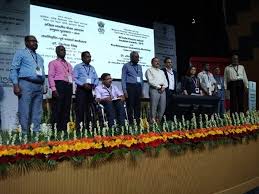
Sri Sri Ravishankar interacts with Ministers, MPs & Senior officials of GOI at Uprashtrapati Bhavan

The Vice President of India Shri M Venkaiah Naidu today said that understanding of Spirituality was extremely important to lead a peaceful and purposeful life. He also stressed the need to preserve, promote and propagate India’s great cultural heritage, values and ideals ingrained in India’s philosophy.

Speaking at an interactive meeting organized at his residence with spiritual Guru Sri Sri Ravishankar Ji today that Vice President said that India has a great tradition of respecting elders, seeking guidance from Seers, Rishis and Guru’s to seek solutions too many problems.

Talking about Sri Sri Ravishankar, the Vice President said that he has been guiding the people across the globe and

enlightening them through his spiritual discourses, especially at a time when there is a rise in violence, tensions, erosion in values leading to social tensions, affecting peace, prosperity, and development of the nation and the world.

Sri Sri, while interacting with the gathering spoke about the importance of Yoga and Meditation and suggested practicing these two for mental hygiene. He also highlighted the importance of daily meditation, proper sleep and focus on breathing for a peaceful mind. He said it would greatly benefit people to think beyond the earthly things and help them find the truth and find the real purpose of once life.

On a question about anger management, Sri Sri replied that anger is not bad if it is momentary and we should not keep holding the anger inside for long. He also emphasised the importance of Indian values such as sharing and caring for creating a peaceful world.

Deputy Chairman of Rajya Sabha, Shri Harivansh, the Minister of State for Home Affairs, Shri G Kishan Reddy, the Minister of State for Parliamentary Affairs, Shri V. Muraleedharan, the Chairperson of Prasar Bharati, Dr A. Surya Prakash, the Chairman of DRDO, Dr G. Satheesh Reddy, and several members of Parliament from different parties like TRS, BJD, YSRCP, TDP, DMK, AIDMK, and Congress were present. Around 50 members including MPs, Senior Officials of Government of India, Mayors of Delhi, and Chairman of NDMC attended the session.

*****

The flying car

Did you see the news item about a flying car, revealed by Kitty Hawk, a Silicon Valley startup funded by Google\’s founder, Larry Page ? If you didn\’t , watch the video below

I now petition Kitty Hawk that the best place in the world to launch it first would be in Bangalore. Everybody knows that a basic version of this already exists in the wonderful city\’s roads , for after all, a two wheeler can come from all 360 degrees to dent your car even  today. But passing over that lightly, let\’s examine how and why this would be a major hit in Bangalore


Everybody who works in the world famous Ecospace building would buy it immediately. Ecospace is the world\’s first building where traffic jams are inside the building area and not outside. Average mean time currently for exiting from parking and coming to the gate is 45 mts. With a flying car, the coder will simply jump out of his office window in it and zoom away.  Similarly coders in cubby holes in every other monstrosity – Maanyata, ITPL, Bagmane in that order – are enough to ensure that Kitty Hawk\’s order book for the next 10 years is filled up.

Two wheeler riders of Bangalore migrating to the flying car are likely to be confused initially as they are genetically programmed only to ride on the pavement or ride on the wrong side of the road. They will need some significant retraining to take to this new vehicle. Two wheeler riders are also currently used to taking the wife and both kids along with them. It is unclear from the prototype of the flying car as to where the two kids can be placed. Perhaps they can be made to hang from the wings. There is no safety worry –  in Bangalore, even babies are trained from birth on how to hang on while on a two wheeler

The world famous cab drivers of Bangalore will be the world\’s best drivers on this car, as they have considerable practice in ducking and weaving and zooming. So the maneuvers required of a flying car come to them naturally. They will also be doing a massive public service. As they are used to constant honking, they will take this practice to the air and thereby drive off all the pigeons who currently infest every apartment building.

One of the greatest features of this car appears to be that it can instantly stop and hover in a particular spot. This will be very useful to BMTC drivers who like to stop in the middle of the road in an instant, if the fancy hits them.

There is one problem however. In Bangalore, every type of a cable – be it electricity, TV or internet cable dangles about 2 mtrs above every public space. Kitty Hawk will have to design the car such that it can take off and land passing through the 1 nanometer space available between the cables. In this they will be greatly aided by the dodging powers of the legendary cab driver of Bangalore.

We have one of the most proactive governments in the world in Bangalore. They will instantly build KR Puram, Silk Board and Graphite junctions in the air so that Bangaloreans on flying cars would not be deprived of the unique experiences to be had at the aforementioned places.  They will also ensure that enough airpockets are released into the atmosphere so that Bangaloreans will not get sick from a smooth ride – their bodies having being conditioned to the soothing effects of pot holes.

Another design suggestion for Kitty Hawk would be to provide a glass panel whereby owners can paint or affix stickers saying Bhuvaneswari , Parthiban and Rajasekhar (please note that these will be written in Kannada and therefore will require some additional lateral space)

Drivers will have to adjust their perception of tree branches. Today, the sight of a tree branch on the road means a vehicle has broken down and a twig and some leaves have been lodged in a crack to warn others of this fact. From the flying car, a branch and leaves may be safely taken to be on a living tree.

I am not sure of the impact these cars will have on the traffic cops of Bangalore. Perhaps they can climb trees and tow away the flying cars that have been parked on every branch – the ex two wheeler driver being an expert at parking his vehicle on any vacant area in any terrain.

What I am not clear is  how two drivers who have banged each other will fight. Current practice, which is almost a holy covenant is that you stop right there, get out and hurl the choicest abuse on the other guy.  You cannot move even 1 mtr from the spot (ie move to the side of the road) before fighting).  How this will be done mid air in the future scenario requires deep thought.

All in all, Kitty Hawk must simply relocate to Bangalore and start here. In any case the CEO is probably Arvindkatakshan Ramasubramaniam, who originally went from here. Welcome home, Sir !

What does ‘Education For Freedom’ mean to You?

Usually, it seems to mean: to become free from want. In the sense of being able to stand on one’s own feet, by being able to earn a livelihood or having a job (much more the last, in our case). But what education seems to be doing, in our context at least, is to create wants.
Just because a person has crossed, say, secondary education, ‘traditional’ work no longer seems to be enough for him, whether he has been prepared for any other career or not. And of course if a person does get a job, the desire to be more and more like the ‘educated’ and upwardly mobile – leads to more and more and more wants…
At the other end of the spectrum of views on this, freedom from want is seen as getting rid of the wants! When education is more religious and ‘environmental’, it helps a person realize that his wants are really few and that he is at his most free when helping others, and reducing from the earth the burden of bearing him. A nation of ascetics is an interesting idea but probably not a very desirable one!

So that leaves us the vast space in between the two extreme views (of ‘want more’ and ‘want nothing) on ‘education for freedom’. Where do you find yourself on this? Is this the lens from which to look at ‘education for freedom’? Is this even a worthwhile question in our times? What do you think?

Sack all Fund Managers !

Here is uncontestable proof that all Fund Managers are a waste of time. They are (mostly) lavishly paid for nothing. If that sounds a radical statement, read on.
Its a well known saying in financial circles that you cannot beat the market in the long run. The sage of Omaha, Warren Buffett has been saying this for a long time. In 2007, he publicly laid a bet that the S&P 500 index would outperform hedge funds over a 10 year period. He wagered $500,000 on it to anybody who would take up the challenge, observing cheekily , \” \”After all, these managers urged others to bet billions on their abilities. Why should they fear putting a little of their own money on the line?\”
Surprisingly only one person took up the bet (shame on you hedge fund industry). Protege Partners handpicked a  portfolio of hedge funds. And the wager was on – the S&P 500 against this handpicked pool of hedge funds.
Ten years ended on 31 Dec 2017. And guess who won ? The hedge fund pool gained 22% over 10 years. The S&P 500 rose 85%. No contest ! Buffet won a handsome amount and promptly donated it to the charity,  Girls Inc of Omaha.
There\’s a big lesson to everybody who is saving and investing. In the long run you cannot beat the market index. Repeat after me, In the long run you cannot beat the index. Repeat again, In the long run you cannot beat the index. Write it out 1000 times.
And yet, we listen to advice from friends. To tips. We hire investment managers. Fund Managers design all sort of esoteric funds and write research reports on how their funds are outperforming the market. A million online portals exist that cater to advice on investment. All of them charge a fee. All of them get handsomely paid.  
Instead follow the advice of Warren Buffet (for free; no fees charged). Simply invest in an index fund – the S&P 500 if you are in the US, the Footsie if you are in the UK, the Nifty if you are in India. A fund that will charge minimum fees to simply hold the basket of securities exactly mimicking the index. And then forget about it. Come back after 10 or 20 or 30 years. You would have made more money than anybody else. It\’s as simple as that.
There\’s only one slight problem. Warren Buffet has beaten the S&P Index handsomely in the 50 odd years he has been at the helm of Berkshire Hathaway !

The Seven Myths That Make Education Difficult To Improve

If you’re from a poor family, there’s a lot more to life than just attending school! Siblings and domestic animals have to be cared for, parents have to be helped, essentials such as water or firewood have to be fetched, birds and animals kept away from the farm, you may need to migrate with your parents…. It’s not necessary that all this is a waste – in fact, despite the shadow child labour, a lot of this is also learning for life.  Children who are in a position to attend daily too might learn a lot if they spent a day or two every week doing things other than school – such as tending to gardens, pursuing a passion, trying to earn something by putting their learning to use, solving a neigbhourhood problem, helping their siblings and parents, making things…. Or helping their underprivileged classmates so that they can spend more time in school.
The kind of focused (and therefore limited) scholastic learning our ‘advanced’ children end up doing has resulted in several luminaries pointing out that (even from institutions such as the IITs) our graduates are ‘unemployable’. One might add they haven’t developed many other aspects of their personality – including civic consciousness.
However, what this requirement of daily attendance does is to marginalize great numbers of children, since the teaching-learning process tends to be sequential (rather than re-iterative). If you miss out an earlier part, you can’t ‘keep up with the class’ and slowly head for being left out or pushed out or dropping out. Effectively, the school is saying: if you are poor and cannot attend regularly (as the we require), you shall not learn. Instead of: attend when you can, we’ll find a way to support you and make sure you learn (which is what the business of the school really is).
There are a few walk-in centres in the country (though of course only for poor and/or working children) and some of them do manage to attract and keep children for a long time even though there is no compulsion to attend. That kind of flexibility is perhaps too much to hope for in the school system. Enabling the school to be more responsive to children’s real living situations, though – that’s both possible and desirable. It needs a spiraling rather than linear flow, a variety and range of materials, and providing children engaging activities in many of which they will work on their own, and the use of a tracking system to keep record of progress. This gels with every provision of the RTE, with expectations put forward in our National Curriculum Framework, and much that contemporary understanding of pedagogy tells us. However, to make it happen what we need is not methods and materials but a way to get rid of this myth and the fear that everything will fall apart if the school seeks to respond (by adapting to children’s needs) rather than coerce (by making children adjust to its needs).
Any suggestions?