Students of Kendriya Vidyalaya across the country

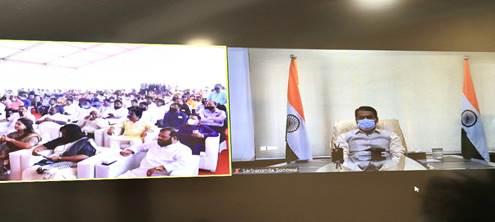
 Union Minister for Education and Chairman, Kendriya Vidyalaya Sangathan Shri Ramesh Pokhriyal ‘Nishank’ virtually interacted with the students of KendriyaVidyalayas across the Country. The Minister attended the programme from KV Andrewsganj, New Delhi and answered the queries of the students.

During the interaction program, the students asked questions related to various fields and subjects. Replying to the query by a student of KV Gurugram, Shri Pokhriyal informed that as the curriculum was cut by 30 percent this year due to Covid-19, therefore in the upcoming competitive examinations like JEE and NEET this year the candidates will have more options to answer the questions.

In response to another query asked by a student from Varanasi, Shri Pokhriyal said that the facilities of online education will continue even after the school reopens. For some time, a mixed format of online and offline will be available for the students.

In response to a question asked by the student of Kendriya Vidyalaya Andrewsganj about the New Education Policy- 2020, the Minister said “New Education Policy has been prepared keeping in mind the India of future. A lot of emphasis has been laid on practical knowledge rather than just bookish knowledge. Vocational training facility will be provided for students from class 6 onwards, in which internship is also associated. Artificial intelligence will also be taught from the school level itself. At the same time, Indian values ​​and culture will also be promoted. This policy is capable of realizing the dream of AatmaNirbhar Bharat”.

Minister also recited his favourite poems on a question related to his literary skills.

Earlier, Shri Pokhriyal also planted a sapling in KV Andrewsganj premises. Giving momentum to the Fit India campaign, he also inaugurated an ‘Open Gym’ in the KV. Apart from this, a Musical Garden was also inaugurated by the Minister in the school premises.

Commissioner, KVS Ms. Nidhi Pandey gave the Welcome Address, while Addl Commissioner, KVS Ms. V. Vijayalakshmi presented the vote of thanks. Senior officials of the Ministry were present on the occasion

******


Challenges of Flood Forecasting

 Flood Forecasting on International & Inter-state Rivers is formulated and issued by Central Water Commission (CWC) using statistical methods for short range forecasting and mathematical modelling for fiveday’s advance flood advisory. The main challenge being faced in flood forecasting is to accurately forecast the impending flood sufficiently in advance with high level of accuracy. Mathematical modelling based flood advisory although provide sufficient lead time, its accuracy is dependent on accuracy of weather(rainfall) forecasts. The growing incidents of high intensity rainfall in shorter duration due to likely impact of climate change poses another challenge for flood forecasting.

There is a continuous effort for improvement of Flood Forecasting using all the latest technology including space technology tools, Geographical Information System (GIS), web based applications, etc. Following steps have been taken to improve the Flood forecasting system in the country.

  • Expansion of Flood Forecasting Network: CWC flood forecasting network has been expanded to 331 Flood Forecast Stations(199 Level Forecast for Villages/Town on the bank of the rivers and 132Inflow Forecast Stations for Dams and Barrages) covering 23 States &2 UTs in 20 river basins for taking proper mitigation measures by respective State Governments. In the State of Andhra Pradesh, there are 13 level forecasting stations and 10 in flow forecasting stations.
  • Modernization of Flood Forecast Formulation: Flood forecasting is issued up to 5 days in advance for major river basins across the country including the State of Andhra Pradesh. The same is updated every three hours and is available online (https://120.57.99.138/index.php).
  • Modernization in dissemination of flood forecasts: Dissemination of flood forecasts has also been modernized through a dedicated website. Daily Flood Situation Report cum Advisory is shared with all stakeholders aswell as general public using social media platforms.

 Bilateral agreements with upper riparian countries Nepal, Bhutan &China have been made for data sharing.

 Common data platform, Water Information Management System(WIMS), under National Water Informatics Centre (NWIC), has been created to ensure seamless data flow from States and CWC formodelling work. In addition, arrangements for seamless data flow from agencies like INCOIS, NASA, JAXA, etc. have also been made.

Valedictory Function of 2nd National Youth Parliament Festival

 The Prime Minister, Shri Narendra Modi addressed the valedictory function of the second National Youth Parliament Festival today via video conferencing. The Event took place in the Central Hall and the Prime Minister also heard the views of the three young national winners of the Festival. Lok Sabha Speaker Shri Om Birla, Union Education Minister Shri Ramesh Pokhriyal ‘Nishank’and MoS (I/C) for Youth Affairs & Sports Shri Kiren Rijiju were present on the occasion.

The Prime Minister addressing the young parliamentarians urged them and the youth of the country to take advantage of the flexibility and innovative learning format provided by the National Education Policy- 2020. An attempt is being made to create an ecosystem in the country, the absence of which often compels the youth to look towards foreign shores, which offered them better enterprise, opportunities, recognition and respect- the Prime Minister said.

Remembering Swami Vivekananda on his birth anniversary, the Prime Minister remarked that even with the passage of time, impact and influence of Swami Vivekananda remains intact in our lives. Swami ji’s views on nationalism and nation-building and his teachings regarding serving the people and serving the world continue to inspire us. Individuals who came into contact of Swami Vivekananda Ji were influenced to create institutions and they in turn created new institution-builders. This started a virtuous cycle of individual development to institution-building and vice versa.

Union Education Minister Shri Pokhriyal recalled Swami Vivekananda’s message that youth are the greatest strength of any country and the future of that country is shaped by the efforts of its youth. Emphasizing that the Youth plays an important role in the democratic system, he urged everyone to become responsible citizens and to contribute in the nation building by adopting Swami Vivekananda’s ideals and values in their lives.

Shri Pokhriyal said India, the largest democracy in the world, derives strength from our constitution, paving the way for the empowerment of the person at the bottom of the society. He said Preamble is the most important part of our constitution. The first word of the preamble is ‘WE’ ie “we the people of India”. This sentence is embedded in Indian society and keeps the society tied together to a national spirit, he added.

He appealed youth to use their tremendous energy, aspirations, dreams and will power to shape the future of the country. “I hope that under the able leadership of the Prime Minister Shri Narendra Modi, the young generation of the 21st century would form the strong foundation of Swarnim Bharat”, he said.

Kindly access below the education related excerpts from PM’s address on National Youth Parliament Festival today:

https://pib.gov.in/PressReleseDetail.aspx?PRID=1687901


******

Process of Planning and Designing a New Town

 Planning is the process of thinking about and organizing the activities required to achieve a desired goal. The process of planning includes the determination of objectives and outlining the future actions that are needed to achieve these objectives. Various steps that are followed in the process of planning are:

1) Identifying the problem 

It involves the identification of the aim for the fulfillment of which the plan is being formulated. If a new plan is require or the modification of an existing plan could help in achieving these aims. 

2) Gathering information about the activities involved 

An effective plan needs complete knowledge of the activities involved and their effect on other external and internal activities. 

3) Analysis of information 

This information is then analyzed minutely and the information related with similar subjects is classified so that similar type of data can be kept together. 

4) Determining alternate plans 

There are alternate plans available for the achievement of the objectives and ingenuity and creativeness are required as some plans are also developed at this stage. 

5) Selecting the plan 

At this stage the plan which is acceptable to the operating personnel is proposed. The adaptability and the cost of the plan are also taken into consideration. 

6) Detailed sequence and timing 

Detailed like who will perform which activity under the plan and the time within which the plan should be carried out is determining in this step. 

7) Progress check of the plan 

The provisions are made for the follow up of the plan as the success of any plan can be measured by the results only. 

8) Implementation 

Implementation is the carrying out, execution, or practice of a plan, a method or any design, idea, model, specification, standard or policy for doing something. As such, implementation is the action that must follow any preliminary thinking in order for something to actually happen. 

9) Monitor and Control 

Managers must continually monitor the actual performance of their work units against the unit’s goals and plans. Manager’s also need to develop control systems to measure that performance and allow them to take corrective action when the plans are implemented improperly or when the situation changes.

Implementation of National Education Policy-2020

 The Governor of Uttar Pradesh Smt. Anandiben Patel called on Union Education Minister Shri Ramesh Pokhriyal ‘Nishank’ here today. Implementation of National Education Policy-2020 and other issues relating to Education sector were discussed during the meeting. Senior officials of the Ministry also attended the meeting.


During the meeting Smt. Anandiben Patel highlighted the initiatives taken by the State Education Department, Uttar Pradesh such as providing training to Anganwadi workers, teachers training, etc to ensure the academic welfare of the students. She also presented a copy of the book ‘Teacher’s guide’ for students of Pre-primary level and Primary level, to the Union Minister. The guide will help teachers to develop a better understanding of student centric teaching practices covering various subjects of environment, value education, etc in a joyful manner.

Shri Pokhriyal informed that as outlined in New Education policy, the foundation literacy and numeracy mission will be extended to Early Childhood Care Education for which a framework will be prepared on learning outcomes, teachers training, etc. He also informed that NCERT is developing a new National Curriculum Framework (NCF). He added that the suggestions given in the Teacher’s Guide will be examined and suitably incorporated in the NCF.

*****

Overhauling of Water Infrastructure

 Government of India has taken several steps towards comprehensively overhauling of the existing water infrastructure of the nation. For improving the safety and operational performances of some of the selected existing dams, Govt. of India implemented the Dam Rehabilitation and Improvement Project (DRIP), with financial assistance from the World Bank. Under the first phase of the DRIP program, which was implemented during April 2012 to March 2021, about 223 existing dams located in 7 States have been comprehensively rehabilitated at a cost of Rs. 2567 crore.

After the completion of DRIP Phase- I, Govt. of India has now taken up DRIP, Phases-II & III. The Scheme envisages rehabilitation of 736 dams located in nineteen (19) States with a budget outlay of Rs 10,211 crore. It is a State Sector Scheme with Central component. The Scheme is of 10 years duration. DRIP Phase-II has become operational from 12th October 2021. DRIP Phase-II entails financial assistance from the World Bank and the Asian Infrastructure Investment Bank (AIIB) to the tune of 500 Million US$.

Further, during 2016-17, ninety-nine (99) on-going Major/Medium irrigation projects (and 7 phases), in the country having balance estimated cost of Rs.77,595 crore (Central Assistance-Rs.31342 crore and State Share- Rs.46253 crore) under Pradhan Mantri Krishi Sinchayee Yojana (PMKSY) – Accelerated Irrigation Benefits Programme (AIBP), have been prioritized in consultation with States for completion in phases. Out of these, AIBP works of 46 projects have been reported to be completed. Under the PMKSY-AIBP scheme there are 7 Extension, Renovation and Modernization (ERM) projects. Rs. 1013.72 Crore have been released to respective States as Central Assistance for ERM projects during 2016-21.

 Government of India is also implementing the Repair, Renovation & Restoration (RRR) of water bodies Scheme under PMKSY (Har Khet Ko Pani). Under the RRR of Water Bodies scheme, since 12th Plan onwards, 2,218 schemes are ongoing with an estimated cost of Rs. 1,910 crore. Central Assistance (CA) of Rs. 476 crore has been released to States up to March, 2021. Further 1,591 water bodies are reported to have been completed up to March, 2021. Target irrigation potential restoration of these schemes is 1.887 lakh ha and out of this, 1.320 lakh ha is reported to be restored till March, 2021

The Union Government has recently enacted the Dam Safety Act, 2021 for surveillance, inspection, operation and maintenance of the specified dams for prevention of dam failure related disasters. As per this Act, dam owners have to take such measures as may be necessary to address safety concerns with a view to achieve satisfactory level of dam safety assurance.

Pollution in Rivers

 Rivers in the country are polluted due to discharge of untreated and partially treated sewage from cities/towns and industrial effluents in their respective catchments, problems in operation and maintenance of sewage/effluent treatment plants, lack of dilution and other non-point sources of pollution. It is the responsibility of the States/Union Territories (UTs), Local Bodies and Industrial Units to ensure required treatment of sewage, industrial effluents to the prescribed norms before discharging into rivers and other water bodies, coastal waters or land and prohibit dumping of puja materials & other items of religious offerings to prevent and control of pollution therein.

 As per the Provisions of Environment (Protection) Act, 1986 and the Water (Prevention & Control of Pollution), Act 1974, industrial units are required to install effluent treatment plants (ETPs) and treat their effluents to comply with stipulated environmental standards before discharging into river and water bodies. Accordingly, Central Pollution Control Board (CPCB), State Pollution Control Boards (SPCBs)/Pollution Control Committees (PCCs) monitor industries with respect to effluent discharge standards and take action for non-compliance under provisions of these Acts.

CPCB has issued guidelines for idol immersion and disposal of other puja materials during festivals and Hon’ble National Green Tribunal (NGT) directed respective District Magistrates and other Authorities to ensure implementation of guidelines of CPCB to curb pollution due to immersion of idols in rivers and water bodies. In addition, National Mission for Clean Ganga (NMCG) has also issued directions under Section 5 of the Environment (Protection) Act, 1986 regarding the immersion of idols in rivers and water bodies on festive occasions, directions have been issued to States/UTs for restricting idol immersion into rivers and water bodies during festivals like Ganesh Chaturthi, Durga Puja, Deepawali, Chat Puja, Viswakarma Puja, etc. as these causes pollution/contamination of water leading to deterioration in the quality of water in rivers, water bodies besides having harmful effect on aquatic life.

Besides, in compliance of the orders of NGT in Original Application No.673/2018 regarding rejuvenation of polluted river stretches in the country, States/UTs are required to implement approved action plans, including installation of wastewater treatment plants, for restoration of the polluted river stretches in their jurisdiction as identified by CPCB and published in their report of 2018, within the stipulated timelines. As per the orders of NGT, regular review on implementation of action plans is undertaken in the States/UTs and also at Central level.

 Delhi Pollution Control Committee (DPCC) has been conducting periodic sampling of major drains (24 nos.) out falling in river Yamuna and at various locations (8 nos.) in the stretch of river Yamuna. CPCB in association with various SPCBs/PCCs have been monitoring the water quality of rivers and other water bodies across the country through a network of monitoring stations under the National Water Quality Monitoring Programme. As per the last report published by CPCB in September 2018, 351 polluted stretches have been identified on 323 rivers in the country based on monitoring results in terms of Bio-chemical Oxygen Demand (BOD), an indicator of organic pollution. This report of CPCB includes the stretches of river Yamuna in Delhi, Haryana, and Uttar Pradesh which are as below:

River

State

Polluted River Stretches

Priority

BOD Range

(mg/l)

Yamuna

Delhi

Along Wazirabad to Asagpur

I

9-80

Haryana

Panipat to Sonepat

I

4-55

Uttar Pradesh

Asgarpur to Etawah Shahpur to Allahabad (Balua Ghat)

I

12-55


Under Namami Gange Programme, 23 projects amounting to Rs.4290 crore for creating/rehabilitation of 1840 mld capacity sewage treatment plants (STP) have been sanctioned in Yamuna river basin. These 23 projects are spread over Himachal Pradesh (1 project), Haryana (2 projects), Delhi (12 projects includes consultancy & public outreach project) and Uttar Pradesh (8 projects). Out of these 23 projects, 6 projects have been completed. Till December 2021, National Mission for Clean Ganga (NMCG) has utilized an amount of Rs. 1593.32 crore for all the 23 projects for river Yamuna.

In addition, Delhi Jal Board is also undertaking works such as capacity augmentation, improvement in treatment effluent parameters, laying of sewer network, construction of decentralized STPs, sewer interceptor, Septage Management and tapping of drains directly out falling into Yamuna river through the Yamuna Cleaning Cell (YCC) to improve quality of river water of Yamuna.

Guidelines for identification, admission and continued education of migrant children

 In order to mitigate the impact of challenges thrown by the COVID-19 pandemic for out of school children, it was felt necessary for every State/UT to devise a proper strategy for preventing increased drop outs, lower enrolments, loss of learning and deterioration in the gains made in providing universal access, quality and equity in the recent years.

Thus the Ministry of Education had issued guidelines for identification, admission and continued education of migrant children.

In order to ensure that school going children have access to education with quality and equity and to minimize the impact of the pandemic on school education across the country, the Ministry of Education has prepared and issued detailed guidelines on steps to be taken by the States and UTs during school closure and when the school re-open.

The main features of the Guidelines are :      

A.        Continued Education for Out of School Children (OoSC) and Children with Special Needs (CWSN)


  • Continuation of non-residential training for identified Out of School children through volunteers, local teachers and community participation.  
  • Continuation of home based education for CWSN children through Volunteers/ Special Educators.


B.        Identifying Out of School Children


  • States and UTs to carry out proper identification of OoSC for 6 to 18 years age group through a comprehensive door to door survey and prepare action plan for their enrolment


C.        Enrolment Drives and Awareness Generation


  • Enrolment drives may be undertaken at the beginning of academic year such as Praveshotsav, School Chalo Abhiyan etc.
  • Undertake awareness generation among parents and community for enrolling and attendance of children
  • Create awareness on practicing 3 Corona appropriate behaviors – wear mask, six-feet distance and washing hands with soap for which IEC material shared on 06.11.2020 with the States & UTs.


D.        Student Support while Schools are closed


  • Students to be provided support including counseling, large scale awareness & targeted home visits
  • Using Manodarpan web portal and tele-counseling number for counseling services and psycho-social support.
  • Distribution of educational material and resources, supplementary graded material, workshops, worksheets etc to support home-based education
  • Exploring option of classroom on wheels and classes in small groups at village level
  • Increasing the access of children to online/digital resources, TV Radio etc. to reduce learning loss
  • Ensuring easy and timely access to the provisions of uniforms, textbooks and MDM
  • Timely disbursement  of stipend to enrolled CWSN girls through DBT
  • Strengthening of Child protection mechanism at local level


E.        Student Support on School Reopening


  • Preparation and running of School readiness modules/Bridge course for initial period when the schools re-open so that they can adjust to the school environment and do not feel stressed or left-out.
  • Identification of students across different grades based on their learning levels
  • Relaxing detention norms to prevent drop out this year.
  • Ensuring reading with comprehension and numeracy skills by encouraging children to  read books beyond syllabus and creative writing & problem solving.
  • Large-scale remedial programmes/Learning Enhancement programmes to mitigate learning loss and inequality.


F.         Teacher Capacity Building


  • Effective utilization of the online NISHTHA training modules and online training module for Corona responsive behavior to be launched on DIKSHA portal soon.
  • Use of alternative Academic Calendar prepared by NCERT for joyful engagement of children in learning.

*****


Rejuvenation of River Yamuna

 Yamuna is largest tributary of Ganga River.Under Namami Gange Programme,National Mission for Clean Ganga (NMCG) has sanctioned 23 projects costing Rs. 4290 crore for creating / rehabilitation of 1840 Million Litres per Day (MLD)Sewage Treatment Plant (STP) capacity in Yamuna basin. These 23 projects are spread in Himachal Pradesh (1 project), Haryana (2 projects), Delhi (12 projects includes consultancy project & public outreach project) and Uttar Pradesh (8 projects). Out of these 23 projects, 6 projects have already been completed. Upto December 2021, NMCG has released an amount of Rs. 1593.32crore for all the ongoing 23 projects for river Yamuna.

 The cleaning of river is an ongoing process and this Ministry is supplementing the efforts of the States for checking the rising level of pollution of river Yamuna by providing financial assistance to States of Himachal Pradesh, Haryana, Delhi and Uttar Pradesh. The aforementioned projects are in different stages of planning/construction/completion. Close monitoring is being done to ensure timely completion.


two-day Virtual International Akhand Conference ‘EDUCON-2020’

 Union Education Minister Shri Ramesh Pokhriyal ‘Nishank’ today inaugurated the two-day Virtual International Akhand Conference ‘EDUCON 2020’ through video conferencing. This two-day International Conference is being organized by Central University of Punjab, Bathinda (CUPB) in collaboration with the Global Educational Research Association (GERA) under the patronage of Prof. (Dr.) Raghavendra P. Tiwari, Vice Chancellor, CUPB & Padma Shri Dr. MahendraSodha (Patron, GERA). The focal theme of EDUCON-2020 is Envisioning Education for Transforming Youth to Restore Global Peace.

Union Education Minister Shri Ramesh Pokhriyal ‘Nishank’ appreciated CUPB for choosing the appropriate and relevant theme for the conference. He stated that this two-day Akhand Conference will pass on the message to the researchers and students across the globe that the research is a 24X7 exercise and requires strong perseverance. He opined that this international conference will help the prospective teachers to become familiar with different technologies and their functioning to bring transformational change in the field of education. He expressed hope that deliberations made during EDUCON2020 by internationally-acclaimed speakers & young researchers will certainly prove to be significant in preparing a roadmap for effective implementation of NEP-2020 and developing necessary skill-set among youngsters to enable them to contribute towards building an AtmaNirbhar Bharat.

Shri Ramesh Pokhriyal ‘Nishank’ emphasized that the National Education Policy, 2020, is revolutionary in all aspect, as it focuses on multiple aspects of promoting mother language at primary level education, imparting vocational skills training for students at the secondary level & other innovative reforms. He further stated that NEP emphasizes on the interdisciplinary studies & integrated course curriculum in higher education for wider learning opportunities, with an aim to provide value-based holistic education, development of scientific temper and imparting skill training to youngsters. He further added that this policy also considers the need to design framework for extended use of technology in the teaching-learning process, development of online course contents, the introduction of Academic Bank of Credits and establishment of National Research Foundation (NRF) and National Educational Technology Forum (NETF), which would benefit the Indian scholars to compete at the global level. He gave the mantra of ‘Perform, Reform and Transform’ for successfully implementing all new imperatives of NEP-2020 essential for changing the society and transforming the life of youth for evolving global peace.

In his opening remarks Prof. Raghavendra P. Tiwari, Vice-Chancellor, CUPB said that CUPB is committed to quality higher education and cutting-edge research, this Conference will provide a platform to researchers and educationists to share their views on drawing strategic-plan for implementing the recommendations of the student-centric National Education Policy-2020, which is rooted in our Indian Culture and Value System. He informed that the Conference will focus, from the global perspectives, on various paradigms of NEP-2020, intended to transform the ‘learning system of our nation’ to meet world standard by empowering youth with the global competencies- thereby realizing the vision of the Prime Minister ShriNarendraModi. He said that deliberations of the conference would bridge out the connection between our past heritage and future education system to re-establish Bharat as the Vishwa Guru in the field of education.


In this International Conference, scholars from United Kingdom, Canada, Thailand, USA, Australia, Bhutan and India would be continuously discussing on the ten subthemes of the focal theme ‘Envisioning Education for Transforming Youth to Realize Global Peace’ for 31 hours. This conference is the first of its kind in India where scholars across the world would be continuously having a non-stop marathon dialogue sessionsfor 31 hours exploring the possibilities of the use of ICT in the higher education to promote the equitable quality education in India. Further, the conference will also provide a platform for discussions on emerging trends in education viz., likely scenario of higher education and school education by 2050, developing disruptive technologies for STEAM (Science, Technology, Engineering, Arts and Mathematics) Education, training youth for strategic future jobs in Universities, skill training programme for future graduates and relevance of ancient education system in 21st century.

***

FLOOD MANAGEMENT SCHEME

 Flood management including erosion control falls within the purview of the States. Flood management and anti-erosion schemes are formulated and implemented by concerned State Governments as per their priority. The Union Government supplements the efforts of the States by providing technical guidance and also promotional financial assistance for management of floods in critical areas. The Government of India had launched a centrally sponsored scheme viz. Flood Mangement Programme (FMP) during XI Plan to provide central assistance to states for taking up works related to flood management, anti-erosion, flood management works, anti-sea erosion etc. which continued during XII Plan period as a component of  “Flood Management  and Border Areas Programme (FMBAP)” for subsequent period.

 In the State of Assam, 141 projects were included for central assistance under FMP. The 111 completed projects have given protection to an area of around 7.2 lakh ha and protected a population of about 17.71million. Central Assistance amounting to the tune of Rs. 1286.39 Crore has been given to the State of Assam under FMP.

In the State of Bihar, 18 projects were included for central assistance under FMP. The 15 completed projects have given protection to an area of around 28.67 lakh ha and protected a population of about 22.34 million. Central Assistance amounting to the tune of Rs. 924.41 Crore has been given to the State of Bihar under FMP.

In the State of West Bengal, 18 projects were included for central assistance under FMP. The 15 completed projects have given protection to an area of around 0.32 lakh ha and protected a population of about 1.96 million. Central Assistance amounting to the tune of Rs. 1007.81 Crore has been given to the State of West Bengal under FMP.

 The State Governments face issues like problem in land acquisition, encroachment of land, costs overrun, contractual disputes etc. in the implementation of projects under Flood Management Programme and regular review meetings by central monitoring agencies are held to expedite implementation of projects. 

The central assistance released to States under FMBAP during recent years to the States of Assam, Bihar and West Bengal is at Annexure-I

 This Information was given by the Minister of State for Jal Shakti, Shri Bishweswar Tudu in a written  reply in Lok Sabha today.

****

BY

Annexure-I

Central assistance released under FMBAP during last four years to the States of Assam, Bihar and West Bengal


S. No.

State

Funds released during FY (Rs. In Crores)

2017-18

2018-19

2019-20

2020-21

1

Assam

245.49

142.12

85.03

2

Bihar

52.57

132.28

65.29

42.49

3

West Bengal

65.03

89.31

117.12


*****


Eligibility criteria of 75 % in Class 12th relaxed for IIT admissions

Considering the decision taken for IIT JEE (Advanced) and in line with the decision taken for the last academic year, the Ministry of Education had decided to waive off the 75% marks (in class 12 exam) eligibility criteria under Joint Entrance Examination (Main) for the next academic year 2021-2022 in respect of NITs, IIITs, SPAs and other CFTIs, whose admissions are based on JEE (Main).

The admissions to various Under Graduate (UG) programmes of the National Institutes of Technology (NITs), Indian Institute of Engineering Science and Technology (IIEST), Shibpur (West Bengal) and other Centrally Funded Technical Institutions (CFTIs – excluding IITs) are made on the basis of ranks / merit secured by the candidates in Joint Entrance Examination (Main) conducted by the National Testing Agency (NTA).

For the candidates to qualify for admission in the IITs / NITs / IIITs and such other CFTis whose admissions are based on the JEE Ranks, they should have secured at least 75% marks in the 12th Class exam, or be in the top 20 percentile in the 12th Class exam conducted by the respective Boards. For SC/ST students, the qualifying mark in 12th Class exam is 65%.

While declaring the date of JEE (Advanced) exam, the Education Minister has announced to waive off the 75% marks (in class 12th exam) eligibility criteria for admissions to the academic year 2021-2022 for the ease of students.


River Cities Alliance

 The River Cities Alliance (RCA) has been launched with the objective to provide the member cities with a platform to discuss and exchange information on aspects that are vital for sustainable management of urban rivers, sharing best practices and supporting innovation. The alliance has been launched initially with 30 cities namely Dehradun, Rishikesh, Haridwar, Srinagar, Varanasi, Kanpur, Prayagraj, Farrukhabad, Mirzapur, Mathura, Bijnor, Ayodhya, Patna, Bhagalpur, Begusarai, Munger, Sahibganj, Rajmahal, Howrah, Jangipur, Hugli-Chinsurah, Behrampore, Maheshtala, Aurangabad, Chennai, Bhubaneshwar, Hyderabad, Pune, Udaipur and Vijaywada.


The Alliance is open to all river cities of India. Any river city can join the Alliance at any time.


 State Governments are implementing Action Plans for restoration of water quality of the identified polluted river stretches. The implementation is being monitored regularly at State level by Chief Secretary of the respective State/UT and at Central level by the Central Monitoring Committee under the Chairmanship of Secretary, Ministry of Jal Shakti.


In addition, under Namami Gange Programme, the progress and activities are reviewed regularly by National Mission for Clean Ganga (NMCG), State Governments and District Ganga Committees.


RCA is envisaged as a facilitatory platform for initiating river-sensitive planning and development. Namami Gange through its integrated and comprehensive framework has been working towards rejuvenating Ganga river basin. As cities start to implement the river-sensitive development agenda, the River Cities Alliance will support them to learn from each other and inspire others to take up progressive action on this front.


 For adjudication of disputes relating to waters of inter-State rivers and river valley thereof, the Parliament has enacted the Inter-State River Water Disputes (ISRWD) Act, 1956. When any request under the said Act is received from any State Government in respect of any water dispute on the inter-State rivers and the Central Government is of the opinion that the water dispute cannot be settled by negotiations, the Central Government constitutes a Water Disputes Tribunal for the adjudication of the said water dispute. Currently, 5 such water disputes Tribunals are active, the details of which are given at Annexure. In addition, Inter State Water disputes has been raised by Government of Bihar in respect of Tilaiya-Dhadhar Diversion scheme concerning States of Bihar, Jharkhand and West Bengal and by Government of Tamil Nadu (TN) in respect of use, distribution and control of Pennaiyar river and its tributaries concerning States of Tamil Nadu, Karnataka, Andhra Pradesh and UT of Puducherry.


This Information was given by the Minister of State for Jal Shakti, Shri Bishweswar Tudu in a written  reply in Lok Sabha today.

 *****


BY

ANNEXURE

Status of active Inter-State Water Disputes Tribunals relating to the sharing of
river water


S. No

Name of Tribunal

States concerned

Date of constitution

Present Status

1.

Krishna Water Disputes Tribunal – II(KWDT-II)

Karnataka, Telengana, Andhra Pradesh and Maharashtra

April, 2004

Report and decision given on 30.12.2010. Further report given by the Tribunal on 29.11.2013.


However, as per Supreme Court Order dated 16.9.2011, till further order, decision taken by the Tribunal on references filed by States and Central Government shall not be published in the official Gazette. As such, matter is sub-judice. Term of the Tribunal was extended for a period of two years w.e.f. 1st August, 2014 to address the terms of reference as contained in section 89 of Andhra Pradesh Reorganisation Act, 2014. Thereafter, the term of the Tribunal has been extended six times for period of one year latest being w.e.f. 01.08.2021.

2.

Mahanadi Water Disputes Tribunal

Odisha and Chhattisgarh

12th March, 2018

The Government of Odisha had filed a complaint dated 19.11.2016 with the Ministry of Water Resources, River Development and Ganga Rejuvenation under Section 3 of the Inter-State River Water Disputes Act, 1956 read with Inter-State River Water Dispute Rules, 1959.


The Central Government has constituted Mahanadi Water Disputes Tribunal vide Notification dated 12.03.2018. Subsequently, the reference was made to the Tribunal under Section 5(1) of the ISRWD Act, 1956 on 17.04.2018. The matter is thus under adjudication in the Tribunal. The Central Government, vide Notification dated 3rd June, 2021 has extended the tenure of the Tribunal for a period of two years upto 11th March, 2023 or till the submission of report, whichever is earlier.

3.

Mahadayi Water Disputes Tribunal

(MW DT)

Goa, Karnataka

and Maharashtra

16th November, 2010 However, vide notification dated 13.11.2014 date of reckoning of the constitution of the Tribunal is w.e.f. 21.08.2013

The MWDT submitted its report under Section 5(2) of the ISRWD Act, 1956 to the Central Government on 14.08.2018. Further references under Section 5(3) have been filed by the party States and the Central Government before the Tribunal. The matter is subjudice. The term of the Tribunal has been extended for a further period of one year w.e.f. 20.08.2021 to submit its Further Report under Section 5(3) of ISRWD Act, 1956.


The Central Government has notified the Award and Final Decision of the MWDT given on 14.08.2018 in the Gazette of India vide notification No. S.O. 888(E). dated 27.02.2020.

4.

Ravi & Beas Water Tribunal

(RB WT)

Punjab, Haryana

and Rajasthan

April, 1986

Report and decision under section 5(2) given in April, 1987. Clarification/explanation sought from the Tribunal under File No.H-11016/134/2021-BM Section-MOWR I/53475/2021 25 Section 5(3) of the said Act by the party States. Presidential Reference 1 of 2004 was made on the Punjab Termination of Agreements Act, 2004. The Hon’ble Supreme Court has pronounced the judgement on Presidential Reference in negative. Further, Government of Haryana has filed IA No. 6 of 2016 in OS No. 6 of 1996 in the matter. The matter is subjudice.


5.

Vansadhara Water Disputes Tribunal

(VW DT)

Andhra Pradesh &

Odisha

February, 2010 However, as per the Supreme Court order the date of reckoning of the constitution of the Tribunal is w.e.f. 17.9.2012

The Tribunal has submitted its report to the Central Government under Section 5(2) of the ISRWD Act, 1956 on 13.09.2017. Further, State of Odisha and the Central Government filed reference under Section 5(3) of the ISRWD Act, 1956 on 11.12.2017 and 12.12.2017 respectively. The State of Odisha has also filed I.A. No.1 of 2019 before the Tribunal and the Tribunal gave its judgement in the matter on 23.09.2019. Subsequently, the State of Odisha has filed SLPC(C) No.27930/2019 before the Supreme Court against Order dated 23.09.2019 which is subjudice. Now, the Tribunal has furnished its Further Report dated 21.06.2021 under section 5(3) of the ISRWD Act.


*****

Toycathon aims to tapIndia’s one billion USD toy market

 Union Education Minister Shri Ramesh Pokhriyal ‘Nishank’ and Union Minister WCD and Textiles Smt. Smriti Zubin Irani jointly launched Toycathon-2021 today. Shri Praveen Kumar, Secretary, Prof. Anil Sahasrabudhe, Chairman, AICTE and Dr Abhay Jere, Chief Innovation Officer, MoEwere present on the launch event of Toycathon-2021. The Union Ministers also jointly launched the Toycathon Portal on the occasion. This Toycathon is aimed to conceptualize innovative toys based on the Indian value system which will inculcate the positive behaviour and good value among the children.

Speaking on the occasion, Shri Pokhriyalsaid that Toycathon is being organized to develop India as the global Toy manufacturing hub. He said size of toy market in India is about one billion USD but unfortunately 80% of the toys are imported. The launch of Toycathon today, is an endeavor by the government to create an ecosystem for the domestic Toy industry and the local manufacturers, tapping the untapped resources and utilizing theirpotential. Recalling the vision of Prime MinisterShri Narendra Modi of 5 trillion-dollar economy and considering the huge potential of our toy market, he exhorted all to make India ‘Atmanirbhar’ in Toy industry. He further stated that National Education Policy-2020also lays emphasis on innovation and research in learning, starting from the primary education. Aligned with the goals of National Education Policy, the Toycathonaims to capture innovative prowess of 33 crores students across the country, he added.

Addressing a press conference Smt. Smriti Z Irani stated that India imports 80 per cent of toys and the government is working towards promoting the indigenous toy industry for making the country self-reliant in this sector. She said that the collaboration with Ministry of Education paves the way for the students, faculties from all schools, colleges and universities of the country to answer to the clarion call of Atmanirbhar Bharat though this Toycathon. Appreciating the initiative, the Minister said, “This is the first time when school children will innovate, design and conceptualize toys also for especially abled ‘divyang children’. The Minister informed that students and faculty members participating in Toycathon can get prizes upto 50 lakhs.Commerce Ministry and MSME Ministry have taken various steps to protect the toy manufacturing industry and to make it competitive and to create awareness about safe toys which are not harmful chemically, Ministry of Education and Ministry of WCD will adopt special measures, she said.


About Toycathon 2021:

Taking a giant leap in the path of becoming ‘Atmanirbhar Bharat’, Ministry of Education, Ministry of Women and Child Development (MWCD), Ministry of Textile, Ministry of Commerce and Industries, Ministry of MSME, Ministry of I&B and All India Council for Technical Education (AICTE) have jointly launched Toycathon-2021.

This is a special kind of hackathon where students and teachers from schools and colleges, design experts, toy experts and startups will get together to crowd source ideas for developing toys and games that are based on Indian culture and ethos, local folklore and heroes, and Indian value systems.While this will greatly help India develop into a global hub for toys and games, it will also help our children to understand the ethos and values of Indian culture as envisaged in the National Education Policy 2020. 

The Toycathon is based on nine themes viz. Indian Culture, History, Knowledge of India and Ethos; Learning, Education and Schooling; Social and human values; Occupations & specific fields; Environment; Divyang ; Fitness and sport; Out of the box, creative and logical thinking and Rediscovering/redesigning traditional Indian toys

The Toycathon will have 3 variants of tracks of Junior Level, Senior Level and Start up Leveland will allow participation of students and teachers from schools, colleges and universitiesapart from startups and toy experts. Participants will have two options for ideasubmission; they can either submit ideas for the published problem statements or undernovel toy concepts category. This is the high time we utilize brightest creative minds andcarve out games based on our Indian culture, tradition and heritage and stories of ancientIndia showcasingthe beliefs and traditions of people.

For participation in Toycathon 2021, please visit https://toycathon.mic.gov.in.The Proposals can be submitted online from 5th January to 20th January, 2021.

Click here to access the PPT on Toycathon-2021

******

Indian Footwear and Leather Development Programme (IFLDP)

 Indian Footwear and Leather Development Programme (IFLDP) (erstwhile IFLADP) has been approved for continuation from 2021-22 with an approved financial outlay of Rs. 1700 crore. IFLDP has been approved by the Union Cabinet on 19.01.2022 as continuation of the erstwhile IFLADP till 31.03.2026 or till further review, whichever is earlier.

Indian Footwear and Leather Development Programme(IFLDP) aims at development of infrastructure for the leather sector, address environmental concerns specific to the leather sector, facilitate additional investments, employment generation and increase in production.

1. The following sub-schemes have been approved under IFLDP during 2021-26:-

(i) Sustainable Technology and Environmental Promotion (proposed outlay Rs.500 crore):- Special Purpose Vehicle constituted for each CETP would be provided assistance @ 80% of the total project cost for Northeastern Areas with industry’s/beneficiary share to be 20% of the project cost and @ 70%  of the total project cost for other areas with industry’s/beneficiary share to be 30% of the project cost with a limit of Rs.200 crore.

(ii) Integrated Development of Leather Sector (IDLS) sub-scheme (proposed outlay Rs.500 crore):- Assistance would be provided to the sectoral units for their modernization/capacity expansion/technology up-gradation on or after 01.01.2020 @30% to MSME units and 20% to other units. Financial assistance is being proposed to North Eastern Areas also @40% of cost of plant & machinery to MSME units and 30% of the same to other units with additional 5% financial assistance for the domestically manufactured plant and machinery. Maximum assistance will be provided upto Rs.15 crore per product line keeping in view 5 times increase in upper limit of investment in Plant and Machinery by MSME 

(iii) Establishment of Institutional Facilities (proposed outlay Rs.200 crore):- Setting up of International Testing Centre, Sports Complex, replacement of conventional light fixtures with LED lights and construction of girls hostel in FDDI campuses are planned.   

(iv) Mega Leather Footwear and Accessories Cluster Development (MLFACD) sub-scheme (proposed outlay Rs.300 crore):- The sub-scheme aims at world-class infrastructure and to integrate the production chain in a manner that caters to the business needs of the leather and footwear industry so as to cater to the domestic market and exports. 

Graded assistance is proposed to be provided @50% of the project cost or @70% of the project cost in Northeastern areas, for land development, core infrastructure, HRD and social infrastructure, production facilities including ready to use sheds with plug and play facility, R&D support and export services  excluding cost of land with maximum Government assistance being limited to Rs. 125 crore.

(v) Brand Promotion of Indian Brands in Leather and Footwear Sector (proposed outlay Rs.100 crore):- The GoI assistance is proposed to be 50% of total project cost subject to limit of Rs 10 crore for each brand in next three year to promote 10 Indian brands in the International Market in 3 years. The designated agency to implement the sub-scheme is being proposed to be selected amongst institutes like NID, NIFT, IBEF, IIFT or Institutes of similar standing.

(vi) Development of Design Studios (proposed outlay Rs.100 crore):- This is a new sub-scheme. Assistance would be provided to develop 10 Indian design studio. The studios will promote marketing/export linkages, facilitates buyer- seller meets, display designs to international buyers and work as interface for the trade fairs.  Design Studios will be kind of ‘one-stop- shop’ providing a wide range of services: design, technical support, quality control etc. Institutes like FDDI, CLRI, NID, NIFT, IBEF, IIFT or institutes of similar standing or any large units of the industry or group of industry would be the implementing agencies.

2. Total approved outlay (Component –wise and Year-wise)

(Rs. In crore)

Sl. No. Name of Sub-scheme 2021-22 2022-23 2023-24 2024-25

2025-26 Total (upto 2021-26)

1 Mega Leather Footwear and Accessories Cluster Development(MLFACD) 50.00 50.00 50.00 50.00 100.00 300.00

2. Integrated Development of Leather Sector (IDLS) 100.00 100.00 100.00 100.00 100.00 500.00

3. Sustainable Technologyand Environmental Promotion (STEP) 140.00 100.00 100.00 100.00 60.00 500.00

4. Promotion of Indian Brands in Leather and Footwear Sector 16.00 24.00 33.00 18.00 9.00 100.00

5. Development of Design Studios 16.00 24.00 33.00 18.00 9.00 100.00

6. Establishment of Institutional Facilities 90.00 25.00 25.00 30.00 30.00 200.00

  Total 412.00 323.00 341.00 316.00 308.00 1700.00

4. Achievements of erstwhile IFLADP 2017-21 

The sub-scheme wise details of activities undertaken under erstwhile IFLADP (as on date) is summarized as below:-

(a) Human Resource Development sub-scheme-During the period 2017-18 to 2019-20, primary skill development training has been provided to 3,24,722 unemployed persons and 2,60,880 trainees provided placement in leather & footwear sector. 12947 workers were provided skill upgradation training in 2019-20.No training could be conducted during 2020-21 due to COVID-19 Pandemic.

(b) Integrated Development of Leather Sector-During the period 2017-18 to 2020-21, financial assistance amounting to Rs. 307.84 crore provided for modernization and technology up-gradation of 714 units in leather & footwear sector. 

(C ) Mega Leather Footwear and Accessories Clusters sub-scheme-The Department has approved the project for setting up of MLFAC at Calcutta Leather Complex, Bantala, Kolkata with project cost of Rs. 178.84 crore and GoI assistance of Rs. 89.42 crore. ‘In-principle’ approval has been accorded for the proposal for setting up of MLFAC at Ramaipur, Kanpur Nagar, Uttar Pradesh with tentative proposed cost of Rs. 451 crore.

(d) Leather Technology Innovation and Environmental Issues sub-scheme- Approval has been accorded for upgradation of twelve Common Effluent Treatment Plants (CETPs) at Dindigul, Ranipet, Ambur, Vaniyambadi, Vellore, Pallavaram, Trichy, Erode districts of Tamil Nadu, Jalandhar (Punjab) and Bantala (Kolkata). As on date, financial assistance amounting to Rs. 132 crore has been released in respect of ten CETP projects with total GOI assistance of Rs.284 crore. Rs.152 crore is the committed liability which would be released in the coming years. 

(e) Establishment of Institutional Facilities sub-scheme- Approval has been granted for up-gradation of seven Footwear Design and Development Institute (FDDI) campuses located at Noida, Chennai, Hyderabad, Jodhpur, Patna, Kolkata and Rohtak into Centres for Excellence (CoEs) with total project cost of Rs. 129.62 crore. First installment of funds amounting to Rs 38.88 crore (30% of total project cost) has been released to Footwear Design and Development Institute. Rs.90.76 crore is the committed liability which would be released in the coming years. 

(f) Promotion of Indian Brands in Leather and Footwear Sector- Five applications for financial assistance were received by the Department. The ‘Designated Agency’ for evaluation of proposals could not be appointed as no specific criteria were mentioned in the guidelines and hence the scheme could not take off.

(g) Additional Employment Incentive in Leather, Footwear and Accessories sector

An online portal has been implemented for receiving applications. Total 48 applications have been received under the sub-scheme by the implementing agency i.e. Footwear Design and Development Institute (FDDI). After physical inspection and financial vetting, reimbursement of Rs. 92,27,971/- in respect of eligible 48 units/applications has been released to FDDI.

5.  Impact of erstwhile IFLADP 

The programme has a direct benefit towards quality employment generation especially for women, skill development, decent work, making the industry more environment friendly and prompting sustainable production system. The leather clusters located in different parts of the country have accrued benefit in terms of reduction of poverty, gender equality, sector specific skill/education, etc., thus touching many of the Sustainable Development Goals (SDGs). Most of the National Development Plans (NDP) also align with the SDGs. NDPs such as economic growth, reduction in poverty, generation of employment, quality education/skills, gender equality, good health and well-being, infrastructure development, affordable and clean energy and other environmental benefits are well-served by the IFLAD Programme.


*******