97th Annual Convocation of Delhi University

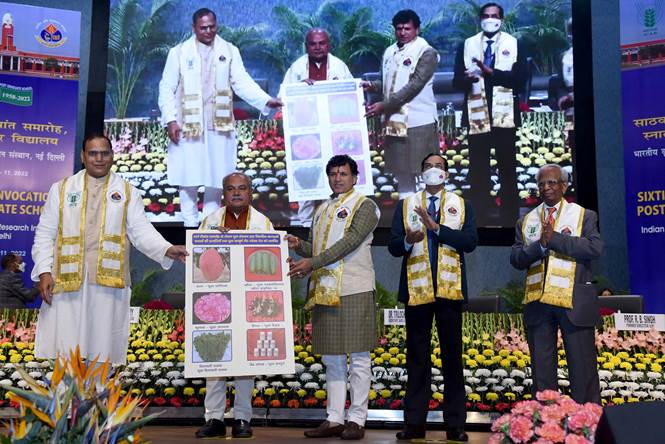
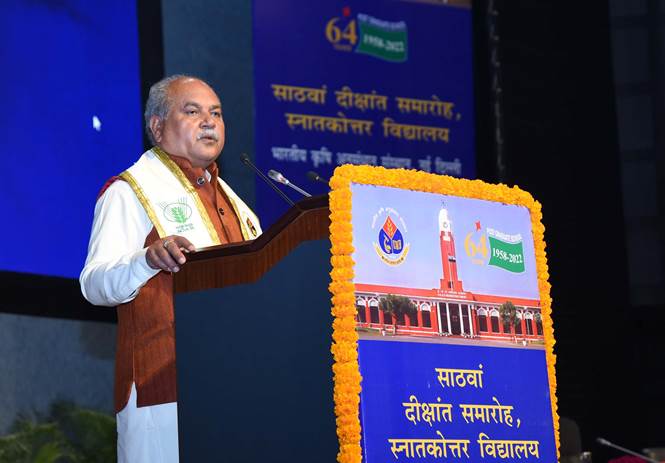
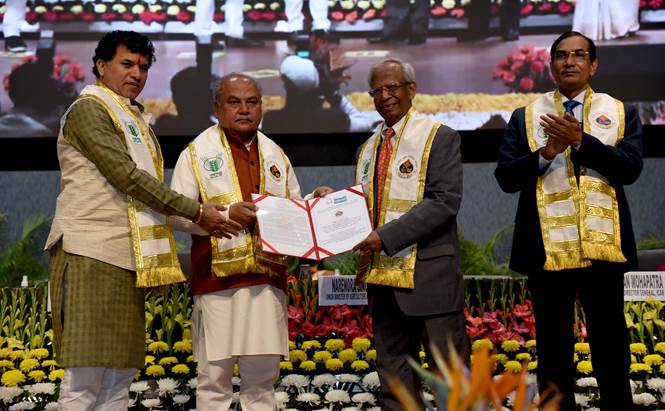
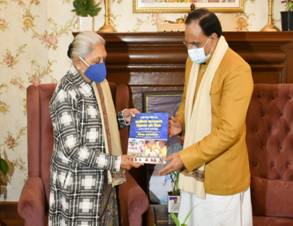
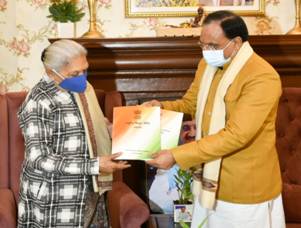
 Union Education Minister Shri Ramesh Pokhriyal ‘Nishank’ addressed the 97th Annual Convocation of the University of Delhi, held today at the Multi-purpose hall, Indoor Stadium Sports Complex, Delhi. The Minister also inaugurated the Maharishi Kanad Bhawan. First time in the history of the University, 1,78,719 digital degrees were distributed online by the Union Minister of Education.

In his address to the august gathering , the Minister asserted that the duty of a University was to patronize, promote, support, & guide other educational institutions. He observed that the University was supporting and promoting institutions located in remote areas under the Vidya Vistar Yojna.

Emphasizing the need for reforms in the education sector, Shri Pokhriyal said that the University of Delhi can further contribute to nation-building by advancing Center of Excellence on National Education Policy. The efforts will not only strengthen Indian education system but also make India a global knowledge superpower, he added. Shri Pokhriyal congratulated the students and parents on this important day of their lives and motivated them to face the future challenges with hard work and determination.

He appreciated the efforts of the University of Delhi for ensuring no disruption in the holistic development of its students during this pandemic year.

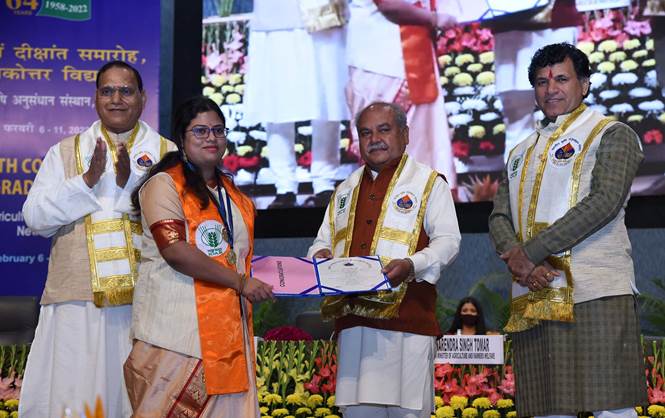
Dean Examinations, Prof. D. S. Rawat congratulated all the award holders – 670 doctoral degrees, 44 DM/M.Ch degrees, 156 medals and 36 prizes from multidisciplinary fields. The University’s Brochure was released which has a dedicated section on Resilience to Covid -19. The biggest achievement has been to become the first University in the Country to conduct Open Book Examination (OBE) for such a large number of students keeping health and safety of the students as the top most priority as instructed by the Ministry of Education.

The Vice Chancellor (Acting) shared with immense pride that the University has launched Vidya Vistar scheme to support institutions in the remote areas. Under V2 scheme, this University will offer expertise of the faculty members, library resources and other academic facilities to the partner institute. The initiatives of the University in terms of establishment of new Centres of learning – Delhi School of Public Health, the Delhi School of Climate Change & Sustainability, the Delhi School of Skill Enhancement & Entrepreneurship Development to provide education in new concepts were also announced.

*****

NDMA Guidelines


S No. Title Release Date Download
1 National Guidelines For Preparation of Action plan – Prevention and Management of Cold Wave and Frost 2021 Oct 2021 Download(7 MB)
2 Simplified Guideline for Earthquake Safety of Building from National Building Code of India 2016 May 2021 Download(10 MB)
3 Cool Roof : House Owners’ Guide to alternate roof cooling solutions May 2021 Download(8.30 MB)
4 Guidelines on Management of Glacial Lake Outburst Floods (GLOFs) Oct 2020 Download(11.21 MB)
4.a Compendium of Task Force Report on NDMA Guidelines on Management of Glacial Lake Outburst Floods (GLOFs) Oct 2020 Download(12.70 MB)
4.b Summary for Policy Makers on NDMA Guidelines on Management of GLOFs Oct 2020 Download(04.01 MB)
5 Guidelines for Preparation of Action Plan – Prevention and Management of Heat Wave Oct 2019 Download(45.74 MB) 
6 Landslide Risk Management Strategy Sept 2019 Download(12.48 MB) 
7 Guidelines on Disability Inclusive Disaster Risk Reduction Sept 2019 Download(64.63 MB) 
8 Guidelines on Temporary Shelters for Disaster-Affected Families Sept 2019 Download(09.86 MB)
9 Guidelines on Prevention & Management of Thunderstorm & Lightning/Squall/Dust/Hailstorm & Strong Winds March 2019 Download(09.55 MB)
10 Guidelines on Boat Safety Sept 2017 Download(04.40 MB)
11 Guidelines on Cultural Heritage Sites and Precincts Sept 2017 Download(21.45 MB)
12 Guidelines on Museums May 2017 Download(02.12 MB)
13 Guidelines on Minimum Standards of Relief Feb 2016 Download(03.00 MB)
14 Guidelines on Hospital Safety Feb 2016 Download(03.22 MB)
15 Guidelines on School Safety Policy Feb 2016 Download(02.50 MB)
16 Guidelines on Seismic Retrofitting of Deficient Buildings and Structures. June 2014 Download(01.25 MB)
17 Guidelines on Scaling, Type of Equipment and Training of Fire Services April 2012 Download(02.61 MB)
18 Guidelines on National Disaster Management Information and Communication System Feb 2012 Download(06.00 MB)
19 Guidelines on Management of Drought Sept 2010 Download(01.40 MB)
20 Guidelines on Management of Urban Flooding Sept 2010 Download(14.35 MB)
21 Guidelines on Management of Dead in the Aftermath of Disaster Aug 2010 Download(01.40 MB)
22 Guidelines on Management of Tsunamis Aug 2010 Download(01.40 MB)
23 Guidelines on Incident Response System  July 2010 Download(08.97 MB)
24 Guidelines on Psycho-Social Support and Mental Health Services in Disasters Dec 2009 Download(0748 KB)
25 Guidelines on Management of Landslides and Snow Avalanches June 2009 Download(03.39 MB)
26 Guidelines on Management of Nuclear and Radiological Emergencies Feb 2009 Download(01.65 MB)
27 Guidelines on Management of Biological Disasters July 2008 Download(03.23 MB)
28 Guidelines on Management of Cyclones April 2008  Download(04.52 MB)
29 Guidelines on Management of Floods Jan 2008 Download(05.84 MB)
30 Guidelines on Medical Preparedness and Mass Casualty Management Oct 2007 Download(60.24 MB)
31 Guidelines on Preparation of State Disaster Management Plans July 2007 Download(05.84 MB)
32 Guidelines on Chemical Disasters April 2007 Download(01.67 MB)
33 Guidelines on Management of Earthquakes April 2007 Download(03.16 MB)

16th FICCI Higher Education Summit 2021

 Union Education Minister Shri Ramesh Pokhriyal ‘Nishank’ delivered the inaugural address at the 16th FICCI Higher Education Summit 2021 today. The 16th edition of FICCI higher Education Summit is being organised virtually by Federation of Indian Chambers of Commerce and Industry in collaboration with Ministry of Education and Ministry of Commerce and Industry. The theme of the summit is ‘‘Higher Education @ 2030: R.I.S.E. – Resilience. Innovation. Sustainability. Enterprise.’

Addressing on the occasion, Shri Pokhriyal said that National Education Policy 2020 lays out the path for transforming Indian education landscape suited to 21st century needs. He further said while the government has formulated the policy, private sector participation will play a key role in implementing the same.

Shri Pokhriyal said, “Built on the foundational pillars of access, equity, quality, affordability and accountability, NEP 2020 is aligned to the 2030 Agenda for Sustainable Development and aims to transform India into a vibrant knowledge society and a global knowledge superpower”.

The Minister remarked that in the next 20-30 years, the energy and talent of young India will be used in advancing the world as 21st century belongs to Young India. India is poised to become the R & D capital of the world not because of the cost advantage but due to the rich and intelligent human capital that the country is bestowed with.

Lauding the FICCI Higher Education Summit, Shri Pokhriyal said that over the years, the Summit has evolved into a thought leadership forum and brings together key stakeholders including, policymakers, academicians, industry and students for deliberations and knowledge sharing at both national and international levels.

The Inaugural session also witnessed the release of FICCI- EY report ‘Higher Education in India: Vision 2040. The report, while defining Education 4.0 in the current context, has highlighted the significant emerging trends within the higher education sector and drawn learnings and highlighted global best practices. 

Dr R A Mashelkar, National Research Professor and Chancellor of Institute of Chemical Technology, Dr Vidya Yeravdekar, Chair-FICCI Higher Education Committee Mr Uday Shankar, President, FICCI and Mr Dilip Chenoy, Secretary General, FICCI and other dignitaries graced the occasion.

****


66th Convocation of IIT Kharagpur

 Prime Minister Shri Narendra Modi addressed the 66th Convocation of IIT Kharagpur today as Chief Guest through a video conference. Union Education Minister Shri Ramesh Pokhriyal ‘Nishank’ and Union Minister of State for Education Shri Sanjay Dhotre were present on the occasion as Guests of Honour.

The Prime Minister said this day is not only important for the parents and teachers of the IIT but also for the New India as the students represent the entire country. He urged the students passing out, as they embark a new journey of life, to work towards creating startups and innovating things that can change the lives of crores of people in the country. He said the degree they won today represents the aspiration of millions of people, which they have to fulfill.

The Prime Minister said the need of the day is to work while anticipating the needs of the future, to make innovations for tomorrow. He said an engineer has the capability to see things in more detail and this understanding forms the basis of new discoveries and new breakthroughs in future. He urged the students to find solutions which can improve and save the lives of millions and can save the country’s resources.

Shri Narendra Modi asked the students to adopt the mantra of Self 3 to overcome their self doubts and obstacles in the future. He said Self 3 is Self-awareness, Self-confidence and Selflessness. He advised the students to recognize their potential and move forward, move ahead with full confidence, move ahead with selflessness.

The Prime Minister said that there is no place for hastiness in the field of science and technology. He added you may not get complete success in the innovation you are working on. But that failure of yours will also be considered a success, because you will learn something from that as well. He said in the 21st century the IITs need to be taken to the next level from Indian Institutes of Technology to Institutes of Indigenous Technologies to meet the changing demands and aspirations of New India.

Shri Modi said at a time when the world is struggling with the challenges of climate change, India has come up with the idea of International Solar Alliance (ISA) and embodied it. He said today India is one of those countries where the cost of solar power is very low per unit. But there are still many challenges to deliver solar power from door to door. He added India needs technology that minimizes damage to the environment, is durable and user friendly.

The Prime Minister said Disaster management is a subject which the world has looked up to India. During major disasters, along with life, infrastructure is the most affected. He added realizing this two years ago, India took the initiative of establishing Coalition for Disaster Resilient Infrastructure in the United Nations,

The Prime Minister emphasized the need for significant innovation for Industry 4.0. He lauded the efforts of IIT Kharagpur to transform academic research related to AI at industrial level, Internet of things and modern construction technology. He said IIT Kharagpur’s software solutions were also useful in the fight against Corona. He urged the institute to work fast on futuristic solutions in Health Technology. He said a huge market has emerged for personal healthcare equipment. He said the market for Health and Fitness related Equipments is also increasing. He said technology has to be developed to provide for Personal Healthcare Equipments in India which are affordable and accurate.

The Prime Minister said after Corona, India has emerged as a major global player in the field of Science, Technology, Research and Innovation. He said with that inspiration, there has been a major increase in the budget for science and research. He said a few days ago, the government has freed Map and Geospatial Data from control. This step will give a lot of strength to the Tech Startup Ecosystem, intensify the campaign for self-reliant India and also give new freedom to young start-ups and innovators of the country.

The Prime Minister lauded the efforts of IIT Kharagpur on the implementation of the new National Education Policy. He praised the institute for the way they were exploring knowledge and science as the strength of our future innovation. He urged the institute to compile 75 major innovations made by the institute to coincide with the 75th year of India’s independence and make them reach the country and the world. He said these inspirations would give a new boost to the country and inspire confidence.

Union Education Minister Shri Ramesh Pokhriyal ‘Nishank’ spoke about the students aiming to become entrepreneurs and job-creators instead of job-seekers. He emphasized how the National Technology Forum will improve research infrastructure in the country. He urged students to work on realising the vision of self-reliant India.

Union Minister of State for Education Shri Sanjay Dhotre highlighted the importance of the fields like agriculture, energy, water for further R&D. He called ideation, innovation, incubation and development of technological solutions in technology sectors like Telecom, auto-tech, solar cells, defence to strengthen the goal of Atmanirbhar Bharat.

2815 students were awarded degrees today of whom 75 students were invited to receive the gold and silver medals conferred by the Institute. In addition, several dignitaries were present to receive DSc (Honoris Causa), Life Fellow and Distinguished Alumnus Awards.

The Director Prof. V K Tewari, while presenting the report took pride in the recent innovations such as COVIRAP and telemedicine application which are bringing hope to the people of the country. He pledged to work more on product-development-oriented projects to support the cause of Atmanirbhar Bharat. He also talked about setting up more awards for faculty and staff for them to pursue excellence.  

*****

CBSE Assessment Framework for Science, Maths and English classes

 Union Education Minister launched CBSE Assessment Framework for Science, Maths and English classes as part of CBSE Competency Based Education Project in New Delhi today.

Speaking at the launch, the Minister said, “The core objective of the NEP is to guide the transition to an education system that enables our youth to have a better future. Schools have a very important role to play in shaping our youth and I am happy that through this launch, the vision of the NEP will be translated into action. My heartiest congratulations to the CBSE and British Council teams for working towards this’’.

He further said that the competency-based assessment framework to strengthen India’s existing school education system for secondary level (classes 6-10) and improve the overall learning outcomes of students across India, mainly covering three subjects: English (reading), Science, and Maths. The framework is a part of the CBSE Competency Based Education Project that aims to replace the existing rote learning model with a competency-based framework as directed in the NEP 2020 over the next 2-3 years, he added. The Minister highlighted that the Framework is aligned with the NEP vision of achieving global standard in assessments.

CBSE Chairperson Shri Manoj Ahuja, said, “The New National Education policy 2020 envisages a significant shift in the education ecosystem in India. It aims at preparing students for the 21st century and lays emphasis on competency-based education rather than an education which tests rote learning.

Barbara Wickham OBE, Director India, British Council, said “Education and research collaboration is central to the India-UK relationship. We are honoured to be a part of this ground breaking initiative led by the CBSE. The reformed assessment framework will support high quality teaching for both an improved learning experience and outcomes for all students in CBSE schools. Our extensive work with government agencies in India over the past few decades and our links across the whole UK education network, meant we were able to propose a framework that will not only bring international assessment standards to Indian schools, but accompany it with an implementation roadmap tailored for India. We are committed to working closely with the CBSE and Indian school system stakeholders in the last mile delivery of the project.”

The framework is the basis for a larger project exercise currently underway where 40 Assessment Designers, 180 Test Item writers and 360 Master Trainer Mentors are being trained in using this framework to create Model Question bank and collection of Ideal Lesson Plans. In the first phase selected Kendriya Vidyalayas, Navodaya Vidyalayas, UT Chandigarh and private schools across the country will participate in the programme which will be rolled out to all 25,000 CBSE schools in India by 2024.

The suggested Assessment framework has been put in place to drive improvement in quality of teaching and implementation of changes recommended in the National Education Policy 2020. British Council along with AlphaPlus as the UK knowledge partner, designed and developed this framework after extensive research and analysis of the current learning and assessment model in Indian schools. British Council has a global track record of supporting governments and education departments in teacher trainings, building institutional capacity, and contributing to long-term systemic change in school ecosystems. For this initiative, the British Council is currently working with select UK partners:

  • Cambridge are developing and delivering teachers’ Continuing Professional Development (CPD) module on competency-based approach to pedagogy, and lesson plan bank.
  • UK NARIC has worked with the CBSE team to review and identify the scope of competency-based approaches to be integrated in the assessment system.
  • Alphaplushas created the competency-based learning assessment framework and are delivering capacity building workshops for 40 assessment designers, 180 master test item writers.


This project will directly support 15 education leaders, 2,000 school principals; 15 senior govt leaders; 180 test item writers; 360 master trainers which will further impact 25,000 CBSE schools that include 2,000 JNV’s and KV’s, 132,000 teachers and 20 million learners by 2024. 

*****

3rd convocation of the Central University of Gujarat

 Educational institutions should try to make students capable citizens of the modern world community, said the President of India, Shri Ram Nath Kovind. He was addressing the 3rd Convocation of the Central University of Gujarat at Gandhinagar today. The Governor of Gujarat Shri Acharya Devvrat, Union Education Minister Shri Ramesh Pokhriyal ‘Nishank’, and Gujarat Deputy Chief Minister Shri Nitinbhai Patel, along with other dignitaries of the University were present on the occasion.

The President said that under the new National Education Policy, efforts are being made to encourage education of modern knowledge-science based on Indian values ​​with the aim to make our country a ‘knowledge super power’. Creating awareness among students about their duties in the changing world is also a major objective of the new education system. Our educational institutions should try to make students capable citizens of the modern world community. There is also a need to give special emphasis on the importance of public interest and morality by higher educational institutions. He stated that only by giving special emphasis on Indian values; we would be able to differentiate between our educational institutions and foreign educational institutions -based on western ideas.

Addressing the students, the President said that building a strong and self-reliant India is at the heart of our global thinking. Local resources, experiences and knowledge should be used for self-reliance. Students can make their education useful in the true sense by empowering local development through research and innovation with utilization of local resources. He said that we should always remember that our education should benefit the development of our society and country apart from personal benefit. By making efforts for the upliftment of the people who were relatively left behind in the development journey, they would be able to contribute towards building a better society, he added.

The President happily noted that about 55 percent of the students getting education in the Central University of Gujarat, are girls and in today’s Convocation ceremony out of 21 medals 13 were won by girl students. He said that this is a great achievement of this university. It shows a glimpse of change in our society and a picture of a new India.

The President noted that students from about 30 states are getting education in the Central University of Gujarat. He also noted that 85 percent students are from other states and union territories. He said that in this way the University campus is like a mini-India and is strengthening our national unity. He urged to the students from other states studying in the University to imbibe the culture of self-reliance, entrepreneurship and self-employment from the people of Gujarat.

Speaking on the occasion the Minister said that the National Education Policy 2020 is a vision document that will take education system to newer heights.  He said that Universities are not only educational institutions but are laboratories of nation building. Highlighting the importance of synergy between Industry and Academia, he said that the gap between both will be bridged through research and innovation. The Minister congratulated all the students who have received their degrees at the convocation. Students who have graduated today should follow the ideals of Sardar Patel and contribute to the society and to the nation.

A total of 244 degrees were conferred to the graduating students at the convocation. Of these 73 are Ph.D. degrees recipients, 26 are M.Phil. degree recipients, 121 are post-graduate recipients, and 24 are undergraduate recipients. A total of 21 CUG medals was also awarded to the students for securing highest marks in respective UG and PG programmes. Specifically, six students namely Ms. Nikita Goel (M.A. in English), Mr. Prajnadipta Panda (M.Sc. in Life Sciences), Ms. Asmita Nandi (M.Sc. in Chemical Sciences), Mr. Saumyadeep Bora (M.Sc. in Nanotechnology), Ms. Maithuma Narzary (M.A. in Economics), and Mr. Vijay Anand Minj (Master of Library and Information Science) have received their CUG Medal directly from President of India. Raval Prachi Umeshkumar (M.A. in Economics) also received the Smt. Vidyadevi Agrawal Medal from President of India for securing highest marks in the final semester examination for MA Economics.     

*****


Exports of Marine Products register a growth of 35%

 Exports of Marine Products registered a growth of 35% to USD 6.1 Billion during April-December 2021 (Provisional) as compared to USD 4.5 Billion during same period in the year 2020. As compared to April-December 2019 (USD 5.5 Billion) and April-December 2014 (USD 4.4 Billion), exports of Marine Products registered a growth of 12% and 38% respectively.

In the month of December 2021, exports of Marine Products touched USD 720.51 Million, registering a growth of 28.01% over $562.85 Mn logged in December 2020.

The overall exports of Marine Products in the last Financial Year (March, 2020-April, 2021) was USD 5.96 Billion, and with USD 6.11 Billion scaled during the first three Quarters of FY2021-22, the sector is very likely to exceed the all-time high of USD 7.02 Billion exports achieved in the FY2017-18, despite the impact of the Covid19 pandemic since January, 2020.

Top 5 export destinations in April-November 2021 (latest available, share% in bracket) are: USA (44.5%), China (15.3%), Japan (6.2%), Vietnam (4%) & Thailand (3%). Frozen shrimps constitute the major share in India’s Marine Products exports items with 74% share in value terms (USD); Frozen Fish (7%), Others (6%) and Frozen Squid (5%) constitute the other major items in the Marine Products exports basket in FY2020-21. Others category included primarily Surimi and Surimi analogue (imitation) products.

Several exports promotion schemes for Fisheries have been implemented by the Marine Products Export Development Authority (MPEDA), a statutory body set up in 1972 under the Ministry of Commerce & Industry for promotion of export of marine products from India. The Prime Minister Shri Narendra Modi launched the Pradhan Mantri Matsya Sampada Yojana (PMMSY) in May 2020 with an array of 100 diverse activities. With a budget of Rs. 20,050 crore, it is by far the largest investment to bring about Blue Revolution through sustainable and responsible development of fisheries sector in India. PMMSY, being implemented over a period of 5 years from FY 2020-21 to FY 2024-25 in all States/Union Territories, has set a target of Rs. 1,00,000 crore fisheries export, additional 70 lakh tonnes fish production, and generation of 55 lakh employment in the years to come.

*****

Mann Ki Baat

 My dear countrymen, Namaskar. Today we are coming together through yet another episode of ‘Mann Ki Baat’. This is the first ‘Mann Ki Baat’ of 2022. Today we will once again take forward discussions which are related to the positive inspirations and collective efforts of our country and countrymen. Today is also the death anniversary of our revered Bapu Mahatma Gandhi ji. The 30th of January reminds us of the teachings of Bapu. Just a few days ago, we celebrated Republic Day as well. The display of the nation’s valour and strength, which we witnessed on Rajpath in Delhi filled everyone with pride and enthusiasm. One change you must have noticed is that now the Republic Day functions will start from the 23rd of January, i.e. the birth anniversary of Netaji Subhas Chandra Bose and will continue till the 30th of January i.e. Gandhiji’s death anniversary. A digital sculpture of Netaji has also been installed at India Gate. We can never forget the way the country welcomed this, the wave of joy that arose from every corner of the country; the kind of feelings expressed by every countryman.


Friends, in the Azadi Ka Amrit Mahotsav, the country is re-establishing its national symbols through these efforts. We saw that the ‘Amar Jawan Jyoti’ near India Gate and the Jyoti lit at the ‘National War Memorial’ in the vicinity, were merged. There were tears in the eyes of many countrymen and martyr families on this emotional occasion. At the ‘National War Memorial’, the names of all the bravehearts of the country who have been martyred since Independence have been inscribed. Some former soldiers of the army have written to me saying that – “The ‘Amar Jawan Jyoti’ lit at the memorial is a symbol of the immortality of the martyrs”. Truly, like ‘Amar Jawan Jyoti’ our martyrs, their inspiration and their contribution are also immortal. I would urge all of you to certainly visit the ‘National War Memorial’ whenever you get an opportunity. Do take along your family and children too. Here you will feel a different energy and inspiration.


Friends, in the midst of these events of Amrit Mahotsav, many important national awards were also given away in the country. One of them is the Pradhan Mantri Rashtriya Baal Puraskaar. These awards are given to the children who have rendered courageous and inspirational work at a young age. We all must highlight about these children in our homes. Our children will also get inspiration from this and the enthusiasm to bring glory to the country will be awakened in them. Padma awards have also just been announced in the country. There are many names among the recipients of Padma awards, about whom very few people know. These are the unsung heroes of our country, who have done extraordinary deeds in ordinary circumstances. For example, Basanti Devi of Uttarakhand, who has been honored with Padma Shri, lived her whole life in the midst of struggles. Her husband died at an early age and she had started living in an ashram. Staying there, she fought to save the river and made an extraordinary contribution to the environment. She has also done a lot of work for the empowerment of women. Similarly, 77-year-old Lorembam Beino Devi of Manipur has been conserving the Liba textile art of Manipur for decades. She has also been awarded the Padma Shri. Arjun Singh of Madhya Pradesh has received Padma award for imparting recognition to the art of Baiga tribal dance. Another person to receive the Padma award is Shriman Amai Mahalinga Naik. He is a farmer and hails from Karnataka. Some people also call him Tunnel Man. He has made such innovations in agriculture, seeing which anyone could be surprised. Small farmers are getting huge benefit from his efforts. There are many more such unsung heroes who have been honoured by the country for their contribution. You must try to know about them. We will get to learn a lot from them in life.


My dear countrymen, all of you send a lot of letters and messages, including many suggestions in connection with The Amrit Mahotsav. Under this series something has happened which is unforgettable for me. More than one crore children have written to me through their ‘Mann Ki Baat’ post cards. These one crore post cards have come from different parts of the country; they have also come from abroad. I have tried to take time out to read many of these post cards. These postcards show how broad and wide is the vision of our new generation for the future of the country. I have shortlisted some postcards for the listeners of ‘Mann Ki Baat’ which I want to share with you. Like this one is the post card of Riddhima Swargiyari from Guwahati, Assam. Riddhima is a student of class 7th and she has written that she wants to see an India in the 100th year of independence which is the cleanest country in the world, completely free of terrorism, included in the 100 percent literate countries, Zero accident country, and be capable of food security with sustainable technology. Riddhima, what our daughters think, the dreams they see for the country, do come true. When everyone’s efforts come together, when your young generation will work towards this goal, you will definitely make India the way you want her to be. I have also got a post card of Navya Verma of Prayagraj, Uttar Pradesh. Navya has written that her dream for 2047 is of an India where everyone has a dignified life, where farmers are prosperous and there is no corruption.


Navya, your dream for the country is very commendable. The country is also moving rapidly in this direction. You talked about a corruption free India. Corruption hollows the country like a termite. Why wait for 2047 to get rid of it? All of us countrymen, today’s youth have to do this work together, as soon as possible and for this it is very important that we give priority to our duties. Where duty is felt, Duty is paramount, corruption cannot even think of entering there.


Friends, in front of me is another postcard of Mohammed Ibrahim from Chennai. Ibrahim wants to see India as a major power in the field of defence in 2047. He wants that India should have its own research base on the Moon, and that India should start the work of settling the human population on Mars. Ibrahim also sees a big role for India in making the earth free from pollution. Ibrahim, nothing is impossible for a country that has youth like you.


Friends, I have another letter in front of me sent by Bhavna, a class 10th student of Saraswati Vidya Mandir in Raisen, Madhya Pradesh. First of all, I will say to Bhavna that I really liked the way you have decorated your postcard with the Tricolor. Bhavna has written about revolutionary Shirish Kumar.


Friends, I have also received Laurencio Pereira’s postcard from Goa. She is a student of class 12th. The subject of her letter is also – Unsung Heroes of Freedom. I am sharing with you its essence in Hindi. She has written that Bhikaji Cama was one of the bravest women involved in the Indian freedom struggle. She carried out many campaigns in the country and abroad to empower daughters; organized many exhibitions. Certainly Bhikaji Cama was one of the most courageous women of the freedom movement. In 1907, she hoisted the Tricolor in Germany. The person who supported her in designing this Tricolor was  Shri Shyamji Krishna Varma. Shri Shyamji Krishna Varma ji died in 1930 in Geneva. His last wish was that after India’s independence, his ashes should be brought to India. Although his ashes should have been brought back to India on the very next day of independence in 1947, this did not happen. Maybe it was the wish of the Almighty to assign me this work… and I was fortune to fulfil this duty. In the year 2003, when I was the Chief Minister of Gujarat, his ashes were brought to India. A memorial has also been constructed in the memory of Shyamji Krishna Varma ji at his birth place, Mandvi in ​​Kutch.


Friends, the enthusiasm of India’s Azaadi ka Amrit Mahotsav is not limited to our country. I have also received 75 postcards from Croatia, a friendly country of India. Students of the School of Applied Arts and Design in Zagreb, Croatia have sent these 75 cards to the people of India and congratulated them on the Amrit Mahotsav. On behalf of all countrymen, I thank Croatia and her people.


My dear countrymen, India has been the sacred land of education and knowledge. We have not confined education to bookish knowledge, but have seen it as a holistic experience of life. The great personalities of our country have also had a deep relationship with education. While Pandit Madan Mohan Malviya ji founded the Banaras Hindu University, Mahatma Gandhi played an important role in the establishment of Gujarat Vidyapeeth. There is a very lovely place in Anand, Gujarat – Vallabh Vidyanagar. On the insistence of Sardar Patel, two of his associates, Bhai Kaka and Bhikha Bhai, established education centres for the youth there. Similarly, Gurudev Rabindranath Tagore established Shantiniketan in West Bengal. Maharaja Gaikwad was also one of the ardent supporters of education. He got many educational institutions built and inspired many personalities including Dr.Ambedkar and Shri Aurobindo for higher education. In the list of such great personalities, there is also the name of Raja Mahendra Pratap Singh ji. Raja Mahendra Pratap Singh ji had handed over his house for the establishment of a technical school. He gave a lot of financial help for the construction of education centers in Aligarh and Mathura. Sometime back I also had the privilege of laying the foundation stone of a university in his name in Aligarh. I am happy that the same vibrant spirit of taking the light of education to the people continues in India even today. Do you know what is the most beautiful thing about this feeling? That is, this awareness about education is visible at every level in the society. The example of Taimmal ji living in Udumalpet block of Trippur district of Tamil Nadu is very inspiring. Taimmal ji does not have any land of her own. For years, her family is making a living by selling coconut water. The financial condition may not be good, but Taimmal ji had left no stone unturned to educate her son and daughter. Her children studied in Chinnaveerampatti Panchayat Union Middle School. One day in the meeting with the parents in the school, it was raised that the condition of the classrooms and school should be improved; the school infrastructure should be fixed. Taimmal ji was also in that meeting. She heard everything. In the same meeting, the discussion again came to a halt on the paucity of money for these works. After this, no one could have imagined what Taimmal did. Taimmal ji, who had accumulated some capital by selling coconut water, doanted one lakh rupees to the school.


Indeed, it takes a big heart, a sense of service, to do this. Taimmal ji says that in the school that is there has classes till 8th standard. Now when the infrastructure of the school improves, classes till higher secondary education will be held. This is the same sentiment I was talking about regarding education in our country. I have also come to know about a similar donation by an alumnus of IIT BHU. Jai Chaudhary, alumnus of BHU, donated one million dollars i.e. about seven and a half crores to IIT BHU Foundation.


Friends, in our country there are many people belonging to different fields, who are fulfilling their responsibility towards the society by helping others. I am very happy that such efforts are being seen continuously in the field of higher education especially in our different IITs. There is no dearth of such inspiring examples in Central Universities as well. To further enhance such efforts, from September last year, Vidyanjali Abhiyan has also been started in the country. Its objective is to improve the quality of education in schools across the country with the participation of various organizations, CSR and private sector. Vidyanjali is furthering the spirit of community participation and ownership. To be constantly connected with your school, college, to contribute something according to your ability, it is something whose fulfilment and joy  can be felt only through experience.


My dear countrymen, love for nature and compassion for every living being, this is our culture as well as innate nature. A glimpse of these Sanskaras of ours was seen recently when a tigress left the world in Pench Tiger Reserve of Madhya Pradesh. People used to call this tigress collared tigress. The Forest Department named it T-15. The death of this tigress made people so emotional as if someone of their own had left the world. People performed her last rites, bid her farewell with full respect and affection. You must have also seen these pictures on social media. This love of Indians for nature and living beings was greatly appreciated the world over. The collared tigress gave birth to 29 cubs in her lifetime and raised 25 of them to maturity. We also celebrated this life of T-15 and when she left the world, we also gave her a heartfelt farewell. This is the specialty of the people of India. We make a relationship of love with every conscious being. We also got to see a similar sight this time in the Republic Day parade as well. In this parade, the charger mount of the President’s Bodyguard, Virat took part in his last parade. Horse Virat came to Rashtrapati Bhavan in 2003 and used to lead the parade every time on Republic Day as Commandant Charger. Even when a foreign head of state was welcomed in Rashtrapati Bhavan, Virat used to play this role. This year, on Army Day, horse Virat was also given COAS Commendation Card by the Army Chief. In view of Virat’s immense services, after his retirement he was given farewell in an equally grand manner.


My dear countrymen, when there is a sincere effort, work is done with a noble intention, results also follow. A great example of this has emerged from Assam. As soon as the name of Assam is taken, the thought of tea plantation and many national parks come to mind. Along with this, the picture of one horned rhinoceros i.e. one horn rhino also emerges in our mind. You all know that the one horned rhinoceros has always been a part of Assamese culture. This song of Bharat Ratna Bhupen Hazarika ji will resonate in every ear.


Friends, the meaning of this song is very relevant. This song says, the lush green surroundings of Kaziranga, the abode of elephants and tigers, the Earth watches one horned rhinoceros and listens to the melodious chirping of birds. The images of the rhinoceros are also seen in the Moonga and Eri dresses woven on the world famous handlooms of Assam. The rhinoceros, which has such great glory in the culture of Assam, also had to face difficulties. In 2013, 37 and in 2014, 32 rhinos were killed by poachers. To tackle this challenge, a huge campaign against the poaching of rhinoceros was launched in the last seven years with the special efforts of the Assam government. On the 22nd of September last year, on the occasion of World Rhino Day, more than 2400 horns seized from smugglers were burnt. This was a stern message to the poachers. The result of such efforts is that now there is a steady decrease in the hunting of rhinos in Assam. Where 37 rhinos were killed in 2013, 2 killings in 2020 and only 1 in 2021 have come to the fore. I appreciate the resolve of the people of Assam to save the rhinoceros.


Friends, the diverse colours and spiritual strength of Indian culture have always attracted people from all over the world. If I tell you that Indian culture is very popular in America, Canada, Dubai, Singapore, Western Europe and Japan, you will find this very common; you will not be surprised. But, if I say that Indian culture has a big attraction in Latin America and South America too, you will definitely think once. Whether it is a matter of promoting Khadi in Mexico or an attempt to popularize Indian traditions in Brazil, we have discussed these topics earlier in ‘Mann Ki Baat’. Today I will tell you about the Indian culture making its mark in Argentina. Our culture is very much liked in Argentina. In 2018, during my visit to Argentina, I participated in a yoga program – ‘Yoga for Peace’. There is an organization in Argentina – Hastinapur Foundation. You will be surprised to hear… whither Argentina… and Hastinapur Foundation there too! This foundation is involved in the propagation of Indian Vedic traditions in Argentina. It was founded 40 years ago by a lady, Professor Aida Albrecht. Professor Aida Albrecht is going to turn 90 today. How her association with India happened is also very interesting. When she was 18 years old, she was first introduced to the power of Indian culture. She also spent a lot of time in India. She studied about Bhagavad Gita and Upanishads in depth. Today the Hastinapur Foundation has more than 40,000 members and about 30 branches in Argentina and other Latin American countries. Hastinapur Foundation has also published more than 100 Vedic and philosophical texts in Spanish language. Her ashram is also very enchanting. Twelve temples have been built in the ashram, in which there are idols of many Gods and Goddesses. There is also a temple at the center of all this which has been built for Advaitwadi Dhyan.


Friends, hundreds of such examples prove that our culture is a priceless heritage not only for us, but for the whole world. People all over the world want to know it, want to understand it, and want to live it. We should also try to make our cultural heritage a part of our life with full responsibility and try to take it to all the people.


My dear countrymen, I now want to ask a question to you and especially to our youth. Now imagine how many push-ups you can do at once. What I am about to tell you will surely fill you with wonder? Thounaojam Niranjoy Singh, a 24-year-old youth in Manipur, has made a record of 109 push-ups in a minute. Breaking the record is nothing new for Niranjoy Singh, earlier also, he had held the record for most Knuckle push-ups with one hand in a minute. I am sure you will be inspired by Niranjoy Singh and make physical fitness a part of your life.


Friends, today I want to share with you one such information about Ladakh which you will definitely be proud to know about. Ladakh will soon be blessed with an impressive Open Synthetic Track and Astro Turf Football Stadium. This stadium is being built at a height of more than 10,000 feet and its construction is going to be completed soon. This will be the largest open stadium in Ladakh where 30,000 spectators can sit together. This modern football stadium in Ladakh will also have a synthetic track with 8 lanes. Apart from this, there will also be a hostel facility with one thousand beds. You will also like to know that this stadium has also been certified by FIFA, the biggest organization of football. Whenever such a big sports infrastructure comes up, it brings great opportunities to the youth of the country. Alongwith such an arrangement, movement of people from all over the country takes place, tourism gets promoted and many employment opportunities are created. The stadium will also benefit many of our youth in Ladakh.


My dear countrymen, this time also in ‘Mann Ki Baat’ we touched upon many topics. There is one more topic, which is on everyone’s mind at this time and that is of Corona. India is fighting with great success with the new wave of corona, it is also a matter of pride that till now about four and a half crore children have been administered the dose of Corona Vaccine. This means that about 60% of youth in the age group of 15 to 18 years have got their vaccines within three to four weeks. This will not only protect our youth but will also help them to continue with their studies. Another good thing is that within 20 days, one crore people have taken the precaution dose as well. This trust of our countrymen on the indigenous vaccine is our great strength. Now the cases of corona infection have also started decreasing – this is a very positive sign. People should be safe, the pace of economic activities of the country should be maintained – this is the wish of every countryman. And you already know, in ‘Mann Ki Baat’, there are certain things, I cannot stay without mentioning… like, we should not forget the’Swachhta Abhiyan’ ; we should accelerate the campaign against single use plastic; Vocal for Local mantra is our responsibility, we have to work wholeheartedly for the Atma Nirbhar Bharat campaign. With the efforts of all of us, the country will reach new heights of development. With this wish, I bid you farewell. Thank you very much


******

The existing collection of books on freedom fighters in the Bhagat Singh Smarak to be converted into “Shaheed Smriti Pustakalaya”

 The University of Delhi organized a programme to pay homage and commemorate 90 years of martyrdom of our national icons of the Indian National Movement -Shaheed Bhagat Singh, Sukhdev Thapar and Shivaram Rajguru on ‘Shaheed Diwas’ in the Convention Hall of the Viceregal Lodge on 23rd March, 2021. Union Minister of Education , Shri Ramesh Pokhriyal ‘Nishank’, graced the occasion virtually as the Chief Guest and Prof. P.C. Joshi, Vice Chancellor, University of Delhi presided over the function. On this occasion Shaheed Bhagat Singh Smarak was inaugurated by the Union Minister of Education virtually.


To honour and value the sacrifices made by the National heroes and to drive out lessons of inspiration from their lives and times, the Government of India has declared 23rd March as ‘Shaheed Diwas’. History holds important lessons for the humanity and commemorating such events remind ourselves of the price paid by our ancestors for the freedom we enjoy today. Only by understanding its value we can keep the flame of freedom ignited among the people. 

On the occasion of the 97th convocation ceremony held at the University of Delhi, Shri Pokhriyal  stressed on the need of holding events that instil inspiration and pride in the youth of today, to absorb the values that our national heroes exemplified in making independent India a reality.

The existing collection of books on freedom fighters in the Bhagat Singh Smarak has been announced to be converted into “Shaheed Smriti  Pustakalaya” by the Union Minister of Education.  Tribute was paid to Shaheed Bhagat Singh and his associates through patriotic songs presented by the students and faculty members of the Music Faculty, University of Delhi. Homage was paid to Shaheed Bhagat Singh in the Chamber located in the basement of the Viceregal Lodge of the University where he was imprisoned.

The University organized various competitions–poetry, song, slogan and essay writing in all the Colleges. The topics for these competitions were related to Shaheed Diwas. The award winning students were felicitated by Prof. P.C. Joshi, Vice Chancellor, University of Delhi. Later, the award winning students also showcased their talents in front of the guests. Vice-Chancellor, University of Delhi announced that the Bhagat Singh Smarak shall remain open to the students and university community to inculcate values of freedom and sacrifice.


******

Leveraging Blockchain, AI , ML, Cloud Computing for digital transformation

 Union Education Minister Shri Ramesh Pokhriyal ‘Nishank’ chaired the 54th Meeting of the Council of Indian Institutes of Technology (IITs) today through online medium. Minister of State for Education Shri Sanjay Shamrao Dhotre; Secretary, Higher Education Shri Amit Khare was also present in the meeting.

Union Minister congratulated Heads of all IITs and Chairpersons (BoG) for successfully continuing the academics during the challenging times of COVID-19 and for their remarkable contribution in combating the COVID-19 by way of new scientific research. He exhorted the IITs to become a driving force behind realizing the vision of Atmanirbhar Bharat, as envisioned by Prime Minister Shri Narendra Modi.

Shri Pokhriyal asked IITs to develop Institute Development Plan as envisioned in NEP 2020 to improve the mobility of faculty between institution and Industry. The mobility of faculty members and industry experts between technical institutes and industry will promote collaborations between industry and academia, he added. Earlier, a committee was constituted under the chairmanship of Dr K. Radhakrishnan, Chairman, Standing Committee for IIT Council for suggesting recruitment of faculties in IITs (Industry interaction and mobility of faculty).

Union Minister also urged IITs to adopt One IIT – One Thrust Area approach based on local needs.

Digital Transformation using Blockchain, AI, ML, and Cloud Computing at IITs also came up for discussion during the meeting. It was recommended to constitute a taskforce to review use of technology at all IITs and also to accelerate deployment of digital tools. It was also recommended to undertake rationalization of staff from current standards to a lower number.

On the basis of the recommendation of the Chairman of Standing Committee for IIT Council, four Working Groups were constituted on the following issues related to NEP-2020:

Group-1: Graded Autonomy, Empowered and accountable BoG and Director

Group-2: Grooming distinguished academics for directorship of IITs

Group-3: Reform and restructuring of the Academic Senate

Group-4: Innovative funding mechanisms

The reports of the these groups and also of a new group which will work on faculty development will be presented in a meeting to be chaired Union Education Minister.

The Council also put up for consideration a suggestion to arrange Online IIT R&D fair to showcase the quality research work being done by IITs to showcase the R&D work of IITs to the industry. This may be followed by a physical fair in after normalization of present situation.

Highlighting several initiatives undertaken by the government, Shri Pokhriyal mentioned about approval of funds to improve the overall infrastructure of the 4 IITs at Madras, Delhi Kharagpur and Bombay. He spoke about making IITs as multi-disciplinary institutions for holistic growth in all disciplines of education, without losing its main focus on Scientific Research and Technology Development. He called upon IITs to make full use of the recently announced scheme National Research Foundation. He hoped IITs will strive to achieve the global rankings by 2022, the 75th Year of India’s Independence. He assured IITs of every possible help and support in terms of finance, administrative guidance, issues relating to various other Ministries and agencies of the Government.   

*****

webinar on 'Cage aquaculture in Reservoir

 Department of Fisheries, Ministry of Fisheries, Animal Husbandry and Dairying, Government of India organized a webinar on “Cage aquaculture in Reservoir: Sleeping Giants” today as a part of  “Azadi Ka Amrit Mohatsav”. The event was presided over by Shri Jatindra Nath Swain, Secretary, Department of Fisheries (DoF), Government of India (GOI) and well-attended by around 100 participants including officials of Department of Fisheries, GoI and fisheries officials of different States/UTs, faculties from State Agriculture, Veterinary and Fisheries universities, entrepreneurs, scientists, farmers, hatchery owners, students and stakeholders from aquaculture industry across the country.

 The Webinar began with the welcome address by Shri I. A. Siddiqui, Fisheries Development Commissioner, DoF along with introduction of the theme of the Webinar and the distinguished panellists, Shri Jatindra Nath Swain, Secretary, Shri Sagar Mehra, Joint Secretary (Inland Fisheries) along with Dr. B. K. Das, Director, ICAR- Central Inland Fisheries Research Institute (CIFRI) and other participants.

In his inaugural address, Union Secretary Fisheries, Shri Swain stated the importance of reservoirs and cage aquaculture for the development of fisheries sector.  Further, Mr. Swain advised to have robust cage culture system in reservoirs including potential markets to ensure good returns to the farmers and highlighted the examples of success stories across the globe and the country. Mr. Swain also requested the scientists and the Fisheries Departments of the States/ Uts to motivate fish farmers and develop innovative ways as well as policies for increasing profits, decreasing input cost, species diversification and increasing the production and productivity of cage culture systems in the reservoirs.

Shri Sagar Mehra, JS (Inland Fisheries), in his opening remarks, briefly stated the pivotal of reservoir fisheries and aquaculture in enhancing fish production using enclosures such as cages. Further, Shri Mehra added that cage systems efficiently utilise the water bodies by harnessing their natural productivity and are economically, socially and ecologically viable. Department of Fisheries, GOI earmarked the investment atrgets for promoting cage aquaculture under flagship scheme Pradhan Mantri Matsya Sampada Yojana (PMMSY).

During the technical session, Dr. B. K. Das, Director, ICAR- Central Inland Fisheries Research Institute (CIFRI) made a comprehensive presentation on “Cage aquaculture in Reservoir: Sleeping Giants” and briefed about various technologies, opportunities and activities developed by ICAR-CIFRI for diversification of cage aquaculture in various parts of the country along with various skill and capacity development programmes for the farmers and stakeholders. Dr. Das emphasised on the need for promotion of cage aquaculture in reservoirs of the country by following good management practices and providing support services and CIFRI is ready to associate in tandem with the States and Uts for knowledge support on technological back drop for various perspectives of enclosed pisciculture.

After the presentation, an open discussion session was held with the fish farmers, entrepreneurs, hatchery owners, students, scientists and faculty of the universities. After discussion, the webinar concluded with a vote of thanks proposed by Dr. S. K. Dwivedi, Assistant Commissioner, DoF.

*******

Common Technology Development and Services Infrastructure

 Ministry of Heavy Industries (MHI) has notified the Scheme on Enhancement of Competitiveness in the Indian Capital Goods Sector- Phase-II for providing assistance to Common Technology Development and Services Infrastructure. The scheme has a financial outlay of Rs. 1207 crores with Budgetary support of Rs.975 crore and Industry Contribution of Rs.232 crore . The scheme was notified on 25th January, 2022.

The objective of Phase II of the Scheme for Enhancement of Competitiveness of the Capital Goods Sector is to expand and enlarge the impact created by Phase I pilot scheme, thereby providing greater impetus through creation of a strong and globally competitive capital goods sector that contributes at least 25% to the manufacturing sector.


There are six components under the Scheme for Enhancement of Capital Goods Sector Phase II, namely:


(i) Identification of Technologies through Technology Innovation Portals;


(ii) Setting up of four New Advanced Centres of Excellence and augmentation of Existing Centres of Excellence;


(iii) Promotion of skilling in Capital Goods Sector–creation of Qualification packages for skill levels 6 and above;


(iv) Setting up of four Common Engineering Facility Centres (CEFCs) and augmentation of existing CEFCs;


(v) Augmentation of Existing Testing and Certification Centres;


(vi) Setting up of ten Industry Accelerators for Technology Development


The detailed scheme guidelines along with the application forms are available at: https://heavyindustries.gov.in/writereaddata/UploadFile/Notification%20for%20Capital%20Goods%20%20Phase%20II%20.pdf


*****

Pandit Jasraj Cultural Foundation

 Present in this special event are Durga Jasraj ji, Shaarangdev Pandit ji, Neeraj Jaitly ji, co-founder of Pandit Jasraj Cultural Foundation, all the musicians and artists of the country and the world, ladies and gentlemen!

Music, ‘sura’ and ‘svara’ are considered immortal in our country. It is said that the energy of ‘svara’, as well as its effect, is also immortal. Therefore, the eminent soul, who has lived music throughout his life and that has been echoing in every particle of his existence, remains immortal in the energy and consciousness of the Universe even after leaving the body.

The performances by musicians and artists in this program and the way Pandit Jasraj ji’s ‘sura’ is echoing here gives an impression that Pandit Jasraj ji is present with us in this consciousness of music.

I am glad that all of you are carrying forward his classical legacy and preserving it for generations and centuries to come. Today is also the auspicious occasion of the birth anniversary of Pandit Jasraj ji. Today, I congratulate all of you on this innovative initiative of establishing Pandit Jasraj Cultural Foundation. I especially extend my best wishes to Durga Jasraj ji and Pandit Shaarangdev ji for taking upon the responsibility to dedicate your father’s inspiration, his penance, to the entire world. I too have had the privilege of meeting and listening to Pandit Jasraj ji many times.

Friends,

Music is a very complex subject. I am not very well-versed with it, but the comprehensive knowledge that our sages have given about ‘svara’ and ‘naada” is amazing in itself. It is written in our Sanskrit texts –

नाद रूपः स्मृतो ब्रह्मा, नाद रूपो जनार्दनः।

नाद रूपः पारा शक्तिः, नाद रूपो महेश्वरः॥

That is, the forces that give birth to the Universe and maintain and govern it are the forms of sound. This ability to feel the cosmic energy and ability to see music in the flow of the universe is what makes Indian classical music tradition so exceptional. Music is a medium that also makes us aware of our worldly duties and it also helps us transcend worldly attachments. What is so special about music is that it resonates till infinity even though you can’t touch it.

I am told that the primary objective of the Pandit Jasraj Cultural Foundation will be to protect, develop and promote India’s national heritage, art and culture. I am glad to know that this foundation will support the budding artists and will also try to make them financially capable. You are also considering promoting education and research in the field of music through this foundation. I believe that this initiative and the roadmap that you have formulated for a great personality like Pandit Jasraj ji is a big tribute in itself. And I would also say that now is the time for his disciples to give ‘Gurudakshina’.

Friends,

Today we are meeting at a time when technology has penetrated a lot in the world of music. I urge this cultural foundation to focus on two things. We hear about globalization quite often, but it is largely centered around the economy. It is our responsibility that Indian music should also make its global identity and create its impact globally in today’s era of globalization.

Indian music has the power to stir the depths of the human mind. Simultaneously, it also emphasizes the experience of the oneness of nature and the divine. Similarly with International Yoga Day! Yoga has emerged as a kind of spontaneous existence all over the world. It has been observed that the entire human race, the entire world has benefited from this heritage of India. Every human being in the world deserves to know, understand, learn and benefit from Indian music. It is our duty to fulfill this sacred exercise.

My second suggestion is that when the impact of technology is in every sphere of life then there should be a revolution of technology and IT in the field of music too. There should be start-ups in India that are completely dedicated to music, musical instruments and musical traditions. A lot needs to be done on how to equip the sacred streams of Indian music, such as the Ganges, with modern technology. While the ‘Guru-shishya’ tradition should remain intact, there should be attempts to become a global power and there should be value addition through technology.

Friends,

At the core of the knowledge and philosophy of India, our thoughts, ethics, culture and music is the spirit of service to humanity which fuels consciousness in all of us for centuries. The desire for the welfare of the entire world is clearly manifested in it. Therefore, the more we promote India and its traditions and identity, the more opportunities we will create to serve humanity. This is the intention and mantra of India today.

Today we are reviving our art and culture centers like Kashi. Our faith in environmental protection and love for nature is showing the world the way to a secure future. ‘Sabka Prayas’ (effort of all) should be involved in this journey which India has embarked on the mantra of heritage along with development.

I am sure the Pandit Jasraj Cultural Foundation will attain new heights of success with the active contribution of all of you. This foundation will become an important medium for service towards music and ‘sadhana’ and for the fulfillment of our resolutions towards the country.

With this belief, thank you very much and many best wishes for this new endeavour!

Thanks!

DISCLAIMER: This is the approximate translation of PM’s speech. Original speech was delivered in Hindi.

***

Green initiatives undertaken for the development of Green Ports & Green Shipping in India

 Union Minister for Ports, Shipping and Waterways Shri Sarbanand Sonowal chaired a meeting with all major ports, Cochin shipyard Limited (CSL) and IWAI (Inland waterways Authority of India) to review the progress on various green initiatives being implemented, as per Maritime India Vision(MIV) 2030, for the development of Green Ports & Green Shipping in India. 

Shri Sonowal reviewed the progress of initiatives undertaken for development of green ports planned under Maritime India Vision 2030. As part of MIV 2030, Total of 963 initiatives have been identified for implementation across major ports with an estimated investment of Rs. 6,77,720.24 crores, of which a total of 208 initiatives with estimated investment of Rs. 44,424.47 crores have been completed in FY 2021. Further 504 initiatives with estimated investment of Rs. 48,256.14 crores are under implementation.

A number of initiatives have been taken in India to promote green ecosystem in maritime sector. These are in line with International Maritime Organization (IMO)’s 2030 Decarbonization strategy and 2050 Green House Gases (GHG) strategy. Initiatives are being implemented by Major Ports of India that include areas, such as increase share of renewable energy to more than 60% across major ports by 2030, setting up of solar power plants, availing of shore power supply to vessels via berths, multi-clean fuel adoption for vehicles within port ecosystem, gradual phasing out of diesel locomotives at ports, etc.

The green port initiatives include acquisition of equipments for monitoring environmental pollution, acquisition of dust suppression systems, setting up of sewage/ waste water treatment plants, setting up of garbage disposal system for ports and ships, developing shore reception facility for wastes from ships, setting up projects for energy generation from renewable energy sources, providing shore power to ships at berths, creating Oil Spill Response (Tier-1) capabilities at all ports, taking actions to improve harbour water quality, inclusion of sustainable practices in terminal design, development and operation, increasing green cover within port premises etc.


Ministry is also working on draft of a “Green Port Policy” document to suggest framework and guidelines for incorporation of green initiatives in the port sector. The Policy document captures the focused areas, measured outcomes, implementation roadmap and cost recovery mechanism for the port operators and port authorities. The proposed target outcomes will help India in achieving the “Intended Nationally Determined Contributions (INDCs) target, as well as the International Maritime Organization (IMO) 2030 target.

In order to enhance the share of Green Shipping, various projects are being implemented by Cochin Shipyard Ltd., India’s largest shipbuilding and maintenance facility. These include green urban mobility solutions like Hybrid Electric Ferries, autonomous Zero-emission vessels, pilot project on Hydrogen Fuel Cell Ferry, Electric Catamaran Water Taxi, Hybrid Electric Ro-Ro, Hybrid LNG-Electric Inland Cargo Carrier, Hybrid Tugs, etc.

Possibilities are also being explored for deployment of fully electric ferry and hydrogen fuelled ferries on Inland Waterways for enhancement of river cruise tourism in the country. For instance, Electric Catamaran Water Taxi deployment is being considered at Varanasi and Guwahati in first phase. Additionally, use of Hybrid Electric Roll on -Roll off (Ro-Ro) vessels having dual fuel system (LNG+ battery) is being considered at Guwahati for river crossings. Use of Hybrid LNG-electric Inland Cargo Carrier vessels is also being considered on NW2 and NW1 . Possibility of deploying CNG vessels at Varanasi is also being explored.

The pace at which the Green initiatives are undertaken by the 12 major ports will surely bring a green revolution in the sector making the ports cleaner and greener, which is also a key component of ‘Blue Economy’, creating environmental benefits and balancing the investments and cash flow.

In his concluding Remarks, Shri Sonowal thanked all officials for their crucial contribution towards realization of Prime Minister’s Vision for Indian Maritime Sector. He further directed all Ports to take the Green Initiatives forward by putting dedicated proactive efforts towards greening of maritime sector including finalization of green port policy.

****

Artificial Intelligence (AI) and Digital Medicine are critical to future healthcare

 Union Minister of State (Independent Charge) Science & Technology; Minister of State (Independent Charge) Earth Sciences; MoS PMO, Personnel, Public Grievances, Pensions, Atomic Energy and Space, Dr Jitendra Singh said here today that Artificial Intelligence (AI) and Digital Medicine are critical to future healthcare.

During a visit to the All India Institute of Medical Sciences (AIIMS) Jammu for the inspection of the upcoming new blocks and inauguration of recently developed facilities, Dr Jitendra Singh suggested that in order to develop an exclusive identity for the institution, the focus should be on these futuristic areas. Tele-Medicine and Robotic Surgery have already taken over in a big way and the indispensable utility of these new options was realised during the pandemic times, he added.

Dr Jitendra Singh informed that the OPD services will start immediately in AIIMS, Jammu and the first batch will move and operate from the premises from 1st of June this year and the second batch will continue thereafter. The Minister said that 30 member faculty has already been inducted and the entire six storey AIIMS building will be ready by early next year.

The Minister announced that AIIMS Jammu will function in close collaboration with CSIR-IIIM Jammu. A MoU was signed in the presence of the Minister, between Director AIIMS Jammu Dr Shakti Gupta and Director CSIR-IIIM Jammu Dr. D. Srinivasa Reddy, on behalf of the two institutions.

Speaking on the occasion Dr Jitendra Singh said, it is an irony that CSIR-IIIM Jammu and Government Medical College Jammu existed in the close vicinity of just about 4 kilometres from each other and even though both the institutions were dedicated to medical research, there was hardly any collaboration between the two in the past. He said, every effort would be made to bring in closer integration of IIIM with GMC and also between IIIM Jammu and AIIMS Jammu, both of which happen to be the Central Government institutions.

Dr Jitendra Singh noted that IIIM Jammu is one of the oldest CSIR laboratories in the country and even today it is conducting pioneering research in Cannabis Medicinal Products and host of other drugs, which makes the institute a natural ally of the AIIMS which has also the mandate of research and medical education.

While appreciating the progress made during the brief period since Dr Shakti Gupta took over as the Director of AIIMS, Dr Jitendra Singh suggested that in order to develop an exclusive identity for the institution, the focus should be on futuristic areas like Digital Health and Artificial Intelligence (AI) and AIIMS could be a pioneer in North India in developing AI based healthcare infrastructure.

The Minister said it is because of the personal indulgence of Prime Minister Narendra Modi that Jammu has, in the recent years, developed major centrally funded academic institutions in close vicinity of each other, thus making it an important educational hub in the region. He called for greater integration at different levels that is among the science institutions, then between scientific institutions and non-scientific institutions and finally among all these education institutions put together and the industry and Start-Ups for sustainable growth, development and livelihood.

Dr Jitendra Singh hoped that with the constitutional barriers of the past having been done away with in case of Jammu & Kashmir, the administration and the management will make all efforts to attract the best of the faculty from different parts of the country.

****