TOP 5 INTERNSHIP SITES IN INDIA

Want you knowledge to get applied somewhere , internship is the chance . Just having a good degree is no longer enough to secure that all-important graduate job offer in today’s world. Pertinent work experience is now just as valuable as your degree and exam results when it comes to building a successful career. As a result, internships have become an essential way to help candidates make themselves stand out. The importance of an internship has been shown in several recent surveys. According to NACE’s Class of 2019 Student Survey, “More than half of all graduating seniors who applied for a full-time job (53.2%) received at least one job offer. Within this group, 57.5% of students who had an internship and 43.7% of graduating seniors who did not have an internship received a job offer.”

Internship helps you get the exposure which you want in any cooperate sector or any organization or non profit organization. It gives you a platform to establish a wide network connection . It helps you to know about yourself , you get to know about your caliber , your potential to cope up with the real industrial work . it help you to lean professional work as well as technical skills according to the requirements of the organization .

TOP 5 INTERNSHIP SITE IN INDIA RAE LISTED BELOW :

  1. INTERNSHALA

This is one of the most popular and probably the first website which all students or workers with no previous experience should usually start at. This website provides all its users with literally thousands of opportunities in all fields and domains. The process for applying to internships on this website is also incredibly simple. To get the process started you would first be required to make a login ID and password. Once you have that then you can access a large number of internships which are available on this website. You can manage and edit your resume at any time and can also find the right internship for you by using the filter box on the side. This website ensures that it connects everybody to trusted and assured companies who are genuinely interested in hiring interns. This website also gives assurance that they are connected to trusted companies & also help you to in various forms like how to talk to others , maintain professionalism .

2. LinkedIn

LinkedIn is a very famous community of professional networks which is known for providing the best jobs. This company connects working professionals on a single platform and allows them to communicate in a professional manner. At this website, you can post jobs or even apply for them. However, what most people don’t know is that this website also allows people to apply for internships.

There is also an entire section of this website which is devoted to students and working professionals alike who wish to learn new and relevant skills. This website allows users to filter their search for internships and it offers thousands of options for everybody to choose from. 

3. LetsIntern

This website exposes students to some of the best internships from a number of large organizations like Tencent, the Indian Express, and Comic-Con India. The website enables employers and students to register in a similar process, which enables better communication between organizations and their interns. They are putting all their hard work to provide you all with the bust internship offers & job offers.

4. Twenty19

With a user base of over 6 lakh students, Twenty19 brings students and companies on a single platform for projects, internships, volunteering opportunities etc. The platform shares your personal profiles with corporate companies to select to enhance the quality of interns. This portal is free of cost for the students as well as colleges.

5. stuMagz

This is a Digital Campus Discovery Platform based out of Hyderabad which was founded in 2015. You can find both tech and non-tech internships here. The site offers a great way to build your profile. The user interface is great and easy to use. With the reach of 500+ colleges, stuMagz serves as the platform for brands to reach out to a talented pool of students.

MUSIC – A GOOD COMPANION!!!

We may live in different place, different state, different country but we a got together by music. Would you agree if say like that? Yes, music is a good companion which helps us to express our feelings. It may be any form of music but we may feel accompanied with music rather than being lonely. Let me tell you about how music has an great effect on us.

Music is something that we enjoy as a part of our life. It accompanies us from birth to death. During our childhood, our parents and grandparents used to sing songs to make us sleep. Crying is a kind of music. When we woke up, we can hear the birds chirpping and trees rustling which is the most lovely feel in the morning. Music is everywhere, all we need is to open our ears to listen to it.

One who knows to create music on their own with musical instruments is called a Musician. The different music instruments include – Percussion, Brass, String, woodwind and keyboard. Brass music instruments are played using mouth. Those instruments include Trombone, Trumpet etc. String music instruments give rythym to music and those instruments include Guitar, Veena, Violin etc.

Some musical instruments

Percussion musical instruments gives main beat and feel to the song and those include Drums, Tabla, Dolak etc. Woodwind instruments are made of wood and they are also played using mounth like brass instruments and these instrument include Flute. The keyboard consists of keys which has high pitches.When you add another voice to an instrument, it is called singing and is a vital part of the music. When people who play different instruments come together to play them together, it is called a band.

There are different genres of music such as rock, pop, classical, blues, jazz, R&B, hip-hop, etc. All of these genres of music are characterized by how the instruments work together. Rock music is often louder and is played using percussion and string instruments. In Jazz music, Saxophone is very popular. In this modern world, the newest genres of music is electronic dance music (EDM) which consists of loud percussive beats and is very popular to young people.

We all have our favorite music director, singer, band, etc. Music is a universal language that unite people regardless of boundaries. This has the sense of familiarity among the people. Eventhough, we don’t understand the meaning of the lyrics of a song, we like it because of the tune and voice. Music is not just a sound but a communicable language which makes feel good. I love to hear music when am alone. But I used to play music when I am with my friends and family and it unites us very much. Listening to your favourite song can completely uplift your mood if you are feeling down. Everybody has their own kind of music that they love, which is why it is special to us all in our own unique ways.

Unique Music Quotes With Images In English - Premium Quotes Only

My best advice for you is to enjoy the music when you are alone and enjoy more than that when you are with your family. This feel cannot be explained in words and you’ll understand by experiencing it. Often hear songs; make everyone around you happy. Be happy; lead a helathy life.



Read more;

DEEPIKA KUMARI – INDIAN ARCHER!!!

Everyone in the world have some unique talent. The talent to do something vary from person to person. Yes, I believe I have the talent of writing articles. I would say this is my unique talent. Likewise, we haven’t heard a lot about the so called unpopular games. Archery is not as famous a cricket. But Archery is a wonderful sport. The people who has interest in this is also low. This game needs a free and concentrated mind. In this game, concentration plays a major role. Let me ask you a question? Do you know the name of any archers in India? Have you heard of Deepika Kumari? I would say I have heard her name and now I know about her a little bit by writing this article. Come on! Let’s see about Deepika Kumari.

Deepika Kumari Mahato was born on 13th June 1994 in Ranchi, Jharkand. Her father, Shivnarayan Mahato, is an auto-driver and her mother Geeta Mahato, a nurse at Ranchi Medical College. Her interest in Archery came from hitting the mangoes with stones. Many of us did this, but this has laid the strong foundation for her archery career. Deepika’s family was financially unstable and they cannot buy her new equipments to practice. So she used bamboo bow and arrow. After that her cousin helped her to develop and improve her talent.

DEEPIKA KUMARI

DEEPIKA’S PROFESSIONAL CAREER:

  • She made her breakthrough in 2005, by entering the Arjun Archery academy run by Wife of Jharkand Chief Minister Arjun Munda.
  • Her professional career started in 2006 by joining Tata Archery Academy in Jhamsedpur. After being sent there, she had uniform and professional equipments and she praticed hard. She only returned home after three years, by winning Cadet World Championship title in November 2009. She is the one to get first medal for India in Archery.
  • Deepika became the second women to win the World Archery Competition held in 2006.
  • She won the 11th Youth World Archery Championship in 2009 at her age of fifteen.
  • In 2010 Common Wealth Games, She won two medals, one in individual event and the other in team event. In the same year, she was awarded Outstanding performance at CWG in the women’s catergory at the Sahara Sports ceremony.
  • In the 2010 Asian games, she lost in the individual Archery game to a North Korean player in the Bronze-level playoffs. But as a recurve team defeated Taipei of China in the Bronze-level playoffs.
  • In 2012, She won her first Word Cup individual stage, held in Turkey.
  • In London Olymbics 2012, She lost to Amy Oliver of Britain in the opening rounds due to relatively high fevers and winds.
  • In July 2013, she won the gold medal in Archey World Cup stage 3 held at Mendellin.
  • In September 2013, she won silver in the FITA Archery World Cup.
  • In 2015, in Stage 3 Archery world Cup, she won bronze in the individual event. She won team Silver with her teammates in the same World Cup.
  • In November 2015, she won a bronze medal in the Asian Championship with Jayanth Taldukar in the Recurve Mixed Team event.
  • In April 2016, at the first stage of the World Cup in Shangai, Deepika equaled the Ki-Bo-Bae’s world record of (686/720) in the women’s recurve event.
  • In November 2019, Deepika Kumari secured an Olympic quota at the Continental Qualification Tournament being held on the sidelines of the 21st Asian Archery Championships in Bangkok.
  • She won three gold medals In Stage Three World Cup held in Paris 2021.
  • She recorded the 13th triple gold and became the 11th archer to achieve the feat – in the 15-year history of the Hyundai Archery World Cup.

In 2017, a Biographical Documentry called Ladies First, flimed the life of Deepika Kumari. This movie won at London Independent Festival and was screened in  Mallorca Film Festival in October 2017. This movie has also been submitted in Short Documentary category at Oscars.

Deepika Kumari - Wikipedia
PadmaSri awarded by Hon’ble Pranab Mukerjee.

AWARDS WON BY DEEPIKA KUMARI

  • 2012 – Arjuna Award by the Government of India
  • 2014 – FICCI Sportsperson of the Year Award
  • 2016 – Padmasri by the Government of India
  • 2017 – Young Achievers award which is felicitated by Vogue.

Read more;

https://en.wikipedia.org/wiki/Deepika_Kumari

Money Management

“Money” is a medium of economic exchange in which prices and values are expressed. It is very important to live a life. Just like the three basic units of life- “food, cloth and shelter”. Money is also can be said to be the basic unit as we can but food, cloth and shelter with money only. So its management is also important. “Money Management” means budgeting, saving, investing, earning, spending money in the best way possible. Spending money to satisfy cravings/needs is a natural human phenomenon. The idea of managing money has been developed to reduce the amount of money that is spend on items that add no significant value to one’s living standards. In a nut shell money management means spending money carefully on the needs rather than on wants and wishes and also saving it for the better future.

In Indian Society, if we take a look, we can see that indian society people/groups were divided into different categories on the basis of their earning and living standards. People are divided on assets and income/expenditure. Based on these parameters there are broadly three categories (sub categories are also there) i.e., rich/upper class people, middle class people and poor/lower class people.

Rich/upper class refers to a group of individuals have highest place and status in society. These people are considered the wealthiest, lying above the poor and middle class in the social hierarchy. Middle class people fall between the poor class and upper class. They are neither poor nor rich. These people have a simple living and their earning are mostly equal or less than their expenditure resulting to short debts. Poor/lower class people are those who live under poverty. They are homeless, living on roads and slums, don’t have food to eat, usually dependent on begging and daily wage activities.

People ending up in the same category in which they are born, it is very less likely that a poor class person becomes a middle class one in this life span. There are chances that a rich person becomes a middle class one due to many reason but the chances of upgradation in class is very less.

The reason for such situations- “Wrong money management” and less/no knowledge of managing money. Rich people become more rich and poor become more poor and middle class reamains in debt, the reason behind this phenomenon is that knowledge of money management is not being taught in school and if we talk about poor class children dont even go to school. They don’t even know how to read and write. Money management is taught at home rather than in school. Many of us usually learn about money from our parents.

Talking about poor people, how can you say that they can teach their children about money when they themselves don’t have money to fill their stomach. Poor people just teach their children to go school and work hard. It might happen that the child will pass with excellent grades in his/her academic career but even after this their economic status and mindset remain poor and they keep running in the vicious cycle of poverty like a rat.

Children of upper class are given exposure and knowledge of money management from their childhood. As their parents have more than enough money and seeing their parents earning and managing money they also learn and their intellectual development happens in the same matter but it is not possible in the case of middle and lower class as they themselves don’t have enough money so how can they teach their children about the importance of the same.

Money management should be a topic of concern as it is an important aspect of one’s life which determines his/her status and standard of living. Money management be taught from school level only then children can understand the importance of it. Both government and private schools should organise lecture and seminars on the topic “money management”. If they can manage then parents should also be invited to attend such seminars and lectures. Parents should also give opportunities to their child to learn about the money, its expenditures, saving and management. Parents should send their children to the nearby shops to purchase small goods.

Tips for Money Management

1.Every child should be given the opportunity to go to schools. 2.Budgeting should be done to save money. 3.One should create a realistic monthly budget. 4.Everyone must track their spending. 5.One should build up their savings 6.Must pay your bills on time. 7.Have an investment plan. 8.Know your money priorities. 9.Differentiate between needs and wants.

Money is important to live a good life so as its management also. Money management is a skill that everyone must know to have a good present and better future. Children should be taught about money management at school from the very beginning. It is effectively must to manage money to have a good lifestyle. So don’t waste your time and manage your money now to have a healthy, happy and wealthy lifestyle.

ENRON SCANDAL : VOILATION OF BUSINESS ETHICS

Business ethics is the study of appropriate business policies and practices regarding potentially controversial subjects including corporate governance, insider trading, bribery, discrimination, corporate social responsibility, and fiduciary responsibilities. The law often guides business ethics, but at other times business ethics provide a basic guideline that businesses can choose to follow to gain public approval.

ENRON corporation was an American energy commodities & service company based in Houston , Texas . It was a merger between Houston natural gas & inter north . Founder of ENRON was Jeffrey Skilling & Kenneth Lay . Earlier they used historical cost accounting method , A historical cost is a measure of value used in accounting in which the value of an asset on the balance sheet is recorded at its original cost when acquired by the company. But in 1992 , this company started using Mark to market method , Mark to market (MTM) is a method of measuring the fair value of accounts that can fluctuate over time, such as assets and liabilities. Mark to market aims to provide a realistic appraisal of an institution’s or company’s current financial situation based on current market conditions , with the help of this method only they did the whole scandal . The fraud was , they took loan from banks & other corporations , but didn’t show them in their books of accounts . They bought a MEDIATIOR , SFS ( special purpose vehicles ). They sold their assets to SFS & in return SFS asked loan from the banks . But they didn’t showed that they sold their assets in their books of accounts . They took loans , raised their capital & did the fraud of billion dollars .The value of shares of ENRON raised from 20$ to 90$ . The whole scandal was they hide the losses , showed fake revenues & profits , used complex accounting methods & did unethical things with the books of accounts by manipulating them .

But in 2001 , scandal burst , ENRON suffered a loss of 618 billion $ . Company did the scandal of 70 billion $ . Many investors , general public & employees suffered huge losses . Company’s one time Chief Jeffrey Shilling was sentenced to 24 to 24 years in prison in 2011 . Business ethics enhances the law by outlining acceptable behaviors beyond government control. Corporations establish business ethics to promote integrity among their employees and gain trust from key stakeholders, such as investors and consumers.

Amidst growing scrutiny of business practices, it’s more important than ever for companies to carry out work the right way. Ethics programs are an exceptional tool for promoting moral conduct. Organizations also need employees dedicated to ethical decision-making.

Bailment

Section 148 defines the terms ‘bailment’, ‘bailor’ and ‘bailee’.

A bailment is the delivery of goods by one person to another for some purpose upon a contract that they shall when the purpose is accomplished be returned or otherwise disposed of according to directions of the person delivering them. The person delivering the goods is called the bailor and the person to whom the goods are delivered is called the bailee.

Essentials of Bailment

1.Delivery of the goods for some purpose

2.Return of the goods after the purpose is achieved, or their disposal according to the bailor’s directions.

Kinds of Bailment

  1. Gratuitous Bailment: In gratuitous bailment it is without any consideration for benefit of bailor or bailee.
  2. Non-Gratuitous Bailment: Benefit for both bailor and bailee. Also known as bailment for reward.
  3. Bailment for benefit of bailor: Bailor delivers his goods to bailee for safe custody without any benefit or reward.
  4. Bailment for benefit of bailee: Bailor delivers his goods to a bailee without any benefit for his own use.
  5. Bailment for benefit of bailor and bailee: It is beneficial for both i.e. bailor and bailee.

Duty of Bailor

Section 150 mentions the following duty of bailor in respect of the goods bailed by him:

  1. The bailor is bound to disclose the faults to the bailee in the goods bailed, of which the bailor is aware and materially interfere with the use of them, or expose the bailee to extraordinary risks; and if he does not make such disclosure, he is responsible for the damage arising to bailee directly from such faults.
  2. If the goods are bailed for hire, the bailor is responsible for such damage, whether he was or was not aware of the existence of such fault in the goods bailed.

Duties of Bailee

  1. Duty to take reasonable care of the goods bailed (Section 151 and 152).
  2. Duty not to make unauthorised use of the goods bailed (Section 153 and 154).
  3. Duty not to mix the bailor’s goods with his own goods ( Section 155,156,157).
  4. Duty to return the goods on fulfillment of the purpose (Section 160,161 and 165,166,167).
  5. Duty to deliver to the bailor increase or profit on the goods bailed (Section 163).

Nature of Partnership

When two or more persons join hands to set up a business and share its profits and losses it is called Partnership. Section 4 of the Indian Partnership Act 1932 defines partnership as the ‘relation between persons who have agreed to share the profits of a business carried on by all or any of them acting for all’.

Partners are the persons who have entered into partnership individually with one another. Partners collectively are called ‘firm’. The essential features of the partnership are as follows:

Two or More Persons:
There should be at least two persons coming together to form the partnership for a common goal. In other words, the minimum number of partners in a partnership firm can be two.
Indian Partnership Act, 1932 has put no limitations on maximum numbers of partners in a firm. But however, Indian Companies Act, 2013 puts a limit on a number of the partners in a firm as follow:
1.For Banking Business, Partners must be less than or equal to 10.
2.For Any Other Business, Partners must be less than or equal to 20.
3.If the number of partners exceeds the limits, the partnership becomes illegal.

Agreement
The partnership is an agreement between two or more persons who decided to do business and share its profits and losses. To have a legal relationship between the partners, the partnership agreement becomes the basis. The agreement can be in written form or oral form. An oral agreement is equally valid. But, preferably the partners should have a written agreement, in order to avoid disputes in future.

Business
To carry on some business there should be an agreement. Mere co-ownership of a property does not amount to the partnership. The business must also be legal in nature, a partnership to carry out illegal business is not valid.

Mutual Agency
The business of a partnership firm may be carried on by all the partners or any of them acting for all. This statement has two important implications. First, to participate in the conduct of the affairs of its business, every partner is entitled. Second that a relationship of mutual agency between all the partners exists.
For all the other partners, each partner carrying on the business is the principal as well as the agent. He can bind other partners by his acts. And also is bound by the acts of other partners with regard to the business of the firm.

Sharing of Profit
The agreement between partners must be to share profits and losses of a business. Sharing of profits and losses is important. The partnership is not for the purpose of some charitable activity.

Liability of Partnership
Each partner is liable jointly with all the other partners. And also when is a partner, severally liable to the third party for all the acts done by the firm. Liability of the partner is not limited. This implies that for paying off the firm’s debts, his private assets can also be used.

Partnership Deed
Agreement to carry on a business between the partners, partnership comes into existence. The partnership agreement can be either oral or written. The Partnership Act does not require that the agreement must be in writing. But when the agreement is in written form, it is called ‘Partnership Deed’. Partnership deed should be duly signed by the partners, stamped & registered.

Partnership deed generally contains the following details:
1)Names and Addresses of the firm and its main business;
2)Names and Addresses of all partners;
3)A contribution of the amount of capital by each partner;
4)The accounting period of the firm;
5)The date of commencement of partnership;
6)Rules regarding an operation of Bank Accounts;
7)Profit and loss sharing ratio;
8)The rate of interest on capital, loan, drawings, etc;
9)Mode of auditor’s appointment, if any;
10)Salaries, commission, etc, if payable to any partner;
11)The rights, duties, and liabilities of each partner;
12)Treatment of loss arising out of insolvency of one or more partners;
13)Settlement of accounts on the dissolution of the firm;
14)Method of a settlement of disputes among the partners;
15)Rules to be followed in case of admission, retirement, a death of a partner; and
16)Any other matter relating to the conduct of business. Normally, all the matters affecting the relationship of partners amongst themselves are covered in partnership deed.

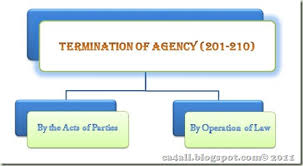
Termination Of Agency

Introduction

In a contract of agency, a person appoints another to act on his behalf with the third party it is called ‘Agency’. According to Section 183 of the said Act, Principal must be competent to contract. Any person may be an agent (Section 184). According to Section 185, in the contract of agency, consideration is not necessary. Termination of agency means putting an end to the legal relationship between principal and agent. Section 201 to 210 of the Indian Contract Act 1872 lay down the provision relating to the termination of Agency.

As above said termination of agency means putting end to the legal relationship between principal and agent. Section 201 to 210 of the Indian Contract Act 1872 lay down the provision relating to the termination of Agency.

Section 201, Indian Contract Act 1872 provides for termination of an agency –

An agency is terminated by the principal revoking his authority, or by the agent renouncing the business of the agency; or by the business of the agency being completed; or by either the principal or agent dying or becoming of unsound mind; or by the principal being adjudicated an insolvent under the provisions of any Act for the time being in force for the relief of insolvent debtors.

Agency may be terminated two ways –
1) By the Act of the Parties
2) By Operation of Law

1) By the act of the parties
i) By agreement – The Contract of Agency can be terminated at any time by mutual agreement between the principal and agent.
ii) By revocation of the principal – The Principal revoke agency at any time by giving notice to the agent.
iii) By Renunciation of an agent – Renunciation which means withdrawing from responsibility as Agent. Like Principal, Agent can also renounce the agency. According to Section 206 of the Indian Contract Act 1872, the agent must give to his Principal reasonable notice of renunciation. Otherwise, he will be liable to make good for the damage caused to the principal for want of such notice.

2) By operation of law
Agency can be terminated by operation of law-
i) By the completion of agency – Agency can become to an end after the completion of work for which the agency is created.
ii) By expiry of the time – Agency can also be terminated by the expiry of time. if the agency is created for the specific period, it is terminated after the expiry of the time.
iii) Death or insanity of principal or agent – Section 209 of the Indian Contract Act 1872 imposes an agent, duty to terminate the contract of agency on the death of the principal. In other words, Agency comes to an end on the death or insanity of the principal or agent.
iv) Insolvency of principal – According to Section 201 of the Indian Contract Act 1872, an insolvent or bankrupt is a person who is unable to run the business due to Excess of liabilities over assets. In this way, if the principal becomes an insolvent agency can be terminated.
v) Destruction of the subject matter – If this subject matter of the agency is destroyed agency comes to an end.
For example – Any agency is created for sale of an Airplane if the Airplane caught fire before the sale the agency comes to an end. In this contract Airplane is the subject matter.
vi) Principal becoming an alien enemy – If the Principal becomes an alien enemy the contract of agency comes to an end. vii) Dissolution of company or firm – A Firm or company may be regarded as a Principal in the contract of Agency. If the company or firm is dissolved the agency comes to an end.

Relationship between Principal agent and sub agent

Relationship between principal agent and sub-agent depends on the question whether the agent has an authority to appoint sub-agent and whether the sub-agent is properly appointed.
If then sub-agent is properly appointed:
1) The principal is bound by and responsible for the acts of a sub agent;
2) the agent is responsible to the principal for the acts of the sub-agent;
3) the sub agent is responsible for his acts to the agent, but not to the principal except in case of fraud or willful wrong.

It is of interest to observe clause (3) above. Sub-agent is responsible and accountable to the agent and not to the principal by clause (1). Principal is liable for acts of the sub-agent if he is properly appointed. Sub-agent is not responsible to the principal because there is no privity of contract between the principal and sub agent. It is case of fraud or willful wrong that the principal can proceed against the sub-agent. Principal can, however, against the agent for acts of a sub-agent. As far as the rights of a third party are concerned, he can enforce the wrongs of a sub-agent on the principal if the sub-agent is properly appointed. Principal is therefore liable for acts of the sub-agents if he is properly appointed.

If the sub-agent is not properly appointed: Where an agent has appointed a person to act as sub agent without having authority to do so, the principal shall not be deemed to be represented or responsible for the acts of the sub-agent so employed, nor is such a sub-agent responsible to the principal. The agent is responsible for the acts of such a sub- agent both to the principal and to third persons.

Sub-agent is said to be improperly appointed where agent delegates his powers without authority from the principal or where none of the circumstances stated above exist which necessitate appointment of a sub agent.

It will be observed that where a sub-agent is not properly appointed, the liability of agent is also towards third parties. As a rule, we have seen that an agent is responsible to the principal and it is the principal who is responsible for the acts of his agent to the third party. However, the section throws additional liability on the agent where he has improperly appointed a sub-agent. Agent stands liable to the third party for the acts of a sub-agent.

Termination of sub-agent’s authority: (Sec 210) Lastly it must be noted that the termination of the authority of an agent causes the termination of the authority of all sub-agents appointed by him

Liabilities of principal, agent and sub-agent: The agent is responsible to the principal for the acts of a sub-agent and the sub-agent is responsible for his acts to the agent but not the principal, except in cases of fraud and willful wrong.

Where an agent improperly appoints a sub-agent, the agent is responsible for his acts both to the principal and to third parties. The principal in such cases is not responsible for the acts of the sub-agent nor is the sub-agent responsible to the principal. But where a sub-agent is properly appointed, the principal as regards third person, is represented by the sub-agent, and is bound by and responsible for his acts, as if he were an agent originally appointed by the principal.

Where an agent under an express or implied authority has named another person to act for the principal, such a person is not a sub-agent, but an agent of the principal. There is no liability on the agent appointing him provided the agent so appointing exercises discretion as a man of ordinary prudence would exercise is his own case (Sec 194 & 195). Such an agent is called a substitute agent.


Stock Market

A stock market is a cluster of buyers and sellers of the stocks representing the ownership claims on businesses which may include securities listed on a public stock exchange, as well as stock that is only traded privately, such as shares of private companies which are sold to investors through equity crowdfunding platforms. Investment is done through  stockbrokerages and electronic trading platforms which is a computer software program that can be used to place orders for financial products over a network with a financial intermediary. Investment is usually made with an investment strategy in mind. A stockbroker is a person who is a registered trading representative.

The total market capitalization of equity backed securities worldwide rose from US$2.5 trillion in 1980 to US$68.65 trillion at the end of 2018. As of December 31, 2019, the total market capitalization of all stocks worldwide was approximately US$70.75 trillion. The largest stock exchange markets are US stock exchange, Japan stock exchange and UK stock exchange.

Many large companies have their stocks listed on a stock exchange. This makes the stock more liquid and thus more attractive to many investors. Large companies, mainly the multi national companies have there stocks listed in various stock exchange markets. Trade in stock markets means the transfer (in exchange for money) of a stock or security from a seller to a buyer. This requires these two parties to agree on a price. Equities (stocks or shares) confer an ownership interest in a particular company. Equity is ownership of assets that may have debts or other liabilities attached to them. Equity is measured for accounting purposes by subtracting liabilities from the value of the assets.

A potential buyer bids a specific price for a stock, and a potential seller asks a specific price for the same stock. Buying or selling at the Market means you will accept any ask price or bid price for the stock. When the bid and ask prices match, a sale takes place, on a first-come, first-served basis if there are multiple bidders at a given price. The stock exchange provides a safe marketplace facilitating the exchange of securities between buyers and sellers.

Duties Of An Agent

Agent and Principal

An “agent” is a person employed to do any act for another, or to represent another in dealing with third person. The person for whom such an act is done, or who is so represented, is called the “principal”. The contract between Principal and Agent is called ‘Contract of Agency’. Section 182 of the act defines the terms “Agent” and “Principal”.

Types of an Agent

  1. Brokers
  2. Factors
  3. Del Ceredere Agents
  4. Auctioneers

Duties Of An Agent

  1. Agent’s duty in conducting principal’s business (Section 211): An agent is bound to conduct the business of his principal according to the directions given by the principal, or, in the absence of any such directions, according to the custom which prevails in doing business of the same kind at the place where the agent conducts such business. When the agent acts otherwise, if any loss be sustained, he must make it good to his principal, and, if any profit accrues, he must account for it. Illustration: B, a broker in whose business it is not the custom to sell on credit, sells goods of A on credit to C, whose credit at the time was very high. C, before payment, becomes insolvent. B must make goods the loss to A.
  2. Skill and diligence required from an agent (Section 212): An agent is bound to conduct the business of the agency with as much skill as is generally possessed by persons engaged in similar business, unless the principal has notice of his want of skill. The agent is always bound to act with reasonable diligence, and to use such skill as he possesses; and to make compensation to his principal in respect of the direct consequences of his own neglect, want of skill or misconduct, but not in respect of loss or damage which are indirectly or remotely caused by such neglect, want of skill or misconduct.
  3. Duty to render proper accounts (Section 213): According to Section 213 of the Indian Contract Act 1872, an agent is bound to render proper accounts to his principal on demand.
  4. Duty to communicate with principal (Section 214): It is the duty of an agent, in cases of difficulty, to use all reasonable diligence in communicating with his principal, and in seeking to obtain his instructions.
  5. Not to deal on his own account: Section 215 of the Indian Contract Act 1872 deals with rights of principal when the agent deals, on his own account, in the business of agency without principal’s consent. Section 215 runs as follows- If an agent deals on his own account in the business of the agency, without first obtaining the consent of his principal and acquainting him with all material circumstances which have come to his own knowledge on the subject, the principal may repudiate the transaction, if the case shows either that any material fact has been dishonestly concealed from him by the agent, or that the dealings of the agent have been disadvantageous to him.
  6. Not to make Secret Profits: Section 216 of the Indian Contract Act, deals with Principal’s right to benefit gained by the agent dealing on his own account in the business of agency. An agent, without the knowledge of his principal, should not deal in the business of agency on his own to make secret profit. Illustrations: A directs B, his agent, to buy a certain house for him. B tells A it cannot be bought, and buys the house for himself. A may, on discovering that B has bought the house, compel him to sell it to A at the price he gave for it.
  7. Duty to pay sums received for principal: According to Section 218 of the said act, an agent is bound to pay to his principal all sums received on his account. It is the duty of an agent to maintain secrecy of the business of agency and should not reveal the confidential matters.
  8. Duty not to delegate his duties (Section 190): When an agent has undertaken to perform certain duties personally, he is not allowed to delegate his duties to another person.

FLOATING NEIGHBORHOODS OF AMSTERDAM: A STEP TO COMBAT SEA LEVEL RISE

“Floating Neighborhood” is a water-based solution for the problem for Holland’s housing needs. This neighborhood floats, freezes, tilts on the water of Lake Eimer. The goal is to “make a circular, resilient, floating neighborhood”. The floating houses have similar architecture to that of the land homes and each house is connected to the floor of Lake Eimer. The building elements of the houses are: wood, plastic and glass. The architecture of the neighborhood is based on water environment and each house have individual water jetties for getting connected with land. Running below the jetties, cables and pipes generate gas, electricity, water, cable, and provide a sewage drainage system for each floating home. The community of the water dwellers have the facility where when one resident is short on electrical power, another neighbor can offer some of theirs if they’ve got any leftover current. The Municipal Authority along with other innovators, planners and architects developed a draft for sustainability master plan for the floating development with maximum priority on sustainability.

Floating House

The main aim of “Floating Neighborhood” is to build sustainable neighborhood capable of addressing the challenges of an aquatic environment and harness the unique synergies it offers to residents. The neighborhood has adopted many approaches for solving environmental issues and rising sea level.

Adopted Approaches:

Sustainability of Floating Neighborhoods
  • Sustainable Solutions: The neighborhood relies on carbon intensive gas heating, well-insulated homes and passive solar heating through designs which make maximum utilization of natural sunlight, along with pumps which harvest warmth from the canal water even in winter. Solar boilers provide hot water, and water-recycling showers are equipped with technologies that recover heat that would otherwise go down the drain.
  • Harvesting waste water: The wastewater is transported to a nearby floating biorefinery which recovers nutrients and energy from the organic waste streams. Houses have vacuum toilets which are linked with decentralized sanitation facility and use anaerobic digester for producing energy using biogas, phosphorous and nitrates.
  • Usage of Sustainable Building Materials: The neighborhood uses sustainable building materials only which are light in weight and buoyant (bamboo is mostly preferred). The neighborhood has a community center which serves as a hub of neighborhood wide sustainability initiatives.
  • Smart Microgrid on Water: With the help of smart microgrid system on water, the residents have special permission that provides them the ownership of their own grid as well as energy sourcing and billing. Each house as installed large solar PV array and heat which with battery storage systems. The households have connections with energy management system which intelligently coordinates supply and demand of power within the community and allows the residents to trade energy with each other.
  • Replicable Blueprint for Green Building: The homes have green roofs where the residents can grow foods and plants. They can also collect rainwater and use it for different purposes. The rainwater can also be used for flushing the ultra-efficient toilets. The homes have solar hot water collector which connects to fixtures like recirculating shower, which cleans water in a water loop and saves both water and energy.
Floating House of Amsterdam

What Is Fast Fashion?

Clothes shopping used to be an occasional event—something that happened a few times a year when the seasons changed or when we outgrew what we had. But about 20 years ago, something changed. Clothes became cheaper, trend cycles sped up, and shopping became a hobby. Enter fast fashion and the global chains that now dominate our high streets and online shopping. But what is fast fashion? And how does it impact people, the planet, and animals?

It was all too good to be true. All these stores selling cool, trendy clothing you could buy with your loose change, wear a handful of times, and then throw away. Suddenly everyone could afford to dress like their favourite celebrity or wear the latest trends fresh from the catwalk.

Then in 2013, the world had a reality check when the Rana Plaza clothing manufacturing complex in Bangladesh collapsed, killing over 1,000 workers. That’s when consumers really started questioning fast fashion and wondering at the true cost of those affordable t-shirts. If you’re reading this article, you might already be aware of fast fashion’s dark side, but it’s worth exploring how the industry got to this point—and how we can help to change it.

What is fast fashion?

Fast fashion can be defined as cheap, trendy clothing that samples ideas from the catwalk or celebrity culture and turns them into garments in high street stores at breakneck speed to meet consumer demand. The idea is to get the newest styles on the market as fast as possible, so shoppers can snap them up while they are still at the height of their popularity and then, sadly, discard them after a few wears. It plays into the idea that outfit repeating is a fashion faux pas and that if you want to stay relevant, you have to sport the latest looks as they happen. It forms a key part of the toxic system of overproduction and consumption that has made fashion one of the world’s largest polluters. Before we can go about changing it, let’s take a look at the history.

How did fast fashion happen?

To understand how fast fashion came to be, we need to rewind a bit. Before the 1800s, fashion was slow. You had to source your own materials like wool or leather, prepare them, weave them, and then make the clothes.The Industrial Revolution introduced new technology—like the sewing machine. Clothes became easier, quicker, and cheaper to make. Dressmaking shops emerged to cater to the middle classes.

Many of these dressmaking shops used teams of garment workers or home workers. Around this time, sweatshops emerged, along with some familiar safety issues. The first significant garment factory disaster was when a fire broke out in New York’s Triangle Shirtwaist Factory in 1911. It claimed the lives of 146 garment workers, many of whom were young female immigrants. By the 1960s and 70s, young people were creating new trends, and clothing became a form of personal expression, but there was still a distinction between high fashion and high street.

In the late 1990s and 2000s, low-cost fashion reached its zenith. Online shopping took off, and fast-fashion retailers like H&M, Zara, and Topshop took over the high street. These brands took the looks and design elements from the top fashion houses and reproduced them quickly and cheaply. With everyone now able to shop for on-trend clothes whenever they wanted, it’s easy to understand how the phenomenon caught on.

How to spot a fast fashion brand

Some key factors are common to fast fashion brands:

  • Thousands of styles, which touch on all the latest trends.
  • Extremely short turnaround time between when a trend or garment is seen on the catwalk or in celebrity media and when it hits the shelves.
  • Offshore manufacturing where labour is the cheapest, with the use of workers on low wages without adequate rights or safety and complex supply chains with poor visibility beyond the first tier.
  • A limited quantity of a particular garment—this is an idea pioneered by Zara. With new stock arriving in store every few days, shoppers know if they don’t buy something they like, they’ll probably miss their chance.
  • Cheap, low quality materials like polyester, causing clothes to degrade after just a few wears and get thrown away.

What’s the impact of fast fashion?

On the planet: Fast fashion’s impact on the planet is immense. The pressure to reduce costs and speed up production time means that environmental corners are more likely to be cut. Fast fashion’s negative impact includes its use of cheap, toxic textile dyes—making the fashion industry the second largest polluter of clean water globally after agriculture. That’s why Greenpeace has been pressuring brands to remove dangerous chemicals from their supply chains through its detoxing fashion campaigns through the years.

Cheap textiles also increase fast fashion’s impact. Polyester is one of the most popular fabrics. It is derived from fossil fuels, contributes to global warming, and can shed microfibers that add to the increasing levels of plastic in our oceans when washed. But even ‘natural fabrics’ can be a problem at the scale fast fashion demands. Conventional cotton requires enormous quantities of water and pesticides in developing countries. This results in drought risks and creates extreme stress on water basins and competition for resources between companies and local communities.

The constant speed and demand mean increased stress on other environmental areas such as land clearing, biodiversity, and soil quality. The processing of leather also impacts the environment, with 300kg of cehmicals added to every 900kg of animal hides tanned. The speed at which garments are produced also means that more and more clothes are disposed of by consumers, creating massive textile waste. In Australia alone, more than 500 million kilos of unwanted clothing ends up in landfill every year.

On workers: As well as the environmental cost of fast fashion, there’s a human cost. Fast fashion impacts garments workers who work in dangerous environments, for low wages, and without fundamental human rights. Further down the supply chain, the farmers may work with toxic chemicals and brutal practices that can have devastating impacts on their physical and mental health, a plight highlighted by the documentary The True Cost.

On animals: Animals are also impacted by fast fashion. In the wild, the toxic dyes and microfibres released in waterways are ingested by land and marine life alike through the food chain to devastating effect. And when animal products such as leather, fur, and even wool are used in fashion directly, animal welfare is put at risk. As an example, numerous scandals reveal that real fur, including cat and dog fur, is often being passed off as a faux fur to unknowing shoppers. The truth is that there is so much real fur being produced under terrible conditions in fur farms that it’s become cheaper to produce and buy than faux fur!

On consumers: Finally, fast fashion can impact consumers themselves, encouraging a ‘throw-away’ culture because of both the built-in obsolescence of the products and the speed at which trends emerge. Fast fashion makes us believe we need to shop more and more to stay on top of trends, creating a constant sense of need and ultimate dissatisfaction. The trend has also been criticized on intellectual property grounds, with some designers alleging that retailers have illegally mass-produced their designs.

Shilpa Shetty, Raj Kundra and their company Viaan Industries fined Rs 3 lakh by SEBI in insider trading case

The Securities and Exchange Board of India (SEBI) has imposed a penalty of Rs 3 lakh on Bollywood actor Shilpa Shetty Kundra, her businessman husband Raj Kundra and their company Viaan Industries for violating insider trading rules.

Kundra, Shetty and Viaan have been fined for a three-year delay in the disclosure of an allotment of preferential shares.

In 2015, Viaan Industries had made a preferential allotment of 500,000 equity shares. Of this 1.28 lakh equity shares each were allotted to Kundra (referred to as Ripu Sudan Kundra) and Shetty, the promoters of the company.

According to SEBI’s Prohibition of Insider Trading Rules, 2015, the promoters had to disclose this transaction to the company within two days if it exceeded Rs 10 lakh in value. The company, in turn, has to relay this disclosure to the stock exchanges within two trading days.

In this case, SEBI said the value of the transaction was Rs 2.57 crore each and the disclosures pertaining to the 2015 transaction were made only in 2019.

In reply to a notice from the regulator, Shetty and Kundra acknowledged the mistake and said it was not done with malafide intent.

However, the SEBI adjudicating officer Suresh B Menon refused this explanation and imposed a fine.

Moneycontrol has reached out to Shetty and this copy will be updated when she replies.

Kundra could not be reached as he is police custody in an unrelated case. He was arrested on July 19 for allegedly making, publishing, and distributing pornography. Earlier a Mumbai court rejected his bail plea.

Minor as a Partner: Comprehensive Study

INTRODUCTION

Partnership is described as “a relationship between parties who have decided to share the proceeds of a company carried on by both or all of them working for all in Section 4 of the Indian Partnership Act, 1932.” A partnership is a relationship between two or more than two people who choose to do business together in order to make money and share profit or loss proportionately. The meaning of relationship is reciprocal trust, absolute good faith, and mind identification among the partners.”

According to the “Indian Majority Act of 1875”, a minor is anyone who has not yet reached legalage of majority. “The Indian Majority Act of 1875, Section 3 tells that a individual who is domiciled in India will reach majority at the age of eighteen.”

“Section 30 of Indian Partnership Act” regulates admission of minor within the partnership. This clause covers rights & responsibilities of minor who joins relationship. A extensive analysis of provision, specially “section 30(1) makes it very clear that a minor cannot be admitted in the partnership as a full-fledged partner, but with the authorization of the other partners, a minor can be admitted in the partnership to the benefits of the partnership.”

MINORS – ADMITTED ONLY TO BENEFITS

The basic principle is set out in “Section 11 of the Indian Contract Act, 1872, which discusses who is qualified to contract and states that a minor does not have the right to contract.”

A special committee has drafted the “Indian Partnership Act. Since partnership provisions were administered by “Indian Contract Act” prior to  passage of “Indian Partnership Act”, The special committee found that there was no reason to depart from “Section 11 of the Indian Contract Act’s definition of a minor’s failure to enter into a relationship contract.”

Following this, it was decided by special committee that minors could not become partners in a relationship, but they could be entitled to the partnership’s benefits with the permission of both of the standing partners.

In judicial decisions such as the S. C. Mandal case, the same theory is proclaimed. It was noted that a firm is described as a collective of people who have formed a partnership contract with one another. under “Section 4 of the Indian Partnership Act, and when read in conjunction with Section 11 of the Indian Contract Act, it can be inferred that a minor cannot be a party to a partnership contract.
A minor should only be in a relationship for the good of the partnership, according to the ruling. It also claimed that before a minor may be entitled to its privileges, there must be a relationship between two major partners.”

The Allahabad High Court also ruled a partnership deed void in which a partnership firm’s rights and liability were split between the minor and main partners. The court ruled that in the current case, not only the partnership’s gains but also its obligations are being imposed on the minor, which is in violation of the Indian Partnership Act.

While there were different judgments along the same line, there was also a lot of doubt about whether a minor should become a full-fledged partner in a partnership company and there were some contradictory judgments as well.

In the historic decision Commissioner of Income Tax vs D. Khaitan and Co., the Supreme Court took the legal position that if a minor is made a full-fledged partner in a company, the relationship cannot be registered with the Income Tax Department.

If the relationship is to be registered with the IRS, a new contract must be written in which the minor is only allowed to participate in the firm’s benefits, and the old contract may be nullified until the new contract is in effect. It was further specified that the revised contract would expressly specify that the minor was accepted to the relationship only for the sake of receiving compensation and that the minor is not responsible for any damages.

Except in the case of Banka Mal Lajja Ram & Co. vs. Commissioner of Income Tax, Delhi , it was determined that even though any of the other members of the relationship agree to make the minor a full-fledged partner, the decision can be implemented.

Commissioner of Income Tax vs. Kedarmall Keshardeo , a Guwahati High Court decision, holds that a contract deed is applicable when a guardian enters into a relationship on behalf of a minor, but that no responsibility should be levied on the minor, and that the minor’s income from the company should not be considered for income tax purposes.

The courts even come to the conclusion that when a guardian contracts with a minor, the damages must be measured based on the guardian’s damages, not the minor’s. The courts have also provided that if a minor contracts with a guardian, the benefits bestowed on the guardian must be approved by the guardian, but the minor may reject the arrangement if it is not entered for his benefit.

RIGHTS AND LIABILITY OF A MINOR

According to “Section 30(2) of the Indian Partnership Act, a minor is entitled to a share of the income and property of the company, as determined at the time the minor was admitted to the partnership’s benefits. A minor has the freedom to audit the partnership’s accounts under this clause, but he or she does not have the right to inspect the partnership’s other records. This restraint on the minor’s privilege, however, is fair and egalitarian, since the minor is not responsible to the same degree as the full-fledged spouses, i.e., individually. The minor will even appeal for the benefits of the relationship to which he has been admitted.”

If a minor chooses not to become a partner, he has the following rights:

  1. Up to the day of public notification, his rights and liabilities would be those of a minor;
  2. His share is exempt from liability for all actions taken by the company since the date of the notice;
  3. He has the right to sue the other partners for his share of the income and land.


Also under “Section 30(3) of the Indian Partnership Act, a minor may only be held responsible for his share of the partnership’s losses and cannot be held individually liable for the firm’s losses.” In a Calcutta High Court decision, it was reported that creditors can only recover money from a minor to the degree of his share in the company, but they cannot sue the minor personally; this advantage is not available to the main member of the firm.

POSITION/STANCE OF MINOR ATTAINING MAJORITY

“After reaching majority, a minor has two options: sever the relation with the firm or become a full-fledged partner in the firm, according to section 30(5) of the Indian Partnership Act.” Within six months of reaching majority, the minor must make a decision.

If the minor decides to become a full partner, he must give a public notice as required by “Section 72 of the Indian Partnership Act.” “The minor retains his rights as a minor before he takes a definitive determination on whether or not to enter the relationship as a full-fledged partner or to cut ties with it.”

“The presumption of arguing that the minor had no idea that he was entitled to the privileges of relationship lies with the party asserting it under Section 30(6).”

“Section 30(7)(a) of The Indian Partnership Act also specifies that if a minor partner is admitted as a full-fledged partner, he is responsible not only for the firm’s potential liabilities, but also for the firm’s past liabilities dating back to the date of his entry.

“That when a minor agrees to become a full-fledged member of the relationship, there is no split in the partnership and it continues as is, it is just that the liabilities of becoming a full-fledged partner are now upon him, Section 30(7)(b) notes that his position after he attains majority will be the same as it was when he was a minor.”

“Section 30(8) of The Indian Partnership Act specifies that if a minor refuses to remain as a full-fledged member of the partnership, he will be responsible for all of the partnership’s obligations before he gives the public notice required by Section 72 of The Indian Partnership Act.” After serving the partnership’s ties, the minor may file a lawsuit to regain the benefits to which he was entitled.

Conclusion

We may conclude from the preceding debate that a partnership company cannot be established with a minor as the only other participant. A contract establishes the partnership agreement. A minor is not competent to enter into a deal, according to “Section 11 of the Indian Contract Act.” Even in the Dwarkadas Khetan case, the country’s Supreme Court rules that a minor cannot be a full partner in the company. In the Shah Mohandas Case, the Supreme Court ruled that a minor could be admitted to the company solely for its benefits. The Indian Contract Act, Section 30. Although a minor is not a full-fledged partner in any event, he or she will only benefit from such a relationship with the consent of both partners and is not individually responsible for the firm’s losses. A guardian may enter into a relationship on behalf of a minor as long as it is not detrimental to the minor’s interests. Furthermore, a minor’s income from a relationship cannot be classified as “earning income” and therefore cannot be counted for income tax purposes. After reaching majority, the minor has the option of remaining in the partnership and becoming liable for losses, or ending the relationship entirely.