The impact of Covid-19 on Small Businesses

The Covid-19 pandemic has had an impact on almost every industry in the world. The IMF’s World Pandemic Uncertainty Index for Q1 2020, which stands at 13.46, is comfortably higher than any prior pandemics in the last two decades. During the SARS pandemic in Q2, 2003, the previous high was 4.40. The Uncertainty Index has always been linked to economic consequences, and the pandemic is no exception.

While small firms are projected to be the hardest hit, many of them are seeking to reinvent themselves by embracing technology and focusing on customers. However, not everyone will be able to use the online mode. During the shutdown, many companies were unable to duplicate their previous working model; it is critical to find a new approach.

These organizations are now developing new channels that do not require physical engagement to keep their clients motivated, having previously depended heavily on social interaction and group involvement to keep motivation levels high. For instance, forming WhatsApp groups, presenting role models, hosting online introductory sessions for new members, and holding contests such as plank challenges, surya-namaskar challenges, and skipping challenges, and publicizing victors on social media are all examples.

The ongoing battle to suppress the world’s second-largest coronavirus outbreak in India has stifled demand, disrupted supply networks, and changed consumer behaviors. Many small firms are developing or changing their business models to cope with the new terrain and uncertainties brought on by virus protocols.

After a boom in WhatsApp orders for carrom boards (an Indian game akin to pool with little discs that are flicked into corner pockets) and home exercise equipment, the company, which regularly employs ten people but is suddenly down to four, decided to offer free delivery.

Photo by cottonbro on Pexels.com

In this moment of crisis, you might also look for goods that are readily available and can be used as needed. Even the tiniest of details can make a significant difference in the global economy’s recovery during these difficult times. To combat this pandemic, stay cheerful, don’t lose hope, be vigilant, and have a lot of patience.

COVID19 is being fought by everyone, and the entire globe is fighting together to remove it. Treat lockdown as an era of creativity, learning, and wisdom that will help humanity grow into a brighter future.

Because to the enormous economic recession induced by COVID 19, businesses have incurred significant losses and many have lost their jobs. We cannot continue to wait without doing action. As a result, we must become more aware, decisive, and proactive, as well as consider enterprises that can be started from home during lockdown for students, working class, or post-retirement.

Following are some of the best small business ideas that can be started after lockdown:

Healthcare Product Sales
With the implementation of lockdown, the manufacturing of homemade or small-scale masks and hand sanitizers has risen dramatically to fulfil the rising demand for a variety of face masks and hand sanitizers. Several entrepreneurs, small company owners, self-employed professionals, and MSMEs have decided to start making face masks and hand sanitizers instead of closing their present enterprises during the lockdown. Business owners or manufacturers can contact local shops, merchants, and wholesalers directly to sell their products to local customers.

Door-to-door delivery service In the coming years, the internet delivery sector will flourish, and customers will prefer to buy things online rather than visiting grocery stores, malls, and shopping complexes, where there is a higher risk of infection. Doorstep delivery is the best alternative business during the lockdown period, in which various types of delivery services can be initiated, such as essential items delivery, grocery delivery, pharmaceuticals delivery and alcohol delivery. Respective licenses shall be required to be obtained from concerned authority to start a specific delivery business.

Food Delivery or Tiffin Service The Indian Central Government recently gave restaurants and food outlets access to sell meals via online platforms and have it delivered by delivery companies. You can also start a new business by opening a kitchen that serves a popular or desired cuisine in your neighborhood. The initial expenditure is minimal, as it only necessitates the acquisition of raw materials from a trained and professional source.

Paintings or Art work Artists have plenty of time to show off their skills through paintings or other forms of art. Artists have all of the necessary materials and only need to create a virtual display online to sell their work and deliver it to the customer’s address. Artists can host an event and showcase their talent if they have enough space to display their paintings.

While nearly all consumers surveyed (95 percent) are ready to wait out the continued limitations, only 61 percent agree with the continued lockdown measures, indicating a desire to return to normalcy, according to the survey.
HOW TO FILE A PATENT IN INDIA?

If any one have created or invented a process, product or service that can be defined as an original invention, then it is important to get it patented because it helps to safeguard ones invention.  It can protect any product, design or process that meets certain specifications according to its originality, practicality, suitability, and utility.  In most cases, a patent can protect an invention for up to 20 years. This time period starts soon as you file your patent.  The first and foremost thing that a person must do for getting a patent is to file a formal application of Patent at patent office. 

However, patent registrations are not applicable for all inventions because the invention should satisfy specific criteria to obtain a patent in India. So, let us know about who can file a patent and what types of inventions get patented in a clear way.

WHO CAN FILE FOR A PATENT ?

A patent registration application for an invention can be made by the people either alone or jointly. Most of the patents were applied by the true inventor or the assignee of first inventor and sometimes it can also be applied by the representative of the deceased true and first inventor assignee. In the case of a proprietorship firm, the application should be made in the proprietors’ name and if it is a partnership firm, then the names of all personally responsible partners must be included in the patent application. Most importantly the applicant is required to disclose the name, address, and nationality of the true and first inventor.

WHAT CAN BE PATENTED?

The Patent Act states that for an invention to be patentable, the invention must be a new product or process that involves an inventive step and can be used in the industry. For an invention to obtain patent registration, it should be technical and the invention should possess utility so that it can be used either in industry or market. The invention must possess novelty i.e the specified invention should not published in India or elsewhere priorly. These all should be cross checked before filing the patent application in India.

PATENT APPLICATION PROCEDURE:

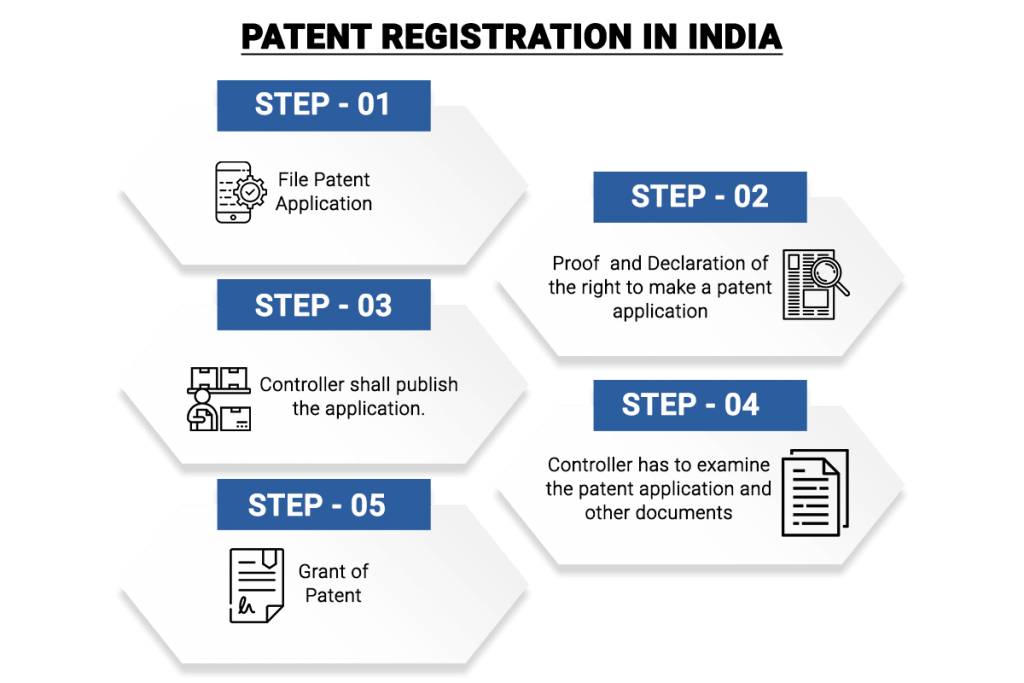
Step 1 – PATENTABILITY OPINION:

Before you begin the patent registration process, you need to check if your invention is patentable. This means that you need to check if another individual has filed a patent for a similar technology for which you are filing. Performing an in-depth patentability search helps you to understand whether you have a chance of getting a patent for your invention or not.

Step 2 – DRAFTING & FILING THE PATENT APPLICATION:

After successfully completing the first step, you can begin the patent application process. Indian applicants need to fill Indian Patent Application Form 1 and along with that you need to provide a Form 2 mandatorily for specifying the type of patent where you can choose between a provisional and complete patent application, based on the stage of invention. This means that if your invention is still under testing then, you need to apply for a provisional patent application where you can get a period of 12 months to complete the invention and can file for a complete patent.

You need to pay special attention when you are drafting your patent application and should include clauses like usability and outcome of the invention in detail. It is also necessary to include the intention to get license on the invention while drafting the patent application and be meticulous in including all the clauses that prevent the competition from others who use same technology.

Step 3 – PUBLISHING THE PATENT APPLICATION :

After submitting all the documents, the patent application is safely secured by the Indian Patent Office and applied patent is then published in an official patent journal after a period of 18 months approximately. However, inventors who wish to have their patent application published before this 18 month period can submit Form 9 (form that requests for early publication) so that the application can be published in official patent journal within 1 month of making request.

Step 4 – EXAMINING THE PATENT APPLICATION:

Before granting the patent, the patent application needs to be examined thoroughly. As per rules of the patent application process in India, applied patent should examined based on the merits of the invention and described in the patent specification form. Unlike the publication process, this is not an automatic process and the applicant needs to make a request to examine their patent application by submitting Form 18 because the patent office queues the application form for examination only after a formal request for examination is made.

When the application lands on the examiner’s desk, it is scrutinized according to the Patent Act and underlying rules along with that the examiner also searches for similar technologies to ensure the invention satisfies patentability criteria or not. After reviewing the application, the first examination report is submitted. The examiner lists his objections in detail which can further extend the application process by another 6- 9 months.

Step 5 – DECISION TO GRANT PATENT:

Once the examiner finds no objections in the patent application, he grants the patent and then the patent is then published in the official patent gazette.

Step 6 – RENEWING THE PATENT:

The patent holder also needs to renew his patent by paying an annual renewal fee. In India, it is possible to renew your patent for a period of 20 years at maximum, from the date the patent was first filed.

OVERVIEW OF PATENT PROCEDURE

CONCLUSION:

Finally, the patent filing process is long and complex, one must remember its importance in the long run. The entire process can take anywhere in between 3-5 years. However, This process is created with the intention of ensuring that the inventor gets credit for his invention and also ensures that no other individual can claim rights over the invention. The legal rights that an inventor earn through patent can prevent competitors from using the invention for financial benefits. In any wrong case the related true inventor of invention can also sue on such individuals and claim compensation for using invention without their approval.

So, guys this is the procedure to file a patent in India and I have tried my level best to make you understand about the patent procedure

WHAT IS THE NEED OF PROTECTING INTELLECTUAL PROPERTY RIGHTS

Protecting intellectual property is essential to remain profitable because intellectual property of a company prevent others from infringement of their own products and innovations. Particularly, protecting IP’s are relevant in today’s competitive market. Intellectual properties can cover a wide range of topics such as brand name, logos, services, processes etc.. of a company. An organisation is bound to face losses when these concepts are used without their permission. Let me explain you about the importance of protecting intellectual property with a case study.

CASE STUDY:

YOU ARE NOT BAJAJ:

A Hyderabad food retain chain, Urban Food Mart, India pvt.ltd has told by the Bombay high court to stop using the name ” BAJAJ SUPER MARKET ” for its business. The justice has passed an interim order on Feb 5th, 2021. Retaining urban food mart using the name of Bajaj and has directed into remove all signatures i.e use of marks on shopping bags, cartons, parking material etc… with in 3 weeks.

Bajaj electricals sued urban food mart saying that it had been using the name Bajaj continuously and extensively since 1961.

In the above case study we can clearly identify that Hyderabad related food retain chain has violated the term Trademark in IPR by copying the name of Bajaj electronics with out it’s permission. As I mentioned in previous articles also, Intellectual property highlights the important assets of an entrepreneur, Intellectual property rights is the collective term for creations of the mind which can be used for the commercial good will.

Almost every company in this technical world has undeniably benefited from the internet, which allows goods, services, and marketing messages to reach a large audience at a low cost – but it has also raised the risk of intellectual property infringements. This ultimately makes the protection of Intellectual Property as one of the most important things in today’s business world.

Most of the entrepreneurs because of having lack of knowledge in intellectual properties ignore important steps that they have to take for protecting their IP assets later which results into loss for their company. So a proper attention should be given for protecting IPR of a company by both management and employees. It will be good for the company, if it nominate a manager who takes the responsibility for understanding and protecting IP rights.

LIFE CYCLE OF INTELLECTUAL PROPERTY(IP):

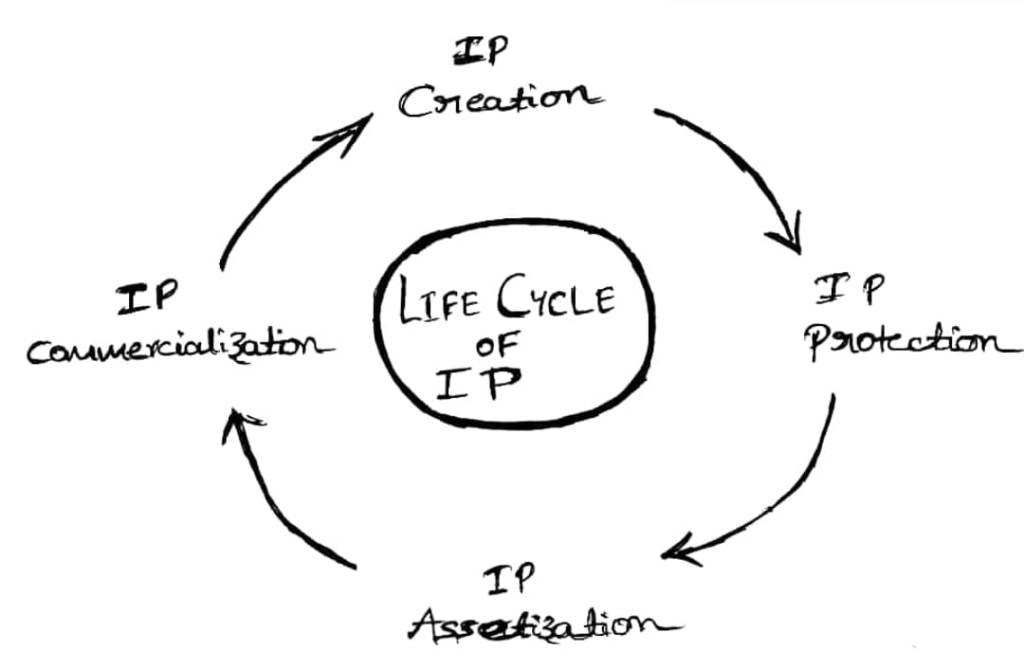
Protecting IP assets at the right time will always maximize the value of business. Now let us see the life cycle of intellectual properties in the following picture.

IP CREATION: Creation of IP enables innovators and inventors to identify and develop the potential research works in various fields.

IP PROTECTION: It enables in getting ownership rights and overall control on IP of a firm.

IP ASSETIZATION: Facilitates the development of IP based products of a company.

IP COMMERCIALIZATION: It enables business to make revenue and helps in expanding the market of the company.

HOW TO PROTECT INTELLECTUAL PROPERTIES:

The following are the five tips that every entrepreneur or owner of a firm must keep in mind for protecting IPR are as follows:

1 APPLY FOR PATENTS, COPY RIGHTS, TRADEMARKS:

Companies can protect their core management and their research & development activities through intellectual property rights and registrations. They also have a better bargaining position for cross-licensing and counterclaims. Intellectual property rights and registrations also allow a corporation to obstruct competing goods, determine new entrants, and pave the way for future market share via technological advancements. Intellectual property rights come in a variety of forms, such as Patents (used to protect technical information), Copyrights ( used to protect original artistic expressions of text, drawings etc..) and Trademarks (used to protect logos, brand names etc..). Each one of these must be applied in prior to protect the companies rights in order to sue if a third party infringes. 

2 SECURE YOUR INTELLECTUAL PROPERTY BOTH PHYSICALLY & DIGITALLY :

Companies must protect their IP in both Physical and digital protection and should maintain high security where sensitive data is stored, whether it is in the server farm or it is in the paper form. Keep track on the person who has the keys. Use passwords and limit employee access to important databases.

3 AVOID JOINT OWNERSHIP FOR INTELLECTUAL PROPERTY RIGHTS:

Make an effort to escape joint intellectual property rights. It is always beneficial for you to have control of your rights. In the long run, joint ownership of such rights can cause confusion and legal issues threatening the security of these assets, causing harm to all parties involved.

4 GET EXACTLY-MATCHING DOMAIN NAMES:

An exact-match domain name is one of the best intellectual property protection strategies for trademarks and copyrights (that you already own). Though it can be a bit expensive but it will help you in the long-term benefits.

5 KEEP YOUR IDEA A SECRET UNTIL YOU HAVE FILED A PATENT APPLICATION:

Make sure that you never share your idea with anyone before you have protected the same. This is because the other person might file for a patent before you and gain ownership rights over it. There is an old maxim that says “a secret shared is not a secret anymore”. So, don’t share the total information about the idea or invention with anyone and keep it as a confidential matter.

ECONOMICS BEHIND INTELLECTUAL PROPERTY RIGHTS

In todays world several companies use the Intellectual Property Rights (IPR) to protect their new inventions and company secrets. IPR are the legal rights granted by government to encourage innovation and creative output by ensuring that creators reap the benefits for their inventions or works. Intellectual property rights include several forms such as patents, trade secrets, copyrights, trademarks, or geographical indications (GIs).

World intellectual property organization(WIPO) defines IPR as a creation of mind inventions, literacy, artistic works and symbols, names, images and designs used in commerce. When a company hold its physical properties with out any IPR then those properties are considered as tangible where as IPR possessed properties are considered as Intangible. Intellectual property is essentially needed for a private nature belong to either through a natured person or legal person( Companies, Institutions). IPR can be own, bought and sold, rented , protected and infringed upon by others.

EVALUTION OF IPR IN INDIA:

Intellectual Property Rights (IPR) in India was imported from the west through the Indian Trade and Merchandise Marks Act 1884 which was considered as the first Indian Law on IPR. The first Indian Patent Law was enacted in 1856 followed by a series of Acts being passed. There is an Indian Patents and Designs Act in 1911 and Indian Copyright Act in 1914 is the first enacted copy write act in India. Later after getting independence the Comprehensive Copyright Act was enacted in the year of 1957 to consolidate the laws related to copyrights in India.

In 1948, the Indian Government appointed the committee to review the prevailing Patents and Designs legislation. In 1957, Government appointed to revise the Patent Law in order to balance the constitutional guarantee of economic and social justice enshrined in the preamble of the constitution. The report submitted by the committee outlined the policy behind the Indian Patent system. After the revision of previous acts on patents, a new patent act was released in the year of 1970 which process the patents only for food, agrochemicals, alloys, drugs and fixed 7 years term for food, drug and 14 years for others with having compulsory license provisions.

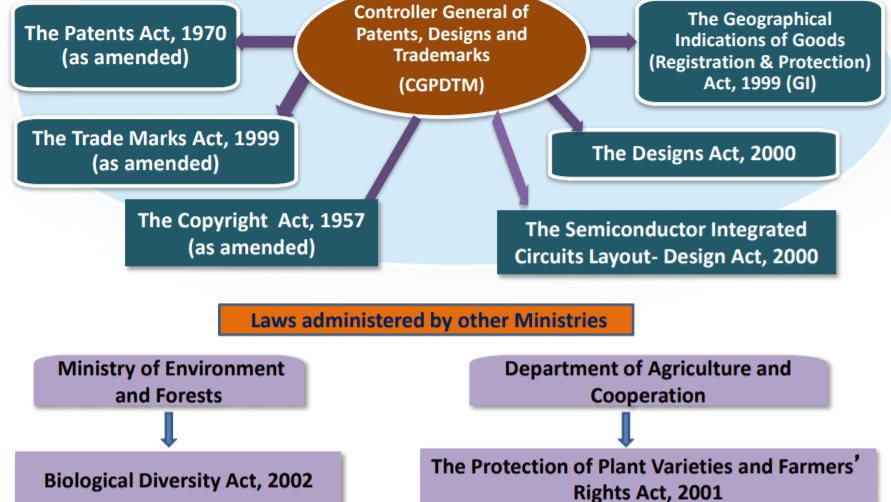
IPR LAWS ADMINISTERED BY OFFICE CGPDTM

EVALUTION OF INTERNATIONAL PERSPECTIVE OF IPR:

Every country has some relationship with other foreign countries in the form of trading, such as imports and exports. The foundation of International Intellectual Property Protection was created in the 19th century in the view of protection of Industrial Property which was created at Paris Convention in the year of 1883 regarding the terms of Patents, Trade Marks and Industrial designs that were granted protection at that convention. In 1998, India also became a member of the Paris Convention. In 1886, International Copyright Act was passed.

The Paris Convention marked the beginning of the International Trade Marks Protection laws and introduced the concept of a well known mark. In 1960 the World Intellectual Property Organization was created which governs the Paris and Berne Convention. In 1977 World Trade Organization (WTO) was created and become an important international organization for the development and understanding the IPR. This WTO was the successor to the General Agreement on Tariffs and Trade(GATT).

The importance of intellectual property in India is well established under statutory, administrative and judicial levels with an agreement made with World Trade Organization (WTO). This Agreement concentrates on Trade Related Aspects of Intellectual Property Rights (TRIPS) which came into force from 1st January 1995. It lays down the minimum standards for protection and enforcement of intellectual property rights in member countries which are required to promote effective and adequate protection of intellectual property rights with a view to reducing distortions and impediments to international trade.

The IPR scene in India has undergone a dramatical change since 1995 with the creation of various tools of Intellectual Property which shows compatibility with TRIPS.

ECONOMICAL PERSPECTIVE OF IPR IN DEVELOPING COUNTRIES :

Intellectual property rights have a great importance in the growth of a country. Intellectual property law differs from county to country. In many developed countries, the strict enforcement of the IPR has a huge contribution to economic growth. IPR promotes innovation which leads to the economic growth. Nowadays every business in the world is looking for the creation of Innovations.

So, protecting those new innovations has become necessary for companies these days. Not only protecting the new inventions of the company but also established companies should also protect their company names also in order to avoid duplicates in the market. Some big companies sell their names in exchange of huge amount in exchange of huge amount of money. Intellectual property rights have a great influence on the financial improvement of a nation. Different country governments face a complex choices on how to design an IP system in the best way to serve their policy objectives.

As India is one of the fastest growing countries, innovation became the first priority to most of the startup companies and as well as established firms including Government firms. Significance of IPR gives a competitive edge in the market for a company and also protects from hackers and pirates. Developing countries went along with the TRIPS agreement for a variety of reasons, ranging from the hope of additional access to agricultural and apparel markets in rich nations, to an expectation that stronger IPR would encourage additional technology transfer and innovation.

From business perspective IPR helps to create a strong brand identity and obtain valuable competitive intelligence. Along with these they help in making revenue through licenses. The main flexibility that is obtained through IPR is freedom of operating. After the introduction of TRIPS the market in India started changing vastly and the act started to provide space for operation and opportunities to companies and innovations. The private sector has started investing in research and development. Finally, The intellectual property right development plays a crucial role on economy for the development of business in a country.

TERMS OF INTELLECTUAL PROPERTY RIGHTS

INTELLECTUAL PROPERTY RIGHTS:

Intellectual Property is an intangible property, which is a product of human intellect, capital, labour, etc. such as artistic creations, literary works, inventions and so forth. It is intangible because it cannot be identified with the help of its physical characteristics.

Intellectual property is an asset by which one can own their business identity, technology, works of authorship, logo, slogans and many other practical expression of the ideas that drives the business forward. Intellectual property plays a vital role at all levels of your business.

To safeguard the interest of the creators, intellectual property rights are introduced which give them the right over their property and prevents others from using it in an illegal way. There are several terms in intellectual property rights, they are described clearly in the following paras:

TERMS OF INTELLECTUAL PROPERTY RIGHTS:

COPYRIGHT:

Copyright is a legal IPR term used to describe the rights that creators have over their literary and artistic works. Works covered by copyright range from books, music, paintings, sculpture, and films, to computer programs, databases, advertisements, maps, and technical drawings. Copyright provides the owner with exclusive rights to use, display, copy, exhibit, modify and distribute the work.

PATENT:

A patent is an intellectual property right which is exclusively related for an invention and grant rights on that invention. The invention may be a product or a process that provides in general for a new way of doing something, or offers a new technical solution to a problem. To get a patent, technical information about the invention must be disclosed to the public in a patent application. There are different types of patents are existed they are:

  • Utility patents: These are the most common form of patents to protect physical inventions, chemicals and processes.
  • Design patents: These patents protect the unique form, appearance or design of an item.
  • Plant patents: These patents protect the development of a new variety of plant through an asexual reproduction in a controlled setting.

TRADEMARK:

A trademark is a sign capable of distinguishing the goods or services of one enterprise from those of other enterprises. Trademarks are protected by intellectual property rights. In simple words trademarks are those things that make up your brand with having certain phrases, logos, unique words, and graphic design elements can be trademarked. Trademarks defend against confusion or dilution of the brand in the marketplace. Trademarks have to be distinctive in order to gain protection. The mark’s that are associated with business denotes its strength, which plays a vital role for defending the piracies.

GEOGRAPHICAL INDICATIONS:

A geographical indication (GI) is a sign used on products that have a specific geographical origin and possess qualities or a reputation that are due to that origin. In order to function as a GI, a sign must identify a product as originating in a given place. A geographical indication is often related to industrial property, which adverts referring to a country or to a place, situated for the origin of that product. This geographical indication not only refers to where the product was made, but more importantly, it identifies the product’s special characteristics which are the result of the products origin. Using the place name where the product was made.

INDUSTRIAL DESIGN:

Industrial design is also a term in intellectual property. It is a process of design applied to products that are to be manufactured by mass production. It can be applied to a wide variety of factors like, materials, production processes, business strategy and prevailing social research activities, commercial or aesthetic attitudes.

As per the Indian law, under the design act 2000, Industrial design protection is a type of intellectual property right that gives the exclusive right to make, sell and use articles that embody the protected design to the selected people only.

TRADE SECRETS:

Trade secrets are intellectual property (IP) rights on confidential information which may be sold or licensed. In general, to qualify as a trade secret, the information must lie in commercially valuable because it is secret and should be known only to a limited group of persons and also it should be subjected to a reasonable steps taken by the rightful holder of the information to keep it secret, including the use of confidentiality agreements for business partners and employees.

The unauthorized acquisition or use or disclosure of such secret information is referred as an unfair practice and considered as violation of the trade secret protection.

So, These are some of the terms that are related to Intellectual property rights. Which are useful and necessary for any type of organization or firm to protect their new inventions, logos, artistic works etc… from their competitors.

INNOVATION MANAGEMENT: TYPES OF INNOVATION

In today’s constantly changing business environment, new opportunities and challenges arise every day which are often driven through digitalization. As a result various market forces like knowledge as business capital, the Information and Communication technologies, Internet of things and of course due to digitalization every organization seeks a competitive advantage. To master over the resulting challenges and get benefited from the opportunities, we must have a systematic and well managed Innovation. That is why now a days innovation has become a core focus area for high performing organizations to ensure long-term survival by making the desired revenue and goals.

WHAT IS AN INNOVATION?

According to Peter Drucker innovation the specific function for entrepreneurship whether in an existing business or a public service institution or a new venture started by a lone individual in family kitchen. Innovation is the means by which the entrepreneur either creates new wealth producing resources or endows existing resources with enhanced potential for creating wealth.

WHAT IS INNOVATION MANAGEMENT ?

Innovation management involves the process of managing an organization’s innovation procedure, starting from the initial stage of ideation to its final stage of successful implementation. It encompasses the decisions, activities and practices of devising and implementing an innovation strategy. These decisions, practices and actions are aimed at achieving a certain target – to generate an idea, product or a service that is of sizeable business value.

According to Gartner, innovation management is a structured process of generating, capturing, discussing and improving, organizing, evaluating and prioritizing valuable insight or alternative thinking that would otherwise not have emerged through normal processes.

The innovation management process necessitates the use of certain management tools that assist in bringing both managers and other entities on a common platform and get them to move towards a common goal. These innovation management tools can look simple but are most effective in reality. Such management tools are considered as brainstorming sessions, planning and finally prototyping. Let’s discuss about various types of innovation which helps in the growth of business.

TYPES OF INNOVATION:

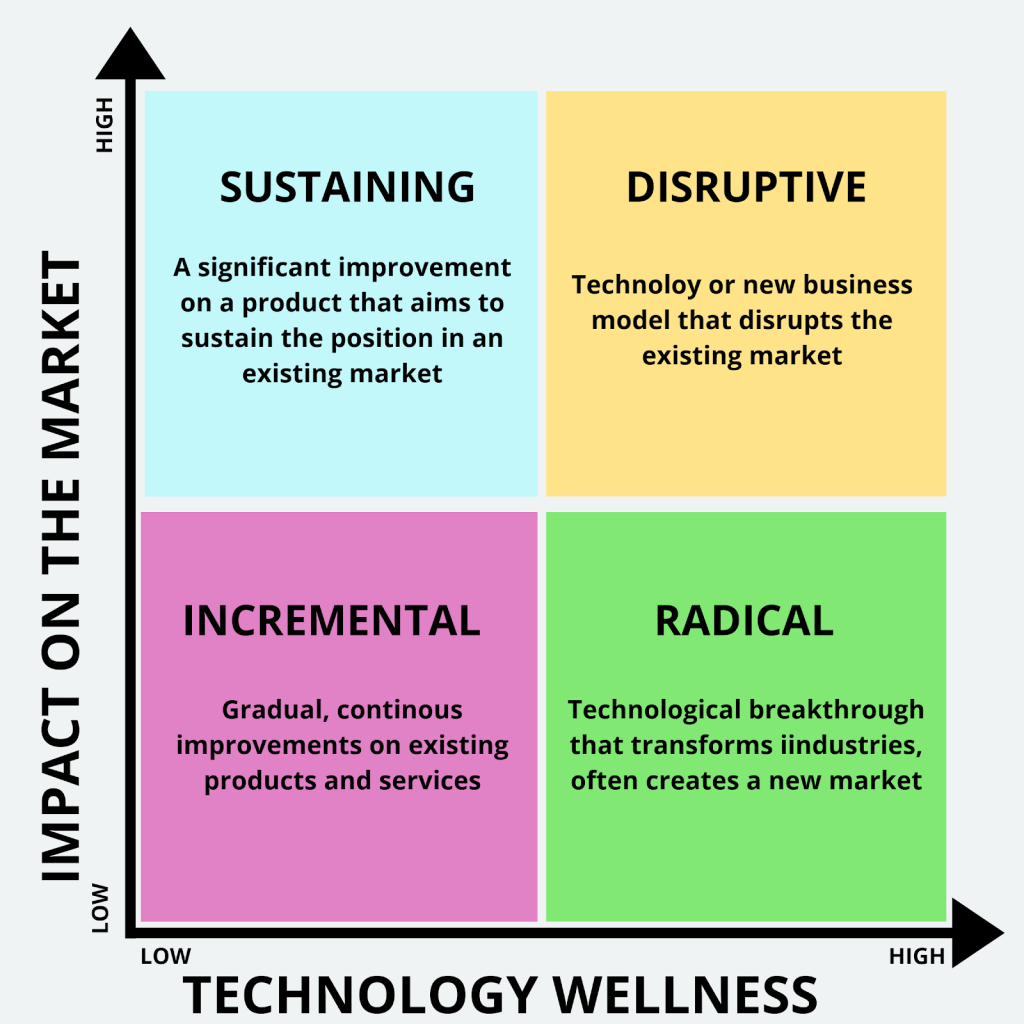
INCREMENTAL INNOVATION: The overwhelming majority of innovations are incremental in nature. Incremental innovation is nothing but improvement or adding new features or characteristics to already existed product which brings a large-scale organisational change. Incremental innovation is arguably the most accessible form of innovation, as it can often be performed without requiring huge budgets, a large team or a reorientation of the business’s strategy.

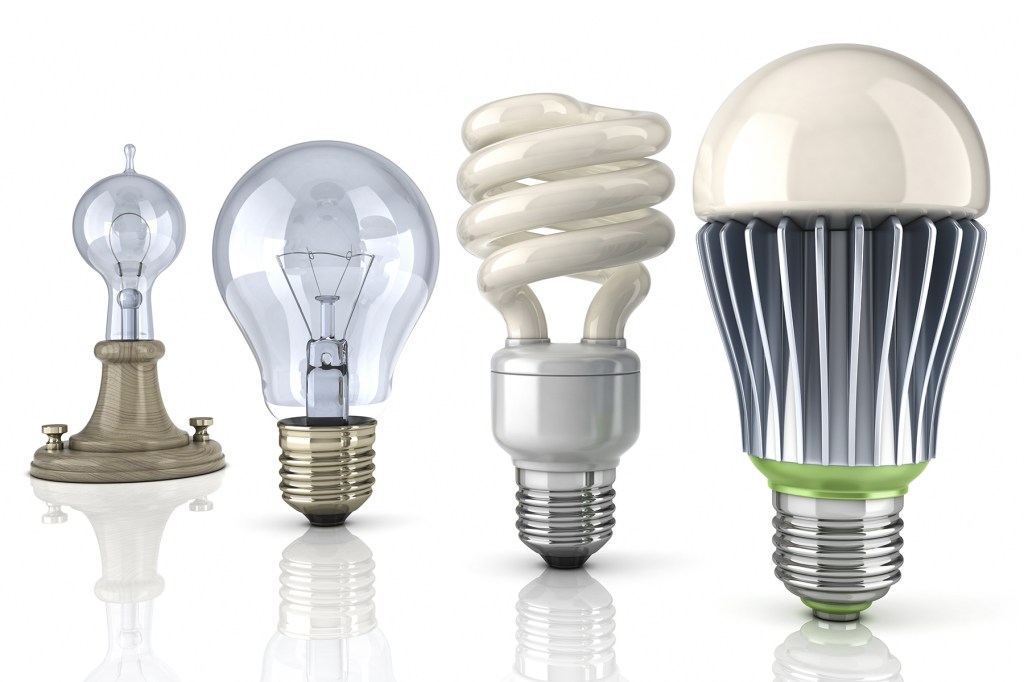
LED LIGHTBULB (Example of Incremental Innovation)

Incremental innovation doesn’t change it’s original dominant design. Incremental innovation will have less financial risks because this innovation doesn’t bring a new product or services into market rather it just modifies already existed product. This innovation can build a strong customer relationships and improves the product longevity in the market and most importantly incremental innovation is the best strategy to get a quick win in the competitive market.

The best example of incremental innovation is, The most famous E-commerce site COCO COLA, CADBURY etc…

DISRUPTIVE INNOVATION: Disruptive innovation is a theory that refers to a concept, product, or a service that creates a new value of network either by entering an existing market or by creating a completely new market. Moreover disruptive innovation refers to innovations by using new technologies that make expensive or sophisticated products and services accessible and more affordable to a broader market.

Disruptive innovation requires enabling technology with an innovative business model for building a coherent network value. One of the key features of disruptive innovation is that it modifies the process of evaluating the company and helps in the provision of better services with its new modification brought in the industry. It improves and modernize a lot of processes of a company, which further benefits the company a lot.

Examples of disruptive innovation are TESLA MOTORS, YOU TUBE, SKYPE etc…

SUSTAINING INNOVATION: Sustaining innovation is the opposite of disruptive innovation as it exists in the current market and instead of creating new value networks, it improves and grows the existing ones by satisfying the needs of a customer. Just like incremental innovation, the products that perform sustaining innovation is slightly made better with every iteration by reducing defects.

A sustaining innovation targets the high-end customers with its better performance than previously available one. The established competitors always win the battles when they operate sustaining technology efficiently. This strategy entails making a better product that can sell for higher profit margins to their best customers.

Examples of sustaining innovation are, IBM, TOYOTA etc..

RADICAL INNOVATIONS: Radical innovation is rare. It has similar characteristics to disruptive innovation but it is different in a way that it simultaneously uses revolutionary technology and a new business model.  Radical innovation solves global problems and addresses needs completely in a new way. This type of innovation completely transforms the market, or even the entire economy .

Technological innovations, such as personal computer and the internet are examples of radical innovations that have transformed the way the entire world functions and communicates. These disruptive innovations provide our society with a platform to build on top of which leads to highly accelerated economic growth where as radical innovation destroys or supplants an existing business model and blows up with something that is entirely new to the market. This types of innovation typically require a lot of time and technological development before they’re ready for the mainstream markets.

Examples of Radical innovation are, I PHONE, NETFLIX, INTERNET etc..

Ola electric scooter receives record 1 lakh bookings in 24 hours

Ola Electric CEO Bhavish Aggarwal announced recently that the much-anticipated Ola e-scooter has achieved 1 lakh bookings in just 24 hours of opening of pre-launch bookings, making it the ‘most pre-booked scooter’ in the world.

Ola Electric had announced the opening of bookings on July 15th at a token amount of ₹499 on its official website.

“India’s EV revolution is off to an explosive start. Huge thanks to the 100,000+ revolutionaries who’ve joined us and reserved their scooter,” Bhavish Aggarwal said on Twitter.

“I am thrilled by the tremendous response from customers across India for our first electric vehicle. The unprecedented demand is a clear indicator of shifting consumer preferences to EVs,” Bhavish Aggarwal said in a statement.

The new Ola electric scooter is likely to go on sale in the country later this month.

Ola Electric has claimed that the scooter will get best-in-class boot space as well. Additionally, the new scooter will get an app-based key for a keyless experience.

Ola has claimed that electric scooter will come with ergonomic seating. The company also claims the scooter will come with “superior cornering” ability as well as “class-leading acceleration.”

What is IPO and all about Zomato IPO

IPO stands for Initial Public Offering. It refers to when a company make its shares available for the public in a new stock issuance. It helps the company to raise capital from public investors to raise its business operations. Through this process a private company turns into a pubic company. It enables easy trading of existing holdings or future capital raising by becoming publicly traded. Companies must meet requirements by exchanges and the Securities and Exchange Commission (SEC) to hold an initial public offering (IPO). After the IPO, shares are traded freely in the open market at what is known as the free float. Companies hire investment banks to market, gauge demand, set the IPO price and date, and more.

In order to apply for IPO, a company should have a net worth o $1 billion or a unicorn status. IPO gives company a lower cost of capital for debt and equity. It also increases company’s image, prestige which ultimately leads to raise in sales and profit. Companies hire investment banks to market, gauge demand, set the IPO price and date, and more. If adequate research is carried out investment in IPO can turn out very successful.

Zomato

Zomato is one such unicorn company which is among the leading Food Service Delivery platforms. It has a strong network of 131,233 restaurants and 161,637 delivery partners. Zomato IPO is a main-board IPO of equity shares of the face value of ₹1 aggregating up to ₹9,375.00 Crores. The issue is priced at ₹72 to ₹76 per equity share. It was opened on July 14 and closed on July 16. A minimum of 1 lot consisting of about 195 shares and costing around 15000 rupees and a maximum of 13 lots consisting of 2535 shares and 192,660 worth of price can be taken.

You can apply in Zomato IPO online using either UPI or ASBA as payment method. The finalization of Basis of Allotment for Zomato IPO will be done on Jul 22, 2021, and the allotted shares will be credited to your demat account by Jul 26, 2021. The tentative date of Zomato IPO listing is Jul 27, 2021.

Universal Design

Universal design is the approach of designing products and environment so that it can be used by broad number people irrespective of age, disability, ability, status in life and various other factors.

Usually, products are designed to be suitable for average users whereas products designed under the principle of universal design try to be suitable for the maximum number of users. The purpose of universal design is not to create a design that can work for 100 percent of the people because it is almost impossible to have a ‘One size fits all’ design. The purpose is to create a design that can serve solutions that are more inclusive. Designers have to look at those designs that push the boundaries as far out as possible without compromising the quality and integrity of the product.

There are many instances where a designer will have to choose between different designs and determine the more suitable design according to UD principles. For instance, if there is a choice to choose between a lever-design handle and a knob-design handle. It is preferable to choose the former rather than the latter as the lever design can accommodate more people’s daily usage. The lever design feature will be a more inclusive element compared to the latter. It can accommodate various usages like opening the door with closed fists or the elbow or so that a person can easily access the door while carrying something as well as people with finite strength.

There are briefly 7 Principles of Universal Design. These were developed in 1997 by a team of architects, designers, engineers, and environmental design researchers.  The team was led by the late Ronald Mace who was an internationally recognized American Architect and designer in North Carolina State University.

The seven principles are:

  • Equitable use

While designing, the product should be kept in mind that it should be accessible by every person including disabled people.  

  • Flexibility in use

The design needs to be configurable to accommodate everyone’s preferences, needs, and abilities.

  • Simple and intuitive

This means that the design should be easy to understand for everybody. The person can easily figure out a well-designed product or an environment without thinking too much about it.

  • Perceptible information

The design can communicate all of its necessary information to everybody irrespective of the environmental conditions or the user’s sensory abilities.

  • Tolerance for error

It refers to safety so that the design minimizes hazards, accidents or unintended actions.

  • Low physical effort

The design in use needs to be comfortable and efficient rather than being exhausting and fatiguing to use.

  • Size and space for approach and use

The design irrespective of user’s body size, posture, or mobility should not restrict anybody by its size or space.

Universal design can really make the lives of people much more comfortable, safer, and efficient in the long run. There are still many areas that are not designed well and poorly designed products, buildings or the environment can be a safety hazard as well. It is usually the job of a universal designer to design new products from the ground up and many also renovate existing designs to make them more accommodative and accessible.

References:

http://universaldesign.ie/What-is-Universal-Design/The-7-Principles/

https://www.washington.edu/doit/what-universal-design-0

Amazon CEO and other returns from their space voyage

Amazon CEO Jeff Bezos returned to earth after his maiden space voyage. Mark Bezos, Wally Funk and Oliver Daemen were his other co-passengers in this journey. He spent total of 10 minutes in space. He went there on Blue Origin’s New Shepard spacecraft from its Launch Site One located in the West Texas desert (United States).

Happy, happy, happy!,You have a very happy crew up here!

Jeff Bezos said in space

For the first time in the history a commercial company launched a privately funded and built spacecraft from a private launch range with astronauts on board.

Congratulations to all of Team Blue past and present on reaching this historic moment in spaceflight history. This first astronaut crew wrote themselves into the history books of space, opening the door through which many after will pass

Blue origin released this statement after safely return of the passengers on earth.

Private companies are competing in space travels and explorations, let’s hope this competition may result in affordable space travel ,well within reach of common man. Space travel is still dream of many people.

Which Trading is Better?

Want to trade? Stuck choosing between online and offline? You have come the right way. We are here to help you through your decision for trading online or offline. First, you should know the basics of trading. Then we will guide you through some points stating differences between online and offline trading. 

Before the age of the internet, trading was carried out by stockbrokers. They dealt with the work of buying and selling equities on behalf of their clients. But the internet made this process a lot easier and faster. Today, both online and offline share trading is prevalent around the world. 

To understand more clearly, let us tell you something about Forex trading. 

What is Forex Trading? 

Forex trading or better known as foreign exchange trading is multipurpose trading carried out around the world. It can be explained as a network of various types of buyers and sellers willing to transfer currency between each other at an agreed price. 

Forex trading or any other type of trading can be carried out by individuals, organizations, companies, and central banks. They convert currency into one another and transfer the same. The amount of currency they convert daily causes price movements across many countries around the globe. 

Now let’s see some differences between online and offline trading. 

Differences between online and offline trading

  1. Ease of trade

Online trading is usually done individually and the person makes all the transactions for himself without any guidance. Also, online trading can be done with any device provided by the internet. Here all you need is the internet so it is less expensive. 

Whereas in offline trading all the transactions are carried out by the broker. And the individual has to approach the broker and contact him by going to his office. This also makes offline trading more expensive. 

  1. Convenience

Convenience is the most important factor to be considered when doing absolutely anything. Similarly, online or offline trading services should be selected based on the convenience of the individual. 

Lack of the internet can be a problem for those who prefer online trading. But if you have a mobile and full-time internet then your best option is online trading. But for people who prefer regular guidance, should go for offline trading. 

Photo by Karolina Grabowska on Pexels.com
  1. Security

In terms of security, online trading is much more secure than offline trading as in online mode, the individual has complete control over the transactions to be made. 

In offline trading, the transactions are in the hands of the broker. They carry out the transactions on behalf of the client without any knowledge. 

Another advantage of online trading is that the traders can check their tax, brokerage, and other statements. But in offline trading, the broker can easily manipulate the trader. 

  1. Real-time information

While trading, the trader needs to keep track of the real-time information. So again online trading has the ball in its court. It is a huge benefit of online trading that all the real-time information is displayed on the trader’s screen. He can have access to updates on any crashes in the stock market. 

Whereas in the case of offline trading, the trader can’t keep track regularly as the market keeps updating every second. 

  1. Trading fees

In online trading, the client executes the trade themselves so there is no need for middlemen. This reduces the trading fees to almost negligible in online mode. 

Whereas in offline trading there is more than one person involved in the process which increases the trading fees significantly. 

  1. Guidance

Guidance is necessary during trading. So in online trading, the trader can surf the internet for various expert comments and suggestions. 

Whereas in the side of offline trading, the trader has no other option but to depend on the broker’s word for everything. 

  1. Platform

It is a huge advantage of online trading that it has all the things under one umbrella. The trader can find everything on a single platform. No need to search here and there. Plus, the broker houses make sure they upload all the necessary things on their site. 

Whereas in offline trading, the trader needs to do independent research about everything, before asking the broker to trade. 

  1. Quality of service

In online trading, the trader can access detailed reports of trends in the market and can have all information regarding stocks and orders. 

Whereas in offline trading, the trader should trust the broker for all information. 

  1. Flexibility

With online trading, getting the order at the right time has become easier. All broker houses provide a trading platform like their website or app. There the trader can execute buying and selling of orders and make transactions. 

Whereas in offline trading, the trader needs to go to the broker’s office or carry out the trade on call. This is tiresome and inconvenient to almost everyone nowadays because of the busy schedule. 

  1. Fraud

Online trading provides the trader with full control over their trades and transactions. 

But in offline trading, clients have to take the broker on his word. This sometimes leads to mistakes and cases of fraud. 

Now you can easily start trading without depending on anyone for information and all the necessary transactions. Clearly, online trading won the battle online Vs offline. Hope you make the right choice. Happy trading! 

Advantages of Online Business

With the development and growth of technology in today’s world, people go for much easier and faster ways to do absolutely anything. Nowadays everything can be easily done with just some clicks here and there. From paying your bills to shopping for your birthday, from wanting to eat a small burger to planning a huge party, almost every single thing is possible online. 

Do you want an Android mobile phone, or do you want a flight ticket to go meet your family? Name it and you got it. Are you still stuck in your mind thinking “Should I start a business online?” If yes, then go nowhere else. We are here to clear your doubts about it and persuade you to just go for it. So yes, you should do business online. Now let’s see why. 

Why Should You Do Business Online? 

We will tell you all about why to start a business online. We are going to shoot you some persuasive points to start a business online. 

  1. Extremely inexpensive

When starting it will be a little expensive but just to fuel the process. Once you have started an online store or maybe an online blog, then you just need a website with a domain name and your business will take off in no time.

  1. Flexibility of time

Depending on the type of online business you wish to start, you will have the flexibility of time and work. You can choose what time of the day you want to work. But this does not mean you relax all the time thinking it is going well. You need to work according to what your business requires. But you can do that at your own convenient time.

  1. Choose your location

In an online business, you are not forced to sit at a desk all the time. You can work from the comfort of your home. You don’t need to spend hours daily stuck in traffic to reach your office or you don’t need to ask for a weekend off to go for a trip with your family. You have the freedom to choose from where you want to work.

  1. Huge income and growth potential

Before starting an online business you should know that your income won’t be defined by the number of hours you work. It solely depends on the amount of progress and productivity of your work. Try to work on the important parts and reduce your time of work. The main focus should be on consistency. Unlike those 9 to 5 office jobs, online business runs even when you relax for some time.

Photo by Michael Burrows on Pexels.com
  1. In action all the time

Online businesses can run all 24 hours a day, 7 days a week. It does not require you always hovering over your screen to work all the time. Keep track of what important is going on and relax for a bit. It provides the owner, flexibility in how they want to work.

  1. Outsourcing your work

As you grow in your online business, begin to earn some money you can start to outsource your work to other contractors or hire them. You can also hire some employees to help you ahead in your journey. Outsourcing work does not cost a lot of money instead it helps you grow your business more and at significantly higher levels.

  1. Focus on important things

One of the most useful perks of starting a business online is that it allows you to focus on the most important aspects of your life rather than just working 24/7. You can build a platform for yourself by sharing your information and ideas with like-minded people. You can spend quality time with your friends and family. You can also guide other individuals thinking of starting an online business too.

  1. Creates long term financial security

An online business that you started just as an experiment of a new thing, can be grown to become a stable, well-established business in the market. It can become your main source of revenue as well. It will provide you with financial security for a longer period than you expected. And not just one, you can add more businesses along the way.

  1. Less overhead and financial commitment

To start a business, people usually take loans, property leases are signed, and what not is done to start the business. But the advantage of online business is that it requires a less overhead and financial commitment. This is also a great path for young entrepreneurs to chase their passion and find stability at a young age.

  1.  Easy to excel

 It has become much easier to be successful in online businesses than it is in others. There is much scope in many different types of businesses around the world. 

There, you have it. You have now got all the motivation you need to start an online business. Make sure to keep these points in mind whenever you have doubts about starting an online business. Hope we threw away the question from your mind. Now, what do you say? Should you start a business online? We hope you got the correct answer. Yes, go for it!

TOP 10 BILLIONAIRES LIST : 2021

The following are the people who secured Top 10 Billionaires post in the world during this pandemic period.

1)JEFF BEZOS :

CEO and chairman, Amazon

Jeff Bezos founded e-commerce giant Amazon in 1994 out of his garage in Seattle.He stepped down as CEO to become executive chairman on July 5, 2021.

2)Elon Musk :

CEO and Chairman, Tesla

BILLIONAIRE NET WORTH : $151B (as of 4/6/21)

Elon Musk is working to revolutionize transportation both on Earth, through electric car maker Tesla — and in space, via rocket producer SpaceX. He owns 21% of Tesla but has pledged more than half his stake as collateral for loans; Forbes has discounted his stake to take the loans into account.

3)Bernard Arnault & family :

Chairman and CEO, LVMH Moët Hennessy Louis Vuitton.

BILLIONAIRE NET WORTH :$150B (as of 4/6/21)

One of the world’s ultimate taste-makers, Bernard Arnault oversees an empire of 70 brands including Louis Vuitton and Sephora.

4)Bill Gates:

Cofounder, Bill & Melinda Gates Foundation

BILLIONAIRE NET WORTH : $124B (as of 4/6/21)

He has invested in dozens of companies including Canadian National Railway and Auto Nation and is one of the largest owners of farmland in the U.S.To date, Gates has donated $35.8 billion worth of Microsoft stock to the Gates Foundation.

5)Mark Zuckerberg :

CEO, Facebook.

BILLIONAIRE NET WORTH : $97B (as of 4/6/21)

Zuckerberg started Facebook at Harvard in 2004 at the age of 19 for students to match names with photos of classmate. Facebook, the social network Zuckerberg runs, has become a go-to communications tool during the coronavirus pandemic lockdown.

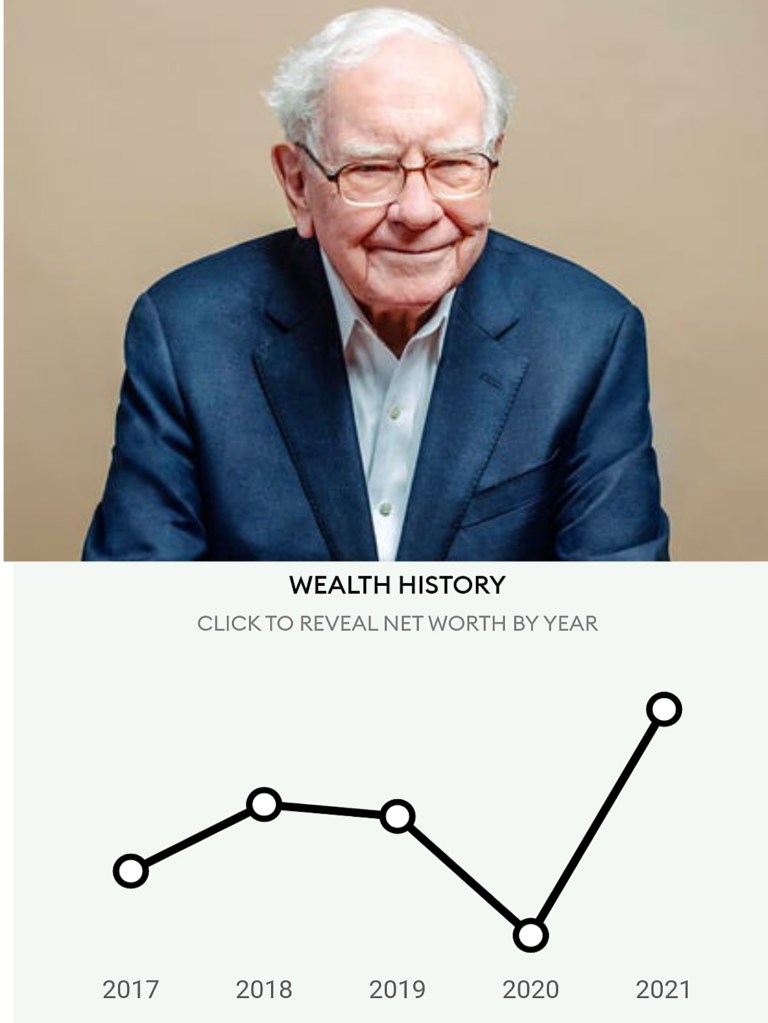
6)Warren Buffett :

CEO, Berkshire Hathaway

BILLIONAIRE NET WORTH : $96B

Buffett runs Berkshire Hathaway, which owns more than 60 companies, including insurer Geico, battery maker Duracell and restaurant chain Dairy Queen.The son of a U.S. congressman, he first bought stock at age 11 and first filed taxes at age 13.

7)Larry Ellison:

CEO and Founder, Oracle.

BILLIONAIRE NET WORTH :$93B

Larry Ellison is chairman, chief technology officer and cofounder of software giant Oracle, of which he owns about 35%.He gave up the Oracle CEO role in 2014 after 37 years at the helm.

8)Larry Page :

Cofounder and board member, Alphabet.

BILLIONAIRE NET WORTH : $91.5B

Larry Page stepped down as CEO of Alphabet, the parent of Google, in December 2019 but remains a board member and a controlling shareholder.

9) Sergey Brin:

Cofounder and board member, Alphabet.

BILLIONAIRE NET WORTH : $89B

Sergey Brin stepped down as president of Alphabet, parent company of Google, in December 2019 but remains a controller shareholder and a board member.

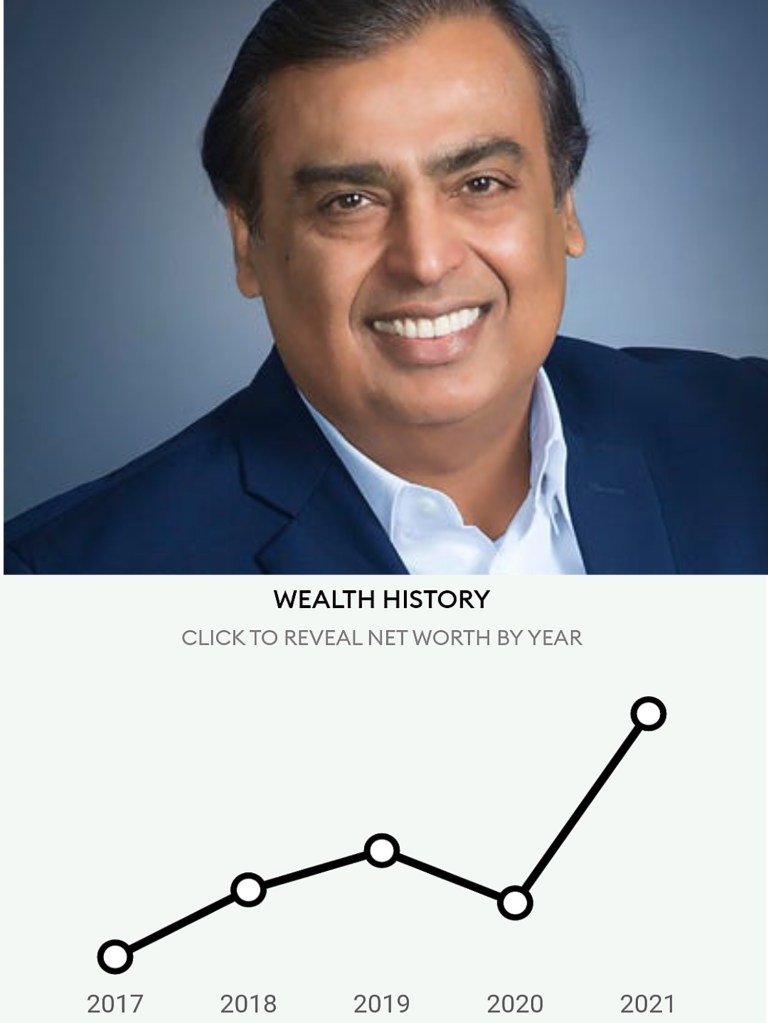
10)Mukesh Ambani :

Founder and Chairman, Reliance Industries.

BILLIONAIRE NET WORTH : $84.5B

Mukesh Ambani chairs and runs $74 billion (revenue) Reliance Industries, which has interests in petrochemicals, oil and gas, telecom and retail.

Gig Economy

What Is the Gig Economy?

In a gig economy, temporary, flexible jobs are commonplace and companies tend to hire independent contractors and freelancers  instead of full-time employees. A gig economy undermines the traditional economy of full-time workers who often focus on their career development.

Understanding the Gig Economy

In a gig economy, large numbers of people work in part-time or temporary positions or as independent contractors. The result of a gig economy is cheaper, more efficient services, such as Uber or Airbnb, for those willing to use them. People who don’t use technological services such as the Internet may be left behind by the benefits of the gig economy. Cities tend to have the most highly developed services and are the most entrenched in the gig economy. A wide variety of positions fall into the category of a gig. The work can range from driving for Lyft or delivering food to writing code or freelance articles. Adjunct and part-time professors, for example, are contracted employees as opposed to tenure-track or tenured professors. Colleges and universities can cut costs and match professors to their academic needs by hiring more adjunct and part-time professors.

The Factors Behind a Gig Economy

America is well on its way to establishing a gig economy, and estimates show as much as a third of the working population is already in some gig capacity. Experts expect this working number to rise, as these types of positions facilitate independent contracting work, with many of them not requiring a freelancer to come into an office. Gig workers are much more likely to be part-time workers and to work from home. Employers also have a wider range of applicants to choose from because they don’t have to hire someone based on their proximity. Additionally, computers have developed to the point that they can either take the place of the jobs people previously had or allow people to work just as efficiently from home as they could in person.

Economic reasons also factor into the development of a gig economy. Employers who cannot afford to hire full-time employees to do all the work that needs to be done will often hire part-time or temporary employees to take care of busier times or specific projects. On the employee’s side of the equation, people often find they need to move or take multiple positions to afford the lifestyle they want. It’s also common to change careers many times throughout a lifetime, so the gig economy can be viewed as a reflection of this occurring on a large scale.

During the coronavirus pandemic of 2020, the gig economy has experienced significant increases as gig workers have delivered necessities to home-bound consumers, and those whose jobs have been eliminated have turned to part-time and contract work for income. Employers will need to plan for changes to the world of work, including the gig economy, when the pandemic has ended.

Criticisms of the Gig Economy

Despite its benefits, there are some downsides to the gig economy. While not all employers are inclined to hire contracted employees, the gig economy trend can make it harder for full-time employees to develop in their careers since temporary employees are often cheaper to hire and more flexible in their availability. Workers who prefer a traditional career path and the stability and security that come with it are being crowded out in some industries.

For some workers, the flexibility of working gigs can actually disrupt the work-life balance, sleep patterns, and activities of daily life. Flexibility in a gig economy often means that workers have to make themselves available any time gigs come up, regardless of their other needs, and must always be on the hunt for the next gig. Competition for gigs has increased during the pandemic, too. And unemployment insurance usually doesn’t cover gig workers who can’t find employment.

In effect, workers in a gig economy are more like entrepreneurs than traditional workers. While this may mean greater freedom of choice for the individual worker, it also means that the security of a steady job with regular pay, benefits—including a retirement account—and a daily routine that has characterized work for generations are rapidly becoming a thing of the past.

Lastly, because of the fluid nature of gig economy transactions and relationships, long-term relationships between workers, employers, clients, and vendors can erode. This can eliminate the benefits that flow from building long-term trust, customary practice, and familiarity with clients and employers. It could also discourage investment in relationship-specific assets that would otherwise be profitable to pursue since no party has an incentive to invest significantly in a relationship that only lasts until the next gig comes along.

ARE WE REALLY ENJOYING OUR WORK?

Work is worship for those who take work seriously and it should be so because your work reflects your personality to some extent and how we do it is also part and parcel of our identity. Here in, comes the real trouble because when you do the work you enjoy, you try to put in your heart and mind into it but, if you are unfortunate enough to be doing the kind of work that you are not proud of, then surely enough it shows in your outcome.

Money, being the prime factor in today’s world and so, when your sole priority is to mint money, then it hardly matters whether you are an engineer or an interior designer. You would try to impress upon the authorities in your field with the sole objective of prosperity in your field. For this, you may go to any extent of unethical attempts, without even thinking about its aftermath.

Mental tension and stress and the related health hazards are all part and parcel of today’ s changing world. Today’s young generation is the first generation of professionals who are earning, four times more than what their parents have earned and so they have a lot of money at their disposal, which is making them spend more All this was possible only because of India’s changing economic condition and the advent of multinational companies with huge capital investment and infrastructure.

In fact, the call centre culture has also changed our lives for the worst, since lifestyle patterns are changing drastically. Initially, youngsters seem to be enjoying the western influence of working like asses on five days and reserving the weekends for parties and celebrations. And to get those two days of relief, they are ready to slog whether they like their job or not. It henceforth, becomes a mechanical slogging where, you are not concerned, whether your mind is at work but it’s just about the finished product that they look forward to. On the whole, we cannot rule out the fact that there are people, who are fortunate enough to bag the job they desire or those who have ultimately landed in those fields, where they have wanted to be. Such people are really lucky in the sense that they do their work with the utmost dedication and they have a fulfilment in life, even if they are not taking home fat salaries like their counter-parts, but don’t have any satisfaction to boost of.

There is a third side to all this and that is trying to derive meaning in whatever meaningless things we are doing to make both ends meet. So even if, one is in a job that is detested by him, he can still work towards generating a positive attitude to one’s Work. Try and enjoy, what one is doing and thus try to attain a sense of satisfaction, that he supposes, he could have otherwise got.