Environmental laws in india

Either Stable burning in various states accrued the air pollution in Delhi and created a gas chamber around NCR ; SC came upon a committee to observe scenario , Or 4 industries inflicting stream pollution were shut down by Maharashtra pollution board . Everybody has responsive to environmental problems as higher than . The key solution for resilience to environmental issues are provided by government in various legislations , enactments and provisions on environment laws .


In republic of India environmental law is concern with the policy and law for protection of the environment . It aims for achieving carbon free economy through taking measures for reducing climate change. All the acts under this laws are safeguards in ensuring effective management of the environment and its multiple ecosystems . It provides for preventing environmental damage .


Natural resources in the earth were unscathed from millions of years. It were remain pure until the industrialized started . After the industrialization this resources have been exploited in Spain of 100 years only . From 19th century, the environment (air , water and land ) is directly exploited by rapidly growing population at alarming-rates.


environment includes water, air and land and the inter-relationship which exists among and between water, air and land, and human beings, other living creatures, plants, microorganisms and property , as mentioned in section 2 of environmental protection Act of 1986 . Environment is a wide sphere , it consists of social, economically , political , religious dimensions .


Addressed area of environmental laws in India :

1. Quality of water : For the prevention and control of water pollution and to maintain or restore wholesomeness of water in the country the water act of 1974 was enacted. It further provides for the establishment of Boards ( CPCB and SPCB ) for the prevention and control of water pollution with a view to carry out the aforesaid purposes. This act prohibits the discharge of pollutants into water bodies beyond a given standard, it also lays down fine and penalties for non-compliance.

2. Reduction of air pollution and maintaining air quality : The Air (Prevention and Control of Pollution) Act, 1981 (the “Air Act”) is an act to provide for the prevention , protection and abatement of air pollution .It provides for establishment of Boards at the Central and State levels with a view to carrying out the aforesaid purposes.

3. Hazardous Waste management : legislations that directly or indirectly deal with hazardous waste management are the Factories Act, 1948, the Public Liability Insurance Act, 1991, the National Environment Tribunal Act, 1995 and rules and notifications under the Environmental Act.

4. Containment cleanup, damage mitigation : preventing future damage to the environment is undeniably the primary objective of environmental law, mitigating and reducing existing damage is also important. This area most often deals with issues like toxic leaks and oil spills. The central objective of this branch of environmental law is deciding liability, planning an appropriate response, and also determining the best process of investigation and monitoring in the overall clean up process. This area also concerns itself with the study and assessment of risk in the long term, to better mitigate any future accidents and risks.

5. Sustainability of resources : United Nations has put great emphasis on ensuring the sustainability of resources. For this vision , it has advocated the formation of various legal principles and legislation. In this regards concept of environmental impact assessment introduced .

Noble legislations and enactments on environment law in India :


Laws on Forest and wild life protection:
• The Indian Forest Act, 1927 ; The Wildlife Protection Act, 1972; The Forest (Conservation) Act, 1980 ; The Environment (Protection) Act, 1986; The National Green Tribunal Act, 2010.


Laws on Water pollution :
• The Water (Prevention and Control of Pollution) Act, 1974.


Laws on air pollution :
• The Air (Prevention and Control of Pollution) Act, 1981 (the “Air Act”)


Laws on hazardous waste management :
• Biomedical Waste (Management and Handling) Rules, 1998 ; Municipal Solid Wastes (Management and Handling) Rules, 2000 ; Batteries (Management & Handling) Rules, 2001 ; Hazardous Wastes (Management, Handling and Transboundary) Rules, 2008 ; E – Waste (Management and Handling) Rules, 2011 .
Laws on wetlands


Ramsar convention (1971) : This convention was initiated to push for greater conservation and sustainable use of wetlands ; Wetlands (Conservation and Management) Rules, 2017.
Constitutional provisions on environment laws


Part IVA (Art 51A-Fundamental Duties) of the constitution casts a duty on every citizen of India to protect and improve the natural environment including forests, lakes, rivers and wildlife, and to have compassion for living creatures.


• the Constitution of India under Part IV (Art 48A-Directive Principles of State Policies) stipulates that the State shall endeavour to protect and improve the environment and to safeguard the forests and wildlife of the country.

environment makes human life possible, and our cultural environment helps define who we are. It is therefore essential that our population and economic growth are environmentally sustainable.

Amity University and CSC collaborate to provide higher education to rural students.

Being a private University, Amity has never been behind when it comes to providing quality education. Recently Amity joins hands with Common Services Centers (CSCs) to provide higher education to rural students. 

It is estimated that approx 15 lakh students in rural areas can now be able to access undergraduate and postgraduate courses with this collaboration of Amity University Online and CSC. Courses like BA, BCom, BCA, BBA, and MCA will be available for the students through over 6000 CSC Academy centers, the Education and CSR wing Of CSC.  Also, courses like BA and BCom will be made available in Hindi considering the language barrier faced by students in rural India. When students will enroll through the CSC Academy center, they will be able to join Amity’s online classes. Also, Amity is going to develop special courses for students, which will be offered through CSC Academy. Amity’s Online team will offer extensive assistance to students throughout the enrolment process. 

Ajit Chauhan (the Chairman of Amity University Online) said, “Amity University Online has always envisioned providing world-class quality education to all its learners. Our endeavor is to bring grassroots-level change and enable professionals in remote areas of India. We hope rural and remote India can benefit through this initiative.” 

MD, CSC SPVDr. Dinesh Tyagi, explaining the collaboration said, “We have endeavored to provide quality education to students and youth in rural areas, particularly to women who miss out on higher education due to societal inequality and patriarchy. Our association with Amity Online is a significant step in that direction and meets the Prime Minister’s vision of Digital India fulfilling the educational needs of rural India. Partnership with Amity will also help us reach out to rural youth with future skills like AI, Machine Learning, and BlockChain.” Also, the Director, Academics of Amity University Online, Dr. Priya Mary Mathew noted, “It is always heartening to see when an education provider looks beyond to create an impact on the society. We are partnering with CSC Academy and their penetration in the remotest parts of India will light up the dreams of the masses to get quality education within their reach.”

This collab will act as a boost to improve enhance rural India’s education base. Amity Online’s team will offer extensive assistance to students throughout the enrolment process.

Is Internship is useful ?

Gaining industry experience has significant benefits whether you are in high school, college or entering into the workforce. Regardless of your current education level or desired career path, an internship can encourage your professional growth.

Why is an internship important?

An internship is important because it can present you with new skills and opportunities that you would not receive otherwise. Interns not only gain technical knowledge within the industry of their choice, but they also learn how to interact with professionals in a workplace setting, and develop essential soft skills like time management, organization, adaptability, problem-solving and teamwork.

virtual internship

A virtual internship is a work experience program where the participant (intern) gains experience while working in a remote professional setting and is not physically present at the job location.

Virtual interns communicate with their employer online through various means including email, Skype, Whatsapp, instant messaging, phone conversations, webinars, project management tools, SMS messaging, etc.

Virtual internships are undertaken by both students and graduates, usually some form of white-collar work, often within fields suitable to remote work such as information technology, media, creative arts, or public relations.

According to career experts, although virtual internships are currently rare, they are growing in popularity due to improving technology and the growth of social media. A rise has been reported in virtual internships — most of which are unpaid — especially from small ventures and start ups seeking additional help. Larger companies are also starting to explore offering these types of internships. They are presently most popular among small to midsize companies and online businesses.

Virtual internships have been criticized for not providing the supervision and guidance that internships are meant to provide. Despite this, virtual or remote internships are a viable option amidst the COVID-19 pandemic, where travel options are limited. They may rival and sometimes exceede what traditional internships offer.

HOW TO FILE A PATENT IN INDIA?

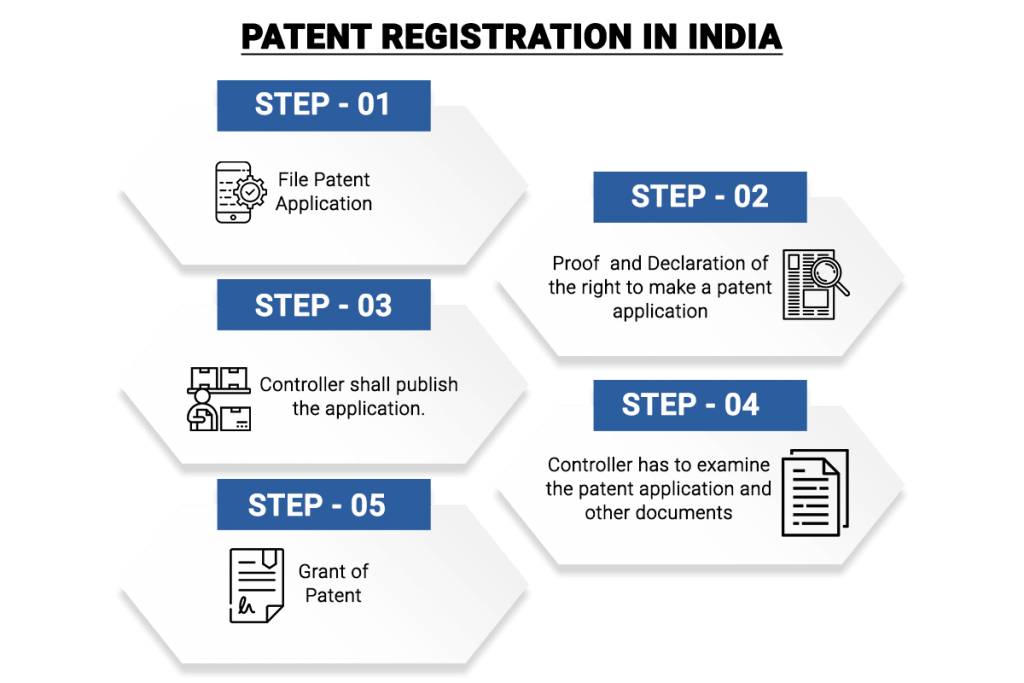
If any one have created or invented a process, product or service that can be defined as an original invention, then it is important to get it patented because it helps to safeguard ones invention.  It can protect any product, design or process that meets certain specifications according to its originality, practicality, suitability, and utility.  In most cases, a patent can protect an invention for up to 20 years. This time period starts soon as you file your patent.  The first and foremost thing that a person must do for getting a patent is to file a formal application of Patent at patent office. 

However, patent registrations are not applicable for all inventions because the invention should satisfy specific criteria to obtain a patent in India. So, let us know about who can file a patent and what types of inventions get patented in a clear way.

WHO CAN FILE FOR A PATENT ?

A patent registration application for an invention can be made by the people either alone or jointly. Most of the patents were applied by the true inventor or the assignee of first inventor and sometimes it can also be applied by the representative of the deceased true and first inventor assignee. In the case of a proprietorship firm, the application should be made in the proprietors’ name and if it is a partnership firm, then the names of all personally responsible partners must be included in the patent application. Most importantly the applicant is required to disclose the name, address, and nationality of the true and first inventor.

WHAT CAN BE PATENTED?

The Patent Act states that for an invention to be patentable, the invention must be a new product or process that involves an inventive step and can be used in the industry. For an invention to obtain patent registration, it should be technical and the invention should possess utility so that it can be used either in industry or market. The invention must possess novelty i.e the specified invention should not published in India or elsewhere priorly. These all should be cross checked before filing the patent application in India.

PATENT APPLICATION PROCEDURE:

Step 1 – PATENTABILITY OPINION:

Before you begin the patent registration process, you need to check if your invention is patentable. This means that you need to check if another individual has filed a patent for a similar technology for which you are filing. Performing an in-depth patentability search helps you to understand whether you have a chance of getting a patent for your invention or not.

Step 2 – DRAFTING & FILING THE PATENT APPLICATION:

After successfully completing the first step, you can begin the patent application process. Indian applicants need to fill Indian Patent Application Form 1 and along with that you need to provide a Form 2 mandatorily for specifying the type of patent where you can choose between a provisional and complete patent application, based on the stage of invention. This means that if your invention is still under testing then, you need to apply for a provisional patent application where you can get a period of 12 months to complete the invention and can file for a complete patent.

You need to pay special attention when you are drafting your patent application and should include clauses like usability and outcome of the invention in detail. It is also necessary to include the intention to get license on the invention while drafting the patent application and be meticulous in including all the clauses that prevent the competition from others who use same technology.

Step 3 – PUBLISHING THE PATENT APPLICATION :

After submitting all the documents, the patent application is safely secured by the Indian Patent Office and applied patent is then published in an official patent journal after a period of 18 months approximately. However, inventors who wish to have their patent application published before this 18 month period can submit Form 9 (form that requests for early publication) so that the application can be published in official patent journal within 1 month of making request.

Step 4 – EXAMINING THE PATENT APPLICATION:

Before granting the patent, the patent application needs to be examined thoroughly. As per rules of the patent application process in India, applied patent should examined based on the merits of the invention and described in the patent specification form. Unlike the publication process, this is not an automatic process and the applicant needs to make a request to examine their patent application by submitting Form 18 because the patent office queues the application form for examination only after a formal request for examination is made.

When the application lands on the examiner’s desk, it is scrutinized according to the Patent Act and underlying rules along with that the examiner also searches for similar technologies to ensure the invention satisfies patentability criteria or not. After reviewing the application, the first examination report is submitted. The examiner lists his objections in detail which can further extend the application process by another 6- 9 months.

Step 5 – DECISION TO GRANT PATENT:

Once the examiner finds no objections in the patent application, he grants the patent and then the patent is then published in the official patent gazette.

Step 6 – RENEWING THE PATENT:

The patent holder also needs to renew his patent by paying an annual renewal fee. In India, it is possible to renew your patent for a period of 20 years at maximum, from the date the patent was first filed.

OVERVIEW OF PATENT PROCEDURE

CONCLUSION:

Finally, the patent filing process is long and complex, one must remember its importance in the long run. The entire process can take anywhere in between 3-5 years. However, This process is created with the intention of ensuring that the inventor gets credit for his invention and also ensures that no other individual can claim rights over the invention. The legal rights that an inventor earn through patent can prevent competitors from using the invention for financial benefits. In any wrong case the related true inventor of invention can also sue on such individuals and claim compensation for using invention without their approval.

So, guys this is the procedure to file a patent in India and I have tried my level best to make you understand about the patent procedure

WHAT IS THE NEED OF PROTECTING INTELLECTUAL PROPERTY RIGHTS

Protecting intellectual property is essential to remain profitable because intellectual property of a company prevent others from infringement of their own products and innovations. Particularly, protecting IP’s are relevant in today’s competitive market. Intellectual properties can cover a wide range of topics such as brand name, logos, services, processes etc.. of a company. An organisation is bound to face losses when these concepts are used without their permission. Let me explain you about the importance of protecting intellectual property with a case study.

CASE STUDY:

YOU ARE NOT BAJAJ:

A Hyderabad food retain chain, Urban Food Mart, India pvt.ltd has told by the Bombay high court to stop using the name ” BAJAJ SUPER MARKET ” for its business. The justice has passed an interim order on Feb 5th, 2021. Retaining urban food mart using the name of Bajaj and has directed into remove all signatures i.e use of marks on shopping bags, cartons, parking material etc… with in 3 weeks.

Bajaj electricals sued urban food mart saying that it had been using the name Bajaj continuously and extensively since 1961.

In the above case study we can clearly identify that Hyderabad related food retain chain has violated the term Trademark in IPR by copying the name of Bajaj electronics with out it’s permission. As I mentioned in previous articles also, Intellectual property highlights the important assets of an entrepreneur, Intellectual property rights is the collective term for creations of the mind which can be used for the commercial good will.

Almost every company in this technical world has undeniably benefited from the internet, which allows goods, services, and marketing messages to reach a large audience at a low cost – but it has also raised the risk of intellectual property infringements. This ultimately makes the protection of Intellectual Property as one of the most important things in today’s business world.

Most of the entrepreneurs because of having lack of knowledge in intellectual properties ignore important steps that they have to take for protecting their IP assets later which results into loss for their company. So a proper attention should be given for protecting IPR of a company by both management and employees. It will be good for the company, if it nominate a manager who takes the responsibility for understanding and protecting IP rights.

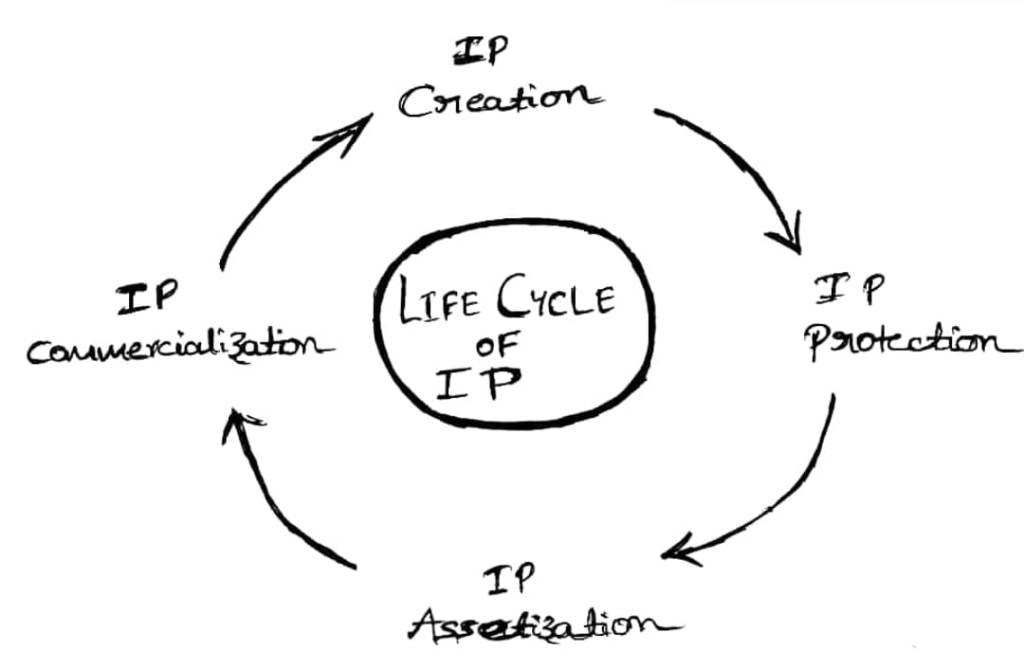
LIFE CYCLE OF INTELLECTUAL PROPERTY(IP):

Protecting IP assets at the right time will always maximize the value of business. Now let us see the life cycle of intellectual properties in the following picture.

IP CREATION: Creation of IP enables innovators and inventors to identify and develop the potential research works in various fields.

IP PROTECTION: It enables in getting ownership rights and overall control on IP of a firm.

IP ASSETIZATION: Facilitates the development of IP based products of a company.

IP COMMERCIALIZATION: It enables business to make revenue and helps in expanding the market of the company.

HOW TO PROTECT INTELLECTUAL PROPERTIES:

The following are the five tips that every entrepreneur or owner of a firm must keep in mind for protecting IPR are as follows:

1 APPLY FOR PATENTS, COPY RIGHTS, TRADEMARKS:

Companies can protect their core management and their research & development activities through intellectual property rights and registrations. They also have a better bargaining position for cross-licensing and counterclaims. Intellectual property rights and registrations also allow a corporation to obstruct competing goods, determine new entrants, and pave the way for future market share via technological advancements. Intellectual property rights come in a variety of forms, such as Patents (used to protect technical information), Copyrights ( used to protect original artistic expressions of text, drawings etc..) and Trademarks (used to protect logos, brand names etc..). Each one of these must be applied in prior to protect the companies rights in order to sue if a third party infringes. 

2 SECURE YOUR INTELLECTUAL PROPERTY BOTH PHYSICALLY & DIGITALLY :

Companies must protect their IP in both Physical and digital protection and should maintain high security where sensitive data is stored, whether it is in the server farm or it is in the paper form. Keep track on the person who has the keys. Use passwords and limit employee access to important databases.

3 AVOID JOINT OWNERSHIP FOR INTELLECTUAL PROPERTY RIGHTS:

Make an effort to escape joint intellectual property rights. It is always beneficial for you to have control of your rights. In the long run, joint ownership of such rights can cause confusion and legal issues threatening the security of these assets, causing harm to all parties involved.

4 GET EXACTLY-MATCHING DOMAIN NAMES:

An exact-match domain name is one of the best intellectual property protection strategies for trademarks and copyrights (that you already own). Though it can be a bit expensive but it will help you in the long-term benefits.

5 KEEP YOUR IDEA A SECRET UNTIL YOU HAVE FILED A PATENT APPLICATION:

Make sure that you never share your idea with anyone before you have protected the same. This is because the other person might file for a patent before you and gain ownership rights over it. There is an old maxim that says “a secret shared is not a secret anymore”. So, don’t share the total information about the idea or invention with anyone and keep it as a confidential matter.

ECONOMICS BEHIND INTELLECTUAL PROPERTY RIGHTS

In todays world several companies use the Intellectual Property Rights (IPR) to protect their new inventions and company secrets. IPR are the legal rights granted by government to encourage innovation and creative output by ensuring that creators reap the benefits for their inventions or works. Intellectual property rights include several forms such as patents, trade secrets, copyrights, trademarks, or geographical indications (GIs).

World intellectual property organization(WIPO) defines IPR as a creation of mind inventions, literacy, artistic works and symbols, names, images and designs used in commerce. When a company hold its physical properties with out any IPR then those properties are considered as tangible where as IPR possessed properties are considered as Intangible. Intellectual property is essentially needed for a private nature belong to either through a natured person or legal person( Companies, Institutions). IPR can be own, bought and sold, rented , protected and infringed upon by others.

EVALUTION OF IPR IN INDIA:

Intellectual Property Rights (IPR) in India was imported from the west through the Indian Trade and Merchandise Marks Act 1884 which was considered as the first Indian Law on IPR. The first Indian Patent Law was enacted in 1856 followed by a series of Acts being passed. There is an Indian Patents and Designs Act in 1911 and Indian Copyright Act in 1914 is the first enacted copy write act in India. Later after getting independence the Comprehensive Copyright Act was enacted in the year of 1957 to consolidate the laws related to copyrights in India.

In 1948, the Indian Government appointed the committee to review the prevailing Patents and Designs legislation. In 1957, Government appointed to revise the Patent Law in order to balance the constitutional guarantee of economic and social justice enshrined in the preamble of the constitution. The report submitted by the committee outlined the policy behind the Indian Patent system. After the revision of previous acts on patents, a new patent act was released in the year of 1970 which process the patents only for food, agrochemicals, alloys, drugs and fixed 7 years term for food, drug and 14 years for others with having compulsory license provisions.

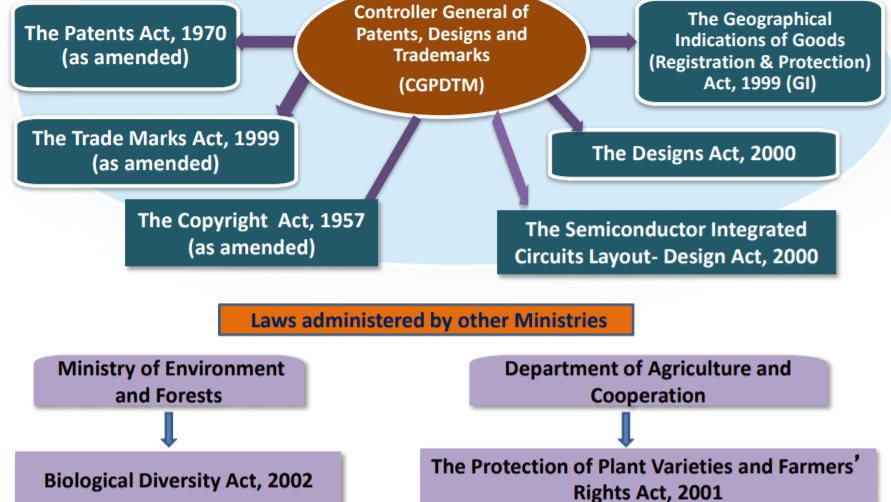
IPR LAWS ADMINISTERED BY OFFICE CGPDTM

EVALUTION OF INTERNATIONAL PERSPECTIVE OF IPR:

Every country has some relationship with other foreign countries in the form of trading, such as imports and exports. The foundation of International Intellectual Property Protection was created in the 19th century in the view of protection of Industrial Property which was created at Paris Convention in the year of 1883 regarding the terms of Patents, Trade Marks and Industrial designs that were granted protection at that convention. In 1998, India also became a member of the Paris Convention. In 1886, International Copyright Act was passed.

The Paris Convention marked the beginning of the International Trade Marks Protection laws and introduced the concept of a well known mark. In 1960 the World Intellectual Property Organization was created which governs the Paris and Berne Convention. In 1977 World Trade Organization (WTO) was created and become an important international organization for the development and understanding the IPR. This WTO was the successor to the General Agreement on Tariffs and Trade(GATT).

The importance of intellectual property in India is well established under statutory, administrative and judicial levels with an agreement made with World Trade Organization (WTO). This Agreement concentrates on Trade Related Aspects of Intellectual Property Rights (TRIPS) which came into force from 1st January 1995. It lays down the minimum standards for protection and enforcement of intellectual property rights in member countries which are required to promote effective and adequate protection of intellectual property rights with a view to reducing distortions and impediments to international trade.

The IPR scene in India has undergone a dramatical change since 1995 with the creation of various tools of Intellectual Property which shows compatibility with TRIPS.

ECONOMICAL PERSPECTIVE OF IPR IN DEVELOPING COUNTRIES :

Intellectual property rights have a great importance in the growth of a country. Intellectual property law differs from county to country. In many developed countries, the strict enforcement of the IPR has a huge contribution to economic growth. IPR promotes innovation which leads to the economic growth. Nowadays every business in the world is looking for the creation of Innovations.

So, protecting those new innovations has become necessary for companies these days. Not only protecting the new inventions of the company but also established companies should also protect their company names also in order to avoid duplicates in the market. Some big companies sell their names in exchange of huge amount in exchange of huge amount of money. Intellectual property rights have a great influence on the financial improvement of a nation. Different country governments face a complex choices on how to design an IP system in the best way to serve their policy objectives.

As India is one of the fastest growing countries, innovation became the first priority to most of the startup companies and as well as established firms including Government firms. Significance of IPR gives a competitive edge in the market for a company and also protects from hackers and pirates. Developing countries went along with the TRIPS agreement for a variety of reasons, ranging from the hope of additional access to agricultural and apparel markets in rich nations, to an expectation that stronger IPR would encourage additional technology transfer and innovation.

From business perspective IPR helps to create a strong brand identity and obtain valuable competitive intelligence. Along with these they help in making revenue through licenses. The main flexibility that is obtained through IPR is freedom of operating. After the introduction of TRIPS the market in India started changing vastly and the act started to provide space for operation and opportunities to companies and innovations. The private sector has started investing in research and development. Finally, The intellectual property right development plays a crucial role on economy for the development of business in a country.

TERMS OF INTELLECTUAL PROPERTY RIGHTS

INTELLECTUAL PROPERTY RIGHTS:

Intellectual Property is an intangible property, which is a product of human intellect, capital, labour, etc. such as artistic creations, literary works, inventions and so forth. It is intangible because it cannot be identified with the help of its physical characteristics.

Intellectual property is an asset by which one can own their business identity, technology, works of authorship, logo, slogans and many other practical expression of the ideas that drives the business forward. Intellectual property plays a vital role at all levels of your business.

To safeguard the interest of the creators, intellectual property rights are introduced which give them the right over their property and prevents others from using it in an illegal way. There are several terms in intellectual property rights, they are described clearly in the following paras:

TERMS OF INTELLECTUAL PROPERTY RIGHTS:

COPYRIGHT:

Copyright is a legal IPR term used to describe the rights that creators have over their literary and artistic works. Works covered by copyright range from books, music, paintings, sculpture, and films, to computer programs, databases, advertisements, maps, and technical drawings. Copyright provides the owner with exclusive rights to use, display, copy, exhibit, modify and distribute the work.

PATENT:

A patent is an intellectual property right which is exclusively related for an invention and grant rights on that invention. The invention may be a product or a process that provides in general for a new way of doing something, or offers a new technical solution to a problem. To get a patent, technical information about the invention must be disclosed to the public in a patent application. There are different types of patents are existed they are:

  • Utility patents: These are the most common form of patents to protect physical inventions, chemicals and processes.
  • Design patents: These patents protect the unique form, appearance or design of an item.
  • Plant patents: These patents protect the development of a new variety of plant through an asexual reproduction in a controlled setting.

TRADEMARK:

A trademark is a sign capable of distinguishing the goods or services of one enterprise from those of other enterprises. Trademarks are protected by intellectual property rights. In simple words trademarks are those things that make up your brand with having certain phrases, logos, unique words, and graphic design elements can be trademarked. Trademarks defend against confusion or dilution of the brand in the marketplace. Trademarks have to be distinctive in order to gain protection. The mark’s that are associated with business denotes its strength, which plays a vital role for defending the piracies.

GEOGRAPHICAL INDICATIONS:

A geographical indication (GI) is a sign used on products that have a specific geographical origin and possess qualities or a reputation that are due to that origin. In order to function as a GI, a sign must identify a product as originating in a given place. A geographical indication is often related to industrial property, which adverts referring to a country or to a place, situated for the origin of that product. This geographical indication not only refers to where the product was made, but more importantly, it identifies the product’s special characteristics which are the result of the products origin. Using the place name where the product was made.

INDUSTRIAL DESIGN:

Industrial design is also a term in intellectual property. It is a process of design applied to products that are to be manufactured by mass production. It can be applied to a wide variety of factors like, materials, production processes, business strategy and prevailing social research activities, commercial or aesthetic attitudes.

As per the Indian law, under the design act 2000, Industrial design protection is a type of intellectual property right that gives the exclusive right to make, sell and use articles that embody the protected design to the selected people only.

TRADE SECRETS:

Trade secrets are intellectual property (IP) rights on confidential information which may be sold or licensed. In general, to qualify as a trade secret, the information must lie in commercially valuable because it is secret and should be known only to a limited group of persons and also it should be subjected to a reasonable steps taken by the rightful holder of the information to keep it secret, including the use of confidentiality agreements for business partners and employees.

The unauthorized acquisition or use or disclosure of such secret information is referred as an unfair practice and considered as violation of the trade secret protection.

So, These are some of the terms that are related to Intellectual property rights. Which are useful and necessary for any type of organization or firm to protect their new inventions, logos, artistic works etc… from their competitors.

INNOVATION MANAGEMENT: TYPES OF INNOVATION

In today’s constantly changing business environment, new opportunities and challenges arise every day which are often driven through digitalization. As a result various market forces like knowledge as business capital, the Information and Communication technologies, Internet of things and of course due to digitalization every organization seeks a competitive advantage. To master over the resulting challenges and get benefited from the opportunities, we must have a systematic and well managed Innovation. That is why now a days innovation has become a core focus area for high performing organizations to ensure long-term survival by making the desired revenue and goals.

WHAT IS AN INNOVATION?

According to Peter Drucker innovation the specific function for entrepreneurship whether in an existing business or a public service institution or a new venture started by a lone individual in family kitchen. Innovation is the means by which the entrepreneur either creates new wealth producing resources or endows existing resources with enhanced potential for creating wealth.

WHAT IS INNOVATION MANAGEMENT ?

Innovation management involves the process of managing an organization’s innovation procedure, starting from the initial stage of ideation to its final stage of successful implementation. It encompasses the decisions, activities and practices of devising and implementing an innovation strategy. These decisions, practices and actions are aimed at achieving a certain target – to generate an idea, product or a service that is of sizeable business value.

According to Gartner, innovation management is a structured process of generating, capturing, discussing and improving, organizing, evaluating and prioritizing valuable insight or alternative thinking that would otherwise not have emerged through normal processes.

The innovation management process necessitates the use of certain management tools that assist in bringing both managers and other entities on a common platform and get them to move towards a common goal. These innovation management tools can look simple but are most effective in reality. Such management tools are considered as brainstorming sessions, planning and finally prototyping. Let’s discuss about various types of innovation which helps in the growth of business.

TYPES OF INNOVATION:

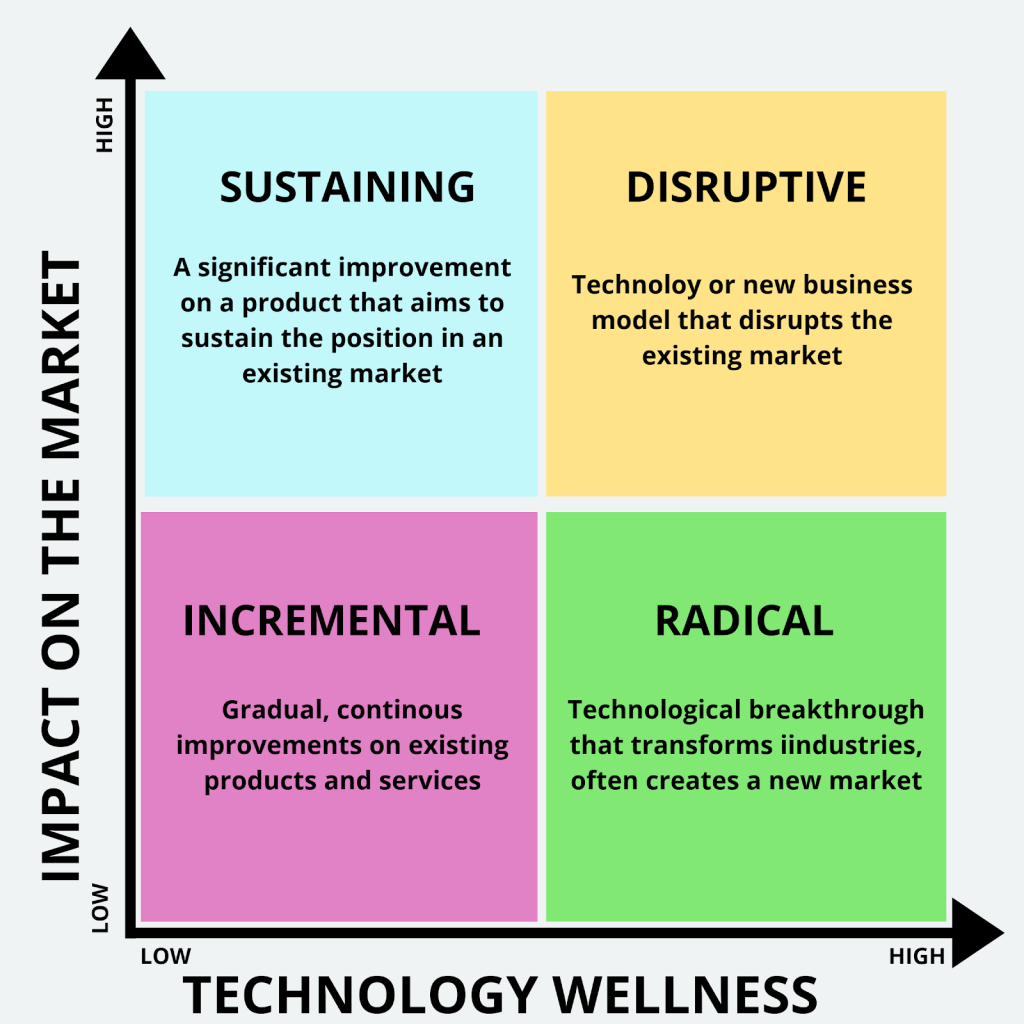
INCREMENTAL INNOVATION: The overwhelming majority of innovations are incremental in nature. Incremental innovation is nothing but improvement or adding new features or characteristics to already existed product which brings a large-scale organisational change. Incremental innovation is arguably the most accessible form of innovation, as it can often be performed without requiring huge budgets, a large team or a reorientation of the business’s strategy.

LED LIGHTBULB (Example of Incremental Innovation)

Incremental innovation doesn’t change it’s original dominant design. Incremental innovation will have less financial risks because this innovation doesn’t bring a new product or services into market rather it just modifies already existed product. This innovation can build a strong customer relationships and improves the product longevity in the market and most importantly incremental innovation is the best strategy to get a quick win in the competitive market.

The best example of incremental innovation is, The most famous E-commerce site COCO COLA, CADBURY etc…

DISRUPTIVE INNOVATION: Disruptive innovation is a theory that refers to a concept, product, or a service that creates a new value of network either by entering an existing market or by creating a completely new market. Moreover disruptive innovation refers to innovations by using new technologies that make expensive or sophisticated products and services accessible and more affordable to a broader market.

Disruptive innovation requires enabling technology with an innovative business model for building a coherent network value. One of the key features of disruptive innovation is that it modifies the process of evaluating the company and helps in the provision of better services with its new modification brought in the industry. It improves and modernize a lot of processes of a company, which further benefits the company a lot.

Examples of disruptive innovation are TESLA MOTORS, YOU TUBE, SKYPE etc…

SUSTAINING INNOVATION: Sustaining innovation is the opposite of disruptive innovation as it exists in the current market and instead of creating new value networks, it improves and grows the existing ones by satisfying the needs of a customer. Just like incremental innovation, the products that perform sustaining innovation is slightly made better with every iteration by reducing defects.

A sustaining innovation targets the high-end customers with its better performance than previously available one. The established competitors always win the battles when they operate sustaining technology efficiently. This strategy entails making a better product that can sell for higher profit margins to their best customers.

Examples of sustaining innovation are, IBM, TOYOTA etc..

RADICAL INNOVATIONS: Radical innovation is rare. It has similar characteristics to disruptive innovation but it is different in a way that it simultaneously uses revolutionary technology and a new business model.  Radical innovation solves global problems and addresses needs completely in a new way. This type of innovation completely transforms the market, or even the entire economy .

Technological innovations, such as personal computer and the internet are examples of radical innovations that have transformed the way the entire world functions and communicates. These disruptive innovations provide our society with a platform to build on top of which leads to highly accelerated economic growth where as radical innovation destroys or supplants an existing business model and blows up with something that is entirely new to the market. This types of innovation typically require a lot of time and technological development before they’re ready for the mainstream markets.

Examples of Radical innovation are, I PHONE, NETFLIX, INTERNET etc..

World Nature Conservation Day

Conservation is the care and protection of  resources so that they can persist for future generations.

Conservation seeks the sustainable use of nature by humans along with preservation.

Preservation means protecting nature.

World Nature Conservation Day is celebrated on 28 July annually.

It is celebrated to generate awareness of the nature and its conservation.

Nature conservation means conserving habitat of different living organism, preventing deforestation, halting species extinction, reducing overfishing and mitigating climate change.

There is increasing interest in extending the responsibility for human well-being to include the Welfare of sentient animals.

Government play a major role in conserving our natural resources and various living organism.

There are various natural conservation is the laws implemented by government.

There are various threat to biodiversity:-

  • Habitat loss and fragmentation
  • Introduction of alien invasive species
  • Disturbance
  • Harvesting and over exploitation
  • Soil, water and atmospheric pollution
  • Intensive agriculture and forestry
  • Climate change

Habitat loss and fragmentation

  • Forests and grasslands turned into deserts.
  • Mangroves get cleared for fuel wood and prawn farming leads to Habitat loss of marine fish.
  • Waste land is increasing.
  • Human activities likely to eliminate approx 10 Millions species by the year of 2050.
  • Rate of disappearance of tropical forest in India is 0.6 % per year.

Thus, there is a need for conservation of living organism as well as natural resources.

Project Tiger – 268 in 1972 in 9 tiger reserve which increases to 1500 in 1997 in 23 Tiger Reserves.

Extinction of Dodo in Madagascar

Alien species

  • Introduction of Exotic breeds and disappearance of native species through biotic interaction.
  • Invasive species is a threat for Island ecosystem due to lack of competitors and Predator that control the population of native ecosystem.
  • E.g.-
    • Amazon sailfin catfish responsible for destruction of the population of Switzerland of Kolkata
    • Water hyacinth
    • Lantana bushes

Disturbance

  • Natural disturbance are very much differ from man made disturbance.
  • Natural disturbance like forest fire, cyclone, draught, Tsunami, etc. They disturb ecosystem very different way.
  • Human disturbances like synthetic compound, pesticides, massive release of radiation or spillover of oil in soil also affect our environment.
  • Biomagnification.
  • Eutrophication i.e, nutrient enrichment
  • Effect of anti-inflammatory drugs, diclofenac on vultures.

Harvesting and over exploitation

  • Exploitation includes hunting, fisheries, the impact of trade in Species and species parts.
  • Due to exploitation many species are getting treated at Global label such as births 30%, mammals 33%, amphibian 6%, marine fishes and reptiles.
  • Fishing often takes large incident catches of non-targeted species and crawling can destroy whole Marine community that live on sea floor.
  • Illegal poaching of animal for large economic benefit.
    • Skin and bones of Tiger, Ivory of elephant, horns of Rhinos, perfume of the Musk deer.

Climate change

  • Climate change is a major threat for all the species present on the globe.
  • Due to climate change the Global temperature is rising (0.74 degrees celsius in global mean surface temperature relative to pre- industrial levels), more extreme weather events, changing pattern of rainfall and drought can expected to have significant impact on biodiversity.

These factors affect directly and indirectly to the species in the form of:-

  • Loss of Polar habitat
  • Loss of coral reef
  • Ocean acidification
  • Shifting of weather
  • Effect on food chain

IUCN  Red List category

Red list is a catalogue of taxa that are facing the risk of extinction.

  • At present it is known as International Union for the conservation of nature and natural resources
  • IUCN has recognised 9 Red List categories of species:-
    1. Extinct
    2. Extinct in the wild
    3. Critically endangered
    4. Endangered
    5. vulnerable
    6. Near threatened
    7. Least concern
    8. Data deficient
    9. Not evaluated

The protected areas of India are :- National Park, Wildlife sanctuaries, conservation Reserves, community Reserves, biosphere reserve, Marine protected areas.

Measures should be taken to conserve nature:-

  • Reduce reuse and recycle
  • Choose sustainable development
  • Choose long lasting light bulbs
  • Try to use renewable resources more than non-renewable resources.
  • Save water
  • Volunteer for clean up our environment
  • Volunteer for clean up our environment
  • Use public transport system
  • Plant more trees
  • Try to avoid plastic
  • Try to minimise pollution at individual level
  • Use reusable shopping bags
  • Educate others about anthropogenic activities or impact of anthropogenic actions on our environment and what can we do to prevent its bad effects.

How Data Science is taking over the world

Data Science is nothing but finding patterns within the data. It uses various techniques to draw insights from the data. The goal of a data scientist is to derive useful information from huge amounts of data. In this era of Artificial Intelligence and Big Data, almost 2.5 exabytes of data is transferred daily. The need for data has begun to rise tremendously since the last decade. Many companies have started to do business on data. New sectors have been created in the IT due to data.

What is data?

In computing language, data is nothing but useful information which has been translated into a for which is efficient for movement or processing. Data which is in its beginning stage is referred to as raw data. That is the basic form of any kind of data. In the modern era, almost everything is stored digitally in computers or smart phones in the form of data. Data in computers is represented as binary values, either 0 or 1. Data is usually measured in Bytes, Kilo bytes, mega bytes, etc.

What makes data so precious?

Nowadays, data is stored digitally rather than in physical format. This usually takes less space but requires a bit of money to store. Data stored digitally is considered safe from any kind of damage and attacks except for hackers. The only way data can be stolen is through hacking. As the population is increasing, the amount of data transferred and stored is also increasing.

There needs to be a way to extract necessary, important data from this huge ocean. Normally it will be a very tedious and time consuming task to search the data we need from such huge amounts of data. But data science provides us with a solution to search, extract and organize our data. Data science churns raw data into meaningful insights.

Why is Data Science Important?

Data is the new magic. A data scientist is a wizard who is able to create magic from the data. A professional and skilled data scientist can extract meaningful data from any chunk of raw data he is given. He helps the company in the right direction. The Data Scientist is an expert in various underlying fields of Statistics and Computer Science. He uses his analytical aptitude to solve business problems.

Data Scientist is well versed with problem-solving and is assigned to find patterns in data. His goal is to recognize redundant samples and draw insights from it. Data Science requires a variety of tools to extract information from the data. A Data Scientist is responsible for collecting, storing and maintaining any form of data.

Companies are using Data to analyze their marketing strategies and create better advertisements. Many times, businesses spend an astronomical amount on marketing their products but at times this may also not get them a solution. Therefore, by studying and analyzing customer feedback, companies are able to create better advertisements. The companies do so by carefully analyzing customer behavior online. Also, monitoring customer trends helps the company to get better market insights.

Therefore, businesses need Data Scientists to assist them in making strong decisions with regards to marketing campaigns and advertisements. Thus, data science has taken over the world and is ruling it currently.

MOM – THE DIVINE SOUL!!!

Have anyone seen God in person? I think many of us would answer, No. But the right thing is everyone is seeing God daily in face of our mother. Yes, she is a unique gift, God had given to us. Am I right, now? In precise, she is the world’s precious gift which God have given to us. The feeling which we get when we are with our mother is the true divine feel that can be felt when we pray to God. None of us might say, I don’t like my mother, right? I can answer this myself. No one would say, I don’t like my mother. Though we don’t say anything to her, should would find what happened to us. And ask us what had happened. This is the divine feel of motherhood. Have you ever thought how things are hard to your mother?

The happiest feeling in this world is that a girl is carrying an another life in her. Yes, that feel cannot be bought buy money. Do you know how happy a mother would be when she is carrying her child in her uterus? Eventhough, she doesn’t know whether you are a boy or a girl, she had began to love you already. The only soul who loved you since the day you began to grow in her belly, is definitely your mother. She cannot eat the food she likes, or to lead her normal life. She lives in a dream world while she is carrying you. A survey says that the pain of childbirth is equal to jumping from the highest palce and even it is equal to the crushing of all the bones in your body. The pain we say that I was cheated by someone, hurt by someone, etc., can we say this pain is equal to the pain your mother endured during your birth? No. This labor pain cannot be expressed in words. A mother risk her life to give birth to her child and let him/her see this beautiful world. Everyone in the world can be selfish, greedy and picky but not our mom. She has never been greedy or selfish because she had you. After birth, she gives her blood as milk that’s been the food to us. No matter whatever heights we reach and whatever we do, this life and body is given by her. A mother would do anything to make her child feel happy and secure.

The Power of a Mother's Prayer | Guideposts

No matter how tired she is or how sick she is, the first word come from her mouth would be have you eaten? This shows that nothing matters more than you. Do you know how late she sleep and how early she wake up? Many don’t know, because they haven’t noted this! The next thing is giving the things that we want. If you want anything to eat, without any hesitation she make and give you, right? She doesn’t care whether she likes it or not!. She just want us to be happy and healthy. Sometimes, she used to eat the leftovers and sleep with a half-filled stomach. Mother is the one who teach us what is good and what is wrong in everything. She will correct the mistakes that we make.

After marriage, all the girls, you would be able to feel that motherhood is a gift to us. Yes, motherhood is the unique gift given by god to us. We feel sorry for the child without a mother and a mother without a child. Motherhood is same for everyone. Even the sterile women have the feeling of motherhood. So, stop judging women by their fertile or sterile nature. Let me ask you a quuestion. If your mother has gone out in the morning and haven’t been back to home for a day what would you do? Obivously, you would search for her right. This shows how you love your mother and how the bond between you two is! Think about a child without mother? Not having a mother is the only thing they would regret throughout their life. I hope you would have understood how mother is important in your life!

Mothers Day Quotes For Students And Children - Kids Portal For Parents

Don’t hurt or scold or argue with your mother for some silly things and don’t make her feel upset about it. Because there are children longing for mother’s love. Cherish this wonderful gift, God have given to you. Cherish your mom as high as you can. At last, Mom-the divine soul, this title suits this article right? God is in the face of your mother. Make you mother feel happy for you. Spare some time, talk to her. This would be the great gift that you give her.

Mother Quote | Quote Number 542279 | Picture Quotes

Delhi University: Societies-Importance for students

The Delhi University is well- known for its academics as well as extra- curriculum. It offers a variety of courses in its affiliated and recognised colleges. Students dream of getting admission to DU colleges. Equally are important the societies of DU as much is its academics. They upskill the students and provide a platform to grow and develop. Societies are a good way to improve yourself and prepare for the future. You can take part in any of the societies as per your (career) choice or hobby. It can be a single or multiple based on your capability to manage things but there are some procedures to be selected for a society in DU. Yes, you have to clear either interviews or auditions to be a member. Some are open societies too, i.e. anyone can enter them but you surely have to participate actively and do hard work to make them a success and make your college proud.

What do the DU societies offer to its students ?

  • There are a number of societies in DU which serve the needs of your career along with making you enjoy the membership.
  • It often makes up a small family or a big group of friends where age is no bar; all three year’s students enjoy and party together besides managing the society.
  • It not only builds a community but also introduce you to the corporate world. You get ready for the formal world by participating in the college activities and also get a chance to launch your own ventures.
  • The staff is very supportive in colleges and always ready to assist the newbies. You will never feel alone or bored once you take part in a college society.
  • You will always feel engaged yet enjoy the moments. There won’t be much burden of work but hard work is a necessity in them.

What are the types of societies in DU ?

  • Social service

You will find some student-led societies that work for the welfare of the people especially who are in need. They provide them assistance either by organising food drives or book donation, etc. to help them out. It feels great to have the youth concerning for the nation and putting forward a step to improve the conditions. The students work their best under the guidance of the college staff and sets up a good example for the upcoming ones.

  • Career related

They help the university students get an exposure to the outside world and sharpen their skills. They provide with opportunities to learn and explore. It could be either by assigning responsibilities in the society itself or outside, i.e. through placements in the corporate world. You will learn while doing and would never regret it. Such societies/cells prepare a student for the formal world full of responsibilities and new opportunities to grow.

  • Hobby / Passion

It’s not necessary to always worry for future, instead you should not worry at all since it spoils the joy of the moment. Think about the present and take up a role you would enjoy forever. There are dance societies, fashion societies, creative writing societies and many more which you can choose as per your hobby or passion to pursue. Usually, their selection process is not hard to crack. You will enjoy a lot in the activities of such society if it matches your preference.

Photo by Helena Lopes on Pexels.com

This is too less to say perhaps. The offerings and advantages can’t be listed better than the real experience a person gets. Besides societies, there are cells and units as well, which too, are student-led. The biggest opportunity and advantage is that the societies are run by the students themselves. They manage the operations their own way but in accordance with university rules. The exposure a student gets especially during college fests is hard to express in short lines. You meet the giant community of the university during fest season.

The societies surely have their own classifications and departments bearing responsibilities and hard work based on good knowledge. It seems easy but actually is difficult, to run such organisations at college level. You need to manage time for that and also grow along to keep up with others’.

Gig Economy

What Is the Gig Economy?

In a gig economy, temporary, flexible jobs are commonplace and companies tend to hire independent contractors and freelancers  instead of full-time employees. A gig economy undermines the traditional economy of full-time workers who often focus on their career development.

Understanding the Gig Economy

In a gig economy, large numbers of people work in part-time or temporary positions or as independent contractors. The result of a gig economy is cheaper, more efficient services, such as Uber or Airbnb, for those willing to use them. People who don’t use technological services such as the Internet may be left behind by the benefits of the gig economy. Cities tend to have the most highly developed services and are the most entrenched in the gig economy. A wide variety of positions fall into the category of a gig. The work can range from driving for Lyft or delivering food to writing code or freelance articles. Adjunct and part-time professors, for example, are contracted employees as opposed to tenure-track or tenured professors. Colleges and universities can cut costs and match professors to their academic needs by hiring more adjunct and part-time professors.

The Factors Behind a Gig Economy

America is well on its way to establishing a gig economy, and estimates show as much as a third of the working population is already in some gig capacity. Experts expect this working number to rise, as these types of positions facilitate independent contracting work, with many of them not requiring a freelancer to come into an office. Gig workers are much more likely to be part-time workers and to work from home. Employers also have a wider range of applicants to choose from because they don’t have to hire someone based on their proximity. Additionally, computers have developed to the point that they can either take the place of the jobs people previously had or allow people to work just as efficiently from home as they could in person.

Economic reasons also factor into the development of a gig economy. Employers who cannot afford to hire full-time employees to do all the work that needs to be done will often hire part-time or temporary employees to take care of busier times or specific projects. On the employee’s side of the equation, people often find they need to move or take multiple positions to afford the lifestyle they want. It’s also common to change careers many times throughout a lifetime, so the gig economy can be viewed as a reflection of this occurring on a large scale.

During the coronavirus pandemic of 2020, the gig economy has experienced significant increases as gig workers have delivered necessities to home-bound consumers, and those whose jobs have been eliminated have turned to part-time and contract work for income. Employers will need to plan for changes to the world of work, including the gig economy, when the pandemic has ended.

Criticisms of the Gig Economy

Despite its benefits, there are some downsides to the gig economy. While not all employers are inclined to hire contracted employees, the gig economy trend can make it harder for full-time employees to develop in their careers since temporary employees are often cheaper to hire and more flexible in their availability. Workers who prefer a traditional career path and the stability and security that come with it are being crowded out in some industries.

For some workers, the flexibility of working gigs can actually disrupt the work-life balance, sleep patterns, and activities of daily life. Flexibility in a gig economy often means that workers have to make themselves available any time gigs come up, regardless of their other needs, and must always be on the hunt for the next gig. Competition for gigs has increased during the pandemic, too. And unemployment insurance usually doesn’t cover gig workers who can’t find employment.

In effect, workers in a gig economy are more like entrepreneurs than traditional workers. While this may mean greater freedom of choice for the individual worker, it also means that the security of a steady job with regular pay, benefits—including a retirement account—and a daily routine that has characterized work for generations are rapidly becoming a thing of the past.

Lastly, because of the fluid nature of gig economy transactions and relationships, long-term relationships between workers, employers, clients, and vendors can erode. This can eliminate the benefits that flow from building long-term trust, customary practice, and familiarity with clients and employers. It could also discourage investment in relationship-specific assets that would otherwise be profitable to pursue since no party has an incentive to invest significantly in a relationship that only lasts until the next gig comes along.

How content writing growing Business ?

Content writing is a field in which the professional writers write about the
relevant content on the website. There work includes a lot Research and a
valuable knowledge on various topics .


How content writing growing businesses??


*Reach the audience
The content writer’s works is in accordance with SEO and Google analytics
which helps the website to reach the targeted audience .
A good quality content will help the website to progress and become the
best digital marketing agency in India


*Best way to know about different products
Content writing is very beneficial for the person who wants to know about
different products and services .It ensures to provide all the relevant
information about the product or services or anything to the audience.


*Accelerate the Brand value
Content writing helps in increasing the brand value of the company .In the
digital world , people usually search about the different things on internet
and if you have valuable content on your website ,it will help you increase
the brand value of your product and be the best digital agency of India

Importance of NCERT Books

The National Council of Education Research and Training (NCERT) attribute towards developing the valuable content for the CBSE students.
The NCERT books published on the principle of child-centred system .The books inculcating creativity and treat children as participants in learning ,not as receivers of a fixed body of knowledge.The NCERT books enhance this endeavour by giving higher priority and space oppurtunities for contemplation and wondering.

Why to use NCERT books ??
Syllabus designed of the NCERT books tried to address the problem of curriculum burden by reorientating knowledge at different stages.

Especially designed for CBSE students
The NCERT books are especially designed in curriculum with CBSE students .NCERT books are the best choice for CBSE students .
All the answers to the tricky questions asked in CBSE exams could easily be answered by using these NCERT books. There will not be a single question which would be beyond the scope of NCERT books.

Easy to understand language
The best advantage of using NCERT books is that ,its quite easy to understand .The NCERT books are written in very simple and easy to understand language. The NCERT books are very simple to understand.

NCERT books especially adhere to CBSE syllabus
CBSE students should use NCERT books as they are strictly adhere to CBSE syllabus .Each and every single topic of CBSE syllabus is covered in NCERT books.

Important question
NCERT books contains all the important question at the end of the books.The questions are very helpful in scoring handsome marks in the Exams .Even if you touch them at the last minute of examination ,you can score good marks in exams .

CONCLUSION
The NCERT books are very helpful for CBSE students .The CBSE board itself suggest the students to use it .Its quite logistics to use NCERT books for CBSE exams .