Indian culture is the heritage of social norms, ethical values, traditional customs, belief system, political systems, artifactcs and technologies that originated in or are associated with the Indian subcontinent. Over the centuries, there has been a significant fusion of cultures between Buddhists, Hindus, Muslims, Jain, sikhs and various tribal population in India.
>Importance of Indian Culture :
Indians are proud of its culture. In our country it is traditional to respect elders, be truthful and honest and also to help out others in need. It is also considered traditional to celebrate our cultural festivals and religious activities with the family and neighbours.
>Indian culture and values :
The two most tenents of Indian culture are Human Values and Holism. Human values refer to moral, spiritual and ethical values whereas Holism means unity.
>Features of Indian culture :
Unity in diversity, tolerance , longevity and continuity , amalgamation of spirituality and materialism.
India is the land of ‘UNITY IN DIVERSITY’, and our dances are no different. Different forms of dances find origin of different parts of the country, and they are a way of representation of the particular culture from which they originate.
UNITY
INDIAN CULTURE IS VERY RICH AND DIVERSE AND TEACHES US TO BE TOLERANT TO OTHERS.
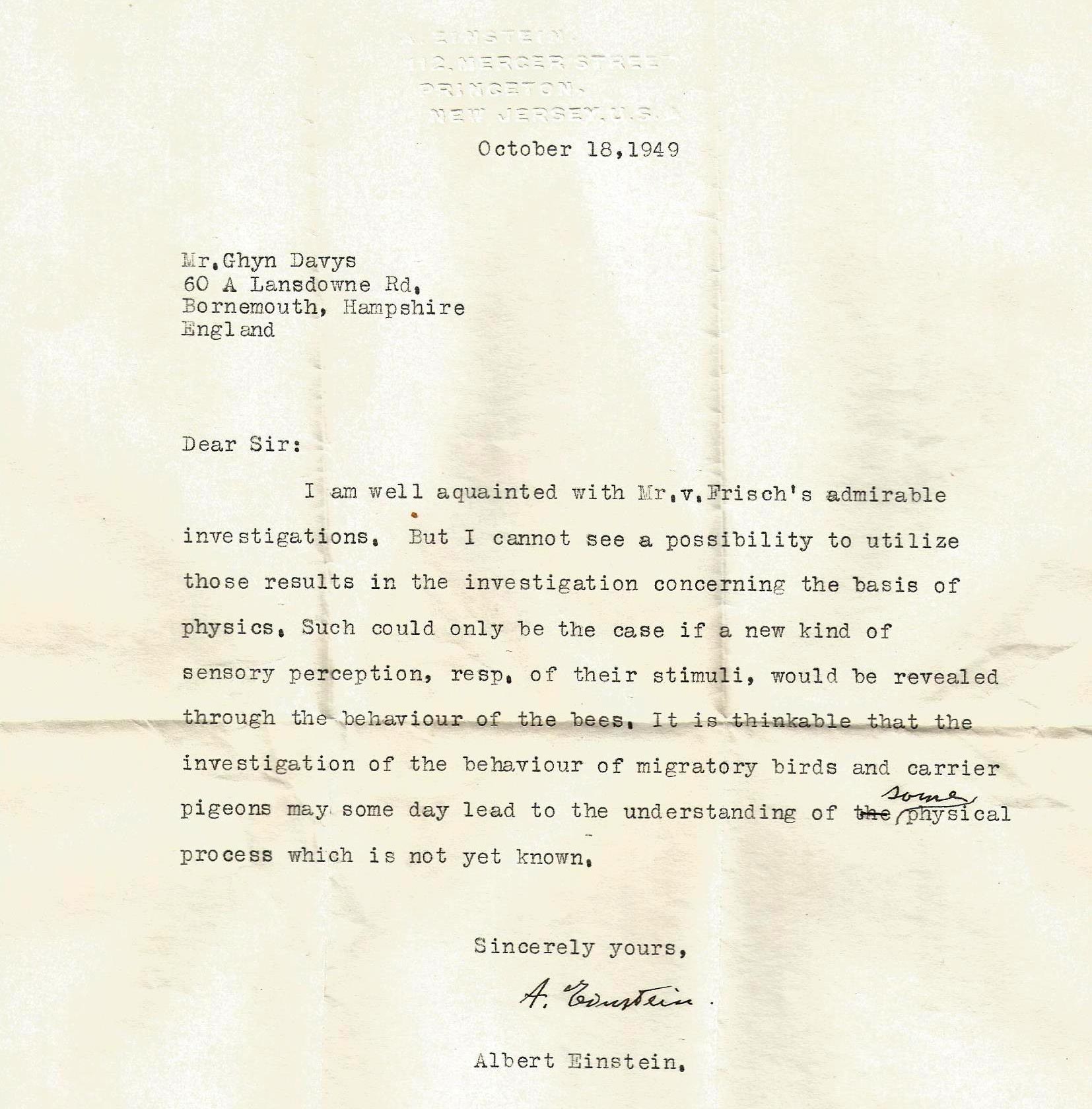
Previously Unknown Letter Reveals Einstein’s Thinking on Bees, Birds and Physics
The 1949 letter by the physicist and Nobel laureate discusses bees, birds, and whether new physics principles could come from studying animal senses.
It’s a position still being realized within physics to this day, with a growing body of research and understanding of how animals such as birds and bees find their way around.
Now a study led by RMIT University in Melbourne, Australia, discusses how recent discoveries in migratory birds back up Einstein’s thinking 72 years ago.
The previously unpublished letter was shared with researchers by Judith Davys — Einstein had addressed it to her late husband, radar researcher Glyn Davys.
RMIT’s Associate Professor Adrian Dyer has published significant studies into bees and is the lead author of the new paper on Einstein’s letter, published in the Journal of Comparative Physiology A.
Letter by Albert Einstein, validated by The Hebrew University of Jerusalem, where Einstein bequeathed his notes, letters and records. Credit: Dyer et al. 2021, J Comp Physiol A / The Hebrew University of Jerusalem
Dyer said the letter shows how Einstein envisaged new discoveries could come from studying animals.
“Seven decades after Einstein proposed new physics might come from animal sensory perception, we’re seeing discoveries that push our understanding about navigation and the fundamental principles of physics,” he said.
The letter also proves Einstein met with Nobel laureate Karl von Frisch, who was a leading bee and animal sensory researcher.
In April 1949, von Frisch presented his research on how honeybees navigate more effectively using the polarization patterns of light scattered from the sky.
The day after Einstein attended von Frisch’s lecture, the two researchers shared a private meeting.
Although this meeting wasn’t formally documented, the recently discovered letter from Einstein provides insight into what they might have talked about.
“It is thinkable that the investigation of the behavior of migratory birds and carrier pigeons may someday lead to the understanding of some physical process which is not yet known,” Einstein wrote.
Professor Andrew Greentree, a theoretical physicist at RMIT, said Einstein also suggested that for bees to extend our knowledge of physics, new types of behavior would need to be observed.
“Remarkably, it is clear through his writing that Einstein envisaged new discoveries could come from studying animals’ behaviors,” Greentree said.
More than 70 years since Einstein sent his letter, research is revealing the secrets of how migratory birds navigate while flying thousands of kilometers to arrive at a precise destination.
In 2008, research on thrushes fitted with radio transmitters showed, for the first time, that these birds use a form of magnetic compass as their primary orientation guide during flight.
One theory for the origin of magnetic sense in birds is the use of quantum randomness and entanglement. Both of these physics concepts were first proposed by Einstein.
Reference: “Einstein, von Frisch and the honeybee: a historical letter comes to light” by Adrian G. Dyer, Andrew D. Greentree, Jair E. Garcia, Elinya L. Dyer, Scarlett R. Howard and Friedrich G. Barth, 10 May 2021, Journal of Comparative Physiology A. DOI: 10.1007/s00359-021-01490-6
The letter to Glyn Davys shows the openness of Einstein’s mind to novel possibilities observed in nature and the evidence that he took an interest in von Frish and his bee research.
I am going to tell you guys about my sweet memory regarding this topic,before we jump right into the topic.
I remember going to an exhibition with my mother.The exhibition used to take place monthly twice.
While we are shopping through the baazar I saw a person making something with some metals and tools and it piqued my curiosity so I asked my mother what was it .
My mother said it is filigree, the art of making jewellery.I was so impressed by their work and asked them if I can watch them more closely.They gave permission and were happy cause I was showing interest in their craft.
They delicately and precisely made jewellery with their hands ,they twisted ,and turned the metals but the result was beautiful in whatever way they turn.
Filigree is also called as filigrann or filgrene.This form of metal work can be traced back to 17th to 19th century of itialian and French and Portugal Metal works.
The word can be broken into two word filum and granum ,which means a thread and grain or bead respectively.
Filigree is mainly done on two metals those are gold and silver.The customers love the works crafted through this art which are often described to be classy,unique.
This work needs a lot of concentration and finesse while making these metal works intricately. This works still remains popular in India and some other parts of Asia .
Jewellery ,watches,spoons,beads and what not everything that is made through this metal work is just wonderful.
Filigree is a metal art because every piece created by this technique is a chef’s kiss or to say a craftsman kiss.
I love this craft cause every piece has its own delicate nature that it depicts and also the finite accuracy in each twist and turn of the metal reminds me the hardwork,the time they sacrifice for our satisfaction.
There is no perfect person in the world, but the most holy and supreme person has his shortcomings, but I believe that everyone is born innocent, because of course you can’t make mistakes in your childhood. But I think people are not really good or bad or both.
Not all people are good people. No matter how hard you try, everyone has their own shortcomings. I also feel bad about people.
The mistakes they make will anger God; therefore human beings are both. People are bad because someone has to do some naughty or bad things in their lives. No one can be so good, because I believe that if you think you are a good person, you should not do anything at all. Lock yourself in the room. people are bad mainly because of temptation. We have all done some non-model things, sometimes without even realizing it.At some point we are all bad people, but most people are not bad, just like everyone goes to jail, so we keep our balance. So we have good and bad. We have holy days and bad days.
We are not perfect people. When we start to think for ourselves and know what is happening, we will do this to ourselves. Our environment, except when we were young, they told us what to do, and now we can control our lives. Our daily decisions make us who we are today.
Sometimes we can be good, sometimes we can be bad. He mentioned in his sermon that God loves everyone, no matter what. Whether you are good or bad, as long as you are willing to give, God will always find in his heart to forgive your sins.
Women in ancient India were highly respected. With the course of time, the status of women got lowered. The practice of female foeticide also started on a large scale. This eventually led to a slump in female sex ratio.
Problems faced
Dowry has become widespread, and birth of girl child became inauspicious. In several parts of India, women are seen as an economic liability even though they contribute in many ways to our economy and society. Early marriages, forced marriages, molestation, domestic and work area harassment, trafficking, and eve teasing are the issues faced by today’s women. Polygamy is also a problem faced by woman of some communities.
Women are also victims of malnutrition. If a pregnant lady suffers from malnutrition, the child’s health will be affected.
As responsible citizens we must strive towards gender equality and women empowerment. Government must also act against women’s rights violators.
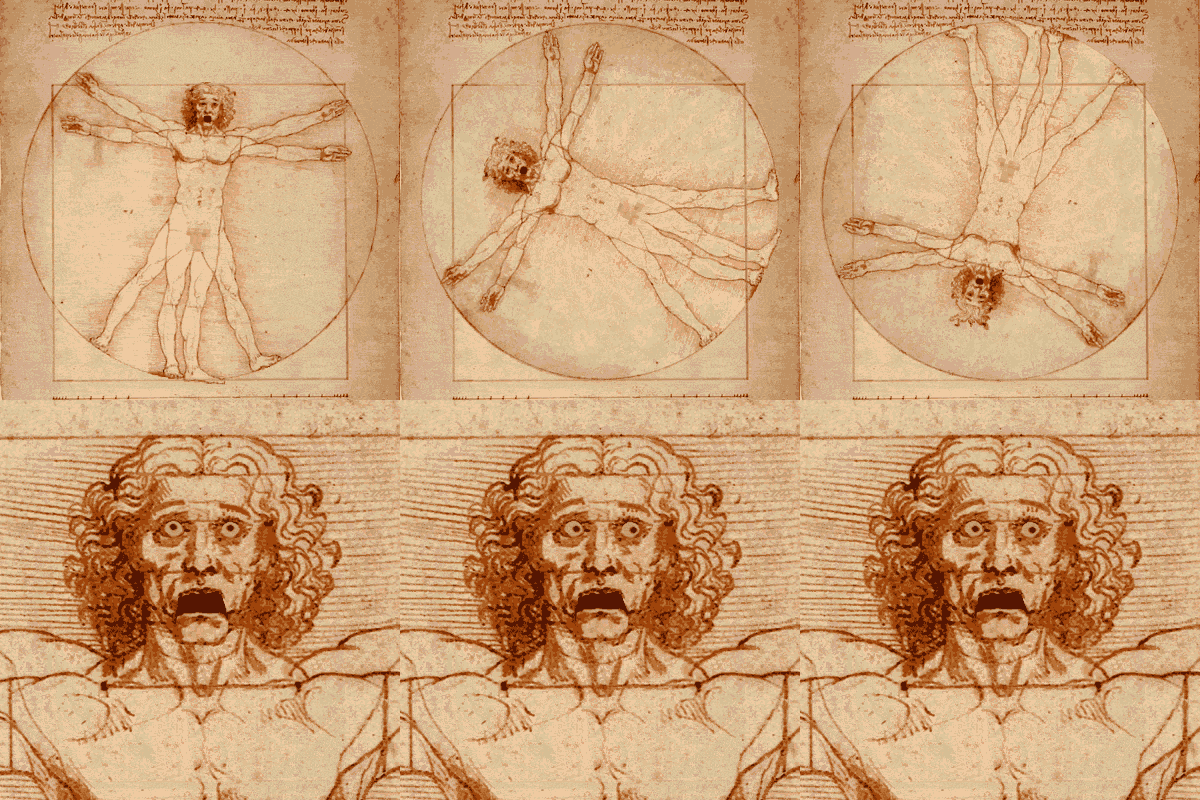
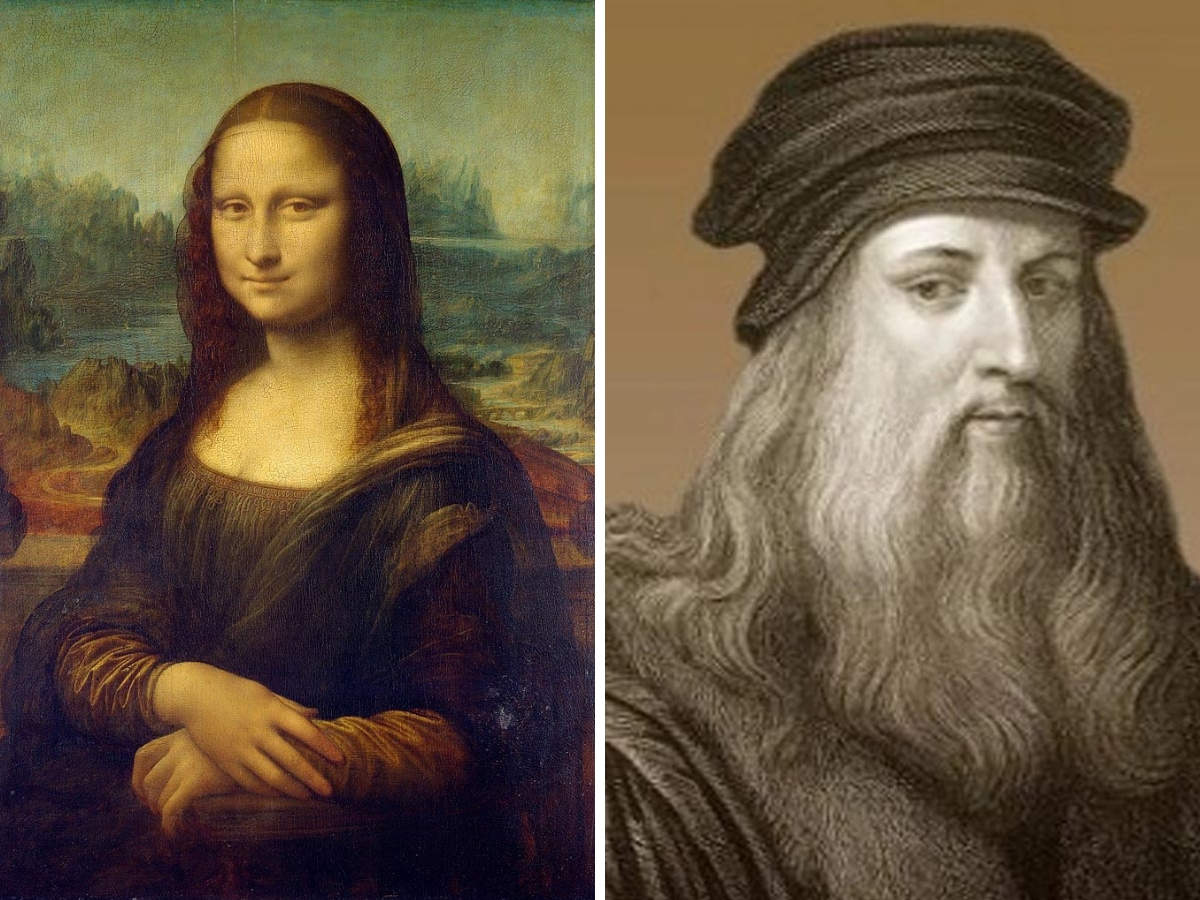
Leonardo da Vinci (1452-1519) was a painter, architect, inventor, and student of all things scientific. His natural genius crossed so many disciplines that he epitomized the term “Renaissance man.” Today he remains best known for his art, including two paintings that remain among the world’s most famous and admired, Mona Lisa and The Last Supper. Art, da Vinci believed, was indisputably connected with science and nature. Largely self-educated, he filled dozens of secret notebooks with inventions, observations and theories about pursuits from aeronautics to anatomy. But the rest of the world was just beginning to share knowledge in books made with moveable type, and the concepts expressed in his notebooks were often difficult to interpret. As a result, though he was lauded in his time as a great artist, his contemporaries often did not fully appreciate his genius—the combination of intellect and imagination that allowed him to create, at least on paper, such inventions as the bicycle, the helicopter and an airplane based on the physiology and flying capability of a bat.
Leonardo da Vinci: Early Life and Training
Leonardo da Vinci (1452-1519) was born in Anchiano, Tuscany (now Italy), close to the town of Vinci that provided the surname we associate with him today. In his own time he was known just as Leonardo or as “Il Florentine,” since he lived near Florence—and was famed as an artist, inventor and thinker.
Did you know? Leonardo da Vinci’s father, an attorney and notary, and his peasant mother were never married to one another, and Leonardo was the only child they had together. With other partners, they had a total of 17 other children, da Vinci’s half-siblings.
Da Vinci’s parents weren’t married, and his mother, Caterina, a peasant, wed another man while da Vinci was very young and began a new family. Beginning around age 5, he lived on the estate in Vinci that belonged to the family of his father, Ser Peiro, an attorney and notary. Da Vinci’s uncle, who had a particular appreciation for nature that da Vinci grew to share, also helped raise him.
Leonardo da Vinci: Early Career
Da Vinci received no formal education beyond basic reading, writing and math, but his father appreciated his artistic talent and apprenticed him at around age 15 to the noted sculptor and painter Andrea del Verrocchio, of Florence. For about a decade, da Vinci refined his painting and sculpting techniques and trained in mechanical arts. When he was 20, in 1472, the painters’ guild of Florence offered da Vinci membership, but he remained with Verrocchio until he became an independent master in 1478. Around 1482, he began to paint his first commissioned work, The Adoration of the Magi, for Florence’s San Donato, a Scopeto monastery.
However, da Vinci never completed that piece, because shortly thereafter he relocated to Milan to work for the ruling Sforza clan, serving as an engineer, painter, architect, designer of court festivals and, most notably, a sculptor. The family asked da Vinci to create a magnificent 16-foot-tall equestrian statue, in bronze, to honor dynasty founder Francesco Sforza. Da Vinci worked on the project on and off for 12 years, and in 1493 a clay model was ready to display. Imminent war, however, meant repurposing the bronze earmarked for the sculpture into cannons, and the clay model was destroyed in the conflict after the ruling Sforza duke fell from power in 1499.
Leonardo da Vinci: ‘The Last Supper’ and ‘Mona Lisa’
Although relatively few of da Vinci’s paintings and sculptures survive—in part because his total output was quite small—two of his extant works are among the world’s most well-known and admired paintings.
The first is da Vinci’s “The Last Supper,” painted during his time in Milan, from about 1495 to 1498. A tempera and oil mural on plaster, “The Last Supper” was created for the refectory of the city’s Monastery of Santa Maria delle Grazie. Also known as “The Cenacle,” this work measures about 15 by 29 feet and is the artist’s only surviving fresco. It depicts the Passover dinner during which Jesus Christ addresses the Apostles and says, “One of you shall betray me.” One of the painting’s stellar features is each Apostle’s distinct emotive expression and body language. Its composition, in which Jesus is centered among yet isolated from the Apostles, has influenced generations of painters.
When Milan was invaded by the French in 1499 and the Sforza family fled, da Vinci escaped as well, possibly first to Venice and then to Florence. There, he painted a series of portraits that included “La Gioconda,” a 21-by-31-inch work that’s best known today as “Mona Lisa.” Painted between approximately 1503 and 1506, the woman depicted—especially because of her mysterious slight smile—has been the subject of speculation for centuries. In the past she was often thought to be Mona Lisa Gherardini, a courtesan, but current scholarship indicates that she was Lisa del Giocondo, wife of Florentine merchant Francisco del Giocondo. Today, the portrait—the only da Vinci portrait from this period that survives—is housed at the Louvre Museum in Paris, France, where it attracts millions of visitors each year.
Around 1506, da Vinci returned to Milan, along with a group of his students and disciples, including young aristocrat Francesco Melzi, who would be Leonardo’s closest companion until the artist’s death. Ironically, the victor over the Duke Ludovico Sforza, Gian Giacomo Trivulzio, commissioned da Vinci to sculpt his grand equestrian-statue tomb. It, too, was never completed (this time because Trivulzio scaled back his plan). Da Vinci spent seven years in Milan, followed by three more in Rome after Milan once again became inhospitable because of political strife.
Leonardo da Vinci: Philosophy of Interconnectedness
Da Vinci’s interests ranged far beyond fine art. He studied nature, mechanics, anatomy, physics, architecture, weaponry and more, often creating accurate, workable designs for machines like the bicycle, helicopter, submarine and military tank that would not come to fruition for centuries. He was, wrote Sigmund Freud, “like a man who awoke too early in the darkness, while the others were all still asleep.”
Several themes could be said to unite da Vinci’s eclectic interests. Most notably, he believed that sight was mankind’s most important sense and that “saper vedere”(“knowing how to see”) was crucial to living all aspects of life fully. He saw science and art as complementary rather than distinct disciplines, and thought that ideas formulated in one realm could—and should—inform the other.
Probably because of his abundance of diverse interests, da Vinci failed to complete a significant number of his paintings and projects. He spent a great deal of time immersing himself in nature, testing scientific laws, dissecting bodies (human and animal) and thinking and writing about his observations. At some point in the early 1490s, da Vinci began filling notebooks related to four broad themes—painting, architecture, mechanics and human anatomy—creating thousands of pages of neatly drawn illustrations and densely penned commentary, some of which (thanks to left-handed “mirror script”) was indecipherable to others.
The notebooks—often referred to as da Vinci’s manuscripts and “codices”—are housed today in museum collections after having been scattered after his death. The Codex Atlanticus, for instance, includes a plan for a 65-foot mechanical bat, essentially a flying machine based on the physiology of the bat and on the principles of aeronautics and physics. Other notebooks contained da Vinci’s anatomical studies of the human skeleton, muscles, brain, and digestive and reproductive systems, which brought new understanding of the human body to a wider audience. However, because they weren’t published in the 1500s, da Vinci’s notebooks had little influence on scientific advancement in the Renaissance period.
Leonardo da Vinci: Later Years
Da Vinci left Italy for good in 1516, when French ruler Francis I generously offered him the title of “Premier Painter and Engineer and Architect to the King,” which afforded him the opportunity to paint and draw at his leisure while living in a country manor house, the Château of Cloux, near Amboise in France. Although accompanied by Melzi, to whom he would leave his estate, the bitter tone in drafts of some of his correspondence from this period indicate that da Vinci’s final years may not have been very happy ones. (Melzi would go on to marry and have a son, whose heirs, upon his death, sold da Vinci’s estate.)
Da Vinci died at Cloux (now Clos-Lucé) in 1519 at age 67. He was buried nearby in the palace church of Saint-Florentin. The French Revolution nearly obliterated the church, and its remains were completely demolished in the early 1800s, making it impossible to identify da Vinci’s exact gravesite.
Year after year, Google has been ranked as one of the top companies to work for, so it’s no surprise that the tech giant receives roughly three million applications per year. With an acceptance rate of 0.2%, you’d have a better chance of getting into Harvard.
It is difficult to get a job at Google because of their quality standards and the high number of applications they receive per year. For example, INC reported that Google receives 2 million job applications per year, which means it’s more competitive to get into than Harvard University.
Google is an employer of choice for the world’s top talent, typically receiving hundreds of resumes for every opening, which allows them to be extremely selective in their hiring.The hardest part is getting an interview. If you attend a university, go through campus recruiting.
According to the Pascale, The lowest paid Google employees are Entry Levels at $51,000.Google says there is no degree or prior experience required. In fact, 61% of learners enrolled do not hold a four-year degree. This certificate could be a perfect launchpad to a career in IT.
So if you have a keen interest in working at Google California or at any other branches of Google work hard my friend. More than studies work on yourselves, on your IQ level the interviewees are not going to ask you a question from your syllabus.
• Archaeological wing,Odisha discovered a 4,000-year-old settlement and ancient artifacts in Balasore. Traces of three cultural phases: Chalcolithic period (2000 to 1000 BC.) Iron Age (1000 to 400 BC) Early Historic Period (400 to 200 BC).
Human colonization in India
• Two broad periods – prehistoric and historic. Prehistoric – divided into stone, bronze and iron ages. Stone age: divided into palaeolithic, mesolithic and neolithic periods.
• Neolithic period: a settled, food-producing way of life.
• Introduction of Copper – the chalcolithic period.
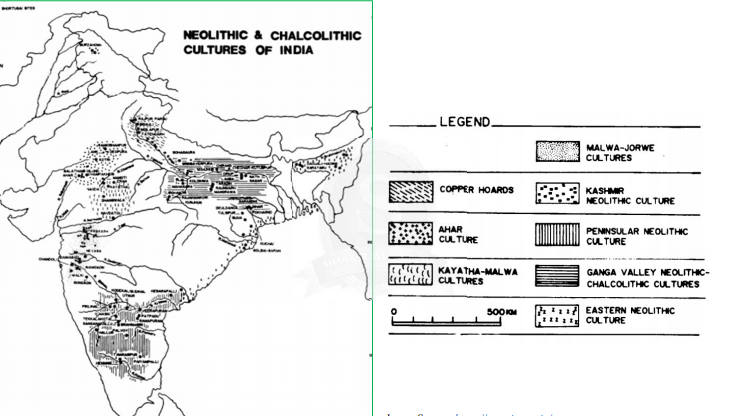
• India – Neolithic period and Chalcolithic period flourished simultaneously – 4th to 2nd millennia B.C. Represents farming based, settled village way of life.
• Neolithic culture – restricted distribution. Kashmir valley, northern Vindhyas, middle Ganga valley, and eastern, north-eastern and south India.
• Chalcolithic cultures – wider distribution. Entire Ganga valley, eastern RJ, Malwa or western MP, some parts of GJ, western MH, and the northern Vindhyas.
Differences
• Mainly regarding distribution pattern, technology, architecture and ceramics. Marked increase in the number of settlements. Introduction of copper-bronze – tools, weapons and ornaments etc. Improvement in architecture. Introduction of wheel-made pottery. Diversification of wares. Decoration of vessels by painted and incised designs.
India’s Important chalcolithic cultures
Ochre-coloured pottery (OCP) culture: Indo-Gangetic Divide and upper Ganga-Yamuna Doab. Named after a ceramic type – extremely rolled and fragile – wash of red ochre which is easily washed off. First recognised by B.B. Lal in 1951 in a small excavation at Bisauli and Rajpur Parsu (U.P).
Ahar culture or Banas culture: Mewar region of Rajasthan. Among the earliest Chalcolithic cultures of India. Type site – Ahar, in District Udaipur, Rajasthan – excavated in1961-62.
Kayatha and Malwa cultures: Malwa region of western MP. Kayatha site in Ujjain dist., MP. Malwa culture – most predominant chalcolithic culture of central India.
Malwa and Jorwe cultures – western Maharashtra. Jorwe – important and characteristic chalcolithic culture of Maharashtra – extend all over except the coastal strip on the west and Vidarbha. Jorwe site in Ahmadnagar district, Gujrat – discovered in 1950.
Narhan culture and variants – northern Vindhyas and the middle and lower Ganga valley. Narhan village situated at the left bank of Ghaghara river – Gorakhpur, Uttar Pradesh. Pre-iron Phase Chalcolithic culture with the principal ceramic assemblages of white painted Black-and-Red Ware.
The word FEMINISM comes from the word FEMININE which means “being a woman”. How is it that out of over a million words in the English language this particular word has created an uproar in the recent times with each woman becoming a “Feminist” proclaiming about her rights under this word and is criticized by others who think this is all a show of gaining attention , popularity and superiority. Read this blog completely to understand what actually caused to the popularity of the word , its implication in Indian terms and how has it helped women.
Feminism
FEMINISM refers to social , political and economic equality to women with respect to the males. Since God has given a woman the power to create life and nurture it , she automatically has a greater emotional quotient and her motherly attributes of being considerate, polite, loving , emotional is taken to be her weakness. Further since she has the organs to produce a human being , she is termed as “delicate” or in real words “WEAK”. WEAK is the term which has led the males believe that they are stronger and more capable and this has led to them ruling a woman since ages. The irony of the situation is that it is not just the males but also few women who thinks the entire woman race to be a subordinate to men and is born just to be a frustration box for the males.
So feminism in simpler words can be termed as a movement which was started to get women equal rights in education, property and employment matters and travelled as far as to the emotional treatment a woman has to suffer. It defines that a woman should be judged on the basis of her mental strength, her capabilities, her behavior rather than being judged for just being a WOMAN. It stands for women standing up to the male dominating world to fight for their self respect .
History of Feminism
The first instance of feminism which was the earliest reported one darts all the way back to 3rd century BCE in Rome where Roman women filled the Capitoline Hill and blocked every entrance to the Forum when consul Marcus Porcius Cato resisted attempts to repeal laws limiting women’s use of expensive goods. Cato’s words “If they are victorious now, what will they not attempt? As soon as they begin to be your equals, they will have become your superiors” proves that he somewhere believed women to be capable of exceeding men and it was this fear of letting that race which was suppressed since ages to be set free without any illogical restrictions bounding them which will make them realise their worth and will subsequently be no longer a personal robotic toy for men.
There was a time when the entire world was suppressing women. Women in each part of the world were denied the rights which would ensure her success instead she was just being treated as a caged animal. Until 19th century Europe did not give the women the right to inherit their father’s property which generally goes to the first child . In the absence of mail heir the property would go to a male relative however distant or evil he maybe. Jane Austen’s novel PRIDE AND PREJUDICE is the best example to this point where the Bennet family which consisted of all females had no right to their ancestral property .
While there were many other rules for women such as they had to step out covering their head as a mark of respect for the “SUPERIOR MALES”, had no right to vote or hold an elective office, cannot participate in any sort of buisness and went as far as to a man getting right to sell of his wife in many parts of the world. These actions proved that women were treated to be a non living enity with no feelings whatsoever.
After several protests, letters addressing women concerns being published, criticism the cause faced by the chauvinists , the woman were granted their rightful rights in many places in the world but the battle is till to be won. Many countries specially the ones in Asia still are treated as the object of male plight and fury.
With different culture the take and views on feminism chnages, let us see what brought about the changes for Indian women though the Feminism here was partly inspired by the west but its meanings and implications are different for the Indian women.
Feminism in India
Women in India are oppressed not only by the males but more by the fellow females. It is like a sort of inheritance being passed from one generation to the other where a girl is told by all the females in her family be it grandmother, mother or aunts that she should always keep all the males in her family above her and sort of idolise them and they are led to believe that if something wrong happens with them then it is the result of their own actions. This is the reason that many women silently suffer all kinds of domestic violence till their last breaths because this was what they had been taught since their birth.
Feminism in India can be divided into broadly three phases.
The first phase was witnessed in mid 19th century when several reforms in education and customs involving women were introduced. Sati, a practice which involved a woman setting herself on the fire by sitting on her husband’s pyre incase he expires before her, was abolished by Raja Ram Mohan Roy in the British Rule. This till date is considered as a biggest step in encouraging a woman where she was told she is much more than being a wife and her life does not ends with her husbands. Rani Lakshmi Bai the woman who fought Britishers with her infant son tied on her back after her husband’s death to save her kingdom from their clutches still continues to be an inspiration for many.
The second phase was witnessed from 1915 till India gained its independence and it started with Mahatma Gandhi incorporating women into his non cooperation movement , a first open political gathering where females were included. After this movement there were various Independent female groups created to fight for the Independence which managed to be off radar and continue their contribution in secrecy as Britishers had no hope that Indian women can step out of their domestic roles.
The third phase was witnessed after independence where women were included in the formation of the world’s largest democracy, has the power to vote and hold an elective office ,get educated and be independent. This phase continues till date and has witnessed many changes along the way. From it becoming normal for girls to get educated and work, to the extension of minimum age of marriage for a girl till 18 years by the Constitution of India to prenatal sex determination and Female Infanticide being considered as a criminal offence with severe punishment it may seem that India has come a long way and the women here are treated with equality and respect which they deserve but sadly this is not the case. Though the upper surface appears to be cleared there are still many horrible trenches inside.
Present Condition of Women in India
Feminism and plight of women in India cannot be sumarised under a single term. The heterogenity of Indian cultures bring with it multiple patriarchies and multiple feminist movements but the basic plight remains the same.
India is a highly patriarchal society where even today in 2021 people claim to be modern and “allowing their women” to have privileges same as that of men but the small privileges of getting educated , working comes at a price. Price of still not be able to take stand when she is wronged , the reason being a woman is pointed every time she becomes a victim while in some case she may act to be a victim hence committing a grievance sin but this minority is turned into making independent decision taking woman being regarded as “too bold” or “unfit” for the society by the chauvinist groups.
****Since even the basic points regarding the topic are indefinitely extended and talked about, it is difficult to make all the basic points in one blog and there will be a continuation to this blog soon.
I would conclude this blog here by stating that feminism is not the superiority of females over the males rather it is about them being treated equally both physically and mentally without any prejudice about them being a woman. It takes a lot to be a woman and to every woman out there be proud of what you are!
“THE PESSIMIST SEES DIFFICULTY IN EVERY OPPORTUNITY. THE OPTIMIST SEES OPPORTUNITY IN EVERY DIFFICULTY.” – Winston Churchill
EFFECTS OF INSPIRATION
The word “Inspiration” rings out many bells in one’s mind. It suggests many feelings such as promise and self-confidence which further charges up the other emotions to move forward in whatever domain one want to. Inspiration is a highly effective dose to bring out all the hidden personalities and characters in one’s disposition, which helps him or her to comprehend the potential and attain the set goals.
IT IS OMNIPRESENT
All the renowned and celebrated people who have made a mark in their life have been inspired and motivated at some or the other point of their life. We can take examples of people in the field of Art, Music and Medicine’ or in the field of Technology. Even politicians and great saints cannot be ruled out. One can get inspired in countless ways, it can be verbal, written or may be through some of the work done or an example set by the person they kind of became role models. When you carry a deep feeling for a person, you start trusting and have a blind faith in his thinking and philosophy and just start following the tracks without even being sure of that.
WE ALL NEED A MENTOR
The person you are impressed with or whom you ae following becomes your counsellor and you have to consider him like your ‘leader’. Only then, benefits can be gained and dreams can be appreciated. If we turn the pages of history Arjuna got so inspired after Lord Krishna’s sermons and he realized that if he did not listen to Lord Krishna at that time, then he will not be able to fight and protect Dharma’, as by that time he was totally influenced.
A TRUE LEADER ENKINDLES OUR FAITH IN THE ACTION
There are many saints who have earned name and fame in people’ s heart by simply following their ‘expert’ for an inspiration in life. So, an inspiration coming from the right person helps us to internalize our goals and we attain our mission Sometimes when we are depressed and are literally down in the junkyards, at that time a Comforting sentence or a gentle hand on the head gives us much required and desirable confidence and assurance. Such motivation goes a long way.
SUPPORT INSPIRATION
Therefore, one can work hard only if there is moral support and inspiration. As the saying goes that there can be perspiration only if there is an inspiration.
Akbar grew up in an environment where remarkable saints like Kabir, Chaitanya emphasized on a religion based on devotion and love rather than one based on rituals and interpretations of revealed books.An atmosphere where liberal sentiments and views propagate greatly influenced Akbar’s religious policy.
Main features of his religious policy:
Protective measures- Abolition of pilgrim tax, giving up policy of religious conversion of the prisoners of war.This laid the foundation of the empire based on equal rights irrespective of religious faiths.
Sulh-I-kul (peace to all)- This involved the adoption of the idea of how a true sovereign should behave . Akbar adopted the idea that a true ruler should show parental love towards his subjects without any discrimination , not allow sectarian strife to rise.
Ibadat khana- Initially Akbar was influenced by the Chief Qazi but after his betrayal he grew increasingly inclined towards mysticism, repeating God’s name . In 1575, he established Ibadat Khana at Fatehpur Sikri where he invited theologians, preachers of different religions. He held discussions about the Quran , features of different religions, the nature of God etc.
“Decree of Infallibility “- To deal with Mullahs Akbar issued a declaration or Mazhar that to consider fit to interpret the Quran among different persons Akbar is the one. Since he is wise , just and ranks higher in the eyes of God so he will choose which interpretation of the Quran is correct among many others.
Maintained contacts- Abar maintained contacts with different religious scholars and continued to invite them to his court. For example , he had invited from Hindu religion Puroshottam and Devi , from Christianity Aquaviva and Monserrate.
Tauhid-I-Illahi- Contact with different religious leaders provided Akbar with great understanding, although all religions had different good points but they all preached the creation of an atmosphere of peace , amity and good for the country. This understanding made Akbar to create a new religion combining all the good of other religions. This was the Tauhid-I-Illahi. It was an order of the Sufistic type, Sunday was the day of initiation where those willing to join placed head at the feet of the Emperor who raised him up and gave him the formula-the shast to repeat upon , Allah-o-Akbar was the motto.
Enrolling Murids- They were a personal band of nobles completely loyal to the Emperor who had to give up their property, life, honour and religion and become devoted to Akbar. Badayuni has criticized this move of Akbar as a strategy to gain loyalists and many unworthy flatterers.
Translation department- Akbar made sure to translate works like Singhasan Battisi , Atharva Veda , Ramayana, Mahabharata etc.
Hence the religious policy of Akbar shows his attempt to maintain peace and cordial relations between different sections in society.
Women’s liberation could be a social and political development that advocates for the rights of ladies on the grounds of uniformity of genders. It does not deny the organic contrasts between the genders but requests correspondence in openings. It covers everything from social and political to financial fields. In reality, women’s activist campaigns have been a vital portion of history in ladies strengthening. The feminist campaigns of the twentieth century made the proper to vote, open property, work and instruction conceivable. Hence, an paper on women’s liberation will examine its significance and affect.
Women’s liberation isn’t fair critical for ladies but for each sex, sexual orientation, caste, ideology and more. It enables the individuals and society as a entirety. A really common misinterpretation is that as it were ladies can be feminists. It is completely off-base but women’s liberation does not fair advantage ladies. It endeavors for balance of the genders, not the prevalence of ladies. Woman’s rights takes the sexual orientation parts which have been around for numerous a long time and tries to deconstruct them. This permits individuals to live unreservedly and engage lives without getting tied down by conventional confinements. In other words, it benefits ladies as well as men. For occasion, whereas it advocates that ladies must be free to gain it too advocates that why ought to men be the sole breadwinner of the family? It tries to deliver flexibility to all. Most importantly, it is essential for youthful individuals to urge included within the women’s activist development. This way, ready to accomplish quicker comes about. It is no less than a dream to live in a world full of equality.
In this way, we must all see at our claim societies and communities for making this dream a reality. We have not however come to the result but we are on the travel, so we must proceed on this mission to attain fruitful comes about.
The key message of woman’s rights must be to highlight the choice in bringing individual meaning to women’s liberation. It is to recognize other’s right for doing the same thing. The pitiful portion is that in spite of women’s liberation being a solid development, there are still parts of the world where disparity and misuse of ladies take places. In this way, we must all attempt to hone intersectional women’s liberation.
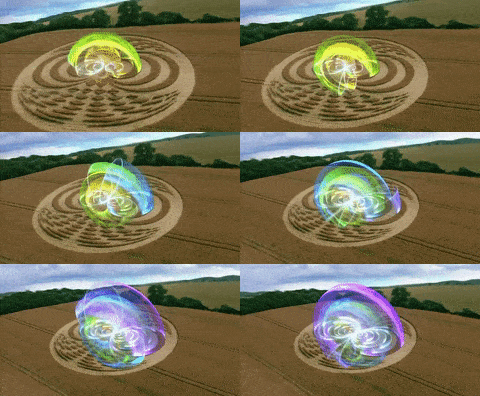
Crop circles have been appearing in grain fields all over the earth during the last few decades. They appear suddenly, usually at night. At first they were simple circles of bent-over grain stalks. Soon a new crop of more elaborate designs evolved—geometric forms reminiscent of profound mathematical theorems.
Some cerealogists (people who study crop circles) say that these diagrams must be created by intelligent alien beings from elsewhere. Even though these diagrams must be constructed in a very short timespan, the genuine crop circles never show any serious mistakes or blunders of execution. Cerealogists see this as evidence that the aliens must be very intelligent and much more advanced than we are. That’s mere speculation, of course. Others say the real reason is that there’s a worldwide conspiracy to hide the fact that the aliens sometimes do make mistakes. This coverup is carried out by people who want to preserve the myth that the aliens are a perfect race. The fact that you’ve never heard of such crop circle blunders just shows how effective this coverup is, they say. Mistakes are repaired at the site, or sometimes photographs of the circles are retouched. This has about as much to recommend it as any of the other conspiracy theories accepted and believed by simple-minded people.
Let’s look at more plausible explanations. Actually, a few designs do seem at first to have apparent irregularities or flaws. Some of these are surely caused by wind or rain, careless hoaxers or the trampling feet of crop circle buffs. But let’s set those aside and look only at those that are genuine and undisturbed. What appear at first to be iregularities or errors, may only be perfection of a higher and subtler kind, that we do not as yet understand.
Crop circles made by aliens?
Why should supposedly intelligent aliens travel huge cosmic distances across the galaxy just to doodle in our grain fields? What an absurd idea! [1] No one has ever seen them doing it, have they? Usually there aren’t even any ufo sightings associated with the circles, except for those reported after the fact by people with overactive imaginations. Surely intelligent aliens have better things to do. The true origin of crop circle designs may be nearer to home.
The whole thing begins to make sense once we realize that the earth is flat. We live on the backside of a huge flat blackboard (whiteboard, scratch paper, or whatever) used by aliens in their schools and universities. There are many of these in the universe. The flat disk of the earth is thin enough that student doodles made in alien art and math classes “bleed through” to our side. This happens because their writing instruments emit mitogenetic radiation (M-rays) that are well known to affect some living plants, especially wheat, barley, oats and corn. [2] M-rays weaken the stalk structure near the ground, and the stalks bend over gently to lie flat on the ground, showing no evidence of forceful breaking. So the crop circles in grain fields are nothing more than the reverse pattern of alien students’ diagrams made in geometry class.
It’s true that a few designs have straight lines and curves that seem at first to be more complex than circles. But we must remember that straight lines are simply circles of infinite radius. Any complex curves can be constructed approximately from circular arc segments of different radius.
Did they use a ruler?
There’s good evidence that aliens have been defacing the earth’s surface with geological grafitti for a very long time. The curious lines and drawings on the Nazca plain in Peru likely have the same cause. At that earlier time in history the aliens had only primitive writing instruments. They were still using “pens” made of inorganic material, that emit E-rays (Earth rays). These only affect non-living things. Sand on flat ground is easily moved around with very little energy. The sandy surface of the Nazca plain acted like a giant Etch-A-Sketch ®. No advanced mathematical figures are found at Nazca, only long straight lines, pictures and geometric doodles. Obviously the aliens weren’t as scientifically advanced then. Then why are the lines so perfect, and the straight lines so straight? The reason is quite simple: on their side of the blackboard the aliens used rulers.
School kid’s prank?
A number of commentators claim to have proven to their own satisfaction that the Ancient Egyptians didn’t have the resources or technology to build the pyramids. Could it be that the pyramids of Egypt were built by alien kids, who, in a playful mood, pushed their play blocks into their blackboard, all the way through, coming up point first on our side? Following this line of reasoning, perhaps Stonehenge and similar structures are the result of an alien children’s game in which stone pegs are pushed into a geometric array of holes
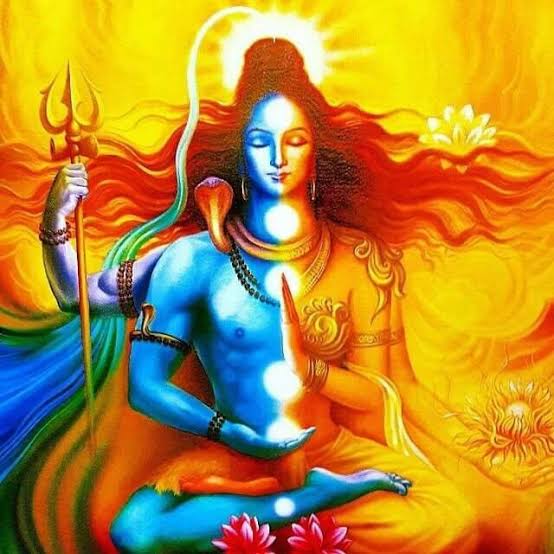
There is a popular concept in the Indian Mythology the Ardhanaarishwara – this word consists of 3 parts “Ardha” which refers to half. “Naari” for women and “Ishwara” for lord. A half male and half female figure, in which the male part depicts lord Shiva and the other half depicts Goddess Shakti, this makes it quite clear to understand that a male and a female has equal importance and power but, in contrast to this we have a society where male enjoys a supreme status than a female in the same household.
There are exceptional cases where a woman is given equal importance in a family as a result of which, most of the women specially those who belong to a backward area or uneducated background have to suffer a lot in her own family but this suffering which is named as the ‘destiny’ of a women creates a much bigger problem. The social norms accept male supremacy and this can be observed in our day-to-day life and practices which are followed since a long time for instance- male head of a family, in a typical household is common but, the drawback is when it comes to decision making and implementation of rules and laws. It ultimately reduces the power of a female they are not allowed to participate in the decision making and even if they are the final decision is in the hand of the head all the major decisions of the family will be taken by the head, rules will be framed by him. Moreover, the traditional role of a women as a housekeeper and the one who is solely responsible for the upbringing of children, serve the family etc has never let women look beyond house and family, this has killed the dreams and ambition of so many women, who could have achieved so much more in life. Similarly, there are so many incidences and rules which can highlight the fact that the society practices inequality, supremacy and discrimination in different forms and if all these problems exist how can we expect balance in a society.
Today, the situation is better than before a women can be seen in much appropriate roles not only at personal level but, professionally also they are self-build, independent and respected, they have come a long way to get accepted in the roles which were not supposed to be theirs. Theses days women are the sole bread earners in family and get equal participation in the decision making, they have done extraordinary progress to stand out and inspire other women to do the same. As great leaders like Swami Vivekananda have said that a woman is of uttermost importance in a society and the condition of a women in a society reflects the development of a society.
This brings us to the conclusion that, it is not only about supremacy or dominance of a particular gender but, a deep-rooted problem of the society which has many causes and can become an obstacle in the path of development in any country and if we can possibly eradicate such problems from the society. It will definitely benefit each and every one.
Have you guys ever heard about warli painting?even if you don’t know it’s name I think many of you can recognise the paintings ,they are present almost on any design,dress,wall art.
Still you haven’t got a clue? No problem .Have you ever seen stick figures on brown walls ,or on any dresses,they are called warli paintings.
From pinterest
Warli painting’s originated from maharastra.The name warli came into light because of the tribe warli in Maharashtra.Warli paintings showcase their drawings on mud walls,brown walls and now recently it is even used as design on dresses.
Warli painting’s have simple structure that is they mostly draw with circles,squares,and rectangles,they put emphasis on the story they are delivering through the painting.
Mostly it’s about their lifestyle,that is farming,dancing,singing,working.
On special occasions they draw these things with the white pigment.
These paintings garnered attention for their simplicity,and raw feel that these drawings show. These paintings are very popular and they are available on many online sites ,people love to decorate their homes with these paintings.
Even the small figures when painted on the walls they recieve so much attention ,they are pleasing to the eyes. The dancers take a long turn in the audience and try to encircle them for entertainment. The circle formation of the dancers is also said to resemble the circle of life.people are doing their own activities and enjoying their time.The huts depict,their homes,the trees.
Every thing is depicted in those basic geometric shapes becoming its own speciality and oozes uniqueness,and sense of familarity.
I remember we had an activity where we had to draw over walls and the topic was warli paintings ,it was very fun to draw those things on the walls.
These paintings depict their culture, lifestyle,and their essence is the depicting small things in our life in a beautiful way.

















 Eduindex
You must be logged in to post a comment.