UN World Food Programme: II

SYRIA: Millions of people have been displaced from their homes , Conflicts in Syria’s northeast and northwest have increased levels of hunger and food insecurity as families have lost their homes, businesses and incomes

In December 2019, conflict escalated in northwest Syria and western

Aleppo. Close to one million people were forced to flee their homes in the largest wave of displacement since the crisis began.

WFP launched an immediate response and scaled up its ongoing humanitarian operations in the northwest and is now providing emergency food assistance to more than one million people each month through cross-border operation from Turkey.

Across Syria, WFP continues to ensure that food reaches the most vulnerable families when they need it the most.

4.8 million people in Syria receive lifesaving food from WFP each month. 

The Nobel Peace Prize 2020 was awarded to World Food Programme (WFP) “for its efforts to combat hunger, for its contribution to bettering conditions for peace in conflict affected areas and for acting as a driving force in efforts to prevent the use of hunger as a weapon of war and conflict.”

And just like that, when the World Food Programme were offered UN Peace Price amidst all the harsh realities, and morbidities, the deaths, the wars — 2020 acknowledged the work and effort that the Food Programme have constantly been putting in, in order to create an equal, and secured environment. 

You can check their work and know more about them at: https://www.wfp.org

United Nations World Food Programme: I

The Nobel Peace Prize is one of the 5 Nobel Prizes established by the will of Swedish inventor Alfred Nobel, along with the prizes in Chemistry, Physics, Physiology or Medicine, and Literature.The Nobel Peace Prize has been awarded 101 times to 135 Nobel Laureates between 1901 and 2020, 107 individuals and 28 organisations. The International Committee of the Red Cross has been awarded the Nobel Peace Prize 3 times. The Office of the United Nations High Commissioner for Refugees has been awarded the Nobel Peace Prize 2 times . The most recent prize was awarded to the World Food Programme in 2020; nominations for the 2021 prize closed in January 2021. WFP was established in 1961, when George McGovern, director of the US Food for Peace Programmes, proposed establishing a multilateral food aid programme. WFP launched its 1st  programme in 1963, in Sudan. WFP operations are funded by voluntary donations principally from governments of the world, and also from corporations and private donors. In 2019, funding was  recorded around US$8 billion, of which the largest donors were the United States ($3.4 billion) and Germany ($886.6 million).

The Motto of the UN World Food Programme stands for, “Saving Lives – Changing Lives become substantial.  In 2015 the global community adopted the 17 Global Goals for Sustainable Development to improve people’s lives by 2030. With priority of achieving  Goal 2 – Zero Hunger –which pledges to end hunger, achieve food security, improve nutrition and promote sustainable agriculture, 

This is the WFP’s vision – 5 steps to Zero Hunger.

a. Put first those who are furthest behind 

b. Pave the road from farm to market

c. Reduce food waste

d. Encourage a sustainable variety of crops

e. Make nutrition a priority

For more than 50 years, the World Food Programme (WFP) has provided emergency food assistance, often in conflict, post-conflict or disaster situations. WFP has  evolved to combine frontline action with the quest for durable solutions.

This also includes – Cash transfers, that is Empowering the people through provision of cash and/or value vouchers, In-kind food distribution to most vulnerable household.

Please read the following post for more information.

Screen-sharing is the new Movie Theatre

And it’s so much better than what you’d initially have ever thought of. 

When the initially was introduced to me, the most apprehensive of situation that I had to face was the fact that would it even be enticing enough to make me watch whatever that’s been screen-shared to me for such a long time? 

But trusting the fact that with all the apprehension considered it has proved to be such a delight. Yes, network issues would occur, or there might be delay or error with the video that has been shared, but beyond that — the time you’d invest in watching something new, something that you enjoy — it could never distract you, however its also a commitment not just halfhearted commitment but a promising act. 

We could even go beyond Zoom, and talk about options such as Amazon Watch Party for those who have laptops accessible or check out websites that are available and trustworthy, this process could be lengthy to have a site that you trust enough, but make no mistake that it’s enjoyable none the less.. sorry if you’d find me just redundantly reiterating it. 

Moving on, for someone who is secured within themselves and don’t really like social interaction or outings, this seems just so appropriate without the whole pandemic upon our heads. We are comfortable on our own couches or beds a comforter over us, we could even chit chat about the movie or show that you’re watching with your group, and comments on sections without being yelled at by someone else .. which you can’t do, while in a theatre. 

Also, without everything aside, you can still after the entertainment is done and dusted, you can still stay connected and converse with your friend over a cup of coffee — within the confines of your own home.

So, if you’ve not yet tried this method with your friend (s), make sure t=you create a small time in your schedule to unwind, even if it is for 30 minutes, and let me know how it goes. 

The social media addiction

From the past few days, I did not get the time to use social media as often as I would. Today when I went back on social media I realised that I am falling back into the cycle of comparing my life with people. It then hit me that from a past few days where I was busy, the world around me changed, the birds were chirping, the flowers were blooming. This was a joke obviously.

But I did notice that I wasn’t comparing my life and was focussing on myself.

Social media is a place where everyone shows how perfect their lives are, even if taking that one picture took them three hours of hard work. Scrolling through social media makes us have questions like

How are they going out daily?

How are they having so many friends?

How do they get such good pictures?

Well, I am not hating on the people who have friends or spend time taking their pictures. They are doing what they want which is good. The problem arises when we start thinking of their lives as “perfect” and start looking down on our lives.

Let’s take an example of how social media makes us feel bad about our lives:

Imagine you have a day planned for working or doing an assignment. Let me tell you which is completely normal. But then you go on social media and see people have fun and it makes you feel bad about your life.

 I know we do like posting a picture and getting likes and comments. So, I am not telling you to stop using social media. I am just asking you to remember where to stop. So today when I realised that I was going to fall back in that cycle I stopped and took a break from social media. I went and did something else because I am in a good place right now and I don’t want other people’s life to affect my life.

So the next time you are using social media always remember a few things:

No one has a perfect life: There is no such thing as a perfect life, every person has their share of problems. So, don’t make yourself feel bad about why your life isn’t perfect.

Everything we see is not real: we see stories of people going out every day. Well, they may not always have as much fun as it is shown on social media. I have ordered a few fancy-looking food and, to tell you the truth it did not taste as good as it looked. Even in stories that people post with their friends, they show how much fun they are having but in reality, people are just sitting and are using their devices and scrolling through social media.

Quality not quantity: having a big friend group is fun but they have a lot of drama too. So if you are someone with even 2-4 good friends, appreciate that because you would rather spend time with real friends than be surrounded by fake friends.

Gratitude: we need to be grateful for all that we have. We know that some people don’t even have what we currently have. If you are reading this article that means you do have a device to read it in so be thankful for that and don’t compare your life with people.

Live in the moment: There is a difference between living the moment and, only capturing it. I remember going to a concert and only recording the concert and not really enjoying it or living the moment. I wished that I lived in the moment. But, I was 13 at that time and lacked brain cells. So, don’t repeat my mistake.

Social media is a great platform and can be used to promote small businesses, raise funds, help people out, make money, become an influencer, etc. But if your mental health is getting affected by it and you are subconsciously feeling bad about your life you need to stop and take a break from it.


Institute of Chartered Accountants ofIndia (ICAI)

• statutory body set up in 1949 – by The Chartered Accountants Act, 1949.

• premier accounting body.

• regulates the profession of Chartered Accountancy in the country.

• functions under the administrative control of
the Ministry of Corporate Affairs.

• second largest professional body of Chartered Accountants in the world.
• Management:
 in accordance with the provisions of Chartered Accountants Act, 1949 and the Chartered Accountants Regulations of 1988.
 Council – empowered to frame Regulations under the Act and to constitute necessary standing and non-standing Committees.
 40 members – 32 elected by CAs and 8 nominated by the Central Government.
 nominees generally represent the Comptroller and Auditor General of India,
SEBI, Ministries of Corporate Affairs and Finance etc.

• maintains highest standards in technical,
ethical areas and for sustaining stringent
examination and education standards.

Role:
 Regulate the profession of Accountancy
 Education and Examination of Chartered Accountancy Course
 Continuing Professional Education of Members
 Conducting Post Qualification Courses
 Formulation of Accounting Standards
 Prescription of Standard Auditing Procedures
 Laying down Ethical Standards
 Monitoring Quality through Peer Review
 Ensuring Standards of performance of Members
 Exercise Disciplinary Jurisdiction
 Financial Reporting Review
 Input on Policy matters to Government .

• functions– Educational, Regulatory and Disciplinary.
 formulates the code of ethics to be followed by its members.

National Investigation Agency (NIA)

• NIA Act, 2008– established the National Investigation Agency (NIA).

• Extends to the whole of India. Applies to Citizens of India outside India.

• Government servants wherever they may be.

• Persons on ships and aircrafts registered in India wherever they may be.

• NIA is the Central Counter Terrorism Law Enforcement Agency in India.

• Can investigate and prosecute for offences under the following Schedule.

National Security Guard (NSG)

• 1984: Union Cabinet decided to create a Federal Contingency Force to tackle terrorism.

• NSG formally came into being in 1986: the NSG Act 1986.

• Modelled on the pattern of Special Air Service (SAS) of the UK and GSG9 of Germany.

• NIA Act, 2008- established the National Investigation Agency
(NIA).

Two complementary elements:
 Special Action Group (SAG)- comprising Army personnel.
 Special Ranger Group (SRG)- comprising personnel drawn from CAPF/State police forces.

Hunger watch report

News

Source: Department of Consumer Affairs, Hunger Watch

• Impacts of Covid-19 pandemic, lockdown – on
personal income and food consumption.

• Hunger watch report analysed to provide
important information.
Income drop.

• In October 2020 – compared to pre lockdown
level
 27% of respondents lost their income due to
the national lockdown
 24% of its respondents record that they lost
50% of their income
 6% responded that their income did not change
despite the lockdown
Source: Department of Consumer Affairs, Hunger Watch

Retail inflation

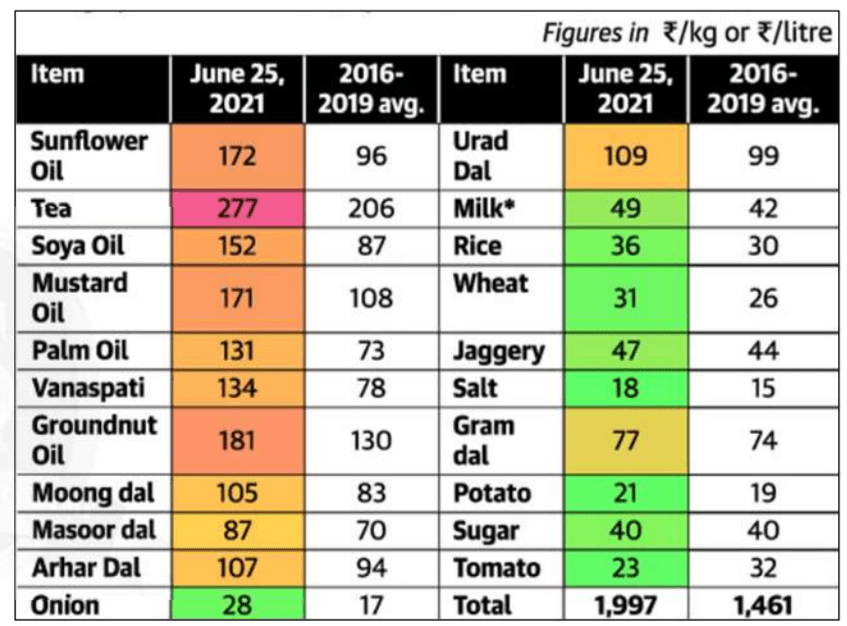
• In June 2021 – the prices of edible oil and pulses are increasing significantly .

• retail price analysis of 21 essential items across India.

• In June 2021- a Consumer – to buy a kg of essential item – has to spend rs.500 more compared to average cost between the year 2016 and 2019 .

• table given – indicates the retail price difference in various occasions .

• with retail inflation – the drop in income level has burdened the consumers.

hold Consumption of Commodities

• the impact of income factor and inflation
factor can be seen from the change in consumption level
 data of October 2020 is compared with March 2020.

• Report – level of household consumption of all
commodities listed have decreased.

• In October 2020 – 38% of households reported
that the consumption of vegetables decreased a lot.

• consumption of egg/meat commodities have also decreased – another problem in ensuring nutrient security.

Conclusion

adequate policy responses are the need of the hour to address both food and nutrition security in the country.

Studying International Relations

Go for it, if you are curious of the process of International Relations among nations.

I’ve already provided my simplest version of the answer, but to dig deeper into this notion of taking up such an interesting, and recently developing subject choice has to do so much with the socio-political situation alongside the increasing globalisation we have encountered  with changing times. 

The subjects holds weird fascination to me, when I first encountered it, and I hope it does the same to you. 

But do make your self aware that you won’t directly jump into knowing what Russia or China is handling it’s relations with India, there isn’t anything direct that could give you an eureka movement, but there are these tiny steps you get to take to understand each and every detail when it come to the subject of International Relations.

From Realism, and Trade Policies to tonnes of agreements, and UN and it’s branches, you slowly understand the subject and then next you deal with Diplomacy and its multitudinous types to how a mere decision over their actions on a global scale is surely going to affect someone else. This leads to another set of trials and tribulations but nonetheless the whole idea or the fascination behind this subject lies, for me, is in the knowledge that someone could hole so much power to change something, or some region could change course to appease and pacify another region, all as an act to not create a situation that is surely going to get out of hands, if not monitored. 

Mediterranean Sea,Red sea ,and Aegean Sea

Red Sea

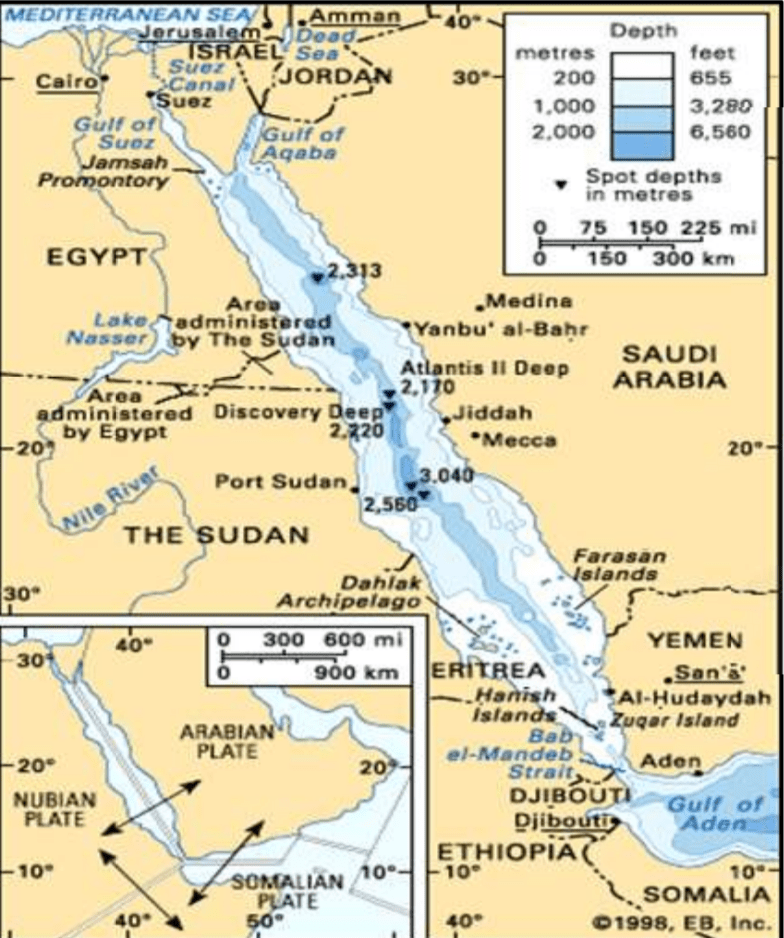
• Extending southeastward from Suez to the Bab el-Mandeb Strait.

• Northern end splits into- the Gulf of Suez to the NW and the Gulf of Aqaba to the NE.

• Separates the coasts of Egypt, Sudan, and Eritrea to the west from those of Saudi
Arabia and Yemen to the east.

• Connected to Mediterranean Sea via the Suez Canal.
 one of the most heavily traveled waterways
in the world.

• Derives its name from the colour changes observed in its waters.
 occasionally populated by the algae Trichodesmium erythraeum.

Mediterranean Sea

• An intercontinental sea .

• Often called the incubator of Western civilization.

• Extends from the Strait of Gibraltar to the Gulf of Iskenderun.

• West- connected with Atlantic Ocean by the
Strait of Gibraltar.

• Northeast- connected with the Black Sea through the strait of Dardanelles, the Sea of Marmara, and the strait of the Bosporus.

• Southeast- connected with the Red Sea by the Suez Canal.

Aegean Sea

• An arm of the Mediterranean Sea- between
the Greek peninsula and Asia Minor.

• Connected through the straits of the Dardanelles, the Sea of Marmara, and the
Bosporus to the Black Sea.

Why Polar Bears are on The Verge of Extinction

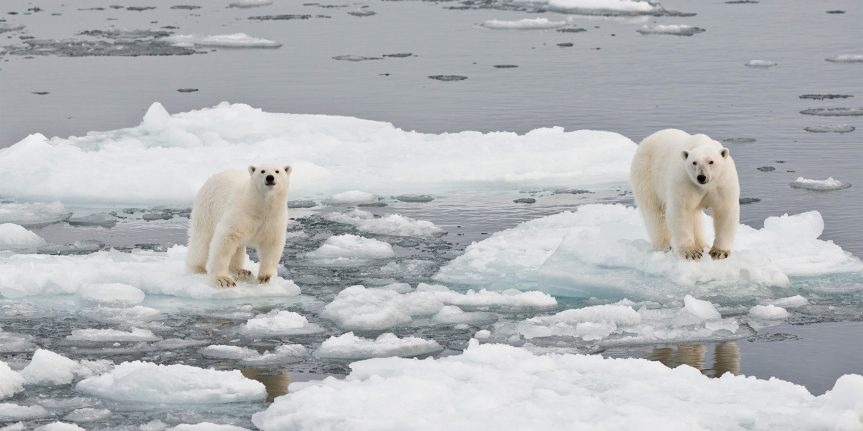
The loss sea ice habitat from climate change is the biggest threat to the survival pf polar bears. Other reasons include human-polar bear conflict, toxic pollution, oil spills and potential hunting of some subpopulations.

Polar Bear-Human Conflicts

As the sea ice of the Arctic thins and disperses, increasing number of polar bears spend longer periods in along the Arctic coastlines. Here their powerful sense of smell attracts them to human communities. Scent leading to garbage, stored food, dog teams, and animal carcasses bring them into greater conflict with people residing in the Arctic.

As apex predators, polar bears pose a significant threat to human life and property. In recent years the attacks on humans, who come within the polar bear’s range, continue to rise.

Effects of Climate Change

Due to climate change the Arctic is heating up twice as fast as anywhere in the world, melting the sea ice cover by 14% per decade. Comparing the data recorded between 1981-2010, we have lost about 770,000 square miles.

Polar bears rely on sea ice as their hunting ground and to rest, breed, and store energy for the summer and sutumn, when food can be scarce. The bears health decline as they go longer periods without food. Bears that come ashore, after the ice breaks up, are roughly 22 pounds lighter and in poorer condition. They also must travel long distances to stay with the rapidly receding ice.

Polar bears suffering from malnutrition can face extreme starvation -especially females with cubs. Scientists have found the main cause of death for cubs to be either lack of food or lack of fat on nursing mothers.

Industrial Impacts

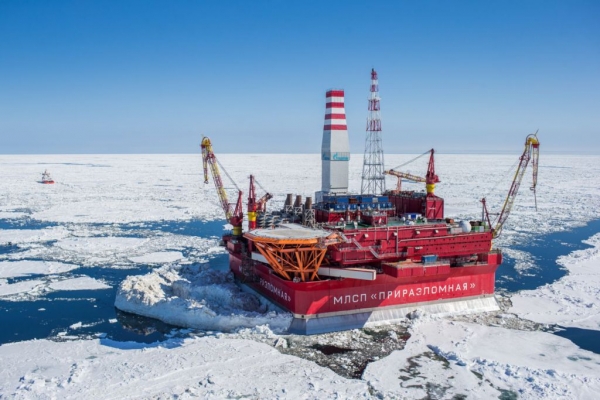
As summer ice retreats, a new ocean is emerging, which allows more opportunities for industrial development at sea, and on large parcels of land. Offshore petroleum installations and operations in the Arctic are expected to increase in number. This results in destruction of habitat, poisoning of the bears when they ingest oil and contaminated prey which causes disturbance in the food web. As traffic by oil tankers and cargo ships in Arctic waters increases, so do the oil spills and human disturbance to their habitat.

The wise always choose the pen, not the war!

Photo by Pixabay on Pexels.com

“Pen isn’t mightier than the sword.

Pens don’t win battles, and swords don’t Write Poetry.

Mighty is the Hand that knows when to pick the pen and

When to pick the sword!”

Thousands of stories, incidents, events are flourished beautifully with some splashes of ink. Indeed, a pen holds up a power which humans will never have. Everyone wants to be powerful in some way or the other. It can be physically, financially, politically, etc but we all need power because we are convicted to the clichéd topic of  “When a man is in power, he is the strongest of all”.  It’s our fault that we have created a world where a lion is considered to be the king of the jungle. We have made the world believe that power plays a major role. But have we ever thought that power can lie in the hands of humans?

 Power is in our hands!

 The strongest are those vintage philosophers and poets, who have a pen with them. Yes, a pen is all we need to be powerful. But how can a tiny pen be so powerful in this whole universe? Ever pondered about those passionate writers of the 18th century, of Victorian-era who still captivate us by telling the class condition and women suppression in that time.

Ever thought about how those writers like Sadat Hasan Manto, Khushwant shah, Ismat Chugtai taught us the value of freedom and sufferings. What made Shakespeare mend to write about the most legend love story of Romeo and Juliet, when he knew it was a time of class distinction. All these eminent writings, poetry which we read now is the power of a pen which amazed the readers of all time.

Pen is a medium

Ink has always been the best media to convey the real scenario of society. The writers have effortlessly portrayed to us how a pen is always mightier than a sword. A pen will always show us the mirage of the real society, where we live. We as a reader forecast many experiences when we read the truth. The authority is with all of us but only some chose a way to remove the disputes and that is through writing. A spot of ink has the power to removes the gap of social norms and customs from our society.

It unites!

Wars, disputes, riots always bridge a gap among humans, but a pen always unites people and their thoughts and believes. Society is filled with humans who are more affected by the glimpse of writing. As people believe in the power of words. Those who know to play with words always win. We have created a society where we have made certain beliefs’ which are not accepted by all and we have been following an age-old system where power is everything. So, it’s time to break those barriers of conventions and realize the reality of words.

Pen and readers are bonded of each other!

The power of the pen is so powerful that it can convey to the audience easily. The pen and the readers are 2 parts of a coin. The audience gets related because of the commendable expression which makes a reader and a pen get bound to each other. Immensely a pen and a reader are bounded emotional with those flickering words which string to their minds.

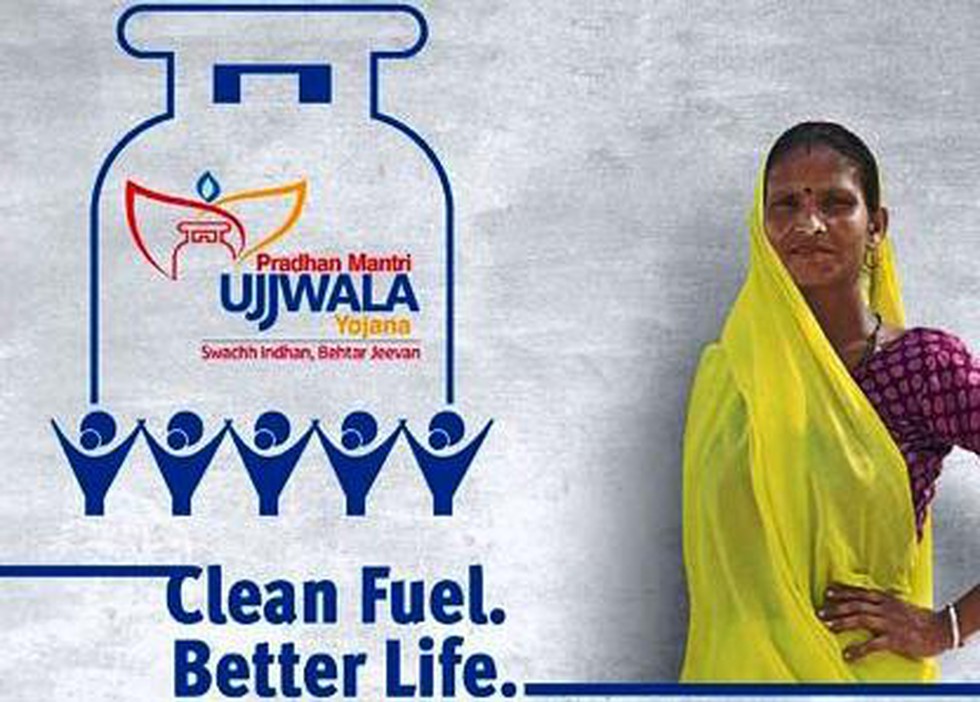
PRADHAN MANTRI UJJWALA YOJANA

In India, around 10 crore households out of more than 24 crore households lack LPG connections and so use coal, firewood, cow dung cakes and other such fuels as primary fuels for cooking. The emission from these are extremely harmful for the human body. To save the women and children from the health risk the PMUY scheme was released.

Pradhan Mantri Ujjwala Yojana was launched on 1st May 2016, by honorable Prime Minister Narendra Modi, in Ballia, Uttar Pradesh. The scheme aims at providing safe cooking fuel- LPG. 5 crore LPG connections will be provided to the families belonging to Below Poverty Line (BPL) with a financial support which is an interest free loan for each connection, for the purchase of gas stove and refill to be provided in next 3 years. The government would bare a cost of 1600 per connection for the purchase of other support items for LPG connection such as a cylinder, regulator, safety hose, booklet, etc.

According to report of WHO, smoke generation from the burning of unclean fuel for cooking such as wood, coal, cow dung cakes, and other such unclean fuel is equally toxic to burning 400 cigarettes in an hour. Inhalation of such unclean fuel smoke affects the health adversely. WHO estimates 5 lakh deaths in India take place because of inhalation of such toxic smoke from household pollution causing several pulmonary, heart and lung diseases to the women and children.

The Pradhan Mantri Ujjwala Yojana was formulated keeping in mind the health of the women and children and to keep them away from the toil of collection firewood from unsafe areas. This scheme also took to the empowerment of women, especially the women in rural areas, by providing LPG connections in the name of the women of the household. An amount of Rs 8000 crore was allocated for this scheme, for The BPL families identified on the basis of the Socio-Economic Caste Census Data.

The Pradhan Mantri Ujjwala Yojana not only empowers the women of the rural areas and safeguard the health of women and children, but also provides business opportunity of at least Rs 10000 by providing employment to around 1 lakh people. It provided a boost in the ‘Make in India’ project as all the gas stoves, LPG cylinders, gas hose and regulators are manufactured domestically for the implementation and fulfilment of this scheme.

Impact

714 districts have been covered under this scheme an 7,19,06,812 PMUY connections have been released, as per the records of ‘pmuy.gov.in’, the official website of government of India for Pradhan Mantri Ujjwala Yojana. Against the target of 15 million for the first year of launch, 22 million connections were provided. 30 million connections were provided by 23rd October 2017. 44% of these connections were provided to the Scheduled Castes and Scheduled Tribes families. In 2018 included 80 million poor households to provide them with LPG connections. An increase of 56% in 2019 was achieved as compared to 2014. This scheme provided the women for prevention against respiratory diseases because of unclean cooking fuel and also provided for the upliftment of social status of women by making it mandatory to take LPG connection on the name of the women of the family.

CLOUD COMPUTING

Cloud computing is the on-demand availability of computer system resources, especially data storage and computing power, without direct active management by the user. The term is generally used to describe data centers available to many users over the Internet.

Cloud computing is the delivery of computing services , including servers, storage, databases, networking, software, analytics, and intelligence over the Internet (“the cloud”) to offer faster innovation, flexible resources, and economies of scale.

There are three main types:

• Infrastructure as a service (IaaS)
• Platform as a service (PaaS)
• Software as a service (SaaS)

Examples of Cloud Computing —

The main types of cloud computing include software as a service, platform as a service, and infrastructure as a service. Serverless computing, also known as function as a service (FaaS), is also a popular method of cloud computing for businesses. SaaS or Software as a Service.

Benefits of cloud computing —

• Reduced IT costs. Moving to cloud computing may reduce the cost of managing and maintaining your IT systems.

• Scalability.

• Business continuity.

• Collaboration efficiency.

• Flexibility of work practices.

• Access to automatic updates

The  most obvious uses of cloud computing is the mobility that it brings, both to the recreational user, as well as to the corporate and business user. Many of us are already familiar with some cloud computing services, like Google Docs, or even email services.

Five characteristics of cloud computing
On-demand self-service.

• Cloud computing resources can be provisioned without human interaction from the service provider.

• Broad network access.

• Multi-tenancy and resource pooling.

• Rapid elasticity and scalability. 

• Measured service.

Google Drive is a cloud-based storage solution that allows you to save files online and access them anywhere from any smartphone, tablet, or computer. … Drive also makes it easy for others to edit and collaborate on files.

Disadvantages of cloud computing

• Data loss or theft.

• Data leakage.

• Account or service hijacking.

• Insecure interfaces and APIs.

• Denial of service attacks.

• Technology vulnerabilities, especially on shared environments.


360 WANDER WRITER

WELCOME TO TECHIE WORLD

CODING


if(brain!=empty)

{

keep coding();

}

else

{

order Coffee();

}


Coding is nothing but the computer language through which we can develop apps and any other software required for this technological world.

Most of them think it to be a difficult task . Actually it is not!. You have to be patient enough to learn and take effort to learn it with persistence. Do you know that all Indians have the capacity to be a good coder! Yes, Most Indians are good at mathematics. This logical thinking helps in problem-solving. Hence having a greater chance to be a good coder.

Computer coding is an important skill in the current job market. It serves as a valuable skill in several fields and job opportunities across the oceans. Knowing how to code is a valuable skill for anyone looking for a job in the technology or computer science fields.

Coding Languages

  • C Programming
  • HTML
  • CSS
  • JAVASCRIPT
  • C++
  • PYTHON
  • PHP
  • SQL …and many more

Careers to coders

  • Database Administrator 
  • Web Developer 
  • Information Security Analyst
  • Applications Developer
  • Instructional Designer
  • Digital Marketing Manager

sharpen the coding skills

Reading Books

Reading books to acquire knowledge is a primary way. The technology might have changed but the importance of books and its impact on human minds on gaining knowledge remains the same. Here are some books listed for reference:

Something new each day…

You should take some time out each day and challenge yourself with something new. Of course, it doesn’t have to be complicated.

Play a coding game 

Here are some :

Platforms to practice:

  • geek for geeks
  • Leetcode
  • Hackerrank
  • Codechef
  • Topcoder

Media Bias: the shoddy practice

Media Bias is a term used to describe biases and personal prejudices of a journalist in the selection of events that will be reported and the manner in which they’ll be reported.

In earlier times, every media organisation had a political backing, that is, funded by any political party or group. It was only with late 19th century and early 20th century, journalists began to feel the need for a truth and unbiased reporting.

Types of Media Bias:

A) Bias by Omission

This is one of the methods in which journalists wipe out one side of the story or series of facts over a period of time.

B) Bias by Selection of Sources:

In this method, journalists usually approach those sources who will favour their own prejudices. Both sides of a story aren’t given any importance.

C) Bias by Story Selection.

This mostly happens when a media organisation is funded by a political party. In this, journalists only highlight those issues and stories that pertain to one political party. For example, only talking of achievements of a political party and ignoring its failures.

D) Bias by Placement.

This means where an editor places the story and how much they consider the story is important. For example, if a news organisation is supporting a certain political party and there’s a humanitarian crisis in any city because of that political party, in this case, news editor would place the story at the end so that it gets less importance.

E) Bias by Spin.

In this, reporters and journalists give their own “subjective comments” to a factual story and make it appear before the public their own way. These interpretations can be harmful as they divert the minds of public from actual facts.

Some examples of Media Bias:

A) Ethnic Bias:

This is the form of bias which includes racism, nationalism or xenophobia. For example, western media’s portrayal of India as a poverty stricken country with no toilets. Yes, India suffers with poverty but the western media made it look like it’s the only thing India is all about.

B) Corporate Bias:

Media is also extremely biased at times when reporting about corporate misconduct. This is because some media channels are funded by big industrialists and business people.

C) Class Bias

Media houses are extremely bias when it comes to class. Higher class cases are handled with dignity whereas oppressed classes are treated with lack of respect and humanity.

D) Religious Bias

Certain media houses favour one religion according to their own religious ideologies and thus even start supporting or give a biased reporting when their religious community is doing something wrong.

E) Political Bias

Probably the most famous form of bias in which a media house supports a political party right from the beginning of covering their political campaigns to trying to hide their political mismanagements.

Journalists must separate fact from opinions and do an unbiased reporting for a better transportation of news information to the public. This way it would also be able to hold the system responsible.