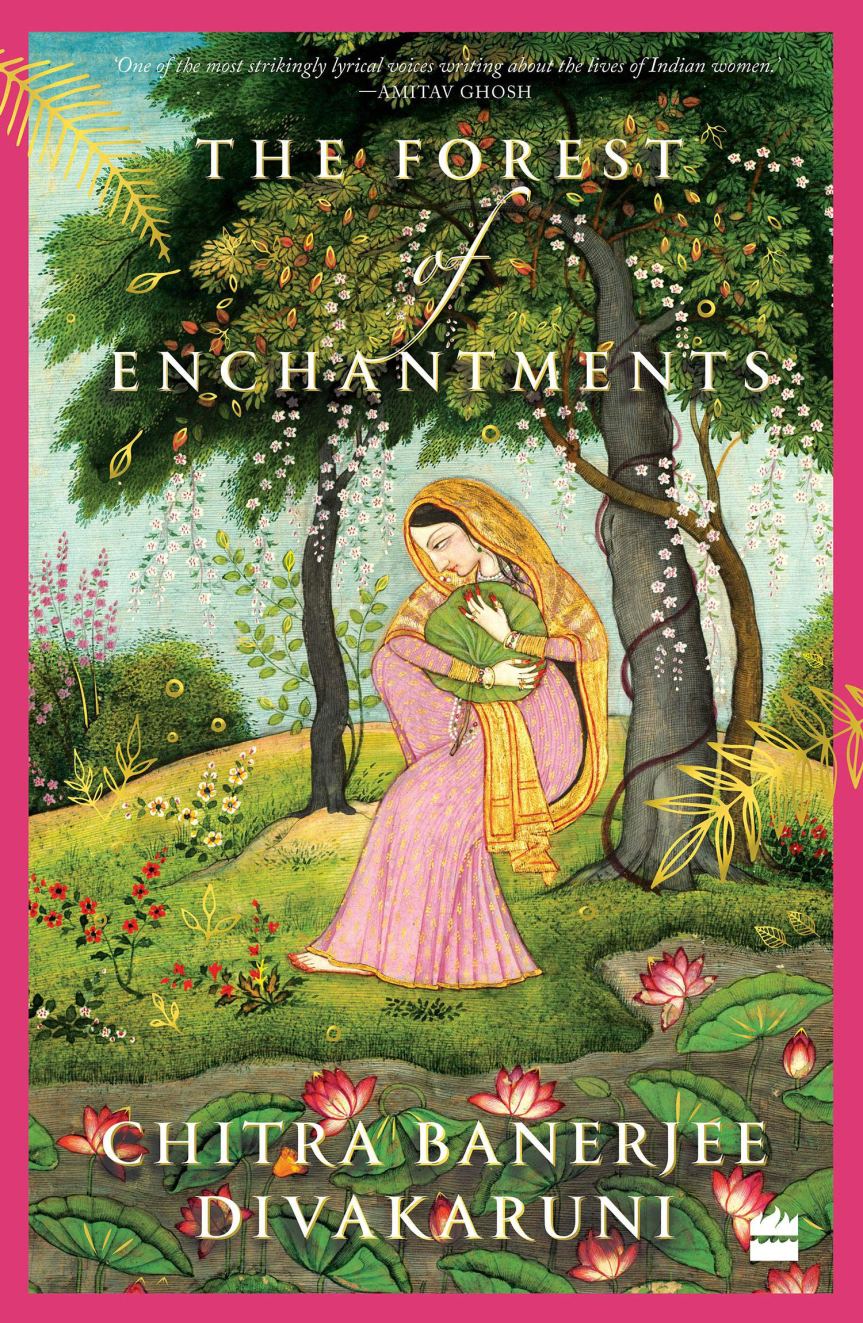
‘The Forest of Enchantments’ – A Sitayan

“Sita’s story haunted me. Because it was one of the first stories I was told, and because I sensed there was a disconnect between the truth of Sita and the way Indian popular culture thought of her. I sensed that Sita was more than what we took her to be. But who she was I didn’t yet know.”

   Chitra Banerjee Divakaruni has made a well-written Author’s note right before the prologue to the novel begins. She tells us one big truth which is to a great extent a commonality among three-fourth of the world’s population who is familiar with the great epic ‘Ramayana’ – who real Sita is, is untold.

      Despite Sita being considered as the incarnation of Goddess Lakshmi herself, she is often regarded as a meek woman who is an epitome of sacrifice and unending love, with no temper or hatred. The ‘ideal-woman concept’ idolizes Sita for she is considered the perfect wife with silent stoicism and the ability to long endure without whimpering. This is of course a prominent reason why many name their daughters ‘Sita’ and asks them to look up to the goddess to learn subservience, sacrifice and ‘perfection’. Sita is indeed to be idolized but not in a way most people perceive.

                     ‘The Forest of Enchantments’ is brilliantly feministic in writing. It retells Ramayana through Sita’s eyes, making us analyse the story through a gynocentric perspective. Thus, it indubitably makes Ramayan a ‘Sitayan’.  The author sets to bring out the version of Sita nobody knows, a Sita who is much more than a mere daughter, a loyal wife and a loving mother, a Sita who is a woman, an equal to Ram, one who refuses to give her dignity away even for love. Chitra Banarjee also tries to sympathize with some of the other female characters of Ramayana, who we consider evil, flawed or obnoxious, through Sita. We see Sita musing about whether Shurpanaka had deserved to get mutilated by Ram just for declaring her love for him. Similarly Sita chats with Ahalya asking her a question that most of us would’ve asked if gotten an opportunity to meet Ahalya in real- ‘why did she forgive Gautam?’. Sita is left answerless by Ahalya but it is quiet clear from her countenance that it is what women are supposed to do, forgive and endure.  Sita herself had to go through a similar situation, when Ram refused to accept her, doubting her chastity after Ravan abducted her, she performed the agni-pareeksha and the gods itself declared her innocence. Sita got the answer as to why Ahalya forgave her husband when she found herself forgiving Ram inspite of how cruel he had been to her. The author draws a picture of how women are taught to endure and forgive when men are never blamed for their actions. She also points out how love can be blinding. Ram’s consecutive injustices to Sita like abandoning her while she’s pregnant and making her do fire test is often celebrated by people as the spirit of kingship and the duty of a husband but ‘The Forest of Enchantments’ questions Ram on how he’s going to pay for his actions. The epilogue to the novel is heart-wrenching, especially for the female audience, for it shows how extreme a woman can get insulted, how her dignity is at stake and her indecisiveness whether to choose love or self-respect. Sita lets go the love of her life and chooses to be dignified and decides not to settle for anything less.

             Chitra Banerjee’s ‘Sita’ is what every woman should be. Loving, caring yet resilient and dignified. The author walks us through every little detail on ‘How to be a Sita’, not the stoic one but the strong one. The book is indeed a must-read if you are ever asked to be like Sita.

Sanskrit.

Sanskrit is a standardized dialect of Old Indo-Aryan, originating as Vedic Sanskrit as early as 1700-1200 BCE. One of the oldest Indo-European languages for which substantial documentation exists, Sanskrit is believed to have been the general language of the greater Indian Subcontinent in ancient times.

Sanskrit ; attributively संस्कृत-, saṃskṛta-; nominaly संस्कृतम्, saṃskṛtam, is a classical language of South Asia belonging to the Indo-Aryan branch of the Indo-European languages. It arose in South Asia after its predecessor languages had diffused there from the northwest in the late Bronze Age. Sanskrit is the sacred language of Hinduism, the language of classical Hindu philosophy, and of historical texts of Buddhism and Jainism. It was a link language in ancient and medieval South Asia, and upon transmission of Hindu and Buddhist culture to Southeast Asia, East Asia and Central Asia in the early medieval era, it became a language of religion and high culture, and of the political elites in some of these regions. As a result, Sanskrit had a lasting impact on the languages of South Asia, Southeast Asia and East Asia, especially in their formal and learned vocabularies.

Sanskrit generally connotes several Old Indo-Aryan varieties. The most archaic of these is Vedic Sanskrit found in the Rig Veda, a collection of 1,028 hymns composed between 1500 BCE and 1200 BCE by Indo-Aryan tribes migrating east from what today is Afghanistan across northern Pakistan and into northern India. Vedic Sanskrit interacted with the preexisting ancient languages of the subcontinent, absorbing names of newly encountered plants and animals; in addition, the ancient Dravidian languages influenced Sanskrit’s phonology and syntax. “Sanskrit” can also more narrowly refer to Classical Sanskrit, a refined and standardized grammatical form that emerged in the mid-1st millennium BCE and was codified in the most comprehensive of ancient grammars, the Aṣṭādhyāyī (“Eight chapters”) of Pāṇini.The greatest dramatist in Sanskrit, Kālidāsa, wrote in classical Sanskrit, and the foundations of modern arithmetic were first described in classical Sanskrit. The two major Sanskrit epics, the Mahābhārata and the Rāmāyaṇa, however, were composed in a range of oral storytelling registers called Epic Sanskrit which was used in northern India between 400 BCE and 300 CE, and roughly contemporary with classical Sanskrit. In the following centuries, Sanskrit became tradition-bound, stopped being learned as a first language, and ultimately stopped developing as a living language.

Social Media

Social media is a big tool and has a huge impact on individuals and their lives. While some impacts can be positive, social media has been shown to negatively affect things like our moods and stress levels. Addiction is caused by social media too. With access to it anytime of day on our phones, it’s easy to fall into the bad habit of checking it everywhere – during a meal, in class when a professor is talking, or even in bed when it’s time to sleep!

Genrally what we consume daily is what we become eventually many people get confuse in their life because they are not ableto enjoy their life as they are comparing their luife with life of someone they haver followed virtually,

social media create fake scenarios among young individual, only some percent of people use it wisely other just get depressed by seeing other persons life.

Social media has been a part of our lifestyle since last few years but eventually it is more disturbing now, social media was created to share information’s, to communicate with people, to make friends but now its idea has been changed widely its used for posting pictures, posting about how they buy new car its a whole show off business this can adversely affect young minds i think their should be some age restriction regarding use of social media

AT last I would say, Blaming someone or some users wont help well who are users they are people like us scrolling Instagram or Facebook hours by hours and wasting their time, i think we have power to use it in positive way just wasting time wont help

Think wisely !!

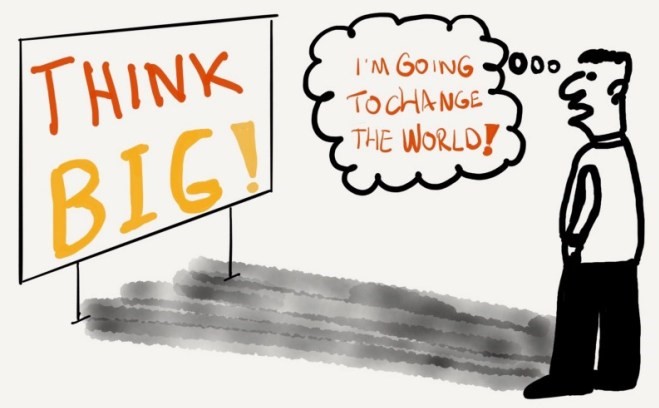
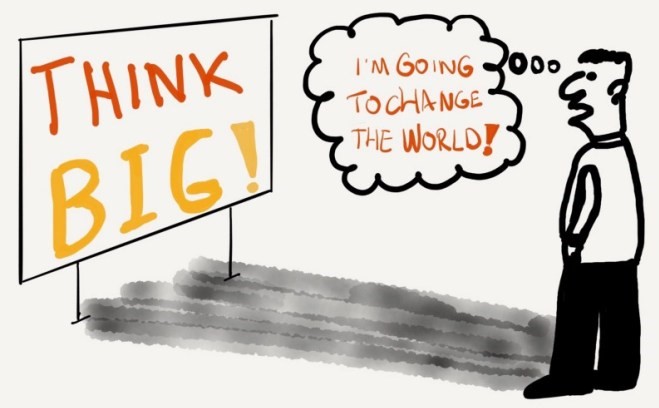
The Danger Of Thinking Big

We live in interesting times. Technology has made a lot of things possible that we couldn’t think of, just a few years ago.

We all crave innovation, change, and improvement. That’s why ideas, creativity, and knowledge are one of the most important resources in the world.

New apps and services pop up every single day. And it seems like every single one of them is a success.

I often hear people, with big ideas, say: “How difficult is it to come up with a new app? You just need to think big and have a great idea.”

And then they continue: “You hire a freelance developer. Release it. Sell it. And BOOM. Relax on a beach.”

But let’s be real, it’s hard to achieve success. And yet, people think that as long as they have a great idea, they can achieve anything they want.

And it’s not just talking. We genuinely believe that we can become anything we want. We look up to people like Mark Zuckerberg, and we say: “You know he started Facebook from his dorm room, right? And now he’s a billionaire.”

“Or how about the founder of Snapchat, Evan Spiegel? He became a billionaire at age 24. Must be easy.”

A Big Idea Does Not Guarantee Success

I’m not going to tell you that you can’t do something—we already have enough people who do that.

But on the other side of that, we have “thinking big.” However, thinking big can turn around and bite you in the ass. It’s delusional to believe that you can change the world before you’ve worked yourself into a place that makes it possible for you to do so.

We often set out to achieve big things that are unique. Things like, “I want to be the first person who did X.” Or, “I want to be the youngest person who did Y.”

Are we a “genius” now because we have these big ideas?

In his new book, Ego Is The Enemy, Ryan Holiday writes about the dangers of thinking big:

“There is a real danger in believing it when people use the word “genius” — and it’s even more dangerous when we let hubris tell ourselves we are one. The same goes for any label that comes along with a career: are we suddenly a “filmmaker,” “writer,” “investor,” “entrepreneur,” or “executive” because we’ve accomplished one thing? These labels put you at odds not just with reality, but with the real strategy that made you successful in the first place. From that place, we might think that success in the future is just the natural next part of the story — when really it’s rooted in work, creativity, persistence and luck.”

  • Are you an entrepreneur if you have one good idea?
  • Are you a writer if you published two articles?
  • Are you a filmmaker when you create a YouTube video?

When you start thinking like that, you might feel like you’ve already achieved success. The biggest reward for most people is that they can call themselves a “founder,” “owner,” “writer,” or any other title that looks good.

But you’re not your Twitter or LinkedIn bio. No one cares about that stuff — but why do we pursue appearances? It’s often our ego speaking for us.

Look, I’m all about thinking big, but I’m also about being practical.

Because there’s still a difference between doing and dreaming. It doesn’t matter how big your dreams are — if you lose sight of what matters, you might never achieve those big dreams in the end.

Start With Tiny Steps

We live in a sum-sum world, not a zero-sum world. So it’s in everyone’s interest that we have people who set out to change the world. And sure, why can’t you change the world? It doesn’t require any special talent to change the world. It requires hard work and determination.

Thomas Edison put it best:

“There is no substitute for hard work.”

But success is not about a glorious vision. It’s about you, working on your goal—even when no one’s watching. With an emphasis on working because dreaming alone won’t get you anywhere.

In Ego Is The Enemy, Ryan Holiday writes about how we are often our own worst enemy when we think big. He draws lessons from different successful people who have made it big now but didn’t think big before they reached a level of success.

Ryan Holiday writes:

“A few years ago, one of the founders of Google gave a talk in which he said that the way he judges prospective companies and entrepreneurs is by asking them “if they’re going to change the world.” Which is fine, except that’s not how Google started. (Larry Page and Sergey Brin were two Stanford PhDs working on their dissertations.) It’s not how YouTube started. (Its founders weren’t trying to reinvent TV; they were trying to share funny video clips.) It’s not how most true wealth was created, in fact.”

Investor Paul Graham (who funded Airbnb, Reddit, Dropbox, and others), even says:

“The way to do really big things seems to be to start with deceptively small things.”

So, if thinking big isn’t a great strategy, what is?

When I study people who are called “successful”, I don’t see hubris. I see hard work. It’s always about doing the work — not about dreaming big.

People who say that dreaming big, visualization, and hoping for big things to happen is a good strategy, always have something to sell. If that stuff worked, everyone was a millionaire, philanthropist, or a world leader.

Unfortunately, you can’t build anything on your good intentions.

As Henry Ford once said:

“You can’t build a reputation on what you’re going to do.”

Similarly, you can’t get any results by dreaming big and not putting in the work on a daily basis. Because at the end of the day, results matter the most, not words.

How Literature is getting popularity due to the advent of Movies and Dramas

“Literature since the Medieval times have always been a mystery as well as a fascination for its audience”. As the decades change, their audience preference also changed. There was a whole decade which we all know as  a biggest blood-curdling historical events of all time, also famously known as “The Age before Queen Elizabeth, when war and slaughter  was the prominent reason and people lost their sanity due to   political catastrophes and the consequences occurred when there was a division between the religion and  science.”

When people lost their sanity, they abandoned literature and art which ultimately made the audience miserable and fragile. However, as the decade improved, we come to see that “Elizabethan Drama’s” has acted as a helping hand in the history of literature when people were gazing for a source of Entertainment.

Dramas are the mainstream or we can say as the generator of the exquisite source of entrainment since the 16th century which played an important role to make awareness among people about various social issues which happened during the era. Drama is one of those fabulous art forms which not only traveled a revolutionized journey from the 16th century to the 21st century but also have contributed a big number of Legendary works in the history of literature.

Dramas which are worldwide famous in the contemporary world are due to the main reason of fandom among the audience and in this process, the fandom not only goes to Drama but also to literature and movies.

Drama, Movies, and Literature – The Best Trio Ever!

Every era has its uniqueness and flair of creativity in any form of art. Likewise, whether it is Literature, Movies, Music, or drama, their secret to flourishing in the millennial generation is “Audience”. The audience has always been a great critic when it comes to Literature and Movies. Today we have Film and Literature which is established due to fandom among the audiences.

To get fame and acknowledgment from the audience is not an easy task, it has always been a striving job to be likable by all types of audiences. Yet Literature gained its popularity with the upper hand of Movies and dramas. Literature which was uncanny for many people is now becoming like their favorite cup of coffee which has the cream of fandom and fasciation towards literature.

Pop fiction – A New Version of Literature

A contemporary era where literature has grown acceptance due to the arrival of Movies and dramas is not only appreciated by their audiences but they are also a newer version of Preserving authentic Literature so that the fragrance of beautiful texts written by prominent writers won’t fade for the coming centuries.

Since it is an up-gradation, the technique of showcasing literature through the lens of the big screen of the cinematography industry is adaptable and modified. Pop Fiction is more merchandised and the writers craft their stories according to their audiences’ preferences.

The contemporary world is full of bustling lives where the audience expects entertainment to be relatable and which has a good quality of content. So cinematography industry had taken this opportunity as a responsibility towards their audience which proofs them their magnificent works by centering on literature.

Great stories come with a great plot!

Literature is famously known by all the audiences due to great movies and TV Series which either are adaptations or taken from real based stories from literature. When we say literature and movies the Millennial generation always mulls over about one great work but also gives a chill about going back to nostalgia! I guess we all know what it is? yes, it’s Harry Potter !  one of the prominent holiday Series which every child of the contemporary era never fails to reminisce about.

Whether it is plot structure, characters, or the setting, J.K Rowling’s works have been justified more cause of movie series made upon her famous works. Literature always provides us the imaginative descriptiveness of a piece of work and Cinematography provides an Illustrative of Visual and audio descriptions and together they have reached a high amount of success worldwide.

Similar to Harry Potter many classical works of literature are in the airy dreams among the audience cause of excellent movies turned from these works. Whether it is Louisa May Alcott’s “Little women” which talks about how women are striving in this society to acknowledge their identities by their forte and minds or whether it is Margaret Atwood’s “The Handmaid’s Tale” which talks about a dystopian where women are taken as an Object to played with, well we can never forget that holocaust literature which made us more emotional and sentimental when we watched the movie “Book Thief”.

Our childhood was like a sweet dream which was incomplete without those fairy tales of Cinderella and beauty and the beast which enlightened us with all the moral values.

Hence, there is no conclusion of how movies and literature are excellently mending with each other and providing us the finest edition of the whole thing. This not only keeps our literature preserved but also protected with increasing fandom with the young audiences.

COVID-19

Symptoms

COVID-19 affects different people in different ways. Most infected people will develop mild to moderate illness and recover without hospitalization.

Most common symptoms:

  • fever
  • dry cough
  • tiredness
  • Less common symptoms:
  • aches and pains
  • sore throat
  • diarrhoea
  • conjunctivitis
  • headache
  • loss of taste or smell
  • a rash on skin, or discolouration of fingers or toes

Serious symptoms:

  • difficulty breathing or shortness of breath
  • chest pain or pressure
  • loss of speech or movement
  • Seek immediate medical attention if you have serious symptoms. Always call before visiting your doctor or health facility.
  • People with mild symptoms who are otherwise healthy should manage their symptoms at home.
  • On average it takes 5–6 days from when someone is infected with the virus for symptoms to show, however it can take up to 14 days.

Where should we register for COVID-19 vaccination?

Register on the Co-WIN Portal and schedule your vaccination appointment. https://www.cowin.gov.in/home

The contraindications to second dose of vaccine are:

Severe allergic reaction after a previous dose of this vaccine. If your treating physician considered this event as a severe allergic reaction to the vaccine, then you should not take second dose of vaccine. If you experience any other adverse event (known or unknown) after first dose, you can take the second dose.

Patients who have experienced major blood clotting (venous and/or arterial thrombosis) in combination with low platelet count (thrombocytopenia) following first dose of vaccine.

Keats’ ‘Ode on a Grecian Urn’

John Keats was an exemplary second-generation romantic poet who lived in the early 19th century. The romantic period refers to several literary movements that were characterised by their highly subjective form of writing, which was essentially a breakaway from the traditions of more rigid writing followed by the Neoclassical poets. Keats belonged to a group of poets who were later dubbed as the ‘second-generation romantics’ and it included other poets like Shelly, Wordsworth and Byron. The romantic age in England is generally marked by the publishing of ‘Lyrical Ballads’ by Coleridge and Wordsworth in 1789.

Thou still unravish'd bride of quietness,
       Thou foster-child of silence and slow time...

One of the main characteristics that set the romantics apart from the others is their intensely personal subject matter. It ranged from their own internal conflicts, to their philosophical thoughts, to praising the glory of nature and its effects on humans. Their poetic style was free and untamed (not that it did not have any metrical compositions, they were comparatively flexible in relation to the neoclassic poets.) like the vast untamedness of nature. They found their sources of poetry from particularly unique and seemingly unlikely experiences. For them, poetry conveyed its own truth and the sincerity was the true criterion for judging a poetry.

Heard melodies are sweet, but those unheard
       Are sweeter; therefore, ye soft pipes, play on;
Not to the sensual ear, but, more endear'd,
       Pipe to the spirit ditties of no tone:...

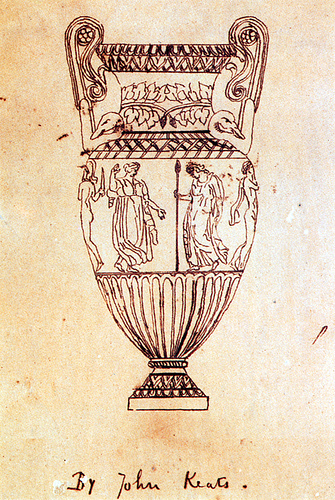
Several of Keats’ poetry questions the mortality and impermanence of human life with relations to art and its everlasting life on earth. In ‘Ode on a Grecian Urn’, the speaker comes across an old Grecian artefact and admires all the paintings on it. The urn contains several pictures of characters including a fair youth who sings beneath an evergreen tree, two lovers who are almost kissing, a melodist playing a pipe, a town of people on a procession with a sacrificial cow and so on. He takes a moment to think about each of their stories and wonders how it is to remain immortal.

For ever panting, and for ever young;
All breathing human passion far above,
         That leaves a heart high-sorrowful and cloy'd,
                A burning forehead, and a parching tongue...

He starts off the poem by describing the beautiful shape of the urn. He addresses it by several names and revels in the beauty and satisfaction that it gives him. He then addresses the sweetness of the music that might be coming out of the painted instruments. He assures himself by saying that the unheard melodies are sweeter because it speaks directly to our inner soul. He then moves onto the loves and assures them that though they may never kiss, they will forever remain young and fair. He complements the beautiful boughs of the trees and tells them that they will never wilt and will forever remain beautiful. In the later stanza, the poem takes a little turn as the speaker as he examines how they will live forever while humans living in the real world are all eventually bound to die one day. He then examines a procession of people who are carrying a sacrificial heifer and wonder which town or village is empty of this folk.

  "Beauty is truth, truth beauty,—that is all
                Ye know on earth, and all ye need to know."

In the final stanza of the poem, the speaker once again admires the beauty of the urn and decides that even after his lifetime, the urn will forever remain and tell its story for generations to come. The speaker finally neds the poem with one of the most beautiful verses in the poem going “Beauty is truth, truth beauty” which he confirms is the only eternal truth that one needs to know on earth.        

Reference Links:


An escape from reality – Books

I can never agree with people who say watching a movie or series is better than reading a book. While watching a movie, we are just looking at a projection of the film. We are not using our imagination.

I have read the divergent series by Veronica Roth. It also has a movie trilogy. Well, the movie is a disappointment to what the book portrays. The book has so much more details which the movie fails to show.

Books allow us to create our own imagination. They talk about the prominent features of their characters like the almond-shaped caramel eyes and the brown hair with a tint of waves and a well-defined jaw of the person. They leave it on us to decide how the person looks. They describe the cottage with a warm and cozy fireplace but do not provide us with how the cottage looks.

Books allow us to create a world of our choice. Every person reading the book would imagine their world differently. I started reading books as an escape from reality. When I was going through a hard time in my life, books became my best friends. No matter how bad my day was, I was always looking forward to start reading. It made me forget about my life because books allow us to live the life of the characters of fiction. Their life would become mine till I completed the book. At the end of every book, I would feel happy and sad at the same time. I felt sad because I never wanted the book to end. Happy because I get to live the life of another character when I start my next book.

Now you see books are an escape from reality, but they are a good escape. Reading books comes with a lot of benefits:

Improving vocabulary: when I started reading, I would make sure to find the meaning of every word that I was unaware of. For me, reading is incomplete without knowing what every word means.

Improves creativity: A person reading a book isn’t just reading literature words. An entire world of imagination is going on in their minds.

The best form of entertainment: it is better than looking at your screens for hours.

Creates a sense of understanding: when we read a book where the character has anxiety. It will make us understand how people around us with anxiety would feel like.

Inspires us: I have read books where the main characters do not give up, no matter how many problems come their way. This has honestly inspired me a lot in my life.

Makes us a better writer: reading makes our brain absorb the vocabulary and grammar required for better writing skills.

You must have also noticed that talking to people who read has always been interesting. People who read have a lot to share with the world. I remember talking to a few people who read a lot and our conversation never dies down. Reading also reduces stress and boosts our mood instantly. I want to end with my favorite quote by Mason Cooley

“Reading gives us someplace to go when we have to stay where we are”

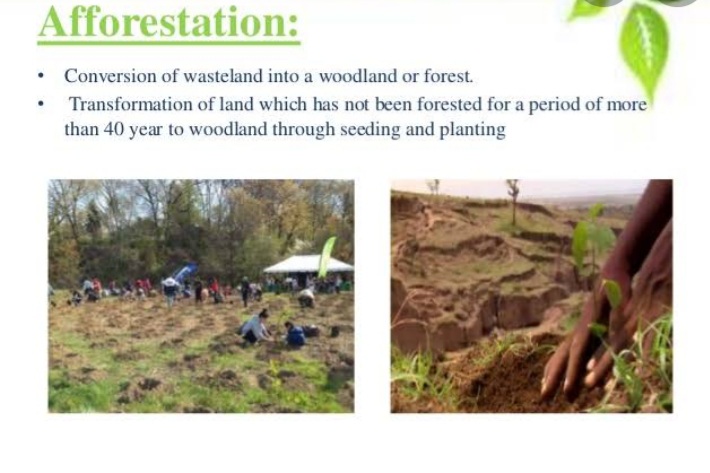
Afforestation

Afforestation is very useful to prevent and maintain the oxygen levels. Due to the deforestation, many of the trees are being cut and the oxygen supply has been reduced very drastically. Afforestation will help to maintain the oxygen levels in the atmosphere and helps the individual and the world to be healthy all the time. Oxygen is the minimum need for the individual to survive on the earth. If there is no oxygen, then which will cannot live or survive. When there is no o2, It is equally difficult for the animals to survive.

It also helps to maintain good forests. Deforestation, that is cutting of the trees makes the land abandoned and trees life less. When an individual takes a step forward to plant trees that is afforestation, good number of trees will be grown and the forests will be developed.

The most important thing for the animal’s survival is trees that give shelter and plants for the food. When the trees are being cut, some of the animals find no shelter and sometimes no food to eat. When afforestation takes place animals will find good shelter and also good food to eat.

Importance of Afforestation :

Afforestation helps to addess all the issues of soil erosion and barren land at the same time. Tress acts as wind barriers thereby weakening the speed of the wind and reducing its impact and ability to carry big soil particles.

The impacts of afforestation is occuring in many parts of world, can modify the nature and transformations of soil organic carbon and associated soil prevents, which in turn can affect plant diversity and ecosystem function. Afforestation also decreased soil bulk density and pH, and increased soil water content.

Types of Afforestation :

Afforestation materials are mainly divided into three categories: seed,seedling,and cutting. The choice of these three types of afforestation materials and methods is related to site conditions, tree species and age.

Various causes of Afforestation :

* Afforestation is highly fundamental in creating an alternative source pool of nature resource.

* Afforestation aids in tackling global warming and stabilizing global temperatures.

* protection of sensitive areas, biodiversity, and natural cycles.

* Afforestation can support wildlif.

* Afforestation creates employment and can provide a source of livelihood.

Advantages of Afforestation :

* A constant supply of forest products.

* prevents soil erosion.

* stabilizes the climate.

* Has the potential of reversing global warming and climate change.

* Better quality air.

* Improve watershed.

* preservation of wildlife.

* provision of employment and economic opportunities.

Disadvantages of Afforestation :

If not properly managed, afforestation can result in a reduction of local biodiversity, the modification of particular biomes, the intriduction of non – native and potentially invasive species, reduced stream flow and lost revenue from agricultural.

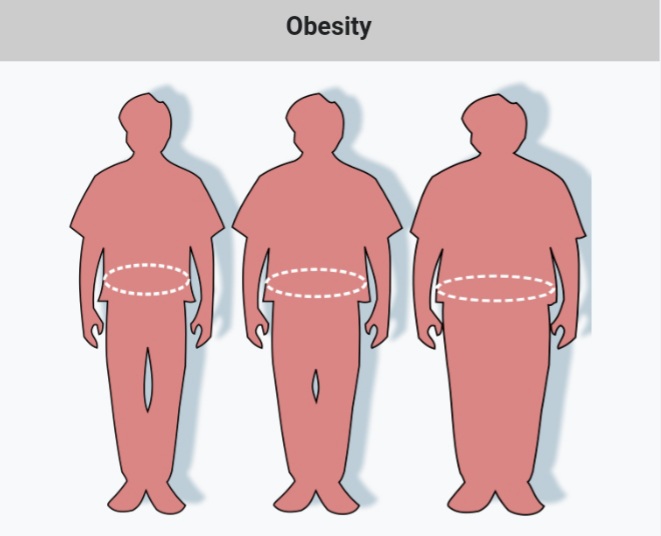
Obesity

Obesity is described by the BMI (Body mass index). The obesity in the body is nothing but the high level of fat stored in the body. It is a very bad thing which in future leads to many health problems.

Many of the children are falling obese now a days. This is because of not having good food. Many of the children are highly addicted to the junk food. The junk food intake in the body increases the fat levels in the body.

A disorder involving excessive body fat that increases the risk of health problems. Obesity often results from takingin more calories than are burned by exercise and normal daily activities.

Symptoms:

Obesity occurs when a person’s body mass index is 25 or greater . The excessive body fat increses the risk of serious health problems.

What causes obesity?

Obesity is generally caused by eating too much and moving too little. If you consume high amounts of energy , particularly fat and sugars, but do not burn off the energy through exercise and physical activity, much of the surpluse energy will be stored by the body as fat.

8 Most common causes of obesity :

* physical inactivity.

* overeating.

* Genetics.

* A diet high in simple carbohydrates.

* A frequency of eating .

* Medications.

* psychological factors.

* Diseases such as hypothyroidism, insulin resistance, polycystic ovary syndrome, and caushing’s syndrome are also contributors to obesity.

Let us now look at some methods to prevent obesity.

*Healthy and nutritious food :

It is very important to consume healthy and nutritious food every day. To gain a sufficient amount of nutrients and and to be healthy it is very important to consume nutritious food. Consuming nutritious food helps us to gain sufficient energy. Being healthy prevents us from Many deadly diseases.

*Exercise :

Exercising at least for 10 to 15 minutes a day help the individual to be physically fit and also mentally strong. Exercising every day is a very good habit which everyone need to make it and perfect habit to do. Exercising 10 to 15 minutes also relieves us from the stress and the tension we have had. So, it is better to spend at least 10 to 15 minutes even in our hectic schedule an exercise.

* yoga :

Yoga relives from the stress and tension we have had. Sparing at least 10 to 15 minutes time on yoga benefit is a lot. It relaxes the muscle and comes to mind. It helps to be physically fit and mentally strong. All the asanas and pranayama helps to Gain strength and to be physically fit.

*Meditation :

Meditating for certain minutes helps to calm the brain and soul. It helps and relieving the stress and the tension we have had. It helps us to focus on the things which we are willing to do. It also equally helps us to be mentally strong. It is such a good and a mandatory practice an individual must obtain and must follow without any delays.

* Monitor your weight regularly.

* Be consistent.

Who obese people?

BMI is calculated by dividing a person’s weight in kilograms by the square of their height in metres. A BMI of 25.0 – 29.9 is classified as overweight but not obese, while a BMI of 30.0 or over is classified as obese. A BMI of graeter than 35.0 is classified as severely obese.

Adult BMI calculator

BMI WEIGHT STATUS

Below 18.5 underweight

18.5 – 24.9 Normal

25.0- 29.9 overweight

30.0 and above obese

The negative effect of obesity :

Obesity is serious beacause it is associated with poorer mental health outcomes and reduced quality of life. Obesity is also associated with the leading causes of death in the united states and worldwide, including ,diabetes, heart disease, stroke, and some types of cancer.

National Simplicity Day

12 July is the day to Honors transcendentalist Henry David Thoreau.Born on 12 July Thoreau was an advocate of living a simple life .He belives that “As you simplify your life,the law of the universe will be simpler.”He was an environmentalist , poet and transcendentalist .He was the man of simplicity who believes “less is more”.

National simplicity day was created to help people to enjoy their life.As simple the word sound ,as complex is when you practice it. livinga simple life,you will find the most beautiful thing in the world.

Indian Miniature Paintings

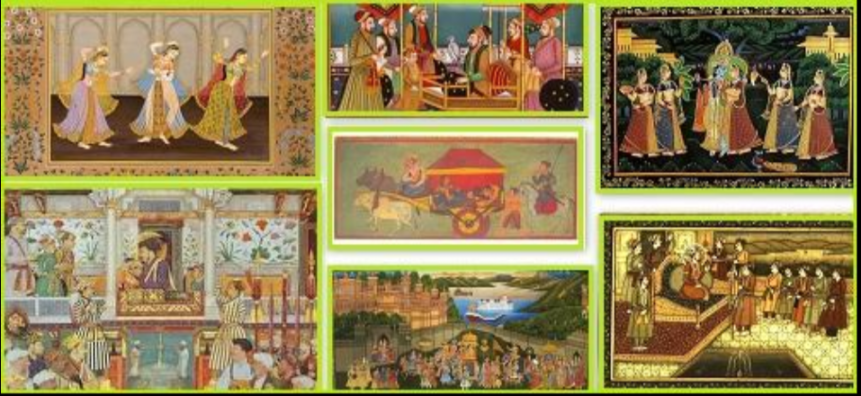
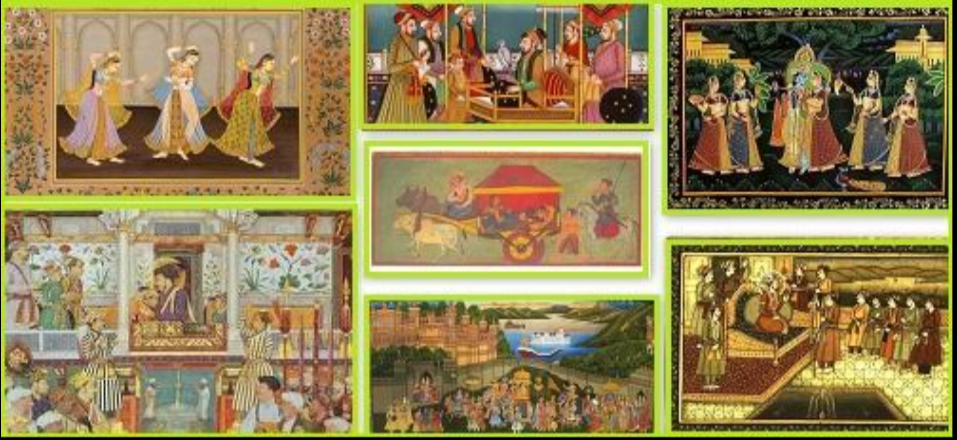
Miniature Art refers to paintings, sculptures, engravings etc. That have small dimensions. Though they are small, they are well detailed. The origin of miniature paintings dates back to the prehistoric times and is profoundly influenced by Indian literature. A miniature painting is generally less than 25 square inches or 100 square centimetres. The subjects in the painting are one -sixth of their actual sizes. Miniature paintings were generally done on materials like cloth, paper, leaves etc. which are quite perishable. These paintings are handmade and very delicate.
Miniature paintings are considered as an ancient art in India and there were many schools for the same, including those of the Rajput’s, Deccan’s and the Mughals. These paintings give an insight into the life of the royals and the common man, the beauty of their womenfolk and the inspirations and devotions of the artists themselves. These paintings are often associated with the Ragas i.e. the melodies of Indian classical music.
Rajasthani School of Miniature Paintings:
This school developed around the areas of Rajasthan, Bundelkhand and Punjab regions. The Rajasthani paintings were greatly influenced by Tulsidas and Kabir. The main theme observed in the illustrations of this school is love in all of its form. Main emphasis is given on the love between human soul and god. This might have been influenced by the Bhakti cult which originated in those days. Paintings are left to the imagination and emotion of the viewers for interpretation.
Features:
Compositions are clear and simple. All figures are in same dimensions. The figure of a woman are duplicated for other women. This is painted as a symbol of femininity. Colours are used harmoniously and are bright with each colour having it’s own specific meaning. The medium mostly used was water colour in tempera hand made paper. The colour scheme is flat and paintings are two dimentional.
Some of the famous Rajasthani miniature paintings:
‘Radha Bani Thani’by Nihal Chand
‘Maru Ragini’ by Sahibdin
‘Chaugan Players’ by Dana

Mughal School of Miniature Painting:
With the advent of Mughal, the Indian miniature paintings shifted to the portraits and richness of colour effects with the unique Persian flavour. During this period, the art specialises in Court and Palace scenes. Themes from Indian epics such as Ramayana, Mahabharata, Bhagvata Purana etc. Are also included. The Indian Miniature painting was at it’s prime time during the period of Mughal Emperor Shah Jahan because he was a great patron of miniature painting. But after his regime, paintings lost their charm and started to decline in the 18th century.
Features:
Mughal paintings denoted the habits of the ruling class. Portraiture was done. Figures were drawn in profile or quarter profile. A decorative border called hasiah was also used. Calligraphy was also done in the paintings. The paintings were male dominated. Portraits of women were drawn from imagination. The medium generally used was water colour in tempera handmade paper.
Some of the famous Mughal Miniature Paintings:
‘Kabir and Raidas’ by Ustad Faquirullah Khan
‘Falcon on a Bird Rest’ by Ustad Mansoor
‘Babur Crossing River Sone’ by Jagannath

https://m.jagranjosh.com/general-knowledge/do-you-know-that-how-indian-art-of-miniature-painting-evolves-1532003322-1

https://artsandculture.google.com/exhibit/indian-miniature-paintings-the-rajasthan-school-academy-of-fine-arts-and-literature/PgLSknKVv0F_JQ?hl=en

The Impact Of Haruki Murakami On The World Of Literature

Fish dropping from the sky and human-animal hybrids are only a few of the “common” happenings in Haruki Murakami’s stories. The famous Japanese author has millions of admirers across the globe, with his best-selling novels translated into over 50 languages.

Haruki Murakami’s widespread fame signals the twenty-first century’s progress to a much more interconnected society, one where origin has no bearing on impact and everyone is a descendant of the diverse communities that happened to come before. Murakami’s huge reach stems in large part from the scope of his own preferences and capabilities. He not only has made many western readers acquainted with some of the East’s modern written achievements, but he’s also translated several  works of English authors like Raymond Carver, F. Scott Fitzgerald, and J.D. Salinger to Japanese, giving Japanese readers exposure to some of  these works for the very first time.

Murakami is heavily inspired by Western writers, finding inspiration in authors ranging from Franz Kafka to Kurt Vonnegut. He now admires the novelists Kazuo Ishiguro and Cormac McCarthy. He became particularly captivated to American culture as a young child, devouring any relics he would discover, whether jazz albums, dollar store paperback books, or Hollywood films.

Murakami’s life has been influenced by jazz music. Several of his novels, like Norwegian Wood (from the same Beatles song) as well as Tsukuru Tazaki, depend heavily on the music of Franz Liszt. 

When it pertains to Haruki Murakami, there seems to be an odd synchronicity between his supporters and his detractors. Everybody thinks that he’s often humorous, especially in his dialogue. His protagonists, who are frequently drawn into detective storylines without the need for a “FOR HIRE” notice in their windows, and who doesn’t love a detective? 

Cats, mundane kitchen activities, dingy barrooms, pop and/or classical theme tunes are always be present in the books, set against a surreal, Manichaean danger zone into which the modest yet progressively resilient protagonist must descend in quest as to what he’s missing, most likely to find something else instead. The hero may also stay a bit of time at the bottom of a well or in another dark and solitary place.

His thoughts and emotions will be torn between yearning for an otherworldly, spiritual lady (typically the one who has vanished) and desire towards a feisty, sensual, down-to-earth woman (who may at first just seem more like his sidekick on the journey but may just turn out to be just what he needed all along).  

Murakami has been writing many versions on similar themes for almost 40 years, and he admits about his tendency of reusing certain types of ideas in several interviews. Some people consider his repeats to be a detriment to him. But what divides his detractors is whether they will accommodate his logical leaps and propensity to build dreamworlds which defy consistency and appear to live irrespective of any writer-imposed constraints.

Although the Kyoto-born novelist might not be the first Japanese author to achieve international recognition, Murakami has dramatically changed the perception of Japanese literature throughout the globe, resulting in a high demand for Japanese books to be translated. 

Aim of life

It is a well-known fact that a person without an aim is a person without a life. All the creatures in this universe have one or other specific aim. It is common for all things. As the human is the best creature among them all, he has given a right to select that what he wants to do in his life. The mindset of each and every person is of its own type. Therefore, his aim of life will also be different from others.

Importance of aim in life

There is a popular saying that a man without an aim is like an aim without a rudder. It means a ship without rudder faces danger. Thus similarly a man without aim cannot reach towards his goal of life. He stumbles in his way of life.

So every person must have a definite aim. So, the aim of life is to give your life a purpose and a meaning. Certainly, it is done by finding out what truly matters to you. Your purpose is to create more joy in life or to show others how you can live your life in the best possible manner.

How to Choose the right Aim of life?

It is the responsibility of the parents and the teachers to persuade their wards to select a profession according to their aptitude. Thus one can say that the right aim means right life and the wrong aim means wrong life. So, we should be very cautious while deciding on our aim.

Certainly, this is the most difficult problem that a young man faces is the selection of a profession.  If a person does not choose his aim rightly, he will be always misfitted in his life. Thus, the best aim would be for one in which one feels happy always and he can do something worthwhile. Also at the same time, he assures about bright prospects in life.

Everyone should set a goal which is personal to him and will always inspire to reach new heights. Therefore, don’t follow the mob and mimic the ambitions of friends.

Aim is life - Home | Facebook

Conclusion:

Thus it is a fact that setting an aim and acting to achieve it is very important for a successful life. Everyone must start working towards it. Timely execution of an action plan with a proactive attitude is the key to success. One of the best ways to stay motivated is by visualizing the change and likewise by achieving step by step milestones.

reference-https://brainly.in/question/8510803

LAST DAY OF LIFE

What do you want to do when God tells you that today is your last day?


I don’t know about you but I do everything that I want to do in my life.


Firstly, I eat my favorite foods like rajma chawal, chhole bhature, sahi paneer, chicken biryani, pav bhaji and much more.And how can I forget junk food – momos, pani puri, burger, noodles, manchurian, soosa, chat, pizza.

Momos, it is my life. And Manchurian and noodles are the best combination ever…

My favorite food list is long so I can’t write everything.


Then I go for a movie trip with my friends and in way to the movie hall I listen to the best songs.


Which songs do you want to hear on loop of on the last day of your life?


I like to hear all the best songs.Here, I can’t tell my favorite songs because I like various songs and it depends on the current situation.The songs are- Waqt ki baatein , Nadan parindey, Tu Jane na, shape of you, Agar tum sath ho, Zindagi ek safar hai suhaai suhaana, O mere dil k chain.


I spend time with my family and with them I am going to talk as much as I can.And I am going to dance recklessly with my mom on the last day
I always wanted to do that but My mom always scolds me.


In my whole life I haven’t talked to boys because I am not allowed to do this.  I don’t know the name  of boys  (not even)  Five) of my class.


I mean really… How?  I am not allowed to do these things but leave it.


I want to fight with a stranger and I’ll do that on my last day
I am definitely going to enjoy that day.


Everyone just thought that it was the way she is going to enjoy the last day.Really?
And my answer is yes because in my whole life I haven’t even visited a theater.I have never gone outside of my house.I am not allowed to go out with my friends.Last time I saw my friend on the last day of school.

I want to explore the world…


I want to do so many things in life. I want to enjoy every moment of my life but when I come to know that today is my last day then everything that I think about it is useless.

Life is too short. Make the most of it. You don’t know when your last day is. Live the way you want to live