ACTUAL MEANING OF FEMINISM

BY: VAIBHAVI MENON

When they hear the word “Feminist,” most people think of a bunch of angry women who believe that they are better than men. By definition the word “feminist” means “the advocacy of women’s rights on the basis of the equality of the sexes.” Feminists are not just women who stand outside buildings demanding things. In reality they have revolutionized today’s society and have improved the lives of many. Most rights that women have today derived from true feminists fighting for equality. Feminism has lost its true meaning. Real feminists such as the Suffragettes, Eleanor Roosevelt, Barbara Walters, and so many more have made it possible for women to become news anchors, be more than just a housewife, or allow women to vote.

Today’s feminists have taken these remarkable women and twisted what they stood for. Women have turned against men. Past feminism changed society forever. Today, feminists believe that men are less superior and that women could live on the Earth without them, but that is not what true feminism is. True feminism allows women to be equal to men. True feminists make it possible for women to work the same jobs as men or have the right to own property like men. Although the basis of feminism is still the same, it has become a more aggressive movement. Instead of bringing men and women together as a united front, it has created an even bigger gap throughout the United States. Today’s feminism isn’t making the same progress or spreading the same message. There are still other problems that feminism could fix, but if we don’t use feminism the right way then we won’t be fixing anything. If we continue to misuse feminism then we really will be just a bunch of angry women protesting outside of buildings. The definition, as I have spent my life believing it to be, is the belief that men and women should have equal social, political, and economic rights and opportunities. I do think that that is the most inclusive definition of what feminism is about. It’s about equality for both men and women and a playing field that respects the voices of women. True equality, true feminism is recognition of the dynamics that each person brings to the table. And I say “each person” because women will have reached truest levels of equality when men also have truest levels of equality. As long as we stay and assign task and duty, responsibility and opportunity to a particular gender, then we are not actually striving for true feminism.

I think at that time there was such an imbalance of power that you had to recognize the need to at least get some balance of power to women, some recognition that women should have choices and opportunities outside of the home, and in the home itself. Today we recognize that true feminism is the true equality of both sexes, without it being limited or restricted. And we actually have more young men and young women growing up today that have been raised in more feminist households, where men and women do a share of work in the house. They both have opportunities for education and for job opportunities. Jobs are not labeled for men and for women. There’s still not true equality and there’s still true job segregation. But in that context, there was a time in the late 60’s and early 70’s when the term feminism started growing and when and the Ms. Foundation started that there was a true segregation. And now I think the feminist movement had to take on “the women’s movement,” the women’s perspective so that it could get to a mainstream conversation.


INTERIOR DESIGN CAREER

What is interior design?


Interior design is about our experience with places and shaping indoor spaces with beautiful aesthetics.

By definition, it is “the art and science of enhancing the interiors of a space to achieve a healthier and aesthetically pleasing environment.”

Related to architecture, interior design involves designing man-made spaces to make them pleasant and comfortable.

An interior designer is equipped with a professional degree and training in interior designing and has knowledge of colors, fabrics & furniture.

What does an interior designer do?

An interior designer makes the wish to have beautiful, plush homes come true and makes places worth living.

Interior design is all about research, conceptual development, efficient planning and creating a relaxed environment for the stakeholders.

Professional interior designers possess the working knowledge of space planning, textiles, color schemes and more.

They work with architects, engineers & builders to plan the look and function of indoor spaces.

Why build an interior design career?


Scope:

With an evolving lifestyle and fast-paced urbanization, the scope of interior design has grown significantly, making it one of the most sought after professions in India today.

The market trend shows a remarkable growth in the demand of interior designers.

Many people rely on professionals to design spaces to achieve a comfortable and happy living.

With booming property prices, Indian homes are becoming smaller and house owners seem to have found the solution to space crisis in the face of interior designing.

People are attracted to have theme-based interiors and styles to make their homes stand out, leading to the potential increase in interior design jobs in the coming years.

Demand:
The interior design market is expected to see an exponential growth by 2025 globally.

As per MarketWatch, in 2018, interior design market was valued at 130,100 million USD and can expect a potential (CAGR) growth rate of 8.5% between 2019-2024, leading the market to be valued at 212,300.

Talking about Indian Market, in a research conducted by CII, the number of designers in India was estimated at 36,387 out of which 10.17% were interior designers.

As per a report by Brandongaille , interior design jobs are expected to see an estimated increase by 13% in the next decade.

Going by the increasing number of people opting for interior design, the demand for interior designers is bound to significantly increase in the years to come.

Qualifications of an Interior designer:


Any creative and passionate person with basic knowledge of designing properties can become an interior decorator.

But an interior design career isn’t easy to build.

Here are some qualifications you need to become a professional interior designer:

10+2 with any stream: The individual should have passed 10+2 in any stream with minimum 50% marks to pursue a graduation course in interior design.

Take All India Entrance Examination for Design (AIEED): Some colleges select candidates based on their AIEED rank. It is conducted for students seeking admission to undergraduate courses in interior design.

Completion of a Bachelor’s of Science (B.SC) in Interior Design degree: To make a successful interior design career, a B.Sc. in Interior design degree from a recognized university would be helpful.

Diploma in interior design: An individual who has passed their 10+2 or equivalent exams with 50% marks can also opt for a Diploma in Interior Design.

Further, an individual can also pursue a Master’s of Science (M.SC) in interior Design

MBA in Interior Design: It is a 2-year course. The individual must have completed a Bachelor’s or Master’s from a recognized university with a minimum of 45% marks.

Tips to Get an Interior Design Job:


1) Research about the field:

Research well and learn everything there is to know about your field.

Understand the different aspects of interior designing and gather relevant information to choose a specific area of work.

2) Learn the necessary tools:
Make sure you are hands-on with important software like AutoCAD, Sketch Up, 3D Homeplanner, Vector works, etc.

All aspiring interior designers must learn these tools to help you start strong and grow early in your career.

3) Get a degree in interior designing:
Earn a formal degree to get well-versed with the technicalities and details of the profession before you set out to get a job in it.

4) Make a Portfolio:
A portfolio is an asset to your career. It is a collection of your best work.

Make a portfolio and include sketches of ideas, before and after images of work sites, fabric samples, etc.

A portfolio will help you take potential clients through the best of your work and will prove your credibility as an interior designer.

5) Intern to train:
In a profession like interior design, work experience really counts.

Before aiming for an interior design job, do intern for 6-12 months to understand the critical aspects of interior design.

INTERIOR DESIGN CAREER

What is interior design?

Interior design is about our experience with places and shaping indoor spaces with beautiful aesthetics.

By definition, it is “the art and science of enhancing the interiors of a space to achieve a healthier and aesthetically pleasing environment.”

Related to architecture, interior design involves designing man-made spaces to make them pleasant and comfortable.

An interior designer is equipped with a professional degree and training in interior designing and has knowledge of colors, fabrics & furniture.

What does an interior designer do?

An interior designer makes the wish to have beautiful, plush homes come true and makes places worth living.

Interior design is all about research, conceptual development, efficient planning and creating a relaxed environment for the stakeholders.

Professional interior designers possess the working knowledge of space planning, textiles, color schemes and more.

They work with architects, engineers & builders to plan the look and function of indoor spaces.

Why build an interior design career?


Scope:

With an evolving lifestyle and fast-paced urbanization, the scope of interior design has grown significantly, making it one of the most sought after professions in India today.

The market trend shows a remarkable growth in the demand of interior designers.

Many people rely on professionals to design spaces to achieve a comfortable and happy living.

With booming property prices, Indian homes are becoming smaller and house owners seem to have found the solution to space crisis in the face of interior designing.

People are attracted to have theme-based interiors and styles to make their homes stand out, leading to the potential increase in interior design jobs in the coming years.

Demand:
The interior design market is expected to see an exponential growth by 2025 globally.

As per MarketWatch, in 2018, interior design market was valued at 130,100 million USD and can expect a potential (CAGR) growth rate of 8.5% between 2019-2024, leading the market to be valued at 212,300.

Talking about Indian Market, in a research conducted by CII, the number of designers in India was estimated at 36,387 out of which 10.17% were interior designers.

As per a report by Brandongaille , interior design jobs are expected to see an estimated increase by 13% in the next decade.

Going by the increasing number of people opting for interior design, the demand for interior designers is bound to significantly increase in the years to come.

Qualifications of an Interior designer:

Any creative and passionate person with basic knowledge of designing properties can become an interior decorator.

But an interior design career isn’t easy to build.

Here are some qualifications you need to become a professional interior designer:

10+2 with any stream: The individual should have passed 10+2 in any stream with minimum 50% marks to pursue a graduation course in interior design.

Take All India Entrance Examination for Design (AIEED): Some colleges select candidates based on their AIEED rank. It is conducted for students seeking admission to undergraduate courses in interior design.

Completion of a Bachelor’s of Science (B.SC) in Interior Design degree: To make a successful interior design career, a B.Sc. in Interior design degree from a recognized university would be helpful.

Diploma in interior design: An individual who has passed their 10+2 or equivalent exams with 50% marks can also opt for a Diploma in Interior Design.

Further, an individual can also pursue a Master’s of Science (M.SC) in interior Design

MBA in Interior Design: It is a 2-year course. The individual must have completed a Bachelor’s or Master’s from a recognized university with a minimum of 45% marks.

Tips to Get an Interior Design Job:


1) Research about the field:

Research well and learn everything there is to know about your field.

Understand the different aspects of interior designing and gather relevant information to choose a specific area of work.

2) Learn the necessary tools:
Make sure you are hands-on with important software like AutoCAD, Sketch Up, 3D Homeplanner, Vector works, etc.

All aspiring interior designers must learn these tools to help you start strong and grow early in your career.

3) Get a degree in interior designing:
Earn a formal degree to get well-versed with the technicalities and details of the profession before you set out to get a job in it.

4) Make a Portfolio:
A portfolio is an asset to your career. It is a collection of your best work.

Make a portfolio and include sketches of ideas, before and after images of work sites, fabric samples, etc.

A portfolio will help you take potential clients through the best of your work and will prove your credibility as an interior designer.

5) Intern to train:
In a profession like interior design, work experience really counts.

Before aiming for an interior design job, do intern for 6-12 months to understand the critical aspects of interior design.

DOWRY SYSTEM

Meetali soni

As we all know that dowry system is the worst system in the world but still in most of the villages take dowry. The dowry system in India, refers to the durable goods, cash, and real or movable property that the bride’s family gives to the groom, his parents and his relatives as a condition of the marriage. Dowry is essentially in the nature of a payment in cash or some kind of gifts given to the groom’s family from the bride including cash, jewellery, electrical appliances, furniture, bedding, crockery, utensils, vehicles and other household items that help to set up their home. The dowry system can put great financial burden on the bride’s family. In some cases, the dowry system leads to crime against women, ranging from emotionally and injury to even deaths. The payment of dowry has long been restricted under specific Indian laws including the Dowry Prohibition Act 1961 and subsequently by Sections 304B and 498A of the Indian Penal Code. In ancient times, a dowry was given to the groom and his family in exchange for the bride as a way of ensuring that she is properly taken care of and comfortable. In those times, it was also expected that the bride would leave her family home to reside with or near her new husband’s family. Today the government has come up with many laws (The Dowry Prohibition Act 1961) and reforms, not only to eradicate the dowry system, but also to uplift the status of the girl child by bringing in many schemes. In order to get rid of this problem, appealing to the social and moral consciousness of the people, providing education and economic independence for women, and effective enforcement of legislation against the dowry system,

WHO STARTED THE DOWRY SYSTEM ?
Dowry system in England was introduced in the 12th century by the Normans. Earlier to this there was another kind of practice where the husband gave some kind of morning gift to his wife. Dowry was generally given at the wedding by the husband at the church door in front of all present public.

GIRLS KILLER BY THE NAME OF DOWRY…..

Dowry deaths are deaths of married women who are murded or driven to suicide by continuous harassment by their husbands and in-laws over a dispute about their dowry. They making the women’s homes the most dangerous place for them to be. Dowry deaths are found predominantly in India. India reports the highest total number of dowry deaths with 8,391 such deaths reported in 2020, meaning there are 1.4 deaths per 100,000 women. Female dowry deaths account for 40 to 50 percent of all female homicides recorded annually in India. The highest rate of dowry death at 2.45 per 100,000 women. Dowry death is considered one of the many categories of violence against women, alongside rape, bride burning , and acid throwing .

Women killed by the name of dowry is not in logical way . In INDIA , it is the worst system . It is the burden over the bride and his family . Marriage is such a beautiful ritual in the world , but people take this the way of getting much money by the other family .

DOWRY SYSTEM

Meetali soni

As we all know that dowry system is the worst system in the world but still in most of the villages take dowry. The dowry system in India, refers to the durable goods, cash, and real or movable property that the bride’s family gives to the groom, his parents and his relatives as a condition of the marriage. Dowry is essentially in the nature of a payment in cash or some kind of gifts given to the groom’s family from the bride including cash, jewellery, electrical appliances, furniture, bedding, crockery, utensils, vehicles and other household items that help to set up their home. The dowry system can put great financial burden on the bride’s family. In some cases, the dowry system leads to crime against women, ranging from emotionally and injury to even deaths. The payment of dowry has long been restricted under specific Indian laws including the Dowry Prohibition Act 1961 and subsequently by Sections 304B and 498A of the Indian Penal Code. In ancient times, a dowry was given to the groom and his family in exchange for the bride as a way of ensuring that she is properly taken care of and comfortable. In those times, it was also expected that the bride would leave her family home to reside with or near her new husband’s family. Today the government has come up with many laws (The Dowry Prohibition Act 1961) and reforms, not only to eradicate the dowry system, but also to uplift the status of the girl child by bringing in many schemes. In order to get rid of this problem, appealing to the social and moral consciousness of the people, providing education and economic independence for women, and effective enforcement of legislation against the dowry system,

WHO STARTED THE DOWRY SYSTEM ?
Dowry system in England was introduced in the 12th century by the Normans. Earlier to this there was another kind of practice where the husband gave some kind of morning gift to his wife. Dowry was generally given at the wedding by the husband at the church door in front of all present public.

GIRLS KILLER BY THE NAME OF DOWRY…..

Dowry deaths are deaths of married women who are murded or driven to suicide by continuous harassment by their husbands and in-laws over a dispute about their dowry. They making the women’s homes the most dangerous place for them to be. Dowry deaths are found predominantly in India. India reports the highest total number of dowry deaths with 8,391 such deaths reported in 2020, meaning there are 1.4 deaths per 100,000 women. Female dowry deaths account for 40 to 50 percent of all female homicides recorded annually in India. The highest rate of dowry death at 2.45 per 100,000 women. Dowry death is considered one of the many categories of violence against women, alongside rape, bride burning , and acid throwing .

Women killed by the name of dowry is not in logical way . In INDIA , it is the worst system . It is the burden over the bride and his family . Marriage is such a beautiful ritual in the world , but people take this the way of getting much money by the other family .

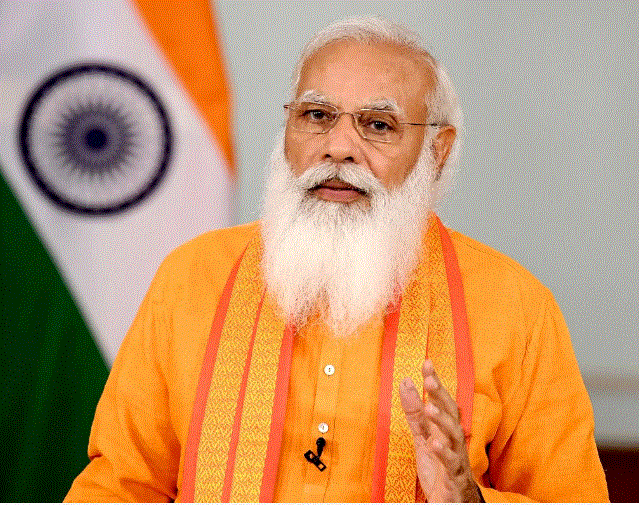
On Sunday, PM Modi talked about Independence Day Celebrations and Tokyo Olympics in Mann Ki Baat.

The Prime Minister in his Mann Ki Baat on Sunday urged the countrymen to be ready to celebrate India’s 74th Independence Day next month.
And asked to support the athletes in the Tokyo Olympics.

Addressing the state through his month-to-month radio program Mann Ki Baat on Sunday, Prime Minister Narendra Modi said that every Indian felt proud to see the contingent at the Tokyo Olympics and urged people to make Team India happy and requested help. “To guide our Olympic group on social media, the ‘Victory Punch Campaign’ has started. You support your team and share the victory. And the Prime Minister said that you also share the victory of the country. And cheer for India,

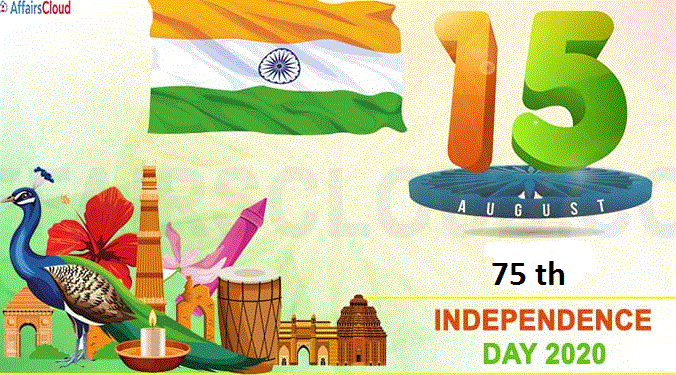
Referring to August 15, PM Modi said this year’s Independence Day is special since India is entering the 75th year of its independence. He said that a website called Rashtragaan.in has been created, and urged people across the nation to send a recording of singing the national anthem of India.

During the address, the prime minister also urged people to read the story of Kargil ahead of Kargil Vijay Diwas tomorrow. “Tomorrow is Kargil Vijay Diwas. Kargil war  is such a symbol of valour and discipline of our armed forces which the entire world has witnessed. I would like you to read the thrilling story of Kargil. Let us all salute the brave hearts of Kargil,” he said.

He also said that the Ministry of Culture had taken up a new initiative to mark Amrut Mahotsav. The idea behind this was to make people follow the path shown by the freedom fighters, he said.

Talking about the National Handloom Day which is celebrated on August 7, Modi spoke about the historical background, when the Swadeshi movement began in 1905. He urged people to support local entrepreneurs, artists, artisans, weavers by buying handloom and Khadi products. “Buy handloom products and share on social media with #MyHandloomMyPride,” Modi said.

PM Modi also spoke about how technology was being harnessed for the greater good, by speaking about the life journeys of two people from Andhra Pradesh and Odisha.

At the end of the speech, PM Modi said that the Covid – 19 pandemic was not over and asked the citizens to follow Covid-19 protocols and maintain social distancing.

On Sunday, PM Modi talked about Independence Day Celebrations and Tokyo Olympics in Mann Ki Baat.

The Prime Minister in his Mann Ki Baat on Sunday urged the countrymen to be ready to celebrate India’s 74th Independence Day next month.
And asked to support the athletes in the Tokyo Olympics.

Addressing the state through his month-to-month radio program Mann Ki Baat on Sunday, Prime Minister Narendra Modi said that every Indian felt proud to see the contingent at the Tokyo Olympics and urged people to make Team India happy and requested help. “To guide our Olympic group on social media, the ‘Victory Punch Campaign’ has started. You support your team and share the victory. And the Prime Minister said that you also share the victory of the country. And cheer for India,

Referring to August 15, PM Modi said this year’s Independence Day is special since India is entering the 75th year of its independence. He said that a website called Rashtragaan.in has been created, and urged people across the nation to send a recording of singing the national anthem of India.

During the address, the prime minister also urged people to read the story of Kargil ahead of Kargil Vijay Diwas tomorrow. “Tomorrow is Kargil Vijay Diwas. Kargil war  is such a symbol of valour and discipline of our armed forces which the entire world has witnessed. I would like you to read the thrilling story of Kargil. Let us all salute the brave hearts of Kargil,” he said.

He also said that the Ministry of Culture had taken up a new initiative to mark Amrut Mahotsav. The idea behind this was to make people follow the path shown by the freedom fighters, he said.

Talking about the National Handloom Day which is celebrated on August 7, Modi spoke about the historical background, when the Swadeshi movement began in 1905. He urged people to support local entrepreneurs, artists, artisans, weavers by buying handloom and Khadi products. “Buy handloom products and share on social media with #MyHandloomMyPride,” Modi said.

PM Modi also spoke about how technology was being harnessed for the greater good, by speaking about the life journeys of two people from Andhra Pradesh and Odisha.

At the end of the speech, PM Modi said that the Covid – 19 pandemic was not over and asked the citizens to follow Covid-19 protocols and maintain social distancing.

NEPOTISM

BY: VAIBHAVI MENON

Nepotism is a form of favoritism which is granted to relatives and friends in various fields, including business, politics, entertainment, sports, religion and other activities. The term originated with the assignment of nephews to important positions by Catholic popes and bishops. Nepotism has been criticized since the ancient times by several philosophers, including Aristotle, Valluvar, and Confucius, condemning it as both evil and unwise. Nepotism in India is common in politics, judiciary, business, the film industry, religious circles, arts, industry, and other types of organizations. Many judges and advocates of the high courts and the Supreme Court of India are alleged to be appointed by exercising casteism, nepotism, and favoritism, primarily due to the Supreme Court and the high court appointment process called Collegium which recommends to the President, in a legally binding manner, the names of judges to be appointed or promoted to the higher judiciary. The various judicial services exams are also infamous for these practices. Rahul Gandhi, Former President of the Indian National Congress party, is a descendant of Jawaharlal Nehru and Indira Gandhi, Rajiv Gandhi, Sonia Gandhi.

The Kapoor family, one of the most prolific generational families involved in Indian cinema, have been known for bringing their children into the industry with their endorsements and influence. In June 2020 a fresh debate on nepotism followed soon after the suicide of actor Sushant Singh Rajput, which fans believe was in reaction to efforts by Bollywood insiders to boycott him. Filmmaker Karan Johar, who Rajput had worked with in the Netflix film Drive, was quickly accused of nepotism by actress Kangana Ranaut, with Rajput’s fans calling for a boycott of Johar and his studio, Dharma Productions, as well as of actor Salman Khan and his brothers, who were accused of bullying outsiders in the past. Actors and actresses Alia Bhatt, Varun Dhawan, Janhvi Kapoor, Ishaan Khatter, Ananya Pandey, Athiya Shetty, Tiger Shroff, Arjun Kapoor and Sara Ali Khan, all of whom hail from film families, were also widely criticized. The term comes from Italian word nepotismo, which is based on Latin root nepos meaning nephew. Since the Middle Ages and until the late 17th century, some Catholic popes and bishops – who had taken vows of chastity and, therefore, usually had no legitimate offspring of their own – gave their nephews such positions of preference as were often accorded by fathers to sons.

Several popes elevated nephews and other relatives to the cardinalate. Often, such appointments were a means of continuing a papal “dynasty”. For instance, Pope Callixtus III, head of the Borgia family, made two of his nephews cardinals; one of them, Rodrigo, later used his position as a cardinal as a stepping stone to the papacy, becoming Pope Alexander VI. Alexander then elevated Alessandro Farnese, his mistress’s brother, to cardinal; Farnese would later go on to become Pope Paul III. Paul III also engaged in nepotism, appointing, for instance, two nephews, aged 14 and 16, as cardinals. The practice was finally limited when Pope Innocent XII issued the bull Romanum decet Pontificem, in 1692.The papal bull prohibited popes in all times from bestowing estates, offices, or revenues on any relative, with the exception that one qualified relative (at most) could be made a cardinal.

The Order

he Order is a Canadian-American horror drama streaming television series created by Dennis Heaton and written by Heaton, Shelley Eriksen, Rachel Langer, Jennica Harper, Penny Gummerson, and Jason Filiatrault. The series premiered on Netflix on March 7, 2019. The series stars Jake Manley, Sarah Grey, Matt Frewer, Sam Trammell, Katharine Isabelle, and Max Martini. The first season received positive reviews upon its release.

In March 2019, it was announced that the series was renewed for a 10-episode second season that was released on June 18, 2020. In November 2020, the series was canceled after two seasons.

Premise

The Order follows college student Jack Morton as he joins the Hermetic Order of the Blue Rose, a secret society that teaches and practices magic. As Jack goes deeper into the organization’s history, he uncovers dark family secrets and an underground battle between werewolves and the magical dark arts.

Plot

When Belgrave University student Jack Morton joins a fabled secret society, the Hermetic Order of the Blue Rose, he is thrust into a world of magic, monsters and intrigue. Out to avenge his mother’s death, he uncovers dark family secrets and lands in an underground battle being waged between werewolves and practitioners of dark magic. Assisting Jack in the fight is Alyssa, a tour guide at Belgrave and fellow member of the Order, which is led by Jack’s estranged father.

No. of episodes: 20 (list of episodes)

Original release: March 7, 2019 –; June 18, 2020

Executive producers: Chad Oakes; Michael Frislev; Dennis Heaton; Shelley Eriksen; David Von Ancken

Genre: Horror; Drama; Supernatural

why does it ended ?

No official reasons have been given for the show’s cancellation, but as usual it likely came down to viewership vs cost. The pandemic is also driving decisions, with production limitations now playing a part in companies cancelling shows – and even backtracking already-ordered seasons.

Is there a chance for another season ?

The third installment of the order season 3 is already canceled but the creator of the show i.e. Dennis Heaton has revealed what will have happened if there will be season 3. There will be a twist! Alyssa will come back but in another state. He explained it by saying that she “was going to come back wrong”.

so , currently its a no we can keep our fingers crossed and wait for netflix to give us a happy news

How To Quickly Improve Your Mood

While we’re in the midst of life’s stresses, we sometimes just want to feel happy immediately. Not only do studies indicate that cheerful individuals have many advantages in life as a result of their happiness, but happiness also just feels good.

Every area of your life is affected by your mood and mental health, from how you feel about yourself to your relationships with others and your physical health.

Though it may appear like happiness is just around the corner with a better career, a healthier relationship or a nicer house, the euphoria that comes with those accomplishments might be ephemeral. Furthermore, you don’t need to make major changes to be joyful; you can experience happiness even with doing miniscule task

There are several strategies to keep your brain and emotions in peak condition. Exercise, good nutrition, and stress-reduction strategies such as meditation or mindfulness may maintain your brain — and your body — in peak condition.

How to Quickly Improve Your Mood

Listen To Music

Music is believed to have the capacity to affect one’s mood, making it a great stress reliever. In reality, music has been utilised therapeutically in hospitals for pain management and mental well-being. Music has also been related to happiness, particularly specific genres of music, according to research. Music, particularly music with a major tone, is associated with reduced stress and feelings of enjoyment.

Incorporate Laughter In Your Life

As it’s so true, the saying “Laughter is the best medicine” has become a cliche. We know that laughing has several benefits other than improving one’s mood. Laughter has been shown to boost immunity and extend life. Laughter can not only be helpful for elevating your mood but the mere anticipation of laughter has been shown to have advantages.

Change Your Mindset

Changing your expectations and comparisons is a quick and easy approach to improve your attitude. Rather than focusing on what you don’t have, consider all you do have. There will always be those that will have more than you in some aspect of life, but so many would have less than you. Enjoy the advantages of thankfulness and shift your perspective on what you have, and you will feel happier right away.

Do a Good Deed

Many people have found that helping others makes them happy. Indeed, studies suggest that individuals who volunteer have higher levels of health and pleasure. This is believed to be true for a number of reasons. The first is that generosity itself has several advantages, including an increased degree of emotional well-being. If you are doing something kind for someone else, your attention shifts away from yourself and your issues and onto others and making them happy. A smile that you put on somebody else’s face is an infectious smile that spreads contagious happiness.

Practice Meditation

Although meditation appears to be more of a stress management strategy than one that may increase happiness, it has been shown to be an efficient approach for both. Meditation’s stress-reduction effects are well-known, but research also suggests that regular meditation can lead to higher levels of happiness.

If your attempts to improve your mood aren’t helping or you’re having difficulty giving yourself a very much needed boost, consider seeking help from a  professional therapist. If your mood has been low for much more than two weeks or is affecting your relationships, job, or education, speaking with a therapist can help.

BLACK HOLE

BY: VAIBHAVI MENON

A black hole is a region of spacetime where gravity is so strong that nothing—no particles or even electromagnetic radiation such as light—can escape from it. The theory of general relativity predicts that a sufficiently compact mass can deform spacetime to form a black hole. The boundary of no escape is called the event horizon. Although it has an enormous effect on the fate and circumstances of an object crossing it, according to general relativity it has no locally detectable features. In many ways, a black hole acts like an ideal black body, as it reflects no light. Moreover, quantum field theory in curved spacetime predicts that event horizons emit Hawking radiation, with the same spectrum as a black body of a temperature inversely proportional to its mass. This temperature is on the order of billionths of a kelvin for black holes of stellar mass, making it essentially impossible to observe directly.

Objects whose gravitational fields are too strong for light to escape were first considered in the 18th century by John Michell and Pierre-Simon Laplace. The first modern solution of general relativity that would characterize a black hole was found by Karl Schwarzschild in 1916, and its interpretation as a region of space from which nothing can escape was first published by David Finkelstein in 1958. Black holes were long considered a mathematical curiosity; it was not until the 1960s that theoretical work showed they were a generic prediction of general relativity. The discovery of neutron stars by Jocelyn Bell Burnell in 1967 sparked interest in gravitationally collapsed compact objects as a possible astrophysical reality. The first black hole known as such was Cygnus X-1, identified by several researchers independently in 1971. Black holes of stellar mass form when very massive stars collapse at the end of their life cycle. After a black hole has formed, it can continue to grow by absorbing mass from its surroundings. By absorbing other stars and merging with other black holes, supermassive black holes of millions of solar masses may form. There is consensus that supermassive black holes exist in the centers of most galaxies.

The presence of a black hole can be inferred through its interaction with other matter and with electromagnetic radiation such as visible light. Matter that falls onto a black hole can form an external accretion disk heated by friction, forming quasars, some of the brightest objects in the universe. Stars passing too close to a supermassive black hole can be shred into streamers that shine very brightly before being “swallowed.” If there are other stars orbiting a black hole, their orbits can be used to determine the black hole’s mass and location. Such observations can be used to exclude possible alternatives such as neutron stars. In this way, astronomers have identified numerous stellar black hole candidates in binary systems, and established that the radio source known as Sagittarius A*, at the core of the Milky Way galaxy, contains a supermassive black hole of about 4.3 million solar masses.

WHAT DOES AN ENGINEER ACTUALLY DO?

BY:VAIBHAVI MENON

Engineers, as practitioners of engineering, are professionals who invent, design, analyze, build and test machines, complex systems, structures, gadgets and materials to fulfill functional objectives and requirements while considering the limitations imposed by practicality, regulation, safety and cost. The word engineer (Latin ingeniator) is derived from the Latin words ingeniare (“to create, generate, contrive, devise”) and ingenium (“cleverness”). The foundational qualifications of an engineer typically include a four-year bachelor’s degree in an engineering discipline, or in some jurisdictions, a master’s degree in an engineering discipline plus four to six years of peer-reviewed professional practice (culminating in a project report or thesis) and passage of engineering board examinations.

The work of engineers forms the link between scientific discoveries and their subsequent applications to human and business needs and quality of life. A professional engineer is competent by virtue of his/her fundamental education and training to apply the scientific method and outlook to the analysis and solution of engineering problems. He/she is able to assume personal responsibility for the development and application of engineering science and knowledge, notably in research, design, construction, manufacturing, superintending, managing and in the education of the engineer. His/her work is predominantly intellectual and varied and not of a routine mental or physical character. It requires the exercise of original thought and judgement and the ability to supervise the technical and administrative work of others. His/her education will have been such as to make him/her capable of closely and continuously following progress in his/her branch of engineering science by consulting newly published works on a worldwide basis, assimilating such information and applying it independently. He/she is thus placed in a position to make contributions to the development of engineering science or its applications. His/her education and training will have been such that he/she will have acquired a broad and general appreciation of the engineering sciences as well as thorough insight into the special features of his/her own branch. In due time he/she will be able to give authoritative technical advice and to assume responsibility for the direction of important tasks in his/her branch. Engineers develop new technological solutions. During the engineering design process, the responsibilities of the engineer may include defining problems, conducting and narrowing research, analyzing criteria, finding and analyzing solutions, and making decisions. Much of an engineer’s time is spent on researching, locating, applying, and transferring information. Indeed, research suggests engineers spend 56% of their time engaged in various information behaviors, including 14% actively searching for information. Engineers must weigh different design choices on their merits and choose the solution that best matches the requirements and needs. Their crucial and unique task is to identify, understand, and interpret the constraints on a design in order to produce a successful result.

Engineers apply techniques of engineering analysis in testing, production, or maintenance. Analytical engineers may supervise production in factories and elsewhere, determine the causes of a process failure, and test output to maintain quality. They also estimate the time and cost required to complete projects. Supervisory engineers are responsible for major components or entire projects. Engineering analysis involves the application of scientific analytic principles and processes to reveal the properties and state of the system, device or mechanism under study. Engineering analysis proceeds by separating the engineering design into the mechanisms of operation or failure, analyzing or estimating each component of the operation or failure mechanism in isolation, and recombining the components. They may analyze risk.

BIG BANG THEORY

BY: VAIBHAVI MENON

The Big Bang theory is the prevailing cosmological model explaining the existence of the observable universe from the earliest known periods through its subsequent large-scale evolution. The model describes how the universe expanded from an initial state of high density and temperature, and offers a comprehensive explanation for a broad range of observed phenomena, including the abundance of light elements, the cosmic microwave background (CMB) radiation, and large-scale structure. Crucially, the theory is compatible with Hubble–Lemaître law—the observation that the farther away a galaxy is, the faster it is moving away from Earth. Extrapolating this cosmic expansion backwards in time using the known laws of physics, the theory describes an increasingly concentrated cosmos preceded by a singularity in which space and time lose meaning (typically named “the Big Bang singularity”). Detailed measurements of the expansion rate of the universe place the Big Bang singularity at around 13.8 billion years ago, which is thus considered the age of the universe.

After its initial expansion, an event that is by itself often called “the Big Bang”, the universe cooled sufficiently to allow the formation of subatomic particles, and later atoms. Giant clouds of these primordial elements—mostly hydrogen, with some helium and lithium—later coalesced through gravity, forming early stars and galaxies, the descendants of which are visible today. Besides these primordial building materials, astronomers observe the gravitational effects of an unknown dark matter surrounding galaxies. Most of the gravitational potential in the universe seems to be in this form, and the Big Bang theory and various observations indicate that this excess gravitational potential is not created by baryonic matter, such as normal atoms. Measurements of the redshifts of supernovae indicate that the expansion of the universe is accelerating, an observation attributed to dark energy’s existence. Georges Lemaître first noted in 1927 that an expanding universe could be traced back in time to an originating single point, which he called the “primeval atom”. Edwin Hubble confirmed through analysis of galactic redshifts in 1929 that galaxies are indeed drifting apart; this is important observational evidence for an expanding universe. For several decades, the scientific community was divided between supporters of the Big Bang and the rival steady-state model which both offered explanations for the observed expansion, but the steady-state model stipulated an eternal universe in contrast to the Big Bang’s finite age. In 1964, the CMB was discovered, which convinced many cosmologists that the steady-state theory was falsified, since, unlike the steady-state theory, the hot Big Bang predicted a uniform background radiation throughout the universe caused by the high temperatures and densities in the distant past. A wide range of empirical evidence strongly favors the Big Bang, which is now essentially universally accepted.

According to the Big Bang theory, the universe at the beginning was very hot and very compact, and since then it has been expanding and cooling down. As the universe cooled, the rest energy density of matter came to gravitationally dominate that of the photon radiation. After about 379,000 years, the electrons and nuclei combined into atoms (mostly hydrogen), which were able to emit radiation. This relic radiation, which continued through space largely unimpeded, is known as the cosmic microwave background.

Difference between Liberty and Freedom

We have heard terms like liberty and freedom. Many times there had been protests, fights, wars in history for freedom and liberty. The process of getting freedom for a nation is quite difficult. For instance, India became free from the Britishers after a very long period of time. Being able to express yourself freely is freedom. But what is the difference between liberty and freedom. We have often confused ourselves with these two terms. They both might mean almost the same, but they do have some differences. But before moving on with the differences, let us first talk about the basic meaning of liberty and freedom.

Liberty

Liberty is defined as the situation in which a person has the right to act according to his/ her will. Liberty also means being free from any oppression. Well, it is interesting to know that liberty also has a symbolic meaning. In India, liberty is known as ‘mukti,’ i.e., dissolution with the divine. Different nations have different notions of liberty. Liberty means different in politics and biblical sense. For instance, in India, liberation also means being consciously aware of oneself. Since India is a land of mystics, there are different connotations attached to the term.

Freedom

Freedom is defined as the situation in which a person has the right to speak, act, and think according to his / her own way. The Constitution of India has several fundamental rights that define freedom. Freedom of speech and expression, freedom of religion, freedom of education, etc., are some of the fundamental rights of India. Well, it is interesting to note that freedom does not have a political realm, i.e., freedom can be practised in houses, among people, or nations. Now, let us discuss the basic points of contrast between liberty and freedom.

S.NO.LIBERTYFREEDOM
1.Liberty is defined as the situation in which a person has the right to act according to his/ her will.On the other hand, freedom is defined as the situation in which a person has the right to speak, act, and think in his/ her own way.
2.There are no rights or laws written in the Constitution of India.There are several fundamental rights provided in the constitution of India, like freedom of speech and expression, freedom of education, etc.
3.Liberty can be considered as a situation wherein one is able to govern themselves, thereby taking responsibility for their actionFreedom is also known as free will. The ability of a person to make choices for themselves without being under oppression is called as freedom.
4.The term liberty comes from the Latin word ‘libertatem,’ meaning being free or freeman.On the other hand, freedom comes from an Old English term ‘freodom,’ meaning a state of deliverance or free will.
5.Liberty can be categorized into two types, i.e., positive liberty and negative liberty.There are two significant kinds of freedom, i.e., social freedom and natural freedom.

So, these are some of the major points of contrast between liberty and freedom. Freedom is the state of being free from any oppression, while liberty is the freedom to act in one’s own way. Liberty is a significant concept because people enjoying liberty have to take responsibility for their actions performed. Freedom, on the other hand, is a concrete concept. Freedom is synonymous with independence. Well, there are several types of liberty and freedom. So, let us take a look at them.Features of Java – Javatpoint

Types of Freedom

  1. Freedom of Association: Freedom of Association is defined as the right to join a particular group or community in order to reach a common goal. The groups include labor unions, business groups, etc.
  2. Freedom of Belief: Freedom is Belief is defined as the right to have faith in a particular thought. For instance, some people believe that are ghosts, while some believe there aren’t any ghosts.
  3. Freedom of Speech & Expression: Freedom of Speech & Expression is defined as the right to speak freely about perspectives, ideas, and opinions.
  4. Freedom of Religion: Freedom of Religion is defined as the right to practice any religion despite belonging to any community.
  5. Freedom of Education: Freedom of Education is defined as the right to practice and learn various skills. Education is the right of every individual. Thus, the right to education implies that every individual be it poor or rich.

Types of Liberty

  1. Natural Liberty: Natural Liberty is defined as the liberty in which a person can do anything he/ she wishes.
  2. Civil Liberty: Civil Liberty is defined as the liberty in which the society enjoys the law or rights provided by the government.
  3. Political Liberty: Political Liberty is defined as the liberty in which the people have the right to participate in the decision-making of the country.
  4. Personal Liberty: Personal Liberty is defined as the liberty in which a person acts according to his/ her own wish.
  5. Economic Liberty: Economic Liberty is the liberty wherein the people work hard in order to earn a living. This liberty goes beyond colour, creed, caste, or religion.
  6. Domestic Liberty: Domestic Liberty is defined as liberty having equal rights for men and women. This kind of liberty includes protection from exploitation, violence, etc.

So, these are the significant types of liberties. Freedom and liberty is a significant topic that has gained attention time and again. The protests and wars had one primary aim, i.e., to gain freedom. Thus, freedom and liberty has been an essential concept in the history of nations.

Difference between Liberty and Freedom

We have heard terms like liberty and freedom. Many times there had been protests, fights, wars in history for freedom and liberty. The process of getting freedom for a nation is quite difficult. For instance, India became free from the Britishers after a very long period of time. Being able to express yourself freely is freedom. But what is the difference between liberty and freedom. We have often confused ourselves with these two terms. They both might mean almost the same, but they do have some differences. But before moving on with the differences, let us first talk about the basic meaning of liberty and freedom.

Liberty

Liberty is defined as the situation in which a person has the right to act according to his/ her will. Liberty also means being free from any oppression. Well, it is interesting to know that liberty also has a symbolic meaning. In India, liberty is known as ‘mukti,’ i.e., dissolution with the divine. Different nations have different notions of liberty. Liberty means different in politics and biblical sense. For instance, in India, liberation also means being consciously aware of oneself. Since India is a land of mystics, there are different connotations attached to the term.

Freedom

Freedom is defined as the situation in which a person has the right to speak, act, and think according to his / her own way. The Constitution of India has several fundamental rights that define freedom. Freedom of speech and expression, freedom of religion, freedom of education, etc., are some of the fundamental rights of India. Well, it is interesting to note that freedom does not have a political realm, i.e., freedom can be practised in houses, among people, or nations. Now, let us discuss the basic points of contrast between liberty and freedom.

S.NO. LIBERTY FREEDOM
1. Liberty is defined as the situation in which a person has the right to act according to his/ her will. On the other hand, freedom is defined as the situation in which a person has the right to speak, act, and think in his/ her own way.
2. There are no rights or laws written in the Constitution of India. There are several fundamental rights provided in the constitution of India, like freedom of speech and expression, freedom of education, etc.
3. Liberty can be considered as a situation wherein one is able to govern themselves, thereby taking responsibility for their action Freedom is also known as free will. The ability of a person to make choices for themselves without being under oppression is called as freedom.
4. The term liberty comes from the Latin word ‘libertatem,’ meaning being free or freeman. On the other hand, freedom comes from an Old English term ‘freodom,’ meaning a state of deliverance or free will.
5. Liberty can be categorized into two types, i.e., positive liberty and negative liberty. There are two significant kinds of freedom, i.e., social freedom and natural freedom.

So, these are some of the major points of contrast between liberty and freedom. Freedom is the state of being free from any oppression, while liberty is the freedom to act in one’s own way. Liberty is a significant concept because people enjoying liberty have to take responsibility for their actions performed. Freedom, on the other hand, is a concrete concept. Freedom is synonymous with independence. Well, there are several types of liberty and freedom. So, let us take a look at them.Features of Java – Javatpoint

Types of Freedom

  1. Freedom of Association: Freedom of Association is defined as the right to join a particular group or community in order to reach a common goal. The groups include labor unions, business groups, etc.
  2. Freedom of Belief: Freedom is Belief is defined as the right to have faith in a particular thought. For instance, some people believe that are ghosts, while some believe there aren’t any ghosts.
  3. Freedom of Speech & Expression: Freedom of Speech & Expression is defined as the right to speak freely about perspectives, ideas, and opinions.
  4. Freedom of Religion: Freedom of Religion is defined as the right to practice any religion despite belonging to any community.
  5. Freedom of Education: Freedom of Education is defined as the right to practice and learn various skills. Education is the right of every individual. Thus, the right to education implies that every individual be it poor or rich.

Types of Liberty

  1. Natural Liberty: Natural Liberty is defined as the liberty in which a person can do anything he/ she wishes.
  2. Civil Liberty: Civil Liberty is defined as the liberty in which the society enjoys the law or rights provided by the government.
  3. Political Liberty: Political Liberty is defined as the liberty in which the people have the right to participate in the decision-making of the country.
  4. Personal Liberty: Personal Liberty is defined as the liberty in which a person acts according to his/ her own wish.
  5. Economic Liberty: Economic Liberty is the liberty wherein the people work hard in order to earn a living. This liberty goes beyond colour, creed, caste, or religion.
  6. Domestic Liberty: Domestic Liberty is defined as liberty having equal rights for men and women. This kind of liberty includes protection from exploitation, violence, etc.

So, these are the significant types of liberties. Freedom and liberty is a significant topic that has gained attention time and again. The protests and wars had one primary aim, i.e., to gain freedom. Thus, freedom and liberty has been an essential concept in the history of nations.