Changing Perspectives

According to post- structuralists,The binary opposition are not true representation of reality rather they are constructed ideas . It reveals the relationship between language and power.Because in every binary opposition, so called ‘positive’, gain power. For example; white vs black, centre vs margin, male vs female… In all these, we tend to favour one over the other when one gets privilege, The other lost its importance. But in some cases, due to these binary oppositions some lost their existence. These concepts are strongly against humanity.What do you think about the binary opposition?

Just take the example of male and female in our patriarchal society. Men always win the favour and the women marginalized as part of it. but now the concept is quite changing. Women also begin to get a proper recognition in the upper layer of the society. Amidst of this binaries, a group of people lack their existence and became subject to the criticism due to the false concept of the public.LGBTs were not even addressed in the society as they considered as people who are against the norms and broke the existing structure of the society that of binaries.They are also humans! They should appreciate for their decision to follow their own identity instead of living with an uncomfortable ‘mask’ to get the favours of the people. They showed their courage enough to stay against the false notions of the society and proved the ‘real’ in them. But these challenges only brought them the hard times… many of them lost their families! Now they are achieving their goals that governments and many organisations are there for them and some humanitarians began to understand the importance of recognition of that are out of these binaries…

Though the society is changing to a positive wave, their community didn’t get enough representation in our society. In this context the new ad of Bhima jewellers in Kerala, brought a positive thought through their ad. The ad begins with a positive response from her family members towards the desire of a man who want to be a woman. Later on ,the ad fulfills the intention by showing ‘her’ covered in gold and being walked into the wedding. At the same time the add gives hope on the progressive mindset of the society. What is the importance of the ad in the present day? Through education many changed their mindset,but the ordinary people are still believe this as a kind of action against the law of nature and also against God! Nobody can expect a sudden changes from these people, because they are rooted in their beliefs deeply.But these kinds of ads and their continuous appearance in the tv can gradually make a change. In this kind of society, Bhima dared to take a revolutionary step through which many sections of the society and the children too might be seeing the ad which can gradually able to make a subtle changes in the mindset of the viewers. In many families this would have led to discussions as well probably this might be the first time,many are even noticing a transwoman and this transformation to a new life pictured in a positive note. The reason behind the popularity of this ad is that a ‘rare thing'(for the present society) portrayed normally. but this should not be a rarity. we should raise to a state in which trans and homeo sexual people are treated in a normal way.Since that’s not the case now we should appreciate Bhima for making such an add as a first step towards progress.

Ad of Bhima: https://youtu.be/NtaLr_r8R2E

DOCTRINE OF RESTITUION UNDER CPC

What is the difference between a fine and restitution in a criminal case?

RESTITUTION

Section 144 makes provisions for the purpose of the doctrine of Restitution.

Restitution means restoring of anything unjustly taken from another.

It means restoring to a party the benefit which the other party has received under a decree subsequently held to be wrong.

The doctrine of restitution is that, on the reversal of a decree, the law imposes an obligation on the party to the suit who received an unjust benefit of the erroneous decree to make restitution to the other party for what he has lost.

OBJECT

The doctrine of restitution is based upon the well known maxim that the act of the court shall harm no one.

    CONDITIONS

Before restitution can be ordered under this section, the following three conditions must be satisfied :

The restitution sought must be in respect of the decree or order which had been reversed or varied;

The party applying for restitution must be entitled to benefit under the reversing decree or order; and

The relief claimed must be properly consequential on the reversal or variation of the decree or order.

WHO MAY APPLY ?

In order to entitle a person to apply under section 144, two conditions must be satisfied :

He must be a party to the decree or order varied or reversed.

He must have become entitled to any benefit by way of restitution or otherwise under the reversing decree or order.

AGAINST WHOM RESTITUTION MAY BE GRANTED ?

Section 144 applies to the parties or their representatives and does not apply to sureties.

WHO MAY GRANT RESTITUTION ?

An application for restitution lies to the court which has passed the decree or made the order.


WANT TO FILE CAVEAT?

Elaboration on the Concept of Caveat Under Civil Procedure Code

CAVEAT

Section 148-A of the Civil Procedure Code,1908 provides for lodging of a Caveat.

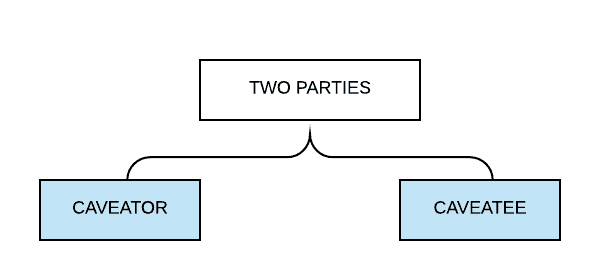
A caveat is a caution or warning given by a party to the court not to take any action or grant any relief to the applicant without notice or intimation being given to the party lodging the caveat and interested in appearing and objecting to such relief.

The person filing the caveat is known as “CAVEATOR“.

Meaning of Caveat in CPC and Who May Lodge It

OBJECT OF CAVEAT

To safeguard the interest of a person against an order that may be passed on an application filed by a party in a suit or proceeding instituted or about to be instituted.

It seeks to avoid multiplicity of proceedings.

WHO MAY LODGE CAVEAT ?

A Caveat may be filed by any person who is going to be affected by an interim order likely to be passed on an application which is expected to be made in a suit or proceeding instituted or about to be instituted in a court.

A person who is stranger to the proceeding cannot lodge a caveat.

FORM

No form of caveat has been prescribed under the Code. A caveat may, therefore, be filed in the form of a petition.

TIME-LIMIT

A Caveat lodged will remain in force for ninety days from the date of its filing.

After the prescribed period of ninety days is over, caveat may be renewed.


Civil Procedure Code, 1908 law notes - iPleaders

RIGHTS OF THE ARRESTED PERSON

Rights Of Arrested Person - LEGAL UTILITY


RIGHTS OF THE ARRESTED PERSONS

  • Section- 41D of the Criminal Procedure Code:- Allows prisoners to be able to consult with their lawyers even during their interrogation.
  • Section 50 (1) of the Criminal Procedure Code:- Right to know the grounds of arrest.
  • Section 50 (2) of the Criminal Procedure Code:- Information regarding the right to be released on bail.
  • Section 50 A of the Criminal Procedure Code:- makes it compulsory for the person/ police official arresting a person to inform of the arrest to any of his relatives or even friends who may have interest in the same
  • Section 56 of the Criminal Procedure Code:- Person arrested to be taken before a Magistrate or officer in charge of the police station
  • Section 54 of the Criminal Procedure Code:- Right to be examined by a medical practitioner.

Sheela Barse vs. State of Maharashtra,1983(SC)

The arrested accused person must be informed by the Magistrate about his right to be medically examined.

  • Section 75 of the Criminal Procedure Code:- States that the police official executing the warrant must notify the substance of the arrested person and furnish the warrant of the arrest when required
  • Section 76 of the Criminal Procedure Code:- Person arrested to be brought before the court without delay.
  • Section 303 of the Criminal Procedure Code:- Right of the person against whom proceedings are instituted to be defended.
  • Article 22(1) of the Constitution of India:- Provides that every arrested person has the right to choose and elect his lawyer.
  • Article- 22(2) of the Indian Constitution:- Stipulates that the police officer making an arrest must produce the arrested person before the Magistrate within 24 hours of the arrest failing to do so would make him liable for wrongful detention.
  • Article 57 of the Constitution Of India:- Right of not being detained for more than 24 hours without judicial scrutiny.
  • Article 39 A of the Indian Constitution:- Right of an arrested person to free legal aid and to be informed about it

Khatri vs. State of Bihar

It was held in this case, where the Supreme Court has therefore cast a duty on all Magistrates and Courts to inform the indigent accused about his right to get free legal aid.


What Are the Rights of the Accused Person in India?

Oobleck: A non-Newtonian fluid revolutionizing speed bumps

Oobleck? Yes you read it right. Thinking you have never come across this term in all your life? Well, Oobleck is nothing but a mixture of cornstarch and water. What does corn starch and water have anything to do with speedbumps? The answer can make you marvel at the human mind with its simple, yet smart thinking capabilities.

Why traditional speedbumps are a problem?

Speed bumps have been a part of the road culture for more than 5 decades now. The were introduced in the 1970s and have managed to exist till now. They are raised ‘bumps’ with 3-4 inches of thickness, used as speed reducing mechanisms for vehicles on road, specially in speed sensitive regions. While they do their purpose, there are some unwanted problems related with the usage of speed breaks, ranging from economical to health concerning issues.

Some of the problems are:

  • Inconsistent speed and abrupt slowing of vehicle due to speed bump and then picking up the speed leads to higher emission, leading to air pollution.
  • Often slow down emergency vehicles
  • May cause spinal damage to some people
  • Inconsistent speed can lead to rupture of vehicles
  • Extra cost (manpower and raw materials) involved in maintaining the road signs, painting and marking, indicating that speed bumps are ahead.
Oobleck

As I already mentioned, Oobleck is a corn starch slurry. This mixture is filled in long cylindrical shaped rubber reinforced tubes resembling a speed bump which is secured to the road. When vehicles pass this speed bump with a slow speed, the liquid parts and allows the vehicle to pass thorugh as if there was nothing present. But, when a vehicle with high speed tries to pass through, the liquid hardens, thus limiting the speed of the vehicle. How does that happen?

oobleck bump
An oobleck filled bump.
The speed bump deforms under the tire when vehicle approaches with a slower speed.

Non-Newtonian fluids and the science behind

Oobleck is a non-Newtonian fluid. A non-Newtonian fluid is one whose viscosity changes under stress. That is, when you apply force to such liquids, it hardens (viscosity increases) and on the release of the force, it gets back to its normal form. But other ‘normal’ Newtonian liquids do not exhibit such characteristics. On application of stress, they do not resist that stress and thus does not cause a strain. Stress is when you hit a metal with hammer and strain is the resulting dent occurred due to the stress.

Non-Newtonian fluids are not rare. We come across them in our daily life without even knowing them. For instance take tomato ketchup. Many times, you may struggle getting the ketchup out from the bottle, and you unconsciously tap the back of the bottle. And you will see that ketchup now falls into your plate. Ketchup is a non-Newtonian fluid whose viscosity decreases when stress is applied. By tapping the back of the bottle, a stress is applied and the ketchup becomes runnier, thus easily pouring out.

Some more examples are:

  • Viscosity decreases with stress over time – Honey ( on stirring honey, it becomes runny)
  • Viscosity increases with stress over time – Cream ( on whipping, it gets thicker)
  • Viscosity decreases with increased stress – Tomato ketchup
  • Viscosity increases with increased stress – Oobleck
Try it at home!

You can easily try this at home by adding 1/2 cup of water gradually to 1 cup of corn starch. After the powder is fully wet and feel like liquid, its time to get your hands messy. Dip you hands into the mixture and try making a ball. It will start to shape due to the stress you are applying with your hand. But once you stop shaping, like magic, the ball turns into liquid and oozes down. Try it and there is no going back. The inner child in you will want to play with it all day long. Visit here for more details on how to do it at home.


Shaping oobleck into a ball by applying stress.


Liquified oobleck
When we stop shaping it, it turns into liquid.

An environment friendly alternative

As the speed bump works as per the speed of the vehicle, there is no need for vehicles to slow down hence increasing fuel efficiency and decreasing emissions. The cost of installing and maintenance is low compared to traditional speed bumps. It does not do damage to the vehicle as the work of shock absorbers is reduced. Hence it is high time that countries start adopting this technology and try to reduce the damages we do to the environment one speed bump at a time!


Telangana celebrates its 8th Formation Day; President, Vice President & PM extend greetings

Telangana state is celebrating its 8th Formation Day today on a low key in the wake of COVID -19. The President has greeted the people of Telengana on the occassion of its Statehood Day. Mr.Ramnath Kovind wished that Telangana continues to expand its traditional, modern & futuristic industries.President Kovind said, Telangana has fulfilled the national objective of providing water to every home and wished a bright future for the people of the state.

Vice President M. Venkaiah Naidu has greeted the people of Telangana on their state formation day. Mr. Naidu today said, Telangana is home to age old traditions and is known for its rich history, diverse cultural heritage and architectural grandeur. He said, Telangana state and its people have contributed immensely towards the development of the nation. The Vice President wished for the progress and prosperity of the state and the well being of its people.

Prime Minister Narendra Modi has wished the people of Telangana on the state’s Formation Day. Mr. Modi today said, the state is blessed with a unique culture and hardworking people who have excelled in many areas. The Prime Minister prayed for the good health and well-being of the people of Telangana.

DRDO’s 500-bed COVID Care Hospital inaugurated in Haldwani, Uttarakhand

A 500-bed COVID Care Hospital set up by Defence Research and Development Organisation (DRDO) in Haldwani, was virtually inaugurated today by Uttarakhand Chief Minister Tirath Singh Rawat. This facility comprises 375 oxygen beds and 125 ICU beds with ventilators. With 100 per cent power backup, it is centrally air conditioned for all weather conditions.

Pathology laboratory, Pharmacy, X-Ray and ECG etc. are inherent part of the facility. The Centre will become fully operational from tomorrow. It has been dedicated and named after late General Bipin Chandra Joshi who belonged to Uttarakhand and was the 17th Chief of Indian Army.

Gujarat govt cancels state board exams for Class 12 students

The Gujarat government has cancelled the state board exams for Class 12 students. This decision has been taken at the state cabinet meeting held today in Gandhinagar. Announcing this decision, the state Education Minister Bhupendrasinh Chudasama said that this decision has been taken following the cancellation of CBSE Class 12th examination.

Mr. Chudasama said that a decision about conducting exams for Class 10 and Class 12 repeater students would be taken shortly. He said that the decision has been taken keeping in view the larger interest of more than 6 lakh students of Class 12th during the COVID-19 pandemic. Earlier, the Gujarat State Higher Secondary Education Board had announced the dates for Class 12th board examinations from July 1 to July 16. However, the examination has been cancelled soon after the central government’s decision to cancel the Class 12 board exams of CBSE.

3 wheeler auto drivers can now use 3 wheeler auto rickshaws for driving test for licence in Punjab

Punjab Transport Minister Razia Sultana, has announced that now 3 wheeler auto drivers can give the driving test for getting Driving License by using a 3 wheeler auto rickshaw. Earlier, three-wheeler drivers were tested on four-wheelers.

She also directed to all the Enforcement Authorities that if any three-wheeler driver has Driving License of Light Motor Vehicle he should not be harassed, because as per provisions of the Motor Vehicle Act 1988, the 3 wheeler auto rickshaw has been categorized into Light Motor Vehicle.

State Transport Commissioner Dr. Amarpal Singh said that instructions have been issued to the Licensing Authorities & Automated Driving Test Tracks of Punjab.

He said that the enforcement agencies have been instructed that a person producing a digital Driving License/Registration Certificate of vehicle and other documents in digital format on m Parivahan application of Union Ministry of Road Transport and Highways and DigiLocker app of Govt. of India, he/she is not required to produce the printed document, accordingly, all the enforcement staff should be sensitized.

Dr. Amarpal said that in case enforcement staff will not accept documents in digital format, a strict action would be taken

Meghalaya reports 24 deaths from COVID-19 complications in last 24 hours

n the last 24 hours, Meghalaya reported 24 deaths from COVID 19 complications; 13 from East Khasi Hills, six from West Jaintia Hills, two each from East Jaintia Hills and West Garo Hills and one from Ri Bhoi district. A statement from the Directorate of Health Services informed that the total number of COVID 19 fatalities in the State has reached 616.

The State also registered 711 recoveries tallying the total number of recovered cases to 29,578 while logging 532 fresh new cases in the last 24 hours. The number of active cases in Meghalaya has reached 6,403. So far 4,67,452 people have been vaccinated in the State.

HOW EXAMINATION OF WITNESESSES DONE?

Procedure for Examination of Witnesses


Examination of witness means asking the witness questions regarding relevant facts in the case and recording those statements as evidence.

General rule is that the order in which witnesses are produced and examined shall be regulated by the law and practice for the time being relating to the civil and criminal procedure respectively, and, in the absence of any such law, by the discretion of the court.

re examination of witnesses – StudyBix

In both the civil as well as the examination of witness will be in the following manner :

  •  EXAMINATION-IN-CHIEF : the examination of witness by the person who calls him shall be called his examination-in-chief.Evidence-Examination of Witness


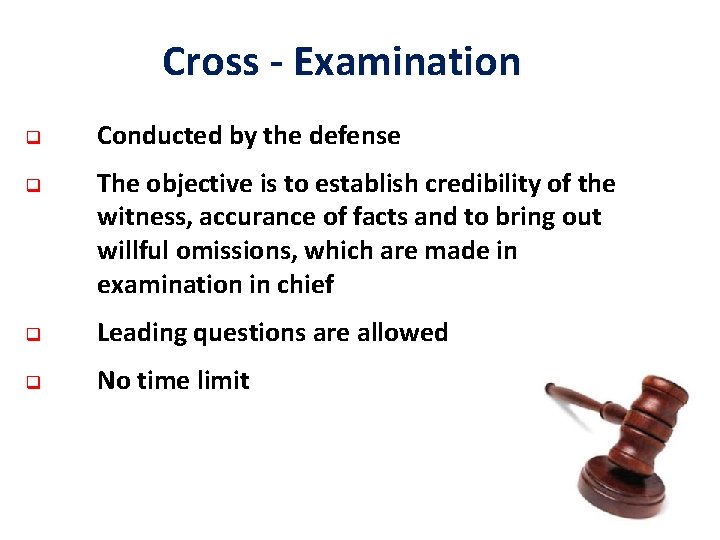
  •  CROSS-EXAMINATION : the examination of a witness by the adverse party shall be called his cross-examination.
  •  RE-EXAMINATION : the examination of a witness, subsequent to the cross-examination by the party who called him, shall be called his re-examination.


Law


CROSS-EXAMINATION

Ganesh Yadav vs. State of Assam,1995 Cr. L. J

The testimony of a witness is not legal evidence unless it is subject to the cross-examination and where no opportunity has been given to the appellant’s counsel to test the veracity of the principle prosecution witness, the evidence of such a witness is not legal testimony and cannot be the basis of a judicial pronouncement.

Jwar Singh vs. State of M.P, A.I.R 1981 (SC)

The objects of the cross-examination are to impeach the accuracy, credibility and general value of the evidence given in-chief, to shift the facts already stated by the witness, to detect and expose discrepancies, or to elicit suppressed facts which will support the case of the cross-examining party.


EVIDENCE ACT Law of evidence lay rules for


How can you improve your English during Lockdown?

Business English Course in London


As Indian we’re mostly multi-lingual and almost 85 percent people know Hindi or use it to communicate but with globalization and with the arrival of big MNCs we’ve realized the importance of English. Even though we learn English in school, why aren’t we so confident while speaking? We learn a language and attain fluency in it only when we practice it in our day to day life but learning English is limited to school or coaching classes. Maybe you’re weak point is reading or you face problems with pronunciation or what so ever. I believe you could utilize your lockdown into being productive and overcoming your flaws by improving your English Language.

Here are some of the ways that you may try to get a better grasp of English Language:

  • Reading everyday-

Make it a habit to regularly read aloud a text for at least 15 minutes daily. You could either read a newspaper/ e-newspaper, begin with a simple book or read paragraphs in English online.


  • Listening to Music-

You could find different kinds of English music according to your genre. Try listening to them while looking at the lyrics. Start with slow English songs for better understanding.


  • Listen to Podcasts-

Podcasts are a great way to learn a language. You could listen to podcasts where two people are conversing, a monologue by a person or a story narration.

http://https://learnenglish.britishcouncil.org/general-english/podcasts


  • Refer dictionary-

I personally prefer online dictionaries as they also correct us with our pronunciation and for better understanding they use the word in a sentence as an example  for better understanding.

http://https://www.merriam-webster.com/


  • Learn by chatting-

In the world of social media we’re used to chatting online but most of the time we don’t talk in  English. There are Chatting apps available as  a simulator to learn English.

http://https://play.google.com/store/apps/details?id=com.yobimi.chatenglish&hl=en_IN&gl=US


  • Write-

Whenever you get time just start writing on any random topic. It doesn’t matter if there’s grammatical mistake or you’re unable to find exact words for the sentence. Pick up a random topic from google and start writing about it as per your understanding. Later on you can correct your mistakes my pasting the content on grammar checker apps and learn from your mistakes.


  • Duolingo-

This app is probably the best for learning any language. I highly recommend using it.

http://https://play.google.com/store/apps/details?id=com.duolingo


  • YouTube/Online course-

If you aren’t willing to pay for learning English, there are lots of options available online. One of them is YouTube where you’d find detailed explanations and better tips for English. Secondly, you can enroll for free online courses as well.


Economists from pre-classical to neo-classical era


Economics is a social science which studies interaction of people in markets. It is concerned with production, consumption, distribution and transfer of wealth from one individual or organization to another. It is a dynamic subject based on postulations and hypothesis. We have to modify its very aspects according to the situation in which it is applied. Classical, Keynesian and Neo-classical are regarded as the three major theories of economics. There were some notable pre-classical economists. 


Pre-classical economists:


William Petty: 

He is remembered for his contribution in the field of economic theory and is regarded as the founder of political economy and statistical method. His contribution to economics was his three most important theories namely- “The Treaties of taxes and contributions” -1662. “A track concerning money”- 1682 and “Discourses on political arithmetic”- 1660. 


John Law: (1671-1729) 

He is regarded as the man of practical affairs. He made important contribution to the theory of money. He made distinction between use value and market value of a commodity. He is regarded as the founder of subjected theory of value. Richard Cantillon: He was an economic thinker who wrote essay on “nature of commerce in general” which is regarded as the most systematic statement before Adam Smith’s Wealth of Nations. 


Sir David Hume: (1711-1776)

He was Philosopher, economist and was regarded as liberal mercantilist because of his advance economic theories. His work “Political discourses” collection of economic essays is regarded as most important. 


James Stuart: (1712-1780)

He was Chief English Mercantilist writer of 18th century. He wrote a book names “An enquiry into principles of political economy” – essay on science of domestic policy in free nations which focused mainly on aspects like population, agriculture, trade, industry, money, coin, interest, circulation, banks, exchange, public credit and taxes 


These were some important pre-classical economists who helped shape the foundation of other important economic theories. 


Classical economists: 

Adam Smith is regarded as the father of economics. His book “An enquiry into nature and causes of the wealth of nations (1776) is regarded as the very first book on classical economics. His concepts of supply side economics and supply side policies majorly focuses on the presence of invisible hand in markets. According to his theories markets can flourish without intervention from external authority which is government here. Invisible hand draws market forces into equilibrium. His theories very widely used before 1930s ‘The great economic’ depression. 

Other notable classical thinkers include – Jean Baptiste who propounded say’s law which states that supply creates its own demand (1803). David Ricardo who developed classical theory of comparative advantage in 1817, Labor theory of value and law of diminishing returns. Thomas Robert Malthus in 1798 wrote a book on “An essay on the principle of population”. John Stuart Mill propounded Utilitarianism in 1881. 


Keynesian economists: 

After 1930 John Maynard Keynes developed his economic theories which is regarded as Keynesian economics. His book on ‘The theory of employment, interest and money’ publish in 1936 was revolutionary. His theories mainly focuses on demand side economics. Government spending is critical factor to drive economy’s demand. Expansionary fiscal policy is regarded as main tool and was widely used after the great depression. Other Keynesian economists include: Dean Baker, Evsay domar, Wynne Godley and several other who found several new theories which gets its foundation from Keynesian economics. 


Neo- Classical economists: 

This theory focuses on supply and demand as driving forces behind production, pricing and consumption of goods and services. It emerged in 1900 to compete with other theories of classical economics.


SALE OF IMMOVABLE PROPERTY

What If Buyer/Seller Breaches Sale Agreement


Sale is the transfer of ownership for money consideration. Section 54 of the Transfer Of Property Act defines sales as a transfer of ownership in exchange for a price paid or promised to be paid.

The elements which are necessary to continue a sale as under :

  • Transfer of ownership
  • Money consideration

Parties of sale :

SELLER AND BUYER

Essentials for a valid sale are as follows :

  1. the parties i.e. the seller and the purchaser are competent
  2. the subject matter i.e. the property is in existence
  3. the money consideration i.e. the price has been fixed or referred
  4. the conveyance i.e. the transfer has been made as prescribed under the law.

Cancellation of sale deed :

A sale deed can be got cancelled, if the contract is affected by coercion, undue influence, fraud. An agreement to sell immovable property may also be void under section 29 of the Indian Contract Act, 1882.

If non-transferable property is transferred by a sale-deed, it is void and liable to be cancelled.

Seller’s duties and rights :

(BEFORE SALE )

  • to disclose material defects in the property or title, if any.
  • to produce the title-deeds for inspection.
  • to answer relevant questions as to title.
  • to execute conveyance.
  • to take care of the property and title-deeds.
  • to pay the outgoings.

(AFTER SALE)

  • to give possession to the buyer.
  • to covenant for title.
  • to deliver title-deeds on receipt of the price.

Buyer’s rights and duties :

(BEFORE SALE)

  • to disclose facts which materially increases the value of property.
  • to pay the price.

(AFTER SALE)

  • to bear the loss to property, if any.
  • to pay the outgoings.

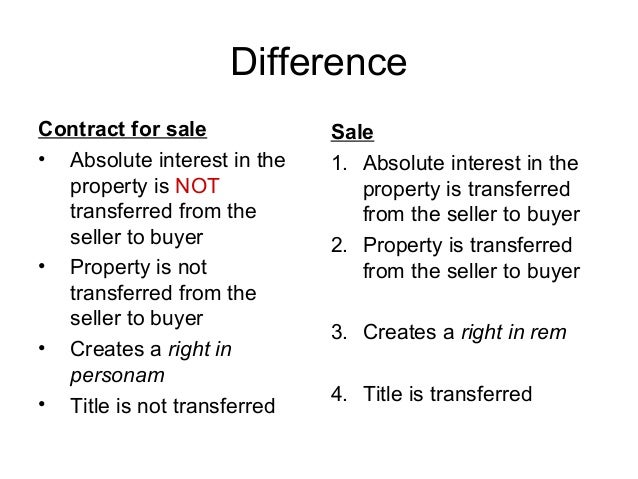
DIFFERENCE BETWEEN CONTRACT FOR SALE AND SALE :

Topic 9. Sale of immovable property


WHAT IS TRANSFER OF PROPERTY?

Rakesh Narula & Co. – Medium

Transfer of property means an act by which a living person conveys property in present or in future, to one or more other living persons (or to himself) and to transfer property is to perform such act.

ESSENTIALS OF A VALID TRANSFER :

In order to constitute a valid transfer of property, whether movable or immovable, under the Transfer Of Property Act :

  1. the property must be transferable
  2. the transfer must be competent to transfer
  3. the transferee must be competent to take the transfer
  4. the consideration or object of the transfer must be lawful
  5. the transfer must not be opposed to the nature of the interest affected thereby
  6. it must be in the manner and in the form required by the act if any.

WHAT PROPERTIES MAY NOT BE TRANSFERRED :

The general rule is that property of any kind may be transferred  but here are properties which cannot be transferred :-

  1. Spes Successionis
  2. Right of re-entry
  3. Easement
  4. Restricted interests
  5. Mere right to sue
  6. Public office
  7. Pensions
  8. Nature of Interests
  9. Un-transferable interests

PERSONS COMPETENT TO TRANSFER :

Every person competent to contract and entitled to transferable property or authorised to dispose of transferable property not his own, is competent to transfer such property either wholly or in part and either absolutely or conditionally, in the circumstances, to the extent and in the manner, allowed and prescribed by any law for the time being in force.

SECTION 11 OF THE CONTRACT ACT provides what persons are, and what persons are not competent to contract. Every person is competent to contract who is of the sound mind and is not disqualified from contracting by any law to which he is subject.