

COVID-19 ROLE OF MEDIA

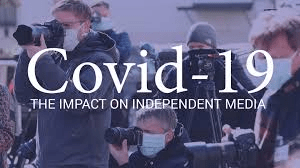
The spread of the COVID-19 has proved deadly, and this is a challenging time for the union as well as state governments as they work to address this health emergency. However, shows that in times of crisis, democratic governments may take a dangerous autocratic turn. In such a situation, journalism has a great role to play in a democracy, as it has been ideally visualized as a platform for objective information and critical-rational discourse. Thus, the health of journalism in a country can be examined in the times of a crisis. 

Corporate control over most media bodies also means that they become an instrument of the ideological apparatus of the state. There are many concerns associated with the COVID-19 crisis: ill-equipped public health systems, policies to combat the pandemic, and the lack of planning and support to the vulnerable sections. These issues demand serious examination, but the mainstream media, barring some courageous exceptions, seems to be forgetting its democratic role.
This image has an empty alt attribute; its file name is image.png

Manipulation of Discourse

Just before the announcement of the nationwide lockdown till 14th April 2020, Prime Minister Narendra Modi reportedly called upon print and electronic media owners and editors of the country and asked them to support government efforts to combat the pandemic and also advised them to present “positive news” related to COVID-19 (Sagar 2020).

Plainly put, these were the owners and editors who control most of the Indian media at the national and regional levels who were advised to abide by the official narrative and present information as provided to them by the government about COVID-19.

Why would media houses follow government diktat rather than investigating the real state of affairs, unless they have associated business interests? Journalism is considered to be an ethical communicative practice in a democracy, but corporate ownership subverts the autonomy of journalism and the freedom of the press. Unfortunately, this conflict of interest has become a common feature of Indian journalism.

However, even though a majority of Indian media is under corporate control, there are many counter-voices both within and outside this grouping. Thus, the Indian mediascape has become a battleground of ideologies. Many of these alternate counter-voices have raised genuine issues of social concern during the pandemic outbreak.

The prevalence of international media on the internet and small media organizations in the country has played an important role in disseminating factual and more nuanced information, but unfortunately, these platforms do not have the vast access that big corporate media platforms are privy to. 

This image has an empty alt attribute; its file name is image-1.png

Media shoes its Islamophobic side

Media’s ugliest moment, however, was its coverage of the news surrounding Delhi’s Tablighi Jamaat Markaz (meeting). Many participants had left after the markaz, but many were stranded in the mosque due to the lockdown and were later found infected. However, the media outrage that followed was clearly an extension of the already prejudiced and polarised coverage, as the Tablighi Jamaat was blamed for violating lockdown rules and for “corona jihad,” “Islamic insurrection,” and “corona terrorism.” This is clearly an example of fake news propagated by the mainstream media to further the predominant agenda (BBC 2020; News Laundry 2020). Muslims were also attacked in various parts of the country. 

People of other religious groups also gathered at religious places in large numbers even after the lockdown, but they were not criticised in a similar manner. However, when some journalists did raise questions, they were threatened with legal action (Scroll 2020).

The need of Greater Accountability

Since most of the people are at home during the lockdown, it is natural to see a growth in media consumption. People are using various media platforms for COVID-19-related information,   but what is provided is far from factual and does not further a critical rational discourse.

Some television news channels see a Chinese conspiracy in the spread of COVID-19. In such a “positive” atmosphere, the news related to labourers’ mass exodus and the markaz was mostly presented due to its sensational value.The pandemic is also threatening an already-deteriorating economy, which also demands a thorough investigation beyond the official narratives. The media, however, has worries related to its own economic situation. Print media, especially, is dealing with a resource crunch, dwindling advertisements, and worries of reduction in circulation and readership.

With concerns of job security, inadequate resource support, and abuses faced by the police, many journalists are putting their health at stake to cover the COVID-19 situation. This scenario does little to add to the morale of honest and responsible journalists. Some media houses have already begun cutting wages; an extension in the lockdown can create a new crisis in Indian journalism. 

The role of larger media as observed during the pandemic, however, is not an overnight shift. It has been visible for some time now.  The media has seen phenomenal growth during the last three decades, and India has become one of the biggest media markets in the world.

YouTubers and YouTube Web Series

Amidst the pandemic, I found it hard to be productive. Being thankful for my privilege, I spent times exploring YouTube.

Here’s a list of Youtubers and YouTube Brands I love:

  • Mostly Sane
  • Bake with Shivesh
  • The Detail Geek
  • Cooking Shooking
  • Jordindian
  • Filter Copy
  • Gabriel Iglesias
  • The Ellen Show
  • East India Company
  • Safiya Nygaard
  • The Try Guys
  • Jess and Gabriel
  • Ladylike
  • Shitty Ideas Trending
  • KKandbabyJ
  • Cupcake Jemma
  • Collins Key  
  • Sejal Kumar
  • OKbaby
  • Keren Swan
  • Jimmy Kimmel Live
  • Chloe Rose Art
  • Jess Conte
  • 8 Passengers
  • Cody and Lexy
  • Rebal D
  • Gabriel Conte
  • OK Tested
  • Dice Media
  • Penn Masala

WEBSERIES:

  • Operation MBBS – “Operation MBBS chronicles the lives of three first year students – Huma, Sakshi and Nishant in one of the best MBBS colleges in the country. Follow their journey as they navigate through friendships, hardships and medical student life.”
  • Wrong Number – “Story revolving around a hilarious confusion where Karan, a 2nd year engineering student, receives a message from Khushi, a medical student, on his (not so) new number. The catch here is that Karan’s new number previously belonged to Rajat, who was Khushi’s ex-boyfriend. Rajat broke contact with Khushi after a fight they had around the time when school ended and never contacted her again. But Khushi never gave up her efforts of contacting him. So now, when this number switch happens, Khushi is under the illusion that she is talking to Rajat whereas it’s Karan on the other side.”
  • College Romance – “Three best friends look for love, laughs and some lifelong memories while attending college together.”
  • Girlsplaining – “How can two girls, a batchmate and a senior, teach and train a guy who is clueless about relationships and sex?”
  • Girl in the City – “This show is about a young girl who comes to Mumbai to live her dreams and aim at her aspirations. It is about her journey in the big city.”
  • Adulting – “Adulting is a coming of age story about two young women trying to handle the responsibilities of being independent adults in the fast-paced, urban bustle of Mumbai.”
  • Kota Factory – “Dedicated to Shrimati SL Loney ji, Shri Irodov ji and Maanniya HC Verma ji, ‘Kota Factory’ is TVF’s latest original. India’s first ‘Black and White’ show highlights the problems present day IIT-JEE aspirants face in their day-to-day lives.”
  • Engineering Girls – “Three engineering students deal with dorm drama, date around, and do whatever it takes to make their dreams come true.”
  • What the Folks – “’What The Folks’ is a journey of how modern families are breaking stereotypes, overcoming generation gaps, and growing to love one another, despite having starkly different world views.”
  • Soulmates – “The story revolves around the two ex-schoolmates who bump into each other while on the trip to Shillong. Priyanshu, an aspiring music composer who is in Shillong chasing the girl of a rock band accidentally meets his schoolmate Anshul Chauhan who is on a solo bike trip across northeast. Two meet unexpectedly and fall in love, or maybe they don’t, but both of them have been giving some really adorable vibes.”
  • The Reunion – “Aarya, Dev, Deva and Gaurav go back to school after 10 years only to realise its important to look back to move forward. Friendships, relationships and some memories are at stake. Amidst the Bourbon High Batch of 2008, they find answers to what was left behind.”

Fundamental rights and the Environment


The Golden Triangle of the Indian Constitution – Article 14, Article 19 and Article 21 – has been invoked time and again for environmental protection. The High Courts and Supreme Court of India have read the right to a wholesome environment as a part of the right to life guaranteed in Article 21 of the Constitution of India.

In the Dehradun Quarrying Case, though the orders did not articulate the fundamental right to a clean and healthy environment, the petition was treated as a writ under Article 32, which implied that the court was seeing this right in the light of a fundamental right. The Supreme Court explained the basis of this jurisdiction in the later case of Subhash Kumar v State of Bihar where the court held that the right to life is a fundamental right under Article 21 of the Constitution and it includes right of enjoyment of pollution free water, air for full enjoyment of life. and that .if anything endangers or impairs the quality of life, in derogation of laws, a citizen has a right to have a recourse to Article 32 of the Constitution for removing the pollution of water or air which may be detrimental to the quality of life.. This concept has been furthered by the Supreme Court and various High Courts decisions worded differently by concretising the idea of right to a clean and healthy environment as a part of fundamental rights.


The other integral part of right to life is right to livelihood as enumerated in the Olga Tellis Case, which is again a judicial enlargement of the right to life envisaged under Article 21 of the Indian Constitution. In Olga Tellis the Court looking at the limitation of the Indian State said that to deprive a person of his right to livelihood would mean depriving him of his life. The State may not by affirmative action be compellable to provide adequate means of livelihood or work to the citizens but any person who is deprived of his right to livelihood by law can challenge the deprivation as offending the right to life conferred by Article 21. Many environmentalists think that the right to livelihood could be asserted to prevent environmentally disruptive projects that threaten to uproot tribal people and villagers for depriving their right to livelihood. The recent agitation by the farmers of Singur and Nandigram in West Bengal and Narmada Bachao Andolans (NBA) campaign against the Sardar Sarovar Dam can be understood in this perspective. However, industries see a strict environmental regime at loggerheads with the right to livelihood and clean/healthy environment of the citizens. The argument forwarded by the industry interests can be rebutted on the grounds that right to clean environment and right to livelihood are complementary rather than contradictory. If all industries follow the environmental standards, then the price of products will include all the external costs which would have to be borne by the consumers. Nevertheless, even this alternative can be questioned in a third world country like India where most people are unable to afford costlier products.


Article 14 can be invoked to challenge government sanctions for projects with high environmental impact, where permissions are arbitrarily granted without adequate consideration, for example, of their environmental impacts. Article 19(1) (g) provides that all citizens shall have the right to practice any profession, or to carry on any occupation, trade or business but with reasonable restrictions which may be placed in the interest of the general public as provided within section 19 sub clause (6), which might include total prohibition. Accordingly, in cases involving polluting industrial units, the courts face the task of balancing the environmental imperative with the right to carry on any occupation/trade or business.

Electric vehicles’; the future

An electric car is just a car propelled by one or more electric motors using energy stored in rechargeable batteries, instead of burning petrol or diesel internally and exhausting fumes. There are broadly three kinds of electric cars at present:

1.   Solar-powered electric cars and vehicles

2.   Hybrid electric cars powered by a mix of internal combustion and batteries 

3.   Electric cars with on-board battery packs also known as battery electric vehicle (BEV) 

More often than not, electric cars in the context of mobility and environmental conservation refer to battery electric vehicles, but may also refer to plug-in hybrid electric vehicles (PHEV)

In the Indian context, automobile manufacturers have announced electric four-wheelers such as Hyundai Kona Electric, Mahindra e-Verito, Mahindra e2o, Porsche Taycan, Tata Tigor EV 2019, MG ZS. But many more will be needed if India is to take meaningful steps towards becoming an EV-first nation. 

With enthusiasm rising around the chances of Elon Musk’s Tesla launching in India in 2020, many local and global auto manufacturers have started testing the waters in the Indian market for electric cars.

Some questions arise that need to be discussed these

* How do you see the evolution globally of electric vehicles in the coming years?

* Are there pockets or regions where EVs will take off sooner?

* What will happen to ICE platforms?

* What does that mean for global automakers in different regions such as Asia, Europe and US?

* What can be done to push the take rate of EVs?

What Are The Advantages Of Electric Cars Over Fuel Cars?

At a fundamental level, electric cars offer a dramatically lower operating cost compared to conventional internal combustion engines. On average, electric vehicles are 75-80% cheaper from fuel and maintenance perspective, which is an important consideration for many consumers who have high usage. This reality holds across form factors because it’s materially cheaper to charge a battery compared to refuelling a conventional liquid fuel tank.

Moreover, EVs have 75-80% fewer moving components and this ultimately translate to a much lower maintenance bill. Over and above the robust operating cost angle, EVs also possess an inherent advantage when it comes to performance and driveability.

What Are The Challenges In Consumer Adoption Of Electric Cars?

Breaking away the old norms and establishing new consumer behaviour is always a challenge. It is common to find users anxious about the speed and range of EVs. Thus, a lot of sensitisation and education is needed, to bust several myths and promote EVs within the Indian market, Zoomcar’s Moran told Inc42.

Apart from this, there are several challenges in the adoption of electric vehicle cars in India shortly. These include:

1.   Charging infrastructure

2.   Battery performance

3.   Supply-demand gap

4.   Creating the closed-loop

Lack of battery cell manufacturing

There is a complete absence of primary battery cell manufacturing in India which poses the risk of increasing our trade deficit. At the moment, most manufacturers rely on batteries imported from Japan, China, Korea and Europe. Hence, the Indian market needs encouragement for indigenous technologies that are suited for India from both strategic and economic standpoint, such as aluminium fuel cells.

How Can The Government Promote Electric Cars Further?

The Indian government is gunning for its goal of making 30% of Indian vehicles electric by 2030. The steps taken in 2019 to promote electric vehicles in the country include:

1.   Special policy measures such as slashing GST on EVs to 5% versus 28% for combustion engines

2.   INR 1.5 lakh tax exemption on loans to buy electric vehicles

3.   INR 10K Cr allocated to FAME II to push electric mobility through standardisation

4.   Union cabinet has proposed customs duty exemption on certain EV parts including electric drive assembly, on-board charger, e-compressor and a charging gun to cut down costs

5.   To localise the value chain, cabinet outplayed a five-year phased manufacturing programme (PMP) until 2024

6.   Nearly a dozen states either issued or proposed electric vehicle policies till date, with Delhi being the latest one.

“We will soon be pushing for setting up of bigger factories for battery manufacturing. We are open to listening to new ideas and pushing them, so I encourage all founders to push the envelope,” Amitabh Kant, CEO, Niti Aayog, said recently.

Further, the industry leaders Inc42 spoke to highlighted more measures that are needed:

1.   More incentives, tax cuts or rebates for every stakeholder in the mix, including the manufacturers and consumers

2.   Facilitating access to capital both for R&D as well as manufacturing

3.   Promotion of indigenous technology and capacity

4.   Creating infrastructure supporting shared mobility

5.   Offering a permit distribution for shared micro-mobility services as against a tendering system to open up the market

6.   Promoting mobility-as-a-service using EVs

7.   Phasing out ICE vehicles. For OEMs, 60% of new vehicles sold after April 1, 2025 should be zero-emission vehicles. This could be applied in a gradual way leading to 60% by 2025.

8.   Access to vehicular loans for EVs to the end-user at interest rates at par with normal vehicles even for new brands.

Article 370 and removal of Kashmir’s special status: Devil lies in ways which Article 367(4) will now apply to Jammu and Kashmir

The Union Government passed a Presidential Order under Article 370 (1) of the Indian Constitution, to supersede the 1954 Presidential Order, which, along with several other Presidential Orders, specifies which provisions of India’s Constitution apply to Jammu and Kashmir. This Presidential Order is unique in that it lays out most of the details on the special status accorded to Jammu and Kashmir under the Indian Constitution.

As described earlier, Article 367(4) as applied to Jammu and Kashmir will in turn make Article 370(3) apply to Jammu and Kashmir (by modifying the reference to the “Constituent Assembly of the State” to mean “Legislative Assembly of the State” as described above). Thus, if the Presidential Order cannot cause Article 370 to apply in a modified form to Jammu and Kashmir directly, the Order cannot achieve the same outcome indirectly, through the funnel of Article 367(4).

But if the Indian Constitution says that Article 370 can be applied to Jammu and Kashmir, then why does Article 370(1)(d) prohibit applying a modified version of Article 370 to Kashmir?

Article 370 of the Indian Constitution provides all those elements of the Indian Constitution which will apply to Jammu and Kashmir, namely:

  • the powers of the Indian Parliament that shall extend to the territory of Jammu and Kashmir;
  • Article 1 and Article 370 of the Indian Constitution will apply to Jammu and Kashmir;
  • provisions other than Article 1 and Article 370 can be made to apply to Jammu and Kashmir in a modified form by a Presidential order provided either concurrence or consultation of the Jammu and Kashmir Government is taken, depending on what is being modified.

Clause (3) of this Article 370 clarifies that all of the above requirements can be overridden by the President in a “public notification” declaring that Article 370 of the Indian Constitution shall have no force or have partial force in the Indian Constitution, so long as the Constituent Assembly of the State of Jammu and Kashmir also consents.

The force of Article 370’s text lies along two vectors:

– One vector of Article 370 is in clause (1), which can cause provisions in the Indian Constitution other than Article 1 and 370 to apply to Jammu and Kashmir (in Article 370(1) and (2)) and;
– Another vector of Article 370 is in clause (3), which applies within the Indian Constitution, and also applies to Jammu and Kashmir in an unmodified form, to sustain the special status of Jammu and Kashmir as delineated in the rest of Article 370

By the Presidential Order, modified Article 367(4) as applied to Jammu and Kashmir causes Article 370(3) to be applied to the State of Jammu and Kashmir by replacing “the Constituent Assembly” with the Jammu and Kashmir “Legislative Assembly”. However, Article 370(3) applies to India too, in the Indian Constitution. So even if this Presidential Order modified Article 370(3) as applied to Jammu and Kashmir, the Indian Constitution’s Article 370(3) continues to require the Jammu and Kashmir Constituent Assembly’s concurrence. This Presidential order cannot modify the text of the Indian Constitution, even if it modifies the text of the Indian Constitution as it applies to Jammu and Kashmir. Therefore, for any action under Article 370(3) to be valid for India, we would still need the Constituent Assembly of Jammu and Kashmir to consent.

In short, for the purposes of the Indian Constitution, any modification of Article 370(3) as applied to Kashmir, even if it were valid, would not touch Article 370(3) as it applies in India.

But the Constituent Assembly no longer exists in Jammu and Kashmir, so is there anything India can do now?

Many hold the view that Article 370 may not be abrogated at all, legally. This idea merits some exploration.

The constitutionally legitimate way to abrogate Article 370 will be for the President to issue a public notification abrogating Article 370, under Article 370(3) of the Indian Constitution as applied to India. In fact, the Rajya Sabha has attempted to recommend that the President pass such a notification in its “Statutory Resolution”. Such a notification would only have been valid, in India, if the Constituent Assembly of Jammu and Kashmir had consented to the abrogation — which needless to say, no longer is in existence.

One conceptual way of thinking about this issue is that Article 370 embodied the terms of a treaty between the State of Jammu and Kashmir (under the Maharaja) and the Dominion of India which laid out the terms on which Jammu and Kashmir would join the dominion. The embodied form of the treaty in Article 370 of the Indian Constitution, represents the coming together of two sovereign territorial units. Therefore, it is important to remember that the Indian Dominion was not bestowing a concession on Jammu and Kashmir, as commentary sometimes propagates. In this background, the Constituent Assembly of Jammu and Kashmir would have been the representative of the sovereignty of Jammu and Kashmir, on questions of whether Article 370 would stop having force in the Indian Constitution.

Therefore, one can argue theoretically that Jammu and Kashmir is free to decide that it will be represented by any legislative body instead of the Constituent Assembly, on the question of ending Article 370’s operation — which is a question of ending the treaty between Jammu and Kashmir and the Union of India. There is no situation in which India can decide for Jammu and Kashmir that a State Assembly can stand in for the Constituent Assembly. This is because, as shown earlier, Article 370(3) continues to apply to India regardless of how the Presidential Order modifies it for Jammu and Kashmir.

In short, only if both Jammu and Kashmir and India were in consensus could Article 370 have been abrogated, and that too by proceeding under Article 370(3) and not Article 370(1) of the Indian Constitution. So long as Jammu and Kashmir wants to retain special status in regard to the Indian State, Article 370 is effectively incapable of revocation or abrogation. The Supreme Court has thus also heldthat Article 370 is permanent, effectively.

Is there any way in which President’s Order can be considered constitutionally legitimate?

Even if we can somehow ignore that the President’s Order attempts to extend Article 370(3) of the Indian Constitution to Jammu and Kashmir — which Article 370(1)(d) does not allow the President to do — there is no way to save this Order. This is because a Presidential Order under Article 370(1)(d) requires the “concurrence of the Government” of Jammu and Kashmir, if it aims to extend the Indian Constitution to Jammu and Kashmir on matters not covered by the Instrument of Accession. This is specially provided in the second proviso to Article 370(1).

We know that Jammu and Kashmir has been under President’s rule for over a year now. This implies that Jammu and Kashmir is not governed by its own elected representatives, but is being run by an officer of the President of India — presently Governor Satya Pal Mallik. Therefore, it remains unclear as to how the Indian Government can argue that it has obtained the “concurrence” of the Government of Jammu and Kashmir.

The role of governor in India

The Governor of a State shall be appointed by the President by warrant under his hand and seal (Article 155). A person to be eligible for appointment as Governor should be citizen of India and has completed age of 35 years (Article157).The Governors of the states of India have similar powers and functions at the state level as that of the President of India at Union level. Governors exist in the states while lieutenant governors or administrator exist in union territories including National Capital Territory of Delhi. The governor acts as the nominal head whereas the real power lies with the Chief ministers of the states and his/her councils of ministers. Although in union Territories real power lies in lieutenant governor or administrator, except in NCT of Delhi, Puducherry and Jammu and Kashmir where he/she shares power with a council of ministers headed by a chief minister.

In India, a lieutenant governor is in charge of a union territory. However, the rank is present only in the union territories of Andaman and Nicobar IslandsLadakhJammu and KashmirDelhi and Puducherry (the other territories have an administrator appointed, who is usually an IAS officer or a retired judge of a court). However, the governor of Punjab acts as the administrator of Chandigarh. Although lieutenant governors do not hold the same rank as a governor of a state in the list of precedence.

QualificationsEdit

Article 157 and Article 158 of the Constitution of India specify eligibility requirements for the post of governor. They are as follows:

A governor must:

The governors and lieutenant governors are appointed by the president for a term of five years.

Procrastination

There is a rule of science according to many great scientists “The entropy of this universe always tends to increase”. Now, what does this mean? It simply means that everything in this universe eventually moves from order to disorder. Nothing wants to settle itself unless or until some force is applied to it. Ok, if we go to some literal definitions of procrastination, it is the delaying or postponing of a task. It is the force that stops you from doing what you are going to do, regardless of whether you term it a degenerative or procrastination or anything else.

So definitions are all cool but let’s come to the reasons now. Why do we procrastinate tho we know it is harmful to our future?

Has it something to do with your self-control or is it fair enough to call a person lazy? Being lazy means doing nothing or state of inactivity but procrastination means doing something which is not important at that time by ignoring what is important.

Being very specific the answer is no. The Quote simply says it all.

“I like work: it fascinates me. I can sit and look at it for hours.”

Jerome K. Jerome (Three Men in a Boat, 1889).

Let’s see this scientifically, say we have two versions of ourselves one is our present self and the other one is our future self. We know eating healthy and doing workouts is good for our future self. And for his sake, we make plans at night about being productive the very next day, but in the morning we usually don’t follow our plans. And one of the major reasons for this is the comfort of our present self, who doesn’t want to ruin his sweet sleep early in the morning.

We make decisions for our future self but ultimately our present self has to implement those plans. And being very truthful our present self does want to do anything which will comfort us only in our future. I mean who wants to eat a bowl of salad for being healthy after months when all you can have is a donut now. Why would I wake up early in a winter morning for doing workout whose results are going to show after months from now when I am in my warm soft bed, cuddling my favorite pillow.

So now the major question is how to stop procrastinating? Let’s explain each step one by one.

Phase 1: Recognize that you’re going to procrastinate

You could be putting off a job because you had to re-prioritize your workload. If for a very good reason, you are momentarily avoiding a significant mission, then you are not procrastinating. Nevertheless, if you start putting things off indefinitely, or changing the emphasis because you want to stop doing it, then perhaps you are.

Procrastination is the bad habit of putting off until the day after tomorrow what should have been done the day before yesterday.

Phase 2: Try to find out the reasons why you procrastinate

Try to find out why you don’t want to do a task which is that important to you. There could be a lot of reasons like you just don’t want to continue with your job but you have to due to some reasons, maybe you are not active enough when it comes to working, it could be anything and surprisingly perfectionism could also lead to procrastination sometimes as we might think we don’t have enough skills to complete the task, but try to find out a solution for your every reason.

Phase 3: Forgive yourself that you have procrastinated in the past. Research suggests that self-forgiveness will make you feel more optimistic about yourself and that the probability of procrastination in the future.

Phase 3: Come on to the job. Keep on doing that, not avoiding it. Write down the tasks you need to do, and determine the time to complete the tasks. It will allow you to take a positive approach to your job.

Phase 4: Promise yourself a reward for that. When you’re finishing a tough task in time, reward yourself with a treat, such as a slice of cake or a coffee from your favorite coffee shop. Just make sure you remember how good it feels to finish things off!

Phase 5: Rephrase the internal conversation. For example, the phrases “need to” and “have to” mean that you don’t have a choice in what you do. It can make you feel helpless and even lead to self-sabotage. Nonetheless, saying, “I want to,” means that you own a project which can help you feel more in control of your workload.

Phase 6: Minimize the noise. Switch off your email and social media, and stop sitting anywhere near a TV while you’re working!

The aim is to “eat the elephant beetle” first thing, every day! Get those things you find the least fun out of the way early. This will allow you the rest of the day to focus on the job you find more enjoyable.

So lets conclude this with a message which actually define procrastination

“Procrastination is reading all the quotes on this page when you have a huge report due tomorrow.”

R. T. A. Birektt (wish I thought of this one)

India to become a knowledge hub :PM Modi

Prime Minister Narendra Modi said that that the New Education Policy will transform millions of lives by making India a knowledge hub in an era where learing, research and innovation are important.

In a series of tweets, Mr. Modi said NEP is based on the pillars of ‘access, equity, quality, affordability and accountability.’

He stated that the policy will bring 2crore ‘out of school’ children back into the mainstream. “Aspects such as widening the availability of scholarships, strengthning the infrastructure for open and distance learning, online education and increasing the usage of technology have recieved great attention in NEP. These are vital reforms for the education sector”

“A truly remarkable day in the history of Indian Education System! Under the visionary leadership of PM Modi , the Union Cabinet approved ‘New Education Policy 2020’, which brings in much needed historic reforms in both School and Higher Education,” said Home Minister Amit Shah. “No nation in the world can excel by giving up its culture and values”, he added.

India’s fatality rate among the lowest

“Fatality rate of India’s Covid-19 is gradually declining and is now standing at the rate of 2.18%, which is one of the lowest, globally while just 0.28% of the total active cases are on ventilator”, said Union Health Minister Dr.Harsh Vardhan on Friday.

He further added, out of total 5,45,318 active cases, 1.61% need ICU care and 2.32% are on oxygen support.

In a meeting of group of ministers via video conferencing on Covid-19 on Friday, Dr. Harsh Vardhan told that India has reached a milestone of more than 10 lac recoveries with a recovery rate of 64.54%.

“Approximately 1/3rd of total positive cases are active cases under medical supervision”, he was quoted as saying in the health ministry statement.

The meeting has also suggested some measures including revamping of strategy for effective management of containment zones through stricter perimeter control, widespread rapid antigen tests, intensive and rapid door to door tests.

Meanwhile, India’s Covid-19 case tally zoomed past 16lacs on Friday, registering a record single day jump of 55,078 infections. The death-toll has reached to 35,747 with 779 fatalities being reported in 24hour span according to a health ministry bulletin.

CoronaVirus India: Record 57000 Covid-19 cases in last 24 hours

Total Covid-19 positive cases stand at 16,95,988 including 5,65,103 active cases, 10,94,374 cured/discharged/migrated and 36,511 deaths, the health ministry said.

With 57,117 people testing positive for coronavirus in a day, India’s COVID-19 tally neared 17 lakh mark today, while the recoveries jumped to 10,94,374. The country’s death toll rose to 36,511 with 764 fatalities being recorded in a day. The fatality from covid currently stands at 2.18% in India as compared to global average of about 4%.

This is the third consecutive day that COVID-19 cases have increased by more than 50,000. The total number of confirmed cases also includes foreigners.

A day after Maharashtra added the highest number of Covid-19 cases, the state’s tally dropped marginally to 10,320 on Friday, its third highest addition so far. This is the second day in a row that the state has added over 10,000 cases. Active cases in the state crossed the 1.5-lakh mark.

The number of COVID-19 cases in Pune city touched 54,255 after 818 people were detected with the infection in the last 24 hours, According to Worldometer.

Odisha Announces Weekend Shutdown in Rourkela City, 4 Districts Till Aug 31 Meanwhile in India, the Odisha government on Friday announced a weekend shutdown in four districts and Rourkela city till August 31 in the wake of a spike in coronavirus cases.

Andhra was also among eight states that recorded their highest single-day jump in cases on Friday.

The others were Uttar Pradesh 4,453 new cases, Bihar 2,986, Bengal 2,496, Assam 2,112, Telangana 1,986, Kerala 1,310, Delhi 1195 and Punjab 665.

Microsoft is in Talks to Acquire TikTok, as Trump to demand TikTok Chinese owner divest application

Microsoft is in advanced talks to acquire the United States operations of the Chinese owned video app TikTok, according to people with knowledge of the discussions, in a deal that would be a concession to White House pressure and make the software giant a major player in social media.

A sale to Microsoft, likely for billions of dollars, would be a win for both TikTok and its parent company, Bytedance Ltd., where executives had feared that the U.S. government would force device makers to take TikTok out of their app stores, according to another person familiar with the matter.

As U.S. president, Trump previously has issued three orders stopping M&A deals involving foreign parties, through the inter-agency Committee on Foreign Investment in the United States.

A deal could be completed by Monday, according to people familiar with the matter. The talks involve representatives from Microsoft, Bytedance and the White House. Talks are fluid, and a deal may not come together.

In a statement to Media, a TikTok representative said: “While we do not comment on rumors or speculation, we are confident in the long-term success of TikTok. Hundreds of millions of people come to TikTok for entertainment and connection, including our community of creators and artists who are building livelihoods from the platform. We’re motivated by their passion and creativity, and committed to protecting their privacy and safety as we continue working to bring joy to families and meaningful careers to those who create on our platform.”

A group of ByteDance investors including Sequoia and General Atlantic, who want to acquire control of TikTok amid the concerns over its Chinese ownership, have valued TikTok at about $50 billion,

Source- Reuters, Wall Street Journal, CGTN

Three young individual charged in Twitter Hack last month

Twitter Inc.’s worstever hack began months earlier with a teenager on a telephone, according to an indictment filed Friday by federal authorities.

The US Department of Justice has charged three young individuals with hacking Twitter last month that compromised the accounts of 130 high profile users including Barack Obama, Bill Gates, Jeff Bezos and Elon Musk.

The three were charged in connection with the July 15 hack, including a 17-year-old juvenile whom authorities have accused of masterminding the scam.

Two teenagers and a 22-year-old were charged with hacking the Twitter Inc accounts of famous people including former President Barack Obama, billionaire Bill Gates and Tesla Chief Executive Elon Musk, the Department of Justice said on Friday.

Mason Sheppard, a 19-year-old British man who went by the alias Chaewon, was charged with carrying out the hack, as well as related wire fraud and money laundering crimes, according to a Justice Department statement.

Orlando, Florida based Nima Fazeli, 22, nicknamed Rolex, was charged with aiding and abetting those crimes. The Justice Department did not name the third defendant, but the Hillsborough County State Attorney Office in Tampa, Florida said it had arrested 17-year-old Graham Clark.

The tweets offered to send $2,000 for every $1,000 sent to an anonymous Bitcoin address.

GDP – An indicator of development

World over, GDP, the Gross Domestic Product is the most common indicator of development. Progress of each country is calculated by the increase in its Gross Domestic Product. GDP is the monetary value of all the final goods and services produced in a country in an accounting year.

It is calculated by three methods –  

  1. Product method
  2. Income Method
  3. Expenditure method  

Under Product method, national income is calculated by the summation of monetary value of all the final goods and services at market price in a year. Under Income method, income earned by various factors engaged in the production of goods and services is added to reach the national income. This provides the National income at factor cost. Under Expenditure method, national income is the sum of expenditure incurred on the purchase of goods and services in a year.  

Apart from GDP, other measures of national income are also prevalent like NDP (Net Domestic Product), GNP (Gross National Income), NNP (Net National Product) etc.  

NDP can be calculated by deducting the depreciation from GDP i.e. NDP = GDP – depreciation  

GNP is calculated by adding net factor incomes from abroad to the GDP i.e. GNP = GDP + Net factor incomes from abroad.  

Net factor income from abroad is calculated by adding the incomes from export of goods and services and subtracting the income going out of the country through import of goods and services.  

NNP is calculated by deducting the depreciation from the GNP i.e. NNP = GNP – Depreciation. All the aforesaid measures of national income are calculated at either market price of factor cost.   

GDPFC = GDPMP – Indirect taxes + subsidies.    

Since indirect taxes and subsidies alter the market price of the commodity, in order to know the share of factor of production in the price, indirect taxes are deducted and subsidies are added in the market price. Apart from factor cost and market price, national income is also calculated at current prices and constant prices. The GDP at current prices determines the GDP at the time of its calculation while GDP at constant prices is used mainly for comparison of GDP in different years. GDP at constant prices is calculated with the help of a base year.   

In this manner different measures of National Income are calculated as per the need of time. Though every country uses GDP to measure its progress but the concept is also criticized as it excludes many other indicators of development like welfare, health, education, inequalities, quality of environment. The basic idea behind the criticism is that the countries treat GDP growth as the objective of their economic development programme however the objective of development is to ensure better life to the citizens and GDP growth is just one means to achieve that objective. Suppose if the GDP of a country is growing by 8 percent per annum but the population of the country is growing by 2 per cent per annum then the per capita GDP of the country is increasing by only 4 per cent per annum. Moreover, if the prevailing inflation is 5 percent, then the real per capita GDP is in fact decreasing by 1 per cent. Thus even on purely economic basis, real GDP per capita is the better indicator of progress than just GDP growth.   

Even the real per capita GDP is blank about the distribution of GDP. Even if real per capita GDP is growing at more that 8 per cent per year but most of this increase is cornered by elite section leaving bulk of the society in the quagmire of poverty, then it cannot be called as development by any means. Therefore many intellectuals call for the replacement of GDP by other to indicators to measure the level of development. One such index is Physical Quality of Life Index (PQLI) developed by Morris de Morris by including non-economic factors like Infant Mortality rate, life expectancy at age one and literacy rate. Though GDP is not the sole representative of development but it is indeed one of the indicator of development and therefore exclusion of GDP from any development index is also prone to criticism as the as the development on the basis of GDP only.  

In order to correct this flaw, United Nations Development Programme (UNDP) came with Human Development Index (HDI) which includes both, economic as well as non economic factors to measure the development. The index includes GDP per capita at Purchasing Power Parity (PPP), adult literacy rate as well as primary, secondary and tertiary enrollment ratio and Life expectancy at birth. GDP per capita takes care of economic well being, while Life expectancy and literacy rate details the health of the society as well as skill development in the society. In 2011, India was ranked at 134 out 187 countries in terms of HDI; indeed a poor show ! Though HDI may have some share in criticism but it is most widely accepted indicator of development as it treats human development as the ultimate objective of development. Apart from HDI, UNDP releases other indices also like Gender Inequality Index, Multi Dimensional Poverty Index, Inequality adjusted HDI etc.   

The incompleteness of the GDP to delineate the development had given rise to the other measures of development. In the latter half of the 20th century, many countries witnessed high level of GDP growth but were still lacking the effective human development. This further caused disillusionment of GDP approach. But few economists feel that there is nothing wrong in the GDP approach.They feel that absence of development despite of high GDP growth is not because of concentration of planners on GDP growth but it is because the growth was not as high as it should be to develop. Moreover, it is also very hard to conceive for a country to develop without a rise in the GDP.   How a country can increase its expenditure on health and education without an increase in its national income. So it can be concluded that though GDP is not a sole indicator of development but indeed it is a necessary input for development. In other words, GDP is necessary but not a sufficient to usher development.

Assets of India

India, the seventh largest country of the world by area and the second largest country of the world by population is poised to become the super power in future. Country posses ample resources, both human as well as material to achieve that goal but the road to become super power is also full of challenges. A super power is not just a military super power but also economic super power, technological super power, political super power etc.

Assets of India which will be helpful for India to realize the goal of becoming a super power are :  

Human Resources : Most significant factor which vital for India to become super power is its human resources. For any country, the most important assets is its human resource power and India boasts of 17.5 percent of world human resources. The presences of ample human resources with the country can boon as well as bane for the country. If nation uses its man power efficiently and ensures their contribution in the nation building process, it will certainly be a boon but if its vast population becomes a burden, then certainly it will be drag for the country’s development.   

Ocean Resources : Oceans are one of Earth’s most valuable natural resources. It provides food in the form of fish and shellfish; about 200 billion pounds are caught each year. It’s used for transportation, both travel and shipping. It provides a treasured source of recreation for humans. It is mined for minerals (salt, sand, gravel, and some manganese, copper, nickel, iron, and cobalt can be found in the deep sea) and drilled for crude oil. India is surrounded by sea on the three sides and also lies on the major sea routes of the world. India’s location on the world trade route provides an opportunity to flourish with the increasing world trade. India has 12 major and 187 minor and intermediate ports along its more than 7500 km long coastline. These ports serve the country’s growing foreign trade in petroleum products, iron ore, and coal, as well as the increasing movement of containers. Already government is gearing up to develop Indian ports to meet the projected throughput of 3.2 billion tons by 2020 from the present 1 billion. Apart from trade, Department of Ocean Development is engaged in the development of technologies to which make the harnessing of resource, living as well non living, commercially viable. In the 21st century, Indians will have to depend a lot on sustainable use of ocean resources. Thirty per cent of our population lives in coastal areas. For a better India, we have to make a judicious use of our vast ocean wealth. For this to happen, we have to learn more about our oceans.  

Technology : One cannot imagine a super power with a trivial technology and India has developed its technology at a brisk pace. Indian Space Research Organization (ISRO), Defense Research and Development Organization (DRDO) etc have developed the military as well as civilian technologies. Role of ISRO in ushering the communication revolution cannot be neglected but there are few challenges which are yet to be addressed. For instance, for launching the geo-stationary satellites, Indian capabilities are very limited and such satellites are launched from French Korou.  

Agriculture : India is among the top ten producers of almost all agriculture crops, yet it is unable to wipe out the hunger. India is far away from achieving the Millennium Development Goals. There is no element of doubt that agriculture is an important asset of India but it is also true that agriculture production in India is not up to its potential. Every year, India had to import oil seeds and pulses in huge quantity. Productivity in India is much lower than other nations like China, US and most of the countries of European Union.  

Water Resources : India’s fresh water resources are third largest in the world and importance of water can viewed from the fact that many thinkers feel that the third world war will be fought for water. In the light of above fact, water is indeed an important asset for the country but the irony is many areas in India lacks potable water supply, only half of the country’s area is irrigated water borne diseases takes heavy toll on the health of citizens every year.   

Energy : As the country develops, its energy demand is poised to increase and so is the case with India. India boasts of ample coal and water resources, thus has huge potential of thermal as well as hydel power. Apart from this, being a tropical country, receives ample sunshine for most of the year which means that solar energy can also be utilized for the energy starved nation. Despite of such a huge potential, power supply of the country is always less than the demand.    

Forests : Forest resources are most important resources of our country useful in maintaining ecological balance, providing fire wood, providing raw materials to many industries, providing protection to wild animals and to conserve the soils. India has 75 million hectares under forest cover which accounts for 23% of total geographical area. Today forests resources are depleting due to urbanization and industrialization. Therefore the conservation of this asset is an urgent requirement not only for economic reasons but also for social reasons as many tribes depend on these resources for their livelihood.  

Minerals : Minerals are valuable natural resources being finite and non-renewable. They constitute the vital raw materials for many basic industries and are a major resource for development. Management of mineral resources has, therefore, to be closely integrated with the overall strategy of development; arid exploitation of minerals is to be guided by long-term national goals and perspectives. India with diverse and significant mineral resources is the leading producer of some of the minerals. India is the largest producer of mica blocks and mica splitting; ranks third in the production of coal and lignite, barytes and chromite; 4th in iron ore, 6th in bauxite and manganese ore, 10th in aluminium and 11th in crude steel. Iron-ore, copper-ore, chromite ore, zinc concentrates, gold, manganese ore, bauxite, lead concentrates, and silver account for the entire metallic production. Limestone, magnesite, dolomite, barytes, kaolin, gypsum, apatite, steatite and fluorite account for 92 percent of non-metallic minerals.  

Health :  Healthcare is one of India’s largest sectors, in terms of revenue and employment, and the sector is expanding rapidly. During the 1990s, Indian healthcare grew at a compound annual rate of 16%. Today the total value of the sector is more than $34 billion. This translates to $34 per capita, or roughly 6% of GDP. By 2012, India’s healthcare sector is projected to grow to nearly $40 billion. The private sector accounts for more than 80% of total healthcare spending in India. India’s expanding health facilities are also attracting the patients from the developing as well as developed world because of the power cost of treatment in India.  

Industry : Indian industries developed at a brisk pace during the post globalization years. Industries like automobile, textile, gems and jewellery are the important assets for the country which are also the most important foreign exchange earners. But industrial sector is not able to grow to its full potential because of poor infrastructure. Poor infrastructure is a significant challenge and it must be addressed on priority basis otherwise we might lose the edge to the developing markets in China, Bangladesh, Sri Lanka and Asian countries.  

Services : Services account for more than 55 percent of the country’s GDP. They are also the most important foreign exchange earner as the service account always earns a surplus in the Balance of Payment account. Further, service sector is employment intensive also. Services like Transport, financial services, communication, personal services software services etc are growing leaps and bound.  

Thus, India is neither short of resources nor efforts to become super power but still its far from becoming a super power. India cannot claim to become a super power with a medium level of human development index, one third of population living below poverty line, power cuts are frequent. Therefore it is expedient for the country to utilize its resources fully and ameliorate the internal challenges. Once India successfully fights with poverty, unemployment and inequality, it tag of super power will come automatically.

Films Division to pay documentary tribute to Munshi Premchand and Mohammad Rafi today

Films Division to pay documentary tribute to Munshi Premchand and Mohammad Rafi today. Films Division Mumbai will be screening two special documentaries to mark the 140th birth anniversary of most accomplished writer and storyteller, Munshi Premchand and the 40th death anniversary of legendary playback singer, Mohammed Rafi today. The documentaries, ‘Premchand’ and ‘Rafi – We Remember You’ will be streamed on Films Division Website and YouTube channel for free.

The documentary, ‘Premchand’ is directed by P C Sharma. It is a short biography on Munshi Premchand who is popularly known as ‘Upanyas Samrat’ or the King among novelists. His innumerable short stories and novels portray India’s rural life very incisively and movingly.

Memories of immortal singers come alive in ‘Rafi – We Remember You’ is directed by Kuldeep Sinha. The hour-long documentary shares special moments from Rafi’s life, his everlasting songs and tributes by contemporaries.