Inner Voice Episode 1

I never wanted that to be happening. Never wanted me to want someone more than myself. It just happened that I started believing in someone more than myself. And every time, no one turned out to be worthy of me. Repeatedly getting cheated, caught dumbed & ditched, people changed one after the other. I thought that this person would not betray me, so I went ahead.

Whereas the one who cheated earlier realized his flaws and wanted to come back I didn’t allow it only because of my belief that the one who had betrayed me once then it not tough to do that again. But Even when I got attached to another person in this world I was also getting that hurt, tears, and even afraid of getting betrayed….Why???

People of this world made me ask “Why” Then why God would answer? I’m pretty sure people would be answerable and have to pay for their Karma.

It’s not possible for a human being to leave and forget someone but every time another human forced me to act like and accept this tough lesson. To be honest I’m not learning too much from these all but yes it’s broken me into tiny pieces inside.

There & then it’s God’s will for my goodwill, right??? I forgot God then what are you and who to enlighten??

It’s my bad as everyone is the same instead of me.

Inflation not yet in control.

In twin blows to Indian economic revival, higher food prices drove retail inflation to a five-month high of 7.4 per cent while factory output fell for the first time in 18 months. This relates to data of september month.

The second consecutive month of rise in consumer price index (CPI)-based inflation will add to the pressure on the Reserve Bank of India (RBI) to again raise interest rates to tame high prices.

Inflation has been above the targeted zone for the ninth month in a row and as per statute, the RBI will now have to explain to the government in writing why it failed to keep prices below 6 per cent.

This is the ninth consecutive month where the inflation print has remained above the upper band of 6 per cent and the second successive quarter where the average is higher than 7 per cent.

Irregular rainfall is said to be the primary reason behind higher inflation in vegetable and fruits. While inflation in cereals has also inched up, the steps taken by the government and a reasonably healthy Kharif output are expected to address the concerns behind the further hike in prices.

Inflation not yet in control.

In twin blows to Indian economic revival, higher food prices drove retail inflation to a five-month high of 7.4 per cent while factory output fell for the first time in 18 months. This relates to data of september month.

The second consecutive month of rise in consumer price index (CPI)-based inflation will add to the pressure on the Reserve Bank of India (RBI) to again raise interest rates to tame high prices.

Inflation has been above the targeted zone for the ninth month in a row and as per statute, the RBI will now have to explain to the government in writing why it failed to keep prices below 6 per cent.

This is the ninth consecutive month where the inflation print has remained above the upper band of 6 per cent and the second successive quarter where the average is higher than 7 per cent.

Irregular rainfall is said to be the primary reason behind higher inflation in vegetable and fruits. While inflation in cereals has also inched up, the steps taken by the government and a reasonably healthy Kharif output are expected to address the concerns behind the further hike in prices.

Netaji is Netaji Subhas Chandra Bose

The death of Mulayam
Singh Yadav
is sad as he was a great political leader and his
contribution to Indian politics in general in our country and Uttar Pradesh in
particular from time to time has been highlighted in many prints and electronic
media.  With a political career straddling more than six decades, being
elected as a Member of Parliament (MP) seven times and the Member of the
Legislative Assembly (MLA) 10 times, the veteran politician was a prominent
political leader. In 1992, Yadav set up his own Samajwadi Party (Socialist
Party). He served three non-consecutive terms as the Chief Minister of Uttar
Pradesh, and also served as the Minister of Defence, at the Government of
India. Later on, his son the young Akhilesh Yadav became Chief Minister of
Uttar Pradesh in 2012. Mulayam Singh Yadav’s controversial statement on rape
many Indians did not take in the good sense. Anyway, he was often referred to
as Netaji by party leaders, workers, and others (reason which may be
understood). But as a senior citizen and academician, I cannot accept. In this
context, I wish to mention all Indians even many Pakistanis and Bangladeshis
talked about Netaji Subhas Chandra Bose’s immense contribution to the freedom
movement of India. So, Netaji means Netaji Subhas Chandra Bose. It is pertinent
to mention that Mahatma means Gandhiji. Indians have accepted Mahatma for
Gandhiji then why some people will use Netaji for Mulayam Singh Yadav? Many
newspapers highlighted ‘Netaji’ for Mulayam Singh Yadav.  Can they write
for any other stalwarts? Here I wish to mention a few lines about Netaji Subhas
Chandra Bose’s contribution to those who are not aware.  While Subhas
Chandra Bose was Congress President, many admired him for his energetic role
and that is why he was elected President of Indian National Congress for two
consecutive terms but had to resign in the mid of second term due to
ideological differences with Gandhiji as Mahatma Gandhi preferred Pattabhi
Sitaramaiah, but he was defeated.   It is believed that albeit
Pattabhi Sitaramaiah was a Telugu person hailing from the southern part of
India but many persons of the southern region of India voted in favour of
Netaji Subhas. Anyhow, while Netaji was Congress President he carried out many
remarkable works – one was his initiative to keep Assam with India as then
Muslim League leaders’ had different game plans. In 1938, Assam was passing
through great political turmoil as there was a serious political problem –
Muslim League vs. Congress. During that time, Gopinath Bordoloi invited Netaji
(President of Congress at that time) to come to Assam and intervene. Netaji
Subhas Chandra immediately rushed to Assam and strongly advocated the formation
of the ministry under the leadership of Gopinath Bordoloi.  As a sequel,
Assamese youths were happy and a booklet on Netaji was published by some
enthusiastic students of Cotton College in 1939, under the umbrella of the All
Assam Progressive Youth Association (AAPYA, formed at that time).  
While Netaji Subhas was Head of the Indian National Army (INA) or Azad Hind
Fauj, Dr. (Mrs.) Lakshmi Swaminathan met him in Singapore and decided to join
the freedom movement as she was impressed with the charismatic speech of Netaji
Subhas. She as   Captain Lakshmi headed a regiment called Jhansi Rani
Laxmi Bai Regiment.  It was the first regiment headed by a lady in Asia
with around 1000 women personnel. Also, it is pertinent to mention that around
60,000 persons consisting of all religions were in Azad Hind Fauj and brigades
were in the name of great personalities like Gandhi brigade, Nehru brigade, Azad
brigade, Subhas brigade, Rani of Jhansi regiment.  

No Indian can forget Netaji’s
great statement, ‘You give me your blood and I will give you
Independence!’ 

Neighbourhood Planning


What is neighbourhood planning?

Neighbourhood planning is a right for communities to shape the way their local area is developed through 

the use of Neighbourhood Development Plans.

Introduced through the Localism Act 2011, Neighbourhood Development Plans become part of the wider 

Local Plan and are used to determine the outcome of planning applications.

Neighbourhood Plans allow communities to have more influence and control over their local area to 

ensure they get the right type of development for their neighbourhood. However they cannot influence 

or block development set out previously by the Local Plan.

Neighbourhood Plans are led and produced by an authorised local community organisation such as a 

parish or town council, or where one does not exist a Neighbourhood Forum may be designated.

A Neighbourhood Plan can:

  • Identify a vision for the area and set objectives for the next 5 to 20 years
  • Provide detailed planning policies setting out for example, where new development should be located 
  • and how it should be designed
  • Allocate sites for different types of development such as housing, retail and office space and designate 
  • areas of community greenspace
  • Identify key areas for improvement and set out proposals for them

Neighbourhood Plans will be subject to consultation, examination and a referendum, and once adopted 

form a part of the statutory development plan for Wigan.

An adopted Neighbourhood Plan carries significant weight in determining development proposals for the 

local area, as a result, there are a number of legal requirements that the plan must meet.

A Neighbourhood Plan must:

  • Have appropriate regard to national planning policy
  • Be in general conformity to the strategic policies in the Wigan Local Plan and Places for Everyone plan
  • Contribute to the achievement of sustainable development
  • Be compatible with environmental obligations, as incorporated in UK law
  • Be compatible with human rights requirements.

Neighbourhood planning activity in Wigan Borough

There are currently four designated Neighbourhood Forums in the borough:

Setting up a Neighbourhood Plan

If you are interested in creating a Neighbourhood Plan for your area, or would like more information, 

please contact Neighbourhood Planning. We will be happy to meet with you and talk through 

what is involved.

The Benefits of Boredom

I have always been a rather easily bored person (much to the annoyance of my parents and friends). I have also been a very creative person. It was not until very recently that I learnt that the two go hand-in-hand with each other.

A lot of neurologists suggest that boredom is good for you. The only problem is that no one allows themselves to experience the benefits of boredom. Why is this, you may wonder? Well, boredom has been demonised in popular culture. People go about saying “An idle mind is a devil’s workshop.” As a result, we instantly seek relief from boredom through some or the other engaging activity- even something as simple as watching a YouTube video or scrolling through Instagram or TikTok.

Photo by Alan Retratos on Pexels.com

Boredom makes you itch to do something, anything. But the only way one can reap the benefits of boredom is to wallow in that discomfort. Instead of seeking relief from the boredom, staying bored and letting your mind wander and work its magic is the perfect way to boost and stimulate creativity.

So, every now and then, just sit there and do nothing and see where your thoughts take you!

The Benefits of Boredom

I have always been a rather easily bored person (much to the annoyance of my parents and friends). I have also been a very creative person. It was not until very recently that I learnt that the two go hand-in-hand with each other.

A lot of neurologists suggest that boredom is good for you. The only problem is that no one allows themselves to experience the benefits of boredom. Why is this, you may wonder? Well, boredom has been demonised in popular culture. People go about saying “An idle mind is a devil’s workshop.” As a result, we instantly seek relief from boredom through some or the other engaging activity- even something as simple as watching a YouTube video or scrolling through Instagram or TikTok.

Photo by Alan Retratos on Pexels.com

Boredom makes you itch to do something, anything. But the only way one can reap the benefits of boredom is to wallow in that discomfort. Instead of seeking relief from the boredom, staying bored and letting your mind wander and work its magic is the perfect way to boost and stimulate creativity.

So, every now and then, just sit there and do nothing and see where your thoughts take you!

IMF’s Chief praises India’s economic growth.

India has emerged as “a bright light” at a time when the world is facing imminent prospects of a recession, the chief economist of the International Monetary Fund (IMF) said on 12 October, noting that the country, however, needed key structural reforms in order to achieve the ambitious target of being a USD 10 trillion economy.

Pierre-Olivier Gourinchas, chief economist of the IMF said: “Well, India is, I want to say, sort of bright light. The Indian economy has been doing reasonably well.”   In its World Economic Outlook, the IMF projected a growth rate of 6.8 per cent in 2022 as compared to 8.7 per cent in 2021 for India.

The projection for 2023 slides down further to 6.1 per cent, he noted.

Responding to a question on the ambitious goal of India becoming a USD 10 trillion economy, Gourinchas told PTI that he certainly believes this is achievable.

“Inflation is still above the central bank target in India. We expect India’s inflation at 6.9 per cent in 2022-23, which is likely to come down to 5.1 per cent next year. So, the overall stance of the policy we think that fiscal and monetary policy should be probably on the tightening side,” Gourinchas said.

IMF's Chief praises India's economic growth.

India has emerged as “a bright light” at a time when the world is facing imminent prospects of a recession, the chief economist of the International Monetary Fund (IMF) said on 12 October, noting that the country, however, needed key structural reforms in order to achieve the ambitious target of being a USD 10 trillion economy.

Pierre-Olivier Gourinchas, chief economist of the IMF said: “Well, India is, I want to say, sort of bright light. The Indian economy has been doing reasonably well.”   In its World Economic Outlook, the IMF projected a growth rate of 6.8 per cent in 2022 as compared to 8.7 per cent in 2021 for India.

The projection for 2023 slides down further to 6.1 per cent, he noted.

Responding to a question on the ambitious goal of India becoming a USD 10 trillion economy, Gourinchas told PTI that he certainly believes this is achievable.

“Inflation is still above the central bank target in India. We expect India’s inflation at 6.9 per cent in 2022-23, which is likely to come down to 5.1 per cent next year. So, the overall stance of the policy we think that fiscal and monetary policy should be probably on the tightening side,” Gourinchas said.

What is Neighbourhood Planning


What is neighbourhood planning?


Neighbourhood planning gives your community the opportunity to plan for your local area, to decide what the place you live in should look like and define how your neighbourhood should grow and change in the future.

Neighbourhood planning gives your community the opportunity to set out proposals such as:

  • developing a shared vision for your neighbourhood
  • choosing where new homes, shops, offices, and other development should be built
  • identifying and protecting local green spaces
  • having a say on what new buildings should look like

While neighbourhood planning gives your community the opportunities to develop you own area, any neighbourhood plan must align with national planning policies as well as policies contained in our local plans for that area. It is important to mention that neighbourhood plans cannot block development already agreed through the council’s local plan or development which has already been agreed.

Who can start neighbourhood planning activity?

Anyone can identify the need for neighbourhood planning. However, only the relevant parish or town council can initiate this and in doing so, they will be responsible for the progression of the work required, in consultation with us.

In the absence of a parish or town council, you can create a neighbourhood forum (a community organisation) to carry out this role. The same measures for neighbourhood planning activity apply to both designated neighbourhood forums and parish / town councils. Its membership is open to:

  • anyone living in the neighbourhood area concerned
  • anyone working there
  • elected members of the county council, whose area falls within the geographic area concerned

Groups can either work individually or jointly in which case a lead authority would need to be nominated. For the purposes of this web page, we refer to all bodies undertaking neighbourhood planning activities as ‘neighbourhood planning groups’.

Types of neighbourhood planning activity

There are three types of neighbourhood planning that your community may wish to do:

  • Neighbourhood plan
  • Neighbourhood development order
  • Community right to build order

Neighbourhood plan

In addition to existing planning policies for your area, your neighbourhood planning group can develop further policies relating to the future development and use of land in your neighbourhood. This can include general or site specific policies.

Whilst our development plan for your area sets out the broad policies which neighborhood planning activity must conform with, your neighbourhood plan can provide greater detail. Future planning applications will be judged against a neighbourhood plan as well other relevant statutory plans. 

Neighbourhood plans have to meet particular tests (known as ‘basic conditions’) before they can be brought into force. You can find out more about basic conditions at Top tips on Neighbourhood Planning: Understanding the Basic Conditions. Before a neighbourhood plan can be brought into force it must pass an independent examination and gain support from a majority of residents through a referendum. Once a plan is in force, planning decisions for that area will take into account its policies as well as those set out in the current local plan. 

Neighbourhood development order

Neighbourhood development orders allow your community to identify development proposals which can go ahead without having to go through the formal planning application process.. Examples are:

  • extensions of a certain size or type
  • major development schemes
  • new houses (including affordable)
  • a new shop or pub
  • employment units

Community right to build order

Community right to build orders allow you to grant planning permission for your local community to build small-scale housing developments, community facilities or shops. Any benefit from this should stay within your community, for example providing or maintaining a playground, village hall or delivering affordable housing.

Any local community organisation can create a community right to build order, not just parish and town councils or a neighbourhood forum.

What neighbourhood plans cannot do

Neighbourhood plans cannot block development already agreed through our local plan, or development that has already been granted planning permission.

The Position of Women In India

 The women have held different status and
position at different times in India. She was regarded as mentally inferior to
man. Manu was of the view that the females should not enjoy any freedom in any
walk of life. They should ever remain under the strict control of their father
during girlhood; of their husband during their married life and of their sons
during widowhood.

The women could freely participate in the
religious and public life during the Vedic Period. The couple jointly performed
the sacrifices. A son’s birth always gave greater joy than daughter’s birth.
The brotherless married girls enjoyed the right of inheritance. The women could
attend the social gatherings and freely meet and converse with strangers. The
bride was most heartily welcomed. She reigned supreme over the household. The
could chant the Vedic Mantras. A window could remarry her own brother-in-law at
her sweet will. She stood high in the public. Even if she overstepped moral
laws she was judged mildly and with sympathy. She was her husband’s helpmate in
all the domestic affairs. The society was tolerant. Even the sons of a maiden
were accepted by the society. The son was known as the boat of salvation but
all the performances remained incomplete without the woman’s participation.

Later on she lost her place in the
religious sphere. The daughter’s birth was despised. Social laws and customs
stamped her with a sort of mental deficiency. The luckless girl was treated as
an intruder and was killed in certain tribes even in infancy. She was strictly
confined to home and domestic cares. She was not to be relied upon in matters
of serious concern. She had no free hand in expenditure.

Need to transform agriculture to advanced farming and maintain continuity

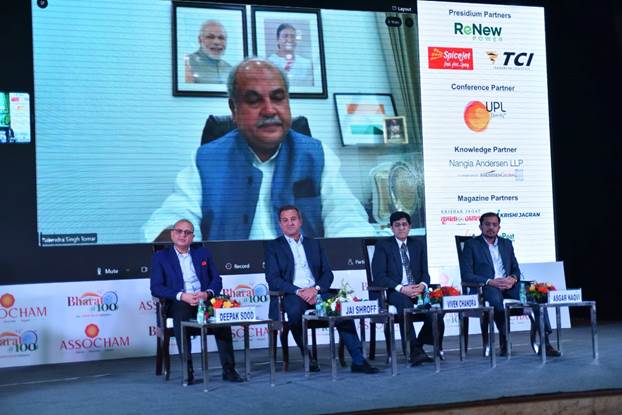
 The Union Minister for Agriculture and Farmers Welfare, Shri Narendra Singh Tomar has said that the Agriculture sector is the backbone of our country and our rural economy and agriculture have such strength that the country can easily overcome even the adverse situations. The Indian Agriculture sector has shown this during the Covid pandemic. The Government of India provided food security to 800 million people of the country, as well as helped friendly countries. Today we are in the first or second place in the world in terms of most of the agricultural produce. Despite this, there are some challenges before the Agriculture sector. There is a need to work in this direction to transform agriculture into advanced farming, technology should be used in agriculture and its continuity should be maintained.

Shri Tomar said this in his virtual address to the National Conference on Enhancing Agricultural Productivity on the topic “Integration of Improved Seeds and Agri Inputs”, organized by the Associated Chamber of Commerce and Industry of India (ASSOCHAM) in New Delhi today. Shri Tomar said that the stronger and more profitable the Agriculture sector is, the stronger the country will be. There is a need to consider the challenges facing Agriculture today. In spite of all the favourable conditions, the area under farming and its profit and loss depend a lot on the nature. People’s curiosity and attachment towards agriculture should increase, agriculture should be attractive for the next generation and farmers can be retained for farming, more work needs to be done in this direction. Shri Tomar said that the government is working to reduce the gap between farmers and the market, providing infrastructure in rural areas and eliminate the role of middlemen. He said that the number of small farmers in the country is more, who have small acreage and do not have money for investment; for such farmers, the Central Government is setting up 10,000 new FPOs, for which a provision of Rs 6,865 crore has been made and small farmers are being mobilized. It is the effort of the government that farmers should do group farming, so that the input costs can be reduced, production quality improves and small farmers can shift to remunerative crops and get the price for their produce on their own terms. FPOs can also process products. For this, the government has extended loans up to Rs. 2 crore without guarantee.

Shri Tomar said that to reduce import dependence in oilseeds, the Oil Palm Mission has been started with a provision of Rs.11,000 crore. 28 lakh hectares of land in the country is suitable for oil palm cultivation. The prospects are high in the Northeast. Provision of Rupees One lakh crore Agri Infra Fund has been made for creation of infrastructure in the villages. Provision has also been made for special packages for Animal Husbandry, Fisheries and Medicinal Farming. Shri Tomar said that the Government of India is also working on the Digital Agriculture Mission, in which farmers, banks and other institutions will be linked, crop assessment made, data collected and crop losses will also be assessed with technology. Mapping will be done in such a way that farmers across the country can be advised through the State Governments as to where and which consumption is there, accordingly profit can be earned by producing as much needed. There will be no panic and there will be no loss. The Government has also emphasized on Natural Farming, in this direction we all need to work ahead. ASSOCHAM members including Secretary General Shri Deepak Sood, Shri Asghar Naqvi and Shri Jai Shroff were present in the programme. A knowledge paper was released on the occasion.

***