Optics – Application, Laser optics, Fiber optics communication

The formal study of light began as an effort to explain vision. Early Greek thinkers associated with a ray emitted from the human eye. A surviving work from Euclid, the Greek geometrician, laid out basic concepts of perspective, using straight lines to show why objects at a distance appear shorter or slower than they actually are. Eleventh-century Islamic scholar Abu Ali al Hasan Ibn Al-Haytham known also by the Latinized name Alhazen revisited the work done by Euclid and Ptolemy and advanced the study of reflection, refraction, and color. He argued that light moves out in all directions from illuminated objects and that vision results when light enters the eye. In the late 16th and 17th centuries, researches including Dutch mathematician Willebrord Snel noticed that light bent as it passed through a lens or fluid. Although he believed the speed of light to be infinite, Danish astronomer Ole Romar in 1676 used telescopic observations of Jupiter moons to estimate the speed of light as 140,000 miles a second. Around the same time, Sir Isaac Newton used prisms to demonstrate that white light could be separated into a spectrum of basics colors. He believed that light was made of particles, where as Dutch mathematician Christiaan Huygens described light as a wave.

The particle versus the wave debate advanced in the 1800s. English physician Thomas young’s experiments with vision suggested wavelike behavior, since sources of light seemed to cancel out or reinforce each other. Scottish physicist James Clerk Maxell’s research united the forces of electromagnetism fell along a single spectrum. Te arrival of quantum physics in late 19th and early 20th century prompted the next leap in understanding light. By studying the emission of electrons from a grid hit by a beam of light known as the photoelectric effect Albert Einstein concluded that light came from what he called photons, emitted as electrons changed their orbit around an atomic nucleus and then jumped back to their original state. Through Einstein’s finding seemed to favor the particle theory of light, further experiments showed that light and matter itself behave both as waves and as particles.

How do lasers work?

Einstein’s work on the photoelectric effect led to the laser, an acronym for “light amplification by stimulated emission radiation.” As electrons are exited from one quantum state to another, they emit a single photon when jumping back. But Einstein predicted that when an already excited atom was hit with the right type of stimulus, it would give off two identical photons. Subsequent experiments showed that certain source materials, such as ruby, not only did that but also emitted photons that were perfectly coherent-not scattered like the emissions of a flashlight, but all of the same wavelength and amplitude. These powerfully focused beams are now common-place, found in grocery store scanners, handheld pointers, and cutting instruments from the hospital operating room to the shop floors of heavy industry.

Future trends in fiber optics communication

Fiber optics communication is definitely the future of data communication. The evolution of fiber optic communication has been driven by advancement in technology and increased demand for fiber optic communication. It is expected to continue into the future, with the development of new and more advanced communication technology.

Another future trend will be the extension of present semiconductor lasers to a wider variety of lasing wavelengths. Shorter wavelength lasers with very high input powers are of interest in some high density optical applications. Presently, laser sources which are spectrally shaped through chirp managing to compensate for chromatic dispersion are available. Chirp managing means that the laser is controlled such that it undergoes a sudden change in its wavelength when firing a pulse, such that the chromatic dispersion experienced by the pulse is reduced. There is need to develop instruments to be used to characterize such lasers. Also, single mode tunable lasers are of great importance for future coherent optical systems. These tunable lasers laser in a single longitudinal mode that can be tuned to a range of different frequencies.

“Music is the arithmetic of sounds as optics is the geometry of light.” – Claude Debussy

Does sneezing stops your heart?

Most of us have experienced it while in our class, meeting or at any other important commitments. Yes, sneezing, especially when we were suffering from some allergies, we can’t control it, but why do we sneeze? What’s the reason behind it? Well a sneeze is officially called as Sternutation. Sneezing is an involuntary activity of our body to clear our nose. Whenever a foreign matter such as dust, dirt, germs or anything that shouldn’t be there enters your nostrils, the nose get irritated and it sends a message to your brain. Then to remove the particle your brain sends a message to all of your muscles for a sudden exhalation process called a sneeze, and it would take only milliseconds for your brain to process this. In 2002, a study at Denmark’s department of Otorhinolaryngology at Rigshospitalet showed that 95% of people sneeze four times or less each day. Worldwide, we could be sneezing upwards of 7.8 billion times a day.

Shot of an attractive young woman feeling ill and blowing her nose with a tissue at home

Cultural beliefs about sneezing

          Many people think that sneeze is a sign of good luck, while others think it’s a bad sign. People in ancient Greece, 400BC believed these sneezes are favorable sign from the gods. During the 6th century, the plague killed 200 million people all over the world; sneeze is also one of the symptoms of this disease. So people started to believe that sneeze is a sign of death and by saying “bless you” they thought it may prevent them from being infected and some used to consider as a final blessing. That’s why still some people say “God bless you” when someone sneeze.

Does really sneeze stops our heart?

        Do you know? Your sneeze can create 100,000 droplets and it can travel up to 160 kilometers (100 miles) an hour. Yes it’s more likely a faster way to spread diseases than a cough. So while sneezing, our heart stops for a second and start after that? Well it seems like it takes a break but, it’s not the case. Usually we inhale deeply before sneezing; this increases the pressure in your chest and slows down the blood flow to your heart. The heart compensates this by changing to its regular beat right after we sneeze. So it only reduces the heart rate for a short period of time rather than stopping it. Do you know? The heart can continue to beat for a short time after being removed from the body because; it has its own electrical system that can pump blood as long as it gets oxygen. So a sneeze won’t stop the electrical activity of our heart.

Is holding your sneeze dangerous?

       Most of us hate sneezing in awkward situations, it makes us embarrassed. Did you ever tried to hold your sneeze? If you did, the following incident will show why you should not. A 34 year old man has admitted to a hospital in the UK for serious neck infection. Doctors found that the pressure built from the sneeze cant able to escape as he blocked his nose and mouth. It causes rupture in the cavity that connects our nose and mouth called pharynx. It seems that he is trying to hold his sneeze every time for the last 30 years because, he feels that it would be unhygienic to sneeze into the atmosphere. He was hospitalized for a week and doctors treated him with the necessary antibiotics to cure the infection.

      Sneezing is one of the primary defense systems in our body to get rid of harmful irritants in our nose. The entered irritant somehow should have to go out. So, don’t try to hold it, just let it happen.

“I used to wake up at 4 AM and start sneezing, sometimes for five hours. I tried to find out what sort of allergy I had but finally came to the conclusion that it must be an allergy to consciousness”.     – James Thurber.

RUSSIA-UKRAINE TALKS

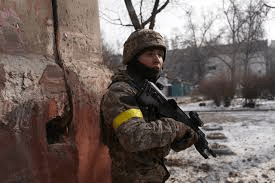
Russia and Ukraine have failed to find a breakthrough on a ceasefire and other humanitarian issues at the first high-level talks in Turkey  since Moscow’s military operation . Russia’s Foreign Minister Sergei Lavrov and Ukrainian counterpart Dmytro Kuleba met on the sidelines of a diplomatic forum in the Turkish resort city of Antalya .Mr Kuleba has  accused his Russian counterpart of bringing “traditional narratives” about Ukraine to the table.  However Kuleba   said that he would be ready to meet with Lavrov  again in this format if there are prospects  of a substantial discussion for seeking solutions.Lavrov said Russia also wants to continue negotiations with Ukraine and President Vladimir Putin would not refuse a meeting with his Ukrainian counterpart Volodymyr Zelenskyy to discuss “specific” issues.

Time and Tide wait for none

The first thought that comes to our mind when thinking about time is it can’t be changed. But we are not trying to understand the wastage of time in our day-to-day life. We know the benefits of it, but we don’t realize its importance in our life. The reasons we gave to waste time are infinity.

Photo by Taryn Elliott on Pexels.com

There are many reasons for wasting time we would have come across in our daily routine. Some of them are :

  1. Addiction over small tasks : This type of time wastage occurs when we get addicted to small tasks that surrounding us neglecting the big tasks that are important and urgent. It is caused due to the need of perfection in our simple task, but the cost of this addiction is realised later.
  2. Procrastination : It happens every time when we lost our focus on the current work and started thinking about something else without knowing. It is the most common and dangerous reason that finally leads to jeopardise our job.
  3. Wrong priorities : We must prioritise our works correctly before involving in it. The more time we give to priorities our works, the more jobs we can finish. Wrong prioritising of jobs leads to losing of important and urgent work.
  4. Multitasking : The tendency to do everything at once is the way to finishing none at last. Initially it may look like doing all at once and saving time. But eventually it makes our easy jobs more complex and atlast completing no tasks. The amount of time we take to do all simultaneously is more than the cumulation of time taken to do all jobs each at a time.
  5. Disorganised : The surrounding of our work bench also influence our time. If it were too clumsy, the time to find something important is also comes under time wastage. The place we work must be clean and organised to make our jobs easier.

METHODS TO SAVE TIME

  1. Eliminate Distractions : There must be no distractions during our work time. It must be eliminated as far as possible to finish the task quickly. Distractions took large amount of time and it results in postponing of jobs.
  2. Creating a To-Do List : A To-Do list can help us prioritise our jobs and it is a easy way to work on our tasks in an proper order. To-Do List must be created either during day before night or early morning. The important point in creating a To-Do list is it must be minimum and must be possible schedule.
  3. Take a Break : A small break between task keeps us productive during the task and motivate us to do other jobs as well. The best way to schedule breaks is pomodoro technique. Pomodoro is a technique which involves 25 minute work – 5 minute break. This break time must be used for our hobbies and favourite tasks instead of using smart phones and televisions.
  4. Reduce social media Time : The time spend in social media must also be scheduled otherwise it will consume large amount of time. It can be used for some time and must be thrown away. Sometimes logging out of social media might help, since the next time we go to social media the lazyness of logging in again may tempt us to see it afterwards.

The more productive we are, the more achievements we can we do in our life.
Stay productive!!

Science or Religion

It is a well-established fact among the human race that “Some things can only be emotionally and mentally felt, rather than being expressed” Catering to the above thought, I would like to open my side of the debate by arguing, that we as humans express our feelings or rather what we believe in, for the benefit of our companions and relatives. Our beliefs are rather stored in our minds and are sometimes difficult to be given a ” DEFINITION”. But, in no way does that signify how strong our emotions are, or the stability of our mindset. Let’s take the most famous example here, Science vs Religion( GOD), or rather how we know it – ILLUMINATI. Some argue, that God does not exist, it is just a notion of our minds that has or can never be clinically proven. I would reply to that with a “Science” fact- If the earth’s gravity were less than 0.000000000001% of what it is right now, our planet would collapse. And if it was increased by the same value, the Earth would explode. There was obviously something that made our planet so perfect that we can survive on it. I am not arguing that there is any specific God, rather, I say that there is some unnatural power that drives our lives every day. And this power is what most people call ” God”. But can we define it? No, we cannot. But do we believe in it? Of course, we do. And there are some cases, where people know that “GOD” does not exist, but still pray to him in the form of meditation, to achieve mental stability of the mind.

Distinguishing science from non-science or religion is generally an easy matter, as the two rarely seem to make claims to be scientific. When they do make claims of being scientific, this becomes known as pseudoscience. Even so, it is useful to recognize the distinctions, as science doesn’t always clearly do so. For the boundary between science and religion, a majority of the cases can be separated well through the verificationistic view. While empirical matters are primarily dealt with science, spiritual matters are primarily dealt with religion because they cannot be objectively and empirically observed.

When distinguishing science from non-science, it’s easiest to start by defining the fundamentals that make up what science is, and then define all of the fields that fall outside this definition as non-science. At it core, science is a system of acquiring knowledge about the physical world through objective experimentation and observation. Therefore, fields that do not involve the acquisition of knowledge, such as art and business, can be classified as being non-science. Moreover, mathematics is a field considered to be non-science because doesn’t acquire knowledge about the physical world. The field of engineering proves to be an interesting case. While engineers practically apply scientific knowledge, the field as a whole is non-scientific.

The story of successful businesswoman: Vineeta Singh

The vineeta Singh is a successful entrepreneur. She is the founder and CEO of the Sugar Cosmetics. Sugar cosmetics is the India’s most popular cosmetic company. The revenue of company is around 3000cr.

Vineeta Singh done her schooling in Delhi. She completed her graduation in Electrical engineering from IIT, Madras. She done her master in MBA from IIM, Ahmedabad. During college days she won various badminton compitition. At age 23 she refuse to 1cr placement and started her own company. She is among top 100 mindful women in the world. Now she is one of most powerful shark in shark tank India.

Vineeta Singh got Start up of the year2019 by entrepreneur award. She is also most powerful women in business- Forbes December 2021.

In Josh talks she said,” I don’t want to try new things. I fear to try new because I always avoid failure. From childhood I do only thing which are easy and give success to me. My dreams are always according to my success. But at 23 I throw away my safe zone and tried new.”

she also advise young entrepreneurs,” To make a successful business or brand 3 thing are important that are patience, consistency in work and many more hardwork. When you are starting business start from your problem and your consumer/ costumer problem. As a entrepreneur think big and always have a big goal/ aim. And the last thing I want to tell you that don’t fear to failure. Learn from your failure and start again with new energy and confidence”.

Vineeta Singh with her husband kaushik Mukharjee (co-founder of sugar cosmetics)

The Indus Valley Civilization

It was in 1921 and 1922 that archaeologists discovered remains of an ancient civilization after distinct stone seals from around the Indus river valley perked their interest. This civilization which flourished around the Indus river was termed the Indus Valley civilization or the Harappan civilization and it was found to be one of the earliest civilizations along with the Mesopotamian and Egyptian civilizations. But what makes Indus valley civilization intriguing for many is that this civilization, unlike its counterparts in Egypt, China and Mesopotamia, had no evidence of war, conquests, or the existence of armies or slaves. It had some of the most impressive city planning and sewage systems. So, what is the story of this civilization and how did it come to an end?

source: wikipedia.org

Indus Valley Civilization existed from 3300 BC to 1300 BC. Archaeologists first identified the civilization at Harappa in the Punjab region of Pakistan in 1921 and then at Mohenjo-Daro in the Sindh region in 1922. These two sites were found to be the 2 major cities of the civilization. It is the most extensive of the world’s 3 earliest civilizations, covering an area of 1 million square kilometers. Like many other civilizations, this one also developed around river valleys. The people set up farming and grew crops along the banks of 2 rivers – the river Indus and the Ghaggar river. A larger number of settlements were found along the Ghaggar than the Indus and it appears to have been more productive too. The river Ghaggar has presently almost completely dried up, however, and flows only during the monsoon season. Many even believe that this is the lost river Saraswati which is mentioned in the Rig Veda as a big river located between the Indus and the Ganges.

Agriculture was the main source of livelihood while trade was also an important part of the economy. People grew wheat, barley, mustard field peas and spices like turmeric, ginger, cumin and cinnamon. Cattle, water buffalos, sheep, goats, chickens and even elephants were domesticated. Figurines of dogs with collars and paw prints suggest that dogs and cats were kept as pets too. . The Harappans also practiced extensive trade with the Mesopotamians, Central Asia and Iran, with Mesopotamian records calling the land of Harappans “Meluha”. Gold, silver, lapis lazuli, copper, timber etc. were exported to Mesopotamia probably in exchange for luxury or manufactured goods.

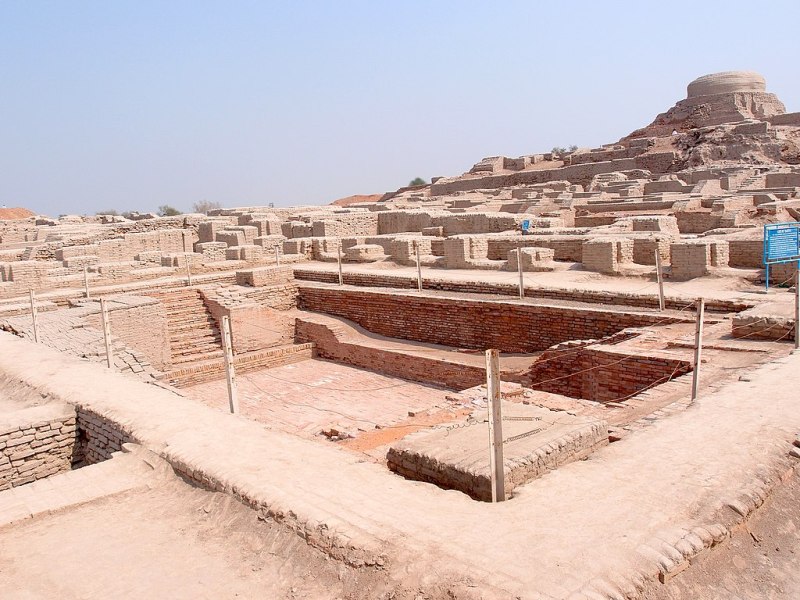
One of the most impressive discoveries about this civilization was how well planned their cities and sewage systems were. It seems water, drainage and bathing were held in high significance by the people. There was a brick-lined sewage system below the main streets that channeled water out of the city. Every house had a bathroom and toilet from where the used water flowed into a small drain cut into the house wall which brought it to the brick-lined sewage system. The public bath in Mohenjo-Daro called “The Great Bath” is one of the earliest instances of water-proofing in the world. This stately multistoried building had a 2.4m deep bathing pool in the center made of specifically-fitted burnt bricks coated with a layer of tar. Every brick found in these sites has the exact same ratio of 1:2:4. They also had a well-formed regular system of weights and measures. Harappan settlements were walled and important buildings like the granaries, warehouses and the Great Bath were separately walled and built on a mound to protect them at the time of floods.

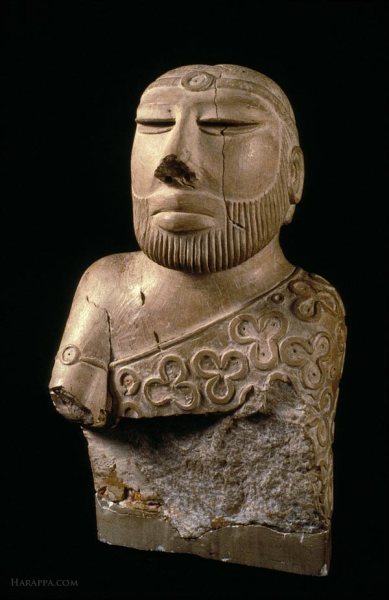
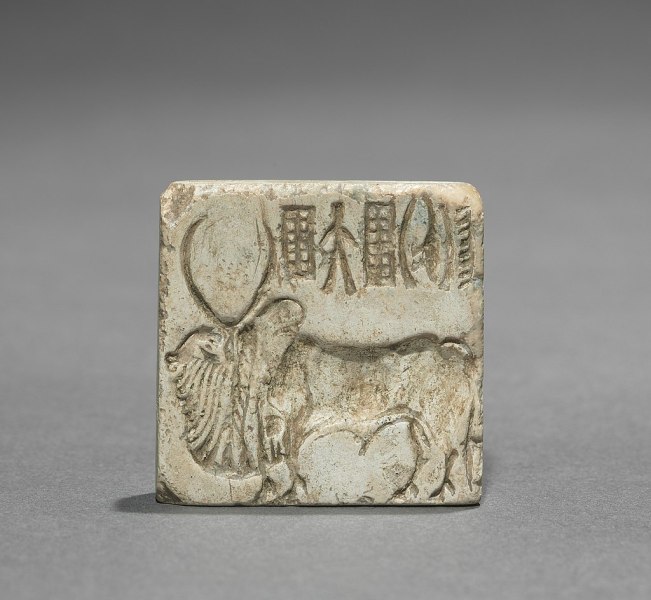
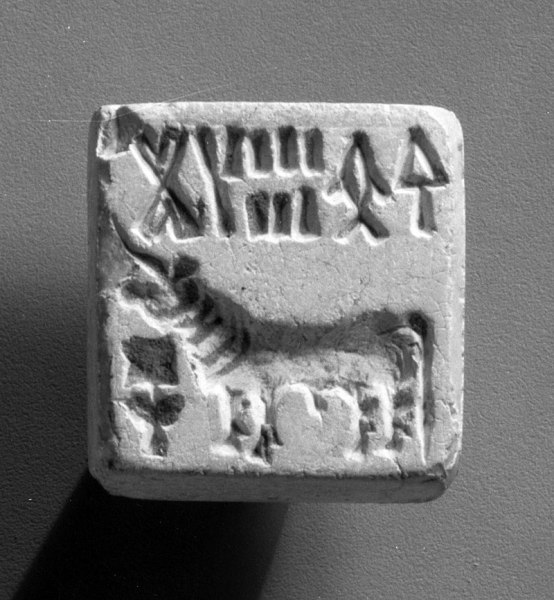
A number of statues and terracotta figurines have been excavated, most of which were probably intended as images for worship. There were figures of seated men, a standing nude male, a dancing girl, small chariots, and kids and animals which appear to be toys. All of them are of excellent quality, signifying that it was a highly developed art in the Harappan culture. Thousands of small Harappan seals are the best-known artifacts from these sites. These seals show an animal such as a “humpless unicorn”, buffalo, elephant, bison, rhinoceros or tiger, with some kind of inscription on top. Around 450 signs or symbols have been identified from these seals which are the only proof that the Harappans had a written language. These seals were could have been used as stamps, identity cards or passports.

This rich and prosperous civilization went into a sudden decline around 1900 BC. It is said that in over a century, the urban social and political system collapsed, and the use of seals and writing disappeared. The Ghaggar or the Saraswati river started to dry up, causing many of the Harappans living in its banks to move in search of greener pastures. Some of them moved to the Ganges which would become the center of North Indian civilization. By 1300 BC, this majestic civilization was completely gone, leaving no traces of its written language or beliefs.   

Evolution of Indian agriculture

India is the second largest producer of wheat and rice, which are the most widely used staple food. India also plays a major role in producing dry fruits, raw materials for textile industries, roots, tuber crops, pulses, coconut, sugarcane and various other vegetables. Agriculture plays a vital role in Indian economy. According to the sources, Indian agriculture began by 9000 BCE on north west India. Indians considered agriculture as their major survival and they even worshiped it and we still do.

Rise and Fall of agriculture

Farmers used to cultivate their lands with completely natural seeds and fertilize them using bio fertilizers, that is manually prepared fertilizers which consists of cow dung, dry leaves, vegetable and fruit waste and farmers even used earthworms to decompose the organic matter. Earthworms have the ability to eat and mix large amount of soil and organic matter and deposit it in the form of casts. The crops that are obtained as a result of natural organic forming were healthy but the yield was less. In order to increase the yield, nowadays lot of chemical fertilizers, pesticides are used, which increases the yield but the quality of the crop is a question mark. Over the years, the dependency on agriculture has declined to 50 percent as per the latest round of the periodic labor force survey for 2018-19, also the lockdown has severely disrupted India’s agriculture.

Reservation Policy of India

Reservation is a controversial and highly debatable topic in India. Furthermore, the main aim behind the reservation was the empowerment of the weaker sections of society. Reservation in its essence is a type of quota-based affirmative action. Reservation is a controversial and highly debatable topic in India. Furthermore, the main aim behind the reservation was the empowerment of the weaker sections of society. Reservation in its essence is a type of quota-based affirmative action. The constitution of India adopts the unique feature of reservation.

In the Hindu religion, the caste system divides people into four categories or varnas – Brahmins, Kshatriyas, Vaishyas, and the Shudras. According to Hindu beliefs, these four varnas originated from Brahma, the creator of the Universe, Vedas, and people. The caste system is considered the distorted form of the Varna system. In the hierarchy of the caste system, Brahmins were on the top. They were supposed to originate from the head of Brahma.

The idea of reservation policy in India was originally developed by William Hunter and Jyotirao Phule in the year 1882. The basic principle behind the reservation was the Caste System and the malpractice of untouchability in India. But the prevailing reservation system in today’s India was introduced in 1933 by British Prime Minister Ramsay Macdonald in the form of the ‘Communal Award.

Under the provisions of the communal award, there were separate electorates for Europeans, Anglo-Indians, Indian Christians, Muslims, Sikhs, and the Dalits. But on 24th September 1932 when the Poona Pact agreement between Mahatma Gandhi and Dr. Ambedkar was signed, it was decided that for Hindus there would be a single elective with certain reservations for the depressed classes in it.

When India got independence from British rule in 1947, the country was divided into two parts India and Pakistan. With the partition, much of the Muslim population migrated to Pakistan and Hinduism became the most prominent religion in India. So, when the constituent assembly was framing the Constitution of India, social discrimination based on the case system was a big hindrance to equality in society. So, the provision of reservation for the socially backward classes was introduced in the Constitution of India. Reservations were initially introduced for a period of 10 years and only for SCs and STs, but it kept on extending with several changes in it.

Reservation in Educational Institutions


In the year 2005, the government introduced the 93rd constitutional amendment act. With the enactment of the act, Article 15 (5) was inserted in the constitution of India. Article 15(5) provides that:
Nothing in this article or in sub-clause (g) of clause (1) of Article 19 shall prevent the State from making any special provision, by law, for the advancement of any socially and educationally backward classes of citizens or for the Scheduled Castes or the Scheduled Tribes in so far as such special provisions relate to their admission to educational institutions including private educational institutions, whether aided or unaided by the State, other than the minority educational institutions referred to in clause (1) of Article 30.

Reservation in Promotion


Reservation for SCs and STs in matters of promotion in public employment was a matter of continuous conflict between the parliament and Apex Court. In 1992, in the case of Indra Sawhney v. Union of India,[iii] the Supreme Court held that Article 16(4) does not allow the reservation in promotion.

Against it, the parliament came with the 77th Constitutional Amendment Act, 1995, and inserted a new clause (4A) under Article 16, which empowers the state to make the provisions of reservation in the matter of promotion to SCs and STs in public employment.

Reservation to Economically Weaker Section


In the 103rd Constitutional Amendment Act, 2019 the new reservation was introduced by the legislature. This amendment introduced a 10% reservation for the economically weaker section of the society popularly known as EWS. It provides reservation to economically weaker sections (EWS) in public employment as well as admission in public and private educational institutions.

Before this amendment, there was a ceiling limit of 50% on reservations. In which, 22.5% of available seats were reserved for Scheduled Caste (SC) and Scheduled Tribe (ST) (7.5% for STs, 15% for SCs). In addition to this 27% of seats, were reservation was given to OBCs. The total reservation provided before the 103rd constitutional amendment was 49.5%, which was in conformity with the rule of 50% ceiling limit on the reservation.

Latest update on reservation

The Supreme Court on Friday is considering widening the ambit of its examination of a Haryana law granting 75% quota for locals in the private sector, to similar laws said to be prevalent in States such as Andhra Pradesh and Jharkhand.

A Bench led by Justice L. Nageswara Rao asked the Haryana government to submit details of cases on domicile quota laws pending in the High Courts of Andhra Pradesh and Jharkhand.

DIABETES

Diabetes is commonly known as Diabetes Mellitus. It is a group of metabolic disorders which results in high blood glucose level in body. Untreated high blood glucose level can damage nerve, eyes, kidney and other organs also. There are 4 types of Diabetes Mellitus.

1.Type 1 diabetes mellitus= It is a chronic condition in which beta cells of pancreas damaged and due to these they produce little or no insulin.

2. Type 2 diabetes mellitus= In this pancreas produce insulin in required amount but it can’t uptake by adipose tissue, Due to insensitivity. It affect the way body processes blood glucose.

3.Prediabetes= It is the disorder where blood glucose is higher than normal but it’s not enough for diagnosis for type 2 diabetes mellitus.

4. Gestational diabetes= The increase in blood glucose level during pregnancy which may be temporarily.

Symptoms: When blood glucose level increase body shows some symptoms such as Excessive thirst, excessive urination, fatigue, weight loss, blurred vision,sweat and hunger.

Treatment: Monitoring blood glucose level, dietary management, maintaining physical activity, keeping weight and stress under control and Monitoring medication.

The journey of college life

Hello & welcome all the dear readers . I am hoping this article will be mostly viewed by the students who are in college or going to join college very soon .

As a 12th passout student after getting out from that hectic board exams pressure many students imagines that they do not need to study in colleges but that isn’t correct . College life is something where you can learn a lot of new things you can acquire lot of new skills that will going to help you in future times . Till class 12th you are not aware about many things but during college life you are going to face lot of new challenges . Till class 12th as a student your first priority is to score goods marks in your boards examination but that is not similar in the college life. Because going ahead in your life your skills will matter more than your professional degrees . And in colleges the syllabus are also not that much broad (except few courses like medical )you can easily learn new skills if you have dedication towards that .

Now lets talk about that 1st day of college . After getting marks in boards examination if a student gets admission in top universities like delhi university then they thinks that 1st day when he/she will go college they will have a great welcome as they are toppers of their respective colleges/state/district and many students will come and they are going to feel like a celebrity as they have scored that much amount of marks but beleive me nothing happens like that . No one going to ask you about your marks & percentages specially in top universities like du & bhu .your first day is going to be very normal .so never be in that imaginary situation like you are going to have a celebrity like feeling or something like that .

You can explore your college life by meeting new peoples in your college from different states by knowing about them , their cultures their traditions & lot more . In colleges like Du there are societies to enhance your skills so join societies according to your interest. Next way is to do internships so that you can gain practical knowledge & also can earn something so that you can manage your expenses . It is also an important part of college life that you must have to earn by your own so that you can learn new new things & get prepared/awarded about challenges that you might face in future.

Now moving ahead I would must say that you must have to explore your college life. Learn as many skills as you can . Be the best version of yourself . This 3 or 4 years of college life cannot Destroy your whole life but if you want than you can do something very very extraordinary by utilising these 3 or 4 years whatever you have . Simply you don’t have something to lose but you have many many things to win . & At last best of luck for your college life.

THE HEAVEN ON EARTH – SHIMLA

Shimla is among the one of the greatest tourist spot in India. It is a hillstation lies in northeast of Chandigarh on a ridge of the Himalayas foothills at an elevation about 7100 feet (2200 m) . In this article I am going to tell you about the beauty of this place & the places where you can visit in shimla.
Shimla is popularly known as “The queen of hills” Mainly shimla is famous for its beautiful environment (natural beauty), snowfall, Toytrains, several tourist places and many more. Shimla is also considered as great vacation spot. It is all season famous hill station because in winter season it is famous for heavy snowfall & in summer it looks even more beautiful.

Various places to visit in shimla
Now I am going to talk about various places where you can visit whenever you go to shimla.
• Green valley
• Annandale
• Kuffri
• Viceregal lodge
• Christ church
• Himachal state museum
• The Ridge
• Jakhoo temple
• Toy train
Green valley
It is just 7km away from shimla bus stand. It lies on national highway 22, on the way to kufri from shimla. Green valley is famous for its elite beauty that’s why it is also considered as one of the best places for photography. It is surrounded by verdant hills that are covered with dense forests of pine and deodar. You will also find some local shacks and markets here. Sometimes rare animals like yaks can be seen wandering and grazing here.
Annandale
It is locality of shimla city which is just 2km away from shimla railway station. Annadale has a very beautiful army heritage museum. Due to its lush green environment, historical importance and first seen place by every VVIP visit, it is also known as the “HEART OF SHIMLA”. The area of Annandale is situated between lush green mountains and deodar trees. It is often used as picnic sports by visitors.
Kufri
It is a tiny hill station located near shimla. It is famous for snowfall and adventurous sports like ice skating, horse riding and also famous for nature parks and picnic sports. Kufri is situated just 14 km away from shimla. Kufri is also known as “Switzerland of east” and “Shimla ki barfili topi”. While coming back from kufri to shimla you can also visit jakhoo temple which is very famous place in shimla.
Jakhoo Temple
It is an ancient temple situated in shimla dedicated to lord hanuman. Because this temple is situated on the height so, views are really amazing from this site. Recently in Jakhoo temple rope way are created due to which the numbers of people visiting shimla are getting very much attracted towards jakhoo temple. The ticket price of rope way is RS500.
Mall Road
It is the major hangout point and shopping center in shimla. It is located a level below the Ridge. Tourists can visits mall road for shopping the things which they want to buy but at mall road he/she have to show their bargaining skills. It has a number of showrooms, departmental stores, shops, Restaurants and cafes. Some of the attractions points on mall road are scandal point, Gaiety Theatre, Kali Bari temple, Town hall etc.
Viceregal Lodge
It is located on the observatory Hills of shimla. It is formally the residence of the British viceroy of India. The viceregal lodge was designed by British architect Henry Irwin. It is also known as “rashtrapati niwas”. Visitors can visit rashtrapati niwas between 10.00 am to 5.00 pm. This viceregal lodge has its own history taking the help of guide will be benefital for you while visiting this amazing place.

Himalayan Bird Park
It is situated near viceregal Lodge. If you are a nature lover then definitely you must have to visit Himalayan Birds Park. The park was established in 1984 and is spread over an area of 1171km2, altitude within the Park Range between 1500 and 6000 meter. This park contains numerous flora and more than 375 fauna species. Then after a drive of 20 minutes you can visit Tara Devi Temple which is surrounded by beautiful mountains of Himalayas.
So,
These are the details about the places where you can visit in shimla. Personally I will definitely recommend you all to visit shimla at least once in your life time. After reading all these things you all have already understood why shimla is the heaven on the earth.
Now if I talk about staying in shimla then there are number of hotels available where you can stay as shimla is very famous and commercialized hill station there are all kinds of hotels are available . Generally if you take a normal room then cost will be around 1500 to 2000. Snowfall lovers can visit shimla during winter season (Nov to March) and even in summers you can visit here because it is among the one of the best places to visit in summer.
Dear readers hope this article will be helpful for you all and you have acquired important information’s about shimla the heaven on earth.

MAKE IN INDIA

Make in India is a campaign launched by the PM, Narendra Modi, which facilitates all the big business investors worldwide who want to do business in India. This program was launched in 2014 on the 25th of September by the PM at the Vigyan Bhawan in New Delhi. It is a big step taken by the government of India to reduce the level of unemployment faced by the youths of the country. This campaign was launched a day after the Mars mission when PM was to go on his first visit to the USA as prime minister of India.

The aim of launching this campaign in India is to make India a world-level manufacturing powerhouse which will definitely help in solving the biggest issue of the Indian economy. This initiative was launched with new deals for foreign investors successfully in New Delhi with the top industrialists of India including Mukesh Ambani (Reliance Industries chairman), Azim Premji (Wipro chairman), etc. This initiative further aims at creating a favorable environment for investment, modern infrastructure, opening up new sectors for foreign investment, and establishing a partnership between government and industry through a broader outlook. 

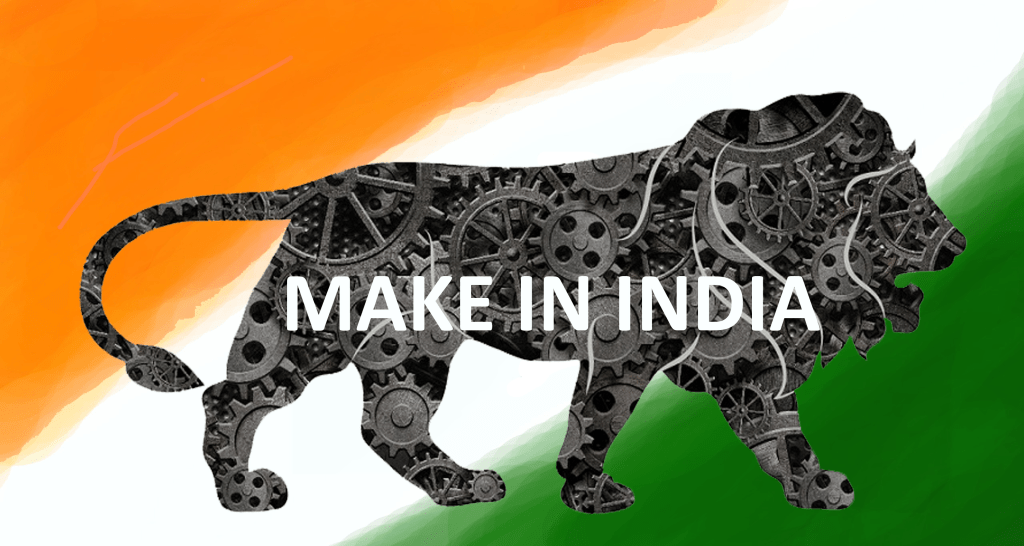
The symbol of this initiative is a giant lion having many wheels. This indicates peaceful progress and way to the vibrant future of the country. A giant walking lion with many wheels represents courage, strength, tenacity, and wisdom.

Guidelines and Policy for Make in India

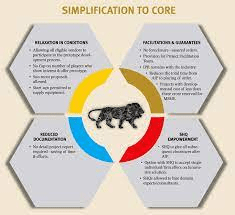
The government laid new Guidelines to start the mission successfully. The main objective of the Guidelines was to sanction the projects that are approved by state governments. Some Guidelines are like:

  1. Reduce paperwork required for establishing companies.
  2. Minimize the time required for government approvals.
  3. Abolish the Corporate Social Responsibility (CSR) from the project cost. 

Policies have been made for convenient transfer of funds while switching jobs anywhere in the country. A cell was dedicated to responding to the queries for business entities through a web portal. 

Nangiar Koothu: Exclusive Domain of Female Artists in Kerala

Kerala is home to several fascinating traditions and art forms. There is the graceful Mohiniyattam, the enigmatic Kathakali and the amusing Ottan Thullal. As we celebrate International Women’s Day this year, let us look at one such dance form that is interestingly, only performed by women.

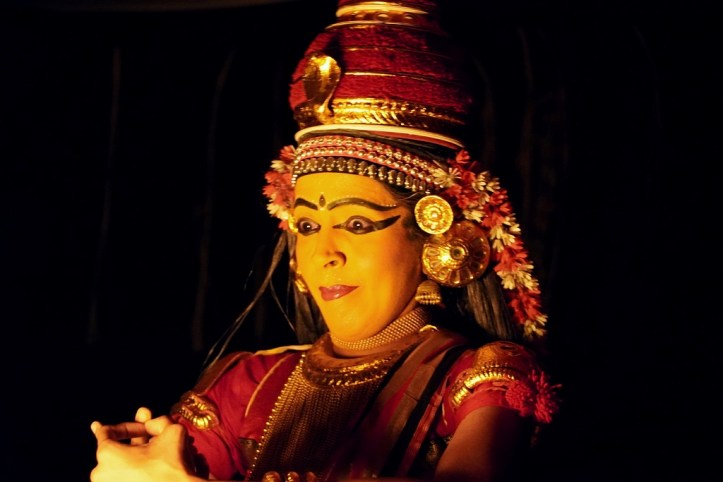
Nangiar Koothu is an art form that evolved from Koodiyattam, an ancient Sanskrit drama tradition. Koodiyattam is performed by Chakyars (a Hindu ‘ambalavasi’ or ‘temple-dwelling’ community) and Nangiars (women of the Hindu “Nambiar” community) together on stage. The Nangiars or ‘Nangiarammas’ as they are called, performed Nangiar Koothu as solo performances purely as a ceremonial ritual in a few temples in Kerala. These performances are staged in a special theatre that forms a part of temples in Kerala called “Koothambalams”. During the 1990s, Nangiar Koothu also experienced a cultural revival much like many other classical art forms in Kerala. The dance form which was until then performed only by a few Nambiar women in some temples across Kerala gained traction after an old acting manual of Sri Krishna Charitam called “Attaprakaram” was discovered in 1982 by Nirmala Paniker and G. Venu. This manuscript which contained 208 slokas dealt with women’s roles in Koodiyattam. Ammanur Madhava Chakyar, a Koodiyattam exponent re-worked the manuscript and made it more popular. It was after this that Kerala Kalamandalam and other training institutions began to witness an increasing number of girl students in the Koodiyattam genre and its offshoots like Nangiar Koothu. This dance form is nowadays no longer restricted to just the Nambiar community. In 1971, Kalamandalam Girija was the first woman from outside the community to learn and perform Nangiar Koothu. Kalamandalam Shylaja, Margi Sathi and Usha Nangiar are other exponents in this field.

source: nangiarkoothu.com

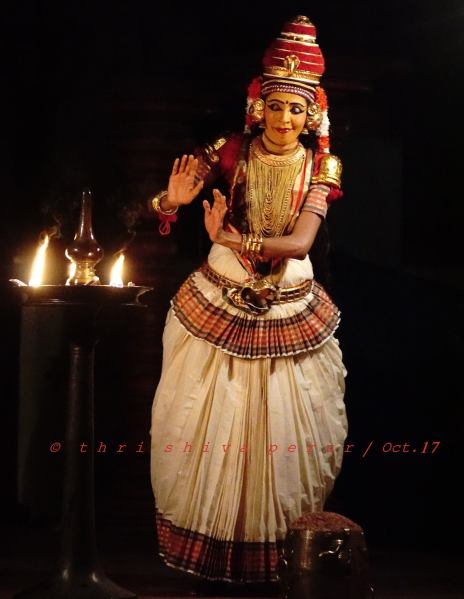
Nangiar Koothu presents stories from Sri Krishna Charitam, which depicts the life of Sri Krishna. The dancer is accompanied by the vocal artist and percussion instruments such as the Mizhavu (pot drum), Idakka and Thimila. Traditionally, this dance goes on for 12 consecutive days. It has its foundations based on the ancient treatise Natya Shastra by Bharatamuni.

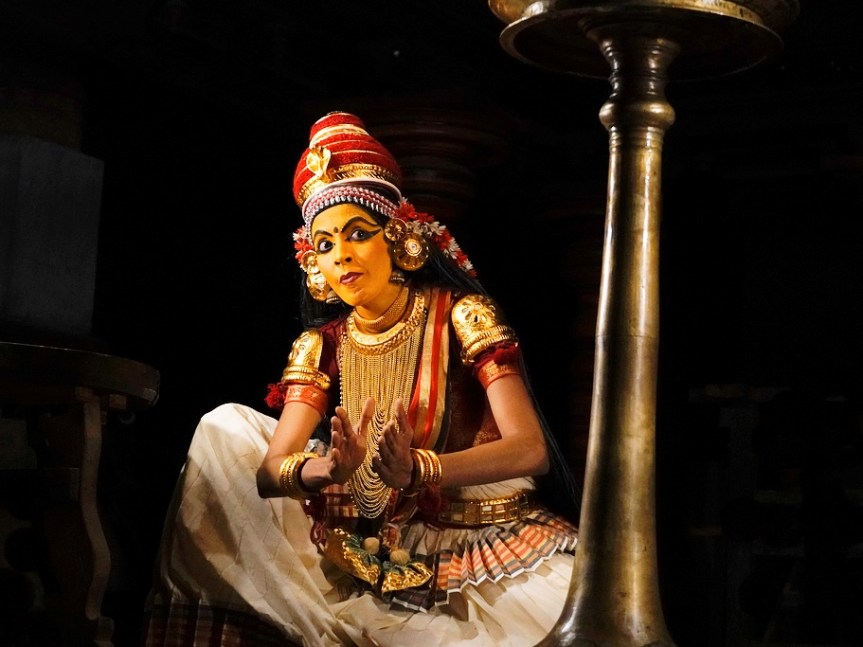
Nangiar Koothu is ‘abhinaya’ or acting-centric, the dancer expressing emotions with her eyes and hand gestures. ‘Nritta’ or pure dance is in focus only during the entry rituals (‘Purappad’). This dance at the beginning is called “Purvaranga Nritta”. During the performance, the Nangiar usually sits on a stool behind an oil lamp and acts out stories using intricate hand gestures, body movements and expressions. The dancer wears a red blouse and a white or cream-coloured skirt laced with gold or “kasavu” embroidery. She also wears red and white flowers in her hair and a distinct red headgear, with a hooded serpent on it probably symbolizing Anantha, the 1000-headed serpent.

This captivating dance form is still performed as a ritual offering in the Trissur Vadakkunathan Temple, Ambalapuzha Sri Krishna Temple, Irinjalakkuda Koodalmanikyam Temple, Tripunithara Poornathrayeswara Temple and Kottayam Kumaranellore Bhagavathy Temple. The performance begins on the day before Ashtamirohini, i.e. Sri Krishna’s birthday, in the Vadakkunathan temple and Ambalapuzha temple. Even though Nangiar Koothu is performed in the daytime, on Ashtamirohini day, it is held at night to match up with the time when Sri Krishna was born. The Koothu starts on the festival day in the Malayalam month of Chingam in the Poonathrayeswara temple and goes on for 8 days. It goes on for 12 consecutive days from the star-day ‘Uttram’ in the month of Medam in the Koodalmanikyam temple.

There is a variant form of Nangiar Koothu known as Dasamam Koothu or Chudala Koothu which is performed after an Akkithirippad has passed away. Akkithippad is a brahmin who has qualified himself to perform yagas including the athirathram, the most intricate of the yagas. The Nangiaramma performs on the ‘Sanjayanam’ day in a temperory koothambalam-like set-up, to help the deceased soul and his wife attain moksha. Though it is a rarely-performed dance form, artists like Aparna Nangiar have performed Dasamam Koothu in the last few years, even as recent as in 2021.

Over time, this art form which has historical antiquity of over 1500 years has also seen innovations in its story content. Dancers like Margi Sathi have introduced stories from Ramayana and the Kannaki Charitha into the performances. For art lovers and others alike, Nangiar Koothu is a very alluring dance form to witness and enjoy.        

The silent killer: Hypertension

Treatment for Hypertension

Hypertension is also called High blood pressure. It is a long-term medical condition. Hypertension is a condition in which the force of blood against the artery walls is too high. The normal blood pressure is 140/90 more than this turns to hypertension. The continuous increased blood pressure may cause heart disease, stroke, and sometimes death. The death due to hypertension is 7.6 million per annum worldwide. To control high blood pressure lifestyle adjustment is important. here are some points to get a healthy heart-


1)Regularly Exercise= regular physical exercise is important for normal blood pressure. The person with hypertension should do at least 75 min aerobic exercise. Simple exercise should be done regularly. Walking is easy and done by everyone.
2)Stress reduction= Stress is the cause of hypertension. so to manage that is important. Learning to manage stress or avoid stress is very much important. Meditation is the best way to reduce stress. other is warm bath and yoga also reduce stress.
3)Medication =the patient should take time to time medication for normal blood pressure. the dose may be given in a single dose or in combination depending on the patient’s stage of hypertension. the category of drugs are- Diuretics,beta-blocker, alpha-blocker, calcium channel blocker, cental agonist, peripheral adrenergic inhibitor, vasodilation, Angiotensin-converting enzyme(ACE) inhibitors, Angiotensin receptor blocker.


4)Diet = it is most important for normal blood pressure. Always follow a proper diet for healthy blood pressure. Reduce salt intake because it has the ability to open sodium channels which may cause hypertension. Eating a more fatty diet is the cause of hypertension. always eat a fresh, healthy, and protein-rich diet. eat fresh fruit and vegetables.


For normal blood pressure avoid alcohol consumption, and smoking. Excess body weight can contribute to hypertension. so for normal blood pressure exercise regularly, meditate in the morning, take time to time medication and follow a proper diet.