WHY IS HUMAN CAPITAL IMPORTANT?

Human capital is basically the amount
of skill, expertise, knowledge and experience instilled in people. It is
associated with the investment in the development of a man as a creative and
productive resource. It is the population that helps in the growth of the
country. For this, they need to be educated and trained. Their knowledge and
efficient work will prove out to be a great contribution in the economic
growth. This makes it quite obvious that the contribution of an educated person
is far more than that of an illiterate one. Therefore, it is necessary to
invest in the human capital formation. Here is a detailed description of how
human capital plays an important role in the growth of the nation.


1.EFFECTIVE
USE OF PHYSICAL CAPITAL

The physical
capital can only be created by the hard work and intelligence of an educated
man. The productivity of physical capital is widely depended on the human
capital available. Therefore, the human capital and their skills and efforts
helps in the effective use of the physical capital.


2.HIGHER
PRODUCTION

The human
capital increases the production and productivity because the knowledgeable
population will use the resources efficiently and effectively. Increase in the
quality and productivity can only be achieved by the high technical skills of
people which is only possible if they educated and trained enough.


3.TECHNOLOGICAL
IMPROVEMENT

The human
capital formation will prepare the generation for the upcoming technologies.
This means that they will be able to adopt the new technologies easily.
Education provides them with the knowledge to embrace the changes in their
surroundings both, economically and technologically. This will ease them out to
be introduced to new mechanizations.


4.MODERNIZATION
OF SOCIETY

The more the
people would be educated, the more the society will develop. There is no
denying in the fact that a lot of small towns and villages in India are still
backward and people are not very open minded. If people are educated and have
knowledge, they will grow personally and as a community. Their new ideologies
and perspectives will allow them to change their actions and move ahead of the
backward thinking. Therefore, investment in human capital helps in changing the
mental outlook and helps in the development of the country.


5.INCREASES
LIFE EXPECTANCY

More
educated people are more health conscious. They focus on their diet and the
nutrition they are absorbing. Being fit becomes one of their major agendas as
they are aware of the consequences of living an unhealthy life. This leads them
to have a longer life and also adds to their quality of life. Not just this
but, being educated also advances the health facility extensively and more
medications are being invented to help cure people with different diseases.
This also contributes to more people being fit.


6.CONTROLS
POPULATION

It has been
observed that the educated people have smaller families as compared to the
illiterate ones. They are aware of the population problem and know the meaning
of planning. Also, they know the methods of controlling their family size.
Therefore, more and more people must be educated so as to control the
population of the country.

 

PUBLIC SECTOR ENTERPRISES

The
enterprises or companies owned and handled by the government are the public
sector enterprises. These may be held by the state or the central government.
Most of the times, the aim of such enterprises is the public welfare. They
participate and contribute in the economic activities to for the growth of the
country. Their second motive is to earn as much profit as they can from these
activities. Some of the biggest public sector enterprises in India are Indian
Oil Corporation (IOC), Hindustan Machine Tools Ltd. (HMT) and Life Insurance
Corporation of India (LIC). Although, not all these enterprises are the same
just because they come under the public sector. There are three forms of such
enterprises.


DEPARTMENTAL
UNDERTAKINGS

This is the
most ancient type of public sector enterprise. These are the departments
through which the government functions and their activities are the most
crucial part of it.

These types
of enterprises are suitable where the complete control of the government is
necessary with the supreme secrecy for all the information. Also, in these a
large of amount heavy investment is required and the economic control is
mandatory which can be only done by the government.

Some of the
advantages of these enterprises are that there is effective control over the
operations being executed since all the power lies within the hands of one
authority. Also, there is high degree of public answerability which means that
the public is aware of almost every step undertaken by them.

Although the
disadvantages of these enterprises are that there are no immediate decisions
made since for every action, a written permission must be received by the
concerned authorities which takes a long time. Also, because of this long
procedure, they can’t take the full advantage of the opportunities available to
them.


STATUTORY
CORPORATION

These are a
special type of enterprises which is brought into existence only by the
parliament. They decide the powers, rules, regulations, operations and
activities as well as its relationship with the government. These enterprises
require a large amount of capital investment and must be run as a business
along with keeping in mind about the public welfare. Some examples of such
enterprises are Air India, Indian Airlines, Reserve Bank of India (RBI) and
Industrial Development Bank of India (IDBI).

The merits
of such organizations are that they have a lot of flexibility since they do not
necessarily have government interference in their operations as well as
financial matters. Also, they are highly important for the economic development
since they have the power of government along with the features of a private
organization.

However,
some downsides are that since it has the responsibility to run as a business,
they may lose themselves into some anti-social actions such charging really
high prices from the public. Also, they do not usually have to face any
competition from anyone therefore, they might slack behind sometimes and turn
out to be inefficient.


GOVERNMENT
COMPANY

Any company
whose majority of the shares, that is at least 51%, are held by a state or the
central government then it is declared a government company according to the
Indian Companies Act, 2013. These types of companies suitable when the
government wants to control an organization in the private sector with the aim
of public welfare. Some examples of such companies in India are Bharat Heavy
Electrics Ltd. (BHEL), Steel Authority of India (SAIL) and Hindustan Aircrafts.

The main
merits of such organizations would be that there is no requirement of a written
permission by the parliament since it is formed under the Companies Act, 2013.
Also, they have complete power over the management of the company since there
is no government interference.

But they are
not answerable to the parliament since it is more of a private organization and
also the independence factor exists on the paper only. Therefore, the
politicians and ministers can interfere if they want to.


INDIA BEFORE AND DURING BRITISH RULE

Before the
British rule in India beginning from the late 1750s, India was not in a much
good condition due to the lack of education and knowledge. Even though we had a
prosperous and flourished economy, we didn’t know how to utilize it, this is
why we had a majorly backward society for a long time. It was after the British
rule that we understood the importance of education and started investing in
it.

So, what
exactly was India’s condition before and during the rule. How were we
underusing our opportunities?


AGRICULTURAL
SECTOR

There was a
big sluggishness in the agricultural sector during the British empire. This was
mainly because of the ‘zamindari system’. Under this system, all of the profits
earned by the farmers for selling the harvested crops in market went directly
to the zamindar of the land in the form of a ‘lagaan’. Here, the zamindars were
only concerned about their lagaan and not the condition of the farmer. So even
if he was not in a good financial position to pay the lagaan, their remaining money
were forcefully being taken away from them. These lagaan was to be given to the
colonial government by the zamindars and therefore, the government did nothing
to improve this system.

Apart from
this, the government also forced the commercialization of agriculture. This
meant that the farmers were only supposed to grow those crops which were meant
for the sale in the market and not the ones for their own consumption. For
doing this, the farmers were even being paid but it didn’t really help since
all of the crops were being taken away by the government.

Also, India
was really underdeveloped when it came to technology. Therefore, there were
hardly any irrigation facilities available or any fertilizers accessible. Due
to this, there was extremely low productivity in the country and there were
never enough crops being produced for the entire nation. Furthermore, the
colonial government did absolutely nothing to improve the conditions of this
sector, no initiatives, no investments, nothing.


INDUSTRIAL
SECTOR

The
industrial sector was quite reputed in the international market, before the
British rule, for its handicrafts. We were known for our creativity in
hand-made products. Although, during the rule, our handicraft industry declined
since British were following two-fold policy to completely collapse the Indian
market. They used to buy the raw materials from India at cheaper rates and
export them their own country. However, when the finished goods were made, they
imported back and sold to the Indians at higher prices.

As a result,
there was high level of unemployment in the nation and also the market was
rebuffing since the Indian goods could not compete with the imported
machine-made goods.

Also, there
was rarely any capital goods industry available during the rule in the country
therefore, industrialization could not be promoted further. this resulted in
the limited contribution to Gross Domestic Product (GDP) which restricted the
growth of the Indian economic. Again, the British government did not take any
initiative to improve this situation as they were more interested in the
economic growth of their home country.

HOW IS A COMPANY FORMED?

Formation of
a company is a big and lengthy procedure. It means bringing your business idea
into existence. This process involves the completion of a lot of legal
formalities and procedures. There are three basic steps involved in the
formation – Promotion , Incorporation and Subscription of capital. The
important fact is that these three steps are required for the formation of a
public company only. In case of the private company, the first two steps are
enough. Hence, private company can be started right after the incorporation of
the company. Lets discuss these steps in detail.


PROMOTION

Promotion
means the discovery of a business opportunities and then taking the right steps
to grab it. According to the Section 2 (69), a promoter is someone who has
complete control over the management of the company, directly or indirectly,
and this could be as a shareholder or director or any other top position.

In the
promotion process, first the identification of the business opportunity is
necessary to further continue the process. After this, the promoter checks the
feasibility of the idea. The ides should be something that is realistic and
financially and economically possible. If the promoter is satisfied with the
finance requirement, then he can move ahead to launch the company.

Next, he has
to give a name to his company or brand by submitting an application to the
Registrar of Companies (ROC). It must be noted that the name cannot be
identical or close to the name of any other existing company. Then he must
decide the signatories to the memorandum of association. These signatories
would be the first official director of the company. For this, their written
consent is mandatory. In a public company, at least 7 signatories must sign the
memorandum whereas, in a private company, only two members are enough.

Then the
promoter appoints certain professionals who are going to help him in the
preparation and the submission of the important documents to the ROC.


INCORPORATION

Incorporation
basically means the legal registration of the company and receiving a
‘certificate of incorporation’. For this, the promoter makes an application for
incorporation to ROC along with other mandatory documents. These other documents
include the articles of association, memorandum of association, statement of
authorized capital, address of the office of the company and the written
consent of the signatories.

Along with
the application for incorporation, a registration fee has to be submitted and
the amount depends upon the amount of the authorized capital.

The ROC then
analyses your application thoroughly and if they are satisfied with all the
legalities and paperwork then they officially declare the company as a
corporate body under the Companies Act, 2013 after which you receive the certificate
of incorporation.


CAPITAL
SUBSCRIPTION

The
formation of a private company was done in the last step. This step is required
for the formation of a public company. After the above two steps, the promoter
must raise funds for his company which can be done through issuing shares and
debentures to the general public. For this, he must take the approval of the
Securities and Exchange Board of India (SEBI).

After this,
a prospectus is to be filed under the ROC. A prospectus is an official document
that invites the public to subscribe to the shares and debentures offered by
the company.

This task is
quite difficult. Therefore, some officials are appointed to ease the process. A
broker is appointed to distribute the prospectus and the application form to
the public and encourage them to buy the shares. A banker is appointed to
collect and deposit all the money from the public. And finally, an underwriter
is appointed if in case the company is not sure of receiving the minimum
subscription from the public. The underwriters are those who will buy the
remaining shares to fulfill minimum subscription requirement.

In order to
issue the shares and debentures to the public, it is necessary for the company
to be officially listed under the stock market. After that, the IPO process can
be started, and shares are allotted to the prospective shareholders.


PROCESS OF PLANNING

Planning is
a major part of the business. In fact, it is the first and foremost step by the
organization towards the achievement of their goal. In terms of business, it
basically refers to the process of setting up of objectives in a given time period
and analyzing all of the alternatives possible to achieve those objectives and
then finally, choosing the correct method to do so.

We can tell
by its definition itself that it is a crucial part of the business that cannot
be ignored. Let us now discuss how this important step is initiated by an
organization and what goes on in order to achieve a perfect plan.


SET
OBJECTIVES

The first
step is to set up the objectives that you want to achieve. These objectives
could be both short-term and long-term. They basically give you a direction to
work in. you can plan your next steps and actions according to these objectives
and develop a proper plan. These objectives must be set for the entire
organization, from the top management to the employees to the field workers.
Everyone should know what they are aiming for.


DEVELOP A
PREMISE

Since
planning is something that is done for an uncertain future event, there always
have to be certain assumptions made. These assumptions are the base of the plans
and they called the premises. They help to foresee the unpredicted losses in
future and also helps in preventing them.


RECOGNIZE
THE ALTERNATIVE COURSES

The next
step is very important. In order to reach your destination, there could be
several ways. Similarly, in order to achieve your objectives, there are several
options available. You will have to identify and gather all of these
alternative options so that you will have more options to choose from. There is
rarely a plan for which there are no alternatives available.


ASSESS
THE ALTERNATIVE COURSES

There are
negative as well as positive impacts of all the alternative options you have in
your hand. In order to choose one, the head or the manager must be aware of all
the pros and cons of these alternatives. Not just this but, the financial
feasibility and the risks must also be measured before selecting one as your
main plan. Besides, the manager must also measure the profitability of each one
of these alternatives as profit is one of the common goals of all the
companies.


SELECT AN
ALTERNATIVE

Now, this is
the real decision-making time. after the evaluation of all the alternatives,
the manager must know which one will prove to be the most profitable at the
least risk. He must not make a mistake while choosing one because this is the
plan that the whole organization will follow and the wrong one might result in
the failing of the achievement of the goals.


EXECUTION
OF THE PLAN

Now that the
most suitable plan has been chosen, it must be properly executed. Execution
means putting and the plan into action as in doing the correct job towards the
achievement of the goal. Not just this, but it should also be noticed by the
heads of every department that all the employees are genuinely committed to
doing their work efficiently and effectively.

PROCESS OF TRADING IN STOCK MARKET

Stock market
has been in the news for quite a long time now. Almost everyone is interested
in the buying and selling of the stock and earning profit out of it. The
trading procedure, although, is a lengthy one. On top of that, investing in
this market needs a lot of knowledge and skills. One must be experienced enough
to anticipate the future of each company in the market and invest their money
accordingly. Those who are not very well educated about the market may hire
brokers for their investment.

These days,
the trading process has been digitalized to minimize the risk of unhealthy
trade practices and keep everyone’s money safe and secure. Let’s have a look at
the whole procedure of trading and settlement in detail.


1.SELECTION
OF BROKER

The first
and foremost step is to select a broker who will buy and sell the securities on
your behalf because according to the rules, only those who are registered under
the Securities and Exchange Board of India (SEBI) can trade securities. These
brokers can be anyone from an individual to a corporate body. There is a broker
– client agreement and a client registration form that has to be signed to
start the process. Also, the investor must submit the following details and documents:-

1.    PAN number

2.    Date of birth

3.    Address

4.    Educational qualification and
occupation

5.    Residential status

6.    Bank account details

7.    Depository account details

8.    Client code number available in the
client registration form


2.OPENING A
DEMAT ACCOUNT

The investor
is then required to open a demat account or a Beneficial Owner (BO) account
with a Depository participant (DO) for holding and transferring the securities
in the demat form. The depository is the organization or institution that holds
the securities in an electronic form. In India, there are two depositories –
National Securities Depositories Limited (NSDL) and Central Depository Services
Limited (CDSL). Also, the investor is supposed to open a bank account for the
cash transactions in the securities market.


3.PLACE THE
ORDER

Then the
investor places an order with his broker to buy or sell the securities. It
should be clearly mentioned by the investor how much shares he wants to buy or
sell so that there would be no confusion. Thereafter, an order confirmation
slip is issued by the broker to the investor.


4.EXECUTING
THE ORDER

The broker,
after the placement of the order, will then connect to the main stock exchange
online and he will match the shares and the best prices available for them.
When the shares are available to be bough or someone is available to buy those
from you, the broker is informed about it and the execution takes place
electronically. The broker then issues a trade confirmation slip to the
investor. After this, a contract note has been issued by the broker within 24
hours which is an important legal document as it helps to settle any disputes
between the broker and the investor.


5.SETTLEMENT

Now the
investor is supposed to deliver the shares he sold or pay the cash in case he
bought. This should be done immediately after the contract note has been
received or before the day when the broker will make the payment or deliver the
shares.

TYPES OF FOREIGN EXCHANGE

 What is
foreign exchange? What is foreign exchange rate? In the business world,
especially an international one, the use foreign exchange is quite frequent,
and it is necessary for them to be updated on the latest news of these
exchanges as their whole finance depends on this. So, what is it?

Foreign
exchange is the currency of all the other countries except for your own. The
money or legal tenders that the other country deals in is known as the foreign
exchange and in order to make a payment to that country, you will have to
exchange your currency with theirs. For instance, India’s currency is rupee but
all the other currency like US Dollar, UK Pound and more will be the foreign
exchange for us.

Foreign
exchange rate is basically the rate at which you are exchanging one currency
for another. Meaning, the price of one currency in respect of other. For
instance, 1 US Dollar in India is of 70 rupees therefore, in India, the price
of US Dollar is 70 rupees.

But how do
we decide this rate and who is responsible for the fluctuations in these rates?
How does the exchange rate system work? Well, there are three different systems
that deals with the foreign exchange rate with different rules in each of them.
Let’s study them in detail.


FIXED
EXCHANGE RATE SYSTEM

In this
system, the rate of a currency is fixed by the government and no one else is
allowed to interfere in their decision. The basic purpose of this system is to
maintain stability in the rates. To maintain the rate fixed by the them, they
buy the foreign currencies when the exchange rate is less and sells them off
when the rate increases. For this, the government must maintain a large reserve
with them so that they can buy the currencies whenever they desire.

Also, in
this system, each country fixes their currency value in the terms of an
‘external standard’. This external currency can be anything, from gold to
silver to any other country’s currency.


FLEXIBLE
EXCHANGE RATE SYSTEM

Under this
system, the exchange rate is set by the forces of demand and supply of the
foreign exchange in the market. This system is also known as ‘floating exchange
rate’. There is no government, or any other authority involved here to make a
decision on the price of the foreign exchange. Therefore, the value of the currency
fluctuates a lot in this system. The demand and supply of the currency in the
market is affected by the interaction of thousand of associations like the
banks, firms and others who buy and sell these currencies on a regular basis.


MANAGED
FLOATING RATE SYSTEM

This is a
system which is a combination of both the above systems. Here, the exchange
rate is set by the market forces of demand and supply as well as the central
bank influence on the prices through the intervention in the market. This system
is also known as ‘dirty floating’. The central bank intervenes in the foreign
exchange market to restrict the rates being fluctuated vastly. The aim is to
keep the rates close to the targeted prices.

THE COBRA EFFECT

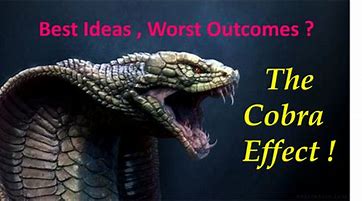
The economic term ‘The Cobra Effect’ was coined by German economist Horst Siebert. The Cobra Effect refers to a situation where in, an attempted well planned and intended solution given to any problem makes the problem worse. This leads to an unintended negative consequence. This term is used to illustrate the causes of incorrect solutions in economy and politics.

This term was coined with regards to a real situation that occurred in Colonial India. There was an alarming increase in the number of venomous cobras in the city of Delhi. The British government expressed their concern regarding this issue. The government planned to offer a sum to the public for killing the cobras. A large number of venomous snakes were captured and killed by people in order to earn the reward. This served as a very successful strategy initially. But, over a period of time, people began to trick the officials by breeding cobras, expanding their numbers and later killing them to continue getting the reward from the government. Ultimately, the government became well informed about the ill happenings in hunger for the reward. Hence, they scrapped this entire plan. After scrapping of the scheme, people were no more interested in capturing, breeding and killing cobras. Therefore, they set all their wild cobra population free in the city. This in turn, increased the population of venomous cobras in the city. Thus, a planned solution to the problem lead to the problem worsening.

A similar instance occurred in Hanoi, Vietnam during the French Colonial rule. The officials designed a scheme in which people would earn a bounty upon killing rats. In order to earn the cash reward, people had to kill a rat, chop off it’s tail and provide it to the responsible officials. Over a span of time, the government noticed rats wandering in places without tails. They were surprised on being aware of the fact that, rat catchers were collecting rats, chopping off their tails and later leaving them into sewers where breeding would take place. This produced a humongous number of rats. The idea of offering a bounty on exchange of dead rat tails failed miserably.

Airbus Airlines, formally suggested their design engineers to make it’s airplane cabins quieter to ensure a pleasant travel experience. The idea was executed and cabins were made more silent than usual. Instead of making the travel more peaceful, it worsened the travel experience of the passengers onboard. People could easily eavesdrop on other people’s conversations, could hear louder noises of food and beverage trollies rolling in the aisle, babies crying on board and restroom doors opening and shutting throughout the journey. This economic decision of Airbus did not succeed.

In 1989, Mexico proposed a plan of action called – ‘Hoy No Circula’ . According to this scheme, people were debarred from using their private vehicles from 5:00 a.m to 10:00 p.m depending on the last digit of their vehicle’s number plate. This was in context of odd and even numbers. The scheme was introduced to limit the number of vehicles on road which in turn would cut down release of pollutants in the atmosphere. Instead of abiding by the norms in a fair manner, people began purchasing two vehicles in the same household, one with an even number plate and another with an odd one. This particular scheme did not serve very fruitful in the longrun.

Perverse Incentive or better known as Cobra Effect may not always be an outcome of poorly planned modules or shortsighted decisions. It may cause due to unpredictable behaviors of the recipients. A strategy planned to curb anything may cause adverse outcomes when people find the same strategy rewarding. In such contrast outcome scenarios, planning authorities may either scrap the plan or re-design it in order to get constructive outcomes.

Sustainable Development Goals

Times are not just difficult but also alarming for every sphere of our existence. At first glance, it might appear that the raging pandemic has temporarily paused climate action and initiatives related to other environmental issues. Sustainability, it appears, may have taken a back-seat too. However, with a decade left for the end of ‘Agenda 2030’, achieving sustainable development has become even more important.


A significant feature of the raging pandemic is that it has disrupted the hyper-interconnected world characterized by globalization. Supply chains are badly affected and global markets are under severe stress. Evidently, the virus has laid bare the vulnerabilities and risks of a globalized world order. In fact, it has put under scanner not just globalization but also the Sustainable Development Goals. Nevertheless, this could be a turning point for the international community to unlearn and revamp its basic conduct on global governance and make it more inclusive in nature. Besides, the pandemic has also thrown open an opportunity to give impetus to a glocalized framework of global governance to protect the ‘global commons’ in the light of the broader debate on sustainability.

This is where glocalization can fill the gap. Simply put, glocalization refers to the interpretation, representation and replication of the global elements at the local level.

The term, glocalization, is used quite frequently in business parlance but it has begun to gain momentum in cultural, social and political arenas too. Utilizing it appropriately in the environmental domain is the need of the hour.

The term, glocalization, is used quite frequently in business parlance but it has begun to gain momentum in cultural, social and political arenas too. Utilizing it appropriately in the environmental domain is the need of the hour.


Covid-19 has brought about the necessity of refining and revising globalization. This can be done by integrating glocal elements to achieve global good, be it sustainable development or climate action, by roping in local actors, such as subnational agencies, grassroots bodies, non-governmental organizations and other relevant non-State actors in the discussion on sustainability. Localizing economies would provide leverage to the development targets of those like India. This can help attain the much-needed balance between ecological equity and economic growth. Additionally, it is hard to overlook the expertise and knowledge offered by local populations that are located at ground zero and are in tune with ground realities. This kind of resource efficiency could prove to be useful in operationalizing the potential glocal elements of global governance. Factors like accountability, transparency and trust-building among the State and non-State actors are also vital in this context.


Considering the changes in modern living, starting from working remotely to radically cutting down on carbon footprints, glocalization could turn out to be a viable alternative to globalization, thereby creating innovative pathways for sustainable development in the near future.

Written by : Ananya Kaushal

The James Webb Space Telescope- World’s most powerful telescope

The James Webb space telescope or JWST will replace the Hubble space telescope. It will help us to see the universe as it was shortly after the big bang. It was named after the second head of NAS James Webb. James Webb headed the office of space affairs from 1961 to 1968. This new telescope was first planned for launch into orbit in 2007 but has since been delayed more than once, now it’s been scheduled for 18 December 2012. After 2030 the Hubble will go on a well deserved rest since its launch in 1990 its provided more than a million images of thousands of stars, nebulae, planets and galaxies. The Hubble captured images of stars that are show about 380 million years after the big bang which supposedly happened 13.7 billion years ago. These objects may no longer exist, we still see their light. Now we expect James Webb to show us the universe as it was only 100 to 250 million years after its birth. It can transform our current understanding of the structure of the universe. The Spitzer space telescope and Hubble telescopes have collected data of gas shells of about a hundred planets. According to experts, the James Webb is capable of exploring the atmospheres of more than 300 different exoplanets.

The main mirror- A giant honeycomb consisting of 18 sections.

The working of James Webb space telescope

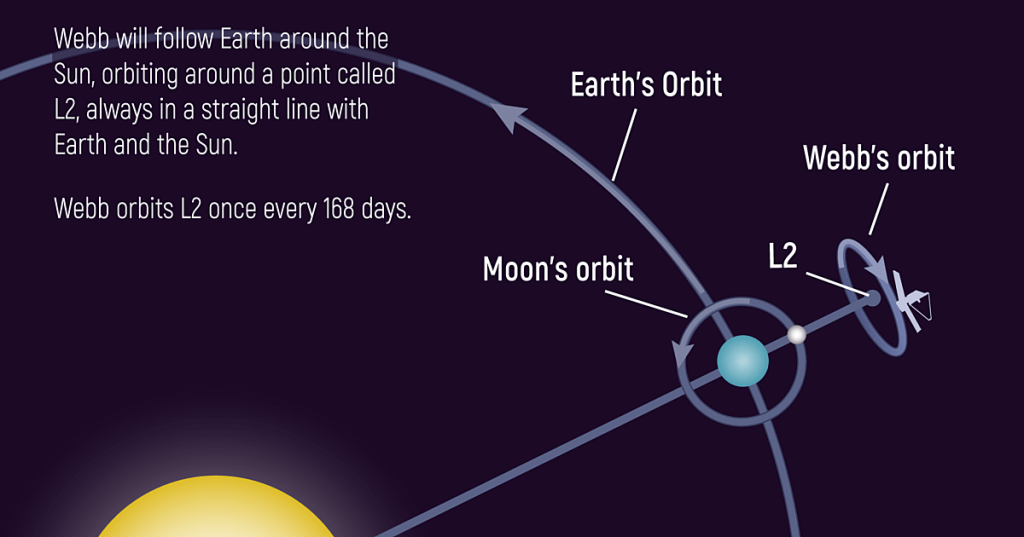
The James Webb is an orbiting infrared observatory that will investigate the thermal radiation of space objects. When heated to a certain temperature, all solids and liquids emit energy in the infrared spectrum; here there is a relationship between wavelength and temperature. The higher the temperature, there will shorter the wavelength and higher the radiation intensity. James Webb sensitive equipment will be able to study the cold exoplanets with surface temperatures of up to 27° Celsius. An important quality of this new telescope is that it will revolve around the sun and not the earth unlike Hubble which is located at an altitude of about 570 kilometers in low earth orbit. With the James Webb orbiting the sun, it will be impossible for the earth to interfere with it, however he James Webb will move in sync with the earth to maintain strong communication yet the distance from the James Webb to the earth will be between about 374,000 to 1.5 million kilometers in the direction opposite of the sun. So its design must be extremely reliable.

The James Webb telescope weighs 6.2 tones. The main mirror of the telescope is with a diameter of 6.5 meters and a colleting area of 25 square meters, it resembles a giant honeycomb consisting of 18 sections. Due to its impressive size, the main has to be folded for start up; this giant mirror will capture light from the most distant galaxies. The mirror can create a clear picture and eliminate distortion. A special type of beryllium was used in the mirror which retains its shape at low cryogenics temperature. The front of the mirror is covered with a layer of 48.25 grams of gold, 100 nanometers thick; such a coating best reflects infrared radiation. A small secondary mirror opposite the main mirror, it receives light from the main mirror and directs it to instruments at the rear of the telescope. The sunshield is with a length of 20 meters and width of 7 meters. It composed of very thin layers of kapton polyimide film which protects the mirror and tools from sunlight and cools the telescope’s ultra sensitive matrices to 220° Celsius.

The NIRCam- Near Infrared Camera is the main set of eyes of the telescope, with the NIRCam we expect to be able to view the oldest stars in the universe and he planets around them. The nurse back near infrared spectrograph will collect information on both physical and chemical properties of an object. And the MIRI mid-infrared instrument will allow you to see stars being born many unknown objects of the Kepler belt. Then the near infrared imager and sliteless spectrograph or NIRIIS camera is aimed at finding exoplanets and the first light of distant objects. Finally the FGS- Fine Guidance Sensor helps accurately point the telescope for higher quality images updates its position in space sixteen times per second and controls the operation the steering and main mirrors. They are planning to launch the telescope with the help of the European launch vehicle Ariana 5 from the kourou Cosmodrome in French Guiana space center. The device is designed for between 5 to 10 years of operation but, it may serve longer. If everything goes well, $10 billion worth of construction and one year of preparation will have finally started in orbit.

दिल्ली को अगले 3 साल में प्रदूषणमुक्त कर देंगे: गडकरी

सड़क परिवहन मंत्री नितिन गडकरी ने गुरुवार को कहा कि केंद्र सरकार अगले तीन साल में दिल्ली को वायु, जल और ध्वनि प्रदूषण से मुक्त करेगी। उन्होंने कहा कि मौजूदा समय में प्रदूषण देश के लिए सबसे बड़ी चिंता की बात है।


इंडस्ट्री पीएचडी चैंबर ऑफ कॉमर्स के सालाना कार्यक्रम में गडकरी ने कहा कि उनके मंत्रालय ने सड़क बुनियादी ढांचा विकास पर 60,000 करोड़ रुपये खर्च किए हैं। इस प्रयास से दिल्ली में वायु प्रदूषण को कम करने में भी मदद की। वायु प्रदूषण, जल प्रदूषण और ध्वनि प्रदूषण देश के लिए चिंतित करने वाले मुद्दे हैं। हम दिल्ली को अगले तीन वर्षों में वायु, जल और ध्वनि प्रदूषण से मुक्त कर देंगे।


गडकरी ने कहा कि सरकार सुप्रीम कोर्ट से मंजूरी मिलने के बाद सभी वाहन निर्माताओं के लिए फ्लेक्स फ्यूल के अनुकूल इंजन बनाना अनिवार्य कर देगी। फ्लेक्स-फ्यूल, पेट्रोल और एथेनॉल को मिलाकर बनने वाला एक वैकल्पिक ईंधन है। अब एक एथेनॉल अर्थव्यवस्था विकसित करने पर काम किया जा रहा है। गडकरी ने सुझाव दिया कि सेना को डीजल इंजन वाले वाहनों के इस्तेमाल पर प्रतिबंध लगाना चाहिए और एलएनजी, सीएनजी और एथनॉल पर चलने वाले ट्रकों का उपयोग करना चाहिए। मंत्री ने कहा कि इथेनॉल, पेट्रोल और डीजल की तुलना में काफी सस्ता है।

अनन्या कौशल द्वारा संपादित।

देश में आसमान छू रहा ईंधन का भाव !

देश में ईंधन की कीमतों में लगातार बढ़ोतरी देखने को मिल रही है। लागतार बढ़ रहा रेट थमने का नाम नहीं ले रहा, जिससे जनता काफी परेशान है। कच्चे तेल के दामों में जिस तरह से अंतरराष्ट्रीय बाजार में तेजी देखने को मिल रही है,वैसे ही घरेलू बाजार में पेट्रोल और डीजल के दाम भी आसमान छू रहा है। भारत में ईंधन की कीमतें रिकॉर्ड स्तर पर है।

5 अक्टूबर 2021 यानी कि मंगलवार को 1 दिन की स्थिरता के बाद भारतीय तेल कंपनियों ने डीजल और पेट्रोल के रेट में इजाफा कर दिया है। बात करें पेट्रोल की तो 25 पैसे प्रति लीटर एवं डीजल 30 पैसे प्रति लीटर और अधिक महंगा हुआ है। वहीं अक्टूबर में हरदिन भाव बढ़ता रहा है। अब तक केवल 1 दिन डीजल और पेट्रोल का रेट स्थिर रहा है।

इंडियन ऑयल कॉर्पोरेशन के मुताबिक़, ईंधन के दामों में वृद्धि के बाद दिल्ली में पेट्रोल की कीमत 102.64 रुपए प्रति लीटर एवं डीजल 91.07 रुपए प्रति लीटर तक पहुंच गया है। हालांकि,देश के चारों महानगरों की तुलना करें तो मुंबई में डीजल-पेट्रोल सबसे अधिक महंगा है। बता दें, जुलाई एवं अगस्त के महीने में कच्चे तेल के दामों में कुछ खास बदलाव नहीं आया था। इसलिए 18 जुलाई से 23 सितंबर तक तेल कंपनियों ने मूल्य वृद्धि नहीं की थी। इस दौरान पेट्रोल 0.65 और डीजल 1.25 की कीमतों में कटौती की गई थी। फिर अंतर्राष्ट्रीय बाजार में निरंतर बढ़ती कीमतों के कारण 28 सितंबर से पेट्रोल और 24 सितंबर से डीजल की कीमतों में बढ़ोतरी की गई है।

अंतरराष्ट्रीय बाजार में पेट्रोल और डीजल की कीमत क्रूड की कीमत के आधार पर प्रतिदिन अपडेट होती है। कीमतों की समीक्षा करने के बाद ऑयल मार्केटिंग कंपनियां रोज डीजल और पेट्रोल के दाम निर्धारित करती है।

अनन्या कौशल द्वारा संपादित।

HOW TO SOLVE THE PROBLEM OF DEFICIENT DEMAND?

 Deficient
demand is basically a situation which arises when the aggregate demand is less
than the aggregate supply that too when the economy is at full employment
level. This means that the population is demanding less that the country is
ready to produce with all the resources available. This could happen due to
many reasons like increment in taxes, increase in the imports, decrease in the
exports, decrease in government expenditure and many more. Due to these
reasons, the population holds no money power to demand and therefore, the
aggregate demand decreases. During these times, the aim to circulating more and
more money among the population so that their demanding power could increase.
So, how does the government control such a consequential matter. Here are the
measures taken by the government.


FISCAL
POLICY


1.INCREASE
IN GOVERNMENT SPENDING

The
government usually spends a huge amount of money in the infrastructure and the
administrative operations. During the time of deficient demand, they would
increase these spendings because then they would have to pay more to their workers,
a part of the population, and eventually more money would be circulated in the
economy.


2.DECREASE
IN TAXES

When in
deficient demand, the government reduces the rate of taxes so that the public
will have more money with them to spend on consumption and investment and
eventually they will end up demanding more.


MONETARY
POLICY


1.DECREASE
IN BANK RATE

Bank rate is
basically the rate at which the central bank lends money to the commercial bank
to meet their long-term needs.  During
this time, the central bank decreases these rate so that the commercial banks
have more than enough funds available with them to lend to the public and
eventually, more money would be circulated in the economy.


2.DECREASE
IN REPO RATE

Repo rate is
the rate at which the central bank lends money to the commercial bank to meet
their short-term needs. This also works as the same way, the banks will have
enough funds to circulate to the public and the demand would surely increase.


3.PURCHASE
OF SECURITIES

In the time
of deficient demand, the central bank starts purchasing securities from the
commercial bank. While selling these securities, the commercial banks will get
more money as their payment in their reserves which will again increase their
lending power and the public will be able to borrow more.


4.DECREASE
IN LEGAL RESERVE RATIO (LRR)

The
commercial banks are supposed to be maintaining a legal reserve. There are two
types of these reserves, Cash Reserve Ratio (CRR) and Statutory Liquidity Ratio
(SRR). If these reserves would be decreased then eventually the banks will have
more money to lend forward to the people and hence, more money circulation in
the economy.


5.DECREASE
IN MARGIN REQUIREMENT

Margin
requirement is the difference between the market value of the security offered
and the value lent to them. During deficient demand, the RBI decreases this
margin which allows the banks to lend extra to the public. Also, after a
decrease in this margin, the public is more interested in borrowing money.


6.ADVISE TO
ENCOURAGE LENDING

During the
deficient demand, the central bank advises, requests or persuades the
commercial banks to lend more money ahead to the public. This helps to increase
the money power among the population and eventually the aggregate demand
raises.


HOW TO SOLVE THE PROBLEM OF EXCESS DEMAND?

 Excess
demand is basically a situation which arises when the aggregate demand is more
than the aggregate supply that too when the economy is at full employment
level. This means that the population is demanding more that the country can
produce with all the resources available. This could happen due to many reasons
like reduction in taxes, decrease in the imports, increase in the exports,
increase in government expenditure and many more. Due to these reasons, the
population holds more money power and therefore, demand more to raise their
standard of living. During these times, the aim is to extract as much money
from the population as possible so that their demanding power would decrease. So,
how does the government control such a consequential matter. Here are the
measures taken by the government.


FISCAL
POLICY


1.DECREASE
IN GOVERNEMNT SPENDINGS

Generally,
the government spends a huge amount on the infrastructure and administrative
activities. Although, during such a situation, they decrease these spendings so
that they will have to pay less to the workers who are a part of the population
and eventually it will lessen their money power. The government should usually
reduce the expenditure on defence as they rarely contribute towards the growth
of the economy.


2.INCREASE
IN TAXES

Here, the
government increases the rate of taxes and also tries to impose some new taxes.
This is because they want to take away the extra money circulating in the
economy so that their credit availability would be lowered, and they won’t be
able to demand more than their need.


MONETARY
POLICY


1.INCREASE
IN BANK RATE

Bank rate is
basically the rate at which the central bank lends money to the commercial bank
to meet their long-term needs.  During
this time, the central bank increases these rate so that the commercial banks
wont have enough funds available with them to lend to the public and
eventually, less money would be circulated in the economy.


2.INCREASE
IN REPO RATE

Repo rate is
the rate at which the central bank lends money to the commercial bank to meet
their short-term needs. This also works as the same way, the banks won’t have
enough funds to circulate to the public and the demand would decrease.


3.SALE OF
SECURITIES

In the time
of excess demand, the central bank offers securities to the commercial bank. In
order to purchase these securities, the commercial banks will have to use their
own money from their reserves which again will reduce their lending power and
the public won’t be able to borrow much.


4.INCREASE
IN LEGAL RESERVE RATIO (LRR)

The
commercial banks are supposed to be maintaining a legal reserve. There are two
types of these reserves, Cash Reserve Ratio (CRR) and Statutory Liquidity Ratio
(SRR). If these reserves would be increased then eventually the banks will have
less money to lend forward to the people and hence, less money circulation in
the economy.


5.INCREASE
IN MARGIN REQUIREMENT

Margin
requirement is the difference between the market value of the security offered
and the value lent to them. During excess demand, the RBI increases this margin
which does not allow the banks to lend extra to the public. Also, after an
increase in this margin, the public is less interested in borrowing money.


6.ADVISE TO
DISCOURAGE LENDING

During the
excess demand, the central bank advises, requests or persuades the commercial
banks not to lend money ahead for a speculative or any non-essential activity.
This helps to reduce the money power among the population and eventually decrease
the aggregate demand.