Launching of One Plus Nord in India

Vaishali Singh (Cheenu Singh Rathore)

One Plus are launching their another smartphone called One Plus Nord today in India on July 21st 2020 at 7:30 PM IST.

The expected price of this smartphone will be around ₹ 34,900

The key specifications of the phone are:

The phone comes in 3 variants 6 GB + 128 GB, 8GB + 256 GB and 12 GB + 256 GB, the entry level price for this mobile is expected to be around ₹ 25,999. The phone will come with 3 colour variants one is Nordic White, second is Arctic Blue, and another one is Amber Red. The back of the One Plus Nord will reportedly flaunt a frosted glass panel, like the previously launched OnePlus 7T.

The OnePlus Nord will come equipped with a Type-C port and will draw power from a 4,200 mAh battery unit powered by a 30W fast-charger. It is well-established that the OnePlus Nord will flaunt a 90Hz refresh rate AMOLED display with dual punch hole housing a 32MP + 8MP selfie camera setup. As far as the rear camera is concerned, we are expecting the OnePlus Nord to boast a quad-lens camera setup featuring 48MP + 8MP + 2MP + 2MP hardware. The OnePlus Nord will use the Adreno 620 GPU to handle graphics.

Features:

  • Octa core (2.4 GHz, Single Core + 2.2 GHz, Single core + 1.8 GHz, Hexa Core)
  • Snapdragon 765G
  • 12 GB RAM

Display:

  • 6.44 inches (16.36 cm)
  • 409 PPI, Fluid AMOLED
  • 90 Hz Refresh Rate

Camera:

  • 48 + 8 + 5 + 2 MP Quad Primary Cameras
  • LED Flash
  • 32 MP + 8 MP Dual Front Cameras

Battery:

  • 4115 mAh
  • Warp Charging
  • USB Type-C Port

Android system:

Android 10 Oxygen OS

E-commerce

Information Technology has been playing a vital role in the future development of financial sectors and the way of doing business in an emerging economy like India, Bangladesh etc. Increased use of smart mobile services and internet as a new distribution channel for business transactions and international trading requires more attention towards e-commerce security for reducing the fraudulent activities. The advancement of Information and Communication technology has brought a lot of changes in all spheres of daily life of human being. E-commerce has a lot of benefits and many acts which hurts the small businesses or business aspects. This study predicts some challenges in an emerging economy.

What is E-Commerce ?

E-commerce means buying and selling of goods over electronic and digital platforms. Thete have been many allegations that big e-commerce are responsible to harm healthy competition in the market. Economies of scale and advancement of logistical companies has helped e-commerce companies to ship goods to anywhere.

Why E-commerce?

With the increasing diffusion of ICTs, more specifically the Internet, the global business community is rapidly moving towards Business-to Business (B2B) e-Commerce. The buyers gain a clear advantage when the Internet gives them access to the global market, by which they can compare prices across regions, find out whether prices vary by order fragmentation and get awareness about substitute products. Due to transparency of the market, customer can compare the services of various e-commerce sites easily. For instant, in case of e-commerce the competitors are one click away from customer. If clients are not happy with the products, prices or services offered by a particular e-commerce site, they are able to change much more easily than in the physical. From the Sellers’ point of view, they don’t need to have physical existence of shop.

E-commerce Hegemony ?

Recently The competition commission of India ordered a probe into alleged competition law violations by Flipkart Amazon over allegations that the e-commerce major promoted and gave discounts to preferred sellers, entered into exclusive partnerships with smartphone brands and abused their dominant position.

Flipkart Amazon is good provider by online marketplace for selling goods in India. Flipkart and Amazon is a wholesaler which is in the business of seeking the good to reseller.

Section 4 of the competition act 2002 is very important as we know completion act is not against possessing dominant position in the market but is objects abusing such dominant position. Section 4 of this act deals with abuse of dominant position.

Dominant position in a market means positions of strength enjoyed by any enterprise in relevant market. Like any enterprise operate independently of competitive forces prevailing in the relevant market Affects it’s competitors or consumers or relevant market in its favor. Recent example of abuse of power should be Amazon Flipkart how they give heavy discounts to customer directly pick-up the good from company that hits the shopkeeper or small enterprises.

Conclusion

As e-commerce industry is emerging sector with high potential of growth govt has to introduce some policies to promote healthy competition in this industry. Govt has to anticipate current loophole in regulations and amend it is such a way that instead of harming msme sector. The e-commerce industry will be a leader with popularity in electronic business world in the upcoming years. The e-commerce revolution has fundamentally changed the business of transaction by giving new opportunities and breaking borders easily. In India, it has strongly impacted the traditional business system and changing the life of people by making it easier. While it gives benefits to customer and seller, e-commerce gives challenges to traditional business for competitive position. Developing countries face many obstacles that affect the successful implementation of e-commerce with the help of comparing with developed country. When the internet cost will be low then the e-commerce will flourish easily and will make many of traditional business to run out of their business. Convenience is one of the benefits that customer gets from the e-commerce and thus increasing customer satisfaction. This is due to customer can place a purchase an order from anywhere with internet connection. E-commerce business provider should give importance on every customer by giving smooth service and many options for payment and have more functions available online. Other benefits are expanded product offerings and expanded geographic reach. But e-commerce business faces a lot of challenges in flourishing their business.


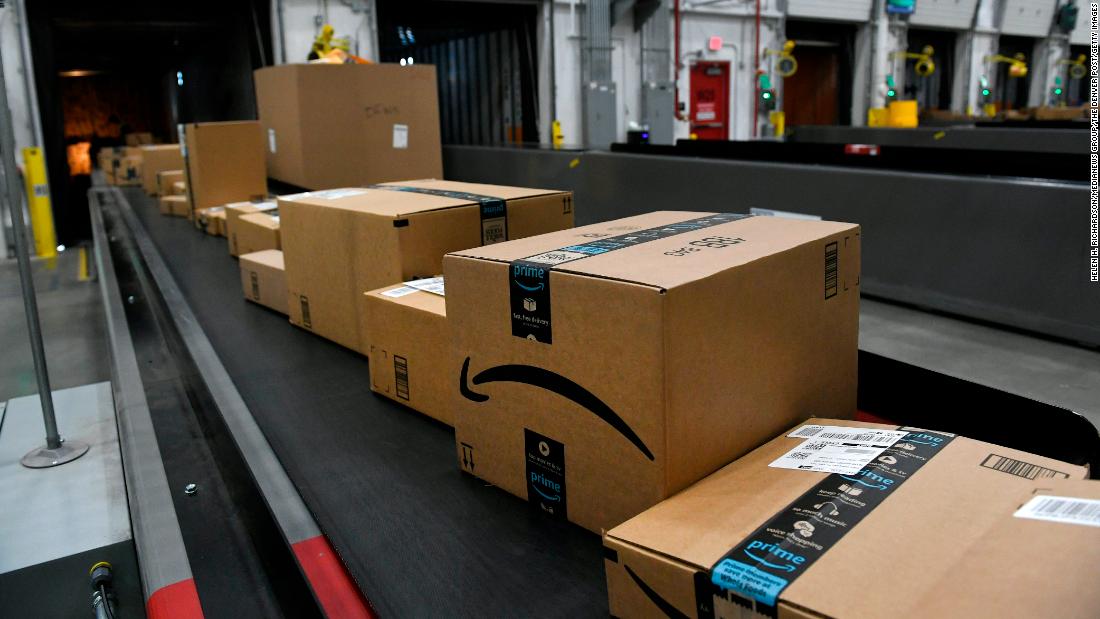
Who delivers the Amazon cardboard boxes???

Cardboard boxes that have been used for generations and thrived in the age of e-commerce continue to flourish or could the cardboard box be facing a new challenger? Cardboard boxes are a very big deal within the U.S. The United States is the Saudi Arabia of trees. Someone’s going to make the first box and that’s almost inevitably a mill generally in the Southeast United States. China certainly doesn’t have trees and India the extent they do have trees they’re not necessarily the right types of trees and shouldn’t be dedicated towards making boxes for us. The box business grew rapidly up through 1999 when the U.S. coordinated box market had its peak shipment. Starting in the early 2000s the U.S. corrugated box market faced multiple economic obstacles.

The great recession dragged on box demand and even after the recession demand continued to slow for commodity like soda and for the boxes that transport them. The move to digital devices also coincided with a drop in demand for copy paper and newsprint. But box makers found a grace in e-commerce sales and Amazon sale specifically which were growing at mostly integer rates within the recession and post-recession years. Those e-commerce sales have become a significant market for the containerboard industry. In 2018 told a U.S. e-commerce sales were estimated to be $512 billion almost 50 percent higher than in 2015. Amazon captured 48 percent of those sales. Most estimates are that e-commerce accounts for about 10 percent of the U.S. box market. Amazon accounts for close to 5 percent of U.S. box demand. By our estimates they are clearly the single largest box user in the US. International Paper with a third of the market I think does closer to 50 percent of all the amazon boxes evidently they got a bit more share than perhaps some of the smaller players.

Amazon's incredible, vanishing cardboard box - CNN

Amazon said they deal with most of the big box makers across the U.S. according to analysts. Those manufacturers include International Paper, WestRock, Packaging Corporation of America and Georgia-Pacific. Some investors were turning to these companies as a way to invest in the e-commerce giant without having to purchase Amazon’s pricey stock. People didn’t really start talking about buying International Paper or WestRock as a secondary investment in Amazon till about the last five years. Despite the boost from e-commerce sales the box business still isn’t growing all that much. And since 2018 their stocks have mostly underperformed the S&P 500. In 2018, 69 percent of International Papers total revenue came from the box business and that sales volume has been mostly flat for the past five years. Although the big producers sold less boxes in 2018 than in 2000, industry consolidation has dramatically narrowed the fields.

The handful of big players remaining are based in Memphis, Tennessee, Atlanta, Georgia and Lake Forest, Illinois. Analysts have told CNBC that substantial industry mergers have made it easier to collectively hike prices and those price increases have helped drive revenue. There are portions of the business that are in indisputable secular decline but if you’re in the brown part of the business, making these boxes, that’s been some very welcome growth. But those extra boxes piling up on people’s doorsteps have led to a backlash from disgruntled customers who are sick of receiving golf ball sized products in supersized boxes. It used to be that you’d order a toothbrush and it would come in three giant boxes and you’d say to yourself, what is this? Well, Amazon is trying to rectify that by using fewer boxes and using other types of packaging where appropriate. With e-commerce packaging underfire Amazon decided to change the way they do shipping. In 2008, Amazon introduced the Frustration Free Packaging program. It aims to reduce the extra packaging created when retail packaged products are placed inside Amazon boxes to be shipped. Instead, products certified in the program that are roughly the size of a blender or larger need to be packaged in their own ready to ship boxes. And those boxes also need to be made of 100 percent recyclable materials. For customers that means that the packaging is easy to recycle and the box is easy to open without all the excess packaging materials.

Use That Pile of Empty Amazon Boxes to Do Something Wonderful ...

Amazon offered vendors an incentive of a dollar per shipment to modify their packaging. And starting August 1st 2019 Amazon is charging a $1.99 penalty for each product shipped that needs to be reboxed. And basically the point of this deadline is for Amazon to get out of the business of packaging. They want their vendors to send them boxes that Amazon doesn’t have to touch or rebox. Over the last two years we have invented two different kinds of flexible mailers. One is the blue and white all plastic mailer. We’ve recently launched in the last six, eight months a paper padded mailer that’s actually fully recyclable with the paper stream. Amazon said they made about 10 million shipments using the paper padded mailer and depending on the month the plastic mailer is used about 20 to 30 percent of the time. So really when we come down to deciding if the product is of the size it can go on a mailer, it’s not likely to be damaged by going in the mailer, the mailer is always the better fitting option and frankly is easier for the customer to choose to recycle than breaking down a corrugate box. We’re driving in that direction for many different reasons. But those plastic mailers generally are not accepted in municipal recycling programs and you’ll need to bring them to a store that accepts plastic bags. The latest stats from the EPA show that corrugated boxes were recycled at a rate of 92 percent in 2015 while plastic bags, sacks and wraps were recycled at a rate of 13 percent in 2015.

AMAZON E-COMMERCE SELLERS, IT'S TIME TO REVIEW YOUR ADVERTISING ...

When you think about what is the greatest pain point for the consumer after having it get there safely arrive on time people are concerned about receiving something that is plastic or made a poly because of the environmental concerns. Some waste management companies say plastic packaging also causes problems for the recycling systems. Plastic mailers get caught in the recycling machinery slowing down the process and raising the costs for recyclers and sometimes contaminating entire bundles. Until Scotty on the Enterprise can beam the products from the warehouse to your living room I think Amazon’s going to be good for the corrugated business. I think there’s going to be noise I think you’re going to have challenges from time to time where people say, “Should we try and the plastic pouch?”, in the long run plastic is going to be on the wrong side of history. Because Amazon is a market leader in the U.S. e-commerce sector any move away from cardboard to plastic mailers could signal a shift for the entire industry. The corrugated box could be about to undergo a major facelift. We’re seeing some major trends among consumers and what they’re expecting from e-commerce and the first one is actually this desire for increased engagement with the package. In 2015, Amazon partnered with Universal Pictures and Illumination Entertainment to ship orders in bright yellow delivery boxes featuring cartoon characters from the movie Minions. The boxes promoting the movie and a special Amazon U.R.L. dedicated to shopping for merchandise from the film.

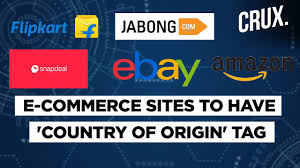
E-commerce sites to display country of origin on products to promote made in India and Atmanirbhar Bharat.

New Delhi: The government had taken yet another big step after ban on 59 Chinese apps to make it compulsory for E-commerce sites to display ‘country of origin’ tag so that users can identify Indian products and help make Atmanirbhar Bharat a success. The online shopping sites have agreed with government to display’country of origin’ and are cooperating with government.

The Government e-Marketplace (GeM) portal, which is used by government departments for public procurement, on Tuesday made it mandatory for sellers to enter the “country of origin” while registering all new products.

The Department for Promotion of Industry and Internal Trade (DPIIT) asked e-commerce players including Amazon and Flipkart to display mention ”country of origin” on each product sold at their platforms.

While GeM says it has taken this step to promote ‘Make in India’ and ‘Aatmanirbhar Bharat’ (Self-reliant India), the move also comes days after a deadly border clash between Indian and Chinese soldiers. Sub-standard and cheap Chinese products often make their way into the Indian market, more so through online platforms. The government has ramped up efforts to curb the inflows of such low-grade imports and their consumption here.

The government has taken such steps to reduce dominance of Chinese products in Indian market and make India self-reliant country. We must support the efforts of government and use as much as possible made in India products.