Artificial intelligence

 Artificial Intelligence

What is artificial intelligence?

Artificial Intelligence (AI) Explained
In the simplest terms, AI which stands for artificial intelligence refers to systems or machines that mimic human intelligence to perform tasks and can iteratively improve themselves based on the information they collect. AI manifests in a number of forms. A few examples are:
1. Chatbots use AI to understand customer problems faster and provide more efficient answers.
2. Intelligent assistants use AI to parse critical information from large free-text datasets to improve scheduling.
3. Recommendation engines can provide automated recommendations for TV shows based on users’ viewing habits.
AI is much more about the process and the capability for superpowered thinking and data analysis than it is about any particular format or function. Although AI brings up images of high-functioning, human-like robots taking over the world, AI isn’t intended to replace humans. It’s intended to significantly enhance human capabilities and contributions. That makes it a very valuable business asset.

Types of artificial intelligence 

1. Purely reactive 

These machines do not have any memory or data to work with, specializing in just one field of work. For example, in a chess game, the machine observes the moves and makes the best possible decision to win. 

2. Limited memory 

These machines collect previous data and continue adding it to their memory. They have enough memory or experience to make proper decisions, but memory is minimal. For example, this machine can suggest a restaurant based on the location data that has been gathered.

3. Theory of mind 

This kind of AI can understand thoughts and emotions, as well as interact socially. However, a machine based on this type is yet to be built. 

4. Self – Aware 

Self – Aware machines are the future generations of these new technologies.
They will be intelligent , sentient , and conscious .

Importance of artificial intelligence 

1. Artificial Intelligence’s importance and subsequent components have been known for a long time. They are being seen as tools and techniques to make this world better. And it’s not like you have to go through to be able to use these fancy tech gadgets. You can look around, and I’m sure most of your work is smoothed out by artificial intelligence.
2. Its importance lies in making our life easier. These technologies are a great asset to humans and are programmed to minimize human effort as much as possible. They can operate in an automated fashion. Therefore, manual intervention is the last thing that can be sought or seen during the operation of parts involving this technology.
3. These machines speed up your tasks and processes with guaranteed accuracy and precision, making them a useful and valuable tool. Apart from making the world an error-free place with their simple and everyday techniques, these technologies and applications are not only related to our ordinary and everyday life. It is affecting and holds importance for other domains as well.

Difference between artificial intelligence and machine learning

Artificial Intelligence and Machine Learning are the terms of computer science. 
Artificial Intelligence comprises two words “Artificial” and “Intelligence”. Artificial refers to something which is made by humans or a non-natural thing and Intelligence means the ability to understand or think. There is a misconception that Artificial Intelligence is a system, but it is not a system. AI is implemented in the system. There can be so many definitions of AI, one definition can be “It is the study of how to train the computers so that computers can do things which at present humans can do better.” Therefore It is an intelligence that we want to add all the capabilities to a machine that human contains.
Machine Learning is the learning in which a machine can learn on its own without being explicitly programmed. It is an application of AI that provides the system the ability to automatically learn and improve from experience. Here we can generate a program by integrating the input and output of that program. One of the simple definitions of Machine Learning is “Machine Learning is said to learn from experience E w.r.t some class of task T and a performance measure P if learners performance at the task in the class as measured by P improves with experiences.” 

What is artificial intelligence (AI)?

The first thing that comes to mind when we hear the term
Artificial intelligence is, what exactly is AI? We see computers workaround for
us all the time but we don’t truly understand what AI actually is and how it
works, so read along to find out.

The purpose of Artificial intelligence is to give
machines, especially computer systems the ability to simulate human
intelligence processes. What is often referred to as AI is nothing more than
machine learning when only one component among many others that AI has.

Python, java, etc. are some of the popular programming
languages which are used to write machine learning algorithms that serve as the
foundation to build specialized software and hardware required by AI to achieve
specific goals it has been programmed to do.

Ai works by gathering large amounts of data, analyzing
them to find patterns and correlations present, and subsequently using them to
make predictions about the future as accurately as possible. For example, an
image recognition tool can be fed millions of images to look for certain
objects present in it. the perfect example of AI is the mars curiosity rover, as it is on an entirely different planet collecting samples analyzing them and sending the results back to earth.


Categories of AI


AI can be categorized in two ways i.e. weak or
strong 

  • Weak/narrow
    AI
     is usually designed and trained to complete a
    particular task for e.g. Apple’s Siri is a really good example of a
    software program that uses weak AI.


  • Strong
    AI 
    also referred to as Artificial General Intelligence
    (AGI), is used to perform tasks that require cognitive abilities to do so.
    The tasks performed by them tend to be much more complex in nature. A really
    good example of software that utilizes a strong AI can be found in
    self-driving cars, hospital operating rooms, etc. 


The four types of AI


There are mainly four types of AI which can range from
intelligence systems that are task-specific and widely in use all around the
world to sentient systems which have not yet been developed.


1) Reactive machines- they are the
most basic type of artificial intelligence. It uses algorithms that enable it
to give optimized output, which will be the same if the inputs are identical.
For e.g. Chess-playing AIs are based on reactive AIs.


2) Limited memory AI- they are the
type of AIs that have the ability to utilize past experiences to improve their
future decisions but they can store limited amounts of data and have a
relatively short length of memory. For e.g. self-driving cars are the best
example of a machine that utilizes limited memory AI.


3) Theory of Mind AI- this type of
AIs has social intelligence enabling them to understand human emotions. They
will be able to understand human emotions and have the ability to predict
behavior which can be extremely helpful in making a Chabot that could
potentially have the ability to even fool humans into believing that the Ai was
an actual human being. The only thing they lack is that they are not
self-aware. 


4) Self-aware AI- this is the
future of artificial intelligence, these machines will have their own
consciousness, sentiments, and will be self-aware and will be a lot like us
humans in terms of emotions behavior patterns, etc. a lot of scientists believe
that AI will never become self-aware or as one might say ‘Alive’.


Applications of Artificial intelligence 


1) AI in healthcare

With the availability of large and complex data in
healthcare implies that Artificial intelligence will be used to process and
analyze it to help us in many ways. One of the most useful and common
applications of AI will be in diagnosis and treatment recommendations. IBM
Watson is one of the best-known healthcare AI software which can mine a
patient’s data and data from other sources to formulate a hypothesis and it
even gives it a confidence scoring scheme as well. 


2) AI in business 

AI is the best thing to happen for business owners
because AI can help you automate the routine tasks which would normally take
hours to do and it can do it with great accuracy too. Not only routine tasks
but AI can also be used to analyze and interpret data which can be very useful
for analyzing customer behavior to help you improve your marketing strategies
and it is extremely cost efficient as well. 


3) AI in finance 

AI can be used by individuals to help manage their
personal finances and can also be used by financial institutions to manage and
analyze large amounts of data. These types of software can help to conduct
fundamental and technical analyses on different companies and funds by
automatically taking information from their balance sheets. these types of AI software
are also capable of executing trades on the stock exchange on behalf of you and
with greater accuracy and results as they remove the emotional aspect which
would affect your trades if you execute them by yourself 


4) AI in law 

AI in law can help save hundreds of man hours which are
spent sifting through documents and analyzing them manually for discrepancies
by automating this process. This helps to make the entire process a lot more
efficient, time-saving and improves customer service. 


5) AI in manufacturing 

In its early stages of development, AI was only being
used to perform a single task and still required some form of human
intervention at all stages of the production process but, with the recent
advancement in technology, entire production lines can now be replaced by AI
machines and the whole process can now be automated as the AI is now capable of
multitasking. It can now produce and assemble the product all while performing
quality checks on each and every product which was simply not possible earlier
when the human workforce was used for everything. 
 

What is Artificial Intelligence ? 4 types of Artificial Intelligence ? Advantages and Disadvantages of Artificial Intelligence?

 Artificial Intelligence

Artificial intelligence (AI) is a computer system which does the work like human intelligence. AI have all the qualities better than a human brain. If you have any doubts or you want to correct something or you want to correct something AI is there for you to help. Humans have made artificial intelligence in such a manner that they know everything better than you. If you have any problem you just have to use it and your problem will be solved.

4 types of Artificial Intelligence

* Limited memory – Limited memory artificial intelligence has a memory so they can use past experiences to make future decisions.

* Reactive machines – These AI systems do have not any memory and they can do only specific tasks. These AI can give predictions but as they don’t have any memory so they can’t inform future decisions.

* Self-awareness – These types of AI systems have a sense of self. They only know their current state. 

* Theory of mind – Theory of mind is a psychological term. These AI systems understand emotions. They can predict the behaviour of humans.

Advantages and Disadvantages of Artificial Intelligence

Advantages

Less time consuming

Can get instant results

AI-powered virtual agents are always available

24/7 you can use it

Disadvantages

* It’s expensive

* It requires deep knowledge

It only knows which they show to you

* Lack of ability 

Artificial intelligence (AI) have both good and bad quality for you all. So whenever you choose an AI system make sure to research and get a better AI system. 

I hope this article will be helpful.

Artificial Intelligence (AI) and Digital Medicine are critical to future healthcare

 Union Minister of State (Independent Charge) Science & Technology; Minister of State (Independent Charge) Earth Sciences; MoS PMO, Personnel, Public Grievances, Pensions, Atomic Energy and Space, Dr Jitendra Singh said here today that Artificial Intelligence (AI) and Digital Medicine are critical to future healthcare.

During a visit to the All India Institute of Medical Sciences (AIIMS) Jammu for the inspection of the upcoming new blocks and inauguration of recently developed facilities, Dr Jitendra Singh suggested that in order to develop an exclusive identity for the institution, the focus should be on these futuristic areas. Tele-Medicine and Robotic Surgery have already taken over in a big way and the indispensable utility of these new options was realised during the pandemic times, he added.

Dr Jitendra Singh informed that the OPD services will start immediately in AIIMS, Jammu and the first batch will move and operate from the premises from 1st of June this year and the second batch will continue thereafter. The Minister said that 30 member faculty has already been inducted and the entire six storey AIIMS building will be ready by early next year.

The Minister announced that AIIMS Jammu will function in close collaboration with CSIR-IIIM Jammu. A MoU was signed in the presence of the Minister, between Director AIIMS Jammu Dr Shakti Gupta and Director CSIR-IIIM Jammu Dr. D. Srinivasa Reddy, on behalf of the two institutions.

Speaking on the occasion Dr Jitendra Singh said, it is an irony that CSIR-IIIM Jammu and Government Medical College Jammu existed in the close vicinity of just about 4 kilometres from each other and even though both the institutions were dedicated to medical research, there was hardly any collaboration between the two in the past. He said, every effort would be made to bring in closer integration of IIIM with GMC and also between IIIM Jammu and AIIMS Jammu, both of which happen to be the Central Government institutions.

Dr Jitendra Singh noted that IIIM Jammu is one of the oldest CSIR laboratories in the country and even today it is conducting pioneering research in Cannabis Medicinal Products and host of other drugs, which makes the institute a natural ally of the AIIMS which has also the mandate of research and medical education.

While appreciating the progress made during the brief period since Dr Shakti Gupta took over as the Director of AIIMS, Dr Jitendra Singh suggested that in order to develop an exclusive identity for the institution, the focus should be on futuristic areas like Digital Health and Artificial Intelligence (AI) and AIIMS could be a pioneer in North India in developing AI based healthcare infrastructure.

The Minister said it is because of the personal indulgence of Prime Minister Narendra Modi that Jammu has, in the recent years, developed major centrally funded academic institutions in close vicinity of each other, thus making it an important educational hub in the region. He called for greater integration at different levels that is among the science institutions, then between scientific institutions and non-scientific institutions and finally among all these education institutions put together and the industry and Start-Ups for sustainable growth, development and livelihood.

Dr Jitendra Singh hoped that with the constitutional barriers of the past having been done away with in case of Jammu & Kashmir, the administration and the management will make all efforts to attract the best of the faculty from different parts of the country.

****

Artificial Intelligence: Can the AI take over?

Artificial Intelligence is a topic with a vast appeal to the en masse. People believe that it is the future of human techologies. But beyond that, people are of various school of thoughts. The first group assumes that AI shall help humanity achieve singularity – a point in technological development that shall mean an utopia. We shall spend all our time towards spiritual and emotional development while most of the crude tasks shall be taken care by machines. The second school of thought assumes that AI shall take over humanity as its overlords. Let us analyse both.

The history of animated, self-thinking, free willed machines is not new at all. It has been imagined for centuries by fiction writers. However, the modern conception of AI in scientific thinking started about 80 years ago. John McCarthy, an American mathematician proposed the idea of such machines back in the first half of the 20th century. Alan Turing, the inventor of the Turing Machine, a British mathematician also proposed his idea of intelligent machines, his proposal now famously called the Turing Test. However, for the next 40 years or so, no important research occurred in the field. It was only in the last decades of the 20th century, when the research started again and not before humanity entered into the 21st century that something formidable was created.

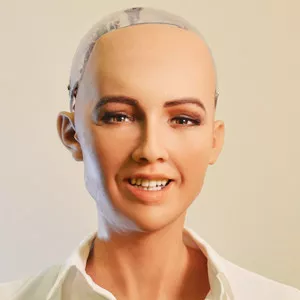
As of today, AI has invaded all spaces of human endeavor. Mechanics, mechatronics, smart devices, our smartphones – all of it is infiltrated with AI. But this AI is what most scientists call ‘weak AI’. It cannot really think. It has a predefined algorithm and then it uses that algorithm to capture inputs and ‘learn’ about new scenarios as per its algorithmic definitions. This AI cannot work without human input and can certainly not take over the world. It can however carry out some actions that are equivalent to evolution as the AI at the Facebook research Center developed their own language to communicate. However, this evolution still does not mean that the AI is “thinking”. It is just evolving its learning based on a preprogrammed code. It is nothing like human beings where discretion is a thing. Even the famous robot AI, Sophia is but a weak AI – a little better than SIRI and google assistant but that is all there is to it. It is not a self-thinking, free-willed machine.

Sophia the Robot – Keynote Speaker | London Speaker Bureau
Sophia, the robot

Researchers have tried hard to create strong AIs with a completely different set of ethical concerns – the main obviously being how would such machines live with humans if they are free to think – but have failed so far. And believe it or not, strong AIs might really not be a thing for at least another 50-100 years at the very least. Maybe even a couple of centuries after that.

So, if you’ve watched the movie Prometheus or Covenant and are scared of the possibility of David being a reality, grab a cup of coffee and relax. By the way, both the movies are really good!

Alien: Covenant, a review by guest columnist David 8 | by Charles Evans |  Medium
David-8 from the movie Prometheus.

Artificial Intelligence

Artificial intelligence (AI) refers to the simulation of human intelligence in machines that are programmed to think like humans and mimic their actions. The term may also be applied to any machine that exhibits traits associated with a human mind such as learning and problem-solving.

Artificial intelligence (AI) is intelligence demonstrated by machines, as opposed to the natural intelligence displayed by humans or animals. Leading AI textbooks define the field as the study of “intelligent agents”: any system that perceives its environment and takes actions that maximize its chance of achieving its goals. Some popular accounts use the term “artificial intelligence” to describe machines that mimic “cognitive” functions that humans associate with the human mind, such as “learning” and “problem solving”.

AI applications include advanced web search engines, recommendation systems (used by YouTube, Amazon and Netflix), understanding human speech (such as Siri or Alexa), self-driving cars (e.g. Tesla), and competing at the highest level in strategic game systems (such as chess and Go), As machines become increasingly capable, tasks considered to require “intelligence” are often removed from the definition of AI, a phenomenon known as the AI effect. For instance, optical character recognition is frequently excluded from things considered to be AI, having become a routine technology.

Artificial intelligence was founded as an academic discipline in 1956, and in the years since has experienced several waves of optimism, followed by disappointment and the loss of funding (known as an “AI winter”), followed by new approaches, success and renewed funding. AI research has tried and discarded many different approaches during its lifetime, including simulating the brain, modeling human problem solving, formal logic, large databases of knowledge and imitating animal behavior. In the first decades of the 21st century, highly mathematical statistical machine learning has dominated the field, and this technique has proved highly successful, helping to solve many challenging problems throughout industry and academia.

The various sub-fields of AI research are centered around particular goals and the use of particular tools. The traditional goals of AI research include reasoning, knowledge representation, planning, learning, natural language processing, perception and the ability to move and manipulate objects. General intelligence (the ability to solve an arbitrary problem) is among the field’s long-term goals. To solve these problems, AI researchers use versions of search and mathematical optimization, formal logic, artificial neural networks, and methods based on statistics, probability and economics. AI also draws upon computer science, psychology, linguistics, philosophy, and many other fields.

The field was founded on the assumption that human intelligence “can be so precisely described that a machine can be made to simulate it”. This raises philosophical arguments about the mind and the ethics of creating artificial beings endowed with human-like intelligence. These issues have been explored by myth, fiction and philosophy since antiquity. Some people also consider AI to be a danger to humanity if it progresses unabated. Others believe that AI, unlike previous technological revolutions, will create a risk of mass unemployment.

Artificial Intelligence Characteristics

  • Deep Learning. Deep learning is a machine learning technique that teaches computers to do what comes naturally to humans, to learn by example.
  • Facial Recognition
  • Automate Simple and Repetitive Tasks
  • Data Ingestion
  • Chatbots
  • Quantum Computing
  • Cloud Computing

Following are some sectors which have the application of Artificial Intelligence:

  • AI in Astronomy. Artificial Intelligence can be very useful to solve complex universe problems
  • AI in Healthcare
  • AI in Gaming
  • AI in Finance
  • AI in Data Security
  • AI in Social Media
  • AI in Travel & Transport
  • AI in Automotive Industry

Artificial Intelligence, Boon or Bane?

Introduction to AI

Artificial intelligence (AI) refers to the simulation of human intelligence in machines that are programmed to think like humans and copy their actions. This may also be applicable to any machine that exhibits traits associated with a human mind such as learning and problem-solving. From SIRI to self-driving cars, AI is progressing rapidly. While science fiction often portrays AI as robots with human-like characteristics, AI can enclose anything from Google’s search algorithms to automatic weapons.

Benefits

AI’s impact on society can be beneficial for research in many areas. Topics such as economics, law, technical topics such as verification, validity, security and control can be improved so much with the help of AI.  it may be little more than a minor nuisance if your laptop crashes or gets hacked, it becomes all the more important that an AI system does what you want it to do if it controls cars, airplanes, automated trading systems or a power grid. Another short-term challenge is preventing a devastating arms race in dangerous automated weapons.

Artificial Intelligence can also be used in performing surgeries which require precision. It can also be helpful in performing tasks which are difficult for humans to perform. As technology advances, previous landmarks that defined artificial intelligence become outdated. For example, machines that calculate basic functions or recognize text through character recognition are no longer considered to embody artificial intelligence, since this function is now taken for granted as a basic computer function.

Disadvantages

When misused, AI has the potential to become the most dangerous weapon humans have ever seen. Autonomous weapons are automated weapons that are programmed to kill. In the hands of wrong people, this weapon can easily be a medium for mass destruction. Moreover, AI arms race can cause an AI war which can also cause mass causalities.

Even if AI is programmed to do something beneficial, but it develops a destructive method to achieve its goals. For example, when we ask an AI powered car to take us in the fastest way possible, it can break several traffic rules and speed limits to help us reach our destination. It can run over people or damage the vehicle. AI is very difficult to tame once it learns to think like humans. So, we should be very careful while handing over our future to the hands of artificial intelligence.

Self Driving Cars

A self-driving car uses a combination of sensors, cameras, radar and artificial intelligence (AI) to travel between destinations without a human operator. To qualify as fully autonomous, a vehicle must be able to navigate without human intervention to a predetermined destination over roads that have not been adapted for its use.

Companies developing or testing autonomous cars include Audi, BMW, Ford, Google, General Motors, Tesla, Volkswagen and Volvo. Google’s test involved self-driving cars – including Toyota Prii and an Audi TT – navigating over 140,000 miles of streets and highways.

How self-driving cars work

AI technologies power self-driving car systems. Developers of self-driving cars use vast amounts of data from image recognition systems, along with machine learning and neural networks, to build systems that can drive autonomously.

The neural networks identify patterns in the data, which is fed to the machine learning algorithms. That data includes images from cameras on self-driving cars from which the neural network learns to identify traffic lights, trees, curbs, pedestrians, street signs and other parts of any given driving environment.

Google’s self-driving car project, called Waymo, uses a mix of sensors, Lidar (light detection and ranging — a technology similar to radar) and cameras and combines all of the data those systems generate to identify everything around the vehicle and predict what those objects might do next. This happens in fractions of a second. Maturity is important for these systems. The more the system drives, the more data it can incorporate into its deep learning algorithms, enabling it to make more nuanced driving choices.

The following outlines how Google Waymo vehicles work:

  • The driver or passenger sets a destination. The car’s software calculates a route.
  • A rotating, roof-mounted Lidar sensor monitors a 60-meter range around the car and creates a dynamic three-dimensional (3D) map of the car’s current environment.
  • A sensor on the left rear wheel monitors sideways movement to detect the car’s position relative to the 3D map.
  • Radar systems in the front and rear bumpers calculate distances to obstacles.
  • AI software in the car is connected to all the sensors and collects input from Google Street View and video cameras inside the car.
  • The AI simulates human perceptual and decision-making processes using deep learning and controls actions in driver control systems, such as steering and brakes.
  • The car’s software consults Google Maps for advance notice of things like landmarks, traffic signs and lights.
  • An override function is available to enable a human to take control of the vehicle.

How artificial intelligence is replacing humans?

Artificial intelligence, this is not a new name. This is the most trending subject in this 21st century. Examples of artificial intelligence Alexa, google assistant, Siri etc. In this blog, we are going to see what is artificial intelligence? Type of artificial intelligence, Can machines think? How artificial intelligence is replacing humans? Advantages and disadvantages of AI?

WHAT IS ARTIFICIAL INTELLIGENCE ?

Artificial Intelligence commonly known as AI is the intelligence represented by machines, as opposed to natural intelligence display by humans. AI is an interdisciplinary science with multiple approaches. Based on capabilities AI can be classified into weak AI, strong AI, and super AI. Weak AI can focus on only one task and it cannot go beyond its limitations. Strong AI can understand and learn that much of a human. Super AI suppresses human intelligence and can perform task better and beyond human intelligence.

TYPES OF ARTIFICIAL INTELLIGENCE

There are four types of artificial intelligence, they are Reactive machines, Limited memory, Theory of mind, Self awareness.

  1. Reactive machines

This is the simplest level of Artificial Intelligence. Reactive machines performs basic operations. No learning occurs in this type. This is the first stage of artificial intelligence system. It doesn’t have past memory and cannot use past memory for future actions. Examples of reactive memory are Static machine learning models, and IBM chess program.

2. Limited memory

Limited memory of AI has the ability to store past memory and predictions and use the data to make future predictions. With limited memory, machine learning architecture become more complex. The examples of limited memory are self-driving cars are the best example. There are three types of limited memory –

i) Reinforcement learning

ii) Long short term memory(LSTM)

iii) Evolutionary Generative Adversarial Networks(EGAN)

3. Theory of Mind

This is the advanced type of artificial intelligence. Theory of mind refers to the ability of human mind to attribute mental states or others is a key component of human cognition.

4. Self awareness

Self awareness is more advanced type of artificial intelligence. It is the final step of AI development to build systems that can form representation of themselves.

CAN MACHINES THINK?

The biggest question in our mind is can machines think like humans? machines do not have feeling, emotions and consciousness. Therefore the artificial intelligence cannot think like us. The artificial intelligence is in the beginning stage in this world right now. But in future when artificial intelligence is in the advanced stage, scientist suggests that there may be a possibility. AI is programmed by humans into every machine to perform a certain task. Therefore AI cannot think and take decisions on its own. Therefore AI cannot think.

HOW ARTIFICIAL INTELLIGENCE IS REPLACING HUMANS?

In earlier day, people used to work in the factories but now machines are working in place of humans. Now the question comes Can artificial intelligence is replace humans? the answer is yes, we have seen robots replacing human works in a organization. As we known that AI is in the beginning stage of development. Experts suggest that AI can replace human work in the future. A study suggests that AI will replace 30 percent of human labor in 2030.

ADVANTAGES OF ARTIFICIAL INTELLIGENCE

  1. AI takes only certain time to perform a task.
  2. AI can do the complex tasks in seconds.
  3. AI is available for 24×7 by a day.
  4. AI can reduce error and increase accuracy.

DISADVANTAGES OF ARTIFICIAL INTELLIGENCE

  1. Creating a machine that could simulate human intelligence requires a lot of time and lot of money.
  2. AI cannot think beyond its box. There is no creativity for AI.
  3. AI will increase the unemployment rate, as it will replace human labor.

What if we are living in a Video Game?

Kids these days are so head over heels into video games, do you ever think what if we are pawns in a video games ourselves, some alien species with the controller?

Rizwan Virk, a computer scientist and video game designer, published a 2019 book, The Simulation Hypothesis, that traces the path from today’s technology to what he calls the “Simulation Point,” the moment at which we could realistically build a Matrix-like simulation.

I know nothing about computer science, but this idea that we’re all characters in an advanced civilization’s video game is, well, kind of awesome.

Pretend I know absolutely nothing about the “simulation hypothesis.” What is the simulation hypothesis?

The simulation hypothesis is the modern equivalent of an idea that’s been around for a while, and it is the idea that the physical world that we live in, including the Earth and the rest of the physical universe, is actually part of a computer simulation.

You can think of it like a high resolution or high-fidelity video game in which we are all characters, and the best way to understand it within Western culture is the movie The Matrix, it’s become a cultural phenomenon now beyond the film industry.

In that movie, Keanu Reeves plays the character Neo, who meets a guy names Morpheus, who is aptly named after the Greek god of dreams, and Morpheus gives him a choice of taking a red pill or a blue pill. And if he takes the red pill, he wakes up and realizes that his entire life, including his job, the building he lived in, and everything else, was part of this elaborate video game, and he wakes up in a world outside of the game, which he did. That is the basic version of the simulation hypothesis.

Are we living in a simulated universe right now?

There are lots of mysteries in physics that are better explained by the simulation hypothesis than by what would be a material hypothesis.

The truth is that there’s much we simply don’t understand about our reality, and I think it’s more likely than not that we are in some kind of a simulated universe. Now, it’s a much more sophisticated video game than the games we produce, just like today World of Warcraft and Fortnite are way more sophisticated than Pac-Man or Space Invaders. They took a couple of decades of figuring out how to model physical objects using 3D models and then how to render them with limited computing power, which eventually led to this spate of shared online video games.

I think there’s a very good chance we are, in fact, living in a simulation, though we can’t say that with 100 percent confidence. But there is plenty of evidence that points in that direction.

Watch season 18, episode 7 of South Park if you haven’t gotten the hint already!

Think of how sometimes when you walk into a room with a purpose but the moment you enter, you forget the reason you walked in for? Who knows some work might have come up so the gamer playing you had to leave? So, you go blank for a few seconds, but when the gamer comes back, you are back on track as well.

Think of how every time you fell down. Who knows that isn’t because the controller from the gamer’s hand maybe because he was balancing his plate of food in his hand while playing?

What if the old people are being played by the gamers with low frame rate and bad internet connectivity?

When I say there are aspects of our world that would make more sense if they were part of a simulation, I mean there are a few different aspects, one of which is quantum indeterminacy, which is the idea that a particle is in one of multiple states and you don’t know that unless you observe the particle.

Probably a better way to understand it is the now-infamous example of Schrödinger’s cat, which is a cat that the physicist Erwin Schrödinger theorized would be in a box with some radioactive material and there was a 50 percent chance the cat is dead and a 50 percent chance the cat is alive. Now, common sense would tell us that the cat is already either alive or it’s dead. We just don’t know because we haven’t looked in the box. We open the box and it’ll be revealed to us whether the cat is alive or dead. But quantum physics tells us that the cat is both alive and dead at the same time until somebody opens up the box to observe it. The cardinal rule is the universe renders only that which needs to be observed.

Isn’t the hypothesis that we’re living in a flesh-and-blood physical world the simpler explanation?

A very famous physicist, John Wheeler, was one of the last physicists who worked with Albert Einstein and many of the great physicists of the 20th century. He said that physics was initially thought to be about the study of physical objects, that everything was reducible to particles. This is what’s often called the Newtonian model.

But then we discovered quantum physics and we realized that everything was a field of probabilities and it wasn’t actually physical objects. That was the second wave in Wheeler’s career.

The third wave in his career was the discovery that at the core level, everything is information, everything is based on bits. So Wheeler came up with a famous phrase called “it from bit,” which is the idea that anything we see as physical is really the result of bits of information. He didn’t live to see quantum computers come into reality, but it’s looking more like that.

So I would say that if the world isn’t really physical, if it’s based on information, then a simpler explanation might in fact be that we are in a simulation that is generated based on computer science and information.

How close are we to having the technological capacity to build an artificial world that’s as realistic and plausible as The Matrix?

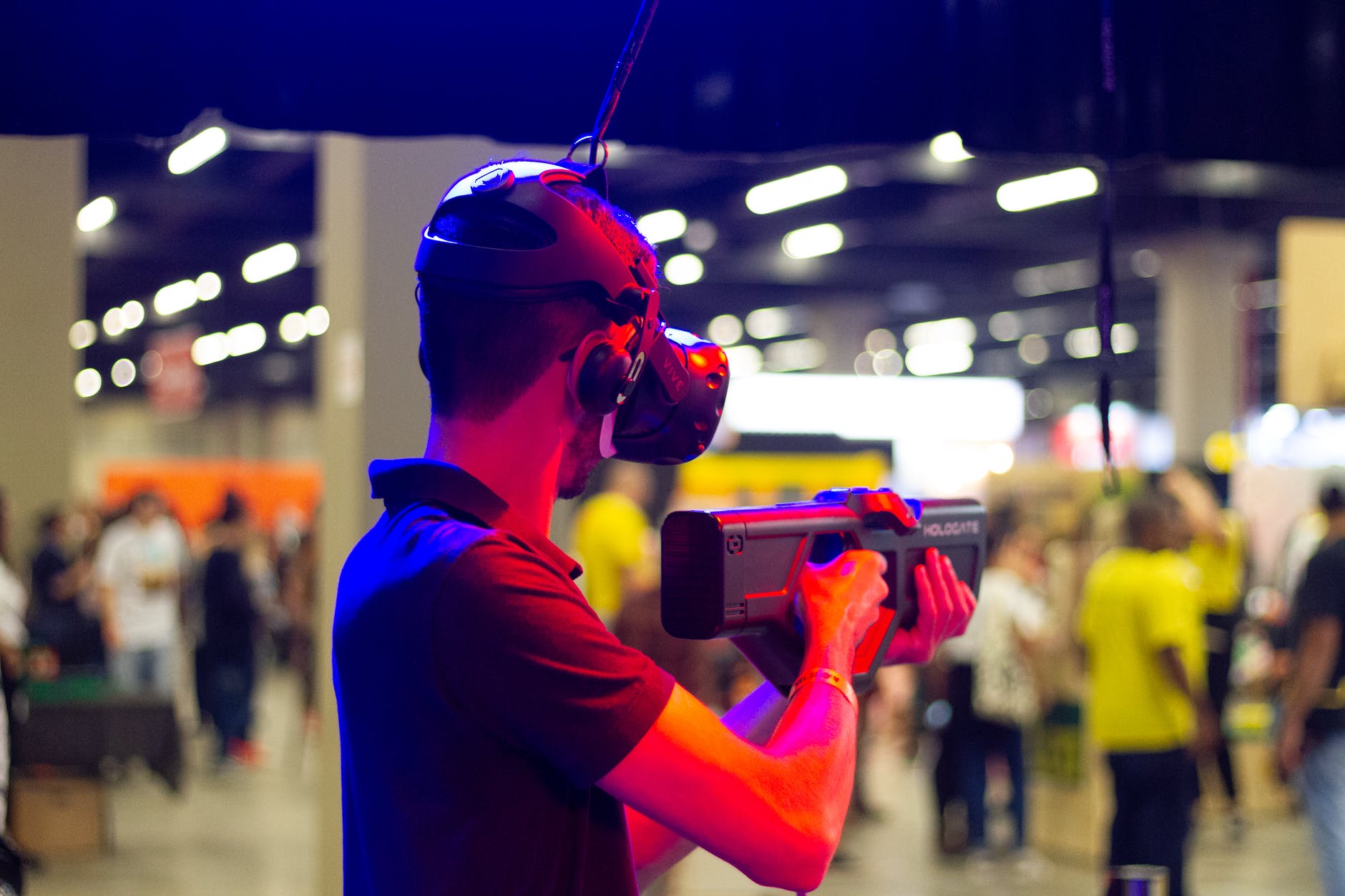
There are 10 stages of technology development that a civilization would have to go through to create a hyper realistic simulation. We’re at about stage five, which is around virtual reality and augmented reality. Stage six is about learning to render these things without us having to put on glasses, and the fact that 3D printers now can print 3D pixels of objects shows us that most objects can be broken down as information.

But the really difficult part — and this is something not a lot of technologists have talked about — is in The Matrix, the reason they thought they were fully immersed was they had this cord going into the cerebral cortex, and that’s where the signal was beamed. This brain-computer interface is the area that we haven’t yet made that much progress in, but we are making progress in it. It’s in the early stages.

So my guess is within a few decades to 100 years from now, we will reach the simulation point.

Applications of Artificial Intelligence-I

What is AI?

Artificial Intelligence is the intelligence exhibited by machines based on the premise that intelligence is not ‘real’ or human’. It mimics cognitive functions exhibited by humans such as learning and problem-solving.

Artificial intelligence based on Natural intelligence

What is the scope of AI?

Jobs related to AI will increase exponentially in the coming days. It helps to find smart solutions to the problems in various fields in medicine, agriculture, education, security, and so on.

Three stages of Artificial Intelligence. We are near to the second stage.

Applications of AI

  • Machine Learning includes Deep Learning- Neural network
  • Vision includes Image & pattern recognition- Facial recognition
  • Hearing includes Voice and speech recognition
  • Natural Language Processing(NLP) includes Natural Language Understanding(NLU)- Natural Language Generation(NLG)
  • Robotics
  • Expert Systems

We are currently using the following AI-based applications:

  1. Image recognition: Recognizes objects, places, people, and actions in an image.
  2. Speech recognition: Allows humans to use their voices to communicate with the software.
  3. Language translation: Translates a word or sentence from one language to another. Ensure that the translated word is culturally and linguistically correct.
  4. Product analysis: Enables companies to leverage data to reveal user engagement with products or services and tracks the activities, likes, and dislikes of the user.
  5. A/B testing: Determines the version of a webpage and compares two versions and delivers better performance.
  6. Sentiment analysis: Analyze a piece of text to determine the writer’s attitude. It can be categorized as positive, negative, or neutral.

Let’s see few examples of Artificial Intelligence

  1. SIRI: Siri is a popular personal assistant offered by Apple which uses Machine Learning and Voice recognition.
  2. COGITO: It improves the intelligence of customer services by analyzing the human voice emotion and provides real-time guidance.
  3. NETFLIX: Uses predictive technology and provides the user with movie recommendations based on the user’s likes.

Use of Artificial Intelligence in society

“AI is a huge benefit to the society as it enhances the efficiency and throughput while creating new opportunities for revenue generation, cost savings, and job creation.”

-Anand Sampat(Datmo)

‘Robots and AI will destroy jobs’ is nothing but fiction and not fact. But instead, AI creates job opportunities in the market.

“The unparallel combination of human and machine will become the new normal in the workforce of the future”

– Matthew Lieberman

The presence of Artificial intelligence enhances our lifestyles and creates efficient businesses.

“Machine allows humans to do the most interpersonal and creative aspects of work”

 -Chalmers Brown(Due company)

AI platforms will provide real-time insights combined with the explosion of computer power.

“Smart homes will reduce energy usage and provide better security for humans. Marketing will be more targeted and health care will become more effective with smart devices”.

 – Naresh Soni

Start-ups using Artificial Intelligence 

  1. NEST: Alphabet Nest uses AI to learn a home owner’s habit resulting in a reduction of energy consumption. It adjusts the house temperature according to the weather hence energy consumption can be controlled.
  2. COMFY: Comfy offers services for reducing energy consumption in office buildings.
  3. PG&E: Pacific gas and electric company(PG&E) connected 200,000 solar customers, accounting for one in every four houses with solar rooftops.

AI benefits multiple Industries and society will be benefitted from the use of facial recognition, digital content analysis, accuracy in identifying patterns.

“AI risks are real if we don’t understand the quality of the incoming data and set AI rules which are making granular trade-off decisions at increasing computing speeds”

-Mark Butler

Facial recognition: Facial recognition is a biometric technology used to identify human faces and can be used for security purposes. 

Example: Snapchat

Snapchat differentiates between images of objects, pets, sports, and food. It suggests relevant borders and stickers. Identifies your location and suggests location-based filters.

Snapchat filters use Machine Learning and image classification techniques called Convolution Neural Networks(CNN).

How AI will shape our future

Artificial intelligence has had a huge impact on many industries in recent years and will continue to benefit them in the future. The pandemic-induced acceleration of technology adoption has led many sectors, both private and public to leverage AI for their advantage and growth. In the last few years, AI has enabled many innovations and driven the proliferation of technologies like IoT, robotics, analytics, and voice assistants. According to a report, AI topped the patent filings in 2020. This is not new, AI has been securing a large number of patents in the last few years.

Impact of AI

Artificial Intelligence has had huge impacts in the healthcare sector, especially since the pandemic last year. AI and other disruptive technologies powered a patient-centered healthcare system. This new care scenario is all digital and highlights the importance of data and analytics. Predictive analytics, machine learning, and AI played a pivotal role in drug discovery and vaccine development. In the coming years, the use of these advanced technologies will become the norm, and easily accessible electronic medical records will simplify diagnostics. AI will enable healthcare systems to track and monitor patients in real-time, gain genetic data, and each person’s lifestyle. Algorithms will take up the charge of diagnosing health conditions and prescribing suitable treatments.AI has a lot to offer to the transportation and manufacturing sectors. In the coming years, we might witness the perfect evolution and commercialization of smart and autonomous vehicles. Self-driving cars are already available today, but by the next two to three decades, the world will witness more people using them. The manufacturing sector will also gain benefits from AI. Increased use of robots in factories and predictive analytics in the sector will enhance the quality of products and streamline the logistics and supply chain. Other potential impacts of AI would be in elder care systems, education, finance and business,  customer services, media, space exploration, smart cities, and smart homes.

Will AI Dismantle the Human Workforce?

his fear has always been looming on artificial intelligence. Experts and tech giants like Elon Musk and Stephen Hawkings have warned humans against the adverse consequences and threats of the technology. One of the widely claimed consequences is AI taking over the human workforce and causing massive job losses. This claim is highly overblown and researchers agree that although AI might displace humans from some job roles, it will not replace the whole workforce. AI is likely to replace routine jobs and repetitive tasks like picking and packaging goods, separating and segregating materials, responding to repetitive customer queries, etc. Even today some of these functions are still done by humans and AI will take over these tasks in the future. Thus, the human workforce engaged in these simple and routine jobs should be upskilled and trained to perform new skills. As we are very far from reaching artificial general intelligence, the current technology cannot augment human intelligence fully. This is the reason people should be trained to do high-skilled tasks like programming, coding, and others that are essential for the future. The transition from the old to the new job should be smoothened to reduce the massive impacts.

Should we fear Apocalypse?

Recently, a paper published by researchers at AMOLF’s Soft Robotic Matter group, exhibited how self-learning robots can easily adapt to changing circumstances. These small robotic units were connected to each other for them to learn on their own to move. The future will harness the hidden capabilities of AI and encourage the creation of self-learning robots. Reinforcement learning and training algorithms based on Generative Adversarial Networks will be explored. AI will also prove a flagbearer for sustainable technologies and will be used against fighting climate change by reducing pollution levels and encouraging green AI research. Another threat posed by AI is the violation of human rights by impacting privacy. For example, voice assistants like Alexa and technologies like facial recognition have been blamed for invading the privacy of humans and probably eavesdropping into their lives. These technologies are feared to be used by the powerful state and federal authorities against specific minorities and will curtail the freedom of speech and expression. Thus, AI needs to evolve much to move ahead of these criticisms and enable an ethical and trustworthy system in the future.

Hence, AI as such might not become a threat to human existence. However, there are chances that humans might misuse the capabilities of the technology for causing harm. The scenario of war robots being used to feed harmful motives through their algorithms can be an example. Therefore, in the years ahead, it is necessary to develop an ethical AI ecosystem without human biases and this might alleviate the potential risks of AI in the future.

ARTIFICIAL INTELLIGENCE:

Artificial Intelligence refers to the intelligence of machines. This is in contrast to the natural intelligence of humans and animals. With Artificial Intelligence, machines perform functions such as learning, planning, reasoning and problem-solving. Most noteworthy, Artificial Intelligence is the simulation of human intelligence by machines. It is probably the fastest-growing development in the World of technology and innovation. Furthermore, many experts believe AI could solve major challenges and crisis situations.

Types of Artificial Intelligence:

First of all, the categorization of Artificial Intelligence is into four types. Arend Hintze came up with this categorization. The categories are as follows:

Type 1: Reactive machines – These machines can react to situations. A famous example can be Deep Blue, the IBM chess program. Most noteworthy, the chess program won against Garry Kasparov, the popular chess legend. Furthermore, such machines lack memory. These machines certainly cannot use past experiences to inform future ones. It analyses all possible alternatives and chooses the best one.

Type 2: Limited memory – These AI systems are capable of using past experiences to inform future ones. A good example can be self-driving cars. Such cars have decision making systems. The car makes actions like changing lanes. Most noteworthy, these actions come from observations. There is no permanent storage of these observations.

Type 3: Theory of mind – This refers to understand others. Above all, this means to understand that others have their beliefs, intentions, desires, and opinions. However, this type of AI does not exist yet.

Type 4: Self-awareness – This is the highest and most sophisticated level of Artificial Intelligence. Such systems have a sense of self. Furthermore, they have awareness, consciousness, and emotions. Obviously, such type of technology does not yet exist. This technology would certainly be a revolution.

Applications of Artificial Intelligence:

First of all, AI has significant use in healthcare. Companies are trying to develop technologies for quick diagnosis. Artificial Intelligence would efficiently operate on patients without human supervision. Such technological surgeries are already taking place. Another excellent healthcare technology is IBM Watson.Artificial Intelligence in business would significantly save time and effort. There is an application of robotic automation to human business tasks. Furthermore, Machine learning algorithms help in better serving customers. Chatbots provide immediate response and service to customers.

AI can certainly make education more efficient. AI technology can discover the needs of students. Then it can adapt according to their needs. AI tutors provide study help to students. Also, AI can automate grading which results in saving a lot of time.AI can greatly increase the rate of work in manufacturing. Manufacture of a huge number of products can take place with AI. Furthermore, the entire production process can take place without human intervention. Hence, a lot of time and effort is saved.Artificial Intelligence has applications in various other fields.

These fields can be military, law, video games, government, finance, automotive, audit, art, etc. Hence, it’s clear that AI has a massive amount of different applications.To sum it up, Artificial Intelligence looks all set to be the future of the World. Experts believe AI would certainly become a part and parcel of human life soon. AI would completely change the way we view our World. With Artificial Intelligence, the future seems intriguing and exciting.

Virtual Assistants have also started understanding Hindi

Virtual Interaction means Artificial Intelligence is gradually strengthening its place in our lives, whether you realize it or not. It is not only affecting our working practices but also changing them- whether we work in Hindi or English. A great example of this is the change in the way computers, mobiles and other digital devices interact. Traditionally, we used to rely on a keyboard, mouse and monitor or screen to make input and to know output in these devices. This method of communication and conversation has changed with the advent of Artificial Intelligence. An interesting change has come in our interaction with virtual assistants, for whom Hindi is no longer unknown at all. Today, the world of computers and mobiles is dominated by four virtual assistants. These are Amazon’s  Alexa, Google’s Google Assistant, Microsoft’s Cortana and Apple’s Siri. The first three of these virtual assistants have been introduced to Hindi in some way, while Hindi has been used with Apple’s Siri and it is expected that this relationship will soon be seen as a reality beyond experiments.

Google Assistant: Google Assistant is now able to execute dozens of instructions in Hindi and can go much further than searching the Internet or answering questions. For example, it also has the ability to access many other Google applications. You can do it with text as well as for instructions through sound. If you have converted it into a smart home using the Internet of Things in your home, then it can control many things in the house. If Google Assistant is not present in your smartphone, then download it from Play Store. After installing you have to make two settings. First, activate voice input in Hindi on your Android phone and second, go to Settings and add Hindi in search language as well. Google Assistant is not only available in Android smartphones, but it works in many devices controlled by Android.

Cortana:  Microsoft’s Cortana also helps you as an application. It is available in Windows 10. It is also able to access your computer like other virtual assistants. Able to open applications, software etc. within it. It can also do typing for you and do an internet search and all kinds of calculations. Although Hindi support in Cortona is limited, it does have the ability to translate, write, and speak Hindi.

Amazon’s Alexa: Alexa is a hardware tool capable of communicating in Hindi that comes in two forms. The first smart speaker is the Amazon Echo and the second is the combined Echo Show with a display screen. The way the user communicates with both is the same. You give him some spoken instructions and Alexa follows up what you said. It can fetch you anything from the Internet, you can listen to the news and music on your request. For video calling also you can use its display version.