A black hole is not really an empty hole or space. Black holes are points in space that are so dense they create deep gravity sinks.
It is formed by a death of a massive star. A black hole takes up zero space but does have mass, that used to be a star. And black holes get more massive as they consume matter near them.
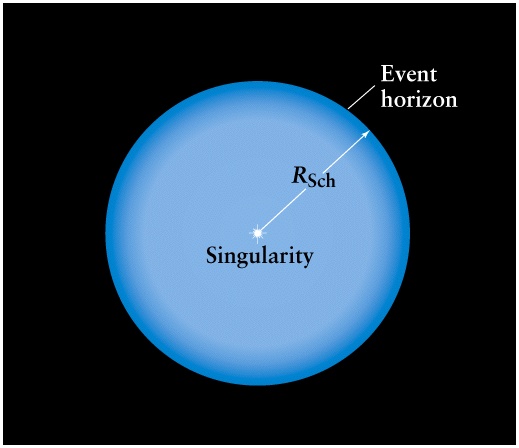
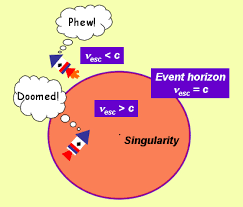
There’s a boundary at the edge of a black hole called the event horizon, which is the point of no return — any light or matter that crosses that boundary is sucked into the black hole. It would need to travel faster than the speed of light to escape, which is impossible.
Event Horizon and Singularity
When a massive star (more than 8 times bigger than Sun) runs out of nuclear fuel in its core hen it’s gravity causes the core to collapse upon itself. This huge weight of its constituent matter falling in compresses the dying star to a point of zero volume and infinite density– called the singularity.
A black hole cannot be observed but only detected by the effects of its enormous gravitational fields on nearby matter.
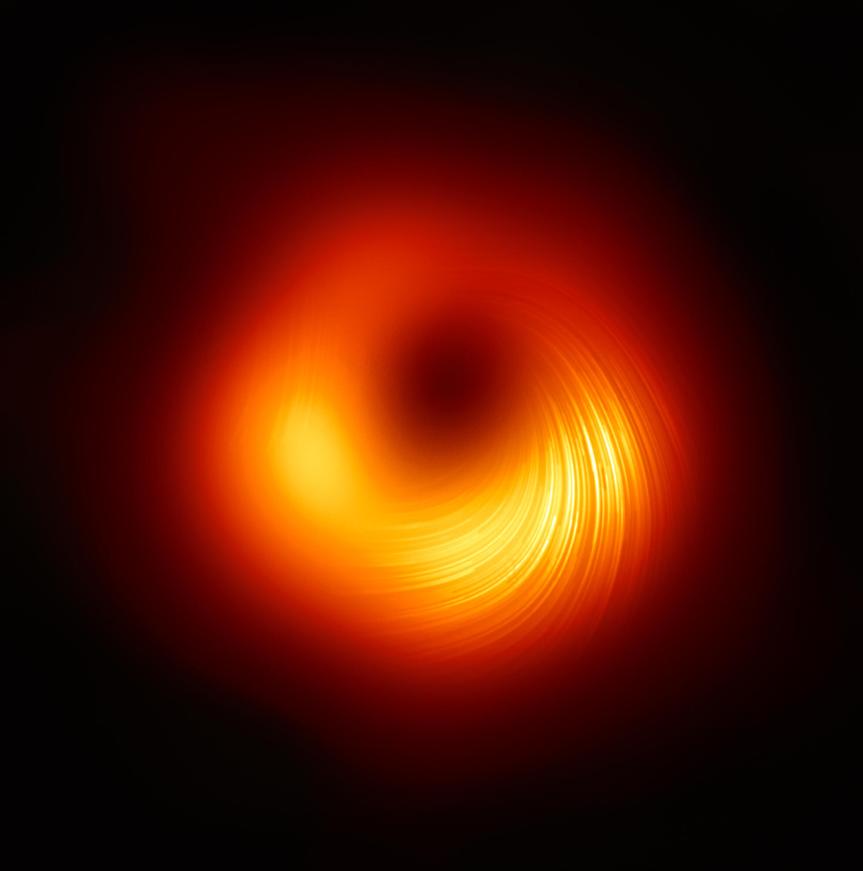
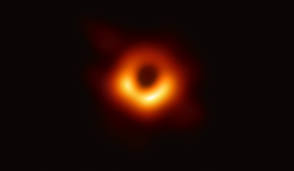
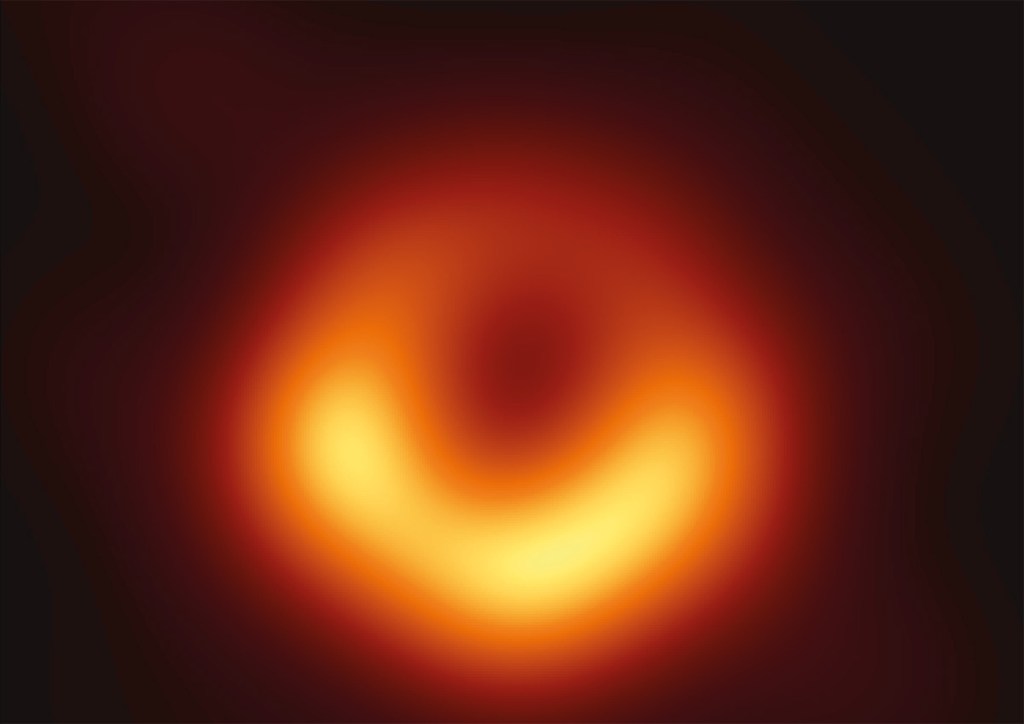
In April 2019, the scientists at the Event Horizon Telescope project released the first-ever image of a black hole.
Supermassive black holes are found at the centre of most galaxies, including our own Milky Way. The one in our galaxy is called Sagittarius A*.
Interesting Facts-
If our Sun were suddenly replaced by a black hole with Mass equal to that of sun, the orbits of the planets wouldn’t change.
If you travelled close to the black hole, you could escape, as long as you don’t enter the event horizon.
If you entered the black hole, you could still see everything outside, since light can enter a black hole.
You wouldn’t notice anything special about the event horizon, since it isn’t a solid surface.
Once you enter the event horizon, you will pulled into the singularity.
When a massive star dies, it leaves a small but dense remnant core in its wake. If the mass of the core is more than 3 times the mass of the sun, the force of gravity overwhelms all other forces and a black hole is formed. Imagine the size of a star is 10times more massive than our sun being squeezed into a sphere with a diameter equal to the size of New York City. The result is a celestial object whose gravitational field is so strong that nothing, not even light can escape it. The history of black holes was started with the father of all physics, Isaac Newton. In 1687, Newton gave the first description of gravity in his publication, Principia mathematica, that would change the world. Then 100 years later, John Michelle proposed the idea that there could exist a structure that would be massive enough and not even light would be able to escape its gravitational pull. In 1796, the famous French scientist Pierre-Simon Laplace made an important prediction about the nature of black holes. He suggested that because even the speed of light was slower than the escape velocity of black hole, the massive objects would be invisible. In 1915, Albert Einstein changed physics forever by publishing his theory of general relativity. In this theory, he explained space time curvature and gave a mathematical description of a black hole. And in 1964, john wheeler gave these objects the name, the black hole.
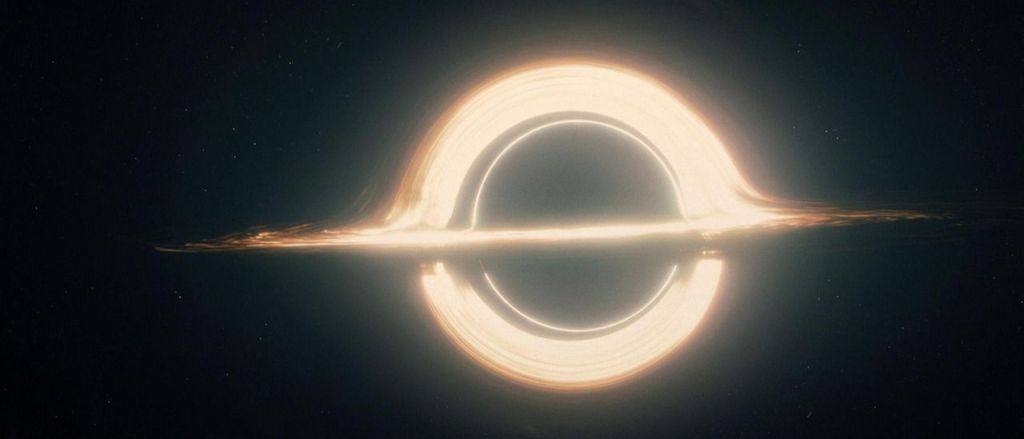
The “Interstellar” black hole was created using a new CGI rendering software that was based on theoretical equations provided by Thorne.
In classical physics, the mass of a black hole cannot decrease; it can either stay the same or get larger, because nothing can escape a black hole. If mass and energy are added to a black hole, then its radius and surface area also should get bigger. For a black hole, the radius is called the Schwarzschild radius. The second law of thermodynamics states that, an entropy of a closed system is always increases or remains the same. In 1974, Stephen hawking– an English theoretical physicists and cosmologist, proposed a groundbreaking theory regarding a special kind of radiation, which later became known as hawking radiation. So hawking postulated an analogous theorem for black holes called the second law of black hole mechanics that in any natural process, the surface area of the event horizon of a black hole always increase, or remains constant. It never decreases. In thermodynamics, black bodies doesn’t transmit or reflect any radiation, it only absorbs radiation.
When Stephen hawking saw these ideas, he found the idea of shining black holes to be preposterous. But when he applied the laws of quantum mechanics to general relativity, he found the opposite to be true. He realized that stuff can come out near the event horizon. In 1974, he published a paper where outlined a mechanism for this shine. This is based on the Heisenberg uncertainty Principe. According to the principle of quantum mechanisms, for every particle throughout the universe, there exists an antiparticle. These particles always exist in pairs, and continually pop in and out of existence everywhere in the universe. Typically, these particles don’t last long because as soon as possible and its antiparticle pop into existence, they annihilate each other and cease to exist almost immediately after their creation.
In 2019, the Event Horizon Telescope (EHT) collaboration produced the first-ever image of a black hole
In the event horizon that the point which nothing can escape its gravity. If a virtual particle pair blip into existence very close to the event horizon of a black hole, one of the particles could fall into the black hole while the other escapes. The one that falls into the black hole effectively has negative energy, which is, in Layman’s terms, akin to subtracting energy from the black hole, or taking mass away from the black hole. The other particle of the pair that escapes the black hole has positive energy, and is referred to as hawking radiation. Due to the presence of hawking radiation, a black hole continues to loss mass and continues shrinking until the point where it loses all its mass and evaporates. It is not clearly established what an evaporating black hole would actually look like. The hawking radiation itself would contain highly energetic particles, antiparticles and gamma rays. Such radiation is invisible to the naked eye, so an evaporating black hole might not look like anything at all. It also possible that hawking radiation might power a hadronic fireball, which could degrade the radiation into gamma rays and particles of less extreme energy, which would make an evaporating black hoe visible. Scientists and cosmologists still don’t completely understand how quantum mechanics explains gravity, but hawking radiation continues to inspire research and provide clues into the nature of gravity and how it relates to other forces of nature.
When a massive star dies, it leaves a small but dense remnant core in its wake. If the mass of the core is more than 3 times the mass of the sun, the force of gravity overwhelms all other forces and a black hole is formed. Imagine the size of a star is 10 times more massive than our sun being squeezed into a sphere with a diameter equal to the size of New York City. The result is a celestial object whose gravitational field is so strong that nothing, not even light can escape it. The history of black holes was started with the father of all physics, Isaac Newton. In 1687, Newton gave the first description of gravity in his publication, Principia mathematica, that would change the world.
Then 100 years later, John Michelle proposed the idea that there could exist a structure that would be massive enough and not even light would be able to escape its gravitational pull. In 1796, the famous French scientist Pierre-Simon Laplace made an important prediction about the nature of black holes. He suggested that because even the speed of light was slower than the escape velocity of black hole, the massive objects would be invisible. In 1915, Albert Einstein changed physics forever by publishing his theory of general relativity. In this theory, he explained space time curvature and gave a mathematical description of a black hole. And in 1964, john wheeler gave these objects the name, the black hole.
The Gargantua in Interstellar is an incredibly close representation of an actual black hole
In classical physics, the mass of a black hole cannot decrease; it can either stay the same or get larger, because nothing can escape a black hole. If mass and energy are added to a black hole, then its radius and surface area also should get bigger. For a black hole, the radius is called the Schwarzschild radius. The second law of thermodynamics states that, an entropy of a closed system is always increases or remains the same. In 1974, Stephen hawking– an English theoretical physicists and cosmologist, proposed a groundbreaking theory regarding a special kind of radiation, which later became known as hawking radiation. So hawking postulated an analogous theorem for black holes called the second law of black hole mechanics that in any natural process, the surface area of the event horizon of a black hole always increase, or remains constant. It never decreases. In thermodynamics, black bodies doesn’t transmit or reflect any radiation, it only absorbs radiation.
When Stephen hawking saw these ideas, he found the idea of shining black holes to be preposterous. But when he applied the laws of quantum mechanics to general relativity, he found the opposite to be true. He realized that stuff can come out near the event horizon. In 1974, he published a paper where outlined a mechanism for this shine. This is based on the Heisenberg uncertainty Principe. According to the principle of quantum mechanisms, for every particle throughout the universe, there exists an antiparticle. These particles always exist in pairs, and continually pop in and out of existence everywhere in the universe. Typically, these particles don’t last long because as soon as possible and its antiparticle pop into existence, they annihilate each other and cease to exist almost immediately after their creation.
In the event horizon that the point which nothing can escape its gravity. If a virtual particle pair blip into existence very close to the event horizon of a black hole, one of the particles could fall into the black hole while the other escapes. The one that falls into the black hole effectively has negative energy, which is, in Layman’s terms, akin to subtracting energy from the black hole, or taking mass away from the black hole. The other particle of the pair that escapes the black hole has positive energy, and is referred to as hawking radiation.
The first-ever image of a black hole by the Event Horizon Telescope (EHT), 2019
Due to the presence of hawking radiation, a black hole continues to loss mass and continues shrinking until the point where it loses all its mass and evaporates. It is not clearly established what an evaporating black hole would actually look like. The hawking radiation itself would contain highly energetic particles, antiparticles and gamma rays. Such radiation is invisible to the naked eye, so an evaporating black hole might not look like anything at all. It also possible that hawking radiation might power a hadronic fireball, which could degrade the radiation into gamma rays and particles of less extreme energy, which would make an evaporating black hoe visible. Scientists and cosmologists still don’t completely understand how quantum mechanics explains gravity, but hawking radiation continues to inspire research and provide clues into the nature of gravity and how it relates to other forces of nature.
A black hole is a region of spacetime where gravity is so strong that nothing—no particles or even electromagnetic radiation such as light—can escape from it. The theory of general relativity predicts that a sufficiently compact mass can deform spacetime to form a black hole. The boundary of no escape is called the event horizon. Although it has an enormous effect on the fate and circumstances of an object crossing it, according to general relativity it has no locally detectable features. In many ways, a black hole acts like an ideal black body, as it reflects no light. Moreover, quantum field theory in curved spacetime predicts that event horizons emit Hawking radiation, with the same spectrum as a black body of a temperature inversely proportional to its mass. This temperature is on the order of billionths of a kelvin for black holes of stellar mass, making it essentially impossible to observe directly.
Objects whose gravitational fields are too strong for light to escape were first considered in the 18th century by John Michell and Pierre-Simon Laplace. The first modern solution of general relativity that would characterize a black hole was found by Karl Schwarzschild in 1916, and its interpretation as a region of space from which nothing can escape was first published by David Finkelstein in 1958. Black holes were long considered a mathematical curiosity; it was not until the 1960s that theoretical work showed they were a generic prediction of general relativity. The discovery of neutron stars by Jocelyn Bell Burnell in 1967 sparked interest in gravitationally collapsed compact objects as a possible astrophysical reality. The first black hole known as such was Cygnus X-1, identified by several researchers independently in 1971. Black holes of stellar mass form when very massive stars collapse at the end of their life cycle. After a black hole has formed, it can continue to grow by absorbing mass from its surroundings. By absorbing other stars and merging with other black holes, supermassive black holes of millions of solar masses may form. There is consensus that supermassive black holes exist in the centers of most galaxies.
The presence of a black hole can be inferred through its interaction with other matter and with electromagnetic radiation such as visible light. Matter that falls onto a black hole can form an external accretion disk heated by friction, forming quasars, some of the brightest objects in the universe. Stars passing too close to a supermassive black hole can be shred into streamers that shine very brightly before being “swallowed.” If there are other stars orbiting a black hole, their orbits can be used to determine the black hole’s mass and location. Such observations can be used to exclude possible alternatives such as neutron stars. In this way, astronomers have identified numerous stellar black hole candidates in binary systems, and established that the radio source known as Sagittarius A*, at the core of the Milky Way galaxy, contains a supermassive black hole of about 4.3 million solar masses.
A black hole is a region of spacetime where gravity is so strong that no particle, even light cannot escape from it. Einstein’s general theory of relativity predicts that a sufficient compact mass can create a black hole anywhere in spacetime. The point from which nothing can escape is called as event horizon. This gigantic space monster is formed from a dying star. The gravitational pull is so strong because everything is compressed into tiny space.
Formation of Black Holes
Scientists believe that the smallest black hole was formed when the universe was created. Stellar or huge black holes are formed when the core of a huge star falls upon itself or collapses. When this happens, it creates a supernova. Supernova is an exploding star which blasts its outer part into the space. When a star has exhausted the thermal nuclear fuel in its core, it becomes highly unstable and gravitationally collapses upon itself.
The crushing weight of matter falling upon the star from all sides compresses the star to a point of no volume and infinite density. This point is called as the singularity. Singularity is the center of the black hole which is hidden by its surface which is the event horizon. The event horizon is the farthest place a particle can go while travelling towards the black hole. After that, there is the point of no return. This is because the escape velocity, the velocity needed to escape from the gravitational pull of a cosmic object, of a black hole is more than the speed of light.
Discovery of Black Holes
The first black hole ever discovered was Cygnus X-1, located within the Milky Way in the constellation of Cygnus. Astronomers saw the first signs of the black hole in 1964 via the gas it sucked away from a closely orbiting blue supergiant star. As this gas spiraled into the black hole, it became so hot it emitted high-energy X-rays and gamma-rays that satellites could detect. This black hole is about 7,240 light years away from Earth
Scientists detected that there is a supermassive black hole in the center of our galaxy, Milky Way. The black hole, Sagittarius A* is a massive black hole whose mass is equivalent to 4 million suns. In 2017 it was detected that every galaxy consists a super massive black hole in its center. As black holes are invisible, it is detected using special telescopes to study the things happening around the black hole. The Event Horizon telescope is used designed specially to detect black holes around the universe.
First Images of a Black Hole
The first direct visual evidence of a black hole has been revealed on 10 April 2019 by astronomers working on the Event Horizon Telescope. The image is of the supermassive black hole that lies at the center of the huge Messier 87 galaxy, in the Virgo galaxy cluster. Located 55 million light-years from Earth, the black hole has been determined to have a mass 6.5 billion times that of the Sun.
Though black holes are not visible, scientists and researchers managed to capture the boundary – the event horizon of the black hole. The size of the image of the black hole is almost equal to the size of the selfies taken by 10,000 people in their life time. This is considered as a huge achievement as this is the first time an image as clear as this has been captured.
Discipline is very important in everyone’s life. It is so important to be disciplined in the life. Discipline is not acquired from a single day. It is a achieved by a continued process.parents are the important in every individual’s life. The are the main reason for the discipline of their children.
After the parents, teacher is the most important person in an individual’s life. Teacher is the one who moulds the individual from the initial stage of the life and makes the individual into and perfect one. Even though the teacher schools or beats sometimes it is all for the well-being of the student and for the bright future of the student.
The first teacher in everyone’s life is their mother. Beginning with the correct thing the first mistake of the child, mother plays a very important role in correcting many of the mistakes in an individual’s life. Also the father who corrects the mistakes and puts the children in a correct way. And the teacher, who is very important in our students life to achieve their desired goals.
Teachers play a very important role in making the student perfect and make them to understand the need of the situation. Teachers help the students to reach their desired goals and in any situation teacher motivates a student to get up and stand in all the ups and downs. Like that of the mother and the father, the teacher also feels equally happy when their student acheives high in their life and when they reach their desired goals.
IMPORTANCE OF DISCIPLINE IN LIFE :
TIME MANAGEMENT :
A disciplined person always has the time to complete all the tasks within given deadlines. This is because they are focused and they know how to schedule the time properly. They dont’t believe in wasting time on unnecessary things. They understand the value of time and they know that time once has gone never comes back.
LEADERSHIP :
All great leaders are not born. Most of them follow a very tight schedule and maintain discipline in their life to become good leaders. Good discipline generates a positive attitude towards society. It creates confidence and eagerness to do something great. It helps people to build an attitude that becomes the key to becoming successful. They are able to set a great examples for others in society.
DECISION MAKING :
It is because everything gets finished within the given deadlines, disciplined people always have time to revise their work and improve their decisions. People who are disciplined are more focused both mentally and physically. They are better able to gain their body and mind with their ideas and goals. Finally, everything is regulated in order and increases their productivity in all the activites they undergo.
ACHIEVEMENTS :
Disciplined people are more motivated and concentrated. Therefore, they achieve more when compared to a person who is not disciplinef with the activites he/she undertakes. As per study, 92% of people are able to achieve their goals in life because of the reason of being disciplined.
STABILITY AND STRUCTURE :
With discipline, comes stability in all the tasks. It helps to schedule and organize the activites and tasks in a proper structure. If a person is focused and regularly follows this particular structure, he/she is sure to succeed in their life.
RESPONSIBILITY AND CONTROL :
With great discipline comes great responsibility. Only by making schedules and timetables a person cannot become successful. It is very important regularly follow and fulfill the responsibilites which are mentioned in the schedule. This will help them to develop self- control and also build good relations with others.
RESPECT :
A disciplined person always respected by society. He/she is lookef upon as role models and mentors. Through discipline, they worked hard and achieved their goals which made them a respectful figure in the eyes of others.
IMPROVES MENTAL HEALTH :
Modern society suffers alot from anxiety and depression. We cannot blame them for their condition. Just by maintaining a little discipline in their life, they can easily improve it. Discipline will help them to reduces stress and take control of their tasks. They would be able to overcome their fears and also control their emotions.
MAINTAIN PEACE IN SOCIETY :
Disciplined people are lie assets to society. If there is no law and order, there would bee too many activites. Discipline is required to prevent such things in society. By setting the requiref rules and regulationa, it becomes easier to live in a society that is full of peace and harmony.
STAY ACTIVE :
Disciplined people have time to do every activity in the schedule. They plan their schedule in such a way that improves both their academic/ instituational performance and also their physical health. They know what is good and bad for them and thereby have good eating habits, exercising habits, sleeping and waking up paterns, etc.
SELF DISCIPLINE self discipline means self control, the ability to avoid unhealthy excess of anything that could lead to negative consequenes.
• It is the ability to reject instant grafication and pleasure, in favor of some great grain, which requires spending effort and time to get it. • It means perservetance and not giving up. • It is the strength not to give in to negative feelings. • It means overcoming one’s weakness. • It is the ability to pursue one plan despite temptations to abandom them. • Delayed gratification in favour of accomplishing long term goals. Discipline is very important. It helps people to showcase their attitude and represent their character and thinking. Both the body and mind are honed by discipline. Descipline helps to address individual problems and develop a society that is both peaceful and respectful. Therefore, it would be right to say that without disciplinr there is no life at all.
Health education is a profession of educating people about health. Areas within this profession encompass environmental health, physical health, social health, emotional health, intellectual health, and spiritual health, as well as sexual and reproductive health education.
Health education teaches about physical, mental, emotional and social health. It motivates students to improve and maintain their health, prevent disease, and reduce risky behaviours. It also focuses on emotional, mental and social health too. Educating students on the importance of health builds their motivation.
Health education is one strategy for implementing health promotion and disease prevention programs. Health education provides learning experiences on health topics. Health education strategies are tailored for their target population. Health education presents information to target populations on particular health topics, including the health benefits/threats they face, and provides tools to build capacity and support behavior change in an appropriate setting.
History
From the late nineteenth to the mid-twentieth century, the aim of public health was controlling the harm from infectious diseases, which were largely under control by the 1950s. By the mid 1970s it was clear that reducing illness, death, and rising health care costs could best be achieved through a focus on health promotion and disease prevention. At the heart of the new approach was the role of a health educator.
Code of ethics
The Health Education Code of Ethics has been a work in progress since approximately 1976, begun by the Society for Public Health Education (SOPHE).
“The Code of Ethics that has evolved from this long and arduous process is not seen as a completed project. Rather, it is envisioned as a living document that will continue to evolve as the practice of Health Education changes to meet the challenges of the new millennium.”
Importance of Health Education .
Health education builds student’s knowledge, skills, and positive attitudes about health. Health education teaches about physical, mental, emotional and social health. It motivates students to improve and maintain their health, prevent disease, and reduce risky behaviours.
Health education curricula and instruction help students to learn skills so that they will use to make healthy choices throughout their lifetime.
Health education teaches people of all ages about how diet and exercise contribute to a healthy lifestyle. It also encourages positive changes in behaviour and lowers the risk of addiction to drugs, alcohol and unsafe sexual practices. The majority of schools around the country have courses aimed at teaching health education to students. These courses often revolve around the body, healthy eating, sex and exercising. Some students are taught basic health and physical fitness early on. More in-depth courses are designed for middle and high school students.
Health education encourages a person to make healthy choices. They are instructed to avoid unhealthy habits. ‘A sound mind lives in a sound body’. Rabindranath Tagore and C.V. Raman, if they were confined to sick bed, could not have won the Nobel Prize. In fact, a sickly student with all his talents and abilities lags behind in the race of life.
Health education also teaches about the emotional and mental health of the student. A healthy person is the happiest person in the world.
“Science has learned recently that contempt and indignation are addictive mental states. I mean physically and chemically addictive. Literally! People who are self-righteous a lot are apparently doping themselves rhythmically with auto-secreted surges of dopamine, endorphins and enkephalins. Didn’t you ever ask yourself why indignation feels so good?”
~ David Brin
Introduction
Doping in sport is a widespread problem not just among elite athletes, but even more so in recreational sports. In scientific literature, major emphasis is placed on doping detection, whereas detrimental effects of doping agents on athletes’ health are seldom discussed. Human growth hormone also increases muscle mass, although the majority of that is an increase in extracellular fluid and not the functional muscle mass.
The term doping is widely used by organizations that regulate sporting competitions. The use of drugs to enhance performance is considered unethical, and therefore prohibited, by most international sports organizations, including the International Olympic Committee.
History
According to the World Anti-Doping Agency (WADA), the term “doping” probably comes from the Dutch word “dop,” an alcoholic beverage made of grape skins that was used by Zulu warriors to make them stronger in battle.
Ancient Greek athletes used special diets and stimulating potions to improve performance, and 19th century endurance athletes indulged in strychnine, caffeine, cocaine and alcohol.
The American specialist in doping, Max M. Novich, wrote: “Trainers of the old school who supplied treatments which had cocaine as their base declared with assurance that a rider tired by a six-day race would get his second breath after absorbing these mixtures.”[8] John Hoberman, a professor at the University of Texas in Austin, Texas, said six-day races were “de facto experiments investigating the physiology of stress as well as the substances that might alleviate exhaustion.”
Effects of doping in sports
It builds muscle but causes abnormal growth, heart disease, diabetes, thyroid problems, hypertension, blood cancers and arthritis. Other adverse effects include joint pain, muscle weakness, visual disturbances, enlarged heart and diabetes.
Other side effects include:
Heart palpitations.Heart rhythm abnormalities.
Weight loss.
Tremors.
Mild high blood pressure (hypertension)
Hallucinations.
Stroke.
Heart attack and other circulatory problems.
Constipation.Skin rash or dermatitis.
Diarrhea.
Dizziness.
Drowsiness.
Dry mouth.
Headache.
Insomnia.
UFC ( Ultimate Fighting Championship ).
In December 2013, the UFC began a campaign to drug test their entire roster randomly all year-round. Random testing, however, became problematic for the promotion as it began to affect revenue, as fighters who had tested positive would need to be taken out of fights, which adversely affected fight cards, and therefore pay-per-view sales.
According to Steven Marrocco of MMAjunkie.com, about 31% of UFC fighters subjected to random testing since the program first started have failed due to using performance-enhancing drugs. That is approximately five failed tests for every sixteen random screenings.
From July 2015, the UFC has advocated to all commissions that every fighter be tested in competition for every card. Lorenzo Feritta, who at the time was one of the presidents of the UFC, said, “We want 100 percent of the fighters tested the night they compete”. Also, in addition to the drug testing protocols in place for competitors on fight night, the UFC conducts additional testing for main event fighters or any fighters that are due to compete in championship matches.
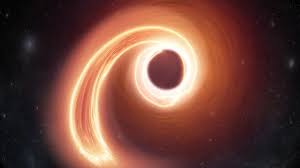
The awesome spectacle of a black hole ripping a star to shreds can be seen in this striking new visualization from the Deutsches Elektronen-Synchrotron (DESY), a particle accelerator lab in Hamburg, Germany.
Such events are known as stellar tidal disruptors, and they are fairly rare, occurring just once every 10,000 years in a typical galaxy, according to NASA. Stars are typically flung toward a ravenous black hole after interacting gravitationally with another star or massive object, only to become stretched and devoured should they come too close to the black hole’s maw in a process called spaghettification.
Gravitational tidal forces, similar to the ones that cause the moon to raise tides on Earth, are responsible for most of the destruction. At first, the star’s outer atmospheric layers will get pulled toward the black hole, spinning around its edge like water going down a drain and forming what’s known as an accretion disk, as the video depicts.
Surprisingly, the black hole only consumes about 1% of a star’s mass, according to NASA. The majority will actually get catapulted back out into space in the form of enormous jets of energy and matter that shoot from the black hole’s central region.
These jets can sometimes light up the cosmos, allowing astronomers on Earth to catch glimpses of distant black holes, which are otherwise mostly invisible. Tiny, ghostly particles called neutrinos will also be flung from the black hole, occasionally giving researchers insights into processes occurring during the consumption event.
Some of the star’s material does fall past the event horizon, the point after which nothing, including light, can escape. The visualization shows some of the strange optical effects that the event horizon produces, such as bending light so much that regions at the back of the accretion disk can be seen from its front.
Witnessing how swiftly the black hole dismembers and dispatches the star is an excellent reminder that no one should want to get anywhere near such a powerful object any time soon.
• An invisible, incredibly fast ripple in space- travel at the speed of light and squeeze and stretch anything in their path as they pass by.
• Albert Einstein’s prediction: When two bodies, such as planets or stars, orbit each other- could cause ripples in space.
• Most powerful gravitational waves are created when objects move at very high speeds.
• Events that could cause a gravitational wave are: When a star explodes; When two big stars orbit each other; When two black holes orbit each other and merge. • Sometimes, these events only cause small, weak gravitational waves- hard to detect.
• 2015: Scientists detected gravitational waves for the very first time- using LIGO. Happened when two black holes crashed into one another- happened almost 1.3 billion years ago.
• Made up of two observatories- one in Louisiana and one in Washington.
• Each observatory has two long “arms”: each more than 4 kilometres long.
• When a gravitational wave passes by Earth, it squeezes and stretches space- detected by LIGO.
• A passing gravitational wave causes the length of the arms to change slightly.
• Uses lasers, mirrors, and extremely sensitive instruments to detect these tiny changes.
IndIGO (Indian Initiative in Gravitational-wave Observations)
• An initiative to set up advanced experimental facilities, with appropriate theoretical and computational support, for a multi-institutional Indian national project in gravitational-wave astronomy.
• IndIGO plans on gravitational-wave astronomy related to the LIGO-India project. LIGO-India Project.
• A planned advanced gravitational-wave detector to be located in India. • To be built and operated in collaboration with the LIGO USA and its international partner Australia, Germany and the UK.
• Scheduled for completion in 2024- will be built in the Hingoli District of Maharashtra state in western India.






























 Eduindex
You must be logged in to post a comment.