Communication skills

Good communication is very important to convey what is there in the mind. Whatever language, communicating in a understandable way is very important. communication today is very important both in the business world and in private life.

Even though the person is good at skills and is capable of doing things better, lack of communication degrades the skills and brings a negative mark on the person which is a bad thing for the individual.

Top 5 communication skills and How to improve them

Developing strong communication skills is essential when it comes to building a successful careee. Communication skills play a key role in your private life too. These 5 skills are absolutely necessary for sucessful commuincation in the workplace or private life.

1. Listening :

Listening is one of the most important aspects of communication. Successful listening is not just and understanding of spoken or written information, but also an understanding of how the speaker feels during communication. If a speaker can see and feel that someone is listening and understanding that can help build a stronger, deeper realtionship between interlocutors.

Careful listening can also create an environment in which everyone feels safe to express ideas, opinions and feelings, or plan and solve problems in a creative way.

2. Straight talking :

Conversation is the basis of communication, and one must not neglect its importanc. Even a simple, friendly conversation with colleafues can build mutual trust and even detect problems before they become serious. A healthy does of chatting with and unknown person can lead to a business opportunity . Be accessible and friendly because then you will be able to talk to almost anymore.

3. Non- verbal communication :
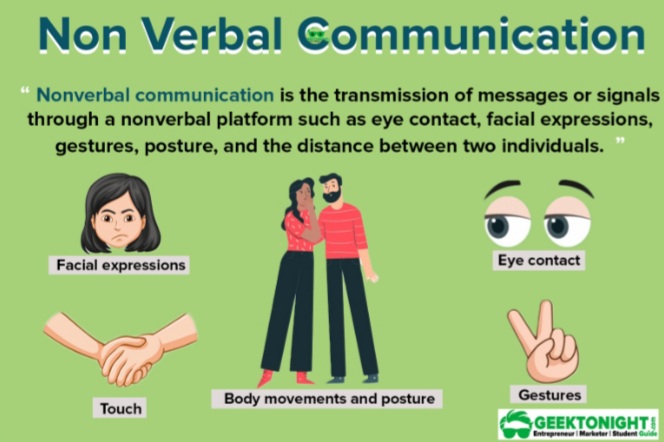
When we talk about things that matter to us then we send a lot of nonverbal messages. Non verbal signals are wordless communication, body position, facial experssion, hand movements, gestures, eye contact, attitude and tone of your voice, muscle tension and the way you breathe. The way you look, listen create, react, gesture , speaks far more about feelings than words will ever be able to.

4. Stress Management :

In small quantities, stress can be very useful and encouraging for work . However, when the stress becomes constant and completely begins to take effect, it can affect communication, clarity of opinion and appropriate behavior and action. When you are under stress you may misunderstand other people, send confusing nonverbal signals, and use funny patterns of behavior.

5. Emotion control :

In communication, feelings play an important role. Making decisions more often affects the way you feel than the way you think. Gudided by emotions, your nonverbal behavior affects the understanding of other people and how others understand and perceive you. Control of emotions provides you with tools to understand others, yourself and the messages you send. Though recognizing feelings makes it simple, many people have strong feeling like anger, sorrow, or fear being pushed under the carpet.

Importance of communication :
Communication thus helps understand people better removing misunderstanding and creating clarity of thoughts and expression. The communication brings people together, closer to each other. The communication is an important management function closely associated with all other managerial functions.

Everybody has their own way of communicating. It is influenced by cultural background, the way someone was raised, their gender, their temperament, and much more. At that point true communication may become utterly impossible. Sometimes we may have a difficult time understanding anothers feelings , needs and habits.

* communication serves four major functions with a group of organization :

* control

* Motivational

* Emotional expression

* Information

* communication serves five major purposes :

* to inform

* to express feelings

* to imagine

* to influence and

* to meet social expectations

For example:

For instance, if an individual is going to an interview with great confidence. An individual who is good at different kinds of skills, and also good at executing them and he is lack of communication skills. As the person is not a good communicator, the person faces difficulty in explaining the things to the other person which is known to him. Instantly, this brings a bad impression on the person and a negative mark will be marked on him. The negative mark has a lot to do with. The negative mark can also lead to the rejection of the person in the interview.

Being knowledgeable is very important to achieve certain goals in life, attaining good communication skills and being a good communicator is also equally important to achieve high in the life. Being a good communicator is not A big deal. It is so easy as the lifestyle. Any individual can be good communicator if he communicates all the time with other people in the possible way.


Acid Rain

“The unthinkable is that we’re distorting this atmospheric balance. We’re shifting the chemical balance so that we have more poisons in the atmosphere – ozones and acid rain on ground level – while we’re also changing the thermal climate of the earth through the greenhouse effect and – get this – simultaneously causing destruction of our primary filter of ultraviolet light. It’s incredible. Talk about the national-debt crisis – we’re piling up debts in the atmosphere, and the piper will want to be paid.”

~ Michael Oppenheimer

Introduction

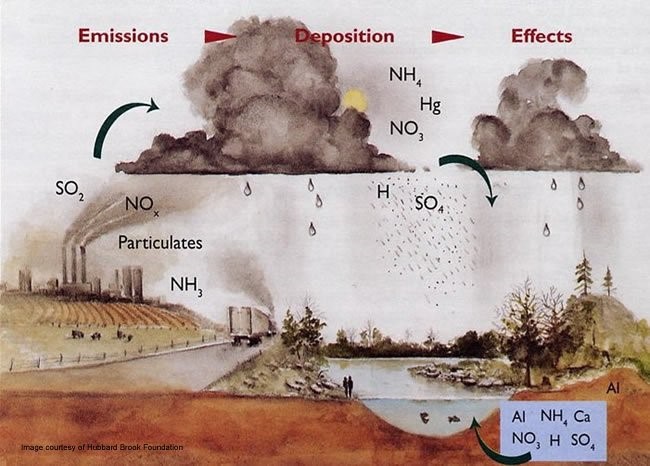
Acid rain, or acid deposition, is a broad term that includes any form of precipitation with acidic components, such as sulfuric or nitric acid that fall to the ground from the atmosphere in wet or dry forms. This can include rain, snow, fog, hail or even dust that is acidic.

Acid rain is caused by a chemical reaction that begins when compounds like sulfur dioxide and nitrogen oxides are released into the air. These substances can rise very high into the atmosphere, where they mix and react with water, oxygen, and other chemicals to form more acidic pollutants, known as acid rain.

It can have harmful effects on plants, aquatic animals, and infrastructure.

Effects of Acid Rain

The ecological effects of acid rain are most clearly seen in aquatic environments, such as streams, lakes, and marshes where it can be harmful to fish and other wildlife. As it flows through the soil, acidic rain water can leach aluminum from soil clay particles and then flow into streams and lakes.

Acid rain has been shown to have adverse impacts on forests, freshwaters, and soils, killing insect and aquatic life-forms, causing paint to peel, corrosion of steel structures such as bridges, and weathering of stone buildings and statues as well as having impacts on human health.

Acid rain also causes the corrosion of water pipes. Which further results in leaching of heavy metals such as iron, lead and copper into drinking water.

Prevention

1. The only precaution that we can take against acid rain is having a check at the emission of oxides of nitrogen and sulphur.
2. We have so far seen the details of acid rain and its harmful effect on animals, plants and the monuments.
3. Being responsible citizens, one should be aware of the harmful effects they cause and of the industries which give out nitrogen and sulphur compound wastes unethically. 4.A great way to reduce acid rain is to produce energy without using fossil fuels. Instead, people can use renewable energy sources, such as solar and wind power. Renewable energy sources help reduce acid rain because they produce much less pollution.

Acid Rain in India

Analysis of rainwater samples from Nagpur, Mohanbari (in Assam), Allahabad, Visakhapatnam and Kodaikanal in the decade 2001-2012 showed a pH level varying from 4.77 to 5.32, indicating that these places have actually been receiving ‘acid rain’. Rainwater with pH below 5.65 is considered acidic.

As energy requirements in India will grow rapidly in tune with the economy, coal dependence is expected to increase threefold over the current level of consumption, making the clouds of acid rain heavier over many highly sensitive areas in the country – the northeast, parts of Bihar, Orissa, West Bengal ,etc ,.

The rains in the Indian Ocean and the Arabian Sea and the Bay of Bengal have become acidic. Studies show the importance to regularly monitor more places for acid rains. But the mechanism to study acid rains is at present inadequate in India. imd stations are not located in the most polluted areas in the country.

Link

Astronomical Breakthroughs

The first scientifically minded celestial observers included people such as Nicolaus Copernicus (1473–1543), Johannes Kepler, and Galileo Galilei, who began looking at the sky through telescopes they built. Galileo’s view of Jupiter in 1610 transformed our view of the planets. They weren’t just dots of light in the sky. They were worlds. Over the years, more and better telescopes have revealed double stars and nebulae in the sky, and their discoverers set out to figure out what these things were. The science of “natural philosophy” uses mathematics, chemistry, and physics to explain objects and events in the universe. Nicolaus Copernicus came up with the heliocentric solar system, with the planets orbiting the Sun. The laws of planetary motion developed by Johannes Kepler and the laws of physics devised by Sir Isaac Newton helped explain the motions of bodies in space.

Contributions of Famous Scientists and Breakthroughs:

Nicolaus Copernicus – He wrote De revolutionibus orbium coelestium(on the revolution of the heavenly sphere)(1543) in which he proposed the heliocentric theory.

Galileo Galilei– He was the first one to look at the sky with a telescope. In 1610, with a telescope, he watched Jupiter and discovered 4 moons(Galilean moons). He also observed phases of Venus and sunspots. He wrote On motion , Dialogue concerning the two chief world systems and  Discourses and mathematical demonstrations relating to two new sciences .

Hans Lippershey and Zacharlas Janssen (dutch-german opticians)- They invented the telescope(first to patent)

Johannes Kepler – He wrote Mysterium cosmographicum (latin for the cosmographic mystery)(1596) in which he defended copernican heliocentric ideas. In 1609, he published the first 2 laws of planetary motion. 

Kepler’s laws: 1. The path of the planets about the sun is elliptical in shape, with the center of the sun being located at one focus.

2. An imaginary line drawn from the center of the sun to the center of the planet will sweep out equal areas in equal intervals of time.

3. The ratio of the squares of the periods of any two planets is equal to the ratio of the cubes of their semi-major axis.

Kepler’s Publications- Johannes Kepler published treatises about many topics. Here is a list of some of his other astronomy-related works.

1. Astronomia Pars Optica (Optics in Astronomy)

2. Astronomia Nova (The New Astronomy) 

3. Dissertatio cum Nuncio Sidereo (Conversation with the Starry Messenger, an endorsement of Galileo Galilei’s observations)

4. Harmonice Mundi (The Harmony of the Worlds, in which Kepler describes harmony and congruence in geometry and presents his third law of planetary motion)

William Herschel– He deduced that the solar system is  moving, and saw martian ice caps. He created a deep sky catalog and double star catalog and catalogue of 500 nebulae, nebulous stars, planetary nebulae,etc. He discovered uranus (1781). He also discovered infrared light.

Caroline Herschel- she was the first woman paid to do astronomy and she discovered 8 comets.

John Federick William Herschel- He published the general catalog of 10,300 multiple and double stars, and The New General Catalog of Nebulae and Clusters(NGC).

Isaac Newton– He gave the famous three laws of motion. 1.The first law states that an object at rest will stay at rest, and an object in motion will stay in motion unless acted on by a net external force.

2]The second law states that the rate of change of momentum of a body over time is directly proportional to the force applied, and occurs in the same direction as the applied force.

3]The third law states that all forces between two objects exist in equal magnitude and opposite direction.

He also gave the universal law of gravitation. He invented Newtonian reflectors- telescopes with reflecting mirrors.

Henrietta Swan Leavitt– She discovered cepheid variables(period of pulsation of star is related to intrinsic brightness of star), many other variable stars and novas.

Edwin Hubble– He showed that the universe was larger and beyond the Milky Way by showing that Andromeda was outside the milky way. He discovered the universe is expanding. He gave the hubble sequence of galaxy morphologies – spiral, elliptical, lenticular or irregular.

Einstein– He discovered the photoelectric effect, and  wave-particle duality. He published the special theory of relativity and the general theory of relativity.

Jocelyn Bell burnell– The first pulsar that Bell found is called PSR 1919+21, and its signal repeats precisely every 1.33 seconds.It was called LGM-1. 

Vera Rubin– She proved the existence of dark matter.

Clyde Tombaugh – In 1930, He discovered pluto.

Mike brown– He demoted Pluto to dwarf planet and wrote How I Killed Pluto and Why It Had It Coming

https://en.wikipedia.org/wiki/Newton’s_laws_of_motion
https://en.wikipedia.org/wiki/History_of_astronomy