BUDDHIST PILGRIMAGES IN INDIA

Buddhism, an esoteric tradition and way of life, arose to teach people how to experience life in a more meaningful way, bringing intrinsic serenity and pleasure. It aspires to live in perfect harmony with the greatest outpouring of love, honesty, and compassion possible. There’s a lot to discover about this 2500-year-old religion and its global appeal. Explore these locations to be awestruck by their beauty and to learn more about Buddha’s teachings.

Bodh Gaya
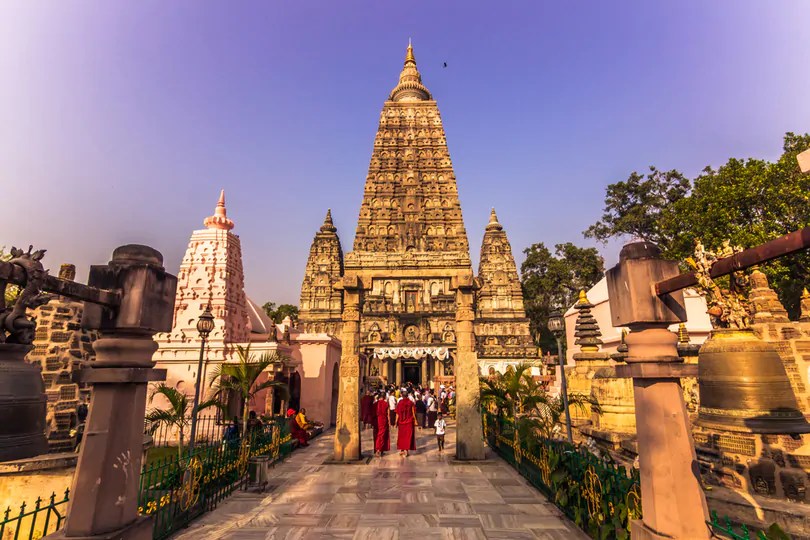
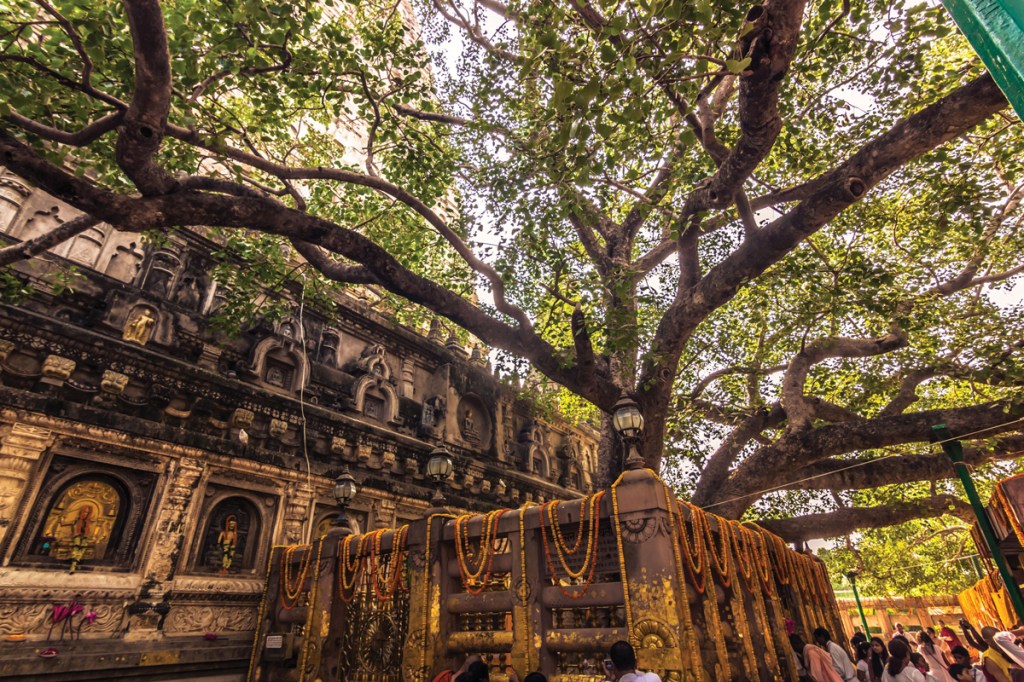
Bodh Gaya is India’s Buddhist epicenter. The tiny village of Bodh Gaya in Bihar reverberates with a serene atmosphere infused with profound devotion. This 2,500-year-old Buddhism cradle, studded with temples and monasteries, welcomes people from all across the globe to soak up its spiritual and holy vibes, follow Lord Buddha’s footsteps, and hear about his teachings at the very spot where he attained enlightenment. The serenity pervades every wind in this tiny village. Prince Siddhartha, better renowned as Lord Buddha, is claimed to have taken shelter under the most sacred tree in the vicinity, the Bodhi tree, there he meditated till enlightenment.

The beautiful Mahabodhi Temple, a UNESCO World Heritage Site, is one of Lord Buddha’s four sacred shrines. The renowned sandstone temple stands 52 meters tall in the heart of Bodh Gaya town, amidst lush green gardens. The existing Bodhi tree, most likely the sixth generation of the first, a prominent emblem in Buddhism, is located to the left of the Mahabodhi Temple. It commemorates the spot where Lord Buddha attained enlightenment underneath the first Bodhi tree. Buddha meditated for about a month in Bodhgaya under a holy fig tree. Bodhi Day, which honors Buddha’s enlightenment under the Bodhi tree, is observed every year on Dec 8 by Buddhists all around the world.

It’s a delightful surprise, with exquisite engravings and arch motifs on the tower. A golden figure of Lord Buddha in his renowned bhumisparsha mudra, with one finger touching the ground and asking it to witness his enlightenment, can be found inside the temple. A statue of Mayadevi, Lord Buddha’s mother, is housed in a room at the top.

Sarnath 
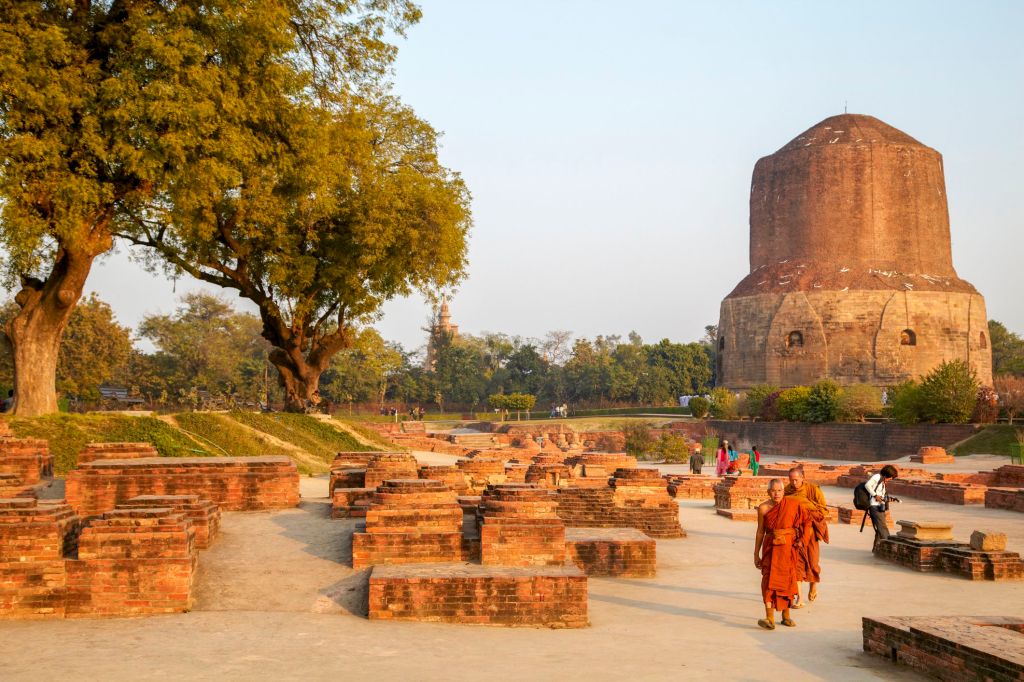
Sarnath,10km from Varanasi, was the starting point for Buddha’s teachings and preaching. Buddha gave his first lectures after nirvana in this very location. Sarnath is one of India’s four holiest Buddhist sites, with constructions like the Dhamekh Stupa and Chaukhandi Stupa highlighting its historical importance.

The solid cylindrical structured Stupa made of red bricks and stone reaches a height of 43.6 m and a diameter of 28 m. This historic site is significant because it represents the site where Lord Buddha delivered His first teaching to His 5 monks following achieving enlightenment in Bodh Gaya. Buddhist pilgrims from all across the world come to Sarnath to worship Lord Buddha.

Lord Buddha’s remains were dispersed and buried beneath 8 mounds after his enlightenment, with the embers and urn buried beneath 2 additional mounds, for a total of 10 such memorials housing Lord Buddha’s relics.

Great Indian Emperor Ashoka of the Maurya Dynasty, who reigned over almost the entire Indian subcontinent from c. 268 to 232 BCE, constructed multiple Stupas across India bearing relics of Lord Buddha and his disciples, to spread Buddhism. At 249 BCE, he ordered the construction of the Dhamek Stupa at Sarnath, which was later reconstructed in 500 CE, as well as several other Sarnath structures.

Kushinagar
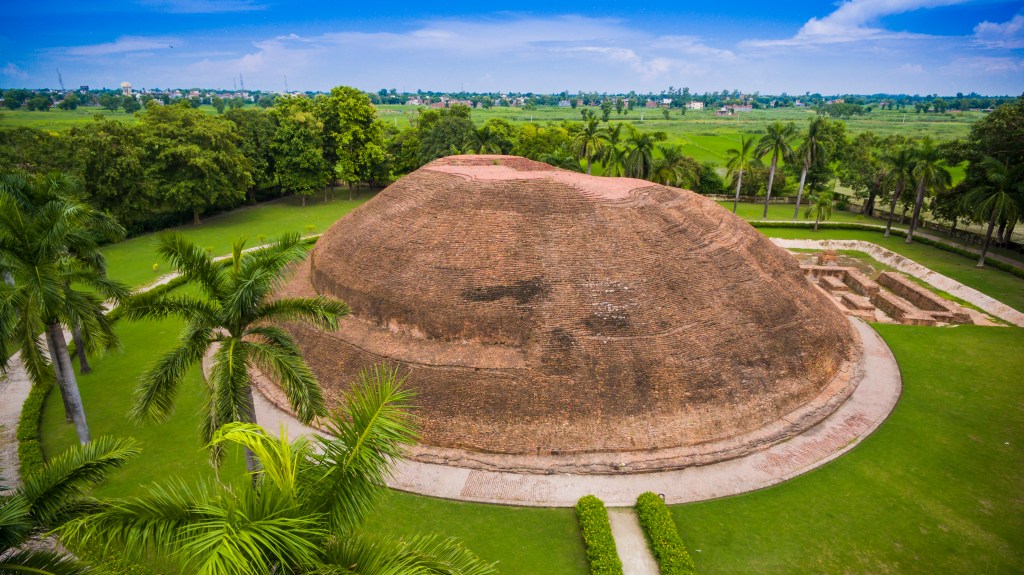
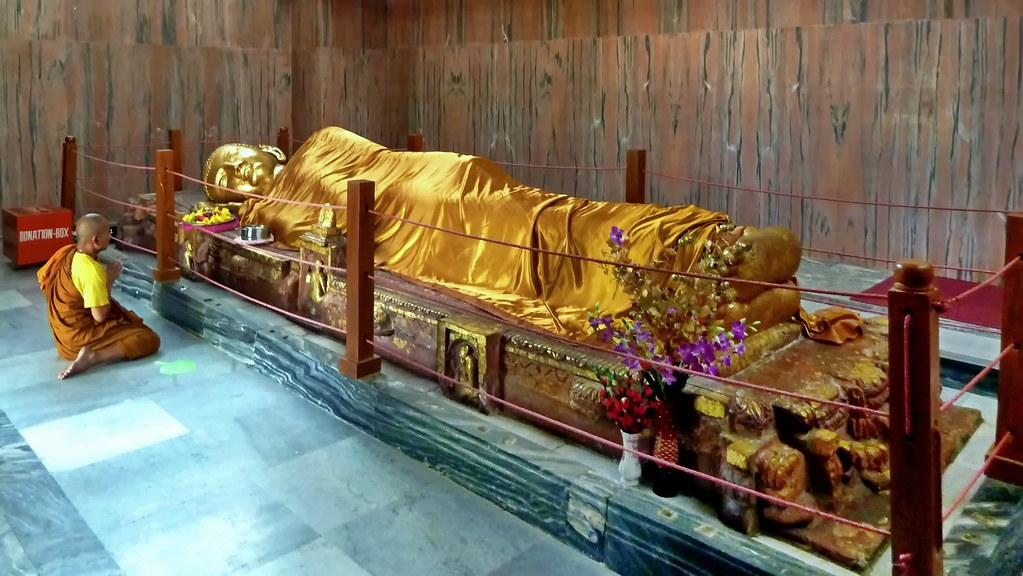
Kushinagar is a well-known tourist destination associated with Gautama Buddha, located 51 kilometers east of Gorakhpur on National Highway No. 28. Buddha delivered his last and final preaching here in 483 BC. The statue of Lord Buddha in nirvana, which towers 6.10 meters tall and dates from the 5th century A.D., is built of monolith red-sandstone. The ‘Resting-Buddha’ is seen lying on his right side, facing west. It is a holy pilgrimage place since it is where Lord Buddha breathed his last.

Kushinagar’s other attractions include the Indo-Japanese Temple, Burmese Temple, Chinese Temple, Thai Temple, Korean, Sri Lankan, Tibetan temples, 15-acre Meditation Park, and Museum.

Tawang Monastery
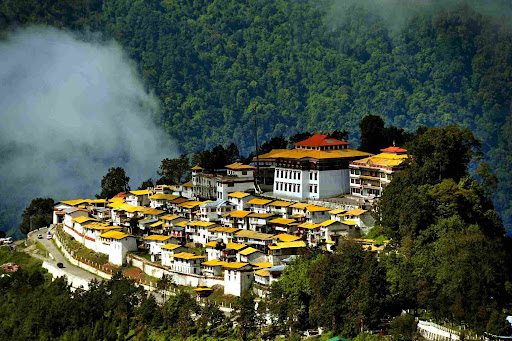
Tawang Monastery, the largest monastery in India and the second largest in the world, located in Tawang city of Tawang district in the Indian state of Arunachal Pradesh, serves as the valley’s social, cultural, and spiritual hub. This monastery, perched on a hill about 10,000 feet above sea level, is India’s largest, with views of ravines to the south and west, a short ridge to the north, and a gradual slope to the east. During the winter, it is buried in snow, which enhances its splendor.

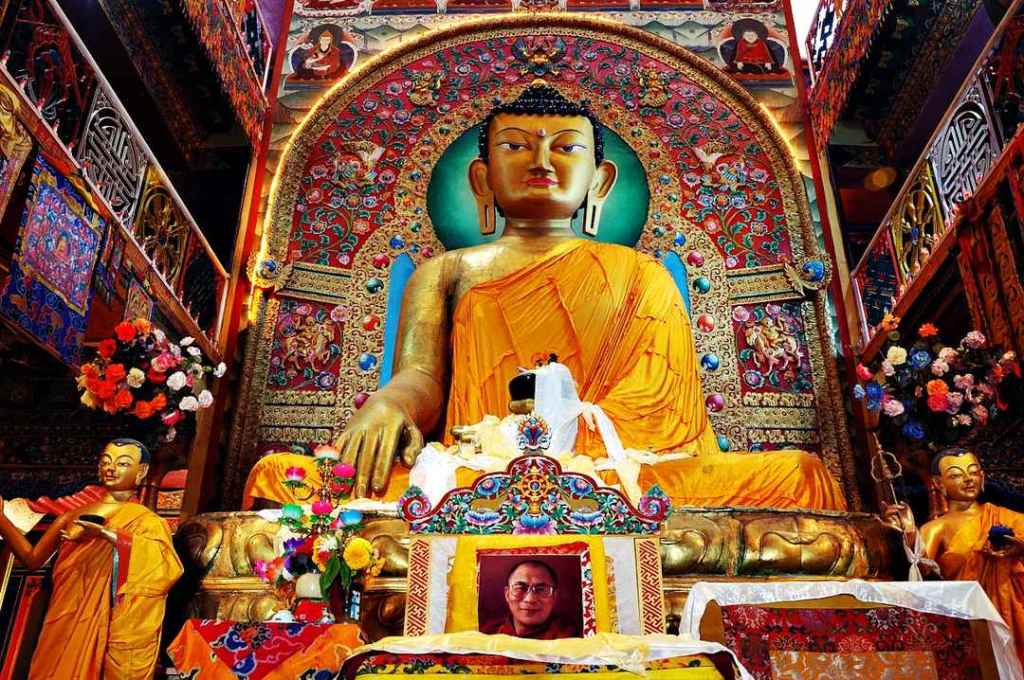
The Mandalas or Kying-Khores are painted on the Kakaling’s ceilings and inner roofs, while saints and divinities are depicted on the inside walls. On the monastery’s northern flank, after Kakaling, is the main gate. It has a 925-foot-long eastern wall. A 25-foot-high golden statue of Lord Buddha, perched on a lotus throne and flanked by his two chief attendants, Maudgalyayana and Sariputra, each bearing staff and a bowl, is a major attraction of the monastery. The Tawang Monastery, which is three stories tall and is enclosed by a 925-foot high compound wall, houses 65 residential buildings.

The monastery is historically notable as it was founded in 1681 per the wishes of Ngawang Lobsang Gyatso, the 5th Dalai Lama. The word ‘Tawang’ translates to ‘chosen by a horse,’ and legend has it that a horse belonging to the founder, Mera Lama Lodre Gyatso, chose the current monastery’s location. Tsangyang Gyatso, the sixth Dalai Lama, was born at Tawang, making it a significant Tibetan Buddhist pilgrimage destination.

Ajanta Caves
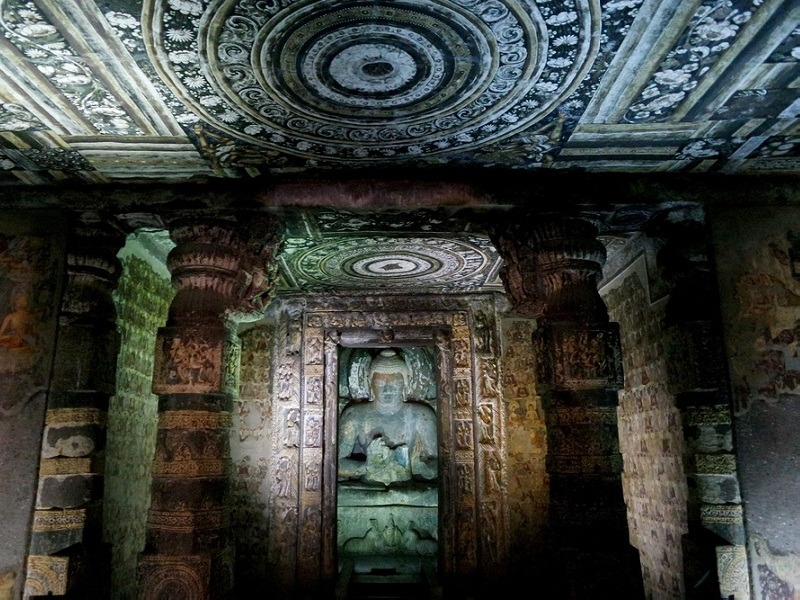
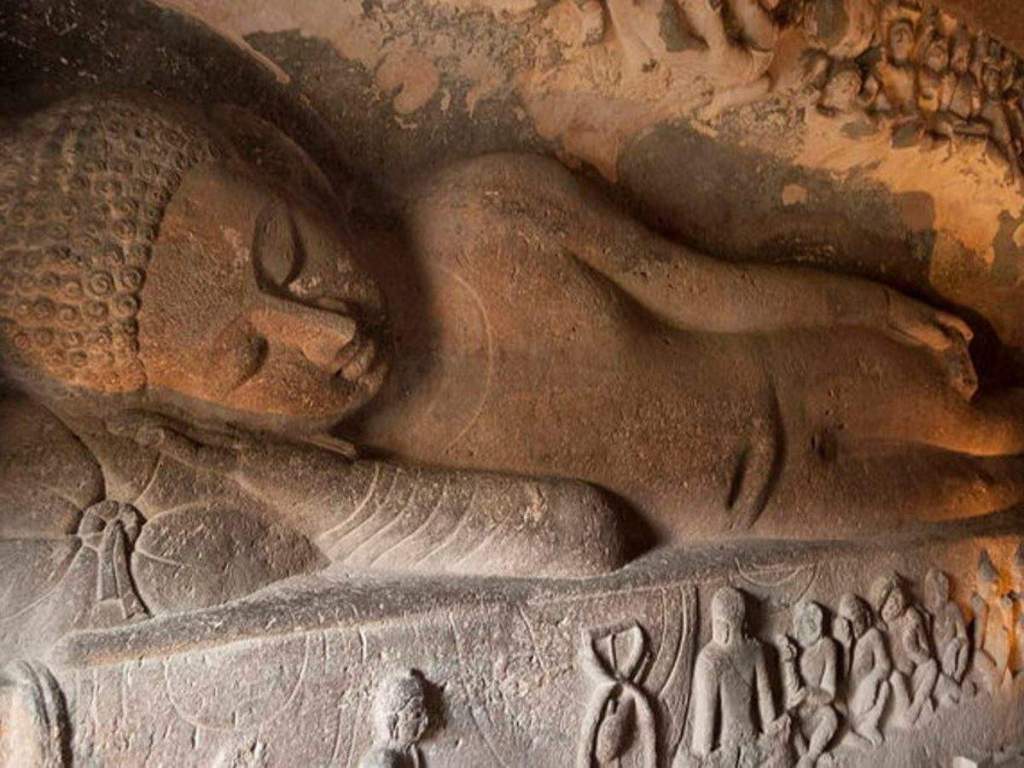
The Ajanta Caves, 107 kms from Aurangabad and 60 kms from Jalgaon, were designated as a UNESCO World Heritage Site in 1983. A protected monument in the care of the Archaeological Survey of India, it is a cluster of 32 Buddhist caves not far from a medieval village of the same name. Ajanta’s thirty rock-hewn caves, built into a cliff’s scarp, are either chapels or monasteries. Paintings adorn the cave walls, many of which retain their original colors. Exquisitely carved sculpture adorns the building’s outer walls. The Ajanta paintings’ Buddhist motif embodies the essence of Lord Buddha’s life and previous earthly events.


What is the History of Buddhism and Buddha?

In this article we will look at things like the origin of Buddhism and the biography of the Buddha.

Biography of the Buddha


The Buddha’s given name was Siddhartha. He lived during the time when the Mahavira lived. Siddhartha was born in the Lumbini forest near Kapilvastu in Nepal born in BC 563. His father was Suddhodana, the leader who ruled Kapilvastu. His mother Mahamaya died when Siddhartha was seven days old. He was raised rich by his nephew. His father wanted his son to be king to rule the world. But the astrologers predicted that Siddhartha would become a monk if he happened to see an old man, a sick man, a dead man and a monk. So Siddhartha’s father started packing so that he could leave the palace. 

Siddhartha grew up happily in the palace for many years enjoying all the comforts unknown to the outside world. He was raised to protect the sufferings of the world from his eyes. At the age of 16, he married his cousin Yasodhara. He was happily married and had a child, Rahula. After that, as predicted, Siddhartha saw an old man, a sick man, a dead man and a monk. Seeing them, Siddhartha began to think deeply about the cause of the world’s problems. Wanting to realize the truth of the monk, he left his wife and child one night at the age of 29 and left the palace without telling anyone.

 Dressed in saffron, he wandered in the forest to learn a lesson from the sages. All the sages said that wisdom can be attained only by grieving their body and performing severe penance. Hearing this, Siddhartha mourned his body for many years. He gradually reduced his diet and eventually ate only one bite of rice a day. The body became bone and skin. But he felt that it was not the way to reach the truth because his body was exhausted and his brain was exhausted by such austerities. He started eating again. All five of his disciples, seeing that he had begun to eat regularly, lost faith in him and left him. 

But he began to spend long hours in solitude thinking hard to find the facts he was looking for. One day while meditating under a fig tree, Siddhartha  realized that his questions had been answered. He was 35 years old when he attained enlightenment. After that he was called Buddha. The place where he attained enlightenment is called Bihar Bodhgaya. 

For the next 45 years he traveled throughout northern India and taught the truths he realized. Buddhists call their teachings the Four Truths.  

  • The first truth human life is inherently miserable. 

  • The second truth is that the cause of that suffering is    selfishness and desire. 

  • The third truth is that man can suppress selfishness and desire. 

  • The fourth true man has 8 types of path to escape   from selfishness. 

These eight paths are,

 1. honest opinion

 2. honest thought

 3. honest speech

 4. honest action

 5. honest life

 6. honest effort

 7. honest will

 8. honest meditation. 

The Buddha performed his first teaching at Sarnath, near Varanasi. His teachings were not written during his lifetime, nor were they written until centuries after his disappearance. That is one of the main reasons why there are so many branches of Buddhism. 

There are currently two major divisions in Buddhism.

1. One is the Theravada faction. It flourished in Southeast Asia. 

2. The second division is the Mahayana. The division prospered in Tibet, China and North Asia. 

Desire is the cause of suffering. The basic teaching of the Buddha is that ignorance and caste divisions are the cause of all suffering. A man should be measured by virtue and not by birth. No one is born superior or inferior. The Buddha insisted that it should be determined by what he did. The Buddha lived for almost 80 years and taught many things. He died in BC 483 at Kushi Nagar in Uttar Pradesh. The Buddha was born, attained enlightenment, and swam this worldly life in a single day. That is, historical records say that May is the day of the full moon. That is why Vesak Day is best celebrated by Buddhists. All religions and denominations teach pure love.

Pratitya-samutpada and I-ness

Pratityasamutpada is one of the 4 doctrines of Buddhist Philosophy. The word Pratityasamutpada translates to ‘Dependent Origination’. The doctrine claims that every effect has a cause and every phenomenon that arises is because of some cause. The Pratityasamutpada can be explained with a simple example of A (cause) → B (effect), when condition A exists only then effect B arises. And -A → -B, if condition A does not exist then effect B does not arise. In simpler terms, an effect arises only and only if there exists a cause for its rise.

Therefore, the existence of metaphysical entities like God, soul etc is denied by this doctrine because nothing can come into existence on its own will. Everything has a cause and effect cycle, and the metaphysical entities fail to fulfil this condition. This cause and effect connection is also known as the ‘causal link or ‘causal nexus’.

If we try to understand the translation of the word Pratityasamutpada, i.e. Dependent Origin, we can infer that the origin of every object, event or phenomenon is dependent on something else. And everything that exists in this world did not come into being on its independent will but as an effect of some cause.

Since everything is dependent, conditional, subject to death and birth therefore Pratityasamutpada states that everything in the world is impermanent.

Pratiyasamutpada is contained in the 2nd and 3rd noble truths. The reason why suffering comes into being is due to ‘existence’. Thus, suffering is samsara (the cycle of death and birth) and the path to eliminate this suffering is Nirvana.

Buddha gave the 12 links of the causal wheel of dependent origin which are as followed:

(1) Ignorance (avidya).

(2) Impressions of karmic forces (samskara).

(3) Initial consciousness of the embryo (vijnana).

(4) Psycho-physical organism (nama-rupa).

(5) Six sense-organs including mind (sadayatana).

(6) Sense-object-contact (sparsha).

(7) Sense-experience (vedana).

(8) Thirst for sense-enjoyment (trsna).

(9) Clinging to this enjoyment (upadana).

(10) Will to be born (bhava).

(11) Birth or rebirth (jati).

(12) Old age and death (jara-marana).

Avidya or ignorance, which refers to the false concept of ‘I’ or ‘Individuality’, leads to the bearing and breeding of Karma which in turn leads to rebirth, and this in turn leads to suffering in life. The consciousness is believed to be the only entity that persists even after death and this consciousness serves as the connecting link between past life and a new birth. (connecting link between old and new). Nirvana is the only way to cease his consciousness and thereby prevent rebirth and suffering.

If we simplify this ‘I’ concept, you’ll realise how most of your life’s perspective begins with ‘I’. For instance, “I don’t want to do this.” “It’s because of me that this happened.” “I’m so not worth it.” 

Because of this ‘I’ – ness you grow blind to the facts, situations and even the feelings of another person. That’s why you need to eradicate this egoistic ‘I’ ness and shape it to the one that’ll be beneficial for you. Not tormenting. 

Why Silence is So Powerful

“Silence is a source of great strength” – Lao Tzu the founder of Taoism philosophy

Silence nourishes our mind and soul and makes us reflective as it is our internal necessity. Through silence we ingress into the imaginary world where we can expand our creativity beyond our boundaries. Silence makes us physically, mentally, emotionally, and morally strong.

  In today’s increasingly stressful and fast-moving world, we rarely apply wisdom while taking our decisions. Instead, we prefer the mechanics of quick problem-solving to get immediate outcomes. Decisions that are taken without thinking are mostly irrational and random. For making proper decisions, we need to use silence as a tool. It often provides us the opportunity to have sufficient time to think deeply and understand the matter before jumping to a random decision.

 When you are in silence, your mind and soul are deeply connected, and in this phase, your inspirations may bubble-up. You may find solutions suddenly for which you might have been struggling for a long time.

You all might have once heard these famous lines “At times silence can speak louder than voice.” Choosing silence is the best way to enhance conversations and strengthen your bonds as it’s a space between our feelings and response. When you keep silent, naturally, you would listen more in a conversation, and others would have the opportunity to speak and share more. Active listening is the key for trust-worthy and effective relationships. Silence helps us in thinking deeper, wakes us up, and increases our emotional regulation.

“Silence” is an explicit power that can either glorify or destroy your life, depending on your choice. Your engagement to its lighter or darker side would decide your transformation.

A Look at the Four Noble Truths of Buddhism

Buddha, the founder of Buddhism, is credited for the four noble truths. The Four Noble Truths contain the essence of Buddha’s teachings and principles that he gained after enlightenment.

The Four Noble Truths are as followed:

  1. The truth of suffering
  2. The truth of the cause of suffering
  3. The truth of the end of suffering
  4. The truth of the path that leads to the end of suffering

The First Truth talks about the identification and acceptance of the presence of suffering. Buddha says that life is not ideal as it often fails to live up to our expectations. The only things that are certain and unavoidable are old age, sickness and death.

Buddhism encourages its followers to view the world with a pragmatic approach and see the world as it is. Free from any illusions or enchantments.

The Second Truth, seeks to determine the cause of suffering.
Buddhism says that the root-cause of all sufferings is desire and ignorance. This comes in three forms known as the Three Roots of Evil, or The Three Fires or The Three Poisons.

Buddha says that these three roots of evil are

  1. Greed and desire
  2. Ignorance or delusion
  3. Hatred and destructive urges

Buddha explains that desire is the craving for pleasure, material goods and immortality and all these are wants that can never be satisfied. Therefore, desiring them can only bring sufferings. Although he does clarify that there are positive desires like the desire for enlightenment, good wishes for others, desire to learn, teach etc.

About Ignorance, Buddha says that ignorance is not being able to see the world as it actually is. He argues that, without the capacity for mental concentration and insight, one’s mind is left undeveloped, making it unable to grasp the true nature of things and leading to vices such as envy, hatred, anger and greed.

The Third Noble Truth, the truth of the end of suffering, talks about the possibility of liberation from suffering. Buddha taught that the way to extinguish desire (the root-cause of all sufferings), is to liberate oneself from attachment.

The Third Nobel Truth also has a dual meaning suggesting,

  1. Either the end of suffering in this life, on earth or
  2. In the spiritual life, through achieving Nirvana (after death)

Buddha was the living example of the former.

The Fourth Noble Truth, prescribes the method for attaining the end of suffering. This prescription is known as the Noble Eightfold Path, which is as followed.

  1. Right Understanding
  2. Right Thought
  3. Right Speech
  4. Right Action
  5. Right Livelihood
  6. Right Effort
  7. Right Mindfulness
  8. Right Concentration

These eightfold paths are further divided into 3 themes.

  1. Good Moral Conduct (Understanding, Thought< Speech)
  2. Mediation and Mental Development (Action, Livelihood, Effort)
  3. Wisdom or insight (Mindfulness and Concentration)

My View on the four noble truths

I do agree to some extent that one should pursue to reduce sufferings in life. However, concentrating only on the elimination of suffering is not the ultimate goal of life, because this will deprive us from seeing the other beauties of life. When we consider pleasure and happiness as a desire that we should aim to extinguish, I believe that one would not really be able to live their life to the fullest. Life for me, is the combination of sad, happy, boring and all other moments, that challenge us to grow into a better person.

Apart from this, the fourth noble truth, the eightfold path, is an extremely difficult thing to stick to. In our ordinary lives we as humans tend to make mistakes, tend to do wrong things and learn from them. The eightfold path requires us to be all good which is an extremely difficult command and requires one to be fully devoted to the Buddhism Teachings. This makes it extremely difficult to attain enlightenment, which is why, after Buddha, there have not been many people who were able to truly attain enlightenment in their lives.

Buddhism and Suffering

Suffering is part of the core teachings of Buddhism. In Buddhism, to study, understand and eliminate suffering is considered to be the ultimate goal of human life. 

It is said that when Buddha attained enlightenment and started his altruistic sermons, he stated the following; 

“O Monks, two things I only teach, dukkha and the cessation of dukkha” Buddha could see suffering at each stages of human life. He understood that from the moment of birth till the state of death, suffering was part of human life. 

Hence, we have the 4 Noble Truths given by Buddha that deal with sufferings in Buddhism: 

1. The truth of suffering (dukkha) 

2. The truth of the cause of suffering (samudaya) 

3. The truth of the end of suffering (nirhodha) 

4. The truth of the path that frees us from suffering (magga) 

Collectively, these principles explain why humans hurt and how they can overcome suffering. Furthermore, Buddha taught that there are three kinds of sufferings. The first type of dukkha is the physical and mental pain from inevitable events like sickness, old age and death. The second type of dukkha occurs when we fail to get what we desire or to lose something that we hold dear. This type of dukkha appears due to impermanence and change. 

The third type of Dukkha is the suffering that arises due to man’s conditioned state of existence. In other words, it’s a kind of existential suffering arising due to the angst of being human, the very state of our existence and being subject to rebirth. 

Buddha, in his 2nd Noble truth explains the reason why humans are subject to suffering. Buddha says that suffering is part of a universal causal link. Universal causal link is a link that is a cycle of cause and effect. It states that for every effect to come into existence, there lies a cause of its origination. Hence suffering is a part of this cycle of causal link. From this causal link Buddha extracts 3 main reasons for humans to be subject to suffering. 

1. Birth According to Buddha, existence leads to suffering. i.e. From the moment we take birth we are bound to experience suffering in our lives. 

2. Attachments and Desires Buddha believes that the root cause of suffering is attachments and desires. When we attach ourselves to materialistic things or desires that cannot always be fulfilled, we are afflicted with pain and suffering. Buddha says that man has a sense of ‘I’, the belief that his existence is individualistic in nature. This belief leads him to feel the obligation to achieve all his desires. What we fail to understand in this belief is that these desires are temporary and momentary, thus we cannot always satisfy our desires and needs. In addition to this Buddha also says that there is no end to human desires, hence one cannot always achieve the things that he or she wishes or desires.

3. Ignorance According to Buddha this is the ultimate cause of suffering in human lives. Due to ignorance humans fail to gain knowledge about suffering and remain ignorant to reality. 

Ignorance also leads to the creation of the false sense of ‘I’. Thus, ignorance increases our infinite desires and attachments that later cause us suffering in our lives.

HOW TO END THIS SUFFERING? 

In his 3rd Noble Truth Buddha affirms that suffering can be ended. And in his 4th Noble Truth Buddha gives us the path to attain this end to suffering. 

Nirvana in Buddhism is a state of freedom from suffering. It is said that when one attains Nirvana, he or she is left with no desires, no attachments and no ignorance. 

Nirvana is a state where one feels ultimate happiness and peace. However, Nirvana is not always a static life but can also be an active life. Thus, there are two types of Nirvana 

1. Jivan Mukti – You attain Nirvana when you are alive. Example: Gautama Buddha 

2. Videh Mukti – You attain Nirvana after your death. Example: End of Rebirth

Since Buddhism accepts Karma and rebirth to be the main causes for humans to take birth and experience suffering, hence Nirvana is also a state where all Karma is annihilated and rebirth comes to an end.

To attain Nirvana, or to attain freedom from suffering Buddha further gives a middle path, i.e. an 8-fold path that advocates neither extreme self-indulgence nor extreme self-denial. It’s a middle path of these two extremes.

THE 8-FOLD-PATH TO ATTAIN FREEDOM FROM SUFFERING 

In no particular order, the Eightfold Path of Buddhism teaches the following ideals for ethical conduct, mental disciple and achieving wisdom: 

1. Right views Buddha said that in order to attain freedom, one needs to acquire right knowledge. Since ignorance is the ultimate cause of suffering, by attaining right knowledge about the 4 Noble Truths it will eventually help an individual to eliminate suffering.

2. Right resolve Right resolve refers to the act in accordance with right knowledge. An individual needs to have the right determination to make the right choices in life. 

3. Right speech Right Speech advises individual to not use harsh or abusive languages. It advises to refrain from cussing, cursing or hurting other people by using abusive words. 

4. Right conduct This talks about the behaviour of an individual. Right conduct is further explained using 5 ways. 

i. Non-Violence (Ahimsa) To not practice violence in any form; physical, mental or emotional. 

ii. Truth (Satyam) To always speak truth and never lie, no matter what condition one may be in. 

iii. Not Steal (Asteya) To never steal or shoplift no matter how much pleasure or happiness one gets from doing so. 

iv. Contentment (Aparigrah) This talks about how one should be satisfied with what he or she has and teaches to be grateful for the things one is blessed with. 

v. Celibacy (Brahmacharya) Celibacy here does not refer to an ascetic life but rather talks about how an individual should learn to control his/her emotions and desires.

5. Right Livelihood Right Livelihood encourages an individual to earn their wages or living expenses by following a moral path. That is, by working hard instead of stealing, murdering or any immoral acts.

6. Right Effort Right effort majorly talks about making an effort to develop and retain good thoughts, to remove existing evil thoughts (negative thoughts) and to prevent evil thoughts from entering the mind.

7. Right Mindfulness Mindfulness talks about retaining the good energy in our mind and encourages to constantly remember good things. 

8. Right Concentration This talks about analysing our sufferings and finding the root cause of it. It encourages individuals to concentrate in discovering our own selves and to detach from any unnecessary desires or attachments.

Hence it is only after following this 8-fold-path can one achieve liberation from suffering. 

What Is Zen Buddhism?

Zen Buddhism is a Japanese school of philosophy that is said to have evolved from Mahayana Buddhism. It is more centred on meditation and intuition, and it is seen as a lifestyle rather than a fixed form of prayer or religion. 

The term “Zen” is the Japanese rendering of the Chinese word “Ch’an,” which means “meditation.” Around the eighth century, Ch’an arrived in Japan and became known as “Zen.” Though Zen Buddhism made its way to Japan via China, but it’s true home is India. Today, the term “Zen” is more often used in the West.

For many individuals from East Asian cultures, Zen is particularly essential in helping families show their continuing love and respect for their ancestors—departed family members who are in the afterlife awaiting rebirth.

CHARACTERISTICS OF ZEN BUDDHISM

Zen Buddhism is a simple, determined, uncompromising, to-the-point, meditation-based Buddhism that is uninterested in theological subtleties. Zen, which does not rely on scripture, dogma, or ritual, is validated by personal experience and is passed down ineffably from teacher to pupil, hand in hand, via rigorous, intimate practice.

Though Zen accepts – at least in part – the legitimacy of traditional Buddhist scriptures, it has developed its own writings over time. Much of ancient Zen literature is based on legendary stories of the great masters, and is liberally flavoured with Taoism, Confucianism, and Chinese poetry, as well as written in casual language studded with Chinese folk sayings and street slang. 

One of the most key characteristics of Zen Buddhism is Zazen or Zen meditation. Zen meditation’s objective is to control one’s attention. It is also referred to as a technique of “thinking about not thinking.” In zazen, practitioners sit on a cushion in a structured pose with a straight back, eyes half open, and legs crossed onto the opposite thigh in what is known as the full-lotus position.

HOW TO PRACTICE ZEN MEDITATION 

  1. Keeping an eye on one’s breath – During zazen (sitting meditation), meditators should adopt a comfortable position such as the Burmese, half-lotus, or Seiza pose. Sitting on a cushioned mat or cushion is preferable, although sitting in a chair is also fine. The focus of awareness focuses on a specific object of meditation, most commonly the breath and how it travels in and out of the abdominal area. 
  1. Stillness of mind – This type of meditation does not rely on a single point of focus, such as the breath. Meditation students are taught to let thoughts pass through their brains without judgement or rejection. This is known as shikantaza, or “simply sitting” in Japanese. This Zen Buddhist meditation technique is performed without the need of an object of concentration, attachments, or contents.
  1. Intensive group meditation – Committed meditators conduct intensive group meditation on a regular basis in meditation centres or temples. This is known as sesshin in Japanese. During this stage of intense meditation, practitioners dedicate the majority of their time seated. Each class lasts approximately 30 to 50 minutes and is interspersed with walking meditation, brief breaks, and meals. 

Finally, Zen Buddhism provides practitioners with means to mend their minds and hearts while also connecting with the world. Many practitioners nowadays turn to Zen in search of mental clarity and peacefulness through meditation. Zen, like other schools of Buddhism, begins with the recognition that humans suffer, and it offers a remedy to this suffering by realising the interconnection of all creatures and learning to live in accordance with this reality.