The impact of Social Media Influencers on Publicity

In terms of marketing, publicity is the public visibility or awareness of a product, service for any organisation or business or company. It may also refer to the movement of information from its source to general public often (but not necessary) via the media. Here are some of the ways by which Influencers impact the publicity of a brand:

1) Building Awareness about the Brand:

Social Media Influencers on various social media platforms establish credibility in a particular industry (like fashion) and there is a huge gap between brands and their end users. Influencers try to bridge this gap as they take consumers through the “decision making phase” and thus help in creating a positive brand reputation.

2) Informing people about the product:

One of the main reasons why consumers trust influencers is that they relate with them on a personal level. Influencers know about the major everyday needs of an individual and hence they keep their followers “up-to- date” about latest trends regarding existing products, services or giving details about latest products.

3) Sponsor products in their profiles:

Sometimes social media influencers prefer fixed payments to feature the products of a brand or feature brands on their profile for a specific period of time or they may feature the products in their social media posts. This directly helps in general awareness of the brand.

4) Giving Prizes:

Social Media Contest is one of the most new ways that increases popularity of brands or product of brands. Business firms collaborate with social media influencers and it is the most cost effective technique to build awareness and general interest in brands. This is a typical strategy and it may require certain condition in exchange of prizes such as following the official page of the brand, tagging friends, liking posts and like.

These things directly help in increasing the online engagement and further increasing general interest in the brand.
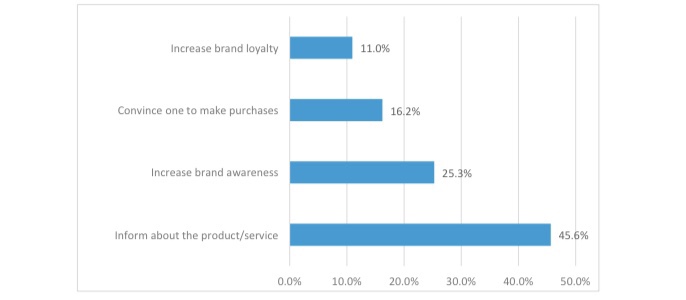
Source: Januz Wielki.

The above graph is from a recent survey conducted in August 2020 and it shows that majority of respondents feel “transfer of information” about a product is the main thing they look when it comes to social media influencers.
Increasing brand awareness and brand loyalty are the next two elements that respondents look when it comes to social media influencers.

This acts as evidence that social media influencers are very impactful when it comes to promotion and publicity of a product or a service. In this modern era, where social media is the new “illusion” of people, social media influencers help in building and increasing brand awareness and thereby they assist in promotion and publicity. Good Marketing Managers would tap this opportunity of “social media influencer marketing” to enhance the audience reach of their business.

India’s Foreign Trade Policy

Foreign Trade Policy is a set of guidelines for the import and export of goods and services of the country. In India, it is formulated by the Directorate General of Foreign Trade (DGFT) under the Ministry of Commerce and Industry. DGFT is a body formed for promotion and facilitation of exports and imports. The policy is formulated every five years for the next five years.

India’s first foreign trade policy was formulated in the year 1985 with the aim of boosting exports (by finding opportunities and encouraging exporters by making industry-friendly policies), generating employment and improving competitiveness of the local market and the quality of the products. With 2020 coming to an end, it was announced that the 2015-2020 policy has been extended till September 2021. Let’s take a look at the highlights of 2015-2020 policy and the new 2021-2026 policy.

2015-2020 Highlights

  • Policies were simplified and new export incentives were introduced for the following categories- Merchandise Export of India (MEIS) and Service Export of India (SEIS). Under these schemes, countries have been categorized into 3 groups and the rewards vary from 2-5% under MEIS and 3-5% under SEIS.
  • Main focus was on Skill Development and Make in India to increase value-addition.
  • It encouraged ‘ease of doing business’ by promoting E-documentation and Digitalisation.
  • It facilitated and encouraged exports.
  • Export Obligation has been reduced to 75% under Export Promotion Capital Goods scheme (EPCG).
  • It also focused on giving a boost to Defence Exports- Tanks, Helicopters, Aircraft etc.
  • New duty exemptions on certain items.
  • Addressal of quality complaints and improvement.
  • Manufacturers labelled as “status holders” (certified by DGFT for their major contribution leading to growth of India’s exports) to self-certify their goods as a product originated from India. This helps them qualify for preferential treatment under various bilateral and regional trade agreements.
  • Construction of three additional ports (to improve connectivity) which is still in progress. These ports are being constructed in Kerala, Gujarat and Andhra Pradesh.
  • Introduction of duty-free schemes for reduction in tariffs
  • Development of additional export excellence zones. Moreover, fast track clearance facility, permitting inter unit transfer of goods and services and permitting warehouses set ups near ports for businesses located in 100% EOU (Export Oriented Units)/EHTP (Export Hardware Technology Park)/STPI (Software Technology Parks of India).

2021-2026 Highlights

Due to the ongoing pandemic, the new policy mainly revolves around ‘ease of doing business’ and digitalisation to promote and support export business in these tough times. It is an extension of 2015-2020 policy as it was extended till September 2021.

The main highlights of the 2021-2026 policy-

  • Digitalisation of business
  • Simplification of export-import procedures- Making documents accessible in digital form.
  • Ease of business by providing easy access to credit and self-certification.
  • Increasing Export awareness: Many exporters and manufacturers are not aware of the duty exemptions and schemes they can benefit from.
  • Help districts reach their potential as an Export Hub. Commerce department will ensure implementation with the help of the State Governments and Union Territories.
  • Improve infrastructure for domestic manufacturing sector to correct the trade imbalance.

How Archives transformed in the Digital era

The Word archive is derived from the Greek word ‘Arkheion’. The word was further referred from ‘Archon’, which meant a magistrate who oversaw the town hall where all the official public documents were stored. The Word Archive came to use for the first time in the 17th century.

Archives are also known as ‘memory institutions’ because they record and preserve memories and form a significant part of culture, community, official and unofficial history of any place or region or state, or any institution. Their function is to collect, store and preserve artefacts and documents of historical, cultural, and legal importance from the yesteryears and the present so that they remain accessible, informative, and useful to future generations. In general, any organization, government institution or individual can build archives. The National Archives, UK has described archives as “collections of records or documents, selected for lasting preservation due to their historical value, significance as evidence, or as a source for research studies”. International Council on Archives (ICA) has defined archives as “documentary result of various human activities conserved for its long-term value”. They further described archives as contemporary accounts created to can provide a true and verified version of past events.

The significance of the archives lies in the orderly collection of crucial source documents accumulated over an individual’s or organizations’ lifespan and preserved, which can serve as evidence or reference for future work. As archives are the repositories housing various historical documents and records of value, archival research is facilitative for scholars and researchers looking for data to assess and facts to study from the original documents. However, owing to the vastness and diversity of ample archival documents and records, archival analysis is a hectic and tedious job. Access to the artefacts and documents stored in an archive is not an easy task and requires permission from the respected authority. In addition, most of the information stored in traditional achieves is paper-based and thus, is susceptible to decay with time. The aforementioned limitation of traditional archives can be overcome by archiving documents and artefacts in various digital formats, which can ensure that the information is preserved for a substantially longer period.

With the advent of newer digital technologies, it became easier and more convenient to store and preserve the information in the digital space. With the assistance of new digital tools and methods, the process of transcending information from the physical world to the digital world became much efficient and easier. 

Digital archiving is an area where the relationship between digital tools/methods and information preservation can be witnessed. It is a blend of the former and current storage of information. Their function is similar to traditional archives, as repositories of elaborated collection of information in various digital formats at a virtual location. This also makes digital archives more accessible and democratic as the physical constraints are eliminated.

Advantages of Digital Archives:

  • The the digital archive allows “anywhere-anytime” accessibility to users ensuring a reduction of time, cost, and money.
  • The redundancy of information stored in digital archives can be reduced, which can promote ease of access.
  • No geographical site is required to build a digital archive, which is cost-effective.
  • The simultaneous requests of access from multiple users can be addressed by creating multiple copies of information stored, which can overcome the issue of bottlenecks encountered in traditional archives.
  • Managing and navigating objects or records stored digitally are easier in digital archives, which allow developing capacity to preserves terabytes of information.
  • Digital archives are less subjected to bureaucracy like traditional archives, which can ensure data accessibility to the general public.

Digital archives are not perfect. Many times due to the digital divide and other constraints, researchers are not able to access the information. Sometimes the information challenges the authority and due to this, the information can be unavailable in the digital archives because of censorship. But there is no denying that digital archives have transformed the way information is stored and processed.  

References: