Investment, a key pillar of the Union Budget 2025-26, will turbocharge India’s journey to Viksit Bharat by 2047

Daily writing prompt
If you could be a character from a book or film, who would you be? Why?

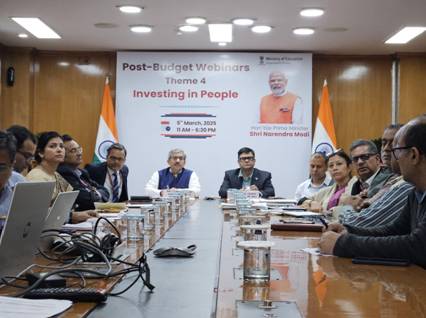
Ministry of Education organised Post Budget Webinar on the theme ‘Investing in People’, today. The Prime Minister Shri Narendra Modi delivered a special address at the inaugural session. Union Education Minister Shri Dharmendra Pradhan along with Secretary, Department of School Education & Literacy (DoSEL), Shri Sanjay Kumar; UGC Chairman Professor M. Jagadesh Kumar ; Secretary, Dept. of Higher Education, Shri Vineet Joshi; Secretary, Ministry of Health and Family Welfare Smt. Punya Salila Srivastava; Secretary Labour & Employment Ms. Sumita Dawra participated in the session.

The webinar brought together experts from the government, industry, and academia to discuss key reforms in job creation, academic flexibility, credit mobility, and future-ready skills—paving the way for a highly skilled and globally competitive workforce in line with Viksit Bharat 2047.

Speaking about the webinar, Shri Pradhan said that investment is one of the engines outlined in the Union Budget 2025-2026 which will turbocharge our journey to Viksit Bharat by 2047. He further said that the insightful special address by the Prime Minister Shri Narendra  Modi  has put forth new ideas for realising aspirations, future-proofing our population, accelerating inclusive development and ensuring benefits of Union Budget reaches every citizen of the country.

He expressed his gratitude to the Prime Minister for drawing attention to the vast potential of ‘Education Tourism’ and its key role in facilitating employment-linked growth and development. The Minister assured that the academic community will engage in comprehensive deliberations to chart out a strong roadmap for moving ahead in this direction. He further said that, together, with the spirit of jan-bhagidari and right investment in right direction, academia and industry will work together for bridging skills gap, harnessing demographic dividend, leveraging AI in education, catalysing research landscape and strengthening deep-tech start-up ecosystem for a future-ready workforce, stronger economy and Viksit Bharat.

Prof M. Jagadesh Kumar opened the session by emphasizing the transformative role of higher education. He highlighted that the implementation of NEP 2020 provided a unique opportunity to reshape India’s higher education landscape. During the webinar, Prof M. Jagadesh Kumar, Chairman, UGC stated that the policy was not merely reformative but transformative, designed to empower youth with the skills, knowledge, and adaptability required to thrive in the 21st century. He stressed that investing in people through quality education, research, and innovation was central to building a self-reliant, inclusive, and globally competitive economy.

Shri Sanjay Kumar stated that education is fundamentally about investing in people. He acknowledged the broad perspective provided by the UGC Chairman on higher education and noted that the 2025-26 Budget included key announcements regarding the establishment of 50,000 Atal Tinkering Labs in government schools over the next five years and the provision of broadband internet connectivity to government schools in rural areas. He further highlighted a significant trend observed over the last decade, noting that the proportion of female teachers has increased. He mentioned that in 2014-15, male teachers comprised 52 percent of the total, while female teachers accounted for 48 percent. By 2025, these figures have reversed, with female teachers now making up 52 percent and male teachers 48 percent, reflecting a move towards greater gender parity in the education sector.
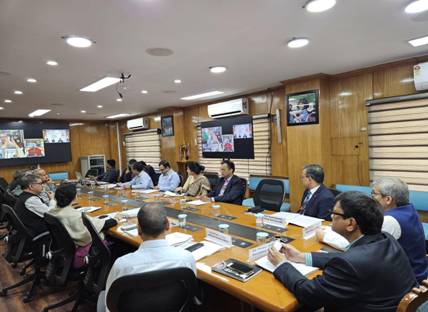
The discussions reinforced the need for strategic investments in human capital to ensure sustainable economic growth, social equity, and global leadership. The government remained committed to fostering a skilled workforce, ensuring India’s continued rise as an innovation and technology hub.

Prime Minister’s address the Post-Budget Webinar on boosting job creation- Investing in People, Economy, and Innovation

Read here: https://pib.gov.in/PressReleasePage.aspx?PRID=2108407

Text of PM’s address at post-budget webinar on boosting job creation via video conferencing Read here: https://pib.gov.in/PressReleasePage.aspx?PRID=2108424  

*****

Farmers’ Welfare Measures

Agriculture is a State subject and Government of India supports the efforts of States through appropriate policy measures, budgetary allocation and various schemes/ programmes. The various schemes/ programmes of the Government of India are meant for the welfare of farmers by increasing production, remunerative returns and income support to farmers. The Government has substantially enhanced the budget allocation of Department of Agriculture & Farmers’ Welfare (DA&FW) from Rs. 21933.50 crore BE during 2013-14 to Rs. 1,22,528.77 crore BE during 2024-25. Schemes/programmes initiated by DA&FW are conceptualised and implemented taken in consideration of improving the economic condition of farmers owning small handholdings, access to credit and to enhance overall income of farmers and remunerative returns in the agriculture sector.

PM KISAN Samman Nidhi Scheme has been launched in 2019 with the sole objective to enhance the income of farmers owning small landholdings. This scheme provides Rs. 6000 per year in 3 equal instalments. So far, more than Rs.3.46 lakh Cr. has been disbursed to eligible farmers through 18 instalments.

The other major schemes run by Department of Agriculture & Farmers Welfare for enhance of overall income of farmers are as under:

  1. Pradhan Mantri Kisan Maan Dhan Yojana (PM-KMY)
  2. Pradhan Mantri Fasal Bima Yojana (PMFBY)/ Restructured Weather Based Crop Insurance Scheme (RWBCIS)
  3. Modified Interest Subvention Scheme (MISS)
  4. Agriculture Infrastructure Fund (AIF)
  5. Formation and Promotion of 10,000 new Farmer Producers Organizations (FPOs)
  6. National Bee Keeping and Honey Mission (NBHM)
  7. Namo Drone Didi
  8. National Mission on Natural Farming (NMNF)
  9. Pradhan Mantri Annadata Aay SanraksHan Abhiyan (PM-AASHA)
  10. Agri Fund for Start-Ups & Rural Enterprises’ (AgriSURE)
  11. Per Drop More Crop (PDMC)
  12. Sub-Mission on Agriculture Mechanization (SMAM)
  13. Paramparagat Krishi Vikas Yojana (PKVY)
  14. Soil Health & Fertility (SH&F)
  15. Rainfed Area Development (RAD)
  16. Agroforestry
  17. Crop Diversification Programme (CDP)
  18. Sub-Mission on Agriculture Extension (SMAE)
  19. Sub-Mission on Seed and Planting Material (SMSP)
  20. National Food Security and Nutrition Mission (NFSNM)
  21. Integrated Scheme for Agriculture Marketing (ISAM)
  22. Mission for Integrated Development of Horticulture (MIDH)
  23. National Mission on Edible Oils (NMEO)-Oil Palm
  24. National Mission on Edible Oils (NMEO)-Oilseeds
  25. Mission Organic Value Chain Development for North Eastern Region
  26. Digital Agriculture Mission
  27. National Bamboo Mission

PM-AASHA (Pradhan Mantri Annadata Aay SanraksHan Abhiyan) scheme ensures remunerative prices for farmers’ produce and prevent distress sales. It aims to strengthen the Minimum Support Price (MSP) mechanism and provide better price support for farmers.

“Formation & Promotion of new 10,000 FPOs with budget outlay of Rs 6,865 Crore. Farmers Producer Organization (FPOs) are being set up to give farmers collective bargaining power in markets as well as enabling small farmers to pool resources, access technology, and get better prices for their crops.

Agriculture Infrastructure Fund (AIF) with financial provision of one Lakh Crore scheme has been launched with an objective to mobilize a medium – long term debt financing facility for investment in viable projects for post-harvest management Infrastructure and community farming assets through incentives and financial support in order to improve agriculture infrastructure in the country. Following supports are being provided under Agri Infra Fund. 

Interest SubventionAll loans under this financing facility have interest subvention of 3% per annum up to a limit of ₹ 2 crore. This subvention is available for a maximum period of 7 years. In case of loans beyond ₹ 2 crore, interest subvention is limited up to ₹ 2 crore.

Credit Guarantee: Credit guarantee coverage is available for eligible borrowers from this financing facility under Credit Guarantee Fund Trust for Micro and Small Enterprises (CGTMSE) scheme for a loan up to ₹ 2 crore. The fee for this coverage will be paid by the Government. In case of FPOs the credit guarantee may be availed from the facility created under FPO promotion scheme of DA&FW.

Modified Interest Subvention Scheme (MISS) provides Interest Subvention (IS) of 1.5% to various Financial Institutions (Banks, RRBs, PACS, etc.) for delivering Short-Term Agriculture Operation (STAO) loans at a fixed rate of 7% to farmers through KCC. If the farmer repays the loan within time, he gets a Prompt Repayment Incentive (PRI) of 3%, bringing his loan liability to 4% overall (7% minus 3%). It is exclusively operated through Kisan Credit Card (KCC).

National Mission on Edible Oils – Oilseeds (NMEO-Oilseeds) has been launched on 3rd Oct, 2024 for enhancing the production of key primary oilseed crops such as Rapeseed-Mustard, Groundnut, Soybean, Sunflower, and Sesamum, as well as increasing collection and extraction efficiency from secondary sources like Cottonseed, Rice Bran, and Tree Borne Oils. The mission aims to increase primary oilseed production from 39 million tonnes (2022-23) to 69.7 million tonnes by 2030-31. Together with NMEO-OP (Oil Palm), the Mission targets to increase domestic edible oil production to 25.45 million tonnes by 2030-31 meeting around 72% of our projected domestic requirement. To ensure the timely availability of quality seeds, the Mission will introduce an online 5-year rolling seed plan through the ‘Seed Authentication, Traceability & Holistic Inventory (SATHI)’ Portal, enabling states to establish advance tie-ups with seed-producing agencies, including cooperatives, Farmer Producer Organizations (FPOs), and government or private seed corporations. 65 new seed hubs and 50 seed storage units will be set up in public sector to improve the seed production infrastructure.

The following have been proposed in the upcoming budget for income support, improve access to credit and overall growth of agriculture sector:

Enhanced Credit through KCC: – Loan increased from 3 lakh to ₹5 lakh to facilitate short term loans for 7.7 crore farmers, fishermen, and dairy farmers.

Aatmanirbharta in Pulses: – To launch a 6-year Mission with special focus on Tur, Urad and Masoor, emphasizing development and commercial availability of climate resilient seeds, enhancing protein content, increasing productivity and improving post-harvest storage and management, assuring remunerative prices to the farmers.

National Mission on High Yielding Seeds: – Targeted development and propagation of seeds with high yield, pest resistance and climate resilience.

Prime Minister Dhan-Dhaanya Krishi Yojana – It has been proposed Agri Districts Programme to cover 100 districts which is likely to help 1.7 crore farmers.

Mission for Cotton Productivity: – To be launched a 5-year mission to facilitate improvements in productivity and sustainability of cotton farming.

Makhana Board in Bihar: – It is proposed to set up Makhana Board to Improve production, processing, value addition, and marketing and organisation of FPOs.

Agricultural Infrastructure Fund

In order to enhance the income of farmers, it is not only essential to enhance production and productivity of farm produce but also minimize the post-harvest losses and ensure better realization of prices for farmers through creation of modern post-harvest management infrastructure. With an objective to address the existing gaps in post-harvest management infrastructure in the country, the flagship scheme of Agriculture Infrastructure Fund (AIF) was launched in 2020-21 to strengthen the infrastructure in the country through creation of farm gate storage and logistics infrastructure to enable farmers to store and preserve their farm produce properly and sell them in the market at better price with reduced post-harvest losses and lesser number of intermediaries. Improved post-harvest management infrastructure like warehouses, Cold stores, sorting and grading units, ripening chambers etc will allow farmers to sell directly to a larger base of consumers and hence, increase value realization for the farmers. This will improve the overall income of farmers. Further, AIF scheme aims to benefit all stakeholders in the agricultural ecosystem by contributing in the holistic development of the agriculture sector. Under AIF, provision for Rs. 1 Lakh crore loan has been made through lending institutions with a interest rate cap of 9% on loans. The scheme is operational from 2020-21 to 2032-33.

All loans under this financing facility have interest subvention of 3% per annum up to a loan limit of ₹2 crores. This interest subvention is available for a maximum period of 7 years. In case of loans beyond ₹2 crores, interest subvention is limited up to ₹2 crores. Credit guarantee coverage is also available for eligible borrowers from this financing facility under Credit Guarantee Fund Trust for Micro and Small Enterprises (CGTMSE) scheme for a loan up to ₹2 crores. The fee for this coverage is borne by the Government.

Budgetary support is being provided for interest subvention and credit guarantee fee as also administrative cost of PMU. This will be amount to Rs. 10,636 crores over a period of 10 years. The detailed break up is as below.

SL NO.Name of ComponentAllotted Fund Amount
1Interest Subvention CostRs. 7907Cr
2Credit Guarantee CostRs. 2629 Cr
3Administration Cost of PMURs. 100 Cr
TotalRs. 10636 Cr

 State/UT wise details of Projects approved under AIF scheme during the last three years is as below: –

  (Amount in Rs Crore)

Sl.State / UTSanctioned NoSanctioned Amount
1Madhya Pradesh7,7015,853
2Maharashtra6,8604,151
3Rajasthan1,8022,310
4Gujarat2,0722,215
5Uttar Pradesh3,8543,636
6Haryana2,7042,108
7Punjab12,0033,116
8Telangana1,6622,178
9Karnataka2,2082,148
10Andhra Pradesh6801,116
11West Bengal2,5371,441
12Tamil Nadu5,8891,189
13Chhattisgarh8141,008
14Odisha1,098810
15Assam409726
16Bihar848680
17Kerala1,600604
18Uttarakhand236315
19Jharkhand225255
20Himachal Pradesh347137
21Jammu And Kashmir88198
22Delhi710
23Goa1910
24Meghalaya28
25Chandigarh28
 26Arunachal Pradesh56
27Tripura510
28Nagaland00
29The Dadra And Nagar Haveli And Daman And Diu11
30Puducherry22
31Manipur31
32Mizoram00
33Sikkim00
34Ladakh00
35Lakshadweep00
36Andaman and Nicobar Islands00
 Total         55,683               36,250

An impact assessment study of AIF was conducted by Agro Economic Research Centre, Gokhale Institute of Politics and Economics, Pune in December 2023 to evaluate overall performance of the scheme, primarily based on feedback from beneficiaries as well as farmers in selected states.  The main findings of the study are as below. 

1.       Based on this study, till 26th January 2025, investment in the agri sector under AIF has generated more than 9 lakh employment opportunities. Out of the sanctioned projects, nearly 97% of the projects created are in rural areas promoting investment and employment opportunities in rural areas. 

2.       The average number of persons employed per unit in the peak season was found to be 11. The average was highest i.e. 27 in Rajasthan and lowest i.e. 5 in the state of Maharashtra.

3.       Further, the storage infrastructure created under AIF has added nearly 550 LMT of storage capacity which includes approx. 510.6 LMT of dry storage and nearly 39.4 LMT of Cold storage capacities (as on 26.01.2025). This additional storage capacity can save up to 20.4 LMT of food grains and 3.9 LMT of horticulture produce annually. 

4.       The Agro processing centres created under the scheme is promoting timely value-addition of farmer’s produce resulting in increase in farmer’s income up to 20% and reduction of post-harvest losses. Custom hiring centres set up under the scheme is boosting farm mechanization and adoption of better crop residue management practices.

5.       31 percent of the AIF units have availed of government subsidies also. Thus, they have been benefitted due to Convergence under AIF. 

6.       For around 85 percent of the total units, availability of AIF loan was the main reason for starting the unit.

‘GYAN BHARATAM MISSION’ TO PRESERVE OVER 1 CRORE MANUSCRIPTS

Daily writing prompt
Tell us about your favorite pair of shoes, and where they’ve taken you.

Union Minister for Education Shri Dharmendra Pradhan lauded the Budget 2025-26, emphasizing it as a budget that takes everyone together and prioritizes welfare, well-being, and empowerment of all citizens while firmly placing India on the path to achieving the goal of developed India by 2047. The Minister expressed his gratitude to the Prime Minister Shri Narendra Modi and Finance Minister Smt. Nirmala Sitharaman for a visionary and futuristic Budget.

Shri Dharmendra Pradhan said that this Budget is aiming to cater to the comprehensive requirements, right from childhood to youth, who would be leading from the front in realizing the Viksit Bharat agenda in 2047 and beyond.

Photo by Pixabay on Pexels.com

He further stated that the Budget announcements encompass today’s entire youth demographic, who will lead the nation for the next 25 years. This will strengthen the Bhartiya Gyan Parampara within our education system and foster a global community, he added.

The Minister highlighted that the Budget 2025-26 emphasizes investing in people and facilitating all-round development of India’s human capital. He noted that with “Gareeb, Yuva, Annadata, and Naari” as the pillars, this budget would uplift sentiments of the poor and middle class, accelerate spending, catalyze investments, and spur growth. He emphasized that it would remove regional imbalances, build rural prosperity, nurture research, innovation and entrepreneurship, invigorate the education and skilling landscape, and lead to employment-led development.

The Minister expressed gratitude for continuing with bigger and bolder investments in education, skilling, research, and innovation, stating that this budget represents another big leap towards empowering India’s population with more opportunities for world-class education and building capacities of human capital.

The Minister informed that the total budget allocation for the Ministry of Education has reached ₹128,650 crore, marking a 6.22% increase over BE 2024-25.

Union Education Minister informed that Fifty thousand Atal Tinkering Labs (ATL) will be set up in Government schools in next 5 years to cultivate the spirit of curiosity and innovation, and foster a scientific temper among young minds. With this, students of all Government secondary schools will have access to ATL. The Union Budget also proposes to provide Broadband connectivity to all Government secondary schools and primary health centres in rural areas under the BharatNet project, he added.

Shri Pradhan informed that the total number of students in 23 IITs has increased 100 per cent from 65,000 to 1.35 lakh in the past 10 years. Additional infrastructure will be created in the 5 IITs started after 2014 to facilitate education for 6,500 more students. Hostel and other infrastructure capacity at IIT, Patna will also be expanded, he further added.

Shri Pradhan said that with the aim to help students understand their subjects better, it is proposed to implement a Bharatiya Bhasha Pustak Scheme to provide digital-form Indian language books for school and higher education.

The Union Minister also informed that five National Centres of Excellence for skilling will be set up with global expertise and partnerships to equip youth with the skills required for “Make for India, Make for the World” manufacturing. The partnerships will cover curriculum design, training of trainers, a skills certification framework, and periodic reviews.

Shri Pradhan highlighted that the fourth AI Centre of Excellence in Education, envisioned in the Budget 2025-26, aims to revolutionize India’s educational system from pre-primary to professional and research levels. By harnessing artificial intelligence, it seeks to address disparities and inefficiencies, ensuring equitable and high-quality education across the nation. This Centre of Excellence in Artificial Intelligence for Education will be established with a total outlay of ₹500 crore, he added

The Minister informed the allocation of Rs 20,000 crore to implement private sector driven Research, Development and Innovation. In the next five years, under the PM Research Fellowship scheme, provision of ten thousand fellowships for technological research in IITs and IISc with enhanced financial support is also proposed in the Budget, he added.

The Minister informed that a Gyan Bharatam Mission for survey, documentation and conservation of our manuscript heritage with academic institutions, museums, libraries and private collectors will be undertaken to cover more than 1 crore manuscripts. A National Digital Repository of Indian knowledge systems for knowledge sharing will also be set up.

D/o School Education & Literacy

  • The Budget Allocation for the FY 2025-26 of ₹ 78572 Cr is the highest ever for the Department of School Education & Literacy.
  • There has been an overall increase of ₹ 5074 Cr (7%) in the Budget Allocation of Department of School Education and Literacy in the FY 2025-26 from BE 2024-25. As compared to RE of FY 2024-25, there has been an increase of ₹ 11,000 Cr (16.28 %).
  • The highest ever Budget Allocation may be seen in the Autonomous Body of Kendriya Vidyalaya Sangathan (KVS) at Rs. 9,503 Cr. Allocation in KVS has increased by ₹ 201.17 Cr as compared to Budget allocation of FY 2024-25. There has been an increase of ₹ 776 Cr (9%) as compared to RE of FY 2024-25.
  • Budget Allocation of FY 2025-26 in Flagship Schemes have increased i.e Samagra Shiksha (by ₹ 3750 Cr), PM-POSHAN (by ₹ 32 Cr) and PM-SHRI (by ₹ 1450 Cr) with respect to Budget Allocation (BE) of FY 2024-25. As compared to RE 2024-25, allocation in Samagra Shiksha has increased by ₹ 4240 Cr (11%), allocation in PM-POSHAN has increased by ₹ 2500 Cr (25 %) and allocation in PM-SHRI has increased by ₹ 3000 Cr (66%).
  • Out of the overall Budget Allocation in FY 2025-26 of ₹ 78,572 Cr, the Scheme allocation is ₹ 63,089 Cr and Non-Scheme Allocation is ₹ 15,483 Cr.
  • Increase in Scheme Allocation in BE 2025-26 is ₹ 5284 Cr (9.14 %) as compared to BE 2024-25. As compared to RE 24-25, increase in Scheme Allocation is ₹ 10248 Cr (19%) and non-Scheme allocation has increased by ₹ 752 Cr (5%) in BE 2025-26.
  • Fifty thousand (50,000) Atal Tinkering Labs (ALT) will be set up in Government schools in next five years to cultivate the spirit of curiosity and innovation, and foster a scientific temper among young minds.
  • Broadband connectivity will be provided to all Government secondary schools under BharatNet project in the next three years.

Department of Higher Education, Ministry of Education

  • The overall Budget Allocation in FY 2025-26 is Rs. 50077.95 Cr out of which Scheme allocation is Rs. 6990.88 Cr and Non- Scheme allocation is Rs. 43087.07 cr.
  • There has been an overall increase of Rs. 2458.18 Cr (5.16%) in the Budget Allocation of Department of Higher Education in the FY 2025-26 with respect to FY 2024-25.

Allocations to Major Autonomous Bodies under Higher Education

  • The total Allocation of Autonomous Bodies in 2025-26 increased to Rs. 42732 Cr from Rs. 39777.40  in 2024-25. There is increase of 7.42%
  • Allocation in Central Universities has been kept at Rs. 16691.31 Cr, against Rs. 15928 Cr in 2024-25 which is  Rs 763.31 Cr more i.e.  4.79 % increase.
  • UGC has been allocated Rs.3335.97 Cr in 2025-26, against Rs. 2500 Cr in 2024-25 which is Rs. 835.97 Cr more i.e. 33.44 % increase.
  • IITs have been allocated Rs. 11349.00 Cr in 2025-26, against Rs. 10324.50 Cr in 2024-25 which is Rs. 1024.50 Cr more i.e. 9.92% increase.
  • For NITs, Rs.5687.47 Cr has been allocated in FY 2025-26, against Rs.5040 Cr in 2024-25 increasing the allocation by Rs. 647.47 Cr i.e. 12.85% increase.
  • Deemed Universities have been allocated Rs.604 Cr in 2025-26, against Rs.596 Cr in 2024-25 increasing the allocation by Rs. 8 Cr i.e. 1.34% increase.
  • IIMs have been allocated Rs.251.89 Cr in 2025-26, against Rs. 212.21 Cr in 2024-25 increasing the allocation by Rs. 39.68 Cr i.e. 18.70% increase.
  • IIITs have been allocated Rs.407.00 Cr in 2025-26, against Rs.315.91 Cr in 2024-25 increasing the allocation by Rs. 91.09 Cr i.e 28.83 % increase.
  • Grants for Promotion of Indian Languages have been allocated Rs.347.03 Cr in 2025-26, against Rs.310.10 Cr in 2024-25 increasing the allocation by Rs. 36.93 Cr i.e. 11.91% increase.                                                                                 

*****

Topics for Writing Content for Internship

Daily writing prompt
If you could un-invent something, what would it be?

General Categories

AGeneral Economics and Teaching
BHistory of Economic Thought, Methodology, and Heterodox Approaches
CMathematical and Quantitative Methods
DMicroeconomics
EMacroeconomics and Monetary Economics
FInternational Economics
GFinancial Economics
HPublic Economics
IHealth, Education, and Welfare
JLabor and Demographic Economics
KLaw and Economics
LIndustrial Organization
MBusiness Administration and Business Economics • Marketing • Accounting • Personnel Economics
NEconomic History
OEconomic Development, Innovation, Technological Change, and Growth
PPolitical Economy and Comparative Economic Systems
QAgricultural and Natural Resource Economics • Environmental and Ecological Economics
RUrban, Rural, Regional, Real Estate, and Transportation Economics
YMiscellaneous Categories
ZOther Special Topics

A. General Economics and Teaching

 
A1General Economics
A10General
A11Role of Economics • Role of Economists • Market for Economists
A12Relation of Economics to Other Disciplines
A13Relation of Economics to Social Values
A14Sociology of Economics
A19Other
 
A2Economic Education and Teaching of Economics
A20General
A21Pre-college
A22Undergraduate
A23Graduate
A29Other
 
A3Collective Works
A30General
A31Collected Writings of Individuals
A32Collective Volumes
A33Handbooks
A39Other

B. History of Economic Thought, Methodology, and Heterodox Approaches

 
B00General
 
B1History of Economic Thought through 1925
B10General
B11Preclassical (Ancient, Medieval, Mercantilist, Physiocratic)
B12Classical (includes Adam Smith)
B13Neoclassical through 1925 (Austrian, Marshallian, Walrasian, Wicksellian)
B14Socialist • Marxist
B15Historical • Institutional • Evolutionary
B16Quantitative and Mathematical
B17International Trade and Finance
B19Other
 
B2History of Economic Thought since 1925
B20General
B21Microeconomics
B22Macroeconomics
B23Econometrics • Quantitative and Mathematical Studies
B24Socialist • Marxist • Sraffian
B25Historical • Institutional • Evolutionary • Austrian • Stockholm School
B26Financial Economics
B27International Trade and Finance
B29Other
 
B3History of Economic Thought: Individuals
B30General
B31Individuals
B32Obituaries
 
B4Economic Methodology
B40General
B41Economic Methodology
B49Other
 
B5Current Heterodox Approaches
B50General
B51Socialist • Marxian • Sraffian
B52Historical • Institutional • Evolutionary • Modern Monetary Theory
B53Austrian
B54Feminist Economics
B55Social Economics
B59Other

C. Mathematical and Quantitative Methods

 
C00General
C01Econometrics
C02Mathematical Methods
 
C1Econometric and Statistical Methods and Methodology: General
C10General
C11Bayesian Analysis: General
C12Hypothesis Testing: General
C13Estimation: General
C14Semiparametric and Nonparametric Methods: General
C15Statistical Simulation Methods: General
C18Methodological Issues: General
C19Other
 
C2Single Equation Models • Single Variables
C20General
C21Cross-Sectional Models • Spatial Models • Treatment Effect Models • Quantile Regressions
C22Time-Series Models • Dynamic Quantile Regressions • Dynamic Treatment Effect Models • Diffusion Processes
C23Panel Data Models • Spatio-temporal Models
C24Truncated and Censored Models • Switching Regression Models • Threshold Regression Models
C25Discrete Regression and Qualitative Choice Models • Discrete Regressors • Proportions • Probabilities
C26Instrumental Variables (IV) Estimation
C29Other
 
C3Multiple or Simultaneous Equation Models • Multiple Variables
C30General
C31Cross-Sectional Models • Spatial Models • Treatment Effect Models • Quantile Regressions • Social Interaction Models
C32Time-Series Models • Dynamic Quantile Regressions • Dynamic Treatment Effect Models • Diffusion Processes • State Space Models
C33Panel Data Models • Spatio-temporal Models
C34Truncated and Censored Models • Switching Regression Models
C35Discrete Regression and Qualitative Choice Models • Discrete Regressors • Proportions
C36Instrumental Variables (IV) Estimation
C38Classification Methods • Cluster Analysis • Principal Components • Factor Models
C39Other
 
C4Econometric and Statistical Methods: Special Topics
C40General
C41Duration Analysis • Optimal Timing Strategies
C43Index Numbers and Aggregation
C44Operations Research • Statistical Decision Theory
C45Neural Networks and Related Topics
C46Specific Distributions • Specific Statistics
C49Other
 
C5Econometric Modeling
C50General
C51Model Construction and Estimation
C52Model Evaluation, Validation, and Selection
C53Forecasting and Prediction Methods • Simulation Methods
C54Quantitative Policy Modeling
C55Large Data Sets: Modeling and Analysis
C57Econometrics of Games and Auctions
C58Financial Econometrics
C59Other
 
C6Mathematical Methods • Programming Models • Mathematical and Simulation Modeling
C60General
C61Optimization Techniques • Programming Models • Dynamic Analysis
C62Existence and Stability Conditions of Equilibrium
C63Computational Techniques • Simulation Modeling
C65Miscellaneous Mathematical Tools
C67Input–Output Models
C68Computable General Equilibrium Models
C69Other
 
C7Game Theory and Bargaining Theory
C70General
C71Cooperative Games
C72Noncooperative Games
C73Stochastic and Dynamic Games • Evolutionary Games • Repeated Games
C78Bargaining Theory • Matching Theory
C79Other
 
C8Data Collection and Data Estimation Methodology • Computer Programs
C80General
C81Methodology for Collecting, Estimating, and Organizing Microeconomic Data • Data Access
C82Methodology for Collecting, Estimating, and Organizing Macroeconomic Data • Data Access
C83Survey Methods • Sampling Methods
C87Econometric Software
C88Other Computer Software
C89Other
 
C9Design of Experiments
C90General
C91Laboratory, Individual Behavior
C92Laboratory, Group Behavior
C93Field Experiments
C99Other

D. Microeconomics

 
D00General
D01Microeconomic Behavior: Underlying Principles
D02Institutions: Design, Formation, Operations, and Impact
D04Microeconomic Policy: Formulation, Implementation, and Evaluation
 
D1Household Behavior and Family Economics
D10General
D11Consumer Economics: Theory
D12Consumer Economics: Empirical Analysis
D13Household Production and Intrahousehold Allocation
D14Household Saving • Personal Finance
D15Intertemporal Household Choice • Life Cycle Models and Saving
D16Collaborative Consumption
D18Consumer Protection
D19Other
 
D2Production and Organizations
D20General
D21Firm Behavior: Theory
D22Firm Behavior: Empirical Analysis
D23Organizational Behavior • Transaction Costs • Property Rights
D24Production • Cost • Capital • Capital, Total Factor, and Multifactor Productivity • Capacity
D25Intertemporal Firm Choice: Investment, Capacity, and Financing
D26Crowd-Based Firms
D29Other
 
D3Distribution
D30General
D31Personal Income, Wealth, and Their Distributions
D33Factor Income Distribution
D39Other
 
D4Market Structure, Pricing, and Design
D40General
D41Perfect Competition
D42Monopoly
D43Oligopoly and Other Forms of Market Imperfection
D44Auctions
D45Rationing • Licensing
D46Value Theory
D47Market Design
D49Other
 
D5General Equilibrium and Disequilibrium
D50General
D51Exchange and Production Economies
D52Incomplete Markets
D53Financial Markets
D57Input–Output Tables and Analysis
D58Computable and Other Applied General Equilibrium Models
D59Other
 
D6Welfare Economics
D60General
D61Allocative Efficiency • Cost–Benefit Analysis
D62Externalities
D63Equity, Justice, Inequality, and Other Normative Criteria and Measurement
D64Altruism • Philanthropy • Intergenerational Transfers
D69Other
 
D7Analysis of Collective Decision-Making
D70General
D71Social Choice • Clubs • Committees • Associations
D72Political Processes: Rent-Seeking, Lobbying, Elections, Legislatures, and Voting Behavior
D73Bureaucracy • Administrative Processes in Public Organizations • Corruption
D74Conflict • Conflict Resolution • Alliances • Revolutions
D78Positive Analysis of Policy Formulation and Implementation
D79Other
 
D8Information, Knowledge, and Uncertainty
D80General
D81Criteria for Decision-Making under Risk and Uncertainty
D82Asymmetric and Private Information • Mechanism Design
D83Search • Learning • Information and Knowledge • Communication • Belief • Unawareness
D84Expectations • Speculations
D85Network Formation and Analysis: Theory
D86Economics of Contract: Theory
D87Neuroeconomics
D89Other
 
D9Micro-Based Behavioral Economics
D90General
D91Role and Effects of Psychological, Emotional, Social, and Cognitive Factors on Decision Making

E. Macroeconomics and Monetary Economics

 
E00General
E01Measurement and Data on National Income and Product Accounts and Wealth • Environmental Accounts
E02Institutions and the Macroeconomy
 
E1General Aggregative Models
E10General
E11Marxian • Sraffian • Kaleckian
E12Keynes • Keynesian • Post-Keynesian • Modern Monetary Theory
E13Neoclassical
E14Austrian • Evolutionary • Institutional
E16Social Accounting Matrix
E17Forecasting and Simulation: Models and Applications
E19Other
 
E2Consumption, Saving, Production, Investment, Labor Markets, and Informal Economy
E20General
E21Consumption • Saving • Wealth
E22Investment • Capital • Intangible Capital • Capacity
E23Production
E24Employment • Unemployment • Wages • Intergenerational Income Distribution • Aggregate Human Capital • Aggregate Labor Productivity
E25Aggregate Factor Income Distribution
E26Informal Economy • Underground Economy
E27Forecasting and Simulation: Models and Applications
E29Other
 
E3Prices, Business Fluctuations, and Cycles
E30General
E31Price Level • Inflation • Deflation
E32Business Fluctuations • Cycles
E37Forecasting and Simulation: Models and Applications
E39Other
 
E4Money and Interest Rates
E40General
E41Demand for Money
E42Monetary Systems • Standards • Regimes • Government and the Monetary System • Payment Systems
E43Interest Rates: Determination, Term Structure, and Effects
E44Financial Markets and the Macroeconomy
E47Forecasting and Simulation: Models and Applications
E49Other
 
E5Monetary Policy, Central Banking, and the Supply of Money and Credit
E50General
E51Money Supply • Credit • Money Multipliers
E52Monetary Policy
E58Central Banks and Their Policies
E59Other
 
E6Macroeconomic Policy, Macroeconomic Aspects of Public Finance, and General Outlook
E60General
E61Policy Objectives • Policy Designs and Consistency • Policy Coordination
E62Fiscal Policy • Modern Monetary Theory
E63Comparative or Joint Analysis of Fiscal and Monetary Policy • Stabilization • Treasury Policy
E64Incomes Policy • Price Policy
E65Studies of Particular Policy Episodes
E66General Outlook and Conditions
E69Other
 
E7Macro-Based Behavioral Economics
E70General
E71Role and Effects of Psychological, Emotional, Social, and Cognitive Factors on the Macro Economy

F. International Economics

 
F00General
F01Global Outlook
F02International Economic Order and Integration
 
F1Trade
F10General
F11Neoclassical Models of Trade
F12Models of Trade with Imperfect Competition and Scale Economies • Fragmentation
F13Trade Policy • International Trade Organizations
F14Empirical Studies of Trade
F15Economic Integration
F16Trade and Labor Market Interactions
F17Trade Forecasting and Simulation
F18Trade and Environment
F19Other
 
F2International Factor Movements and International Business
F20General
F21International Investment • Long-Term Capital Movements
F22International Migration
F23Multinational Firms • International Business
F24Remittances
F29Other
 
F3International Finance
F30General
F31Foreign Exchange
F32Current Account Adjustment • Short-Term Capital Movements
F33International Monetary Arrangements and Institutions
F34International Lending and Debt Problems
F35Foreign Aid
F36Financial Aspects of Economic Integration
F37International Finance Forecasting and Simulation: Models and Applications
F38International Financial Policy: Financial Transactions Tax; Capital Controls
F39Other
 
F4Macroeconomic Aspects of International Trade and Finance
F40General
F41Open Economy Macroeconomics
F42International Policy Coordination and Transmission
F43Economic Growth of Open Economies
F44International Business Cycles
F45Macroeconomic Issues of Monetary Unions
F47Forecasting and Simulation: Models and Applications
F49Other
 
F5International Relations, National Security, and International Political Economy
F50General
F51International Conflicts • Negotiations • Sanctions
F52National Security • Economic Nationalism
F53International Agreements and Observance • International Organizations
F54Colonialism • Imperialism • Postcolonialism
F55International Institutional Arrangements
F59Other
 
F6Economic Impacts of Globalization
F60General
F61Microeconomic Impacts
F62Macroeconomic Impacts
F63Economic Development
F64Environment
F65Finance
F66Labor
F68Policy
F69Other

G. Financial Economics

 
G00General
G01Financial Crises
 
G1General Financial Markets
G10General
G11Portfolio Choice • Investment Decisions
G12Asset Pricing • Trading Volume • Bond Interest Rates
G13Contingent Pricing • Futures Pricing
G14Information and Market Efficiency • Event Studies • Insider Trading
G15International Financial Markets
G17Financial Forecasting and Simulation
G18Government Policy and Regulation
G19Other
 
G2Financial Institutions and Services
G20General
G21Banks • Depository Institutions • Micro Finance Institutions • Mortgages
G22Insurance • Insurance Companies • Actuarial Studies
G23Non-bank Financial Institutions • Financial Instruments • Institutional Investors
G24Investment Banking • Venture Capital • Brokerage • Ratings and Ratings Agencies
G28Government Policy and Regulation
G29Other
 
G3Corporate Finance and Governance
G30General
G31Capital Budgeting • Fixed Investment and Inventory Studies • Capacity
G32Financing Policy • Financial Risk and Risk Management • Capital and Ownership Structure • Value of Firms • Goodwill
G33Bankruptcy • Liquidation
G34Mergers • Acquisitions • Restructuring • Corporate Governance
G35Payout Policy
G38Government Policy and Regulation
G39Other
 
G4Behavioral Finance
G40General
G41Role and Effects of Psychological, Emotional, Social, and Cognitive Factors on Decision Making in Financial Markets
 
G5Household Finance
G50General
G51Household Saving, Borrowing, Debt, and Wealth
G52Insurance
G53Financial Literacy
G59Other

H. Public Economics

 
H00General
 
H1Structure and Scope of Government
H10General
H11Structure, Scope, and Performance of Government
H12Crisis Management
H13Economics of Eminent Domain • Expropriation • Nationalization
H19Other
 
H2Taxation, Subsidies, and Revenue
H20General
H21Efficiency • Optimal Taxation
H22Incidence
H23Externalities • Redistributive Effects • Environmental Taxes and Subsidies
H24Personal Income and Other Nonbusiness Taxes and Subsidies
H25Business Taxes and Subsidies
H26Tax Evasion and Avoidance
H27Other Sources of Revenue
H29Other
 
H3Fiscal Policies and Behavior of Economic Agents
H30General
H31Household
H32Firm
H39Other
 
H4Publicly Provided Goods
H40General
H41Public Goods
H42Publicly Provided Private Goods
H43Project Evaluation • Social Discount Rate
H44Publicly Provided Goods: Mixed Markets
H49Other
 
H5National Government Expenditures and Related Policies
H50General
H51Government Expenditures and Health
H52Government Expenditures and Education
H53Government Expenditures and Welfare Programs
H54Infrastructures • Other Public Investment and Capital Stock
H55Social Security and Public Pensions
H56National Security and War
H57Procurement
H59Other
 
H6National Budget, Deficit, and Debt
H60General
H61Budget • Budget Systems
H62Deficit • Surplus
H63Debt • Debt Management • Sovereign Debt
H68Forecasts of Budgets, Deficits, and Debt
H69Other
 
H7State and Local Government • Intergovernmental Relations
H70General
H71State and Local Taxation, Subsidies, and Revenue
H72State and Local Budget and Expenditures
H73Interjurisdictional Differentials and Their Effects
H74State and Local Borrowing
H75State and Local Government: Health • Education • Welfare • Public Pensions
H76State and Local Government: Other Expenditure Categories
H77Intergovernmental Relations • Federalism • Secession
H79Other
 
H8Miscellaneous Issues
H80General
H81Governmental Loans • Loan Guarantees • Credits • Grants • Bailouts
H82Governmental Property
H83Public Administration • Public Sector Accounting and Audits
H84Disaster Aid
H87International Fiscal Issues • International Public Goods
H89Other

I. Health, Education, and Welfare

 
I00General
 
I1Health
I10General
I11Analysis of Health Care Markets
I12Health Behavior
I13Health Insurance, Public and Private
I14Health and Inequality
I15Health and Economic Development
I18Government Policy • Regulation • Public Health
I19Other
 
I2Education and Research Institutions
I20General
I21Analysis of Education
I22Educational Finance • Financial Aid
I23Higher Education • Research Institutions
I24Education and Inequality
I25Education and Economic Development
I26Returns to Education
I28Government Policy
I29Other
 
I3Welfare, Well-Being, and Poverty
I30General
I31General Welfare, Well-Being
I32Measurement and Analysis of Poverty
I38Government Policy • Provision and Effects of Welfare Programs
I39Other

J. Labor and Demographic Economics

 
J00General
J01Labor Economics: General
J08Labor Economics Policies
 
J1Demographic Economics
J10General
J11Demographic Trends, Macroeconomic Effects, and Forecasts
J12Marriage • Marital Dissolution • Family Structure • Domestic Abuse
J13Fertility • Family Planning • Child Care • Children • Youth
J14Economics of the Elderly • Economics of Disability • Non-Labor Market Discrimination
J15Economics of Minorities, Races, Indigenous Peoples, and Immigrants • Non-labor Discrimination
J16Economics of Gender • Non-labor Discrimination
J17Value of Life • Forgone Income
J18Public Policy
J19Other
 
J2Demand and Supply of Labor
J20General
J21Labor Force and Employment, Size, and Structure
J22Time Allocation and Labor Supply
J23Labor Demand
J24Human Capital • Skills • Occupational Choice • Labor Productivity
J26Retirement • Retirement Policies
J28Safety • Job Satisfaction • Related Public Policy
J29Other
 
J3Wages, Compensation, and Labor Costs
J30General
J31Wage Level and Structure • Wage Differentials
J32Nonwage Labor Costs and Benefits • Retirement Plans • Private Pensions
J33Compensation Packages • Payment Methods
J38Public Policy
J39Other
 
J4Particular Labor Markets
J40General
J41Labor Contracts
J42Monopsony • Segmented Labor Markets
J43Agricultural Labor Markets
J44Professional Labor Markets • Occupational Licensing
J45Public Sector Labor Markets
J46Informal Labor Markets
J47Coercive Labor Markets
J48Public Policy
J49Other
 
J5Labor–Management Relations, Trade Unions, and Collective Bargaining
J50General
J51Trade Unions: Objectives, Structure, and Effects
J52Dispute Resolution: Strikes, Arbitration, and Mediation • Collective Bargaining
J53Labor–Management Relations • Industrial Jurisprudence
J54Producer Cooperatives • Labor Managed Firms • Employee Ownership
J58Public Policy
J59Other
 
J6Mobility, Unemployment, Vacancies, and Immigrant Workers
J60General
J61Geographic Labor Mobility • Immigrant Workers
J62Job, Occupational, and Intergenerational Mobility
J63Turnover • Vacancies • Layoffs
J64Unemployment: Models, Duration, Incidence, and Job Search
J65Unemployment Insurance • Severance Pay • Plant Closings
J68Public Policy
J69Other
 
J7Labor Discrimination
J70General
J71Discrimination
J78Public Policy
J79Other
 
J8Labor Standards: National and International
J80General
J81Working Conditions
J82Labor Force Composition
J83Workers’ Rights
J88Public Policy
J89Other

K. Law and Economics

 
K00General
 
K1Basic Areas of Law
K10General
K11Property Law
K12Contract Law
K13Tort Law and Product Liability • Forensic Economics
K14Criminal Law
K15Civil Law • Common Law
K16Election Law
K19Other
 
K2Regulation and Business Law
K20General
K21Antitrust Law
K22Business and Securities Law
K23Regulated Industries and Administrative Law
K24Cyber Law
K25Real Estate Law
K29Other
 
K3Other Substantive Areas of Law
K30General
K31Labor Law
K32Energy, Environmental, Health, and Safety Law
K33International Law
K34Tax Law
K35Personal Bankruptcy Law
K36Family and Personal Law
K37Immigration Law
K38Human Rights Law • Gender Law • Animal Rights Law
K39Other
 
K4Legal Procedure, the Legal System, and Illegal Behavior
K40General
K41Litigation Process
K42Illegal Behavior and the Enforcement of Law
K49Other

L. Industrial Organization

 
L00General
 
L1Market Structure, Firm Strategy, and Market Performance
L10General
L11Production, Pricing, and Market Structure • Size Distribution of Firms
L12Monopoly • Monopolization Strategies
L13Oligopoly and Other Imperfect Markets
L14Transactional Relationships • Contracts and Reputation • Networks
L15Information and Product Quality • Standardization and Compatibility
L16Industrial Organization and Macroeconomics: Industrial Structure and Structural Change • Industrial Price Indices
L17Open Source Products and Markets
L19Other
 
L2Firm Objectives, Organization, and Behavior
L20General
L21Business Objectives of the Firm
L22Firm Organization and Market Structure
L23Organization of Production
L24Contracting Out • Joint Ventures • Technology Licensing
L25Firm Performance: Size, Diversification, and Scope
L26Entrepreneurship
L29Other
 
L3Nonprofit Organizations and Public Enterprise
L30General
L31Nonprofit Institutions • NGOs • Social Entrepreneurship
L32Public Enterprises • Public-Private Enterprises
L33Comparison of Public and Private Enterprises and Nonprofit Institutions • Privatization • Contracting Out
L38Public Policy
L39Other
 
L4Antitrust Issues and Policies
L40General
L41Monopolization • Horizontal Anticompetitive Practices
L42Vertical Restraints • Resale Price Maintenance • Quantity Discounts
L43Legal Monopolies and Regulation or Deregulation
L44Antitrust Policy and Public Enterprises, Nonprofit Institutions, and Professional Organizations
L49Other
 
L5Regulation and Industrial Policy
L50General
L51Economics of Regulation
L52Industrial Policy • Sectoral Planning Methods
L53Enterprise Policy
L59Other
 
L6Industry Studies: Manufacturing
L60General
L61Metals and Metal Products • Cement • Glass • Ceramics
L62Automobiles • Other Transportation Equipment • Related Parts and Equipment
L63Microelectronics • Computers • Communications Equipment
L64Other Machinery • Business Equipment • Armaments
L65Chemicals • Rubber • Drugs • Biotechnology • Plastics
L66Food • Beverages • Cosmetics • Tobacco • Wine and Spirits
L67Other Consumer Nondurables: Clothing, Textiles, Shoes, and Leather Goods; Household Goods; Sports Equipment
L68Appliances • Furniture • Other Consumer Durables
L69Other
 
L7Industry Studies: Primary Products and Construction
L70General
L71Mining, Extraction, and Refining: Hydrocarbon Fuels
L72Mining, Extraction, and Refining: Other Nonrenewable Resources
L73Forest Products
L74Construction
L78Government Policy
L79Other
 
L8Industry Studies: Services
L80General
L81Retail and Wholesale Trade • e-Commerce
L82Entertainment • Media
L83Sports • Gambling • Restaurants • Recreation • Tourism
L84Personal, Professional, and Business Services
L85Real Estate Services
L86Information and Internet Services • Computer Software
L87Postal and Delivery Services
L88Government Policy
L89Other
 
L9Industry Studies: Transportation and Utilities
L90General
L91Transportation: General
L92Railroads and Other Surface Transportation
L93Air Transportation
L94Electric Utilities
L95Gas Utilities • Pipelines • Water Utilities
L96Telecommunications
L97Utilities: General
L98Government Policy
L99Other

M. Business Administration and Business Economics • Marketing • Accounting • Personnel Economics

 
M00General
 
M1Business Administration
M10General
M11Production Management
M12Personnel Management • Executives; Executive Compensation
M13New Firms • Startups
M14Corporate Culture • Diversity • Social Responsibility
M15IT Management
M16International Business Administration
M19Other
 
M2Business Economics
M20General
M21Business Economics
M29Other
 
M3Marketing and Advertising
M30General
M31Marketing
M37Advertising
M38Government Policy and Regulation
M39Other
 
M4Accounting and Auditing
M40General
M41Accounting
M42Auditing
M48Government Policy and Regulation
M49Other
 
M5Personnel Economics
M50General
M51Firm Employment Decisions • Promotions
M52Compensation and Compensation Methods and Their Effects
M53Training
M54Labor Management
M55Labor Contracting Devices
M59Other

N. Economic History

 
N00General
N01Development of the Discipline: Historiographical; Sources and Methods
 
N1Macroeconomics and Monetary Economics • Industrial Structure • Growth • Fluctuations
N10General, International, or Comparative
N11U.S. • Canada: Pre-1913
N12U.S. • Canada: 1913–
N13Europe: Pre-1913
N14Europe: 1913–
N15Asia including Middle East
N16Latin America • Caribbean
N17Africa • Oceania
 
N2Financial Markets and Institutions
N20General, International, or Comparative
N21U.S. • Canada: Pre-1913
N22U.S. • Canada: 1913–
N23Europe: Pre-1913
N24Europe: 1913–
N25Asia including Middle East
N26Latin America • Caribbean
N27Africa • Oceania
 
N3Labor and Consumers, Demography, Education, Health, Welfare, Income, Wealth, Religion, and Philanthropy
N30General, International, or Comparative
N31U.S. • Canada: Pre-1913
N32U.S. • Canada: 1913-
N33Europe: Pre-1913
N34Europe: 1913-
N35Asia including Middle East
N36Latin America • Caribbean
N37Africa • Oceania
 
N4Government, War, Law, International Relations, and Regulation
N40General, International, or Comparative
N41U.S. • Canada: Pre-1913
N42U.S. • Canada: 1913–
N43Europe: Pre-1913
N44Europe: 1913–
N45Asia including Middle East
N46Latin America • Caribbean
N47Africa • Oceania
 
N5Agriculture, Natural Resources, Environment, and Extractive Industries
N50General, International, or Comparative
N51U.S. • Canada: Pre-1913
N52U.S. • Canada: 1913–
N53Europe: Pre-1913
N54Europe: 1913–
N55Asia including Middle East
N56Latin America • Caribbean
N57Africa • Oceania
 
N6Manufacturing and Construction
N60General, International, or Comparative
N61U.S. • Canada: Pre-1913
N62U.S. • Canada: 1913–
N63Europe: Pre-1913
N64Europe: 1913–
N65Asia including Middle East
N66Latin America • Caribbean
N67Africa • Oceania
 
N7Transport, Trade, Energy, Technology, and Other Services
N70General, International, or Comparative
N71U.S. • Canada: Pre-1913
N72U.S. • Canada: 1913–
N73Europe: Pre-1913
N74Europe: 1913–
N75Asia including Middle East
N76Latin America • Caribbean
N77Africa • Oceania
 
N8Micro-Business History
N80General, International, or Comparative
N81U.S. • Canada: Pre-1913
N82U.S. • Canada: 1913–
N83Europe: Pre-1913
N84Europe: 1913–
N85Asia including Middle East
N86Latin America • Caribbean
N87Africa • Oceania
 
N9Regional and Urban History
N90General, International, or Comparative
N91U.S. • Canada: Pre-1913
N92U.S. • Canada: 1913–
N93Europe: Pre-1913
N94Europe: 1913–
N95Asia including Middle East
N96Latin America • Caribbean
N97Africa • Oceania

O. Economic Development, Innovation, Technological Change, and Growth

 
O1Economic Development
O10General
O11Macroeconomic Analyses of Economic Development
O12Microeconomic Analyses of Economic Development
O13Agriculture • Natural Resources • Energy • Environment • Other Primary Products
O14Industrialization • Manufacturing and Service Industries • Choice of Technology
O15Human Resources • Human Development • Income Distribution • Migration
O16Financial Markets • Saving and Capital Investment • Corporate Finance and Governance
O17Formal and Informal Sectors • Shadow Economy • Institutional Arrangements
O18Urban, Rural, Regional, and Transportation Analysis • Housing • Infrastructure
O19International Linkages to Development • Role of International Organizations
 
O2Development Planning and Policy
O20General
O21Planning Models • Planning Policy
O22Project Analysis
O23Fiscal and Monetary Policy in Development
O24Trade Policy • Factor Movement Policy • Foreign Exchange Policy
O25Industrial Policy
O29Other
 
O3Innovation • Research and Development • Technological Change • Intellectual Property Rights
O30General
O31Innovation and Invention: Processes and Incentives
O32Management of Technological Innovation and R&D
O33Technological Change: Choices and Consequences • Diffusion Processes
O34Intellectual Property and Intellectual Capital
O35Social Innovation
O36Open Innovation
O38Government Policy
O39Other
 
O4Economic Growth and Aggregate Productivity
O40General
O41One, Two, and Multisector Growth Models
O42Monetary Growth Models
O43Institutions and Growth
O44Environment and Growth
O47Empirical Studies of Economic Growth • Aggregate Productivity • Cross-Country Output Convergence
O49Other
 
O5Economywide Country Studies
O50General
O51U.S. • Canada
O52Europe
O53Asia including Middle East
O54Latin America • Caribbean
O55Africa
O56Oceania
O57Comparative Studies of Countries

P. Political Economy and Comparative Economic Systems

 
P00General
 
P1Capitalist Economies
P10General
P11Planning, Coordination, and Reform
P12Capitalist Enterprises
P13Cooperative Enterprises
P14Property Rights
P16Capitalist Institutions • Welfare State
P17Performance and Prospects
P18Energy • Environment
P19Other
 
P2Socialist and Transition Economies
P20General
P21Planning, Coordination, and Reform
P22Prices
P23Factor and Product Markets • Industry Studies • Population
P24National Income, Product, and Expenditure • Money • Inflation
P25Urban, Rural, and Regional Economics
P26Property Rights
P27Performance and Prospects
P28Natural Resources • Energy • Environment
P29Other
 
P3Socialist Institutions and Their Transitions
P30General
P31Socialist Enterprises and Their Transitions
P32Collectives • Communes • Agriculture
P33International Trade, Finance, Investment, Relations, and Aid
P34Financial Economics
P35Public Economics
P36Consumer Economics • Health • Education and Training • Welfare, Income, Wealth, and Poverty
P37Legal Institutions • Illegal Behavior
P39Other
 
P4Other Economic Systems
P40General
P41Planning, Coordination, and Reform
P42Productive Enterprises • Factor and Product Markets • Prices • Population
P43Public Economics • Financial Economics
P44National Income, Product, and Expenditure • Money • Inflation
P45International Trade, Finance, Investment, and Aid
P46Consumer Economics • Health • Education and Training • Welfare, Income, Wealth, and Poverty
P47Performance and Prospects
P48Legal Institutions • Property Rights • Natural Resources • Energy • Environment • Regional Studies
P49Other
 
P5Comparative Economic Systems
P50General
P51Comparative Analysis of Economic Systems
P52Comparative Studies of Particular Economies
P59Other

Q. Agricultural and Natural Resource Economics • Environmental and Ecological Economics

 
Q00General
Q01Sustainable Development
Q02Commodity Markets
 
Q1Agriculture
Q10General
Q11Aggregate Supply and Demand Analysis • Prices
Q12Micro Analysis of Farm Firms, Farm Households, and Farm Input Markets
Q13Agricultural Markets and Marketing • Cooperatives • Agribusiness
Q14Agricultural Finance
Q15Land Ownership and Tenure • Land Reform • Land Use • Irrigation • Agriculture and Environment
Q16R&D • Agricultural Technology • Biofuels • Agricultural Extension Services
Q17Agriculture in International Trade
Q18Agricultural Policy • Food Policy • Animal Welfare Policy
Q19Other
 
Q2Renewable Resources and Conservation
Q20General
Q21Demand and Supply • Prices
Q22Fishery • Aquaculture
Q23Forestry
Q24Land
Q25Water
Q26Recreational Aspects of Natural Resources
Q27Issues in International Trade
Q28Government Policy
Q29Other
 
Q3Nonrenewable Resources and Conservation
Q30General
Q31Demand and Supply • Prices
Q32Exhaustible Resources and Economic Development
Q33Resource Booms
Q34Natural Resources and Domestic and International Conflicts
Q35Hydrocarbon Resources
Q37Issues in International Trade
Q38Government Policy
Q39Other
 
Q4Energy
Q40General
Q41Demand and Supply • Prices
Q42Alternative Energy Sources
Q43Energy and the Macroeconomy
Q47Energy Forecasting
Q48Government Policy
Q49Other
 
Q5Environmental Economics
Q50General
Q51Valuation of Environmental Effects
Q52Pollution Control Adoption and Costs • Distributional Effects • Employment Effects
Q53Air Pollution • Water Pollution • Noise • Hazardous Waste • Solid Waste • Recycling
Q54Climate • Natural Disasters and Their Management • Global Warming
Q55Technological Innovation
Q56Environment and Development • Environment and Trade • Sustainability • Environmental Accounts and Accounting • Environmental Equity • Population Growth
Q57Ecological Economics: Ecosystem Services • Biodiversity Conservation • Bioeconomics • Industrial Ecology
Q58Government Policy
Q59Other

R. Urban, Rural, Regional, Real Estate, and Transportation Economics

 
R00General
 
R1General Regional Economics
R10General
R11Regional Economic Activity: Growth, Development, Environmental Issues, and Changes
R12Size and Spatial Distributions of Regional Economic Activity
R13General Equilibrium and Welfare Economic Analysis of Regional Economies
R14Land Use Patterns
R15Econometric and Input–Output Models • Other Models
R19Other
 
R2Household Analysis
R20General
R21Housing Demand
R22Other Demand
R23Regional Migration • Regional Labor Markets • Population • Neighborhood Characteristics
R28Government Policy
R29Other
 
R3Real Estate Markets, Spatial Production Analysis, and Firm Location
R30General
R31Housing Supply and Markets
R32Other Spatial Production and Pricing Analysis
R33Nonagricultural and Nonresidential Real Estate Markets
R38Government Policy
R39Other
 
R4Transportation Economics
R40General
R41Transportation: Demand, Supply, and Congestion • Travel Time • Safety and Accidents • Transportation Noise
R42Government and Private Investment Analysis • Road Maintenance • Transportation Planning
R48Government Pricing and Policy
R49Other
 
R5Regional Government Analysis
R50General
R51Finance in Urban and Rural Economies
R52Land Use and Other Regulations
R53Public Facility Location Analysis • Public Investment and Capital Stock
R58Regional Development Planning and Policy
R59Other

Y. Miscellaneous Categories

 
Y1Data: Tables and Charts
Y10Data: Tables and Charts
 
Y2Introductory Material
Y20Introductory Material
 
Y3Book Reviews (unclassified)
Y30Book Reviews (unclassified)
 
Y4Dissertations (unclassified)
Y40Dissertations (unclassified)
 
Y5Further Reading (unclassified)
Y50Further Reading (unclassified)
 
Y6Excerpts
Y60Excerpts
 
Y7No Author General Discussions
Y70No Author General Discussions
 
Y8Related Disciplines
Y80Related Disciplines
 
Y9Other
Y90Other
Y91Pictures and Maps
Y92Novels, Self-Help Books, etc.

Z. Other Special Topics

 
Z00General
 
Z1Cultural Economics • Economic Sociology • Economic Anthropology
Z10General
Z11Economics of the Arts and Literature
Z12Religion
Z13Economic Sociology • Economic Anthropology • Language • Social and Economic Stratification
Z18Public Policy
Z19Other
 
Z2Sports Economics
Z20General
Z21Industry Studies
Z22Labor Issues
Z23Finance
Z28Policy
Z29Other
 
Z3Tourism Economics
Z30General
Z31Industry Studies
Z32Tourism and Development
Z33Marketing and Finance
Z38Policy
Z39Other

Success Story of UPI – Crossed 10 Billion Transactions

Daily writing prompt
What is the greatest gift someone could give you?

By Shashikant Nishant Sharma

The Unified Payments Interface (UPI) has emerged as a game-changer in India’s financial landscape, revolutionizing digital transactions. This critical essay assesses UPI’s evolution, highlighting its undeniable success in fostering financial inclusion and empowering users. UPI’s exponential growth, from millions to billions of transactions, underscores its widespread acceptance. UPI faces significant challenges. Security concerns and frauds pose threats, highlighting the need for robust cybersecurity measures. The digital divide and accessibility issues persist, raising questions about equitable access. Transaction costs burden small businesses, hindering widespread adoption. Regulatory complexities and concerns about market dominance call for a more transparent and equitable ecosystem. Additionally, privacy concerns surround the vast amount of transaction data generated. UPI’s impact on India’s financial landscape is undeniable, but it is essential to address its challenges. Balancing convenience, security, and affordability while ensuring accessibility for all, alongside robust regulations and privacy protection, will be crucial for UPI’s continued success.

The Unified Payments Interface (UPI) has emerged as a transformative force in the Indian financial landscape, revolutionizing the way people conduct transactions. Since its inception in 2016, UPI has garnered immense popularity and is hailed as one of India’s most successful fintech innovations. While UPI’s growth and impact on financial inclusion are commendable, it is crucial to critically examine its various facets to understand both its strengths and limitations.

The Rise of UPI

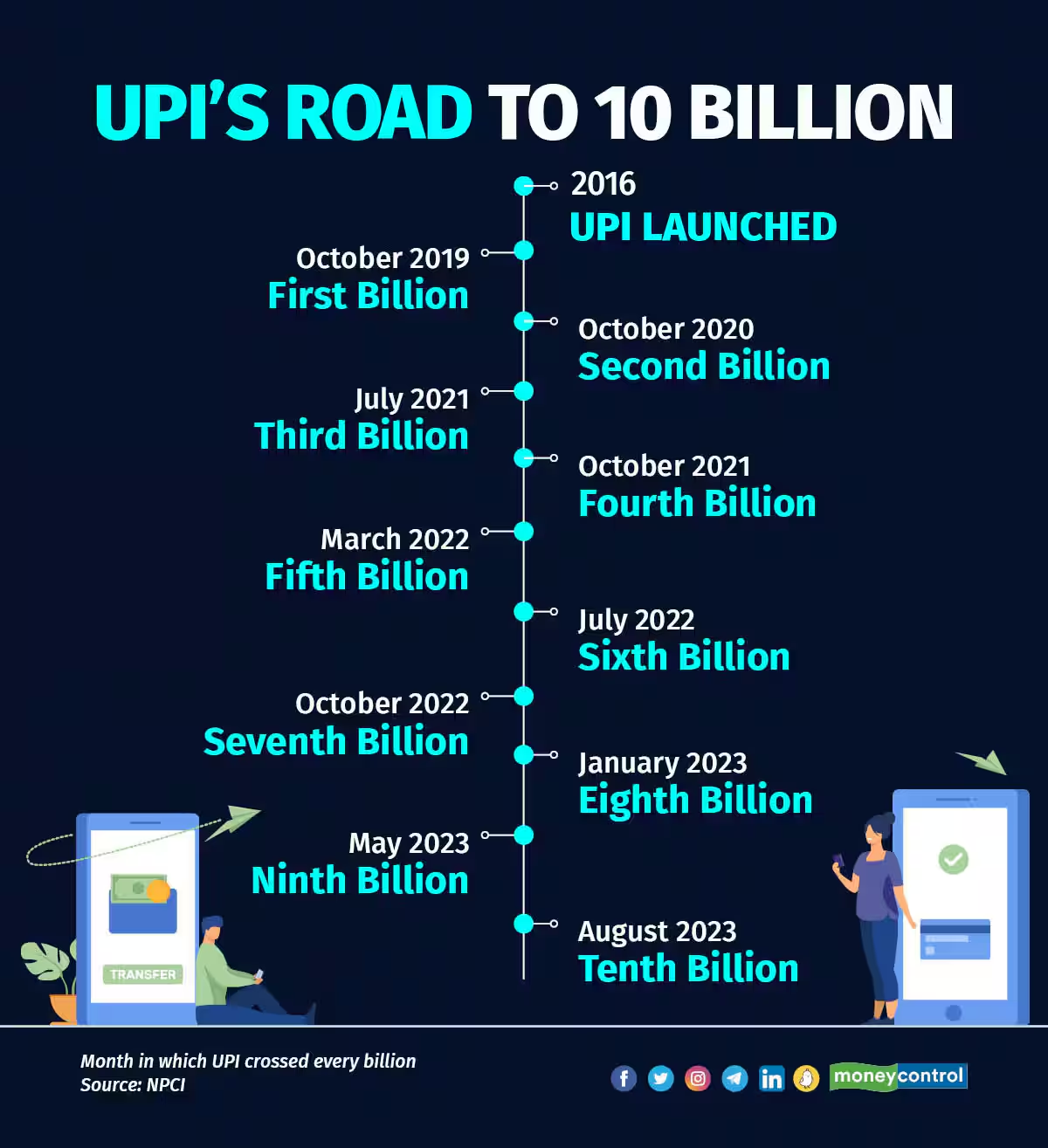
UPI’s success is indisputable. Its user-friendly interface and bank interoperability have made it accessible to millions of Indians. The rapid adoption of UPI can be attributed to its simplicity and convenience, enabling users to send and receive money seamlessly. Its growth from a mere 0.2 million transactions in August 2016 to over 10 billion transactions in August 2023 is a testament to its widespread acceptance.

Financial Inclusion: UPI’s Greatest Triumph

One of the most significant achievements of UPI is its role in furthering financial inclusion. It has allowed people in remote areas to access banking services, make digital payments, and participate in the formal financial system (Daya & Madar, 2018). The Jan Dhan Yojana and Aadhar integration have played pivotal roles in enabling this, but UPI has acted as the vehicle for reaching the underserved.

Security Concerns and Frauds

While UPI offers numerous benefits, it has its share of challenges. Security concerns and frauds have been a growing issue. Despite stringent regulations and guidelines, instances of phishing, social engineering, and unauthorized access have been reported. The ease of transferring funds via UPI has made it an attractive target for cybercriminals (Jajodia & Krishnaswamy, 2017).

Digital Divide and Accessibility

Another critical issue is the digital divide in India. While UPI has made banking services more accessible, it has also left behind a significant portion of the population that lacks access to smartphones, the internet, or digital literacy. The government must address these disparities to ensure that the benefits of UPI reach every citizen.

Transaction Costs and Merchant Concerns

For businesses, minimal vendors, UPI has been a double-edged sword. While it provides a platform for digital payments, the associated transaction fees can be burdensome, particularly for those operating on slim profit margins. This cost factor has led to a reluctance to adopt UPI, which is a concern for the broader goal of a cashless economy.

Regulatory Challenges

The regulatory framework governing UPI needs continuous refinement. Disputes over revenue sharing between various stakeholders and concerns about monopolistic behavior by certain players like Google Pay and PhonePe have highlighted the need for stricter regulation. An equitable and transparent ecosystem is essential to maintain UPI’s integrity.

Privacy Concerns

UPI transactions generate a significant amount of data, which raises concerns about user privacy. The potential misuse of transaction data for profiling or targeted advertising requires robust data protection regulations and practices.

Concluding Remarks

UPI’s emergence in India has undoubtedly transformed the country’s payment landscape and has contributed to greater financial inclusion. However, it is essential to critically assess its impact and address the challenges it faces. Striking the right balance between convenience, security, and affordability, while ensuring accessibility for all, is crucial for the continued success of UPI. Additionally, regulatory and privacy concerns must be addressed to safeguard users’ interests and maintain trust in this revolutionary payment system.

References

  1. Daya, H., & Mader, P. (2018). Did demonetisation accelerate financial inclusion. Economic & Political Weekly, 53(45), 17-20.
  2. Jajodia, N., & Krishnaswamy, A. (2017). A Cashless Society, Cyber Security and the Aam Aadmi. Economic and Political Weekly, 35-38.
  3. Shree, S. (2023). India’s fintech industry and the G20 summit. Economic and Political Weekly, 58(2). https://www.epw.in/journal/2023/2/letters/indias-fintech-industry%C2%A0and-g20-summit.html
  4. Singh, S. K., Singh, S. S., & Singh, V. L. (2022). The adoption of Unified Payments Interface in India. Economic and Political Weekly, 57 (48). https://www.epw.in/journal/2022/48/commentary/adoption-unified-payments-interface-india.html

Role of India in Multipolar Global Political Economy

Daily writing prompt
What are your thoughts on the concept of living a very long life?

By Shashikant Nishant Sharma

India’s role in the multipolar global political economy is significant due to its economic and geopolitical importance. India is the world’s sixth-largest economy and has been experiencing steady economic growth in recent years. The country’s strategic location between East and West, coupled with its large population, make it an important player in the international arena. 

India’s economic policies and reforms have contributed to its rise as a major economic power. The country has implemented policies to attract foreign investment and has opened up various sectors for private participation. The government has also focused on improving infrastructure, developing a skilled workforce, and promoting entrepreneurship. In addition to its economic importance, India also plays a significant role in global politics. The country is a member of various international organizations, including the United Nations, World Trade Organization, and BRICS. India’s leadership has been instrumental in shaping the agenda of these organizations and in promoting the interests of developing countries. India’s strategic location also makes it an important player in regional geopolitics. The country has been involved in various peacekeeping missions, and its military capabilities have been growing in recent years. India has also been strengthening its relationships with other major powers, including the United States, Russia, and China. Overall, India’s role in the multipolar global political economy is likely to continue to grow in the coming years. The country’s economic and geopolitical importance, coupled with its strategic location, make it a key player in the international arena. Global trade is an essential aspect of the modern economy, and it relies heavily on trust and confidence between parties involved. A breach of confidence can have severe consequences for international trade and the global economy as a whole.

A breach of confidence in global trade can take many forms, including the failure to fulfill contractual obligations, misrepresentation of goods or services, or the theft of intellectual property. These breaches can result in legal disputes, loss of revenue, and damage to reputation, which can be costly for businesses and countries involved. When a breach of confidence occurs, it can lead to a breakdown in trust between parties involved, making it more challenging to engage in future trade deals. This can lead to increased transaction costs, reduced investment, and lower economic growth, ultimately impacting consumers. The World Trade Organization (WTO) and other international bodies play a crucial role in promoting fair trade practices and resolving disputes between countries. However, their effectiveness is limited when it comes to enforcing trade agreements and preventing breaches of confidence.

Dollar hegemony refers to the dominant position of the US dollar in the global economy as the primary reserve currency and medium of exchange. The term is used to describe the extensive use of the US dollar in international trade, finance, and investment, giving the United States significant economic and political power.

The dollar’s dominance dates back to the Bretton Woods agreement of 1944, where the US dollar was established as the international reserve currency, and other countries pegged their currencies to the dollar. This allowed the US to enjoy significant economic and political power and played a crucial role in the post-World War II economic order. Today, the dollar remains the dominant currency in international trade and finance, with over 60% of global foreign exchange reserves held in US dollars. Many countries continue to use the dollar as a medium of exchange, and international commodity prices are usually quoted in dollars. The dollar’s dominance has several implications for the global economy. First, it provides the United States with a unique advantage in international trade, as other countries are dependent on the US dollar to conduct transactions. Second, it allows the US to borrow at lower interest rates, as investors have a high level of confidence in the US dollar and the US economy. However, the dollar’s hegemony also comes with some challenges. The US’s monetary policy decisions can have significant impacts on the global economy, as changes in interest rates and other monetary policies can affect other countries’ economies. Additionally, the US’s high level of debt has raised concerns about the dollar’s stability as a reserve currency. In recent years, there have been calls for the diversification of international reserve currencies and the establishment of alternative payment systems. Some countries, including China and Russia, have been promoting the use of their currencies in international trade and finance to reduce their dependence on the US dollar.

Overall, dollar hegemony continues to shape the global economy, and it is an essential factor in international trade and finance. The ongoing debates around its stability and the need for diversification demonstrate the complex and ever-changing nature of the global economic order.

India plays a significant role in the multipolar global political economy due to its economic and geopolitical importance. The country’s economic policies and reforms have contributed to its rise as a major economic power, and its strategic location makes it a key player in regional geopolitics. India’s leadership has been instrumental in shaping the agenda of international organizations and promoting the interests of developing countries.

However, India also faces several challenges, including poverty, inequality, and infrastructure gaps. The country has been working towards addressing these challenges through various initiatives such as the Make in India campaign, Digital India, and Swachh Bharat Abhiyan. India’s role in the global economy and its rise as a major economic power can provide opportunities for businesses and investors to tap into its large market and skilled workforce. The country’s focus on innovation and entrepreneurship can also create opportunities for collaboration and partnership in various sectors. 

In conclusion, India’s position in the multipolar global political economy is significant, and its continued growth and development will have far-reaching implications for the global economy. However, the country faces several challenges that need to be addressed, and there is a need for continued investment and collaboration to unlock its full potential.

References

Bastos, M. (2014). The Indian Ocean and the rise of a multi-polar world order: The role of China and India. Policy Perspectives: The Journal of the Institute of Policy Studies11(2), 17-28.

Chakraborty, S. (2018). Significance of BRICS: Regional powers, global governance, and the roadmap for multipolar world. Emerging Economy Studies4(2), 182-191.

Cooper, A. F., & Flemes, D. (2013). Foreign policy strategies of emerging powers in a multipolar world: An introductory review. Third World Quarterly34(6), 943-962.

Kukreja, V. (2020). India in the emergent multipolar world order: Dynamics and strategic challenges. India Quarterly76(1), 8-23.

Peters, M. A. (2023). The emerging multipolar world order: A preliminary analysis. Educational Philosophy and Theory55(14), 1653-1663.

Sharma, S. N. (2017). Geopolitics and Terrorism in Asia-Pacific Region vis-a-vis India.

What is Street Index

Daily writing prompt
Is your life today what you pictured a year ago?

The term “street index” can refer to different concepts depending on the context in which it’s used. Below are some of the most common meanings:

Photo by Josh Sorenson on Pexels.com
  1. In Urban Planning or Mapping: A street index is a reference list or map that organizes the streets within a particular area. This index allows people to easily locate streets based on their names, numbers, or grid system. It might be included in city maps, directories, or GPS applications, providing a comprehensive list of streets and their locations.
  2. In Finance or Economics: A street index can sometimes refer to a benchmark or index that tracks the performance of a specific set of stocks or financial instruments, similar to the way the Dow Jones Industrial Average or S&P 500 tracks stock market performance. In this sense, “street” could be a shorthand reference to Wall Street or financial markets in general.
  3. In Real Estate: A street index might be used to track property values, trends, or transactions specific to various streets within a city or region. This could be used by real estate professionals or analysts to measure the relative value of properties in certain areas.
  4. In Postal Systems or Directories: A street index might be used in postal codes or address directories, helping individuals or delivery services quickly find specific streets based on postal codes or other identifiers.

If you meant a different concept by “street index,” please clarify, and I’d be happy to provide more specific information.

From Uncertainty to Security


How PMAY-G Transformed Nondo’s Life!

In the small village of ‘Rotlang W’ in Mizoram,’ Nondo’s family faced a constant battle for survival. As a daily wage laborer, Nondo worked tirelessly to feed his wife and five children. Yet, no amount of effort could change the harsh reality of their living conditions. Their dilapidated kutcha house, with its leaky roof and crumbling walls, offered little protection against the elements. 

During the monsoons, water seeped through the roof, soaking their clothes and bedding. Winters were unbearably cold, with biting winds finding their way through the fragile structure. The family’s health and peace of mind suffered with every cold night made us worry if our house would hold up.

Relief came in 2017 when Nondo’s name appeared on the beneficiary list of the Pradhan Mantri Awaas Yojana – Grameen (PMAY-G). The scheme, designed to provide pucca houses for vulnerable rural families, offered Nondo the opportunity to build a secure home. With financial assistance and support from local officials, construction of his house began. 

rotlanf w.jpeg

Lunglei District, Mizoram

By the end of the year, the family moved into their new home. It was a simple and sturdy structure, built to withstand harsh weather and provide a safe haven for the family. The new house brought a profound sense of security to Nondo’s family. No longer did they worry about rainwater flooding their home or chilly winds making their children sick. Their pucca house stood firm against the elements, offering warmth and stability. The newfound security also gave Nondo a sense of pride and belonging. For the first time, his family could welcome guests into their home without embarrassment or fear of judgment. 

Nondo’s story is a testament to the transformative power of PMAY-G, launched in 2016 by the Government of India to fulfil the vision of “Housing for All.” The scheme focuses on providing pucca houses with essential amenities to rural families living in kutcha houses or without a home. The key features of PMAY-G include providing financial assistance for constructing houses with a minimum size of 25 square meters. The scheme prioritizes vulnerable groups such as houseless families, households without literate adults, and those reliant on casual labour for income. Special emphasis is placed on supporting marginalized communities, including Scheduled Castes, Scheduled Tribes, and other disadvantaged sections of society.

Through such targeted measures, the program ensures that the most deserving households, like Nondo’s, benefit first.

Today, Nondo and his family live with peace of mind, no longer burdened by the fear of homelessness or the harshness of nature. Their pucca house is more than a shelter; it is a symbol of hope, resilience, and progress. 

References

PMAY Success stories

*******

Financial and Passport Related Services by Post Offices

The details of the financial and passport related services primarily being provided by the post offices to the customers are attached herewith.

SchemeFeatures
Post Office Passport Seva Kendras (POPSK)Currently, providing the passport services at 442 Post Offices Passport Seva Kendras
Post Office SavingsAccount (POSA)For regular savings, withdrawals etc.Min. balance – ₹ 500/- and ₹ zero in case of Basic Savings AccountATM / Internet & Mobile Banking Facility / NEFT & RTGSPost office Savings Accounts with India Post Payment Bank account linkage for UPI, IMPS etc.
Recurring Deposit (RD)Min. instalment (per month): ₹ 100/- and thereafter any amount in the multiple of ₹ 10/-Max. instalment: No limitTerm: 5 Years and extendable for another 5 years
Time Deposit (TD)1/2/3/5 Year(s)Min. Deposit (Single): ₹ 1000 /- or in the multiple of ₹ 100/-Max. Deposit: No limitIncome Tax exemption for investment in 5 Year TDExtension – Twice after completion of term
MonthlyIncome Scheme  (MIS)For source of monthly incomeMin. Deposit: ₹ 1,000/- or in its multipleMax. Deposit: ₹ 9.0 lakh /- (individual); ₹ 15 lakh (in Joint)Term – 5 Years
Senior Citizens Savings Schemes (SCSS)Special scheme for Senior CitizensFor source of quarterly incomeMin. Single Deposit: Rs. 1,000/- or in its multipleMax. Deposit: Rs. 30,00,000/-Term – 5 Year and extendable after the expiry of each block period of three years
Public Provident Fund (PPF)Min. Initial Deposit: ₹ 500/-Max. Deposit: ₹ 1,50,000/- in a Financial YearMin. Subsequent deposit in the multiple of ₹ 50/-Income Tax exemption for investmentTax free InterestTerm – 15 Years and extendable further
 Sukanya Samriddhi Yojana Account (SSA)Special Scheme for girl childrenMin. Initial Deposit: ₹ 250/-Max. Deposit: ₹ 1,50,000/- in a Financial YearMin. Subsequent deposit in the multiple of ₹ 50/-Income Tax exemption for investmentTax free InterestTerm – 21 Years
NationalSavings Certificate – VIII Issue (NSC)Minimum investment – ₹ 1,000/-Maximum investment: No limit – In multiples of ₹ 100/-Income Tax exemption for investmentTerm – 5 years
Kisan Vikas Patra (KVP) Minimum investment – ₹ 1,000/-Maximum investment: No limit – In multiples of ₹ 100/-Maturity – Double the amount of investment
Mahila Samman Savings Certificate (MSSC)Special Scheme for Women and girl childrenInvestment is allowed from 01.04.2023 to 31.03.2025Minimum investment – ₹ 1,000/-Maximum investment: ₹ 2 Lakh per individual – In multiples of ₹ 100/-3 months-time-gap between the opening of accountsTerm – Two yearsLockup period – 6 months
PM Cares for Children Scheme 2021Special scheme for the beneficiaries identified by Ministry of Women and Child DevelopmentInitially, 4515 accounts were opened and fundedInvestment differs based on the age of child and maturity amount is ₹10 LakhMIS Interest is payable on 10 Lakh from the age of 18 to 23Maturity at the age of 23 of the account holders.
India Post Payment Bank (IPPB) Savings and current accounts Virtual Debit Card Domestic Money Transfer services Bill and utility payments Insurance services for IPPB customers

“Payroll Reporting in India: An Employment Perspective –September, 2024”

Ministry of Statistics & Programme Implementation is releasing the employment related statistics in the formal sector covering the period September 2017 onwards, using information on the number of subscribers who have subscribed under three major schemes, namely the Employees’ Provident Fund (EPF) Scheme, the Employees’ State Insurance (ESI) Scheme and the National Pension Scheme (NPS).

The full report can be accessed at: Payroll Reporting in India An Employment Perspective –September, 2024.pdf

1.Employees’ Provident Funds Scheme:

The total number of new EPF subscribers during the month of September, 2024 is9,47,068, which was 9,78,275during the month of August, 2024. The highest number of EPF subscribers 1,117,481 were added during July, 2024.

​​​​​​​2.Employees’ State Insurance Scheme:

The newly registered employees and paying contribution under the ESI scheme during the month of September,2024 is 15,02,964which was 15,25,086 during the month of August, 2024.

3.National Pension Scheme (NPS):

During September 2024, the NPS recorded a total of 58,018new contributing subscribers which was54,869 duringthe month of August, 2024.

*****

INCREASING TREND OF EMPLOYMENT IN INDIA

The official data source on Employment and Unemployment is Periodic Labour Force Survey (PLFS) which is conducted by the Ministry of Statistics and Programme Implementation (MoSPI) since 2017-18. The survey period is July to June every year. As per the latest available Annual PLFS reports, the estimated Worker Population Ratio (WPR) and Unemployment Rate (UR) on usual status for persons of age 15 years and above in the country is as follows:

YearWPR (in %)UR (in %)
2017-1846.86.0
2018-1947.35.8
2019-2050.94.8
2020-2152.64.2
2021-2252.94.1
2022-2356.03.2
2023-2458.23.2

                          Source: PLFS, MoSPI

The above data indicates that the WPR i.e. employment has increasing trend and Unemployment Rate has a decreasing trend over the years.

The KLEMS (K: Capital, L: Labour, E: Energy, M: Materials and S: Services) database published by Reserve Bank of India’s (RBI) provides employment estimates at all India level. As per the latest data of the database, provisional estimates for 2023-24, employment in the country increased to 64.33 crore in year 2023-24 compared to 47.15 crore in 2014-15. Total increase in employment during 2014-15 to 2023-24 is about 17 crore.

To provide various employment related services to the youth of the country on a single platform, Government of India has launched National Career Service (NCS) portal (www.ncs.gov.in) which includes services like job search & matching, career counselling, vocational guidance, information on skill development courses, internships etc through the portal.  During the year 2024-25 (as on 15.11.2024), 1.12 crore vacancies were posted on NCS portal and more than 3.53 Crore number of vacancies mobilized on the portal since its launch in 2015.

Further, Government of India has also launched MY Bharat platform which provides myriad opportunities for youth engagement through various organizations onboarded on the portal with a view to involve them in meaningful activities. The MY Bharat portal is envisioned as a pivotal, technology-driven facilitator for youth development and youth-led development, with the overarching goal of providing equitable opportunities to empower the youth in realizing their aspirations.

Employment generation coupled with improving employability is the priority of the Government. Accordingly, the Government of India has taken various steps for generating employment in the country.

The various Ministries/ Departments of Government of India like Ministry of Micro, Small and Medium Enterprises, Ministry of Rural Development, Ministry of Housing and Urban Affairs, Ministry of Finance, Ministry of Textiles, Ministry of Electronics and Information Technology, etc. are implementing different employment generation schemes/ programmes like Prime Minister’s Employment Generation Programme (PMEGP), Mahatma Gandhi National Rural Employment Guarantee Scheme (MGNREGS), Deen Dayal Upadhyaya Grameen Kaushalya Yojana (DDU-GKY), Rural Self Employment and Training Institutes (RSETIs),  Deendayal Antyodaya Yojana-National Urban Livelihoods Mission (DAY-NULM), Pradhan Mantri Mudra Yojana (PMMY),  etc. including increase in capital expenditure to boost employment creation. The details of various employment generation schemes/programmes being implemented by the Government of India may be seen at https://dge.gov.in/dge/schemes_programmes.

Further, Government announced in the Budget 2024-25, the Prime Minister’s package of 5 schemes and initiatives to facilitate employment, skilling and other opportunities for 4.1 crore youth over a 5-year period with a central outlay of Rs. 2 lakh crore.

Labour Force Indicators Providing Evidence of Improved Employment Scenario in India

India Employment Report, 2024 of Institute for Human Development (IHD) – International Labour Organisation (ILO) mentioned that in ILO’s Global Report Trends for Youth, 2022, the worldwide youth unemployment rate was 15.6 per cent in 2021. Further, as per World Employment and Social Outlook Trends, 2024 by ILO, globally, in 2023, the youth unemployment rate was 13.3 per cent.

The official data source of Employment/ Unemployment indicator in India at present is the Periodic Labour Force Survey (PLFS) conducted by the Ministry of Statistics and Programme Implementation (MoSPI) since 2017-18. The survey period is July to June of the next year. As per the latest available Annual PLFS reports, the estimated Unemployment Rate (UR) on usual status for youth of age 15-29 years in the country in the year 2023-24 was 10.2% which is lower than global levels. Further, the Worker Population Ratio (WPR) for youth indicating employment has increased from 31.4% in 2017-18 to 41.7% in 2023-24.

Employees’ Provident Fund Organization (EPFO) Payroll Data gives an idea of the level of employment in the formal sector. More than 1.3 crore net subscribers joined EPFO during 2023-24. Moreover, during September 2017 to August, 2024, more than 7.03 crore net subscribers have joined EPFO, indicating increase in formalisation of employment. 

All the labour force indicators are providing evidence of improved employment scenario in the country.

Employment generation coupled with improving employability is the priority of the Government. Accordingly, the Government of India has taken various steps for generating employment in the country.

The various Ministries/ Departments of Government of India like Ministry of Micro, Small and Medium Enterprises, Ministry of Rural Development, Ministry of Housing and Urban Affairs, Ministry of Finance, Ministry of Textile, etc. are implementing different employment generation schemes/ programmes like Prime Minister’s Employment Generation Programme (PMEGP), Mahatma Gandhi National Rural Employment Guarantee Scheme (MGNREGS), Pt. Deen Dayal Upadhyaya Grameen Kaushalya Yojana (DDU-GKY), Rural Self Employment and Training Institutes (RSETIs), Deen Dayal Antodaya Yojana-National Urban Livelihoods Mission (DAY-NULM), Pradhan Mantri Mudra Yojana (PMMY), etc. The details of various employment generation schemes/ programmes being implemented by the Government of India may be seen at https://dge.gov.in/dge/schemes_programmes.

CREDAI to formalise its 14,000 members, says social security of labour crucial to real estate growth

Daily writing prompt
What is one thing you would change about yourself?

The real estate sector should look at a greater formalisation that will help the industry grow faster. This was stated by Union Minister of Commerce & Industry, Shri Piyush Goyal during his keynote address at the 25th Foundation Day of CREDAI (Confederation of Real Estate Developers’ Associations of India) in New Delhi today. He further urged the industry to engage the labour in formal employment, giving them the social security benefits of insurance (ESIC) and provident fund (EPFO). This will help in the number of employees getting reflected in annual reports and in national statistics. If social security, healthcare and post-retirement benefits are provided then the employees will align with the industry’s goals of enhancing their quality of work leading to better productivity and greater profits, he said. 

Photo by Alex Staudinger on Pexels.com

Commerce and Industry Minister also appealed to CREDAI to expedite formalisation of its 14,000 members. If everyone who works for CREDAI will receive salary through digital payment and if it is ensured that employees working in the ecosystem is a part of the national effort to meet the needs of the people, CREDAI’s contribution to employment will get recognised and rewarded, he said.

In his address, Shri Goyal raised the issue of environment pollution and urged CREDAI to consider setting up a team to study ways to adopt better construction techniques in the metropolitan cities of India. He further suggested the industry body to  take this up as a mission and report to the Government steps being taken in this direction. Adopting steel and precast fabrication will speed up construction benefitting the entire ecosystem. This can help in reducing AQI and pollution levels, he said.

Shri Goyal lauded CREDAI for its contribution to making India a powerhouse and also in its  journey towards Viksit Bharat and added that the industry has not only worked with brick and mortar to collectively prepare the nation for the future but has worked to provide opportunities and aspirations to the nation. Real estate contributes to the economy and jobs, he said.

Emphasising the difficulty citizens faced earlier in owning homes, Shri Goyal pointed out that a concerted effort has been undertaken in the last ten years to clean up processes, promote Ease of Doing Business and encourage businesses to expand. He also noted that bringing The Real Estate (Regulation and Development) Act (RERA) into effect in 2017 was a challenge, however, the regulations have enabled citizens to acquire homes without dispute. The Minister further highlighted CREDAI’s commitment to rectify the processes and pointed out that provisions like Goods and Services Tax (GST), RERA Act and efforts to eliminate irregular transactions have resulted in an organised growth of the real estate sector.

Hailing Prime Minister Shri Narendra Modi’s efforts to clean up the banking system, Shri Goyal noted that non-performing assets (NPAs) have decreased significantly and banks have strong credit portfolios with strong balance sheets, maintaining healthy profit each year. It shows how important the banking sector is for the real estate sector and for the economy to gain momentum in meeting the aspirations of the nation. As income levels rise, more people will take possession of their homes as they will be able to afford cheaper loans at  lower interest rates, he said.

Shri Goyal also spoke about affordable rental housing and announced that the Government would be engaging in discussions with the industry body to find ways to provide affordable rental to the citizens, besides working on the rehabilitations programme for slum dwellers. He said that affordable rental housing if made available would be able to stop the proliferation of slums in cities. Shri Goyal pointed out that aspects like parking lots and spaces for entertainment families should be looked into when planning layouts. He added that we need to recycle construction waste so that we move towards a circular economy as to be a net zero nation we have to begin from net zero localities and societies. 

Encouraging the industry leaders and participants to look for real estate opportunities abroad, Shri Goyal said that expanding the real estate footprint outside India will add to India’s exports and infrastructure services. He also urged the industry to expand its sector and the 250+ associate industries to make real estate a $1 trillion contributor to the nation.

***

PM-Vidyalaxmi scheme to provide financial support to meritorious students so that financial constraints

The Union Cabinet, chaired by Prime Minister Shri Narendra Modi, has approved PM Vidyalaxmi, a new Central Sector scheme that seeks to provide financial support to meritorious students so that financial constraints do not prevent anyone from pursuing higher studies. PM Vidyalaxmi is another key initiative stemming out of the National Education Policy, 2020, which had recommended that financial assistance should be made available to meritorious students through various measures in both public and private HEIs. Under the PM Vidyalaxmi scheme, any student who gets admission in quality Higher Education Institution (QHEIs) will be eligible to get collateral free, guarantor free loan from banks and financial institutions to cover full amount of tuition fees and other expenses related to the course. The scheme will be administered through a simple, transparent and student-friendly system that will be inter-operable and entirely digital.

The scheme will be applicable to the top quality higher educational institutions of the nation, as determined by the NIRF rankings – including all HEIs, government and private, that are ranked within the top 100 in NIRF in overall, category-specific and domain specific rankings; state government HEIs ranked in 101-200 in NIRF and all central government governed institutions. This list will be updated every year using the latest NIRF ranking, and to begin starts with 860 qualifying QHEIs, covering more than 22 lakh students to be able to potentially avail benefits of PM-Vidyalaxmi; if they so desire.

For loan amount up to ₹ 7.5 lakhs, the student will also be eligible for a credit guarantee of 75% of outstanding default. This will give support to banks in making education loans available to students under the scheme.

In addition to the above, for students having an annual family income of up to ₹ 8 lakhs, and not eligible for benefits under any other government scholarship or interest subvention schemes, 3 percent interest subvention for loan up to ₹ 10 lakhs will also be provided during moratorium period. The interest subvention support will be given to one lakh students every year. Preference will be given to students who are from government institutions and have opted for technical/ professional courses. An outlay of ₹ 3,600 Crore has been made during 2024-25 to 2030-31, and 7 lakh fresh students are expected to get the benefit of this interest subvention during the period.

The Department of Higher Education will have a unified portal “PM-Vidyalaxmi” on which students will be able to apply for the education loan as well as interest subvention, through a simplified application process to be used by all banks. Payment of interest subvention will be made through E-voucher and Central Bank Digital Currency (CBDC) wallets.

PM Vidyalaxmi will build on and further enhance the scope and reach of the range of initiatives undertaken by the Government of India over the past decade in the domains of education and financial inclusion, for maximizing access to quality higher education for the youth of IndiaThis will supplement the Central Sector Interest Subsidy (CSIS) and Credit Guarantee Fund Scheme for Education Loans (CGFSEL), the two component schemes of PM-USP, being implemented by the Department of Higher Education. Under the PM-USP CSIS, students with annual family income up to ₹ 4.5 lakhs and pursuing technical/ professional courses from approved institutions get full interest subvention during moratorium period for education loans up to ₹ 10 lakhs. Thus, PM Vidyalaxmi and PM-USP will together provide holistic support to all deserving students to pursue higher education in quality HEIs and technical/ professional education in approved HEIs.

*****