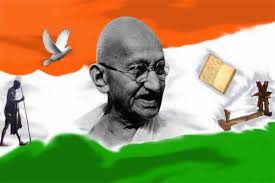
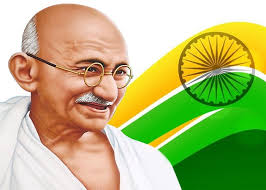
The name ‘Gandhi’ needs no introduction. Any part of the world that understands civilisation and humanitarian values appreciates Mahatma Gandhi (October 2, 1869-January 30, 1948). Thus it doesn’t come as a surprise that you find Gandhi fans in a diverse range-from the present American President, Barack Obama to philanthropic groups working in Rio
Movements launched by Mahatma Gandhi:
Mahatma Gandhi overcame insurmountable odds to bring the mighty British Empire to its knees. It is not merely because of the Non-cooperation Movement or the Dandi March (1931) that we know him today. It is true, of course, that these movements, along with the Quit India Movement (1942), brought the British Government to its knees. Gandhi was a man of the masses. Such was his popularity that the British went weak in their knees at the prospect of arresting him. They were afraid of making a martyr of him and thus adding to his popularity. This was no mean achievement for a man described by Winston Churchill as a ‘half- naked fakir’. Gandhi’s idea of non-violent resistance against the British rule appealed to the conscience of the Indian society groaning under the unjust rule of the British since the Battle of Plassey in 1757.
When Gandhi put Satyagraha into action for the first time in South Africa in1906 and became a success there, it didn’t take much time to recognise and hail the arrival of a great leader. But Gandhi was more than a messiah in the world of politics. He was a powerful social reformer who campaigned relentlessly to end discrimination against India’s untouchable class, whom he called the Harijans (children of God).
Mahatma Gandhi Awards:
• In 1930, Gandhi was named the Man of the Year by Time’s Magazine. • In 2011, Time magazine named Gandhi as one of the top 25 political icons of all time. • He did not receive the Nobel Peace Prize despite being nominated five times between 1937 and 1948.
• The Government of India institutionalized the annual Gandhi Peace Prize to distinguished social workers, world leaders, and citizens. Nelson Mandela, the leader of South Africa’s struggle against apartheid was a recipient of the award
About Mahatma gandhi Personality:
The spiritual strength of Gandhi’s personality has to be given due recognition. His autobiography My Experiments with Truth bears a living testimony to this. Gandhiji used his spiritual strength to overcome all opposition. He walked across the country’s villages trying to make its people realise the importance of sanitation and healthy habits. If this does not prove his sincerity, let us remember his fast-unto-death in the riot-hit Calcutta of September 1947, which brought the Hindus and Muslims together again after a terrible violence.
Would any of our leaders today dare to walk the riot-hit streets of Noakhali with only a Tagore song to give him company? It is stupid to question the courage of this man who perhaps might even have achieved the impossible task of unifying India and Pakistan again had he not been shot dead by a fanatic called Nathuram Godse on January 30, 1948.
Film on Mahatma Gandhi:
Ben Kingsley portrayed Mahatma Gandhi in the 1982 film Gandhi, which won the Academy Award for Best Picture. Therefore, Mahatma Gandhi would be remembered forever as he spread the message of non-violence, truth, faith in God, and also he fought for India’s Independence. His methods inspired various leaders, youth not only in India but also out of India. In Indian history, he is considered as a most prominent personality and as the simplest person who wears dhoti. He spread the message of swaraj and taught Indians how to become independent.
Owning a piece of land in the world is a dream for many people. People having their own place for settlement is the daily struggle. Many Country politics are revolving around settlements, refugees and Wars for acquiring other colonies are daily news.
But do you know who own not only a piece of land but multiple countries?
Owner of 16 Countries
The world’s biggest Landowner is Queen Elizabeth II, who legally owns about 16.6% of the Earth’s land surface. She is the only person on the earth who owns multiple countries.
Queen Elizabeth II serves as the Head of State of United Kingdom, Barbados, Antigua and Barbuda, Australia, Bahamas, Belize, Canada, Grenada, Jamaica, New Zealand, Papua New Guinea, Saint Kitts and Nevis, Saint Lucia, Saint Vincent and the Grenadines, Solomon Islands and Tuvalu.
These nations are termed as “Commonwealth Realms”. These nations were former British colonies. The British sovereign retains the position she holds in the United kingdom that of the Head of State. As in Britain, this is largely a ceremonial role from day to day.
Many nations have withdrawn from the Queen’s rule before as like that from these 16 current nations, Barbados has announced that it will remove Queen Elizabeth II as the country’s head of state and become Republic by November 2021.
After which Queen Elizabeth II will own 14 Countries in addition to the home country United Kingdom.
The origin of chess is something that is debated and there is not really a consensus on its origin or even the history of chess, from the old to the present.
Some say that versions of chess and its board date back from Ancient Egypt or Dynastic China, but its most supported origin is that it first appeared in India around the 6th century, at that time it would have the name of Chaturanga.
Over time, it eventually reached Persia and its name eventually changed, being now called Xatranje, probably having other rules as well.
It eventually spread throughout Europe slowly and it took about 500 years for Xatranje to begin to look more like the chess we know today.
In the yoer of 1475 began to be consolidated with the current rules and its name also eventually changed to chess but it still took a few hundred years for Europe to play with the most modern pieces and rules as well.
In the middle of the nineteenth century began to appear tournaments and chess competitions, thus giving rise to a sport, which was always dominated by the same players and had World champions who maintained their reign for long periods, 20 / 30 years for example.
Chess game
The game of Chess aims to give the “mate” in the king of the opponent player. This happens in the following situations:
The king can not move to any house (they are all in the attack line of the opponent’s pieces);
No part can stand in front and protect the King;
The piece you are attacking cannot be captured;
If any of these conditions arise, then the “mate” or “checkmate” will occur and the game ends, winning the player who applied the “mate”.
Board and Chess Pieces
The chessboard is composed of squares of white and black color (8 squares of length on each side), being these always alternating.
The pieces also have the same colors and each color corresponds to the pieces of a player.
The board should be positioned so the last house on the right side of the row closest to each player is a white square.
The game of chess consists of the following pieces:
Pawn
Tower
Horse
Queen
Bishop
Rei
The pieces have their own order to be placed on the board (Follow the positions that are represented in the image);
Please note: The position of the King and Queen changes depending on the player, following the rule:
White King – Black House Black King – White House White Queen – White House Black Queen – Black House
Who starts playing is always the player who owns the white pieces.
Chess Moves / Plays
Each piece has its unique way of moving around on the board, which enables a very large number of patterns and strategies, making chess a strategy sport and more interesting.
The possible plays per house piece are:
Pawn This can only just move forward (no more part has this rule), being that it can only advance 1 home in front, or 2 if it has never been tweaked. It is also the only one that moves differently when it is to take the opponent’s piece, and he can only take the piece that is diagonally forward.
Tower The tower has a fairly simple movement. It can move forward, backward, left or right in a straight line across the entire board as long as it has the path without any part.
Horse The horse is the one that has the most unique movement. It can only move in L. format. This means that you can only walk two houses forward and one to the side at each move. This piece can already make your move jumping over other pieces (it’s the only one with this rule).
Bishop The bishop has a movement similar to that of the Tower, only the latter, instead of moving in a straight line, moves diagonally, and can not pass over any part either.
Queen This is considered the most powerful piece of Chess, this due to its versatility of movements since it can make the same movements of the Tower and the Bishop.
Rei The King can move 1 each in all directions. The only restriction that this has is not being able to go to a house that is “check” (in the line of attack) by some part of the opponent.
Special moves
There are certain moves that can be made under special circumstances that make this magnificent game even more interesting and competitive. The special plays that exist are:
Pedestrian Promotion
When you can get one of your pawns to reach the end of the board (on the first line of the opponent), the pawn must be replaced by another piece (being a bishop, tower, queen, or horse), and is usually chosen the queen since it is the most powerful piece of the game.
Roque
It consists of a movement between the king and the queen, who change positions at the same time, in an attempt to defend the king by taking it from the center of the board and move the tower to a better position of attack.
In this movement, the king moves toward the tower two houses and the tower moves to the king’s side passing over him. There are two rocks: the small and the large, the only difference being its designation. The big rock is when the rock is made with the tower farthest from the king and the small is the opposite.
To make this move, certain conditions must be met:
The king could not have moved;
The tower can not have been moved;
The way between the tower and the king must be clean;
The king can not stand in a position that is in the line of attack of the enemy;
Passing
This is a special way for the pawn to move and can take the opponent’s pawn that passed next to him when he is in the 5 row counting from his field. Observe the images to better understand the move.
For this move there are also special conditions, which are:
Your pawn should be in the 5 row
The pawn of the opponent has advanced two houses and thus have stayed next to his;
The bid must be made immediately to the movement of your opponent;
Some Chess Rules
Chess also has some rules. Let’s just highlight the main rules that are usually addressed.
When a player lifts a piece, it may place it anywhere that is valid for the movement of that piece. After landing the piece cannot be removed, only if it has made an invalid movement.
When promoting a pawn, the player can touch a piece that is outside the board and change for his pawn, thus finishing the move;
During the Roque the player must first take the King and then in the Tower thus making their exchange of positions. If you touch both at the same time you can do it. If this one raises the King with the intention to make the Roque but this is impossible, then it must move the King to a valid house.
Players must not speak during the game, only when asking for a tie or advising the referee of any infraction. In games between amateurs it is common to announce the “check” but among professionals, the same should not be announced.
Modern art refers to the artistic work produced during the period of 1860s to the 1970s and represents the styles and philosophies of the art produced during that era. The term is usually pertains to the art in which the traditions of the past have been thrown aside in a spirit of experimentation. In India, the modern art movement began in the early 1900s. During 1900-1925, Bengal School dominated the Indian art. Bengal school of painting represented the first art movement in the country. Artists like Abindranath Tagore, Nandal Bose, Raja Ravi Verma, Jamini Roy were some of the pioneers of Bengal school. It was the rebirth of Indian art. Bengal school witnessed the departure of traditional painting methods like tempera. Chinese cloth painting and Japanese wash technique were used. The Japanese water colour technique called wash became the hallmark of Bengal school. This technique diluted the impact of the colours used giving the paintings a mystic sense of space and atmosphere. The these of the paintings included religious, social and historical events. Paintings of landscapes, birds and animals were also done. After 1925, artists refused to imitate the mannerisms of the art of the past. They argued that such imitation bounds the imagination and creativity of the artists. The contemporary artists stressed on liberating the imagination from the shackles of past. The art after 1925, was therefore very different from the previous Indian arts. There was variety in the techniques used and artworks were different from each other having more or less similarity. Technique like cubism was used by the artist Gaganendranath. Cubism is a European style of art which aims to show all of the possible viewpoints of a person or an object all at once. Cubistic artworks look like they are made out of cubes and other geometrical shapes. Chiaroscuro, which is a characteristic of the European Renaissance was used in his famous painting ‘Magician’. Chiaroscuro is the use of strong contrasts between light and dark, usually bold contrasts affecting a whole composition. The soft wash technique was discarded and oil painting started getting more recognition. These paintings had bold and contrasting colour scheme in comparison to the light wash technique of the Bengal school. The credit for popularising oil painting in India goes to Amrita Sher Gil. Graphic Prints stated getting popular as well. Artist Krishna Reddy used techniques like intaglio and kaleidoscopic effects in his graphic prints. Intaglio is a printmaking technique in which the image is incised into a surface and the incised line or sunken area holds the ink. It is a process of print on engraved design. In his painting ‘Whirlpool’ which is a intaglio on paper, Krishna Reddy has also used the method of viscosity printing. Viscosity printing is a multi-colour printmaking technique which is uses the viscosity of the paint or ink. Etching and aquatint was also used in contemporary print making. Etching is an intaglio printmaking process in which lines or areas are incised using acid into a metal plate in order to hold the ink. Aquatint is also an intaglio printmaking technique, a variant of etching that produces areas of tone rather than lines. Both of these techniques were used together to create contemporary prints. ‘The Children’ by Somnath Hore, ‘TheDevi’ by Jyoti Bhatt and ‘ Man, Women and Tree’ by K. Laxman Goud are some of the famous prints which have been made using these techniques.
Formation of the Bishnoi sect— India’s original environmentalists
Bishnoism originated in the 1485AD by Saint Guru Jambheshwar in theThar Desert of Rajasthan, India. Long before the world came to know about the environmental crises, Bishnois have been cognizant of man’s relationship with nature and the importance to maintain its delicate balance. It is remarkable that these issues were considered, half a century ago by Bishnoi visionaries. No other secthas given this level of importance to environment value, protection and care.
Not many of us know that the concept of Tree Huggers and Tree-Hugging, have roots within theBishnoi community. The famous ‘Chipko Movement’ was inspired by a true story of a brave lady called Amrita Devi Bishnoi who refused to let the kingsmen cut the trees and sacrificed her life to save the trees.
Sundarlal Bahuguna
This sacrifice not only inspired the “Chipco Andoloan” by Sunder Lal Bahuguna but also the Indian government. The “Amrita Devi Bishnoi Smrithi Paryavaran Award” for contributing to environment conservation is given to those who have significantly contributed for environment conservation.
The Bishnois are one of the first organized communities that have collectively sought for eco-conservation, wildlife protection, and green living. The ideals and tenets of the bishnois and bishnoism mentioned in the 29 religious tenets are very crucial and relevant to our ever evolving world.
The social concern, in medieval Rajasthan, manifested itself in various forms. To unite the people for a common cause, Guru Jambheswar Ji advised 29 principles to become a Bishnoi. The word ‘Bishnoi’ stands for ‘bish’ which means 20 and ‘noi’ which means 9; derived from these 29 principles out of which 6 principles are dedicated to environmental protection and compassion for all living beings.
Of the 6 tenets that focus on protecting nature, the two most profound ones are:
Jeev Daya Palani – Be compassionate to all living beings.
Runkh Lila Nahi Ghave – Do not cut green trees.
Though these rules date back centuries, they still hold the morals and the beliefs for which the bishnois stand and are more than relevant to the environmental problems faced in today’s world.
Conservation as a practical necessity
In the arid and semi-arid regions of western Rajasthan, Bishnoism as a sect has over the ages has not only proposed, but also internalised their practices in an effort to usher in new practices of conservation ethics in Rajasthan. A majority of the Bishnoi rules suggested maintenance of harmony with the environment, like the prohibition on cutting green trees and animal slaughter. One plausible explanation is that the economy was primarily sustained by animal rearing. Hence, any slaughter, even during droughts, would have affected their means of livelihood.
Similarly, the cutting of green trees was prohibited, as it would scale back the availability of green fodder for the cattle, especially in the dry region where natural vegetation was very thin and sparse. Jambhoji’s teachings, which were in line with the interests of the folk, became immensely popular primarily in the arid regions of Bikaner and Jodhpur. The number of his followers increased manifold in these regions. His principles became so influential that the rulers of these states were forced to respect his teachings and sermons. The Bishnois have since long proposed for placing restrictions and punishments for cutting trees.
Rajasthan’s landscape demands dependence on agricultural and cattle-rearing practices. The conservation of natural vegetation of the region helped sustain superior breeds of cattle for export to other regions, exports such as sheep for wool, and camels for transport proved beneficial. Trade and commerce were also an important component of these economies as is evident in the nature of taxation where non-agricultural production was also taxed extensively (Kumar 2005).
Protection of wildlife and animals
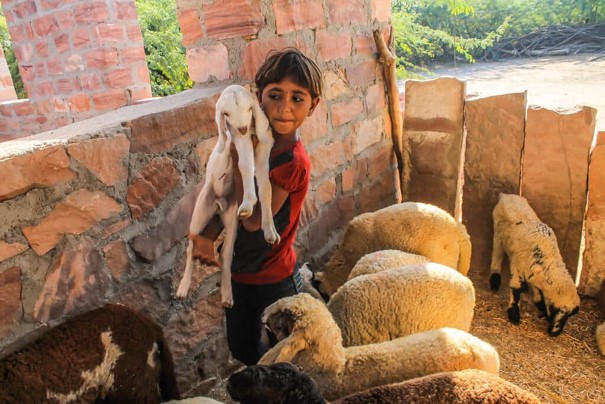
The Bishnois consider the blackbucks as pavitra, or sacred. They follow what is perhaps the only environment-friendly religion in the world and recognise the rights of all kinds of birds, animals and trees and believe in living with peace and harmony with them. Reports show that in 2016, over 1,700 people who were involved in wildlife crimes in Rajasthan were arrested owing to the tireless efforts of the bishnoi community.
Some of their commandments mention to “provide shelters for abandoned animals to avoid them from being slaughtered in abattoirs,” making clear the Bishnoi’s reverence of all life on the planet.
The Khejarli massacre
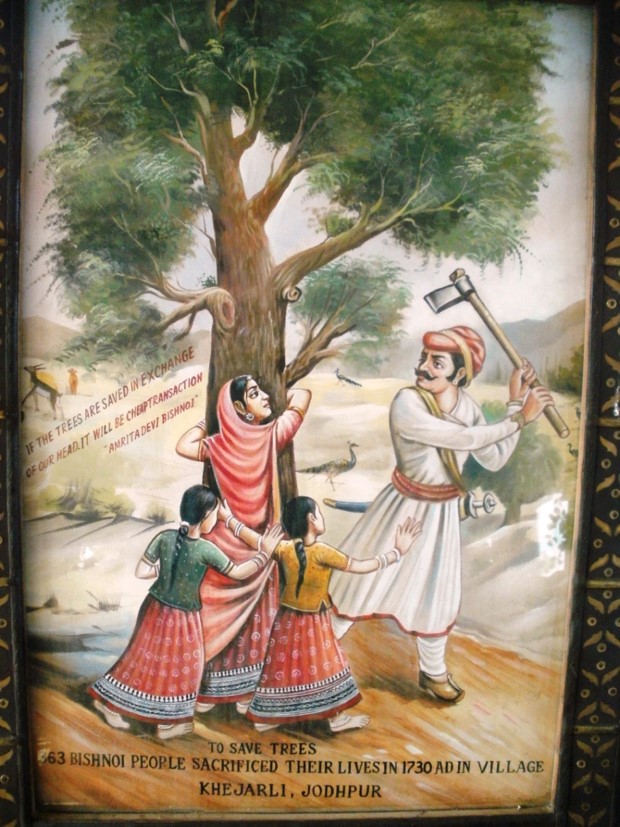
Khejarli or Khejadli is a village situated in Jodhpur district of Rajasthan, just 26 km southeast of the main city of Jodhpur. The name of the town is derived from khejri trees, which were in abundance in the village. In the year 1730 AD (Vardhan 2014), the king of Jodhpur sent-out his army to cut trees in order to build his palace. When his army started to cut down and log a Bishnoi forest, the bishnois organised a non-violent protest, offering their bodies as shields for the trees. The soldiers had warned that anyone intending to stand in their way would share the fate of Amrita (or Imarta/Imarti as she is often also referred to by the locals) and her three daughters who had taken the bold step of hugging trees following their mother’s action, and had been killed by the soldiers. Men, women and children from 83 different villages stepped forward, embraced the trees and sacrificed themselves one after the other.
The army’s axes had already slain 363 people, when the king, Maharaja Abhay Singh, hearing the whole incident and their perseverance and courage, halted the logging and declared the Khejarli region a preserve, issued a royal decree engraved on a tambra patra (a letter engraved on a copper plate), prohibiting the felling of trees and hunting in the Bishnoi areas. The Bishnois as well as non-Bishnois consider the tambra-patra declaration as a victory of the communities efforts at conservation.
Till date, the Bishnoi community commemorates and celebrates this collective sacrifice as a symbolic victory in Khejarli by maintaining the place as a heritage site. An annual fair is organised at the village near Jodhpur, which also maintains a functional temple. In 1988, the Government of India commemorated the massacre formally, by naming the Khejarli village as the first National Environmental Memorial (Clarke 1991). A cenotaph now stands at the site as a memorial to the Bishnoi lives lost at the massacre site, which is collectively maintained through community funding as well as by private donations.
Incidentally, Imarta Devi, the first woman who died in defence of the khejri trees during the 1730 Khejarli massacre, uttered her last words as follows: Sar sāntey rūkh rahe to bhī sasto jān (even if one were to get their head severed to save a tree, still it is a cheap bargain).
The story of human origins is complicated since our ancestors swapped genes (and probably skills).
The first humans emerged in Africa around two million years ago, long before the modern humans known as Homo sapiens appeared on the same continent.
There’s a lot anthropologists still don’t know about how different groups of humans interacted and mated with each other over this long stretch of prehistory. Thanks to new archaeological and genealogical research, they’re starting to fill in some of the blanks.
The First Humans
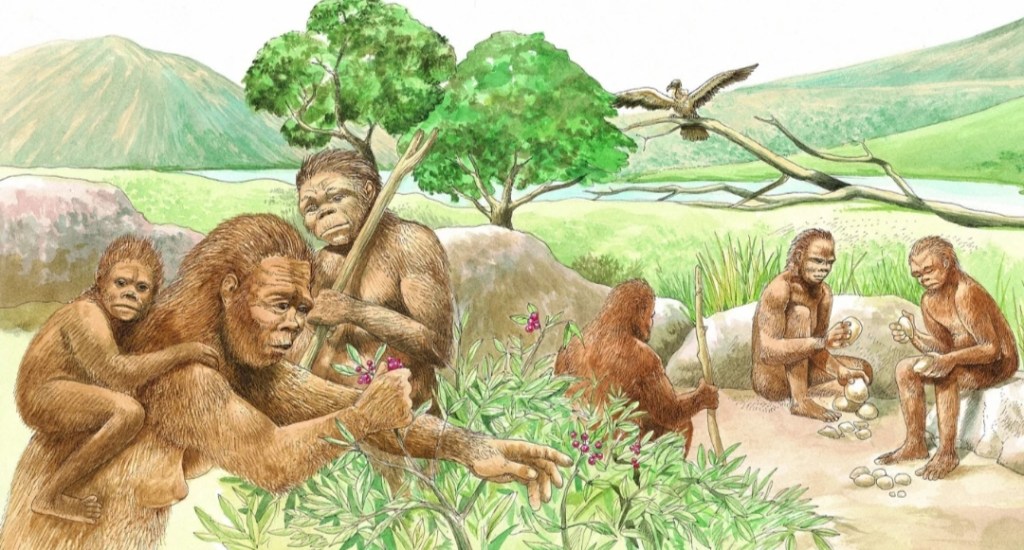
Homo habilis individuals chip away at rocks, sharpening them for cutting up game or scraping hides while a woman, with her child, gathers wild berries to eat and branches to make shelters.
First things first: A “human” is anyone who belongs to the genus Homo (Latin for “man”). Scientists still don’t know exactly when or how the first humans evolved, but they’ve identified a few of the oldest ones.
One of the earliest known humans is Homo habilis, or “handy man,” who lived about 2.4 million to 1.4 million years ago in Eastern and Southern Africa. Others include Homo rudolfensis, who lived in Eastern Africa about 1.9 million to 1.8 million years ago (its name comes from its discovery in East Rudolph, Kenya); and Homo erectus, the “upright man” who ranged from Southern Africa all the way to modern-day China and Indonesia from about 1.89 million to 110,000 years ago.
In addition to these early humans, researchers have found evidence of an unknown “superarchaic” group that separated from other humans in Africa around two million years ago. These superarchaic humans mated with the ancestors of Neanderthals and Denisovans, according to a paper published in Science Advances in February 2020. This marks the earliest known instance of human groups mating with each other—something we know happened a lot more later on.
After the superarchaic humans came the archaic ones: Neanderthals, Denisovans and other human groups that no longer exist.
Archaeologists have known about Neanderthals, or Homo neanderthalensis, since the 19th century, but only discovered Denisovans in 2008 (the group is so new it doesn’t have a scientific name yet). Since then, researchers have discovered Neanderthals and Denisovans not only mated with each other, they also mated with modern humans.
“When the Max Plank Institute [for Evolutionary Anthropology] began getting nuclear DNA sequenced data from Neanderthals, then it became very clear very quickly that modern humans carried some Neanderthal DNA,” says Alan R. Rogers, a professor of anthropology and biology at the University of Utah and lead author of the Science Advances paper. “That was a real turning point… It became widely accepted very quickly after that.”
As a more recently-discovered group, we have far less information on Denisovans than Neanderthals. But archaeologists have found evidence that they lived and mated with Neanderthals in Siberia for around 100,000 years. The most direct evidence of this is the recent discovery of a 13-year-old girl who lived in that cave about 90,000 years ago. DNA analysis revealed that her mother was a Neanderthal and her father was a Denisovan.
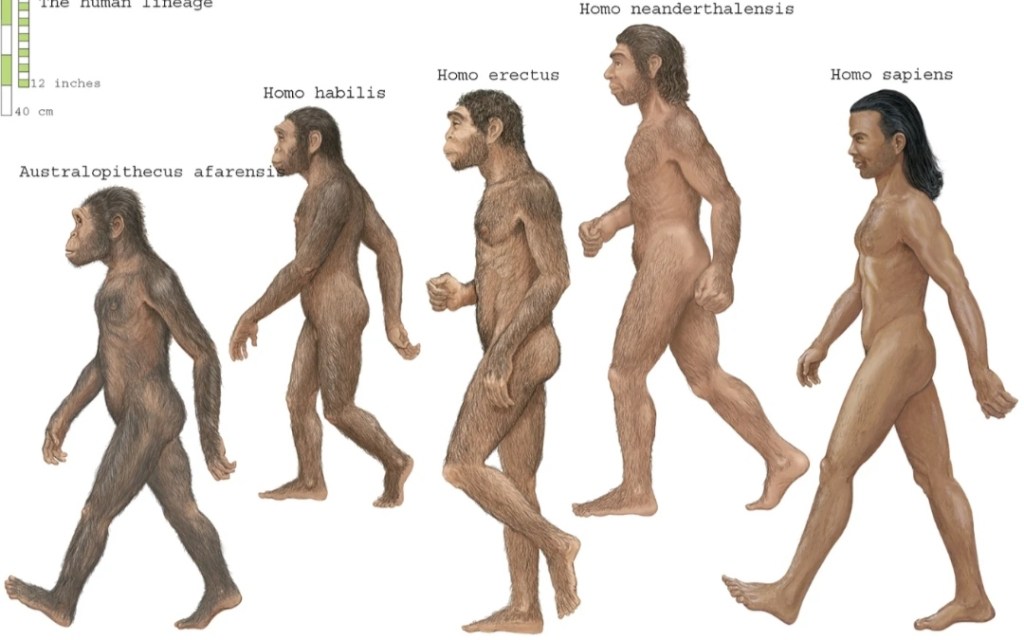
The human lineage of Australopithecus afarensis, Homo habilis, Homo erectus, Neanderthals and Homo sapiens.
Scientists are still figuring out when all this inter-group mating took place. Modern humans may have mated with Neanderthals after migrating out of Africa and into Europe and Asia around 70,000 years ago. Apparently, this was no one-night stand—research suggests there were multiple encounters between Neanderthals and modern humans.
Less is known about the Denisovans and their movements, but research suggests modern humans mated with them in Asia and Australia between 50,000 and 15,000 years ago.
Until recently, some researchers assumed people of African descent didn’t have Neanderthal ancestry because their predecessors didn’t leave Africa to meet the Neanderthals in Europe and Asia. But in January 2020, a paper in Cell upended that narrative by reporting that modern populations across Africa also carry a significant amount of Neanderthal DNA. Researchers suggest this could be the result of modern humans migrating back into Africa over the past 20,000 years after mating with Neanderthals in Europe and Asia.
Given these types of discoveries, it may be better to think about human evolution as a “braided stream,” rather than a “classical tree of evolution,” says Andrew C. Sorensen, a postdoctoral researcher in archaeology at Leiden University in the Netherlands. Although the majority of modern humans’ DNA still comes from a group that developed in Africa (Neanderthal and Deniosovan DNA accounts for only a small percentage of our genes), new discoveries about inter-group mating have complicated our view of human evolution.
“It seems like the more DNA evidence that we get—every question that gets answered, five more pop up,” he says. “So it’s a bit of an evolutionary wack-a-mole.”
Early Human Ancestors Shared Skills
Human groups that encountered each other probably swapped more than just genes, too. Neanderthals living in modern-day France roughly 50,000 years ago knew how to start a fire, according to a 2018 Nature paperon which Sorensen was the lead author. Fire-starting is a key skill that different human groups could have passed along to each other—possibly even one that Neanderthals taught to some modern humans.
“These early human groups, they really got around,” Sorensen says. “These people just move around so much that it’s very difficult to tease out these relationships.”
“Tell me your story. I want to hear your voice, and I want to hear your conviction. No matter who you are, where you’re from, your skin color, gender identity: speak yourself.”
-BTS(UNICEF)
Bangtan Boys also known as BTS is a Korean-pop group, currently the biggest phenomenon of the music industry with a huge fandom named A.R.M.Y. It is a seven-member boyband and their names go like this, Kim Namjoon(RM), Kim Seokjin(Jin), Min Yoongi(Suga), Jung Hoseok(Jhope), Park Jimin(Jimin), Kim Taehyung(V), Jeon Jungkook. BTS debuted on 13th June 2013 under Bighit Entertainment.
BangTan Sonyeondan
BTS, through their songs, talk about personal issues and society’s expectations, and commentary on youth. They focus on mental issues, depression, and almost everything that people usually don’t prefer to talk about. Moreover, they are inspiring and touching the hearts of millions of people every day through their lyrics. From the beginning of their career, they told stories that are very much familiar to our stories like teenage love affairs, the desire to achieve everything, society’s expectations on you, depression. So basically, it’s like a guy next door story which we all can relate.
“If you want to love others, I think you should love yourself first.”
-RM
“Don’t be trapped in someone else’s dream“
-V
Back in 2013, BTS was completely unknown to the world they hardly had 200 to 300 people to cheer them up. All seven of them used to live in a small dorm with very little to no luxury, they were discriminated against by the other companies as they come from a small and completely underrated company(Big Hit). They were never invited to big shows, got so much hatred and criticism from the pop community because of their looks, clothes, make-up, and were accused of false plagiarism. But despite the hardships they have faced, they’ve pushed themselves and never lost hope. They fought together, stood against the negativity, and motivated themselves to just moved on to make a better version of themselves every day. They released 22 albums till now each album sharing a different story. They have learned to love themselves for who they are and accept their flaws. Just like that, they want us to love ourselves and end self-hatred and bring peace into our lives.
BTS albums sold till now
“In the middle of the road, at the moment you want to give up, shout out even louder: “So what?”
-BTS
And now, their efforts paid off. They have won 370 awards including National awards, Billboard awards, Asian artist awards, the American Music Awards, etc. 549 nominations including the Grammys. And attained 26 Guinness World records and broke the records of Michael Jackson and The Beatles. They got covered by TIME magazine as “The next generation heroes”. They are the brand ambassadors of Hyundai, FILA, Louis Vuitton, Samsung, Coca-Cola, and many more. BTS delivered a speech at the UN general assembly as a part of the “LOVE MYSELF” campaign that they have launched in 2017 and partnered with UNICEF’s “End Violence” program. BTS generates 4 trillion Korean won as economic value to their country per year and 1.42 trillion won as added value per year, according to the 2018 report( Hyundai Research Institute). BTS contributes 1.7% of total Korean consumer goods export.
“Love myself, love yourself, peace.”
-Suga
“Find your name, find your voice by speaking yourself.”
-RM
Their growth is phenomenal.
From small dorms to spacious hotel rooms.
From congested practice rooms to a multi storey building.
From 200 fans to millions of ARMYs.
From a few lightsticks to an ocean of purple lights.
From small-town boys to Global leaders.
From ordinary teenagers to legends.
“In the dark night, don’t be lonely, Like the stars, we shine, Don’t disappear, because you’re a great existence, Let us shine”
-BTS(Mikrokosmos)
“Purple is the last colour of the rainbow colours. So means I will trust and love you for a long time.”
― Kim Taehyung
BTS with their first awardBTS awards by 2021
They have achieved everything they wanted but always stay the same as they were a few years ago. This is a story of models, dancers, singers, philanthropists, the next generation leaders, and more importantly our well-wishers.
Their journey is worth telling, as an ARMY I will not stop narrating this story to the world.
One of India’s biggest festivals, Rath Yatra begins today, July 12 and that is celebrated all across the world by millions of Indians. The festival has its primary significance in Indian states like Odisha, Jharkhand, West Bengal and Assam.
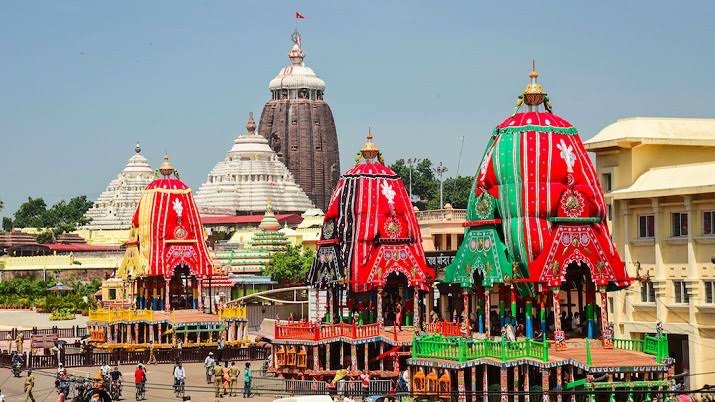
Picture Credits: India TV. Location: Puri Jagannath Temple.
As everyone has their eyes on Puri Jagannath Temple’s grand celebration for this festival, let us know some of the important facts about the temple.
1) Formation of Temple.
The temple was first built by the Ganga Dynasty ruler Anantavarman Chodaganga in 12 Century CE and was further developed by several other kings including that of the Ganga Dynasty as well as the Suryvamshi Dynasty.
2) Deities Worshipped
Lord Jagannath, Lord Balabhadra and Goddess Subhadra are worshipped inside the temple. The deities are adorned with different jewelleries and accessories according to different seasons.
3) Structure of the Temple.
The Temple has four distinct structures:
a) Deula, Vimana or Garba Griha where the triad deities are kept on the ratnavedi, the throne of pearls, in Deula Style.
b) Mukhashala, the frontal porch
c) Nata Mandir, Natamandapa which is known as Jagmohan, the audience hall or the dancing hall.
d) Bhoga Mandapa, the offerings hall.
The main temple is a curvilinear temple and crowning the top is the Srichakra, an eight spoked wheel of Lord Vishnu. It is also known as Nilachakra which is made out of Ashtdhatu and is considered sacrosanct.
4) The Food Offerings:
The food is offered to the Lord six times a day. The breakfast that is offered early morning is called Gopala Vallabha Bhog, the next offering at about 10 am is known as Sakala Bhog and another offering after some time is called the Sankhudi Bhoga which consists of Pakhala with curd and Kanji Payas.
The noon offering is known as Madhyanha Dhupa and that is followed by evening food at 8 pm known as Sandhya Dhupa. The last offering to Lord is called the Bada Simhara Bhoga.
5) Rosaighara- Temple’s Kitchen.
The temple’s kitchen is considered to be the largest in the world. About 56 varieties of food are produced which are purely vegetarian and prepared without the use of onions, garlic or chilies as prescribed by some Hindu Texts. Cooking is done only by using earthen pots with some water that comes from two nearby tube-wells known as Ganga and Yamuna. The most awaited food offering is known as Kotho Bhoga, offered during Mid-Day. After being offered to Lord Jagannath and other deities, the food is sold in a nearby market.
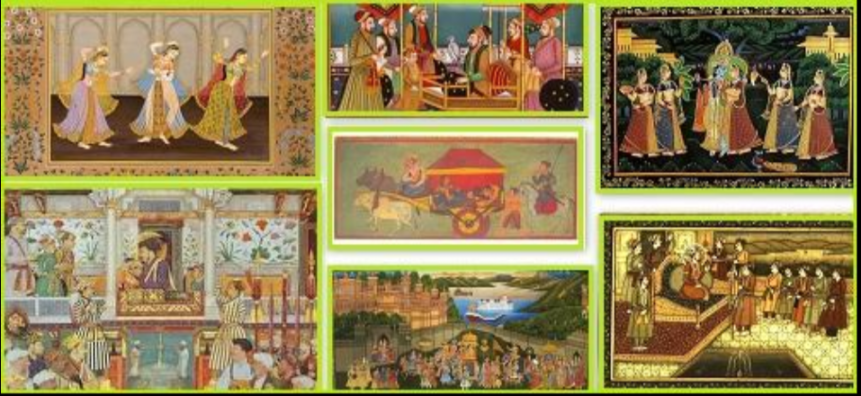
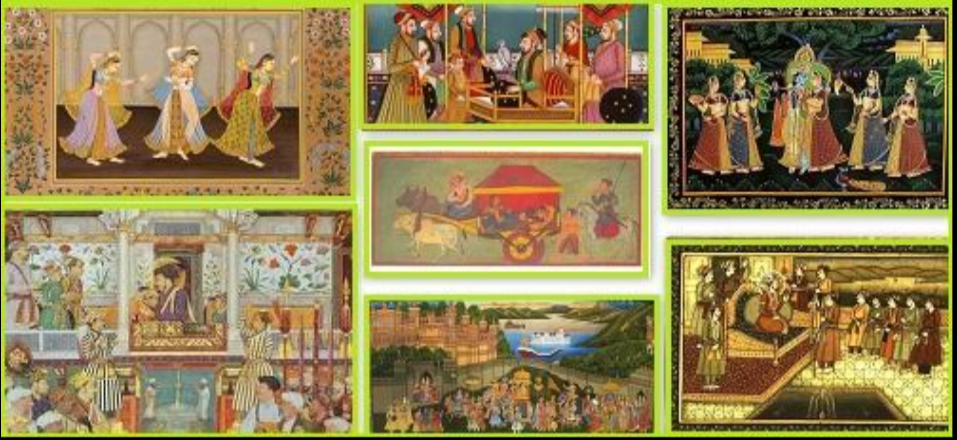
Miniature Art refers to paintings, sculptures, engravings etc. That have small dimensions. Though they are small, they are well detailed. The origin of miniature paintings dates back to the prehistoric times and is profoundly influenced by Indian literature. A miniature painting is generally less than 25 square inches or 100 square centimetres. The subjects in the painting are one -sixth of their actual sizes. Miniature paintings were generally done on materials like cloth, paper, leaves etc. which are quite perishable. These paintings are handmade and very delicate. Miniature paintings are considered as an ancient art in India and there were many schools for the same, including those of the Rajput’s, Deccan’s and the Mughals. These paintings give an insight into the life of the royals and the common man, the beauty of their womenfolk and the inspirations and devotions of the artists themselves. These paintings are often associated with the Ragas i.e. the melodies of Indian classical music. Rajasthani School of Miniature Paintings: This school developed around the areas of Rajasthan, Bundelkhand and Punjab regions. The Rajasthani paintings were greatly influenced by Tulsidas and Kabir. The main theme observed in the illustrations of this school is love in all of its form. Main emphasis is given on the love between human soul and god. This might have been influenced by the Bhakti cult which originated in those days. Paintings are left to the imagination and emotion of the viewers for interpretation. Features: Compositions are clear and simple. All figures are in same dimensions. The figure of a woman are duplicated for other women. This is painted as a symbol of femininity. Colours are used harmoniously and are bright with each colour having it’s own specific meaning. The medium mostly used was water colour in tempera hand made paper. The colour scheme is flat and paintings are two dimentional. Some of the famous Rajasthani miniature paintings: ‘Radha Bani Thani’by Nihal Chand ‘Maru Ragini’ by Sahibdin ‘Chaugan Players’ by Dana
Mughal School of Miniature Painting: With the advent of Mughal, the Indian miniature paintings shifted to the portraits and richness of colour effects with the unique Persian flavour. During this period, the art specialises in Court and Palace scenes. Themes from Indian epics such as Ramayana, Mahabharata, Bhagvata Purana etc. Are also included. The Indian Miniature painting was at it’s prime time during the period of Mughal Emperor Shah Jahan because he was a great patron of miniature painting. But after his regime, paintings lost their charm and started to decline in the 18th century. Features: Mughal paintings denoted the habits of the ruling class. Portraiture was done. Figures were drawn in profile or quarter profile. A decorative border called hasiah was also used. Calligraphy was also done in the paintings. The paintings were male dominated. Portraits of women were drawn from imagination. The medium generally used was water colour in tempera handmade paper. Some of the famous Mughal Miniature Paintings: ‘Kabir and Raidas’ by Ustad Faquirullah Khan ‘Falcon on a Bird Rest’ by Ustad Mansoor ‘Babur Crossing River Sone’ by Jagannath
Though most religions make it a point to claim their teachings have been consistent since the dawn of time (whenever that was), spiritual traditions have appeared and disappeared throughout the ages with the same regularity as empires. And if such ancient faiths as Manichaeism, Mithraism, and Tengriism are all but gone, a few of the oldest religions and practices are still around today. Find out what they are below.
Hinduism (founded around the 15th – 5th century BCE)
Hinduism may not be a unified religion per se, or organized into a distinctive belief system, but Hindus (as they have been identifying themselves for centuries, the result of opposition with other religions) roughly follow the same central traditions, understandable to all the religion’s multifarious adherents. The first and foremost of these is a belief in the Vedas – four texts compiled between the 15th and 5th centuries BCE on the Indian subcontinent, and the faith’s oldest scriptures – which make Hinduism without doubt the oldest religion in existence. It has since evolved into a diverse and flexible tradition, notable, as the scholar Wendy Doniger puts it, for its ability to ‘absorb potentially schismatic developments.’ There are close to one billion Hindus in the world today.
Zoroastrianism (10th – 5th century BCE)
The ancient Indo-Iranian religion of Zoroastrianism (known to natives as Mazdayasna) – said to date back to the 2nd millennium BCE – emerged in its current version from the teachings of the reforming prophet Zoroaster (Zarathustra), who historians contend lived at some point between the 10th and 6th centuries BCE (they disagree somewhat). Extremely influential over the development of the Abrahamic tradition, it was the state religion of various Persian empires until the Muslim conquest of the 7th century CE, and survives in parts of Iran, India, and Iraq to this day, reportedly followed by some 200,000 people.
Yazdânism: Interestingly enough, three particular Kurdish religious variants (practiced among the Yazidis, Goran, and Ishik Alevis), grouped together under the umbrella neologism Yazdânism (Cult of Angels), have evolved from a mix of Islam and a Hurrian precursor to the Zoroastrian faith. They reconcile the existence of Abrahamic prophets with a doctrine of reincarnation, and the belief that the world is defended from evil by seven ‘angels’. This may make these creeds as old, if not older, as Zoroastrianism.
Judaism (9th – 5th century BCE)
The foundation for all other Abrahamic religions, and the oldest monotheism still around (though by no means the first – that is alleged to be a variation on ancient Egyptian faith called Atenism, which disappeared in the 14th century BCE), Judaism originated in the kingdoms of Israel and Judah, which first appeared in the Levant around the 9th century BCE. The religion morphed into its current form in the 6th century BCE, evolving from the worship of a state god based in a polytheistic worldview into that of a one ‘true’ God, codified in the Bible. If it is today followed by an estimated 11–14 million people, its two successor faiths – Christianity (1st century CE) and Islam (7th century CE) – are the world’s most popular, with a combined 3.8 billion adherents.
Jainism (8th – 2nd century BCE)
Once a dominant religion on the Indian subcontinent (before the rise of reform Hinduism in the 7th century CE), Jainism has fairly obscure origins. Its followers believe in the tirthankaras, omniscient preachers of the Jain path, whose defining characteristics are marked by asceticism and self-discipline. The last two tirthankaras are known historical figures: Parshvanatha (8th century BCE) and Mahavira (599 – 527 BCE). Yet archeological evidence proving the existence of Jainism only dates back to the second century BCE. Jains are said to number six to seven million worldwide.
Confucianism (6th – 5th century BCE)
If, like Buddhism, Confucianism must invariably be traced to one man – in this case, the Chinese politician, teacher, and philosopher Confucius (551 – 479 BCE) – it is worth noting that he himself maintained he was part of a scholarly tradition dating back to an earlier golden age.
Though the most humanistic and least spiritual creed on this list, Confucianism does provide for a supernatural worldview (it incorporates Heaven, the Lord on High, and divination) influenced by Chinese folk tradition. Since the teachings were first compiled in the Analects a generation or two after Confucius’s death, the tradition has gone through various periods of popularity and unpopularity in China, and remains one of the leading influences on modern Chinese folk religion. Strict Confucianists are said to number about six million.
Buddhism (6th – 5th century BCE)
Unlike most other religions on this list, Buddhism has a fairly clear history: it begins with one man, Siddhartha Gautama, known otherwise as Buddha. Based in the northernmost regions of the Indian subcontinent (most likely in present-day Nepal) roughly between the 6th and 5th centuries BCE, he was the founder and leader of his own monastic order, one of many sects (known as Śramana) that existed across the region at the time. His teachings began to be codified shortly after his death, and continue to be followed one way or another (and with major discrepancies) by at least 400 million people to this day.
Taoism (6th – 4th century BCE)
Taoism can be traced with some certainty to a work attributed to the mythical Laozi (said to have been a contemporary of Confucius), the Tao Te Ching, whose oldest recorded edition dates back to the 4th century BCE. The religion evolved from a strand of traditional Chinese folk religion, and makes mention of masters and teachings from long before it was codified, including the god-like Yellow Emperor, said to have reigned from 2697 – 2597 BCE, and the I Ching, a divination system dating back to 1150 BCE. Today, an estimated 170 million Chinese claim some affiliation with Taoism, with 12 million following it strictly.
Shintoism (3rd century BCE – 8th century CE)
Though not codified until 712 CE in response to contact with mainland religions (namely, Confucianism, Buddhism, and Taoism), Shintoism is a direct descendant of the animistic folk religion of the Yayoi, whose culture spread from the north of Kyushu to the rest of Japan from the 3rd century BCE onward. Today, the faith is a unified account of ancient Japanese mythology, marked strongly by Buddhist influences, and followed by the vast majority of the country’s population (though only a small minority identify it as an organized religion).
A note on methodology:
Before getting into it, it is worth mentioning that determining a religion’s age depends entirely on how one defines what a religion is. All spiritual systems have roots in beliefs dating back millennia – meaning that the main differences between each are found elsewhere: in their codification and general uniformity, and the age of their wider precepts.
Not included, then, are the various animistic and shamanistic traditions (counting the Chinese folk religion, which lacks consistency and is partly constructed on Taoist and Confucian beliefs), as well as the modern revival of ancient religions such as Neopaganism or Mexicayotl (both traditions that were for a long time eradicated, and may differ in important ways from their original conception).
Likewise omitted is atheism, which, despite its natural rejection of organization, is known to have existed at least since the 6th century BCE (though we suspect it’s as old as the first stirrings of religious thoughts).
Gandhi is an important figure in India’s national movement. A phase of our national movement is called the Gandhian Phase. Nation is defined as a people sharing a common language, history and culture and having a sense of belonging to their common identity. The idea of nation was combined with the nation of the state. It developed where the people of one nation were suppose to live in one state. Nationalism has 2 versions: Premordial and Modernist.
Premordial versions means is the the original versions of nationalism in which the nation has a common language, culture, ethics and history. The modernist version however they treat people like a particular territory and sharing its civic amenities despite loving different ethic on regular affinities.
Gandhi ji was one of the nationalist who was the leader of many movements. He helped us to get independence. He believed in non- violence. He lead many movements in his opposition to the British rule like Satyagraha, Dandi March, Khilafat Movement, the non-cooperation movement. For Mahatma Gandhi, nationalist was based on understanding what was required for people to be free. He was not a socialist but, in common with the socialists, he believed that capitalism could never solve the problem of unemployment and the mental dullness is produced. Gamdhi ji also fought against the practices of sati, child marriage, oppressions of widow, ‘pardah’ and fueled emancipation of women.
Gandhi ji on Communal Liberty
India is a land of diversity. Populated by heterogeneous people of multifarious languages, religion, castes and creeds. Inspite of such diversities of character, there is always an underlying unity among them since time immemorial. The fact also remains that there is always a threat to narrow communal feelings. In modern India, gandhi was one of the greatest champions and communal unity. He lived his whole lofe striving for it, ensuring it, stood firmly by itand finally sacrificed his life in the pursuit of his communal unity. For Gandhi the life of communal unity was even greater than swaraj. None of the political leaders or religious priests were as devotedly concerned about communal unity as Gandhi ji was. Gandhi ji saw truth, love, compassion and service enlisted in all religions, which led him to accord equal respects to all faiths. All religion insist on equality of human race and developing a harmonious relationship with the entirety of creation. Any violation of the principle of equality gives way to conflict and violation. Gnadhiji regarded Islam as a religion of peace in the same sense as Christanity, Buddhism and Hinduism. No doubt, there are differences in the degree. He said in this regard that he knew the passages that could be quoted from the holy Quran to the contrary. Hindu and Muslim has often raised a great challenge before India became secular. Without unity between Hindu and Muslim no certain progress can be made by the nation tenet that ‘unity is strength’ is not merely a copy book maxim but a rule of life. Hindu-Muslim unity means not only unity betwwen Hindus and Muslims but betwwen all these who believe India to be their home, no matter to what faith they belong. Gandhi ji did not fully succeed in Hindu-Muslim unity . Some writers felt that Gandhi ji locked a historocal perspective. He did not take into the account that held that religion with its dagma, tradition, customs, rituals and historical memories has on the minds of men and women in the pre modern society. Gandhi assigned only a derination role to the cultural factors. He did not grasp the deeper social and cultural roots of the hindu-muslims conflict. Gamdhi placed the entire blame for the communal problem on the British. He thought that hindu-muslim was essentially religious amd missed the social aspect of the problems. Gandhi always emphasized upon the necessity of openness of mind for the unity and harmony of the society. It was not a question of failure or success. Gandhi realised that the only alternative to violence coercion, retribution and chaos was restoration of society among the misguided individual to counter Frenzy and indictiveness, gandhi sought rehabilitation of balanced social interrogation among the masses to reslove to put the cause of nation above all denominated prejudices. Today, India is a secular nation. Democracy is mature, muslims have got equal rights and opportunities and are more secure in India than in any other country. The credit goes to the founding father of contribution and Mahatma Gandhi.
World’s Oldest Language It is not possible to answer exactly how many languages of the world are there. According to an estimate, the total number of languages in the world is about 6809, out of which the number of speakers of 90 per cent of the languages is less than 100000. There are about 200 to 150 languages that are spoken by more than 1 million people. There are about 357 languages that only 50 people speak. Not only this, but there are also 46 languages whose number of speakers is only one.
But do you know which is the oldest language in the world? If you are not aware of the answer to this question then after reading this article you will know which is the oldest language in the world, because in this article we are giving the details of the 10 oldest languages of the world according to the origin.
World’s 10 oldest languages
10. Armenian Language The Armenian language is also part of the Indo-European linguistic group, which is spoken by the Armenians. Bibles written in the fifth century exist as its earliest appearance. The Armenian language originated in 450 BC. At present, about 5 per cent of people speak this language. This language is spoken in Mesopotamia and the intermediate valleys of the caucus and in the southeastern region of the Black Sea. The region falls in Armenia, Georgia and Azerbaijan (northwestern Iran). It is the official language of the Republic of Armenia.
9. Korean language The Korean language is spoken from around 600 BC. At present, about 80 million people speak the Korean language. The script of this language is Hangul. In ancient times, the Chinese settled in Korea, so the Korean language is strongly influenced by the Chinese language.
8. Arabic language This language is found in Hebrew and Arabic languages today. It was once the official language of the Armenian Republic. There is evidence of its presence even 1,000 years before Christ. Even today the Arabic language is spoken in Iraq, Iran, Syria, Israel, Lebanon and modern Rome.
7. Chinese Language Chinese is the most spoken language in the world. It is spoken in China and some countries of East Asia. The Chinese language belongs to the Chinese-Tibetan language-family and is actually a group of languages and dialects. Standardized Chinese is actually a language called “mandarin”. This language is 1200 years old even before the arrival of Jesus. Currently, about 1.2 billion people speak Chinese.
6. Greek Language The Greek language is the oldest language in Europe, spoken since 1450 years before Christ. Currently Greek is spoken in Greece, Albania and Cyprus. About 13 million people still speak Greek today.
5. Egyptian Language The Egyptian language is the oldest known language in Egypt. This language belongs to the Afro-Asian linguistic family. it is 2600–2000 years old from Christ. This language is still keeping its nature alive.
4. Hebrew Language Hebrew is the language falling under the Semitic branch of the Sami-Hami language-family. The Hebrew language is about 3000 years old. It is currently the official language of Israel, after its extinction, the Israeli people revived it. The Jewish community considers it to be ‘holy language’ and the Old Testament of the Bible was written in it. The Hebrew language is written in the Hebrew script, read and written from right to left. Studies of Hebrew are relatively popular nowadays in Western universities. The official language of Palestine after the First World War is also modern Hebrew.
3. Latin Language Greek is the third oldest language in the world. Latin was the official language of the ancient Roman Empire and ancient Roman religion. It is currently the official language of the Roman Catholic Church and the official language of the Vatican City. Like Sanskrit, it is a classical language. Latin comes in the romance branch of the Indo-European language family. From this, French, Italian, Spanish, Romanian, Portuguese and the most popular language of the present time, English has originated. Due to the dominance of Christianity in Europe, Latin language in medieval and pre-modern times was the international language of almost all Europe, in which books of all religions, science, higher literature, philosophy and mathematics were written.
2. Tamil Language The Tamil language is recognized as the oldest language in the world and it is the oldest language of the Dravidian family. This language had a presence even around 5,000 years ago. According to a survey, 1863 newspapers are published in the Tamil language only every day. At present, the number of speakers of Tamil language is around 7.7 crores. This language is spoken in India, Sri Lanka, Singapore and Malaysia.
1. Sanskrit Language World’s oldest language is Sanskrit. The Sanskrit language is called Devbhasha. All European languages seem inspired by Sanskrit. All the universities and educational institutions spread across the world consider Sanskrit as the most ancient language. It is believed that all the languages of the world have originated from Sanskrit somewhere. The Sanskrit language has been spoken since 5,000 years before Christ. Sanskrit is still the official language of India. However, in the present time, Sanskrit has become a language of worship and ritual instead of the language of speech. All the auspicious works performed in Hindu religion are recited by Veda Mantra, whose language is Sanskrit.
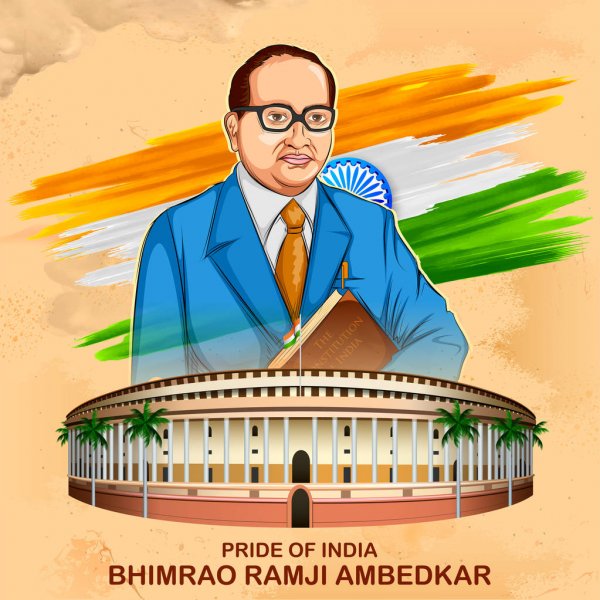
Dr. Babasaheb Ambedkar was born on April 14, 1891 in Mhow, Madhya Pradesh. His childhood name was Bhimrao. His fathers’ name was Ramji Sakpal and his mothers’ name was Bhimabai Sakpal. His father was a Subhedar in the British Army. In those days the government ensured that all the Army Personel and their children were educated and they ran special schools for this purpose. Born in a Dalit family in those times, when the Dalits were considered to be the “untouchables” and were denied from almost everything, Dr. B R Ambedkar was lucky to get good education from the Army Personel Schools.
After his retirement, Bhimrao’s father settled in Satara, Maharashtra where Bhimrao was enrolled in a local school. He was an intelligent and hardworking student but there he had to face a lot of caste discrimination because he was born as “Shudras” meaning “untouchables”. In school he had to sit on the floor in one corner of the classroom. He was always made fun of by his classmates and even discriminated by his teachers who would not touch his notebooks. Upper caste students would not talk, study or even play with him. He was not even allowed to drink water from the vessel used by the upper caste students. Despite all the humiliations and difficulties he faced, young Bhimrao never lost his faith. By the quality of his hard work, determination and commitment he earned several scholarships to support his education. His teachers gave him the surname “Ambedkar” in school records.
In 1906, when he was just 15 years old got married to Ramabai who was just 9 years old at that time. Bhimrao continued his studies and passed his matriculation exam from Bombay University with flying colors in 1908. He joined the Elphistone College for further education. In 1912, he graduated in Political Science and Economics from Bombay University and got a job in Baroda. During a public ceremony, Dada Keluskar gifted him Biography of Buddha. In 1913, Bhimrao Ambedkar lost his father. In the same year Maharaja of Baroda awarded him a scholarship and sent him to America for his further studies. Bhimrao reached New York in July 1913. For the first time in his life, Bhimrao was not demeaned for being a Mahar. This kept him motivated to bring a change in the society for the way Dalits were being treated and so he immersed himself in studies and received a degree in Master of Arts and a Doctorate in Philosophy from Columbia University in 1916 for his thesis “National Dividend for India: A Historical and Analytical study”. On his returning back to India, The Maharaja of Baroda appointed Dr. Ambedkar as his political secretary. Unfortunately, no one took orders from him because he was a Mahar, saying that a lower caste person cannot give orders to the upper caste ones. Bhimrao Ambedkar returned to Bombay in November 1917. With the help of Shahu Maharaj of Kolhapur he started a fortnightly newspaper- The “MOOKNAYAK” on January 31,1920. The Maharaja also organized many meetings and conferences of the “untouchables” which was addressed by Bhimrao.
In September 1920, after accumulating sufficient funds Ambedkar went back to London to complete his studies. He became a Barrister and got a Doctorate in science while practicing law in the Bombay High court he tried to promote education to “untouchables” and uplift them. In 1927, Babasaheb Ambedkar decided to launch active movements against untouchability- to open up public drinking water resources, that led to a Satyagrah in Mahad. He attended all the three round table conferences in London and argued for the welfare of the “untouchables”. In 1937, Dr. Ambedkar introduced a bill to abolish the “KHOTI” system of land tenure in Konkan region and the Mahar “WATAN” system of working for the government as slaves. In 1947, when India became independent the first Prime Minister Pandit Jawaharlal Nehru invited him, as he had been elected as a member of the Constituent Assembly from Bengal to join his Cabinet as a Law Minister. He was appointed as the chairman of the constitution drafting committee.
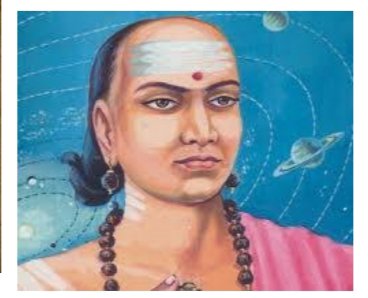
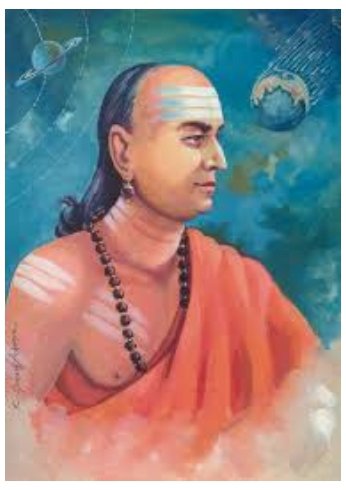
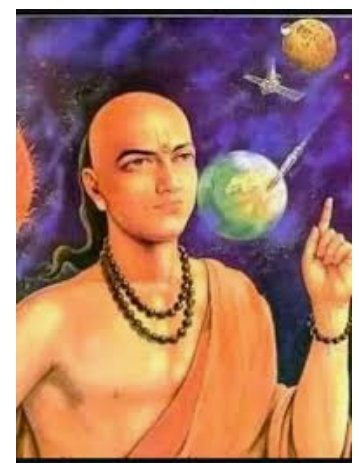
Aryabhatta (476–550 CE) was the first of the major mathematician-astronomers from the classical age of Indian mathematics and Indian astronomy.
Aryabhatta mentions in the Aryabhatiya that it was composed 3,600 years into the Kali Yuga, when he was 23 years old. This corresponds to 499 CE, and implies that he was born in 476.
Aryabhatta provides no information about his place of birth. The only information comes from Bhaskara I, who describes Aryabhatta as asmakiya, “one belonging to the Asmaka country.” During the Buddha’s time, a branch of the Asmaka people settled in the region between the Narmada and Godavari rivers in central India; Aryabhatta is believed to have been born there.
It is fairly certain that, at some point, he went to Kusumapura for advanced studies and lived there for some time. Both Hindu and Buddhist tradition, as well as Bhaskara I (CE 629), identify Kusumapura as Pataliputra, modern Patna. A verse mentions that Aryabhatta was the head of an institution (kulapa) at Kusumapura, and, because the university of Nalanda was in Pataliputra at the time and had an astronomical observatory, it is speculated that Aryabhatta might have been the head of the Nalanda university as well. Aryabhatta is also reputed to have set up an observatory at the Sun temple in Taregana, Bihar.
Therefore, it would make great sense that this was where he would have invested a great deal of time learning to be a great astronomer. There were not exactly scores of other opportunities for him to take advantage during the classical era as institutions in which to learn astronomy were likely very limited.
Aryabhatta is the author of several treatises on mathematics and astronomy, some of which are lost. His major work, Aryabhatiya, a compendium of mathematics and astronomy, was extensively referred to in the Indian mathematical literature and has survived to modern times. The mathematical part of the Aryabhatiya covers arithmetic, algebra, plane trigonometry, and spherical trigonometry. It also contains continued fractions, quadratic equations, sums-of-power series, and a table of sines.
Aryabhata gave the world the digit “0” (zero) for which he became immortal.
The Aryabhatiya was a well-constructed work that covered many different facets of mathematics and astronomy. Portions of the work were quoted in other works and this has allowed it to avoid becoming lost. Within the mathematics portion of the work, a great deal was written about high level math topics.
There are 108 verses in the text and the style of writing is very tight and direct. It can be said the work is written in a manner not dissimilar from the sutra literature crafted at the time. Within the work, information is revealed about the table of sines, progressions in geometry and arithmetic, the relationship of time, the positions of the planets, and insights into celestial spheres. To a great extent, the work was many years ahead of its time. Both thought-provoking and introspection inducing, anyone interested in the subjects of math and astronomy would find it worth reading.
As with many of the great astronomers in history, Aryabhata promoted the notion the earth spun on its own axis and the sun revolved around the earth and not the other way around. This belief is known as heliocentrism and it was deemed a heresy in most parts of the world until well past the Middle Ages.
Aryabhatta is believed to have died around 550 A.D. He has left an amazing legacy to be sure. A great many modern mathematicians and astronomers look towards his early work for inspiration.
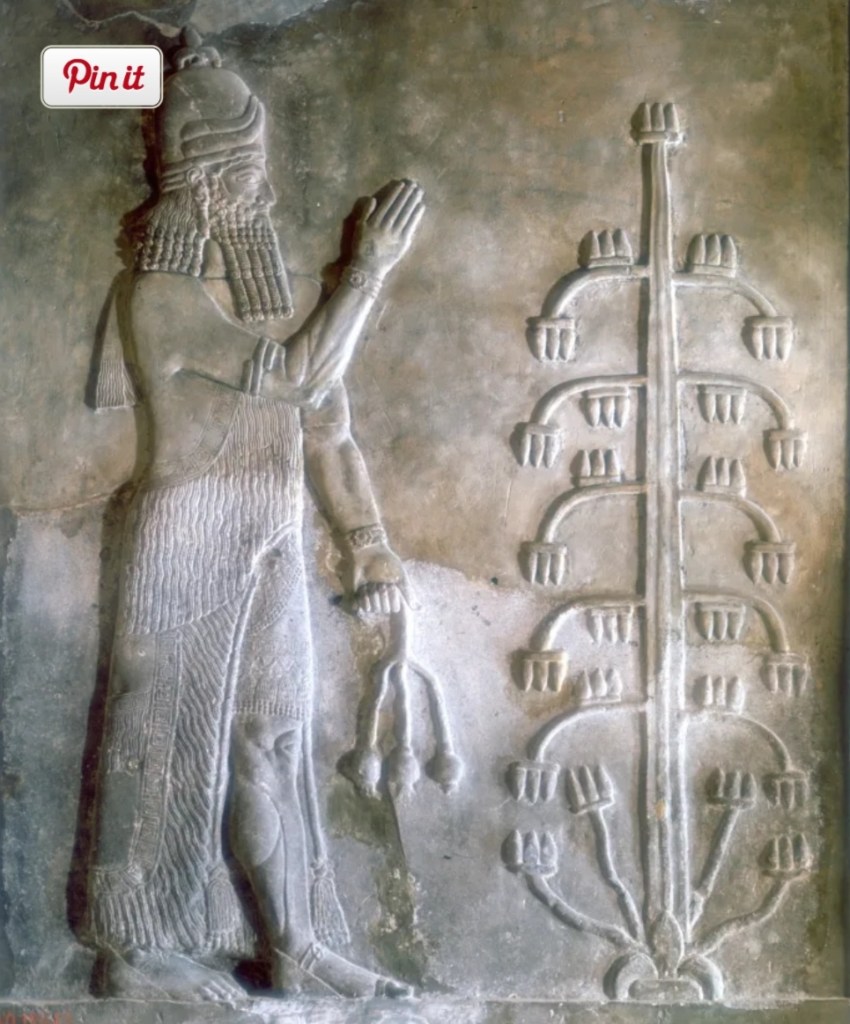
Sumer was an ancient civilization founded in the Mesopotamia region of the Fertile Crescent situated between the Tigris and Euphrates rivers. Known for their innovations in language, governance, architecture and more, Sumerians are considered the creators of civilization as modern humans understand it. Their control of the region lasted for short of 2,000 years before the Babylonians took charge in 2004 B.C.
Sumerian Civilization
Sumer was first settled by humans from 4500 to 4000 B.C., though it is probable that some settlers arrived much earlier.
This early population—known as the Ubaid people—was notable for strides in the development of civilization such as farming and raising cattle, weaving textiles, working with carpentry and pottery and even enjoying beer. Villages and towns were built around Ubaid farming communities.
The people known as Sumerians were in control of the area by 3000 B.C. Their culture was comprised of a group of city-states, including Eridu, Nippur, Lagash, Kish, Ur and the very first true city, Uruk. At its peak around 2800 BC, the city had a population between 40,000 and 80,000 people living between its six miles of defensive walls, making it a contender for the largest city in the world.
Each city-state of Sumer was surrounded by a wall, with villages settled just outside and distinguished by the worship of local deities.
Sumerian Language And Literature
The Sumerian language is the oldest linguistic record. It first appeared in archaeological records around 3100 B.C. and dominated Mesopotamia for the next thousand years. It was mostly replaced by Akkadian around 2000 B.C. but held on as a written language in cuneiform for another 2,000 years.
Cuneiform, which is used in pictographic tablets, appeared as far back as 4000 B.C., but was later adapted into Akkadian, and expanded even further outside of Mesopotamia beginning in 3000 B.C.
Writing remains one of the most important cultural achievements of the Sumerians, allowing for meticulous record keeping from rulers down to farmers and ranchers. The oldest written laws date back to 2400 B.C. in the city of Ebla, where the Code of Er-Nammu was written on tablets.
The Sumerians were considered to have a rich body of literary works, though only fragments of these documents exist.
Sumerian Art and Architecture
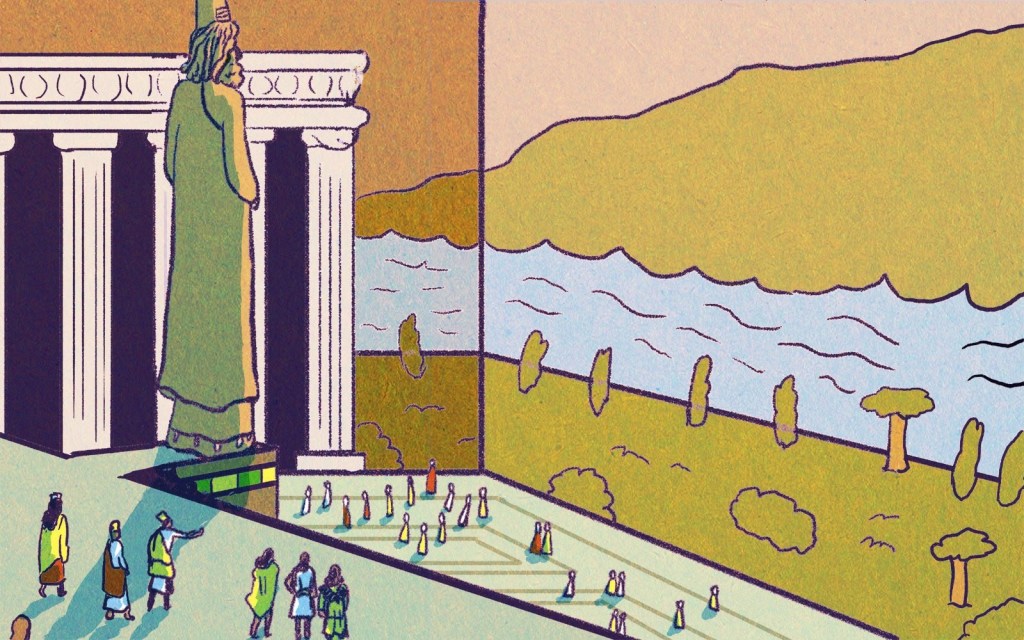
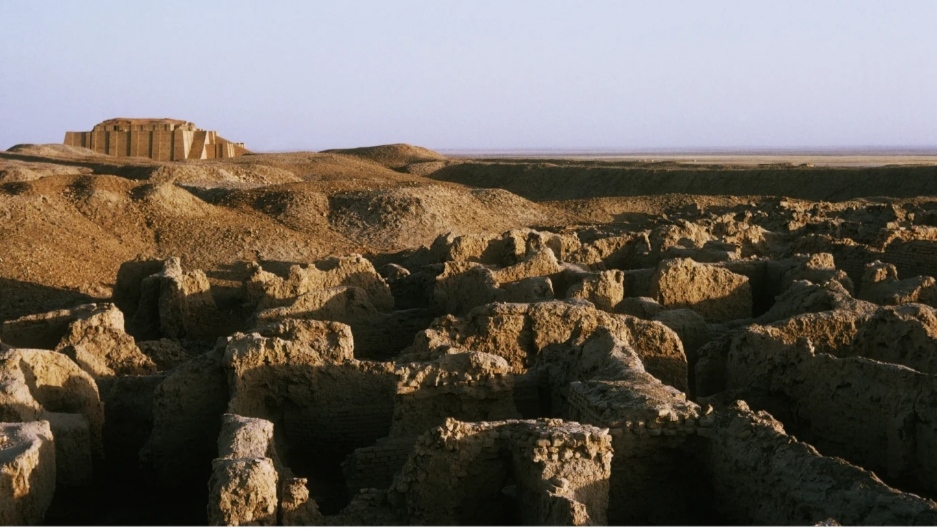
Architecture on a grand scale is generally credited to have begun under the Sumerians, with religious structures dating back to 3400 B.C., although it appears that the basics of the structures began in the Ubaid period as far back as 5200 B.C. and were improved upon through the centuries. Homes were made from mud bricks or bundled marsh reeds. The buildings are noted for their arched doorways and flat roofs.
Elaborate construction, such as terra cotta ornamentation with bronze accents, complicated mosaics, imposing brick columns and sophisticated mural paintings all reveal the society’s technical sophistication.
Sculpture was used mainly to adorn temples and offer some of the earliest examples of human artists seeking to achieve some form of naturalism in their figures. Facing a scarcity of stone, Sumerians made leaps in metal-casting for their sculpture work, though relief carving in stone was a popular art form.
Under the Akkadian dynasty, sculpture reached new heights, as evidenced by intricate and stylized work in diorite dated to 2100 B.C.
Ziggurats began to appear around 2200 B.C. These impressive pyramid-like, stepped temples, which were either square or rectangular, featured no inner chambers and stood about 170 feet high. Ziggurats often featured sloping sides and terraces with gardens. The Hanging Gardens of Babylon was one of these.
Palaces also reach a new level of grandiosity. In Mari around 1779 B.C., an ambitious 200-room palace was constructed.
Sumerian Science
Sumerians had a system of medicine that was based in magic and herbalism, but they were also familiar with processes of removing chemical parts from natural substances. They are considered to have had an advanced knowledge of anatomy, and surgical instruments have been found in archeological sites.
One of the Sumerians greatest advances was in the area of hydraulic engineering. Early in their history they created a system of ditches to control flooding, and were also the inventors of irrigation, harnessing the power of the Tigris and Euphrates for farming. Canals were consistently maintained from dynasty to dynasty.
Their skill at engineering and architecture both point to the sophistication of their understanding of math. The structure of modern time keeping, with sixty seconds in a minute and sixty minutes in an hour, is attributed to the Sumerians.
Sumerian Culture
Schools were common in Sumerian culture, marking the world’s first mass effort to pass along knowledge in order to keep a society running and building on itself.
Sumerians left behind scores of written records, but they are more renowned for their epic poetry, which influenced later works in Greece and Rome and sections of the Bible, most notably the story of the Great Flood, the Garden of Eden, and the Tower of Babel. The Sumerians were musically inclined and a Sumerian hymn, “Hurrian Hymn No. 6,” is considered the world’s oldest musically notated song.
Gilgamesh
The very first ruling body of Sumer that has historical verification is the First Dynasty of Kish. The earliest ruler mentioned is Etana of Kish, who, in a document from the time, is credited as having “stabilized all the lands.” One thousand years later, Etana would be memorialized in a poem that told of his adventures in heaven.
The most famous of the early Sumerian rulers is Gilgamesh, king of Uruk, who took control around 2700 B.C. and is still remembered for his fictional adventures in the Epic of Gilgamesh, the first epic poem in history and inspiration for later Roman and Greek myths and Biblical stories.
A devastating flood in the region was used as a pivotal point in the epic poem and later reused in the Old Testament story of Noah.
Sumerian Power Struggles
Somewhere around 2600 B.C., a power struggle erupted between the leaders of Kish, Erech and Ur, which set off a “musical-chairs” scenario of rulers for the region for the next 400 years.
The first conflict resulted in the kingdom of Awan seizing control and shifting the ruling body outside of Sumer until the kingship was returned to the Kish.
The Kish kept control briefly until the rise of Uruk King Enshakushanna, whose brief dynasty was followed by Adabian conqueror Lugalannemundu, who held power for 90 years and is said to have expanded his kingdom up to the Mediterranean. Lugalannemundu also conquered the Gutian people, who lived in the Eastern Iraqi mountains and who would later come to rule Sumer.
In 2500 B.C. the only woman to rule the Sumerians, Kubaba, took the throne. She is the only female listed on the Sumerian King List, which names all rulers of Sumer and their accomplishments. Kubaba’s son, Puzur-Suen, eventually reigned, bringing in the fourth dynasty of Kish, following a brief ascendency of Unzi, the first in the Akshak Dynasty.
This last Kish dynasty ruled for a century before Uruk king Lugal-zage-si ruled for 25 years before Sargon took control in 2234.
Sargon
Sargon was an Akkadian whose past is shrouded in legends that some claim were ignited by Sargon himself. The claim is that he was the secret child of a high priestess who placed him in a basket and cast him off into a river, a story that was later utilized for Moses in the Old Testament.
Sumerian tradition says that Sargon was the son of a gardener who rose to the position of cupbearer for Ur-Zababa, king of Kish, which was not a servant position but a high official.
Ur-Zababa was defeated by the king of Uruk, who was, in turn, overtaken by Sargon. Sargon followed that victory by seizing the cities of Ur, Umma and Lagash, and establishing himself as ruler. His militaristic reign reached to the Persian Gulf.
Sargon built the city of Agade as his base, south of Kish, which became an important center in the ancient world and a prominent port. Agade was also home to Sargon’s army, which is considered the first organized standing army in history and the earliest to use chariots in warfare.
Sargon took control of the religious cultures of the Akkadians and the Sumerians, making his daughter Enhedu-anna the head priestess of the moon god cult of Ur. Enheduanna is best remembered for her transcriptions of temple hymns, which she also wrote and preserved in her writings.
Sargon ruled for 50 years, and after his death, his son Rimush faced widespread rebellion and was killed. Rimush’s brother Manishtushu met the same fate.
Sargon’s grandson, Naram-Sin, took the throne in 2292 B.C. Naram-Sin considered himself divine and was leveled with charges of sacrilege.
The Gutians invaded in 2193 B.C. following the reign of the last Akkadian king, Naram-Sin’s son Sharkalisharri. Their era is marked by decentralized chaos and neglect. It was during Gutian reign that the grand city of Agade decayed into wreckage and disappeared from history.
Ur-Nammu
The final gasp of Sumer leadership came in 2100 B.C. when Utuhegal, king of Ur, overthrew the Gutians. Utuhegal’s reign was brief, with Ur-Nammu, the former governor of Ur, taking the throne, starting a dynasty that would rule for about a century.
Ur-Nammu was known as a builder. Figurines from the time depict him carrying building materials. During his reign, he started massive projects to build walls around his capital city, to create more irrigation canals, construct new temples and rebuild old ones.
Ur-Nammu also did the considerable work of constructing an organized and complicated legal code that is considered the first in history. Its purpose was to ensure that everyone in the kingdom, no matter what city they lived in, received the same justice and punishments, rather than rely on the whims of individual governors.
Ur-Nammu also created an organized school system for state administrators. Called the Edubba, it kept an archive of clay tablets for learning.
What Happened to Sumer?
In 2004 B.C., the Elamites stormed Ur and took control. At the same time, Amorites had begun overtaking the Sumerian population.
The ruling Elamites were eventually absorbed into Amorite culture, becoming the Babylonians and marking the end of the Sumerians as a distinct body from the rest of Mesopotamia.





























 Eduindex
You must be logged in to post a comment.