Aryabhata was one of the first Indian mathematicians and astronomers belonging to the classical age. He was born in 476 BC in Tarenaga, a town in Bihar, India. His major work, Aryabhatiya, a compendium of mathematics and astronomy, was extensively referred to in the Indian mathematical literature and has survived to modern times. The mathematical part of the Aryabhatiya covers arithmetic, algebra, plane trigonometry, and spherical trigonometry. It also contains continued fractions, quadratic equations, sums-of-power series, and a table of sines. It is however definite that he travelled to Kusumapara for studies and even resided there for some time. It is mentioned in a few places that Aryabhata was the head of the educational institute in Kusumapara. The University of Nalanda had an observatory in its premises so it is hypothesized that Aryabhata was the principal of the university as well. On the other hand some other commentaries mention that he belonged to Kerala.
Mathematical Work
Aryabhata wrote many mathematical and astronomical treatises. His major work, Aryabhatiya, a compendium of mathematics and astronomy, was extensively referred to in the Indian mathematical literature and has survived to modern times. The mathematical part of the Aryabhatiya covers arithmetic, algebra, plane trigonometry, and spherical trigonometry. It also contains continued fractions, quadratic equations, sums-of-power series, and a table of sines. His chief work was the ‘Aryabhatiya’ which was a compilation of mathematics and astronomy. The name of this treatise was not given to it by Aryabhata but by later commentators. A disciple by him called the ‘Bhaskara’ names it ‘Ashmakatanra’ meaning ‘treatise from the Ashmaka’. This treatise is also referred to as ‘Arya-shatas-ashta’ which translates to ‘Aryabhata’s 108’. This is a very literal name because the treatise did in fact consist of 108 verses.
Aryabhata worked on the place value system using letters to signify numbers and stating qualities. He also came up with an approximation of pi and area of a triangle. He introduced the concept of sine in his work called ‘Ardha-jya’ which is translated as ‘half-chord’.
Astronomical Work
Aryabhata also did a considerable amount of work in astronomy. He knew that the Earth is rotating on an axis around the sun and the moon rotated around it. He also discovered the position of nine planets and stated that these also revolved around the sun. He pointed out the eclipses, both lunar and solar. Aryabhata stated the correct number of days in a year that is 365 days. He was the first person to mention that the earth was not flat but in fact a spherical shape. He also gave the circumference and diameter of the earth and the radius of the orbits of 9 planets.
More about Aryabhata
Aryabhata was a very intelligent man. The theories that he came up with at that time present a wonder to the scientific world today. His works were used by the Greeks and the Arabs to develop further. A commentary by Bhaskara I, a century later on Aryabhatiya says:
‘Aryabhata is the master who, after reaching the furthest shores and plumbing the inmost depths of the sea of ultimate knowledge of mathematics, kinematics and spherics, handed over the three sciences to the learned world.’
Aryabhata’s Legacy
Aryabhata was an immense influence to mathematics and astronomy. Many of his works inspired Arabs more particularly. His astronomical calculations helped form the ‘Jalali calendar’. He has been honored in many ways. The first Indian satellite is named after him as ‘Aryabhata’, so is the lunar crater. An Indian research center is called ‘Aryabhata Research Institute of Observational Sciences’.
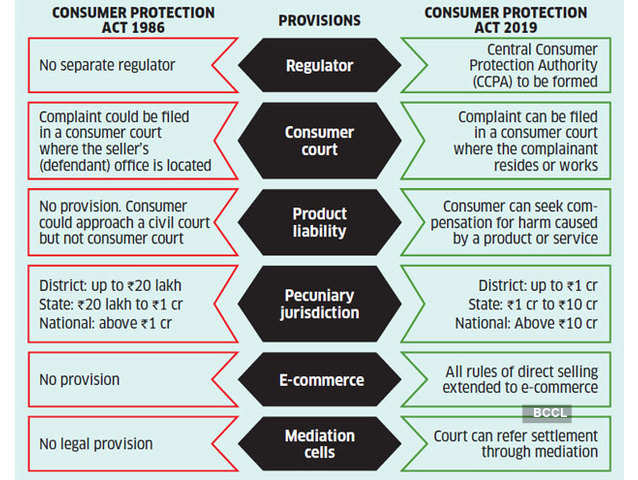
The Consumers can now cheer as the Consumer Protection Act, 2019 has recently replaced the three decade old Consumer Protection Act, 1986. The Consumer Protection Act, 2019 which came into effect on Monday (July 20) has replaced the earlier Consumer Protection Act, 1986.
The new Act as per the Experts say that “it gives more power to the consumers”. It seeks to revamp the process of administration and settlement of consumer disputes, with strict penalties, including jail term for adulteration and misleading ads by firms.
On July 20, 2020 certain provisions of the Consumer Protection Act, 2019 came into force as notified by the Central Government. Following the the key features of the relevant provisions:-
Key features of the Consumer Protection Act, 2019 which came into effect on July 20, 2020:-
1) Consumers can now institute a complaint from where they reside or work for gain.
2) The original pecuniary jurisdiction of the District Commissions has increased upto ₹1 crore from ₹20 lakh earlier.
3) The Pecuniary jurisdiction of State Commissions has been increased from ₹1 crore to Rs. 10 crore.
4) The National Commission can hear cases above ₹10 crore when compared to above ₹1 crore earlier.
5) While the provisions relating to e-commerce are not yet notified, a section relating to electronic service provider (covering software services, electronic payments) is notified.
6) The opposite party needs to deposit 50% of the amount ordered by the District Commission before filing an appeal before the State Commission. Earlier, the ceiling was a maximum of ₹25,000, which has been removed.
7) The limitation period for filing of appeals to the State Commission has been increased from 30 days to 45 days.
8) The Parties can be allowed to settle the disputes through mediation.
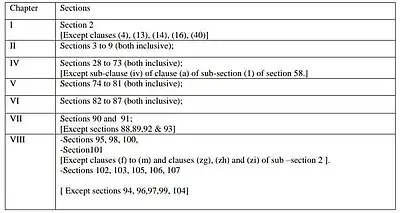
Following are the Sections which came into force:
Above mentioned provisions pertain to the Consumer Protection Councils, Consumer Disputes Redressal Forum, Mediation, Product Liability, punishment for manufacturing, selling, distributing etc spurious good or products which contain adulterant.
As per the rules, the e-commerce players will have to display the total ‘price’ of goods and services offered for sale along with break-up of other charges. Only a few certain miscellaneous provisions with regards and respect to the powers of the Central and State Government to make the rules and regulations have also been enforced.
On misleading advertisements there is provision for jail term and fine for manufacturers. There is no provision for jail for celebrities but they could be banned for endorsing products if it is found to be misleading.
For the first time there will be an exclusive law dealing with Product Liability. A manufacturer or product service provider or product seller will now be responsible to compensate for an injury or damage caused by the defective product or deficiency in services.
The Act has also defined an “e-commerce” as the buying or selling of goods or services including the digital products over digital or electronic networks. The existing definition of e-commerce has been adopted from India’s FDI Guidelines on e-commerce.
The definition of ‘e-commerce Entity’ as provided under the FDI Guidelines includes inventory and market place models.
There is also a provision for class action law suit for ensuring that rights of consumers are not infringed upon. The authority will have power to impose a penalty on a manufacturer or an endorser of up to 10 lakh rupees and imprisonment for up to two years for a false or misleading advertisement.
The Unique Identification Authority of India (UIDAI) is a statutory authority established under the provisions of the Aadhaar (Targeted Delivery of Financial and Other Subsidies, Benefits and Services) Act, 2016 (“Aadhaar Act 2016”) on 12 July 2016 by the Government of India, under the Ministry of Electronics and Information Technology (MeitY). The Aadhaar Act 2016 has been amended by the Aadhaar and Other Laws (Amendment) Act, 2019 (14 of 2019) w.e.f. 25.07.2019.
Prior to its establishment as a statutory authority, UIDAI was functioning as an attached office of the then Planning Commission (now NITI Aayog) vide its Gazette Notification No.-A-43011/02/2009-Admn.I) dated 28th January, 2009. Later, on 12 September 2015, the Government revised the Allocation of Business Rules to attach the UIDAI to the Department of Electronics & Information Technology (DEIT) of the then Ministry of Communications and Information Technology.
UIDAI was created with the objective to issue Unique Identification numbers (UID), named as “Aadhaar”, to all residents of India. The UID had to be (a) robust enough to eliminate duplicate and fake identities, and (b) verifiable and authenticable in an easy, cost-effective way. The first UID number was issued on 29 September 2010 to a resident of Nandurbar, Maharashtra. The Authority has so far issued more than 124 crore Aadhaar numbers to the residents of India.
Under the Aadhaar Act 2016, UIDAI is responsible for Aadhaar enrolment and authentication, including operation and management of all stages of Aadhaar life cycle, developing the policy, procedure and system for issuing Aadhaar numbers to individuals and perform authentication and the security of identity information and authentication records of individuals.
The idea behind the unique identification number was to assign each individual a unique 12 digit number which will help to identify the individual uniquely.
The objective was to attach all the biometric and demographic data of an individual with a 12-digit unique identity number called Aadhaar. The biometric and demographic data of individual will be stored in a centralized database.
The act related to Aadhaar was initially introduced as a money bill in the parliament of India on 3rd March 2016.
The bill was passed in the Lok Sabha on 11th March 2016 and on 26th March 2016, this bill became an Act.
The process of issuing the unique number and collection, maintenance and updating of biometric and demographic data related to each individual is done by the ‘Unique Identification Authority of India (UIDAI)‘, which is a central government agency of India.
With the issuance of Aadhaar card, India has entered the group of countries which has national identity cards for its native residents.
Even though Aadhaar was initially started to eliminate leakages, with time it became a basic identity document.
Reasons for this move:-
This process of attaching all the legal data of an individual with a unique number is an attempt of India to develop a secure system of identification and will have a long term impact.
The first recommendation of any such identity number was after the 1999 Kargil war by the Kargil Review Committee to then Prime Minister of India, for the security and authenticity reasons.
With the centralized database of each individual, it became possible for security agencies to access information of each citizen under a certain emergency situation in the interest of the national cause.
By considering the population of India, it was necessary to have such a secure identification system for controlling illegal migration and anti-national activities.
By connecting the Aadhaar number with the banking system, the Indian government has created a proper and secure channel through which beneficiaries receive all the subsidies directly to their bank account.
It has eliminated the role of middleman and agents thus helping the poor and the Indian Economy. Thereby Aadhaar empowers marginalised sections and ensures dignity.
With the help of UID, it became possible to identify the native Indians and illegal migrants and thus helps to ensure that only the Indian citizens and the legal migrants get benefits of government schemes and also employment.
As all the biometric and demographic data of an individual is linked to Aadhaar, it helps to identify the families that really belongs to BPL (Below Poverty Level) and hence providing them employment under NREGA (National Rural Employment Guarantee Act) and also easy and prompt payment to the actual workers.
Another big issue which can be addressed through UID is the real number of voters. Rural to urban migration is highly prevalent in India. Thus they enrol their names in the voter list of both places and politicians take an ill advantage of such a situation. But by the implementation of UID, it will not be possible for any individual to possess more than one voter identity card.
Government of India could save 15000 crores till 2016 by linking bank accounts with aadhaar for the LPG cylinder subsidies. Aadhaar will eliminate fake accounts.
Aadhaar based biometric attendance will make a good impact in government offices where most people try to escape from their work.
UID will also help indirectly in controlling corruption.
Challenges:-
For a nation like India with such a large population, it becomes a matter of security risk to handle such a large data of individual associated with their UID.
As almost all the details are associated with Aadhaar, it poses a threat to ‘right to privacy’. The data is susceptible to commercial exploitation by private parties and also to surveillance by the government.
No effective implementation of law and punishments in case of any misuse such as the leakage of personal information of citizens.
Assigning UID to such a huge population with authenticity is also a big challenge as no prior documents asked for it.
Conclusion:-
UID for every Indian is a very good system for eliminating agents and commission culture from India. It will help the poor to get their benefits directly to their accounts. It will also help in eliminating the illegal migrants from India and thus controlling the anti-national activities. But the implementation and execution must be done in a proper and prompt manner. And there must some guidelines related to risks associated with the system.
COMPANY COMPLIANCES DURING THE COVID-19 ERA: AN INTRODUCTION
The global outbreak of the novel coronavirus has taken the world by storm. While the issue pertaining to the public health is the talk of the town, the impact of COVID-19 on businesses and corporates seems to be least talked about.
Day to day business of the corporates is being affected due to decreased inflow of the human resource and a decrease in the workflow. While technologies have provided a relief to the human resource for physical attendances and conferences, there seemed to be unsettled trouble regarding legal compliances that required various filings and physical meetings.
Pursuant to the ongoing global COVID-19 pandemic and the Finance Minister, Ms. Nirmala Sitharaman’s announcements on March 24, 2020, the Ministry of Corporate Affairs (“MCA”) has issued various circulars to provide relief to companies from certain compliances under the Companies Act, 2013 (“Act”) and associated rules. This has been done as a measure to reduce the compliance burden on entities during the unprecedented health and economic situation caused by COVID-19. Following are the measures:-
1. Company Affirmation of Readiness towards COVID-19
Social distancing has gained its importance as a way to contain the spread, morbidity, and mortality of COVID-19. Government of India (“GOI”), responsible for the public welfare at large, has realised that social distancing can be achieved in its true sense only if the employers of the Indian public make the same application in their respective premises.
Considering that major employers of the nation belong to the companies or limited liability partnership (“LLP”) type entity, GOI as part of disaster management have advised all companies/LLPs to put in place an immediate plan to implement the “work from home” policy as a temporary measure up till March 31, 2020.
Further, in case of a requirement of physical visits of the essential staff to such offices by the employers, staggered timings may be followed in order to minimize physical interactions of all kinds.
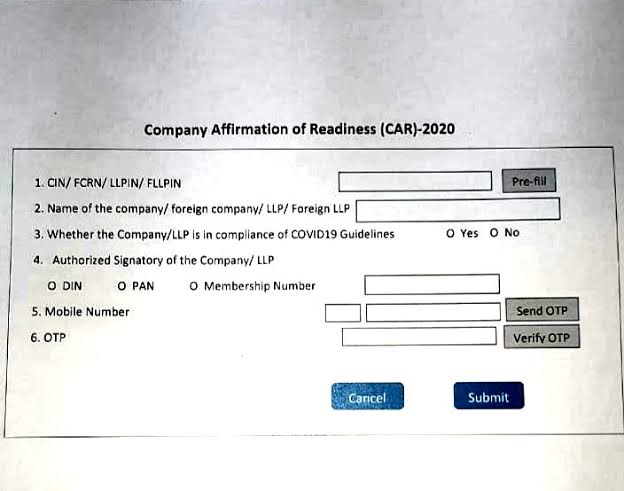
A simple webform for companies/LLP shall be deployed by MCA on March 23, 2020, in order to confirm the readiness of the employers to deal with COVID-19 threat. The webform shall be called CAR (Company Affirmation of Readiness towards COVID-19) and would be required to be signed and submitted by the authorised signatory of the company/LLP.
Therefore, it shall be expected by each company/LLP to ensure reporting of the compliance through CAR instantly from the date of its deployment.
2. Companies Fresh Start Scheme 2020
The MCA issued a circular on March 30, 2020, introducing the Companies Fresh Start Scheme, 2020 which, inter alia, grants a one-time opportunity to defaulting companies to complete all belated filings, including, without limitation, annual filings and filings required under IEPFA (Accounting, Audit, Transfer and Refund) Rules, 2016 in relation to transfer of money remaining unpaid or unclaimed for a period of seven years under Section 124(5) of the Act and transfer of relevant shares in the name of the ‘Investor Education and Protection Fund’ under Section 124(6) of the Act, with the MCA21 registry, without incurring additional fees on account of any delay.
This scheme came into force on April 1, 2020, and is valid till September 30, 2020. The application for seeking immunity for belated filings under this scheme should be made within a period of six months from September 30, 2020, through Form CFSS-2020. Thereafter, an immunity certificate will be provided by the designated authority on the basis of the declarations made in such form.
However, no immunity shall be provided under the scheme in a matter where (i) an appeal or management dispute is pending before any court or tribunal, or (ii) a court has ordered a conviction, or the adjudicating authority under the Act has imposed a penalty, and in respect of such orders, no appeal has been filed prior to the scheme coming into force.
Further, the scheme shall not apply: (i) where an application has been filed or an action for final notice for striking off the name of the company has already been initiated; (ii) where the company has been amalgamated; (iii) when application of obtaining dormant status has been filed; (iv) to vanishing companies; and/or (v) where charge related documents or an increase in authorised capital is involved.
3. CSR Spending
The MCA has by way of circular dated March 23, 2020 and the office memorandum dated March 28, 2020, clarified that the spending of CSR funds by companies in relation to COVID-19, including by way of contribution to the PM CARES Fund, is an eligible CSR expenditure under the Act.
The MCA has further clarified by way of FAQs dated April 10, 2020 that contributions made to the State Disaster Management Authority will also be eligible CSR activity, but contributions towards (a) ‘Chief Minister’s Relief Fund’ or ‘State Relief Fund for COVID-19’; and (b) payment of salary/ wages to employees and workers (including contract labour/ temporary/ casual/ daily wage workers) during the lockdown period will not be considered as eligible CSR expenditure.
However, ex-gratia payment over and above the disbursement of wages to temporary/ casual workers/ daily wage workers, specifically for the purpose of fighting COVID-19, will be admissible towards CSR expenditure, provided there is an explicit declaration to that effect by the board of the company, which is duly certified by the statutory auditor.
4. Meetings of Board and the Shareholders
The Companies (Meetings of Board and its Powers) Rules, 2014 were amended by a notification dated March 19, 2020, to enable companies to hold board meetings on the following matters (which earlier had to be necessarily held at a physical meeting) through video-conferencing or other audio-visual means (collectively “VCC”) till June 30, 2020: (i) approval of annual financial statements and board’s report; (ii) approval of prospectus; (iii) audit committee meetings for consideration of financial statements; and (iv) approval of amalgamation, merger, demerger, acquisition and takeover.
MCA has, by way of a general circular dated April 8, 2020, requested companies to pass all decisions of an urgent nature requiring shareholder approval, other than those of ordinary business or business where any person has right to be heard, through postal ballot/ e-voting in accordance with the relevant statutory provisions without holding a physical general meeting. However, in cases where holding an extraordinary general meeting (“EEGM”) is unavoidable, these have now been permitted to be held through VC until June 30, 2020. The circular further lays down certain conditions to be met for conducting an EGM through VC and the key conditions, inter alia, include: (i) attendance of at least one independent director (where a company is required to appoint one) and auditor (or his authorised representative who is qualified to be the auditor); (ii) maintenance of recorded transcripts of the EGM and, in case of a public company, such transcripts to be uploaded on the company website (if any); and (iii) e-voting facility being available. All other provisions relating to general meetings under the Act (and relevant rules) will continue to apply.
Due to difficulties faced by various stakeholders in serving and receiving notices/responses by post on account of COVID-19, the MCA, on April 13, 2020, provided that notice of EGMs to be held through VC (and for passing shareholder resolutions through postal ballot/ e-voting) may now be given to shareholders only through email addresses of the shareholders registered with the company or with the depository participant/ depository. This circular also specifies various conditions which companies must comply with while sending email notices to shareholders.
CONCLUSION
Business entities in India are requested and expected to keep an eye on the major government websites to ensure timely compliance with all such immediate requirements and mandates issued by GOI as need of the hour from time to time.
WEBSITES REFERRED:-
1) MCA General Circular No. 10/20 dated March 23, 2020 on Clarification on spending of CSR for COVID-19.
2) MCA General Circular No. 12/20 dated March 30, 2020 on Companies Fresh Start Scheme, 2020
3) MCA Notification dated March 19, 2020 on Companies (Meetings of Board and its Powers) Amendment Rules, 2020
4) MCA General Circular No. 14/2020 dated April 8, 2020 on Clarification on passing of ordinary or special resolutions by companies under the Companies Act, 2013 and rules made thereunder on account of threat posed by Covid-19.
5) MCA General Circular No. 17/20 dated April 13, 2020 on clarification on passing ordinary and special resolutions by companies under the Companies Act, 2013 and rules made thereunder on account of threat posed by COVID-19.
India has been under lockdown phase 4 until May 31st with some relaxations. Prime Minister Mr. Modi announced a relief package of 20 lakh Crores INR for various sectors to propel economic growth on May 17. Some relaxations which were provided to Red, Orange and Green zone areas during the Lockdown 3.0 like opening of some of the individual shops of non-essential items were extended to Medium and small scale industrial sector, farm and trading sector. Malls, Cinemas, restaurants and places with probable high foot fall remained closed. India now is ranked third in the world in terms of coronavirus cases, after the US and Brazil.
The COVID-19 pandemic pushed economies into a Great pushback, which helped contain the virus and save lives, but also triggered the worst recession since the Great Depression. Over 75 per cent of countries are now reopening at the same time as the pandemic is intensifying in many emerging market and developing economies. Few countries have started to recover. However, in the absence of a medical assistance, the strength of the recovery is highly uncertain and the impact on sectors and countries are uneven.
The entire country remained under lockdown till May 31, 2020 followed by Unlock phase-1 from June 1 and June 14. Up to May 31, was the Lockdown 4. Earlier the Lockdown 3 was up to May 17, Lockdown 2 was upto May 3 and before that the Lockdown 1 was from March 22 to April 16, 2020. Prime Minister Mr. Modi announced measures with some relaxations. According to experts, this is being done to ensure that the Food Safety of India is protected as Rabi harvesting season is on anvil. PM Modi said detailed guidelines have kept in mind the needs of the informal sector and farmers. India now joins countries such as France, USA which are moving with the idea of unlock phases after extended lockdowns.
The Harsh Effects on World Economies
A high degree of uncertainty surrounds this forecast, with both upside and downside risks to the outlook. On the upside, better news on vaccines and treatments, and additional policy support can lead to a quicker resumption of economic activity. On the downside, further waves of infections can reverse increased mobility and spending, and rapidly tighten financial conditions, triggering debt distress. Geopolitical and trade tensions could damage fragile global relationships at a time when trade is projected to collapse by around 12 per cent.
This pandemic like no other will have a recovery like no other. First, the unprecedented global sweep of this crisis hampers recovery prospects for export-dependent economies and jeopardises the prospects for income convergence between developing and advanced economies. We are projecting a synchronised deep downturn in 2020 for both advanced economies (-8 per cent) and emerging market and developing economies (-3 per cent; -5 per cent if excluding China), and over 95 percent of countries are projected to have negative per ca-pita income growth in 2020. The cumulative hit to GDP growth over 2020–21 for emerging market and developing economies, excluding China, is expected to exceed that in advanced economies. Sooner or later this crisis will vanish and it has to because change is the undisputed law of nature. The only thing waiting for us after this epidemic is a shattering or rather say, a collapsing economy for many nations. We are fighting this pandemic together hence same should be our spirit in handling the ruptured economy. With confirmed case count for India crossing a million and more than 26000 deaths, all we can do is to get more strongly committed to all guidelines and suggested precautions by governments and health agencies worldwide.
What happened at Galwan valley of Indian Ladakh had raised tensions between India and China to all time high. The clash between Indian and Chinese forces led to nationwide outburst against China.
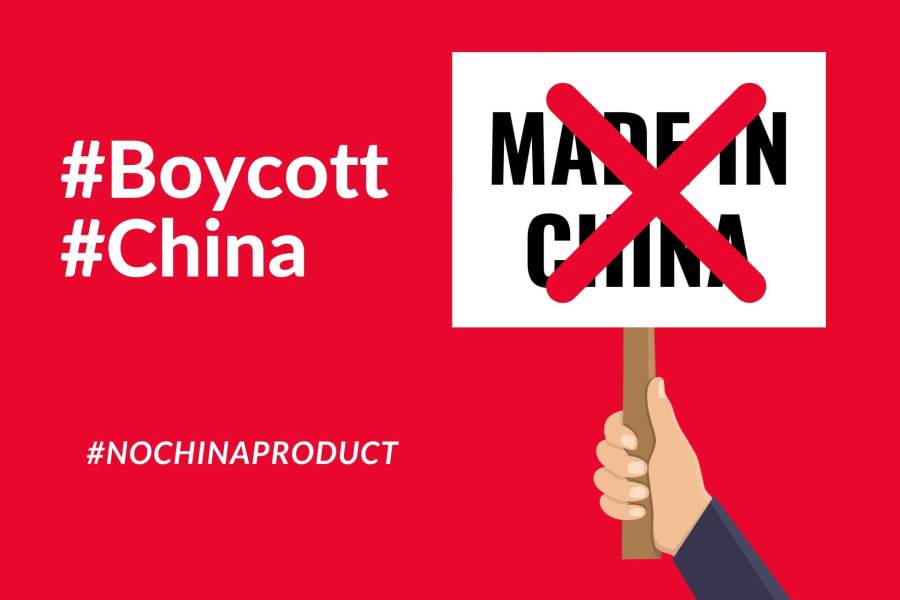
Fuelling this, there had been a sudden disagreement for buying any Chinese product or services. This is to make sure that Chinese economy doesn’t receive a single penny from India and its citizens, making it obvious after China bearing malice towards its neighbours, specifically India. The initiative has greatly boosted with GOI’s (Government of India) decision of banning 59 Chinese applications in India and by increasing the import taxes on Chinese goods or services. The Indian armed forces had already been deployed at disputed regions of border and are ready for any surprise from counter side.
With Governments and Armed forces holding tight on attempts to self-reliant India, the dice of responsibility falls our side too. By us I mean, all the common or less common citizens of India whose decision of just boycotting Chinese products could shatter its trade. Already many huge economies of the world have turned against China, amid Corona virus outbreak and deaths of 600,000 (still rising) innocent people.
Boycotting Chinese items won’t be that easy as it sounds, one has to spend a little more of their money while switching to non-chinese brands, as the only PSP (product selling protocol) of Chinese products is its cheap pricing. This pricing gets balanced with its poor quality and doesn’t last any longer. Yet, Chinese products have kept its dominance in certain sectors of Indian market.
The mobile phone sector
India had imported mobile phones worth $11.3 billion from China in 2016-17, and that was about 68 per cent of all mobile phones (both push-button feature phones and smart devices) imports into the nation that year. In 2017-18, even as the duties were imposed, the value of mobile phone imports from China climbed to $15.6 billion, or 71 per cent of the mobile phones imported. As the tax measure began to hurt and local manufacturing of mobile phones gathered momentum, imports of these devices from China halved to $7.4 billion and about 41 per cent of all mobile phone imports in 2018-19. Imports of phones, by value, from China declined further in 2019-20 but not the share, which remains at 40 per cent. If we just speak of alternatives, we have few options of some Korean, Taiwanese, American and just few Indian tech companies. These options are:
LG
Samsung
Nokia
Apple
Asus
The drop in electronic imports gradually implemented by the GOI in recent years but this won’t be enough and buyers need to push their expenses to continue supporting the campaign of #boycottchina.
Other imports from China include toys, gift items, fabrics and garments, and thousands of small value items that are popular with consumers. CAIT (Confederation of All India Traders) estimates that there are some 3,000 items that can be easily substituted with India-made products in the first phase of the boycott of Chinese goods campaign. The list of China-made items popular with consumers includes fairy lights with tiny LED bulbs that are used to decorate homes during festivals, idols of deities, home decors, kite strings and even incense sticks (agarbattis). It is estimated that about 80 per cent of the incense sticks sold in India are imported from China.
For all of it to happen, for this campaign to succeed we all should hold our horses and should maintain an adequate transition of market into indigenous domain. This would be the only secure and once for all time solution to problems India facing with the dragon as war could never be a solution. It would just tear up economies at both ends and loss of Brave Indian soldiers shouldn’t happen any further.
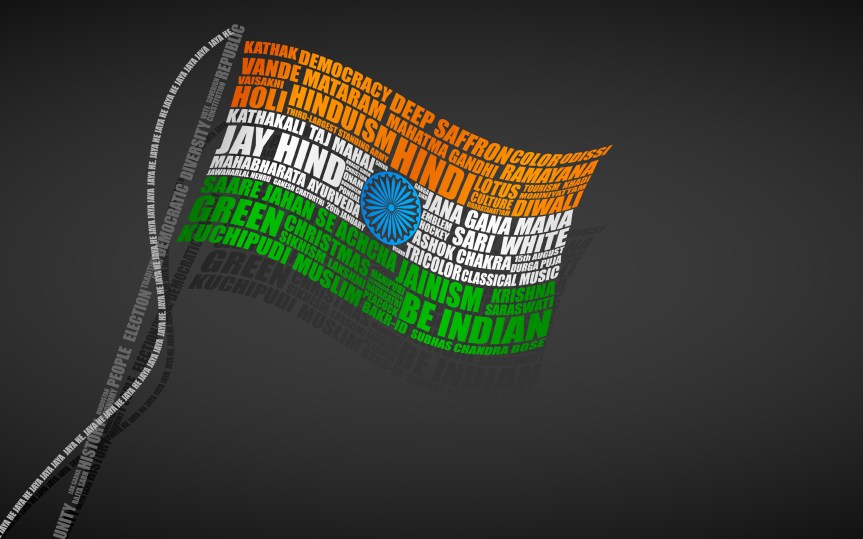
The Indian Flag Portraying Diversified Culture of India
India, the world’s most diversified country, 565 princely states united by Sardar Vallabhbhai Patel (former Home Minister of India). These states with their own set of languages, food cuisines, apparels, climates, race, skin shades, religions, traditions and cultures make India vibrant and colourful. A nation that is alternate to rainbows and unexpected surprises. The only nation with a demography including almost all sets of the religions in the world, the super minority religious group of Parses too. Now the question arises, does this variance divide us or its just mix of spices that unites us with delicious flavour of nationalism, i personally prefer the latter option.
Now let us see how it is according to the recent activities in the nation. With the high tensions among certain communities in India and dozens of riots among them in the past, shows us that there had been some sort of hatred pumping into veins of many Indians. Definitely some are not happy with the partition and some seek another partition but the biggest difficulty arises when we try to see all under same umbrella, which is indeed not appropriate measure to be followed by any responsible citizen of India. Yes, there is communal hatred in India and we cannot hide it anymore, the truth should prevail over emotions and need to see where India is lagging behind, what is pulling her back from developing. With this another question arises, how do we solve it, we cannot cut another piece of land to satisfy any particular community and we know it well that 1947’s partition resulted in the biggest failure of mankind ever. It turned into huge loss for both India and Pakistan and the purpose to completely divide Hindus and Muslims could not work out.
Coming back to our topic, we certainly understand this that there’s shouldn’t be any more partitions and we are actually good with a mix of all religions living with harmony and peace. The law & order should dominate over any religion and law breakers shouldn’t be judged on the basis of their skin shade, race, state or religion.
Religion isn’t the only problem that causes distress in India. There are certain cases of cultural biases. Certain states that are unable to generate enough revenue to sustain its domiciles within the state are responsible for migration of millions. These unfortunate poor citizens of India are forced to leave their states, to be into developed cities of India for earning their bread. Who are they and why do they have leave their homes, their villages and walk thousands of miles and live in exile. The one word answer is poverty. The all the diversifying elements we discussed earlier does not divide humanity as much as poverty does. The gap between rich and poor, strong and weak, literate and illiterate, fortunate and unfortunate, happy and unhappy is unfortunately increasing day by day, year by year. There’s a saying that nothing goes for vain but life of a poor in India, yes it goes for waste. The biharis in general always discriminated in India and their lives are counted as meaningless. We saw a good example of this during recent impact of Covid-19 in India, where millions of labours migrated miles on their way home, majority by walk.
Does diversity really divide us or is it poverty that does so. Readers of this article should ask this question to themselves and others. Let us understand this for real, India’s diversity is not dividing, we should see it as a blend of brilliant tastes, south and north, Hindi and tamil, Idli and Paratha, Chai and Coffee, Bengali sweet and Rajasthani Salty, Delhi Rajma and Pune’s Poha and this list goes on because there’s no ending to tastes and cultures in India. India is a garden of most beautiful flowers and some weeds like any other nation would have. All we have to do is nourish these flowers so to blossom India into rich fragrance and for weeds we have use our wisdom as weedicide and should kill our differences and see every citizen of this Nation as Indian first.
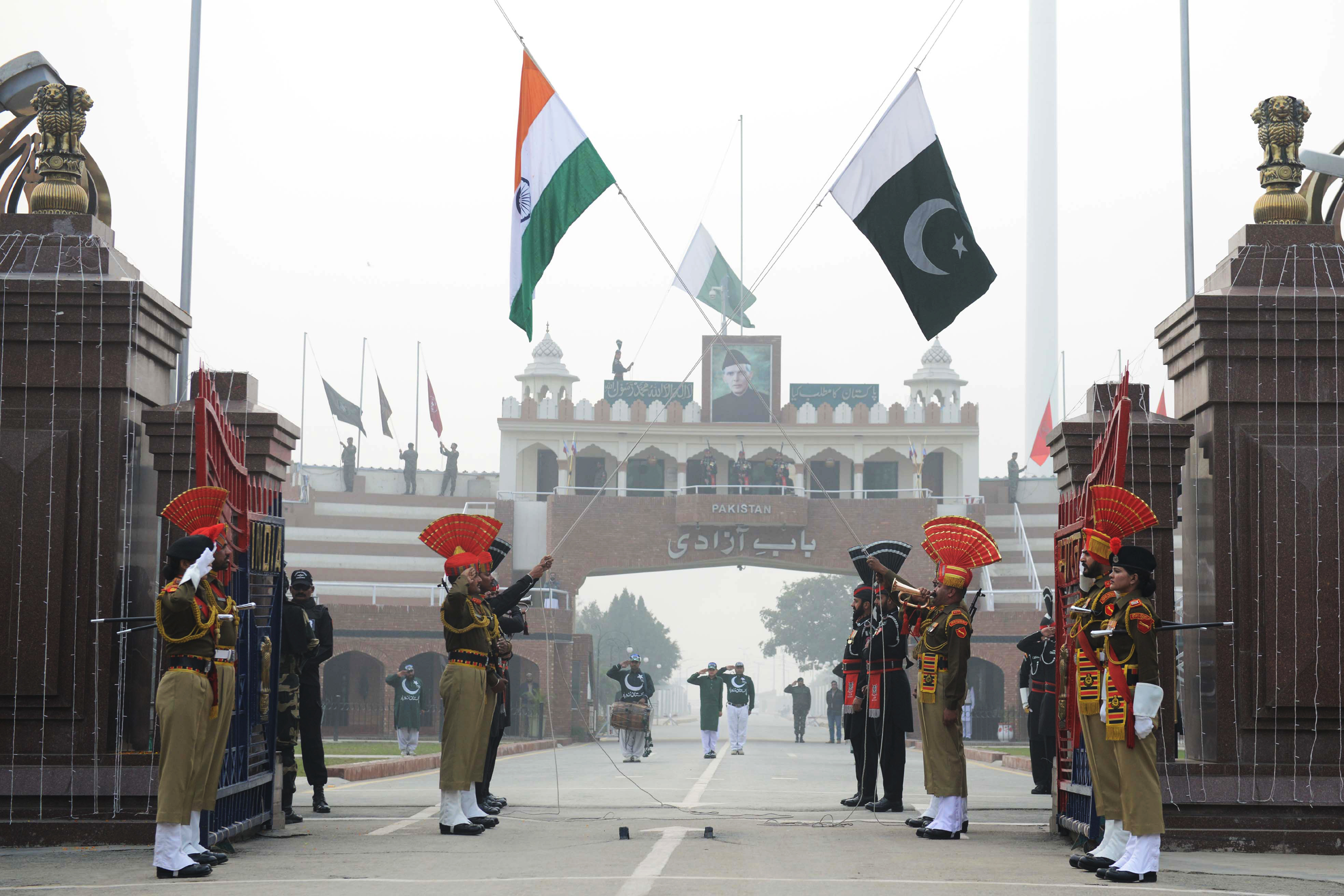
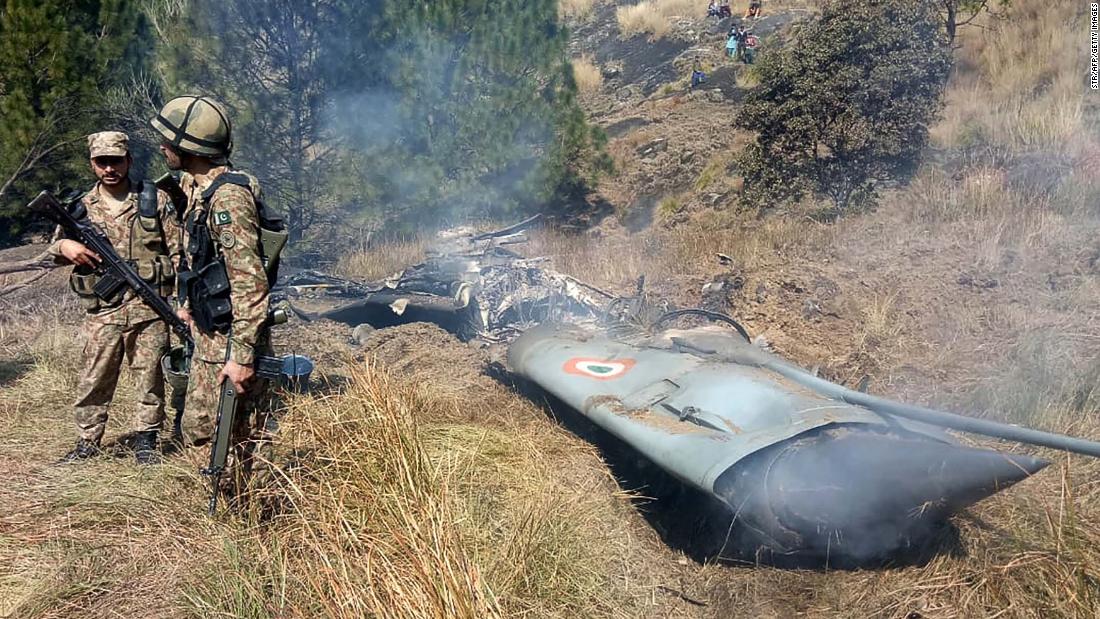
On February 14th 2019, a suicide bomber attacked a convoy of Indian security forces. “We’re getting reports of multiple casualties in a roadside…” He killed at least 40 Indian soldiers here in Kashmir. “The deadliest attack the region has seen this century.” The bomber was part of an Islamic militant group based in Pakistan. “Jaish-e-Mohammed claimed responsibility for that attack.” 12 days later, India carried out airstrikes in Northwestern Pakistan. Then Pakistan shot down at least one Indian aircraft around here. “The most serious escalation in years.” Kashmir is one of the most disputed places on Earth. Over the course of 70 years, it’s been at the center of three wars fought between two massive armies. It’s heavily occupied by more than half a million Indian troops and a deadly collection of militias and terrorist groups.
Kashmir is the stage for the relentless conflict between India and Pakistan. But focusing on the two countries can obscure what’s really at stake: The voice of Kashmiris who are caught in a vicious cycle of violence. Kashmir is one of the most strategic places in the world, where 3 powerful countries collide: India, Pakistan, and China. China invaded and took this slice of Kashmir from India. And was given this one by Pakistan. India and Pakistan control these parts, but lay claim to more. This region is at the center of a brutal conflict over these disputed borders. So it’s important to start when they were being drawn. In the mid-1800s, India was a patchwork of several hundred provinces and princely states under British rule. A century later, when British India won independence, the British left and hastily decided to split the region into two. These areas would be a new Muslim-majority country, Pakistan. And this would be the mostly Hindu, but secular, India. The partition was bloody. “Communal hatred flares up within the Punjab.” “1 million people become refugees overnight.” “They flee from savagery and butchery that has never been exceeded, even in India’s stormy history.” Amid the chaos, some princely states were given the choice to join either country. In most cases, the ruling monarchs followed the will of their people. But this state, called “Jammu & Kashmir” was different. It was right along this new border and had a Muslim-majority population, but was ruled by a Hindu monarch. When asked to pick a side, the ruler chose to stay neutral Fearing that the monarch would join India, the Kashmiri population rebelled here in 1947 Armed tribesmen from Pakistan soon joined the fight.
The monarch turned to India for military help and in exchange agreed to join them, which sparked the first Indo-Pakistan war in Kashmir. “Continuing thus increased the threat to world peace and brought the dispute to the eye of the United Nations . The UN Security Council brokered a ceasefire in 1949, which established this line with Pakistan controlling this side and India this one. It also asked Pakistani tribesmen to withdraw and Indian troops to follow, so that Kashmir could hold a direct vote to decide its own future. But neither held up their end of the deal. Pakistan argued that Kashmir’s Muslim-majority population rightfully belonged with them. While India insisted that Kashmir was handed over to them by the Hindu monarch. So they doubled down and added Kashmir to their constution. Both countries continued to tighten their grip around it for many years . “Kashmir. Fighting is going on and heavy casualties in men and equipment have been inflicted on the aggressor.”
In 1965, the second India-Pakistan war broke out in Kashmir. Thousands of people were killed between the huge armies on both sides. A ceasefire ended the war, but didn’t change this line. Kashmir was kept divided and occupied. And another war broke out in 1971. This time the focus wasn’t in Kashmir — it was in East Pakistan. Here, India helped rebels fight for independence and dealt Pakistan a devastating defeat. This region became a new country, Bangladesh, and Pakistan lost its eastern half. This made Kashmir more important than ever: It became one of the most militarized places on Earth, as India and Pakistan deployed planes, tanks, artillery, and soldiers along the Line of Control. On the political front, in ’87, India reportedly rigged an election, declaring a pro-India party as the winner. Now this was a big turning point for many Kashmiris, who felt they were again denied the chance to vote. Thousands took to the streets in Indian-controlled Kashmir to protest the occupation. But India met the movement for independence with harsh resistance. Which quickly escalated to more violence.
“In January security forces opened fire on demonstrating separatists, turning a two-year old struggling movement into a full-blown popular uprising.” “More than 600 people are killed in clashes between troops and separatists.” Kashmiri militias, just like the Jammu and Kashmir Liberation Front, started recruiting Muslim youth to fight for independence. And increasingly attacked the Indian military. Pakistan saw an opportunity in this insurgency. They helped introduce a new kind of militant group: Radical Islamic fighters who fought for a more pro-Pakistan Kashmir. By the mid ’90s, these groups dominated the insurgency. India responded with incredible military force, deploying 500,000 troops to Kashmir. And they cracked down on militants and protestors. Unarmed civilians were killed and many more were forced to flee the violence. And in ’98 the stakes were raised yet again. “Today India conducted three underground nuclear tests.” “Pakistan today successfully conducted five nuclear tests.” Kashmir became a battleground between two nuclear-armed nations and another war broke out in 1999. “More evidence of the attacks being launched on the Indian-controlled area of Kargil.” “The past two days have seen a number of the fiercest fighting thus far .” “Militant Muslim fighters have also crossed over into some parts of Indian-ruled Kashmir.” The 1999 war ended with another ceasefire, but that did not stop either country.
Over the years, Pakistan’s militant groups got bolder and launched terror attacks in Kashmir and outside of Kashmir. In 2001, members of Lashkar-e-Taiba bombed India’s parliament building in New Delhi killing 14 people. And in 2008, 10 militants from the same group killed 174 people and wounded 300 in Mumbai. Meanwhile, Indian military cracked down in Kashmir, firing bullets and pellets on unarmed protesters. Leaving hundreds wounded and blind. This is the vicious cycle of violence. The Indian Army’s crackdown drives some Kashmiris to join Pakistani-backed militant groups, who carry out violence against the Indian forces. It’s a cycle that Kashmiri civilians are stuck in the middle of. Which brings us back to 2019. The suicide bomber was 19-year old Adil Ahmed Dar from Pulwama, Kashmir. According to his parents, in 2016, Indian police officers stopped him and humiliated him by forcing his face into the ground. The same year he was shot in the leg at a protest. The next year, Dar left home with his brothers, to join Jaish-e-Mohammed, a Pakistani-supported militia that radicalized him and trained him to be a suicide bomber. A year later, he drove explosives into an Indian military convoy. For more than 70 years India and Pakistan have driven a cycle of violence, retaliation, and exploitation in Kashmir. But beneath it all is the Kashmiri’s wish to make a choice. A wish that continues to be suppressed, again and again, by violence.








 Eduindex
You must be logged in to post a comment.