What are type of emotions?

Till today, I myself was confused as to what is a motivational subsystem and what is an emotional subsystem and if my blog posts conflated the two and created confusions, I apologize. I have now come to believe that emotions are the reading by our mind of how our body is doing. This needs some unpacking.

The somatic marker theory of Damasio, and others, is inline with this formulation that there are brain areas that keep track of how the body is doing and if the body is say geared to flee a predator- then a corresponding feeling of fear may be felt by the mind. Feelings are conscious emotions and the subject of this post. The eight basic emotions to recap are Interest, Fear, Lust/ Wonder, Disgust, Love, Anger , Joy and Sadness. The emotions may even be conceptualizes as indicators of bodily needs: eg. Disgust signifying the need of the body to close off / get away from source of disgust.

Motivations, or the basic fundamental drives, on the other hand are drives that help us cope with problems in living: These are to SURVIVE , REPRODUCE, TAKE-CARE-OF-YOUNG-ONES and to THRIVE. All the steps are essential to pass on our genes to the next generation- if say we don’t take care of our young ones then our genes do not live on. So evolution has built in these four basic drives in us. These drives are action-focused: they are intentional and *about* the world; they are mechanisms via which we get our needs met. They are primed action tendencies that tilt us to act one way or the other, out in the world.

Most of us when we think about motivation think of Maslow’s needs. They are conceptualizes at a higher level- the level I am taking about is the most fundamental, the most basic. Panksepp has talked about that level, but he wrongly called such neuroscientist as affective subsystems, while they should be called drives/ motivational systems to reduce confusion.

Lets unpack this a bit. SURVIVE system in an ideal world should be about finding food and nutrition to grow and maintain ones’ bodily composition. Of course we don’t live in an ideal world, so predators loom large and survival also becomes about avoiding them. However the underlying drive/ need is the same to preserve, maintain and grow ones body. Some people have focused on maintaining bodily integrity or avoiding dangers/ predators as having primary significance and thus focused more on FEAR ; I however think that’s mistake. The drive is primarily about finding nutrients for self and because in the search for food, you are likely to come across predators, secondarily about avoiding them once you encounter them.

Thus the primary neurocircuit for SURVIVAL is the SEEKING system: it is primary in the sense that it is the default program of the self when it comes to survival. It primarily enabled foraging behavior, but since then has been coopted for finding knowledge (learning) etc too and is marked by curiosity, exploration, learning, pattern finding, meaning making etc.

While searching for food (either hunting or gathering) you are likely to come in contact with a predator; at that time only the FEAR/predator avoidance system kicks in and focuses actions and body for that specific task. At least that is the purpose for which this system evolved.

The primary neurocircuit for REPRODUCTION is LUST/Seducing system. When one is in the grip of this circuit/drive one flirts, seduces, and tries to mate with conspecific.

While trying to copulate with as many con-specifics as possible, a danger of getting infected with STD looms large. My hunch is that DISGUST evolved as a means to avoid STD’s/ be picky and selective while choosing.

The primary neurocircuit for TAKE-CARE-OF-LOVED-ONES is CARE. It evolved so that parents can take care of their children, but sine then has been coopted for taking care of all vulnerable entities.

The secondary neurocircuit comes into play because of cuckolding. While one wants to take care of ones genuine offsprings, one doesn’t want to be cuckolded and displays aggression towards the weakling which in not of self. This is the RAGE circuit.

The primary neurociruit for THRIVING is PLAY. It evolved so that we can form social bonds/ rise up the hierarchy by building coalitions and alliances.

While playing and rising up the social ladder, there is a risk of aggression by the alpha male or the risk of losing existing ties and suffering losses. This manifests as the PANIC/ separation distress system.

How do the (eight basic) emotions and the (eight basic) motivations interact? It might be tempting to assume that each motivational circuit is associated with one emotion/ feeling; however that would be a mistake. We first need to understand that emotions come in pairs (interest-fear, wonder-disgust, love-anger and joy-sadness) ; we also need to appreciate that the motivational circuits form opponent processes such that if FEAR is activated, SEEKING is suppressed etc. with that background lets forge ahead.

Feelings modulate motivations/drives. They either initiate and sustain the corresponding motivational circuit or suppress and stop it. Thus they are either inhibitory or excitatory in their effect.

Take SEEKING. If your body is feeling interest (is in a state of interest) it is more likely to explore or activate the SEEKING system. On the other hand if the body is feeling fear, it will suppress the SEEKING system. And how does the body gets into a state of interest/ fear? In the most general case its by cognitive appraisal of outside events/ stimulus. Lets take novelty, say a rat placed in a novel environment. The rat can either see that novel environment as interesting and thus get curious and explore; or it can see the novelty as frightening, get fearful and stop exploring. Thus the cognitive appraisal we make induce emotions that either inhibit or excite the motivational circuits.

Lest take another example: Take PLAY. Feelings of joy will increase likelihood of playing; while being in a sad mood will decrease playful behavior. Or take PANIC: feelings of sadness will tilt the probability of panicking , while being in a joyful mood will buffer against panic.

Or take CARE . Appraising a vulnerable dependent/weakling as in group leads to feelings of love and compassion leading to activation of CARE; appraising the same person as outgroup leads to feelings of anger over why I need to support him/her and lead to suppression of CARE.

Or take LUST. Thinking someone as attractive leads to feelings of wonder about what the person is like and activate flirting/seducing behavior aka LUST. However, thinking of the person as unattractive/ugly leads to feelings of disgust and deactivation of LUST system.

I think by now, it should be clear how the emotions and motivations are connected. In the next post I will be extending this emotions/ motivations linkage forward to personality traits and psychological disorders.

See yaa..

How to learn effectively and efficiently

 Imagine studying so hard for a test and ending up getting lesser marks than expected, that’s quite disappointing right? Each and every time we learn something new, it is important to learn it in an effective way. Focusing on the right points and methods can make us all memorize things very easily. It will also become easier for us to score more marks too.

Methods of studying can vary from student to student but the most common and reliable methods are mentioned below.

  • Learn at your own pace

Learning capacity for every single person is different from each other. Some people have the ability to memorize much more than others can possibly do. But don’t be afraid of that. Always take your time in learning but make sure to not waste your time too. Learn as much as your brain can take and do not stress over it because if you do there are higher chances that you might not recall what you have learned.  Learning Is a process that requires a lot of brain power, so never exhaust yourself in the process.

  • Make a time table

Always make a time table for your course of study so that you will be regular at it, it can be exhausting to follow a time table but if you really try, you would fall into pace very easily in a week or two’s time. When a time table is made, your brain functions accordingly, the body also knows that it is your time study. Studying then will become a habit and much easier too.

  • Getting proper sleep

A very important aspect of learning is getting proper sleep, students must make sure to sleep at least 7-8 hours a day to lead a healthy life. Proper sleep and food makes your body function properly, this way it will become easier for you to learn too.

  • Making notes

When attending a lecture, always make notes of what is taught in the class. When you listen to the teacher and write notes, it gets registered in your brain so that it will become easier to recall when you are revising.

  • Short notes

When reading a book or a study material, make short notes, use highlighters, little pop ups so as to learn easily. Making eye catching notes will make it easier for the brain to learn. Also in the process of making it we all also be revising. Carry this short note always with you, so that you can read through it whenever you are free.

  • Taking breaks

Taking breaks between studying makes studying more effective. It will make our brain function properly. It helps the brain cells arrange the important information and filter out what’s needed to be studied and not.

  • Always drink water and eat healthy food

During the times of exam or when your studying make sure to drink water regularly. Eating healthy food should be made a habit. When during exams avoid eating food from outside, so as to avoid any kind of food poisoning of any sorts.

  • Practice

Just like the quote ‘ practice makes a man perfect’, it is to be made a habit of practicing and writing down what is learnt every day. When you are regular at it, memorizing will be an easier.

  • Learning by experience.

Learning something by experience makes sure that we do not forget it, it is always better than simply memorizing it in our minds. When you experience something there are higher chances you might not forget it.

Web Development

When browsing the internet and forging, do you ever feel like making various web pages? Ok, if yes, you can probably go to web development. One of the basic skills that almost every technological enthusiast should learn, this skill is one of the most fascinating and easiest. Now, what’s the web development?

Web development refers to building, creating, and maintaining websites. It includes aspects such as web designweb publishing, web programming, and database management.

While the terms “web developer” and “web designer” are often used synonymously, they do not mean the same thing. Technically, a web designer only designs website interfaces using HTML and CSS. A web developer may be involved in designing a website, but may also write web scripts in languages such as PHP and ASP. Additionally, a web developer may help maintain and update a database used by a dynamic website.

Web development includes many types of web content creation. Some examples include hand coding web pages in a text editor, building a website in a program like Dreamweaver, and updating a blog via a blogging website. In recent years, content management systems like WordPress, Drupal, and Joomla have also become a popular means of web development. These tools make it easy for anyone to create and edit their website using a web-based interface.

Web Development has many terms associated with it like front-end. back-end, and full-stack developer. What are they and in which perspective are they used?

front end developer

A front-end developer is a person who is responsible for the looks and design of the website. The design of the site aims to ensure that, when users open the site, they see the information in a format that is easily readable and relevant. This is further complicated by the fact that consumers are now using a vast range of devices of different screen sizes and resolutions, thereby requiring the designer to take these considerations into account when constructing the web. They need to ensure that their site is correctly positioned in different browsers (cross-browser), different operating systems (cross-platform) and different devices (cross-device), which require careful planning on the developer’s side.

The front end section is constructed using some of the languages discussed below:

HTML: HTML is the HyperText Markup Language. It is used to build the front end portion of a web page using a markup language. HTML is a mixture of Hypertext and Markup. Hypertext describes a connection between a web page. The markup language is used to define the text documentation within the tag that defines the web page structure.

CSS: Cascading Style Sheets affectionately referred to as CSS is a simple language designed to simplify the process of making web pages presentable. CSS allows you to apply styles to your web pages. More significantly, CSS helps you to do this independent of HTML.

JavaScript: JavaScript is a well-known scripting language used to build magic on blogs that render the web interactive for the user. It is used to improve the functionality of a website to run cool games and web-based applications.

Front End Framework and libraries

AngularJS: AngularJs is a front-end open-source JavaScript platform that is predominantly used to build single-page web applications (SPAs). It is a constantly growing and evolving platform that offers better ways to build web applications. Changes static HTML to dynamic HTML. It is an open-source project that can be freely used and updated by anyone. It extends HTML attributes with Directives, and data is bound with HTML.

React.js: React is a declarative, efficient, and flexible JavaScript library for creating user interfaces. ReactJS is an open-source, component-based front end library responsible for the view layer of the application only. It’s being maintained by Facebook.

Bootstrap: Bootstrap is a free and open-source collection of tools for creating responsive websites and web applications. It is the most popular HTML, CSS, and JavaScript framework for the development of responsive, mobile-first websites.

jQuery: jQuery is an open-source JavaScript library that simplifies the interaction between an HTML / CSS document or, more precisely, a Document Object Model (DOM) and a JavaScript document. Developing terminology, jQuery simplifies HTML document traversing and handling, browser event handling, DOM animations, Ajax interactions, and JavaScript cross-browser creation.

SASS: is the most accurate, mature, and robust CSS extension language. It is used to expand the features of the current site CSS, including everything from variables, inheritance, and nesting to ease.

Certain libraries and frameworks are Semantic-UI, Framework, Materialize, Backbone.js, Express.js, Ember.js, etc.

back-end developer

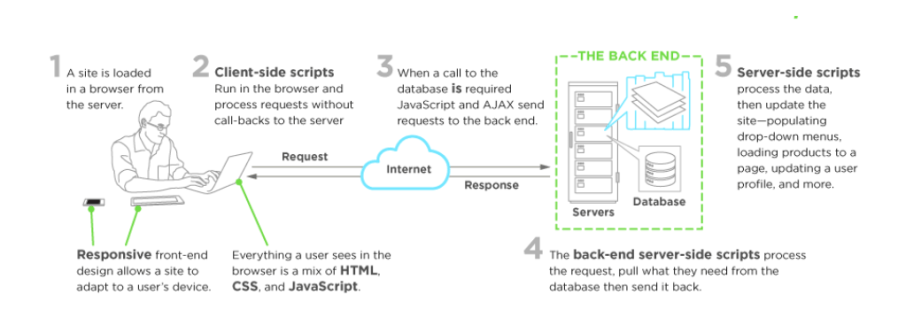
Backend is the server-side of the web. It stores and arranges data, and also ensures that everything on the client-side of the website works fine. It’s the part of the website you can’t see and interact with. It’s the portion of the software that doesn’t come into direct contact with users. Parts and features developed by backend designers are accessed indirectly by users through a front-end application. Activities such as writing APIs, creating libraries, and working with system components without user interfaces or even science programming systems are also included in the backend.

Back-end Languages

The back end component is built using some of the languages discussed below:

PHP: PHP is a server-side scripting language built specifically for web creation. Since PHP code is running on the server-side, it is called the server-side scripting language.

C++: It is a general programming language and is now widely used for competitive programming. It’s also used as a backend script.

Java: Java is one of the most common and widely used programming languages and platforms. It’s very scalable. Java components are readily available.

Python: Python is a programming language that helps you to work quickly and implement systems more efficiently.

JavaScript: Javascript can be used as both (front and back end) programming languages.

Node.js: Node.js is an open-source and cross-platform runtime environment for running JavaScript code outside the browser. You need to remember that NodeJS is not a framework and is not a programming language. Most people are confused and understand that it’s a framework or a programming language. We also use Node.js to create back-end services like Web App or Mobile App APIs. It is used in the development of major corporations such as Paypal, Uber, Netflix, Wallmart, and so on.

Back-end Frameworks

The list of back end frames is Express, Django, Rails, Laravel, Spring, etc.

The other back end programs/scripting languages are: C #, Ruby, REST, GO, etc.

Difference between Frontend and Backend:

Frontend and backend developments are quite different from each other, but there are still two aspects of the same situation. The frontend is what users see and interact with, and backend is how it works.

The frontend is a part of the website that users can see and interact with, such as the graphical user interface ( GUI) and command line, including design, navigation menus, text, pictures, videos, etc. Backend, on the other hand, is where part of the website users are unable to see and communicate.

The visual aspects of the website that users can see and experience are front-end. On the other hand, everything that happens in the background can be attributed to the backend

The languages used for the front end are HTML, CSS, Javascript, while those used for the backend are Java, Ruby, Python, .Net.

full stack developer

A full-stack web developer is a person who can develop both client and server software. Besides mastering HTML and CSS, he/she also knows how to:

Browser software (such as JavaScript, jQuery, Angular, or Vue)

Programming a server (like using PHP, ASP, Python, or Node)

Program a database (such as SQL, SQLite, or MongoDB)

Being a full-stack developer is a good practice because you know almost every aspect of web development. You can switch between front-end and back-end stuff according to the requirement.

Resources to learn

  • W3 School(Free)
  • Coursera(Paid)
  • Udemy(Paid)
  • FreeCode Camp(Free)
  • Treehouse(Paid)
  • Codeacademy(Free)
  • Traversy Media(Free)
  • HTMLDog(Free)

So, all the best guys for this amazing learning journey, hope you guys find this piece informative.