Top 10 Scholars of the World

Daily writing prompt
If you could be someone else for a day, who would you be, and why?

here’s a list of ten influential scholars from various fields, although “top” is subjective and may vary depending on criteria like impact, citations, awards, and contributions to their respective fields:

Photo by Davis Su00e1nchez on Pexels.com
  1. Noam Chomsky (Linguistics, Philosophy, Cognitive Science): Known for his groundbreaking work in linguistics, Chomsky is also a prominent figure in political activism and philosophy. His theories on generative grammar have revolutionized the study of language.
  2. Stephen Hawking (Theoretical Physics, Cosmology): Renowned for his work on black holes, Hawking made significant contributions to our understanding of the universe despite battling amyotrophic lateral sclerosis (ALS). His book “A Brief History of Time” brought complex scientific concepts to a wider audience.
  3. Angela Davis (Social Activism, Critical Theory): A scholar-activist, Davis is known for her work in feminism, Marxism, and prison abolitionism. Her writings on race, class, and gender have had a profound impact on social justice movements globally.
  4. Michio Kaku (Theoretical Physics, Futurism): Kaku is a leading theoretical physicist known for his work on string theory and his popular science books exploring the future of technology and humanity. He’s a frequent commentator on science and technology in the media.
  5. Judith Butler (Gender Studies, Philosophy): Butler’s contributions to gender theory and queer studies have reshaped how we understand identity and performativity. Her book “Gender Trouble” is considered a seminal work in feminist philosophy.
  6. Edward Said (Literary Theory, Postcolonialism): Said’s work on Orientalism and colonial discourse has had a profound impact on literary studies, cultural studies, and postcolonial theory. His critiques of Western representations of the Middle East continue to influence academic discourse.
  7. Cornel West (Philosophy, African American Studies): A public intellectual and political activist, West is known for his work on race, class, and democracy. His blend of philosophy, theology, and social criticism has made him a prominent figure in contemporary American thought.
  8. Mary Beard (Classics, Ancient History): A distinguished classicist, Beard’s work on ancient Rome and Greece has brought new insights into the study of antiquity. Her engaging writing style and public engagement have made her a leading figure in popularizing the classics.
  9. Amartya Sen (Economics, Social Choice Theory): Sen’s contributions to welfare economics and social choice theory have earned him the Nobel Prize in Economics. His work on poverty, development, and capabilities has had a significant impact on global policy.
  10. bell hooks (Feminist Theory, Cultural Criticism): An influential feminist theorist and cultural critic, hooks’ work on intersectionality, love, and the politics of representation has been pivotal in feminist thought. Her accessible writing style has made her ideas accessible to a wide audience.

This list represents just a fraction of the many scholars making significant contributions to their respective fields.

Dr B R Ambedkar’s Social Philosophy and Humanism

 Dr. M Govindaraju

Assistant Professor

Department of Philosophy

Bangalore University, Bengaluru-560056.

Abstract 

This paper attempts to analyze some of the important issues of humanism and social philosophy raised by Dr. B. R. Ambedkar. The study of philosophy, as a world outlook, includes the entire existence, the being in its totality. There are two main areas of philosophy: epistemology and metaphysics. “Epistemology is the theory of knowledge. An important province of philosophical theory, the doctrine on man’s ability to cognize reality, on the sources, forms, and methods of the truth and ways of attaining it”. Metaphysics studies the highest principles of all that exists, which are inaccessible to the senses. Comprehensible only to speculative reason and indispensable to all sciences.

Keywords: Social Philosophy, Epistemology, philosophical theory and Dr.B.R. Ambedkar

Introduction 

Is Dr. Ambedkar’s philosophy restricted to epistemology and metaphysics? Sincerely, this does not correspond to what the great Indian and Western philosophers were generally confined to, and as a consequence, their speculative reasoning extended beyond human concerns of immediate nature. Dr. Ambedkar was personally involved in a human scenario in which he and his community, India’s dejected and disturbed people, were reduced to the ashes of graveyards; they were almost non-entities as human beings in their own country. Could he then afford to limit his studies to epistemology and metaphysics alone? 

Dr. Ambedkar has recognized the human faculties of sense and reason as the main sources of knowledge, and his metaphysical position is obviously non-theistic because he does not indulge in the question of ‘Ayyaktani’ nature as one finds in the tradition of Buddha’s philosophy and religion. Dr. Ambedkar has made his position very clear regarding the questions of the immortal soul, God, Karma, Rebirth, transmigration, etc. The proper study of mankind is the main theme of his philosophy; that is, his analysis is confined to man’s relation to society, wherein ethics and religion play a very significant role.

Philosophical views about man by Dr. Ambedkar. In today’s human scenario, society and politics are intertwined. Dr. Ambedkar’s humanism ideology is a result of the scenario that existed in India previous to and after his birth on April 14th, 1891. Let us now go further into his social and humanitarian ideas.

The social philosophy

The focus of social philosophy is on “the social unity of mankind, and seeks to interpret the significance of the special aspects of human life in relation to that unity.” A social philosophy stands for a correct knowledge of human connections and encompasses the ideas that bring people together in their minds and hearts. It indicates that social philosophy is the philosophical justification of value and position in relation to humanity’s oneness. It takes into account the current information at the same time. Suggests beliefs and values that can bring people together for a similar goal. That is why Dr. Ambedkar examined and analyzed not only the current structural and functional components of Indian society, particularly Hindu society. 

“Negatively, Ambedkar rejects the Hindu social philosophy propounded in the Bhagavad-Gita, which is based on the Triguna of Sankhya philosophy and which, in his opinion, is a cruel perversion of Kapil’s philosophy and has made the caste system and the system of graded equality the Law of Hindu Social Life.” Dr. Ambedkar says it at the same time. Positively, Ambedkar’s social philosophy can be summed up in three words: “Liberty, Equality, and Fraternity.” Clearly, Dr. Ambedkar’s social philosophy is based on the “values of justice, liberty, equality, and fraternity,” and he desired for future institutions to be built in the direction of such a social system.

Ethical standard

When the three principles of Liberty, Equality, and Fraternity are combined, they establish an esthetical standard, or esthetical norm, against which we can judge what an individual does, what a community believes, and what a nation aspires. “Every man should have a life philosophy, because everyone needs a standard against which to measure his behavior.” And philosophy is nothing more than a measuring stick.” 

According to Dr. Ambedkar, the same ethical criteria can be used to assess the nature of a nation. If a nation is founded on authoritarianism and tyranny and is constantly dominated by a group of people or a single family member, as we have seen in India, it cannot allow for the development and flourishing of a free society, and hence it is not a democratic nation. A decent nation has a constitution that incorporates the ideas of justice, liberty, equality, and fraternity and aspires for its citizens to establish an egalitarian society. From this perspective, Dr. Ambedkar’s societal philosophy is nothing more than an ethical norm or standard against which to assess the behavior of an individual and the institutions of society.

Dr. Ambedkar, as he has previously said, rejects Hindu social philosophy because it does not meet his ethical standards. His ethical standard teaches and upholds the ideas of liberty and equality, whereas the Hindu social ideal does not only deny them in theory but also in fact. The Hindu social ideology also contradicts the Indian Constitution, which supports a life of justice, liberty, equality, and fraternity. The caste system is effectively a denial of all social and political objectives as stated and visualized in the Indian Constitution.

Though liberty and equality have an important role in Dr. Ambedkar’s social and political design, he believes that unrestricted liberty destroys the actual sense of equality and that total equality leaves no room for liberty. Only a correct balance of liberty and equality can benefit both the individual and society. Dr. Ambedkar has emphasized the need for liberty to establish a foundation for equality and equality to defend liberty; both must be woven together for the benefit of society’s most vulnerable members.

Law and morality

Dr. Ambedkar’s conception of social existence The law also plays an important role, but only as a safeguard against violations of liberty and equality. He did not believe that the rule of law could protect against violations of liberty and equality. He elevated fraternity to the highest level as the only real shield against the denial of liberty and equality. Fraternity is another term for men’s social fraternity and spiritual oneness. Religion is yet another label for metaphysical speculation. “Law is secular,” he explained.

Morality, specifically social brotherhood of men, has been given a prominent role in Dr. Ambedkar’s plan of social relations in order to bring men together. The law is vital, but it has taken a back seat. Law, on the other hand, is a required institution, a state liberty, to defend man against injustice, tyranny, exploitation, and suppression. Law is intended to regulate a minority of people only when there are disagreements and disturbances among them, whereas morality binds a majority of people in both peaceful and turbulent times. Most people in rural villages in India or in the interiors of our society are unaware of the law and how it might aid them on numerous occasions, yet they are just as excellent. They appear to be more submissive to state laws than those who enact laws and are well-versed in the role of law. “Man does not have to be moral in order to please God.” Man must love himself for his own good.”

Dr. Ambedkar’s social and ethical theory encourages people to organize themselves on the basis of liberty, equality, and fraternity, and only in this way can they be liberated from superstitution, fanaticism, dogmatism, ritualism, caste, varna, untouchability, and so on. Ambedkar highlighted that every individual must have liberty in all legitimate ways with his or her co-religionists, and that every citizen’s fellow being in a community must be treated with equal respect and dignity insofar as they are common citizens.  Much as they are common citizens of a nation, fellow beings in a society must be treated with equal respect and dignity. A ‘shared code of conduct’ should be developed by the people who live in a specific culture and nation. If they are allowed to marry among themselves, dine together, and work together in all aspects of life, they will become a united people with the strength and strategy to grow with energy and vitality in the direction of pace and progress. Common rules of conduct would also limit the spread of group moralities and pave the path for a more peaceful existence for all members of society. They would be able to promote justice and peace, and therefore establish social and spiritual connection among themselves.


The good life

The nature of good life is inherent in the unity and harmony- internal and external, as Dr. Ambedkar imagined it. Harmony is the correct means of inspiring a man to live a happy life. A variety of intellectuals and philosophers have attempted to explain the essence of the happy life in various ways. According to Dr. Ambedkar, the good life is one devoted to the protection and promotion of the ideals of liberty, equality, and fraternity in order to disseminate education and enlightenment among the people. Karuna and Maitri (love and fraternity) encourage such a life, which is guided by proper understanding, i.e. Pragya. 

Lord Buddha’s teachings have influenced the entire concept of living a good life. If the good life is to be sustained, it requires knowledge, kindness, and courage. It need love, faith, inspiration, and logic. It also necessitates a courageous view, a broad intellect, and an open heart, rather than a rigid and dead system of human relations, old or modern.

Dr. Ambedkar’s concept of the good life necessitates an endless number of favorable social conditions. It also requires a favorable political and economic position in society, but it cannot be realized without individual and social obligations that fellow citizens must meet. To live a happy life–a true life of liberty, equality, and fraternity–a man must have a good education, cooperation, a suitable income, friends, and other civic amenities. All of these things are dependent, to varied degrees, on the social and spiritual unity of a community’s members, and they may also be aided by political institutions such as law and state. The state can offer a legal framework for a broad peaceful environment in which all citizens can exercise their rights and responsibilities. In other words, the good life can be enjoyed in a just and peaceful community devoid of any caste and creed problems. A democratic state is also a great tool for creating favorable conditions for its citizens. 

A true religion, such as Lord Buddha’s, can assist people in achieving and maintaining the texture of a happy life. All the ingredients of a good life, according to Dr. Ambedkar, are contained in the teachings of Lord Buddha, the Compassionate One, and true to his world, the learned Doctor decided and declared: “Buddhism is a true religion and lead a life guided by three principles of knowledge, right path, and compassion.” Pragya (understanding as opposed to superstition and supernaturalism), Karuna (love), and Samta (equality) are all taught in Buddhism. This is what man desires in order to live a decent and happy life.


Social responsibility

Theistic charm, i.e. hope for betterment by divine grace, which is extremely natural in Hinduism, Islam, and Christianity, has no place in Dr. Ambedkar’s philosophical, ethical, and religious concepts. In the current circumstances, his dedication to a secular perspective of society within a humanist framework is the most relevant principle. Man bears sole responsibility for his or her own social and economic well-being as a result of Ambedkar’s conviction in fraternity, what man chooses he chooses for everyone, and in fashioning himself, he designs not only his own being, but also the beings of others in society. The basis of Dr. Ambedkar’s social and ethical philosophy is man’s responsibility to fulfil individual and social commitments. Responsibility is more important than anything else in sustaining correct relations between man and man.

Dr. Ambedkar believed in the bright future of mankind because he had an unwavering confidence in man’s social obligation as a result of his strong conviction in empirical man. Noble was his goal, sublime and wonderful was his purpose in the service of humanity’s forgotten people. He restored human rights that are needed for a good and happy life to all depressed classes and poorer sectors of Indian society. Ambedkar also underlined the importance of corresponding tasks for members of society in order to promote peace in human connections. 

The inspiring base

Humanism serves as the foundation for all of Dr. Ambedkar’s philosophical, ethical, and religious views because it was this empirically-based individual who lived in society and was the proper subject of his research. His philosophy was based on the fundamental tenet that “the true measure of man is worth, not birth”—that is, that “man is the measure of all things.” The Mahakarunika received a profound and majestic revelation of the harmony between man and society based on the ideals of liberty, equality, and fraternity through the Lord Buddha. Everyone must agree with his humanist viewpoint because it is so natural and essential. His thought developed out of social and economic need based on humanism, and his strategy included peace, consent, and persuasion. By virtue of law, morality, and religion, Dr. Ambedkar was destined to struggle for a change in social and political life. The worried men have undoubtedly understood that, and they will continue to understand it till the miserable people are unified and social at their own feet. They must see the need for a philosophy or religion that could unify them in opposition to the pervasive manifestations of casteism and untouchability.

Dr. Ambedkar’s unwavering relationship with the oppressed, the lowly, and the destitute, among whom he was born, was the source of his confidence. His humanistic philosophy was inspired by the unhappy people. He was certain that Hinduism did not pass “the test of social utility or the test of individual justice” because he had personally experienced the pains, sorrows, and suffering of being an untouchable, the lowest man in Hindu society. Dr. Ambedkar meticulously studied Indian history before coming to his own understanding of the message and purpose rooted in humanism and Buddhism. His main objective was to increase the social and political awareness of their human rights among the lower classes. He wanted them to prepare themselves for a “social revolution” and spiritual enlightenment through education. Education alone could create a sense of new thinking among the depressed classed for organization and agitation.

Dr. Ambedkar’s social, ethical, and educational worldview always attempted to lift depressed people’s eyes toward unity and emancipation via education and religion, and to engage their minds and understanding to transform their thoughts and old behavioral patterns. In other words, Dr. Ambedkar wanted his philosophy to be the driving force behind both the expansion of human mental capacities and the emergence of social life. He was not content with simply having a new philosophical purpose. Dr. Ambedkar was not only a couch potato; he was a unique individual who devoted his entire life to the service and emancipation of the oppressed as well as the nation. The service of suffering people, of the heart, the strength of the mind, and the reason of the just conscience for the interest of the many, for the happiness of the many—that is, “bahujan hitaya bahugan sukhaya”—can be said with confidence of everything he fought for, cooperated with, revolted against, and contributed to. In a nutshell, one can only do it if they adhere to the Buddha’s teachings.

Conclusions 

The following are some examples of Dr. Ambedkar’s humanism philosophy from a social, ethical, and religious standpoint:

1.      Philosophy engages in epistemological and metaphysical hypotheses because it serves as a yardstick for judging human behavior. 

2.     Since they meet the secular requirements of fairness and utility, social and ethical aspects of life are more pertinent to a man who lives in society.

3.     The trinity principle of liberty, equality, and fraternity upholds social and ethical philosophy and serves as a moral yardstick for judging the morality and character of individuals.

4.     Although morality, as a close ally of fraternity, is more significant than law in governing interpersonal relationships in general, both are the pillars of human society.

5.     Because the concepts of a permanent soul and God are philosophical conjectures, morality is not only a way of living, but also the law of human life.

6.     The good life is that which protects principles of liberty, equality and fraternity and promotes the values of karuna (love), maitri (brotherhood) and pragya (understanding).

7.     The importance of societal and individual responsibility cannot be overstated; it develops from the fraternal relationship between men and keeps responsible men healthy and content while also helping others.

8.     Philosophical, ethical, and religious concepts must be based in humanism and Buddhism, and the circumstance in which people are compelled to live and behave without conscience and reason must serve as the motivation for all of this.

9.     The best way to inspire people’s social consciousness and bring about the highest ideals of intelligence and human togetherness is through humanist education.

10.  The centre of religion is man in relation to man, not animal sacrifice, superstition, or the immortal soul. Religion is vital for a free society, spiritual harmony, and progress. include God.

11.  The primary goals of morality and religion are to rebuild and make the world happier, and this is only achievable thanks to Lord Buddha’s teachings, according to which all people are created equally and are valued according to their intrinsic worth.

         To summarize Dr. Ambedkar’s humanism philosophy, we may say that the ideas he upheld are still important, motivating, and relevant for all oppressed people around the world as well as the Dalit’s of India. He persuaded the Indians that they must stop erecting walls of exclusivity and inequality around them and instead become more open, tolerant, and inclusive if they are to achieve peace and harmony. He did not accept man-made inequalities of an unethical character.  According to Dr. Ambedkar’s, human society will change when we change, both internally and outside, especially when it comes to those who resist the modernization of Indian culture. The philosophy of the leader of the oppressed serves this purpose even today to bring the people together for the transformation of our social and economic life. The wise person must uphold the dignity of human life and its legal rights, and they must work passionately for social justice and spiritual unity. However, he advised the oppressed people to keep up their resistance to the forces of exploitation and oppression rather than repaying injustice with more injustice or even to be cooperative and obedient to either injustice or inequity. In reality, Dr. Ambedkar’s wanted youngsters to get ready to contribute to reshaping society in line with the principles and rules outlined in the Indian Constitution as well as his philosophy of the Nine Gems. It is our best chance at surviving the future, escaping the tragedies of the past, and improving the world for people now.


Bibliography

1.     Buddharakkhit: The Buddha and his Dhamma Venerable Acharya (Buddhavacham Trust Maha Bodhi society Bangalore India) 2005, Vol. I & II, 1-PP, Bangalore 2005, India.

2.     Dr.Jatava Dr. Ambedkar and Humanise, ABD, Publishers 1999, Jaipur, India.

3.     Kuber W.N: Dr. Ambedkar A Critical Studies, People’s publishing house,1979- New Delhi.

4.     Rodrigues Valerian: Dr. Ambedkar A Critical Studies, People’s publishing house,1979- New Delhi.

5.     Naik C.D: The Essential Writings of B.R Ambedkar Published Oxford University Press,2003. New Delhi: Thoughts and Philosophy of Dr. Ambedkar’s, Published Sarups Sons 2003, New Delhi.

6.     A History of Japanese Religion, edited by KAZAUO Kasahara.

7.     Samvada (Kannada); Dr. Nataraj Huliyar (Ed.) Monthly Magazine, June 2006.

8.     SHAPES of Japanese Buddhism edited Yuren Kasharo, Koyu Sonoda.   


The change in current of philosophy

  • Introduction
  • Early references
  • The conditions to mastery
  • conclusion

Many question the relevance of philosophy in current times. Every other subject or field of study is given due importance- physics, chemistry, mathematics, astronomy, geology, psychology, you name it! then why has philosophy dropped to simply graduate academics which very few people choose that too while being concerned about its scope and relevance in career and life. It is a matter of fact that all fields, if not all then majority have evolved from philosophy. The theories that have been expanded were once mere philosophical thought. For instance, the Archimedes principle.

This is where we need a change in perspective and practice.

Philosophy is to be studied, not for the sake of any definite answers to its questions, since no definite answers can, as a rule, be known to be true, but rather for the sake of the questions themselves.

Bertrand Russell, Problem of Philosophy

Philosophy, from Greek translates to love of wisdom. it involves rational, abstract and methodical consideration of reality as a whole, viewing it from multiple dimensions. Curiosity, rationality and abstractive are salient characteristics of philosophical thought. Philosophy, in primeval civilizations was considered to be art of living and not a subject of arts. Choosing a school, in that time, meant adopting their view of life and abiding by their ideals and practices. The school designed its students like an artist would design his piece of art. The schools of thought facilitated transformation of being and search for the eternal truth that would set human free from bondages and discover the intangible with its gifted intellect. Abilities were developed and put to test in these schools. The students were deeply engrossed in enquiry of reality both natural and abstract and its exportation to practice.

See the source image
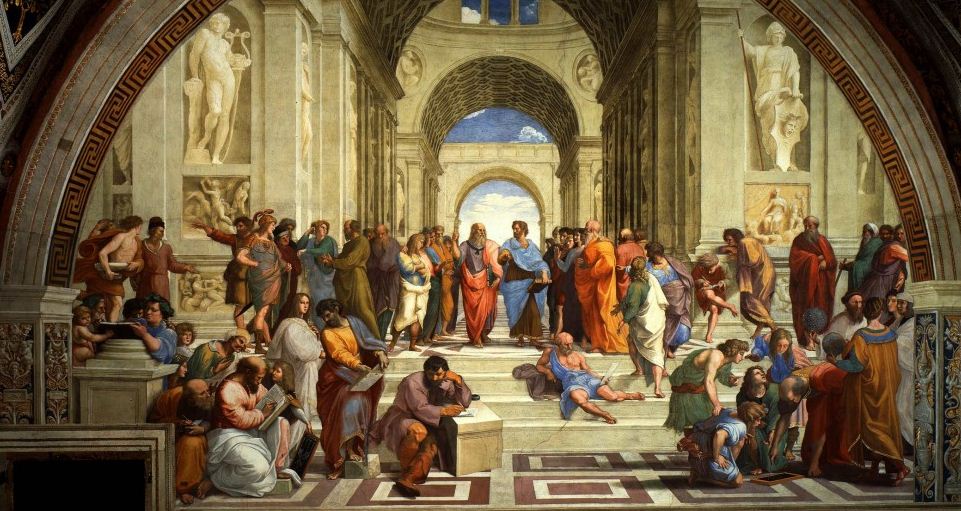
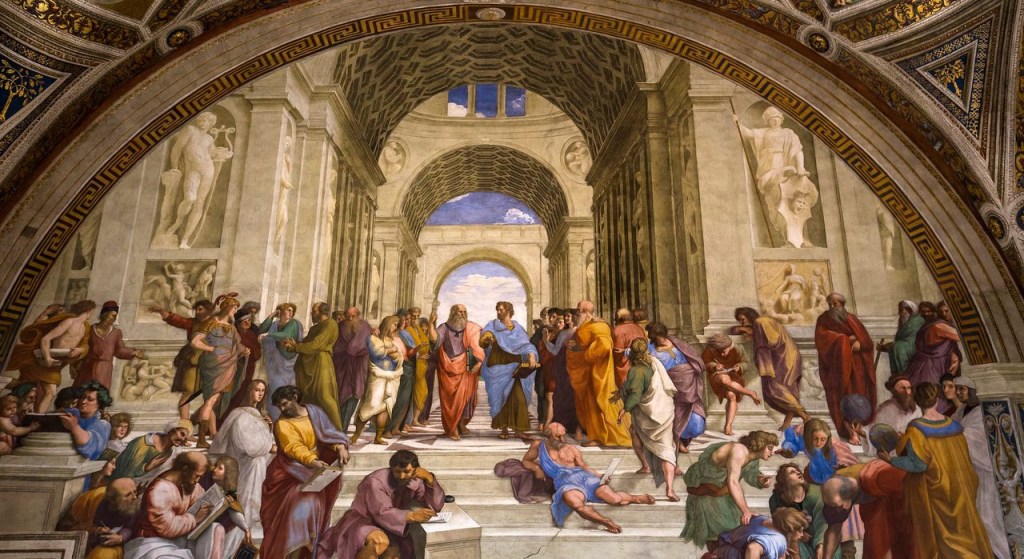
The greek school of thought

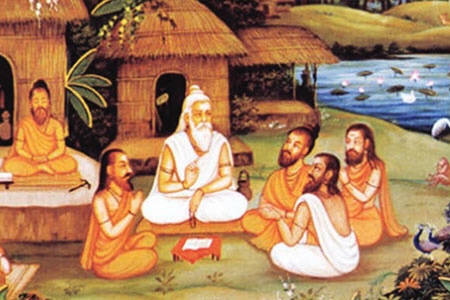
Early references suggest that philosophy then was more intuitional, though it indicates a thought system acquired by intuitive experience and sustained by logical argument. Just like the Greeks term philos as love for wisdom; Indians call philosophy as Darshana and the field as darshan shastra. The word darshan in itself is vague but philosophically it means putting intuition to proof and propagating logically. A darshan is a spiritual perception, a whole view revealed to the soul sense. This soul sight, which is possible only when and where philosophy is lived, is distinguishing mark of a true philosopher. Only purity of soul can make a triumphant philosophy and an awakened philosopher. This purity is based on profound acceptance of experience, realized only when some point of hidden strength within man, from which he can not only inspect but comprehend life, is found. Philosophies arise from experiences of senses and soul and involves adroit introspection.

Philosophy seeks truth and the one in practice is a philosopher. The seeker after truth must satisfy certain essential conditions before he sets out on his quest. Samkara, in his commentary on first sutra of the Vedanta Sutras, makes out the four conditions essential for any student of philosophy.

Sri Samkara was a marvelous genius. He was a master of logic. Samkara’s philosophical conquests are unique in the world.  He expounded the doctrine of Advaita Vedanta.

The first condition is knowledge of the distinction between the eternal and the non-eternal.This means having a metaphysical bent that will not accept all it sees to be absolutely real and justified. There must be a questioning tendency in the inquirer and the spirit to probe all things, a burning imagination which could extract truth from mass of apparently disconnected data. The student must have a habit of meditation which allows him remain focussed.

The second condition is the subjugation of the desire for the fruits of action either in present life or a future one. It demands renunciation of all petty desires, personal motive and practical interests. The philosopher is a naturalist who should follow the movement of things without exaggerating the good and belittling the evil based on his prejudices. So, it is said that he must have no love of present or the future. Clear thinking and honest judgement must be developed.

To achieve a modest temper, he must suffer a change in heart, where a student is meant to acquire tranquillity, self-restraint, renunciation, patience, peace of mind and faith. This counts the third condition which asserts that only a trained mind which utterly controls the body can inquire and meditate endlessly till the end of life, never losing sight of the object and not for a moment letting it obscured by any terrestrial temptation. Such a courage to lose all for his highest end has to be developed. Physical and mental difficulties are to occur and in the midst of all suffering, he must build discipline. A spiritual discipline which includes pitiless self-examination will enable the seeker to reach his end of freedom.

The fourth condition is the desire for moksha or release. The one who has renounced all his material desires and is metaphysically minded has only one devouring desire to achieve the end or reach the eternal.

CONCLUSION

 Men have become so sceptical to trust their own decisions and judgements of life that they take refuge in scriptures, authority and tradition. Little do we create our own for ourselves and mankind.  The early geniuses – the philosophers, comprehended experiences on behalf of mankind, so the latter are eternally grateful to them. So, Question yourself and introspect how am I a philosopher? beacuse –

“The unexamined life is not worth living”

– Socrates

Sources

  • Indian Philosophy by S. Radhakrishnan

Branches of Philosophy

Aesthetics

This branch of philosophy deals with beauty , art and taste of things. It examines what happens in our minds when we are involved in aesthetic objects like art, music, poetry or while exploring Nature. Aesthetics consider why we like some specific thing over other. Aesthetic judgements may be linked to emotions and mood. When we say an object or art piece is beautiful , it triggers an aesthetic pleasure in ourselves . Beauty is a positive aesthetic value in contrast to ugliness, which is negative.

Epistemology

It deals with questions on nature and scope of knowledge. It focuses on sources of people’s consciousness, cognition ( structure and forms) and the relationship between mind and reality. It examines questions such as ‘ what we mean when we say we know something?’ ; the ability to differentiate between what one knows and what one believes.

Ethics

Ethics is the study of morals and the concept of right and wrong conduct. It deals with questions such as – What is morality ; does morality exists? It has 3 types :

Meta ethics ~ deals with foundations and nature of moral values.

Normative ethics ~ deals with systems of morality and questions on how one ought to act morally.

Applied ethics~ deals with what a person is obliged to do in specific situations.

Logic

It is the act of being rational by application of reason. The reasoning process can be done well or badly. Logic allows human beings to distinguish good reasoning from bad. In logic , we study rules and techniques that enables us to do correct ( whether good /bad ) reasoning. A logic must formulate precise standards for evaluating reasoning by developing proper set of arguments.

Metaphysics

Metaphysics deals with existence. It concerns with the fundamental nature of reality.

Theme 1~ The study of first causes — It studies that which does not change and from which the world has come into play. Some identify it with God.

Theme 2~ The study of being— Study of the fundamental categories of being or which exists. This field is also called Ontology.

It is further divided into disciplines such as cosmology, rational psychology and theology. Specific issues like immortality , free will are discussed.

Philosophy of mind

The branch of philosophy that deals with nature of mind and its relation with body . The aspects of mind such as thought, mental properties , consciousness are studied. It addresses issues like the hard problem of consciousness. It tries to explain how a supposedly non materialistic mind can influence material body and vica-versa. Rene Descartes was the first person to clearly identify mind with consciousness and self-awareness and to distinguish it from the brain , where intelligence lies.

Axiology

It is the study of origin of values or study of worth. Through axiology, one can determine what is valuable and why something can be said to be valuable.

Philosophy of language

It investigates nature of language , meaning, language use and language cognition. It explains how the meaning of complex sentences is derived from the meaning of their parts.

Political philosophy

Political philosophers seek to establish basic principles that will justify the formation of state, show individuals their rights and tell the fair distribution of society’s resources among its members . This usually involves analysing ideas like freedom , justice , authority and democracy and then applying them to institutions in a methodological way.

Philosophy of Science

It studies assumptions , foundation and implications of science. Questions addressed are: What is science; does science lead to certainty and truth; nature of statements and conclusions or how does science explain , predict and harness technology. It deals with the reliability of scientific theories and the ultimate purpose of science .

Philosophy in different parts of the world

The word philosophy means ‘ love of wisdom ’ in Greek. It is the pursuit of wisdom , truth and knowledge. It is the study of life’s fundamental questions involving truth, morality, ethics, reasons, logic and existence. A human being , at some point in his life , has wondered upon questions such as ‘ why am I here’ , ‘what is truth’, ‘what is reality’ , ‘is there a free will’ , ‘ what is right and wrong’ etc. These questions come in the realm of philosophy. It is closely related to natural sciences.

History of philosophy

Western philosophy

The ancient western era was dominated by Greek philosophical school of thoughts. This era was largely influenced by Socrates and Aristotle. The common topics discussed included metaphysics, cosmology, atomism and monism . In the medieval period , with the rise of the Roman Empire and Christianity , questions such as mature of God , evil & good were pondered upon. Modern philosophy concerned with developing a secular foundation and discarded the authority of religion.

Islamic Philosophy

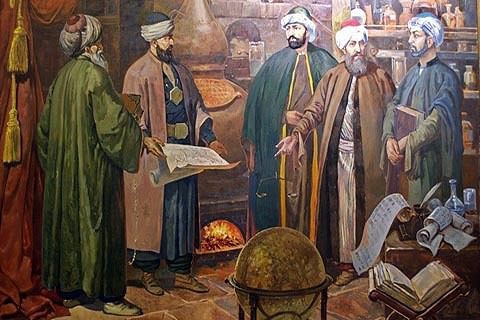
Islamic philosophy is mostly done in Arabic . Two main schools of thought were Kalam ( which focused on Islamic theology) and Falsafa. Philosophers such as Al Kindi , Avicenna and Averroes were greatly influenced by the work of Aristotle whereas Al Ghazali was highly critical of him. The 19th and 20th century Arab world witnessed Nahda movement ( The Awakening or The Arab Renaissance). This shaped the modern Islamic philosophy.

Indian Philosophy

Indian philosophy included concepts like dharma , karma, pramana , dukha-sukha and moksh. It is grouped based on teachings of Vedas and Upanishads . The Himdu philosophers of various orthodox ( astika) schools investigated topics such as metaphysics, ethics , psychology. These schools presented different interpretation within the framework of Vedic knowledge. On the other side , the unorthodox (nastika) traditions rejected the ideas of Atman , Brahman and Ishwara . Jainism accepted atman bit discarded ishwara, vedas and brahman. Buddhism only accepted concept of rebirth and karma.

East Asian Philosophy

The Chinese philosophy saw the rise of schools such as Confucianism , Legalism and Taoism. These traditions developed metaphysical , political and ethical theories such as Tao, Yin & Yang , Ren & Li. Buddhism arrived in China through Silk route and transformed into Chinese form Zen. Many different philosophies such as that of Korea, Japan and Vietnam were influenced by the Chinese philosophy. In modern era, China and Japan philosophers have incorporated ideas of western philosophy. Kokugaku thinker from Japan returned to pure traditions called Shinto that is untainted by foreign influence.

Indigenous American Philosophy

This consists of variety of beliefs including principle of presence of ‘ The Great Spirit’ and concept of Orenda or spiritual power. The practices to access the transcendental experiences of mind came to known as Shamanism. The Nahua metaphysics proposed the concept of an ultimate universal energy which it says is single, vital , self generating sacred force.

The change in current of philosophy

  • Introduction
  • Early references
  • The conditions to mastery
  • conclusion

Many question the relevance of philosophy in current times. Every other subject or field of study is given due importance- physics, chemistry, mathematics, astronomy, geology, psychology, you name it! then why has philosophy dropped to simply graduate academics which very few people choose that too while being concerned about its scope and relevance in career and life. It is a matter of fact that all fields, if not all then majority have evolved from philosophy. The theories that have been expanded were once mere philosophical thought. For instance, the Archimedes principle.

This is where we need a change in perspective and practice.

Philosophy is to be studied, not for the sake of any definite answers to its questions, since no definite answers can, as a rule, be known to be true, but rather for the sake of the questions themselves.

Bertrand Russell, Problem of Philosophy

Philosophy, from Greek translates to love of wisdom. it involves rational, abstract and methodical consideration of reality as a whole, viewing it from multiple dimensions. Curiosity, rationality and abstractive are salient characteristics of philosophical thought. Philosophy, in primeval civilizations was considered to be art of living and not a subject of arts. Choosing a school, in that time, meant adopting their view of life and abiding by their ideals and practices. The school designed its students like an artist would design his piece of art. The schools of thought facilitated transformation of being and search for the eternal truth that would set human free from bondages and discover the intangible with its gifted intellect. Abilities were developed and put to test in these schools. The students were deeply engrossed in enquiry of reality both natural and abstract and its exportation to practice.

See the source image
The greek school of thought

Early references suggest that philosophy then was more intuitional, though it indicates a thought system acquired by intuitive experience and sustained by logical argument. Just like the Greeks term philos as love for wisdom; Indians call philosophy as Darshana and the field as darshan shastra. The word darshan in itself is vague but philosophically it means putting intuition to proof and propagating logically. A darshan is a spiritual perception, a whole view revealed to the soul sense. This soul sight, which is possible only when and where philosophy is lived, is distinguishing mark of a true philosopher. Only purity of soul can make a triumphant philosophy and an awakened philosopher. This purity is based on profound acceptance of experience, realized only when some point of hidden strength within man, from which he can not only inspect but comprehend life, is found. Philosophies arise from experiences of senses and soul and involves adroit introspection.

Philosophy seeks truth and the one in practice is a philosopher. The seeker after truth must satisfy certain essential conditions before he sets out on his quest. Samkara, in his commentary on first sutra of the Vedanta Sutras, makes out the four conditions essential for any student of philosophy.

Sri Samkara was a marvelous genius. He was a master of logic. Samkara’s philosophical conquests are unique in the world.  He expounded the doctrine of Advaita Vedanta.

The first condition is knowledge of the distinction between the eternal and the non-eternal.This means having a metaphysical bent that will not accept all it sees to be absolutely real and justified. There must be a questioning tendency in the inquirer and the spirit to probe all things, a burning imagination which could extract truth from mass of apparently disconnected data. The student must have a habit of meditation which allows him remain focussed.

The second condition is the subjugation of the desire for the fruits of action either in present life or a future one. It demands renunciation of all petty desires, personal motive and practical interests. The philosopher is a naturalist who should follow the movement of things without exaggerating the good and belittling the evil based on his prejudices. So, it is said that he must have no love of present or the future. Clear thinking and honest judgement must be developed.

To achieve a modest temper, he must suffer a change in heart, where a student is meant to acquire tranquillity, self-restraint, renunciation, patience, peace of mind and faith. This counts the third condition which asserts that only a trained mind which utterly controls the body can inquire and meditate endlessly till the end of life, never losing sight of the object and not for a moment letting it obscured by any terrestrial temptation. Such a courage to lose all for his highest end has to be developed. Physical and mental difficulties are to occur and in the midst of all suffering, he must build discipline. A spiritual discipline which includes pitiless self-examination will enable the seeker to reach his end of freedom.

The fourth condition is the desire for moksha or release. The one who has renounced all his material desires and is metaphysically minded has only one devouring desire to achieve the end or reach the eternal.

CONCLUSION

 Men have become so sceptical to trust their own decisions and judgements of life that they take refuge in scriptures, authority and tradition. Little do we create our own for ourselves and mankind.  The early geniuses – the philosophers, comprehended experiences on behalf of mankind, so the latter are eternally grateful to them. So, Question yourself and introspect how am I a philosopher? beacuse –

“The unexamined life is not worth living”

– Socrates

Sources

  • Indian Philosophy by S. Radhakrishnan

Sri Aurobindo’s philosophy of ‘Revolution’ and ‘Evolution’

 The Prime Minister, Shri Narendra Modi  today chaired the first  meeting of the  High Level Committee (HLC) which has been constituted to commemorate 150th Birth Anniversary of Sri Aurobindo in a befitting manner. The  notification of HLC was issued on 20th December, 2021. The Committee comprises 53 members from various walks of life.

Secretary (Culture), Shri Govind Mohan, gave a presentation on the Road Map for the celebration of the Commemoration and sought the advise of the esteemed members for celebrating 150th Anniversary of Sri Aurobindo in a befitting manner. 

Speaking on the occasion, the  Prime Minister expressed his gratitude to the esteemed members for their valuable thoughts and suggestions on Sri Aurobindo’s Commemoration. The Prime Minister said that the two aspects of Sri Aurobindo’s philosophy of ‘Revolution’ and ‘Evolution’, are  of key importance and should be emphasized  as part of the commemoration. The youth should be encouraged towards the concept of greatness as embodied in the philosophy of  Nar to Narayan to create a MahaManav as propounded by Sri Aurobindo, he added. 

The Prime Minister  further added that it is the responsibility of India  as a spiritual leader of the world to contribute in terms of spiritualism to nations across the globe. He suggested that 150 universities across the country should be involved in writing papers on different aspects of Sri Aurobindo’s life and philosophy and the 150 papers to be published on the occasion. 

The Prime Minister proposed to launch the commemoration celebrations of Sri Aurobindo from Puducherry coinciding with the celebration of National Youth Day. This will encourage the youth to visit Puducherry and learn about his life and teachings, where Sri Aurobindo spent his life from 1910 to 1950. The Prime Minister fondly recalled his discussions and deliberations as Gujarat Chief Minister with Shri Kireet Joshi, who was a disciple of Sri Aurobindo. He said that these discussions enriched him with the thoughts of Sri Aurobindo, which were deeply reflected when he was working on preparing the National Education Policy.The  Prime Minister stated that the literature of Sri Kireet Joshi on Sri Aurobindo should be disseminated widely across the world. 

The Home Minister profusely thanked the participants for their valuable suggestions and time and closed the meeting.

Today’s meeting of HLC was held in a hybrid mode. 16 distinguished members were  present physically and 22 members participated through Video Conference (VC). The Home Minister Shri Amit Shah  welcomed the distinguished participants. Members gave their suggestions at the meeting. All the members expressed the opinion that the concept of integral education of Sri Aurobindo should be a part of the New Education Policy and should be included  in the curriculum at the college and university levels. 


RELIGIOUS AND PHILOSOPHICAL ELEMENTS IN THE NOVEL ‘THE SLAVE’ BY ISAAC BASHEVIS SINGER

Written in the socio-political background of Polish- Cossack war and the Khemelnsky massacre, the novel The Slave unfolds many layers of religion, philosophy, vulnerabilities and guilt of man. The novel also portrays the critical or unbiased representation of the jew community. Isaac Bashevis Singer is a Jewish immigrant writer, and he is known for his unbiased representation of the Judaism. In this novel also Singer portrays this criticism of religion and Judaism and he questions the aim or meaning of the religion if it only serves for the separation of humans. The novel carries various religious allusions, symbols and philosophical truths.

The protagonist Jacob is a religious Jew, with extreme beliefs. He is described as ” he resembles the men in the holy pictures that hung in the chapel in the valley”. He upholds his Jewish identity. At the same time he is in a religious conflict and dilemma. Being an ardent believer , sexual relations and marriage with an “outsider” or non Jew is not allowed in Judaism. But his intense love for Wanda is in conflict with this. Here, a juxtaposition between free will and determinism is evident. The question that does God control his destiny or does Jacob controls his destiny is always in juxtaposition in his mind. In the relationship between Jacob and Wanda the novel questions the religion and the customs by giving the notion that, why do we follow certain rituals if it intends the seperatedness of individuals rather than their union. Apart from this internal dilemma, one external dilemma is there, that is the thought of discrimination or exclusion in the village. And this made him to tell that Wanda is deaf and mute to hide her ethnic Identity.

Another question of choice, righteousness comes in the instance where Teresa tries to seduce Jacob. But Jacob refuses and Teresa feels guilt and she laments.

There are several biblical allusions present in the novel. When Jacob changes Wanda’s name to Sarah, he is alluded to Abraham who changes his wife’s name to Sarah. The name of their son Benjamin also carry biblical allusion. And he takes him to Jerusalem for pilgrimage. Towards the end novelist presents the ultimate philosophy of life by the growing cemetery, which included the remains of Sarah, which was not accepted by the community because of Sarah not being a Jew. So here Singer portrays the ultimate philosophy and truth of life, the death. Death is the leveller, which is equal for everyone irrespective of race and religion. And everyone gets equality through death.

Father of western philosophy- Socrates

Socrates is one of the most prominent philosophical figures in the history of western philosophy. He laid the bricks for the very same idea on which philosophers like Plato and Aristotle built upon in the coming years.

Firstly let’s dissect the term “philosophy”, it comes from the Greek word philo- meaning love and sophia- meaning wisdom, i.e., the love for wisdom. 

Socrates’s lifestyle

Socrates followed his love for wisdom/knowledge for as long as he lived, he pursued knowledge in it’s absolute true sense, he thought that pursuing knowledge was the ultimate purpose of life and Socrates didn’t just think that he lived by these words, his actions reflected his ideas in the purest form. But he was born in 469 BC in Athens during a time when court trials were on the basis of the intensity of the arguments made and not facts, so no points for guessing that Socrates’s ideas were not received well by the Athenian population. 

And you can’t really blame them, that was a long long time ago, a time when women were thought to be inferior than men, it was a time when slavery was normal. On the other hand socrates did not do a very good job at dealing with people either, he was not the most hygienic person of that time, he did not shower for days and would go around the city asking random people questions and if that wasn’t enough he would tell them they were wrong. This is what Socrates loved to do, question and not because he knew more than an average Athenian citizen or that he wanted to massage his own ego; on the contrary Socrates admitted that he knew nothing. There is a very well known quote by Socrates that goes “One thing only I know, and that is that I know nothing”, that is why he went around Athens asking everybody questions hoping to one day find some answers, spoiler alert he didn’t. The Athenian population wasn’t very fond of him, and found him to be annoying.

Socrates- the martyr

And just to make it more clear, he annoyed the people so much that they united together and eventually he was put on trial. At this point you might think that Socrates would have given up on his unapologetic attitude but he didn’t. He stood by his principles even though he knew it would lead to his death. Socrates was a smart person, he could have very easily won that trial by making a strong argument but if he did then all his ideas and all his actions would have been in vain. In that trial, Socrates said that the people of Athens should be thanking him for asking them questions and showering upon them his own wisdom, this did not sit well with the jury and about many more dialogues later the jury declared Socrates guilty and was later sentenced to death by drinking poison.

Socrates died a martyr, a martyr for philosophy, he died defending his ideas. Socrates might have died but he made sure to immortalize his ideas.

An unexamined life is not worth living

 by Shashikant Nishant Sharma 

                                                       (Photo: Motivation Mentalist)

Well said by
Socrates.

An
unexamined human life is deprived of the meaning and purpose of existence. The
ability to introspect removes the individualistic absurdity by invoking a
commitment to moral integrity and social solidarity.

 Just like a seed
needs soil, sunlight and water for its germination, human life needs
introspection and examination for its growth. A greater understanding of the
experiences gained in the life at any particular time, enriches one’s
engagement with self and the universe.

Mahatma Gandhi’s
examination of self through his autobiography, “My experiments with
truth”, highlights the significance of reflection on life. Mahatma Gandhi
was not only able to map his weaknesses and vulnerabilities through the
examination, but was also able to question his prejudices and understand his
strength as a human being.

 This very ability
to reflect on life adds more depth to the character of Arjun in Mahabharat than
most of the other characters. Instead of following the norms and fighting with
his clan, Arjun questions the meaninglessness of the war and the purpose of his
life.

 The fast-changing
societies and consumerist culture in the contemporary world leave less time for
human beings to examine and think about the changes. Adaptation to changes have
become automatic and unquestionable.

 The quotation has
strong relevance in the present times where human beings are burdened with the
histories of war, colonisation, nationalisation, erosion of morality in the
scientific and technological advancements and the sense of spiritual
uprootedness. 

It is in these
times that one needs to dwell deeper into the conscience to find the purpose of
existence and engage in a more meaningful manner with the society.


The mind of a philosopher

Introduction:
Philosophy is defined as a set of beliefs which explains the true meaning of life.
Through the years, money is the one thing that I value the most. The main reason being money solves all our problems and it’s the main tool to survive in a competent world like ours. It also helps us achieve what we want and stay ahead in life. Most people may deny this but deep down they know it too. Even if we are in desperate need of money, we need to remember our morals in order to have a clear conscience.


Morals:
Morals help us differentiate between right and wrong. They help us to make decisions which can benefit us and even at times everyone around us. Whenever making a decision, the first thing to keep in mind would be not to hurt anyone , to not be selfish and only think about ourselves but considering others opinions and thoughts would be great. If we have to ever choose between things then it’s better to first understand what they are or what they can do and then listen to others point of view and to keep in mind the consequences of that decision. It’s not easy making the “right” decision but we have to factor in all the possibilities before making that decision and going with our intuition may save the day. To make the right decision, we must believe in ourselves.


From the time I could think for myself, one thing I’ve known is God doesn’t exist. I believe in cleaning up the mess I created and not depend on a non-existential being to solve my problems. I also don’t believe in an afterlife. I believe in the fact that when a person dies he is reborn with a clean slate and nothing of his past life would matter. Even if God doesn’t exist, having faith surround us Is important.


I believe having good and healthy relationships with people, be it our parents or friends or anybody makes our life worth living and adds value to it. For most of us, the purpose of our life is still pretty unclear but leading a happy life would definitely be one of the reasons for existing. Achieving anything in life is easy if we work hard and focus on what we want. Right now, living a financially stable life and having a steady job is maybe something I would like to achieve for myself.


To find the truth, we must check all the facts and being truthful shouldn’t be difficult for anyone. Science gives us all the facts and therefore we must believe In science and not blindly believe in anything people ask us to believe in. My intuition is what helps me decide if it’s the truth or not. It’s what helps me to “know” when things are right and when something’s not right. An example would be knowing the fact that “honesty is the best policy” as whenever we lie, we need to make up more lies to cover the truth but instead of we’re just honest from the start then we wouldn’t get into any troubles and it wouldn’t haunt us forever.

Free will:
Free will is something I do believe in as every person must make a decision for himself and held accountable if it’s the wrong decision as that’s how we learn to make the right decisions and grow. Any choice I make, it’s because I wanted to and not because I was pressurised into making that decision.

Anything which catches the eye is beautiful. Everyone is beautiful. We may not believe that because of these beauty standards but what really matters is a person’s personality. Nature is beautiful. If not for nature, mankind wouldn’t exist. Art usually helps us capture what the eye witnesses. I really don’t believe “extreme” forms of artistic expressions should be censored as I believe everything is beautiful and should be accepted within judgement.


Every person should be entitled to basic human rights. It’s in the name itself. There shouldn’t be any discrimination when it comes to these rights as everyone deserves a voice. Justice is doing right by the people.


Conclusion:
I believe in being true to oneself, helping others and minding my own business. This is something people should really inculcate in themselves.

https://www.britannica.com/topic/philosophy

ETHICS

Ethics are fundamental principles or ideas that govern a person’s or a community’s activities. This is not a burden to bear, but rather a sensible and successful guide to life and advancement. Because ethics is a fundamental cornerstone on which an enlightened system is based, it is required in business, as well as academic institutions and societal organizations. Following legal laws and being ethical are frequently not synonymous. Emotions, like law, will stray from morality. The inhumane laws controlling apartheid and slavery in South Africa, as well as the practice of sati in India, are instances of unethical laws and customs.

When making decisions, ethics is crucial since it allows one to distinguish between what is right and wrong. Ethics also encompasses a person’s personal moral codes or ideals, which are more personal than codes of ethics.

Importance of Ethics:

The individual, the consumer, the employee, or the human social unit of society are the primary beneficiaries of ethics. Furthermore, ethics is important for the following reasons:

Creating Credibility: An organization that is thought to be driven by moral values is respected in society, even by individuals who have no knowledge of how it operates or what it sells. For example, Infosys is regarded as a company that practices good corporate governance and participates in social responsibility projects. This impression is widespread, even among those who have no idea what the company does.

Uniting People and Leadership: Employees respect and admire organizations that are values-driven. They’re the connecting thread that connects employees and decision-makers. This goes a long way toward bringing the organization’s behaviors together in pursuit of a single common objective or aim.

Improving Decision Making: A man’s fate is the sum of all of his decisions made throughout his life. The same is true for businesses. Values drive decisions. An organization that does not respect competition, for example, will be ruthless in its operations in order to eliminate its competitors and achieve a monopoly in the market.

Long-Term Gains: Organizations that are led by ethics and principles are successful in the long run, even if they appear to be losing money in the near term. In the early 1990s, the Tata Group, one of India’s largest commercial conglomerates, was assumed to be on the verge of bankruptcy, but this proved to be inaccurate. The Tata NANO car, made by the same company, was expected to fail and perform poorly, yet it is already gaining appeal.

Securing the Society: When it comes to securing the society, ethics frequently outperforms the law. The legal system is frequently discovered to be a silent observer, unable to safeguard society and the environment. Technology, for example, advances at such a rapid rate that by the time legislation is enacted, a newer technology with new hazards has supplanted the older. Lawyers and public interest lawsuits may not be very helpful, but ethics can.

Conclusion:

The study of ethics helps students to comprehend human behavior and decision-making. The importance of moral standards in society is highlighted in this paper’s discussion on ethics. Everyone must be conscious of how their activities, whether direct or indirect, affect others. Personal and professional ethics are intertwined and reveal a person’s personality. In any event, our actions and decisions determine how society perceives us. We must consider how others perceive us, our choices, and our actions. Negative ethical decisions are more likely to be observed and judged than positive ethical decisions. Every time an ethical circumstance comes, each individual has a unique obligation to make the appropriate and moral decision.

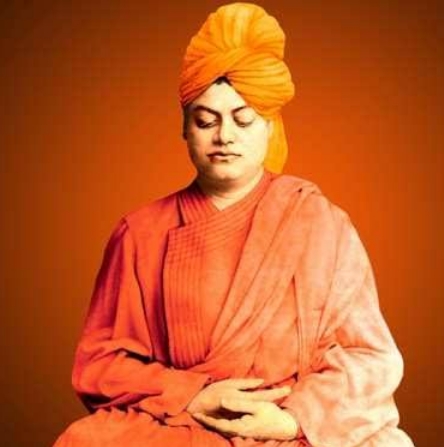
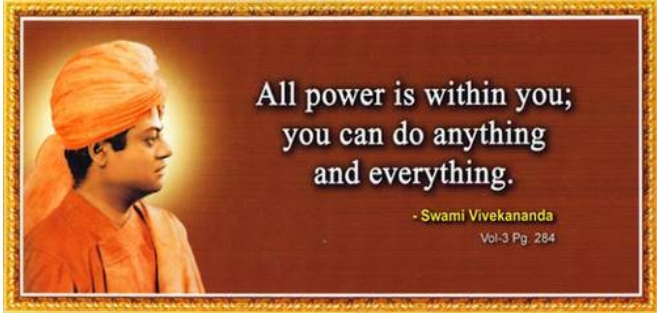
Swami Vivekanand

Swami Vivekananda’s inspiring personality was well known both in India and in America during the last decade of the nineteenth century and the first decade of the twentieth. 

Born as Narendranath Datta in a Bengali Kayastha family,  he is the chief driving force behind various religious reform movements during the times of Colonial India. He introduced Hinduism to the world in a famous speech that he spoke in Chicago in 1893.

He was born on January 12, 1863 and His father was Vishwanath Datta, an attorney at the Calcutta high court while his mother, Bhubaneswari Devi was a housewife. From a very young age, Vivekananda was interested in spirituality and would meditate in front of the images of Hindu Gods and Goddesses.

He is regarded as a one of the finest spiritual leaders and intellects India has produced.

He was a devout follower of an Indian saint named Sri Ramakrishna Paramhansa. Not only that, he was a devout follower of Sri Ramakrishna Paramhansa, whose ideologies he followed till the day he breathed his last. Inspired him, he even formed the Ramakrishna Math and the Ramakrishna Mission. He went to the United States of America to teach modern Hindu philosophy.

His vast knowledge of Eastern and Western culture as well as his deep spiritual insight, fervid eloquence, brilliant conversation, broad human sympathy, colourful personality, and handsome figure made an irresistible appeal to the many types of Americans who came in contact with him. People who saw or heard Vivekananda even once still cherish his memory after a lapse of more than half a century.

The Swami’s mission was both national and international. A lover of mankind, he strove to promote peace and human brotherhood on the spiritual foundation of the Vedantic Oneness of existence. A mystic of the highest order, Vivekananda had a direct and intuitive experience of Reality. He derived his ideas from that unfailing source of wisdom and often presented them in the soulstirring language of poetry.

To the Hindus he preached the ideal of a strength-giving and man-making religion. Service to man as the visible manifestation of the Godhead was the special form of worship he advocated for the Indians, devoted as they were to the rituals and myths of their ancient faith. Many political leaders of India have publicly acknowledged their indebtedness to Swami Vivekananda.

In America Vivekananda’s mission was the interpretation of India’s spiritual culture, especially in its Vedantic setting. He also tried to enrich the religious consciousness of the Americans through the rational and humanistic teachings of the Vedanta philosophy. In America he became India’s spiritual ambassador and pleaded eloquently for better understanding between India and the New World in order to create a healthy synthesis of East and West, of religion and science.

The natural tendency of Vivekananda’s mind, like that of his Master, Ramakrishna, was to soar above the world and forget itself in contemplation of the Absolute. But another part of his personality bled at the sight of human suffering in East and West alike. It might appear that his mind seldom found a point of rest in its oscillation between contemplation of God and service to man. Be that as it may, he chose, in obedience to a higher call, service to man as his mission on earth; and this choice has endeared him to people in the West, Americans in particular.

Swami Vivekananda focused on channelling the energy of the youth. He said that Youth is the most important segment of any country.

In the course of a short life of thirty-nine years (1863-1902), of which only ten were devoted to public activities-and those, too, in the midst of acute physical suffering-he left for posterity his four classics: Jnana-Yoga, Bhakti-Yoga, Karma-Yoga, and Raja-Yoga, all of which are outstanding treatises on Hindu philosophy. In addition, he delivered innumerable lectures, wrote inspired letters in his own hand to his many friends and disciples, composed numerous poems, and acted as spiritual guide to the many seekers, who came to him for instruction. He also organized the Ramakrishna Order of monks, which is the most outstanding religious organization of modern India. It is devoted to the propagation of the Hindu spiritual culture not only in the Swami’s native land, but also in America and in other parts of the world.

Swami Vivekananda passed away on July 4 in the year 1902. He was just 39 years old. Even almost 120 years after his demise, he is still alive in many people’s hearts and minds as they fondly remember his ideologies and what he taught.

National Youth Day is celebrated on January 12, every year in India to honor the birth anniversary of Swami Vivekananda.

Mahatma Gandhi’s philosophy of Sarvodaya

Mahatma Gandhi’s philosophy of Sarvodaya aimed at rural reconstruction and uplifting the people of rural India by peaceful and cooperative means.

Sarvodaya, in simple terms, means welfare and upliftment of people and of all living beings . It means the welfare of not only oneself but of others as well. Sarvodaya stresses coexistence and love.

Ideals of Sarvodaya:

  • Economic implications-Under this philosophy, one should be given the opportunity to contribute to national production. The surplus should be distributed equally and inequalities of wealth should be reduced. Sarvodaya also emphasizes that industries should be decentralized and land should be redistributed.
  • Based on Trusteeship-This philosophy involves that everyone must utilize only that part of his wealth that enables him to lead an honorable livelihood and the rest of the wealth belongs to the community and must be used for its welfare. So all industrialists must act as trustees of wealth and not its owners.
  • Social implications- In the social aspect, this philosophy believes in individual freedom, opposes untouchability, and promotes widow remarriage. It believes in the promotion of brotherhood and human dignity Sarvodaya believes in functional education and decentralized society.
  • Political implications- In Sarvodaya philosophy, political power is not an end in itself but it is only means to an end, the end is human welfare. It believes in the universal adult franchise and favors decentralized democracy. Sarvodaya condemns the majority rule and centralization of power and majorly believes in self-sufficiency. 

Hence, the philosophy of Sarvodaya is an example of the Gandhian philosophy of ‘Simple living and high thinking. It envisages a new pattern of life-based on the decentralization of economic and social power, ensuring the moral freedom of man.

What is philosophy?

Philosophy comes from two Ancient Greek words: philo– which means loving, and sophia– which means wisdom. Simply put, philosophy is a love of wisdom. But, what does that really mean? 

Philosophy intends to answer questions about our existence using tools like logic and reason. It is concerned with questions which range from how one should live to epistemology, from the fundamental nature of the world to the search for knowledge and truth. Philosophers have questioned the existence of God and religion, how politics is shaped and the very essence of free will and freedom. They have written about language, animal rights, aesthetics, law and justice. Chances are if you have a question, some student of philosophy has already sought to answer it.

Typically, philosophy requires you to reflect more than ‘do’ as the questions it seeks to answer tend to be abstract in nature. In spite of this, philosophers have contributed significantly to many fields- politics (J.S. Mill), mathematics (Pythagoras), medicine (Avicenna), and literature (Tagore) amongst others. 

Despite its importance, you don’t often come across people who study it or apply its principles to their lives. Part of it has to do with its seemingly inaccessible nature with most people considering it too serious or complicated a subject to really bother with. This couldn’t be further from the truth as even the most basic understanding of philosophy can change how you approach life.  What better way to gain this understanding than to read philosophical books?

The Philosophy of Literature

The philosophy of literature addresses the most fundamental questions about the nature of literature as an art. Some of these questions address the metaphysics of literary works: What, if anything, essentially distinguishes literary works of art (such as epics, novels, drama, and poetry) from other kinds of writings, such as scientific reports, historical treatises, religious texts, guides, and manuals, which may happen to be written in a literary manner? Also, what kinds of things are literary works of art that seem to exist over time in some way independently of any of their particular printed editions? Other questions address our ways of engaging with literature, such as: What norms govern our interpretation and understanding of such works? Is the meaning of a work fixed, or does it change with the changes in the contexts in which it is read? Can we have a genuine emotional response to the characters, events, and states of affairs represented in such works even when we believe that they are not real? Finally, some questions address the value of works of literature: Do they offer any distinctive form of knowledge or insight? Can their cognitive and moral merits and defects count as artistic merits and defects? Philosophy of literature is not alone in pursuing these questions, for literary history, criticism, and other modes of scholarship address these concerns, as do readers when they reflect on their own and others’ practices of attending to works of art. However, the philosophical approach to literature, while often productively drawing on the empirical study and first-order analysis of literary works, tends to adopt a more systematic, theoretical, ahistorical, and foundational approach than commonly found in other fields. Also, while the philosophy of literature tends to address the nature of literature as an art, it has been profoundly shaped by work in other areas of philosophy far from aesthetics such as analytic metaphysics and philosophy of language, which since their inception have addressed such topics as the metaphysics of fictional characters. More recently, there has been an exciting cross-fertilization between philosophical approaches to literature and developments in cognitive science, particularly in areas devoted to the study of emotions and imagination.

Why You Should Read Philosophy?

Since logic and reason are the cornerstones of philosophy, taking the time out to read books on the subject can help you become a better thinker and evolve

your ability to reason. You will be able to understand the assumptions behind arguments, identify fallacies in the reasoning and also form and form your own reasoned out opinion on the subject at hand. 

A study of philosophy will help you develop critical thinking skills. It will encourage you to understand the constraints you operate within when you make certain choices or even when you decide which goals you should pursue. You will be able to think intelligently of how you live and why you live that way. Concepts like correlation and causation will become clearer and you will be able to make better deductions and inferences.

Philosophy will make you question everything. According to Aristotle, philosophy begins with wonder. It is only when we begin to wonder about something that we go on a search for answers to questions which matter to us. For example, questioning the importance of religion or the existence of God could lead you down a rabbit hole where you find yourself searching for evidence which either confirms or disaffirms your view on the subject. Maybe you’ll discover Christopher Hitchens or Richard Dawkins or perhaps, you’ll decide to explore religious philosophy like Jain or Buddhist philosophy to see what truly resonates with you.

Philosophy will make you curious. As you explore philosophy, you’ll find that there are no right answers. Just when you find one answer, you’ll realise that there are many other possibilities out there. The more you study, the more your view will become nuanced and your reasoning behind it will become more solid. Paradoxically, you’ll also become more willing to change your viewpoint as you delve into a particular topic. 

How To Read Philosophy

While reading philosophy, even if it is philosophical fiction, you have to give yourself the time to understand the material. The books can be dense and you may need to re-read the same sentence, passage or page more than once to truly comprehend what the philosopher is saying. While it may take you a minute to read a page from a ‘regular’ book, it might take you tens of minutes to comprehend one page from a philosophy book. A 120-page book may take you weeks as you find yourself ruminating over what you’ve read. 

A great way to understand and think about what you read is to annotate and make notes. What is the main idea? What is your conclusion? Do you agree with the argument? Is there any follow-up research you need to do? Are there any other books about the same subject that you should read? What questions are answered and which new ones are raised. Highlight passages which you want to remember, question or revisit.

Another great way is to write out your own thoughts on the subject. What do you agree with? What do you disagree with? What is your own conclusion and the rationale behind it? Since philosophy relies on logic, you have to be able to provide cogent arguments for your conclusion. Revisit them later to find flaws in them especially once you’ve read a different work which makes you rethink your views.

Discuss what you are reading with others. There are many online fora and discussion groups, where ardent students of philosophy engage in arguments and discussions on their interpretation of philosophical works.

Most importantly though, do not limit yourself to a particular school of philosophy. Read the stoics but also try your hand at something unusual- say Islamic philosophy. If you don’t expose yourself to different schools of thoughts, you are not gaining everything philosophy has to offer.

Philosophy is important if you want to understand yourself and the world you live in. Be warned though, while it is unlikely to have all the answers, it will make you ask questions. And then, it will give you the tools you need to find your own answers to them. If nothing else, it will make you a more rationale and reasonable human being who is constantly trying to evolve and is able to adapt to change, disagreement and dissent with more ease.