
Marketing Mix

In every business it is important to have an efficient marketing plan or strategy to promote their product, to engage more customers or to understand consumer behaviour, to upgrade their pricing strategy. For this in 1960s, an academic and marketer E. Jerome McCarthy proposed the idea of ‘marketing mix’.

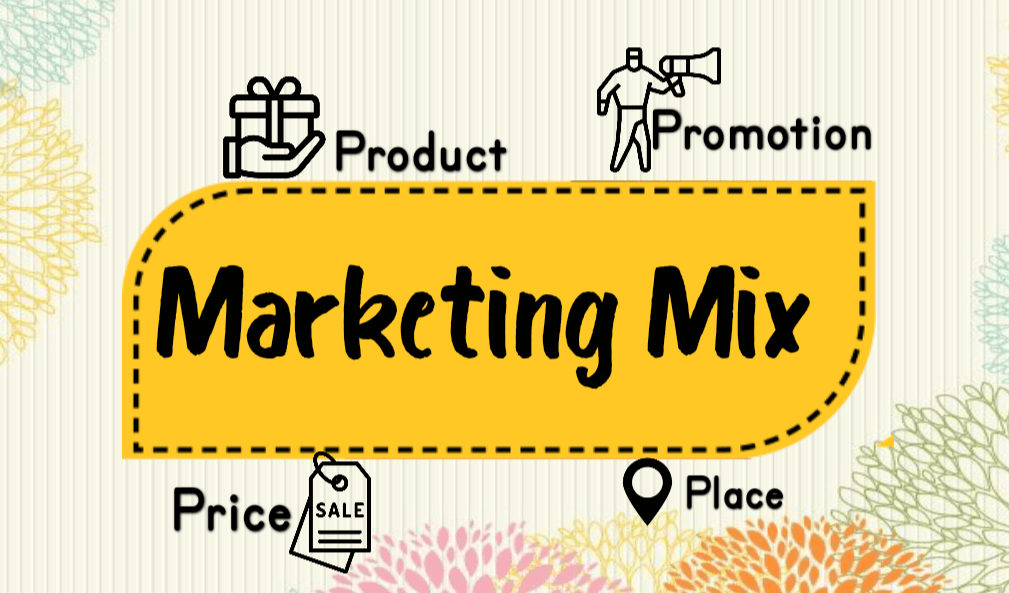
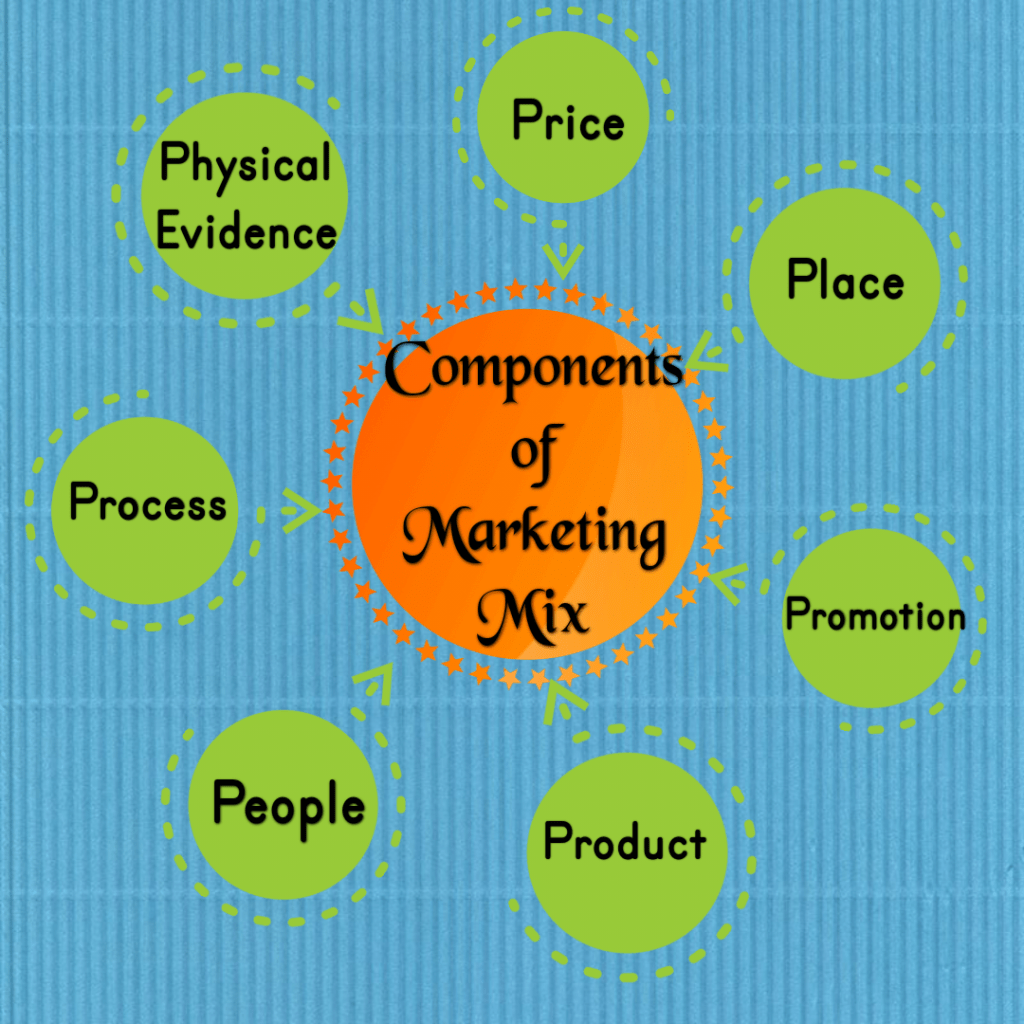
Marketing mix is basically a mixture of 4Ps to enhance business model with Price, Product, Place and Promotion. These 4Ps can be used as marketing tools by any business for achieving their market goals and targets.
Components of Marketing Mix

  1. Product

Product means anything which is for sale any physical product or any service rendered to customer.  Product should the meet expectations and demand of customers in the market.Some of the marketing decision which every seller should think of  such as branding, packaging, product range, product design, packaging and labelling, guarantees and warranties.

2. Place

In marketing mix, place refers that where seller choose to sell his product whether it is warehouse, street market, online platforms, supermarkets, etc. It depends upon the nature of the product i.e. if product is perishable, shops are preferable to sell that product and if product is non-perishable both shops and online platforms are suitable.Marketing decisions related to place includes: market coverage, inventory, transportation, location, distributors, warehousing and franchising.

3. Price

Price is the main aspect for the business and customer. Each and every customer gets affected from price of the product which consumer is selling. Price reflects the cost or value of the product. Seller should set the price as per the demand of customer and the actual cost of the product. Accurate price can change the customer’s preference form one product to another. Other important aspect of pricing is what price has been set by your competitors? This can help any business in setting their pricing strategy. Pricing strategy can make profits for the business or can cause loss to the business if it is not accurate.Price market decisions includes: payment method (card or cash), credit payment, pricing strategy, allowances for distributors and discounts for customers.

4. Promotion

Promotion means to tell or convey about the product to customers through advertising, marketing and sales promotion. It can be through offline mode such as T.V. magazines, newspapers, radio etc. and online mode like websites, ads on social media, etc. It depends upon the seller of the product which way or method he chooses to communicate about his product to customers and according to response from his customers, he should continue with that particular promotion method.Marketing decisions for promotion involves: advertising, sales promotion, public relation, direct marketing, what and how to communicate to customers.

In 1980s Booms and Bitner proposed a model of marketing mix which consist of 7Ps, generally he added 3 more Ps to marketing mix i.e. Process, People and Physical Evidence which is beneficial for Service Marketing.

5. Process

Process describes the chain of delivering the goods or services to the customer. Process examination involves the evaluation of each and every step like procedure of distribution, payment system and relationships with customer. Evaluating, modifying and improving different steps of process will help business to maintain their efforts and to check that methods are new and as per recent trend. Process related marketing decisions involves: blueprint service, process design, checking system failures, monitoring service performance, allocation of resources required.

6. People

In marketing mix, ‘people’ refer to those who all are involved in the process of delivering of goods; managing the process; handle customer relationship, etc. Employees, staff, workers or labour all are included in ‘people’, basically all those who are a part of business. For any business it is necessary to employ right people to manage all the business related process. Marketing decisions related to people includes: staff recruitment and training, attending customers, handling complaints and failures, handling social interactions.

7. Physical Evidence

 Physical evidence means evidence of the product which has been purchased by the customer. It can be receipt, brochures, tracking information, invoices, etc. It is beneficial for both customer and seller to have a record or any document of transaction. It also relates to validation of the product, authenticity of the product check by the customer through their websites, logo etc. Here, marketing decisions includes: interior design like furniture and scheme, facilities like equipment access, brochures, stationery, surrounding conditions, and signage.

References:

https://en.wikipedia.org/wiki/Marketing_mix

https://blog.hurree.co/blog/marketing-mix-7ps

PLANNING- process and importance

WHAT IS PLANNING?????
Planning is a common term which focuses on pre deciding the things which we have to do later. Not only deciding the things but also planning includes thinking of the ways by which we can complete a particular plan successfully. It is an important parameter of the management and we need to plan things in the every sphere of life so that we can go on accordingly. Planning is the combination of creativity and innovation. Planning is done to perform any task effectively and efficiently so that there is no hurdle between the complete process of the task which we wish to perform. In the business world, it is said that planning acts as a bridge to reach the position where we wish to reach.
STEPS OF PLANNING
Planning is not an easy task rather it is a combination of several steps. The complete process of planning has been divided into 7 different steps which are mentioned below –

  1. To set objectives i.e. to decide where we aim to reach. It is basically aiming the destination. Every organization has some targets and thus has to complete them so setting objectives is the first and important step of the planning process.
  2. To develop premises i.e. to set assumptions. No work is completed without a risk and assuming things. So premises are basically assuming what can be done. So making those assumptions is the next step.
  3. To identify alternative courses of action is the third step i.e. once the objective has been set and assumptions have been made, then it is the time to identify and think the proper course of actions which must be performed to reach that particular aim.
  4. To evaluate alternative course i.e. to think of the advantages and disadvantages of each course of action and to find what alternative can work for it if that would not happen.
  5. The next step is to select the best alternative which would be suitable according to our aim. The best plan is adapted and implemented.
  6. The next step is to implement the actual plan which has been thought of yet. This is the step where actually planned course of actions take place and where actually the work is done by the individuals.
  7. The next and final step of the process of planning is to follow-up the actions. In this step all the validation and verification occurs that whether the planned process is going on with the same flow or not. Also it is seen that whether the plan needs any change or it should go on like that only.

IMPORTANCE OF PLANNING

  1. Planning tends to reduce the uncertainty of occurring a process.
  2. It is very essential to provide a proper direction to the plan.
  3. Planning helps to promote innovative ideas and thus the planned work is done more efficiently.
  4. Planning helps in decision-making and dividing the equal amount of work to each individual of the group or team.
  5. Planning reduces confusion at any level of the process.
  6. Planning helps in setting some goals and thus an organization does better work.

MANAGEMENT

Management is not only a term but a whole process of getting things done more effectively. In managing things, we aim to achieve our goals more effectively and efficiently. Management is very essential for all the organizations, whether small or big, profit or non-profit. Every type of organization requires management in achieving their goals more successfully. Lack of management makes the things confusing and thus company may fall or lack as compared to other companies of their competition. Management is a group or team work and cannot be actually achieved by a single individual.
Management has several advantages and importance in an organization such as –
• It actually helps in achieving group or team goals.
• It helps in increasing efficiency of work.
• It actually creates a dynamic organization.
• Despite of group, it also helps in achieving the personal goals or it can be said that it develops the personality of the individual.
• It also helps in the development of the society by the interaction of different people.
The complete definition of the management contains 3 essential terms –

  1. PROCESS i.e. management is a process requiring planning, organizing, staffing, directing, and controlling.
  2. EFFECTIVELY i.e. managing the task helps us complete the task more effectively and better than before.
  3. EFFICIENCY i.e. management increases the benefits and profits by the tasks than before.

CHARACTERISTICS OF MANAGEMENT

  1. Management is a goal oriented process i.e. it does not go just like that. It is actually a goal oriented process. These goals are decided and stated before starting any project and there is no doubt in the fact that management helps us achieving our goals more efficiently and better than before.
  2. Management is all pervasive i.e. it has been observed and meant that management is a universal concept all types of organization, whether small or big, profit or non-profit has to apply some management rules to improve their organization’s standards.
  3. Management is multi-dimensional i.e. it is a kind of complex activity. It can be more understood by saying that a lot of things need to be managed in order to rum an organization. Management of work, people, and operations are the three main dimensions which need to be managed for effective working.
  4. Management is a continuous process i.e. it never stops. It is an ongoing process. It requires constantly solving the issues faced by the organization by managing its dimensions.
  5. Management is a group activity i.e. it is not the work of a single person rather it requires a group or team. Every member of the team has to work very effectively for the good results of the operation they are performing.
  6. Management is a dynamic function i.e. management allows the organization to better interact with the surrounding environment and to build better relations with other organizations so that they can help in need.
  7. Management is an intangible force i.e. it cannot be seen but its effect can be felt and seen in the betterment of the organization. The company works more happily, employees are more energetic when each and every work of the organization is managed properly.