The study published in Nature Geoscience states that the globally consistent pattern suggests that inner-core rotation has recently paused. The rotation came to a grinding halt in 2009 and then it surprisingly turned in an opposite direction. Researchers have long believed that the inner core rotates, relative to the Earth’s surface, back and forth, like a swing.
“This globally consistent pattern suggests that inner-core rotation has recently paused,” they wrote. “We show surprising observations that indicate the inner core has nearly ceased its rotation in the recent decade and may be experiencing a turning-back.”
With a radius of almost 2,200 miles, Earth’s core is about the size of Mars. It consists mostly of iron and nickel, and contains about one-third of Earth’s mass.
On February 1st, a comet named C/2022 E3 (ZTF) with a bright green color will come close to Earth for the first time in 50,000 years. It will pass by at a distance of 26 million miles (42 million kilometers) from Earth, providing a unique night sky view that hasn’t been seen since the time that modern humans roamed the Earth alongside one of the many extinct human species, the Neanderthals.
In the Northern Hemisphere, the green comet should be visible just before dawn in late January, according to NASA. Amateur astronomers have already begun photographing the green comet to show what you could see.
Comet ZTF will pass about 26 million miles from Earth — the closest it will get — on February 2. That’s nearly 109 times the average distance of the moon, but the comet is burning so bright that it could still be visible in the night sky.
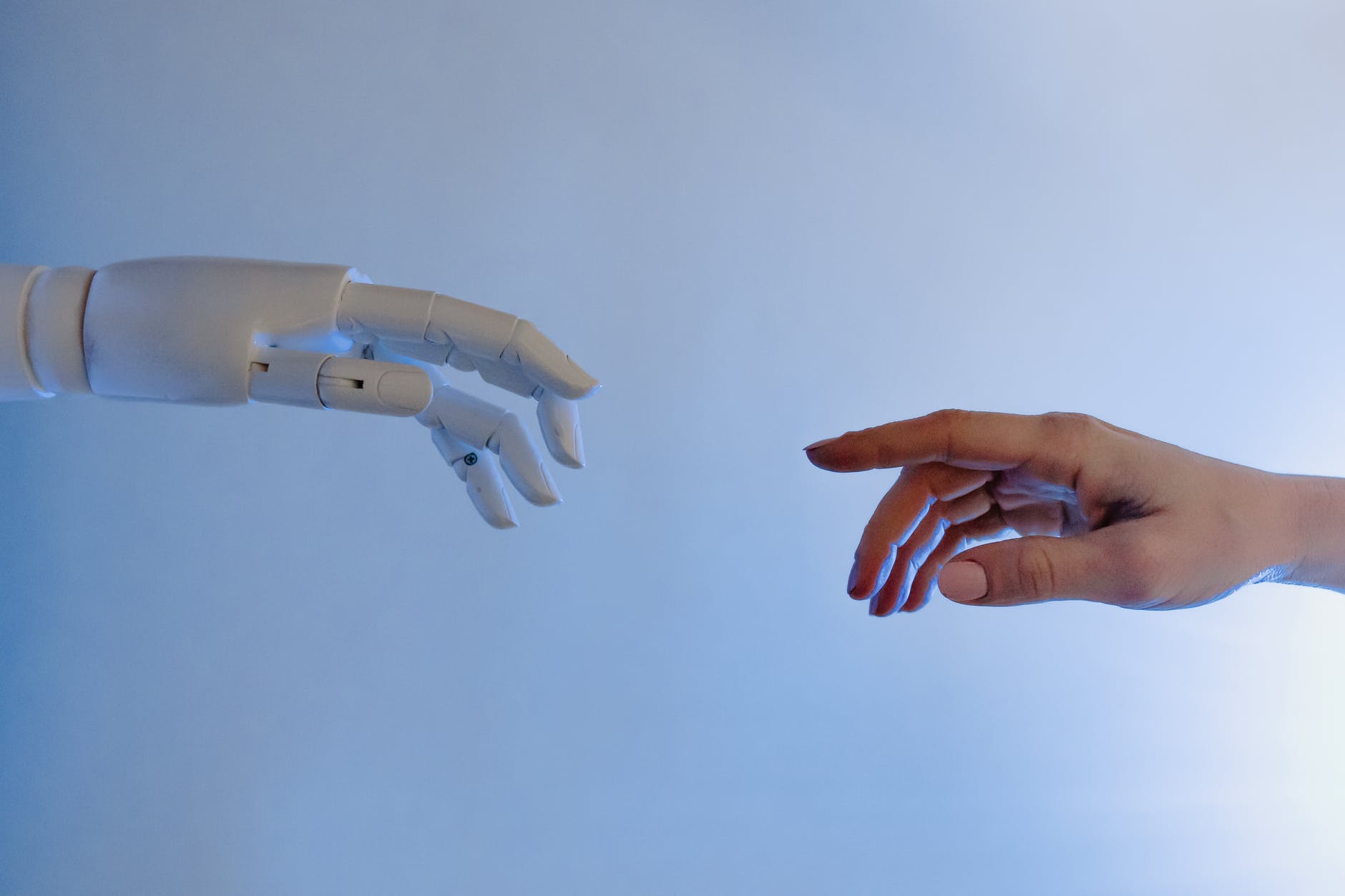
Artificial intelligence (AI) refers to the simulation of human intelligence in machines that are programmed to think like humans and mimic their actions. The term may also be applied to any machine that exhibits traits associated with a human mind such as learning and problem-solving.
The ideal characteristic of artificial intelligence is its ability to rationalize and take actions that have the best chance of achieving a specific goal. When most people hear the term artificial intelligence, the first thing they usually think of is robots. That’s because big-budget films and novels weave stories about human-like machines that wreak havoc on Earth. But nothing could be further from the truth. Artificial intelligence is based on the principle that human intelligence can be defined in a way that a machine can easily mimic it and execute tasks, from the simplest to those that are even more complex. The goals of artificial intelligence include learning, reasoning, and perception.
Application of AI in different fields.
Personalized Online Shopping.
Personalizing users’ experience has become the latest pantheon for all the leading tech giants. Ecommerce stores aren’t behind either, and have been the biggest platforms to implement the personalization domain of AI.
Marketing.
One of the greatest artificial intelligence examples applications, Marketing, has been a key area for improvement and the latest trends in AI. With the growing advancement in AI, in the near future, it may be possible for consumers on the web to buy products by snapping a photo of it.
Social Media.
The most common use of AI in social media is for face verification and to detect facial features. AI in social media can be associated with big data and machine learning where deep learning is used to extract every minute detail from an image by using a bunch of deep neural networks. On the other hand, machine learning algorithms are used to design your feed based on your interests.
Agriculture.
The latest artificial intelligence applications in the form of image recognition identify possible defects in the crops through images captured by the user’s smartphone camera. Users are then provided with soil restoration techniques, tips, and other possible solutions to deal with the identified defects.
Video Games.
The gaming world is the best example of intelligent applications of artificial intelligence as it is at this platform where there are a lot of alterations in the purpose. AI is used for designing the game, developing the characters, and also frame the story to a certain extent.
Healthcare.
The Healthcare sector has been amongst the top adopters of AI technology. It boils down to the power of AI to crunch numbers fast and learn from historical data, which is critical in the healthcare industry. AI has taken a critical step in helping people with looking after patients as well. The automated bots and healthcare applications ensure proper medication and treatment of patients in the facilities.
Smart Homes.
The most advanced form of applications of artificial intelligence in the real-world are being implemented in homes, and are becoming smarter every day. Various devices like smart locks, smart switches, ect., are increasingly becoming compatible with various devices, and the application of smart homes is becoming more accessible to the general population every day.
Banks.
A lot of banks have already adopted AI-based systems or software to provide customer support and detect anomalies and credit card fraud. By tracing card usage and endpoint access, security specialists are more effectively preventing fraud. Organizations rely on AI to trace those steps by analyzing the behaviors of transactions.
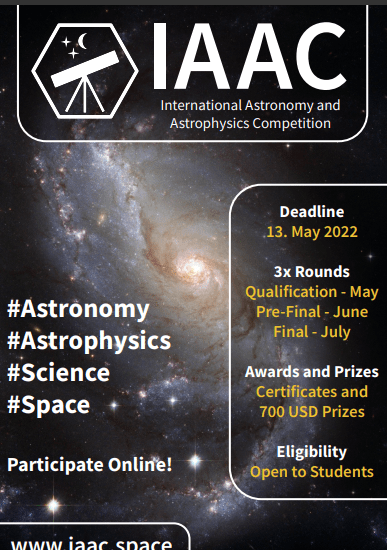
The International Astronomy and Astrophysics Competition is a global competition for science and astronomy enthusiasts.
Online Submission: The competition uses the possibilities of the modern world to allow all students to participate regardless of nation, region, school, or affiliation. Every student may participate independently – there is no affiliation of your school or teacher to IAAC required to participate in this competition.
Research Problems: The pre-final round includes two research problem types. They require participants to get in touch with real scientific research papers and learn about recent scientific results to solve the problems. They encourage students for more advanced science and give them insights into actual research material.
Teacher Support and Online Tools: We supply teachers and schools with additional materials and an online teacher interface that allows teachers to make better use of IAAC problems in class. We also generate performance reports for each individual student.
Information for Teachers and Schools
Teachers and schools are invited to share this opportunity with their students to make talented students in particular benefit from IAAC. There are also special school awards.
3. Final Round : Final Exam with 20 Multiple-Choice Questions, 60 Seconds/Question, Teacher Supervision
Note: The Qualification round is free. The 8EUR Registration cost covers both the Pre-final and Final round. DIgital participation certificates are awarded for all rounds.
Who can participate?
You have to be at least 10 years old and you have to be a student (this includes high school, college, and university). There are two age categories:
Junior: under 18 years on 13. May 2022.
Youth: over 18 years on 13. May 2022
Students from both categories will receive the same problems in all rounds, however, students that are youths (18 years or older) will have to reach more points to qualify for the next round (e.g. to qualify for the pre-final round, students that are under 18 years have to reach 15 points and students that are over 18 years have to reach 20 points).
If you are a science enthusiast and love astronomy this competition is the way to go!
Contact me for further details at-yutsawant@amb.iaac.space
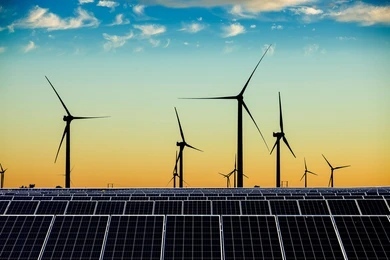
With energy consumption being the buzzword in developing economies around the world, fears of an energy crisis looming ahead are not totally unfounded. The non-renewable nature of fossil fuels makes complete dependence on these for future energy needs a very dicey affair. Renewable energy sources are the best bet in the scenario. And what can be a better renewable resource than the sun?
In a country like India, if the abundant amount of sunlight available is harnessed properly it could mean an end to the energy crisis. It is the most abundant source of energy. The average global solar radiation is around 5 kilowatt hours (KWH) per square meter per day with the sunshine hours ranging between 2300-4300 per year. India is in the sunny belt of the world. The country receives solar energy equivalent to more than 5000 trillion KWH per year, which is far more than its total annual energy consumption.
Besides, it is a renewable and clean energy source. Taking both environmental and economic cost, solar energy works cheaper than fossil fuel resources. Once we master techniques to harness solar energy, it can be a vital source of power on all planets. Solar energy could be a viable source of power generation for the next 1000 crore years. There are many technologies available for conversion of solar energy into solar power. For instance, solar photovoltaic (SPV) technology, photo galvanic cells, solar steam generators (solar concentrating power), solar tower or solar chimney, radio micrometers and thermopile are some of them.
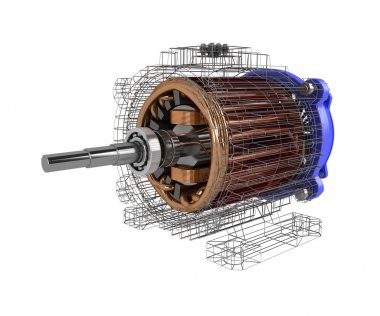
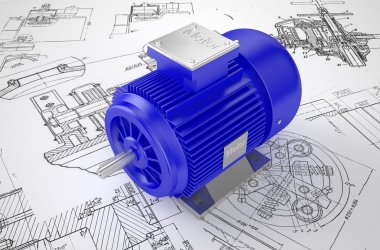
ELECTRIC MOTORS:
Imagining a future where clean air is no longer a dream and our cities are not smog filled concrete jungles, could well become a reality in the coming years if the world begins to increasingly adopt the use of cleaner options like alternate-fuel vehicles . The rise in economic activity and the burgeoning population have led to a tremendous demand in the transport sector, especially in urban India. By 2025, India’s urban population is expected to grow five fold to a staggering 200 million while pollution is expected to grow seven times. With this tremendous growth has emerged a very critical issue of keeping air and noise pollution in urban areas under control.
If we can have three lakh electric vehicles (EVs) on the roads by 220 including three wheelers, cars and scooters, we would have reduced pollution by 16 lakh metric tones, saved ? 3700 crores in foreign exchange earnings and substantially reduced healthcare costs. Small electric buses, three wheelers and electric scooters are ideal for city mobility in India but it could take between 5-10 years before they become viable for commercial use.
Image Source – google.
The electric vehicle uses electric energy which is stored in batteries that feed the electric motor. Driving an electric vehicle is easier and more relaxing than a traditional one because it has no speed-gear and functioning noise. It is enough to turn the key and press the acceleration pedal; you need only two driving pedals- accelerator and brake.
The need to reduce air pollution along with the availability of new advanced clean alternative to internal batteries have allowed EVs to reappear as a combustion vehicles. Electric drive systems are virtually non-polluting and extremely energy efficient. While internal combustion vehicles can convert about 20% of the chemical energy in gasoline into useful work, 75% or more of the energy from a battery has productive power in an electric vehicle.
Electric motors can also provide power at almost any engine speed. While internal combustion engines must be revved up to high rpm to achieve maximum power electric motors provide nearly peak power even at low speeds. this gives electric vehicles strong acceleration performance from a stop.
The emergence of newer batteries has driven the cost and performance EVs. There are several major types of automotive batteries available and under development, from advanced lead acid batteries like those that start our internal combustion engines to lithium polymer bateries. Although recharging could be a consideration, home recharging systems are available giving EVs an added advantage.
Apart from being environment-and -user friendly, there are several other reasons for alternate fuel cars to flourish in India. Firstly, electricity for EVs can be produced from various sources for which India has natural resources and does not need to depend on the import of oil. Although EVs will not replace LPG, CNG or petrol and diesel for intercity use, the infrastructure required for EVs in the form of electricity distribution infrastructure is already available in all our cities and minimum costs are required to install additional capacity.
EVs are zero polluting, easy to handle and have low maintenance costs. EVs will not degrade with time and they are always zero polluting unlike conventional vehicles where the pollution increases with engine degradation, poor maintenance and adulterated fuel.. India also has the maximum market potential for EVs owing to an established auto component infrastructure, low manufacturing and R&D cost, mechanical hardware availability, high urban congestion and the presence of domestic market. The industry could significantly gain from rising exports by 2010, and with appropriate government support, could transform the landscape of urban India by reducing pollution, improving public health, creating employment opportunities and impacting society.
In order to do that, a holistic approach involving the government, public and auto majors is needed to promote EVs in India. Appropriate government policies during the next five years and adequate support from business houses and institutions. for instance, purchasing a fixed percentage of vehicles for their fleets and offering subsidies and tax exemptions, will go a long in promoting the industry in India. Finally, people have to become more informed about these technologies. The media must play its role in educating the public about alternate fuel vehicles and their advantages.
Technology is defined as the use of data to create and develop products and equipment that may be used in a variety of ways.
Technology has become an increasingly important aspect of our daily lives. Despite the fact that technology has made life easier for all of us, it has also brought with it a number of negative consequences that we must not overlook. Technology is essentially the means by which we put scientific discoveries into practice and combine them with our personal demands. Technology is a broad term that refers to the various tools, machinery, and equipment that we utilize on a daily basis. Man devised these tools and equipment to make tasks faster, easier, and more comfortable. Science and technology are inextricably linked; progress in one field leads to progress in the other. Science helps to build and produce technical items and equipment that serve humanity through research, experimentation, and observations.
Advantages of Technology in Life:
1. It has aided human growth and development.
2. Inventions and discoveries have improved the quality of life by making it easier, more effective, and more convenient.
3. Technology has connected the entire world, transforming it into a global village.
4. It is a boon to mankind because it is used in every aspect of life.
5. Technology has not only made our lives easier and more comfortable, but it has also contributed significantly to global economic growth.
6. Creative technology, which includes art, design, and advertising, has aided in the promotion of art and design through software applications.
7. Buildings, bridges, and plazas have become easier to design and construct thanks to advancements in architectural technology.
8. Industry has benefited from industrial technology as well.
9. Microtechnology is advancing at a breakneck pace, allowing chips and microelectronics circuits to improve performance and functionality while lowering costs.
10. Medical technology has produced a plethora of diagnostic and treatment devices and instruments. With the use of technology, diseases that were formerly difficult to diagnose and treat are now effectively diagnosed and treated.
Drawbacks of Technology:
While technological improvements are beneficial to us, we now appear to be overly reliant on them.
The following are some examples of technological disadvantages:
1. The use of mobile phones was intended to allow people to communicate in times of crisis. However, we now witness children becoming overly engrossed in various mobile applications, wasting their time.
2. The use of digital technology has been linked to a number of crimes.
3. It has also been observed that many people lack the fundamental education required to ensure proper use of today’s technology. Most of them, in fact, use it for the sake of fashion and hence end up misusing it.
4. People have become so reliant on technology that they are unwilling to engage in any manual labour. People prefer to use technology even for little tasks that can be completed manually. As a result, humans have become both intellectually and physically inert.
Finally, we must acknowledge that science and technology have led human society to the pinnacle of living perfection. However, we must proceed with prudence and in moderation. Misuse of science and technology can lead to negative outcomes. As a result, we must keep an eye on usage and behave wisely.
A paradox is a logically self-contradictory statement or a statement that runs contrary to one’s expectation. It is a statement that, despite apparently valid reasoning from true premises, leads to a seemingly self-contradictory or a logically unacceptable conclusion. A paradox usually involves contradictory-yet-interrelated elements that exist simultaneously and persist over time.
Bentley’s paradox: In a Newtonian universe, gravitation should pull all matter into a single point.
Boltzmann brain: If the universe we observe resulted from a random thermodynamic fluctuation, it would be vastly more likely to be a simple one than the complex one we observe. The simplest case would be just a brain floating in vacuum, having the thoughts and sensations you have.
Fermi paradox: If there are, as various arguments suggest, many other sentient species in the Universe, then where are they? Shouldn’t their presence be obvious?
Pinocchio paradox: What would happen if Pinocchio said “My nose grows now”? If Pinocchio were to say “I am getting sick,” this could be either true or false, but Pinocchio’s sentence “My nose grows now” can be neither true nor false; hence this and only this sentence creates the Pinocchio (liar) paradox.
Heat death paradox: If the universe were infinitely old, it would be in thermodynamic equilibrium, which contradicts what we observe.
Olbers’ paradox: Why is the night sky dark if there is an infinity of stars, covering every part of the celestial sphere?
Bootstrap paradox (also ontological paradox): You send information/an object to your past self, but you only have that information/object because in the past, you received it from your future self. This means the information/object was never created, yet still exists.
Predestination paradox: A man travels back in time to discover the cause of a famous fire. While in the building where the fire started, he accidentally knocks over a kerosene lantern and causes a fire, the same fire that would inspire him, years later, to travel back in time. The bootstrap paradox is closely tied to this, in which, as a result of time travel, information or objects appear to have no beginning.
Schrödinger’s cat paradox: This is a well known paradox. According to the Copenhagen interpretation of quantum mechanics, a cat could be simultaneously alive and dead, as long as it remains unobserved.
Black hole information paradox: Black holes violate a commonly assumed tenet of science that information cannot be destroyed.
Temporal paradox: What happens when a time traveler does things in the past that prevent them from doing them in the first place?
Grandfather paradox: If one travels back in time and kills their grandfather before he conceives one of their parents, which precludes their own conception and, therefore, they couldn’t go back in time and kill their grandfather. Don’t even think about trying this.
Polchinski’s paradox: A billiard ball can be thrown into a wormhole in such a way that it would emerge in the past and knock its incoming past self away from the wormhole entrance, creating a variant of the grandfather paradox.
Hitler’s murder paradox: One can travel back in time and murder Adolf Hitler before he can instigate World War II and the Holocaust; but if he had never instigated that, then the murder removes any reason for the travel.
Twin paradox: The theory of relativity predicts that a person making a round trip will return younger than his or her identical twin who stayed at home.
Paradoxes are very interesting in their own way which sometimes lead to new ideas and many a time confusion. I hope you found these paradoxes very mind-blowing. Share this with your friends and enjoy the look on their faces!
The evolution of science is like a boon to the world, as human beings come to know a lot about the world they are living in including the activities they indulge into. Furthermore, the development of technology along with the advancement in Science helps to bring in a revolution in various fields such as medicine, agriculture, education, information and technology, and many more.In the present world, if we think of any sort of development, then the presence of science and technology cannot be ignored.
What is Science?
Science fundamentally is the systematic study of the structure and behavior of the natural and physical world through observations and experiments.
Study of science evolved with the civilization of human beings.
What is Technology?
Technology (which is basically derived from the Greek word ‘technologia’) is an art, skill or ability, which is used to create and develop products and acquire knowledge.
Scientists used their knowledge to develop technology and then used technology to develop Science; so, because of this reason science and technology are an integrated term in today’s world.
Consider the following points to understand the relationship between Science and Technology −
Contribution of Science to Technology
Contribution of Technology to Science
Let us discuss these points in brief.
Contribution of Science to Technology
Let us now understand how Science has contributed to Technology −
Science as a direct source of new technological ideas
For example, innovation and development medical instruments; nuclear technology, radar system, etc.
Science as a source of engineering
Most of the technical knowledge used in the designing and development of tools and techniques is actually an outcome of ‘engineering science’.
Science has also helped in the development of human skills. This is one of the fundamental contributions of Science.
Contribution of Technology to Science
Consider the following points to understand the contribution of Technology to Science −
Technology as a source of scientific challenges
The development in the field of technology paves way for research and development in the field of Science. For example, space science is one of them. Technological development likewise indirectly stimulates basic research in the field of science.
Instrumentation and measurement techniques
Development of advanced instruments facilitated scientists to measure the distance between sun and earth, the intensity of sun’s rays, the revolution of celestial bodies, internal problems of human beings, life of a bridge, etc.
Connection between science and technology:-
Science is the study of the natural world by scientific method i.e. collecting data through a systematic process. And technology is where we apply science to create devices that can solve problems and perform different tasks. Technology is literally the application of science. So, it is really impossible to separate the two.
Science, innovation, and technology each represent a successively larger category of activities that are highly interdependent from each other but distinct. Science contributes to technology generally in six ways:
New knowledge which serves as a direct source of ideas for new technological innovations.
Source of tools and techniques for more efficient engineering designs and a knowledge base for evaluation of the feasibility of different new designs.
Research instrumentation and laboratory techniques used in research eventually find their way into the design or industrial practices, through different methods in different areas.
The practice of research as a source for the development and assimilation of new human skills and capabilities useful for different innovative technologies.
Creating a knowledge that becomes increasingly important in the assessment of technology in terms of its wider social and environmental impacts.
Develops knowledge that enables more efficient strategies of applied research, development, and refinement of new technologies.
The confer impact of technology on science is of equal importance as a source of unavailable instrumentation and techniques needed to address difficult scientific questions more efficiently.
When you look at the night sky, you admire the fascinating beauty of millions of stars and galaxies of the universe. Humans have looked in awe and wondered what those twinkling dots of light are, since ancient times. Due to their inborn curiosity, humans have found answers to their questions and ventured deeper into the unknown.
Today, many spacecrafts have been sent beyond our little world -earth -and humans have even walked on the moon! All this has been possible only because of our thirst to know more. So, space has its own separate branch of science- Astronomy.
What is astronomy?
Astronomy is the branch of science dealing with the study of the universe. There are two major types of astronomy- observational and theoretical. In observational astronomy, many different types of electromagnetic waves like X-rays , gamma rays, microwaves, UV rays, infrared and visible light. Theoretical astronomy mainly deals with simulations and creating theoretical models to predict the observations.
Distance in astronomy
We know that the universe is a very very large place. So, to measure distance in the cosmos we need bigger units of length than kilometers:
Astronomical unit(AU): It is used to define the distance between Earth and the Sun. 1AU is equivalent to 149 million kilometers (93 million miles).
Light year(ly): It is defined as the distance travelled by light in one year. The speed of light is 300,000 kilometers per second. So 1ly is equal to 9.5 trillion kilometers(a lot right!).
Parsec: It is defined as the distance at which the mean radius of the earth’s orbit subtends an angle of one second of arc. 1 parsec is equal to 3.26light years.
Some fun facts:
The limit of the visible universe is about 46.5billion light years(radius) which equals to 4.4* 10^26metres (humongous!).
The universe is about 13.8billion light years old.
The universe formed as a result of the Big Bang-literally a single point expanded to form the universe!
The universe is expanding at the rate of 72 kilometers per second.
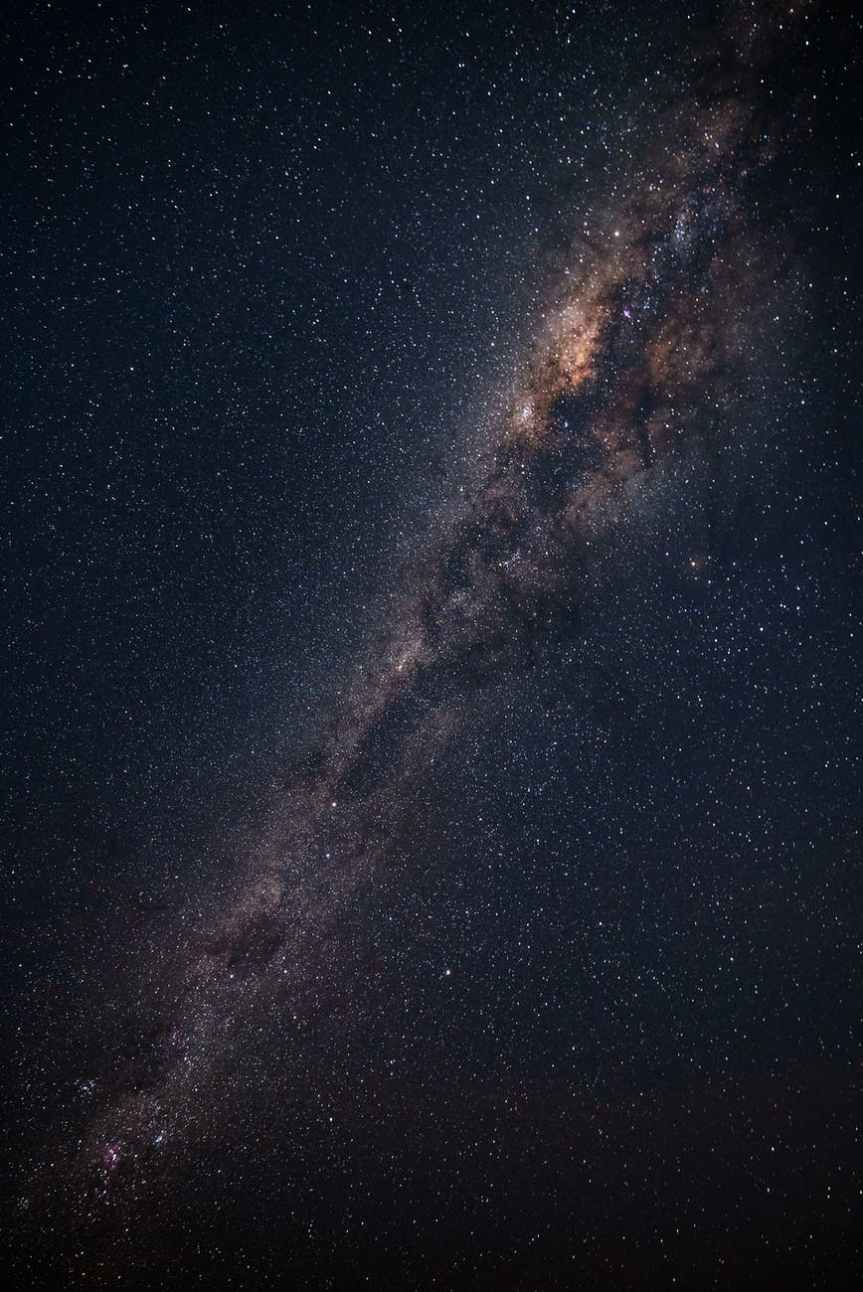
There are more than one hundred thousand million stars in our galaxy (the milky way). Imagine if there are trillions of galaxies like our own, how many stars would that be!
The death of the universe is not completely predicted yet. Some say that it will become a dark and cold place when all the stars die. Others say that the universe will end with “the Big Crunch”.
When you look at the sun, you look about 8 minutes into the past, since light has taken 8 minutes to reach us.
The milky way has a supermassive black hole at its center- Sagittarius A*
Are we alone?
We haven’t found any other life in the universe but the search is on. Since there are billions of stars, the chances of them having earth like planets are high. So, there probably are “aliens” out there, we just haven’t found them yet or they haven’t found us yet. Sadly, the chances of having contact with a developed alien life like us are very low. However, that won’t stop us from looking. Hopefully, we will find them soon (and let them be friendly!).
Astronomy is a diversified branch with biology, geology, chemistry, mathematics and physics, all different types of fields coming together. There is a lot of scope for a great career in this discipline. Besides, who wouldn’t want to find out the secrets of the universe.
Avengers endgame, back to the future, and so many amazing sci-fi movies are based on time travel. Apparently, everyone loves them, but have you ever wondered if it could happen in real life? Most people would say no and answer that it is just some fantasy. However, physicists would say differently.
There is something called ‘time dilation’ in relativity according to which time can slow down or move faster depending upon velocity(special relativistic time dilation) or gravity(gravitational time dilation).
Special relativistic time dilation
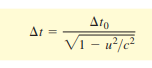
First, let’s talk about special relativistic time dilation. According to Einstein’s special theory of relativity, time in a moving frame appears to run slower. You may have heard this famous spaceship example. If you travel in a spaceship with speed closer to that of light, and return after 10 years of travel, on earth about 30 years would have passed! Talking in scientific terms, in a particular frame of reference, suppose that two events occur at the same point in space. The time interval between these events, as measured by an observer at rest in this same frame (which we call the rest frame of this observer), is Δt0 . Then an observer in a second frame moving with constant speed relative to the rest frame will measure the time interval to be Δt where-
The denominator is always smaller than 1( u<c), so Δt is always larger than Δt0 .Thus we call this effect time dilation(time getting elongated).
Now, let’s come to the other type of time dilation- gravitational. Gravitational time dilation is a form of time dilation, where the difference in elapsed time is due to the gravitational potential. The lower the gravitational potential (the closer the clock is to the source of gravitation), the slower time passes, speeding up as the gravitational potential increases (the clock getting away from the source of gravitation). Albert Einstein originally predicted this effect in his general theory of relativity and it has since been confirmed by tests of general relativity. For example, imagine that you are approaching a black hole which has gravity due to its mass(the gravitational potential is decreasing as you are moving towards the source of gravity). If your friends observe your clock, it would be seen as running slower and slower as you move ahead. Since the gravity is so strong, for them it would appear that you are moving towards the event horizon forever! In simple terms, the closer you are to some strong source of gravity, the slower time passes for you.
Earlier, in our spaceship example, the spaceship is moving at very high velocity, and when it returns back, there is a 20 year gap. We can say that the spaceship traveled 20 years back in time. I get it, not quite fulfilling your expectations.
You see, time travelling has consequences. To further limit the possibility of time travel, we have Einstein’s equation- E=mc2 . To travel at high speeds we need a lot of energy to be synthesized within a fraction of a second, which is not possible currently.
Conclusion
So, time travel is ‘possible’, we just haven’t figured it out yet. Don’t let down your childhood fantasies . Remember that once mobile phones were a fantasy but now they are a reality. I am sure that the future won’t let us down.
Does the word “special relativity” strike fear in your heart? It might seem tough at first glance but it is very easy to understand.
Postulates
Special theory of relativity is a theory regarding space and time, given by Albert einstein. The main postulates of this theory are:
1]The Principle of Relativity : The laws of physics are the same in every inertial frame of reference.
2]The Principle of Invariant Light Speed :The speed of light in vacuum is the same in all inertial frames of reference and is independent of the motion of the light source.
Now, let us understand these two postulates. The first postulate basically means that physical laws, for example, Newton’s laws of motion and laws of electromagnetism, are independent from the choice of inertial systems. If the laws differed, that difference could distinguish one inertial frame from the others or make one frame somehow more “correct” than another. However, all frames of reference are correct in their own way. Suppose you watch two children playing catch with a ball while the three of you are aboard a train moving with constant velocity. Your observations of the motion of the ball, no matter how carefully done, can’t tell you how fast (or whether) the train is moving. If seen from outside, all three appear to be moving with the train at constant velocity. This is because Newton’s laws of motion are the same in every inertial frame.
Let’s think about what the second postulate means. Suppose two observers measure the speed of light in vacuum. One is at rest with respect to the light source, and the other is moving away from it. Both are in inertial frames of reference. According to the principle of relativity, the two observers must obtain the same result, despite the fact that one is moving with respect to the other. Now suppose a spacecraft moving with constant velocity turns on a searchlight. An observer on the spacecraft measures the speed of light emitted by the searchlight and obtains the value. According to Einstein’s second postulate, the motion of the light after it has left the source cannot depend on the motion of the source. So the observer on earth who measures the speed of this same light must also obtain the same value. This result contradicts our elementary notion of relative velocities, and it may not appear to agree with common sense. But “common sense” is intuition based on everyday experience, and this does not usually include measurements of the speed of light.
Speed of light as a constant
Einstein’s second postulate immediately implies the following result: It is impossible for an inertial observer to travel at c, the speed of light in vacuum. We can prove this by showing that travel at c implies a logical contradiction. Suppose that the spacecraft is moving at the speed of light relative to an observer on the earth, so that If the spacecraft turns on a headlight, the second postulate now asserts that the earth observer measures the headlight beam to be also moving at c. Thus this observer measures that the headlight beam and the spacecraft move together and are always at the same point in space. But Einstein’s second postulate also asserts that the headlight beam moves at a speed relative to the spacecraft, so they cannot be at the same point in space. This contradictory result can be avoided only if it is impossible for an inertial observer, such as a passenger on the spacecraft, to move at.
Hopefully, now you can brag that you know the special theory of relativity.






 Eduindex
You must be logged in to post a comment.